EP1146069A2 - Kunststoffe die mit Zinkoxidhaltigen, abriebfesten Multischichten stabilisiert sind - Google Patents
Kunststoffe die mit Zinkoxidhaltigen, abriebfesten Multischichten stabilisiert sind Download PDFInfo
- Publication number
- EP1146069A2 EP1146069A2 EP01107846A EP01107846A EP1146069A2 EP 1146069 A2 EP1146069 A2 EP 1146069A2 EP 01107846 A EP01107846 A EP 01107846A EP 01107846 A EP01107846 A EP 01107846A EP 1146069 A2 EP1146069 A2 EP 1146069A2
- Authority
- EP
- European Patent Office
- Prior art keywords
- zinc oxide
- plastics
- abrasion
- resistant
- protected
- Prior art date
- Legal status (The legal status is an assumption and is not a legal conclusion. Google has not performed a legal analysis and makes no representation as to the accuracy of the status listed.)
- Granted
Links
Images

Classifications
-
- C—CHEMISTRY; METALLURGY
- C08—ORGANIC MACROMOLECULAR COMPOUNDS; THEIR PREPARATION OR CHEMICAL WORKING-UP; COMPOSITIONS BASED THEREON
- C08J—WORKING-UP; GENERAL PROCESSES OF COMPOUNDING; AFTER-TREATMENT NOT COVERED BY SUBCLASSES C08B, C08C, C08F, C08G or C08H
- C08J7/00—Chemical treatment or coating of shaped articles made of macromolecular substances
- C08J7/04—Coating
- C08J7/06—Coating with compositions not containing macromolecular substances
-
- C—CHEMISTRY; METALLURGY
- C09—DYES; PAINTS; POLISHES; NATURAL RESINS; ADHESIVES; COMPOSITIONS NOT OTHERWISE PROVIDED FOR; APPLICATIONS OF MATERIALS NOT OTHERWISE PROVIDED FOR
- C09D—COATING COMPOSITIONS, e.g. PAINTS, VARNISHES OR LACQUERS; FILLING PASTES; CHEMICAL PAINT OR INK REMOVERS; INKS; CORRECTING FLUIDS; WOODSTAINS; PASTES OR SOLIDS FOR COLOURING OR PRINTING; USE OF MATERIALS THEREFOR
- C09D183/00—Coating compositions based on macromolecular compounds obtained by reactions forming in the main chain of the macromolecule a linkage containing silicon, with or without sulfur, nitrogen, oxygen, or carbon only; Coating compositions based on derivatives of such polymers
- C09D183/14—Coating compositions based on macromolecular compounds obtained by reactions forming in the main chain of the macromolecule a linkage containing silicon, with or without sulfur, nitrogen, oxygen, or carbon only; Coating compositions based on derivatives of such polymers in which at least two but not all the silicon atoms are connected by linkages other than oxygen atoms
-
- C—CHEMISTRY; METALLURGY
- C01—INORGANIC CHEMISTRY
- C01G—COMPOUNDS CONTAINING METALS NOT COVERED BY SUBCLASSES C01D OR C01F
- C01G9/00—Compounds of zinc
- C01G9/02—Oxides; Hydroxides
-
- C—CHEMISTRY; METALLURGY
- C08—ORGANIC MACROMOLECULAR COMPOUNDS; THEIR PREPARATION OR CHEMICAL WORKING-UP; COMPOSITIONS BASED THEREON
- C08J—WORKING-UP; GENERAL PROCESSES OF COMPOUNDING; AFTER-TREATMENT NOT COVERED BY SUBCLASSES C08B, C08C, C08F, C08G or C08H
- C08J7/00—Chemical treatment or coating of shaped articles made of macromolecular substances
- C08J7/04—Coating
- C08J7/043—Improving the adhesiveness of the coatings per se, e.g. forming primers
-
- C—CHEMISTRY; METALLURGY
- C08—ORGANIC MACROMOLECULAR COMPOUNDS; THEIR PREPARATION OR CHEMICAL WORKING-UP; COMPOSITIONS BASED THEREON
- C08J—WORKING-UP; GENERAL PROCESSES OF COMPOUNDING; AFTER-TREATMENT NOT COVERED BY SUBCLASSES C08B, C08C, C08F, C08G or C08H
- C08J7/00—Chemical treatment or coating of shaped articles made of macromolecular substances
- C08J7/04—Coating
- C08J7/046—Forming abrasion-resistant coatings; Forming surface-hardening coatings
-
- C—CHEMISTRY; METALLURGY
- C08—ORGANIC MACROMOLECULAR COMPOUNDS; THEIR PREPARATION OR CHEMICAL WORKING-UP; COMPOSITIONS BASED THEREON
- C08K—Use of inorganic or non-macromolecular organic substances as compounding ingredients
- C08K3/00—Use of inorganic substances as compounding ingredients
- C08K3/18—Oxygen-containing compounds, e.g. metal carbonyls
- C08K3/20—Oxides; Hydroxides
- C08K3/22—Oxides; Hydroxides of metals
-
- C—CHEMISTRY; METALLURGY
- C08—ORGANIC MACROMOLECULAR COMPOUNDS; THEIR PREPARATION OR CHEMICAL WORKING-UP; COMPOSITIONS BASED THEREON
- C08K—Use of inorganic or non-macromolecular organic substances as compounding ingredients
- C08K9/00—Use of pretreated ingredients
- C08K9/04—Ingredients treated with organic substances
- C08K9/06—Ingredients treated with organic substances with silicon-containing compounds
-
- C—CHEMISTRY; METALLURGY
- C09—DYES; PAINTS; POLISHES; NATURAL RESINS; ADHESIVES; COMPOSITIONS NOT OTHERWISE PROVIDED FOR; APPLICATIONS OF MATERIALS NOT OTHERWISE PROVIDED FOR
- C09C—TREATMENT OF INORGANIC MATERIALS, OTHER THAN FIBROUS FILLERS, TO ENHANCE THEIR PIGMENTING OR FILLING PROPERTIES ; PREPARATION OF CARBON BLACK ; PREPARATION OF INORGANIC MATERIALS WHICH ARE NO SINGLE CHEMICAL COMPOUNDS AND WHICH ARE MAINLY USED AS PIGMENTS OR FILLERS
- C09C1/00—Treatment of specific inorganic materials other than fibrous fillers; Preparation of carbon black
- C09C1/04—Compounds of zinc
- C09C1/043—Zinc oxide
-
- C—CHEMISTRY; METALLURGY
- C09—DYES; PAINTS; POLISHES; NATURAL RESINS; ADHESIVES; COMPOSITIONS NOT OTHERWISE PROVIDED FOR; APPLICATIONS OF MATERIALS NOT OTHERWISE PROVIDED FOR
- C09D—COATING COMPOSITIONS, e.g. PAINTS, VARNISHES OR LACQUERS; FILLING PASTES; CHEMICAL PAINT OR INK REMOVERS; INKS; CORRECTING FLUIDS; WOODSTAINS; PASTES OR SOLIDS FOR COLOURING OR PRINTING; USE OF MATERIALS THEREFOR
- C09D183/00—Coating compositions based on macromolecular compounds obtained by reactions forming in the main chain of the macromolecule a linkage containing silicon, with or without sulfur, nitrogen, oxygen, or carbon only; Coating compositions based on derivatives of such polymers
- C09D183/04—Polysiloxanes
-
- C—CHEMISTRY; METALLURGY
- C01—INORGANIC CHEMISTRY
- C01P—INDEXING SCHEME RELATING TO STRUCTURAL AND PHYSICAL ASPECTS OF SOLID INORGANIC COMPOUNDS
- C01P2004/00—Particle morphology
- C01P2004/60—Particles characterised by their size
- C01P2004/64—Nanometer sized, i.e. from 1-100 nanometer
-
- C—CHEMISTRY; METALLURGY
- C01—INORGANIC CHEMISTRY
- C01P—INDEXING SCHEME RELATING TO STRUCTURAL AND PHYSICAL ASPECTS OF SOLID INORGANIC COMPOUNDS
- C01P2006/00—Physical properties of inorganic compounds
- C01P2006/60—Optical properties, e.g. expressed in CIELAB-values
- C01P2006/64—Optical properties, e.g. expressed in CIELAB-values b* (yellow-blue axis)
-
- C—CHEMISTRY; METALLURGY
- C08—ORGANIC MACROMOLECULAR COMPOUNDS; THEIR PREPARATION OR CHEMICAL WORKING-UP; COMPOSITIONS BASED THEREON
- C08J—WORKING-UP; GENERAL PROCESSES OF COMPOUNDING; AFTER-TREATMENT NOT COVERED BY SUBCLASSES C08B, C08C, C08F, C08G or C08H
- C08J2300/00—Characterised by the use of unspecified polymers
-
- C—CHEMISTRY; METALLURGY
- C08—ORGANIC MACROMOLECULAR COMPOUNDS; THEIR PREPARATION OR CHEMICAL WORKING-UP; COMPOSITIONS BASED THEREON
- C08K—Use of inorganic or non-macromolecular organic substances as compounding ingredients
- C08K3/00—Use of inorganic substances as compounding ingredients
- C08K3/18—Oxygen-containing compounds, e.g. metal carbonyls
- C08K3/20—Oxides; Hydroxides
- C08K3/22—Oxides; Hydroxides of metals
- C08K2003/2296—Oxides; Hydroxides of metals of zinc
-
- C—CHEMISTRY; METALLURGY
- C08—ORGANIC MACROMOLECULAR COMPOUNDS; THEIR PREPARATION OR CHEMICAL WORKING-UP; COMPOSITIONS BASED THEREON
- C08K—Use of inorganic or non-macromolecular organic substances as compounding ingredients
- C08K2201/00—Specific properties of additives
- C08K2201/002—Physical properties
- C08K2201/005—Additives being defined by their particle size in general
-
- C—CHEMISTRY; METALLURGY
- C08—ORGANIC MACROMOLECULAR COMPOUNDS; THEIR PREPARATION OR CHEMICAL WORKING-UP; COMPOSITIONS BASED THEREON
- C08L—COMPOSITIONS OF MACROMOLECULAR COMPOUNDS
- C08L2201/00—Properties
- C08L2201/10—Transparent films; Clear coatings; Transparent materials
-
- Y—GENERAL TAGGING OF NEW TECHNOLOGICAL DEVELOPMENTS; GENERAL TAGGING OF CROSS-SECTIONAL TECHNOLOGIES SPANNING OVER SEVERAL SECTIONS OF THE IPC; TECHNICAL SUBJECTS COVERED BY FORMER USPC CROSS-REFERENCE ART COLLECTIONS [XRACs] AND DIGESTS
- Y10—TECHNICAL SUBJECTS COVERED BY FORMER USPC
- Y10T—TECHNICAL SUBJECTS COVERED BY FORMER US CLASSIFICATION
- Y10T428/00—Stock material or miscellaneous articles
- Y10T428/25—Web or sheet containing structurally defined element or component and including a second component containing structurally defined particles
-
- Y—GENERAL TAGGING OF NEW TECHNOLOGICAL DEVELOPMENTS; GENERAL TAGGING OF CROSS-SECTIONAL TECHNOLOGIES SPANNING OVER SEVERAL SECTIONS OF THE IPC; TECHNICAL SUBJECTS COVERED BY FORMER USPC CROSS-REFERENCE ART COLLECTIONS [XRACs] AND DIGESTS
- Y10—TECHNICAL SUBJECTS COVERED BY FORMER USPC
- Y10T—TECHNICAL SUBJECTS COVERED BY FORMER US CLASSIFICATION
- Y10T428/00—Stock material or miscellaneous articles
- Y10T428/25—Web or sheet containing structurally defined element or component and including a second component containing structurally defined particles
- Y10T428/256—Heavy metal or aluminum or compound thereof
-
- Y—GENERAL TAGGING OF NEW TECHNOLOGICAL DEVELOPMENTS; GENERAL TAGGING OF CROSS-SECTIONAL TECHNOLOGIES SPANNING OVER SEVERAL SECTIONS OF THE IPC; TECHNICAL SUBJECTS COVERED BY FORMER USPC CROSS-REFERENCE ART COLLECTIONS [XRACs] AND DIGESTS
- Y10—TECHNICAL SUBJECTS COVERED BY FORMER USPC
- Y10T—TECHNICAL SUBJECTS COVERED BY FORMER US CLASSIFICATION
- Y10T428/00—Stock material or miscellaneous articles
- Y10T428/26—Web or sheet containing structurally defined element or component, the element or component having a specified physical dimension
-
- Y—GENERAL TAGGING OF NEW TECHNOLOGICAL DEVELOPMENTS; GENERAL TAGGING OF CROSS-SECTIONAL TECHNOLOGIES SPANNING OVER SEVERAL SECTIONS OF THE IPC; TECHNICAL SUBJECTS COVERED BY FORMER USPC CROSS-REFERENCE ART COLLECTIONS [XRACs] AND DIGESTS
- Y10—TECHNICAL SUBJECTS COVERED BY FORMER USPC
- Y10T—TECHNICAL SUBJECTS COVERED BY FORMER US CLASSIFICATION
- Y10T428/00—Stock material or miscellaneous articles
- Y10T428/31504—Composite [nonstructural laminate]
- Y10T428/31507—Of polycarbonate
-
- Y—GENERAL TAGGING OF NEW TECHNOLOGICAL DEVELOPMENTS; GENERAL TAGGING OF CROSS-SECTIONAL TECHNOLOGIES SPANNING OVER SEVERAL SECTIONS OF THE IPC; TECHNICAL SUBJECTS COVERED BY FORMER USPC CROSS-REFERENCE ART COLLECTIONS [XRACs] AND DIGESTS
- Y10—TECHNICAL SUBJECTS COVERED BY FORMER USPC
- Y10T—TECHNICAL SUBJECTS COVERED BY FORMER US CLASSIFICATION
- Y10T428/00—Stock material or miscellaneous articles
- Y10T428/31504—Composite [nonstructural laminate]
- Y10T428/31652—Of asbestos
- Y10T428/31663—As siloxane, silicone or silane
-
- Y—GENERAL TAGGING OF NEW TECHNOLOGICAL DEVELOPMENTS; GENERAL TAGGING OF CROSS-SECTIONAL TECHNOLOGIES SPANNING OVER SEVERAL SECTIONS OF THE IPC; TECHNICAL SUBJECTS COVERED BY FORMER USPC CROSS-REFERENCE ART COLLECTIONS [XRACs] AND DIGESTS
- Y10—TECHNICAL SUBJECTS COVERED BY FORMER USPC
- Y10T—TECHNICAL SUBJECTS COVERED BY FORMER US CLASSIFICATION
- Y10T428/00—Stock material or miscellaneous articles
- Y10T428/31504—Composite [nonstructural laminate]
- Y10T428/31725—Of polyamide
-
- Y—GENERAL TAGGING OF NEW TECHNOLOGICAL DEVELOPMENTS; GENERAL TAGGING OF CROSS-SECTIONAL TECHNOLOGIES SPANNING OVER SEVERAL SECTIONS OF THE IPC; TECHNICAL SUBJECTS COVERED BY FORMER USPC CROSS-REFERENCE ART COLLECTIONS [XRACs] AND DIGESTS
- Y10—TECHNICAL SUBJECTS COVERED BY FORMER USPC
- Y10T—TECHNICAL SUBJECTS COVERED BY FORMER US CLASSIFICATION
- Y10T428/00—Stock material or miscellaneous articles
- Y10T428/31504—Composite [nonstructural laminate]
- Y10T428/31725—Of polyamide
- Y10T428/31765—Inorganic-containing or next to inorganic-containing
-
- Y—GENERAL TAGGING OF NEW TECHNOLOGICAL DEVELOPMENTS; GENERAL TAGGING OF CROSS-SECTIONAL TECHNOLOGIES SPANNING OVER SEVERAL SECTIONS OF THE IPC; TECHNICAL SUBJECTS COVERED BY FORMER USPC CROSS-REFERENCE ART COLLECTIONS [XRACs] AND DIGESTS
- Y10—TECHNICAL SUBJECTS COVERED BY FORMER USPC
- Y10T—TECHNICAL SUBJECTS COVERED BY FORMER US CLASSIFICATION
- Y10T428/00—Stock material or miscellaneous articles
- Y10T428/31504—Composite [nonstructural laminate]
- Y10T428/31855—Of addition polymer from unsaturated monomers
Definitions
- the invention relates to plastics with zinc oxide-containing, abrasion-resistant multi-layers are stabilized.
- UV absorbers are protected to avoid degradation. This can e.g. can be achieved by having the plastic in the entire volume of UV absorber adds. It is also possible to contain the plastic with a UV absorber To protect coating, e.g. applied by coextrusion or wet chemical can be.
- Plastics can usually do well by using organic UV absorbers to be protected. In the event of very long exposure to UV radiation (e.g. Sunlight), however, organic UV absorbers are slowly broken down and thus lose their protective effect. Due to weather influences (moisture, higher Temperatures) can also lead to the loss of UV absorbers due to migration and wash out come.
- UV radiation e.g. Sunlight
- inorganic UV absorbers such as zinc oxide have the mentioned disadvantages of organic UV absorbers not.
- the particle size of the zinc oxide (nano-ZnO) used is also small enough to succeed to produce highly transparent layers from it.
- the production of such zinc oxide nanoparticles is e.g. described in German patent application DE 19907704.5.
- the plastic should also protect against mechanical ones Damage can be protected by applying an abrasion-resistant one Coating can be achieved.
- an abrasion-resistant one Coating can be achieved.
- some coatings have been described that this meet high requirements. Examples can be found in US-A 5 677 410, DE-A 196 03 241, WO 98/52992, EP-A 947 520, DE-A 45 38 361 and EP-A 0 263 428.
- the incorporation of zinc oxide in these coatings is often problematic, as this can lead to a loss of abrasion resistance.
- the coating solutions contain acidic catalysts (which is the case with many Sol-gel solutions is the case), zinc oxide is dissolved and no longer contributes to UV protection at.
- the object of the present invention was therefore to provide plastics, that are permanently protected against UV radiation and have an abrasion-resistant surface, the above-mentioned disadvantages in the production of suitable coatings be avoided.
- the present invention therefore relates permanently to UV radiation protected plastics with an abrasion-resistant surface, characterized in that that on the plastics a coating of a multilayer structure, consisting of at least one layer containing zinc oxide and at least one abrasion-resistant layer becomes.
- ZnO nanoparticles with particle sizes can in principle be used as ZnO sources ⁇ 30 nm can be used.
- Preferred ZnO nanoparticle preparations are the directly without causing flocculation or other segregation phenomena comes with the coating solution and / or at least one of the components the coating solution can be mixed. Use is particularly preferred of ZnO nanoparticles described in German patent application DE-A 19907704.5a have been described.
- Abrasion-resistant coatings in the sense of the invention are those which are after Taber-Abraser scratching (determined according to ISO 3537, 1,000 cycles, 500 g load per Wheel, CS-10-F stones) scattered light on the scratch mark (determined according to ASTM D 1003) of less than 20%, preferably less than 10%, particularly preferably less than 5 % demonstrate.
- Taber-Abraser scratching determined according to ISO 3537, 1,000 cycles, 500 g load per Wheel, CS-10-F stones
- scattered light on the scratch mark determined according to ASTM D 1003
- abrasion-resistant coatings are, in particular, thermal or called radiation-curing sol-gel materials.
- sol-gel materials are based mostly on condensates of low molecular weight organoalkoxysilanes and / or organosilanols, by further condensation and / or polymerization (in the case of unsaturated or epoxy-functional organosilyl residues) on the substrate to be highly wear-resistant Coatings can be cured.
- sol-gel materials are in the Literature widely described, for example in US-A 5 677 410, DE-A 196 03 241, WO 98/52992, EP-A 947 520, DE-A 45 38 361 and EP-A 0 263 428.
- Zinc oxide-containing coatings in the sense of the invention are those which in addition to a suitable binder zinc oxide particles with a primary particle size of 1 up to 30 nm, so that in the range of visible light no noteworthy Scattering or absorption is observed.
- Zinc oxide can be used as a binder especially those that have little or no tendency to photooxidative decomposition exhibit.
- the coatings contain from 1 to 50% by weight zinc oxide.
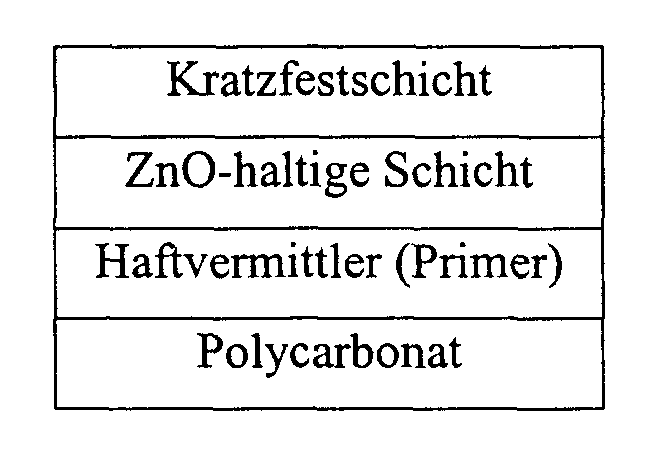
- the simplest layer structure according to the invention on the plastic consists of a Zinc oxide-containing layer and an abrasion-resistant top layer. But it can also additional layers are applied.
- the zinc oxide-containing layer chemically with the surface of the substrate an adhesion promoter or treated physically (plasma, corona) to improve To achieve liability.
- an adhesion promoter or treated physically plasma, corona
- the abrasion-resistant layer of the multilayer structure according to the invention can also consist, for example, of SiO 2 , TiO 2 , Al 2 O 3 or mixtures thereof. This can further increase the abrasion resistance and / or improve the anti-reflective effect.
- the organosilane must have at least one condensation-crosslinking residue.
- residues are alkoxy residues, especially methoxy or ethoxy residues, silanols or acetoxy residues.
- the organo residue of the organosilane can be aliphatic, aromatic or optionally substituted aliphatic or aromatic.
- organosilanes are e.g. Methyltriethoxysilane or 3-glycidyloxypropyltrimethoxysilane called.
- the surface modification takes place of nano zinc oxide in aqueous dispersion by adding the organosilane (pure or dissolved in a suitable solvent) and stirring the reaction mixture at temperatures between 15 ° C and 100 ° C. To avoid agglomeration it may also make sense to carry out the reaction in the presence of ultrasound.
- the ratio of organosilane and nano-zinc oxide in the cured coating is usually chosen so that after application to a substrate such as plastic, glass, ceramic, metal, etc. and drying / curing, a transparent coating is obtained and is between 1- 50% by weight nano-zinc oxide to 5-90% by weight organosilane.
- Transparent substrates are particularly preferred substrates.
- the application of the zinc oxide-containing and abrasion-resistant layer can be done after all common techniques, such as Spin, spray, dive, pour, Squeegees or brushes.
- substrates that are provided with the multilayer structure according to the invention can be plastics, such as Polyamide, polyethylene, polypropylene, polymethyl methacrylate, Polystyrene, polyvinylcyclohexane and its copolymers, acrylonitrile-butadiene-styrene copolymers (ABS), polyvinyl chloride, polycarbonate or whose blends, called.
- plastics such as Polyamide, polyethylene, polypropylene, polymethyl methacrylate, Polystyrene, polyvinylcyclohexane and its copolymers, acrylonitrile-butadiene-styrene copolymers (ABS), polyvinyl chloride, polycarbonate or whose blends, called.
- Plastics can e.g. as a replacement for glass for the glazing of Buildings or vehicles (cars, buses, trucks, trains).
- a scratch-resistant coating was produced from a sol-gel solution consisting of 6.8% cyclo- ⁇ SiOCH 3 [(CH 2 ) 2 Si (CH 3 ) 2 OH] ⁇ 4 , 32.1% tetraethyl orthosilicate, 9.6% Aluminum 2-butoxide, 5.1% acetoacetic ester, 12.6% water, 32.8% 1-methoxy-2-propanol and 1% Tinuvin® 384; the production is described in EP-A 947 520. Cyclo- ⁇ SiOCH 3 [(CH 2 ) 2 Si (CH 3 ) 2 OH] ⁇ 4 was prepared as described in US Pat. No. 5,880,305. Cyclo ⁇ SiOCH 3 [(CH 2 ) 2 Si (CH 3 ) 2 OH] ⁇ 4 is referred to below as D4-silanol.
- the different layers were applied by means of centrifuging, whereby always the maximum number of revolutions (in rpm) and the holding time (in sec) are specified at maximum speed.
- the abrasion resistance was determined using the Taber Abraser test (ISO 3537; 1000 cycles, 500 g per wheel, CS-10-F stones) and subsequent determination of the scattered light checked (ASTM D 1003).
- the durability of the coated Makrolon® 3103 was weathered by QUV-A- according to ASTM G 154-97 (Cyclus 4) and QUV-B determined according to DIN 53 384.
- the Yellow index b * determined according to DIN 6174 in reflection.
- the centrifugation steps were in a laboratory centrifuge from Heraeus (Variofuge RE) with a rotor carried out with a 20.4 cm rotor radius.
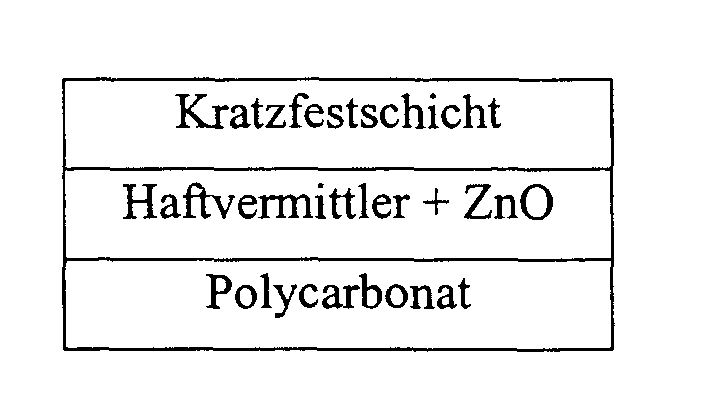
- an adhesion promoter (primer) may be dispensed with.
- the adhesion promoter as a binder for the ZnO particles, so that the following layer structure would result:
- TEOS tetraethoxysilane
- a first Makrolon® plate (10x10 cm) was first coated with 3-aminopropyltrimethoxysilane, (AMMO, 2000 rpm, 20 sec) and a second with hydroxymethyltriethoxysilane (HMTS, 50% by weight in ethanol, 1000 U) / min, 20 sec) coated and thermally treated at 130 ° C for 30 min.
- the nano zinc oxide dispersion prepared according to Example 4 was then applied to both Makrolon® plates using a film-drawing frame (gap height 30 ⁇ m) and these were cured at 130 ° C. for 30 minutes.
- the scratch-resistant coating 2 was applied (500 rpm, 20 sec), which was cured for one hour at 80 ° C. and then for one hour at 130 ° C. After Taber-Abraser scratching, a scattered light increase of 4.0 (AMMO) and 3.5 (HMTS) percentage points was found.
- a Makrolon® plate (7.5x15 cm) was first used coated with hydroxymethyltriethoxysilane (50% by weight in ethanol) (1000 rpm, 20 sec) and then thermally treated at 130 ° C for one hour. After that the spin-coated nano-zinc oxide dispersion prepared according to Example 4 (400 U / min, 20 sec) and after one hour curing at 130 ° C was finally applied the scratch-resistant coating 2 and this for 1 h at 80 ° C and one hour 130 ° C hardened. After that, the UV and weather resistance was assessed using QUV-B weathering checked. The yellow index b * was determined as a measure of the Yellowing of the polycarbonate.
- uncoated Makrolon® 3103 shows a yellow value after 500 h b * from 18.5.
- Makrolon® sheets 100 mm x 100 mm were made of polycarbonate by spinning (1000 rpm, 20 sec.) With hydroxymethyltriethoxysilane (HMTS, 50% by weight in Ethanol) coated and thermally treated at 130 ° C for one hour.
- HMTS hydroxymethyltriethoxysilane
- the zinc oxide coating solution applied to the Makrolon® plates by spinning (2000 rpm; 20 sec.); this was then thermally cured at 130 ° C. for 30 minutes.
- the scratch-resistant coating was then applied by spinning (800 rpm; 20 sec.) 1 applied and 60 min. cured at 130 ° C.
Landscapes
- Chemical & Material Sciences (AREA)
- Organic Chemistry (AREA)
- Chemical Kinetics & Catalysis (AREA)
- Polymers & Plastics (AREA)
- Medicinal Chemistry (AREA)
- Health & Medical Sciences (AREA)
- Materials Engineering (AREA)
- Wood Science & Technology (AREA)
- Engineering & Computer Science (AREA)
- Life Sciences & Earth Sciences (AREA)
- Inorganic Chemistry (AREA)
- Laminated Bodies (AREA)
- Coating Of Shaped Articles Made Of Macromolecular Substances (AREA)
- Wrappers (AREA)
- Paints Or Removers (AREA)
- Application Of Or Painting With Fluid Materials (AREA)
Abstract
Description
Besonders bevorzugte Untergründe sind transparente Substrate.
| Proben-Nr. | 0 h | 250 h | 500 h | 750 h | 1000 h |
| HFC 528-1 | 2,9 | X | X | X | X |
| HFC 528-2 | 2,8 | 1,8 | X | X | X |
| HFC 528-3 | 3,2 | X | 2,1 | X | X |
| HFC 528-4 | 2,5 | X | X | 1,9 | X |
| HFC 528-5 | 2,9 | X | X | X | 2,7 |
| Probe | 0 h | 250 h | 500 h |
| Makrolon® 3103 mit nano-ZnO | 1,3 | 1,4 | 2,5 |
| Makrolon® 3103 | 11,2 | 18,5 |
Claims (6)
- Dauerhaft gegen UV-Strahlung geschützte Kunststoffe mit einer abriebfesten Oberfläche, dadurch gekennzeichnet, daß auf die Kunststoffe ein Überzug aus einem Mehrschichtaufbau, bestehend aus mindestens einer zinkoxid-haltigen und mindestens einer abriebfesten Schicht, aufgebracht wird.
- Oberflächengeschützter Kunststoff nach Anspruch 1, dadurch gekennzeichnet, dass die abriebfeste Beschichtung aus Sol-Gel-Materialien besteht.
- Oberflächengeschützte Kunststoffe nach Anspruch 1, dadurch gekennzeichnet, dass die Zinkoxidpartikel eine Primärteilchengröße von 1 bis 30 nm aufweisen.
- Oberflächengeschützte Kunststoffe nach Anspruch 1, dadurch gekennzeichnet, dass das Zinkoxid mit 3-Glycidyloxypropyltrimethoxysilan oberflächenmodifiziert ist.
- Oberflächengeschützter Kunststoff, dadurch gekennzeichnet, dass transparente Kunstoffe eingesetzt werden.
- Oberflächengeschützer Kunststoff, dadurch gekennzeichnet, dass der Kunststoff ausgewählt ist aus der Gruppe Polyamid, Polyethylen, Polypropylen, Polymethylmethacrylat, Polystyrol, Polyvinylcyclohexan und dessen Copolymere, Acrylnitril-Butadien-Styrol-Copolymere (ABS), Polyvinylchlorid, Polycarbonat oder deren Blends.
Applications Claiming Priority (2)
| Application Number | Priority Date | Filing Date | Title |
|---|---|---|---|
| DE2000118429 DE10018429A1 (de) | 2000-04-14 | 2000-04-14 | Kunststoffe die mit zinkoxidhaltigen, abriebfesten Multischichten stabilisiert sind |
| DE10018429 | 2000-04-14 |
Publications (3)
| Publication Number | Publication Date |
|---|---|
| EP1146069A2 true EP1146069A2 (de) | 2001-10-17 |
| EP1146069A3 EP1146069A3 (de) | 2003-03-19 |
| EP1146069B1 EP1146069B1 (de) | 2007-09-12 |
Family
ID=7638672
Family Applications (1)
| Application Number | Title | Priority Date | Filing Date |
|---|---|---|---|
| EP20010107846 Expired - Lifetime EP1146069B1 (de) | 2000-04-14 | 2001-04-09 | Kunststoffe die mit Zinkoxidhaltigen, abriebfesten Multischichten stabilisiert sind |
Country Status (14)
| Country | Link |
|---|---|
| US (1) | US6884501B2 (de) |
| EP (1) | EP1146069B1 (de) |
| JP (1) | JP2002012685A (de) |
| KR (1) | KR100755117B1 (de) |
| CN (1) | CN1174033C (de) |
| AT (1) | ATE373038T1 (de) |
| CA (1) | CA2343626C (de) |
| CZ (1) | CZ20011350A3 (de) |
| DE (2) | DE10018429A1 (de) |
| ES (1) | ES2292504T3 (de) |
| MX (1) | MXPA01003700A (de) |
| PL (1) | PL203808B1 (de) |
| PT (1) | PT1146069E (de) |
| TW (1) | TWI248949B (de) |
Cited By (3)
| Publication number | Priority date | Publication date | Assignee | Title |
|---|---|---|---|---|
| EP1344749A1 (de) * | 2002-03-15 | 2003-09-17 | Bayer Ag | Verfahren zur Herstellung von nano-Zinkoxid-Dispersionen stabilisiert durch hydroxylgruppenhaltige anorganische Polymere |
| WO2004029161A1 (de) | 2002-09-23 | 2004-04-08 | Lanxess Deutschland Gmbh | Zinkoxiddispersionen in halogen- und wasserfreien dispersionsmedien |
| WO2007059841A1 (de) * | 2005-11-25 | 2007-05-31 | Merck Patent Gmbh | Zinkoxid-nanopartikel |
Families Citing this family (7)
| Publication number | Priority date | Publication date | Assignee | Title |
|---|---|---|---|---|
| DE10102739A1 (de) * | 2001-01-23 | 2002-07-25 | Bayer Ag | Verfahren zur Herstellung von Sol-Gel-Kondensaten auf Basis polyfunktioneller Organosilane sowie deren Verwendung |
| DE10324305A1 (de) * | 2003-05-30 | 2004-12-16 | Bayer Ag | Verfahren zur Herstellung sphärischer Zinkoxidpartikel |
| WO2010149646A1 (de) * | 2009-06-24 | 2010-12-29 | Basf Se | Modifizierte zno-nanopartikel |
| CN102875956B (zh) * | 2012-09-20 | 2014-04-23 | 吴江市天源塑胶有限公司 | 一种高耐磨工程塑料 |
| TR201617722A2 (tr) * | 2016-12-02 | 2017-02-21 | Tuerkiye Sise Ve Cam Fabrikalari Anonim Sirketi | Anorgani̇k nanoparti̇küller i̇çeren saydam uv koruyucu sert kaplama ve kaplamali cam |
| CN109134903B (zh) * | 2018-08-14 | 2021-06-18 | 安徽久升户外用品有限公司 | 一种电瓶车防雨遮阳蓬用金刚石微粉-二氧化钛填充制备改性聚碳酸酯板材的方法 |
| CN117778078A (zh) * | 2023-12-18 | 2024-03-29 | 安徽省含山县锦华氧化锌厂 | 一种水基润滑剂高分散纳米氧化锌的制备方法 |
Family Cites Families (15)
| Publication number | Priority date | Publication date | Assignee | Title |
|---|---|---|---|---|
| US5693422A (en) * | 1990-10-02 | 1997-12-02 | Ppg Industries, Inc. | Silica-free UV-absorbing abrasion resistant coatings |
| JP3260214B2 (ja) * | 1993-09-29 | 2002-02-25 | 住友大阪セメント株式会社 | 紫外線遮断ガラス及びその製造方法 |
| US5747152A (en) * | 1993-12-02 | 1998-05-05 | Dai Nippon Printing Co., Ltd. | Transparent functional membrane containing functional ultrafine particles, transparent functional film, and process for producing the same |
| JP4302782B2 (ja) * | 1994-12-13 | 2009-07-29 | クラリアント インターナショナル リミティド | 紫外線防止透明板の製造方法 |
| US5677410A (en) | 1995-05-16 | 1997-10-14 | Bayer Ag | Carbosilane-dendrimers, carbosilane-hybrid materials, methods for manufacturing them and a method for manufacturing coatings from the carbosilane-dendrimers |
| DE69617576T2 (de) * | 1995-09-18 | 2002-05-29 | Nasu Nikon Co. Ltd., Tochigi | Grundierungszusammensetzung und optischer Gegenstand |
| JP3835769B2 (ja) * | 1996-03-19 | 2006-10-18 | リンテック株式会社 | ウインドフィルム |
| EP0963414B1 (de) * | 1997-02-25 | 2012-07-25 | Bayer MaterialScience AG | Organisch-anorganische hybridmaterialien |
| DE19711650C1 (de) | 1997-03-20 | 1998-06-10 | Bayer Ag | Verfahren zur Herstellung SiOH-funktioneller Carbosilan-Dendrimere |
| JPH11179837A (ja) * | 1997-12-24 | 1999-07-06 | Asahi Glass Co Ltd | 被覆成形板およびその製造方法 |
| US6319594B1 (en) * | 1998-03-17 | 2001-11-20 | Dai Nippon Printing Co., Ltd. | Low reflective antistatic hardcoat film |
| JP2000007996A (ja) * | 1998-06-26 | 2000-01-11 | Hitachi Ltd | 塗膜材及びそれを用いた電気掃除機並びに塗膜の形成方法 |
| JP3900506B2 (ja) * | 1998-11-06 | 2007-04-04 | Jsr株式会社 | 液状硬化性樹脂組成物、その硬化物および反射防止膜 |
| DE19907704A1 (de) * | 1999-02-23 | 2000-08-24 | Bayer Ag | Nanopartikuläres, redispergierbares Fällungszinkoxid |
| US6261694B1 (en) * | 1999-03-17 | 2001-07-17 | General Electric Company | Infrared reflecting coatings |
-
2000
- 2000-04-14 DE DE2000118429 patent/DE10018429A1/de not_active Withdrawn
-
2001
- 2001-04-06 TW TW90108223A patent/TWI248949B/zh active
- 2001-04-09 ES ES01107846T patent/ES2292504T3/es not_active Expired - Lifetime
- 2001-04-09 PT PT01107846T patent/PT1146069E/pt unknown
- 2001-04-09 AT AT01107846T patent/ATE373038T1/de not_active IP Right Cessation
- 2001-04-09 EP EP20010107846 patent/EP1146069B1/de not_active Expired - Lifetime
- 2001-04-09 DE DE50112983T patent/DE50112983D1/de not_active Expired - Lifetime
- 2001-04-10 MX MXPA01003700A patent/MXPA01003700A/es active IP Right Grant
- 2001-04-10 US US09/829,684 patent/US6884501B2/en not_active Expired - Fee Related
- 2001-04-10 CA CA 2343626 patent/CA2343626C/en not_active Expired - Fee Related
- 2001-04-12 PL PL347050A patent/PL203808B1/pl not_active IP Right Cessation
- 2001-04-12 JP JP2001113954A patent/JP2002012685A/ja not_active Withdrawn
- 2001-04-13 CZ CZ20011350A patent/CZ20011350A3/cs unknown
- 2001-04-13 KR KR1020010019750A patent/KR100755117B1/ko not_active Expired - Fee Related
- 2001-04-13 CN CNB011165944A patent/CN1174033C/zh not_active Expired - Fee Related
Cited By (3)
| Publication number | Priority date | Publication date | Assignee | Title |
|---|---|---|---|---|
| EP1344749A1 (de) * | 2002-03-15 | 2003-09-17 | Bayer Ag | Verfahren zur Herstellung von nano-Zinkoxid-Dispersionen stabilisiert durch hydroxylgruppenhaltige anorganische Polymere |
| WO2004029161A1 (de) | 2002-09-23 | 2004-04-08 | Lanxess Deutschland Gmbh | Zinkoxiddispersionen in halogen- und wasserfreien dispersionsmedien |
| WO2007059841A1 (de) * | 2005-11-25 | 2007-05-31 | Merck Patent Gmbh | Zinkoxid-nanopartikel |
Also Published As
| Publication number | Publication date |
|---|---|
| US20010044020A1 (en) | 2001-11-22 |
| PL203808B1 (pl) | 2009-11-30 |
| MXPA01003700A (es) | 2002-06-04 |
| CA2343626A1 (en) | 2001-10-14 |
| HK1042717A1 (en) | 2002-08-23 |
| DE10018429A1 (de) | 2001-10-18 |
| JP2002012685A (ja) | 2002-01-15 |
| CZ20011350A3 (cs) | 2001-12-12 |
| CA2343626C (en) | 2008-07-29 |
| CN1328075A (zh) | 2001-12-26 |
| EP1146069A3 (de) | 2003-03-19 |
| ATE373038T1 (de) | 2007-09-15 |
| US6884501B2 (en) | 2005-04-26 |
| ES2292504T3 (es) | 2008-03-16 |
| DE50112983D1 (de) | 2007-10-25 |
| PL347050A1 (en) | 2001-10-22 |
| TWI248949B (en) | 2006-02-11 |
| EP1146069B1 (de) | 2007-09-12 |
| KR100755117B1 (ko) | 2007-09-04 |
| KR20010100900A (ko) | 2001-11-14 |
| CN1174033C (zh) | 2004-11-03 |
| PT1146069E (pt) | 2007-12-20 |
Similar Documents
| Publication | Publication Date | Title |
|---|---|---|
| EP2691478B1 (de) | Wetterstabile perlglanzpigmente, verfahren zu ihrer herstellung und verwendung | |
| EP2516533B1 (de) | Mehrschichtsystem, enthaltend eine basisschicht, eine primerschicht und eine kratzfestschicht | |
| DE69920642T2 (de) | Organische/anorganische Hybridmaterialien und Verfahren zu deren Herstellung | |
| DE60031033T2 (de) | Organisch-anorganischer Verbundwerkstoff und Verfahren zu seiner Herstellung | |
| EP1904587B1 (de) | Wetterstabile perlglanzpigmente mit nachbeschichtung enthaltend -silane und verfahren zu deren herstellung | |
| EP2358822B1 (de) | Kratzfestbeschichtete polycarbonate mit hoher transparenz, verfahren zu deren herstellung und deren verwendung | |
| EP0947520B1 (de) | Bor- und/oder aluminiumhaltige Mischungen, Hybridmaterialien und Beschichtungen | |
| DE102004041586A1 (de) | Beschichtete Perlglanzpigmente mit SiO2 und Ceroxid | |
| DE10362060A1 (de) | Verpackungsmaterial mit einer Barriereschicht für Gase | |
| EP1146069B1 (de) | Kunststoffe die mit Zinkoxidhaltigen, abriebfesten Multischichten stabilisiert sind | |
| EP1565768A1 (de) | Schichtsystem, beschichtungszusammensetzung und verfahren zu deren herstellung | |
| EP1633805A1 (de) | Verfahren zur herstellung von beschlagsfreien kratzfest-schichtsystemen | |
| WO2002059225A1 (de) | Verfahren zur herstellung von sol-gel-kondensaten auf basis polyfunktioneller organosilane sowie deren verwendung | |
| EP2917286A1 (de) | Pigment mit photokatalytischer aktivität, verfahren zu dessen herstellung und beschichtungsmittel | |
| EP1546266A1 (de) | Zinkoxiddispersionen in halogen- und wasserfreien dispersionsmedien | |
| DE10215941A1 (de) | Anorganische UV-Absorber enthaltene Bindemittel | |
| EP1301446B1 (de) | Leitfähige, hochabriebfeste beschichtungen, ein verfahren zu deren herstellung und deren vewendung | |
| EP0849332B1 (de) | Verfahren zur Herstellung von Überzügen auf Substraten und ein Beschichtungsmaterial hierzu | |
| EP1192225B1 (de) | Verwendung stickstofffreier verbindungen als haftvermittler für siliciumbasierte kratzfestbeschichtungen auf polycarbonat | |
| EP3430092A1 (de) | Beschichtungssystem | |
| HK1042717B (en) | Plastics stabilized with zinc oxide-containing, abrasion-resistant multilayers |
Legal Events
| Date | Code | Title | Description |
|---|---|---|---|
| PUAI | Public reference made under article 153(3) epc to a published international application that has entered the european phase |
Free format text: ORIGINAL CODE: 0009012 |
|
| AK | Designated contracting states |
Kind code of ref document: A2 Designated state(s): AT BE CH CY DE DK ES FI FR GB GR IE IT LI LU MC NL PT SE TR |
|
| AX | Request for extension of the european patent |
Free format text: AL;LT;LV;MK;RO;SI |
|
| RIC1 | Information provided on ipc code assigned before grant |
Free format text: 7C 08J 7/04 A, 7C 09D 183/04 B, 7C 09D 1/00 B, 7C 08J 7/06 B |
|
| PUAL | Search report despatched |
Free format text: ORIGINAL CODE: 0009013 |
|
| AK | Designated contracting states |
Designated state(s): AT BE CH CY DE DK ES FI FR GB GR IE IT LI LU MC NL PT SE TR Kind code of ref document: A3 Designated state(s): AT BE CH CY DE DK ES FI FR GB GR IE IT LI LU MC NL PT SE TR |
|
| AX | Request for extension of the european patent |
Extension state: AL LT LV MK RO SI |
|
| 17P | Request for examination filed |
Effective date: 20030919 |
|
| AKX | Designation fees paid |
Designated state(s): AT BE CH CY DE DK ES FI FR GB GR IE IT LI LU MC NL PT SE TR |
|
| RAP1 | Party data changed (applicant data changed or rights of an application transferred) |
Owner name: BAYER MATERIALSCIENCE AG |
|
| 17Q | First examination report despatched |
Effective date: 20050414 |
|
| GRAP | Despatch of communication of intention to grant a patent |
Free format text: ORIGINAL CODE: EPIDOSNIGR1 |
|
| GRAS | Grant fee paid |
Free format text: ORIGINAL CODE: EPIDOSNIGR3 |
|
| GRAA | (expected) grant |
Free format text: ORIGINAL CODE: 0009210 |
|
| AK | Designated contracting states |
Kind code of ref document: B1 Designated state(s): AT BE CH CY DE DK ES FI FR GB GR IE IT LI LU MC NL PT SE TR |
|
| REG | Reference to a national code |
Ref country code: GB Ref legal event code: FG4D Free format text: NOT ENGLISH |
|
| REG | Reference to a national code |
Ref country code: CH Ref legal event code: EP |
|
| REF | Corresponds to: |
Ref document number: 50112983 Country of ref document: DE Date of ref document: 20071025 Kind code of ref document: P |
|
| REG | Reference to a national code |
Ref country code: IE Ref legal event code: FG4D Free format text: LANGUAGE OF EP DOCUMENT: GERMAN |
|
| REG | Reference to a national code |
Ref country code: CH Ref legal event code: NV Representative=s name: E. BLUM & CO. AG PATENT- UND MARKENANWAELTE VSP |
|
| GBT | Gb: translation of ep patent filed (gb section 77(6)(a)/1977) |
Effective date: 20071115 |
|
| REG | Reference to a national code |
Ref country code: PT Ref legal event code: SC4A Free format text: AVAILABILITY OF NATIONAL TRANSLATION Effective date: 20071204 |
|
| REG | Reference to a national code |
Ref country code: SE Ref legal event code: TRGR |
|
| PG25 | Lapsed in a contracting state [announced via postgrant information from national office to epo] |
Ref country code: FI Free format text: LAPSE BECAUSE OF FAILURE TO SUBMIT A TRANSLATION OF THE DESCRIPTION OR TO PAY THE FEE WITHIN THE PRESCRIBED TIME-LIMIT Effective date: 20070912 |
|
| ET | Fr: translation filed | ||
| REG | Reference to a national code |
Ref country code: ES Ref legal event code: FG2A Ref document number: 2292504 Country of ref document: ES Kind code of ref document: T3 |
|
| PG25 | Lapsed in a contracting state [announced via postgrant information from national office to epo] |
Ref country code: GR Free format text: LAPSE BECAUSE OF FAILURE TO SUBMIT A TRANSLATION OF THE DESCRIPTION OR TO PAY THE FEE WITHIN THE PRESCRIBED TIME-LIMIT Effective date: 20071213 |
|
| REG | Reference to a national code |
Ref country code: IE Ref legal event code: FD4D |
|
| PLBE | No opposition filed within time limit |
Free format text: ORIGINAL CODE: 0009261 |
|
| STAA | Information on the status of an ep patent application or granted ep patent |
Free format text: STATUS: NO OPPOSITION FILED WITHIN TIME LIMIT |
|
| PG25 | Lapsed in a contracting state [announced via postgrant information from national office to epo] |
Ref country code: DK Free format text: LAPSE BECAUSE OF FAILURE TO SUBMIT A TRANSLATION OF THE DESCRIPTION OR TO PAY THE FEE WITHIN THE PRESCRIBED TIME-LIMIT Effective date: 20070912 |
|
| 26N | No opposition filed |
Effective date: 20080613 |
|
| PG25 | Lapsed in a contracting state [announced via postgrant information from national office to epo] |
Ref country code: IE Free format text: LAPSE BECAUSE OF FAILURE TO SUBMIT A TRANSLATION OF THE DESCRIPTION OR TO PAY THE FEE WITHIN THE PRESCRIBED TIME-LIMIT Effective date: 20070912 |
|
| PG25 | Lapsed in a contracting state [announced via postgrant information from national office to epo] |
Ref country code: MC Free format text: LAPSE BECAUSE OF NON-PAYMENT OF DUE FEES Effective date: 20080430 |
|
| PG25 | Lapsed in a contracting state [announced via postgrant information from national office to epo] |
Ref country code: CY Free format text: LAPSE BECAUSE OF FAILURE TO SUBMIT A TRANSLATION OF THE DESCRIPTION OR TO PAY THE FEE WITHIN THE PRESCRIBED TIME-LIMIT Effective date: 20070912 |
|
| PGFP | Annual fee paid to national office [announced via postgrant information from national office to epo] |
Ref country code: GB Payment date: 20100325 Year of fee payment: 10 |
|
| PG25 | Lapsed in a contracting state [announced via postgrant information from national office to epo] |
Ref country code: LU Free format text: LAPSE BECAUSE OF NON-PAYMENT OF DUE FEES Effective date: 20080409 |
|
| PGFP | Annual fee paid to national office [announced via postgrant information from national office to epo] |
Ref country code: FR Payment date: 20100521 Year of fee payment: 10 Ref country code: PT Payment date: 20100331 Year of fee payment: 10 Ref country code: ES Payment date: 20100505 Year of fee payment: 10 |
|
| PG25 | Lapsed in a contracting state [announced via postgrant information from national office to epo] |
Ref country code: TR Free format text: LAPSE BECAUSE OF FAILURE TO SUBMIT A TRANSLATION OF THE DESCRIPTION OR TO PAY THE FEE WITHIN THE PRESCRIBED TIME-LIMIT Effective date: 20070912 |
|
| PGFP | Annual fee paid to national office [announced via postgrant information from national office to epo] |
Ref country code: NL Payment date: 20100402 Year of fee payment: 10 Ref country code: IT Payment date: 20100420 Year of fee payment: 10 Ref country code: DE Payment date: 20100327 Year of fee payment: 10 Ref country code: AT Payment date: 20100413 Year of fee payment: 10 |
|
| PGFP | Annual fee paid to national office [announced via postgrant information from national office to epo] |
Ref country code: BE Payment date: 20100423 Year of fee payment: 10 Ref country code: CH Payment date: 20100414 Year of fee payment: 10 |
|
| PGFP | Annual fee paid to national office [announced via postgrant information from national office to epo] |
Ref country code: SE Payment date: 20100409 Year of fee payment: 10 |
|
| REG | Reference to a national code |
Ref country code: PT Ref legal event code: MM4A Free format text: LAPSE DUE TO NON-PAYMENT OF FEES Effective date: 20111010 |
|
| BERE | Be: lapsed |
Owner name: BAYER MATERIALSCIENCE A.G. Effective date: 20110430 |
|
| REG | Reference to a national code |
Ref country code: DE Ref legal event code: R119 Ref document number: 50112983 Country of ref document: DE |
|
| REG | Reference to a national code |
Ref country code: DE Ref legal event code: R119 Ref document number: 50112983 Country of ref document: DE |
|
| REG | Reference to a national code |
Ref country code: NL Ref legal event code: V1 Effective date: 20111101 |
|
| REG | Reference to a national code |
Ref country code: SE Ref legal event code: EUG |
|
| REG | Reference to a national code |
Ref country code: CH Ref legal event code: PL |
|
| GBPC | Gb: european patent ceased through non-payment of renewal fee |
Effective date: 20110409 |
|
| REG | Reference to a national code |
Ref country code: AT Ref legal event code: MM01 Ref document number: 373038 Country of ref document: AT Kind code of ref document: T Effective date: 20110409 |
|
| REG | Reference to a national code |
Ref country code: FR Ref legal event code: ST Effective date: 20111230 |
|
| PG25 | Lapsed in a contracting state [announced via postgrant information from national office to epo] |
Ref country code: FR Free format text: LAPSE BECAUSE OF NON-PAYMENT OF DUE FEES Effective date: 20110502 Ref country code: NL Free format text: LAPSE BECAUSE OF NON-PAYMENT OF DUE FEES Effective date: 20111101 Ref country code: CH Free format text: LAPSE BECAUSE OF NON-PAYMENT OF DUE FEES Effective date: 20110430 Ref country code: BE Free format text: LAPSE BECAUSE OF NON-PAYMENT OF DUE FEES Effective date: 20110430 Ref country code: LI Free format text: LAPSE BECAUSE OF NON-PAYMENT OF DUE FEES Effective date: 20110430 Ref country code: PT Free format text: LAPSE BECAUSE OF NON-PAYMENT OF DUE FEES Effective date: 20111010 |
|
| PG25 | Lapsed in a contracting state [announced via postgrant information from national office to epo] |
Ref country code: GB Free format text: LAPSE BECAUSE OF NON-PAYMENT OF DUE FEES Effective date: 20110409 Ref country code: AT Free format text: LAPSE BECAUSE OF NON-PAYMENT OF DUE FEES Effective date: 20110409 Ref country code: IT Free format text: LAPSE BECAUSE OF NON-PAYMENT OF DUE FEES Effective date: 20110409 |
|
| REG | Reference to a national code |
Ref country code: ES Ref legal event code: FD2A Effective date: 20120604 |
|
| PG25 | Lapsed in a contracting state [announced via postgrant information from national office to epo] |
Ref country code: ES Free format text: LAPSE BECAUSE OF NON-PAYMENT OF DUE FEES Effective date: 20110410 |
|
| PG25 | Lapsed in a contracting state [announced via postgrant information from national office to epo] |
Ref country code: SE Free format text: LAPSE BECAUSE OF NON-PAYMENT OF DUE FEES Effective date: 20110410 |
|
| PG25 | Lapsed in a contracting state [announced via postgrant information from national office to epo] |
Ref country code: DE Free format text: LAPSE BECAUSE OF NON-PAYMENT OF DUE FEES Effective date: 20111031 |