EP1140952B1 - Phosphororganische verbindungen und ihre verwendung - Google Patents
Phosphororganische verbindungen und ihre verwendung Download PDFInfo
- Publication number
- EP1140952B1 EP1140952B1 EP99968365A EP99968365A EP1140952B1 EP 1140952 B1 EP1140952 B1 EP 1140952B1 EP 99968365 A EP99968365 A EP 99968365A EP 99968365 A EP99968365 A EP 99968365A EP 1140952 B1 EP1140952 B1 EP 1140952B1
- Authority
- EP
- European Patent Office
- Prior art keywords
- substituted
- group
- unsubstituted
- alkyl
- groups
- Prior art date
- Legal status (The legal status is an assumption and is not a legal conclusion. Google has not performed a legal analysis and makes no representation as to the accuracy of the status listed.)
- Expired - Lifetime
Links
- 0 CC(CCC(*)NO*)=O Chemical compound CC(CCC(*)NO*)=O 0.000 description 10
Classifications
-
- C—CHEMISTRY; METALLURGY
- C07—ORGANIC CHEMISTRY
- C07F—ACYCLIC, CARBOCYCLIC OR HETEROCYCLIC COMPOUNDS CONTAINING ELEMENTS OTHER THAN CARBON, HYDROGEN, HALOGEN, OXYGEN, NITROGEN, SULFUR, SELENIUM OR TELLURIUM
- C07F9/00—Compounds containing elements of Groups 5 or 15 of the Periodic Table
- C07F9/02—Phosphorus compounds
- C07F9/547—Heterocyclic compounds, e.g. containing phosphorus as a ring hetero atom
- C07F9/6561—Heterocyclic compounds, e.g. containing phosphorus as a ring hetero atom containing systems of two or more relevant hetero rings condensed among themselves or condensed with a common carbocyclic ring or ring system, with or without other non-condensed hetero rings
-
- C—CHEMISTRY; METALLURGY
- C07—ORGANIC CHEMISTRY
- C07F—ACYCLIC, CARBOCYCLIC OR HETEROCYCLIC COMPOUNDS CONTAINING ELEMENTS OTHER THAN CARBON, HYDROGEN, HALOGEN, OXYGEN, NITROGEN, SULFUR, SELENIUM OR TELLURIUM
- C07F9/00—Compounds containing elements of Groups 5 or 15 of the Periodic Table
- C07F9/02—Phosphorus compounds
- C07F9/547—Heterocyclic compounds, e.g. containing phosphorus as a ring hetero atom
- C07F9/553—Heterocyclic compounds, e.g. containing phosphorus as a ring hetero atom having one nitrogen atom as the only ring hetero atom
- C07F9/576—Six-membered rings
- C07F9/62—Isoquinoline or hydrogenated isoquinoline ring systems
-
- A—HUMAN NECESSITIES
- A01—AGRICULTURE; FORESTRY; ANIMAL HUSBANDRY; HUNTING; TRAPPING; FISHING
- A01N—PRESERVATION OF BODIES OF HUMANS OR ANIMALS OR PLANTS OR PARTS THEREOF; BIOCIDES, e.g. AS DISINFECTANTS, AS PESTICIDES OR AS HERBICIDES; PEST REPELLANTS OR ATTRACTANTS; PLANT GROWTH REGULATORS
- A01N57/00—Biocides, pest repellants or attractants, or plant growth regulators containing organic phosphorus compounds
- A01N57/18—Biocides, pest repellants or attractants, or plant growth regulators containing organic phosphorus compounds having phosphorus-to-carbon bonds
- A01N57/24—Biocides, pest repellants or attractants, or plant growth regulators containing organic phosphorus compounds having phosphorus-to-carbon bonds containing heterocyclic radicals
-
- A—HUMAN NECESSITIES
- A61—MEDICAL OR VETERINARY SCIENCE; HYGIENE
- A61K—PREPARATIONS FOR MEDICAL, DENTAL OR TOILETRY PURPOSES
- A61K31/00—Medicinal preparations containing organic active ingredients
- A61K31/66—Phosphorus compounds
- A61K31/675—Phosphorus compounds having nitrogen as a ring hetero atom, e.g. pyridoxal phosphate
-
- A—HUMAN NECESSITIES
- A61—MEDICAL OR VETERINARY SCIENCE; HYGIENE
- A61P—SPECIFIC THERAPEUTIC ACTIVITY OF CHEMICAL COMPOUNDS OR MEDICINAL PREPARATIONS
- A61P31/00—Antiinfectives, i.e. antibiotics, antiseptics, chemotherapeutics
-
- A—HUMAN NECESSITIES
- A61—MEDICAL OR VETERINARY SCIENCE; HYGIENE
- A61P—SPECIFIC THERAPEUTIC ACTIVITY OF CHEMICAL COMPOUNDS OR MEDICINAL PREPARATIONS
- A61P31/00—Antiinfectives, i.e. antibiotics, antiseptics, chemotherapeutics
- A61P31/04—Antibacterial agents
-
- A—HUMAN NECESSITIES
- A61—MEDICAL OR VETERINARY SCIENCE; HYGIENE
- A61P—SPECIFIC THERAPEUTIC ACTIVITY OF CHEMICAL COMPOUNDS OR MEDICINAL PREPARATIONS
- A61P31/00—Antiinfectives, i.e. antibiotics, antiseptics, chemotherapeutics
- A61P31/12—Antivirals
-
- A—HUMAN NECESSITIES
- A61—MEDICAL OR VETERINARY SCIENCE; HYGIENE
- A61P—SPECIFIC THERAPEUTIC ACTIVITY OF CHEMICAL COMPOUNDS OR MEDICINAL PREPARATIONS
- A61P33/00—Antiparasitic agents
-
- C—CHEMISTRY; METALLURGY
- C07—ORGANIC CHEMISTRY
- C07F—ACYCLIC, CARBOCYCLIC OR HETEROCYCLIC COMPOUNDS CONTAINING ELEMENTS OTHER THAN CARBON, HYDROGEN, HALOGEN, OXYGEN, NITROGEN, SULFUR, SELENIUM OR TELLURIUM
- C07F9/00—Compounds containing elements of Groups 5 or 15 of the Periodic Table
- C07F9/02—Phosphorus compounds
- C07F9/547—Heterocyclic compounds, e.g. containing phosphorus as a ring hetero atom
- C07F9/553—Heterocyclic compounds, e.g. containing phosphorus as a ring hetero atom having one nitrogen atom as the only ring hetero atom
- C07F9/5537—Heterocyclic compounds, e.g. containing phosphorus as a ring hetero atom having one nitrogen atom as the only ring hetero atom the heteroring containing the structure -C(=O)-N-C(=O)- (both carbon atoms belong to the heteroring)
-
- C—CHEMISTRY; METALLURGY
- C07—ORGANIC CHEMISTRY
- C07F—ACYCLIC, CARBOCYCLIC OR HETEROCYCLIC COMPOUNDS CONTAINING ELEMENTS OTHER THAN CARBON, HYDROGEN, HALOGEN, OXYGEN, NITROGEN, SULFUR, SELENIUM OR TELLURIUM
- C07F9/00—Compounds containing elements of Groups 5 or 15 of the Periodic Table
- C07F9/02—Phosphorus compounds
- C07F9/547—Heterocyclic compounds, e.g. containing phosphorus as a ring hetero atom
- C07F9/553—Heterocyclic compounds, e.g. containing phosphorus as a ring hetero atom having one nitrogen atom as the only ring hetero atom
- C07F9/572—Five-membered rings
-
- C—CHEMISTRY; METALLURGY
- C07—ORGANIC CHEMISTRY
- C07F—ACYCLIC, CARBOCYCLIC OR HETEROCYCLIC COMPOUNDS CONTAINING ELEMENTS OTHER THAN CARBON, HYDROGEN, HALOGEN, OXYGEN, NITROGEN, SULFUR, SELENIUM OR TELLURIUM
- C07F9/00—Compounds containing elements of Groups 5 or 15 of the Periodic Table
- C07F9/02—Phosphorus compounds
- C07F9/547—Heterocyclic compounds, e.g. containing phosphorus as a ring hetero atom
- C07F9/553—Heterocyclic compounds, e.g. containing phosphorus as a ring hetero atom having one nitrogen atom as the only ring hetero atom
- C07F9/576—Six-membered rings
- C07F9/59—Hydrogenated pyridine rings
-
- C—CHEMISTRY; METALLURGY
- C07—ORGANIC CHEMISTRY
- C07F—ACYCLIC, CARBOCYCLIC OR HETEROCYCLIC COMPOUNDS CONTAINING ELEMENTS OTHER THAN CARBON, HYDROGEN, HALOGEN, OXYGEN, NITROGEN, SULFUR, SELENIUM OR TELLURIUM
- C07F9/00—Compounds containing elements of Groups 5 or 15 of the Periodic Table
- C07F9/02—Phosphorus compounds
- C07F9/547—Heterocyclic compounds, e.g. containing phosphorus as a ring hetero atom
- C07F9/6561—Heterocyclic compounds, e.g. containing phosphorus as a ring hetero atom containing systems of two or more relevant hetero rings condensed among themselves or condensed with a common carbocyclic ring or ring system, with or without other non-condensed hetero rings
- C07F9/65616—Heterocyclic compounds, e.g. containing phosphorus as a ring hetero atom containing systems of two or more relevant hetero rings condensed among themselves or condensed with a common carbocyclic ring or ring system, with or without other non-condensed hetero rings containing the ring system having three or more than three double bonds between ring members or between ring members and non-ring members, e.g. purine or analogs
Definitions
- the invention relates to organophosphorus compounds, their salts, esters and amides and their Use for the therapeutic and prophylactic treatment of infections in humans and animals caused by viruses, bacteria, fungi and parasites, and their Use as a fungicide, bactericide and herbicide in plants.
- organophosphorus compounds phosphinoyl derivatives, phosphinic acid derivatives and Phosphonic.
- the object of the present invention is therefore to provide a substance that is universal can be used for infections caused by viruses, bacteria, fungi and parasites in humans and animals and fulfills the conditions specified above.
- This object is achieved in a completely surprising way by that defined in claim 1 Substance group solved.
- This group of substances shows an anti-infectious effect against viruses, bacteria, Fungi and single and multicellular parasites. Furthermore, a fungicidal, bactericidal and herbicidal activity in plants.
- the organophosphorus compounds according to the invention correspond to the general formula (I): wherein A is selected from the group consisting of a (C 1-9 ) alkylene radical, which may have one or more double bonds and with hydroxyl, halogen, amino, oxo groups with branched or unbranched C 1-9 alkyl groups and C 2-9 alkenyl groups can be substituted, it being possible for the C 1-9 alkyl groups and C 2-9 alkenyl groups to be substituted with hydrogen, hydroxyl, amino, halogen and oxo groups, -COC and - CNC consists where the carbon atoms of -COC- and -CNC- can be substituted with an alkyl having up to 7 carbon atoms or hydroxyl groups, or in which A corresponds to the following formula (II): where one or more of the carbon atoms selected from the group C 3 , C 4 , C 5 , together with their substituents, can also be omitted, and at least one substituent from
- each C 1-26 alkyl radical and each C 1-26 alkoxy radical may be branched or unbranched and saturated or unsaturated with one or more double bonds and may be substituted by hydroxyl, amino, halogen and oxo groups, in which R 1 is selected from the group consisting of 5- and 6-membered heterocycles with at least one nitrogen atom in the ring or a polycyclic carbon with at least one of these heterocycles, at least one of these nitrogen atoms belonging to a hydroxamic acid group or hydroxamic acid ester group, and the Heterocycle saturated or unsaturated with one or more double or triple bonds and can therefore also be aromatic and substituted with hydroxyl, halogen, amino, oxo groups and with branched or unbranched C 1-9 alkyl groups and C 2
- R 5 is selected from the group consisting of hydrogen, substituted and unsubstituted C 1-9 alkyl, substituted and unsubstituted hydroxy-C 1-9 -alkyl, substituted and unsubstituted C 2-9 -alkenyl, substituted and unsubstituted C 2- 9 -alkynyl, substituted and unsubstituted aryl, substituted and unsubstituted acyl, substituted and unsubstituted cycloalkyl, substituted and unsubstituted aralkyl, substituted and unsubstituted heterocyclic radical, in which R 3 and R 4 are the same or different and are selected from the group consisting of hydrogen, substituted and unsubstituted C 1-26 alkyl, hydroxyC 1-26 alkyl, substituted and unsubstituted aryl, substituted and unsubstituted acyl , substituted and unsubstituted aralkyl, substituted and unsub
- oxygen or sulfur atoms can also be present in the ring.
- the organophosphorus compounds preferably correspond to the formula (III) wherein R 3 is preferably hydrogen, methyl, ethyl, an amide residue or OX 3 and X 4 is selected from the group consisting of hydrogen, sodium, potassium, methyl, ethyl, where X 3 is as defined above and particularly preferably of the formula (IV) wherein X 3 and X 4 are identical or different and selected from the group consisting of hydrogen, a (C 1-3 ) alkyl, a metal of the first, second or third main group of the periodic table, ammonium, substituted ammonium, or ammonium compounds, derived from ethylenediamine or amino acids.
- X 3 and X 4 are preferably a metal of the first, second or third main group of the periodic table, ammonium, substituted ammonium, or ammonium compounds which are derived from ethylenediamine or amino acids.
- salt compounds of organophosphorus compounds with organic or inorganic bases e.g. sodium salt, potassium salt, calcium salt, aluminum salt, ammonium salt, magnesium salt, triethylamine salt, ethanolamine salt, dicyclohexylamine salt, ethylene diamine salt, N, N'-dibenzylethylene diamine salt etc.
- salts with amino acids e.g. arginine salt, aspartic acid salt, glutamic acid salt etc.
- X 3 and X 4 are particularly preferably the same or different and selected from the group consisting of hydrogen, sodium, potassium, methyl, ethyl.
- A is preferably selected from the group consisting of alkylene, alkenylene, hydroxyalkylene and Oxoalkylene exists.
- A is preferably chosen such that between the phosphorus atom and the nitrogen atom of the Heterocycle a three-link chain is formed.
- A is advantageous, for example a methylene, hydroxymethylene, ethylene, ethenylene, hydroxyethylene and in particular also be substituted with an oxo group.
- the carbon chain of A with the formula (II) preferably also connects the nitrogen and the phosphorus atom via three atoms together with the atoms of the heterocycle. If the carbon atom arranged in the ⁇ -position to the nitrogen or phosphorus atom is substituted by an oxo group in the connecting chain, connecting chains having four carbon atoms are also preferred. If both an oxo group in the ⁇ position to the nitrogen atom and a further oxo group in the ⁇ position to the phosphorus atom are present in this connecting chain, then a connecting chain with five carbon atoms is also preferred. If the carbon atom arranged in the ⁇ -position to the phosphorus atom is substituted with a hydroxyl group, connecting chains with four carbon atoms are preferred. In this case, methylene groups are also preferred for R 3 and R 4 .
- the aliphatic hydrocarbon part in particular the alkyl group or the alkane radical. possibly one or more suitable Have substituents such as amino, halogen (e.g. fluorine, chlorine, bromine, etc.), hydroxy, hydroxyimino, Carboxy, alkoxy (e.g. methoxy, ethoxy, propoxy etc.), alkoxycarbonyl, acylamino (e.g. benzyloxycarbonylamino etc.), acyloxy (e.g. acetoxy, benzoyloxy etc.) and the like; as preferred aliphatic acyl radicals with such substituents are e.g. With Amino, carboxy, amino and carboxy, halogen, acylamino or the like To name alkanoyle.
- substituents such as amino, halogen (e.g. fluorine, chlorine, bromine, etc.), hydroxy, hydroxyimino, Carboxy, alkoxy (e.g. methoxy
- the aromatic hydrocarbon part can (in particular the aryl radical) and / or the aliphatic hydrocarbon part (in particular the alkane radical) may have one or more suitable substituents, such as those already specified as suitable substituents for the alkyl group or the alkane radical were.
- suitable substituents such as those already specified as suitable substituents for the alkyl group or the alkane radical were.
- Substituents are with halogen and hydroxy or with halogen and acyloxy substituted aroyl and substituted with hydroxy, hydroxyimino, dihaloalkanoyloxyimino Aralkanoyl and arylthiocarbamoyl (e.g. phenylthiocarbamoyl etc.); Arylcarbamimidoyl (e.g. phenylcarbamimidoyl etc.).
- heterocyclic acyl radicals the heterocycle and / or the aliphatic hydrocarbon part optionally have one or more suitable substituents, as the same ones that have been stated to be suitable for alkyl and alkane groups.
- Alkyl is a straight or branched chain alkyl radical, such as methyl, ethyl, propyl, isopropyl, Butyl, isobutyl, tert-butyl, pentyl, hexyl and the like.
- Hydroxylalkyl is a straight or branched chain alkyl radical that has at least one hydroxyl group has, preferably one or two hydroxyl groups.
- Alkenyl includes straight or branched chain alkenyl groups, e.g. Vinyl, propenyl (e.g. 1-propenyl, 2-propenyl), 1-methyl propenyl, 2-methyl propenyl, butenyl, 2-ethyl propenyl, Pentenyl, hexenyl.
- Alkynyl includes straight or branched chain alkynyl groups.
- Cycloalkyl preferably represents an optionally substituted C 3-8 cycloalkyl; possible substituents include alkyl, alkenyl, alkynyl, alkoxy (eg methoxy, ethoxy etc.), halogen (eg fluorine, chlorine, bromine etc.), nitro and the like.
- Aryl is an aromatic hydrocarbon residue such as phenyl naphthyl, etc., which may be one or can have several suitable substituents, such as alkyl, alkenyl, alkynyl, alkoxy (e.g. methoxy, ethoxy etc.), halogen (e.g. fluorine, chlorine, bromine etc.), nitro and the like.
- Alkyl includes mono-, di-, triphenylalkyls such as benzyl, phenethyl, benzhydryl, trityl and the like, the aromatic part optionally having one or more suitable substituents may have such as alkoxy (e.g. methoxy, ethoxy etc.), halogen (e.g. fluorine, chlorine, bromine etc.), nitro and the like.
- the radicals X 3 and X 4 can preferably be chosen such that esters are formed on the phosphino group or phosphono group.
- suitable examples of such esters according to formulas (I), (III) and (IV) include suitable mono- and diesters, and preferred examples of such esters include alkyl esters (eg hexadecanyl ester, octadecanyl ester, etc.); Aralkyl esters (benzyl esters, phenethyl esters, benzhydryl esters, trityl esters, etc.); Aryl esters (for example phenyl esters, tolyl esters, naphthyl esters etc.); Aroyl alkyl esters (e.g.
- silyl esters e.g., trialkylhalosilyl, dialkyldihalosilyl, alkyltrihalosilyl, dialkylarylhalosilyl, trialkoxyhalosilyl, dialkylaralkylhalosilyl, dialkoxydihalosilyl, trialkoxyhalosilyl, etc.
- silyl esters e.g., trialkylhalosilyl, dialkyldihalosilyl, alkyltrihalosilyl, dialkylarylhalosilyl, trialkoxyhalosilyl, dialkylaralkylhalosilyl, dialkoxydihalosilyl, trialkoxyhalosilyl, etc.
- the alkane and / or arene part can optionally at least one suitable Have substituents such as halogen, alkoxy, hydroxy, nitro or the like.
- the compounds of the formulas (I), (III) and (IV) used according to the invention can in its protonated form as the ammonium salt of organic or inorganic acids, such as hydrochloric acid, hydrobromic acid, sulfuric acid, nitric acid, methanesulfonic acid, p-toluenesulfonic acid, Acetic acid, lactic acid, maleic acid, fumaric acid, oxalic acid, tartaric acid, Benzoic acid, etc. are present.
- organic or inorganic acids such as hydrochloric acid, hydrobromic acid, sulfuric acid, nitric acid, methanesulfonic acid, p-toluenesulfonic acid, Acetic acid, lactic acid, maleic acid, fumaric acid, oxalic acid, tartaric acid, Benzoic acid, etc. are present.
- the compounds of the formulas (I), (III) and (IV) used according to the invention allow, for example for double bonds containing or chiral groups R 1 , R 3 , R 4 , X 3 , X 4 or A, the occurrence of spatial isomers.
- the use of the compounds according to the invention comprises all spatial isomers both as pure substances and in the form of their mixtures.
- the organophosphorus compounds are for therapeutic and prophylactic treatment suitable for infections in humans and animals caused by viruses, bacteria, and multicellular parasites and fungi are caused.
- the compounds are active against unicellular parasites (protozoa), especially against Pathogens of malaria and sleeping sickness as well as Chagas disease, toxoplasmosis. amoebic dysentery, leishmaniasis, trichomoniasis. pneumocystosis, balantidiosis, Cryptosporidiosis, Sarcocystosis, Acanthoma, Naeglerosis, The Coccidiosis, Giardiosis and Lambliosis.
- malaria prophylaxis and as a prophylaxis of sleeping sickness as well as Chagas disease, toxoplasmosis, amoebic dysentery, leishmaniasis, Trichomoniasis, Pneumocystosis, Balantidiosis, Cryptosporidiosis, Sarcocystosis, Akanthamöbose, Naeglerose, Coccidiosis, Giardiose and Lambliose suitable.
- Chagas disease toxoplasmosis, amoebic dysentery, leishmaniasis, Trichomoniasis, Pneumocystosis, Balantidiosis, Cryptosporidiosis, Sarcocystosis, Akanthamöbose, Naeglerose, Coccidiosis, Giardiose and Lambliose suitable.
- organophosphorus compounds and their derivatives are therefore suitable for treatment diphtheria, acne vulgaris, listeriosis, erysipelas in animals, gas fire in Humans and animals, parasitic burns in humans and animals, tuberculosis in humans and Animal.
- Campylobacter enteritis in humans and animals Moraxella keratoconjunctivitis and serositis of animals, brucellosis of animals and humans, anthrax in humans and Animal, actinomycosis in humans and animals, streptotrichoses, psittacosis / ornithosis in animals, Q fever, Ehrlichiosis.
- the use is particularly in Helicobacter eradication therapy for ulcers of the Gastrointestinal tract preferred.
- Combinations with another antibiotic can also be used to treat the above Diseases are used.
- isoniazid isoniazid, rifampicin, ethambutol, pyrazinamide, streptomycin, Protionamide and dapsone to treat tuberculosis.
- the compounds described i.e. the organophosphorus compounds according to formula (I), (III) and (IV) and esters and amides thereof on the phosphino group and salts thereof show a strong cytotoxic activity against single and multicellular parasites, especially against the pathogens of malaria and sleeping sickness. Accordingly, are the compounds of the invention for the treatment of infectious diseases usable caused by viruses, bacteria, parasites and fungi in humans and animals become.
- the compounds are also for use in disease prevention caused by viruses, bacteria, parasites and fungi, especially as malaria prophylaxis and suitable as sleep sickness prophylaxis.
- the organophosphorus compounds according to the invention generally include these pharmaceutically acceptable salts, amides, esters, a salt of such an ester, or else Compounds which, when applied, the compounds according to the invention as metabolic products or provide breakdown products, also called “prodrugs", for administration in any suitable manner analogous to known anti-infectious agents (mixed with a non-toxic pharmaceutically acceptable carrier).
- salts of the compounds include salts that the invention Compounds of formulas (I), (III) and (IV) in their protonated form as the ammonium salt inorganic or organic acids, such as hydrochloric acid, sulfuric acid, citric acid, Form maleic acid, fumaric acid, tartaric acid, p-toluenesulfonic acid.
- salts which are formed by suitable selection of X 3 and X 4 , such as sodium salt, potassium salt, calcium salt, ammonium salt, ethanolamine salt, triethylamine salt, dicyclohexylamine salt and salts of an amino acid such as arginine salt, aspartic acid salt, glutamic acid salt.
- test system The activity of the substances is determined in a test system. This system is based on measuring the inhibition of the growth of bacteria, parasites, viruses, or fungi Plants in vitro. For this purpose, test methods are used in part, which the expert are known.
- the inhibition of growth is used to determine antimalarial activity determined by malaria parasites in blood cultures.
- the determination of the antibacterial activity is based on measuring the inhibition of bacterial growth on culture media and in liquid cultures.
- the determination of the antiviral activity is based on inhibition of the formation of viral elements in cell cultures.
- the determination of fungicidal activity is based on inhibiting the growth of fungi Culture media and in liquid cultures.
- microorganisms to be examined can only be examined in animal models become.
- the corresponding models are used here.
- the screening for herbicidal activity is carried out by means of algae systems and measurement of the isoprene emission determined by plants under standard conditions.
- the pharmaceutically active agents can be in the form of pharmaceutical preparations be prepared in dosage units. This means that the preparation is in the form of individual Parts, e.g. B. tablets. Dragees. Capsules, pills, suppositories and ampoules are available, whose active ingredient content corresponds to a fraction or a multiple of a single dose.
- the dosage units can e.g. B. 1, 2, 3 or 4 single doses or 1/2, 1/3 or 1/4 one Single dose included.
- a single dose preferably contains the amount of active ingredient an application is administered and usually a whole, half or one Corresponds to a third or a quarter of a daily dose.
- non-toxic, inert pharmaceutically suitable carriers are solid, semi-solid or to understand liquid diluents, fillers and formulation aids of all kinds.
- Preferred pharmaceutical preparations are tablets, dragees, capsules, pills, Granules, suppositories, solutions, suspensions and emulsions, pastes, ointments, gels, Creams, lotions, powders and sprays called.
- Tablets, dragees, capsules, pills and granules can contain the active ingredient (s) in addition to the usual carriers, such as (a) filling and Extenders, e.g. B. starches, milk sugar, cane sugar, glucose, mannitol and silica, (b) binders, e.g. B.
- the tablets, dragees, capsules, pills and granules can with the usual, if necessary Coatings and casings containing opacifying agents are provided and also so composed be that they contain the active ingredient (s) only or preferably in a certain one Part of the intestinal tract may be released with a delay, with z.
- Coatings and casings containing opacifying agents are provided and also so composed be that they contain the active ingredient (s) only or preferably in a certain one Part of the intestinal tract may be released with a delay, with z.
- B. polymer substances and waxes can be used.
- the active ingredient (s) can optionally be combined with one or more of the above Carriers are also available in microencapsulated form.
- Suppositories can contain the usual water-soluble or water-insoluble excipients in addition to the active ingredient or ingredients, e.g. B. polyethylene glycols, fats, e.g. B. cocoa fat and higher esters (z. B. C 14 alcohol with C 16 fatty acid) or mixtures of these substances.
- B. polyethylene glycols e.g. B. polyethylene glycols
- fats e.g. B. cocoa fat and higher esters (z. B. C 14 alcohol with C 16 fatty acid) or mixtures of these substances.
- ointments, pastes, creams and gels can contain the usual carriers included, e.g. B. animal and vegetable fats, waxes, paraffins, starch, tragacanth, Cellulose derivatives, polyethylene glycols, silicones, bentonites, silicic acid, talc and zinc oxide or mixtures of these substances.
- powders and sprays can contain the usual carriers, z. B. milk sugar, talc, silica, aluminum hydroxide, calcium silicate and polyamide powder or mixtures of these substances.
- Sprays can also use the usual blowing agents, e.g. B. chlorofluorocarbons.
- solutions and emulsions can contain the usual carriers such as solvents, solubilizers and emulsifiers, e.g. B. water, ethyl alcohol, isopropyl alcohol, Ethyl carbonate, ethyl acetate, benzyl alcohol, benzyl benzoate, propylene glycol, 1,3-butylene glycol, Dimethylformamide, oils, especially cottonseed oil, peanut oil, corn oil, Olive oil, castor oil and sesame oil, glycerin, glycerin formal, tetrahydrofurfuryl alcohol, Contain polyethylene glycols and fatty acid esters of sorbitan or mixtures of these substances.
- solvents e.g. B. water, ethyl alcohol, isopropyl alcohol, Ethyl carbonate, ethyl acetate, benzyl alcohol, benzyl benzoate, propylene glycol, 1,3-butylene glycol, Dimethyl
- solutions and emulsions can also be used in sterile and blood isotonic Form.
- suspensions can contain the usual carriers, such as liquid ones Diluents, e.g. B. water. Ethyl alcohol, propylene glycol, suspending agents, e.g. B. ethoxylated isostearyl alcohols. Polyoxyethylene sorbitol and sorbitan esters, microcrystalline Cellulose, aluminum metahydroxide, bentonite, agar and tragacanth or mixtures of these Contain substances.
- Diluents e.g. B. water.
- Ethyl alcohol propylene glycol
- suspending agents e.g. B. ethoxylated isostearyl alcohols.
- Polyoxyethylene sorbitol and sorbitan esters microcrystalline Cellulose, aluminum metahydroxide, bentonite, agar and tragacanth or mixtures of these Contain substances.
- the formulation forms mentioned can also contain colorants, preservatives and odor and taste-improving additives, e.g. B. peppermint oil and eucalyptus oil and Sweeteners, e.g. B. saccharin.
- the active ingredients of the formulas (I), (III) and (IV) are intended in the pharmaceuticals listed above Preparations, preferably in a concentration of about 0.1 to 99.5% by weight, preferably from about 0.5 to 95% by weight of the total mixture.
- the pharmaceutical preparations can and (IV) also contain other active pharmaceutical ingredients.
- the compounds can be used with previously described substances with antibacterial, antiviral, antimyctoic and antiparasitic properties. This includes, in particular, compounds that have already been used in therapy or are still being used. Substances are particularly suitable for this purpose, which are listed in the Red List or in Simon / Stille, Antibiotic Therapy in Clinic and Practice, 9th Edition 1998 Schattauer Verlag, or at http: /www.customs.treas.gov/imp-exp /rulings/harmoniz/hrm129.html listed on the Internet.
- Bifonazole flucytosine, griseofulvin, ciclopiroxolamine, tolnaftat, naftifm, terbinafine, amorolfine, antrachinone, betulinic acid, semianthraquinone, xanthones, naphthoquinone, aryamino alcoholone, acrinolone, acronidone, acronidone, acronidone, acronidone, acrofinodinone, halofinodinone, halofinodinone, halofinodinone, halofinodinone, halofinodinone, halofinodinone, halofinodinone, halofinodinone, acronidone, methanone, quinine, moneylinone , Sulfonamides, sulfadoxine, sulfalenes, trimethoprim, progu
- the pharmaceutical preparations listed above are prepared in a conventional manner Way by known methods, e.g. B. by mixing the active ingredient or ingredients with the or the carriers.
- the preparations mentioned can be administered either orally, rectally or parenterally in humans and animals (intravenous, intramuscular, subcutaneous), intracisternal, intravaginal, intraperitoneal, local (powder, Ointment, drops) and for the treatment of infections in cavities. Body cavities applied become. Injection solutions, solutions and Suspensions for oral therapy, gels, infusion formulations, emulsions, ointments or Drop in question. For local therapy, ophthalmic and dermatological formulations, Silver and other salts, ear drops, eye ointments, powder or solutions be used. In animals, the intake can also be in the feed or drinking water appropriate formulations.
- the active ingredient or formula (I), (III) and (IV) in total amounts of about 0.05 to about 600, preferably 0.5 to 200 mg / kg body weight per 24 hours, if appropriate in the form of several single doses to achieve the desired results.
- a single dose contains the active ingredient (s), preferably in amounts of approximately 1 to about 200, especially 1 to 60 mg / kg body weight.
- the doses mentioned depending on the type and the body weight of the patient to be treated, the type and severity of the disease, the type of preparation and the application of the drug as well as the period or interval, within which the administration takes place.
- the compounds according to the invention can be used in the customary concentrations and formulations in animals together with the feed or with feed preparations or with the Be given drinking water.
- the compounds according to the invention can be outstanding as bactericides, fungicides and herbicides are used in plants.
- a solution of 31.8 mol of 4a in 150 ml of dioxane is mixed with 1 g of Pd / C and hydrogenated under normal pressure until 10 mol of hydrogen have been taken up (4-6 h). After filtering off the catalyst, the mixture is evaporated to dryness, concentrated in 40 ml of water and 60 ml. HCl taken up, boiled under reflux for 4 h and stored in the refrigerator overnight. The filtered solution is concentrated, taken up in 50 ml of water and purified on an ion exchanger Amberlite IR 120, H + by elution with 300 ml of aqueous ammonia solution. Boil until ammonia can no longer be detected, concentrate again under reduced pressure and recrystallize.
- a solution of 100 ml of sodium ethanolate in 50 ml of absolute ethanol is added dropwise to a solution of 120 mmol of O-benzylhydroxylamine hydrochloride in 100 ml of absolute ethanol with exclusion of moisture at 0 ° C.
- the precipitated NaCl is filtered through an argon frit. The filtrate is freed from ethanol under reduced pressure and after venting with argon with abs.
- Toluene added. 1 mol% RhCl 3 3 H 2 O, 5 mol% DMAP and 50 mmol 4f dropwise are added at 0 ° C. The mixture is allowed to thaw and stirred overnight under reflux on a water separator.
- reaction mixture is stirred for 40 min at -78 ° C and 1.5 h at -40 ° C. Quenching with 0.1 N HCl followed by repeated etherification gives a yellowish, characteristic-smelling oil 5b after chromatography on silica gel .
- 0.2 mmol of phenylseleno compound 5b - dissolved in 1 ml of absolute THF - is mixed with 30 ⁇ l of glacial acetic acid, 140 ⁇ l of perhydrol (30% strength hydrogen peroxide solution) are added dropwise, and the mixture is stirred at the same temperature for 30 min.
- the solution is poured into cold saturated aqueous sodium bicarbonate solution, extracted with ether, dried over MgSO 4 , concentrated under reduced pressure and the crude product is chromatographed on silica gel. 5c is obtained in good yield as a yellowish oil.
- the organic phase is separated off, the aqueous phase is extracted three times with 40 ml of dichloromethane each time and the combined organic phases are concentrated after drying over MgSO 4 .
- the yellow crude product can be purified on a short column of SiO 2 .
- the organic phase is separated off, the aqueous phase is extracted several times with 40 ml of dichloromethane each time and the combined organic phases are concentrated after drying over MgSO 4 .
- the yellow crude product can be purified by chromatography on SiO 2 , 7b being formed in a yield of 47%.
- a mixture of 50 mmol of 1-hydroxyphoshonic acid ester 8c, 75 mmol of triethylamine, 75 mmol of acetic anhydride and 4 mmol of dimethylaminopyridine (DMAP) is left to stand at RT for 14 h and, after adding 100 ml of ether and 2N HCl, the ethereal phase is washed with saturated aqueous NaHCO 3 solution, dries over MgSO 4 , evaporates and cleans on a short Alox column.
- DMAP dimethylaminopyridine
- a solution of 40 mmol 8d in 30 ml glacial acetic acid is hydrogenated at 70 ° C. for 6 hours under normal pressure after adding 400 mg PtO 2 .
- the mixture is etherified several times in a strongly alkaline medium, the combined ether extracts are dried over MgSO 4 and concentrated, and the product 8e which is formed in good yield is reacted further directly.
- a solution of 70 mmol of dimethyldioxirane in 110 ml of dry acetone is added dropwise to a solution of 20 mmol of 8e in 50 ml of dry acetone cooled to 0.degree.
- the mixture is stirred at 0 ° C. for 30 min and the solvent is then stripped off in vacuo.
- a yellow oil is obtained which can be purified on silica gel using a chloroform / methanol mobile phase.
- the yellow oil 8f is stirred with 5 M aqueous KOH in MeOH at RT overnight, then neutralized, freed from MeOH under reduced pressure and etherified. The combined organic phases were dried over MgSO 4 and concentrated to dryness. The resulting 8 g is used for the following reactions without further purification.
- 9a 40 mmol 9a is heated with an equivalent of trimethyl phosphite in toluene under reflux for 0.5 to 1 h. After cooling, the mixture is concentrated under reduced pressure and the yellowish oil is chromatographed on SiO 2 . After volatile constituents have been stripped off, 9b is obtained in low yield.
- a solution of 20 mmol of dimethyl 2-bromoethylphosphonate and 2 mmol of hexadecyltributylphosphonium bromide in 10 ml of toluene is mixed with 25 mmol of the potassium salt of 7-methylxanthine and heated to 100 ° C. for 2 h. After the reaction mixture has cooled, undissolved matter is filtered off and the concentrated organic phase is chromatographed on silica gel with ether / chloroform as the eluent.
- 3-N- (2-dimethylphosphonoethyl) -7-methylxanthine ( 10a ' ) can be converted to 3-N- (2-dimethylphosphonoethyl) -1-hydroxy-7-methylxanthine ( 10b' ).
- the aqueous phase is extracted twice with 10 ml of CHCl 3 and then evaporated in vacuo.
- the residue is purified by chromatography (silica gel, H 2 O / methanol 1: 1). The desired product is obtained in a yield of 54%.
- the antimalarial activity was determined for the substances listed in Table I on in vitro cultures of the malaria pathogen Plasmodium falciparum.
- the figures in Roman numerals refer to the particularly preferred compounds given on pages to.
- the wells of a 96-well microtiter plate were each loaded with 200 ⁇ l of an asynchronous Plasmodium falciparum culture with 0.4% parasitemia and 2% hematocrit.
- a serial dilution series of the compounds was then prepared in three steps between concentrations of 100 to 1 ⁇ mol l -1 .
- the plates are incubated at 37 ° C, 3% CO 2 and 5% O 2 for 48 hours.
- the antibacterial activity for the substances listed in Table II was determined.
- the figures in Roman numerals relate to the particularly preferred compounds given on pages 5 to 8.
- a dilution series with the concentrations 500, 100, 50, 10 and 0 ⁇ mol l -1 of the individual compounds in LB medium in a volume of 0.5 ml was placed in 5 culture tubes.
- the tubes were inoculated with 10 ⁇ l each from the overnight culture of E. coli K12 and shaken at 37 ° C. overnight.
- the growth of the bacteria was assessed by the turbidity of the medium.
- the minimum concentration at which the bacterial growth was inhibited was determined (minimum inhibition concentration MIC)
Landscapes
- Chemical & Material Sciences (AREA)
- Health & Medical Sciences (AREA)
- Organic Chemistry (AREA)
- Life Sciences & Earth Sciences (AREA)
- General Health & Medical Sciences (AREA)
- Veterinary Medicine (AREA)
- Biochemistry (AREA)
- Molecular Biology (AREA)
- Medicinal Chemistry (AREA)
- Pharmacology & Pharmacy (AREA)
- Animal Behavior & Ethology (AREA)
- Public Health (AREA)
- General Chemical & Material Sciences (AREA)
- Nuclear Medicine, Radiotherapy & Molecular Imaging (AREA)
- Chemical Kinetics & Catalysis (AREA)
- Communicable Diseases (AREA)
- Oncology (AREA)
- Virology (AREA)
- Tropical Medicine & Parasitology (AREA)
- Agronomy & Crop Science (AREA)
- Pest Control & Pesticides (AREA)
- Plant Pathology (AREA)
- Engineering & Computer Science (AREA)
- Dentistry (AREA)
- Wood Science & Technology (AREA)
- Zoology (AREA)
- Environmental Sciences (AREA)
- Epidemiology (AREA)
- Pharmaceuticals Containing Other Organic And Inorganic Compounds (AREA)
- Agricultural Chemicals And Associated Chemicals (AREA)
Description

wobei die Kohlenstoffatome von -C-O-C- und -C-N-C- mit einem Alkyl mit bis zu 7 Kohlenstoffatomen oder Hydroxygruppen substituiert sein können,
oder in der A der folgenden Formel (II) entspricht:

in der R1 aus der Gruppe ausgewählt ist, die aus 5- und 6-gliedrigen Heterocyclen mit mindestens einem Stickstoffatom im Ring oder einem polycyclischen Kohlenstoff mit mindestens einem dieser Heterocyclen besteht, wobei mindestens eines dieser Stickstoffatome zu einer Hydroxamsäuregruppe oder Hydroxamsäureestergruppe gehört, und der Heterocyclus gesättigt oder mit ein oder mehreren Doppel- oder Dreifachbindungen ungesättigt und damit auch aromatisch sein kann und mit Hydroxy-, Halogen-, Amino-, Oxogruppen und mit verzweigten oder unverzweigten C1-9-Alkylgruppen und C2-9-Alkenylgruppen substituiert sein kann, wobei die C1-9-Alkylgruppen und C2-9-Alkenylgruppen gesättigt oder mit ein oder mehreren Doppeloder Dreifachbindungen ungesättigt sein können und mit Wasserstoff-, Hydroxy-, Amino-, Halogen- und Oxogruppen substituiert sein können, wobei das Stickstoffatom der Hydroxamsäuregruppe oder -säureestergruppe mit OR5 substiuiert ist und
in der R3 und R4 gleich oder verschieden sind und aus der Gruppe ausgewählt sind, die aus Wasserstoff, substituiertem und unsubstituiertem C1-26-Alkyl, Hydroxy-C1-26-alkyl, substituiertem und unsubstituiertem Aryl, substituiertem und unsubstituiertem Acyl, substituiertem und unsubstituiertem Aralkyl, substituiertem und unsubstituiertem C2-26-Alkenyl, substituiertem und unsubstituiertem C2-26-Alkinyl, substituiertem und unsubstituiertem Cycloalkyl, substituiertem und unsubstituiertem heterocyclischem Rest, Halogen, OX3 und OX4 besteht,
wobei X3 und X4 gleich oder verschieden sind und aus der Gruppe ausgewählt sind, die aus Wasserstoff, substituiertem und unsubstituiertem C1-26-Alkyl, substituiertem und unsubstituiertem Hydroxy-C1-26-alkyl, substituiertem und unsubstituiertem Aryl, substituiertem und unsubstituiertem Aralkyl, substituiertem und unsubstituiertem C2-26-Alkenyl, substituiertem und unsubstituiertem C2-26-Alkinyl, substituiertem und unsubstituiertem Cycloalkyl, substituiertem und unsubstituiertem heterocyclischem Rest, einem Silyl, einem Kation einer organischen und anorganischen Base, insbesondere einem Metall der ersten, zweiten oder dritten Hauptgruppe des Periodensystems, Ammonium, substituiertem Ammonium und Ammoniumverbindungen, die sich von Ethylendiamin oder Aminosäuren ableiten, besteht,
und deren pharmazeutisch akzeptablen Salze, Ester und Amide und Salze der Ester.

und besonders bevorzugt der Formel (IV)


Zu dieser Lösung werden bei -78°C unter Rühren 133.9 g (0.3 mol) 1c in 300 ml trockenem THF zugetropft. Nach Aufwärmen auf Raumtemperatur wird 4 h weitergerührt. Anschließend gibt man 85.15 g (1 mol) Piperidin hinzu und läßt über Nacht rühren. Es wird filtriert, das Filtrat wird auf 2 l Wasser gegossen, man trennt die organische Phase ab und extrahiert die wäßrige Phase 4mal mit je 100 ml Dichlormethan. Nach dem Trocknen der vereinigten organischen Phasen über MgSO4 wird das Lösungsmittel entfernt und der Rückstand im Vakuum fraktioniert destilliert. 2-[2-(Dimethylphosphono)ethyl]-pyrrolidin (1d) wird als farbloses Öl in Ausbeuten von 30-40 % erhalten.
Diacetoxyaceton wird nach einer Vorschrift von A.O.L.Fischer, H.Mildbrand Ber.Dt.chem.Ges. 57, 707, 1924 synthetisiert.
50 mmol 2-Methylbernsteinsäureanhydrid - gelöst in 30 ml absolutiertem Tetrachlorkohlenstoff - mit 1.2 Äquivalenten N-Bromsuccinimid um, indem man 12 h unter Rückfluß erhitzt. Azobisisobutyronitril (AIBN) wird stündlich in kleinen Mengen zugegeben. Nach dem Abkühlen wird von Succinimid filtriert, dieses mit CCl4 gewaschen und die vereinigten CCl4-Phasen unter reduziertem Druck eingeengt. Das entstandene Öl kann an SiO2 chromatographiert werden, wobei man 9a in geringer Ausbeute erhält.
N-Hydroxy-1,2,3,4-tetrahydro-1-oxo-3 -(2-diethylphosphonoethyl)-isochinolin 11g.
| Substanz | R5 | A | eingesetzte Form | 100 µM Inhibition (%) | 10 µM Inhibition (%) | 1 µM Inhibition (%) |
| I | H | C2H4 | Na-Salz | 98 | 98 | 98 |
| III | H | CH2 | Na-Salz | 96 | 98 | 63 |
| II | H | CH2 | Na-Salz | 98 | 87 | 59 |
| I | H | CH2CHOH | Na-Salz | 98 | 97 | 78 |
| X | H | CH2 | Na-Salz | 89 | 80 | 0 |
| X | H | CH2 | Na-Salz | 98 | 97 | 98 |
| III | H | CH2 | Na-Salz Pyrrolring ist in 3-Stellung mit NH2 substituiert | 98 | 98 | 82 |
| VII | H | C2H4 | Na-Salz | 98 | 98 | 98 |
| XXXI | H | C2H4 | Na-Salz | 97 | 73 | 53 |
| XXVIII | H | C2H4 | Na-Salz | 98 | 97 | 82 |
| XXXVIII | H | C2H4 N-substituiert in 5-Stellung | Na-Salz | 92 | 78 | 30 |
| XXXVI | H | C2H4 in 3-Stellung | Na-Salz | 95 | 80 | 37 |
In 5 Kulturröhrchen wurde eine Verdünnungsserie mit den Konzentrationen 500, 100, 50, 10 und 0 µmol l-1 der einzelnen Verbindungen in LB-Medium in einem Volumen von 0,5 ml vorgelegt. Die Röhrchen wurden mit je 10 µl aus der Übernachtkultur von E. coli K12 inokuliert und über Nacht bei 37°C geschüttelt. Das Wachstum der Bakterien wurde durch Trübung des Mediums beurteilt. Es wurde die minimale Konzentration bestimmt, bei der das bakterienwachstum inhibiert wurde (Minimale Inhibitionskonzentration MIC)
| Substanz | R5 | A | eingesetzte Form | E.coli MIC (mg/l) | P. aeruginosa mg/l |
| I | H | C2H4 | Na-Salz | 2,5 | 5 |
| III | H | CH2 | Na-Salz Pyrrolring ist in 3-Stellung mit NH2 substituiert | 5 | 5 |
| II | H | CH2 | Na-Salz | 10 | 5 |
| I | H | CH2CHOH | Na-Salz | 2,5 | 1,25 |
| X | H | CH2 | Na-Salz | 1,25 | 1,25 |
| X | H | CH2 | Na-Salz | 10 | 20 |
| III | H | CH2 | Na-Salz | 1,25 | 10 |
| VII | H | C2H4 | Na-Salz | 10 | 40 |
| XXXI | H | C2H4 | Na-Salz | 10 | 1,25 |
| XXVIII | H | C2H4 | Na-Salz | 5 | 5 |
| XXXVIII | H | C2H4 N-substituiert in 5-Stellung | Na-Salz | 20 | 80 |
| XXXVI | H | C2H4 in 3-Stellung | Na-Salz | 40 | 20 |
Claims (12)
- Phosphororganische Verbindungen der allgemeinen Formel (I)wobei A aus der Gruppe ausgewählt ist, die aus einem (C1-9)-Alkylenrest, der ein oder mehrere Doppelbindungen aufweisen kann und mit Hydroxy-, Halogen-, Amino-, Oxogruppen mit verzweigten oder unverzweigten C1-9-Alkylgruppen und C2-9-Alkenylgruppen substituiert sein kann, wobei die C1-9-Alkylgruppen und C2-9-Alkenylgruppen mit Wasserstoff-, Hydroxy-, Amino-, Halogen- und Oxogruppen substituiert sein können, -C-O-C- und -C-N-C- besteht, wobei die Kohlenstoffatome von -C-O-C- und -C-N-C- mit einem Alkyl mit bis zu 7 Kohlenstoffatomen oder Hydroxygruppen substituiert sein können.
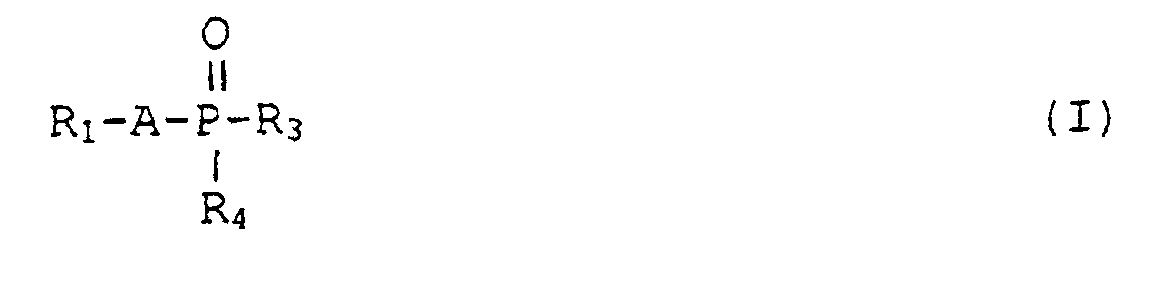
oder in der A der folgenden Formel (II) entspricht:wobei ein oder mehrere der Kohlenstoffatome, ausgewählt aus der Gruppe C3, C4, C5, mitsamt ihren Substituenten auch wegfallen können, und mindestens ein vorliegender Substituent von B1 bis B10 eine C3-8-Cycloalkyl-(C0-9)-alkylgruppe ist, wobei sowohl die C3-8-Cycloalkylgruppe als auch die C0-9-Alkylgruppe ein oder mehrere Doppelbindungen aufweisen können und ein oder zwei Kohlenstoffatome der Cycloalkylgruppe durch Stickstoff-, Sauerstoff- oder Schwefelatome ersetzt sein können, und wobei sowohl die Cycloalkylgruppe als auch die Alkylgruppe mit Hydroxy-, Halogen-, Amino-, Oxogruppen mit verzweigten oder unverzweigten C1-9-Alkylgruppen und C2-9-Alkenyigruppen substituiert sein können, wobei die C1-9-Alkylgruppen und C2-9-Alkenylgruppen mit Wasserstoff-, Hydroxy-, Amino-, Halogen- und Oxogruppen substituiert sein können, und die restlichen vorliegenden Substituenten B1 bis B10 aus der Gruppe ausgewählt sind, die aus Wasserstoff, Hydroxy-, Halogen-, Aminogruppen, C1-26-Alkylresten, C1-26-Alkoxyresten, C1-26-Alkoxy-C1-26-Alkylresten besteht oder beide Substituenten eines C-Atoms zusammen eine Oxogruppe bilden, wobei jeder C1-26-Alkylrest und jeder C1-26-Alkoxyrest verzweigt oder unverzweigt und gesättigt oder mit ein oder mehreren Doppelbindungen ungesättigt sein kann und mit Hydroxy-, Amino-, Halogen- und Oxogruppen substituiert sein kann,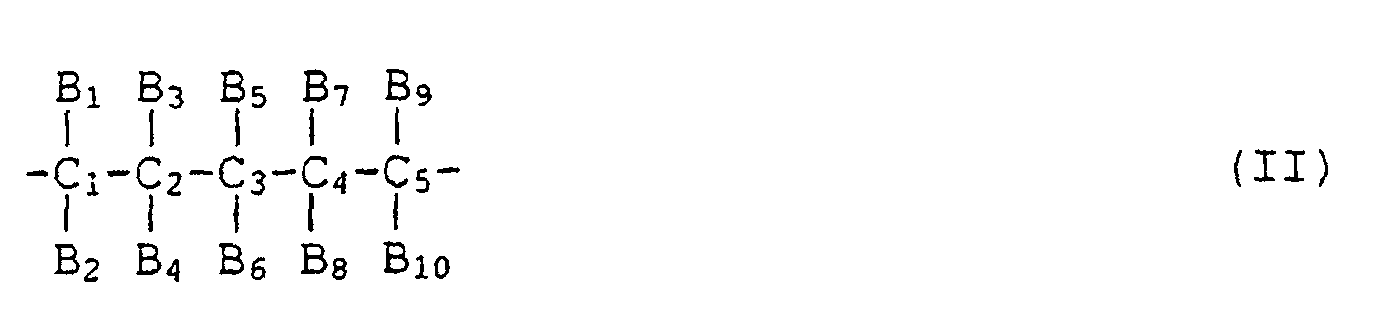
in der R1 aus der Gruppe ausgewählt ist, die aus 5- und 6-gliedrigen Heterocyclen mit mindestens einem Stickstoffatom im Ring oder polycyclischen Kohlenwasserstoffen, die mindestens einen dieser Heterocyclen enthalten, besteht, wobei mindestens eines dieser Stickstoffatome zu einer Hydroxamsäuregruppe oder Hydroxamsäureestergruppe gehört, und gesättigt oder mit ein oder mehreren Doppel- oder Dreifachbindungen ungesättigt und damit auch aromatisch sein kann und mit Hydroxy-, Halogen-, Amino-, Oxogruppen und mit verzweigten oder unverzweigten C1-9-Alkylgruppen und C2-9-Alkenylgruppen substituiert sein kann, wobei die C1-9-Alkylgruppen und C2-9-Alkenylgruppen gesättigt oder mit ein oder mehreren Doppel- oder Dreifachbindungen ungesättigt sein können und mit Wasserstoff-, Hydroxy-, Amino-, Halogen- und Oxogruppen substituiert sein können und wobei das Stickstoffatom der Hydroxamsäuregruppe oder -säureestergruppe mit OR5 substiuiert ist und
R5 aus der Gruppe ausgewählt ist, die aus Wasserstoff, substituiertem und unsubstituiertem C1-9-Alkyl, substituiertem und unsubstituiertem Hydroxy-C1-9-alkyl, substituiertem und unsubstituiertem C2-9-Alkenyl, substituiertem und unsubstituiertem C2-9-Alkinyl, substituiertem und unsubstituiertem Aryl, substituiertem und unsubstituiertem Acyl, substituiertem und unsubstituiertem Cycloalkyl, substituiertem und unsubstituiertem Aralkyl, substituiertem und unsubstituiertem heterocyclischen Rest besteht,
in der R3 und R4 gleich oder verschieden sind und aus der Gruppe ausgewählt sind, die aus Wasserstoff, substituiertem und unsubstituiertem C1-26-Alkyl, Hydroxy-C1-26-alkyl, substituiertem und unsubstituiertem Aryl, substituiertem und unsubstituiertem Acyl, substituiertem und unsubstituiertem Aralkyl, substituiertem und unsubstituiertem C2-26-Alkenyl, substituiertem und unsubstituiertem C2-26-Alkinyl, substituiertem und unsubstituiertem Cycloalkyl, substituiertem und unsubstituiertem heterocyclischem Rest, Halogen, OX3 und OX4 besteht,
wobei X3 und X4 gleich oder verschieden sind und aus der Gruppe ausgewählt sind, die aus Wasserstoff, substituiertem und unsubstituiertem C1-26-Alkyl, substituiertem und unsubstituiertem Hydroxy-C1-26-alkyl, substituiertem und unsubstituiertem Aryl, substituiertem und unsubstituiertem Aralkyl, substituiertem und unsubstituiertem C2-26-Alkenyl, substituiertem und unsubstituiertem C2-26-Alkinyl, substituiertem und unsubstituiertem Cycloalkyl, substituiertem und unsubstituiertem heterocyclischem Rest, einem Silyl, einem Kation einer organischen und anorganischen Base, insbesondere einem Metall der ersten, zweiten oder dritten Hauptgruppe des Periodensystems, Ammonium, substituiertem Ammonium und Ammoniumverbindungen, die sich von Ethylendiamin oder Aminosäuren ableiten, besteht,
und deren pharmazeutisch akzeptablen Salze, Ester und Amide und Salze der Ester. - Verbindung nach Anspruch 1, dadurch gekennzeichnet, daß die phosphororganischen Verbindungen der Formel (III)entspricht, wobei R3 bevorzugt Wasserstoff, Methyl, Ethyl oder ein Amidrest ist und X4 aus der Gruppe ausgewählt ist, die aus Wasserstoff, Natrium, Kalium, Methyl, Ethyl besteht.
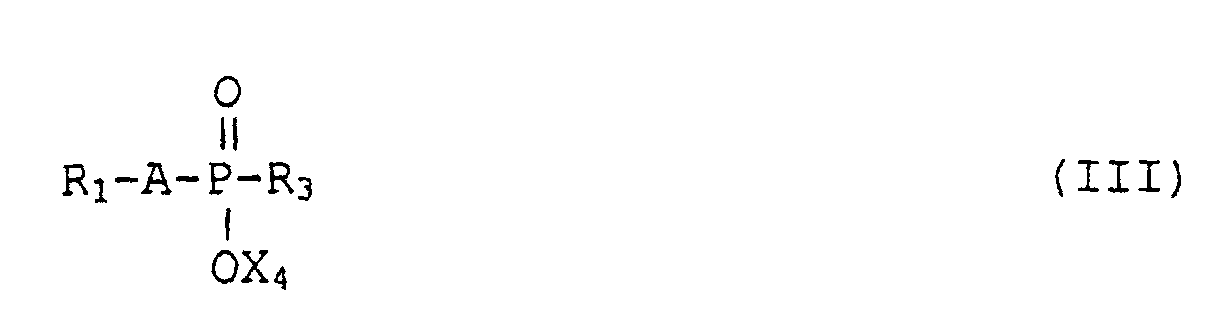
- Verbindung nach Anspruch 1, dadurch gekennzeichnet, daß die phosphororganischen Verbindungen der Formel (IV)entspricht, wobei X3 und X4 gleich oder verschieden und aus der Gruppe ausgewählt sind, die aus Wasserstoff, einem (C1-3)-Alkyl, einem Metall der ersten, zweiten oder dritten Hauptgruppe des Periodensystems, Ammonium, substituiertem Ammonium, oder Ammoniumverbindungen, die sich von Ethylendiamin oder Aminosäuren ableiten, besteht.
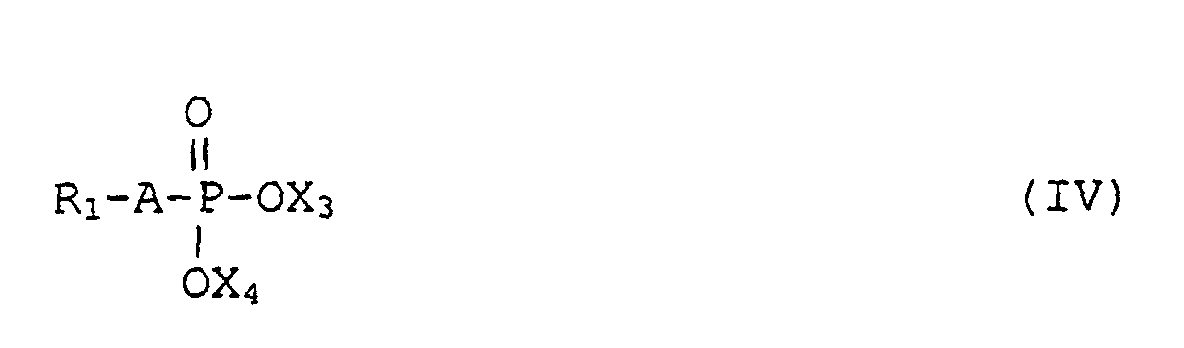
- Verbindung nach Anspruch 3, dadurch gekennzeichnet, daß X3 und X4 gleich oder verschieden sind und aus der Gruppe ausgewählt sind, die aus Wasserstoff, Natrium, Kalium, Methyl, Ethyl besteht.
- Verbindung nach einem der vorhergehenden Ansprüche, dadurch gekennzeichnet, daß A aus der Gruppe ausgewählt ist, die aus Alkylen, Alkenylen, Hydroxyalkylen und Oxoalkylen besteht.
- Verbindung nach Anspruch 5, dadurch gekennzeichnet, daß A so ausgewählt ist, daß zwischen dem Stickstoffatom der heterocyclische Gruppe und das Phosphoratom drei Atome vorliegen, wobei A bevorzugt ein Methylen, Hydroxymethylen, Ethylen, Ethenylen oder Hydroxyethylen ist.
- Verbindung nach einem der Ansprüche 1 bis 3, dadurch gekennzeichnet, daß die Verbindung aus der Gruppe ausgewählt ist, die aus

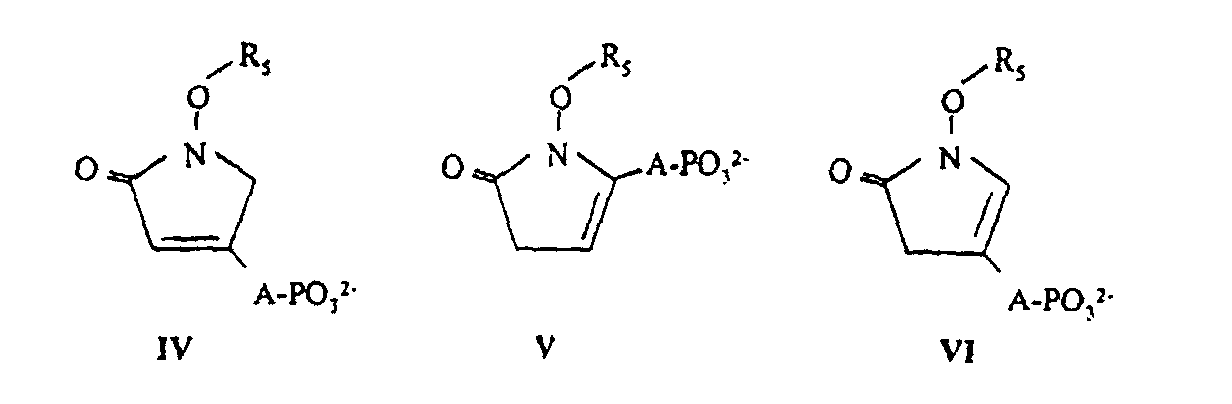

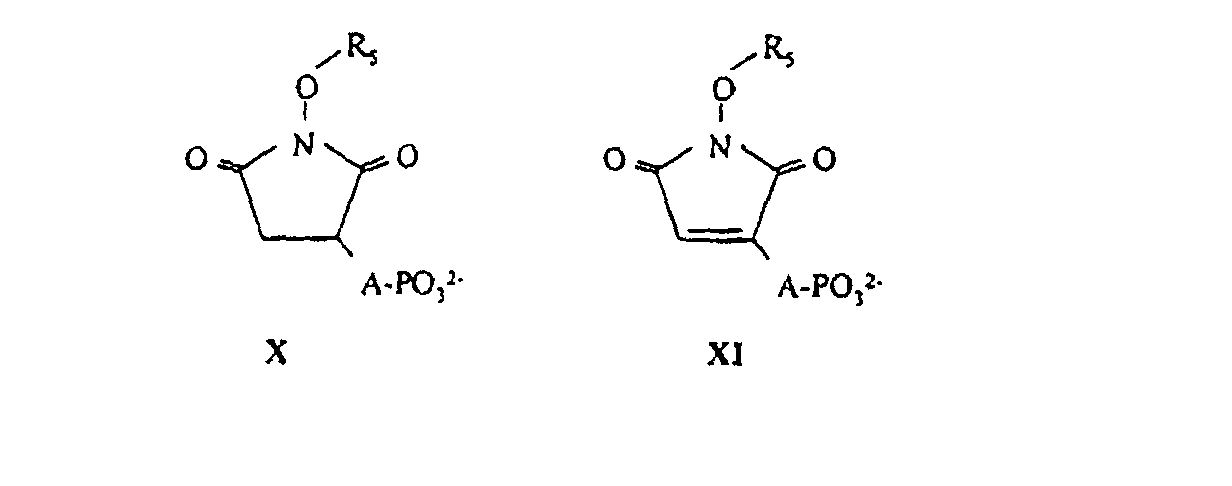
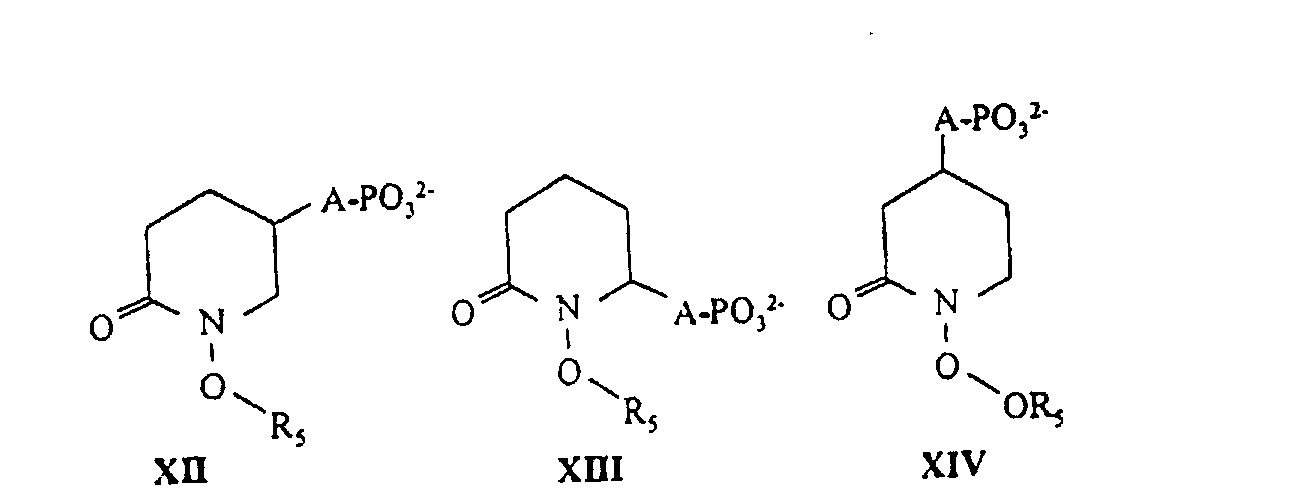
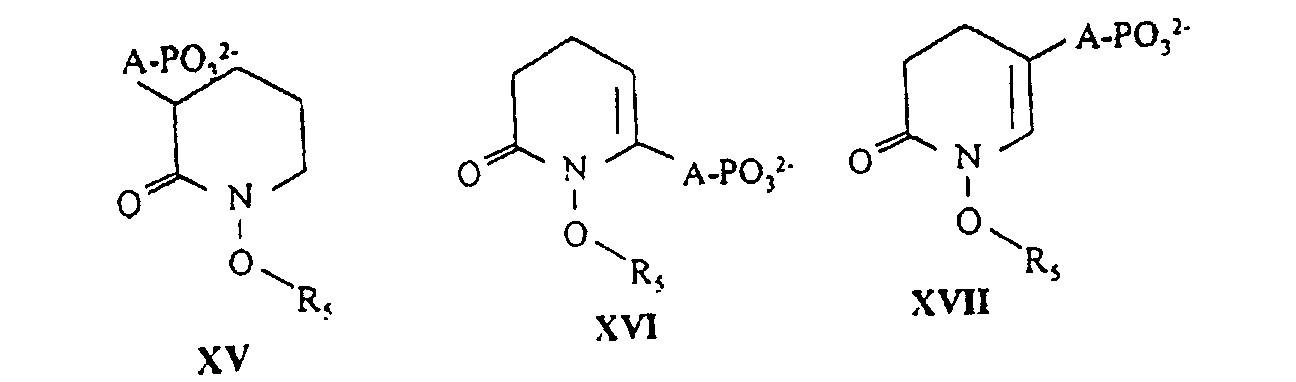


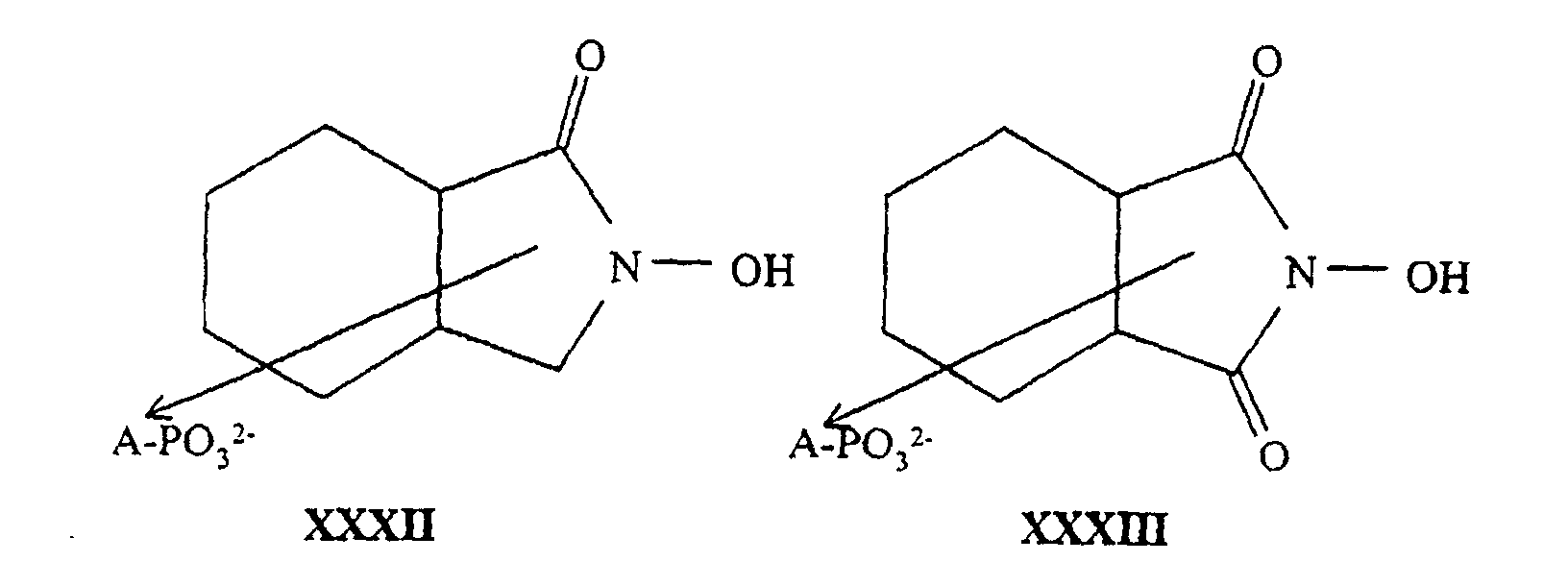
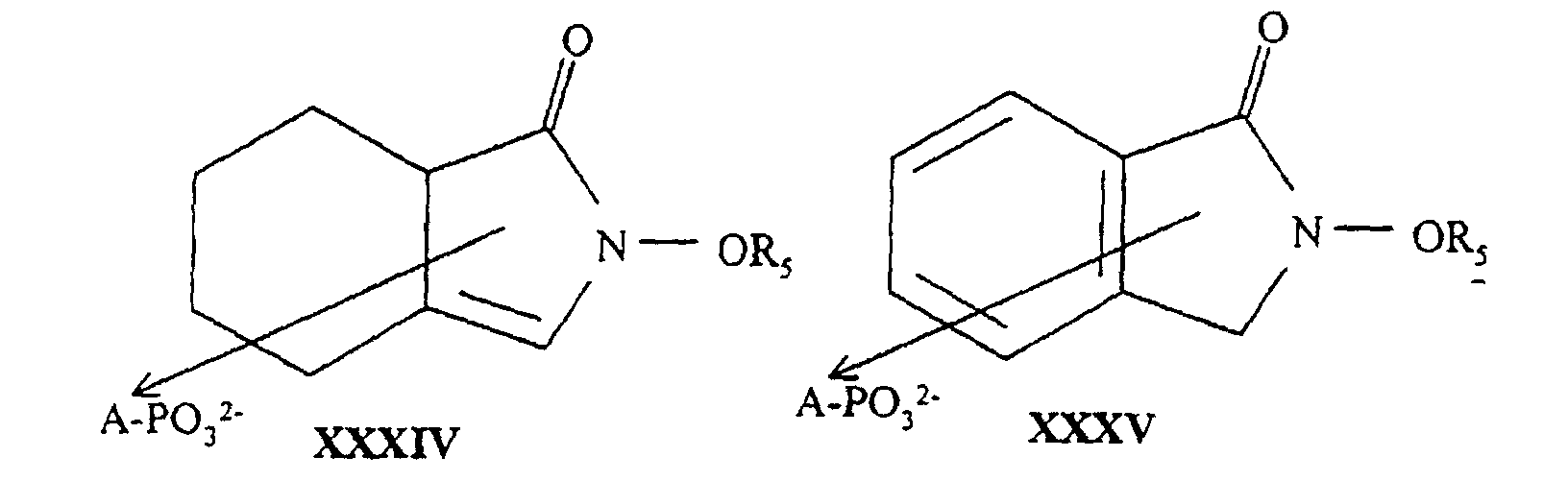
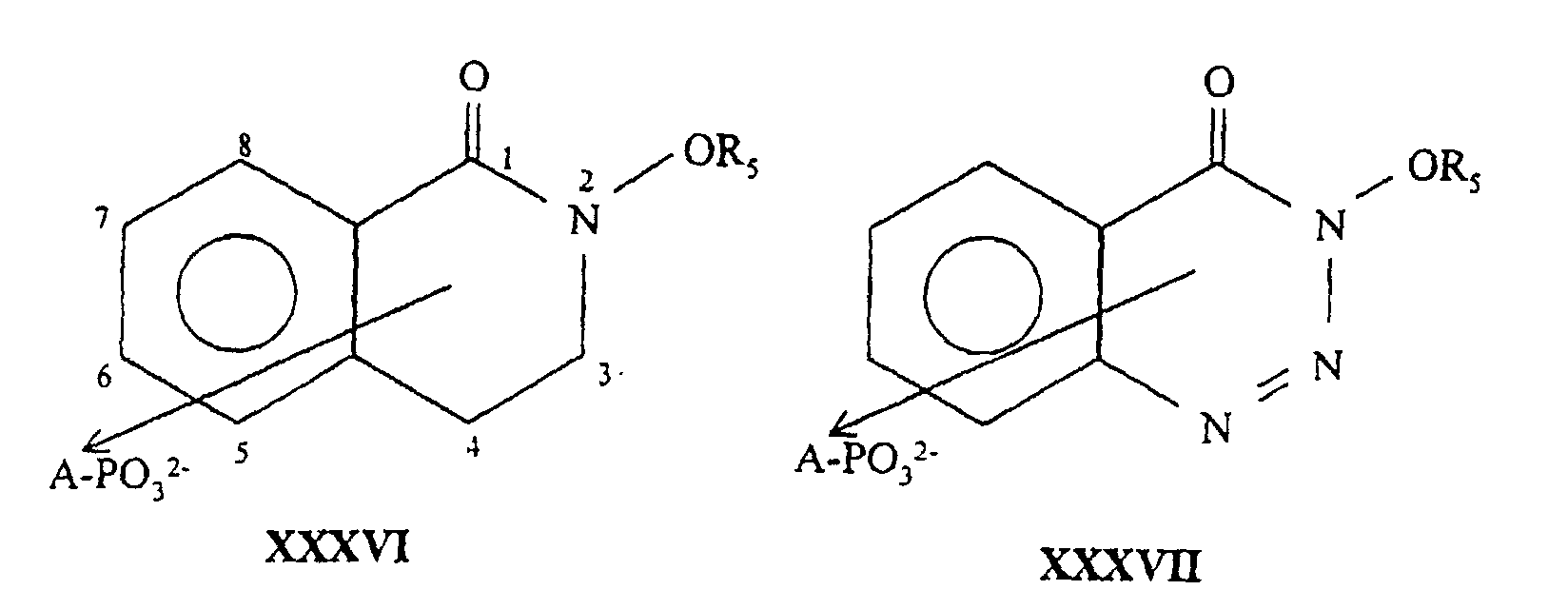 und den entsprechenden Phosphinsäure- und Phosphinoylderivaten besteht, wobei R5 wie in Anspruch 1 definiert ist.
- Verwendung einer Verbindung nach einem der Ansprüche 1 bis 7 als Fungizid, Bakterizid oder Herbizid bei Pflanzen.
- Verwendung einer Verbindung nach einem der Ansprüche 1 bis 7 zur Behandlung von Infektionen, verursacht durch Bakterien, Viren, Pilze oder ein- oder mehrzellige Parasiten.
- Verwendung nach Anspruch 9 zur Vorbeugung und Behandlung von Infektionen verursacht durch einzellige Parasiten, nämlich Erreger der Malaria, der Schlafkrankheit, der Chagas-Krankheit, der Toxoplasmose, der Amöbenruhr, der Leishmaniosen, der Trichomoniasis, der Pneumozystose, der Balantidiose, der Kryptosporidiose, der Sarkozystose, der Akantha-möbose, der Naeglerose, der Kokzidiose, der Giardiose und der Lambliose.
- Pharmazeutisches Präparat zur therapeutischen und prophylaktischen Behandlung infektiöser Prozesse, dadurch gekennzeichnet, daß das Präparat einen wirksamen Gehalt an zumindest einer phosphororganischen Verbindung nach einem der Ansprüche 1 bis 7 zusammen mit einem pharmazeutisch akzeptablen Träger enthält.
- Pharmazeutisches Präparat nach Anspruch 11, dadurch gekennzeichnet, daß das Präparat einen weiteren pharmazeutischen Wirkstoff enthält.
Applications Claiming Priority (3)
| Application Number | Priority Date | Filing Date | Title |
|---|---|---|---|
| DE19859426 | 1998-12-22 | ||
| DE19859426A DE19859426A1 (de) | 1998-12-22 | 1998-12-22 | Verwendung von phosphororganischen Verbindungen zur therapeutischen und prophylaktischen Behandlung von Infektionen |
| PCT/EP1999/010274 WO2000037477A1 (de) | 1998-12-22 | 1999-12-22 | Phosphororganische verbindungen und ihre verwendung |
Publications (2)
| Publication Number | Publication Date |
|---|---|
| EP1140952A1 EP1140952A1 (de) | 2001-10-10 |
| EP1140952B1 true EP1140952B1 (de) | 2003-09-03 |
Family
ID=7892237
Family Applications (1)
| Application Number | Title | Priority Date | Filing Date |
|---|---|---|---|
| EP99968365A Expired - Lifetime EP1140952B1 (de) | 1998-12-22 | 1999-12-22 | Phosphororganische verbindungen und ihre verwendung |
Country Status (25)
| Country | Link |
|---|---|
| EP (1) | EP1140952B1 (de) |
| JP (1) | JP2002533350A (de) |
| KR (1) | KR20010089670A (de) |
| CN (1) | CN1331695A (de) |
| AP (1) | AP2001002168A0 (de) |
| AT (1) | ATE248846T1 (de) |
| AU (1) | AU2538500A (de) |
| BR (1) | BR9916466A (de) |
| CA (1) | CA2356289A1 (de) |
| CZ (1) | CZ20012284A3 (de) |
| DE (2) | DE19859426A1 (de) |
| DK (1) | DK1140952T3 (de) |
| EA (1) | EA200100689A1 (de) |
| ES (1) | ES2204189T3 (de) |
| HU (1) | HUP0104866A3 (de) |
| IL (1) | IL143470A0 (de) |
| MX (1) | MXPA01006456A (de) |
| NO (1) | NO20013085L (de) |
| OA (1) | OA11730A (de) |
| PL (1) | PL349045A1 (de) |
| PT (1) | PT1140952E (de) |
| SK (1) | SK8892001A3 (de) |
| TR (1) | TR200101832T2 (de) |
| WO (1) | WO2000037477A1 (de) |
| ZA (1) | ZA200104443B (de) |
Cited By (3)
| Publication number | Priority date | Publication date | Assignee | Title |
|---|---|---|---|---|
| US9949988B2 (en) | 2014-09-12 | 2018-04-24 | Antibiotx A/S | Antibacterial use of halogenated salicylanilides |
| US10463680B2 (en) | 2015-05-29 | 2019-11-05 | UNION therapeutics A/S | Halogenated salicylanilides for treating clostridium infections |
| US11419834B2 (en) | 2019-02-25 | 2022-08-23 | Rhode Island Hospital | Methods for treating diseases or infections caused by or associated with H. pylori using a halogenated salicylanilide |
Families Citing this family (8)
| Publication number | Priority date | Publication date | Assignee | Title |
|---|---|---|---|---|
| WO2002078714A1 (de) * | 2001-03-30 | 2002-10-10 | Jomaa Pharmaka Gmbh | Magensaftresistente formulierungen zur applikation von antiinfektiös wirkenden verbindungen, die den 2-c-methylerythrose-4-stoffwechselweg hemmen, sowie ihren salzen und estern |
| AU2007304839A1 (en) * | 2006-10-06 | 2008-04-10 | Unilever Plc | Furanone compounds and lactam analogues thereof |
| EP2018864A1 (de) | 2007-07-23 | 2009-01-28 | Biomet Deutschland GmbH | Pharmazeutische Zusammensetzung, Substrat mit einer pharmazeutischen Zusammensetzung und Verwendung einer pharmazeutischen Zusammensetzung |
| CN101977610B (zh) | 2008-01-25 | 2012-05-16 | 奇默里克斯公司 | 治疗病毒感染的方法 |
| PT2534150T (pt) | 2010-02-12 | 2017-05-02 | Chimerix Inc | Métodos para tratar uma infecção viral |
| US9278135B2 (en) | 2010-04-26 | 2016-03-08 | Chimerix Inc. | Methods of treating retroviral infections and related dosage regimes |
| WO2016145113A1 (en) * | 2015-03-09 | 2016-09-15 | Board Of Regents, The University Of Texas System | Enolase inhibitors and methods of treatment therewith |
| GB201604484D0 (en) | 2016-03-16 | 2016-04-27 | Antibiotx Aps And Københavns Uni University Of Copenhagen | Topical antibacterial compositions |
Family Cites Families (4)
| Publication number | Priority date | Publication date | Assignee | Title |
|---|---|---|---|---|
| US4206156A (en) * | 1976-07-27 | 1980-06-03 | Fujisawa Pharmaceutical Company, Limited | Hydroxyaminohydrocarbonphosphonic acids |
| US4693742A (en) * | 1983-12-20 | 1987-09-15 | Rohm And Hass Company | Herbicidal hydroxyamino phosphonic acids and derivatives |
| JPS61106504A (ja) * | 1984-10-30 | 1986-05-24 | Teijin Ltd | 除草剤 |
| BR9909668A (pt) * | 1998-04-14 | 2000-12-19 | Jomaa Hassan | Uso de compostos de organofósforo para o tratamento terapêutico e profilático de infecções |
-
1998
- 1998-12-22 DE DE19859426A patent/DE19859426A1/de not_active Withdrawn
-
1999
- 1999-12-22 ES ES99968365T patent/ES2204189T3/es not_active Expired - Lifetime
- 1999-12-22 JP JP2000589547A patent/JP2002533350A/ja active Pending
- 1999-12-22 EP EP99968365A patent/EP1140952B1/de not_active Expired - Lifetime
- 1999-12-22 EA EA200100689A patent/EA200100689A1/ru unknown
- 1999-12-22 SK SK889-2001A patent/SK8892001A3/sk unknown
- 1999-12-22 PL PL99349045A patent/PL349045A1/xx not_active Application Discontinuation
- 1999-12-22 KR KR1020017007908A patent/KR20010089670A/ko not_active Ceased
- 1999-12-22 CA CA002356289A patent/CA2356289A1/en not_active Abandoned
- 1999-12-22 DK DK99968365T patent/DK1140952T3/da active
- 1999-12-22 CZ CZ20012284A patent/CZ20012284A3/cs unknown
- 1999-12-22 AT AT99968365T patent/ATE248846T1/de not_active IP Right Cessation
- 1999-12-22 BR BR9916466-3A patent/BR9916466A/pt not_active IP Right Cessation
- 1999-12-22 DE DE59906907T patent/DE59906907D1/de not_active Expired - Fee Related
- 1999-12-22 PT PT99968365T patent/PT1140952E/pt unknown
- 1999-12-22 TR TR2001/01832T patent/TR200101832T2/xx unknown
- 1999-12-22 HU HU0104866A patent/HUP0104866A3/hu unknown
- 1999-12-22 OA OA00100153A patent/OA11730A/en unknown
- 1999-12-22 WO PCT/EP1999/010274 patent/WO2000037477A1/de not_active Ceased
- 1999-12-22 MX MXPA01006456A patent/MXPA01006456A/es unknown
- 1999-12-22 IL IL14347099A patent/IL143470A0/xx unknown
- 1999-12-22 AP APAP/P/2001/002168A patent/AP2001002168A0/en unknown
- 1999-12-22 AU AU25385/00A patent/AU2538500A/en not_active Abandoned
- 1999-12-22 CN CN99814915A patent/CN1331695A/zh active Pending
-
2001
- 2001-05-30 ZA ZA200104443A patent/ZA200104443B/en unknown
- 2001-06-21 NO NO20013085A patent/NO20013085L/no not_active Application Discontinuation
Cited By (4)
| Publication number | Priority date | Publication date | Assignee | Title |
|---|---|---|---|---|
| US9949988B2 (en) | 2014-09-12 | 2018-04-24 | Antibiotx A/S | Antibacterial use of halogenated salicylanilides |
| US10758553B2 (en) | 2014-09-12 | 2020-09-01 | UNION therapeutics A/S | Antibacterial use of halogenated salicylanilides |
| US10463680B2 (en) | 2015-05-29 | 2019-11-05 | UNION therapeutics A/S | Halogenated salicylanilides for treating clostridium infections |
| US11419834B2 (en) | 2019-02-25 | 2022-08-23 | Rhode Island Hospital | Methods for treating diseases or infections caused by or associated with H. pylori using a halogenated salicylanilide |
Also Published As
| Publication number | Publication date |
|---|---|
| JP2002533350A (ja) | 2002-10-08 |
| ES2204189T3 (es) | 2004-04-16 |
| IL143470A0 (en) | 2002-04-21 |
| OA11730A (en) | 2005-05-12 |
| KR20010089670A (ko) | 2001-10-08 |
| SK8892001A3 (en) | 2001-12-03 |
| NO20013085D0 (no) | 2001-06-21 |
| CZ20012284A3 (cs) | 2001-10-17 |
| AU2538500A (en) | 2000-07-12 |
| CN1331695A (zh) | 2002-01-16 |
| MXPA01006456A (es) | 2002-04-24 |
| ATE248846T1 (de) | 2003-09-15 |
| DE59906907D1 (de) | 2003-10-09 |
| CA2356289A1 (en) | 2000-06-29 |
| HUP0104866A3 (en) | 2002-08-28 |
| NO20013085L (no) | 2001-08-22 |
| PT1140952E (pt) | 2004-02-27 |
| AP2001002168A0 (en) | 2001-06-30 |
| TR200101832T2 (tr) | 2001-12-21 |
| DK1140952T3 (da) | 2004-01-12 |
| WO2000037477A1 (de) | 2000-06-29 |
| EA200100689A1 (ru) | 2001-12-24 |
| EP1140952A1 (de) | 2001-10-10 |
| HUP0104866A2 (en) | 2002-06-29 |
| DE19859426A1 (de) | 2000-07-06 |
| PL349045A1 (en) | 2002-07-01 |
| ZA200104443B (en) | 2002-01-14 |
| BR9916466A (pt) | 2001-09-25 |
Similar Documents
| Publication | Publication Date | Title |
|---|---|---|
| EP1071409B1 (de) | Verwendung von phosphororganischen verbindungen zur therapeutischen und prophylaktischen behandlung von infektionen | |
| AU754165B2 (en) | Phosphorous organic compounds and their use | |
| WO2000037477A1 (de) | Phosphororganische verbindungen und ihre verwendung | |
| WO2000066094A2 (de) | Verwendung von verbindungen mit einem stickstoff-sauerstoff-heterocyclus als antiinfektiöse mittel | |
| EP1133500B1 (de) | Phosphororganische verbindungen und ihre verwendung | |
| DE19903398A1 (de) | Verwendung von Thiadiazolderivaten zur prophylaktischen und therapeutischen Behandlung von Infektionen | |
| DE19843383A1 (de) | Phosphororganische Verbindungen und ihre Verwendung | |
| WO2000016757A2 (de) | Verwendung von phosphororganischen verbindungen zur herstellung von arzneimitteln zur therapeutischen und prophylaktischen behandlung von infektionen oder als fungizid, bakterizid oder herbizid bei pflanzen | |
| WO2000044358A2 (de) | Verwendung von phosphororganischen verbindungen zur prophylaktischen und therapeutischen behandlung von infektionen | |
| EP1272198A1 (de) | Verwendung von phosophororganischen verbindungen zur herstellung eines medikaments zur behandlung von infektionen | |
| WO2000017212A1 (de) | Phosphororganische verbindungen und ihre verwendung | |
| EP1255762A1 (de) | Phosphororganische verbindungen und ihre verwendung | |
| WO2001093872A1 (de) | Verwendung von phosphororganischen hydroxamsäurederivaten zur herstellung von arzneimitteln | |
| DE19843360A1 (de) | Phosphororganische Verbindungen und ihre Verwendung | |
| DE19843334A1 (de) | Schwefelorganische Verbindungen und ihre Verwendung | |
| DE19859668A1 (de) | Verwendung von Bisphosphonaten zur Prophylaxe und zur Behandlung von infektiösen Prozessen | |
| WO2000003699A2 (de) | Arzneimittel mit einem gehalt an phosphonsäurederivaten als wirkstoff und ihre verwendung | |
| DE19903666A1 (de) | Arzneimittel mit einem Gehalt an 3-Isoxazolidinonen und Hydroxylaminsäuren als Wirkstoff und ihre Verwendung |
Legal Events
| Date | Code | Title | Description |
|---|---|---|---|
| PUAI | Public reference made under article 153(3) epc to a published international application that has entered the european phase |
Free format text: ORIGINAL CODE: 0009012 |
|
| 17P | Request for examination filed |
Effective date: 20010630 |
|
| AK | Designated contracting states |
Kind code of ref document: A1 Designated state(s): AT BE CH CY DE DK ES FI FR GB GR IE IT LI LU MC NL PT SE |
|
| AX | Request for extension of the european patent |
Free format text: AL;LT PAYMENT 20010629;LV;MK;RO;SI PAYMENT 20010629 |
|
| GRAG | Despatch of communication of intention to grant |
Free format text: ORIGINAL CODE: EPIDOS AGRA |
|
| 17Q | First examination report despatched |
Effective date: 20020306 |
|
| GRAG | Despatch of communication of intention to grant |
Free format text: ORIGINAL CODE: EPIDOS AGRA |
|
| GRAG | Despatch of communication of intention to grant |
Free format text: ORIGINAL CODE: EPIDOS AGRA |
|
| GRAH | Despatch of communication of intention to grant a patent |
Free format text: ORIGINAL CODE: EPIDOS IGRA |
|
| RAP1 | Party data changed (applicant data changed or rights of an application transferred) |
Owner name: BIOAGENCY AG |
|
| GRAS | Grant fee paid |
Free format text: ORIGINAL CODE: EPIDOSNIGR3 |
|
| GRAA | (expected) grant |
Free format text: ORIGINAL CODE: 0009210 |
|
| AK | Designated contracting states |
Kind code of ref document: B1 Designated state(s): AT BE CH CY DE DK ES FI FR GB GR IE IT LI LU MC NL PT SE |
|
| AX | Request for extension of the european patent |
Extension state: LT SI |
|
| REG | Reference to a national code |
Ref country code: GB Ref legal event code: FG4D Free format text: NOT ENGLISH |
|
| REG | Reference to a national code |
Ref country code: CH Ref legal event code: EP |
|
| REG | Reference to a national code |
Ref country code: CH Ref legal event code: NV Representative=s name: E. BLUM & CO. PATENTANWAELTE |
|
| REF | Corresponds to: |
Ref document number: 59906907 Country of ref document: DE Date of ref document: 20031009 Kind code of ref document: P |
|
| REG | Reference to a national code |
Ref country code: IE Ref legal event code: FG4D Free format text: GERMAN |
|
| PG25 | Lapsed in a contracting state [announced via postgrant information from national office to epo] |
Ref country code: CY Free format text: LAPSE BECAUSE OF FAILURE TO SUBMIT A TRANSLATION OF THE DESCRIPTION OR TO PAY THE FEE WITHIN THE PRESCRIBED TIME-LIMIT Effective date: 20031222 |
|
| REG | Reference to a national code |
Ref country code: SE Ref legal event code: TRGR |
|
| PG25 | Lapsed in a contracting state [announced via postgrant information from national office to epo] |
Ref country code: MC Free format text: LAPSE BECAUSE OF NON-PAYMENT OF DUE FEES Effective date: 20031231 |
|
| REG | Reference to a national code |
Ref country code: DK Ref legal event code: T3 |
|
| GBT | Gb: translation of ep patent filed (gb section 77(6)(a)/1977) |
Effective date: 20031230 |
|
| REG | Reference to a national code |
Ref country code: GR Ref legal event code: EP Ref document number: 20030404935 Country of ref document: GR |
|
| LTIE | Lt: invalidation of european patent or patent extension |
Effective date: 20030903 |
|
| REG | Reference to a national code |
Ref country code: ES Ref legal event code: FG2A Ref document number: 2204189 Country of ref document: ES Kind code of ref document: T3 |
|
| ET | Fr: translation filed | ||
| PLBE | No opposition filed within time limit |
Free format text: ORIGINAL CODE: 0009261 |
|
| STAA | Information on the status of an ep patent application or granted ep patent |
Free format text: STATUS: NO OPPOSITION FILED WITHIN TIME LIMIT |
|
| 26N | No opposition filed |
Effective date: 20040604 |
|
| PGFP | Annual fee paid to national office [announced via postgrant information from national office to epo] |
Ref country code: GB Payment date: 20041110 Year of fee payment: 6 |
|
| PGFP | Annual fee paid to national office [announced via postgrant information from national office to epo] |
Ref country code: IE Payment date: 20041221 Year of fee payment: 6 Ref country code: FR Payment date: 20041221 Year of fee payment: 6 |
|
| PGFP | Annual fee paid to national office [announced via postgrant information from national office to epo] |
Ref country code: PT Payment date: 20041222 Year of fee payment: 6 |
|
| PGFP | Annual fee paid to national office [announced via postgrant information from national office to epo] |
Ref country code: GR Payment date: 20041223 Year of fee payment: 6 |
|
| PGFP | Annual fee paid to national office [announced via postgrant information from national office to epo] |
Ref country code: FI Payment date: 20041227 Year of fee payment: 6 Ref country code: AT Payment date: 20041227 Year of fee payment: 6 |
|
| PGFP | Annual fee paid to national office [announced via postgrant information from national office to epo] |
Ref country code: SE Payment date: 20041228 Year of fee payment: 6 Ref country code: LU Payment date: 20041228 Year of fee payment: 6 Ref country code: ES Payment date: 20041228 Year of fee payment: 6 Ref country code: DK Payment date: 20041228 Year of fee payment: 6 |
|
| PGFP | Annual fee paid to national office [announced via postgrant information from national office to epo] |
Ref country code: NL Payment date: 20041229 Year of fee payment: 6 Ref country code: CH Payment date: 20041229 Year of fee payment: 6 |
|
| PGFP | Annual fee paid to national office [announced via postgrant information from national office to epo] |
Ref country code: BE Payment date: 20050112 Year of fee payment: 6 |
|
| PGFP | Annual fee paid to national office [announced via postgrant information from national office to epo] |
Ref country code: DE Payment date: 20050221 Year of fee payment: 6 |
|
| PG25 | Lapsed in a contracting state [announced via postgrant information from national office to epo] |
Ref country code: IT Free format text: LAPSE BECAUSE OF NON-PAYMENT OF DUE FEES;WARNING: LAPSES OF ITALIAN PATENTS WITH EFFECTIVE DATE BEFORE 2007 MAY HAVE OCCURRED AT ANY TIME BEFORE 2007. THE CORRECT EFFECTIVE DATE MAY BE DIFFERENT FROM THE ONE RECORDED. Effective date: 20051222 Ref country code: IE Free format text: LAPSE BECAUSE OF NON-PAYMENT OF DUE FEES Effective date: 20051222 Ref country code: GB Free format text: LAPSE BECAUSE OF NON-PAYMENT OF DUE FEES Effective date: 20051222 Ref country code: FI Free format text: LAPSE BECAUSE OF NON-PAYMENT OF DUE FEES Effective date: 20051222 Ref country code: AT Free format text: LAPSE BECAUSE OF NON-PAYMENT OF DUE FEES Effective date: 20051222 |
|
| PG25 | Lapsed in a contracting state [announced via postgrant information from national office to epo] |
Ref country code: SE Free format text: LAPSE BECAUSE OF NON-PAYMENT OF DUE FEES Effective date: 20051223 Ref country code: ES Free format text: LAPSE BECAUSE OF NON-PAYMENT OF DUE FEES Effective date: 20051223 |
|
| PG25 | Lapsed in a contracting state [announced via postgrant information from national office to epo] |
Ref country code: LU Free format text: LAPSE BECAUSE OF NON-PAYMENT OF DUE FEES Effective date: 20051231 Ref country code: LI Free format text: LAPSE BECAUSE OF NON-PAYMENT OF DUE FEES Effective date: 20051231 Ref country code: CH Free format text: LAPSE BECAUSE OF NON-PAYMENT OF DUE FEES Effective date: 20051231 Ref country code: BE Free format text: LAPSE BECAUSE OF NON-PAYMENT OF DUE FEES Effective date: 20051231 |
|
| PG25 | Lapsed in a contracting state [announced via postgrant information from national office to epo] |
Ref country code: DK Free format text: LAPSE BECAUSE OF NON-PAYMENT OF DUE FEES Effective date: 20060102 |
|
| PG25 | Lapsed in a contracting state [announced via postgrant information from national office to epo] |
Ref country code: PT Free format text: LAPSE BECAUSE OF NON-PAYMENT OF DUE FEES Effective date: 20060622 |
|
| PG25 | Lapsed in a contracting state [announced via postgrant information from national office to epo] |
Ref country code: NL Free format text: LAPSE BECAUSE OF NON-PAYMENT OF DUE FEES Effective date: 20060701 Ref country code: DE Free format text: LAPSE BECAUSE OF NON-PAYMENT OF DUE FEES Effective date: 20060701 |
|
| REG | Reference to a national code |
Ref country code: DK Ref legal event code: EBP |
|
| REG | Reference to a national code |
Ref country code: CH Ref legal event code: PL |
|
| EUG | Se: european patent has lapsed | ||
| GBPC | Gb: european patent ceased through non-payment of renewal fee |
Effective date: 20051222 |
|
| PG25 | Lapsed in a contracting state [announced via postgrant information from national office to epo] |
Ref country code: FR Free format text: LAPSE BECAUSE OF NON-PAYMENT OF DUE FEES Effective date: 20060831 |
|
| REG | Reference to a national code |
Ref country code: PT Ref legal event code: MM4A Effective date: 20060622 |
|
| NLV4 | Nl: lapsed or anulled due to non-payment of the annual fee |
Effective date: 20060701 |
|
| REG | Reference to a national code |
Ref country code: IE Ref legal event code: MM4A |
|
| REG | Reference to a national code |
Ref country code: FR Ref legal event code: ST Effective date: 20060831 |
|
| REG | Reference to a national code |
Ref country code: ES Ref legal event code: FD2A Effective date: 20051223 |
|
| BERE | Be: lapsed |
Owner name: *BIOAGENCY A.G. Effective date: 20051231 |
|
| PG25 | Lapsed in a contracting state [announced via postgrant information from national office to epo] |
Ref country code: GR Free format text: LAPSE BECAUSE OF NON-PAYMENT OF DUE FEES Effective date: 20030903 |