EP1135449B1 - Schmelzklebstoff zur verklebung von dvds - Google Patents
Schmelzklebstoff zur verklebung von dvds Download PDFInfo
- Publication number
- EP1135449B1 EP1135449B1 EP99950684A EP99950684A EP1135449B1 EP 1135449 B1 EP1135449 B1 EP 1135449B1 EP 99950684 A EP99950684 A EP 99950684A EP 99950684 A EP99950684 A EP 99950684A EP 1135449 B1 EP1135449 B1 EP 1135449B1
- Authority
- EP
- European Patent Office
- Prior art keywords
- layer
- dvds
- styrene
- hydrocarbon resins
- adhesives
- Prior art date
- Legal status (The legal status is an assumption and is not a legal conclusion. Google has not performed a legal analysis and makes no representation as to the accuracy of the status listed.)
- Expired - Lifetime
Links
Images
Classifications
-
- C—CHEMISTRY; METALLURGY
- C09—DYES; PAINTS; POLISHES; NATURAL RESINS; ADHESIVES; COMPOSITIONS NOT OTHERWISE PROVIDED FOR; APPLICATIONS OF MATERIALS NOT OTHERWISE PROVIDED FOR
- C09J—ADHESIVES; NON-MECHANICAL ASPECTS OF ADHESIVE PROCESSES IN GENERAL; ADHESIVE PROCESSES NOT PROVIDED FOR ELSEWHERE; USE OF MATERIALS AS ADHESIVES
- C09J153/00—Adhesives based on block copolymers containing at least one sequence of a polymer obtained by reactions only involving carbon-to-carbon unsaturated bonds; Adhesives based on derivatives of such polymers
- C09J153/02—Vinyl aromatic monomers and conjugated dienes
-
- G—PHYSICS
- G11—INFORMATION STORAGE
- G11B—INFORMATION STORAGE BASED ON RELATIVE MOVEMENT BETWEEN RECORD CARRIER AND TRANSDUCER
- G11B7/00—Recording or reproducing by optical means, e.g. recording using a thermal beam of optical radiation by modifying optical properties or the physical structure, reproducing using an optical beam at lower power by sensing optical properties; Record carriers therefor
- G11B7/24—Record carriers characterised by shape, structure or physical properties, or by the selection of the material
- G11B7/26—Apparatus or processes specially adapted for the manufacture of record carriers
-
- C—CHEMISTRY; METALLURGY
- C08—ORGANIC MACROMOLECULAR COMPOUNDS; THEIR PREPARATION OR CHEMICAL WORKING-UP; COMPOSITIONS BASED THEREON
- C08L—COMPOSITIONS OF MACROMOLECULAR COMPOUNDS
- C08L53/00—Compositions of block copolymers containing at least one sequence of a polymer obtained by reactions only involving carbon-to-carbon unsaturated bonds; Compositions of derivatives of such polymers
- C08L53/02—Compositions of block copolymers containing at least one sequence of a polymer obtained by reactions only involving carbon-to-carbon unsaturated bonds; Compositions of derivatives of such polymers of vinyl-aromatic monomers and conjugated dienes
-
- C—CHEMISTRY; METALLURGY
- C08—ORGANIC MACROMOLECULAR COMPOUNDS; THEIR PREPARATION OR CHEMICAL WORKING-UP; COMPOSITIONS BASED THEREON
- C08L—COMPOSITIONS OF MACROMOLECULAR COMPOUNDS
- C08L53/00—Compositions of block copolymers containing at least one sequence of a polymer obtained by reactions only involving carbon-to-carbon unsaturated bonds; Compositions of derivatives of such polymers
- C08L53/02—Compositions of block copolymers containing at least one sequence of a polymer obtained by reactions only involving carbon-to-carbon unsaturated bonds; Compositions of derivatives of such polymers of vinyl-aromatic monomers and conjugated dienes
- C08L53/025—Compositions of block copolymers containing at least one sequence of a polymer obtained by reactions only involving carbon-to-carbon unsaturated bonds; Compositions of derivatives of such polymers of vinyl-aromatic monomers and conjugated dienes modified
-
- C—CHEMISTRY; METALLURGY
- C09—DYES; PAINTS; POLISHES; NATURAL RESINS; ADHESIVES; COMPOSITIONS NOT OTHERWISE PROVIDED FOR; APPLICATIONS OF MATERIALS NOT OTHERWISE PROVIDED FOR
- C09J—ADHESIVES; NON-MECHANICAL ASPECTS OF ADHESIVE PROCESSES IN GENERAL; ADHESIVE PROCESSES NOT PROVIDED FOR ELSEWHERE; USE OF MATERIALS AS ADHESIVES
- C09J109/00—Adhesives based on homopolymers or copolymers of conjugated diene hydrocarbons
- C09J109/06—Copolymers with styrene
-
- C—CHEMISTRY; METALLURGY
- C09—DYES; PAINTS; POLISHES; NATURAL RESINS; ADHESIVES; COMPOSITIONS NOT OTHERWISE PROVIDED FOR; APPLICATIONS OF MATERIALS NOT OTHERWISE PROVIDED FOR
- C09J—ADHESIVES; NON-MECHANICAL ASPECTS OF ADHESIVE PROCESSES IN GENERAL; ADHESIVE PROCESSES NOT PROVIDED FOR ELSEWHERE; USE OF MATERIALS AS ADHESIVES
- C09J5/00—Adhesive processes in general; Adhesive processes not provided for elsewhere, e.g. relating to primers
-
- C—CHEMISTRY; METALLURGY
- C09—DYES; PAINTS; POLISHES; NATURAL RESINS; ADHESIVES; COMPOSITIONS NOT OTHERWISE PROVIDED FOR; APPLICATIONS OF MATERIALS NOT OTHERWISE PROVIDED FOR
- C09J—ADHESIVES; NON-MECHANICAL ASPECTS OF ADHESIVE PROCESSES IN GENERAL; ADHESIVE PROCESSES NOT PROVIDED FOR ELSEWHERE; USE OF MATERIALS AS ADHESIVES
- C09J9/00—Adhesives characterised by their physical nature or the effects produced, e.g. glue sticks
Definitions
- the invention relates to hot melt adhesives for bonding sandwich-like assembled DVDs and a method for producing sandwich-like assembled DVD.
- DVD denotes digital versatile disks or digital video disks. These are optical storage media analogous to the known CD (Compact Disk). The main difference between DVD and CD and other previously known optical storage disks are considerably higher Information density of the stored music, image, or data information on the DVD. This higher data or information density of the Storage medium places increased demands on the manufacturing process as well as the materials used for it.
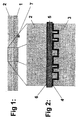
- FIG. 1 A possible structure for a DVD is shown schematically in FIG. 1, it is a so-called "DVD 5", this DVD exists essentially of two halves, it is one-sided and carries an information layer, their storage capacity is 4.7 gigabytes.
- Figure 1 is the layer which carries the information with "1" and no information load-bearing top layer with "2". The one required to scan the information Laser beam is labeled "7".
- the structure of the DVDs differs from that of today common and well-known GD's (Compact Disk), that the DVDs are made from a "sandwich" construction. While the CD's essentially consist of a 1.2 mm thick disc Made of polycarbonate or poly (meth) acrylate resin, the DVDs are made of each made two 0.6 mm thick slices. This is almost what today only polycarbonate used. By a refined Data structure and lasers with low wavelength can be a Information layer on the DVD contains approximately 4.7 gigabytes of information, while the conventional CD only has about 640 megabytes of information can save.
- the sandwich-like construction of the DVD means that the two Layers 1 and 2 must be connected. According to the older one State of the art has been used to connect the two layers solvent-based adhesives used together, more recently hot melt adhesives, UV-curable solvent-free liquid Adhesives and UV-crosslinkable hot melt adhesives are proposed.
- DE-A-3224647 describes a manufacturing process for optical video disks or digital sound records. There it is suggested that the the information supporting layer after coating with a reflective Aluminum film a protective film made of a heat-melting film-forming agent is provided at a predetermined Temperature melts and solidifies at room temperature. In a One embodiment is this heat-melting film-forming agent at the same time the adhesive for connecting the two plate substrate halves. In a further embodiment, this film-forming agent is combined with a coated with another adhesive that is sticky at room temperature with the help of this adhesive, the two plate substrates together connected.
- DE-A-3224647 makes no information about the Composition of the heat-fusible film-forming agent or sticky adhesive at room temperature. In addition, the teaching of DE-A-3224647 gives no indication as to whether these adhesive agents are also suitable for the production of DVDs.
- DE-A-3246857 describes an optical disk which comprises a pair of substrates comprises, at least one of which is formed on a surface Possesses in-depth information. On this layer of information deepening is a metallic layer of a reflective film applied to this metallic reflection layer is in turn a protective resin layer applied. There is an adhesive layer on this protective resin layer, which serves to connect the two substrate halves.
- DE-A-3246857 suggests that hot melt adhesives should be used as the adhesive Base polymer is a blend of one or more thermoplastic Contain elastomers.
- the hot melt adhesives described there are usual tackifying resins and additives, for example fillers, Antioxidants or UV absorbers contain around their heat and Increase weather resistance. It is also said that the Melt viscosity of the adhesive is 1,000 poise at 160 ° C should not exceed, so that the adhesive has no adverse effects exerts on the vapor-coated metallic film. About a suitability These adhesives for the production of DVDs are not specified made.
- DE-A-3840391 the use of hot melt adhesives in the bonding of pairs of substrates for the production of video discs or digital audio discs are problematic because of their low thermal stability.
- the use of UV curable monomer compositions according to this teaching, as an adhesive can cause corrosion of the substrate.
- DE-A-3840391 contributes to the bonding of the substrate pairs the production of video discs the use of UV cross-linkable Hot melt adhesives. No information is given on whether these UV-crosslinkable hot melt adhesives are suitable for the production of DVDs are.
- the DVD stands out from the known ones CD's or optical disks (also called laser disks) by one higher data or information density of the storage medium, which is why they place higher demands on the manufacturing process and the requirements for it materials used, e.g. Adhesives.
- Adhesives e.g. Adhesives
- WO-A-98/40883 describes the use of a hot melt adhesive with a melt viscosity of over 100,000 mPa.s at 160 ° C to Bonding of digital video discs (DVD) with a sandwich structure.
- the scripture gives no information about the thermal Resistance of the DVDs glued in this way, in particular with regard to a possible distortion-free scanning of those contained on the DVD Information.
- JP-A-09 208 919 describes compositions of hot melt adhesives for optical discs, which are essentially made up of three components are, one component being a styrene resin made from styrene diene block copolymers or their hydrogenated derivatives, second These hot melt adhesives contain component based tackifiers of rosins, terpene or petroleum resins, the softening point the tackifier at least 115 ° C, preferably at least Should be 140 ° C.
- the hot melt adhesives should be based on the teaching of these Font contain waxes, which are preferably paraffin waxes, micro waxes, low molecular weight polyethylene, low molecular weight polypropylene and are said to be non-crystalline poly- ⁇ -olefin.
- waxes which are preferably paraffin waxes, micro waxes, low molecular weight polyethylene, low molecular weight polypropylene and are said to be non-crystalline poly- ⁇ -olefin.
- it is proposed to use waxes that are not functional in their molecular structure Have group therefore it is suggested, preferably crystalline Polypropylene with a maximum average molecular weight 20,000 to use.
- JP-A-09 208 919 provides information on standard adhesive properties like ring and ball softening point, Melt viscosity, peel strength, adhesive strength and creep elevated temperature, however, this information does not allow any conclusions to be drawn on the usability of these adhesives for the bonding of DVDs.
- hot melt adhesives to be used according to the invention can be used in addition to the essential structural components mentioned above tackifying resins, optionally plasticizers, stabilizers / antioxidants, optionally fillers or extenders, pigments, Adhesion promoter or mixtures thereof.
- thermoplastic elastomers of component a) are thermoplastic polyurethanes (TPU), which are generally based on aromatic diisocyanates.
- TPU thermoplastic polyurethanes
- block copolymers of the AB, ABA, A (BA) n -B and (AB) n -Y type are also suitable, in which A represents an aromatic polyvinyl block and the B block comprises a rubber-like middle block which is partially or can be completely hydrogenated.
- block copolymers contain as A a polystyrene block and B an essentially rubber-like polybutadiene and / or polyisoprene block, Y can be a polyvalent compound and n can be an integer of at least 3.
- the middle block B (ie the polybutadiene or polyisoprene block) may be partially hydrogenated, whereby at least some of the double bonds originally present are removed.
- block copolymers are also used as SBS (styrene-butadiene-styrene) copolymer or as SIS (styrene-isoprene-styrene) copolymer or as SEPS (styrene-ethylene-propoylene-styrene) -, SEEPS- (styrene-ethylene) -Ethylene-propylene-styrene) - or SEBS- (styrene-ethylene-butadiene-styrene) copolymer offered by various manufacturers.
- Suitable hydrocarbon resins of component b) are the aliphatic, cycloaliphatic or aromatic hydrocarbon resins or also aliphatic-aromatic hydrocarbon resins, petroleum hydrocarbon resins and their hydrogenation products and mixtures. As is known, these hydrocarbon resins are polymers with a molecular weight of generally ⁇ 2,000. They are obtained by polymerizing C 5 sections of unsaturated compounds and in many cases are hydrogenated in a subsequent step. Specific examples of this are hydrocarbon resins based on polycyclopentadiene with subsequent hydrogenation. Such products are commercially available from Exxon under the trade name Escorez.
- Analog products are also produced by the companies CdF Chemie under the trade name Norsolene, GOODYEAR under the name Wing-Tack, HERCULES under the names Hercures, Kristalex, Piccotac, REICHHOLD under the name Sta-tac or by the company Idemitsu.
- the atactic ⁇ -olefin copolymers are suitable as poly- ⁇ -olefins of component c) and terpolymers of ethylene, propylene and / or 1-butene a molecular weight range between 5,000 and 30,000, the Molecular weight as number average by gel permeation chromatography (GPC) is determined based on DIN 55672.
- GPC gel permeation chromatography
- terpolymers can be operated in a continuously operated process Ziegler low pressure polymerization process from the aforementioned Monomers are produced. They are also called amorphous poly- ⁇ -olefins (APAO) referred to, although the particular invention preferred to use poly- ⁇ -olefins a significant semi-crystalline Share included.
- This partial crystallinity can be determined using the Differential thermal analysis (DTA) can be determined because the semi-crystalline Poly- ⁇ -olefins in the melting curve one or more pronounced Can have peak maxima.
- DTA Differential thermal analysis
- the functional group-bearing polar waxes of component d) are selected from the group of functionalized polyolefins with a molecular weight range (GPC) between approximately 4,000 and 80,000 on the basis of ethylene and / or propylene with acrylic acid, methacrylic acid and their C 1 to C 4 esters, Itaconic acid, fumaric acid, vinyl acetate, and in particular maleic acid and mixtures thereof.
- GPC molecular weight range
- the hotmelt adhesives according to the invention per se contain known auxiliaries and additives, including fillers, pigments, Plasticizers and stabilizers.
- fillers including fillers, pigments, Plasticizers and stabilizers.
- Fillers Calcium carbonate, calcium magnesium carbonate, talc, Silicic acid, carbon black, zinc white, titanium dioxide or other inorganic Pigments are used.
- plasticizers that may be used are essentially based on the polymer component used.
- plasticizers are Process oils, especially naphthenic process oils, paraffin oils, castor oil, low molecular weight polybutenes or polyisobutylenes or polyisoprenes and dialkyl or alkylaryl esters of phthalic acid.
- antioxidants or antioxidants to reduce oxidative degradation a variety of commercially available antioxidants can be used, examples for this are hindered phenols and / or thioethers and the like. It can be advantageous to use 2 or more different antioxidants Combine chemical composition to make it special to achieve good stability.
- the hot melt adhesives have furthermore a very high cohesion, which results in the so produced DVD a good and quick resetting force Bending load when using or handling the DVD.
- the softening point was measured according to ASTM E28, the viscosity was tested according to ASTM D3236 with a Brookfield RVT viscometer, Spindle 27 measured.
- the heat resistance was on the bond of 2 polycarbonate test strips (PC) with an overlapping bond of 25 x 25 mm, the bonded substrates with a Weight of 1,360 g were loaded and then with a Heating rate of 5 ° C per 10 min were heated. It has been in several Single trials recorded the temperature at which the bond failed.
- “k” means cohesive break.
- PC polycarbonate substrate
- Hot melt adhesives according to the invention and a hot melt adhesive of the prior art were tested with the ODT-A measuring method for their tangential (tilt) and radial (dishing) before and after climatic stress.
- the bonded test DVDs were stored for 96 hours at 80 ° C and 95% relative humidity and conditioned for 24 hours in a normal climate before the measurement.
- the test DVDs were produced in an injection molding machine from Krauss-Maffei and coated with adhesive on a commercially available hot melt bonder.
- the ODT-A measurements were measured on a Conttec device. The measurement results are shown in Table 2 below.
- the specification for 120 mm DVD-RAM allows a maximum and minimum deviation in the radial direction (dishing) of 0.70 ° and a tilt value of maximum and minimum 0.30 ° before and after aging.
- the examples according to the invention meet this requirement very well both before and after climatic aging.
- the DVDs bonded with the hot-melt adhesive according to the prior art have a tilt or dishing value that is significantly too high after climatic aging. 11 12 13 Comp. 1 Comp.
Landscapes
- Chemical & Material Sciences (AREA)
- Organic Chemistry (AREA)
- Chemical Kinetics & Catalysis (AREA)
- Health & Medical Sciences (AREA)
- Medicinal Chemistry (AREA)
- Polymers & Plastics (AREA)
- Engineering & Computer Science (AREA)
- Manufacturing & Machinery (AREA)
- Adhesives Or Adhesive Processes (AREA)
- Optical Record Carriers And Manufacture Thereof (AREA)
Abstract
Description
- Die Polycarbonat- oder Poly(meth)acrylat-Rohlinge müssen im Spritzgußverfahren hergestellt werden,
- der Rohling 1, der die Informationsschicht trägt, wird mit einer reflektierenden Schicht beschichtet. Dies ist in der Regel eine im Vakuum aufgedampfte Reflexionsschicht, z.B. aus Aluminium.
- Diese reflektierende Schicht muß unmittelbar nach der Herstellung gegen Korrosion geschützt werden. In einer bekannten Ausführungsform wird daher auf diese Schicht eine Lackschicht aufgebracht, die durch UV-Strahlen ausgehärtet wird. Ein alternatives Verfahren ist die Aufbringung eines Schutzfilms aus einem thermoplastischen Material.
- Der Rohling ohne Informationsschicht 2 kann nach unterschiedlichen Verfahren mit Bild und Textinformationen bedruckt werden.
- Je ein Rohling 1 und 2 werden mit einem Klebstoff verklebt.
- 10 bis 40 Gew.-%, vorzugsweise 15 bis 30 Gew.-% mindestens eines thermoplastischen Elastomers
- 15 bis 50 Gew.-%, vorzugsweise 25 bis 45 Gew.-% mindestens eines Kohlenwasserstoffharzes
- 10 bis 40 Gew.-%, vorzugsweise 15 bis 30 Gew.-% mindestens eines Poly-α-Olefins
- 10 bis 45 Gew.-%, vorzugsweise 15 bis 35 Gew.-% mindestens eines funktionelle Gruppen tragenden polaren Wachses
- 0 bis 10 Gew.-%, vorzugsweise 0,5 bis 10 Gew.-% an Hilfs- und Zusatzmitteln,
- Schmelzklebstoffe sind mindestens um den Faktor 4 wirtschaftlicher. Auch die Verklebungslinien für Schmelzklebstoffe sind billiger als die für UV-härtenden Systeme notwendigen Geräte und Anlagen.
- Es besteht die Möglichkeit der Einfärbung oder Pigmentierung der Klebstoffe, dadurch ergeben sich vielfältige Möglichkeiten in der Gestaltung der DVD.
- Schmelzklebstoffe weisen eine gutes Haftverhalten insbesondere bei schlagartiger Belastung auf, das gilt ganz besonders bei niedrigen Temperaturen.
- Schmelzklebstoffe können Ungenauigkeiten bzw. Formabweichungen der Polycarbonatsubstrate besser ausgleichen.
- Normalerweise fällt bei der Verarbeitung von Schmelzklebstoff während der laufenden Produktion keinerlei Abfall an.
- Es treten keine gesundheitsschädliche Gase wie z.B. Ozon oder Monomerdämpfe auf.
| 11 | 12 | 13 | Vergl. 1 | Vergl. 2 | |
| Radiale Verbiegung (dishing) vor Alterung | |||||
| minimum (Grad) | -0,27 | -0,18 | -0,30 | n.a. | n.a. |
| maximum (Grad) | 0,04 | 0,26 | 0,24 | n.a. | n.a. |
| nach Alterung | |||||
| minimum (Grad) | -0,62 | -0,53 | -0,64 | -0,27 | -1,74 |
| maximum (Grad) | -0,11 | 0,16 | 0,08 | 1,47 | 0,68 |
| Tangentiale Verbiegung (Tilt) vor Alterung | |||||
| minimum (Grad) | -0,23 | -0,20 | -0,28 | n.a. | n.a. |
| maximum (Grad) | 0,07 | 0,16 | 0,09 | n.a. | n.a. |
| nach Alterung | |||||
| minimum (Grad) | -0,27 | -0,24 | -0,29 | -0,48 | -0.48 |
| maximum (Grad) | 0,10 | 0,09 | 0,13 | 0,81 | 0,11 |
| n. a. = nicht verfügbar |
Claims (6)
- Verwendung von Schmelzklebstoffen enthaltendzur Herstellung von Digital Versatile Disks (DVDs).a.) mindestens ein thermoplastisches Elastomerb.) mindestens ein Kohlenwasserstoffharzc.) mindestens ein Poly-α-Olefind.) 10-45 Gew.% mindestens eines funktionelle Gruppen tragenden polaren Wachses, ausgewählt aus der Gruppe der funktionalisierten Polyolefine mit einem Molekulargewichtsbereich (GPC) von 4.000 bis 80.000 auf der Basis von Polymeren des Ethylens und/oder Propylens mit Acrylsäure, Methacrylsäure sowie deren C1 bis C4-Ester, Maleinsäure, Itakonsäure, Fumarsäure, Vinylacetat oder deren Mischungen.
- Verwendung nach Anspruch 1, dadurch gekennzeichnet, daß das/die thermoplastische(n) Elastomer(en) a.) ausgewählt wird/werden aus den Styrol-Dien-Blockcopolymeren, Styrol-Isopren-Styrol, Styrol-Butadien-Styrol sowie deren zumindest teilweise hydrierten Derivate oder deren Mischungen.
- Verwendung gemäß Anspruch 1, dadurch gekennzeichnet, daß die Komponente b.) ausgewählt wird aus cycloaliphatischen Kohlenwasserstoffharzen, aromatischen Kohlenwasserstoffharzen, aliphatischen Kohlenwasserstoffharzen, aliphatisch-aromatischen Kohlenwasserstoffharzen, Petroleumkohlenwasserstoffharzen sowie deren Hydrierungsprodukten und Mischungen der vorgenannten Harze.
- Verwendung nach Anspruch 1, dadurch gekennzeichnet, daß die Komponente c.) ausgewählt wird aus ataktischen α-Olefin-Co- und Terpolymeren des Ethylens, Propylens und/oder 1-Butens mit einem Molekulargewichtsbereich zwischen 5.000 und 30.000.
- Verwendung nach mindestens einem der vorhergehenden Ansprüche, dadurch gekennzeichnet, daß der Schmelzklebstoff weitere übliche Hilfs- und Zusatzstoffe ausgewählt aus Füllstoffen, Pigmenten, Weichmachern, klebrigmachenden Harzen, Alterungsschutzmittel, insbesondere Antioxidantien und/oder UV-Schutzmitteln, Haftvermittler oder deren Mischungen enthält.
- Verfahren zur Herstellung von sandwichartig aufgebauten Digital Versatile Disks (DVDs) gekennzeichnet durch die folgenden, wesentlichen Verfahrensschrittea.) Aufbringen der Informationsschicht auf den Scheibenrohling,b.) Beschichten der Informationsschicht mit einer das Licht reflektierenden Metallschicht, ggf. gefolgt vom Aufbringen einer Korrosionsschutzschicht,c.) Beschichten der Metallschicht mit einer Schicht des Schmelzklebstoffes nach mindestens einem der Ansprüche 1 bis 4,d.) ggf. Bedrucken der Innenseite der Scheibe mit einem Druckbild,e.) ggf. Beschichten der Druckbildschicht mit einer Schmelzklebstoff-Schichtf.) Verkleben der Schichten mit Hilfe der Schmelzklebstoff-Schicht(en) unter Verpressen.
Applications Claiming Priority (3)
| Application Number | Priority Date | Filing Date | Title |
|---|---|---|---|
| DE19848146 | 1998-10-20 | ||
| DE19848146A DE19848146C2 (de) | 1998-10-20 | 1998-10-20 | Verwendung eines Schmelzklebstoffs zur Verklebung von DVDs und Verfahren zu deren Herstellung |
| PCT/EP1999/007579 WO2000023537A1 (de) | 1998-10-20 | 1999-10-09 | Schmelzklebstoff zur verklebung von dvds |
Publications (2)
| Publication Number | Publication Date |
|---|---|
| EP1135449A1 EP1135449A1 (de) | 2001-09-26 |
| EP1135449B1 true EP1135449B1 (de) | 2004-12-15 |
Family
ID=7884944
Family Applications (1)
| Application Number | Title | Priority Date | Filing Date |
|---|---|---|---|
| EP99950684A Expired - Lifetime EP1135449B1 (de) | 1998-10-20 | 1999-10-09 | Schmelzklebstoff zur verklebung von dvds |
Country Status (10)
| Country | Link |
|---|---|
| US (1) | US6767424B1 (de) |
| EP (1) | EP1135449B1 (de) |
| JP (1) | JP2002527600A (de) |
| KR (1) | KR100612640B1 (de) |
| CN (1) | CN1323335A (de) |
| BR (1) | BR9914669A (de) |
| CA (1) | CA2384280A1 (de) |
| DE (2) | DE19848146C2 (de) |
| TW (1) | TWI230190B (de) |
| WO (1) | WO2000023537A1 (de) |
Cited By (1)
| Publication number | Priority date | Publication date | Assignee | Title |
|---|---|---|---|---|
| CN102660207A (zh) * | 2012-04-28 | 2012-09-12 | 郑昭 | 一种制造瓷砖减震间隔用热熔胶的方法 |
Families Citing this family (22)
| Publication number | Priority date | Publication date | Assignee | Title |
|---|---|---|---|---|
| US7300690B2 (en) * | 2001-03-29 | 2007-11-27 | General Electric Company | Radial tilt reduced media |
| DE10163858B4 (de) * | 2001-12-22 | 2005-09-08 | Henkel Kgaa | Verwendung korrosionsschutzpigmenthaltiger Klebstoffe zur Herstellung von DVDs |
| DE10314866B4 (de) * | 2003-04-01 | 2005-08-04 | Arccure Technologies Gmbh | Verfahren und Anordnung zum Ausgleichen von Deformationen eines optischen Speichermediums |
| EP1700895A1 (de) * | 2005-03-11 | 2006-09-13 | National Starch and Chemical Investment Holding Corporation | Abschälbare Schmelzhaftkleber |
| US7838590B2 (en) * | 2007-06-08 | 2010-11-23 | Bostik, Inc. | Hot melt adhesive based on styrene-ethylene-ethylene-propylene-styrene copolymer |
| EP2119751A1 (de) * | 2008-05-15 | 2009-11-18 | Sunstar Giken Kabushiki Kaisha | Einkomponenten-Haftvorbeschichtungszusammensetzung |
| US20090286077A1 (en) * | 2008-05-16 | 2009-11-19 | Hirokazu Okamoto | One-pack type adhesive precoating composition |
| AU2010260018B2 (en) * | 2009-06-11 | 2015-04-09 | Henkel Corporation | Thermally reversible hot melt adhesive composition containing multifunctional diene and dienophile compounds |
| US9376597B2 (en) | 2010-11-19 | 2016-06-28 | Henkel Ag & Co. Kgaa | Adhesive composition and use thereof |
| PL3480273T3 (pl) * | 2010-11-19 | 2021-05-17 | Henkel Ag & Co. Kgaa | Kompozycje klejowe i ich zastosowanie |
| US9469791B2 (en) | 2011-04-28 | 2016-10-18 | Adherent Laboratories, Inc. | Polyolefin based hot melt adhesive composition |
| US9241843B2 (en) | 2012-09-19 | 2016-01-26 | The Procter & Gamble Company | Article with tackifier-free adhesive |
| US8865824B2 (en) | 2012-09-19 | 2014-10-21 | IFS Industries Inc. | Hot melt adhesive |
| CN103320067B (zh) * | 2013-07-05 | 2015-08-26 | 杨志 | 用于快递防水袋的快速粘合热熔压敏胶及制备方法 |
| NL2011815C2 (en) | 2013-11-18 | 2015-05-19 | Saba Dinxperlo B V | Hot melt adhesive composition. |
| US10639210B2 (en) | 2013-12-19 | 2020-05-05 | The Procter & Gamble Company | Article with tackifier-free adhesive |
| CN104212389B (zh) * | 2014-08-01 | 2016-07-06 | 广州大禹防漏技术开发有限公司 | 一种seps耐候型建筑防水密封胶及其制备方法 |
| DK3234058T3 (da) | 2014-12-17 | 2020-12-07 | Fuller H B Co | Pakker af metalbeholdere |
| CN108047996A (zh) * | 2017-12-26 | 2018-05-18 | 上海邦中新材料有限公司 | 一种ppr铝塑稳态管专用粘接树脂及其制备方法 |
| EP3854365B1 (de) | 2020-01-27 | 2023-07-19 | The Procter & Gamble Company | Absorbierende artikel mit einem schmelzklebstoff auf sbc-basis |
| KR102792610B1 (ko) * | 2022-11-10 | 2025-04-17 | 주식회사 네패스야하드 | 스프레이 도포성이 우수한 난연성 핫멜트 감압접착제 및 이의 제조에 사용되는 조성물 |
| CN116285801A (zh) * | 2022-12-31 | 2023-06-23 | 上海永冠众诚新材料科技(集团)股份有限公司 | 用于自封纸盒的热熔压敏胶 |
Family Cites Families (15)
| Publication number | Priority date | Publication date | Assignee | Title |
|---|---|---|---|---|
| JPS586536A (ja) | 1981-07-01 | 1983-01-14 | Pioneer Electronic Corp | 光学式デイスク |
| JPS58108044A (ja) | 1981-12-22 | 1983-06-28 | Pioneer Electronic Corp | 光学式デイスク |
| GB8401567D0 (en) * | 1984-01-20 | 1984-02-22 | Exxon Research Engineering Co | Polyethylene wax |
| EP0243976B1 (de) | 1986-05-02 | 1996-09-04 | Hitachi, Ltd. | Methode zur Aufzeichnung, Wiedergabe und zum Löschen von Informationen und Dünnfilm zur Aufzeichnung von Informationen |
| US5001179A (en) * | 1987-08-05 | 1991-03-19 | National Starch And Chemical Investment Holding Corporation | Recyclable hot melt adhesive compositions |
| US5128388A (en) * | 1987-11-30 | 1992-07-07 | Sunstar Giken Kabushiki Kaisha | Hot melt adhesive crosslinkable by ultraviolet irradiation, optical disc using the same and process for preparing thereof |
| US5227213A (en) | 1987-11-30 | 1993-07-13 | Sunstar Giken Kabushiki Kaisha | Hot melt adhesive crosslinkable by ultraviolet irradiation, optical disc using the same and process for preparing thereof |
| US4880487A (en) * | 1988-06-24 | 1989-11-14 | Hoechst Celanese Corporation | Hot melt adhesives containing poly(p-hydroxystyrene) homopolymers and copolymers and bonding methods employing same |
| JP2661884B2 (ja) | 1995-03-31 | 1997-10-08 | 東芝イーエムアイ株式会社 | 貼り合わせディスクの製造方法およびその装置 |
| JPH09161320A (ja) * | 1995-12-08 | 1997-06-20 | Nippon Columbia Co Ltd | 貼り合わせ型光情報記録媒体 |
| JPH09208919A (ja) | 1996-01-30 | 1997-08-12 | Toagosei Co Ltd | 光学式ディスク用ホットメルト接着剤組成物 |
| JP3865438B2 (ja) | 1996-09-03 | 2007-01-10 | Tdk株式会社 | 光ディスク |
| JPH10149578A (ja) | 1996-11-20 | 1998-06-02 | Taiyo Yuden Co Ltd | 光記録媒体 |
| DE19710115A1 (de) * | 1997-03-12 | 1998-09-17 | Henkel Kgaa | Schmelzklebstoff zur Verklebung von DVDs |
| US6125299A (en) * | 1998-10-29 | 2000-09-26 | Survivalink Corporation | AED with force sensor |
-
1998
- 1998-10-20 DE DE19848146A patent/DE19848146C2/de not_active Expired - Fee Related
-
1999
- 1999-10-09 BR BR9914669-0A patent/BR9914669A/pt not_active Application Discontinuation
- 1999-10-09 DE DE59911294T patent/DE59911294D1/de not_active Expired - Fee Related
- 1999-10-09 CN CN99812140A patent/CN1323335A/zh active Pending
- 1999-10-09 US US09/807,837 patent/US6767424B1/en not_active Expired - Fee Related
- 1999-10-09 KR KR1020017005007A patent/KR100612640B1/ko not_active Expired - Fee Related
- 1999-10-09 EP EP99950684A patent/EP1135449B1/de not_active Expired - Lifetime
- 1999-10-09 WO PCT/EP1999/007579 patent/WO2000023537A1/de not_active Ceased
- 1999-10-09 JP JP2000577253A patent/JP2002527600A/ja active Pending
- 1999-10-09 CA CA002384280A patent/CA2384280A1/en not_active Abandoned
- 1999-10-12 TW TW088117601A patent/TWI230190B/zh not_active IP Right Cessation
Cited By (1)
| Publication number | Priority date | Publication date | Assignee | Title |
|---|---|---|---|---|
| CN102660207A (zh) * | 2012-04-28 | 2012-09-12 | 郑昭 | 一种制造瓷砖减震间隔用热熔胶的方法 |
Also Published As
| Publication number | Publication date |
|---|---|
| BR9914669A (pt) | 2001-07-17 |
| DE59911294D1 (de) | 2005-01-20 |
| CN1323335A (zh) | 2001-11-21 |
| WO2000023537A1 (de) | 2000-04-27 |
| DE19848146A1 (de) | 2000-05-04 |
| TWI230190B (en) | 2005-04-01 |
| CA2384280A1 (en) | 2000-04-27 |
| US6767424B1 (en) | 2004-07-27 |
| KR100612640B1 (ko) | 2006-08-14 |
| EP1135449A1 (de) | 2001-09-26 |
| JP2002527600A (ja) | 2002-08-27 |
| DE19848146C2 (de) | 2002-10-02 |
| KR20010080283A (ko) | 2001-08-22 |
Similar Documents
| Publication | Publication Date | Title |
|---|---|---|
| DE19848146C2 (de) | Verwendung eines Schmelzklebstoffs zur Verklebung von DVDs und Verfahren zu deren Herstellung | |
| EP0654070B1 (de) | Thermoplastischer schmelzklebstoff | |
| EP2220186B1 (de) | Coextrudierbarer schmelzklebstoff | |
| EP2782969B1 (de) | Psa enthaltend olefinblockcopolymere und styrolblockcopolymere | |
| EP2331648B1 (de) | Schmelzklebstoff auf basis von metallocen-katalysierten ethylen-alpha-olefin copolymeren | |
| US5128388A (en) | Hot melt adhesive crosslinkable by ultraviolet irradiation, optical disc using the same and process for preparing thereof | |
| JPH0248984B2 (de) | ||
| US5227213A (en) | Hot melt adhesive crosslinkable by ultraviolet irradiation, optical disc using the same and process for preparing thereof | |
| DE102022107749A1 (de) | Wiederablösbare Selbstklebeprodukte | |
| EP1828340B1 (de) | Schmelzklebstoff | |
| DE60317828T2 (de) | Klebstoffzusammensetzung für verpackungsklebebänder und diese zusammensetzung enthaltende klebebänder | |
| EP0966739B1 (de) | Schmelzklebstoff zur verklebung von dvds | |
| US20040014863A1 (en) | Uv-resistant hot-melt contact adhesive, a method for producing the same and adhesive objects produced therefrom | |
| JPS58501863A (ja) | 接着剤組成物 | |
| DE10163858B4 (de) | Verwendung korrosionsschutzpigmenthaltiger Klebstoffe zur Herstellung von DVDs | |
| HK1039141A (en) | Hot-melt adhesive for glueing dvds | |
| JPS62156183A (ja) | ホツトメルト型粘着剤 | |
| US20040122143A1 (en) | Hot-melt adhesive based on a copolymer of ethylene and of an alkyl (meth) acrylate | |
| DE112021004487T5 (de) | Propylenharzzusammensetzung | |
| HK1023207B (en) | Hot-melt adhesive for gluing digital versatile discs |
Legal Events
| Date | Code | Title | Description |
|---|---|---|---|
| PUAI | Public reference made under article 153(3) epc to a published international application that has entered the european phase |
Free format text: ORIGINAL CODE: 0009012 |
|
| 17P | Request for examination filed |
Effective date: 20010411 |
|
| AK | Designated contracting states |
Kind code of ref document: A1 Designated state(s): AT BE CH CY DE DK ES FI FR GB GR IE IT LI LU MC NL PT SE |
|
| 17Q | First examination report despatched |
Effective date: 20031216 |
|
| GRAP | Despatch of communication of intention to grant a patent |
Free format text: ORIGINAL CODE: EPIDOSNIGR1 |
|
| RBV | Designated contracting states (corrected) |
Designated state(s): DE ES FR GB IT |
|
| GRAS | Grant fee paid |
Free format text: ORIGINAL CODE: EPIDOSNIGR3 |
|
| GRAA | (expected) grant |
Free format text: ORIGINAL CODE: 0009210 |
|
| AK | Designated contracting states |
Kind code of ref document: B1 Designated state(s): DE ES FR GB IT |
|
| PG25 | Lapsed in a contracting state [announced via postgrant information from national office to epo] |
Ref country code: IT Free format text: LAPSE BECAUSE OF FAILURE TO SUBMIT A TRANSLATION OF THE DESCRIPTION OR TO PAY THE FEE WITHIN THE PRESCRIBED TIME-LIMIT;WARNING: LAPSES OF ITALIAN PATENTS WITH EFFECTIVE DATE BEFORE 2007 MAY HAVE OCCURRED AT ANY TIME BEFORE 2007. THE CORRECT EFFECTIVE DATE MAY BE DIFFERENT FROM THE ONE RECORDED. Effective date: 20041215 Ref country code: GB Free format text: LAPSE BECAUSE OF FAILURE TO SUBMIT A TRANSLATION OF THE DESCRIPTION OR TO PAY THE FEE WITHIN THE PRESCRIBED TIME-LIMIT Effective date: 20041215 Ref country code: FR Free format text: LAPSE BECAUSE OF FAILURE TO SUBMIT A TRANSLATION OF THE DESCRIPTION OR TO PAY THE FEE WITHIN THE PRESCRIBED TIME-LIMIT Effective date: 20041215 |
|
| REG | Reference to a national code |
Ref country code: GB Ref legal event code: FG4D Free format text: NOT ENGLISH |
|
| REG | Reference to a national code |
Ref country code: IE Ref legal event code: FG4D Free format text: GERMAN |
|
| REF | Corresponds to: |
Ref document number: 59911294 Country of ref document: DE Date of ref document: 20050120 Kind code of ref document: P |
|
| PG25 | Lapsed in a contracting state [announced via postgrant information from national office to epo] |
Ref country code: ES Free format text: LAPSE BECAUSE OF FAILURE TO SUBMIT A TRANSLATION OF THE DESCRIPTION OR TO PAY THE FEE WITHIN THE PRESCRIBED TIME-LIMIT Effective date: 20050326 |
|
| GBV | Gb: ep patent (uk) treated as always having been void in accordance with gb section 77(7)/1977 [no translation filed] |
Effective date: 20041215 |
|
| PLBE | No opposition filed within time limit |
Free format text: ORIGINAL CODE: 0009261 |
|
| STAA | Information on the status of an ep patent application or granted ep patent |
Free format text: STATUS: NO OPPOSITION FILED WITHIN TIME LIMIT |
|
| 26N | No opposition filed |
Effective date: 20050916 |
|
| EN | Fr: translation not filed | ||
| PG25 | Lapsed in a contracting state [announced via postgrant information from national office to epo] |
Ref country code: DE Free format text: LAPSE BECAUSE OF NON-PAYMENT OF DUE FEES Effective date: 20060503 |