EP1132433A2 - Wasserlösliche faserreakive Farbstoffe, Verfahren zu ihrer Herstellung und ihre Verwendung - Google Patents
Wasserlösliche faserreakive Farbstoffe, Verfahren zu ihrer Herstellung und ihre Verwendung Download PDFInfo
- Publication number
- EP1132433A2 EP1132433A2 EP01111301A EP01111301A EP1132433A2 EP 1132433 A2 EP1132433 A2 EP 1132433A2 EP 01111301 A EP01111301 A EP 01111301A EP 01111301 A EP01111301 A EP 01111301A EP 1132433 A2 EP1132433 A2 EP 1132433A2
- Authority
- EP
- European Patent Office
- Prior art keywords
- carbon atoms
- dye
- sulfo
- general formula
- groups
- Prior art date
- Legal status (The legal status is an assumption and is not a legal conclusion. Google has not performed a legal analysis and makes no representation as to the accuracy of the status listed.)
- Withdrawn
Links
Classifications
-
- C—CHEMISTRY; METALLURGY
- C09—DYES; PAINTS; POLISHES; NATURAL RESINS; ADHESIVES; COMPOSITIONS NOT OTHERWISE PROVIDED FOR; APPLICATIONS OF MATERIALS NOT OTHERWISE PROVIDED FOR
- C09B—ORGANIC DYES OR CLOSELY-RELATED COMPOUNDS FOR PRODUCING DYES, e.g. PIGMENTS; MORDANTS; LAKES
- C09B62/00—Reactive dyes, i.e. dyes which form covalent bonds with the substrates or which polymerise with themselves
- C09B62/02—Reactive dyes, i.e. dyes which form covalent bonds with the substrates or which polymerise with themselves with the reactive group directly attached to a heterocyclic ring
- C09B62/022—Reactive dyes, i.e. dyes which form covalent bonds with the substrates or which polymerise with themselves with the reactive group directly attached to a heterocyclic ring the heterocyclic ring being alternatively specified
- C09B62/026—Azo dyes
- C09B62/032—Metal complex azo dyes
-
- C—CHEMISTRY; METALLURGY
- C09—DYES; PAINTS; POLISHES; NATURAL RESINS; ADHESIVES; COMPOSITIONS NOT OTHERWISE PROVIDED FOR; APPLICATIONS OF MATERIALS NOT OTHERWISE PROVIDED FOR
- C09B—ORGANIC DYES OR CLOSELY-RELATED COMPOUNDS FOR PRODUCING DYES, e.g. PIGMENTS; MORDANTS; LAKES
- C09B62/00—Reactive dyes, i.e. dyes which form covalent bonds with the substrates or which polymerise with themselves
- C09B62/02—Reactive dyes, i.e. dyes which form covalent bonds with the substrates or which polymerise with themselves with the reactive group directly attached to a heterocyclic ring
-
- C—CHEMISTRY; METALLURGY
- C09—DYES; PAINTS; POLISHES; NATURAL RESINS; ADHESIVES; COMPOSITIONS NOT OTHERWISE PROVIDED FOR; APPLICATIONS OF MATERIALS NOT OTHERWISE PROVIDED FOR
- C09B—ORGANIC DYES OR CLOSELY-RELATED COMPOUNDS FOR PRODUCING DYES, e.g. PIGMENTS; MORDANTS; LAKES
- C09B62/00—Reactive dyes, i.e. dyes which form covalent bonds with the substrates or which polymerise with themselves
- C09B62/02—Reactive dyes, i.e. dyes which form covalent bonds with the substrates or which polymerise with themselves with the reactive group directly attached to a heterocyclic ring
- C09B62/20—Reactive dyes, i.e. dyes which form covalent bonds with the substrates or which polymerise with themselves with the reactive group directly attached to a heterocyclic ring to a pyrimidine ring
-
- C—CHEMISTRY; METALLURGY
- C09—DYES; PAINTS; POLISHES; NATURAL RESINS; ADHESIVES; COMPOSITIONS NOT OTHERWISE PROVIDED FOR; APPLICATIONS OF MATERIALS NOT OTHERWISE PROVIDED FOR
- C09B—ORGANIC DYES OR CLOSELY-RELATED COMPOUNDS FOR PRODUCING DYES, e.g. PIGMENTS; MORDANTS; LAKES
- C09B62/00—Reactive dyes, i.e. dyes which form covalent bonds with the substrates or which polymerise with themselves
- C09B62/02—Reactive dyes, i.e. dyes which form covalent bonds with the substrates or which polymerise with themselves with the reactive group directly attached to a heterocyclic ring
- C09B62/20—Reactive dyes, i.e. dyes which form covalent bonds with the substrates or which polymerise with themselves with the reactive group directly attached to a heterocyclic ring to a pyrimidine ring
- C09B62/205—Specific dyes not provided for in groups C09B62/22 - C09B62/26
-
- C—CHEMISTRY; METALLURGY
- C09—DYES; PAINTS; POLISHES; NATURAL RESINS; ADHESIVES; COMPOSITIONS NOT OTHERWISE PROVIDED FOR; APPLICATIONS OF MATERIALS NOT OTHERWISE PROVIDED FOR
- C09B—ORGANIC DYES OR CLOSELY-RELATED COMPOUNDS FOR PRODUCING DYES, e.g. PIGMENTS; MORDANTS; LAKES
- C09B62/00—Reactive dyes, i.e. dyes which form covalent bonds with the substrates or which polymerise with themselves
- C09B62/02—Reactive dyes, i.e. dyes which form covalent bonds with the substrates or which polymerise with themselves with the reactive group directly attached to a heterocyclic ring
- C09B62/20—Reactive dyes, i.e. dyes which form covalent bonds with the substrates or which polymerise with themselves with the reactive group directly attached to a heterocyclic ring to a pyrimidine ring
- C09B62/24—Azo dyes
- C09B62/255—Metal complex azo dyes
-
- C—CHEMISTRY; METALLURGY
- C09—DYES; PAINTS; POLISHES; NATURAL RESINS; ADHESIVES; COMPOSITIONS NOT OTHERWISE PROVIDED FOR; APPLICATIONS OF MATERIALS NOT OTHERWISE PROVIDED FOR
- C09B—ORGANIC DYES OR CLOSELY-RELATED COMPOUNDS FOR PRODUCING DYES, e.g. PIGMENTS; MORDANTS; LAKES
- C09B62/00—Reactive dyes, i.e. dyes which form covalent bonds with the substrates or which polymerise with themselves
- C09B62/44—Reactive dyes, i.e. dyes which form covalent bonds with the substrates or which polymerise with themselves with the reactive group not directly attached to a heterocyclic ring
- C09B62/4401—Reactive dyes, i.e. dyes which form covalent bonds with the substrates or which polymerise with themselves with the reactive group not directly attached to a heterocyclic ring with two or more reactive groups at least one of them being directly attached to a heterocyclic system and at least one of them being directly attached to a non-heterocyclic system
- C09B62/4422—Reactive dyes, i.e. dyes which form covalent bonds with the substrates or which polymerise with themselves with the reactive group not directly attached to a heterocyclic ring with two or more reactive groups at least one of them being directly attached to a heterocyclic system and at least one of them being directly attached to a non-heterocyclic system the heterocyclic system being a pyrimidine ring
Definitions
- the invention is in the technical field of fiber-reactive dyes.
- new fiber-reactive dyes with a 5,6-difluoropyrimidin-4-yl radical as fiber-reactive group have been found which have the general formula (1) defined below Fb - Z n correspond and differ advantageously from the known dyes and deliver dyeings and prints with high color strength.
- Alkylene radicals are preferably those of 1 to 4 carbon atoms.
- the dye residue Fb has one or more, such as 2 to 6, sulfo groups.
- the rest Fb can contain further substituents customary in organic dyes.
- substituents are, for example: alkyl groups of 1 to 4 carbon atoms, such as methyl, ethyl, propyl, isopropyl or butyl, of which preferably ethyl and in particular methyl; Alkoxy groups of 1 to 4 carbon atoms, such as methoxy, ethoxy, propoxy, isopropoxy and butoxy, preferably thereof ethoxy and in particular methoxy; Alkanoylamino groups of 2 to 5 carbon atoms, such as the acetylamino and propionylamino group; benzoylamino groups optionally substituted by sulfo, carboxy, methyl, ethyl, methoxy, ethoxy and / or chlorine; primary and mono- or disubstituted amino groups, the substituents being, for
- Ethyl carbamoyl Sulfamoyl groups, which can be mono- or disubstituted by alkyl groups of 1 to 4 carbon atoms, and N-phenyl-N-alkyl-sulfamoyl groups with an alkyl group of 1 to 4 carbon atoms, these alkyl groups in turn being hydroxyl, sulfato, sulfo , Carboxy, phenyl and sulfophenyl may be substituted, such as N-methyl-sulfamoyl, N-ethyl-sulfamoyl, N-propyl-sulfamoyl, N-isopropyl-sulfamoyl, N-butyl-sulfamoyl, N- (ß-hydroxyethyl) - sulfamoyl and N, N-di- ( ⁇ -hydroxyethyl) sulfamoyl; N-phenylsul
- the dye radical Fb can furthermore have one or two fiber-reactive groups of the general formula Y-SO 2 -W o -, in which W ° an alkylene radical of 1 to 4 carbon atoms or an amino group of the formula -N (CH 3 ) - or - N (C 2 H 5 ) - or a group of the formula - (C2-C4-alkylene) -NH- or stands for a direct covalent bond and Y is vinyl or ⁇ -sulfatoethyl, ⁇ -thiosulfatoethyl, ⁇ -phosphatoethyl, ⁇ - (C 2 -C 5 -alkanoyloxy) ethyl, such as ⁇ -acetyloxyethyl, ⁇ -benzoyloxyethyl, ⁇ - (sulfobenzoyloxy) ethyl, ⁇ - (p-toluenesulfonyloxy) ethyl
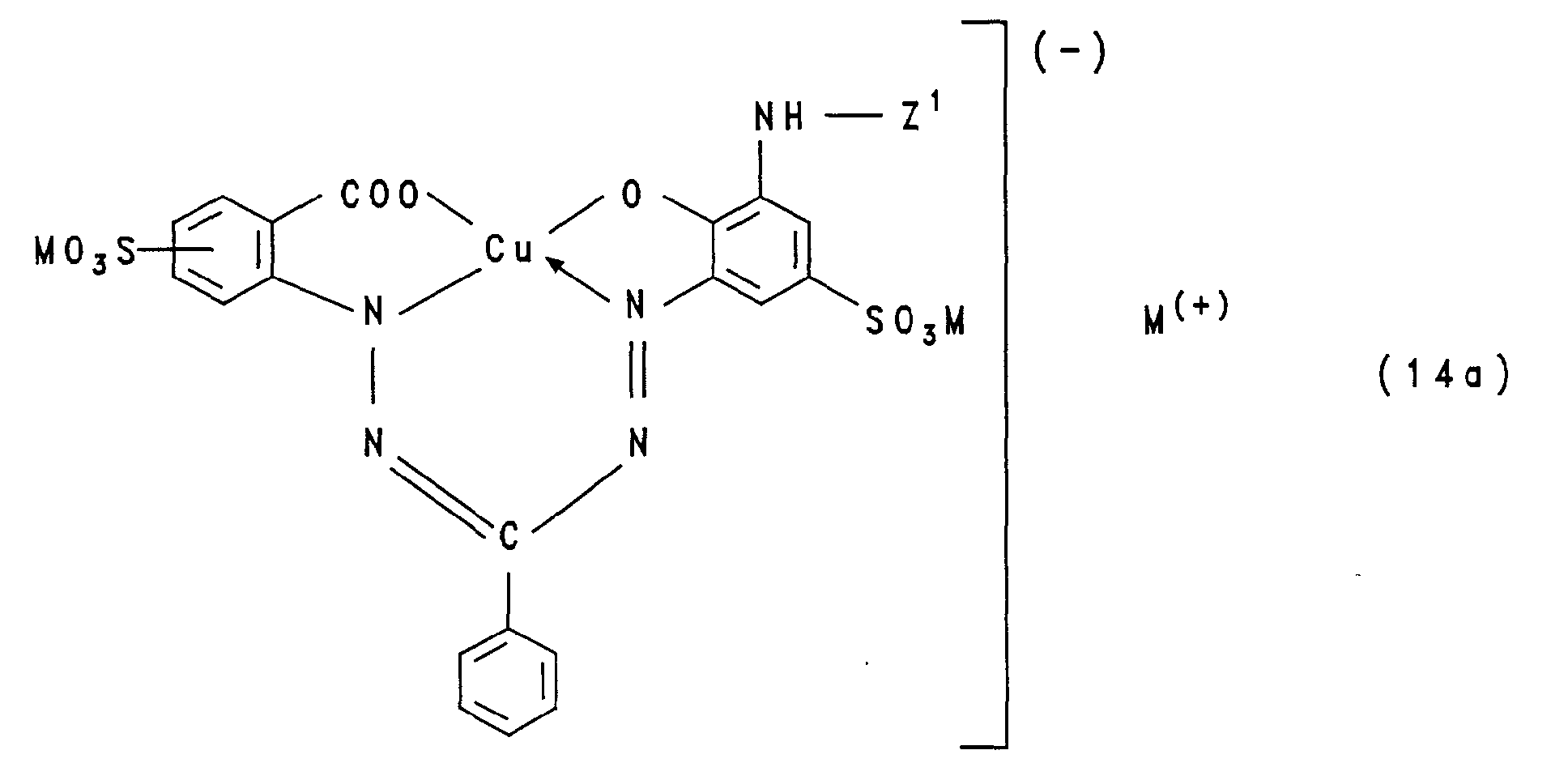
- Preferred of the copper formazan dyes of the general formula (14) are those in which P 1 and P 2 both represent a benzene ring, the group -NH-Z 1 is bonded to P 2 and T 1 and T 2 each represent a sulfo group, where e and g both represent the number 1. If the group -NH-Z 1 is bound to P 1 , e is the number zero, g the number 2 and T 2 is a sulfo group.
- the group -P 3 - (T 3 ) f is furthermore preferably the phenyl or a 2- or 4-sulfo-phenyl radical.
- the copper formazan dyes which have the general formula (14a) correspond in which M and Z 1 have the above-mentioned, particularly preferred meanings.
- the present invention further relates to processes for the preparation of the dyes of the general formula (1) according to the invention.
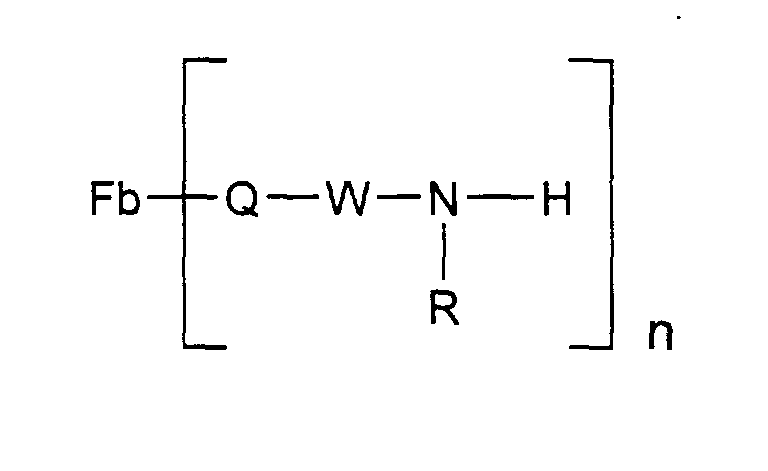
- They can be prepared in a manner known per se, in a conventional manner, analogously and specifically for the respective dye class, by reacting with each other typical precursors, at least one of which contains one or two groups of the general formula (2), or by using a compound of the general formula (20) with Fb, R, Q, W and n of the abovementioned meanings in an equivalent amount with 4,5,6-trifluoropyrimidine, or by reacting a compound of the general formula Fb-N (R A ) H with Fb and R A
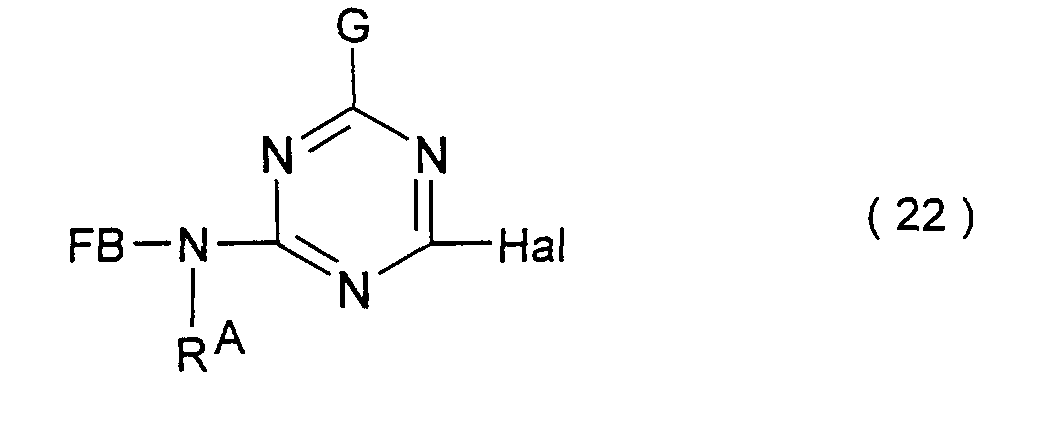
- a compound of the general formula (21) in which Hal represents halogen, such as fluorine and chlorine, and G, R B , W A and R have the meanings given above, or by using a compound of the general formula (22) with Fb, R A , G and Hal of the abovementioned meaning with a compound of the general formula (23) with R B , W A and R
- the starting compounds are reacted in aqueous or aqueous-organic Medium in suspension or solution.
- aqueous-organic medium so is the organic medium for example acetone, dimethylformamide, dimethyl sulfoxide or N-methylpyrrolidone.
- the one released during the condensation is advantageous Hydrogen halide continuously by adding aqueous alkali or Alkaline earth metal hydroxides, carbonates or bicarbonates neutralized.
- the Condensation reaction of 4,5,6-trifluoropyrimidine usually takes place in one Temperature between -5 ° C and + 50 ° C, preferably at one temperature between 0 ° C and + 40 ° C, and at a pH between 2 and 11, preferably between 4 and 10.
- the reaction of the starting compounds of the general formula Fb-N (R A ) H and the general formula (21) is generally carried out at a temperature between -5 ° C and + 60 ° C, in the case of Hal equal to fluorine preferably at one temperature between 0 ° C and 30 ° C, and at a pH between 3 and 10, preferably between 6 and 9.
- the compounds of the general formulas (22) and (23) are generally reacted at a temperature between -5 ° C. and + 30 ° C., in the case of Hal equal to fluorine, preferably at a temperature between 0 ° C. and 30 ° C. , and at a pH between 3 and 10, preferably between 6 and 9.
- the starting compound of the general formulas (21) and (23) can be prepared in a manner which is customary and known per se by reacting a dihalogeno-s-triazine substituted by the substituent G with an amine of the general formula -H (R B ) NW A -N (R) H and then with 4,5,6-trifluoropyrimidine or by reacting this diamino compound with 4,5,6-trifluoropyrimidine.
- the starting compound of the general formula (22) is obtained in a manner known per se by reacting a compound of the general formula Fb-N (R A ) H of the abovementioned meaning with a dihalogeno-s-triazine substituted by the substituent G.
- the dyes of the general formula (1) prepared according to the invention are separated from the synthesis batches by generally known methods either by precipitation from the reaction medium by means of electrolytes, such as sodium chloride or potassium chloride, or by evaporation of the reaction solution, for example by spray drying, this reaction solution being a buffer substance can be supplied.
- the dyes of the general formula (1) - hereinafter called dyes (1) - are suitable for dyeing (which includes printing) the most diverse materials, such as silk, leather, wool, polyamide fibers and polyurethanes, and in particular cellulose-containing fiber materials of all kinds Fiber materials are, for example, the natural cellulose fibers, such as cotton, linen and hemp, as well as cellulose and regenerated cellulose.
- the dyes (1) are also suitable for dyeing or printing fibers containing hydroxyl groups which are contained in blended fabrics, for example mixtures of cotton with polyester fibers or polyamide fibers.
- the dyes (1) can be applied to the fiber material in different ways apply and fix on the fiber, especially in the form of aqueous Dye solutions and printing pastes. They are suitable for both Exhaust process as well as for dyeing according to the foulard dyeing process, after which the goods with aqueous, optionally saline dye solutions impregnated and the dye after an alkali treatment or in the presence of alkali, optionally under the action of heat.
- This coloring and Printing processes are numerous in the general specialist literature as well as in the Patent literature, such as in the publications mentioned at the beginning, described.
- the present invention therefore also relates to the use of Dyes (1) for dyeing (including printing) these materials or Process for dyeing (and printing) such materials in and of itself usual procedure in which a dye (1) is used as the colorant is by placing the dye (1) in an aqueous medium on the material applied and using heat or an alkaline Connection or by means of both fixed on the material.
- the dyes (1) are notable for high reactivity and good fixing properties and a very good build-up ability. You can therefore after Pull-out dyeing processes are used at low dyeing temperatures and require only short steaming times with pad-steam processes.
- the degrees of fixation are high, and the unfixed portions can be washed out easily the difference between the degree of extension and the degree of fixation is remarkably small, i.e. the Soap loss is very low.
- the dyes (1) are also particularly suitable for Printing, especially on cotton, but also for printing on nitrogen-containing fibers, e.g. of wool or silk or of blended fabrics that Contain wool or silk.
- the dyes (1) according to the invention are characterized in that after the dyeing process, dye portions not fixed on the fiber material themselves can be washed out very easily without having to wash the Washing process is soiled by the detaching dye. This results in advantages for the dyeing process; Washing cycles and thus Costs are saved.
- the dyeings and prints produced with the dyes (1) have especially on cellulose fiber materials, a high color strength and a high Fiber-dye binding stability in both acidic and alkaline Area, continue to have good lightfastness and very good Wet fastness properties, such as washing, water, sea water, overdyeing and Sweat fastness, as well as good pleating fastness, ironing fastness and Fastness to rubbing.
- Parts by weight relate to parts by volume such as kilograms to liters.
- the compounds described by formula in the examples are in the form of specified free acid; generally they are in the form of their Alkali metal salts, such as lithium, sodium or potassium salts, prepared and isolated and used in the form of their salts for coloring.
- Alkali metal salts such as lithium, sodium or potassium salts
- alkali metal salts used in the synthesis become.
- the absorption maxima ( ⁇ max ) in the visible range specified for the dyes according to the invention were determined on the basis of their alkali metal salts in aqueous solution.
- the ⁇ max values are given in brackets when specifying the color; the wavelength specification refers to nm.
- the copper formazan dye of the formula (written in the form of the free acid) is salted out of the synthesis solution by sodium chloride.
Landscapes
- Chemical & Material Sciences (AREA)
- Organic Chemistry (AREA)
- Coloring (AREA)
Abstract
Description
- Fb
- ist der Rest eines sulfogruppen-haltigen Formazan- oder, Kupferformazan-Farbstoffes;
- n
- ist die Zahl 1, 2 oder 3, bevorzugt 1 oder 2, insbesondere bevorzugt 1;
- Z
- ist eine Gruppe der allgemeinen Formel (2)
in welcher
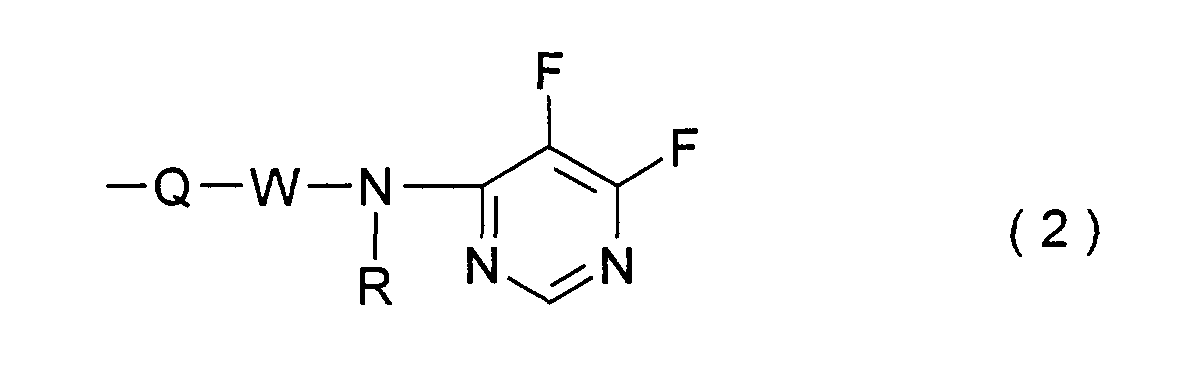
- Q
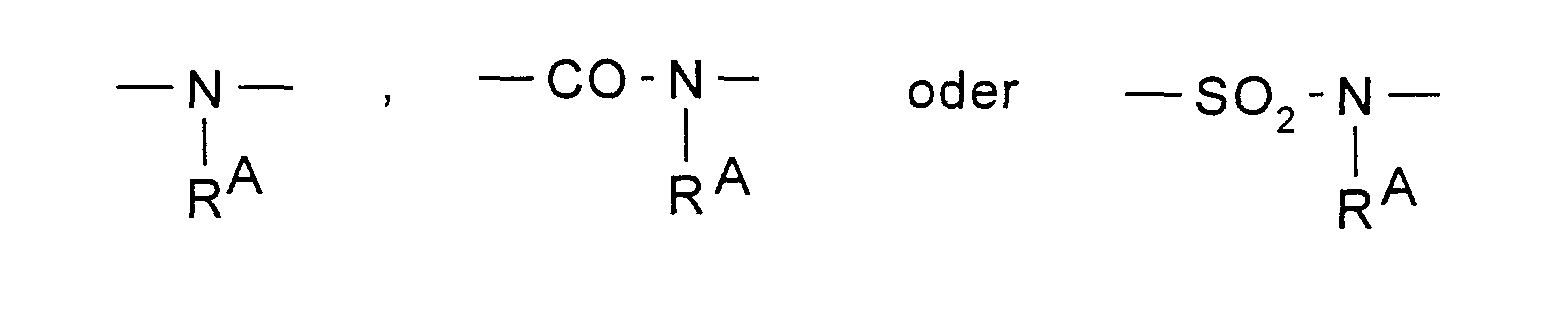
- eine kovalente Bindung oder eine Gruppe der Formel
ist, bevorzugt eine Gruppe der Formel -N(RA)- oder eine kovalente Bindung, in welchen

- RA
- Wasserstoff oder Alkyl von 1 bis 4 C-Atomen, wie Methyl und Ethyl ist, das durch Halogen, wie Chlor und Brom, Hydroxy, Cyano, Alkoxy von 1 bis 4 C-Atomen, wie Methoxy und Ethoxy, Alkoxycarbonyl von 2 bis 5 C-Atomen, wie Carbethoxy und Carbomethoxy, Carboxy, Sulfamoyl, Sulfo, Sulfato oder Phosphato substituiert sein kann, und bevorzugt Methyl oder Ethyl und insbesondere bevorzugt Wasserstoff ist,
- W
- eine kovalente Bindung oder ein Brückenglied ist, wie beispielsweise ein geradkettiger oder verzweigter Alkylenrest von 1 bis 6 C-Atomen oder ein Alkylenrest von 2 bis 8 C-Atomen, der durch 1 oder 2 Heterogruppen aus der Gruppe -NH- , -N(RA)- mit RA der obengenannten Bedeutung, -SO2-, -CO-, -O- , -NH-SO2- , -SO2-NH- , -CO-NH- und -NH-CO- unterbrochen ist, oder ein gegebenenfalls substituierter Arylenrest oder ein gegebenenfalls substituierter Arylen-alkylen-Rest oder beispielsweise ein zwei Arylenreste enthaltender Rest, die über eine kovalente Bindung, eine Heterogruppe, wie -NH- oder -O- , oder einen Alkylenrest von 1 bis 4 C-Atomen oder einen olefinischen Rest von 2 bis 4 C-Atomen miteinander verbunden sind, oder beispielsweise der bivalente Rest eines Heterocyclus, wie eines Triazins, an den der bivalente Rest eines gegebenenfalls substituierten Phenylen-amino-, Naphthylen-amino-, Phenylenmethyl-amino- oder (C1-C6)-Alkylen-amino-Restes gebunden sein kann, wobei jedoch Q zwingend eine kovalente Bindung bedeutet, falls W für eine kovalente Bindung steht, und
- R
- Wasserstoff oder Alkyl von 1 bis 4 C-Atomen, wie Methyl oder
Ethyl, ist, das durch Halogen, wie Chlor und Brom, Hydroxy, Cyano,
Alkoxy von 1 bis 4 C-Atomen, wie Methoxy und Ethoxy,
Alkoxycarbonyl von 2 bis 5 C-Atomen, wie Carbomethoxy und
Carbethoxy, Carboxy, Sulfamoyl, Sulfo, Sulfato oder Phosphato
substituiert sein kann, bevorzugt Methyl oder Ethyl und
insbesondere bevorzugt Wasserstoff ist.
Arylenreste sind bevorzugt Phenylenreste, die substituiert sein können, wie beispielsweise durch einen oder zwei Substituenten aus der Gruppe Sulfo, Carboxy, Alkyl von 1 bis 4 C-Atomen, wie Ethyl und insbesondere Methyl, Alkoxy von 1 bis 4 C-Atomen, wie Ethoxy und insbesondere Methoxy, Chlor, Hydroxy und Alkanoylamino von 2 bis 4 C-Atomen, wie Propionylamino und Acetylamino, und Naphthylenreste, die substituiert sein können, wie beispielsweise durch 1, 2 oder 3 Sulfogruppen oder durch 1 oder 2 Carboxygruppen oder durch Alkyl von 1 bis 4 C-Atomen, wie Ethyl und Methyl, oder Alkoxy von 1 bis 4 C-Atomen, wie Ethoxy und Methoxy, oder durch zwei oder drei Substituenten aus der Gruppe Alkyl von 1 bis 4 C-Atomen, wie Ethyl und Methyl, Alkoxy von 1 bis 4 C-Atomen, wie Ethoxy und Methoxy, Sulfo und Carboxy.
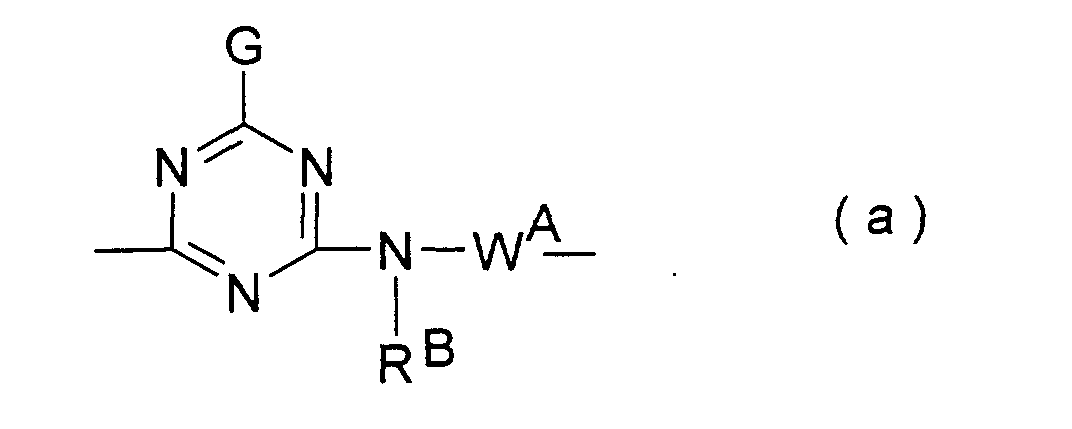
- G
- Fluor, Chlor, Brom, Cyanoamino, gegebenenfalls substituiertes Amino, Hydroxy, Alkoxy von 1 bis 4 C-Atomen, wie Methoxy und Ethoxy, Phenoxy, gegebenenfalls durch 1 oder 2 Substituenten aus der Gruppe Sulfo, Carboxy, Methyl, Ethyl, Methoxy und Ethoxy substituiertes Phenoxy oder Alkylthio von 1 bis 4 C-Atomen, wie Methylthio und Ethylthio, bevorzugt jedoch Chlor oder Fluor, ist,
- RB
- Wasserstoff oder Alkyl von 1 bis 4 C-Atomen, wie Methyl und Ethyl, ist, das durch Halogen, wie Chlor und Brom, Hydroxy, Cyano, Alkoxy von 1 bis 4 C-Atomen, wie Methoxy und Ethoxy, Alkoxycarbonyl von 2 bis 5 C-Atomen, wie Carbethoxy und Carbomethoxy, Carboxy, Sulfamoyl, Sulfo, Sulfato oder Phosphato substituiert sein kann, und bevorzugt Methyl oder Ethyl und insbesondere bevorzugt Wasserstoff ist, und
- WA
- geradkettiges Alkylen von 2 bis 6 C-Atomen oder verzweigtes Alkylen von 3 bis 6 C-Atomen ist, die jeweils durch eine oder zwei Heterogruppen unterbrochen sein können, welche aus den Gruppen der Formeln -O-, -CO- , -SO2-, -NH- , -N(RA) mit RA einer der obengenannten Bedeutungen, -NH-CO- , -CO-NH- , -SO2-NH- oder -NH-SO2- ausgewählt sind, oder Phenylen ist, das durch 1 oder 2 Substituenten aus der Gruppe Sulfo, Carboxy, Methyl, Ethyl, Methoxy und Ethoxy substituiert sein kann, wie beispielsweise Phen-1,3-ylen, Phen-1,4-ylen, 6-Sulfo-phen-1,3-ylen, 6-Sulfo-phen-1,4-ylen, 3,6-Disulfo-phen-1,4-ylen, 6-Methoxy-phen-1,3-ylen oder Benzyliden, das durch 1 oder 2 Substituenten aus der Gruppe Sulfo, Carboxy, Methyl, Ethyl, Methoxy und Ethoxy substituiert sein kann, wie beispielsweise 1,4-Benzyliden, 1,3-Benzyliden, 2-Sulfo-phen-1-yl-4-methylen, 2-Suldo-phen-1-yl-5-methylen oder 2-Methoxy-phen-1-yl-4-methylen.
- M
- Wasserstoff oder ein Alkalimetall, wie Natrium, Kalium oder Lithium, oder das Moläquivalent eines Erdalkalimetalls, wie des Calciums, und bevorzugt Wasserstoff oder ein Alkalimetall ist.

- Z1
- ist ein Rest der obengenannten und definierten allgemeinen Formel (2a)
in welcher
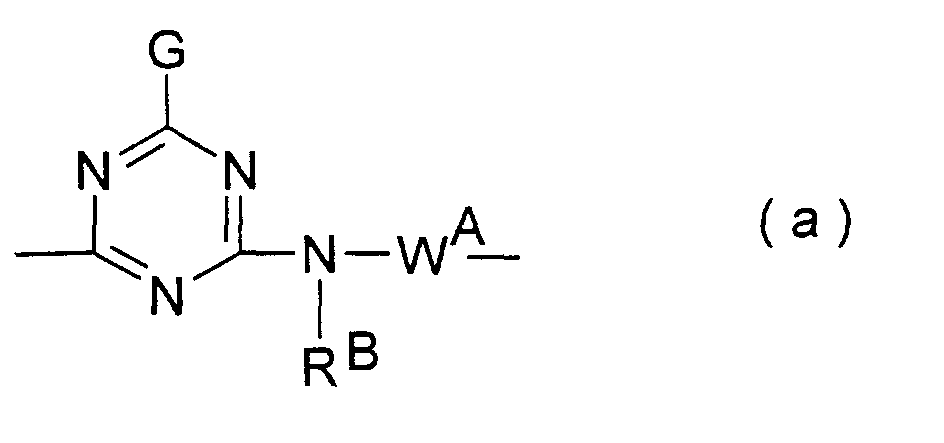
- G
- Fluor, Chlor, Brom, Cyanoamino, gegebenenfalls substituiertes Amino, Hydroxy, Alkoxy von 1 bis 4 C-Atomen, wie Methoxy und Ethoxy, Phenoxy, gegebenenfalls durch 1 oder 2 Substituenten aus der Gruppe Sulfo, Carboxy, Methyl, Ethyl, Methoxy und Ethoxy substituiertes Phenoxy oder Alkylthio von 1 bis 4 C-Atomen, wie Methylthio und Ethylthio, bevorzugt jedoch Chlor oder Fluor, ist,
- RB
- Wasserstoff oder Alkyl von 1 bis 4 C-Atomen, wie Methyl und Ethyl, ist, das durch Halogen, wie Chlor und Brom, Hydroxy, Cyano, Alkoxy von 1 bis 4 C-Atomen, wie Methoxy und Ethoxy, Alkoxycarbonyl von 2 bis 5 C-Atomen, wie Carbethoxy und Carbomethoxy, Carboxy, Sulfamoyl, Sulfo, Sulfato oder Phosphato substituiert sein kann, und bevorzugt Methyl oder Ethyl und insbesondere bevorzugt Wasserstoff ist, und
- WA
- geradkettiges Alkylen von 2 bis 6 C-Atomen oder verzweigtes Alkylen von 3 bis 6 C-Atomen ist, die jeweils durch eine oder zwei Heterogruppen unterbrochen sein können, welche aus den Gruppen der Formeln -O-, -CO- , -SO2-, -NH- , -N(RA) mit RA einer der obengenannten Bedeutungen, -NH-CO- , -CO-NH- , -SO2-NH- oder -NH-SO2-ausgewählt sind, oder Phenylen ist, das durch 1 oder 2 Substituenten aus der Gruppe Sulfo, Carboxy, Methyl, Ethyl, Methoxy und Ethoxy substituiert sein kann, wie beispielsweise Phen-1,3-ylen, Phen-1,4-ylen, 6-Sulfo-phen-1,3-ylen, 6-Sulfo-phen-1,4-ylen, 3,6-Disulfo-phen-1,4-ylen, 6-Methoxy-phen-1,3-ylen oder Benzyliden, das durch 1 oder 2 Substituenten aus der Gruppe Sulfo, Carboxy, Methyl, Ethyl, Methoxy und Ethoxy substituiert sein kann, wie beispielsweise 1,4-Benzyliden, 1,3-Benzyliden, 2-Sulfo-phen-1-yl-4-methylen, 2-Suldo-phen-1-yl-5-methylen oder 2-Methoxy-phen-1-yl-4-methylen, oder oder der 5,6-Difluor-pyrimidin-4-yl-Rest;
- X1
- ist ein Sauerstoffatom oder bevorzugt die Carbonyloxygruppe der Formel -COO- ;
- P1 und P2
- bedeuten, unabhängig voneinander, jedes einen Benzol- oder Naphthalinring, wobei an P1 das Stickstoffatom und die Gruppe X1 ortho-ständig zueinander und an P2 das Sauerstoffatom und das Stickstoffatom ortho-ständig zueinander gebunden sind und die Benzolkerne bzw. Napthalinkerne noch durch einen oder zwei Substituenten aus der Gruppe Halogen, wie Chlor, Nitro, Alkyl von 1 bis 4 C-Atomen, wie Methyl und Ethyl, Alkoxy von 1 bis 4 C-Atomen, wie Methoxy und Ethoxy, Sulfamoyl, durch Alkyl von 1 bis 4 C-Atomen mono- oder disubstituiertes Sulfamoyl, Alkylsulfonyl von 1 bis 4 C-Atomen, wie Methylsulfonyl und Ethylsulfonyl, und Phenylsulfonyl substituiert sein können, wobei sowohl P1 als auch P2 beide bevorzugt einen Benzolring bedeuten;
- P3
- ist eine geradkettige oder verzweigte Alkylengruppe von 2 bis 6 C-Atomen, vorzugsweise von 2 bis 4 C-Atomen, die durch eine Sulfophenylgruppe substituiert sein kann, oder ist eine Phenylengruppe oder eine Naphthylengruppe, die durch 1 oder 2 Substituenten aus der Gruppe Methyl, Ethyl, Methoxy, Ethoxy und Chlor substituiert sein können, wobei P3 bevorzugt ein Benzolring ist;
- T1, T2 und T3
- bedeuten, unabhängig voneinander, jedes eine Sulfo- oder Carboxygruppe, bevorzugt Sulfogruppe;
- e, f und g
- stellen, unabhängig voneinander, jedes die Zahl Null, 1 oder 2 dar, wobei die Summe von (e+f+g) eine ganze Zahl von 1 bis 4 bedeutet und vorzugsweise 2 oder 3, insbesondere 2, ist, wobei im Falle von e oder f oder g gleich Null die Gruppe T1 bzw. T2 bzw. T3 ein Wasserstoffatom bedeutet;
- k
- steht für die Zahl 1 oder 2, bevorzugt 1, wobei die Gruppe -NH-Z1 an einen aromatischen Rest von P1, P2 oder P3 gebunden sein kann und bevorzugt an P2 gebunden ist.


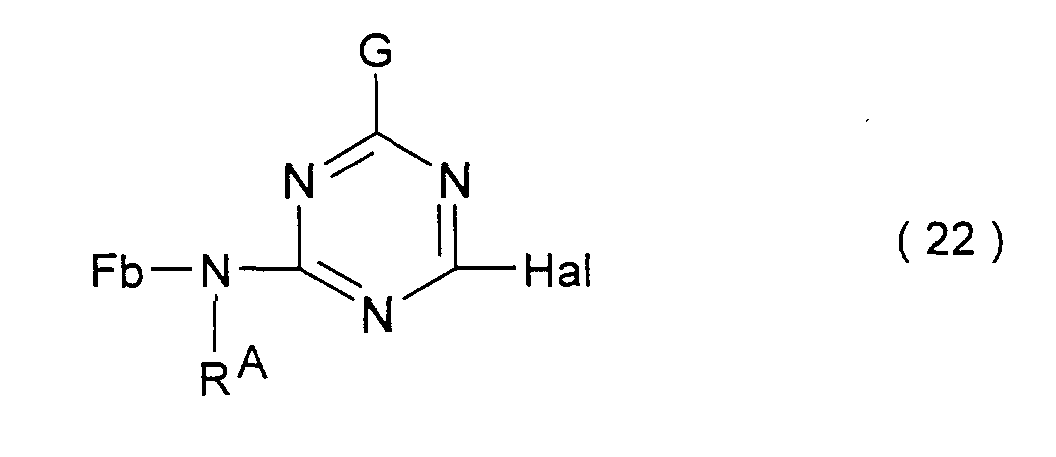

Die Umsetzung der Verbindungen der allgemeinen Formeln (22) und (23) erfolgt in der Regel bei einer Temperatur zwischen -5°C und + 30°C, im Falle von Hal gleich Fluor bevorzugt bei einer Temperatur zwischen 0°C und 30°C, und bei einem pH-Wert zwischen 3 und 10, bevorzugt zwischen 6 und 9.
Die Abscheidung der erfindungsgemäß hergestellten Farbstoffe der allgemeinen Formel (1) aus den Syntheseansätzen erfolgt nach allgemein bekannten Methoden entweder durch Ausfällen aus dem Reaktionsmedium mittels Elektrolyten, wie beispielsweise Natriumchlorid oder Kaliumchlorid, oder durch Eindampfen der Reaktionslösung, beispielsweise durch Sprühtrocknung, wobei dieser Reaktionslösung eine Puffersubstanz zugeführt werden kann.
Die Farbstoffe der allgemeinen Formel (1) - im nachfolgenden Farbstoffe (1) genannt - eignen sich zum Färben (was das Bedrucken einschließt) der verschiedensten Materialien, wie Seide, Leder, Wolle, Polyamidfasern und Polyurethanen, und insbesondere cellulosehaltiger Fasermaterialien aller Art. Solche Fasermaterialien sind beispielsweise die natürlichen Cellulosefasern, wie Baumwolle, Leinen und Hanf, sowie Zellstoff und regenerierte Cellulose. Die Farbstoffe (1) sind auch zum Färben oder Bedrucken von hydroxygruppenhaltigen Fasern geeignet, die in Mischgeweben enthalten sind, z.B. von Gemischen aus Baumwolle mit Polyesterfasern oder Polyamidfasern.
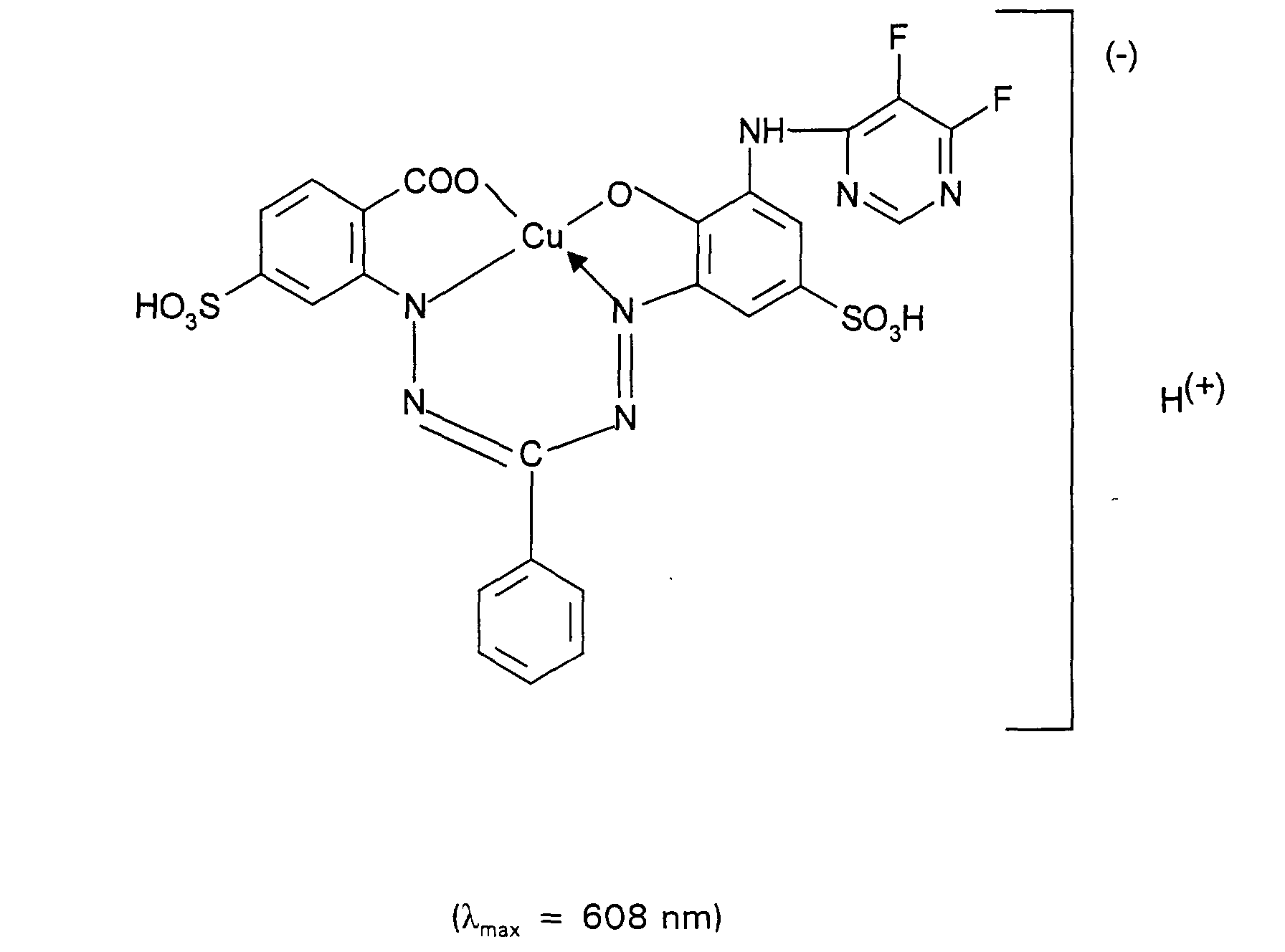
Die erhaltene Suspension des roten Kupplungsproduktes wird langsam unter Aufrechterhaltung eines pH-Wertes zwischen 7 und 8 mit 275 Teilen 2-Aminobenzoesäure und danach mit 1380 Teilen einer 18 %igen wäßrigen Kupfersulfatlösung versetzt. Man rührt noch einige Stunden nach, filtriert die Reaktionslösung und isoliert den erfindungsgemäßen Kupferformazanfarbstoff der Formel (in Form der freien Säure geschrieben)

Drucke von sehr hohen Echtheiten.
Claims (12)
- Fb
- ist der Rest eines sulfogruppenhaltigen Formazan-, Kupferformazan-Farbstoffes;
- n
- ist die Zahl 1, 2 oder 3;
- Z
- ist eine Gruppe der allgemeinen Formel (2)
in welcher

- Q
- eine kovalente Bindung oder eine Gruppe der Formel
ist, in welchen
- RA
- Wasserstoff oder Alkyl von 1 bis 4 C-Atomen ist, das durch Halogen, Hydroxy, Cyano, Alkoxy von 1 bis 4 C-Atomen, Alkoxycarbonyl von 2 bis 5 C-Atomen, Carboxy, Sulfamoyl, Sulfo, Sulfato oder Phosphato substituiert sein kann,
- W
- eine kovalente Bindung oder ein Brückenglied ist, wobei jedoch Q zwingend eine kovalente Bindung bedeutet, falls W für eine kovalene Bindung steht und wobei die Aminogruppen -N(RA)- und -N(R)- an ein C-Atom des Brückengliedes W oder an ein C-Atom eines Substituenten von W gebunden sind, und
- R
- Wasserstoff oder Alkyl von 1 bis 4 C-Atomen ist, das durch Halogen, Hydroxy, Cyano, Alkoxy von 1 bis 4 C-Atomen, Alkoxycarbonyl von 2 bis 5 C-Atomen, Carboxy, Sulfamoyl, Sulfo, Sulfato oder Phosphato substituiert sein kann.
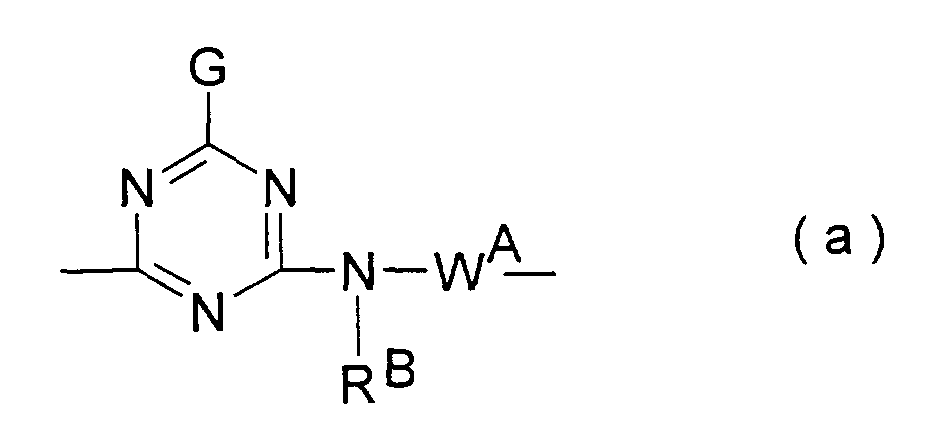
- G
- Fluor, Chlor, Brom, Cyanoamino, gegebenenfalls substituiertes Amino, Hydroxy, Alkoxy von 1 bis 4 C-Atomen, Phenoxy, gegebenenfalls durch 1 oder 2 Substituenten aus der Gruppe Sulfo, Carboxy, Methyl, Ethyl, Methoxy und Ethoxy substituiertes Phenoxy oder Alkylthio von 1 bis 4 C-Atomen ist,
- RB
- Wasserstoff oder Alkyl von 1 bis 4 C-Atomen ist, das durch Halogen, Hydroxy, Cyano, Alkoxy von 1 bis 4 C-Atomen, Alkoxycarbonyl von 2 bis 5 C-Atomen, Carboxy, Sulfamoyl, Sulfo, Sulfato oder Phosphato substituiert sein kann, und
- WA
- geradkettiges Alkylen von 2 bis 6 C-Atomen oder verzweigtes Alkylen von 3 bis 6 C-Atomen ist, die jeweils durch eine oder zwei Heterogruppen unterbrochen sind, welche aus den Gruppen der Formeln -O- , -CO- , -SO2-, -NH- , -N(RA) mit RA einer der in Anspruch 1 genannten Bedeutungen, -NH-CO- , -CO-NH- , -SO2-NH- oder -NH-SO2- ausgewählt sind, oder Phenylen ist, das durch 1 oder 2 Substituenten aus der Gruppe Sulfo, Carboxy, Methyl, Ethyl, Methoxy und Ethoxy substituiert sein kann.


Applications Claiming Priority (3)
| Application Number | Priority Date | Filing Date | Title |
|---|---|---|---|
| DE19651213A DE19651213A1 (de) | 1996-12-10 | 1996-12-10 | Wasserlösliche faserreaktive Farbstoffe, Verfahren zu ihrer Herstellung und ihre Verwendung |
| DE19651213 | 1996-12-10 | ||
| EP97121539A EP0848042A3 (de) | 1996-12-10 | 1997-12-08 | Wasserlösliche faserreaktive Farbstoffe, Verfahren zu ihrer Herstellung und ihre Verwendung |
Related Parent Applications (1)
| Application Number | Title | Priority Date | Filing Date |
|---|---|---|---|
| EP97121539A Division EP0848042A3 (de) | 1996-12-10 | 1997-12-08 | Wasserlösliche faserreaktive Farbstoffe, Verfahren zu ihrer Herstellung und ihre Verwendung |
Publications (2)
| Publication Number | Publication Date |
|---|---|
| EP1132433A2 true EP1132433A2 (de) | 2001-09-12 |
| EP1132433A3 EP1132433A3 (de) | 2003-02-12 |
Family
ID=7814189
Family Applications (3)
| Application Number | Title | Priority Date | Filing Date |
|---|---|---|---|
| EP01111301A Withdrawn EP1132433A3 (de) | 1996-12-10 | 1997-12-08 | Wasserlösliche faserreakive Farbstoffe, Verfahren zu ihrer Herstellung und ihre Verwendung |
| EP01111100A Withdrawn EP1127923A3 (de) | 1996-12-10 | 1997-12-08 | Wasserlösliche faserreakive Farbstoffe, Verfahren zu ihrer Herstellung und ihre Verwendung |
| EP97121539A Withdrawn EP0848042A3 (de) | 1996-12-10 | 1997-12-08 | Wasserlösliche faserreaktive Farbstoffe, Verfahren zu ihrer Herstellung und ihre Verwendung |
Family Applications After (2)
| Application Number | Title | Priority Date | Filing Date |
|---|---|---|---|
| EP01111100A Withdrawn EP1127923A3 (de) | 1996-12-10 | 1997-12-08 | Wasserlösliche faserreakive Farbstoffe, Verfahren zu ihrer Herstellung und ihre Verwendung |
| EP97121539A Withdrawn EP0848042A3 (de) | 1996-12-10 | 1997-12-08 | Wasserlösliche faserreaktive Farbstoffe, Verfahren zu ihrer Herstellung und ihre Verwendung |
Country Status (5)
| Country | Link |
|---|---|
| US (1) | US6060591A (de) |
| EP (3) | EP1132433A3 (de) |
| JP (1) | JPH10219130A (de) |
| KR (1) | KR19980063905A (de) |
| DE (1) | DE19651213A1 (de) |
Families Citing this family (6)
| Publication number | Priority date | Publication date | Assignee | Title |
|---|---|---|---|---|
| DE19711828A1 (de) * | 1997-03-21 | 1998-09-24 | Dystar Textilfarben Gmbh & Co | Wasserlösliche faserreaktive Farbstoffe, Verfahren zu ihrer Herstellung und ihre Verwendung |
| HUP0401711A3 (en) | 2001-06-26 | 2009-07-28 | Bristol Myers Squibb Co | N-heterocyclic inhibitors of tnf-alpha and pharmaceutical compositions containing them |
| GB0221907D0 (en) * | 2002-09-20 | 2002-10-30 | Dystar Textilfarben Gmbh & Co | Dye mixtures of fibre-reactive azo dyes and use thereof for dyeing material containing hydroxy- and/or carboxamido groups |
| US20080016119A1 (en) * | 2006-07-14 | 2008-01-17 | Sharma Parit K | Quality Assurance System and Method |
| US8187340B2 (en) | 2009-12-21 | 2012-05-29 | Living Proof, Inc. | Coloring agents and methods of use thereof |
| CN106590026B (zh) * | 2016-12-05 | 2018-06-12 | 泰兴锦云染料有限公司 | 一种活性蓝染料及其制备和应用 |
Family Cites Families (10)
| Publication number | Priority date | Publication date | Assignee | Title |
|---|---|---|---|---|
| US4024123A (en) * | 1966-07-21 | 1977-05-17 | Paul Dussy | Fiber-reactive, heavy metal-containing formazane dyestuffs |
| DE1644203B2 (de) * | 1967-03-25 | 1977-11-17 | Bayer Ag, 5090 Leverkusen | Reaktivfarbstoffe |
| US4007164A (en) * | 1968-03-19 | 1977-02-08 | Bayer Aktiengesellschaft | Azo dyestuffs containing 6-fluoro-pyrimidinyl 4-reactive group |
| DE4102777A1 (de) * | 1991-01-31 | 1992-08-06 | Bayer Ag | Vinylsulfon/pyrimidingruppenhaltige bifunktionelle reaktivfarbstoffe |
| DE59206979D1 (de) * | 1991-05-15 | 1996-10-02 | Bayer Ag | Reaktivfarbstoffe |
| DE4125754A1 (de) * | 1991-08-03 | 1993-02-04 | Bayer Ag | Fluorpyrimidin-reaktivfarbstoffe |
| DE4137291A1 (de) * | 1991-11-13 | 1993-05-19 | Bayer Ag | Verfahren zur kontinuierlichen umsetzung von halogenpyrimidinen mit aminen |
| DE4314300A1 (de) * | 1993-04-30 | 1994-11-03 | Bayer Ag | Reaktivfarbstoffe |
| DE4318620A1 (de) * | 1993-06-04 | 1994-12-08 | Bayer Ag | Reaktivfarbstoffe |
| DE19542547A1 (de) * | 1995-11-15 | 1997-05-22 | Dystar Textilfarben Gmbh & Co | Faserreaktive Azofarbstoffe, Verfahren zu ihrer Herstellung und ihre Verwendung |
-
1996
- 1996-12-10 DE DE19651213A patent/DE19651213A1/de not_active Withdrawn
-
1997
- 1997-12-01 US US08/987,939 patent/US6060591A/en not_active Expired - Fee Related
- 1997-12-08 EP EP01111301A patent/EP1132433A3/de not_active Withdrawn
- 1997-12-08 EP EP01111100A patent/EP1127923A3/de not_active Withdrawn
- 1997-12-08 EP EP97121539A patent/EP0848042A3/de not_active Withdrawn
- 1997-12-09 JP JP9339178A patent/JPH10219130A/ja not_active Withdrawn
- 1997-12-09 KR KR1019970066825A patent/KR19980063905A/ko not_active Withdrawn
Also Published As
| Publication number | Publication date |
|---|---|
| US6060591A (en) | 2000-05-09 |
| EP1127923A3 (de) | 2003-02-12 |
| EP0848042A3 (de) | 1998-10-28 |
| DE19651213A1 (de) | 1998-08-06 |
| EP1127923A2 (de) | 2001-08-29 |
| KR19980063905A (ko) | 1998-10-07 |
| JPH10219130A (ja) | 1998-08-18 |
| EP1132433A3 (de) | 2003-02-12 |
| EP0848042A2 (de) | 1998-06-17 |
Similar Documents
| Publication | Publication Date | Title |
|---|---|---|
| DE3217812A1 (de) | Monoazoverbindungen, verfahren zu ihrer herstellung und ihre verwendung als farbstoffe | |
| EP0056975B1 (de) | Wasserlösliche Monoazoverbindungen, Verfahren zu ihrer Herstellung und ihre Verwendung als Farbstoffe | |
| EP0783028B1 (de) | Wasserlösliche Azofarbstoffe, Verfahren zu ihrer Herstellung und ihre Verwendung | |
| EP0775730B1 (de) | Reaktivfarbstoffe, Verfahren zu deren Herstellung und deren Verwendung | |
| EP0675172A2 (de) | Wasserlösliche Azoverbindungen, Verfahren zu ihrer Herstellung und ihre Verwendung als Farbstoffe | |
| EP0043561B1 (de) | Wasserlösliche Phthalocyaninverbindungen, Verfahren zu ihrer Herstellung und ihre Verwendung als Farbstoffe | |
| EP1132433A2 (de) | Wasserlösliche faserreakive Farbstoffe, Verfahren zu ihrer Herstellung und ihre Verwendung | |
| EP0872523A2 (de) | Faseraktive Azofarbstoffe, Verfahren zu ihrer Herstellung und ihre Verwendung | |
| EP0542214A2 (de) | Wasserlösliche faserreaktive Farbstoffe, Verfahren zu ihrer Herstellung und ihre Verwendung | |
| DE19851497A1 (de) | Farbstoffmischungen von faserreaktiven Azofarbstoffen und ihre Verwendung | |
| EP0697443B1 (de) | Triphendioxazin-Reaktivfarbstoffe | |
| EP0630946A1 (de) | Wasserlösliche faserreaktive Azofarbstoffe, Verfahren zu ihrer Herstellung und ihre Verwendung | |
| EP0648815B1 (de) | Wasserlösliche, metallfreie Phthalocyaninfarbstoffe, Verfahren zu ihrer Herstellung und ihre Verwendung | |
| EP0708151B1 (de) | Faserreaktive Anthrachinonfarbstoffe, Verfahren zu deren Herstellung und deren Verwendung | |
| EP0507801B1 (de) | Azoverbindung, verfahren zu deren herstellung und ihre verwendung als farbstoffe | |
| EP0493759A1 (de) | Wasserlösliche Azoverbindungen, Verfahren zu deren Herstellung und ihre Verwendung als Farbstoffe | |
| EP1055710B1 (de) | Wasserlösliche faserreaktive Farbstoffe, Verfahren zu ihrer Herstellung und ihre Verwendung | |
| DE19820543A1 (de) | Wasserlösliche Monoazoverbindungen, Verfahren zu ihrer Herstellung und ihre Verwendung als Farbstoffe | |
| EP0326011B1 (de) | Wasserlösliche Disazoverbindungen, Verfahren zu ihrer Herstellung und ihre Verwendung als Farbstoffe | |
| DE3800690A1 (de) | Wasserloesliche 2-naphthol-azoverbindungen, verfahren zu ihrer herstellung und ihre verwendung als farbstoffe | |
| EP0624630A1 (de) | Wasserlösliche faserreaktive Farbstoffe, Verfahren zu ihrer Herstellung und ihre Verwendung | |
| EP0103156B1 (de) | Wasserlösliche Kupferkomplex-Disazoverbindungen, Verfahren zu ihrer Herstellung und ihre Verwendung als Farbstoffe | |
| DE3939909A1 (de) | Azoverbindungen und ihre verwendung als farbstoffe, 1-sulfo-6-carboxy-2-amino-naphthalin, dessen verwendung als vorprodukt der azoverbindungen und verfahren zur herstellung dieser verbindungen | |
| WO1994024214A1 (de) | Wasserlösliche faserreaktive farbstoffe, verfahren zu ihrer herstellung und ihre verwendung | |
| DE4327055A1 (de) | Wasserlösliche faserreaktive Farbstoffe, Verfahren zu ihrer Herstellung und ihre Verwendung |
Legal Events
| Date | Code | Title | Description |
|---|---|---|---|
| PUAI | Public reference made under article 153(3) epc to a published international application that has entered the european phase |
Free format text: ORIGINAL CODE: 0009012 |
|
| AC | Divisional application: reference to earlier application |
Ref document number: 848042 Country of ref document: EP |
|
| AK | Designated contracting states |
Kind code of ref document: A2 Designated state(s): CH DE FR GB LI |
|
| RIN1 | Information on inventor provided before grant (corrected) |
Inventor name: REDDIG, WOLFRAM, DR. Inventor name: EHRENBERG, STEFEN, DR. Inventor name: HENK, HERMANN, DR. Inventor name: HANSMANN, WILFRIED |
|
| RAP1 | Party data changed (applicant data changed or rights of an application transferred) |
Owner name: DYSTAR TEXTILFARBEN GMBH & CO. DEUTSCHLAND KG |
|
| PUAL | Search report despatched |
Free format text: ORIGINAL CODE: 0009013 |
|
| AK | Designated contracting states |
Designated state(s): CH DE FR GB LI |
|
| RIC1 | Information provided on ipc code assigned before grant |
Ipc: 7C 09B 62/038 B Ipc: 7C 09B 62/02 B Ipc: 7C 09B 62/503 B Ipc: 7C 09B 62/20 A |
|
| 17P | Request for examination filed |
Effective date: 20030812 |
|
| AKX | Designation fees paid |
Designated state(s): CH DE FR GB LI |
|
| 17Q | First examination report despatched |
Effective date: 20030919 |
|
| STAA | Information on the status of an ep patent application or granted ep patent |
Free format text: STATUS: THE APPLICATION IS DEEMED TO BE WITHDRAWN |
|
| 18D | Application deemed to be withdrawn |
Effective date: 20040130 |