EP1130641A1 - Boítier de circuit intégré surmoulé - Google Patents
Boítier de circuit intégré surmoulé Download PDFInfo
- Publication number
- EP1130641A1 EP1130641A1 EP01400403A EP01400403A EP1130641A1 EP 1130641 A1 EP1130641 A1 EP 1130641A1 EP 01400403 A EP01400403 A EP 01400403A EP 01400403 A EP01400403 A EP 01400403A EP 1130641 A1 EP1130641 A1 EP 1130641A1
- Authority
- EP
- European Patent Office
- Prior art keywords
- integrated circuit
- face
- substrate
- housing
- chip
- Prior art date
- Legal status (The legal status is an assumption and is not a legal conclusion. Google has not performed a legal analysis and makes no representation as to the accuracy of the status listed.)
- Granted
Links
Images


Classifications
-
- H—ELECTRICITY
- H10—SEMICONDUCTOR DEVICES; ELECTRIC SOLID-STATE DEVICES NOT OTHERWISE PROVIDED FOR
- H10W—GENERIC PACKAGES, INTERCONNECTIONS, CONNECTORS OR OTHER CONSTRUCTIONAL DETAILS OF DEVICES COVERED BY CLASS H10
- H10W70/00—Package substrates; Interposers; Redistribution layers [RDL]
- H10W70/40—Leadframes
- H10W70/453—Leadframes comprising flexible metallic tapes
-
- H—ELECTRICITY
- H10—SEMICONDUCTOR DEVICES; ELECTRIC SOLID-STATE DEVICES NOT OTHERWISE PROVIDED FOR
- H10W—GENERIC PACKAGES, INTERCONNECTIONS, CONNECTORS OR OTHER CONSTRUCTIONAL DETAILS OF DEVICES COVERED BY CLASS H10
- H10W40/00—Arrangements for thermal protection or thermal control
- H10W40/70—Fillings or auxiliary members in containers or in encapsulations for thermal protection or control
- H10W40/77—Auxiliary members characterised by their shape
- H10W40/778—Auxiliary members characterised by their shape in encapsulations
-
- H—ELECTRICITY
- H10—SEMICONDUCTOR DEVICES; ELECTRIC SOLID-STATE DEVICES NOT OTHERWISE PROVIDED FOR
- H10W—GENERIC PACKAGES, INTERCONNECTIONS, CONNECTORS OR OTHER CONSTRUCTIONAL DETAILS OF DEVICES COVERED BY CLASS H10
- H10W74/00—Encapsulations, e.g. protective coatings
- H10W74/01—Manufacture or treatment
- H10W74/016—Manufacture or treatment using moulds
-
- H—ELECTRICITY
- H10—SEMICONDUCTOR DEVICES; ELECTRIC SOLID-STATE DEVICES NOT OTHERWISE PROVIDED FOR
- H10W—GENERIC PACKAGES, INTERCONNECTIONS, CONNECTORS OR OTHER CONSTRUCTIONAL DETAILS OF DEVICES COVERED BY CLASS H10
- H10W74/00—Encapsulations, e.g. protective coatings
- H10W74/10—Encapsulations, e.g. protective coatings characterised by their shape or disposition
- H10W74/111—Encapsulations, e.g. protective coatings characterised by their shape or disposition the semiconductor body being completely enclosed
- H10W74/114—Encapsulations, e.g. protective coatings characterised by their shape or disposition the semiconductor body being completely enclosed by a substrate and the encapsulations
Definitions
- the present invention relates to a molded integrated circuit housing. She is located in the field of CSP boxes, abbreviation Anglo-Saxon for "Chip Scale packaging ", and particularly concerns BGA boxes, abbreviation for Anglo-Saxon for "Bail Grid Array”.
- It relates more particularly to a molded integrated circuit case allowing to dissipate the power emitted by the integrated circuit through the card that receives it.
- chip will be used to define the integrated circuit.
- ribbon will be used to define a substrate, usually in the form ribbon, flexible (flexible) to which the chip is connected by a technology known by the English terminology TAB, abbreviation for "Tape Automated Bonding ".
- the overmolding of the chips is widely used by the manufacturers of cases of chips and in particular the BGA boxes.
- the overmolding operation is generally used to protect the chip vis-à-vis of its external environment while allowing the evacuation of calories dissipated by the chip.
- EP0684641A describes a technique using two successive overmolding operations to avoid the phenomenon known as the English terminology "bending" which occurs during injection under pressure of the resin inside the mold and which causes stress, even destruction, connections between the chip and the copper conductors supported by the ribbon.
- the process described in this document consists in carrying out a first overmolding of the chip as close as possible to the chip, thus avoiding the "bending" effect, then to perform a second overmolding including the first and forming the upper part of the case.
- the chip and its overmolding are oriented towards the outside of the case.
- the first overmolding then includes the chip and the radiator without covering the external part of the radiator to allow good heat dissipation to the outside of the case.
- the second overmolding includes the first without however covering its part external.
- this packaging solution does not allow, from a size of determined housing, to receive chips of different sizes and thicknesses.
- the invention particularly aims to overcome these drawbacks.
- the housing according to the invention can thus respond to applications where it is necessary to dissipate by the card on which the chip is mounted, and especially for applications in the automotive field.
- the invention has the particular advantage of avoiding the "bending" effect during the overmolding and use the same overmolding tool for a size of housing determined and for different sizes of chips admissible for this housing.
- the subject of the invention is a molded case comprising an integrated circuit (1), conductive tracks carried by a flexible insulating substrate and connected to one side of the integrated circuit according to TAB technology and to outputs of the housing arranged on one face of the substrate, and an electrically insulating overmolding covering said face of the integrated circuit and overflowing on the face opposite to said face of the substrate, characterized in that it comprises, embedded in the overmolding, an electrically insulating reinforcement plate, placed flat in look of said face of the integrated circuit and projecting on either side of said face of the integrated circuit to cover part of the substrate and tracks corresponding, so as to completely and tightly obstruct the space between the integrated circuit and the substrate.
- the invention has as a corollary object a card carrying at least one case including an integrated circuit, conductive tracks carried by a flexible insulating substrate and connected to one face of the integrated circuit according to the TAB technology and to outputs of the housing arranged on one face of the substrate, and an electrically insulating overmolding covering said face of the integrated circuit and overflowing on the face opposite to said face of the substrate, characterized in that that the case is the one defined above.
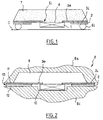
- Figure 1 schematically illustrates the basic structure of a BGA box overmolded fitted with balls, in a cross-sectional view.
- This structure comprises a chip 1 mounted according to TAB technology on a flexible insulating tape 2, for example of polyimide, supporting tracks conductive 3, usually copper.
- a flexible insulating tape 2 for example of polyimide
- supporting tracks conductive 3 usually copper.
- the wiring of the chip 1 on the ribbon 2 is carried out in a known manner according to the "bumpless” technology according to which the 3rd free ends of the tracks in copper 3 are connected to the respective aluminum 5i connection pads of chip 1 by thermosony. Wiring with "bump” is also compatible with the basic structure of the housing according to the invention.
- the outputs of the housing thus formed are intended to be connected to a card C by means of solder balls 6i.
- the upper part of structure 1, 2 and 3 is fully coated with an electrically insulating protective resin 7.
- the overmolding of the case in addition to the chip 1 protection function, also has the effect of stiffening the structure of the ribbon 2 and thus guarantee good coplanarity of the balls 6i during mounting on card C.
- Figure 2 schematically illustrates the shape of a tool used for the overmolding operation and which is attached to the chip-ribbon structure of the figure 1.
- the overmolding tool comprises a mold 8 in two parts: a part upper 8s whose internal profile 9 has a general bowl shape turned upside down, in the direction of the figure, and a lower part 8i opposite the first and comprising a cavity 10 disposed opposite the bowl 9.
- the lateral edges 11 and 12 of the two respective parts of the mold 8s and 8i are arranged to pinch the parts 13 of the ribbon 2 which are adjacent to the chip.
- the internal profile of the upper part 8s of the mold 8 defines the external shape of the overmolding 7 and the internal profile of the lower part 8i of the mold 8 defines the cavity 10 intended to contain the chip 1.
- the lower part 8i of the mold 8 also supports the chip-ribbon structure during the operation of overmolding.
- the lateral edges 11 of the upper part 8s are supported on the ribbon 2 and the tracks 3, on either side of the chip 1.
- the upper part 8s covers with sealing the active face 4 of the chip 1 and the TAB connections connecting the conductive pads 5i of the chip 1 at the 3rd ends of the supported tracks 3 by the ribbon 2.
- Overmolding is carried out by injecting the resin 7 inside the part upper 8s of the mold 8.
- the lower part 8i of the mold 8 is not intended to receive resin 7.
- the resin 7 passes between the ends 3e of the tracks 3 connected to the chip 1 and penetrates inside the cavity 10 of the lower part 8i of the mold 8 by pressing on chip 1, which lifts and reproduces at new to the "bending" effect defined above.
- Figures 3 to 7 illustrate exemplary embodiments of the invention in which a reinforcing plate 14, electrically insulating, is arranged on the upper part of the tape 2 and the ends of the tracks before overmolding of the case.
- This plate 14 has the advantage of reinforcing the rigidity of the structure of the housing and function to completely and tightly seal the space between chip 1 and ribbon 2, thus preventing the passage of the resin 7 inside the cavity 10 of the lower part 8i of the mold 8.
- the reinforcing plate 14 is placed flat on the strip 2 and extends on either side on the other side of the chip 1, extending over the ribbon 2 so as to cover completely and tightly the upper face 4 of the chip 1 as well as the 3rd ends of the tracks 3 connected to the chip 1.
- the reinforcing plate 14 can be made of epoxy with a thickness of 250 ⁇ m. His size is determined based on the maximum allowable chip size for a determined housing.
- the size of the cavity 10 of the lower part 8i of the mold 8 must be substantially the same order of magnitude as the reinforcing plate 14. It is also determined based on the maximum allowable chip size for the same case. This configuration is illustrated in Figures 3 and 4.
- the size of the plate is around 17 mm side.
- the reinforcing plate 14 remains identical in size to that used for the 15 mm side chip.
- the lower part 8i of the mold 8 remains the same size regardless of the allowable chip size for the housing.
- the structure according to the invention can allow mounting of an optional heat sink, or radiator 15 consisting for example of a metal plate serving as a dissipator thermal, more or less thick depending on the power dissipated by the chip and its application.
- connection balls 6i to the card C will be adapted to take into account the total thickness of the stack formed by the chip 1 and the radiator 15.
- radiator 15 will be adapted to chip dimensions 1.
- the radiator 15 is shown projecting slightly from the chip.
- the radiator 15 is either glued or welded to the underside of the chip 1.
- Figure 7 illustrates, alternatively, an embodiment of a mounted housing on card C where chip 1 dissipates directly on card C.
- the underside of the chip can be, for example, provided with a conducting plane, which can be soldered or glued to a conductive surface formed on the surface of the card C next to bullet 1.
- the dimensions of the connection balls 6i will be adapted to take account of the thickness of the chip 1 and of the solder or glue. 1.
- the invention has in particular the following optional characteristics.
- the plate 14 is dimensioned as a function of the maximum determined size of the integrated circuit 1 admissible for the dimensions of the housing.
- a heat sink 15 can be arranged on the face opposite the face of the integrated circuit 1 to its active face and having a size adapted to the size of the integrated circuit.
- the size of the cavity 10 of the first part 8i of the mold 8 is determined as a function of the maximum size of the integrated circuit 1 admissible for the housing.
- the plate 14 is dimensioned according to the maximum size of the integrated circuit 1 admissible for the dimensions of the housing.
- the face opposite to the active face of the integrated circuit is placed opposite the card and can either have a heat sink 15 in thermal contact with the card, or directly dissipate its thermal energy in the menu.
Landscapes
- Structures Or Materials For Encapsulating Or Coating Semiconductor Devices Or Solid State Devices (AREA)
- Encapsulation Of And Coatings For Semiconductor Or Solid State Devices (AREA)
- Cooling Or The Like Of Semiconductors Or Solid State Devices (AREA)
- Transmitters (AREA)
- Injection Moulding Of Plastics Or The Like (AREA)
Abstract
Description
- à disposer l'ensemble formé par le substrat et le circuit intégré relativement à une première partie d'un moule pourvue d'une cavité contenant le circuit intégré et de bords latéraux supportant ladite face du substrat de part et d'autre du circuit intégré ;
- à disposer une plaque de renfort électriquement isolante à plat en regard de ladite face du circuit intégré et débordant de part et d'autre de ladite face du circuit intégré pour recouvrir une partie du substrat et des pistes correspondantes de manière à obstruer totalement et de manière étanche l'espace compris entre le circuit intégré et le substrat ;
- à disposer une deuxième partie du moule, pourvue de bords latéraux et d'une cuvette placée en regard de ladite cavité, sur l'ensemble formé par le substrat et le circuit intégré de façon que les bords latéraux des deux parties du moule pincent de manière étanche des parties du substrat adjacentes au circuit intégré ; et
- à injecter une résine de surmoulage dans la cuvette pour former le surmoulage du boítier.
- la figure 1 est une vue schématique en coupe transversale d'un exemple de structure initiale d'un boítier équipé de billes ;
- la figure 2 est une vue schématique en coupe transversale d'un exemple d'outillage de surmoulage ;
- la figure 3 est une vue schématique en coupe transversale d'un exemple de structure d'un boítier selon l'invention avec plaque de renfort et plaque optionnelle de refroidissement dans le cas d'une puce de grande taille ;
- la figure 4 est une vue schématique en coupe transversale de l'outillage de surmoulage selon l'invention adapté à la structure de la figure 3 ;
- la figure 5 est une vue schématique en coupe transversale d'un exemple de structure d'un boítier selon l'invention avec plaque de renfort et plaque optionnelle de refroidissement dans le cas d'une puce de petite taille ;
- la figure 6 est une vue schématique en coupe transversale de l'outillage de surmoulage selon l'invention adapté à la structure de la figure 5 ; et
- la figure 7 est une variante d'un mode de réalisation d'un boítier monté sur une carte ou la puce dissipe directement sur la carte.
- disposer l'ensemble formé par le ruban et la puce à l'intérieur d'une première partie d'un moule comportant une cavité contenant la puce et des bords latéraux supportant le ruban de part et d'autre de la puce ;
- disposer une plaque de renfort électriquement isolante, disposée à plat, en regard de la puce, sur la face du ruban souple opposée à la face recevant la puce et débordant de part et d'autre de la puce sur le ruban de manière à rigidifier l'ensemble formé par la puce montée sur le ruban et à obstruer totalement et de manière étanche l'espace compris entre la puce et le ruban ;
- disposer une deuxième partie du moule sur l'ensemble formé par le ruban et la puce en les recouvrant et s'appuyant sur le ruban de part et d'autre de la puce pour pincer de manière étanche le ruban entre les deux parties du moule ; et
- injecter une résine de surmoulage à l'intérieur de la deuxième partie du moule pour former le surmoulage du boítier.
1. En conclusion, l'invention a notamment les caractéristiques optionnelles suivantes. Dans le boítier, la plaque 14 est dimensionnée en fonction de la taille maximale déterminée du circuit intégré 1 admissible pour les dimensions du boítier. En outre, un dissipateur thermique 15 peut être disposé sur la face opposée à la face du circuit intégré 1 à sa face active et ayant une taille adaptée à la taille du circuit intégré. Pour le procédé, la taille de la cavité 10 de la première partie 8i du moule 8 est déterminée en fonction de la taille maximale du circuit intégré 1 admissible pour le boítier. D'autre part, la plaque 14 est dimensionnée en fonction de la taille maximale du circuit intégré 1 admissible pour les dimensions du boítier. Enfin, en ce qui concerne la carte C, la face opposée à la face active du circuit intégré est placée en regard de la carte et peut soit présenter un dissipateur thermique 15 en contact thermique avec la carte, soit dissiper directement son énergie thermique dans la carte.
Claims (9)
- 2. Boítier surmoulé comprenant un circuit intégré (1), des pistes conductrices (3) portées par un substrat isolant souple (2) et connectées à une face du circuit intégré selon la technologie TAB et à des sorties du boítier disposées sur une face du substrat (2), et un surmoulage électriquement isolant (7) recouvrant ladite face du circuit intégré et débordant sur la face opposée à la dite face du substrat, caractérisé en ce qu'il comporte, noyé dans le surmoulage (7), une plaque de renfort (14) électriquement isolante, disposée à plat en regard de ladite face du circuit intégré et débordant de part et d'autre de ladite face du circuit intégré pour recouvrir une partie du substrat (2) et des pistes (3) correspondantes, de manière à obstruer totalement et de manière étanche l'espace compris entre le circuit intégré (1) et le substrat (2).
- 3. Boítier selon la revendication 1, caractérisé en ce que la plaque (14) est dimensionnée en fonction de la taille maximale déterminée du circuit intégré (1) admissible pour les dimensions du boítier.
- 4. Boítier selon la revendication 1 ou 2, caractérisé en ce qu'il comporte un dissipateur thermique (15) disposé sur la face opposée à ladite face du circuit intégré (1) et ayant une taille adaptée à la taille du circuit intégré.
- 5. Procédé de surmoulage d'un boítier comprenant un circuit intégré (1) et des pistes conductrices (3) portées par un substrat isolant souple (2) et connectées à une face du circuit intégré selon la technologie TAB et à des sorties du boítier disposées sur une face du substrat (2), caractérisé en ce qu'il consiste :à disposer l'ensemble formé par le substrat (2) et le circuit intégré (1) relativement à une première partie (8i) d'un moule (8) pourvue d'une cavité (10) contenant le circuit intégré (1) et de bords latéraux (12) supportant ladite face du substrat (2) de part et d'autre du circuit intégré (1) ;à disposer une plaque de renfort électriquement isolante (14) à plat en regard de ladite face du circuit intégré et débordant de part et d'autre de ladite face du circuit intégré pour recouvrir une partie du substrat (2) et des pistes (3) correspondantes de manière à obstruer totalement et de manière étanche l'espace compris entre le circuit intégré (1) et le substrat (2) ;à disposer une deuxième partie (8s) du moule (8), pourvue de bords latéraux (11) et d'une cuvette (9) placée en regard de ladite cavité (10), sur l'ensemble formé par le substrat (2) et le circuit intégré (1) de façon que les bords latéraux (11, 12) des deux parties du moule pincent de manière étanche des parties (13) du substrat adjacentes au circuit intégré ; età injecter une résine de surmoulage dans la cuvette (9) pour former le surmoulage (7) du boítier.
- 6. Procédé selon la revendication 4, caractérisé en ce que la taille de la cavité (10) de la première partie (8i) du moule (8) est déterminée en fonction de la taille maximale du circuit intégré (1) admissible pour le boítier.
- 7. Procédé selon la revendication 4 ou 5, caractérisé en ce que la plaque (14) est dimensionnée en fonction de la taille maximale du circuit intégré (1) admissible pour les dimensions du boítier.
- 8. Carte (C) portant au moins un boítier incluant un circuit intégré (1), des pistes conductrices (3) portées par un substrat isolant souple (2) et connectées à une face du circuit intégré selon la technologie TAB et à des sorties du boítier disposées sur une face du substrat (2), et un surmoulage électriquement isolant (7) recouvrant ladite face du circuit intégré et débordant sur la face opposée à la dite face du substrat, caractérisé en ce que le boítier est défini par l'une des revendications 1 à 3.
- 9. Carte selon la revendication 7, caractérisé en ce que la face opposée à ladite face du circuit intégré est placée en regard de la carte et présente un dissipateur thermique (15) en contact thermique avec la carte.
- 10. Carte selon la revendication 7, caractérisé en ce que la face opposée à ladite face du circuit intégré est placée en regard de la carte et dissipe directement son énergie thermique dans la carte.
Applications Claiming Priority (2)
| Application Number | Priority Date | Filing Date | Title |
|---|---|---|---|
| FR0001965A FR2805392B1 (fr) | 2000-02-17 | 2000-02-17 | Boitier de circuit integre surmoule |
| FR0001965 | 2000-02-17 |
Publications (2)
| Publication Number | Publication Date |
|---|---|
| EP1130641A1 true EP1130641A1 (fr) | 2001-09-05 |
| EP1130641B1 EP1130641B1 (fr) | 2007-12-26 |
Family
ID=8847093
Family Applications (1)
| Application Number | Title | Priority Date | Filing Date |
|---|---|---|---|
| EP01400403A Expired - Lifetime EP1130641B1 (fr) | 2000-02-17 | 2001-02-15 | Boîtier de circuit intégré surmoulé |
Country Status (4)
| Country | Link |
|---|---|
| EP (1) | EP1130641B1 (fr) |
| AT (1) | ATE382191T1 (fr) |
| DE (1) | DE60132037T2 (fr) |
| FR (1) | FR2805392B1 (fr) |
Citations (4)
| Publication number | Priority date | Publication date | Assignee | Title |
|---|---|---|---|---|
| JPS5827350A (ja) * | 1981-08-11 | 1983-02-18 | Citizen Watch Co Ltd | Icの実装方法 |
| JPH01135050A (ja) * | 1987-11-20 | 1989-05-26 | Hitachi Ltd | 半導体装置 |
| EP0684641A2 (fr) * | 1994-05-26 | 1995-11-29 | Nec Corporation | Encapsulage d'un dispositif à semi-conducteur ayant une haute résistance à l'humidité |
| US6023096A (en) * | 1997-03-01 | 2000-02-08 | Nitto Denko Corporation | Semiconductor device having metal foil integral with sealing resin |
-
2000
- 2000-02-17 FR FR0001965A patent/FR2805392B1/fr not_active Expired - Fee Related
-
2001
- 2001-02-15 DE DE60132037T patent/DE60132037T2/de not_active Expired - Lifetime
- 2001-02-15 AT AT01400403T patent/ATE382191T1/de not_active IP Right Cessation
- 2001-02-15 EP EP01400403A patent/EP1130641B1/fr not_active Expired - Lifetime
Patent Citations (4)
| Publication number | Priority date | Publication date | Assignee | Title |
|---|---|---|---|---|
| JPS5827350A (ja) * | 1981-08-11 | 1983-02-18 | Citizen Watch Co Ltd | Icの実装方法 |
| JPH01135050A (ja) * | 1987-11-20 | 1989-05-26 | Hitachi Ltd | 半導体装置 |
| EP0684641A2 (fr) * | 1994-05-26 | 1995-11-29 | Nec Corporation | Encapsulage d'un dispositif à semi-conducteur ayant une haute résistance à l'humidité |
| US6023096A (en) * | 1997-03-01 | 2000-02-08 | Nitto Denko Corporation | Semiconductor device having metal foil integral with sealing resin |
Non-Patent Citations (2)
| Title |
|---|
| PATENT ABSTRACTS OF JAPAN vol. 007, no. 107 (E - 174) 11 May 1983 (1983-05-11) * |
| PATENT ABSTRACTS OF JAPAN vol. 013, no. 386 (E - 812) 25 August 1989 (1989-08-25) * |
Also Published As
| Publication number | Publication date |
|---|---|
| EP1130641B1 (fr) | 2007-12-26 |
| FR2805392B1 (fr) | 2003-08-08 |
| ATE382191T1 (de) | 2008-01-15 |
| DE60132037T2 (de) | 2008-12-18 |
| FR2805392A1 (fr) | 2001-08-24 |
| DE60132037D1 (de) | 2008-02-07 |
Similar Documents
| Publication | Publication Date | Title |
|---|---|---|
| US7906859B2 (en) | Semiconductor device | |
| US6509636B1 (en) | Semiconductor package | |
| US7608915B2 (en) | Heat dissipation semiconductor package | |
| US6515360B2 (en) | Packaged semiconductor device and manufacturing method thereof | |
| FR2837022A1 (fr) | Dispositif a semiconducteur de puissance | |
| CN110228786B (zh) | 半导体装置封装及其制造方法 | |
| FR2726940A1 (fr) | Dispositif a semiconducteurs comportant un boitier et une embase isolante, et procede de fabrication de ce dispositif | |
| FR2851374A1 (fr) | Boitier-semi-conducteur a puce de circuits integres portee par les pattes de connexion electrique | |
| FR2755540A1 (fr) | Cadre conducteur a fils de connexion, boitier le comportant et son procede de fabrication | |
| FR3012670A1 (fr) | Systeme electronique comprenant des dispositifs electroniques empiles munis de puces de circuits integres | |
| US20090109626A1 (en) | Apparatus and method providing metallic thermal interface between metal capped module and heat sink | |
| EP0883177A1 (fr) | Dispositif semi-conducteur muni d'un dissipateur thermique. | |
| US20100308468A1 (en) | Semiconductor device and semiconductor device fabrication method | |
| FR2725833A1 (fr) | Structure d'etancheite pour un emballage porteur de bande et son procede de fabrication | |
| US9236276B2 (en) | Semiconductor device and method for manufacturing the same | |
| WO2001033635A1 (fr) | Boitier semi-conducteur optique et procede de fabrication d'un tel boitier | |
| FR3085576A1 (fr) | Couvercle pour boitier de circuit integre | |
| WO2018115709A1 (fr) | Module électronique de puissance comprenant une face d'échange thermique | |
| EP1130641B1 (fr) | Boîtier de circuit intégré surmoulé | |
| EP1192592B1 (fr) | Dispositif et procede de fabrication de dispositifs electroniques comportant au moins une puce fixee sur un support | |
| FR2968126A1 (fr) | Boitier semi-conducteur a via thermique et procédé de fabrication | |
| EP0948047A2 (fr) | Dispositif de refroidissement pour composant électronique | |
| FR2758908A1 (fr) | Boitier d'encapsulation hyperfrequences bas cout | |
| WO2013053476A2 (fr) | Systeme de maintien mecanique, ensemble comprenant un tel systeme et une carte electronique et procede d'assemblage sur une surface d'un tel systeme et d'une telle carte | |
| FR3059152A1 (fr) | Dispositif de transfert thermique, de connexion electrique et dispositif electronique |
Legal Events
| Date | Code | Title | Description |
|---|---|---|---|
| PUAI | Public reference made under article 153(3) epc to a published international application that has entered the european phase |
Free format text: ORIGINAL CODE: 0009012 |
|
| AK | Designated contracting states |
Kind code of ref document: A1 Designated state(s): AT BE CH CY DE DK ES FI FR GB GR IE IT LI LU MC NL PT SE TR |
|
| AX | Request for extension of the european patent |
Free format text: AL;LT;LV;MK;RO;SI |
|
| 17P | Request for examination filed |
Effective date: 20020305 |
|
| AKX | Designation fees paid |
Free format text: AT BE CH CY DE DK ES FI FR GB GR IE IT LI LU MC NL PT SE TR |
|
| 17Q | First examination report despatched |
Effective date: 20020513 |
|
| GRAP | Despatch of communication of intention to grant a patent |
Free format text: ORIGINAL CODE: EPIDOSNIGR1 |
|
| GRAS | Grant fee paid |
Free format text: ORIGINAL CODE: EPIDOSNIGR3 |
|
| GRAA | (expected) grant |
Free format text: ORIGINAL CODE: 0009210 |
|
| AK | Designated contracting states |
Kind code of ref document: B1 Designated state(s): AT BE CH CY DE DK ES FI FR GB GR IE IT LI LU MC NL PT SE TR |
|
| REG | Reference to a national code |
Ref country code: GB Ref legal event code: FG4D Free format text: NOT ENGLISH |
|
| GBT | Gb: translation of ep patent filed (gb section 77(6)(a)/1977) |
Effective date: 20071228 |
|
| REG | Reference to a national code |
Ref country code: IE Ref legal event code: FG4D Free format text: LANGUAGE OF EP DOCUMENT: FRENCH |
|
| REG | Reference to a national code |
Ref country code: CH Ref legal event code: EP |
|
| REF | Corresponds to: |
Ref document number: 60132037 Country of ref document: DE Date of ref document: 20080207 Kind code of ref document: P |
|
| PG25 | Lapsed in a contracting state [announced via postgrant information from national office to epo] |
Ref country code: SE Free format text: LAPSE BECAUSE OF FAILURE TO SUBMIT A TRANSLATION OF THE DESCRIPTION OR TO PAY THE FEE WITHIN THE PRESCRIBED TIME-LIMIT Effective date: 20080326 |
|
| PG25 | Lapsed in a contracting state [announced via postgrant information from national office to epo] |
Ref country code: FI Free format text: LAPSE BECAUSE OF FAILURE TO SUBMIT A TRANSLATION OF THE DESCRIPTION OR TO PAY THE FEE WITHIN THE PRESCRIBED TIME-LIMIT Effective date: 20071226 Ref country code: NL Free format text: LAPSE BECAUSE OF FAILURE TO SUBMIT A TRANSLATION OF THE DESCRIPTION OR TO PAY THE FEE WITHIN THE PRESCRIBED TIME-LIMIT Effective date: 20071226 |
|
| NLV1 | Nl: lapsed or annulled due to failure to fulfill the requirements of art. 29p and 29m of the patents act | ||
| PG25 | Lapsed in a contracting state [announced via postgrant information from national office to epo] |
Ref country code: AT Free format text: LAPSE BECAUSE OF FAILURE TO SUBMIT A TRANSLATION OF THE DESCRIPTION OR TO PAY THE FEE WITHIN THE PRESCRIBED TIME-LIMIT Effective date: 20071226 |
|
| PG25 | Lapsed in a contracting state [announced via postgrant information from national office to epo] |
Ref country code: ES Free format text: LAPSE BECAUSE OF FAILURE TO SUBMIT A TRANSLATION OF THE DESCRIPTION OR TO PAY THE FEE WITHIN THE PRESCRIBED TIME-LIMIT Effective date: 20080406 |
|
| BERE | Be: lapsed |
Owner name: BULL S.A. Effective date: 20080228 |
|
| PG25 | Lapsed in a contracting state [announced via postgrant information from national office to epo] |
Ref country code: PT Free format text: LAPSE BECAUSE OF FAILURE TO SUBMIT A TRANSLATION OF THE DESCRIPTION OR TO PAY THE FEE WITHIN THE PRESCRIBED TIME-LIMIT Effective date: 20080526 |
|
| REG | Reference to a national code |
Ref country code: CH Ref legal event code: PL |
|
| REG | Reference to a national code |
Ref country code: IE Ref legal event code: FD4D |
|
| PG25 | Lapsed in a contracting state [announced via postgrant information from national office to epo] |
Ref country code: MC Free format text: LAPSE BECAUSE OF NON-PAYMENT OF DUE FEES Effective date: 20080228 Ref country code: DK Free format text: LAPSE BECAUSE OF FAILURE TO SUBMIT A TRANSLATION OF THE DESCRIPTION OR TO PAY THE FEE WITHIN THE PRESCRIBED TIME-LIMIT Effective date: 20071226 Ref country code: CH Free format text: LAPSE BECAUSE OF NON-PAYMENT OF DUE FEES Effective date: 20080229 Ref country code: IE Free format text: LAPSE BECAUSE OF FAILURE TO SUBMIT A TRANSLATION OF THE DESCRIPTION OR TO PAY THE FEE WITHIN THE PRESCRIBED TIME-LIMIT Effective date: 20071226 Ref country code: LI Free format text: LAPSE BECAUSE OF NON-PAYMENT OF DUE FEES Effective date: 20080229 |
|
| PLBE | No opposition filed within time limit |
Free format text: ORIGINAL CODE: 0009261 |
|
| STAA | Information on the status of an ep patent application or granted ep patent |
Free format text: STATUS: NO OPPOSITION FILED WITHIN TIME LIMIT |
|
| 26N | No opposition filed |
Effective date: 20080929 |
|
| PG25 | Lapsed in a contracting state [announced via postgrant information from national office to epo] |
Ref country code: GR Free format text: LAPSE BECAUSE OF FAILURE TO SUBMIT A TRANSLATION OF THE DESCRIPTION OR TO PAY THE FEE WITHIN THE PRESCRIBED TIME-LIMIT Effective date: 20080327 |
|
| PG25 | Lapsed in a contracting state [announced via postgrant information from national office to epo] |
Ref country code: BE Free format text: LAPSE BECAUSE OF NON-PAYMENT OF DUE FEES Effective date: 20080228 |
|
| PG25 | Lapsed in a contracting state [announced via postgrant information from national office to epo] |
Ref country code: CY Free format text: LAPSE BECAUSE OF FAILURE TO SUBMIT A TRANSLATION OF THE DESCRIPTION OR TO PAY THE FEE WITHIN THE PRESCRIBED TIME-LIMIT Effective date: 20071226 |
|
| PG25 | Lapsed in a contracting state [announced via postgrant information from national office to epo] |
Ref country code: LU Free format text: LAPSE BECAUSE OF NON-PAYMENT OF DUE FEES Effective date: 20080215 |
|
| PG25 | Lapsed in a contracting state [announced via postgrant information from national office to epo] |
Ref country code: TR Free format text: LAPSE BECAUSE OF FAILURE TO SUBMIT A TRANSLATION OF THE DESCRIPTION OR TO PAY THE FEE WITHIN THE PRESCRIBED TIME-LIMIT Effective date: 20071226 |
|
| REG | Reference to a national code |
Ref country code: FR Ref legal event code: PLFP Year of fee payment: 16 |
|
| REG | Reference to a national code |
Ref country code: FR Ref legal event code: PLFP Year of fee payment: 17 |
|
| REG | Reference to a national code |
Ref country code: FR Ref legal event code: PLFP Year of fee payment: 18 |
|
| PGFP | Annual fee paid to national office [announced via postgrant information from national office to epo] |
Ref country code: GB Payment date: 20190227 Year of fee payment: 19 Ref country code: IT Payment date: 20190221 Year of fee payment: 19 |
|
| PGFP | Annual fee paid to national office [announced via postgrant information from national office to epo] |
Ref country code: FR Payment date: 20190227 Year of fee payment: 19 |
|
| PGFP | Annual fee paid to national office [announced via postgrant information from national office to epo] |
Ref country code: DE Payment date: 20190426 Year of fee payment: 19 |
|
| REG | Reference to a national code |
Ref country code: DE Ref legal event code: R119 Ref document number: 60132037 Country of ref document: DE |
|
| GBPC | Gb: european patent ceased through non-payment of renewal fee |
Effective date: 20200215 |
|
| PG25 | Lapsed in a contracting state [announced via postgrant information from national office to epo] |
Ref country code: GB Free format text: LAPSE BECAUSE OF NON-PAYMENT OF DUE FEES Effective date: 20200215 Ref country code: FR Free format text: LAPSE BECAUSE OF NON-PAYMENT OF DUE FEES Effective date: 20200229 Ref country code: DE Free format text: LAPSE BECAUSE OF NON-PAYMENT OF DUE FEES Effective date: 20200901 |
|
| PG25 | Lapsed in a contracting state [announced via postgrant information from national office to epo] |
Ref country code: IT Free format text: LAPSE BECAUSE OF NON-PAYMENT OF DUE FEES Effective date: 20200215 |