EP1127072B1 - Mittel zur bestimmung und reinigung von lymphocytenpopulationen des typs tcd8+, die spezifisch für im zusammenhang mit hla präsentierte peptide sind - Google Patents
Mittel zur bestimmung und reinigung von lymphocytenpopulationen des typs tcd8+, die spezifisch für im zusammenhang mit hla präsentierte peptide sind Download PDFInfo
- Publication number
- EP1127072B1 EP1127072B1 EP00960796A EP00960796A EP1127072B1 EP 1127072 B1 EP1127072 B1 EP 1127072B1 EP 00960796 A EP00960796 A EP 00960796A EP 00960796 A EP00960796 A EP 00960796A EP 1127072 B1 EP1127072 B1 EP 1127072B1
- Authority
- EP
- European Patent Office
- Prior art keywords
- peptide
- tetramer
- complexes
- specific
- hla
- Prior art date
- Legal status (The legal status is an assumption and is not a legal conclusion. Google has not performed a legal analysis and makes no representation as to the accuracy of the status listed.)
- Expired - Lifetime
Links
Images



Classifications
-
- A—HUMAN NECESSITIES
- A61—MEDICAL OR VETERINARY SCIENCE; HYGIENE
- A61P—SPECIFIC THERAPEUTIC ACTIVITY OF CHEMICAL COMPOUNDS OR MEDICINAL PREPARATIONS
- A61P37/00—Drugs for immunological or allergic disorders
- A61P37/02—Immunomodulators
-
- A—HUMAN NECESSITIES
- A61—MEDICAL OR VETERINARY SCIENCE; HYGIENE
- A61P—SPECIFIC THERAPEUTIC ACTIVITY OF CHEMICAL COMPOUNDS OR MEDICINAL PREPARATIONS
- A61P37/00—Drugs for immunological or allergic disorders
- A61P37/02—Immunomodulators
- A61P37/04—Immunostimulants
-
- C—CHEMISTRY; METALLURGY
- C07—ORGANIC CHEMISTRY
- C07K—PEPTIDES
- C07K14/00—Peptides having more than 20 amino acids; Gastrins; Somatostatins; Melanotropins; Derivatives thereof
- C07K14/435—Peptides having more than 20 amino acids; Gastrins; Somatostatins; Melanotropins; Derivatives thereof from animals; from humans
- C07K14/705—Receptors; Cell surface antigens; Cell surface determinants
- C07K14/70503—Immunoglobulin superfamily
- C07K14/70539—MHC-molecules, e.g. HLA-molecules
-
- C—CHEMISTRY; METALLURGY
- C12—BIOCHEMISTRY; BEER; SPIRITS; WINE; VINEGAR; MICROBIOLOGY; ENZYMOLOGY; MUTATION OR GENETIC ENGINEERING
- C12N—MICROORGANISMS OR ENZYMES; COMPOSITIONS THEREOF; PROPAGATING, PRESERVING, OR MAINTAINING MICROORGANISMS; MUTATION OR GENETIC ENGINEERING; CULTURE MEDIA
- C12N5/00—Undifferentiated human, animal or plant cells, e.g. cell lines; Tissues; Cultivation or maintenance thereof; Culture media therefor
- C12N5/06—Animal cells or tissues; Human cells or tissues
- C12N5/0602—Vertebrate cells
- C12N5/0634—Cells from the blood or the immune system
- C12N5/0636—T lymphocytes
-
- G—PHYSICS
- G01—MEASURING; TESTING
- G01N—INVESTIGATING OR ANALYSING MATERIALS BY DETERMINING THEIR CHEMICAL OR PHYSICAL PROPERTIES
- G01N33/00—Investigating or analysing materials by specific methods not covered by groups G01N1/00 - G01N31/00
- G01N33/48—Biological material, e.g. blood, urine; Haemocytometers
- G01N33/50—Chemical analysis of biological material, e.g. blood, urine; Testing involving biospecific ligand binding methods; Immunological testing
- G01N33/53—Immunoassay; Biospecific binding assay; Materials therefor
- G01N33/569—Immunoassay; Biospecific binding assay; Materials therefor for microorganisms, e.g. protozoa, bacteria, viruses
- G01N33/56966—Animal cells
- G01N33/56972—White blood cells
-
- A—HUMAN NECESSITIES
- A61—MEDICAL OR VETERINARY SCIENCE; HYGIENE
- A61K—PREPARATIONS FOR MEDICAL, DENTAL OR TOILETRY PURPOSES
- A61K35/00—Medicinal preparations containing materials or reaction products thereof with undetermined constitution
- A61K35/12—Materials from mammals; Compositions comprising non-specified tissues or cells; Compositions comprising non-embryonic stem cells; Genetically modified cells
- A61K2035/124—Materials from mammals; Compositions comprising non-specified tissues or cells; Compositions comprising non-embryonic stem cells; Genetically modified cells the cells being hematopoietic, bone marrow derived or blood cells
-
- A—HUMAN NECESSITIES
- A61—MEDICAL OR VETERINARY SCIENCE; HYGIENE
- A61K—PREPARATIONS FOR MEDICAL, DENTAL OR TOILETRY PURPOSES
- A61K38/00—Medicinal preparations containing peptides
Definitions
- the invention relates to means for detecting and purifying TCD8 + lymphocyte populations specific for peptides presented in the HLA context.
- the T lymphocyte carries a specific receptor for the antigen against which it is committed, called TCR.
- This TCR is composed of several chains, including the ⁇ and ⁇ chains that are involved in the specific recognition of a particular antigenic peptide presented in an HLA molecule. This recognition is materialized by the ability of the TCR ⁇ / ⁇ of the T lymphocyte to bind with a certain affinity to the HLA-peptide complexes present on the surface of the target cell.
- soluble HLA-peptide complexes are capable of binding to the TCRs present on the surface of the T lymphocytes specific for the HLA-peptide complex under consideration.
- the most molecularly studied system is the recognition by CD8 + T lymphocytes of antigenic peptides presented in molecules of the major histocompatibility complex (MHC) of class I and in particular in the HLA-A0201 allele.
- MHC major histocompatibility complex
- the TCR is not the only molecule in the T lymphocyte that can interact with the HLA-peptide complex. Indeed, during physiological recognition, the TCR binding to the MHC-peptide complex is enhanced by the binding of the CD8 co-receptor to a constant portion of the class I MHC molecules. The participation of the CD8 in the interaction is variable. one lymphocyte clone to another and may in some cases lead to a very significant increase in binding capacity to a given HLA-peptide complex. This ability of CD8 to bind to HLA class I results in a background binding of HLA class I tetramers to CD8 + T cells that carry non-specific TCRs of the HLA-peptide complex.
- HLA tetramers In addition, another potential application of HLA tetramers has been considered. It consists of isolating, by sorting (in flow cytometry or by immunomagnetic screening) reactive lymphocyte populations against a given HLA-peptide complex for expansion purposes in vitro, and then of therapeutic use in anti-inflammatory passive immunization protocols. viral or anti-tumor. But the background tetramer fixation due to the participation of CD8 can be a serious obstacle to this application because it leads to the isolation of an often large fraction of non-reactive T cells vis-à-vis the complex HLA- peptide selecting.
- Salter et al (2) showed that the binding of a membranous HLA expressed by cells transfected with a CD8 ⁇ co-receptor was altered when the HLA involved a mutation in the ⁇ 3 domain.
- the mutated tetramers detect only a fraction of the reactive cells (the least CD8-dependent) within a polyclonal population.
- the invention is therefore based on the use of the properties demonstrated in multimers of HLA mutated, or, more generally, altered, and aims, as new products, such multimers and their complexes with antigenic peptides .
- TCD8 + peptide-specific lymphocyte populations It also relates to the use of these molecules for the detection and / or isolation of TCD8 + peptide-specific lymphocyte populations.
- It also aims to provide a method for detecting and / or isolating such populations using such molecules, loaded with peptide, in particular for diagnostic and therapeutic applications.
- the invention thus relates to a tetrameric complex of MHC class I monomers having at least one amino acid substitution in the ⁇ 3 domain in the interaction zone of a class I MHC monomer heavy chain with a T-cell CD8 receptor, the affinity of this tetrameric complex for T-cell CD8 co-receptors being reduced relative to the affinity of a corresponding unsubstituted native tetrameric complex.
- the alteration of the interaction zone more particularly concerns the ⁇ 3 domain of the heavy chain.
- the mutation of an alanine residue into a valine residue at position 245 of the ⁇ 3 domain of the HLA-A2 molecule may be mentioned.
- the alteration may also consist of a chemical modification of at least one amino acid and / or a deletion of at least one amino acid, this or these types of alteration being added, if necessary, to one or more mutations.
- the invention also aims, as new products, complexes developed from multimers defined above and antigenic peptides.
- the multimers are in particular in the form of tetramers.
- these complexes are used for the detection and / or isolation of TCD8 + lymphocyte populations specifically recognizing the antigenic peptide of the complexes.
- said complexes are used in a cell sorting process, such as immunomagnetic screening.
- This technique is based on the use of a system of beads coated with MHC-peptide complexes (produced in a Drosophila system, loaded with peptides and chemically biotinylated).
- the revelation is carried out for example by fluorescence using multimers comprising fluorescent compounds.
- the method of isolating peptide-specific lymphocyte populations from polyclonal populations is also within the scope of the invention and can be carried out, if appropriate, after the above detection step.
- a bacterial expression plasmid containing the cDNA coding for the HLA0201 heavy chain extended with a sequence coding for an enzymatic biotinylation motif (construction according to Altman et al (1)) was used.
- coding for the ⁇ 3 domain was amplified with specific primers SEQ ID No. 1 5 'CCTTCCAGAAGTGGGTGGCTGTGGTGGTGCC 3' and SEQ ID NO: 2 5 'GGCACCACCACAGCCACCCACTTCTGGAAGG 3'
- a mutation of a base was introduced into the amplification fragments to transform the alanine codon into a valine codon using the Stratagene Site-directed Mutagenesis R QuickChange Kit.
- the mutated fragment was reintroduced into the expression plasmid and the presence of the mutation was monitored by sequencing.
- the mutated HLA-A0201 heavy chain was produced in a bacterial inclusion body and the peptide-loaded HLA monomer, and then the corresponding mutated tetramer, could be obtained according to a renaturation protocol previously described by Garboczi et al (3).
- Native HLA-A0201 tetramers and corresponding mutated tetramers were either loaded with a peptide derived from the EBV virus BMLF1 protein, or with a peptide derived from the CMV pp65 protein.
- the native tetramers are obtained according to the technique of Example 1, but without the mutation.
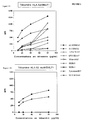
- the figure 1 gives the fluorescence intensity averages (MFI) obtained with the native HLA-A2 / BMLF1 tetramers ( Figure 1A ) and with the corresponding mutated tetramers ( Figure 1B ).
- This background does not seem to be exclusively related to the HLA restriction of the clone considered, but also depends on the charged peptide since two HLA-A0201 restricted anti-IE1 clones give a strong background noise, whereas the anti-melan-A clone also restricted HLA-A0201 gives a moderate background noise.
- the fluorescence averages (MFI) obtained on the specific clones (BM / A2) are lower than those obtained with the native tetramer, but the background noise on the non-specific clones is virtually zero and this regardless the concentration of tetramer used.
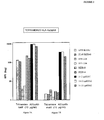
- the fluorescence mean is indicated in log scale in order to visualize the low marking background obtained with the mutated tetramer.
- the differential between the specific marking and the non-specific marking is of the order of 2 log (10 2 ) with the tetramer A2 / pp65 mutated, while it is only 1 log with the native tetramer.
- the two notable exceptions are the two anti-EBV CD4 clones for which the background noise is very low with the native tetramer. This observation reinforces the hypothesis that the background of labeling obtained with the native tetramer is due to a certain percentage of nonspecific binding of the tetramer to CD8.
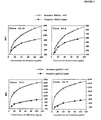
- the degree of CD8 dependence was estimated according to the cytotoxicity test of Couedel et al (4) with or without anti-CD8 antibody and is considered inversely proportional to the TCR affinity for the HLA-peptide complex.
- a cytotoxicity test is shown against a HLA-A0201 line loaded with BMLF1 peptide (10 ⁇ M) with two specific clones.
- Clone A2.10 is highly CD8 dependent since its cytotoxicity is abrogated by the anti-CD8 antibody, whereas the A4.5 clone is relatively dependent on CD8.
- Tagging with the mutated tetramer and labeling with an anti-CD3 antibody were performed to estimate the number of TCRs expressed on the surface.
- the results are given on the Figures 4B (CD3 labeling) and 4C (labeling of the BMFL1 / A2 mutated tetramer).
- the decrease in affinity for CD8 induced by the mutation of the HLA molecule does not significantly affect the specific labeling of the tetramer.
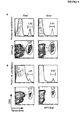
- peripheral lymphocytes of two HLA-A0201 patients were labeled. These are patients in whom a PP65 anti-PPV peptide response had previously been demonstrated. These lymphocytes had previously been amplified polyclonally in vitro and frozen.
- the discrimination capacity of the native tetramer in single labeling is variable depending on the percentage of specific cells in the starting population. Indeed, for patient A, the peak of positive cells which represents 5.60% is easily identifiable while for patient B, this peak is contaminated by non-specific labeling making it difficult to determine the percentage of positive cells.
- the dual tetramer-native and anti-CD8 labeling decreases the background clearly identify the positive sub-population and accurately estimate its percentage (0.84% in this case). This therefore demonstrates that the accurate estimation of the percentage of positive cells with the native tetramer involves the use of double labeling with anti-CD8.
- the simple labeling with the mutated tetramer allows in both patients to unambiguously identify a peak of positive cells.
- the percentages of positive cells obtained are almost identical to those obtained by double labeling with the native tetramer. This demonstrates that all the specific cells detectable by the native tetramer are also with the mutated tetramer and thus corroborates the results obtained with the highly dependent and weakly dependent CD8 clones, namely that the mutation does not significantly affect the specific recognition.
- the use of the mutated tetramer thus makes it possible to dispense with double labeling with anti-CD8 to estimate the percentage of specific cells within a polyclonal population.
- Biotinylated HLA-A0201 monomers loaded with pp65 peptide were bound to streptavidin-coupled magnetic beads (Dynabeads M-280 Streptavidin, DYNAL)
- the lymphocyte populations used in the study were derived from synovial fluids or PBL from patients with rheumatoid arthritis or PBL from healthy donors who are seropositive for CMV.
- populations were sorted with beads loaded either with the native tetramer or with the mutated tetramer, then the selected populations were amplified in vitro by polyclonal stimulation (PHA, IL2, irradiated PBL), which stimulation does not affect the representativeness of the amplified populations.
- PHA polyclonal stimulation
- IL2 irradiated PBL
- the cells from sorting with the native tetramer are positively labeled with this same tetramer, but on the other hand a very small percentage of these cells are positive with the mutated tetramer (0.7% and 2.88%).
- the positive cell enrichment factor obtained with the mutated tetramer is 421 for sample 1 (92.64% vs 0.22%) and 693 for sample 2 (97.01% vs 0.14%).
- the majority of the cells sorted with the mutated tetramer activate in the presence of T2 loaded with the pp65 peptide and the percentage of CD25-positive cells corresponds well with the percentage of cells that were labeled by the mutated tetramer (90,63). % activated cells vs 92.64% of labeled cells and 97.20% vs 97.01% for patients 1 and 2 respectively).
Landscapes
- Health & Medical Sciences (AREA)
- Life Sciences & Earth Sciences (AREA)
- Immunology (AREA)
- Engineering & Computer Science (AREA)
- Chemical & Material Sciences (AREA)
- Biomedical Technology (AREA)
- Organic Chemistry (AREA)
- General Health & Medical Sciences (AREA)
- Cell Biology (AREA)
- Bioinformatics & Cheminformatics (AREA)
- Zoology (AREA)
- Genetics & Genomics (AREA)
- Hematology (AREA)
- Biotechnology (AREA)
- Wood Science & Technology (AREA)
- Biochemistry (AREA)
- Medicinal Chemistry (AREA)
- Molecular Biology (AREA)
- Microbiology (AREA)
- Nuclear Medicine, Radiotherapy & Molecular Imaging (AREA)
- Public Health (AREA)
- General Engineering & Computer Science (AREA)
- Veterinary Medicine (AREA)
- Urology & Nephrology (AREA)
- Animal Behavior & Ethology (AREA)
- Pharmacology & Pharmacy (AREA)
- General Chemical & Material Sciences (AREA)
- Chemical Kinetics & Catalysis (AREA)
- Food Science & Technology (AREA)
- Virology (AREA)
- General Physics & Mathematics (AREA)
- Analytical Chemistry (AREA)
- Gastroenterology & Hepatology (AREA)
- Physics & Mathematics (AREA)
- Proteomics, Peptides & Aminoacids (AREA)
- Tropical Medicine & Parasitology (AREA)
- Pathology (AREA)
- Biophysics (AREA)
- Toxicology (AREA)
- Peptides Or Proteins (AREA)
Claims (9)
- Tetramerer Komplex von MHC-Klasse-I-Monomeren, die wenigstens eine Substitution einer Aminosäure in der α3-Domäne in der Zone der Wechselwirkung einer schweren Kette eines MHC-Klasse-I-Monomers mit einem CD8-Corezeptor von T-Lymphocyten aufweisen, wobei die Affinität dieses tetrameren Komplexes zu den CD8-Corezeptoren von T-Lymphocyten in Bezug auf die Affinität eines entsprechenden unsubstituierten nativen tetrameren Komplexes reduziert ist.
- Tetramerer Komplex gemäß Anspruch 1, dadurch gekennzeichnet, dass sich die Substitution in einer α3-Domäne der schweren Kette befindet.
- Tetramerer Komplex gemäß Anspruch 1 oder 2, dadurch gekennzeichnet, dass die MHC-Monomere in Form eines Komplexes mit einem MHCbindenden Peptid vorliegen.
- Verwendung eines tetrameren Komplexes gemäß einem der Ansprüche 1 bis 3 zum Nachweisen und/oder Isolieren der peptidspezifischen Populationen von CD8-positiven T-Lymphocyten.
- Verwendung eines tetrameren Komplexes gemäß Anspruch 4 in einem Zellsortierungsverfahren.
- Verwendung eines tetrameren Komplexes gemäß Anspruch 5, dadurch gekennzeichnet, dass das Zellsortierungsverfahren ein immunmagnetisches Sortierungsverfahren ist.
- Verfahren zum Nachweisen der peptidspezifischen Populationen von CD8-positiven T-Lymphocyten in einer polyklonalen Population, dadurch gekennzeichnet, dass es Folgendes umfasst:- das In-Kontakt-Bringen der polyklonalen Population mit den tetrameren Komplexen gemäß einem der Ansprüche 1 bis 3 unter Bedingungen, die eine Wechselwirkung zwischen den Komplexen aus rekombinanten MHC-Klasse-I-Monomeren und Peptid und den Rezeptoren von T-Lymphocyten mit einer Affinität zu diesen Komplexen erlauben; und- den Nachweis der T-Lymphocyten mit einer Affinität zu diesen Komplexen, so dass die peptidspezifische CD8-positive Population nachgewiesen wird.
- Verfahren gemäß Anspruch 7, dadurch gekennzeichnet, dass die Komplexe aus tetrameren Klasse-I-MHC und Peptid eine fluoreszierende Struktureinheit umfassen und dass der Nachweis den Nachweis der Fluoreszenz der Komplexe umfasst.
- Verfahren zum Isolieren der peptidspezifischen Populationen von CD8-positiven T-Lymphocyten ausgehend von einer polyklonalen Population, dadurch gekennzeichnet, dass es Folgendes umfasst:- das In-Kontakt-Bringen der polyklonalen Population mit Magnetkügelchen, an die die tetrameren Komplexe gemäß einem der Ansprüche 1 bis 3 gebunden sind, unter Bedingungen, die eine Wechselwirkung zwischen den Komplexen aus rekombinantem MHC-Klasse-I-Monomer und Peptid und den Rezeptoren von T-Lymphocyten mit einer Affinität zu diesen Komplexen erlauben; und- die Gewinnung der gebundenen T-Lymphocyten, so dass die peptidspezifische CD8-positive Population isoliert wird.
Applications Claiming Priority (3)
| Application Number | Priority Date | Filing Date | Title |
|---|---|---|---|
| FR9911133A FR2798128B1 (fr) | 1999-09-06 | 1999-09-06 | Moyens de detection et de purification de populations lymphocytaires t cd8+ specifiques de peptides presentes dans le contexte hla |
| FR9911133 | 1999-09-06 | ||
| PCT/FR2000/002443 WO2001018053A1 (fr) | 1999-09-06 | 2000-09-05 | Moyens de detection et de purification de populations lymphocytaires tcd8+, specifiques de peptides presentes dans le contexte hla |
Publications (2)
| Publication Number | Publication Date |
|---|---|
| EP1127072A1 EP1127072A1 (de) | 2001-08-29 |
| EP1127072B1 true EP1127072B1 (de) | 2008-04-30 |
Family
ID=9549571
Family Applications (1)
| Application Number | Title | Priority Date | Filing Date |
|---|---|---|---|
| EP00960796A Expired - Lifetime EP1127072B1 (de) | 1999-09-06 | 2000-09-05 | Mittel zur bestimmung und reinigung von lymphocytenpopulationen des typs tcd8+, die spezifisch für im zusammenhang mit hla präsentierte peptide sind |
Country Status (10)
| Country | Link |
|---|---|
| EP (1) | EP1127072B1 (de) |
| JP (1) | JP5020452B2 (de) |
| CN (2) | CN101298478B (de) |
| AT (1) | ATE393784T1 (de) |
| AU (1) | AU778840B2 (de) |
| CA (1) | CA2350185C (de) |
| DE (2) | DE1127072T1 (de) |
| FR (1) | FR2798128B1 (de) |
| IL (1) | IL142976A0 (de) |
| WO (1) | WO2001018053A1 (de) |
Families Citing this family (18)
| Publication number | Priority date | Publication date | Assignee | Title |
|---|---|---|---|---|
| GB9923337D0 (en) * | 1999-10-04 | 1999-12-08 | Isis Innovation | Binding agents |
| DE10117858A1 (de) * | 2001-04-10 | 2002-10-24 | Gsf Forschungszentrum Umwelt | MHC-Tetramere |
| NZ591133A (en) | 2008-09-02 | 2012-08-31 | Inst Nat Sante Rech Med | Novel melanoma antigen peptide and uses thereof |
| ES2635335T3 (es) * | 2010-09-20 | 2017-10-03 | Biontech Cell & Gene Therapies Gmbh | Receptores de células T específicos de antígeno y epítopos de células T |
| WO2012164004A1 (en) | 2011-06-01 | 2012-12-06 | INSERM (Institut National de la Santé et de la Recherche Médicale) | Novel antigen peptide and uses thereof |
| WO2013175258A1 (en) | 2012-05-22 | 2013-11-28 | Inserm (Institut National De La Sante Et De La Recherche Medicale) | Novel melanoma antigen peptide and uses thereof |
| WO2015150491A1 (en) | 2014-04-01 | 2015-10-08 | INSERM (Institut National de la Santé et de la Recherche Médicale) | An isolated donor mhc-derived peptide and uses thereof |
| US10137181B2 (en) | 2014-04-01 | 2018-11-27 | INSERM (Institut National de la Santé et de la Recherche Médicale) | Isolated donor MHC-derived peptide and uses thereof |
| US20210023209A1 (en) | 2018-03-16 | 2021-01-28 | INSERM (Institut National de la Santé et de la Recherche Médicale) | Antigenic peptides deriving from pcsk2 and uses thereof for the diagnosis and treatment of type 1 diabetes |
| EP3765053A2 (de) | 2018-03-16 | 2021-01-20 | INSERM (Institut National de la Santé et de la Recherche Médicale) | Antigene peptide aus urocortin 3 und verwendungen davon zur diagnose und behandlung von typ-1-diabetes |
| WO2019175380A2 (en) | 2018-03-16 | 2019-09-19 | INSERM (Institut National de la Santé et de la Recherche Médicale) | Antigenic peptides deriving from secretogranin v and uses thereof for the diagnosis and treatment of type 1 diabetes |
| ES2935702T3 (es) | 2018-04-11 | 2023-03-09 | Enterome S A | Péptidos antigénicos para la prevención y el tratamiento del cáncer |
| CN109293779A (zh) * | 2018-07-03 | 2019-02-01 | 清华大学 | 一种多聚体复合物及其制备方法 |
| EP3894543A1 (de) | 2018-12-14 | 2021-10-20 | INSERM (Institut National de la Santé et de la Recherche Médicale) | Isolierte humane mhc-abgeleitete peptide und verwendungen davon zur stimulierung und aktivierung der suppressiven funktion von cd8cd45rc + cd45rc low tregs |
| WO2020148206A1 (en) | 2019-01-14 | 2020-07-23 | INSERM (Institut National de la Santé et de la Recherche Médicale) | Methods and kits for generating and selecting a variant of a binding protein with increased binding affinity and/or specificity |
| PL4021487T3 (pl) | 2019-11-15 | 2024-04-15 | Enterome S.A. | Peptydy antygenowe do zapobiegania i leczenia nowotworów złośliwych wywodzących się z limfocytów b |
| WO2023115459A1 (zh) * | 2021-12-23 | 2023-06-29 | 青岛华赛伯曼医学细胞生物有限公司 | 一种肿瘤抗原/mhc-i复合物及其制备方法和用途 |
| AU2023246941A1 (en) | 2022-03-31 | 2024-10-24 | Enterome S.A. | Antigenic peptides for prevention and treatment of cancer. |
Family Cites Families (3)
| Publication number | Priority date | Publication date | Assignee | Title |
|---|---|---|---|---|
| US5635363A (en) * | 1995-02-28 | 1997-06-03 | The Board Of Trustees Of The Leland Stanford Junior University | Compositions and methods for the detection, quantitation and purification of antigen-specific T cells |
| WO1997044667A2 (fr) * | 1996-05-21 | 1997-11-27 | Institut Pasteur | Methodes d'utilisation de complexes peptide/complexe majeur d'histocompatibilite pour obtenir ou purifier des cellules t antigene-specifiques et pour stimuler des cellules t |
| US6248564B1 (en) * | 1997-08-29 | 2001-06-19 | Harvard University | Mutant MHC class I molecules |
-
1999
- 1999-09-06 FR FR9911133A patent/FR2798128B1/fr not_active Expired - Lifetime
-
2000
- 2000-09-05 IL IL14297600A patent/IL142976A0/xx unknown
- 2000-09-05 EP EP00960796A patent/EP1127072B1/de not_active Expired - Lifetime
- 2000-09-05 WO PCT/FR2000/002443 patent/WO2001018053A1/fr not_active Ceased
- 2000-09-05 DE DE1127072T patent/DE1127072T1/de active Pending
- 2000-09-05 CN CN2008100872673A patent/CN101298478B/zh not_active Expired - Lifetime
- 2000-09-05 DE DE60038726T patent/DE60038726T2/de not_active Expired - Lifetime
- 2000-09-05 AT AT00960796T patent/ATE393784T1/de not_active IP Right Cessation
- 2000-09-05 CN CN00801877A patent/CN1321167A/zh active Pending
- 2000-09-05 JP JP2001522275A patent/JP5020452B2/ja not_active Expired - Lifetime
- 2000-09-05 AU AU72981/00A patent/AU778840B2/en not_active Expired
- 2000-09-05 CA CA2350185A patent/CA2350185C/fr not_active Expired - Lifetime
Also Published As
| Publication number | Publication date |
|---|---|
| FR2798128A1 (fr) | 2001-03-09 |
| DE60038726T2 (de) | 2009-07-02 |
| EP1127072A1 (de) | 2001-08-29 |
| CA2350185A1 (fr) | 2001-03-15 |
| DE60038726D1 (de) | 2008-06-12 |
| CN1321167A (zh) | 2001-11-07 |
| AU7298100A (en) | 2001-04-10 |
| CN101298478A (zh) | 2008-11-05 |
| DE1127072T1 (de) | 2002-05-23 |
| CA2350185C (fr) | 2012-02-21 |
| IL142976A0 (en) | 2002-04-21 |
| JP5020452B2 (ja) | 2012-09-05 |
| AU778840B2 (en) | 2004-12-23 |
| CN101298478B (zh) | 2013-01-02 |
| FR2798128B1 (fr) | 2001-11-16 |
| ATE393784T1 (de) | 2008-05-15 |
| WO2001018053A1 (fr) | 2001-03-15 |
| JP2003510039A (ja) | 2003-03-18 |
Similar Documents
| Publication | Publication Date | Title |
|---|---|---|
| US8309312B2 (en) | Means for detection and purification of CD8+ T lymphocyte populations specific to peptides presented in the context of HLA | |
| CA2350185C (fr) | Moyens de detection et de purification de populations lymphocytaires tcd8+, specifiques de peptides presentes dans le contexte hla | |
| Chuang et al. | Mu opioid receptor gene expression in immune cells | |
| KR102489353B1 (ko) | 특정 집단에 대한 항원으로 t 세포를 스크리닝하기 위한 조성물 및 방법 | |
| KR102805266B1 (ko) | 종양-특이적 t 세포 수용체를 수득하는 방법 | |
| CN110785432B (zh) | Tcr和肽 | |
| AU2025237926A1 (en) | Nanoparticle compositions for sustained therapy | |
| EP3155426B1 (de) | Allgemeiner nachweis und isolierung spezifischer zellen durch binden markierter moleküle | |
| CN110462024B (zh) | 用于癌症免疫疗法的mr1限制性t细胞受体 | |
| EP1485719B1 (de) | Gemeinsame epitope von antigenen aus einer multigen-familie | |
| TR201811128T4 (tr) | Bir hedef hücrenin tersinir şekilde boyama yöntemi. | |
| CA2777821A1 (en) | Tumor-associated peptides that bind to mhc-molecules | |
| CA3117272A1 (en) | Tcr and peptides | |
| Lancien et al. | Dendritic cells require TMEM176A/B ion channels for optimal MHC class II antigen presentation to naive CD4+ T cells | |
| WO2019023269A1 (en) | DISCOVERING TROGOCYTOSE MEDIATION EPITOPES | |
| Thorsby | On the future of HLA | |
| WO2005063969A2 (fr) | Methodes d'identification et de preparation de lymphocytes t regulateurs/suppresseurs, compositions et utilisations | |
| WO2003040299A2 (fr) | Procede de selection de ligands d'hla-dp4 | |
| WO2020127996A2 (fr) | Melanges d'epitopes t cd8+ immunogenes de la cycline b1 | |
| JP7264824B2 (ja) | 安定な調節性t細胞の単離及びその使用 | |
| HK40095794A (en) | General detection and isolation of specific cells by binding of labeled molecules | |
| WO1996027613A1 (fr) | Anticorps mono et polyclonaux diriges contre la region 63-75 de la proteine e2 | |
| HK40024455A (en) | Tcr and peptides | |
| FR2673429A1 (fr) | Inhibiteur lymphocytaire des fonctions du systeme immunitaire. | |
| WO1997018232A2 (fr) | Peptides derives de la proteine oncogene bcr-abl exprimes par des cellules leucemiques et leur utilisation pour la therapie des leucemies humaines |
Legal Events
| Date | Code | Title | Description |
|---|---|---|---|
| PUAI | Public reference made under article 153(3) epc to a published international application that has entered the european phase |
Free format text: ORIGINAL CODE: 0009012 |
|
| 17P | Request for examination filed |
Effective date: 20010521 |
|
| AK | Designated contracting states |
Kind code of ref document: A1 Designated state(s): AT BE CH CY DE DK ES FI FR GB GR IE IT LI LU MC NL |
|
| AX | Request for extension of the european patent |
Free format text: AL;LT;LV;MK;RO;SI |
|
| GBC | Gb: translation of claims filed (gb section 78(7)/1977) | ||
| TCNL | Nl: translation of patent claims filed | ||
| IECL | Ie: translation for ep claims filed | ||
| DET | De: translation of patent claims | ||
| 17Q | First examination report despatched |
Effective date: 20030605 |
|
| 17Q | First examination report despatched |
Effective date: 20030605 |
|
| GRAP | Despatch of communication of intention to grant a patent |
Free format text: ORIGINAL CODE: EPIDOSNIGR1 |
|
| RBV | Designated contracting states (corrected) |
Designated state(s): AT BE CH CY DE DK ES FI FR GB GR IE IT LI LU MC NL PT SE |
|
| GRAS | Grant fee paid |
Free format text: ORIGINAL CODE: EPIDOSNIGR3 |
|
| GRAA | (expected) grant |
Free format text: ORIGINAL CODE: 0009210 |
|
| AK | Designated contracting states |
Kind code of ref document: B1 Designated state(s): AT BE CH CY DE DK ES FI FR GB GR IE IT LI LU MC NL PT SE |
|
| REG | Reference to a national code |
Ref country code: GB Ref legal event code: FG4D Free format text: NOT ENGLISH |
|
| REG | Reference to a national code |
Ref country code: CH Ref legal event code: EP |
|
| REG | Reference to a national code |
Ref country code: IE Ref legal event code: FG4D |
|
| REF | Corresponds to: |
Ref document number: 60038726 Country of ref document: DE Date of ref document: 20080612 Kind code of ref document: P |
|
| NLV1 | Nl: lapsed or annulled due to failure to fulfill the requirements of art. 29p and 29m of the patents act | ||
| PG25 | Lapsed in a contracting state [announced via postgrant information from national office to epo] |
Ref country code: NL Free format text: LAPSE BECAUSE OF FAILURE TO SUBMIT A TRANSLATION OF THE DESCRIPTION OR TO PAY THE FEE WITHIN THE PRESCRIBED TIME-LIMIT Effective date: 20080430 Ref country code: ES Free format text: LAPSE BECAUSE OF FAILURE TO SUBMIT A TRANSLATION OF THE DESCRIPTION OR TO PAY THE FEE WITHIN THE PRESCRIBED TIME-LIMIT Effective date: 20080810 Ref country code: FI Free format text: LAPSE BECAUSE OF FAILURE TO SUBMIT A TRANSLATION OF THE DESCRIPTION OR TO PAY THE FEE WITHIN THE PRESCRIBED TIME-LIMIT Effective date: 20080430 |
|
| PG25 | Lapsed in a contracting state [announced via postgrant information from national office to epo] |
Ref country code: AT Free format text: LAPSE BECAUSE OF FAILURE TO SUBMIT A TRANSLATION OF THE DESCRIPTION OR TO PAY THE FEE WITHIN THE PRESCRIBED TIME-LIMIT Effective date: 20080430 |
|
| REG | Reference to a national code |
Ref country code: IE Ref legal event code: FD4D |
|
| PG25 | Lapsed in a contracting state [announced via postgrant information from national office to epo] |
Ref country code: IE Free format text: LAPSE BECAUSE OF FAILURE TO SUBMIT A TRANSLATION OF THE DESCRIPTION OR TO PAY THE FEE WITHIN THE PRESCRIBED TIME-LIMIT Effective date: 20080430 Ref country code: DK Free format text: LAPSE BECAUSE OF FAILURE TO SUBMIT A TRANSLATION OF THE DESCRIPTION OR TO PAY THE FEE WITHIN THE PRESCRIBED TIME-LIMIT Effective date: 20080430 Ref country code: SE Free format text: LAPSE BECAUSE OF FAILURE TO SUBMIT A TRANSLATION OF THE DESCRIPTION OR TO PAY THE FEE WITHIN THE PRESCRIBED TIME-LIMIT Effective date: 20080731 |
|
| PLBE | No opposition filed within time limit |
Free format text: ORIGINAL CODE: 0009261 |
|
| STAA | Information on the status of an ep patent application or granted ep patent |
Free format text: STATUS: NO OPPOSITION FILED WITHIN TIME LIMIT |
|
| BERE | Be: lapsed |
Owner name: INSTITUT NATIONAL DE LA SANTE ET DE LA RECHERCHE Effective date: 20080930 |
|
| 26N | No opposition filed |
Effective date: 20090202 |
|
| REG | Reference to a national code |
Ref country code: HK Ref legal event code: WD Ref document number: 1042709 Country of ref document: HK |
|
| PG25 | Lapsed in a contracting state [announced via postgrant information from national office to epo] |
Ref country code: MC Free format text: LAPSE BECAUSE OF NON-PAYMENT OF DUE FEES Effective date: 20080930 |
|
| REG | Reference to a national code |
Ref country code: CH Ref legal event code: PL |
|
| PG25 | Lapsed in a contracting state [announced via postgrant information from national office to epo] |
Ref country code: BE Free format text: LAPSE BECAUSE OF NON-PAYMENT OF DUE FEES Effective date: 20080930 |
|
| PG25 | Lapsed in a contracting state [announced via postgrant information from national office to epo] |
Ref country code: IT Free format text: LAPSE BECAUSE OF FAILURE TO SUBMIT A TRANSLATION OF THE DESCRIPTION OR TO PAY THE FEE WITHIN THE PRESCRIBED TIME-LIMIT Effective date: 20080430 |
|
| PG25 | Lapsed in a contracting state [announced via postgrant information from national office to epo] |
Ref country code: CH Free format text: LAPSE BECAUSE OF NON-PAYMENT OF DUE FEES Effective date: 20080930 Ref country code: LI Free format text: LAPSE BECAUSE OF NON-PAYMENT OF DUE FEES Effective date: 20080930 |
|
| PG25 | Lapsed in a contracting state [announced via postgrant information from national office to epo] |
Ref country code: LU Free format text: LAPSE BECAUSE OF NON-PAYMENT OF DUE FEES Effective date: 20080905 |
|
| PG25 | Lapsed in a contracting state [announced via postgrant information from national office to epo] |
Ref country code: CY Free format text: LAPSE BECAUSE OF FAILURE TO SUBMIT A TRANSLATION OF THE DESCRIPTION OR TO PAY THE FEE WITHIN THE PRESCRIBED TIME-LIMIT Effective date: 20080430 |
|
| PG25 | Lapsed in a contracting state [announced via postgrant information from national office to epo] |
Ref country code: GR Free format text: LAPSE BECAUSE OF FAILURE TO SUBMIT A TRANSLATION OF THE DESCRIPTION OR TO PAY THE FEE WITHIN THE PRESCRIBED TIME-LIMIT Effective date: 20080731 |
|
| PG25 | Lapsed in a contracting state [announced via postgrant information from national office to epo] |
Ref country code: PT Free format text: LAPSE BECAUSE OF FAILURE TO SUBMIT A TRANSLATION OF THE DESCRIPTION OR TO PAY THE FEE WITHIN THE PRESCRIBED TIME-LIMIT Effective date: 20080430 |
|
| REG | Reference to a national code |
Ref country code: FR Ref legal event code: PLFP Year of fee payment: 16 |
|
| REG | Reference to a national code |
Ref country code: FR Ref legal event code: PLFP Year of fee payment: 17 |
|
| REG | Reference to a national code |
Ref country code: FR Ref legal event code: PLFP Year of fee payment: 18 |
|
| REG | Reference to a national code |
Ref country code: FR Ref legal event code: PLFP Year of fee payment: 19 |
|
| PGFP | Annual fee paid to national office [announced via postgrant information from national office to epo] |
Ref country code: FR Payment date: 20190925 Year of fee payment: 20 |
|
| PGFP | Annual fee paid to national office [announced via postgrant information from national office to epo] |
Ref country code: GB Payment date: 20190927 Year of fee payment: 20 |
|
| PGFP | Annual fee paid to national office [announced via postgrant information from national office to epo] |
Ref country code: DE Payment date: 20190927 Year of fee payment: 20 |
|
| REG | Reference to a national code |
Ref country code: DE Ref legal event code: R071 Ref document number: 60038726 Country of ref document: DE |
|
| REG | Reference to a national code |
Ref country code: GB Ref legal event code: PE20 Expiry date: 20200904 |
|
| PG25 | Lapsed in a contracting state [announced via postgrant information from national office to epo] |
Ref country code: GB Free format text: LAPSE BECAUSE OF EXPIRATION OF PROTECTION Effective date: 20200904 |