EP1120104A1 - Compositions cosmétiques détergentes contenant un amidon amphotère particulier et leurs utilations - Google Patents
Compositions cosmétiques détergentes contenant un amidon amphotère particulier et leurs utilations Download PDFInfo
- Publication number
- EP1120104A1 EP1120104A1 EP00403530A EP00403530A EP1120104A1 EP 1120104 A1 EP1120104 A1 EP 1120104A1 EP 00403530 A EP00403530 A EP 00403530A EP 00403530 A EP00403530 A EP 00403530A EP 1120104 A1 EP1120104 A1 EP 1120104A1
- Authority
- EP
- European Patent Office
- Prior art keywords
- chosen
- composition according
- composition
- les
- weight
- Prior art date
- Legal status (The legal status is an assumption and is not a legal conclusion. Google has not performed a legal analysis and makes no representation as to the accuracy of the status listed.)
- Granted
Links
- 0 C*(*)*(*)*(C)N(*)**(*)N Chemical compound C*(*)*(*)*(C)N(*)**(*)N 0.000 description 1
Classifications
-
- A—HUMAN NECESSITIES
- A61—MEDICAL OR VETERINARY SCIENCE; HYGIENE
- A61Q—SPECIFIC USE OF COSMETICS OR SIMILAR TOILETRY PREPARATIONS
- A61Q5/00—Preparations for care of the hair
- A61Q5/12—Preparations containing hair conditioners
-
- A—HUMAN NECESSITIES
- A61—MEDICAL OR VETERINARY SCIENCE; HYGIENE
- A61K—PREPARATIONS FOR MEDICAL, DENTAL OR TOILETRY PURPOSES
- A61K8/00—Cosmetics or similar toiletry preparations
- A61K8/18—Cosmetics or similar toiletry preparations characterised by the composition
- A61K8/72—Cosmetics or similar toiletry preparations characterised by the composition containing organic macromolecular compounds
- A61K8/73—Polysaccharides
-
- A—HUMAN NECESSITIES
- A61—MEDICAL OR VETERINARY SCIENCE; HYGIENE
- A61K—PREPARATIONS FOR MEDICAL, DENTAL OR TOILETRY PURPOSES
- A61K8/00—Cosmetics or similar toiletry preparations
- A61K8/18—Cosmetics or similar toiletry preparations characterised by the composition
- A61K8/72—Cosmetics or similar toiletry preparations characterised by the composition containing organic macromolecular compounds
- A61K8/73—Polysaccharides
- A61K8/732—Starch; Amylose; Amylopectin; Derivatives thereof
-
- A—HUMAN NECESSITIES
- A61—MEDICAL OR VETERINARY SCIENCE; HYGIENE
- A61Q—SPECIFIC USE OF COSMETICS OR SIMILAR TOILETRY PREPARATIONS
- A61Q5/00—Preparations for care of the hair
- A61Q5/02—Preparations for cleaning the hair
-
- A—HUMAN NECESSITIES
- A61—MEDICAL OR VETERINARY SCIENCE; HYGIENE
- A61K—PREPARATIONS FOR MEDICAL, DENTAL OR TOILETRY PURPOSES
- A61K2800/00—Properties of cosmetic compositions or active ingredients thereof or formulation aids used therein and process related aspects
- A61K2800/40—Chemical, physico-chemical or functional or structural properties of particular ingredients
- A61K2800/54—Polymers characterized by specific structures/properties
- A61K2800/542—Polymers characterized by specific structures/properties characterized by the charge
- A61K2800/5428—Polymers characterized by specific structures/properties characterized by the charge amphoteric or zwitterionic
Definitions
- the present invention relates to new cosmetic compositions with properties materials intended simultaneously for cleaning and conditioning materials keratinous, such as the hair, and comprising, in an aqueous support cosmetically acceptable, a cleansing base consisting of surfactants with power detergent and a specific amphoteric starch.
- a cleansing base consisting of surfactants with power detergent and a specific amphoteric starch.
- the invention also relates to the use said compositions in the above-mentioned cosmetic application.
- detergent compositions such as shampoos
- anionic type not ionic and / or amphoteric, but more particularly of the anionic type
- surfactants such as anionic type, not ionic and / or amphoteric, but more particularly of the anionic type
- compositions certainly have good washing power, but the properties intrinsic cosmetics attached to them however remain quite weak, in particular due to the fact that the relatively aggressive nature of such treatment of cleaning can cause damage to the hair fiber in the long run more or less marked linked in particular to the progressive elimination of the lipids or proteins contained in or on the surface of the latter.
- conditioning agents primarily intended to repair or limit the harmful or undesirable effects induced by the different treatments or assaults that they undergo, more or less repeated, hair fibers.
- conditioning agents can of course also improve the cosmetic behavior of natural hair.
- compositions according to the invention give the hair, after rinsing, a remarkable treatment effect which manifests in particular by a contribution of lightness, discipline and flexibility.
- the subject of the present invention is new cosmetic compositions.
- detergents and conditioning characterized by the fact that they include, in a cosmetically acceptable aqueous medium, a washing base and at least one starch amphoteric defined below, the composition being free of fatty acid soaps.
- a subject of the invention is also the use in cosmetics of the above compositions for cleaning and / or removing makeup and / or packaging materials keratin such as hair and skin.
- the subject of the invention is also a use of the composition according to the invention as a shampoo for materials keratinous.
- fatty acid soaps a salt of an alkali or alkaline earth metal or of a fatty amine and of a C10-C18 fatty acid.
- concentration of fatty acid soaps is less than or equal to about 1% by weight, preferably less than about 0.1% by weight.
- compositions according to the invention necessarily comprise a base washing, generally aqueous.
- the surfactant (s) forming the washing base can be chosen indifferently, only or in mixtures, within anionic, amphoteric detergent surfactants, not ionic.
- the washing base preferably comprises at least one or several anionic surfactants or mixtures of at least one or more anionic surfactants and at least one or more amphoteric surfactants or at least at least one or more nonionic surfactants.
- the washing base can represent from 4% to 50% by weight, of. preferably from 6% to 35% by weight, and even more preferably from 8% to 25% by weight, the total weight of the final composition.
- the surfactants which are suitable for carrying out the present invention are in particular The following :
- anionic surfactants which can be used, alone or in mixtures, in the context of the present invention, mention may be made in particular (non-limiting list) of the salts (in particular alkaline, in particular sodium, ammonium salts , amine salts, amino alcohol salts or alkaline earth (magnesium) salts of the following compounds: alkylsulfates, alkylethersulfates, alkylamidoethersulfates, alkylarylpolyethersulfates, monoglycerides sulfates; alkylsulfonates, alkylphosphates, alkylamidesulfonates, alkylarylsulfonates, ⁇ -olefins , paraffin-sulfonates; alkylsulfosuccinates, alkylethersulfosuccinates, alkylamidesulfosuccinates; alkylsulfosuccinamates; alkylsulf
- anionic surfactants which can still be used, mention may also be made of the salts of fatty acids such as the salts of oleic, ricinoleic, palmitic, stearic acids, coconut oil or hydrogenated coconut oil acids; acyl-lactylates whose acyl radical contains 8 to 20 carbon atoms.
- Weakly anionic surfactants can also be used, such as alkyl D galactoside uronic acids and their salts as well as polyoxyalkylenated (C 6 -C 24 ) alkyl ether acids, (C 6 -C 24 ) aryl ether carboxylic acids. polyoxyalkylenated, (C 6 -C 24 ) alkyl amido ether polyoxyalkylenated carboxylic acids and their salts, in particular those comprising from 2 to 50 ethylene oxide groups, and mixtures thereof.
- anionic surfactants it is preferred to use, according to the invention, the salts alkyl sulfates and alkyl ether sulfates and mixtures thereof.
- Nonionic surfactants are also well known compounds per se (see in particular in this regard "Handbook of Surfactants” by MR PORTER, Blackie & Son editions (Glasgow and London), 1991, pp 116-178) and their nature is not, in the context of the present invention, of a critical nature.
- alcohols alpha-diols, alkylphenols or polyethoxylated, polypropoxylated or polyglycerolated fatty acids, having a fatty chain comprising for example 8 to 18 carbon atoms, the number of ethylene oxide or propylene oxide groups which may range in particular from 2 to 50 and the number of glycerol groups which may range in particular from 2 to 30.
- Amphoteric surfactants may in particular be (nonlimiting list) derivatives of aliphatic secondary or tertiary amines, in which the aliphatic radical is a linear chain or branched having 8 to 22 carbon atoms and containing at least one water-soluble anionic group (for example carboxylate, sulfonate, sulfate, phosphate or phosphonate); Mention may also be made of (C 8 -C 20 ) alkyl betaines, sulfobetaines, (C 8 -C 20 ) alkyl amidoalkyl (C 1 -C 6 ) betaines or (C 8 -C 20 ) alkyl amidoalkyl (C 1 -C 6 ) sulfobetaines.
- mixtures are preferably used surfactants and in particular mixtures of anionic surfactants and amphoteric or nonionic surfactants.
- a particularly preferred mixture is a mixture consisting of at least one anionic surfactant and at least one amphoteric surfactant.
- Starch molecules can come from all plant sources of starch such as in particular corn, potato, oats, rice, tapioca, sorghum, barley or wheat. It is also possible to use the hydrolysates of the starches mentioned above.
- the starch is preferably obtained from the potato.
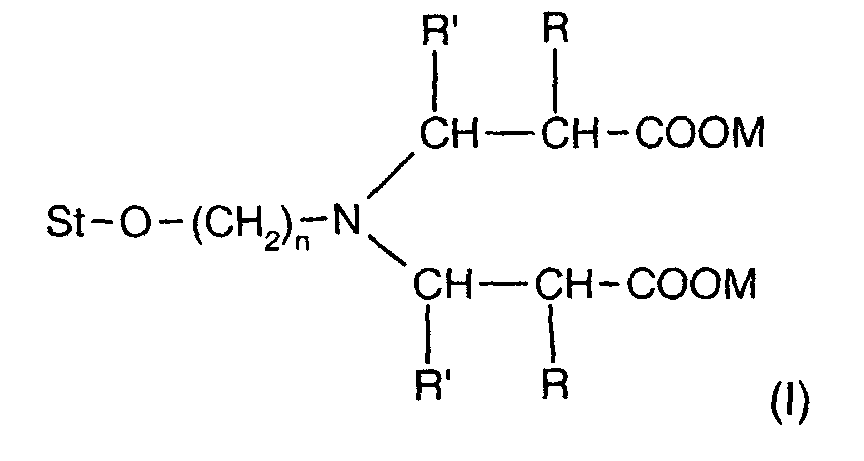
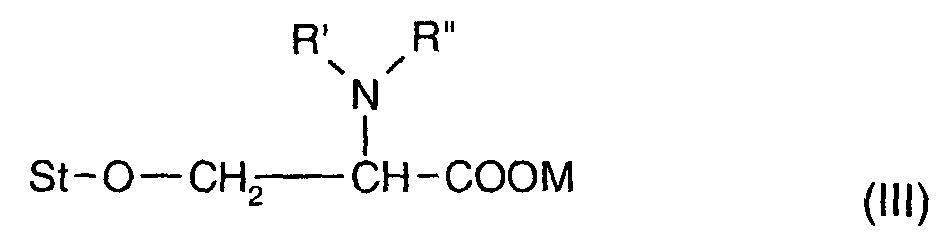
- starches of formulas (I) or (II) are used in particular. We no longer use particularly starches modified with 2-chloroethyl aminodipropionic acid, that is to say the starches of formula (I) or (II) in which R, R ', R "represent a hydrogen atom and n is 2.
- amphoteric starches according to the invention can be used in the compositions in accordance with the invention in concentrations generally between 0.01 and 10%, and preferably between 0.1 and 5% by weight relative to the total weight of the composition.
- the composition also comprises at least one cationic polymer.
- cationic polymer means any polymer containing cationic groups and / or groups which can be ionized into cationic groups.
- the cationic polymers which can be used in accordance with the present invention can be chosen from among all those already known per se as improving the properties hair cosmetics treated with detergent compositions, namely in particular those described in patent application EP-A- 0 337 354 and in the applications for French patents FR-A- 2,270,846, 2,383,660, 2,598,611, 2,470,596 and 2,519,863.
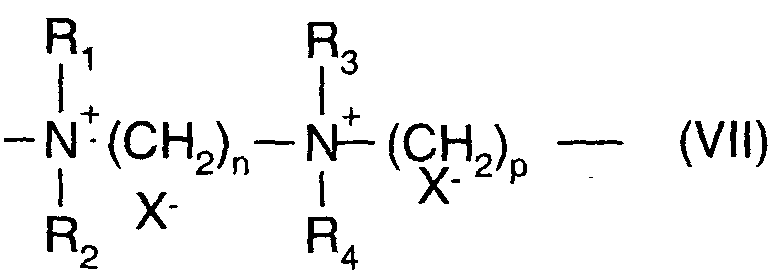
- the preferred cationic polymers are chosen from those which contain units having primary, secondary, tertiary and / or quaternary amine groups can either be part of the main polymer chain, or be carried by a lateral substituent directly connected to it.
- the cationic polymers used generally have a number average molecular mass of between 500 and 5.10 6 approximately, and preferably between 10 3 and 3.10 6 approximately.
- cationic polymers mention may be made more particularly of the polymers of polyamine, polyaminoamide and quaternary polyammonium type. These are products known.
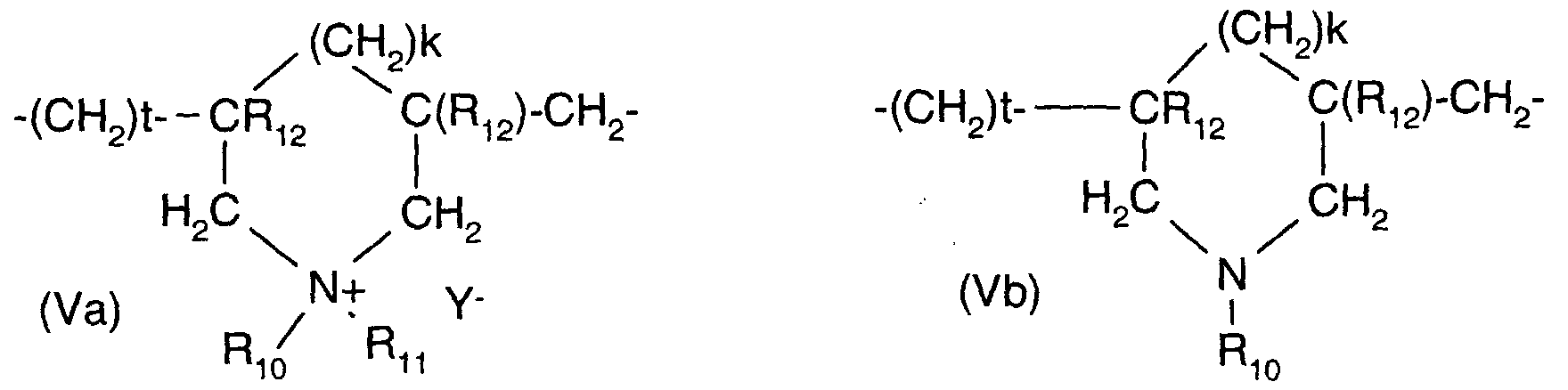
- cationic polymers which can be used in the context of the invention are proteins cationic or cationic protein hydrolysates, polyalkyleneimines, in in particular polyethyleneimines, polymers containing vinylpyridine units or vinylpyridinium, condensates of polyamines and epichlorohydrin, polyureylenes quaternaries and chitin derivatives.
- cationic polymers capable of being used in the context of present invention, it is preferred to use cellulose ether derivatives quaternaries such as the products sold under the name "JR 400" by the Company UNION CARBIDE CORPORATION, cationic cyclopolymers, especially homopolymers or copolymers of dimethyldiallylammonium chloride, sold under the names "MERQUAT 100", “MERQUAT 550” and “MERQUAT S” by the CALGON company, cationic polysaccharides such as guar gums modified with a 2,3-epoxypropyltrimethylammonium salt, quaternary polymers vinylpyrrolidone and vinylimidazole and mixtures thereof.
- cellulose ether derivatives quaternaries such as the products sold under the name "JR 400" by the Company UNION CARBIDE CORPORATION
- cationic cyclopolymers especially homopolymers or copolymers of dimethyldiallylammonium chloride, sold under the names "MER
- the cationic polymer (s) can represent from 0.001% to 10 % by weight, preferably from 0.005% to 5% by weight and more particularly from 0.01 to 3% by weight relative to the total weight of the final composition.
- compositions according to the invention further comprise at least one silicone.
- the silicones which can be used in accordance with the invention may be soluble or insoluble in the composition and in particular be polyorganosiloxanes insoluble in the composition; they can be in the form of oils, waxes, resins or erasers.
- Organopolysiloxanes are defined in more detail in the work of Walter NOLL “Chemistry and Technology of Silicones” (1968) Academy Press. They can be volatile or non-volatile.
- non-volatile silicones are used and more particularly polyalkylsiloxanes, polyarylsiloxanes, polyalkylarylsiloxanes, gums and silicone resins, polyorganosiloxanes modified by groups organofunctional and their mixtures.
- silicones are more particularly chosen from polyalkylsiloxanes among which mention may mainly be made of polydimethylsiloxanes with trimethylsilyl end groups having a viscosity of 5.10 -6 to 2.5 m 2 / s at 25 ° C and preferably 1.10 -5 to 1 m 2 / s.
- the viscosity of the silicones is for example measured at 25 ° C. according to standard ASTM 445 Appendix C.
- the polyalkylarylsiloxanes are particularly chosen from polydimethyl methylphenylsiloxanes, linear and / or branched polydimethyl diphenylsiloxanes with a viscosity of 1.10 -5 to 5.10 -2 m 2 / s at 25 ° C.
- the silicone gums which can be used in accordance with the invention are in particular polydiorganosiloxanes having high number average molecular weights between 200,000 and 1,000,000 used alone or as a mixture in a solvent.
- This solvent can be chosen from volatile silicones, polydimethylsiloxane oils (PDMS), polyphenylmethylsiloxane oils (PPMS), isoparaffins, polyisobutylenes, methylene chloride, pentane, dodecane, tridecanes or their mixtures.
- the organopolysiloxane resins which can be used in accordance with the invention are crosslinked siloxane systems containing the units: R 2 SiO 2/2 , R 3 SiO 1/2 , RSiO 3/2 and SiO 4/2 in which R represents a hydrocarbon group having 1 to 16 carbon atoms or a phenyl group.
- R represents a hydrocarbon group having 1 to 16 carbon atoms or a phenyl group.
- R denotes a lower C 1 -C 4 alkyl radical, more particularly methyl, or a phenyl radical.
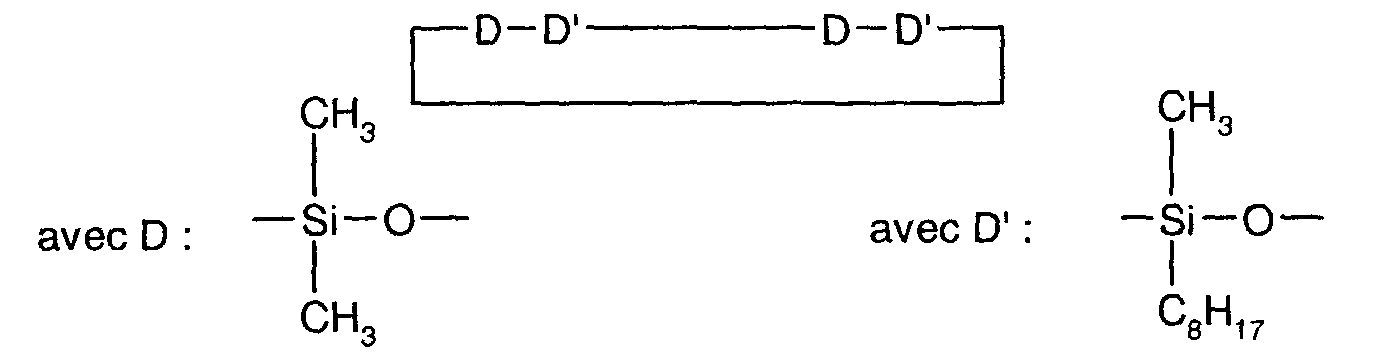
- organo modified silicones which can be used in accordance with the invention are silicones as defined above and comprising in their structure one or more organofunctional groups attached via a hydrocarbon radical.
- grafted silicone polymers are in particular polydimethylsiloxanes (PDMS) to which are grafted, via a chain connection type thiopropylene, mixed polymer units of the acid type poly (meth) acrylic and poly (meth) acrylate and polydimethylsiloxanes (PDMS) on which are grafted, via a connection chain of thiopropylene type, polymeric units of the isobutyl poly (meth) acrylate type.
- PDMS polydimethylsiloxanes
- PDMS polydimethylsiloxanes
- silicones can also be used in the form emulsions, nanoemulsions or micremulsions.
- the silicone (s) can represent from 0.001% to 20% by weight, from preferably from 0.01% to 10% by weight and more particularly from 0.1 to 3% by weight per relative to the total weight of the final composition.
- the cosmetically acceptable aqueous medium can consist solely of water or of a mixture of water and a cosmetically acceptable solvent such as a lower C 1 -C 4 alcohol, such as ethanol, isopropanol, tertiobutanol, n-butanol; alkylene glycols such as propylene glycol, glycol ethers.
- a cosmetically acceptable solvent such as a lower C 1 -C 4 alcohol, such as ethanol, isopropanol, tertiobutanol, n-butanol
- alkylene glycols such as propylene glycol, glycol ethers.
- the detergent compositions according to the invention generally have a final pH between 3 and 10. Preferably, this pH is between 4 and 8. Adjusting the pH at the desired value can be done conventionally by adding a base (organic or mineral) in the composition, for example ammonia or a (poly) amine primary, secondary or tertiary such as monoethanolamine, diethanolamine, triethanolamine, isopropanolamine or propanediamine-1,3, or by addition of a acid, preferably a carboxylic acid such as for example citric acid.
- a base organic or mineral
- a (poly) amine primary, secondary or tertiary such as monoethanolamine, diethanolamine, triethanolamine, isopropanolamine or propanediamine-1,3, or by addition of a acid, preferably a carboxylic acid such as for example citric acid.
- compositions in accordance with the invention may contain, in addition to the combination defined above, viscosity regulating agents such as electrolytes, or thickening agents (associative or non-associative). Mention may in particular be made of sodium chloride, sodium xylene sulfonate, scleroglucans, xanthan gums, fatty acid alkanolamides, alkyl ether carboxylic acid alkanolamides optionally oxyethylenated with up to 5 moles of oxide ethylene such as the product sold under the name "AMINOL A15" by the company CHEM Y, crosslinked polyacrylic acids and acrylic acid / crosslinked C 10 -C 30 alkyl acrylate copolymers. These viscosity regulating agents are used in the compositions according to the invention in proportions which can range up to 10% by weight relative to the total weight of the composition.
- viscosity regulating agents such as electrolytes, or thickening agents (associative or non-a
- compositions in accordance with the invention may also preferably contain up to 5% of pearlescent or opacifying agents well known in the prior art than for example fatty alcohols higher than C16, fatty chain acylated derivatives such as ethylene glycol or polyethylene glycol monostearates or distearates, fatty chain ethers such as, for example, distearyl ether or 1- (hexadecyloxy) -2-octadecanol.
- pearlescent or opacifying agents well known in the prior art than for example fatty alcohols higher than C16
- fatty chain acylated derivatives such as ethylene glycol or polyethylene glycol monostearates or distearates
- fatty chain ethers such as, for example, distearyl ether or 1- (hexadecyloxy) -2-octadecanol.
- compositions in accordance with the invention may optionally also contain at least one additive chosen from foam synergists such as C 10 -C 18 1,2-alkanediols or fatty alkanolamides derived from mono or diethanolamine, sun filters silicone or not, cationic surfactants, anionic or nonionic or amphoteric polymers, proteins, protein hydrolysates, ceramides, pseudoceramides, fatty acids with linear or branched C 12 -C 40 chains such as 18-methyl-eicosanoic acid, hydroxy acids, vitamins, provitamins such as panthenol, vegetable, animal, mineral or synthetic oils and any other additive conventionally used in the cosmetic field which does not affect the properties of the compositions according to the invention. 'invention.
- foam synergists such as C 10 -C 18 1,2-alkanediols or fatty alkanolamides derived from mono or diethanolamine, sun filters silicone or not, cationic surfactants, anionic or non
- additives are present in the composition according to the invention in proportions which can range from 0 to 20% by weight relative to the total weight of the composition.
- the precise quantity of each additive is easily determined by a person skilled in the art according to its nature and function.
- compositions can be in the form of more or less thickened liquids, creams or gels and they are mainly suitable for washing, caring for keratin materials especially hair and skin and even more especially hair.
- compositions in accordance with the invention are used as classic shampoos, they are simply applied to wet hair and the foam generated by massage or friction with the hands is then eliminated, after a possible pause time, by rinsing with water, the operation can be repeated once or several times.
- the subject of the invention is also a method of washing and conditioning keratin materials such as in particular the hair consisting in applying to said wetted materials an effective amount of a composition as defined above, then rinse with water after a possible pause time.
- compositions according to the invention are preferably used as shampoos for washing and conditioning the hair and they are applied in this case on wet hair in amounts effective for washing it, this application being followed by a water rinse.
- compositions according to the invention can also be used as shower gels for washing and conditioning the hair and / or skin, in which case it is applied to damp skin and / or hair and rinsed off after application.
- composition A Composition Invention A Sodium lauryl ether sulfate (C12 / C14 to 70/30) with 2.2 moles of ethylene oxide in aqueous solution containing 28% of MA 15 g MA Potato starch modified with 2-chloroethyl aminodipropionic acid neutralized by soda, (Solanace structure from NATIONAL STARCH) 0.5 g Hydroxyethylcellulose crosslinked by epichlorohydrin and quaternized by trimethylamine (JR 400 by the company UNION CARBIDE) 0.4g Hydroxyethylcellulose 0.4g Citric acid qs pH 7 Demineralized water qs 100g
- Shampooing is carried out by applying approximately 12 g of composition A to hair previously wet. We lather the shampoo and then rinse abundantly with water.
- composition according to the invention provides, on hair wet a significant root lift and a lot of lightness.
- Example 2 Example 3 Sodium lauryl ether sulfate (C12 / C14 to 70/30) with 2.2 moles of ethylene oxide 16 g MA 16 g MA Cocoyl amidopropyl betaine in an aqueous solution at 38% M.A.
- Shampooing is carried out by applying approximately 12 g of the composition to hair previously wet. We lather the shampoo and then rinse abundantly with water.
- the hair treated with the composition of Example 2 or of Example 3 is soft, light and easily detangled.
- a shampoo in accordance with the invention of the following composition was produced: Sodium lauryl ether sulfate (C12 / C14 to 70/30) with 2.2 moles of ethylene oxide 15.5 g MA Cocoyl betaine in aqueous solution at 32% MA 3 g MA Hydroxypropyl guar trimethyl ammonium chloride, sold under the name Jaguar C13S by the company RHODIA 0.1g Potato starch modified with 2-chloroethyl aminodipropionic acid neutralized by 0.3g soda (NATIONAL STARCH Solanace structure) Polydimethylsiloxane with a viscosity of 60,000 cSt 2.7g Amodimethicone in cationic emulsion at 35% MA (DC939 from DOW CORNING) 1.05 gMA Mixture 1- (hexadecyloxy) 2-octadecanol / cetyl alcohol 2.5g Copra monoisopropanolamide 0.5 g Preservatives, fragrance
- Shampooing is carried out by applying approximately 12 g of the composition to hair previously wet.
- the shampoo is lathered and then rinsed thoroughly with water.
- Hair treated with this composition is soft, light and is disentangled easily.
Landscapes
- Health & Medical Sciences (AREA)
- Life Sciences & Earth Sciences (AREA)
- Animal Behavior & Ethology (AREA)
- General Health & Medical Sciences (AREA)
- Public Health (AREA)
- Veterinary Medicine (AREA)
- Birds (AREA)
- Epidemiology (AREA)
- Dermatology (AREA)
- Cosmetics (AREA)
- Detergent Compositions (AREA)
- Polysaccharides And Polysaccharide Derivatives (AREA)
- Compositions Of Macromolecular Compounds (AREA)
- Organic Low-Molecular-Weight Compounds And Preparation Thereof (AREA)
Abstract
Description
Par exempte de savons d'acides gras, on comprend selon l'invention que la concentration en savons d'acide gras est inférieure ou égale à environ 1% en poids, de préférence inférieure à environ 0,1% en poids.
et
A titre d'exemple on peut citer le cocoamphodiacetate commercialisé sous la dénomination commerciale MIRANOL® C2M concentré par la société RHODIA.
- soit un agent tensioactif amphotère tel que les dérivés d'amine dénommés disodiumcocoamphodipropionate ou sodiumcocoamphopropionate commercialisés notamment par la société RHODIA sous la dénomination commerciale "MIRANOL® C2M. CONC" en solution aqueuse à 38 % de matière active ou sous la dénomination MIRANOL® C32;
- soit un agent tensioactif amphotère de type zwittérionique tel que les alkylbétaïnes en particulier la cocoylbétaïne commercialisée sous la dénomination "DEHYTON® AB 30" en solution aqueuse à 32 % de MA par la société HENKEL ou les alkylamidobétaïnes telles que la TEGOBETAINE® F50 commercialisée par la société GLODSCHMIDT.


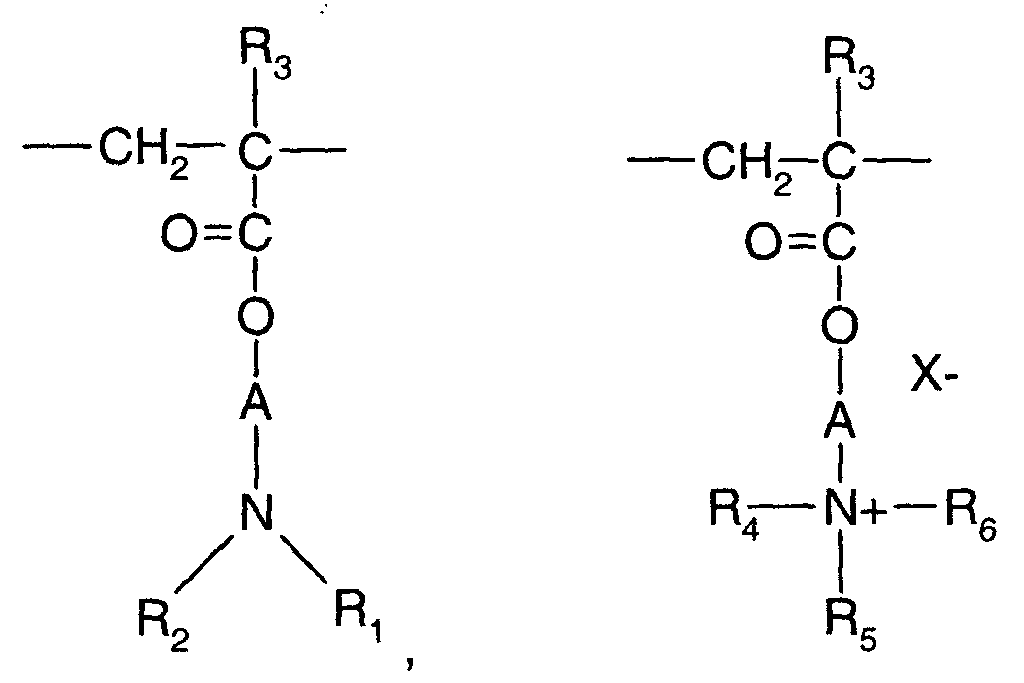
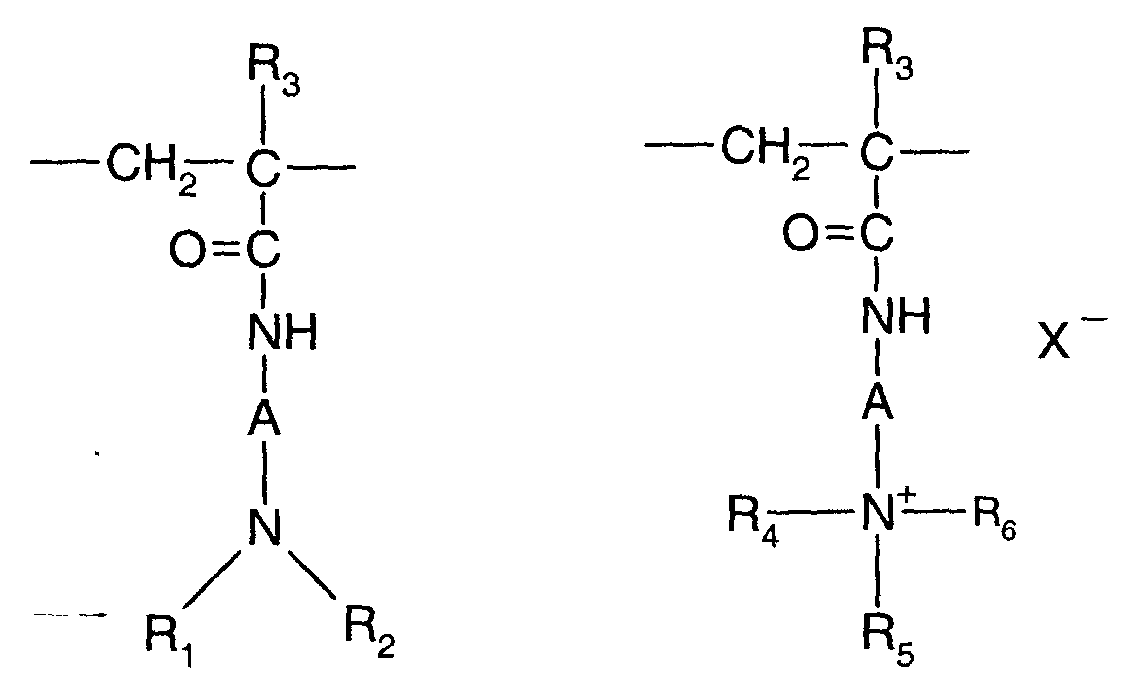
- les copolymères d'acrylamide et de diméthylaminoéthyl méthacrylate quaternisé au sulfate de diméthyle ou avec un halogénure de diméthyle tels que celui vendu sous la dénomination HERCOFLOC par la société HERCULES,
- les copolymères d'acrylamide et de chlorure de méthacryloyloxyéthyltriméthylammonium décrit par exemple dans la demande de brevet EP-A-080976 et vendus sous la dénomination BINA QUAT P 100 par la société CIBA GEIGY,
- le copolymère d'acrylamide et de méthosulfate de méthacryloyloxyéthyltriméthylammonium vendu sous la dénomination RETEN par la société HERCULES,
- les copolymères vinylpyrrolidone / acrylate ou méthacrylate de dialkylaminoalkyle quaternisés ou non, tels que les produits vendus sous la dénomination "GAFQUAT" par la société ISP comme par exemple "GAFQUAT 734" ou "GAFQUAT 755" ou bien les produits dénommés "COPOLYMER 845, 958 et 937". Ces polymères sont décrits en détail dans les brevets français 2.077.143 et 2.393.573,
- les terpolymères méthacrylate de diméthyl amino éthyle/ vinylcaprolactame/ vinylpyrrolidone tel que le produit vendu sous la dénomination GAFFIX VC 713 par la société ISP,
- les copolymère vinylpyrrolidone / méthacrylamidopropyl dimethylamine commercialisés notamment sous la dénomination STYLEZE CC 10 par ISP.
- et les copolymères vinylpyrrolidone / méthacrylamide de diméthylaminopropyle quaternisé tel que le produit vendu sous la dénomination "GAFQUAT HS 100" par la société ISP.
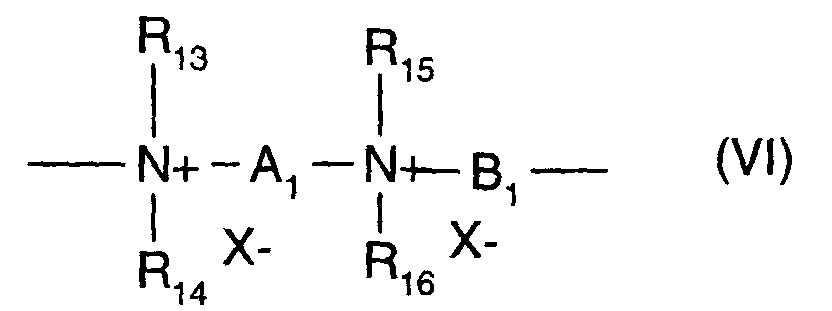
- a) un reste de glycol de formule : -O-Z-O-, où Z désigne un radical hydrocarboné
linéaire ou ramifié ou un groupement répondant à l'une des formules suivantes :
-(CH2-CH2-O)x-CH2-CH2-
-[CH2-CH(CH3)-O]y-CH2-CH(CH3)-
où x et y désignent un nombre entier de 1 à 4, représentant un degré de polymérisation défini et unique ou un nombre quelconque de 1 à 4 représentant un degré de polymérisation moyen ; - b) un reste de diamine bis-secondaire tel qu'un dérivé de pipérazine ;
- c) un reste de diamine bis-primaire de formule : -NH-Y-NH-, où Y désigne un
radical hydrocarboné linéaire ou ramifié, ou bien le radical bivalent
-CH2-CH2-S-S-CH2-CH2- ; - d) un groupement uréylène de formule : -NH-CO-NH- ; n varie de 1 à 6

- les huiles SILBIONE des séries 47 et 70 047 ou les huiles MIRASIL commercialisées par RHODIA telles que par exemple l'huile 70 047 V 500 000 ;
- les huiles de la série MIRASIL commercialisées par la société RHODIA ;
- les huiles de la série 200 de la société DOW CORNING telles que plus particulièrement la DC200 de viscosité 60 000 Cst ;
- les huiles VISCASIL de GENERAL ELECTRIC et certaines huiles des séries SF (SF 96, SF 18) de GENERAL ELECTRIC.
- les huiles SILBIONE de la série 70 641 de RHODIA ;
- les huiles des séries RHODORSIL 70 633 et 763 de RHODIA ;
- l'huile DOW CORNING 556 COSMETIC GRAD FLUID de DOW CORNING ;
- les silicones de la série PK de BAYER comme le produit PK20 ;
- les silicones des séries PN, PH de BAYER comme les produits PN1000 et PH1000 ;
- certaines huiles des séries SF de GENERAL ELECTRIC telles que SF 1023, SF 1154, SF 1250, SF 1265.
- polydiméthylsiloxane
- les gommes polydiméthylsiloxanes/méthylvinylsiloxane,
- polydiméthylsiloxane/diphénylsiloxane,
- polydiméthylsiloxane/phénylméthylsiloxane,
- polydiméthylsiloxane/diphénylsiloxane/méthylvinylsiloxane.
- les mélanges formés à partir d'un polydiméthylsiloxane hydroxylé en bout de chaíne (dénommé diméthiconol selon la nomenclature du dictionnaire CTFA) et d'un polydiméthylsiloxane cyclique (dénommé cyclométhicone selon la nomenclature du dictionnaire CTFA) tel que le produit Q2 1401 commercialisé par la société DOW CORNING ;
- les mélanges formés à partir d'une gomme polydiméthylsiloxane avec une silicone cyclique tel que le produit SF 1214 Silicone Fluid de la société GENERAL ELECTRIC, ce produit est une gomme SF 30 correspondant à une diméthicone, ayant un poids moléculaire moyen en nombre de 500 000 solubilisée dans l'huile SF 1202 Silicone Fluid correspondant au décaméthylcyclopentasiloxane ;
- les mélanges de deux PDMS de viscosités différentes, et plus particulièrement d'une gomme PDMS et d'une huile PDMS, tels que le produit SF 1236 de la société GENERAL ELECTRIC. Le produit SF 1236 est le mélange d'une gomme SE 30 définie ci-dessus ayant une viscosité de 20 m2/s et d'une huile SF 96 d'une viscosité de 5.10-6m2/s. Ce produit comporte de préférence 15 % de gomme SE 30 et 85 % d'une huile SF 96.
R2SiO2/2, R3SiO1/2, RSiO3/2 et SiO4/2 dans lesquelles R représente un groupement hydrocarboné possédant 1 à 16 atomes de carbone ou un groupement phényle. Parmi ces produits, ceux particulièrement préférés sont ceux dans lesquels R désigne un radical alkyle inférieur en C1-C4, plus particulièrement méthyle, ou un radical phényle.
- des groupements polyéthylèneoxy et/ou polypropylèneoxy comportant éventuellement des groupements alkyle en C6-C24 tels que les produits dénommés diméthicone copolyol commercialisé par la société DOW CORNING sous la dénomination DC 1248 ou les huiles SILWET L 722, L 7500, L 77, L 711 de la société UNION CARBIDE et l'alkyl (C12) méthicone copolyol commercialisée par la société DOW CORNING sous la dénomination Q2 5200 ;
- des groupements aminés substitués ou non comme les produits commercialisés sous la dénomination GP 4 Silicone Fluid et GP 7100 par la société GENESEE ou les produits commercialisés sous les dénominations Q2 8220 et DOW CORNING 929 ou 939 par la société DOW CORNING. Les groupements aminés substitués sont en particulier des groupements aminoalkyle en C1-C4 ;
- des groupements thiols comme les produits commercialisés sous les dénominations "GP 72 A" et "GP 71" de GENESEE ;
- des groupements alcoxylés comme le produit commercialisé sous la dénomination "SILICONE COPOLYMER F-755" par SWS SILICONES et ABIL WAX 2428, 2434 et 2440 par la société GOLDSCHMIDT ;
- des groupements hydroxylés comme les polyorganosiloxanes à fonction hydroxyalkyle décrits dans la demande de brevet français FR-A-85 16334 .
- des groupements acyloxyalkyle tels que par exemple les polyorganosiloxanes décrits dans le brevet US-A-4957732.
- des groupements anioniques du type carboxylique comme par exemple dans les produits décrits dans le brevet EP 186 507 de la société CHISSO CORPORATION, ou de type alkylcarboxyliques comme ceux présents dans le produit X-22-3701 E de la société SHIN-ETSU ; 2-hydroxyalkylsulfonate; 2-hydroxyalkylthiosulfate tels que les produits commercialisés par la société GOLDSCHMIDT sous les dénominations "ABIL S201" et "ABIL S255".
- des groupements hydroxyacylamino, comme les polyorganosiloxanes décrits dans la demande EP 342 834. On peut citer par exemple le produit Q2-8413 de la société DOW CORNING.
De tels polymères sont par exemple les copolymères susceptibles d'être obtenus par polymérisation radicalaire à partir du mélange de monomères constitué par :

- les silicones non volatiles choisies dans la famille des polyalkylsiloxanes à groupements terminaux triméthylsilyle telles que les huiles ayant une viscosité comprise entre 0,2 et 2,5 m2/s à 25° C telles que les huiles de la séries DC200 de DOW CORNING en particulier celle de viscosité 60 000 Cst, des séries SILBIONE 70047 et 47 et plus particulièrement l'huile 70 047 V 500 000 commercialisées par la société RHODIA, les polyalkylsiloxanes à groupements terminaux diméthylsilanol tels que les diméthiconol ou les polyalkylarylsiloxanes tels que l'huile SILBIONE 70641 V 200 commercialisée par la société RHODIA ;
- la résine d'organopolysiloxane commercialisée sous la dénomination DOW CORNING 593 ;
- les polysiloxanes à groupements aminés tels que les amodiméthicones ou les triméthylsilylamodiméthicone ;
| Composition | Invention A |
| Lauryléthersulfate de sodium (C12/C14 à 70/30) à 2.2 moles d'oxyde d'éthylène en solution aqueuse à 28% de MA | 15 g MA |
| Fécule de pomme de terre modifiée par l'acide 2-chloroéthyl aminodipropionique neutralisée par la soude, (Structure Solanace de NATIONAL STARCH) | 0.5 g |
| Hydroxyéthylcellulose réticulée par l'épichlorhydrine et quaternisée par la triméthylamine (JR 400 par la société UNION CARBIDE) | 0.4 g |
| Hydroxyéthylcellulose | 0.4 g |
| Acide citrique q.s. | pH 7 |
| Eau déminéralisée q.s.p. | 100 g |
| Exemple 2 | Exemple 3 | |
| Lauryléthersulfate de sodium (C12/C14 à 70/30) à 2.2 moles d'oxyde d'éthylène | 16 g MA | 16 g MA |
| Cocoyl amidopropyl bétaïne en solution aqueuse à 38% M.A. | 2 g MA | 2 g MA |
| Hydroxyéthylcellulose réticulée à l'épichlorhydrine, quaternisée par la triméthylamine ( Polymer JR 400 de la société UNION CARBIDE) | 0.4 g | ― |
| Chlorure d'hydroxypropyl guar triméthyl ammonium, vendu sous la dénomination Jaguar C13S par la société RHODIA | ― | 0.1 g |
| Fécule de pomme de terre modifiée par l'acide 2-chloroéthyl aminodipropionique neutralisée par la soude (Structure Solanace de NATIONAL STARCH) | 0.2 g | 0.3 g |
| Polydiméthylsiloxane de viscosité 300 000 cSt | - | 2.7 g |
| Polydiméthylsiloxane de viscosité 500 000 cSt | 1.5 g | - |
| Mélange 1-(hexadécyloxy) 2-octadécanol / Alcool cétylique | 3 g | 3 g |
| Monoisopropanolamide de coprah | 0.5 g | 0.5 g |
| Conservateurs, parfum | q.s. | q.s. |
| Agent de pH q.s. | pH 7 | pH 7 |
| Eau déminéralisée q.s.p. | 100 g | 100 g |
| Lauryléthersulfate de sodium (C12/C14 à 70/30) à 2.2 moles d'oxyde d'éthylène | 15,5 g MA |
| Cocoyl bétaïne en solution aqueuse à 32% M.A. | 3 g MA |
| Chlorure d'hydroxypropyl guar triméthyl ammonium, vendu sous la dénomination Jaguar C13S par la société RHODIA | 0.1 g |
| Fécule de pomme de terre modifiée par l'acide 2-chloroéthyl aminodipropionique neutralisée par la | 0.3 g |
| soude (Structure Solanace de NATIONAL STARCH) Polydiméthylsiloxane de viscosité 60 000 cSt | 2.7 g |
| Amodiméthicone en émulsion cationique à 35% de MA (DC939 de DOW CORNING) | 1,05 gMA |
| Mélange 1-(hexadécyloxy) 2-octadécanol / Alcool cétylique | 2,5 g |
| Monoisopropanolamide de coprah | 0.5 g |
| Conservateurs, parfum | q.s. |
| Acide citrique q.s. | pH 5,5 |
| Eau déminéralisée q.s.p. | 100 g |
Les cheveux traités avec cette composition sont doux, légers et se démêlent facilement.
Claims (22)
- Composition cosmétique détergente et conditionnante, caractérisée par le fait qu'elle comprend, dans un milieu aqueux cosmétiquement acceptable une base lavante et au moins un amidon amphotère choisi parmi les composés de formules (I) à (IV) :

 formules dans lesquelles :
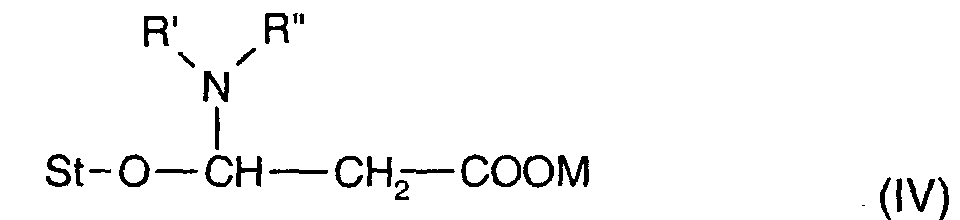 la composition étant exempte de savons d'acides gras.St-O représente une molécule d'amidon,R, identique ou différent, représente un atome d'hydrogène ou un radical méthyle,R', identique ou différent, représente un atome d'hydrogène, un radical méthyle ou un groupement -COOH,n est un entier égal à 2 ou 3,M, identique ou différent, désigne un atome d'hydrogène, un métal alcalin ou alcalinoterreux, NH4 , un ammonium quaternaire ou une amine organique,R" représente un atome d'hydrogène ou un radical alkyle ayant de 1 à 18 atomes de carbone,
 - Composition selon la revendication précédente, caractérisée par le fait que les amidons sont de formules (I) ou (II).
- Composition selon la revendication précédente, caractérisée par le fait que R, R', R" représentent un atome d'hydrogène et n est égal à 2.
- Composition selon l'une quelconque des revendications 1 à 3, caractérisée par le fait que ladite base lavante comprend un ou plusieurs tensioactifs détergents choisis parmi les tensioactifs anioniques, amphotères, non ioniques et leurs mélanges.
- Composition selon l'une quelconque des revendications 1 à 3, caractérisée par le fait que ladite base lavante comprend au moins un ou plusieurs tensioactifs anioniques.
- Composition selon l'une quelconque des revendications 1 à 5, caractérisée par le. fait que ladite base lavante est présente à une teneur pondérale comprise entre 4 % et 50 % en poids par rapport au poids total de la composition, de préférence comprise entre 6 % et 35 % en poids et plus préférentiellement comprise entre 8 % et 25 % en poids.
- Composition selon l'une quelconque des revendications 1 à 6, caractérisée par le fait que l'amidon amphotère est présent dans des concentrations comprises entre 0,01 et 10 %, et de préférence entre 0,1 et 5 % en poids par rapport au poids total de la composition.
- Composition selon l'une quelconque des revendications 1 à 7, caractérisée par le fait qu'elle comprend en outre au moins un polymère cationique.
- Composition selon la revendication 8, caractérisée par le fait que ledit polymère cationique est choisi parmi les dérivés d'éther de cellulose quaternaires, les cyclopolymères cationiques, les polysaccharides cationiques, les polymères quaternaires de vinylpyrrolidone et de vinylimidazole et leurs mélanges.
- Composition selon la revendication 9, caractérisée par le fait que ledit cyclopolymère est choisi parmi les homopolymères du chlorure de diallyldiméthylammonium et les copolymères du chlorure de diallyldiméthylammonium et d'acrylamide.
- Composition selon la revendication 9, caractérisée par le fait que lesdits dérivés d'éther de cellulose quaternaires sont choisis parmi les hydroxyéthylcelluloses ayant réagi avec un époxyde substitué par un groupement triméthylammonium.
- Composition selon la revendication 9, caractérisée par le fait que lesdits polysaccharides cationiques sont choisis parmi les gommes de guar modifiées par un sel de 2,3-époxypropyl triméthylammonium.
- Composition selon l'une quelconque des revendications 8 à 12 caractérisée en ce que le polymère cationique représente de 0,001 % à 10 % en poids, de préférence de 0,005 % à 5 % en poids, et encore plus préférentiellement de 0,01 % à 3 % en poids, du poids total de la composition.
- Composition selon l'une quelconque des revendications 1 à 13, caractérisée par le fait qu'elle comprend en outre au moins une silicone.
- Composition selon la revendication 14, caractérisée par le fait que les silicones sont des polyorganosiloxanes non volatils choisis parmi les polyalkylsiloxanes, les polyarylsiloxanes, les polyalkylarylsiloxanes, les gommes et résines de silicones, les polyorganosiloxanes modifiés par des groupements organofonctionnels ainsi que leurs mélanges.
- Composition selon la revendication 15, caractérisée par le fait que :(a) les polyalkylsiloxanes sont choisis parmi :les polydiméthylsiloxanes à groupements terminaux triméthylsilyle ;les polydiméthylsiloxanes à groupements terminaux diméthylsilanol ;les polyalkyl(C1-C20)siloxanes ;(b) les polyalkylarylsiloxanes sont choisis parmi :les polydiméthylméthylphénylsiloxanes, les polydiméthyldiphényl siloxanes linéaires et/ou ramifiés de viscosité comprise entre 1.10-5 et 5.10-2m2/s à 25°C ;(c) les gommes de silicone sont choisies parmi les polydiorganosiloxanes ayant des masses moléculaires moyennes en nombre comprises entre 200 000 et 1 000 000 utilisés seuls ou sous forme de mélange dans un solvant ;(d) les résines sont choisies parmi les résines constituées d'unités : R3 Si O1/2, R2 Si O2/2, R Si O3/2, Si O4/2
dans lesquelles R représente un groupement hydrocarboné ayant de 1 à 16 atomes de carbone ou un groupement phényle ;(e) les silicones organo modifiées sont choisies parmi les silicones comportant dans leur structure un ou plusieurs groupements organofonctionnels fixés par l'intermédiaire d'un radical hydrocarboné. - Composition selon l'une quelconque des revendications 14 à 16, caractérisée par le fait que les silicones sont choisies parmi les polyalkylsiloxanes à groupements terminaux triméthylsilyle, les polyalkylsiloxanes à groupements terminaux diméthylsilanol, les polyalkylarylsiloxanes, les mélanges de deux PDMS constitués d'une gomme et d'une huile de viscosités différentes, les mélanges d'organosiloxanes et de silicones cycliques, les résines d'organopolysiloxanes.
- Composition selon l'une quelconque des revendications 14 à 17, caractérisée en ce que la silicone est présente à une concentration comprise entre 0,001 % et 20 % en poids par rapport au poids total de la composition, de préférence entre 0,01 % et 10 % en poids.
- Composition selon l'une quelconque des revendications 1 à 18, caractérisée par le fait qu'elle comprend en outre au moins un additif choisi parmi les synergistes de mousses tels que des 1,2-alcanediols en C10-C18 ou des alcanolamides gras dérivés de mono ou de diéthanolamine, les filtres solaires siliconés ou non, les agents tensioactifs cationiques, les polymères anioniques ou non ioniques ou amphotères, les protéines, les hydrolysats de protéines, les céramides, les pseudocéramides, les acides gras à chaínes linéaires ou ramifiées en C12-C40 tels que l'acide méthyl-18 eicosanoique, les hydroxyacides, les vitamines, les provitamines tels que le panthénol, les huiles végétales, animales, minérales ou de synthèse et tout autre additif classiquement utilisé dans le domaine cosmétique.
- Utilisation d'une composition telle définie dans l'une quelconque des revendications 1 à 19 pour le nettoyage et/ou le démaquillage et/ou le conditionnement des matières kératiniques.
- Utilisation d'une composition telle définie dans l'une quelconque des revendications 1 à 19 comme shampooing des matières kératiniques.
- Procédé de lavage et de conditionnement des matières kératiniques telles que les cheveux consistant à appliquer sur lesdites matières mouillées une quantité efficace d'une composition telle que définie dans l'une quelconque des revendications 1 à 19, puis à effectuer un rinçage à l'eau après un éventuel temps de pause.
Applications Claiming Priority (2)
| Application Number | Priority Date | Filing Date | Title |
|---|---|---|---|
| FR0000411 | 2000-01-13 | ||
| FR0000411A FR2803744B1 (fr) | 2000-01-13 | 2000-01-13 | Compositions cosmetiques detergentes contenant un amidon amphotere particulier et leurs utilisations |
Publications (2)
| Publication Number | Publication Date |
|---|---|
| EP1120104A1 true EP1120104A1 (fr) | 2001-08-01 |
| EP1120104B1 EP1120104B1 (fr) | 2004-10-06 |
Family
ID=8845882
Family Applications (1)
| Application Number | Title | Priority Date | Filing Date |
|---|---|---|---|
| EP00403530A Expired - Lifetime EP1120104B1 (fr) | 2000-01-13 | 2000-12-14 | Compositions cosmétiques détergentes contenant un amidon amphotère particulier et leurs utilisations |
Country Status (20)
| Country | Link |
|---|---|
| US (1) | US20020034487A1 (fr) |
| EP (1) | EP1120104B1 (fr) |
| JP (2) | JP2001233744A (fr) |
| KR (1) | KR100444624B1 (fr) |
| CN (1) | CN1192763C (fr) |
| AR (1) | AR027920A1 (fr) |
| AT (1) | ATE278375T1 (fr) |
| AU (1) | AU746456B2 (fr) |
| BR (1) | BRPI0100265B1 (fr) |
| CA (1) | CA2330462C (fr) |
| CZ (1) | CZ20004816A3 (fr) |
| DE (1) | DE60014574T2 (fr) |
| ES (1) | ES2230043T3 (fr) |
| FR (1) | FR2803744B1 (fr) |
| HU (1) | HUP0100127A3 (fr) |
| MX (1) | MXPA01000262A (fr) |
| PL (1) | PL345085A1 (fr) |
| PT (1) | PT1120104E (fr) |
| RU (1) | RU2193389C2 (fr) |
| ZA (1) | ZA200007629B (fr) |
Cited By (3)
| Publication number | Priority date | Publication date | Assignee | Title |
|---|---|---|---|---|
| WO2007080539A3 (fr) * | 2006-01-09 | 2007-10-18 | Procter & Gamble | Compositions pour soins personnels contenant de l'amidon modifié de façon cationique et un système tensioactif anionique |
| WO2010033897A1 (fr) * | 2008-09-19 | 2010-03-25 | The Procter & Gamble Company | Composition de nettoyage contenant de l'amidon substitué |
| FR2976483A1 (fr) * | 2011-06-17 | 2012-12-21 | Oreal | Composition cosmetique comprenant un tensioactif anionique, un tensioactif non ionique ou amphotere et un alcool gras solide et procede de traitement cosmetique |
Families Citing this family (33)
| Publication number | Priority date | Publication date | Assignee | Title |
|---|---|---|---|---|
| FR2819403B1 (fr) | 2001-01-12 | 2004-10-15 | Oreal | Compositions cosmetiques contenant un fructane, un polysaccharide et un agent benefique et leurs utilisations |
| US7037513B1 (en) | 2005-01-31 | 2006-05-02 | Aquea Scientific Corporation | Bodywash additives |
| US6998113B1 (en) * | 2005-01-31 | 2006-02-14 | Aquea Scientific Corporation | Bodywashes containing additives |
| US20060173709A1 (en) * | 2005-01-31 | 2006-08-03 | Traynor Daniel H | Bodywash additive business methods |
| US7025952B1 (en) | 2005-01-31 | 2006-04-11 | Aquea Scientific Corporation | Methods of preparation and use of bodywashes containing additives |
| US8623341B2 (en) * | 2004-07-02 | 2014-01-07 | The Procter & Gamble Company | Personal care compositions containing cationically modified starch and an anionic surfactant system |
| US7001592B1 (en) | 2005-01-31 | 2006-02-21 | Aquea Scientific Corporation | Sunscreen compositions and methods of use |
| US20080112904A1 (en) * | 2005-03-08 | 2008-05-15 | Daniel Henry Traynor | Sunscreen Compositions And Methods Of Use |
| US7666963B2 (en) * | 2005-07-21 | 2010-02-23 | Akzo Nobel N.V. | Hybrid copolymers |
| US8277788B2 (en) * | 2005-08-03 | 2012-10-02 | Conopco, Inc. | Quick dispersing hair conditioning composition |
| US20080020961A1 (en) * | 2006-07-21 | 2008-01-24 | Rodrigues Klin A | Low Molecular Weight Graft Copolymers |
| US8674021B2 (en) * | 2006-07-21 | 2014-03-18 | Akzo Nobel N.V. | Sulfonated graft copolymers |
| AU2008254646A1 (en) * | 2007-05-21 | 2008-11-27 | Aquea Scientific Corporation | Highly charged microcapsules |
| FR2938436B1 (fr) | 2008-11-18 | 2011-08-26 | Natura Cosmeticos Sa | Composition cosmetique pour le nettoyage de la peau |
| MX341475B (es) | 2009-07-31 | 2016-08-19 | Akzo Nobel N V * | Composiciones de copolimero hibrido para aplicaciones de cuidado personal. |
| US8636918B2 (en) | 2011-08-05 | 2014-01-28 | Ecolab Usa Inc. | Cleaning composition containing a polysaccharide hybrid polymer composition and methods of controlling hard water scale |
| US8853144B2 (en) | 2011-08-05 | 2014-10-07 | Ecolab Usa Inc. | Cleaning composition containing a polysaccharide graft polymer composition and methods of improving drainage |
| US8841246B2 (en) | 2011-08-05 | 2014-09-23 | Ecolab Usa Inc. | Cleaning composition containing a polysaccharide hybrid polymer composition and methods of improving drainage |
| US8679366B2 (en) | 2011-08-05 | 2014-03-25 | Ecolab Usa Inc. | Cleaning composition containing a polysaccharide graft polymer composition and methods of controlling hard water scale |
| MX2014005094A (es) | 2011-11-04 | 2014-08-08 | Akzo Nobel Chemicals Int Bv | Copolimeros de dendrita hibridos, composiciones de los mismos y metodos para producirlos. |
| EP2773321B1 (fr) | 2011-11-04 | 2015-09-09 | Akzo Nobel Chemicals International B.V. | Copolymères dendritiques greffés, et procédés de production associés |
| US8945314B2 (en) | 2012-07-30 | 2015-02-03 | Ecolab Usa Inc. | Biodegradable stability binding agent for a solid detergent |
| US11707421B2 (en) | 2012-11-06 | 2023-07-25 | Colabs Int'l Corp. | Compositions containing a flexible derived capsule with an active agent |
| US11690793B2 (en) | 2012-11-06 | 2023-07-04 | Colabs Int'l Corp. | Composition containing a cellulose derived capsule with a sunscreen |
| EP2916814B1 (fr) | 2012-11-06 | 2020-02-12 | Colabs International Corporation | Composition contenant une capsule dérivée de cellulose ayant un écran solaire |
| US11724134B2 (en) | 2012-11-06 | 2023-08-15 | CoLabs International Corporation | Compositions containing a cellulose derived capsule with a sunscreen active agent |
| US10322301B2 (en) | 2012-11-06 | 2019-06-18 | CoLabs International Corporation | Compositions containing a cellulose derived capsule with a sunscreen active agent |
| US11491088B2 (en) | 2012-11-06 | 2022-11-08 | CoLabs International Corporation | Compositions containing a capsule with a moisturizing agent |
| US9365805B2 (en) | 2014-05-15 | 2016-06-14 | Ecolab Usa Inc. | Bio-based pot and pan pre-soak |
| DE102016222636A1 (de) * | 2016-11-17 | 2018-05-17 | Henkel Ag & Co. Kgaa | Haarreinigungsspülung |
| WO2020006322A1 (fr) | 2018-06-27 | 2020-01-02 | CoLabs International Corporation | Compositions comprenant des particules à base de dioxyde de silicium comprenant un ou plusieurs agents |
| DE102019213571A1 (de) * | 2019-09-06 | 2021-03-11 | Henkel Ag & Co. Kgaa | Stylingzusammensetzung zum temporären Verformen keratinischer Fasern und deren Verwendung |
| WO2025251067A1 (fr) * | 2024-05-31 | 2025-12-04 | L'oreal | Compositions et procédés de nettoyage de matières kératiniques |
Citations (5)
| Publication number | Priority date | Publication date | Assignee | Title |
|---|---|---|---|---|
| JPH05132410A (ja) * | 1991-11-11 | 1993-05-28 | Kao Corp | 化粧料 |
| JPH05132695A (ja) * | 1991-11-11 | 1993-05-28 | Kao Corp | 洗浄剤組成物 |
| EP0689829A2 (fr) * | 1994-06-28 | 1996-01-03 | National Starch and Chemical Investment Holding Corporation | Compositions cosmétiques contenant de l'amidon modifié par des groupes amino-multicarboxyliques |
| DE19816665A1 (de) * | 1998-04-15 | 1999-10-21 | Henkel Kgaa | Glycolipid-Cremes |
| WO2000033806A1 (fr) * | 1998-12-05 | 2000-06-15 | Imperial Chemical Industries Plc | Systemes d'emulsification et emulsions |
Family Cites Families (6)
| Publication number | Priority date | Publication date | Assignee | Title |
|---|---|---|---|---|
| GB1540384A (en) * | 1975-06-12 | 1979-02-14 | Beecham Inc | Shampoo |
| JPS5791910A (en) * | 1980-11-28 | 1982-06-08 | Kao Corp | Preshampoo-type hair treatment composition |
| LU84894A1 (fr) * | 1983-07-01 | 1985-04-17 | Oreal | Composition capillaire et procede de traitement des cheveux |
| FR2747036B1 (fr) * | 1996-04-05 | 1998-05-15 | Oreal | Composition cosmetique comprenant un polymere fixant et un amidon amphotere |
| CA2268464A1 (fr) * | 1998-04-09 | 1999-10-09 | National Starch And Chemical Investment Holding Corporation | Empois obtenus sans ions et leurs applications dans des compositions de fixatifs non aerosols aux cov reduits |
| AU782336B2 (en) * | 1999-12-03 | 2005-07-21 | Lubrizol Advanced Materials, Inc. | Modified starch solutions and their use in personal care |
-
2000
- 2000-01-13 FR FR0000411A patent/FR2803744B1/fr not_active Expired - Fee Related
- 2000-12-14 DE DE60014574T patent/DE60014574T2/de not_active Expired - Lifetime
- 2000-12-14 ES ES00403530T patent/ES2230043T3/es not_active Expired - Lifetime
- 2000-12-14 PT PT00403530T patent/PT1120104E/pt unknown
- 2000-12-14 AT AT00403530T patent/ATE278375T1/de active
- 2000-12-14 EP EP00403530A patent/EP1120104B1/fr not_active Expired - Lifetime
- 2000-12-19 ZA ZA200007629A patent/ZA200007629B/xx unknown
- 2000-12-20 AU AU72397/00A patent/AU746456B2/en not_active Ceased
- 2000-12-20 CZ CZ20004816A patent/CZ20004816A3/cs unknown
-
2001
- 2001-01-09 MX MXPA01000262A patent/MXPA01000262A/es active IP Right Grant
- 2001-01-10 BR BRPI0100265-1A patent/BRPI0100265B1/pt not_active IP Right Cessation
- 2001-01-10 CA CA002330462A patent/CA2330462C/fr not_active Expired - Fee Related
- 2001-01-11 KR KR10-2001-0001653A patent/KR100444624B1/ko not_active Expired - Fee Related
- 2001-01-11 AR ARP010100105A patent/AR027920A1/es not_active Application Discontinuation
- 2001-01-12 CN CNB011033770A patent/CN1192763C/zh not_active Expired - Fee Related
- 2001-01-12 RU RU2001101415/14A patent/RU2193389C2/ru not_active IP Right Cessation
- 2001-01-12 PL PL01345085A patent/PL345085A1/xx not_active Application Discontinuation
- 2001-01-12 HU HU0100127A patent/HUP0100127A3/hu unknown
- 2001-01-15 JP JP2001007087A patent/JP2001233744A/ja not_active Withdrawn
- 2001-01-16 US US09/759,530 patent/US20020034487A1/en not_active Abandoned
-
2005
- 2005-06-15 JP JP2005175774A patent/JP2005336197A/ja active Pending
Patent Citations (5)
| Publication number | Priority date | Publication date | Assignee | Title |
|---|---|---|---|---|
| JPH05132410A (ja) * | 1991-11-11 | 1993-05-28 | Kao Corp | 化粧料 |
| JPH05132695A (ja) * | 1991-11-11 | 1993-05-28 | Kao Corp | 洗浄剤組成物 |
| EP0689829A2 (fr) * | 1994-06-28 | 1996-01-03 | National Starch and Chemical Investment Holding Corporation | Compositions cosmétiques contenant de l'amidon modifié par des groupes amino-multicarboxyliques |
| DE19816665A1 (de) * | 1998-04-15 | 1999-10-21 | Henkel Kgaa | Glycolipid-Cremes |
| WO2000033806A1 (fr) * | 1998-12-05 | 2000-06-15 | Imperial Chemical Industries Plc | Systemes d'emulsification et emulsions |
Non-Patent Citations (2)
| Title |
|---|
| DATABASE CHEMICAL ABSTRACTS STN; XP002150749 * |
| DATABASE CHEMICAL ABSTRACTS STN; XP002150750 * |
Cited By (4)
| Publication number | Priority date | Publication date | Assignee | Title |
|---|---|---|---|---|
| WO2007080539A3 (fr) * | 2006-01-09 | 2007-10-18 | Procter & Gamble | Compositions pour soins personnels contenant de l'amidon modifié de façon cationique et un système tensioactif anionique |
| WO2010033897A1 (fr) * | 2008-09-19 | 2010-03-25 | The Procter & Gamble Company | Composition de nettoyage contenant de l'amidon substitué |
| FR2976483A1 (fr) * | 2011-06-17 | 2012-12-21 | Oreal | Composition cosmetique comprenant un tensioactif anionique, un tensioactif non ionique ou amphotere et un alcool gras solide et procede de traitement cosmetique |
| WO2012171850A3 (fr) * | 2011-06-17 | 2013-06-13 | L'oreal | Composition cosmétique comprenant un tensioactif anionique, un tensioactif non ionique ou amphotère et un alcool gras solide, et procédé de traitement cosmétique |
Also Published As
| Publication number | Publication date |
|---|---|
| CZ20004816A3 (cs) | 2001-10-17 |
| AU7239700A (en) | 2001-07-19 |
| CN1192763C (zh) | 2005-03-16 |
| AR027920A1 (es) | 2003-04-16 |
| BRPI0100265B1 (pt) | 2015-04-22 |
| HUP0100127A3 (en) | 2002-02-28 |
| CA2330462C (fr) | 2007-05-22 |
| KR20010076245A (ko) | 2001-08-11 |
| DE60014574D1 (de) | 2004-11-11 |
| KR100444624B1 (ko) | 2004-08-18 |
| BR0100265A (pt) | 2001-08-21 |
| FR2803744A1 (fr) | 2001-07-20 |
| CN1307860A (zh) | 2001-08-15 |
| RU2193389C2 (ru) | 2002-11-27 |
| PL345085A1 (en) | 2001-07-16 |
| JP2005336197A (ja) | 2005-12-08 |
| PT1120104E (pt) | 2005-02-28 |
| HU0100127D0 (en) | 2001-03-28 |
| JP2001233744A (ja) | 2001-08-28 |
| ZA200007629B (en) | 2001-06-20 |
| AU746456B2 (en) | 2002-05-02 |
| EP1120104B1 (fr) | 2004-10-06 |
| DE60014574T2 (de) | 2005-10-20 |
| MXPA01000262A (es) | 2002-10-23 |
| US20020034487A1 (en) | 2002-03-21 |
| HUP0100127A2 (hu) | 2001-11-28 |
| CA2330462A1 (fr) | 2001-07-13 |
| FR2803744B1 (fr) | 2003-12-19 |
| ES2230043T3 (es) | 2005-05-01 |
| ATE278375T1 (de) | 2004-10-15 |
Similar Documents
| Publication | Publication Date | Title |
|---|---|---|
| EP1120104B1 (fr) | Compositions cosmétiques détergentes contenant un amidon amphotère particulier et leurs utilisations | |
| EP0918506B1 (fr) | Compositions lavantes et conditionnantes a base de silicone et de dialkylether | |
| EP1291003A2 (fr) | Compositions cosmétiques contenant un copolymère d'acide méthacrylique, une silicone et un polymère cationique et leurs utilisations | |
| FR2795312A1 (fr) | Composition contenant un agent opacifiant ou nacrant et au moins deux alcools gras | |
| EP1380284B1 (fr) | Compositions cosmétiques détergentes contenant un tensioactif anionique, un tensioactif amphotère ou non ionique et un polysaccharide et utilisation | |
| EP1379215B1 (fr) | Compositions cosmetiques contenant un phosphate d'amidon et un polymere cationique et leurs utilisations | |
| EP1353634B1 (fr) | Compositions cosmetiques contenant un fructane et polymere cationique et leurs utilisations | |
| FR2802086A1 (fr) | Compositions cosmetiques contenant une silicone quaternisee et un polymere cationique et leurs utilisations | |
| EP1502585B1 (fr) | Compositions cosmétique contenant un mélange de tensioactifs, un mélange de polymères cationiques et une silicone | |
| FR2802085A1 (fr) | Compositions cosmetiques contenant une silicone quaternisee et une silicone non aminee et leurs utilisations | |
| WO2005092275A1 (fr) | Composition cosmetique comprenant un dendrimere a chaînes grasses peripheriques, un tensioactif et un agent cosmetique, et ses utilisations | |
| EP1776983B1 (fr) | Composition de lavage et de conditionnement des matières kératiniques comprenant un carboxyalkylamidon, utilisation et procédé. | |
| EP1726294B1 (fr) | Compositions cosmétiques détergentes comprenant une silicone aminée pipéridine et un polymère cationique et utilisation de ces dernières | |
| EP1430885A1 (fr) | Compositions cosmétiques contenant un tensioactif amphothère et un agent nacrant et leurs utilisations | |
| FR2822681A1 (fr) | Compositions cosmetiques detergentes contenant un tensioactif anionique derive d'acides amines et une silicone et leurs utilisations | |
| FR2802087A1 (fr) | Compositions cosmetiques contenant une silicone quaternisee et un agent nacrant et leurs utilisations | |
| FR2874176A1 (fr) | Compositions cosmetiques detergentes contenant un tensioactif anionique, un tensioactif amphotere ou non ionique et un amidon cationique et utilisation | |
| FR2788971A1 (fr) | Compositions cosmetiques contenant une huile cationique et un agent conditionneur et leurs utilisations | |
| FR2848848A1 (fr) | Composition de lavage des matieres keratiniques a base de tensioactif amphotere et de peg modifie par un groupe hydrophobe | |
| FR2892631A1 (fr) | Composition de lavage des matieres keratiniques et procede de traitement cosmetique mettant en oeuvre ladite compositon | |
| FR2864769A1 (fr) | Composition cosmetiques detergentes comprenant un polymere cationique et un polymere de haut poids moleculaire et utilisation de ces dernieres |
Legal Events
| Date | Code | Title | Description |
|---|---|---|---|
| PUAI | Public reference made under article 153(3) epc to a published international application that has entered the european phase |
Free format text: ORIGINAL CODE: 0009012 |
|
| AK | Designated contracting states |
Kind code of ref document: A1 Designated state(s): AT BE CH CY DE DK ES FI FR GB GR IE IT LI LU MC NL PT SE TR |
|
| AX | Request for extension of the european patent |
Free format text: AL;LT;LV;MK;RO;SI |
|
| 17P | Request for examination filed |
Effective date: 20020201 |
|
| AKX | Designation fees paid |
Free format text: AT BE CH CY DE DK ES FI FR GB GR IE IT LI LU MC NL PT SE TR |
|
| 17Q | First examination report despatched |
Effective date: 20031204 |
|
| GRAP | Despatch of communication of intention to grant a patent |
Free format text: ORIGINAL CODE: EPIDOSNIGR1 |
|
| GRAS | Grant fee paid |
Free format text: ORIGINAL CODE: EPIDOSNIGR3 |
|
| GRAA | (expected) grant |
Free format text: ORIGINAL CODE: 0009210 |
|
| AK | Designated contracting states |
Kind code of ref document: B1 Designated state(s): AT BE CH CY DE DK ES FI FR GB GR IE IT LI LU MC NL PT SE TR |
|
| PG25 | Lapsed in a contracting state [announced via postgrant information from national office to epo] |
Ref country code: TR Free format text: LAPSE BECAUSE OF FAILURE TO SUBMIT A TRANSLATION OF THE DESCRIPTION OR TO PAY THE FEE WITHIN THE PRESCRIBED TIME-LIMIT Effective date: 20041006 Ref country code: CY Free format text: LAPSE BECAUSE OF FAILURE TO SUBMIT A TRANSLATION OF THE DESCRIPTION OR TO PAY THE FEE WITHIN THE PRESCRIBED TIME-LIMIT Effective date: 20041006 Ref country code: FI Free format text: LAPSE BECAUSE OF FAILURE TO SUBMIT A TRANSLATION OF THE DESCRIPTION OR TO PAY THE FEE WITHIN THE PRESCRIBED TIME-LIMIT Effective date: 20041006 Ref country code: IE Free format text: LAPSE BECAUSE OF FAILURE TO SUBMIT A TRANSLATION OF THE DESCRIPTION OR TO PAY THE FEE WITHIN THE PRESCRIBED TIME-LIMIT Effective date: 20041006 |
|
| REG | Reference to a national code |
Ref country code: GB Ref legal event code: FG4D Free format text: NOT ENGLISH |
|
| REG | Reference to a national code |
Ref country code: CH Ref legal event code: EP |
|
| REG | Reference to a national code |
Ref country code: IE Ref legal event code: FG4D Free format text: FRENCH |
|
| REF | Corresponds to: |
Ref document number: 60014574 Country of ref document: DE Date of ref document: 20041111 Kind code of ref document: P |
|
| PG25 | Lapsed in a contracting state [announced via postgrant information from national office to epo] |
Ref country code: LU Free format text: LAPSE BECAUSE OF NON-PAYMENT OF DUE FEES Effective date: 20041214 |
|
| REG | Reference to a national code |
Ref country code: SE Ref legal event code: TRGR |
|
| PG25 | Lapsed in a contracting state [announced via postgrant information from national office to epo] |
Ref country code: MC Free format text: LAPSE BECAUSE OF NON-PAYMENT OF DUE FEES Effective date: 20041231 |
|
| PG25 | Lapsed in a contracting state [announced via postgrant information from national office to epo] |
Ref country code: DK Free format text: LAPSE BECAUSE OF FAILURE TO SUBMIT A TRANSLATION OF THE DESCRIPTION OR TO PAY THE FEE WITHIN THE PRESCRIBED TIME-LIMIT Effective date: 20050106 |
|
| REG | Reference to a national code |
Ref country code: GR Ref legal event code: EP Ref document number: 20040404104 Country of ref document: GR |
|
| GBT | Gb: translation of ep patent filed (gb section 77(6)(a)/1977) |
Effective date: 20050116 |
|
| REG | Reference to a national code |
Ref country code: PT Ref legal event code: SC4A Free format text: AVAILABILITY OF NATIONAL TRANSLATION Effective date: 20050103 |
|
| REG | Reference to a national code |
Ref country code: ES Ref legal event code: FG2A Ref document number: 2230043 Country of ref document: ES Kind code of ref document: T3 |
|
| REG | Reference to a national code |
Ref country code: IE Ref legal event code: FD4D |
|
| RIN2 | Information on inventor provided after grant (corrected) |
Inventor name: DOUIN, VERONIQUE Inventor name: DECOSTER, SANDRINE Inventor name: MAUBRU, MIREILLE Inventor name: BEAUQUEY, BERNARD |
|
| PLBE | No opposition filed within time limit |
Free format text: ORIGINAL CODE: 0009261 |
|
| STAA | Information on the status of an ep patent application or granted ep patent |
Free format text: STATUS: NO OPPOSITION FILED WITHIN TIME LIMIT |
|
| 26N | No opposition filed |
Effective date: 20050707 |
|
| PGFP | Annual fee paid to national office [announced via postgrant information from national office to epo] |
Ref country code: CH Payment date: 20071213 Year of fee payment: 8 |
|
| PGFP | Annual fee paid to national office [announced via postgrant information from national office to epo] |
Ref country code: SE Payment date: 20071205 Year of fee payment: 8 |
|
| REG | Reference to a national code |
Ref country code: CH Ref legal event code: PL |
|
| EUG | Se: european patent has lapsed | ||
| PG25 | Lapsed in a contracting state [announced via postgrant information from national office to epo] |
Ref country code: LI Free format text: LAPSE BECAUSE OF NON-PAYMENT OF DUE FEES Effective date: 20081231 Ref country code: CH Free format text: LAPSE BECAUSE OF NON-PAYMENT OF DUE FEES Effective date: 20081231 |
|
| PG25 | Lapsed in a contracting state [announced via postgrant information from national office to epo] |
Ref country code: SE Free format text: LAPSE BECAUSE OF NON-PAYMENT OF DUE FEES Effective date: 20081215 |
|
| PGFP | Annual fee paid to national office [announced via postgrant information from national office to epo] |
Ref country code: AT Payment date: 20101129 Year of fee payment: 11 |
|
| PGFP | Annual fee paid to national office [announced via postgrant information from national office to epo] |
Ref country code: PT Payment date: 20101203 Year of fee payment: 11 |
|
| PGFP | Annual fee paid to national office [announced via postgrant information from national office to epo] |
Ref country code: GR Payment date: 20101115 Year of fee payment: 11 Ref country code: NL Payment date: 20101210 Year of fee payment: 11 |
|
| PGFP | Annual fee paid to national office [announced via postgrant information from national office to epo] |
Ref country code: BE Payment date: 20110222 Year of fee payment: 11 |
|
| REG | Reference to a national code |
Ref country code: PT Ref legal event code: MM4A Free format text: LAPSE DUE TO NON-PAYMENT OF FEES Effective date: 20120614 |
|
| BERE | Be: lapsed |
Owner name: L'*OREAL Effective date: 20111231 |
|
| REG | Reference to a national code |
Ref country code: NL Ref legal event code: V1 Effective date: 20120701 |
|
| PG25 | Lapsed in a contracting state [announced via postgrant information from national office to epo] |
Ref country code: PT Free format text: LAPSE BECAUSE OF NON-PAYMENT OF DUE FEES Effective date: 20120614 |
|
| REG | Reference to a national code |
Ref country code: GR Ref legal event code: ML Ref document number: 20040404104 Country of ref document: GR Effective date: 20120704 |
|
| PG25 | Lapsed in a contracting state [announced via postgrant information from national office to epo] |
Ref country code: BE Free format text: LAPSE BECAUSE OF NON-PAYMENT OF DUE FEES Effective date: 20111231 |
|
| PG25 | Lapsed in a contracting state [announced via postgrant information from national office to epo] |
Ref country code: GR Free format text: LAPSE BECAUSE OF NON-PAYMENT OF DUE FEES Effective date: 20120704 |
|
| REG | Reference to a national code |
Ref country code: AT Ref legal event code: MM01 Ref document number: 278375 Country of ref document: AT Kind code of ref document: T Effective date: 20111214 |
|
| PG25 | Lapsed in a contracting state [announced via postgrant information from national office to epo] |
Ref country code: AT Free format text: LAPSE BECAUSE OF NON-PAYMENT OF DUE FEES Effective date: 20111214 Ref country code: NL Free format text: LAPSE BECAUSE OF NON-PAYMENT OF DUE FEES Effective date: 20120701 |
|
| REG | Reference to a national code |
Ref country code: FR Ref legal event code: PLFP Year of fee payment: 16 |
|
| REG | Reference to a national code |
Ref country code: FR Ref legal event code: PLFP Year of fee payment: 17 |
|
| REG | Reference to a national code |
Ref country code: FR Ref legal event code: PLFP Year of fee payment: 18 |
|
| PGFP | Annual fee paid to national office [announced via postgrant information from national office to epo] |
Ref country code: DE Payment date: 20191203 Year of fee payment: 20 |
|
| PGFP | Annual fee paid to national office [announced via postgrant information from national office to epo] |
Ref country code: FR Payment date: 20191115 Year of fee payment: 20 Ref country code: IT Payment date: 20191209 Year of fee payment: 20 |
|
| PGFP | Annual fee paid to national office [announced via postgrant information from national office to epo] |
Ref country code: ES Payment date: 20200102 Year of fee payment: 20 Ref country code: GB Payment date: 20191213 Year of fee payment: 20 |
|
| REG | Reference to a national code |
Ref country code: DE Ref legal event code: R071 Ref document number: 60014574 Country of ref document: DE |
|
| REG | Reference to a national code |
Ref country code: GB Ref legal event code: PE20 Expiry date: 20201213 |
|
| PG25 | Lapsed in a contracting state [announced via postgrant information from national office to epo] |
Ref country code: GB Free format text: LAPSE BECAUSE OF EXPIRATION OF PROTECTION Effective date: 20201213 |
|
| REG | Reference to a national code |
Ref country code: ES Ref legal event code: FD2A Effective date: 20210805 |
|
| PG25 | Lapsed in a contracting state [announced via postgrant information from national office to epo] |
Ref country code: ES Free format text: LAPSE BECAUSE OF EXPIRATION OF PROTECTION Effective date: 20201215 |