EP1109883B1 - Verfahren zur effizienzsteigerung von tensiden und verfahren zur unterdrückung lamellarer mesophasen in mikroemulsionen sowie ein tensid, welchem ein additiv beigefügt ist - Google Patents
Verfahren zur effizienzsteigerung von tensiden und verfahren zur unterdrückung lamellarer mesophasen in mikroemulsionen sowie ein tensid, welchem ein additiv beigefügt ist Download PDFInfo
- Publication number
- EP1109883B1 EP1109883B1 EP99953661A EP99953661A EP1109883B1 EP 1109883 B1 EP1109883 B1 EP 1109883B1 EP 99953661 A EP99953661 A EP 99953661A EP 99953661 A EP99953661 A EP 99953661A EP 1109883 B1 EP1109883 B1 EP 1109883B1
- Authority
- EP
- European Patent Office
- Prior art keywords
- block
- water
- oil
- surfactants
- additive
- Prior art date
- Legal status (The legal status is an assumption and is not a legal conclusion. Google has not performed a legal analysis and makes no representation as to the accuracy of the status listed.)
- Expired - Lifetime
Links
Images






Classifications
-
- C—CHEMISTRY; METALLURGY
- C11—ANIMAL OR VEGETABLE OILS, FATS, FATTY SUBSTANCES OR WAXES; FATTY ACIDS THEREFROM; DETERGENTS; CANDLES
- C11D—DETERGENT COMPOSITIONS; USE OF SINGLE SUBSTANCES AS DETERGENTS; SOAP OR SOAP-MAKING; RESIN SOAPS; RECOVERY OF GLYCEROL
- C11D3/00—Other compounding ingredients of detergent compositions covered in group C11D1/00
- C11D3/16—Organic compounds
- C11D3/37—Polymers
- C11D3/3788—Graft polymers
-
- C—CHEMISTRY; METALLURGY
- C11—ANIMAL OR VEGETABLE OILS, FATS, FATTY SUBSTANCES OR WAXES; FATTY ACIDS THEREFROM; DETERGENTS; CANDLES
- C11D—DETERGENT COMPOSITIONS; USE OF SINGLE SUBSTANCES AS DETERGENTS; SOAP OR SOAP-MAKING; RESIN SOAPS; RECOVERY OF GLYCEROL
- C11D17/00—Detergent materials or soaps characterised by their shape or physical properties
- C11D17/0008—Detergent materials or soaps characterised by their shape or physical properties aqueous liquid non soap compositions
- C11D17/0017—Multi-phase liquid compositions
- C11D17/0021—Aqueous microemulsions
-
- C—CHEMISTRY; METALLURGY
- C11—ANIMAL OR VEGETABLE OILS, FATS, FATTY SUBSTANCES OR WAXES; FATTY ACIDS THEREFROM; DETERGENTS; CANDLES
- C11D—DETERGENT COMPOSITIONS; USE OF SINGLE SUBSTANCES AS DETERGENTS; SOAP OR SOAP-MAKING; RESIN SOAPS; RECOVERY OF GLYCEROL
- C11D17/00—Detergent materials or soaps characterised by their shape or physical properties
- C11D17/0008—Detergent materials or soaps characterised by their shape or physical properties aqueous liquid non soap compositions
- C11D17/0026—Structured liquid compositions, e.g. liquid crystalline phases or network containing non-Newtonian phase
-
- C—CHEMISTRY; METALLURGY
- C11—ANIMAL OR VEGETABLE OILS, FATS, FATTY SUBSTANCES OR WAXES; FATTY ACIDS THEREFROM; DETERGENTS; CANDLES
- C11D—DETERGENT COMPOSITIONS; USE OF SINGLE SUBSTANCES AS DETERGENTS; SOAP OR SOAP-MAKING; RESIN SOAPS; RECOVERY OF GLYCEROL
- C11D3/00—Other compounding ingredients of detergent compositions covered in group C11D1/00
- C11D3/16—Organic compounds
- C11D3/37—Polymers
Definitions
- the invention relates to a method for increasing efficiency of surfactants with simultaneous suppression of lamellar Mesophases especially in microemulsions and Emulsions, as well as surfactants, to which an additive is added is.
- emulsions and microemulsions are stabilized by nonionic, anionic or cationic surfactants.
- the surfactants can solubilize a non-polar solvent (oil) in a polar solvent (eg water) or water in oil.
- the effectiveness of the surfactants is expressed in the amount of surfactant required to solubilize a certain proportion of oil in water or vice versa.
- water-oil-surfactant mixtures between emulsions and microemulsions. While microemulsions are thermodynamically stable, emulsions are thermodynamically unstable and disintegrate.
- Lamellar mesophases can occur in microemulsion systems. Lamellar mesophases lead to optical anisotropy and increased viscosity. These properties are e.g. B. undesirable for detergents, since the lamellar mesophases are not washable.
- additives generally influence the temperature behavior of the emulsions and microemulsions. A shift in the single-phase areas for oil-water-surfactant mixtures to other temperature ranges can be observed in the phase diagram when an additive is added. The shifts can be on the order of 10 ° C. However, this has the consequence that, for. B. detergent formulations have to be changed to adapt them to the new temperature behavior of the single-phase area.
- British patent 1 103 201 discloses organosiloxaneoxyalkylene Block copolymers used as organic surface active compounds can be used.
- British patent application 2 223 235 A discloses a composition comprising ethylene oxide - Propylene oxide block copolymer.
- the efficiency of surfactants and increase the interfacial tension between water and oil in the presence of surfactants decrease more. Furthermore, the occurrence of lamellar phases in microemulsions or water, oil, Surfactant mixtures can be suppressed.
- the temperature behavior of the emulsions and microemulsions is said to Addition of the additive remains unaffected, that is, the location of the single-phase area in the phase diagram by adding the additives with respect to the temperature in the are not significantly influenced. It is said to be an additive be created, which is the location of the single-phase area not affected by temperature. It an additive should also be made available, which has the advantages mentioned above and e.g. can be mixed into a detergent without a Changing the formulation of the remaining detergent formulation must be made. An opportunity is to be created to produce microemulsions, the Size of the emulsified liquid particles that of Emulsions.
- the addition of the AB block copolymer the location of the water-oil-surfactant mixture of the single-phase area in the phase diagram in the temperature area did not change the efficiency of the surfactant mixture is significantly increased, lamellar mesophases are suppressed in microemulsions and the interfacial tension between water and oil is lowered more than by the surfactants alone. Also keep Microemulsions have their characteristic properties while increasing their structure size; so the emulsified structures take sizes of up to approx. 2000 angstroms. A microemulsion is thus obtained which has the structure sizes of an emulsion, but is thermodynamically stable. The size of the emulsified Liquid particles depend on the temperature and the added Amount of block copolymer, or therefore of the composition of the surfactant mixture.
- Blocks A and B can assume molecular weights between 500 u and 60,000 u.
- a polyethylene oxide (PEO) block is preferably used as block A.
- all blocks A which are water-soluble can be used, so that they form an amphiphile in conjunction with block B.
- block A polyacrylic acid, polymethacrylic acid, polystyrene sulfonic acid and their alkali metal salts in which the acid function has been at least partially replaced by alkali metal cations, polyvinylpyridine and polyvinyl alcohol, polymethylvinyl ether, polyvinylpyrrolidine, polysaccharides and mixtures thereof can also be mentioned as examples.
- Various water-insoluble components of the stated molecular weight are used for block B.
- Block B can be the product of an anionic 1,2-, 3,4-polymerization or 1,4-polymerization of dienes.
- block B can furthermore be the product of an at least partial hydrogenation of the polydienes.
- Typical monomeric components are 1,3 butadiene, isoprene, all constitutents of dimethylbutadiene, 1.3 pentadiene, 2.4 hexadienes, ⁇ methylstyrene, isobutylene, ethylene, propylene, styrene or alkyl acrylates and alkyl methacrylates, the alkyl group containing between 2 and 20 carbon atoms for use.
- Block B can also be polydimethylsiloxane.
- the polymer of a single monomer or a monomer mixture can be used as block B.
- Block B can have methyl, ethyl, vinyl-phenyl or benzyl groups as side chains.
- the double bonds in the polydiene chain as well as in the vinyl groups, which can exist as a side chain, can be either completely or partially hydrogenated.
- any sufficiently amphiphilic block copolymer can be used in the present invention.
- the AB block copolymers used according to the invention can preferably be obtained from an anionic polymerization. With lower molecular weights of blocks A and B in the order of about 500-5000 g / mol for blocks A and B, particularly advantageous properties of the AB block copolymers according to the invention are observed in application products. The polymers with these low molecular weights dissolve quickly and well. This applies, for example, to solutions in soaps and detergents.
- Block A should be as polar as possible and block B as non-polar as possible. This increases the amphiphilic behavior.
- Block A should be water-soluble and Block B should be soluble in non-polar media.
- Block B is advantageously soluble in mineral oils or aliphatic hydrocarbons or in mineral oils and aliphatic hydrocarbons. This also applies at room temperature.
- AB block copolymers of the ABA and BAB type which are referred to as triblock copolymers, can also be used.
- PX / Y additive with a molecular weight in 1000g / mol X of a hydrophobic alkyl chain (hydrogenated 1,4-polyisoprene) and a molecular weight in 1000g / mol Y of polyethylene oxide.
- P22 / 15 the alkyl chain has a molecular weight of 22000 g / mol and the polyethylene oxide chain has a molecular weight of 15000 g / mol.
- the additives shown in this way are AB block copolymers.
- the compounds shown here by way of example can be obtained by the production process from DE 196 34 477 A1.
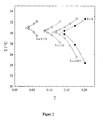
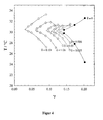
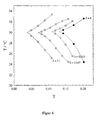
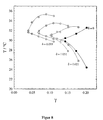
- the H 2 O / n-dean ratios realized in FIGS. 1 to 9 and 11 to 13 are 1: 1.
- FIG. 1 shows the type of phase diagram according to the prior art, which provides the basis for FIGS. 1 to 8.
- the temperature T is plotted against the total surfactant concentration ⁇ for the water / n-tetradecane-C 6 E 2 system and a water / n-tetradecane ratio of 1: 1.
- the single phase area 1 of the mixture is located. This area is followed by a closed three-phase area 3 in the direction of lower surfactant concentrations.
- T / ⁇ diagrams shown in Figures 2 to 9 refer to systems with a constant water / oil volume ratio of 1: 1 and are general below are explained.
- Figure 2 shows how the efficiency of the total surfactant enlarged with the addition of the block copolymer. additionally is not a significant shift in the single phase area recorded on the temperature axis. This is synonymous with the fact that the block copolymer D Location of the effectiveness of the surfactant C with regard to its application temperature leaves essentially invariant. Furthermore no lamellar arises occur in the investigated mixtures Mesophases.
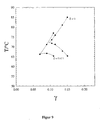
- FIGS. 7 and 8 A significant increase in efficiency can also be observed in FIGS. 7 and 8. Furthermore, no lamellar phases occur in the experiments shown in FIGS. 7 and 8. In Figure 7, the gray dots are PI5 / PEO15 and the triangles P5 / 15. While the increase in efficiency of the nonionic surfactant C 10 E 4 was documented by the addition of block copolymers in FIGS. 2-8, the increase in efficiency in an anionic surfactant system (water + NaCl) / n-decane-AOT-P5 / 5 is shown in FIG.
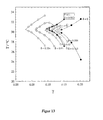
- Figure 11 documents an overview of the very strong increase in efficiency of the block copolymer admixtures according to the invention.
- the total surfactant concentrations at the crossing point are shown as a function of the addition ⁇ of the block copolymer.
- a very small addition ⁇ leads to a greater decrease in the block copolymers , and thus a strong increase in efficiency.
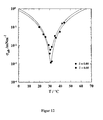
- interfacial tension is shown as a function of temperature for the water / n-dean-C 10 E 4 -P5 / 5 system.
- the interfacial tension of surfactants such as, for example, anionic, cationic and nonionic surfactants, sugar surfactants or technical surfactant mixtures, is reduced.
- the occurrence of lamellar mesophases is suppressed.
- the temperature behavior of the microemulsions remains unchanged, that is to say the position of the single-phase region with respect to the temperature in the phase diagram is not influenced by the addition of the additives used according to the invention. Therefore, the formulation of a detergent does not have to be changed in order to bring about a constant position of the single-phase area with respect to the temperature in the single-phase diagram.
- the AB block copolymers according to the invention can not only be used in detergents; they can also be used with the same effect, for example as additives in foods and cosmetics and in all industrial or technical applications of microemulsions and emulsions, for example when used in oil production, in soil remediation and when used as a reaction medium.
- the microemulsions produced by adding the AB block copolymers according to the invention have emulsified liquid volumes whose size corresponds to that of emulsions.
- the effects according to the invention can be achieved by any use of a surfactant together with the AB block copolymer in a system to be emulsified.
- a surfactant, to which an AB block copolymer according to the invention is added, and any system emulsified therewith, comprising additionally water and / or oil, are therefore encompassed by the invention.
- the effects according to the invention are not limited to emulsions and microemulsions, but generally influence the behavior of surfactants in the manner described.
Landscapes
- Chemical & Material Sciences (AREA)
- Life Sciences & Earth Sciences (AREA)
- Engineering & Computer Science (AREA)
- Chemical Kinetics & Catalysis (AREA)
- Oil, Petroleum & Natural Gas (AREA)
- Wood Science & Technology (AREA)
- Organic Chemistry (AREA)
- Crystallography & Structural Chemistry (AREA)
- Cosmetics (AREA)
- Emulsifying, Dispersing, Foam-Producing Or Wetting Agents (AREA)
- Detergent Compositions (AREA)
- Compositions Of Macromolecular Compounds (AREA)
- Colloid Chemistry (AREA)
- Other Resins Obtained By Reactions Not Involving Carbon-To-Carbon Unsaturated Bonds (AREA)
- General Preparation And Processing Of Foods (AREA)
- Processes Of Treating Macromolecular Substances (AREA)
Description
Weiterhin beeinflussen Additive im Allgemeinen das Temperaturverhalten der Emulsionen und Mikroemulsionen. So ist im Phasendiagramm eine Verlagerung der Einphasengebiete für Öl-Wasser-Tensid-Mischungen in andere Temperaturbereiche zu beobachten, wenn ein Additiv zugegeben wird. Die Verschiebungen können in der Größenordnung von 10°C liegen. Dies hat jedoch zur Folge, daß z. B. Waschmittelrezepturen geändert werden müssen, um sie dem sich jeweils neu einstellenden Temperaturverhalten des Einphasengebietes anzupassen.
Zusätzlich besteht das Bedürfnis, unter Einsparung von Tensiden ein mindestens gleich gutes Emulgierungsverhalten zu erlangen und die Grenzflächenspannung zu verkleinern, das bedeutet, beispielsweise die Waschkraft von Waschmitteln zu verbessern.
Für den Block B kommen verschiedene wasserunlösliche Komponenten des genannten Molekulargewichts zum Einsatz. So kann Block B das Produkt einer anionischen 1,2-, 3,4- Polymerisation, bzw. 1,4 Polymerisation von Dienen sein. In Folge kann Block B weiterhin das Produkt einer mindestens teilweisen Hydrierung der Polydiene sein. Als typische monomere Bestandteile kommen 1,3 Butadien, Isopren, alle Konstitumere des Dimethylbutadien, 1,3 Pentadien, 2,4 Hexadiene, α Methylstyrol, Isobutylen, Ethylen, Propylen, Styrol oder Alkylacrylate und Alkylmethacrylate wobei die Alkylgruppe zwischen 2 uns 20 Kohlenstoffatome enthält zum Einsatz. Block B kann auch Polydimethylsiloxan sein. Als Block B kann das Polymerisat eines einzigen Monomers oder eines Monomerengemisches verwendet werden.
Block B kann als Seitenketten Methyl-, Ethyl-, Vinyl-Phenyl- oder Benzylgruppen aufweisen.
Die Doppelbindungen in der Polydienkette sowie in den Vinylgruppen, die als Seitenkette existieren können, können entweder ganz oder teiweise hydriert sein. Jedoch kann erfindungsgemäß jedes genügend amphiphile Blockcopolymer eingesetzt werden. Die erfindungsgemäß eingesetzten AB-Blockcopolymere können vorzugsweise aus einer anionischen Polymerisation erhalten werden.
Bei geringeren Molekulargewichten der Blöcke A und B in einer Größenordnung von ca 500-5000 g/mol für die Blökke A und B werden besonders vorteilhafte Eigenschaften der erfindungsgemäßen AB-Blockcopolymere in Anwendungsprodukten beobachtet. So lösen sich die Polymere mit diesen niedrigen Molekulargewichten schnell und gut auf. Dies gilt zum Beispiel für Lösungen in Seifen und Waschmitteln.
Weiterhin können auch AB-Blockcopolymere des Typs ABA und BAB einegesetzt werden, die als Triblockcopolymere bezeichnet werden.
- nichtionische Tenside der Klasse Alkylpolyglycolether (CiEj) mit i ≥ 8 (C = C-Atome in der Alkylkette, E = Ethylenoxideinheiten)
- nichtionische Tenside der Klasse Alkylpolyglucoside (APG) "Zuckertenside",CiGj mit i ≥ 8) mit Cotensid Alkohol (Cx-OH, x ≥ 6)
- anionische Tenside, z.B. AOT (Natrium bis (2-ethylhexyl)sulfosuccinat)
- kationische Tenside
- Tensidgemische
- technische Tenside
- m = Masse in g.
- γ = dimensionsloser Massenbruch
- mges = Gesamtmasse aus mwasser + mÖl + m (C) + m (D)
- = Gesamttensidkonzentration am Kreuzungspunkt, an dem im Phasendiagramm das einphasige auf das dreiphasige Gebiet trifft. Dies entspricht der bei gegebenen Wasser/Öl-Verhältnis minimal zur vollständigen Solubilierung von Wasser und Öl notwendigen Gesamttensidkonzentration.

- δ = Massenbruch des Additivs D im Gemisch Tensid C + Additiv D, entspricht δ= m(D) / m(C) + m (D)
- mit m = Masse in g und
- δ = Massenbruch (dimensionslos)
Beispiel P5/5 : die Alkylkette hat ein Molekulargewicht von 5000 g/mol (= u) und die Polyethylenoxidkette hat ein Molekulargewicht von 5000 g/mol.
P22/15: die Alkylkette hat ein Molekulargewicht von 22000 g/mol und die Polyethylenoxidkette hat ein Molekulargewicht von 15000 g/mol.
Die auf diese Weise dargestellten Additive sind AB-Blockcopolymere.
Die hier beispielhaft dargestellten Verbindungen können nach dem Herstellungsverfahren aus der DE 196 34 477 Al erhalten werden.
Dabei ist die Temperatur T gegen die Gesamttensidkonzentration γ für das System Wasser/n-Tetradecan-C6E2 und ein Wasser/n-Tetradekan-Verhältnis von 1:1 aufgetragen. Bei höheren Tensidkonzentrationen befindet sich das Einphasengebiet 1 des Gemisches. An diesen Gebiet schließt sich in Richtung kleinerer Tensidkonzentrationen ein geschlossenes Dreiphasengebiet 3 an. Oberhalb und unterhalb der Phasengrenzlinien befinden sich Zweiphasengebiete 2. Der Punkt, an dem alle Phasengebiete zusamnmentreffen, wird durch die Tensidkonzentration

Während in den Figuren 2-8 die Effizienzsteigerung des nichtionischen Tensides C10E4 durch die Zugabe von Blockcopolymeren dokumentiert wurde, ist in Figur 9 die Effizienzsteigerung in einem anionischen Tensidsystem (Wasser+NaCl)/n-Dekan-AOT-P5/5 gezeigt.
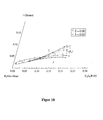
Um die Effizienzsteigerung der Blockcopolymere für eine weitere Tensidklasse zu dokumentieren, ist in Fig 10 ein Schnitt durch einen Phasentetraeder im System Wasser/n-Oktan-Oktanol-C8G1-P5/5, bei dem das Verhältnis Wasser/n-Oktan 1:1 ist, gezeigt. Dabei wird das Phasenverhalten hier nicht durch die Temperatur sondern durch die Zugabe eines Cotensides (Oktanol) bestimmt. Auch hier verschiebt sich das Einphasengebiet durch die Zugabe von Blockcopolymeren zu wesentlich kleineren Tensidkonzentrationen und außerdem auch zu kleineren Cotensid-Konzentrationen.
Im Gegensatz zu konventionellen Tensidmischungen führt bei den Blockcopolymeren schon eine sehr geringe Zugabe δ zu einem stärkeren Absinken von
In Figur 12 ist Grenzflächenspannung als Funktion der Temperatur für das System Wasser/n-Dekan-C10E4-P5/5 dargestellt. Durch die Zugabe des Blockcopolymers sinkt schon bei einem δ von 0.05 der Wert des Grenzflächenspannungsminimums um Faktor fünf ab.
Die erfindungsgemäßen AB-Blockcopolymere können nicht nur in Waschmitteln eingesetzt werden; sie können mit derselben Wirkung auch beispielsweise als Zusätze in Lebensmitteln und Kosmetika sowie in allen industriellen oder technischen Anwendungen von Mikroemulsionen und Emulsionen, z.B. beim Einsatz in der Erdölförderung, in der Bodensanierung sowie bei der Anwendung als z.B. Reaktionsmedium verwendet werden.
Die mittels der erfindungsgemäßen Zugabe der AB Blockcopolymere hergestellten Mikroemulsionen weisen emulgierte Flüssigkeitsvolumina auf, deren Größe denen von Emulsionen entsprechen.
Die erfindungsgemäßen Wirkungen können durch jeden gemeinsamen Einsatz eines Tensids mit dem AB-Blockcopolymer in einem zu emulgierenden System erreicht werden. Ein Tensid, welchem ein erfindungsgemäßes AB-Blockcopolymer beigefügt ist, sowie jedes damit emulgierte System umfassend zusätzlich Wasser und/oder Öl sind daher von der Erfindung umfaßt.
Die erfindungsgemäßen Wirkungen beschränken sich nicht auf Emulsionen und Mikroemulsionen, sondern beeinflussen das Verhalten von Tensiden im allgemeinen in der beschriebenen Weise.
Claims (20)
- Verfahren zur Steigerung der Effizienz von Tensiden in einer Emulsion oder Mikroemulsion aus Wasser und Öl durch Zugabe von Additiven mit einem wasserlöslichen und einem wasserunlöslichen Anteil, dadurch gekennzeichnet, dass als Additiv ein AB-Blockcopolymer mit einem wasserlöslichen Block A und einem wasserunlöslichen Block B zugegeben wird.
- Verfahren zur Verhinderung lamellarer Phasen in Wasser-, Öl, Tensidgemischen die in Mikroemulsionen vorliegen, dadurch gekennzeichnet, dass dem Wasser, Öl,- Tensidgemisch als Additiv ein AB-Blockcopolymer mit einem wasserlöslichen Block A und einem wasserunlöslichen Block B zugegeben wird.
- Verfahren zur Stabilisierung der Temperaturlage des Einphasengebietes für Öl-, Wasser-, Tensidmischungen in Mikroemulsionen, denen ein Additiv zugegeben wird, bei dem den Öl-, Wasser-, Tensidmischungen als Additiv ein AB-Blockcopolymer mit einem wasserlöslichen Block A und einem wasserunlöslichen Block B zugegeben wird.
- Verfahren zur Verminderung der Grenzflächenspannung von Öl-, Wassergemischen, die als Mikroemulsion Tenside enthalten, dadurch gekennzeichnet, dass den Öl-, Wasser-, Tensidgemischen als Additiv ein Blockcopolymer mit einem wasserlöslichen Block A und einem wasserunlöslichen Block B zugegeben wird.
- Verfahren nach einem der Ansprüche 1 bis 4, dadurch gekennzeichnet, dass als Blockcopolymer eine Verbindung mit der Struktur nach dem Muster AB, ABA oder BAB zugegeben wird.
- Verfahren nach einem der Ansprüche 1 bis 5, dadurch gekennzeichnet, dass ein öllöslicher und in aliphatischen Kohlenwasserstoffen löslicher Block B eingesetzt wird.
- Verfahren nach einem der Ansprüche 1 bis 6, dadurch gekennzeichnet, dass Block A ein Molekulargewicht zwischen 500 u und 60000 ü hat.
- Verfahren nach einem der Ansprüche 1 bis 7, dadurch gekennzeichnet, dass Block B ein Molekulargewicht zwischen 500 u und 60000 u hat.
- Verfahren nach einem der Ansprüche 1 bis 8, dadurch gekennzeichnet, dass als Block A ein Polyethylenoxid (PEO) eingesetzt wird.
- Verfahren nach einem der Ansprüche 1 bis 9, dadurch gekennzeichnet, dass als Block B ein Polydien oder ein mindestens teilweise hydriertes Polydien eingesetzt wird.
- Verfahren nach Anspruch 10, dadurch gekennzeichnet, dass Block B als Seitenketten mindestens eine Komponente aus den Gruppen von Methyl-, Ethyl-, Phenyl-, und Vinyl- umfasst.
- Mikroemulsion, enthaltend ein Wasser-Öl-Tensidgemisch sowie ein Additiv,
dadurch gekennzeichnet, daß das Additiv ein AB-Blockcopolymer mit einem wasserlöslichen Block A und einem wasserunlöslichen Block B ist. - Mikroemulsion nach Anspruch 12,
dadurch gekennzeichnet, daß der wasserunlösliche Block B in aliphatischen Kohlenwasserstoffen und Mineralölen löslich ist. - Mikroemulsion nach Anspruch 12 oder 13,
dadurch gekennzeichnet, daß sie als Additiv ein AB-Blockcopolymer mit der Struktur nach dem Muster ABA oder BAB enthält. - Mikroemulsion nach einem der Ansprüche 12 bis 14,
dadurch gekennzeichnet, daß Block A ein Molekulargewicht zwischen 500 u und 60000 u hat. - Mikroemulsion nach einem der Ansprüche 12 bis 15,
dadurch gekennzeichnet, daß Block B ein Molekulargewicht zwischen 500 u und 60000 u hat. - Mikroemulsion nach einem der Ansprüche 12 bis 16,
dadurch gekennzeichnet, daß Block A ein Polyethylenoxid ist. - Mikroemulsion nach einem der Ansprüche 12 bis 17 ,
dadurch gekennzeichnet, daß Block B ein Polydien oder ein mindestens teilweise hydriertes Polydien ist. - Mikroemulsion nach Anspruch 18,
dadurch gekennzeichnet, daß Block B als Seitenketten mindestens eine Komponente aus der Gruppe von Methyl- Ethyl-, Benzyl- und Vinyl- umfaßt. - Mikroemulsion nach einem der Ansprüche 12 bis 19,
dadurch gekennzeichnet, daß sie eine Beimischung in einem Stoff ist.
Applications Claiming Priority (3)
| Application Number | Priority Date | Filing Date | Title |
|---|---|---|---|
| DE19839054A DE19839054A1 (de) | 1998-08-28 | 1998-08-28 | Verfahren zur Effizienzsteigerung von Tensiden bei simultaner Unterdrückung lamellarer Mesophasen sowie Tenside, welchen ein Additiv beigefügt ist |
| DE19839054 | 1998-08-28 | ||
| PCT/DE1999/002748 WO2000012660A2 (de) | 1998-08-28 | 1999-08-26 | Verfahren zur effizienzsteigerung von tensiden bei simultaner unterdrückung lamellarer mesophasen sowie tenside, welchen ein additiv beigefügt ist |
Publications (3)
| Publication Number | Publication Date |
|---|---|
| EP1109883A2 EP1109883A2 (de) | 2001-06-27 |
| EP1109883B1 true EP1109883B1 (de) | 2004-10-27 |
| EP1109883B2 EP1109883B2 (de) | 2014-09-03 |
Family
ID=7878952
Family Applications (1)
| Application Number | Title | Priority Date | Filing Date |
|---|---|---|---|
| EP99953661.8A Expired - Lifetime EP1109883B2 (de) | 1998-08-28 | 1999-08-26 | Verfahren zur effizienzsteigerung von tensiden und verfahren zur unterdrückung lamellarer mesophasen in mikroemulsionen sowie ein tensid, welchem ein additiv beigefügt ist |
Country Status (6)
| Country | Link |
|---|---|
| US (2) | US6677293B1 (de) |
| EP (1) | EP1109883B2 (de) |
| JP (1) | JP4703852B2 (de) |
| AT (1) | ATE280821T1 (de) |
| DE (2) | DE19839054A1 (de) |
| WO (1) | WO2000012660A2 (de) |
Cited By (2)
| Publication number | Priority date | Publication date | Assignee | Title |
|---|---|---|---|---|
| WO2006060993A1 (de) * | 2004-12-08 | 2006-06-15 | Forschungszentrum Jülich GmbH | Verfahren zur effizienzsteigerung von tensiden und emulgatoren mittels additiven |
| EP2223995B1 (de) | 2007-09-19 | 2018-03-07 | intelligents fluids GmbH | Formulierungen zur entfernung von farbschichten und diversen schmutzschichten von oberflächen, verfahren zur herstellung des mittels und verfahren zur reinigung |
Families Citing this family (32)
| Publication number | Priority date | Publication date | Assignee | Title |
|---|---|---|---|---|
| DE19839054A1 (de) * | 1998-08-28 | 2000-03-02 | Forschungszentrum Juelich Gmbh | Verfahren zur Effizienzsteigerung von Tensiden bei simultaner Unterdrückung lamellarer Mesophasen sowie Tenside, welchen ein Additiv beigefügt ist |
| US20050004864A1 (en) * | 2000-06-15 | 2005-01-06 | Nextcard Inc. | Implementing a counter offer for an on line credit card application |
| JP4756671B2 (ja) * | 2001-04-06 | 2011-08-24 | 孝志 澤口 | スチレンオリゴマー−ポリエチレンオキシド共重合体及びその製造方法 |
| US20030158078A1 (en) * | 2002-02-11 | 2003-08-21 | Jeanne Chang | Detergent composition comprising a block copolymer |
| EP1490411B1 (de) * | 2002-02-11 | 2009-01-21 | Rhodia Chimie | Verfahren zur regulierung der stabilität von emulsionen und stabilisierten emulsionen |
| FR2845930B1 (fr) * | 2002-10-21 | 2006-05-26 | Oreal | Procede de solubilisation de composes lipophiles en solution aqueuse par des copolymeres blocs amphiphiles et composition cosmetique |
| WO2004035013A2 (en) * | 2002-10-21 | 2004-04-29 | L'oreal | Process for dissolving lipophilic compounds, and cosmetic composition |
| DE10323180A1 (de) | 2003-05-22 | 2004-12-09 | Basf Ag | Mischung, umfassend ein Tensid und ein Cotensid |
| DE10323178A1 (de) | 2003-05-22 | 2004-12-09 | Basf Ag | Mischung, umfassend ein Tensid und ein Cotensid |
| DE10358534A1 (de) | 2003-12-13 | 2005-07-14 | Henkel Kgaa | Adhäsionshemmung von Mikroorganismen durch nichtionische Tenside |
| DE102004007473A1 (de) * | 2004-02-13 | 2005-09-01 | Basf Ag | Mischung, umfassend ein Tensid und ein Cotensid |
| DE102004007501A1 (de) * | 2004-02-13 | 2005-09-01 | Basf Ag | Amphiphile Blockcopolymere enthaltende wässrige Polymerdispersionen, Verfahren zu ihrer Herstellung und ihre Verwendung |
| DE102004056362A1 (de) * | 2004-11-22 | 2006-06-01 | Henkel Kgaa | Schimmel-beständige Baustoffe |
| DE102005023762A1 (de) * | 2005-05-19 | 2006-11-23 | Forschungszentrum Jülich GmbH | Verfahren zur Effizienzsteigerung von Tensiden, zur Unterdrückung lamellarer Mesophasen, zur Temperaturstabilisierung des Einphasengebietes sowie ein Verfahren zur Verminderung der Grenzflächenspannung in Mikroemulsionen welche Siliconöle enthalten mittels Additiven, sowie Tensid-Ölgemisch |
| DE102005026716A1 (de) | 2005-06-09 | 2006-12-28 | Basf Ag | Tensidmischungen für die tertiäre Erdölförderung |
| CN101233187A (zh) * | 2005-08-04 | 2008-07-30 | 巴斯福股份公司 | 水分散体及其用途 |
| DE102005049765A1 (de) * | 2005-10-18 | 2007-04-19 | Forschungszentrum Jülich GmbH | Verfahren zur Effizienzsteigerung von Tensiden, zur Aufweitung des Temperaturfensters, zur Unterdrückung lamellarer Mesophasen in Mikroemulsionen mittels Additiven, sowie Mikroemulsionen |
| EP2152843A2 (de) * | 2007-04-27 | 2010-02-17 | Bernd Schwegmann Gmbh&co. Kg | Mischung, welche ein alkylpolyglucosid, ein cotensid und ein polymeres additiv umfasst |
| DE102007020426A1 (de) | 2007-04-27 | 2008-10-30 | Bernd Schwegmann Gmbh & Co. Kg | Mischung, welche ein Alkylpolyglucosid, ein Cotensid und ein polymeres Additiv umfasst |
| DE102007030406A1 (de) | 2007-06-29 | 2009-01-08 | Henkel Ag & Co. Kgaa | Verminderung der Adhäsion von biologischem Material durch Algenextrakte |
| CA2696312C (en) * | 2007-08-13 | 2015-10-06 | Rhodia, Inc. | Method for separating crude oil emulsions |
| US7671099B2 (en) | 2007-08-13 | 2010-03-02 | Rhodia Inc. | Method for spearation crude oil emulsions |
| US8133924B2 (en) * | 2007-08-13 | 2012-03-13 | Rhodia Operations | Demulsifiers and methods for use in pharmaceutical applications |
| DE102007058342A1 (de) | 2007-12-03 | 2009-06-04 | Henkel Ag & Co. Kgaa | Verminderung der Biofilmbildung durch multifunktionelle Copolymere |
| DE102007058343A1 (de) | 2007-12-03 | 2009-06-04 | Henkel Ag & Co. Kgaa | Verminderung der Adhäsion von Schmutz, Staub und biologischem Material durch Polyesteramide |
| FR2934154B1 (fr) * | 2008-07-23 | 2010-08-13 | Rhodia Operations | Emulsions thermosensibles |
| DE102008063070A1 (de) | 2008-12-23 | 2010-07-01 | Henkel Ag & Co. Kgaa | Verwendung sternförmiger Polymere mit peripheren negativ geladenen Gruppen und/oder peripheren Silyl-Gruppen zur Ausrüstung von Oberflächen |
| US20110277376A1 (en) * | 2009-02-04 | 2011-11-17 | Archer-Daniels-Midland Company | Incorporation of biologically derived carbon into petroleum products |
| DE102012204378A1 (de) | 2012-03-20 | 2013-09-26 | Bernd Schwegmann Gmbh & Co. Kg | Reinigungsmittel auf Mikroemulsionsbasis |
| DE102015011694A1 (de) | 2015-09-14 | 2017-03-16 | Forschungszentrum Jülich GmbH | Reinigungsmittel auf Mikroemulsionsbasis |
| EP4011996A1 (de) | 2020-12-11 | 2022-06-15 | Henkel AG & Co. KGaA | Verfahren zum ablösen von verklebten substraten |
| EP4140679B1 (de) | 2021-08-24 | 2026-05-13 | Henkel AG & Co. KGaA | Verfahren zum ablösen von durch polyurethankleber verbundenen substraten |
Family Cites Families (29)
| Publication number | Priority date | Publication date | Assignee | Title |
|---|---|---|---|---|
| GB1103201A (en) * | 1963-07-23 | 1968-02-14 | Union Carbide Corp | Organosilicon compositions |
| JPS5536237A (en) * | 1978-09-06 | 1980-03-13 | Kureha Chem Ind Co Ltd | Antistatic resin composition |
| US4266610A (en) * | 1978-11-28 | 1981-05-12 | Phillips Petroleum Company | Sulfonate-cosurfactant mixtures for use in hard brines during oil recovery operations |
| NZ192888A (en) | 1979-04-02 | 1982-03-30 | Canadian Ind | Water-in-oil microemulsion explosive compositions |
| US4384974A (en) | 1979-07-27 | 1983-05-24 | Revlon, Inc. | Stable water-in-oil emulsions |
| DE3436177A1 (de) † | 1984-10-03 | 1986-04-03 | Goldschmidt Ag Th | Verwendung von polyoxyalkylen-polysiloxan-copolymerisaten mit an siliciumatomen gebundenen langkettigen alkylresten als emulgatoren zur herstellung von w/o-emulsionen |
| GB8822374D0 (en) | 1988-09-23 | 1988-10-26 | Abster Co Ltd | Detergent composition |
| GB8914905D0 (en) † | 1989-06-29 | 1989-08-23 | Unilever Plc | Cosmetic composition |
| US5162378A (en) | 1990-04-20 | 1992-11-10 | Revlon Consumer Products Corporation | Silicone containing water-in-oil microemulsions having increased salt content |
| US5077040A (en) † | 1990-04-30 | 1991-12-31 | Helene Curtis, Inc. | Hair-treating microemulsion composition and method of preparing and using the same |
| CA2053147A1 (en) | 1990-10-15 | 1992-04-16 | Charles F. Cooper | Esterified polyoxyalkylene block copolymers as reduced calorie fat substitutes |
| DE4100119A1 (de) * | 1991-01-04 | 1992-07-09 | Bayer Ag | Verwendung von polyether-polycarbonat-blockcopolymeren als beschichtungen fuer kunststofformkoerper |
| DE4141942A1 (de) | 1991-12-19 | 1993-06-24 | Huels Chemische Werke Ag | Verfahren zur herstellung grossteiliger, waessriger kunststoffdispersionen |
| US5292795A (en) * | 1992-05-08 | 1994-03-08 | Shell Oil Company | Very fine stable dispersions of block copolymers |
| WO1994022420A1 (en) † | 1993-04-05 | 1994-10-13 | Quest International B.V. | Silicone based skin care products |
| US5985979A (en) * | 1993-07-20 | 1999-11-16 | Shell Oil Company | Process for making stable latexes of block copolymers |
| US5741760A (en) † | 1993-08-04 | 1998-04-21 | Colgate-Palmolive Company | Aqueous cleaning composition which may be in microemulsion form comprising polyalkylene oxide-polydimethyl siloxane |
| US5461104A (en) * | 1994-01-21 | 1995-10-24 | Shell Oil Company | Process for making water-based latexes of block copolymers |
| DE4418156A1 (de) * | 1994-05-25 | 1995-11-30 | Basf Ag | Verfahren zur Herstellung von stabilen Wasser-in-Öl-Emulsionen von hydrolysierten Polymerisaten von N-Vinylamiden und ihre Verwendung |
| US5518648A (en) | 1994-06-14 | 1996-05-21 | Basf Corporation | Solid dishwashing composition comprising a two-component blend of alkoxylated nonionic surfactants |
| DE19509079A1 (de) † | 1995-03-15 | 1996-09-19 | Beiersdorf Ag | Kosmetische oder dermatologische Mikroemulsionen |
| CA2257313C (en) * | 1996-06-05 | 2006-03-14 | Forschungszentrum Julich Gmbh | Process for the preparation of hydrophobic/ hydrophile ab block copolymers |
| DE19634477C2 (de) * | 1996-06-05 | 2002-10-17 | Forschungszentrum Juelich Gmbh | Verfahren zur Herstellung von hydrophob-hydrophilen AB-Blockcopolymeren und AB-Blockcopolymer |
| DE19641672A1 (de) † | 1996-10-10 | 1998-04-16 | Beiersdorf Ag | Kosmetische oder dermatologische Zubereitungen auf der Basis von ethylenoxidfreien und propylenoxidfreien Emulgatoren zur Herstellung von Mikroemulsionsgelen |
| US5908707A (en) * | 1996-12-05 | 1999-06-01 | The Procter & Gamble Company | Cleaning articles comprising a high internal phase inverse emulsion and a carrier with controlled absorbency |
| DE19654168A1 (de) * | 1996-12-23 | 1998-06-25 | Basf Ag | Verfahren zur Herstellung wäßriger Polymerisatdispersionen durch radikalische, wäßrige Emulsionspolymerisation |
| DE19714714A1 (de) * | 1997-04-09 | 1998-10-15 | Basf Ag | Blockcopolymere und deren Verwendung als polymere Tenside |
| US5962003A (en) * | 1998-03-30 | 1999-10-05 | Council Of Scientific & Industrial Research | Process for the preparation of polyurethane microcapsules containing monocrotophos |
| DE19839054A1 (de) * | 1998-08-28 | 2000-03-02 | Forschungszentrum Juelich Gmbh | Verfahren zur Effizienzsteigerung von Tensiden bei simultaner Unterdrückung lamellarer Mesophasen sowie Tenside, welchen ein Additiv beigefügt ist |
-
1998
- 1998-08-28 DE DE19839054A patent/DE19839054A1/de not_active Withdrawn
-
1999
- 1999-08-26 EP EP99953661.8A patent/EP1109883B2/de not_active Expired - Lifetime
- 1999-08-26 AT AT99953661T patent/ATE280821T1/de active
- 1999-08-26 WO PCT/DE1999/002748 patent/WO2000012660A2/de not_active Ceased
- 1999-08-26 JP JP2000571065A patent/JP4703852B2/ja not_active Expired - Fee Related
- 1999-08-26 US US09/763,413 patent/US6677293B1/en not_active Expired - Fee Related
- 1999-08-26 DE DE59910950T patent/DE59910950D1/de not_active Expired - Lifetime
-
2003
- 2003-08-19 US US10/643,491 patent/US7468349B2/en not_active Expired - Fee Related
Cited By (2)
| Publication number | Priority date | Publication date | Assignee | Title |
|---|---|---|---|---|
| WO2006060993A1 (de) * | 2004-12-08 | 2006-06-15 | Forschungszentrum Jülich GmbH | Verfahren zur effizienzsteigerung von tensiden und emulgatoren mittels additiven |
| EP2223995B1 (de) | 2007-09-19 | 2018-03-07 | intelligents fluids GmbH | Formulierungen zur entfernung von farbschichten und diversen schmutzschichten von oberflächen, verfahren zur herstellung des mittels und verfahren zur reinigung |
Also Published As
| Publication number | Publication date |
|---|---|
| JP4703852B2 (ja) | 2011-06-15 |
| WO2000012660A3 (de) | 2000-06-22 |
| EP1109883A2 (de) | 2001-06-27 |
| US20040054064A1 (en) | 2004-03-18 |
| US6677293B1 (en) | 2004-01-13 |
| ATE280821T1 (de) | 2004-11-15 |
| JP2002525392A (ja) | 2002-08-13 |
| DE59910950D1 (de) | 2004-12-02 |
| WO2000012660A2 (de) | 2000-03-09 |
| DE19839054A1 (de) | 2000-03-02 |
| US7468349B2 (en) | 2008-12-23 |
| EP1109883B2 (de) | 2014-09-03 |
Similar Documents
| Publication | Publication Date | Title |
|---|---|---|
| EP1109883B2 (de) | Verfahren zur effizienzsteigerung von tensiden und verfahren zur unterdrückung lamellarer mesophasen in mikroemulsionen sowie ein tensid, welchem ein additiv beigefügt ist | |
| AT397215B (de) | Polymerisat- und tensidhaltige präparate, deren herstellung und verwendung | |
| DE68928669T2 (de) | Verdickungssystem | |
| DE69528278T2 (de) | Asphalt-trennmittel und verfahren zu seiner verwendung | |
| DE69708459T2 (de) | Mikroemulsionen und emulsionen mit kontinuierlicher ölphase, mit hohem wassergehalt, niedriger viskosität und ihre verwendung in reinigungsanwendungen | |
| DE847348C (de) | Verfahren zur Herstellung von Polymeren in Form von Kuegelchen | |
| DE2537586B2 (de) | Verfahren zur Herstellung einer stabilen Wasser-in-öl-Emulsion von Polymeren und Copolymeren | |
| DE10323178A1 (de) | Mischung, umfassend ein Tensid und ein Cotensid | |
| EP1470208B1 (de) | Alkylglykolalkoxylate oder -diglykolalkoxylate, ihre mischungen mit tensiden und ihre verwendung | |
| DE69509766T2 (de) | Mikroemulsionen | |
| EP1937795B1 (de) | Verfahren zur effizienzsteigerung von tensiden, zur unterdrückung lamellarer mesophasen in mikroemulsionen mittels additiven sowie mikroemulsion | |
| EP0863176A1 (de) | Polymerisate mit mehr als einem Hohlraum | |
| DE3929071A1 (de) | Universalschmiermittel auf der basis einer syntheseoelloesung | |
| DE19630176C2 (de) | Kosmetische und pharmazeutische Mittel, gebildet durch eine nach dem Phaseninversionsverfahren erzeugte W/O/W-Emulsion | |
| DE60101689T2 (de) | Verdickungsmittel für wässrige Systeme | |
| DE69430051T2 (de) | Verfahren zur herstellung eines hydrogenierten nbr-latex | |
| DE102004058956A1 (de) | Verfahren zur Effizienzsteigerung von Tensiden und Emulgatoren mittels Additiven | |
| DE102004007473A1 (de) | Mischung, umfassend ein Tensid und ein Cotensid | |
| EP1882003B1 (de) | Verfahren zur effizienzsteigerung von tensiden, zur unterdrückung lamellarer mesophasen, zu temperaturstabilisierung des einphasengebietes sowie ein verfahren zur verminderung der grenzflächenspannung in mikroemulsionen, welche siliconöle enthalten, mittels additiven sowie tensid-ölgemisch | |
| EP1323741A2 (de) | Olefinisch ungesättigte Ethercarbonsäuren und ihre Verwendung in der Emulsionsspaltung | |
| DE2036395C3 (de) | Verfahren zur Gewinnung von elastomeren Polymerisaten oder Copolymerisaten aus ihrer Lösung | |
| EP0932483B1 (de) | Wässrige betontrennmittel | |
| DE2646505B2 (de) | Verfahren zum Fluten von Erdöllagerstätten mittels Dispersionen nichtionogener grenzflächenaktiver Stoffe in Wasser | |
| DE69501785T2 (de) | Neues verfahren zur behandlung einer emulsion | |
| DE19636039A1 (de) | Emulgatoren |
Legal Events
| Date | Code | Title | Description |
|---|---|---|---|
| PUAI | Public reference made under article 153(3) epc to a published international application that has entered the european phase |
Free format text: ORIGINAL CODE: 0009012 |
|
| 17P | Request for examination filed |
Effective date: 20010131 |
|
| AK | Designated contracting states |
Kind code of ref document: A2 Designated state(s): AT BE CH CY DE DK ES FI FR GB GR IE IT LI LU MC NL PT SE |
|
| RAP1 | Party data changed (applicant data changed or rights of an application transferred) |
Owner name: FORSCHUNGSZENTRUM JUELICH GMBH |
|
| 17Q | First examination report despatched |
Effective date: 20030715 |
|
| GRAP | Despatch of communication of intention to grant a patent |
Free format text: ORIGINAL CODE: EPIDOSNIGR1 |
|
| GRAS | Grant fee paid |
Free format text: ORIGINAL CODE: EPIDOSNIGR3 |
|
| GRAA | (expected) grant |
Free format text: ORIGINAL CODE: 0009210 |
|
| AK | Designated contracting states |
Kind code of ref document: B1 Designated state(s): AT BE CH CY DE DK ES FI FR GB GR IE IT LI LU MC NL PT SE |
|
| PG25 | Lapsed in a contracting state [announced via postgrant information from national office to epo] |
Ref country code: IT Free format text: LAPSE BECAUSE OF FAILURE TO SUBMIT A TRANSLATION OF THE DESCRIPTION OR TO PAY THE FEE WITHIN THE PRESCRIBED TIME-LIMIT;WARNING: LAPSES OF ITALIAN PATENTS WITH EFFECTIVE DATE BEFORE 2007 MAY HAVE OCCURRED AT ANY TIME BEFORE 2007. THE CORRECT EFFECTIVE DATE MAY BE DIFFERENT FROM THE ONE RECORDED. Effective date: 20041027 Ref country code: IE Free format text: LAPSE BECAUSE OF FAILURE TO SUBMIT A TRANSLATION OF THE DESCRIPTION OR TO PAY THE FEE WITHIN THE PRESCRIBED TIME-LIMIT Effective date: 20041027 Ref country code: FI Free format text: LAPSE BECAUSE OF FAILURE TO SUBMIT A TRANSLATION OF THE DESCRIPTION OR TO PAY THE FEE WITHIN THE PRESCRIBED TIME-LIMIT Effective date: 20041027 |
|
| REG | Reference to a national code |
Ref country code: GB Ref legal event code: FG4D Free format text: NOT ENGLISH |
|
| REG | Reference to a national code |
Ref country code: CH Ref legal event code: EP |
|
| REG | Reference to a national code |
Ref country code: IE Ref legal event code: FG4D Free format text: GERMAN |
|
| REF | Corresponds to: |
Ref document number: 59910950 Country of ref document: DE Date of ref document: 20041202 Kind code of ref document: P |
|
| PG25 | Lapsed in a contracting state [announced via postgrant information from national office to epo] |
Ref country code: SE Free format text: LAPSE BECAUSE OF FAILURE TO SUBMIT A TRANSLATION OF THE DESCRIPTION OR TO PAY THE FEE WITHIN THE PRESCRIBED TIME-LIMIT Effective date: 20050127 Ref country code: GR Free format text: LAPSE BECAUSE OF FAILURE TO SUBMIT A TRANSLATION OF THE DESCRIPTION OR TO PAY THE FEE WITHIN THE PRESCRIBED TIME-LIMIT Effective date: 20050127 Ref country code: DK Free format text: LAPSE BECAUSE OF FAILURE TO SUBMIT A TRANSLATION OF THE DESCRIPTION OR TO PAY THE FEE WITHIN THE PRESCRIBED TIME-LIMIT Effective date: 20050127 |
|
| PG25 | Lapsed in a contracting state [announced via postgrant information from national office to epo] |
Ref country code: ES Free format text: LAPSE BECAUSE OF FAILURE TO SUBMIT A TRANSLATION OF THE DESCRIPTION OR TO PAY THE FEE WITHIN THE PRESCRIBED TIME-LIMIT Effective date: 20050207 |
|
| GBT | Gb: translation of ep patent filed (gb section 77(6)(a)/1977) |
Effective date: 20050208 |
|
| REG | Reference to a national code |
Ref country code: IE Ref legal event code: FD4D |
|
| PLBI | Opposition filed |
Free format text: ORIGINAL CODE: 0009260 |
|
| PG25 | Lapsed in a contracting state [announced via postgrant information from national office to epo] |
Ref country code: LU Free format text: LAPSE BECAUSE OF NON-PAYMENT OF DUE FEES Effective date: 20050826 Ref country code: CY Free format text: LAPSE BECAUSE OF FAILURE TO SUBMIT A TRANSLATION OF THE DESCRIPTION OR TO PAY THE FEE WITHIN THE PRESCRIBED TIME-LIMIT Effective date: 20050826 |
|
| PG25 | Lapsed in a contracting state [announced via postgrant information from national office to epo] |
Ref country code: MC Free format text: LAPSE BECAUSE OF NON-PAYMENT OF DUE FEES Effective date: 20050831 |
|
| PLAX | Notice of opposition and request to file observation + time limit sent |
Free format text: ORIGINAL CODE: EPIDOSNOBS2 |
|
| 26 | Opposition filed |
Opponent name: HENKEL KOMMANDITGESELLSCHAFT AUF AKTIEN Effective date: 20050727 Opponent name: BASF AKTIENGESELLSCHAFT Effective date: 20050726 |
|
| ET | Fr: translation filed | ||
| NLR1 | Nl: opposition has been filed with the epo |
Opponent name: HENKEL KOMMANDITGESELLSCHAFT AUF AKTIEN Opponent name: BASF AKTIENGESELLSCHAFT |
|
| PLAF | Information modified related to communication of a notice of opposition and request to file observations + time limit |
Free format text: ORIGINAL CODE: EPIDOSCOBS2 |
|
| PLBB | Reply of patent proprietor to notice(s) of opposition received |
Free format text: ORIGINAL CODE: EPIDOSNOBS3 |
|
| PG25 | Lapsed in a contracting state [announced via postgrant information from national office to epo] |
Ref country code: PT Free format text: LAPSE BECAUSE OF NON-PAYMENT OF DUE FEES Effective date: 20050327 |
|
| PLAB | Opposition data, opponent's data or that of the opponent's representative modified |
Free format text: ORIGINAL CODE: 0009299OPPO |
|
| PLAB | Opposition data, opponent's data or that of the opponent's representative modified |
Free format text: ORIGINAL CODE: 0009299OPPO |
|
| R26 | Opposition filed (corrected) |
Opponent name: HENKEL AG & CO. KGAA Effective date: 20050727 Opponent name: BASF AKTIENGESELLSCHAFT Effective date: 20050726 |
|
| APAH | Appeal reference modified |
Free format text: ORIGINAL CODE: EPIDOSCREFNO |
|
| APBM | Appeal reference recorded |
Free format text: ORIGINAL CODE: EPIDOSNREFNO |
|
| APBP | Date of receipt of notice of appeal recorded |
Free format text: ORIGINAL CODE: EPIDOSNNOA2O |
|
| APBM | Appeal reference recorded |
Free format text: ORIGINAL CODE: EPIDOSNREFNO |
|
| APBP | Date of receipt of notice of appeal recorded |
Free format text: ORIGINAL CODE: EPIDOSNNOA2O |
|
| APBM | Appeal reference recorded |
Free format text: ORIGINAL CODE: EPIDOSNREFNO |
|
| APBP | Date of receipt of notice of appeal recorded |
Free format text: ORIGINAL CODE: EPIDOSNNOA2O |
|
| APBQ | Date of receipt of statement of grounds of appeal recorded |
Free format text: ORIGINAL CODE: EPIDOSNNOA3O |
|
| PLAB | Opposition data, opponent's data or that of the opponent's representative modified |
Free format text: ORIGINAL CODE: 0009299OPPO |
|
| APBQ | Date of receipt of statement of grounds of appeal recorded |
Free format text: ORIGINAL CODE: EPIDOSNNOA3O |
|
| R26 | Opposition filed (corrected) |
Opponent name: HENKEL AG & CO. KGAA Effective date: 20050727 Opponent name: BASF SE Effective date: 20050726 |
|
| APBQ | Date of receipt of statement of grounds of appeal recorded |
Free format text: ORIGINAL CODE: EPIDOSNNOA3O |
|
| NLR1 | Nl: opposition has been filed with the epo |
Opponent name: HENKEL AG & CO. KGAA Opponent name: BASF SE |
|
| PLAB | Opposition data, opponent's data or that of the opponent's representative modified |
Free format text: ORIGINAL CODE: 0009299OPPO |
|
| R26 | Opposition filed (corrected) |
Opponent name: HENKEL AG & CO. KGAA Effective date: 20050727 Opponent name: BASF SE Effective date: 20050726 |
|
| APBU | Appeal procedure closed |
Free format text: ORIGINAL CODE: EPIDOSNNOA9O |
|
| PLAY | Examination report in opposition despatched + time limit |
Free format text: ORIGINAL CODE: EPIDOSNORE2 |
|
| PLBC | Reply to examination report in opposition received |
Free format text: ORIGINAL CODE: EPIDOSNORE3 |
|
| PLAB | Opposition data, opponent's data or that of the opponent's representative modified |
Free format text: ORIGINAL CODE: 0009299OPPO |
|
| R26 | Opposition filed (corrected) |
Opponent name: BASF SE Effective date: 20050726 Opponent name: HENKEL AG & CO. KGAA Effective date: 20050727 |
|
| PUAH | Patent maintained in amended form |
Free format text: ORIGINAL CODE: 0009272 |
|
| STAA | Information on the status of an ep patent application or granted ep patent |
Free format text: STATUS: PATENT MAINTAINED AS AMENDED |
|
| 27A | Patent maintained in amended form |
Effective date: 20140903 |
|
| AK | Designated contracting states |
Kind code of ref document: B2 Designated state(s): AT BE CH CY DE DK ES FI FR GB GR IE IT LI LU MC NL PT SE |
|
| REG | Reference to a national code |
Ref country code: DE Ref legal event code: R102 Ref document number: 59910950 Country of ref document: DE |
|
| REG | Reference to a national code |
Ref country code: CH Ref legal event code: AELC |
|
| REG | Reference to a national code |
Ref country code: DE Ref legal event code: R102 Ref document number: 59910950 Country of ref document: DE Effective date: 20140903 |
|
| PGFP | Annual fee paid to national office [announced via postgrant information from national office to epo] |
Ref country code: DE Payment date: 20140703 Year of fee payment: 16 Ref country code: NL Payment date: 20140821 Year of fee payment: 16 Ref country code: CH Payment date: 20140821 Year of fee payment: 16 |
|
| PGFP | Annual fee paid to national office [announced via postgrant information from national office to epo] |
Ref country code: AT Payment date: 20140820 Year of fee payment: 16 Ref country code: GB Payment date: 20140821 Year of fee payment: 16 Ref country code: FR Payment date: 20140819 Year of fee payment: 16 |
|
| REG | Reference to a national code |
Ref country code: NL Ref legal event code: T3 |
|
| PGFP | Annual fee paid to national office [announced via postgrant information from national office to epo] |
Ref country code: BE Payment date: 20140820 Year of fee payment: 16 |
|
| REG | Reference to a national code |
Ref country code: DE Ref legal event code: R119 Ref document number: 59910950 Country of ref document: DE |
|
| REG | Reference to a national code |
Ref country code: CH Ref legal event code: PL |
|
| REG | Reference to a national code |
Ref country code: AT Ref legal event code: MM01 Ref document number: 280821 Country of ref document: AT Kind code of ref document: T Effective date: 20150826 |
|
| GBPC | Gb: european patent ceased through non-payment of renewal fee |
Effective date: 20150826 |
|
| PG25 | Lapsed in a contracting state [announced via postgrant information from national office to epo] |
Ref country code: LI Free format text: LAPSE BECAUSE OF NON-PAYMENT OF DUE FEES Effective date: 20150831 Ref country code: CH Free format text: LAPSE BECAUSE OF NON-PAYMENT OF DUE FEES Effective date: 20150831 |
|
| REG | Reference to a national code |
Ref country code: NL Ref legal event code: MM Effective date: 20150901 |
|
| PG25 | Lapsed in a contracting state [announced via postgrant information from national office to epo] |
Ref country code: AT Free format text: LAPSE BECAUSE OF NON-PAYMENT OF DUE FEES Effective date: 20150826 |
|
| REG | Reference to a national code |
Ref country code: FR Ref legal event code: ST Effective date: 20160429 |
|
| PG25 | Lapsed in a contracting state [announced via postgrant information from national office to epo] |
Ref country code: NL Free format text: LAPSE BECAUSE OF NON-PAYMENT OF DUE FEES Effective date: 20150901 |
|
| PG25 | Lapsed in a contracting state [announced via postgrant information from national office to epo] |
Ref country code: DE Free format text: LAPSE BECAUSE OF NON-PAYMENT OF DUE FEES Effective date: 20160301 Ref country code: GB Free format text: LAPSE BECAUSE OF NON-PAYMENT OF DUE FEES Effective date: 20150826 |
|
| PG25 | Lapsed in a contracting state [announced via postgrant information from national office to epo] |
Ref country code: FR Free format text: LAPSE BECAUSE OF NON-PAYMENT OF DUE FEES Effective date: 20150831 |
|
| PG25 | Lapsed in a contracting state [announced via postgrant information from national office to epo] |
Ref country code: BE Free format text: LAPSE BECAUSE OF NON-PAYMENT OF DUE FEES Effective date: 20150831 |