EP1106986A2 - Verfahren zur Messung der Korrosionsbeständigkeit von Weissblech - Google Patents
Verfahren zur Messung der Korrosionsbeständigkeit von Weissblech Download PDFInfo
- Publication number
- EP1106986A2 EP1106986A2 EP00125403A EP00125403A EP1106986A2 EP 1106986 A2 EP1106986 A2 EP 1106986A2 EP 00125403 A EP00125403 A EP 00125403A EP 00125403 A EP00125403 A EP 00125403A EP 1106986 A2 EP1106986 A2 EP 1106986A2
- Authority
- EP
- European Patent Office
- Prior art keywords
- calibration
- der
- sample
- tinplate
- calibration samples
- Prior art date
- Legal status (The legal status is an assumption and is not a legal conclusion. Google has not performed a legal analysis and makes no representation as to the accuracy of the status listed.)
- Withdrawn
Links
Images



Classifications
-
- C—CHEMISTRY; METALLURGY
- C23—COATING METALLIC MATERIAL; COATING MATERIAL WITH METALLIC MATERIAL; CHEMICAL SURFACE TREATMENT; DIFFUSION TREATMENT OF METALLIC MATERIAL; COATING BY VACUUM EVAPORATION, BY SPUTTERING, BY ION IMPLANTATION OR BY CHEMICAL VAPOUR DEPOSITION, IN GENERAL; INHIBITING CORROSION OF METALLIC MATERIAL OR INCRUSTATION IN GENERAL
- C23C—COATING METALLIC MATERIAL; COATING MATERIAL WITH METALLIC MATERIAL; SURFACE TREATMENT OF METALLIC MATERIAL BY DIFFUSION INTO THE SURFACE, BY CHEMICAL CONVERSION OR SUBSTITUTION; COATING BY VACUUM EVAPORATION, BY SPUTTERING, BY ION IMPLANTATION OR BY CHEMICAL VAPOUR DEPOSITION, IN GENERAL
- C23C2/00—Hot-dipping or immersion processes for applying the coating material in the molten state without affecting the shape; Apparatus therefor
- C23C2/04—Hot-dipping or immersion processes for applying the coating material in the molten state without affecting the shape; Apparatus therefor characterised by the coating material
- C23C2/08—Tin or alloys based thereon
-
- C—CHEMISTRY; METALLURGY
- C25—ELECTROLYTIC OR ELECTROPHORETIC PROCESSES; APPARATUS THEREFOR
- C25D—PROCESSES FOR THE ELECTROLYTIC OR ELECTROPHORETIC PRODUCTION OF COATINGS; ELECTROFORMING; APPARATUS THEREFOR
- C25D3/00—Electroplating: Baths therefor
- C25D3/02—Electroplating: Baths therefor from solutions
- C25D3/30—Electroplating: Baths therefor from solutions of tin
Definitions
- the invention relates to a method for measuring the corrosion resistance of Tinplate.
- tinplate For the production of containers for food from tinplate, such as Beverage cans, tinplate are required, which is a tasteless Preservation and high storage stability enable. Such containers are especially in the case of beverage cans, in a deep drawing and ironing process (also draw-wall-ironing process or DWI process for short) painted on the inside. These days, water-based paints are usually used used, which are applied in the spin spray process. For storage stability is in addition to the painting quality, the quality of the tinplate used by Importance.
- DE 35 11 706 A1 describes a method for testing protective layers Metal parts, also for testing the corrosion resistance of metal parts can be seen in which a sample of the metal part is exposed to an acidic electrolyte and the peak voltage occurring during a constant current pulse is detected.
- DE 30 08 611 A1 describes a method for identifying defects in the ground Metal pipes described in which the potential of the pipe to be examined against a reference electrode is measured, the comparison values from a Calibration series are taken, which by measuring the potential flawless Pipes against the same reference electrode was determined.
- Figure 1 shows the influence of different tinplate qualities with poor Painting based on the perforation of the paint layer of DWI cans in one Storage trial after six months.
- the perforation rate gives the share damaged cans.
- increases in particular poor painting quality the perforation rate with inferior tinplate qualities clearly too.
- electrochemicals are used to check finished cans Investigation methods, such as so-called Enamel-Rater measurement methods.
- Enamel-Rater measurement methods As with the storage test described above, this is also a question of an examination of the composite system "finished DWI beverage can", i.e. an investigation of an end product that is already coated on the inside at the end of a manufacturing process.
- an anodic one takes place Polarization of the finished beverage can in a sodium sulfate electrolyte, the one Wetting agent is added.
- the current flowing during polarization is used as the measured variable detected.
- this method is disadvantageous in that that it is only the detection of gross defects, such as pores or mechanical injuries, allowed.
- the measuring method for the storage behavior of the can is little meaningful, since it is only used to assess the manufacturing process of the can serves.
- the measurement is carried out on the already painted, complete finished can, so that this procedure for statements about the quality of the Tinplate is not suitable in terms of its corrosion behavior.
- the invention has for its object to provide a measurement method at a very early stage in a manufacturing process precise information about the corrosion behavior of the respective tinplate allowed.
- this enables inventive method the determination of the quality of the starting material for the Can production and thus allows conclusions to be drawn about the corrosion resistance of the Tinplate and thus towards the storage stability of the finished beverage can.
- the Measurement is based on the explained calibration due to high reproducibility excellent.
- the method according to the invention can be based on the manufacturing process the beverage can at a very early point in time, namely immediately after the production of the starting material, i.e. of tinplate. So there is Possibility to regulate the manufacturing process of tinplate parts relatively early How to intervene in beverage cans to ensure a sufficiently high storage stability guarantee and inferior sheet quality even before the actual forming to sort out the parts or cans.
- the calibration samples a compensating curve (fit curve) and measured by means of this and the surface potential measured in the test sample Surface reaction value of the test sample determined.
- the polarization takes place with a constant current density in the range from 10 to 1000 ⁇ A / cm 2 .
- FIG shown measurement setup used.
- This comprises a measuring cell 1 with a synthetic electrolytes protrude into the 3 electrodes 2, 3, 4.
- One of these Electrodes serve as the working electrode 2, in their place one to be examined Tinplate sample, namely either a calibration sample or one to be tested Tinplate sample (test sample) is arranged.
- the working electrode 2 is on the cathode a constant current generator 5 connected.
- the working electrode 2 and the Reference electrodes 3 are each provided with a device 6 (XT recorder) for detection of the voltage curve coupled over a certain period of time.
- XT recorder device 6
- the electrolyte in the measuring cell 1 is based on a fruit acid, suitably one Citric acid. It can advantageously contain 1 to 5% citric acid.
- the pH of the electrolyte should be less than 4 and preferably in the pH range from 2 to 3.
- each of these different Tinplate samples are dependent on the corrosion resistance determined by means of the perforation rates is different high value assigned, which here as the surface reaction value or "Steelsurface Reactive Value "(SRV).
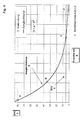
- the following assignments have been made: Calibration sample A with a perforation rate of 120% o becomes an SRV of 80 assigned, calibration sample B with a perforation rate of 40% or an SRV of 35, Calibration sample C with a perforation rate of 4% o an SRV of 5 and calibration sample D with a perforation rate of 1.5 ⁇ an SRV of 2. This assignment is also in Figure 4 shown.
- tinplate calibration samples Before the tinplate calibration samples are brought into the measurement set-up according to FIG. 2, they must first be carefully degreased and tin-plated. This also applies to the tinplate samples (test samples) to be tested, whose corrosion resistance is to be checked. Calibration samples are first degreased in a 5 percent sodium carbonate solution. The surface to be tested is cathodically polarized with a voltage of 3 V over a period of 30 to 45 seconds. After this degreasing, the surface is stripped in an alkaline potassium iodate solution (40 to 60 g / l NaOH; 7 - 15 g / l KIO 3 ) at a temperature of 50 ° C over a period of 30 to 80 in a further operation Seconds. The calibration samples are then washed first with tap water and then with distilled water and with alcohol and dried with a hair dryer.
- alkaline potassium iodate solution 40 to 60 g / l NaOH; 7 - 15
- the calibration samples prepared in this way are used one after the other as working electrodes 2 in the measurement setup shown in FIG. 2 in order to polarize them cathodically and to measure the surface potential which arises after a predetermined dwell time t.
- a potential-time curve according to FIG. 3 is recorded for each calibration sample A, B, C, D.
- the surface potential which is established after a predetermined dwell time in the range from 20 to 180 seconds is detected.
- the surface potentials thus determined after an equally large dwell time of, for example, 120 seconds are then assigned to the aforementioned SRV of 80, 45, 5 and 2 according to FIG. 4.
- a compensating curve (fit curve) K is then expediently created from the surface potentials measured in the calibration samples, as shown in FIG. The respective (daily) compensation curve is thus defined.
- test sample A tinplate sample to be tested (test sample) is degreased in the same way and tinned and in the same acidic electrolyte that previously polarized the Calibration samples were used cathodically in the measurement setup under the same test conditions polarized.
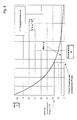
- a potential-time curve is also recorded here and that after a dwell time, which is the dwell time of the calibration samples, here how assumed 120 seconds, corresponds to the setting surface potential. Is the test sample e.g. found a surface potential of 776 mV, Thus, using the previously created compensation curve K according to FIG Surface reaction value or SRV of 18 can be determined.
- the measurement is distinguished by a high level of reproducibility.
- the detection of the SRV can be achieved with a reproducibility of +/- 0.5 in a range from SRV 1 - 5.
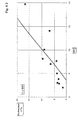
- FIG. 6 A correlation between tinplate quality defined by the surface reaction value or SRV and the perforation rate that was determined in a storage test is shown in FIG. 6.
- the measurements were carried out with sample collectives of more than 800 cans each for tin coatings from 2.0 to 2.4 g / m 2 for cans that had been coated once.
- the cans were filled with carbonated soft drinks and were stored at room temperature for a period of 6 months. As can be seen from FIG. 6, there is an almost linear relationship between the surface reaction value and the perforation rate.
Landscapes
- Chemical & Material Sciences (AREA)
- Chemical Kinetics & Catalysis (AREA)
- Engineering & Computer Science (AREA)
- Materials Engineering (AREA)
- Metallurgy (AREA)
- Organic Chemistry (AREA)
- Mechanical Engineering (AREA)
- Electrochemistry (AREA)
- Testing Resistance To Weather, Investigating Materials By Mechanical Methods (AREA)
Abstract
Description
Mit diesem Verfahren läßt sich zwar das tatsächliche Lagerverhalten fertiger Dosen in Abhängigkeit der verwendeten Weißblechqualität überprüfen, aufgrund der langwierigen Testmethodik sind korrigierende Eingriffe im Hinblick auf die Weißblechqualität jedoch nur sehr bedingt möglich.
- Figur 1
- die bei Lagerversuchen von DWI-Dosen nach 6 Monaten bei unterschiedlichen Weißblechqualitäten (standard bzw. spezialverzinnt) in Abhängigkeit von der Lackierqualität festgestellten Perforationsraten,
- Figur 2
- einen Meßaufbau zur Bestimmung des Oberflächenreaktionswertes (SRV),
- Figur 3
- eine Potentional-Zeit-Kurve,
- Figur 4
- die Zuordnung der bei Kalibrierproben erfaßten Oberflächenpotentionale zu den zugehörigen Oberflächenreaktionswerten (SVR) mit einer Ausgleichskurve,
- Figur 5
- Bestimmung des Oberflächenreaktionswertes (SVR) einer Prüfprobe mittels des erfaßten Oberflächenpotentionals und der Ausgleichskurve,
- Figur 6
- die Perforationsraten von Softdrink-Getränkedosen im Lagerversuch in Abhängigkeit von verschiedenen Oberflächenreaktionswerten (SVR).
Claims (10)
- Verfahren zur Messung der Korrosionsbeständigkeit von Weißblech mit folgenden Schritten:a) mehrere Weißblechproben (Kalibrierproben) mit bekannten, unterschiedlichen Verzinnungsqualitäten werden entfettet und entzinnt,b) jeder Kalibrierprobe wird einmalig ein in Abhängigkeit von einer früher festgestellten Korrosionsbeständigkeit verschiedenhoher Oberflächenreaktionswert (SRV) zugeordnet,c) die entzinnten Kalibrierproben werden nacheinander in einen sauren Elektrolyten eingebracht und kathodisch polarisiert,d) das sich nach einer vorbestimmten Verweildauer (t) einstellende Oberflächenpotentional wird erfaßt und dieses dem dieser Kalibrierprobe zugehörigen Oberflächenreaktionswert zugeordnet,e) eine zu prüfende Weißblechprobe (Prüfprobe) wird in gleicher Weise entfettet, entzinnt und in demselben sauren Elektrolyten, der vorher zur Polarisierung der Kalibrierproben diente, unter gleichen Prüfbedingungen kathodisch polarisiert,f) nach einer der Verweildauer der Kalibrierproben entsprechenden Verweildauer wird das sich bei der Prüfprobe einstellende Oberflächenpotential erfaßt undg) unter Zugrundelegung der zuvor bei den Kalibrierproben festgestellten Oberflächenpotentiale und der diesen zugeordneten Oberflächenreaktionswerte wird der bei der Prüfprobe vorhandene Oberflächenreaktionswert bestimmt.
- Verfahren nach Anspruch 1, dadurch gekennzeichnet, daß aus dem bei den Kalibrierproben gemessenen Oberflächenpotentionalen eine Ausgleichskurve (Fit-Kurve) erstellt und mittels dieser und dem bei der Prüfprobe gemessenen Oberflächenpotentional der Oberflächenrekationswert der Prüfprobe bestimmt wird.
- Verfahren nach Anspruch 1 oder 2, dadurch gekennzeichnet, daß die Polarisierung bei einer konstanten Stromdichte im Bereich von 10 bis 1000 µA/cm2 erfolgt.
- Verfahren nach Anspruch 2 oder 3, dadurch gekennzeichnet, daß das sich nach einer Verweildauer (t) im Bereich von 20 bis zu 180 Sekunden einstellende Oberflächenpotentional erfaßt wird.
- Verfahren nach einem der vorhergehenden Ansprüche, dadurch gekennzeichnet, daß während der Polarisierung einer Probe eine Potentional-Zeit-Kurve aufgenommen und aus dieser das sich nach jeweils nach einer bestimmten Verweildauer (t) einstellende Oberflächenpotentional entnommen wird.
- Verfahren nach einem der vorhergehenden Ansprüche, dadurch gekennzeichnet, daß der Oberflächenreaktionswert (SRV) der Kalibrierproben entsprechend den bei diesen Proben jeweils früher festgestellten Perforationsraten festgelegt wird.
- Verfahren nach einem der vorhergehenden Ansprüche, dadurch gekennzeichnet, daß der Elektrolyt eine Fruchtsäure enthält.
- Verfahren nach einem der vorhergehenden Ansprüche, dadurch gekennzeichnet, daß der Elektrolyt eine Zitronensäure-Puffer enthält.
- Verfahren nach Anspruch 8, dadurch gekennzeichnet, daß in dem Elektrolyten 1 bis 5 Prozent Zitronensäure enthalten sind.
- Verfahren nach einem der vorhergehenden Ansprüche, dadurch gekennzeichnet, daß der pH-Wert des Elektrolyten kleiner als 4 ist, vorzugsweise im pH-Bereich von 2 bis 3 liegt.
Applications Claiming Priority (2)
| Application Number | Priority Date | Filing Date | Title |
|---|---|---|---|
| DE1999159748 DE19959748C1 (de) | 1999-12-11 | 1999-12-11 | Verfahren zur Messung der Korrosionsbeständigkeit von Weißblech |
| DE19959748 | 1999-12-11 |
Publications (2)
| Publication Number | Publication Date |
|---|---|
| EP1106986A2 true EP1106986A2 (de) | 2001-06-13 |
| EP1106986A3 EP1106986A3 (de) | 2003-10-29 |
Family
ID=7932255
Family Applications (1)
| Application Number | Title | Priority Date | Filing Date |
|---|---|---|---|
| EP00125403A Withdrawn EP1106986A3 (de) | 1999-12-11 | 2000-11-18 | Verfahren zur Messung der Korrosionsbeständigkeit von Weissblech |
Country Status (2)
| Country | Link |
|---|---|
| EP (1) | EP1106986A3 (de) |
| DE (1) | DE19959748C1 (de) |
Cited By (7)
| Publication number | Priority date | Publication date | Assignee | Title |
|---|---|---|---|---|
| CN100380112C (zh) * | 2004-03-29 | 2008-04-09 | 宝山钢铁股份有限公司 | 镀锡板耐蚀性快速检测方法 |
| RU2373517C1 (ru) * | 2008-06-07 | 2009-11-20 | Государственное научное учреждение Всероссийский научно-исследовательский институт консервной и овощесушильной промышленности Российской академии сельскохозяйственных наук | Способ определения коррозионной стойкости внутренней поверхности металлической тары |
| US7776606B2 (en) * | 2006-03-03 | 2010-08-17 | Concurrent Technologies Corporation | Processes to create discrete corrosion defects on substrates and establish corrosion NDI test standards |
| CN104122195A (zh) * | 2014-07-30 | 2014-10-29 | 奥瑞金包装股份有限公司 | 一种检测镀锡钢板表面钝化膜耐蚀性的检测液 |
| CN105021516A (zh) * | 2014-04-15 | 2015-11-04 | 上海梅山钢铁股份有限公司 | 一种检测镀锡板耐蚀性的测试液和测试贴膜及其检测方法 |
| CN106153530A (zh) * | 2015-03-23 | 2016-11-23 | 上海宝钢工业技术服务有限公司 | 镀锡板耐腐蚀性能检测系统及方法 |
| CN119066802A (zh) * | 2024-08-02 | 2024-12-03 | 中机生产力促进中心有限公司 | 弯螺栓的增强防腐蚀性能设计的多属性目标决策评估方法 |
Families Citing this family (1)
| Publication number | Priority date | Publication date | Assignee | Title |
|---|---|---|---|---|
| DE19959749C2 (de) * | 1999-12-11 | 2003-06-18 | Rasselstein Hoesch Gmbh | Verfahren zur Erzeugung von Weißblech hoher Korrosionsfestigkeit |
Family Cites Families (4)
| Publication number | Priority date | Publication date | Assignee | Title |
|---|---|---|---|---|
| US3649472A (en) * | 1968-10-14 | 1972-03-14 | Amp Inc | Porosity testing |
| US3684679A (en) * | 1969-06-05 | 1972-08-15 | John R Smith | Apparatus for testing the corrosion resistance of tinplate |
| DE3008611A1 (de) * | 1980-03-06 | 1981-09-10 | Buderus Ag, 6330 Wetzlar | Verfahren zur erkennung von fehlstellen in korrisionsschutzumhuellungen von erdverlegten guss- oder stahlrohren |
| DE3511706C2 (de) * | 1985-03-29 | 1987-02-19 | Heusler, Konrad, Prof. Dr., 3392 Clausthal-Zellerfeld | Verfahren und Vorrichtung zur Prüfung von elektrisch isolierenden Schutzschichten auf Metallteilen |
-
1999
- 1999-12-11 DE DE1999159748 patent/DE19959748C1/de not_active Expired - Fee Related
-
2000
- 2000-11-18 EP EP00125403A patent/EP1106986A3/de not_active Withdrawn
Cited By (11)
| Publication number | Priority date | Publication date | Assignee | Title |
|---|---|---|---|---|
| CN100380112C (zh) * | 2004-03-29 | 2008-04-09 | 宝山钢铁股份有限公司 | 镀锡板耐蚀性快速检测方法 |
| US7776606B2 (en) * | 2006-03-03 | 2010-08-17 | Concurrent Technologies Corporation | Processes to create discrete corrosion defects on substrates and establish corrosion NDI test standards |
| US8448490B2 (en) | 2006-03-03 | 2013-05-28 | Concurrent Technologies Corporation | Processes to create discrete corrosion defects on substrates and establish corrosion NDI test standards |
| US8532952B2 (en) | 2006-03-03 | 2013-09-10 | Concurrent Technologies Corporation | Processes to create discrete corrosion defects on substrates and establish corrosion NDI test standards |
| RU2373517C1 (ru) * | 2008-06-07 | 2009-11-20 | Государственное научное учреждение Всероссийский научно-исследовательский институт консервной и овощесушильной промышленности Российской академии сельскохозяйственных наук | Способ определения коррозионной стойкости внутренней поверхности металлической тары |
| CN105021516A (zh) * | 2014-04-15 | 2015-11-04 | 上海梅山钢铁股份有限公司 | 一种检测镀锡板耐蚀性的测试液和测试贴膜及其检测方法 |
| CN105021516B (zh) * | 2014-04-15 | 2018-11-23 | 上海梅山钢铁股份有限公司 | 一种检测镀锡板耐蚀性的测试液和测试贴膜及其检测方法 |
| CN104122195A (zh) * | 2014-07-30 | 2014-10-29 | 奥瑞金包装股份有限公司 | 一种检测镀锡钢板表面钝化膜耐蚀性的检测液 |
| CN104122195B (zh) * | 2014-07-30 | 2017-02-01 | 奥瑞金包装股份有限公司 | 一种检测镀锡钢板表面钝化膜耐蚀性的检测液 |
| CN106153530A (zh) * | 2015-03-23 | 2016-11-23 | 上海宝钢工业技术服务有限公司 | 镀锡板耐腐蚀性能检测系统及方法 |
| CN119066802A (zh) * | 2024-08-02 | 2024-12-03 | 中机生产力促进中心有限公司 | 弯螺栓的增强防腐蚀性能设计的多属性目标决策评估方法 |
Also Published As
| Publication number | Publication date |
|---|---|
| EP1106986A3 (de) | 2003-10-29 |
| DE19959748C1 (de) | 2001-06-21 |
Similar Documents
| Publication | Publication Date | Title |
|---|---|---|
| DE69013993T2 (de) | Verfahren zur Anodisierung von Aluminium. | |
| DE2757458C2 (de) | ||
| EP0902849B1 (de) | Kurzzeit-heissverdichtung anodisierter metalloberflächen mit tensidhaltigen lösungen | |
| DE2106593C3 (de) | Verfahren und Vorrichtung zur elektrochemischen Bestimmung von durchgehenden Fehlstellen in einem eine metallische Oberfläche bedeckenden Schutzüberzug | |
| DE19959748C1 (de) | Verfahren zur Messung der Korrosionsbeständigkeit von Weißblech | |
| CH623360A5 (de) | ||
| DE2918553C2 (de) | ||
| DE3339151A1 (de) | Verfahren und vorrichtung zur bewertung eines korrosionsschutzes | |
| DE69321686T2 (de) | Verfahren zur Feststellung von Bestandteilen in Plattierungsbädern | |
| DE3043116A1 (de) | Stahlbleche fuer die herstellung von geschweissten und ueberzogenen behaeltern | |
| EP0857227B1 (de) | Kurzzeit-heissverdichtung anodisierter metalloberflächen | |
| DE2157043A1 (de) | Verfahren zur Kontrolle des Schichtgewichtes von Überzügen | |
| DE3511706A1 (de) | Verfahren und vorrichtung zur pruefung von elektrisch isolierenden schutzschichten auf metallteilen | |
| DE69308369T4 (de) | Verfahren und Vorrichtung zum Überwachen der Qualität eines Phosphatüberzugs | |
| DE69412354T2 (de) | Verfahren zur Überwachung der Ionenkonzentration in galvanischen Bädern | |
| WO1985002464A1 (fr) | Procede pour l'examen non destructif de defauts de surface | |
| DE1963774A1 (de) | Verfahren zur Vorbehandlung von Metallen von der Aufbringung von Anstrichen | |
| DE2127606C3 (de) | Zerstörungsfreies, elektrolytisches Verfahren zur quantitativen und/oder qualitativen Bestimmung eines Bestandteils eines metallischen Werkstoffs sowie zur Durchführung des Verfahrens bestimmte Vergleichsprobe | |
| DE2609577A1 (de) | Verfahren zur erzeugung versiegelter anodischer oxidduennschichten auf aluminium und aluminiumlegierungen vor deren beschichtung | |
| DE102009012260B4 (de) | Verfahren zum Ermitteln der Beständigkeit einer anorganischen Beschichtung gegen Kontaktkorrosion | |
| DE102004050150A1 (de) | Korrosionstestmittel und -verfahren | |
| DE3016053C2 (de) | Verfahren zur Vorbehandlung von Stahlblech für die elektrolytische Abscheidung eines Chrommetall/Chromoxidhydrat-Überzuges | |
| Vogelsang et al. | Electrochemical investigations of organic, corrosion protective barrier coatings–limiting factors of small signal perturbation techniques | |
| DE3781485T2 (de) | Metalldose fuer lebensmittelverpackung und verfahren zur herstellung desselben. | |
| DE10108323A1 (de) | Methode zur Voraussage von Lochkorrosion |
Legal Events
| Date | Code | Title | Description |
|---|---|---|---|
| PUAI | Public reference made under article 153(3) epc to a published international application that has entered the european phase |
Free format text: ORIGINAL CODE: 0009012 |
|
| AK | Designated contracting states |
Kind code of ref document: A2 Designated state(s): AT BE CH CY DE DK ES FI FR GB GR IE IT LI LU MC NL PT SE TR |
|
| AX | Request for extension of the european patent |
Free format text: AL;LT;LV;MK;RO;SI |
|
| PUAL | Search report despatched |
Free format text: ORIGINAL CODE: 0009013 |
|
| AK | Designated contracting states |
Kind code of ref document: A3 Designated state(s): AT BE CH CY DE DK ES FI FR GB GR IE IT LI LU MC NL PT SE TR |
|
| AX | Request for extension of the european patent |
Extension state: AL LT LV MK RO SI |
|
| STAA | Information on the status of an ep patent application or granted ep patent |
Free format text: STATUS: THE APPLICATION HAS BEEN WITHDRAWN |
|
| 18W | Application withdrawn |
Effective date: 20031016 |