EP1102499A1 - Alternative message usage for voice mail retreival via revertive calling - Google Patents
Alternative message usage for voice mail retreival via revertive calling Download PDFInfo
- Publication number
- EP1102499A1 EP1102499A1 EP00308377A EP00308377A EP1102499A1 EP 1102499 A1 EP1102499 A1 EP 1102499A1 EP 00308377 A EP00308377 A EP 00308377A EP 00308377 A EP00308377 A EP 00308377A EP 1102499 A1 EP1102499 A1 EP 1102499A1
- Authority
- EP
- European Patent Office
- Prior art keywords
- mobile station
- remotefeaturerequest
- msc
- invocation
- voice mail
- Prior art date
- Legal status (The legal status is an assumption and is not a legal conclusion. Google has not performed a legal analysis and makes no representation as to the accuracy of the status listed.)
- Withdrawn
Links
Images

Classifications
-
- H—ELECTRICITY
- H04—ELECTRIC COMMUNICATION TECHNIQUE
- H04M—TELEPHONIC COMMUNICATION
- H04M3/00—Automatic or semi-automatic exchanges
- H04M3/42—Systems providing special services or facilities to subscribers
- H04M3/50—Centralised arrangements for answering calls; Centralised arrangements for recording messages for absent or busy subscribers ; Centralised arrangements for recording messages
- H04M3/53—Centralised arrangements for recording incoming messages, i.e. mailbox systems
- H04M3/533—Voice mail systems
-
- H—ELECTRICITY
- H04—ELECTRIC COMMUNICATION TECHNIQUE
- H04M—TELEPHONIC COMMUNICATION
- H04M2207/00—Type of exchange or network, i.e. telephonic medium, in which the telephonic communication takes place
- H04M2207/18—Type of exchange or network, i.e. telephonic medium, in which the telephonic communication takes place wireless networks
-
- H—ELECTRICITY
- H04—ELECTRIC COMMUNICATION TECHNIQUE
- H04M—TELEPHONIC COMMUNICATION
- H04M3/00—Automatic or semi-automatic exchanges
- H04M3/42—Systems providing special services or facilities to subscribers
- H04M3/42229—Personal communication services, i.e. services related to one subscriber independent of his terminal and/or location
-
- H—ELECTRICITY
- H04—ELECTRIC COMMUNICATION TECHNIQUE
- H04M—TELEPHONIC COMMUNICATION
- H04M3/00—Automatic or semi-automatic exchanges
- H04M3/42—Systems providing special services or facilities to subscribers
- H04M3/50—Centralised arrangements for answering calls; Centralised arrangements for recording messages for absent or busy subscribers ; Centralised arrangements for recording messages
- H04M3/53—Centralised arrangements for recording incoming messages, i.e. mailbox systems
- H04M3/533—Voice mail systems
- H04M3/53333—Message receiving aspects
-
- H—ELECTRICITY
- H04—ELECTRIC COMMUNICATION TECHNIQUE
- H04W—WIRELESS COMMUNICATION NETWORKS
- H04W4/00—Services specially adapted for wireless communication networks; Facilities therefor
- H04W4/12—Messaging; Mailboxes; Announcements
Definitions
- the invention relates to wireless telecommunications, and, more particularly, to voice mail retrieval from a roaming mobile station.
- One approach to providing access to a user's voice mail is to employ a special "star code” feature, that is, a feature which requires a user to key in a special series of digits on his mobile station.
- a special "star code” feature that is, a feature which requires a user to key in a special series of digits on his mobile station.
- star 69 the familiar star 69
- This telecommunications systems allow a roaming user to dial his own directory number.
- the system attempts to deliver the call, but, since the mobile station is outside the range of its home mobile switching center (MSC), the call cannot be completed. After the call fails, the system establishes a default connection to the user's message recording service, at which point the subscriber may access his recorded messages. Although it has the benefit of obviating the use of special star code sequences, this is an awkward, time-consuming approach which anyone who has been forced to listen through several tiers of selections offered by an automated call distribution system will recognize as an incredibly frustrating experience. Additionally, this approach consumes telephone system resources that might otherwise be put to better use.
- a mobile switching center in accordance with the principles of the present invention provides access to a subscriber's voice mail message from the subscriber's roaming mobile station.
- the MSC is responsive to a "RemoteFeatureRequest" invocation by the roaming mobile station in which the subscriber's directory number is the same as the dialed digits by routing the call from the mobile station to the subscriber's voice mail.
- the MSC may also be responsive to a "OriginationRequest" employing the subscriber's directory number as the dialed digits by routing the roaming mobile station's call to the subscriber's voice mail system.
- the MSC determines which of the approaches to use in response to the reception of a subscriber's directory number as the dialed digits from the subscriber's roaming mobile station.
- the MSC may make this determination on the basis of information stored in a local database that indicates the method employed by other telecommunications devices, such as other MSCs, Visiting Location Registers, or Home Location Registers, within the system.
- One of the methods that is, the use of an OriginationRequest invocation or the use of a RemoteFeatureRequest invocation, may be chosen as a default method.
- the conceptual block diagrams may-not include many components that may be incorporated in an actual system.
- the following call scenario diagrams may delete some of the steps that may be involved in establishing calls. These deleted components and steps are known and are discussed, for example, in, Ming-Chwan Chow, Understanding Wireless Digital Mobile, Cellular and PCS, Andan Publishers, Holmdel, New Jersey, 1998 pp 2-1 through 3-54 which are hereby incorporated by reference.
- the conceptual block diagram of Figure 1 illustrates a mobile telecommunications system 100 in accordance with the principles of the present invention.
- the mobile system 100 may be operated in conjunction with the publicly switched telephone network 102.
- the mobile telecommunications system 100 includes a serving system 105 and a home location register 106, which communicate with one another.
- the serving system may include one or more visiting location registers and one or more base stations, for example.
- the mobile telecommunications system 100 includes at least one switching component 104, such as a mobile switching center (MSC), at least one registering component 106, such as a home location register (HLR), and at least one mobile station 108.
- the mobile station 108 may be of the mobile identification number (MIN) type, international mobile subscriber identity (IMSI) type, MIN-based IMSI type, or both MIN-based IMSI and IMSI type.
- MIN mobile identification number
- IMSI international mobile subscriber identity
- the mobile telecommunications system 100 establishes a connection from a land station, as follows.
- the land system routes the call to the appropriate switching component 104 (only one of which is shown in this Figure) within the mobile system.
- the switching component 104 forwards the dialed digits, along with other information, to the registering component 106 to which the mobile station is assigned, and requests routing information for the mobile station 108 associated with the dialed digits.
- the registering component 106 returns routing information to the switching component 104.
- the serving system 105 includes a database that may be located within the registering component 106, for example.
- the database includes the association between the mobile's identifier (MIN or IMSI) and the mobile's directory number. This information may be relayed to the switching component 104, for example.
- a roaming mobile station 108 may initiate a call by sending dialed digits and an identifier to the serving system 105.
- the serving system queries a database to determine how to route the call. If the mobile station 108 sends its own directory number or mobile subscriber identifier (MSID) as the dialed digits, the serving system indicates that this mobile is supported by voice mail retrieval via revertive calling (VMR-RC), and that the mobile station's voice message center may be accessed through a RemoteFeatureRequest invocation, the serving switch 104 sends a RemoteFeatureRequest invocation to the mobile station's associated register 106.
- MSID mobile subscriber identifier
- the register 106 responds to the RemoteFeatureRequest invocation by sending the mobile station's voice mail digits to the serving switch 104.
- the serving switch employs these digits to complete the call, thereby permitting user of the mobile station 108 to access his voice mail system.
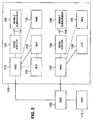
- the conceptual block diagram of Figure 2 provides a more detailed view of a mobile telecommunications system in accordance with the principles of the present invention.
- the illustrative system 100 includes a mobile station 108, which may communicate, via a wireless link 110 with a base station 112.
- the base station communicates with a mobile switching center 114 which operates as the switching component 104 in this illustrative embodiment.
- the mobile switching center 114 provides interfaces to the landline system 102 and to the remainder of the wireless, or mobile telecommunications system 100.
- the switching center 114 also provides mobility management for mobile stations.
- the mobile subscriber's voice messaging system 115 may be reached, directly or indirectly, through the MSC 114. In the following examples it is assumed that the MSC 114 is not the home MSC of the mobile station 108. That is, it is assumed that the mobile station 108 is roaming and interacting with a visiting MSC 114.
- the mobile system 100 also includes a complement of components that operate in accordance with TIA/EIA 41D, a telecommunications standard that is hereby incorporated by reference in its entirety. These components include a home location register (HLR) 116, which operates as the registering component 106 in this illustrative embodiment.
- the HLR 116 may be reached from the MSC 114 through an indirect connection, as indicated by the broken line, and includes a database which may store, among other things, a permanent copy of the mobile subscriber's subscription information and location information which permits calls to be routed toward the mobile switching center associated with the mobile unit's current location.
- This information may include such things, as the mobile station roaming number (MSRN) or temporary local directory number (TLDN), the visiting location register (VLR) address, the mobile switching center (MSC) address), the international mobile subscriber identity (and the MIN, if available), the mobile subscriber ISDN number (MSISDN) teleservices and bearer services subscription information, and service restrictions, such as roaming limitations, and supplementary service parameters.
- MSRN mobile station roaming number
- TLDN temporary local directory number
- VLR visiting location register
- MSC mobile switching center
- MSISDN mobile subscriber ISDN number
- a stand-alone HLR 116 supports such features as call delivery, message waiting notification, call forwarding, remote feature control, call transfer, subscriber PIN intercept, call waiting, conference calling, and voice message retrieval.
- a visited location register (VLR) 118 which functions, to some extent, as a home location register for a mobile station that is outside it home calling area, may be included in the system.
- the system 100 would typically include additional mobile switching centers to service a roaming mobile station. With the mobile station 108 roaming it may communicate via a wireless link 120 with a base station 122.
- the base station 122 may communicate with a mobile switching center 124 that may have access to the home location register 116 of the mobile station, to a visited location register 128, or to the voice message center 115.
- These communications may be effected directly or, in the case of the home location register 116 or the voice message center 115, the communications may be realized through the public switched telephone network 102.
- the MSC 124 may include a data field which indicates that when a mobile station 108 attempts to establish a telephone call using its directory number as the dialed digits, the MSC 124 is to send a RemoteFeatureRequest Invoke to the mobile station's HLR 116.
- the invocation of a RemoteFeatureRequest is a type of direct feature request with call routing.
- the operation of a direct feature requests is known and described, for example, in EIA/ 41 D, 4.10.2 which is hereby incorporated by reference.
- the HLR responds by sending routing information to the visited MSC and the call is routed, either directly or indirectly, to the mobile station's voice message center.
- the database may include information within the data field to indicate that the MSC is to send an OriginationRequest Invocation under the same set of circumstances.
- An MSC could then retrieve information from this data field and determine which approach to use with a given mobile station under this scenario.
- Use of an OriginationRequest invocation to retrieve voice mail is known and discussed, for example, in EIA/TIA SP3588 5.23.3, previously incorporated by reference.
- an MSC may employ either the RemoteFeatureRequest invocation or an OriginationRequest invocation to connect a roaming mobile with its voice message center.
- this voice mail retrieval via revertive calling feature which encompasses the RemoteFeatureRequest or OriginationRequest approach may be activated or de-activated through an entry in a data field within the MSC.
- the OriginationRequest approach is the default approach and the RemoteFeatureRequest approach is indicated by an entry in a data field in the MSC's database.
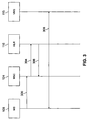
- the call scenario diagram of Figure 3 illustrates, in broad strokes, a mobile station's process of retrieving voice mail while it is roaming.
- the subscriber initiates a call and information, including the subscriber's mobile identifier and the mobile station's directory number, is routed to a visited MSC 124 from the mobile station 108.
- the visited MSC 124 determines that the mobile station is outside its home location and that the mobile's feature set includes activation of VMR-RC through use of a RemoteFeatureRequest invocation.
- the visited MSC 124 sends a RemoteFeatureRequest invocation to the mobile stations' HLR 116.
- the visited MSC 124 may also encode the Billing ID, Dialed Digits, Electronic Serial Number, Mobile Identification Number, MSCID, and Transaction Capability. The Transaction Capability would indicate that the digits may be sent back in the termination list for routing by the visited MSC 124.
- the HLR 116 responds by delivering the routing digits to the mobile station's message system 115 to the visited MSC 124. That is, the HLR 116 includes termination list parameters used to route the call to the mobile station's voice mail system "box" in the return result.
- the visited MSC 124 establishes a connection between the mobile station 108 and the mobile station's voice message center 115 using the digits contained in the termination list paratmeters.
- the MSC may support both RemoteFeatureRequest and OriginationRequest Invocations in providing voice mail retrieval via revertive calling (VMR-RC).
- step 302 would include the determination of whether the mobile station supports VMR-RC and, if it does, whether its HLR does so through a RemoteFeatureRequest Invocation or an OriginationRequest invocation. Following this determination the MSC would proceed accordingly, invoking either a RemoteFeatureRequest or OriginationRequest, as appropriate, in step 304.
Landscapes
- Engineering & Computer Science (AREA)
- Signal Processing (AREA)
- Mobile Radio Communication Systems (AREA)
- Telephonic Communication Services (AREA)
Applications Claiming Priority (2)
| Application Number | Priority Date | Filing Date | Title |
|---|---|---|---|
| US412282 | 1999-10-05 | ||
| US09/412,282 US6665532B1 (en) | 1999-10-05 | 1999-10-05 | Alternative message usage for voice mail retreival via revertive calling |
Publications (1)
| Publication Number | Publication Date |
|---|---|
| EP1102499A1 true EP1102499A1 (en) | 2001-05-23 |
Family
ID=23632381
Family Applications (1)
| Application Number | Title | Priority Date | Filing Date |
|---|---|---|---|
| EP00308377A Withdrawn EP1102499A1 (en) | 1999-10-05 | 2000-09-25 | Alternative message usage for voice mail retreival via revertive calling |
Country Status (6)
| Country | Link |
|---|---|
| US (1) | US6665532B1 (enExample) |
| EP (1) | EP1102499A1 (enExample) |
| JP (1) | JP2001157241A (enExample) |
| CN (1) | CN1307433A (enExample) |
| BR (1) | BR0004543A (enExample) |
| CA (1) | CA2321412C (enExample) |
Families Citing this family (19)
| Publication number | Priority date | Publication date | Assignee | Title |
|---|---|---|---|---|
| KR100270216B1 (ko) | 1998-07-10 | 2000-10-16 | 김영환 | Cdma 시스템에서 무선가상 사설망 기능을 구현하는 방법 |
| DE19859081C2 (de) * | 1998-12-21 | 2001-03-29 | Plus Mobilfunk Gmbh E | Verfahren zum Routen von Nachrichten in mindestens einem Telekommunikationsnetz nach GSM-Standard |
| US7783508B2 (en) | 1999-09-20 | 2010-08-24 | Numerex Corp. | Method and system for refining vending operations based on wireless data |
| US7245928B2 (en) | 2000-10-27 | 2007-07-17 | Cellemetry, Llc | Method and system for improved short message services |
| US6898760B2 (en) * | 2001-01-05 | 2005-05-24 | Microsoft Corporation | Reporting status of external references in a spreadsheet without updating |
| US7359491B2 (en) * | 2002-03-29 | 2008-04-15 | At&T Delaware Intellectual Property, Inc. | Saving information from information retrieval systems |
| US7317908B1 (en) * | 2002-03-29 | 2008-01-08 | At&T Delaware Intellectual Property, Inc. | Transferring voice mail messages in text format |
| US7072452B1 (en) | 2002-06-24 | 2006-07-04 | Bellsouth Intellectual Property Corporation | Saving and forwarding customized messages |
| US7221742B1 (en) * | 2002-06-26 | 2007-05-22 | Bellsouth Intellectual Property Corporation | Voicemail box with caller-specific storage folders |
| US6996212B1 (en) * | 2002-06-26 | 2006-02-07 | Bellsouth Intellectual Property Corporation | Voicemail system with subscriber specific storage folders |
| US7505571B2 (en) * | 2002-09-12 | 2009-03-17 | Sabeer Bhatia | Communications systems and methods for exchanging messages between users |
| US7323970B1 (en) | 2004-01-21 | 2008-01-29 | Numerex Corporation | Method and system for remote interaction with a vehicle via wireless communication |
| SE531400C2 (sv) | 2006-05-10 | 2009-03-24 | Rebtel Networks Ab | Telefonkommunikation |
| WO2007136723A2 (en) | 2006-05-17 | 2007-11-29 | Numerex Corp. | System and method for prolonging wireless data product's life |
| CA2823457C (en) | 2007-02-06 | 2015-09-22 | Numerex Corp. | Service escrowed transportable wireless event reporting system |
| KR100906759B1 (ko) * | 2007-08-07 | 2009-07-09 | 주식회사 케이티프리텔 | 멀티미디어 메시지 사서함 서비스 장치, 방법 및 그기록메체 |
| US9100415B2 (en) * | 2009-12-17 | 2015-08-04 | Verizon Patent And Licensing Inc. | On-net direct access to voicemail |
| US20180210911A1 (en) * | 2017-01-23 | 2018-07-26 | Oliver Wendel Gamble | Method and System for Interactive Notation, Text Data Storage and Management on a Mobile Device. |
| US20220292069A1 (en) * | 2017-01-23 | 2022-09-15 | Oliver Wendel Gamble | Method and System for Enhancement and Cross Relating Messages Received and Stored on a Mobile Device |
Citations (2)
| Publication number | Priority date | Publication date | Assignee | Title |
|---|---|---|---|---|
| WO1995012268A1 (en) * | 1993-10-27 | 1995-05-04 | Bellsouth Corporation | Personal number communication system with cellular mobile radiotelephone roaming capability |
| US5839064A (en) * | 1996-07-26 | 1998-11-17 | Telefonaktiegolaget Im Ericsson | System and method of dynamic allocation of redundant peripheral equipment gateways in a radio telecommunications network |
Family Cites Families (18)
| Publication number | Priority date | Publication date | Assignee | Title |
|---|---|---|---|---|
| US6295449B1 (en) * | 1992-01-27 | 2001-09-25 | @Track Communications, Inc. | Data messaging in a communications network using a feature request |
| US5758279A (en) * | 1996-04-12 | 1998-05-26 | Telefonaktiebolaget Lm Ericsson | System and method of rapid voice mail access in a radio telecommunications network |
| US6032043A (en) * | 1996-09-25 | 2000-02-29 | Telefonaktiebolaget L M Ericsson (Publ) | Home location register feature dispatching and arbitration in a wireless intelligent network |
| US6014559A (en) * | 1997-04-10 | 2000-01-11 | At&T Wireless Services, Inc. | Method and system for delivering a voice mail notification to a private base station using cellular phone network |
| US6333973B1 (en) * | 1997-04-23 | 2001-12-25 | Nortel Networks Limited | Integrated message center |
| US6011969A (en) * | 1997-06-13 | 2000-01-04 | Telefonaktiebolaget L M Ericsson | TCAP package type specification for ANSI-41 MAP messages in order to support MAP operation closure |
| JP2002505059A (ja) * | 1997-06-20 | 2002-02-12 | ブリティッシュ・テレコミュニケーションズ・パブリック・リミテッド・カンパニー | 移動電話の位置に依存するサービス |
| JPH11122655A (ja) * | 1997-10-16 | 1999-04-30 | Toshiba Corp | 移動通信システム |
| SE517553C2 (sv) * | 1997-11-06 | 2002-06-18 | Telia Ab | Mobilkommunikationssystem innefattande mobilterminaler med röstbrevlådefunktion |
| US6131028A (en) * | 1997-12-10 | 2000-10-10 | Integrated Telecom Solutions, Inc. | Method of providing services specified by feature codes based upon location of a wireless telephone unit |
| US6236857B1 (en) * | 1998-06-29 | 2001-05-22 | Lucent Technologies, Inc. | Methods and apparatus for accessing enhanced wireless services platforms via the public switched telephone network |
| US6301473B1 (en) * | 1998-07-17 | 2001-10-09 | Telefonaktiebolaget L M Ericsson (Publ) | Call transfer activation indicator in a radio telecommunications network |
| US6253081B1 (en) * | 1998-08-12 | 2001-06-26 | Bellsouth Intellect Pty Corp | Method and system for providing roaming service in a telecommunications system that is partially enabled for local number portability |
| US6178322B1 (en) * | 1998-11-10 | 2001-01-23 | Northern Telecom Limited | Message waiting notification using ANSI-41 network messaging protocols |
| US6256512B1 (en) * | 1998-12-28 | 2001-07-03 | Nortel Networks Limited | Mobile access to a PBX via a TLDN |
| US6282416B1 (en) * | 1998-12-28 | 2001-08-28 | Nortel Networks Limited | Voice mail deposit for wireless mobile telephone networks |
| US6535730B1 (en) * | 1998-12-31 | 2003-03-18 | At&T Corp. | Wireless centrex conference call adding a party |
| US6498930B1 (en) * | 1999-06-02 | 2002-12-24 | At&T Wireless Services, Inc. | Method for automatically programming a wireless telephone with a voice mail system access number |
-
1999
- 1999-10-05 US US09/412,282 patent/US6665532B1/en not_active Expired - Lifetime
-
2000
- 2000-09-25 EP EP00308377A patent/EP1102499A1/en not_active Withdrawn
- 2000-09-29 CA CA002321412A patent/CA2321412C/en not_active Expired - Fee Related
- 2000-09-29 BR BR0004543-8A patent/BR0004543A/pt not_active Application Discontinuation
- 2000-09-30 CN CN00129280A patent/CN1307433A/zh active Pending
- 2000-10-04 JP JP2000304526A patent/JP2001157241A/ja not_active Ceased
Patent Citations (2)
| Publication number | Priority date | Publication date | Assignee | Title |
|---|---|---|---|---|
| WO1995012268A1 (en) * | 1993-10-27 | 1995-05-04 | Bellsouth Corporation | Personal number communication system with cellular mobile radiotelephone roaming capability |
| US5839064A (en) * | 1996-07-26 | 1998-11-17 | Telefonaktiegolaget Im Ericsson | System and method of dynamic allocation of redundant peripheral equipment gateways in a radio telecommunications network |
Also Published As
| Publication number | Publication date |
|---|---|
| JP2001157241A (ja) | 2001-06-08 |
| BR0004543A (pt) | 2001-05-29 |
| US6665532B1 (en) | 2003-12-16 |
| CA2321412A1 (en) | 2001-04-05 |
| CN1307433A (zh) | 2001-08-08 |
| CA2321412C (en) | 2004-11-23 |
Similar Documents
| Publication | Publication Date | Title |
|---|---|---|
| US6665532B1 (en) | Alternative message usage for voice mail retreival via revertive calling | |
| US6587688B1 (en) | Providing telephone number data for international cellular roamer service | |
| US6038451A (en) | Location based method of and system for forwarding wireless telephone calls | |
| US9036801B2 (en) | Enhanced call return in a communications network | |
| JP3544978B2 (ja) | 移動機電話システム内の未登録移動機加入者に対する呼び出し取扱い方法 | |
| US6556823B2 (en) | Location dependent service for mobile telephones | |
| US20020080751A1 (en) | System and method for routing calls in a wireless communication network | |
| US6463277B1 (en) | Personal mobile communication system with call bridging | |
| EP1594324B1 (en) | System and methods for global access to services for mobile telephone subcribers | |
| US6684072B1 (en) | Global wireless prepaid roaming | |
| JP3068207B2 (ja) | ルーティングのための方法及びシステム | |
| EP1198145A1 (en) | Method and apparatus for suppressing route request messages for wireless gateway applications | |
| CA2313036C (en) | Wireless mobile call location and delivery for non-geographic numbers using a wireline ssp+scp/wireless hlr interface | |
| CA2299722A1 (en) | Transfer of calling party identification in a mobile communication system | |
| EP0890274A1 (en) | Method and apparatus for dialing a b-number within a mobile telecommunications system | |
| JPH09503360A (ja) | 遠隔通信ネットワーク | |
| US6782268B1 (en) | Method and apparatus for tracking call history for mobile and wireline users accessing the network on different ports for subsequent calls | |
| EP1089585B1 (en) | Mobile telecommunications device having multiple directory number capability | |
| US6678528B2 (en) | Wireless handset notification of a call processing event | |
| US6233457B1 (en) | Method and mobile communication system for routing of call connections | |
| HK1076344B (en) | System and methods for global access to services for mobile telephone subcribers |
Legal Events
| Date | Code | Title | Description |
|---|---|---|---|
| PUAI | Public reference made under article 153(3) epc to a published international application that has entered the european phase |
Free format text: ORIGINAL CODE: 0009012 |
|
| AK | Designated contracting states |
Kind code of ref document: A1 Designated state(s): DE FR GB SE |
|
| AX | Request for extension of the european patent |
Free format text: AL;LT;LV;MK;RO;SI |
|
| 17P | Request for examination filed |
Effective date: 20011109 |
|
| AKX | Designation fees paid |
Free format text: DE FR GB SE |
|
| 17Q | First examination report despatched |
Effective date: 20061006 |
|
| RAP3 | Party data changed (applicant data changed or rights of an application transferred) |
Owner name: LUCENT TECHNOLOGIES INC. |
|
| STAA | Information on the status of an ep patent application or granted ep patent |
Free format text: STATUS: THE APPLICATION IS DEEMED TO BE WITHDRAWN |
|
| 18D | Application deemed to be withdrawn |
Effective date: 20100401 |
|
| P01 | Opt-out of the competence of the unified patent court (upc) registered |
Effective date: 20230520 |