EP1093779A2 - Bandage zur Entlastung der Muskulatur beim Muskelfaserriss - Google Patents
Bandage zur Entlastung der Muskulatur beim Muskelfaserriss Download PDFInfo
- Publication number
- EP1093779A2 EP1093779A2 EP00121543A EP00121543A EP1093779A2 EP 1093779 A2 EP1093779 A2 EP 1093779A2 EP 00121543 A EP00121543 A EP 00121543A EP 00121543 A EP00121543 A EP 00121543A EP 1093779 A2 EP1093779 A2 EP 1093779A2
- Authority
- EP
- European Patent Office
- Prior art keywords
- bandage
- distal
- proximal
- tension
- central section
- Prior art date
- Legal status (The legal status is an assumption and is not a legal conclusion. Google has not performed a legal analysis and makes no representation as to the accuracy of the status listed.)
- Granted
Links
- 206010028331 Muscle rupture Diseases 0.000 title description 4
- 210000003205 muscle Anatomy 0.000 claims abstract description 31
- 210000001087 myotubule Anatomy 0.000 claims description 14
- 206010050031 Muscle strain Diseases 0.000 claims description 5
- 239000003381 stabilizer Substances 0.000 claims description 2
- 238000012337 thromboprophylaxis Methods 0.000 claims 1
- 210000000689 upper leg Anatomy 0.000 description 13
- 210000003414 extremity Anatomy 0.000 description 10
- 208000014674 injury Diseases 0.000 description 6
- 239000000463 material Substances 0.000 description 6
- 208000027418 Wounds and injury Diseases 0.000 description 5
- 230000006378 damage Effects 0.000 description 5
- 210000001699 lower leg Anatomy 0.000 description 5
- 238000011282 treatment Methods 0.000 description 5
- 239000000853 adhesive Substances 0.000 description 4
- 244000309466 calf Species 0.000 description 4
- 239000002674 ointment Substances 0.000 description 4
- 210000002303 tibia Anatomy 0.000 description 4
- 206010030113 Oedema Diseases 0.000 description 3
- 230000001070 adhesive effect Effects 0.000 description 3
- 230000015572 biosynthetic process Effects 0.000 description 3
- 208000027744 congestion Diseases 0.000 description 3
- 238000000034 method Methods 0.000 description 3
- 229920000742 Cotton Polymers 0.000 description 2
- 239000002390 adhesive tape Substances 0.000 description 2
- 230000006835 compression Effects 0.000 description 2
- 238000007906 compression Methods 0.000 description 2
- 230000000694 effects Effects 0.000 description 2
- 230000003203 everyday effect Effects 0.000 description 2
- 239000004744 fabric Substances 0.000 description 2
- 239000006260 foam Substances 0.000 description 2
- 229920001821 foam rubber Polymers 0.000 description 2
- 210000002414 leg Anatomy 0.000 description 2
- 210000002346 musculoskeletal system Anatomy 0.000 description 2
- 239000004033 plastic Substances 0.000 description 2
- 206010010071 Coma Diseases 0.000 description 1
- 206010018852 Haematoma Diseases 0.000 description 1
- 206010065433 Ligament rupture Diseases 0.000 description 1
- HCHKCACWOHOZIP-UHFFFAOYSA-N Zinc Chemical compound [Zn] HCHKCACWOHOZIP-UHFFFAOYSA-N 0.000 description 1
- 230000009471 action Effects 0.000 description 1
- 230000008901 benefit Effects 0.000 description 1
- 210000000746 body region Anatomy 0.000 description 1
- 230000008859 change Effects 0.000 description 1
- 230000002860 competitive effect Effects 0.000 description 1
- 238000010276 construction Methods 0.000 description 1
- 230000008602 contraction Effects 0.000 description 1
- 238000001816 cooling Methods 0.000 description 1
- 230000006735 deficit Effects 0.000 description 1
- 238000011161 development Methods 0.000 description 1
- 230000018109 developmental process Effects 0.000 description 1
- 201000010099 disease Diseases 0.000 description 1
- 208000037265 diseases, disorders, signs and symptoms Diseases 0.000 description 1
- 239000013013 elastic material Substances 0.000 description 1
- 230000005611 electricity Effects 0.000 description 1
- 239000003292 glue Substances 0.000 description 1
- 230000035876 healing Effects 0.000 description 1
- 230000003100 immobilizing effect Effects 0.000 description 1
- 239000004745 nonwoven fabric Substances 0.000 description 1
- 230000000399 orthopedic effect Effects 0.000 description 1
- 239000000123 paper Substances 0.000 description 1
- 238000000554 physical therapy Methods 0.000 description 1
- 230000035790 physiological processes and functions Effects 0.000 description 1
- 238000011321 prophylaxis Methods 0.000 description 1
- 238000011084 recovery Methods 0.000 description 1
- 230000010076 replication Effects 0.000 description 1
- 238000001228 spectrum Methods 0.000 description 1
- 230000006641 stabilisation Effects 0.000 description 1
- 238000011105 stabilization Methods 0.000 description 1
- 230000000638 stimulation Effects 0.000 description 1
- 230000003319 supportive effect Effects 0.000 description 1
- 208000024891 symptom Diseases 0.000 description 1
- 238000002560 therapeutic procedure Methods 0.000 description 1
- 238000007395 thrombosis prophylaxis Methods 0.000 description 1
- 230000008733 trauma Effects 0.000 description 1
- XLYOFNOQVPJJNP-UHFFFAOYSA-N water Substances O XLYOFNOQVPJJNP-UHFFFAOYSA-N 0.000 description 1
- 239000011701 zinc Substances 0.000 description 1
- 229910052725 zinc Inorganic materials 0.000 description 1
Images



Classifications
-
- A—HUMAN NECESSITIES
- A61—MEDICAL OR VETERINARY SCIENCE; HYGIENE
- A61F—FILTERS IMPLANTABLE INTO BLOOD VESSELS; PROSTHESES; DEVICES PROVIDING PATENCY TO, OR PREVENTING COLLAPSING OF, TUBULAR STRUCTURES OF THE BODY, e.g. STENTS; ORTHOPAEDIC, NURSING OR CONTRACEPTIVE DEVICES; FOMENTATION; TREATMENT OR PROTECTION OF EYES OR EARS; BANDAGES, DRESSINGS OR ABSORBENT PADS; FIRST-AID KITS
- A61F13/00—Bandages or dressings; Absorbent pads
- A61F13/10—Bandages or dressings; Absorbent pads specially adapted for fingers, hands or arms; Finger-stalls; Nail-protectors
-
- A—HUMAN NECESSITIES
- A61—MEDICAL OR VETERINARY SCIENCE; HYGIENE
- A61F—FILTERS IMPLANTABLE INTO BLOOD VESSELS; PROSTHESES; DEVICES PROVIDING PATENCY TO, OR PREVENTING COLLAPSING OF, TUBULAR STRUCTURES OF THE BODY, e.g. STENTS; ORTHOPAEDIC, NURSING OR CONTRACEPTIVE DEVICES; FOMENTATION; TREATMENT OR PROTECTION OF EYES OR EARS; BANDAGES, DRESSINGS OR ABSORBENT PADS; FIRST-AID KITS
- A61F13/00—Bandages or dressings; Absorbent pads
- A61F13/02—Adhesive bandages or dressings
-
- A—HUMAN NECESSITIES
- A61—MEDICAL OR VETERINARY SCIENCE; HYGIENE
- A61F—FILTERS IMPLANTABLE INTO BLOOD VESSELS; PROSTHESES; DEVICES PROVIDING PATENCY TO, OR PREVENTING COLLAPSING OF, TUBULAR STRUCTURES OF THE BODY, e.g. STENTS; ORTHOPAEDIC, NURSING OR CONTRACEPTIVE DEVICES; FOMENTATION; TREATMENT OR PROTECTION OF EYES OR EARS; BANDAGES, DRESSINGS OR ABSORBENT PADS; FIRST-AID KITS
- A61F13/00—Bandages or dressings; Absorbent pads
- A61F13/06—Bandages or dressings; Absorbent pads specially adapted for feet or legs; Corn-pads; Corn-rings
-
- A—HUMAN NECESSITIES
- A61—MEDICAL OR VETERINARY SCIENCE; HYGIENE
- A61F—FILTERS IMPLANTABLE INTO BLOOD VESSELS; PROSTHESES; DEVICES PROVIDING PATENCY TO, OR PREVENTING COLLAPSING OF, TUBULAR STRUCTURES OF THE BODY, e.g. STENTS; ORTHOPAEDIC, NURSING OR CONTRACEPTIVE DEVICES; FOMENTATION; TREATMENT OR PROTECTION OF EYES OR EARS; BANDAGES, DRESSINGS OR ABSORBENT PADS; FIRST-AID KITS
- A61F13/00—Bandages or dressings; Absorbent pads
- A61F13/06—Bandages or dressings; Absorbent pads specially adapted for feet or legs; Corn-pads; Corn-rings
- A61F13/08—Elastic stockings; for contracting aneurisms
- A61F13/085—Openable readjustable
Definitions
- the invention relates to a bandage to relieve the muscles when tearing muscle fibers especially on the extremities of the human body.
- muscle strain When the musculoskeletal system of the human body is stressed, muscle strain, muscle overstretching, muscle fiber tears and muscle bundle tears occur repeatedly, especially during sporting activities. These indications are sometimes accompanied by great pain, especially the torn muscle fibers that arise when a muscle is overworked or chronically overstrained. In addition to the pain already mentioned, such as movement, tension, pressure and stretch pain, the symptoms also show hematomas. Especially in grassroots and competitive sports, as well as in everyday life, there are only a few injuries that occur with such a high frequency as the muscle fiber tear and the torsional trauma or the ligament tear on the OSG.
- muscle fiber tears are treated by, for example, immobilizing the muscle for 24 to 48 hours, cold applications in the injury area and elevation of the affected limb. Pressure bandages are still used.
- ointment dressings and zinc glue dressings are known as well as the approach of physical therapy, which generally includes the stimulation or targeted treatment of disturbed physiological functions with physical, natural means, such as water, heat and cold, light, air, static-mechanical (massage) , with dynamic forces, healing springs or electricity.
- the design of the pressure bandage to be applied depends on the injured Body part, be it the upper or lower leg, be it the upper or lower arm.
- compression bandages are created, which are made using non-adhesive and self-adhesive bandages.
- the affected limb is surrounded in a circular manner with the non-adhesive bandages, leaving out the area of injury.
- the fixation is carried out with circular reins of the adhesive material which intersect in a coma-like manner, these being attached distally and proximally to the injured area, in order to thus relieve the damaged muscles, the actual area of injury always remaining free.
- This area can be supported with ointments in its recovery, whereby the ointment can be done without changing the overall dressing.
- this recessed area should also be closed.
- the functional dressing technique described is one overall Treatment method for the prophylaxis and therapy of injuries, diseases and Changes in the musculoskeletal system.
- the goal of taping is the capsule-band structures targeted replication and thereby selective support and stabilization to reach.
- the actual tape bandage is preferably made of non-elastic strips self-adhesive tapes, so-called reins, or in connection with short-elastic self-adhesive tapes. It protects, supports and relieves vulnerable, damaged or disturbed parts of a functional unit. It allows selective loading in the pain-free room of movement, but prevents extreme or painful Movements.
- Orthoses can also be used as a means of treatment, the orthosis being pure medically speaking it is more of a care that is normally used for these indications represents an undersupply.
- Orthopedic bandages perform a fixing, guiding, supporting and / or supporting function on the extremities of the human body according to their construction and their field of indication. These medical bandages must have a three-dimensional shape in order to correspond to the anatomical conditions in order to be able to act positively and non-positively on the human body from the outside.
- the object of the invention is to develop a bandage which can be used for muscle strains, Muscle overstretching, muscle fiber tears and muscle bundle tears successfully used can be, without having the shortcomings mentioned above.
- the bandage should the bandage is easy to put on, is very comfortable to wear and easy to readjust If necessary, the bandage should also be the injured area relieve.
- the invention relates to a bandage for relieving the muscles, comprising an essentially rectangular central section, on the transverse edges of which a total of four tension belts are preferably fastened in the corner regions.
- the central section is nestled against the injured area in the muscle tissue in the extremity.
- the two proximal tension belts are guided in a diagonal distal movement and the two distal tension belts in a diagonal movement proximally such that the two proximal tension belts cross proximally to the injured area, the two distal tension belts cross distally to the injured area, and a proximal and a distal bridle cross over to the side of the injured area so that the injured area is left out and the ends of the tension belts are fastened to the bandage.
- the central section of the bandage should be made from a strong but stretchable material be, preferably from a longitudinally elastic woven or knitted fabric, which if necessary can also have a low transverse elasticity, especially based on cotton.
- the longitudinal elasticity preferably corresponds to that of so-called Short-tie, i.e. Bandages with a stretch of about 60% to 90%.
- a proximal bandage unites in each case Tension belt and a distal tension belt to the side of the injured area into a single belt, so that there are two Y-shaped tension belts.
- the straps preferably have Velcro straps at their ends and are attached to themselves using lashing eyes.
- the bandage can be attached in just two easy steps apply the desired pressure and thus relieve the entire musculature.
- the belt advantageously consists of a soft, thin and short-elastic Material such as woven or knitted fabrics. Occasionally you can also get elastic or plastic portions in the longitudinal or transverse direction advantageous to the user experience impact. Nonwovens or foams or paper can also be used be used if they have sufficient strength. For the ends the belts are used in particular inelastic materials.
- the material can preferably consist of cotton, furthermore a maximum tensile force of not less than 50 N / cm and a maximum tensile strength elongation of less than 20%.
- the straps should only surround the straps semi-circularly to avoid congestion.
- lashing eyes can be attached to the central section, through which the belts are guided and then attached to themselves.
- the lashing eyes ensure that the belts are not applied in a circular manner, which considerably reduces the risk of congestion.
- the bandage can be secured particularly well on the affected limb if on proximal end of the central section a Velcro fastener and at the distal end of the Central section a Velcro tape are attached. Slipping is therefore impossible.
- the fastener tapes should preferably be at most 3 ⁇ 4 the extremity to avoid congestion.
- a vertical, soft section is used to relieve pressure points on the To avoid tibia.
- a locking tab can be attached to the central section, which reversibly covers the injured area.
- the closure flap is preferably sewn onto the central section in such a way that the tension straps or the Y-shaped tension belt can be carried out between the central section and the closure flap so as not to hinder the tensioning of the bandage.
- the simplest way to do this is to sew the closure flap to the central section only at the edge area.
- the closure tab should preferably also consist of a material that is relatively strong and has a short pull.
- the closure flap can then be provided with a soft pad so that the injured area can be additionally compressed.
- the pad can also serve as an ointment carrier.
- the pad is advantageously fastened to the closure flap by means of a Velcro fastener, in order to enable a quick and easy change.
- the pad can be double-walled or have a sewn-on pocket in order to be able to insert cooling elements into the pad or into the pocket, which ensure primary care.
- a suitable material for forming the pad is, for example, a textile-laminated latex foam that is correspondingly flexible and can be easily applied to strongly contoured body regions. Such latex foam is one of the names at Beiersdorf Leukotape Foam ® "available.
- lateral stabilizers are on the bandage attached, for example from thin plastic rolls.
- the bandage according to the invention for muscle strains, muscle strains, muscle fiber tears and muscle bundle tears can be used excellently without contraindications.
- a further advantageous use of the bandage is in connection with a thrombosis prophylaxis stocking, such as that from the Beiersdorf company under the name Comprinet ® S "or Comprinet ® "are offered.
- the principle of the bandage according to the invention is based on the modes of action of the successfully applied tape dressing technique for the above mentioned indications.
- the bandage according to the invention can be put on in just a few simple steps. Furthermore becomes a large patient spectrum due to the high flexibility with only a few sizes covered.
- bandage can be used as desired, that is, if necessary turned through 180 ° or rotated around the limb at any angle without changes to have to do on the bandage.
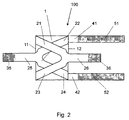
- the bandage 100 for relieving the muscles comprises an essentially rectangular central section 1, on the transverse edges 11, 12 of which four in total in the corner areas Tension belts 21, 22, 23, 24 are attached.
- the central section 1 is snuggled against the injured area in the muscle tissue in the extremity.
- the two proximal tension belts 21, 22 are guided in a diagonal movement distally and the two distal tension belts 23, 24 in a diagonal movement proximally such that the two proximal tension belts 21, 22 are proximal to the injured location, the two distal tension belts 23 , 24 cross over distal to the injured area and a proximal 21, 22 and a distal reins 23, 24 cross over each other laterally so that the injured area is left out.
- the ends 31, 32, 33, 34 of the tension belts 21, 22, 23, 24 are finally attached to the bandage 100.
- the ends 31, 32, 33, 34 are preferably equipped with a Velcro surface.
- FIG. 2 shows the bandage 100 in a first advantageous embodiment.
- the Velcro straps 41, 42 carry Velcro surfaces 51, 52 over almost the entire length in order to ensure a secure fit of the bandage on the extremity.
- a proximal tension belt 21, 22 and a distal tension belt 23, 24 unite to the side of the injured point to form a single belt, so that two Y-shaped tension belts 25, 26 result.
- the tension belts 25, 26 have Velcro straps 35, 36 at their ends and are fastened to themselves by means of lashing eyes which are located on the back of the central section 1.
- FIG. 3 shows the bandage 100 in the advantageous embodiment with the Y-shaped ones Tension belts 25, 26 according to Figure 2, the bandage 100 on the right thigh of a patient.
- the injured area 2 (torn muscle fibers) is anterior in the muscle tissue of the thigh.
- the injured muscle fibers are brought together by means of the tensioned tension belts 25, 26, so that pain relief in the injured area 2 is achieved.
- the Pain relief is not permanent, but only occurs when there is a contraction the injured muscle fibers are loaded on the muscles.
- the bandage 100 is disclosed in a further advantageous embodiment with the Y-shaped tension belts 25, 26 according to FIG. 2 and with a fastening tab 71.
- the bandage 100 is applied to the right thigh of a patient, the injured area 2 being located posteriorly in the muscle tissue of the thigh.
- the fastening tab 71 is fastened to the central section 1, preferably sewn on as usual, in such a way that the tension belt 26 can be carried out between the central section 1 and the fastening tab 71 so as not to impede the tensioning of the tension belt 26.
- the seam with which the closure flap 71 is fastened to the central section 1 is interrupted in the middle, so that two partial seams 74 and 75 result.
- the tension belt 26 is guided through the resulting gap 76, that is to say between the central section 1 and the locking tab 71.
- a soft pad 72 is present on the closure tab 71 to apply the compression to increase the injured area 2.
- a Velcro surface 73 is also provided for closing the locking tab 71, which is attached to the bandage 100 itself after the flap 71 has been folded over can be.
- FIG. 5 shows the bandage 100 in a further advantageous embodiment shown, namely the bandage 100 on the Y-shaped tension belts 25, 26, which by means of Lashing eyes 81, 82 are closed, as well as the one inserted in the central section 1 soft section 91.
- the bandage 100 is on the right lower leg of a patient
- the injured area is located posteriorly in the muscle tissue of the calf.
- the lashing eyes 81, 82 are attached to the outer side of the central section 1, preferably sewn on again.
- the tension belts 25, 26 are guided through the eyelets 81, 82, tensioned vigorously so that the required pressure builds up, and closed on themselves by means of the Velcro ends 35, 36.
- the vertical, soft section 91 used to avoid pressure points on the tibia.
- FIG. 6 finally shows the bandage 100 in a further advantageous embodiment.
- the bandage 100 shown is simplified compared to the bandage 100 from FIG. 5, the bandage 100 again being placed on the right lower leg of a patient and the injured area being located posteriorly in the muscle tissue of the calf. The lashing eyes are missing on this bandage 100.
- the pressure is built up by tensioning the tension belts 25, 26. Particularly in the case of minor impairments of the muscle tissue, it is sufficient to fix the tension belts 25, 26 to themselves by means of Velcro surfaces.
Landscapes
- Health & Medical Sciences (AREA)
- Engineering & Computer Science (AREA)
- Biomedical Technology (AREA)
- Heart & Thoracic Surgery (AREA)
- Vascular Medicine (AREA)
- Life Sciences & Earth Sciences (AREA)
- Animal Behavior & Ethology (AREA)
- General Health & Medical Sciences (AREA)
- Public Health (AREA)
- Veterinary Medicine (AREA)
- Orthopedics, Nursing, And Contraception (AREA)
- Medicines Containing Material From Animals Or Micro-Organisms (AREA)
- Surgical Instruments (AREA)
Abstract
Description
Gerade im Breitensport und im Leistungssport sowie im alltäglichen Leben gibt es nur wenige Verletzungen, die in einer so großen Häufigkeit auftreten wie der Muskelfaserriß und das Distorsionstrauma beziehungsweise der Bänderriß am OSG.
Des weiteren sind Salbenverbände und Zinkleimverbände bekannt sowie der Ansatz der physikalischen Therapie, die allgemein die Anregung oder gezielte Behandlung gestörter physiologischer Funktionen mit physikalischen, naturgegebenen Mitteln umfaßt, wie zum Beispiel Wasser, Wärme und Kälte, Licht, Luft, statisch-mechanisch (Massage), mit dynamischen Kräften, Heilquellen oder Elektrizität.
Nachdem der Verband angelegt worden ist, sollte aber - um die Bildung eines Fensterödems auszuschließen - diese ausgesparte Stelle ebenfalls verschlossen werden.
Diese medizinischen Bandagen müssen eine dreidimensionale Form aufweisen, um den anatomischen Gegebenheiten zu entsprechen, um form- und kraftschlüssig von extern auf den menschlichen Körper einwirken zu können.
Der Zentralabschnitt wird gegenüber der verletzten Stelle im Muskelgewebe in der Extremität angeschmiegt. Die beiden proximalen Zuggurte werden in einer diagonalen Bewegung nach distal und die beiden distalen Zuggurte in einer diagonalen Bewegung nach proximal derartig geführt, daß sich die beiden proximalen Zuggurte proximal der verletzten Stelle, die beiden distalen Zuggurte distal der verletzten Stelle überkreuzen und jeweils ein proximaler und ein distaler Zügel sich seitlich der verletzten Stelle überkreuzen, so daß die verletzte Stelle ausgelassen wird, und wobei die Enden der Zuggurte auf der Bandage befestigt werden.
Durch die Zurrösen wird ermöglicht, daß die Gurte nicht zirkulär angelegt werden, was die Gefahr einer Stauung erheblich verringert.
Die Verschlußlasche ist am Zentralabschnitt vorzugsweise angenäht, und zwar derartig, daß die Zuggurte beziehungsweise der Y-förmige Zuggurt zwischen Zentralabschnitt und Verschlußlasche durchgeführt werden kann, um das Spannen der Bandage nicht zu behindern.
Am einfachsten ist hierzu die Verschlußlasche nur jeweils am Randbereich mit dem Zentralabschnitt vernäht.
Die Verschlußlasche sollte bevorzugt ebenfalls aus einem Material bestehen, welches relativ fest ist und einen kurzen Zug aufweist.
Vorteilhafterweise wird das Pad auf der Verschlußlasche mittels eines Klettverschluß befestigt, um somit einen schnellen und einfachen Wechsel zu ermöglichen.
Des weiteren kann das Pad doppelwandig ausgeführt sein beziehungsweise eine aufgenähte Tasche aufweisen, um Kühlelemente in das Pad beziehungsweise in die Tasche einführen zu können, die eine Primärversorgung gewährleisten.
Ein geeignetes Material zur Bildung des Pads stellt zum Beispiel ein textilkaschierter Latexschaum dar, der entsprechend flexibel ist und sich an stark konturierte Körperregionen gut anlegen läßt. U.a. ist solch Latexschaum bei der Firma Beiersdorf unter der Bezeichnung

- Figur 1
- die Bandage in der einfachsten Ausführungsform mit vier Zuggurten,
- Figur 2
- die Bandage in einer vorteilhaften Ausführungsform mit den Y-förmigen Zuggurten,
- Figur 3
- die Bandage in der vorteilhaften Ausführungsform mit den Y-förmigen Zuggurten gemäß Figur 2, angelegt am rechten Oberschenkel eines Patienten, wobei sich die verletzte Stelle anterior im Muskelgewebe des Oberschenkels befindet,
- Figur 4
- die Bandage in einer weiteren vorteilhaften Ausführungsform mit den Y-förmigen Zuggurten gemäß Figur 2 sowie mit einer Verschlußlasche, angelegt am rechten Oberschenkel eines Patienten, wobei sich die verletzte Stelle posterior im Muskelgewebe des Oberschenkels befindet,
- Figur 5
- die Bandage in einer weiteren vorteilhaften Ausführungsform mit den Y-förmigen Zuggurten, die mittels Zurrösen verschlossen werden, sowie mit dem eingesetzten weichen Abschnitt, angelegt am rechten Unterschenkel eines Patienten, wobei sich die verletzte Stelle posterior im Muskelgewebe der Wade befindet, und
- Figur 6
- die Bandage in einer vorteilhaften Ausführungsform, gegenüber der Bandage aus Figur 5 vereinfacht, angelegt am rechten Unterschenkel eines Patienten, wobei sich die verletzte Stelle posterior im Muskelgewebe der Wade befindet.
Beim Anlegen der Bandage an einem der Arme oder einem der Beine wird der Zentralabschnitt 1 gegenüber der verletzten Stelle im Muskelgewebe in der Extremität angeschmiegt. Die beiden proximalen Zuggurte 21, 22 werden in einer diagonalen Bewegung nach distal und die beiden distalen Zuggurte 23, 24 in einer diagonalen Bewegung nach proximal derartig geführt, daß sich die beiden proximalen Zuggurte 21, 22 proximal der verletzten Stelle, die beiden distalen Zuggurte 23, 24 distal der verletzten Stelle überkreuzen und jeweils ein proximaler 21, 22 und ein distaler Zügel 23, 24 sich seitlich der verletzten Stelle überkreuzen, so daß die verletzte Stelle ausgelassen wird.
Die Enden 31, 32, 33, 34 der Zuggurte 21, 22, 23, 24 werden abschließend auf der Bandage 100 befestigt. Die Enden 31, 32, 33, 34 sind hierzu vorzugsweise mit einer Klettfläche ausgerüstet.
Die Klettverschlußbänder 41, 42 tragen annähernd über die gesamte Länge Klettflächen 51, 52, um einen sicheren Sitz der Bandage an der Extremität zu gewährleisten.
Die Zuggurte 25, 26 weisen an ihren Enden Klettverschlußbänder 35, 36 auf und werden mittels Zurrösen, die sich auf der Rückseite des Zentralabschnitts 1 befinden, auf sich selbst befestigt.
Die Bandage 100 ist angelegt am rechten Oberschenkel eines Patienten, wobei sich die verletzte Stelle 2 posterior im Muskelgewebe des Oberschenkels befindet.
Die Verschlußlasche 71 ist am Zentralabschnitt 1 befestigt, wie üblich vorzugsweise angenäht, und zwar derartig, daß der Zuggurt 26 zwischen Zentralabschnitt 1 und Verschlußlasche 71 durchgeführt werden kann, um das Spannen des Zuggurtes 26 nicht zu behindern.
Die Naht, mit der die Verschlußlasche 71 am Zentralabschnitt 1 befestigt ist, ist mittig unterbrochen, so daß sich zwei Teilnähte 74 und 75 ergeben. Durch die daraus resultierende Lücke 76 wird der Zuggurt 26 geführt, also zwischen Zentralabschnitt 1 und Verschlußlasche 71.
Die Zuggurte 25, 26 werden durch die Ösen 81, 82 geführt, kräftig gespannt, so daß sich der erforderliche Druck aufbaut, und auf sich selbst mittels der Klettenden 35, 36 verschlossen.
Bei dieser Bandage 100 fehlen die Zurrösen. Der Druck wird aufgebaut, in dem die Zuggurte 25, 26 gespannt werden. Insbesondere bei leichteren Beeinträchtigungen des Muskelgewebes ist es ausreichend, die Zuggurte 25, 26 auf sich selbst mittels Klettflächen zu fixieren.
Claims (9)
- Bandage 100 zur Entlastung der Muskulatur, umfassend einen im wesentlichen rechteckigen Zentralabschnitt 1, an dessen Querkanten 11, 12 insgesamt vier Zuggurte 21, 22, 23, 24 befestigt sind, wobei der Zentralabschnitt 1 gegenüber der verletzten Stelle im Muskelgewebe in der Extremität angeschmiegt wird, die beiden proximalen Zuggurte 21, 22 in einer diagonalen Bewegung nach distal und die beiden distalen Zuggurte 23, 24 in einer diagonalen Bewegung nach proximal derartig geführt werden, daß sich die beiden proximalen Zuggurte 21, 22 proximal der verletzten Stelle, die beiden distalen Zuggurte 23, 24 distal der verletzten Stelle überkreuzen und jeweils ein proximaler 21, 22 und ein distaler Zügel 23, 24 sich seitlich der verletzten Stelle überkreuzen, so daß die verletzte Stelle ausgelassen wird, und wobei die Enden 31, 32, 33, 34 der Zuggurte 21, 22, 23, 24 auf der Bandage 100 befestigt werden.
- Bandage gemäß Anspruch 1, dadurch gekennzeichnet, daß jeweils ein proximaler Zuggurt 21, 22 und ein distaler Zuggurt 23, 24 sich seitlich der verletzten Stelle zu einem einzigen Gurt vereinigen, so daß sich zwei Y-förmige Zuggurte 25, 26 ergeben.
- Bandage gemäß den Ansprüchen 1 und 2, dadurch gekennzeichnet, daß am proximalen Ende des Zentralabschnitts 1 ein Klettverschlußband 41 und am distalen Ende des Zentralabschnitts 1 ein Klettverschlußband 42 angebracht sind.
- Bandage gemäß den Ansprüchen 1 bis 3, dadurch gekennzeichnet, daß die Y-förmigen Zuggurte 25, 26 an ihren Enden Klettverschlußbänder 35, 36 aufweisen und mittels Zurrösen 81, 82 auf sich selbst befestigt werden.
- Bandage gemäß einem der vorherigen Ansprüche, dadurch gekennzeichnet, daß in den Zentralabschnitt 1 ein vertikal verlaufender, weicher Abschnitt 91 eingesetzt ist.
- Bandage gemäß einem der vorherigen Ansprüche, dadurch gekennzeichnet, daß am Zentralabschnitt 1 eine Verschlußlasche 71 angebracht ist, die die verletzte Stelle reversibel überdeckt.
- Bandage gemäß einem der vorherigen Ansprüche, dadurch gekennzeichnet, daß an der Bandage 100 seitliche Stabilisatoren angebracht sind.
- Verwendung der Bandage gemäß einem der vorherigen Ansprüche bei Muskelzerrungen, Muskelüberdehnungen, Muskelfaserrissen und Muskelbündelrissen.
- Verwendung der Bandage gemäß einem der vorherigen Ansprüche in Verbindung mit einem Thromboseprophylaxe-Strumpf.
Applications Claiming Priority (2)
| Application Number | Priority Date | Filing Date | Title |
|---|---|---|---|
| DE19950509 | 1999-10-20 | ||
| DE19950509A DE19950509C1 (de) | 1999-10-20 | 1999-10-20 | Bandage zur Entlastung der Muskulatur beim Muskelfaserriß und ihre Verwendung |
Publications (3)
| Publication Number | Publication Date |
|---|---|
| EP1093779A2 true EP1093779A2 (de) | 2001-04-25 |
| EP1093779A3 EP1093779A3 (de) | 2001-06-13 |
| EP1093779B1 EP1093779B1 (de) | 2004-12-01 |
Family
ID=7926272
Family Applications (1)
| Application Number | Title | Priority Date | Filing Date |
|---|---|---|---|
| EP00121543A Expired - Lifetime EP1093779B1 (de) | 1999-10-20 | 2000-09-30 | Bandage zur Entlastung der Muskulatur beim Muskelfaserriss |
Country Status (6)
| Country | Link |
|---|---|
| US (1) | US7173161B1 (de) |
| EP (1) | EP1093779B1 (de) |
| AT (1) | ATE283677T1 (de) |
| AU (1) | AU781700B2 (de) |
| DE (2) | DE19950509C1 (de) |
| ES (1) | ES2233265T3 (de) |
Cited By (1)
| Publication number | Priority date | Publication date | Assignee | Title |
|---|---|---|---|---|
| WO2009156143A1 (de) * | 2008-06-25 | 2009-12-30 | Medi Gmbh & Co. Kg | Kniebandage |
Families Citing this family (20)
| Publication number | Priority date | Publication date | Assignee | Title |
|---|---|---|---|---|
| DE10256646B4 (de) * | 2002-12-03 | 2005-08-04 | Udo John | Druckverband zum Fixieren von Kompressorien auf kleinen Wunden, insbesondere für die Kompression von punktierten Femoralarterien |
| US8663144B2 (en) | 2004-03-22 | 2014-03-04 | Farrow Medical Innovations Holdings Llc | Modular compression device and method of assembly |
| US7942838B2 (en) | 2004-03-22 | 2011-05-17 | Farrow Medical Innovations, Inc. | Compression garment |
| US11690746B2 (en) | 2004-04-02 | 2023-07-04 | Applied Biokinetics Llc | Pre-cut adhesive supports for anatomical support, pain reduction, or therapeutic treatment |
| DE102006000699B4 (de) * | 2005-01-07 | 2012-10-18 | Ulrich Östreicher | Medizinische Binde |
| US7951104B2 (en) * | 2007-11-13 | 2011-05-31 | Rodgers Jr James Bowmar | Brace for arm or elbow region including angularly-displaced muscle/tendon engaging portions |
| CA123317S (en) * | 2007-11-21 | 2008-12-01 | Ray Arbesman | Adhesive knee brace |
| US8491514B2 (en) * | 2009-06-08 | 2013-07-23 | Farrow Medical Innovations Holdings Llc | Customizable therapeutic compression garment and method |
| US8376977B2 (en) | 2008-08-28 | 2013-02-19 | Wade P. Farrow | Trim-to-fit therapeutic compression garment system and method |
| US20100056973A1 (en) * | 2008-08-28 | 2010-03-04 | Farrow Medical Innovations, Inc. | Therapeutic Compression Garments |
| CA128323S (en) * | 2008-10-22 | 2009-07-30 | Kevin Jardine | Adhesive combination foot arch support and calf strain brace |
| CA128324S (en) * | 2008-10-22 | 2010-01-21 | Kevin Jardine | Adhesive lower back brace |
| CA128878S (en) * | 2008-12-08 | 2009-09-23 | Kevin Jardine | Adhesive upper knee brace |
| US8690811B2 (en) * | 2011-01-27 | 2014-04-08 | Richard Fox | Knee brace |
| US9125787B2 (en) | 2011-09-30 | 2015-09-08 | Covidien Lp | Compression garment having a foam layer |
| US9402779B2 (en) | 2013-03-11 | 2016-08-02 | Covidien Lp | Compression garment with perspiration relief |
| USD777936S1 (en) * | 2015-07-29 | 2017-01-31 | Kahkashan Neseem | Arm sling |
| US10166164B2 (en) | 2016-04-27 | 2019-01-01 | Radial Medical, Inc. | Adaptive compression therapy systems and methods |
| US11446185B2 (en) | 2016-12-02 | 2022-09-20 | 3M Innovative Properties Company | Muscle or joint support article |
| US12551379B2 (en) * | 2019-02-19 | 2026-02-17 | Systagenix Wound Management, Limited | Advanced digit dressing |
Family Cites Families (10)
| Publication number | Priority date | Publication date | Assignee | Title |
|---|---|---|---|---|
| US3926186A (en) * | 1973-03-27 | 1975-12-16 | Robert P Nirschl | Muscular support |
| US3888244A (en) * | 1974-02-01 | 1975-06-10 | Steve Lebold | Means for supporting a limb in relaxed position |
| CH672061A5 (de) * | 1986-09-09 | 1989-10-31 | Jago Res Ag | |
| DE3710115A1 (de) * | 1987-03-13 | 1988-09-22 | Budde Franz Josef | Bandage anzulegen bei reizzustaenden der muskulatur, der sehnen und der gelenke |
| US5472413A (en) * | 1994-10-07 | 1995-12-05 | Pro Orthopedic Devices, Inc. | Universal fit knee and elbow braces with spiders |
| US5512039A (en) * | 1995-01-05 | 1996-04-30 | White; Patrick J. | Multi-angle knee support |
| IL118000A0 (en) * | 1995-04-25 | 1996-08-04 | Sinai School Medicine | Bandage with external anchor |
| DE19646740A1 (de) * | 1996-11-13 | 1998-05-14 | Beiersdorf Ag | Selbstklebende Fertigbandage zur Band- und Muskelstabilisierung am Kniegelenk |
| DE59813517D1 (de) * | 1997-01-23 | 2006-06-01 | Beiersdorf Ag | Selbstklebende fertigbandage zur streckungs- oder beugungseinschränkung des fingergrundgelenks und des handgelenks |
| US5968002A (en) * | 1998-04-02 | 1999-10-19 | Morrisseau; John K. | Orthotic garment and method |
-
1999
- 1999-10-20 DE DE19950509A patent/DE19950509C1/de not_active Expired - Fee Related
-
2000
- 2000-09-14 AU AU59429/00A patent/AU781700B2/en not_active Expired
- 2000-09-30 EP EP00121543A patent/EP1093779B1/de not_active Expired - Lifetime
- 2000-09-30 AT AT00121543T patent/ATE283677T1/de not_active IP Right Cessation
- 2000-09-30 ES ES00121543T patent/ES2233265T3/es not_active Expired - Lifetime
- 2000-09-30 DE DE50008820T patent/DE50008820D1/de not_active Expired - Lifetime
- 2000-10-16 US US09/688,658 patent/US7173161B1/en not_active Expired - Lifetime
Cited By (6)
| Publication number | Priority date | Publication date | Assignee | Title |
|---|---|---|---|---|
| WO2009156143A1 (de) * | 2008-06-25 | 2009-12-30 | Medi Gmbh & Co. Kg | Kniebandage |
| CN102076292A (zh) * | 2008-06-25 | 2011-05-25 | 麦迪有限及两合公司 | 膝绷带 |
| JP2011525396A (ja) * | 2008-06-25 | 2011-09-22 | メディ ゲーエムベーハー アンド カンパニー カーゲー | 膝包帯 |
| RU2469683C2 (ru) * | 2008-06-25 | 2012-12-20 | Меди Гмбх Унд Ко. Кг | Коленный бандаж |
| CN102076292B (zh) * | 2008-06-25 | 2014-06-25 | 麦迪有限及两合公司 | 膝绷带 |
| US8845567B2 (en) | 2008-06-25 | 2014-09-30 | Medi Gmbh & Co. Kg | Knee bandage |
Also Published As
| Publication number | Publication date |
|---|---|
| ATE283677T1 (de) | 2004-12-15 |
| ES2233265T3 (es) | 2005-06-16 |
| AU781700B2 (en) | 2005-06-09 |
| DE50008820D1 (de) | 2005-01-05 |
| EP1093779B1 (de) | 2004-12-01 |
| US7173161B1 (en) | 2007-02-06 |
| DE19950509C1 (de) | 2001-11-22 |
| EP1093779A3 (de) | 2001-06-13 |
| AU5942900A (en) | 2001-04-26 |
Similar Documents
| Publication | Publication Date | Title |
|---|---|---|
| EP1093779B1 (de) | Bandage zur Entlastung der Muskulatur beim Muskelfaserriss | |
| EP2612631B1 (de) | Stützbandage | |
| EP0627205B1 (de) | Sprunggelenkorthese | |
| EP1179325B1 (de) | Bandage für das Sprunggelenk | |
| DE212010000006U1 (de) | Orthopädische Vorrichtung | |
| EP1906890B1 (de) | Sprunggelenkbandage | |
| EP2380530B1 (de) | Sprunggelenkorthesensystem | |
| DE112007003134T5 (de) | Fußstützvorrichtung | |
| DE102009038517B4 (de) | Baukastensystem zur Zusammenstellung einer Orthese für ein Knie und Verfahren zum Umbau einer Orthese aus diesem Baukastensystem | |
| EP3210581A1 (de) | Fussbandage zur kompressionstherapie von lymphödemen | |
| EP1284695B1 (de) | Orthopädische schiene und orthopädisches kleidungsstück | |
| DE102009025416B4 (de) | Stütz- oder Fixiergurt | |
| EP1280487A1 (de) | Bandage für das sprunggelenk | |
| DE102018107576A1 (de) | Bandagesystem mit Entstauungsfunktion | |
| DE202024102521U1 (de) | Hüftorthese zur Mobilisierung eines Hüftgelenks | |
| DE202015107145U1 (de) | Kompressionsbandage zur Behandlung von Lymphödemen | |
| DE102019119079A1 (de) | Sprunggelenkorthese | |
| EP0879033B1 (de) | Lordosekorrekturmieder | |
| EP3082664A1 (de) | Schulterbandage | |
| DE102020101744A1 (de) | Kniegelenkbandage | |
| DE202020100382U1 (de) | Kniegelenkbandage | |
| DE102009025415C5 (de) | Stützbandage | |
| DE102023133446A1 (de) | Hüftorthese zur Mobilisierung eines Hüftgelenks | |
| DE947332C (de) | Streckguertel fuer die Behandlung von Rueckenverletzungen | |
| DE202021003430U1 (de) | Funktionsshirt mit Faszienaktivierungszonen und rumpfstabilisierenden Klett- und Tapebändern |
Legal Events
| Date | Code | Title | Description |
|---|---|---|---|
| PUAI | Public reference made under article 153(3) epc to a published international application that has entered the european phase |
Free format text: ORIGINAL CODE: 0009012 |
|
| AK | Designated contracting states |
Kind code of ref document: A2 Designated state(s): AT BE CH CY DE DK ES FI FR GB GR IE IT LI LU MC NL PT SE |
|
| AX | Request for extension of the european patent |
Free format text: AL;LT;LV;MK;RO;SI |
|
| PUAL | Search report despatched |
Free format text: ORIGINAL CODE: 0009013 |
|
| AK | Designated contracting states |
Kind code of ref document: A3 Designated state(s): AT BE CH CY DE DK ES FI FR GB GR IE IT LI LU MC NL PT SE |
|
| AX | Request for extension of the european patent |
Free format text: AL;LT;LV;MK;RO;SI |
|
| RIC1 | Information provided on ipc code assigned before grant |
Free format text: 7A 61F 13/00 A, 7A 61F 13/04 B, 7A 61F 13/06 B, 7A 61F 13/10 B |
|
| 17P | Request for examination filed |
Effective date: 20010428 |
|
| AKX | Designation fees paid |
Free format text: AT BE CH CY DE DK ES FI FR GB GR IE IT LI LU MC NL PT SE |
|
| 17Q | First examination report despatched |
Effective date: 20030207 |
|
| GRAP | Despatch of communication of intention to grant a patent |
Free format text: ORIGINAL CODE: EPIDOSNIGR1 |
|
| GRAS | Grant fee paid |
Free format text: ORIGINAL CODE: EPIDOSNIGR3 |
|
| GRAA | (expected) grant |
Free format text: ORIGINAL CODE: 0009210 |
|
| AK | Designated contracting states |
Kind code of ref document: B1 Designated state(s): AT BE CH CY DE DK ES FI FR GB GR IE IT LI LU MC NL PT SE |
|
| PG25 | Lapsed in a contracting state [announced via postgrant information from national office to epo] |
Ref country code: FI Free format text: LAPSE BECAUSE OF FAILURE TO SUBMIT A TRANSLATION OF THE DESCRIPTION OR TO PAY THE FEE WITHIN THE PRESCRIBED TIME-LIMIT Effective date: 20041201 Ref country code: IE Free format text: LAPSE BECAUSE OF FAILURE TO SUBMIT A TRANSLATION OF THE DESCRIPTION OR TO PAY THE FEE WITHIN THE PRESCRIBED TIME-LIMIT Effective date: 20041201 Ref country code: NL Free format text: LAPSE BECAUSE OF FAILURE TO SUBMIT A TRANSLATION OF THE DESCRIPTION OR TO PAY THE FEE WITHIN THE PRESCRIBED TIME-LIMIT Effective date: 20041201 |
|
| REG | Reference to a national code |
Ref country code: GB Ref legal event code: FG4D Free format text: NOT ENGLISH |
|
| REG | Reference to a national code |
Ref country code: CH Ref legal event code: EP |
|
| REG | Reference to a national code |
Ref country code: IE Ref legal event code: FG4D Free format text: GERMAN |
|
| REF | Corresponds to: |
Ref document number: 50008820 Country of ref document: DE Date of ref document: 20050105 Kind code of ref document: P |
|
| PG25 | Lapsed in a contracting state [announced via postgrant information from national office to epo] |
Ref country code: DK Free format text: LAPSE BECAUSE OF FAILURE TO SUBMIT A TRANSLATION OF THE DESCRIPTION OR TO PAY THE FEE WITHIN THE PRESCRIBED TIME-LIMIT Effective date: 20050301 Ref country code: SE Free format text: LAPSE BECAUSE OF FAILURE TO SUBMIT A TRANSLATION OF THE DESCRIPTION OR TO PAY THE FEE WITHIN THE PRESCRIBED TIME-LIMIT Effective date: 20050301 Ref country code: GR Free format text: LAPSE BECAUSE OF FAILURE TO SUBMIT A TRANSLATION OF THE DESCRIPTION OR TO PAY THE FEE WITHIN THE PRESCRIBED TIME-LIMIT Effective date: 20050301 |
|
| GBT | Gb: translation of ep patent filed (gb section 77(6)(a)/1977) |
Effective date: 20050319 |
|
| NLV1 | Nl: lapsed or annulled due to failure to fulfill the requirements of art. 29p and 29m of the patents act | ||
| REG | Reference to a national code |
Ref country code: ES Ref legal event code: FG2A Ref document number: 2233265 Country of ref document: ES Kind code of ref document: T3 |
|
| REG | Reference to a national code |
Ref country code: IE Ref legal event code: FD4D |
|
| PG25 | Lapsed in a contracting state [announced via postgrant information from national office to epo] |
Ref country code: MC Free format text: LAPSE BECAUSE OF NON-PAYMENT OF DUE FEES Effective date: 20050930 Ref country code: CH Free format text: LAPSE BECAUSE OF NON-PAYMENT OF DUE FEES Effective date: 20050930 Ref country code: BE Free format text: LAPSE BECAUSE OF NON-PAYMENT OF DUE FEES Effective date: 20050930 Ref country code: LU Free format text: LAPSE BECAUSE OF NON-PAYMENT OF DUE FEES Effective date: 20050930 Ref country code: LI Free format text: LAPSE BECAUSE OF NON-PAYMENT OF DUE FEES Effective date: 20050930 Ref country code: AT Free format text: LAPSE BECAUSE OF NON-PAYMENT OF DUE FEES Effective date: 20050930 Ref country code: CY Free format text: LAPSE BECAUSE OF FAILURE TO SUBMIT A TRANSLATION OF THE DESCRIPTION OR TO PAY THE FEE WITHIN THE PRESCRIBED TIME-LIMIT Effective date: 20050930 |
|
| PLBE | No opposition filed within time limit |
Free format text: ORIGINAL CODE: 0009261 |
|
| STAA | Information on the status of an ep patent application or granted ep patent |
Free format text: STATUS: NO OPPOSITION FILED WITHIN TIME LIMIT |
|
| 26N | No opposition filed |
Effective date: 20050902 |
|
| ET | Fr: translation filed | ||
| REG | Reference to a national code |
Ref country code: GB Ref legal event code: 732E |
|
| REG | Reference to a national code |
Ref country code: CH Ref legal event code: PL |
|
| REG | Reference to a national code |
Ref country code: FR Ref legal event code: TP |
|
| REG | Reference to a national code |
Ref country code: FR Ref legal event code: TP Ref country code: FR Ref legal event code: CD |
|
| BERE | Be: lapsed |
Owner name: *BEIERSDORF A.G. Effective date: 20050930 |
|
| PG25 | Lapsed in a contracting state [announced via postgrant information from national office to epo] |
Ref country code: PT Free format text: LAPSE BECAUSE OF NON-PAYMENT OF DUE FEES Effective date: 20050501 |
|
| REG | Reference to a national code |
Ref country code: FR Ref legal event code: GC Effective date: 20130108 |
|
| REG | Reference to a national code |
Ref country code: FR Ref legal event code: GC Effective date: 20131007 |
|
| REG | Reference to a national code |
Ref country code: FR Ref legal event code: PLFP Year of fee payment: 16 |
|
| REG | Reference to a national code |
Ref country code: FR Ref legal event code: GC Effective date: 20151215 |
|
| PGFP | Annual fee paid to national office [announced via postgrant information from national office to epo] |
Ref country code: ES Payment date: 20151214 Year of fee payment: 16 |
|
| PGFP | Annual fee paid to national office [announced via postgrant information from national office to epo] |
Ref country code: IT Payment date: 20151223 Year of fee payment: 16 |
|
| REG | Reference to a national code |
Ref country code: FR Ref legal event code: PLFP Year of fee payment: 17 |
|
| REG | Reference to a national code |
Ref country code: DE Ref legal event code: R082 Ref document number: 50008820 Country of ref document: DE Representative=s name: UEXKUELL & STOLBERG PARTNERSCHAFT VON PATENT- , DE Ref country code: DE Ref legal event code: R081 Ref document number: 50008820 Country of ref document: DE Owner name: BSN MEDICAL GMBH, DE Free format text: FORMER OWNER: BSN MEDICAL GMBH, 20253 HAMBURG, DE |
|
| REG | Reference to a national code |
Ref country code: DE Ref legal event code: R082 Ref document number: 50008820 Country of ref document: DE Representative=s name: UEXKUELL & STOLBERG PARTNERSCHAFT VON PATENT- , DE Ref country code: DE Ref legal event code: R081 Ref document number: 50008820 Country of ref document: DE Owner name: BSN MEDICAL GMBH, DE Free format text: FORMER OWNER: BSN MEDICAL HOLDING GMBH, 20253 HAMBURG, DE |
|
| REG | Reference to a national code |
Ref country code: GB Ref legal event code: 732E Free format text: REGISTERED BETWEEN 20170511 AND 20170517 |
|
| REG | Reference to a national code |
Ref country code: FR Ref legal event code: PLFP Year of fee payment: 18 |
|
| PG25 | Lapsed in a contracting state [announced via postgrant information from national office to epo] |
Ref country code: IT Free format text: LAPSE BECAUSE OF NON-PAYMENT OF DUE FEES Effective date: 20160930 |
|
| REG | Reference to a national code |
Ref country code: FR Ref legal event code: RG Effective date: 20180112 |
|
| REG | Reference to a national code |
Ref country code: ES Ref legal event code: FD2A Effective date: 20180507 |
|
| PG25 | Lapsed in a contracting state [announced via postgrant information from national office to epo] |
Ref country code: ES Free format text: LAPSE BECAUSE OF NON-PAYMENT OF DUE FEES Effective date: 20160930 |
|
| PG25 | Lapsed in a contracting state [announced via postgrant information from national office to epo] |
Ref country code: ES Free format text: LAPSE BECAUSE OF NON-PAYMENT OF DUE FEES Effective date: 20161001 |
|
| REG | Reference to a national code |
Ref country code: FR Ref legal event code: PLFP Year of fee payment: 19 |
|
| PGFP | Annual fee paid to national office [announced via postgrant information from national office to epo] |
Ref country code: FR Payment date: 20190815 Year of fee payment: 20 Ref country code: DE Payment date: 20190917 Year of fee payment: 20 |
|
| PGFP | Annual fee paid to national office [announced via postgrant information from national office to epo] |
Ref country code: GB Payment date: 20190926 Year of fee payment: 20 |
|
| REG | Reference to a national code |
Ref country code: GB Ref legal event code: PE20 Expiry date: 20200929 |
|
| PG25 | Lapsed in a contracting state [announced via postgrant information from national office to epo] |
Ref country code: GB Free format text: LAPSE BECAUSE OF EXPIRATION OF PROTECTION Effective date: 20200929 |