EP1088813A2 - Urethangruppen enthaltende Photoinitiatoren zur kationischen Härtung - Google Patents
Urethangruppen enthaltende Photoinitiatoren zur kationischen Härtung Download PDFInfo
- Publication number
- EP1088813A2 EP1088813A2 EP00119683A EP00119683A EP1088813A2 EP 1088813 A2 EP1088813 A2 EP 1088813A2 EP 00119683 A EP00119683 A EP 00119683A EP 00119683 A EP00119683 A EP 00119683A EP 1088813 A2 EP1088813 A2 EP 1088813A2
- Authority
- EP
- European Patent Office
- Prior art keywords
- radical
- group
- rest
- iodonium salts
- formula
- Prior art date
- Legal status (The legal status is an assumption and is not a legal conclusion. Google has not performed a legal analysis and makes no representation as to the accuracy of the status listed.)
- Granted
Links
- JOYRKODLDBILNP-UHFFFAOYSA-N urethane group Chemical group NC(=O)OCC JOYRKODLDBILNP-UHFFFAOYSA-N 0.000 title claims description 11
- 125000002091 cationic group Chemical group 0.000 title claims description 4
- -1 urethane groups Iodonium salts Chemical class 0.000 claims abstract description 121
- 238000000034 method Methods 0.000 claims abstract description 7
- 238000002360 preparation method Methods 0.000 claims abstract description 4
- XMBWDFGMSWQBCA-UHFFFAOYSA-N hydrogen iodide Chemical class I XMBWDFGMSWQBCA-UHFFFAOYSA-N 0.000 claims description 45
- 150000003254 radicals Chemical class 0.000 claims description 34
- 125000004430 oxygen atom Chemical group O* 0.000 claims description 22
- 125000004432 carbon atom Chemical group C* 0.000 claims description 21
- 125000002887 hydroxy group Chemical group [H]O* 0.000 claims description 17
- 229910052717 sulfur Inorganic materials 0.000 claims description 17
- 125000004434 sulfur atom Chemical group 0.000 claims description 17
- 229930195733 hydrocarbon Natural products 0.000 claims description 15
- 239000004215 Carbon black (E152) Substances 0.000 claims description 14
- IQPQWNKOIGAROB-UHFFFAOYSA-N isocyanate group Chemical group [N-]=C=O IQPQWNKOIGAROB-UHFFFAOYSA-N 0.000 claims description 11
- 229920001296 polysiloxane Polymers 0.000 claims description 10
- 125000001424 substituent group Chemical group 0.000 claims description 10
- 125000003118 aryl group Chemical group 0.000 claims description 8
- 239000002253 acid Substances 0.000 claims description 7
- 150000001450 anions Chemical class 0.000 claims description 7
- 150000003839 salts Chemical class 0.000 claims description 7
- 125000004185 ester group Chemical group 0.000 claims description 6
- 125000003178 carboxy group Chemical group [H]OC(*)=O 0.000 claims description 5
- 239000003153 chemical reaction reagent Substances 0.000 claims description 5
- 125000003700 epoxy group Chemical group 0.000 claims description 5
- 125000001188 haloalkyl group Chemical group 0.000 claims description 5
- 239000002184 metal Substances 0.000 claims description 5
- 125000001624 naphthyl group Chemical group 0.000 claims description 5
- 229910052760 oxygen Inorganic materials 0.000 claims description 5
- 239000001301 oxygen Substances 0.000 claims description 5
- 125000001997 phenyl group Chemical group [H]C1=C([H])C([H])=C(*)C([H])=C1[H] 0.000 claims description 5
- 239000000126 substance Substances 0.000 claims description 5
- ZCYVEMRRCGMTRW-UHFFFAOYSA-N 7553-56-2 Chemical compound [I] ZCYVEMRRCGMTRW-UHFFFAOYSA-N 0.000 claims description 4
- 125000001495 ethyl group Chemical group [H]C([H])([H])C([H])([H])* 0.000 claims description 4
- 229910052740 iodine Inorganic materials 0.000 claims description 4
- 239000011630 iodine Substances 0.000 claims description 4
- 125000002496 methyl group Chemical group [H]C([H])([H])* 0.000 claims description 4
- 125000006413 ring segment Chemical group 0.000 claims description 4
- MYMOFIZGZYHOMD-UHFFFAOYSA-N Dioxygen Chemical compound O=O MYMOFIZGZYHOMD-UHFFFAOYSA-N 0.000 claims description 3
- 125000000068 chlorophenyl group Chemical group 0.000 claims description 3
- 125000004212 difluorophenyl group Chemical group 0.000 claims description 3
- 125000001207 fluorophenyl group Chemical group 0.000 claims description 3
- 125000000959 isobutyl group Chemical group [H]C([H])([H])C([H])(C([H])([H])[H])C([H])([H])* 0.000 claims description 3
- 125000004108 n-butyl group Chemical group [H]C([H])([H])C([H])([H])C([H])([H])C([H])([H])* 0.000 claims description 3
- 125000002347 octyl group Chemical group [H]C([*])([H])C([H])([H])C([H])([H])C([H])([H])C([H])([H])C([H])([H])C([H])([H])C([H])([H])[H] 0.000 claims description 3
- 238000006116 polymerization reaction Methods 0.000 claims description 3
- CLZAEVAEWSHALL-UHFFFAOYSA-N 1,1,1,2,2,3,3-heptafluoropropane Chemical compound F[C](F)C(F)(F)C(F)(F)F CLZAEVAEWSHALL-UHFFFAOYSA-N 0.000 claims description 2
- 229910017008 AsF 6 Inorganic materials 0.000 claims description 2
- 229910020366 ClO 4 Inorganic materials 0.000 claims description 2
- 229910018286 SbF 6 Inorganic materials 0.000 claims description 2
- QYKIQEUNHZKYBP-UHFFFAOYSA-N Vinyl ether Chemical class C=COC=C QYKIQEUNHZKYBP-UHFFFAOYSA-N 0.000 claims description 2
- 150000005840 aryl radicals Chemical class 0.000 claims description 2
- 125000004799 bromophenyl group Chemical group 0.000 claims description 2
- 125000004218 chloromethyl group Chemical group [H]C([H])(Cl)* 0.000 claims description 2
- 125000000113 cyclohexyl group Chemical group [H]C1([H])C([H])([H])C([H])([H])C([H])(*)C([H])([H])C1([H])[H] 0.000 claims description 2
- 125000002704 decyl group Chemical group [H]C([H])([H])C([H])([H])C([H])([H])C([H])([H])C([H])([H])C([H])([H])C([H])([H])C([H])([H])C([H])([H])C([H])([H])* 0.000 claims description 2
- 125000003438 dodecyl group Chemical group [H]C([H])([H])C([H])([H])C([H])([H])C([H])([H])C([H])([H])C([H])([H])C([H])([H])C([H])([H])C([H])([H])C([H])([H])C([H])([H])C([H])([H])* 0.000 claims description 2
- 150000002118 epoxides Chemical class 0.000 claims description 2
- 125000003187 heptyl group Chemical group [H]C([*])([H])C([H])([H])C([H])([H])C([H])([H])C([H])([H])C([H])([H])C([H])([H])[H] 0.000 claims description 2
- 125000004051 hexyl group Chemical group [H]C([H])([H])C([H])([H])C([H])([H])C([H])([H])C([H])([H])C([H])([H])* 0.000 claims description 2
- 125000001972 isopentyl group Chemical group [H]C([H])([H])C([H])(C([H])([H])[H])C([H])([H])C([H])([H])* 0.000 claims description 2
- 125000001449 isopropyl group Chemical group [H]C([H])([H])C([H])(*)C([H])([H])[H] 0.000 claims description 2
- 125000003136 n-heptyl group Chemical group [H]C([H])([H])C([H])([H])C([H])([H])C([H])([H])C([H])([H])C([H])([H])C([H])([H])* 0.000 claims description 2
- 125000001280 n-hexyl group Chemical group C(CCCCC)* 0.000 claims description 2
- 125000000740 n-pentyl group Chemical group [H]C([H])([H])C([H])([H])C([H])([H])C([H])([H])C([H])([H])* 0.000 claims description 2
- 125000004123 n-propyl group Chemical group [H]C([H])([H])C([H])([H])C([H])([H])* 0.000 claims description 2
- 125000001971 neopentyl group Chemical group [H]C([*])([H])C(C([H])([H])[H])(C([H])([H])[H])C([H])([H])[H] 0.000 claims description 2
- 125000006340 pentafluoro ethyl group Chemical group FC(F)(F)C(F)(F)* 0.000 claims description 2
- 125000000538 pentafluorophenyl group Chemical group FC1=C(F)C(F)=C(*)C(F)=C1F 0.000 claims description 2
- 125000001973 tert-pentyl group Chemical group [H]C([H])([H])C([H])([H])C(*)(C([H])([H])[H])C([H])([H])[H] 0.000 claims description 2
- JOXIMZWYDAKGHI-UHFFFAOYSA-N toluene-4-sulfonic acid Chemical compound CC1=CC=C(S(O)(=O)=O)C=C1 JOXIMZWYDAKGHI-UHFFFAOYSA-N 0.000 claims description 2
- 125000003866 trichloromethyl group Chemical group ClC(Cl)(Cl)* 0.000 claims description 2
- 125000002023 trifluoromethyl group Chemical group FC(F)(F)* 0.000 claims description 2
- 125000001400 nonyl group Chemical group [H]C([*])([H])C([H])([H])C([H])([H])C([H])([H])C([H])([H])C([H])([H])C([H])([H])C([H])([H])C([H])([H])[H] 0.000 claims 1
- 238000001723 curing Methods 0.000 abstract description 9
- 239000000203 mixture Substances 0.000 abstract description 8
- 238000003847 radiation curing Methods 0.000 abstract description 2
- XEKOWRVHYACXOJ-UHFFFAOYSA-N Ethyl acetate Chemical compound CCOC(C)=O XEKOWRVHYACXOJ-UHFFFAOYSA-N 0.000 description 12
- YXFVVABEGXRONW-UHFFFAOYSA-N Toluene Chemical compound CC1=CC=CC=C1 YXFVVABEGXRONW-UHFFFAOYSA-N 0.000 description 12
- 239000012948 isocyanate Substances 0.000 description 9
- 239000003795 chemical substances by application Substances 0.000 description 8
- 238000006243 chemical reaction Methods 0.000 description 5
- 239000000047 product Substances 0.000 description 5
- LPLLVINFLBSFRP-UHFFFAOYSA-N 2-methylamino-1-phenylpropan-1-one Chemical compound CNC(C)C(=O)C1=CC=CC=C1 LPLLVINFLBSFRP-UHFFFAOYSA-N 0.000 description 4
- 241000132539 Cosmos Species 0.000 description 4
- 235000005956 Cosmos caudatus Nutrition 0.000 description 4
- 239000003054 catalyst Substances 0.000 description 4
- 238000000576 coating method Methods 0.000 description 4
- 150000001875 compounds Chemical class 0.000 description 4
- 238000004821 distillation Methods 0.000 description 4
- 238000002844 melting Methods 0.000 description 4
- 230000008018 melting Effects 0.000 description 4
- 239000002904 solvent Substances 0.000 description 4
- XLYOFNOQVPJJNP-UHFFFAOYSA-N water Substances O XLYOFNOQVPJJNP-UHFFFAOYSA-N 0.000 description 4
- LRHPLDYGYMQRHN-UHFFFAOYSA-N N-Butanol Chemical compound CCCCO LRHPLDYGYMQRHN-UHFFFAOYSA-N 0.000 description 3
- 125000000217 alkyl group Chemical group 0.000 description 3
- 230000015572 biosynthetic process Effects 0.000 description 3
- 238000012663 cationic photopolymerization Methods 0.000 description 3
- 239000013078 crystal Substances 0.000 description 3
- 150000002513 isocyanates Chemical class 0.000 description 3
- HJOVHMDZYOCNQW-UHFFFAOYSA-N isophorone Chemical compound CC1=CC(=O)CC(C)(C)C1 HJOVHMDZYOCNQW-UHFFFAOYSA-N 0.000 description 3
- 238000004519 manufacturing process Methods 0.000 description 3
- CTMGYQHKKIEXKF-UHFFFAOYSA-N 1-isocyanato-2-(trifluoromethoxy)benzene Chemical compound FC(F)(F)OC1=CC=CC=C1N=C=O CTMGYQHKKIEXKF-UHFFFAOYSA-N 0.000 description 2
- QWDQYHPOSSHSAW-UHFFFAOYSA-N 1-isocyanatooctadecane Chemical compound CCCCCCCCCCCCCCCCCCN=C=O QWDQYHPOSSHSAW-UHFFFAOYSA-N 0.000 description 2
- XDTMQSROBMDMFD-UHFFFAOYSA-N Cyclohexane Chemical compound C1CCCCC1 XDTMQSROBMDMFD-UHFFFAOYSA-N 0.000 description 2
- SNRUBQQJIBEYMU-UHFFFAOYSA-N Dodecane Natural products CCCCCCCCCCCC SNRUBQQJIBEYMU-UHFFFAOYSA-N 0.000 description 2
- 150000007513 acids Chemical class 0.000 description 2
- 125000000484 butyl group Chemical group [H]C([*])([H])C([H])([H])C([H])([H])C([H])([H])[H] 0.000 description 2
- 125000005520 diaryliodonium group Chemical group 0.000 description 2
- 125000005442 diisocyanate group Chemical group 0.000 description 2
- 230000000694 effects Effects 0.000 description 2
- 230000007062 hydrolysis Effects 0.000 description 2
- 238000006460 hydrolysis reaction Methods 0.000 description 2
- 230000003301 hydrolyzing effect Effects 0.000 description 2
- PNDPGZBMCMUPRI-UHFFFAOYSA-N iodine Chemical compound II PNDPGZBMCMUPRI-UHFFFAOYSA-N 0.000 description 2
- 239000000843 powder Substances 0.000 description 2
- 239000002244 precipitate Substances 0.000 description 2
- 125000001436 propyl group Chemical group [H]C([*])([H])C([H])([H])C([H])([H])[H] 0.000 description 2
- 125000003944 tolyl group Chemical group 0.000 description 2
- SXJYSIBLFGQAND-UHFFFAOYSA-N 1-isocyanato-3-(trifluoromethyl)benzene Chemical compound FC(F)(F)C1=CC=CC(N=C=O)=C1 SXJYSIBLFGQAND-UHFFFAOYSA-N 0.000 description 1
- 125000002941 2-furyl group Chemical group O1C([*])=C([H])C([H])=C1[H] 0.000 description 1
- 125000000175 2-thienyl group Chemical group S1C([*])=C([H])C([H])=C1[H] 0.000 description 1
- 125000003682 3-furyl group Chemical group O1C([H])=C([*])C([H])=C1[H] 0.000 description 1
- 125000004207 3-methoxyphenyl group Chemical group [H]C1=C([H])C(*)=C([H])C(OC([H])([H])[H])=C1[H] 0.000 description 1
- 239000004593 Epoxy Substances 0.000 description 1
- YUDRVAHLXDBKSR-UHFFFAOYSA-N [CH]1CCCCC1 Chemical group [CH]1CCCCC1 YUDRVAHLXDBKSR-UHFFFAOYSA-N 0.000 description 1
- 238000004220 aggregation Methods 0.000 description 1
- 230000002776 aggregation Effects 0.000 description 1
- 150000001336 alkenes Chemical class 0.000 description 1
- 125000003302 alkenyloxy group Chemical group 0.000 description 1
- QVGXLLKOCUKJST-UHFFFAOYSA-N atomic oxygen Chemical compound [O] QVGXLLKOCUKJST-UHFFFAOYSA-N 0.000 description 1
- 125000001797 benzyl group Chemical group [H]C1=C([H])C([H])=C(C([H])=C1[H])C([H])([H])* 0.000 description 1
- 125000004803 chlorobenzyl group Chemical group 0.000 description 1
- 239000011248 coating agent Substances 0.000 description 1
- 230000009918 complex formation Effects 0.000 description 1
- XXKOQQBKBHUATC-UHFFFAOYSA-N cyclohexylmethylcyclohexane Chemical compound C1CCCCC1CC1CCCCC1 XXKOQQBKBHUATC-UHFFFAOYSA-N 0.000 description 1
- 230000007547 defect Effects 0.000 description 1
- 239000012955 diaryliodonium Substances 0.000 description 1
- CZZYITDELCSZES-UHFFFAOYSA-N diphenylmethane Chemical compound C=1C=CC=CC=1CC1=CC=CC=C1 CZZYITDELCSZES-UHFFFAOYSA-N 0.000 description 1
- WUDNUHPRLBTKOJ-UHFFFAOYSA-N ethyl isocyanate Chemical compound CCN=C=O WUDNUHPRLBTKOJ-UHFFFAOYSA-N 0.000 description 1
- 230000004992 fission Effects 0.000 description 1
- 229910052731 fluorine Inorganic materials 0.000 description 1
- 239000011737 fluorine Substances 0.000 description 1
- 125000001153 fluoro group Chemical group F* 0.000 description 1
- 230000004927 fusion Effects 0.000 description 1
- ANJPRQPHZGHVQB-UHFFFAOYSA-N hexyl isocyanate Chemical compound CCCCCCN=C=O ANJPRQPHZGHVQB-UHFFFAOYSA-N 0.000 description 1
- 150000002430 hydrocarbons Chemical class 0.000 description 1
- MGFYSGNNHQQTJW-UHFFFAOYSA-N iodonium Chemical compound [IH2+] MGFYSGNNHQQTJW-UHFFFAOYSA-N 0.000 description 1
- 239000003446 ligand Substances 0.000 description 1
- 239000007788 liquid Substances 0.000 description 1
- GPKUICFDWYEPTK-UHFFFAOYSA-N methoxycyclohexatriene Chemical compound COC1=CC=C=C[CH]1 GPKUICFDWYEPTK-UHFFFAOYSA-N 0.000 description 1
- 125000006178 methyl benzyl group Chemical group 0.000 description 1
- 239000000178 monomer Substances 0.000 description 1
- BKFPILLUYYCDSK-UHFFFAOYSA-N n-(4-formamido-3-methylphenyl)formamide Chemical compound CC1=CC(NC=O)=CC=C1NC=O BKFPILLUYYCDSK-UHFFFAOYSA-N 0.000 description 1
- 125000006606 n-butoxy group Chemical group 0.000 description 1
- 125000006501 nitrophenyl group Chemical group 0.000 description 1
- 125000001037 p-tolyl group Chemical group [H]C1=C([H])C(=C([H])C([H])=C1*)C([H])([H])[H] 0.000 description 1
- DGTNSSLYPYDJGL-UHFFFAOYSA-N phenyl isocyanate Chemical compound O=C=NC1=CC=CC=C1 DGTNSSLYPYDJGL-UHFFFAOYSA-N 0.000 description 1
- 125000000286 phenylethyl group Chemical group [H]C1=C([H])C([H])=C(C([H])=C1[H])C([H])([H])C([H])([H])* 0.000 description 1
- 230000000886 photobiology Effects 0.000 description 1
- 238000001556 precipitation Methods 0.000 description 1
- 230000005855 radiation Effects 0.000 description 1
- 238000001953 recrystallisation Methods 0.000 description 1
- 239000007787 solid Substances 0.000 description 1
- 239000007858 starting material Substances 0.000 description 1
- 238000003860 storage Methods 0.000 description 1
- 239000000758 substrate Substances 0.000 description 1
- 125000000999 tert-butyl group Chemical group [H]C([H])([H])C(*)(C([H])([H])[H])C([H])([H])[H] 0.000 description 1
- DVKJHBMWWAPEIU-UHFFFAOYSA-N toluene 2,4-diisocyanate Chemical compound CC1=CC=C(N=C=O)C=C1N=C=O DVKJHBMWWAPEIU-UHFFFAOYSA-N 0.000 description 1
- 125000005409 triarylsulfonium group Chemical group 0.000 description 1
- 230000037303 wrinkles Effects 0.000 description 1
Classifications
-
- C—CHEMISTRY; METALLURGY
- C08—ORGANIC MACROMOLECULAR COMPOUNDS; THEIR PREPARATION OR CHEMICAL WORKING-UP; COMPOSITIONS BASED THEREON
- C08F—MACROMOLECULAR COMPOUNDS OBTAINED BY REACTIONS ONLY INVOLVING CARBON-TO-CARBON UNSATURATED BONDS
- C08F2/00—Processes of polymerisation
- C08F2/46—Polymerisation initiated by wave energy or particle radiation
- C08F2/48—Polymerisation initiated by wave energy or particle radiation by ultraviolet or visible light
- C08F2/50—Polymerisation initiated by wave energy or particle radiation by ultraviolet or visible light with sensitising agents
-
- C—CHEMISTRY; METALLURGY
- C07—ORGANIC CHEMISTRY
- C07C—ACYCLIC OR CARBOCYCLIC COMPOUNDS
- C07C271/00—Derivatives of carbamic acids, i.e. compounds containing any of the groups, the nitrogen atom not being part of nitro or nitroso groups
- C07C271/06—Esters of carbamic acids
- C07C271/08—Esters of carbamic acids having oxygen atoms of carbamate groups bound to acyclic carbon atoms
- C07C271/26—Esters of carbamic acids having oxygen atoms of carbamate groups bound to acyclic carbon atoms with the nitrogen atom of at least one of the carbamate groups bound to a carbon atom of a six-membered aromatic ring
- C07C271/28—Esters of carbamic acids having oxygen atoms of carbamate groups bound to acyclic carbon atoms with the nitrogen atom of at least one of the carbamate groups bound to a carbon atom of a six-membered aromatic ring to a carbon atom of a non-condensed six-membered aromatic ring
Definitions
- the present invention relates to urethane groups Iodonium salts with reduced tendency to crystallize Process for their preparation and their use for Radiation curing of cationically curing compositions.
- Diaryliodonium (I) and triarylsulfonium salts (II) are particularly efficient photoinitiators.
- Diaryliodonium salts (I) in particular are from the patent literature known (DE-A-25 18 639, US-A-4 279 717, EP-A-0 334 056, EP-B-0 618 919) and are used as photoinitiators for polymerization of cationically polymerizable substances used.
- the Cationically polymerizable substances can be nonpolar to be little polar, especially if the polymerizable groups are contained in organopolysiloxanes. It is therefore at Addition of these photoinitiators very often observed that depending on the structure of the preparation, the miscibility and Solubility of the photoinitiators is limited. Therefore, the Aryl residues of such onium salts are often substituted with alkyl chains, to increase the solubility in organopolysiloxanes (US-A-4,310,469 and US-A-4,374,066).
- the two oxygen atoms in the molecule act as ligands for a second iodonium ion. Through this aggregation behavior the formation of crystals is promoted.
- the high tendency to crystallize has a negative effect from when the iodonium salts in nonpolar media such as organopolysiloxanes, should be solved.
- they are either insoluble or a solid is formed after a short time Precipitation.
- the present invention is based on the object Hydroxyl group-bearing iodonium salts on a particularly inexpensive, simple way to modify so that the tendency to crystallize is greatly reduced, good tolerance especially with epoxy groups Organopolysiloxanes is produced and the resulting Compounds are stable to hydrolysis, so that during storage no iodonium salts bearing hydroxyl groups regressed can be.
- aromatic hydrocarbon radicals C are the phenyl, naphthyl and anthryl radical.
- Aromatic hydrocarbon radicals containing sulfur atom C are the 2-furyl, 3-furyl, 2-thienyl and 3-thienyl radicals.
- Preferred examples of the divalent hydrocarbon radical R 3 which can be interrupted by at least one oxygen atom and / or at least one sulfur atom and / or a carboxyl group, are -CH 2 -, -CH 2 -CH 2 -, -CH 2 -CH 2 - O-CH 2 -CH 2 -, -CH 2 -CH (CH 3 ) -, -CH 2 -CH (CH 2 CH 3 ) -, -CH 2 -CH ((CH 2 ) 3 CH 3 ) -, - CH 2 -CH ((CH 2 ) 11 CH 3 ) -, -CH 2 -CH ((CH 2 ) 13 CH 3 ) -, -CH 2 -CH 2 -S-CH 2 -CH 2 -, -CH 2 -OC (O) -CH 2 -.
- R 4 the monovalent linear, branched and / or cyclic alkyl, aryl, haloalkyl and / or haloaryl radical radical having 1 to 40 carbon atoms, optionally by at least one oxygen atom and / or at least one sulfur atom and / or at least one Urethane and / or ester group can be interrupted, and the optionally hydrophobicizing substituent and / or at least one isocyanate group can be alkyl radicals, such as the methyl, ethyl, n-propyl, iso-propyl, n-butyl, iso-butyl, tert-butyl, n-pentyl, iso-pentyl, neo-pentyl, tert-pentyl; Hexyl radicals, such as the n-hexyl radical, such as the cyclohexyl radical; Heptyl residues, such as the n-
- radical R 4 also apply in full to the radicals R 5 and R 6 .
- hydrocarbons R 4 , R 5 and R 6 interrupted by at least one oxygen atom and / or sulfur atom are -CH 2 -CH 2 -O-CH 3 , -CH 2 -CH 2 O-CH 2 CH 3 and -CH 2 - CH 2 -S-CH 2 CH 3 .
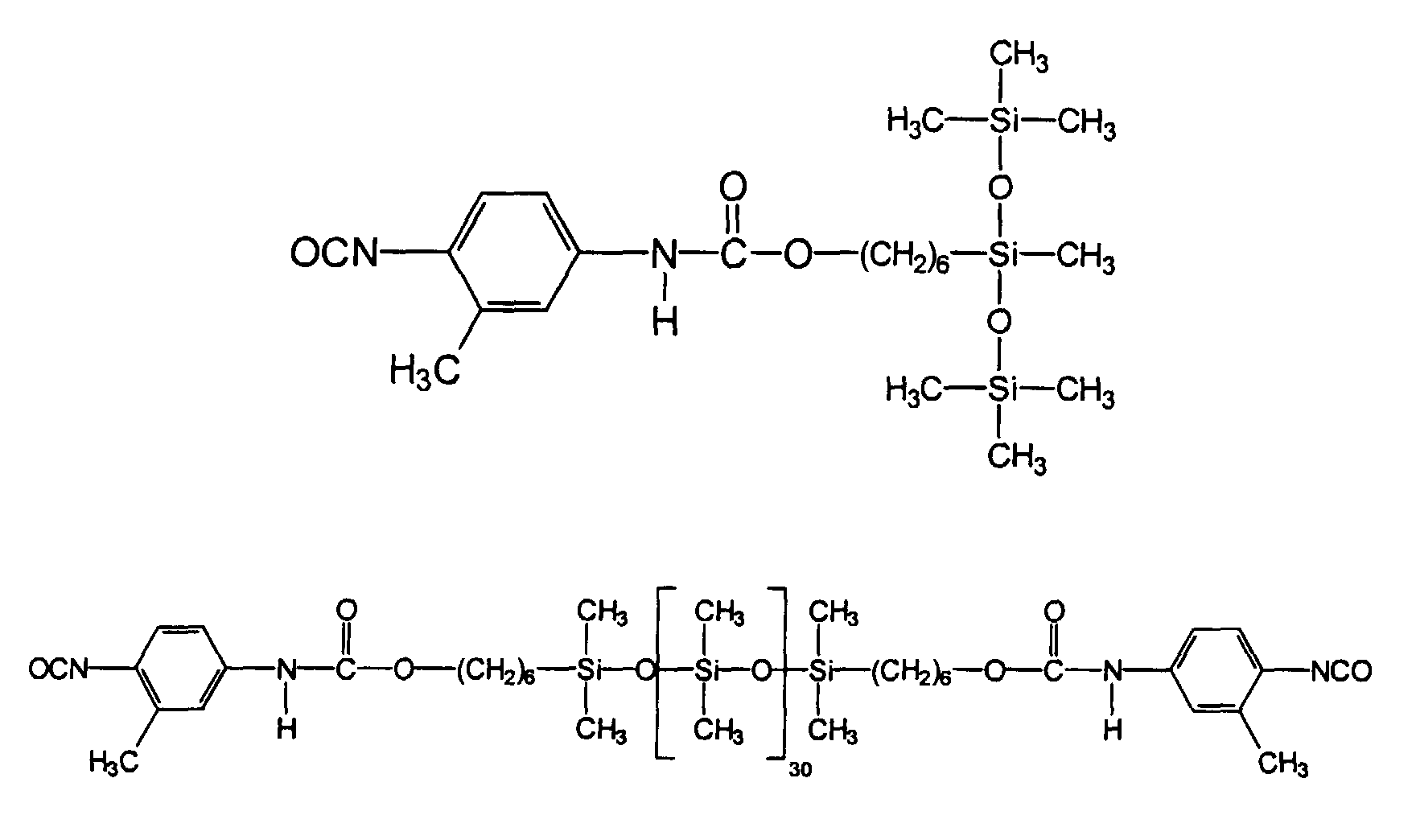
- radical R 4 interrupted by at least one urethane and / or ester group, which may optionally contain hydrophobizing substituents and / or at least one isocyanate group
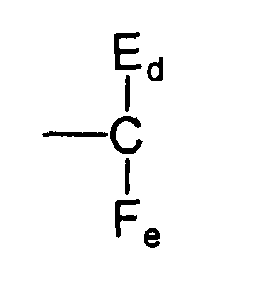
- radicals E are methoxy, ethoxy and the n-butoxy residue.
- radicals F are the methyl, ethyl, Propyl, 2-methylpropyl and the n-butyl radical.
- radicals R 2 are the phenyl, 4-methylphenyl, 3-methoxyphenyl and 4-methoxyphenyl radical.
- Preferred examples of anions X - of a complex metal salt and / or a strong acid are tosylate, SbF 6 - , PF 6 - , BF 4 - , F 3 CSO 3 - , F 3 CCO 2 - , AsF 6 - , ClO 4 - , HSO 4 - .
- Strong acids in the sense of the present invention include, in particular, strong Brönstedt acids.
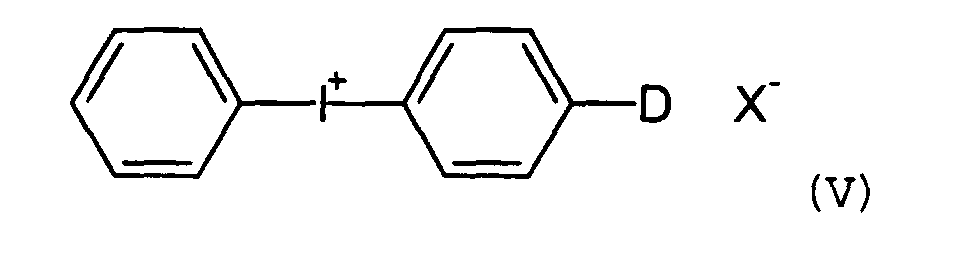
- Preferred iodonium salts with reduced tendency to crystallize are those of the general formula (V) where D and X - have the meaning already given.
- the tendency of the iodonium salts modified in this way to crystallize is significantly reduced compared to the prior art mentioned at the outset.
- the iodonium salt (VII) is a viscous liquid at room temperature
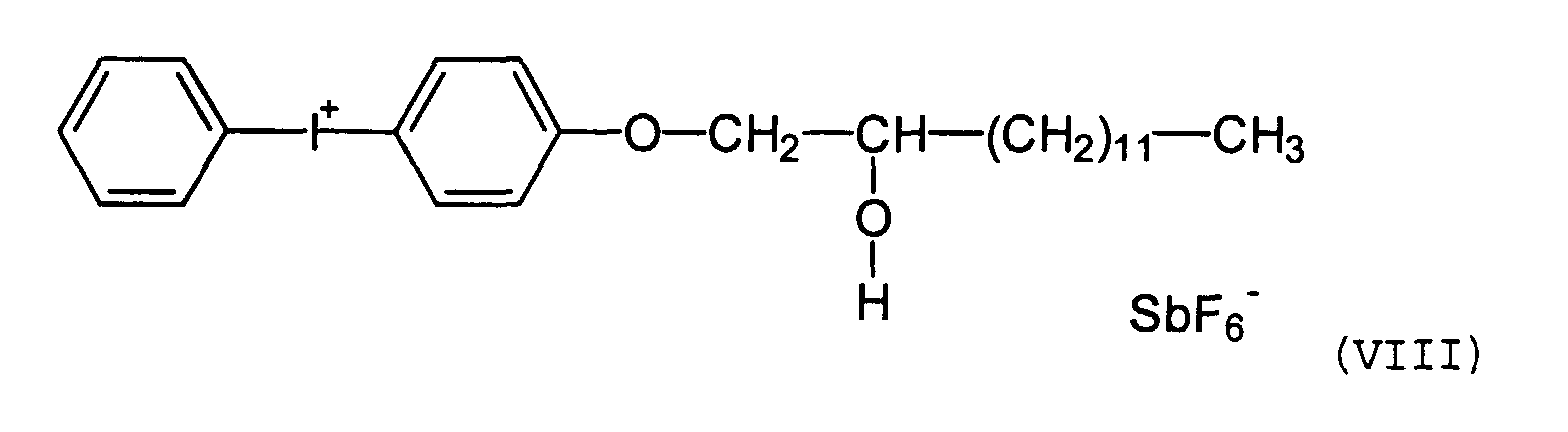
- the comparable hydroxyl group-containing iodonium salt has the following formula (VIII) represents a powder with a melting point of 91 ° C, which is available under the trade name CD-1012 from Sartomer.
- the solubility of the iodonium salts according to the invention is likewise essential in non-polar media, such as n-alkanes or siloxanes larger than that of the comparable hydroxyl groups Iodonium salts.
- the iodonium salt is of the general formula (VII) indefinitely soluble in toluene.
- the invention further relates to a method for producing the iodonium salts with reduced tendency to crystallize.
- Iodonium salts according to the invention are conveniently prepared by reactions with isocyanates.
- Photo denotes a photoinitiator residue to be modified.
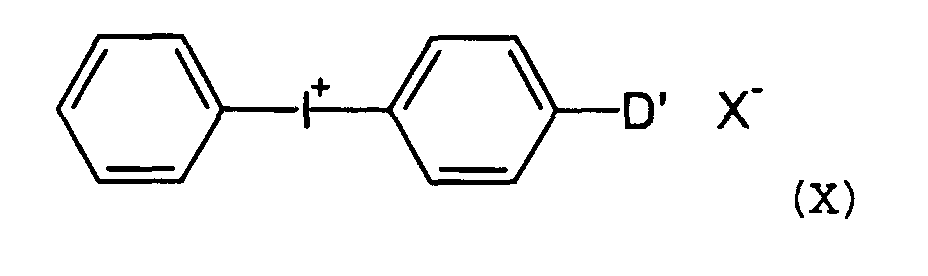
- Iodonium salts containing hydroxyl groups are preferably those of the general formula (X) where D 'and X - have the meaning already given.
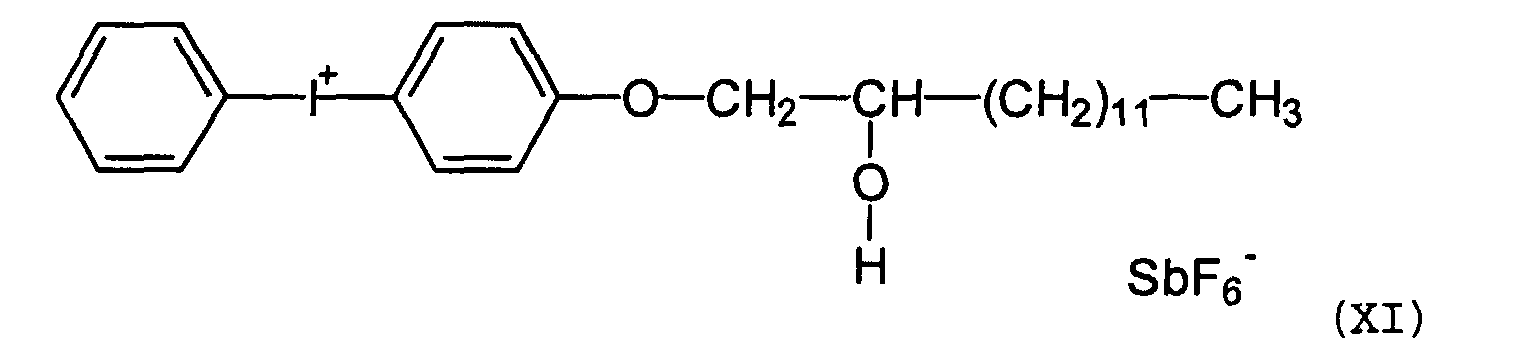
- Particularly preferred starting materials are iodonium salts of the following formula (XI):
- the iodonium salts according to the invention are suitable, for example as photoinitiators for the polymerization of cationic polymerizable organic substances, such as epoxides, Organopolysiloxanes containing vinyl ethers, epoxy groups, Alkenyloxy groups, such as vinyloxy groups or propenyloxy groups, containing organopolysiloxanes and olefins.
- cationic polymerizable organic substances such as epoxides, Organopolysiloxanes containing vinyl ethers, epoxy groups, Alkenyloxy groups, such as vinyloxy groups or propenyloxy groups, containing organopolysiloxanes and olefins.
- Photoinitiator Melting point Formula (XI) 91 ° C Ex. 1 viscous oil Ex. 2 viscous oil Ex. 3 viscous oil Ex. 4 viscous oil
- the mixtures were then applied to a standard OPP film (30 ⁇ m) using a pilot plant coating machine equipped with a five-roll application unit.
- the application weight was 0.5 - 1 g / m 2 .
- the coatings were then cured using a microwave-excited UV lamp (Fusion, 120 W / cm) at a web speed of 20 m / min.
Landscapes
- Chemical & Material Sciences (AREA)
- Organic Chemistry (AREA)
- Health & Medical Sciences (AREA)
- Chemical Kinetics & Catalysis (AREA)
- Medicinal Chemistry (AREA)
- Polymers & Plastics (AREA)
- Organic Low-Molecular-Weight Compounds And Preparation Thereof (AREA)
- Polyurethanes Or Polyureas (AREA)
- Epoxy Resins (AREA)
- Paints Or Removers (AREA)
- Other Resins Obtained By Reactions Not Involving Carbon-To-Carbon Unsaturated Bonds (AREA)
- Polymerisation Methods In General (AREA)
Abstract
Description


- I
- Iod ist,
- X-
- ein Anion eines komplexen Metallsalzes und/oder einer starken Säure ist,
- R1
- der Rest

- C
- ein einwertiger aromatischer Kohlenwasserstoffrest mit 6 bis 14 Kohlenstoffatomen je Rest oder ein einwertiger, mindestens ein Sauerstoff- und/oder Schwefelatom enthaltender aromatischer Kohlenwasserstoffrest mit 5 bis 15 Ringatomen je Rest ist,
- a
- 1, 2 oder 3,
- b
- 0, 1 oder 2,
- c
- 0, 1 oder 2 sind,
- D, E und F
- jeweils Substituenten von C sind, wobei
- D
- ein Rest der Formel

- x
- 0 oder 1,
- y
- 0 oder 1 sind,
- R3
- ein linearer oder verzweigter zweiwertiger Kohlenwasserstoffrest mit 1 bis 40 Kohlenstoffatomen je Rest, der gegebenenfalls durch mindestens ein Sauerstoffatom und/oder mindestens ein Schwefelatom und/oder mindestens eine Carboxylgruppe unterbrochen sein kann, ist,
- R4
- ein einwertiger linearer, verzweigter und/oder cyclischer Alkyl-, Aryl-, Haloalkyl- und/oder Haloarylradikalrest mit 1 bis 40 Kohlenstoffatomen ist, der gegebenenfalls durch mindestens ein Sauerstoffatom und/oder mindestens ein Schwefelatom und/oder mindestens eine Urethan- und/oder Estergruppe unterbrochen sein kann, und der gegebenenfalls hydrophobierende Substituenten und/oder mindestens eine Isocyanatgruppe enthalten kann,
- E
- ein Rest der Formel
- F
- ein Rest der Formel
- R2
- ein Rest der Formel
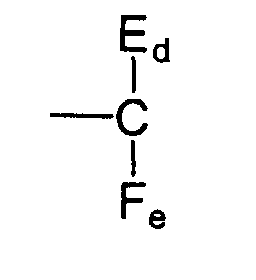
- R5
- ein einwertiger Kohlenwasserstoffrest mit 1 bis 18 Kohlenstoffatomen je Rest ist, der gegebenenfalls durch mindestens ein Sauerstoffatom unterbrochen sein kann,
- R6
- ein einwertiger Kohlenwasserstoffrest mit 1 bis 18 Kohlenstoffatomen je Rest ist, der gegebenenfalls durch mindestens ein Sauerstoffatom unterbrochen sein kann,
- d
- 0, 1 oder 2 und
- e
- 0, 1 oder 2 sind.





- I
- Iod ist,
- X-
- ein Anion eines komplexen Metallsalzes und/oder einer starken Säure ist,
- R1
- ein Rest
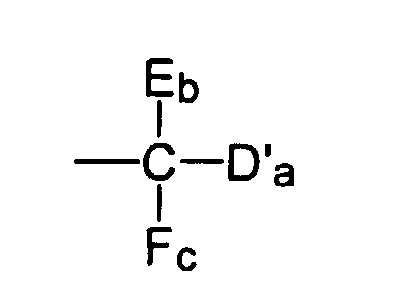
- C
- ein einwertiger aromatischer Kohlenwasserstoffrest mit 6 bis 14 Kohlenstoffatomen je Rest oder ein einwertiger, mindestens ein Sauerstoff- und/oder Schwefelatom enthaltender aromatischer Kohlenwasserstoffrest mit 5 bis 15 Ringatomen je Rest ist,
- a
- 1, 2 oder 3,
- b
- 0, 1 oder 2,
- c
- 0, 1 oder 2 sind,
- D', E und F
- jeweils Substituenten von C sind, wobei
- D'
- ein Rest der Formel
- x
- 0 oder 1,
- y
- 0 oder 1 sind,
- R3
- ein linearer oder verzweigter, zweiwertiger Kohlenwasserstoffrest mit 1 bis 40 Kohlenstoffatomen je Rest, der gegebenenfalls durch mindestens ein Sauerstoffatom und/oder ein Schwefelatom und/oder eine Carboxylgruppe unterbrochen sein kann, ist,
- E
- ein Rest der Formel
- F
- ein Rest der Formel
- R2
- ein Rest der Formel
- R5
- ein einwertiger Kohlenwasserstoffrest mit 1 bis 18 Kohlenstoffatomen je Rest ist, der gegebenenfalls durch mindestens ein Sauerstoffatom unterbrochen sein kann,
- R6
- ein einwertiger Kohlenwasserstoffrest mit 1 bis 18 Kohlenstoffatomen je Rest ist, der gegebenenfalls durch mindestens ein Sauerstoffatom unterbrochen sein kann,
- d
- 0, 1 oder 2 und
- e
- 0, 1 oder 2 sind,

- R4
- ein einwertiger linearer, verzweigter und/oder cyclischer Alkyl-, Aryl-, Haloalkyl- und/oder Haloarylradikalrest mit 1 bis 40 Kohlenstoffatomen ist, der gegebenenfalls durch mindestens ein Sauerstoffatom und/oder mindestens ein Schwefelatom und/oder mindestens eine Urethan- und/oder Estergruppe unterbrochen sein kann, und der gegebenenfalls hydrophobierende Substituenten und/oder mindestens eine Isocyanatgruppe enthalten kann.
| Photoinitiator | Löslichkeit in Toluol |
| Formel (XI) | unlöslich |
| Bsp. 1 | klar löslich |
| Bsp. 2 | klar löslich |
| Bsp. 3 | klar löslich |
| Bsp. 4 | klar löslich |
| Photoinitiator | Schmelzpunkt |
| Formel (XI) | 91 °C |
| Bsp. 1 | viskoses Öl |
| Bsp. 2 | viskoses Öl |
| Bsp. 3 | viskoses Öl |
| Bsp. 4 | viskoses Öl |

| Photoinitiator | Stabilität in Toluol (50% w/w) | Stabilität in 1-Butanol (50% w/w) |
| Formel (XVI) | 21d | 2d |
| Bsp. 1 | >90d | >90d |
| Bsp. 2 | >90d | >90d |
| Bsp. 3 | >90d | >90d |
| Bsp. 4 | >90d | >90d |
| Photoinitiator | Aussehen der Mischung | Aushärtung nach der UV-Lampe |
| Formel (VIII) | trübe, kristalliner Niederschlag | ungenügend; trüber, klebriger Film; Kristalle sichtbar |
| Bsp. 1 | opak | Aushärtung; nicht mehr klebriger Film |
| Bsp. 2 | klar | gute Aushärtung; klarer, nicht mehr klebriger Film |
| Bsp. 3 | klar | gute Aushärtung; klarer, nicht mehr klebriger Film |
| Bsp. 4 | klar | gute Aushärtung; klarer, nicht mehr klebriger Film |
Claims (13)
- Iodoniumsalze der allgemeinen Formel (IV)
- I
- Iod ist,
- X-
- ein Anion eines komplexen Metallsalzes und/oder einer starken Säure ist,
- R1
- der Rest

- C
- ein einwertiger aromatischer Kohlenwasserstoffrest mit 6 bis 14 Kohlenstoffatomen je Rest oder ein einwertiger, mindestens ein Sauerstoff- und/oder Schwefelatom enthaltender aromatischer Kohlenwasserstoffrest mit 5 bis 15 Ringatomen je Rest ist,
- a
- 1, 2 oder 3,
- b
- 0, 1 oder 2,
- c
- 0, 1 oder 2 sind,
- D, E und F
- jeweils Substituenten von C sind, wobei
- D
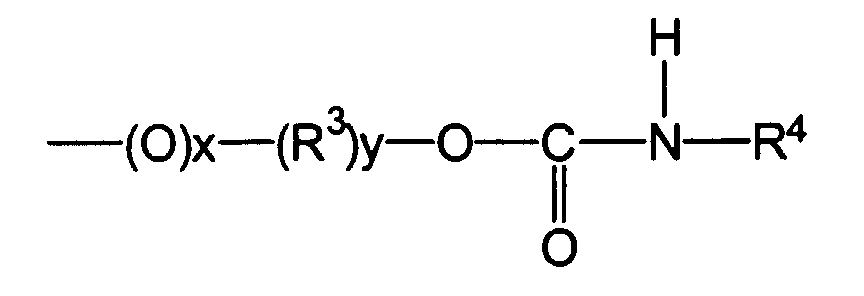
- ein Rest der Formel
- x
- 0 oder 1,
- y
- 0 oder 1 sind,
- R3
- ein linearer oder verzweigter, zweiwertiger Kohlenwasserstoffrest mit 1 bis 40 Kohlenstoffatomen je Rest, der gegebenenfalls durch mindestens ein Sauerstoffatom und/oder ein Schwefelatom und/oder eine Carboxylgruppe unterbrochen sein kann, ist,
- R4
- ein einwertiger linearer, verzweigter und/oder cyclischer Alkyl-, Aryl-, Haloalkyl- und/oder Haloarylradikalrest mit 1 bis 40 Kohlenstoffatomen ist, der gegebenenfalls durch mindestens ein Sauerstoffatom und/oder mindestens ein Schwefelatom und/oder mindestens eine Urethan- und/oder Estergruppe unterbrochen sein kann, und der gegebenenfalls hydrophobierende Substituenten und/oder mindestens eine Isocyanatgruppe enthalten kann,
- E
- ein Rest der Formel
- F
- ein Rest der Formel
- R2
- ein Rest der Formel

- R5
- ein einwertiger Kohlenwasserstoffrest mit 1 bis 18 Kohlenstoffatomen je Rest ist, der gegebenenfalls durch mindestens ein Sauerstoffatom unterbrochen sein kann,
- R6
- ein einwertiger Kohlenwasserstoffrest mit 1 bis 18 Kohlenstoffatomen je Rest ist, der gegebenenfalls durch mindestens ein Sauerstoffatom unterbrochen sein kann,
- d
- 0, 1 oder 2 und
- e
- 0, 1 oder 2 sind.
- Iodoniumsalze nach Anspruch 1, wobei mindestens einer der Reste R4, R5 und R6 ein Alkylrest, wie der Methyl-, Ethyl-, n-Propyl-, iso-Propyl-, n-Butyl-, iso-Butyl-, tert.-Butyl-, n-Pentyl-, iso-Pentyl-, neo-Pentyl-, tert.-Pentylrest; ein Hexylrest, wie der n-Hexylrest, wie der Cyclohexylrest; ein Heptylrest, wie der n-Heptylrest; ein Octylrest, wie der n-Octylrest oder ein iso-Octylrest, wie der 2,2,4-Trimethylpentylrest; ein Nonylrest, wie der n-Nonylrest; ein Decylrest, wie der n-Decylrest; ein Dodecylrest, wie der n-Dodecylrest oder ein Octyldecylrest, wie der n-Octadecylrest ist.
- Iodoniumsalze nach Anspruch 1, wobei mindestens einer der Reste R4, R5 und R6 ein Arylrest, wie der Phenyl-, Naphthyl- oder Anthrylrest ist.
- Iodoniumsalze nach Anspruch 1, wobei mindestens einer der Reste R4, R5 und R6 ein Haloalkylrest, wie der Chlormethyl-, Trichlormethyl-, Trifluormethyl-, Pentafluorethyl- oder Heptafluorpropylrest ist.
- Iodoniumsalze nach Anspruch 1, wobei mindestens einer der Reste R4, R5 und R6 ein Haloarylrest, wie der Bromphenyl-, Chlorphenyl-, Fluorphenyl-, Difluorphenyl-, Fluor(trifluormethyl)phenyl-, Pentafluorphenyl-, (Trifluormethyl)phenyl-, (Trifluormethylthio)phenyl- oder (Trifluormethoxy)phenylrest ist.
- Iodoniumsalze nach Anspruch 1, wobei mindestens einer der Reste R4, R5 und R6 ein durch mindestens ein Sauerstoffatom und/oder Schwefelatom unterbrochener Kohlenwasserstoffrest der allgemeinen Formel -CH2-CH2-O-CH3, -CH2-CH2O-CH2CH3 oder -CH2-CH2-S-CH2CH3 ist.
- Iodoniumsalze nach Anspruch 1, wobei X- unabhängig ausgewählt ist aus der Gruppe von Tosylat, SbF6 -, PF6 -, BF4 -, F3CSO3 -, F3CCO2 -, AsF6 -, ClO4 -, HSO4 -.
- Iodoniumsalze nach Anspruch 1 mit der allgemeinen Formel (V)wobei D und X- die bereits angegebene Bedeutung haben.

- Verfahren zur Herstellung der Iodoniumsalze nach den Ansprüchen 1-8, dadurch gekennzeichnet, daß ein Hydroxylgruppen enthaltendes Iodoniumsalz mit der allgemeinen Formel (IX)
- I
- Iod ist,
- X-
- ein Anion eines komplexen Metallsalzes und/oder einer starken Säure ist,
- R1
- ein Rest
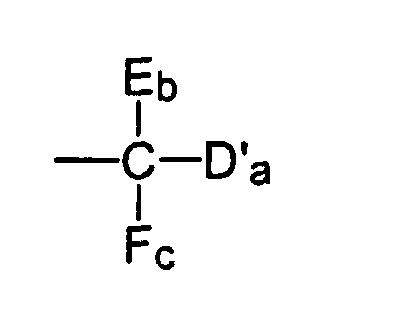
- C
- ein einwertiger aromatischer Kohlenwasserstoffrest mit 6 bis 14 Kohlenstoffatomen je Rest oder ein einwertiger, mindestens ein Sauerstoff- und/oder Schwefelatom enthaltender aromatischer Kohlenwasserstoffrest mit 5 bis 15 Ringatomen je Rest ist,
- a
- 1, 2 oder 3,
- b
- 0, 1 oder 2,
- c
- 0, 1 oder 2 sind,
- D', E und F
- jeweils Substituenten von C sind, wobei
- D'
- ein Rest der Formel
- x
- 0 oder 1,
- y
- 0 oder 1 sind,
- R3
- ein linearer oder verzweigter, zweiwertiger Kohlenwasserstoffrest mit 1 bis 40 Kohlenstoffatomen je Rest, der gegebenenfalls durch mindestens ein Sauerstoffatom und/oder ein Schwefelatom und/oder eine Carboxylgruppe unterbrochen sein kann, ist,
- E
- ein Rest der Formel
- F
- ein Rest der Formel
- R2
- ein Rest der Formel

- R5
- ein einwertiger Kohlenwasserstoffrest mit 1 bis 18 Kohlenstoffatomen je Rest ist, der gegebenenfalls durch mindestens ein Sauerstoffatom unterbrochen sein kann,
- R6
- ein einwertiger Kohlenwasserstoffrest mit 1 bis 18 Kohlenstoffatomen je Rest ist, der gegebenenfalls durch mindestens ein Sauerstoffatom unterbrochen sein kann,
- d
- 0, 1 oder 2 und
- e
- 0, 1 oder 2 sind,
- Verfahren nach Anspruch 9, gekennzeichnet dadurch, daß als Hydroxylgruppen enthaltende Iodoniumsalze solche der allgemeinen Formel (X) eingesetzt werden,wobei D' und X- die angegebene Bedeutung haben.

- Verfahren nach Anspruch 9, gekennzeichnet dadurch, daß als Hydroxylgruppen enthaltende Iodoniumsalze solche der allgemeinen Formel (XI):eingesetzt werden.
- Verfahren nach Anspruch 9, gekennzeichnet dadurch, daß Isocyanatgruppen enthaltende Reagenzien der allgemeinen Formel (XII)
- R4
- ein einwertiger linearer, verzweigter und/oder cyclischer Alkyl-, Aryl-, Haloalkyl- und/oder Haloarylradikalrest mit 1 bis 40 Kohlenstoffatomen ist, der gegebenenfalls durch mindestens ein Sauerstoffatom und/oder mindestens ein Schwefelatom und/oder mindestens eine Urethan- und/oder Estergruppe unterbrochen sein kann, und der gegebenenfalls hydrophobierende Substituenten und/oder mindestens eine Isocyanatgruppe enthalten kann,
- Verwendung der Iodoniumsalze nach den Ansprüchen 1-8 als Photoinitiatoren zur Polymerisation von kationisch polymerisierbaren Substanzen, insbesondere Epoxiden, Vinylethern, Epoxygruppen enthaltenden Organopolysiloxanen, Alkenyloxygruppen enthaltenden Organopolysiloxanen und/oder Olefinen.
Applications Claiming Priority (2)
| Application Number | Priority Date | Filing Date | Title |
|---|---|---|---|
| DE19945251 | 1999-09-21 | ||
| DE19945251 | 1999-09-21 |
Publications (3)
| Publication Number | Publication Date |
|---|---|
| EP1088813A2 true EP1088813A2 (de) | 2001-04-04 |
| EP1088813A3 EP1088813A3 (de) | 2003-01-15 |
| EP1088813B1 EP1088813B1 (de) | 2003-12-03 |
Family
ID=7922798
Family Applications (1)
| Application Number | Title | Priority Date | Filing Date |
|---|---|---|---|
| EP00119683A Expired - Lifetime EP1088813B1 (de) | 1999-09-21 | 2000-09-08 | Urethangruppen enthaltende Photoinitiatoren zur kationischen Härtung |
Country Status (9)
| Country | Link |
|---|---|
| US (1) | US6380277B1 (de) |
| EP (1) | EP1088813B1 (de) |
| JP (1) | JP2001139539A (de) |
| AT (1) | ATE255560T1 (de) |
| AU (1) | AU5649400A (de) |
| CA (1) | CA2317391A1 (de) |
| DE (1) | DE50004630D1 (de) |
| DK (1) | DK1088813T3 (de) |
| ES (1) | ES2211434T3 (de) |
Cited By (2)
| Publication number | Priority date | Publication date | Assignee | Title |
|---|---|---|---|---|
| US6380277B1 (en) * | 1999-09-21 | 2002-04-30 | Goldschmidt Ag | Iodonium salt photoinitiators containing urethane groups for cationic curing |
| US6632960B2 (en) | 2002-06-21 | 2003-10-14 | Goldschmidt Ag | Diaryliodonium salt catalysts made from iodotoluene and a method for preparing them |
Families Citing this family (10)
| Publication number | Priority date | Publication date | Assignee | Title |
|---|---|---|---|---|
| ATE269842T1 (de) * | 1999-08-02 | 2004-07-15 | Nippon Soda Co | Photovernetzbare zusammensetzungen mit einer iodonium-salz-verbindung |
| DE10341137A1 (de) * | 2003-09-06 | 2005-03-31 | Goldschmidt Ag | Verwendung von hydroxyfunktionellen Polyalkylorganosiloxanen als Lösungsmittel für kationische Photoinitiatoren für die Verwendung in strahlenhärtbaren Siliconen |
| JP5050336B2 (ja) * | 2005-03-09 | 2012-10-17 | Jsr株式会社 | ポジ型感放射線性樹脂組成物 |
| JP4770244B2 (ja) * | 2005-04-11 | 2011-09-14 | Jsr株式会社 | オニウム塩、それを用いた感放射線性酸発生剤及びポジ型感放射線性樹脂組成物 |
| JP4946094B2 (ja) * | 2006-03-01 | 2012-06-06 | Jsr株式会社 | 新規化合物、それを用いた感放射線性酸発生剤及びポジ型感放射線性樹脂組成物 |
| CN101454277B (zh) | 2006-05-17 | 2014-02-19 | 美洲染料资源公司 | 用于平版印刷版涂料的材料、含这些材料的平版印刷版和涂料以及制备方法和用途 |
| TWI401238B (zh) * | 2007-05-09 | 2013-07-11 | American Dye Source Inc | 用於微影板塗覆物之新穎材料、包含其之微影板及塗覆物、製備及使用的方法 |
| JPWO2011040531A1 (ja) | 2009-10-01 | 2013-02-28 | 日立化成株式会社 | 有機エレクトロニクス用材料、有機エレクトロニクス素子、有機エレクトロルミネセンス素子、及びそれを用いた表示素子、照明装置、表示装置 |
| KR101537654B1 (ko) | 2010-04-22 | 2015-07-17 | 히타치가세이가부시끼가이샤 | 유기 일렉트로닉스 재료, 중합 개시제 및 열중합 개시제, 잉크 조성물, 유기 박막 및 그 제조 방법, 유기 일렉트로닉스 소자, 유기 일렉트로 루미네센스 소자, 조명 장치, 표시 소자, 및 표시 장치 |
| US10665786B2 (en) | 2013-03-08 | 2020-05-26 | Hitachi Chemical Company, Ltd. | Treatment liquid containing ionic compound, organic electronic element, and method for producing organic electronic element |
Family Cites Families (13)
| Publication number | Priority date | Publication date | Assignee | Title |
|---|---|---|---|---|
| GB1516351A (en) | 1974-05-02 | 1978-07-05 | Gen Electric | Curable epoxide compositions |
| US4310469A (en) | 1978-12-29 | 1982-01-12 | General Electric Company | Diaryliodonium salts |
| US4279717A (en) | 1979-08-03 | 1981-07-21 | General Electric Company | Ultraviolet curable epoxy silicone coating compositions |
| US4374066A (en) | 1979-09-28 | 1983-02-15 | General Electric Company | Method for making triarylsulfonium salts |
| US4882201A (en) | 1988-03-21 | 1989-11-21 | General Electric Company | Non-toxic aryl onium salts, UV curable coating compositions and food packaging use |
| DE3902114A1 (de) * | 1989-01-25 | 1990-08-02 | Basf Ag | Strahlungsempfindliche, ethylenisch ungesaettigte, copolymerisierbare sulfoniumsalze und verfahren zu deren herstellung |
| DE3914896A1 (de) | 1989-05-05 | 1990-11-22 | Wacker Chemie Gmbh | Enoxyfunktionelle organosiliciumverbindungen, deren herstellung und verwendung |
| DE4002922A1 (de) | 1990-02-01 | 1991-08-08 | Wacker Chemie Gmbh | Alkenyloxygruppen aufweisende siloxancopolymere, deren herstellung und verwendung |
| US5079378A (en) * | 1990-07-27 | 1992-01-07 | Polyset Corporation | Preparation of diaryliodonium salt photoinitiators having long chain ester groups concatenated with aryl groups |
| US5073643A (en) * | 1990-08-30 | 1991-12-17 | Polyset Corporation | High yield synthesis of hydroxyl-containing cationic photoinitiators |
| DE4142327A1 (de) | 1991-12-20 | 1993-06-24 | Wacker Chemie Gmbh | Jodoniumsalze und verfahren zu deren herstellung |
| DE59912389D1 (de) * | 1999-01-16 | 2005-09-15 | Goldschmidt Gmbh | Photoinitiatoren zur kationischen Härtung |
| AU5649400A (en) * | 1999-09-21 | 2001-10-11 | Goldschmidt Ag | Photoinitiators containing urethane groups for cationic curing |
-
2000
- 2000-09-05 AU AU56494/00A patent/AU5649400A/en not_active Abandoned
- 2000-09-07 CA CA002317391A patent/CA2317391A1/en not_active Abandoned
- 2000-09-08 DE DE50004630T patent/DE50004630D1/de not_active Expired - Fee Related
- 2000-09-08 DK DK00119683T patent/DK1088813T3/da active
- 2000-09-08 AT AT00119683T patent/ATE255560T1/de not_active IP Right Cessation
- 2000-09-08 ES ES00119683T patent/ES2211434T3/es not_active Expired - Lifetime
- 2000-09-08 EP EP00119683A patent/EP1088813B1/de not_active Expired - Lifetime
- 2000-09-19 US US09/665,525 patent/US6380277B1/en not_active Expired - Fee Related
- 2000-09-21 JP JP2000286751A patent/JP2001139539A/ja not_active Withdrawn
Cited By (3)
| Publication number | Priority date | Publication date | Assignee | Title |
|---|---|---|---|---|
| US6380277B1 (en) * | 1999-09-21 | 2002-04-30 | Goldschmidt Ag | Iodonium salt photoinitiators containing urethane groups for cationic curing |
| US6632960B2 (en) | 2002-06-21 | 2003-10-14 | Goldschmidt Ag | Diaryliodonium salt catalysts made from iodotoluene and a method for preparing them |
| WO2004000774A1 (en) * | 2002-06-21 | 2003-12-31 | Polyset Company, Inc. | Diaryliodonium salt catalysts made from iodotoluene and a method for preparing them |
Also Published As
| Publication number | Publication date |
|---|---|
| EP1088813A3 (de) | 2003-01-15 |
| JP2001139539A (ja) | 2001-05-22 |
| ES2211434T3 (es) | 2004-07-16 |
| DK1088813T3 (da) | 2004-03-15 |
| ATE255560T1 (de) | 2003-12-15 |
| CA2317391A1 (en) | 2001-03-21 |
| DE50004630D1 (de) | 2004-01-15 |
| EP1088813B1 (de) | 2003-12-03 |
| US6380277B1 (en) | 2002-04-30 |
| AU5649400A (en) | 2001-10-11 |
Similar Documents
| Publication | Publication Date | Title |
|---|---|---|
| DE2948708C2 (de) | Verfahren zur Herstellung von mit Pentaerythrittriacrylsäure- oder Pentaerythrittrimethacrylsäureestern modifizierten Organopolysiloxanen | |
| EP0449050B1 (de) | Härtbare Organopolysiloxane mit über SiC-Gruppen gebundenen Oxyalkylenethergruppen, ihre Herstellung und Verwendung | |
| DE3426087C1 (de) | acrylsaeureestermodifizierte Organopolysiloxangemische,deren Herstellung und Verwendung als abhaesive Beschichtungsmassen | |
| EP0175092B1 (de) | Lacke und Formmassen mit einem den Verlauf fördernden und die Gleitfähigkeit erhöhenden Gehalt an Siloxanen und die Verwendung solcher Siloxane als Zusatzmittel für Lacke und Formmassen | |
| EP1088813B1 (de) | Urethangruppen enthaltende Photoinitiatoren zur kationischen Härtung | |
| EP1614705B1 (de) | Polyestermodifizierte Polysiloxane und deren Verwendung als Additive für Thermoplaste, Formmassen und Lacke | |
| DE69838456T2 (de) | Beschichtungen, die Reaktivsilikon-Oligomere enthalten | |
| EP1216278B2 (de) | Mit nanopartikeln modifizierte bindemittel für überzugsmittel und deren verwendung | |
| EP0604363B1 (de) | Lagerstabile Lösungen von Beschleunigersystemen für Epoxydharze | |
| EP2539409A1 (de) | Zusammensetzungen von mit oligomeren siloxanolen funktionalisierten metalloxiden und deren verwendung | |
| EP0468305B1 (de) | Härtbare Epoxygruppen aufweisende Organopolysiloxane, Verfahren zu ihrer Herstellung und ihre Verwendung als härtbare Beschichtungsmittel mit abhäsiven Eigenschaften | |
| WO2014057095A1 (de) | VERFAHREN ZUR UMWANDLUNG REAKTIVER GRUPPEN AN SI-C-GEBUNDENEN RESTEN VON SILANEN UNTER GLEICHZEITIGER VERGRÖßERUNG VON DEREN RÄUMLICHEM ABSTAND ZUEINANDER | |
| DE2550744A1 (de) | Polysiloxan-zusammensetzung und verfahren zu deren herstellung | |
| DE1905101A1 (de) | Siloxanmodifizierte Cabamidsaeurederivate | |
| EP2838904B1 (de) | Verfahren zur herstellung von (meth)acrylamido-funktionellen silanen durch umsetzung von aminoalkyl-alkoxysilanen mit acrylsäureanhydrid | |
| DE69104086T2 (de) | Korrosionsschützende Polysiloxanbeschichtung mit verlängerter Verarbeitungszeit. | |
| EP0546406B1 (de) | Verwendung von organofunktionellen Polysiloxanen zum Modifizieren der Oberfläche feinteiliger Partikel | |
| EP2838936B1 (de) | Neue, einfach herstellbare, voc reduzierte, umweltfreundliche (meth)acrylamido-funktionelle siloxan-systeme, verfahren zu ihrer herstellung sowie verwendung | |
| DE1696182C3 (de) | ||
| DE10224380A1 (de) | Beschichtungsstoff, Verfahren zu seiner Herstellung und seine Verwendung zur Herstellung haftfester Beschichtungen | |
| EP1403349B1 (de) | Verwendung von mit Oxyalkylenethergruppen modifizierten Epoxypolysiloxanen als Additive für strahlenhärtende Beschichtungen | |
| DE68926925T2 (de) | MTQ-Polysiloxanharz, Verfahren zur Herstellung und Beschichtungs- oder Einbettungszusammensetzung | |
| DE3918328A1 (de) | Waermehaertbare zusammensetzungen | |
| EP1020479B1 (de) | Photoinitiatoren zur kationischen Härtung | |
| DE10219734A1 (de) | Herstellung von (meth)acrylfunktionellen Siloxanen |
Legal Events
| Date | Code | Title | Description |
|---|---|---|---|
| PUAI | Public reference made under article 153(3) epc to a published international application that has entered the european phase |
Free format text: ORIGINAL CODE: 0009012 |
|
| 17P | Request for examination filed |
Effective date: 20000915 |
|
| AK | Designated contracting states |
Kind code of ref document: A2 Designated state(s): AT BE CH CY DE DK ES FI FR GB GR IE IT LI LU MC NL PT SE |
|
| AX | Request for extension of the european patent |
Free format text: AL;LT;LV;MK;RO;SI |
|
| PUAL | Search report despatched |
Free format text: ORIGINAL CODE: 0009013 |
|
| AK | Designated contracting states |
Kind code of ref document: A3 Designated state(s): AT BE CH CY DE DK ES FI FR GB GR IE IT LI LU MC NL PT SE |
|
| AX | Request for extension of the european patent |
Free format text: AL;LT;LV;MK;RO;SI |
|
| GRAH | Despatch of communication of intention to grant a patent |
Free format text: ORIGINAL CODE: EPIDOS IGRA |
|
| GRAS | Grant fee paid |
Free format text: ORIGINAL CODE: EPIDOSNIGR3 |
|
| AKX | Designation fees paid |
Designated state(s): AT BE CH CY DE DK ES FI FR GB GR IE IT LI LU MC NL PT SE |
|
| GRAA | (expected) grant |
Free format text: ORIGINAL CODE: 0009210 |
|
| AK | Designated contracting states |
Kind code of ref document: B1 Designated state(s): AT BE CH CY DE DK ES FI FR GB GR IE IT LI LU MC NL PT SE |
|
| PG25 | Lapsed in a contracting state [announced via postgrant information from national office to epo] |
Ref country code: CY Free format text: LAPSE BECAUSE OF FAILURE TO SUBMIT A TRANSLATION OF THE DESCRIPTION OR TO PAY THE FEE WITHIN THE PRESCRIBED TIME-LIMIT Effective date: 20031203 |
|
| REG | Reference to a national code |
Ref country code: GB Ref legal event code: FG4D Free format text: NOT ENGLISH |
|
| REG | Reference to a national code |
Ref country code: CH Ref legal event code: EP |
|
| REG | Reference to a national code |
Ref country code: IE Ref legal event code: FG4D Free format text: GERMAN |
|
| REF | Corresponds to: |
Ref document number: 50004630 Country of ref document: DE Date of ref document: 20040115 Kind code of ref document: P |
|
| REG | Reference to a national code |
Ref country code: SE Ref legal event code: TRGR |
|
| PG25 | Lapsed in a contracting state [announced via postgrant information from national office to epo] |
Ref country code: GR Free format text: LAPSE BECAUSE OF FAILURE TO SUBMIT A TRANSLATION OF THE DESCRIPTION OR TO PAY THE FEE WITHIN THE PRESCRIBED TIME-LIMIT Effective date: 20040303 |
|
| REG | Reference to a national code |
Ref country code: DK Ref legal event code: T3 |
|
| GBT | Gb: translation of ep patent filed (gb section 77(6)(a)/1977) |
Effective date: 20040303 |
|
| REG | Reference to a national code |
Ref country code: ES Ref legal event code: FG2A Ref document number: 2211434 Country of ref document: ES Kind code of ref document: T3 |
|
| ET | Fr: translation filed | ||
| PGFP | Annual fee paid to national office [announced via postgrant information from national office to epo] |
Ref country code: SE Payment date: 20040909 Year of fee payment: 5 |
|
| PGFP | Annual fee paid to national office [announced via postgrant information from national office to epo] |
Ref country code: FI Payment date: 20040910 Year of fee payment: 5 Ref country code: LU Payment date: 20040910 Year of fee payment: 5 |
|
| PGFP | Annual fee paid to national office [announced via postgrant information from national office to epo] |
Ref country code: DK Payment date: 20040913 Year of fee payment: 5 |
|
| PGFP | Annual fee paid to national office [announced via postgrant information from national office to epo] |
Ref country code: IE Payment date: 20040915 Year of fee payment: 5 |
|
| PGFP | Annual fee paid to national office [announced via postgrant information from national office to epo] |
Ref country code: ES Payment date: 20040920 Year of fee payment: 5 |
|
| PG25 | Lapsed in a contracting state [announced via postgrant information from national office to epo] |
Ref country code: MC Free format text: LAPSE BECAUSE OF NON-PAYMENT OF DUE FEES Effective date: 20040930 |
|
| PLBE | No opposition filed within time limit |
Free format text: ORIGINAL CODE: 0009261 |
|
| STAA | Information on the status of an ep patent application or granted ep patent |
Free format text: STATUS: NO OPPOSITION FILED WITHIN TIME LIMIT |
|
| 26N | No opposition filed |
Effective date: 20040906 |
|
| REG | Reference to a national code |
Ref country code: CH Ref legal event code: PFA Owner name: GOLDSCHMIDT GMBH Free format text: GOLDSCHMIDT AG#GOLDSCHMIDTSTRASSE 100#45127 ESSEN (DE) -TRANSFER TO- GOLDSCHMIDT GMBH#GOLDSCHMIDTSTRASSE 100#45127 ESSEN (DE) |
|
| PGFP | Annual fee paid to national office [announced via postgrant information from national office to epo] |
Ref country code: FR Payment date: 20050823 Year of fee payment: 6 |
|
| PGFP | Annual fee paid to national office [announced via postgrant information from national office to epo] |
Ref country code: GB Payment date: 20050830 Year of fee payment: 6 |
|
| PG25 | Lapsed in a contracting state [announced via postgrant information from national office to epo] |
Ref country code: FI Free format text: LAPSE BECAUSE OF NON-PAYMENT OF DUE FEES Effective date: 20050908 Ref country code: IE Free format text: LAPSE BECAUSE OF NON-PAYMENT OF DUE FEES Effective date: 20050908 |
|
| PG25 | Lapsed in a contracting state [announced via postgrant information from national office to epo] |
Ref country code: SE Free format text: LAPSE BECAUSE OF NON-PAYMENT OF DUE FEES Effective date: 20050909 |
|
| PG25 | Lapsed in a contracting state [announced via postgrant information from national office to epo] |
Ref country code: ES Free format text: LAPSE BECAUSE OF NON-PAYMENT OF DUE FEES Effective date: 20050910 |
|
| PGFP | Annual fee paid to national office [announced via postgrant information from national office to epo] |
Ref country code: DE Payment date: 20050912 Year of fee payment: 6 |
|
| PGFP | Annual fee paid to national office [announced via postgrant information from national office to epo] |
Ref country code: NL Payment date: 20050914 Year of fee payment: 6 |
|
| PGFP | Annual fee paid to national office [announced via postgrant information from national office to epo] |
Ref country code: CH Payment date: 20050915 Year of fee payment: 6 |
|
| PGFP | Annual fee paid to national office [announced via postgrant information from national office to epo] |
Ref country code: AT Payment date: 20050919 Year of fee payment: 6 |
|
| PG25 | Lapsed in a contracting state [announced via postgrant information from national office to epo] |
Ref country code: LU Free format text: LAPSE BECAUSE OF NON-PAYMENT OF DUE FEES Effective date: 20050930 Ref country code: DK Free format text: LAPSE BECAUSE OF NON-PAYMENT OF DUE FEES Effective date: 20050930 |
|
| PGFP | Annual fee paid to national office [announced via postgrant information from national office to epo] |
Ref country code: BE Payment date: 20051013 Year of fee payment: 6 |
|
| REG | Reference to a national code |
Ref country code: FR Ref legal event code: CJ Ref country code: FR Ref legal event code: CD |
|
| REG | Reference to a national code |
Ref country code: DK Ref legal event code: EBP |
|
| EUG | Se: european patent has lapsed | ||
| REG | Reference to a national code |
Ref country code: IE Ref legal event code: MM4A |
|
| PG25 | Lapsed in a contracting state [announced via postgrant information from national office to epo] |
Ref country code: AT Free format text: LAPSE BECAUSE OF NON-PAYMENT OF DUE FEES Effective date: 20060908 |
|
| PG25 | Lapsed in a contracting state [announced via postgrant information from national office to epo] |
Ref country code: BE Free format text: LAPSE BECAUSE OF NON-PAYMENT OF DUE FEES Effective date: 20060930 Ref country code: LI Free format text: LAPSE BECAUSE OF NON-PAYMENT OF DUE FEES Effective date: 20060930 Ref country code: CH Free format text: LAPSE BECAUSE OF NON-PAYMENT OF DUE FEES Effective date: 20060930 |
|
| PGFP | Annual fee paid to national office [announced via postgrant information from national office to epo] |
Ref country code: IT Payment date: 20060930 Year of fee payment: 7 |
|
| REG | Reference to a national code |
Ref country code: ES Ref legal event code: FD2A Effective date: 20050910 |
|
| PG25 | Lapsed in a contracting state [announced via postgrant information from national office to epo] |
Ref country code: NL Free format text: LAPSE BECAUSE OF NON-PAYMENT OF DUE FEES Effective date: 20070401 |
|
| PG25 | Lapsed in a contracting state [announced via postgrant information from national office to epo] |
Ref country code: DE Free format text: LAPSE BECAUSE OF NON-PAYMENT OF DUE FEES Effective date: 20070403 |
|
| REG | Reference to a national code |
Ref country code: CH Ref legal event code: PL |
|
| GBPC | Gb: european patent ceased through non-payment of renewal fee |
Effective date: 20060908 |
|
| NLV4 | Nl: lapsed or anulled due to non-payment of the annual fee |
Effective date: 20070401 |
|
| REG | Reference to a national code |
Ref country code: FR Ref legal event code: ST Effective date: 20070531 |
|
| PG25 | Lapsed in a contracting state [announced via postgrant information from national office to epo] |
Ref country code: GB Free format text: LAPSE BECAUSE OF NON-PAYMENT OF DUE FEES Effective date: 20060908 |
|
| BERE | Be: lapsed |
Owner name: *GOLDSCHMIDT G.M.B.H. Effective date: 20060930 |
|
| PG25 | Lapsed in a contracting state [announced via postgrant information from national office to epo] |
Ref country code: PT Free format text: LAPSE BECAUSE OF NON-PAYMENT OF DUE FEES Effective date: 20040503 |
|
| PG25 | Lapsed in a contracting state [announced via postgrant information from national office to epo] |
Ref country code: FR Free format text: LAPSE BECAUSE OF NON-PAYMENT OF DUE FEES Effective date: 20061002 |
|
| PG25 | Lapsed in a contracting state [announced via postgrant information from national office to epo] |
Ref country code: IT Free format text: LAPSE BECAUSE OF NON-PAYMENT OF DUE FEES Effective date: 20070908 |