EP1086970A2 - Füllstoffhaltige Bindemittelzusammensetzung, Verfahren zu deren Herstellung und deren Verwendung - Google Patents
Füllstoffhaltige Bindemittelzusammensetzung, Verfahren zu deren Herstellung und deren Verwendung Download PDFInfo
- Publication number
- EP1086970A2 EP1086970A2 EP00118219A EP00118219A EP1086970A2 EP 1086970 A2 EP1086970 A2 EP 1086970A2 EP 00118219 A EP00118219 A EP 00118219A EP 00118219 A EP00118219 A EP 00118219A EP 1086970 A2 EP1086970 A2 EP 1086970A2
- Authority
- EP
- European Patent Office
- Prior art keywords
- binder composition
- composition according
- binder
- mixture
- thermoplastic block
- Prior art date
- Legal status (The legal status is an assumption and is not a legal conclusion. Google has not performed a legal analysis and makes no representation as to the accuracy of the status listed.)
- Withdrawn
Links
- 239000011230 binding agent Substances 0.000 title claims abstract description 86
- 239000000203 mixture Substances 0.000 title claims abstract description 79
- 238000002360 preparation method Methods 0.000 title abstract description 7
- 238000000034 method Methods 0.000 title abstract description 6
- 239000000945 filler Substances 0.000 title description 4
- 238000004519 manufacturing process Methods 0.000 claims abstract description 23
- 229920001169 thermoplastic Polymers 0.000 claims abstract description 18
- 239000004416 thermosoftening plastic Substances 0.000 claims abstract description 18
- 239000011256 inorganic filler Substances 0.000 claims abstract description 15
- 229910003475 inorganic filler Inorganic materials 0.000 claims abstract description 15
- 150000001875 compounds Chemical class 0.000 claims description 43
- 125000004432 carbon atom Chemical group C* 0.000 claims description 37
- 239000004433 Thermoplastic polyurethane Substances 0.000 claims description 34
- 229920002803 thermoplastic polyurethane Polymers 0.000 claims description 34
- -1 methoxybenzyl Chemical group 0.000 claims description 33
- 229920000642 polymer Polymers 0.000 claims description 29
- 239000004814 polyurethane Substances 0.000 claims description 18
- 239000000049 pigment Substances 0.000 claims description 17
- 229920002635 polyurethane Polymers 0.000 claims description 17
- 125000003118 aryl group Chemical group 0.000 claims description 10
- 229920000728 polyester Polymers 0.000 claims description 10
- 238000006243 chemical reaction Methods 0.000 claims description 9
- 125000001931 aliphatic group Chemical group 0.000 claims description 8
- 229920002678 cellulose Polymers 0.000 claims description 8
- 229920000570 polyether Polymers 0.000 claims description 8
- UFHFLCQGNIYNRP-UHFFFAOYSA-N Hydrogen Chemical compound [H][H] UFHFLCQGNIYNRP-UHFFFAOYSA-N 0.000 claims description 7
- 239000004721 Polyphenylene oxide Substances 0.000 claims description 7
- 229910052739 hydrogen Inorganic materials 0.000 claims description 7
- 239000001257 hydrogen Substances 0.000 claims description 7
- IQPQWNKOIGAROB-UHFFFAOYSA-N isocyanate group Chemical group [N-]=C=O IQPQWNKOIGAROB-UHFFFAOYSA-N 0.000 claims description 7
- 229920000515 polycarbonate Polymers 0.000 claims description 7
- 239000004417 polycarbonate Substances 0.000 claims description 7
- 239000001913 cellulose Substances 0.000 claims description 6
- 125000000217 alkyl group Chemical group 0.000 claims description 5
- 229920002554 vinyl polymer Polymers 0.000 claims description 5
- PPBRXRYQALVLMV-UHFFFAOYSA-N Styrene Chemical compound C=CC1=CC=CC=C1 PPBRXRYQALVLMV-UHFFFAOYSA-N 0.000 claims description 4
- 229920000193 polymethacrylate Polymers 0.000 claims description 4
- 125000000391 vinyl group Chemical group [H]C([*])=C([H])[H] 0.000 claims description 4
- 229920001400 block copolymer Polymers 0.000 claims description 3
- 229920000058 polyacrylate Polymers 0.000 claims description 3
- 229920006324 polyoxymethylene Polymers 0.000 claims description 3
- 229930182556 Polyacetal Natural products 0.000 claims description 2
- XTXRWKRVRITETP-UHFFFAOYSA-N Vinyl acetate Chemical compound CC(=O)OC=C XTXRWKRVRITETP-UHFFFAOYSA-N 0.000 claims description 2
- BZHJMEDXRYGGRV-UHFFFAOYSA-N Vinyl chloride Chemical compound ClC=C BZHJMEDXRYGGRV-UHFFFAOYSA-N 0.000 claims description 2
- 229920002301 cellulose acetate Polymers 0.000 claims description 2
- 229920001577 copolymer Polymers 0.000 claims description 2
- 239000003822 epoxy resin Substances 0.000 claims description 2
- UIWXSTHGICQLQT-UHFFFAOYSA-N ethenyl propanoate Chemical compound CCC(=O)OC=C UIWXSTHGICQLQT-UHFFFAOYSA-N 0.000 claims description 2
- LNEPOXFFQSENCJ-UHFFFAOYSA-N haloperidol Chemical compound C1CC(O)(C=2C=CC(Cl)=CC=2)CCN1CCCC(=O)C1=CC=C(F)C=C1 LNEPOXFFQSENCJ-UHFFFAOYSA-N 0.000 claims description 2
- 239000000178 monomer Substances 0.000 claims description 2
- 229920001220 nitrocellulos Polymers 0.000 claims description 2
- 229920006287 phenoxy resin Polymers 0.000 claims description 2
- 239000013034 phenoxy resin Substances 0.000 claims description 2
- 229920002401 polyacrylamide Polymers 0.000 claims description 2
- 229920000647 polyepoxide Polymers 0.000 claims description 2
- UHESRSKEBRADOO-UHFFFAOYSA-N ethyl carbamate;prop-2-enoic acid Chemical class OC(=O)C=C.CCOC(N)=O UHESRSKEBRADOO-UHFFFAOYSA-N 0.000 claims 1
- 125000001701 trimethoxybenzyl group Chemical group 0.000 claims 1
- 125000005442 diisocyanate group Chemical group 0.000 description 20
- 125000000524 functional group Chemical group 0.000 description 20
- IISBACLAFKSPIT-UHFFFAOYSA-N bisphenol A Chemical compound C=1C=C(O)C=CC=1C(C)(C)C1=CC=C(O)C=C1 IISBACLAFKSPIT-UHFFFAOYSA-N 0.000 description 12
- MTHSVFCYNBDYFN-UHFFFAOYSA-N diethylene glycol Chemical compound OCCOCCO MTHSVFCYNBDYFN-UHFFFAOYSA-N 0.000 description 12
- 230000009477 glass transition Effects 0.000 description 12
- 150000003254 radicals Chemical class 0.000 description 11
- 239000006185 dispersion Substances 0.000 description 10
- 229920005906 polyester polyol Polymers 0.000 description 9
- WYURNTSHIVDZCO-UHFFFAOYSA-N Tetrahydrofuran Chemical compound C1CCOC1 WYURNTSHIVDZCO-UHFFFAOYSA-N 0.000 description 8
- 125000002887 hydroxy group Chemical group [H]O* 0.000 description 7
- 239000002904 solvent Substances 0.000 description 7
- 239000000126 substance Substances 0.000 description 7
- UFWIBTONFRDIAS-UHFFFAOYSA-N Naphthalene Chemical compound C1=CC=CC2=CC=CC=C21 UFWIBTONFRDIAS-UHFFFAOYSA-N 0.000 description 6
- JUJWROOIHBZHMG-UHFFFAOYSA-N Pyridine Chemical compound C1=CC=NC=C1 JUJWROOIHBZHMG-UHFFFAOYSA-N 0.000 description 6
- WNLRTRBMVRJNCN-UHFFFAOYSA-N adipic acid Chemical compound OC(=O)CCCCC(O)=O WNLRTRBMVRJNCN-UHFFFAOYSA-N 0.000 description 6
- 125000002947 alkylene group Chemical group 0.000 description 6
- WERYXYBDKMZEQL-UHFFFAOYSA-N butane-1,4-diol Chemical compound OCCCCO WERYXYBDKMZEQL-UHFFFAOYSA-N 0.000 description 6
- 150000001991 dicarboxylic acids Chemical class 0.000 description 6
- 229920005862 polyol Polymers 0.000 description 6
- 150000003077 polyols Chemical class 0.000 description 6
- YIMQCDZDWXUDCA-UHFFFAOYSA-N [4-(hydroxymethyl)cyclohexyl]methanol Chemical compound OCC1CCC(CO)CC1 YIMQCDZDWXUDCA-UHFFFAOYSA-N 0.000 description 5
- XXMIOPMDWAUFGU-UHFFFAOYSA-N hexane-1,6-diol Chemical compound OCCCCCCO XXMIOPMDWAUFGU-UHFFFAOYSA-N 0.000 description 5
- VYPSYNLAJGMNEJ-UHFFFAOYSA-N Silicium dioxide Chemical compound O=[Si]=O VYPSYNLAJGMNEJ-UHFFFAOYSA-N 0.000 description 4
- GWEVSGVZZGPLCZ-UHFFFAOYSA-N Titan oxide Chemical compound O=[Ti]=O GWEVSGVZZGPLCZ-UHFFFAOYSA-N 0.000 description 4
- 229910001566 austenite Inorganic materials 0.000 description 4
- 230000015572 biosynthetic process Effects 0.000 description 4
- 239000003054 catalyst Substances 0.000 description 4
- 238000006352 cycloaddition reaction Methods 0.000 description 4
- 150000002148 esters Chemical class 0.000 description 4
- 150000002334 glycols Chemical class 0.000 description 4
- QQVIHTHCMHWDBS-UHFFFAOYSA-N isophthalic acid Chemical compound OC(=O)C1=CC=CC(C(O)=O)=C1 QQVIHTHCMHWDBS-UHFFFAOYSA-N 0.000 description 4
- 239000005056 polyisocyanate Substances 0.000 description 4
- 229920001228 polyisocyanate Polymers 0.000 description 4
- WGYKZJWCGVVSQN-UHFFFAOYSA-N propylamine Chemical compound CCCN WGYKZJWCGVVSQN-UHFFFAOYSA-N 0.000 description 4
- 150000003839 salts Chemical class 0.000 description 4
- DVKJHBMWWAPEIU-UHFFFAOYSA-N toluene 2,4-diisocyanate Chemical compound CC1=CC=C(N=C=O)C=C1N=C=O DVKJHBMWWAPEIU-UHFFFAOYSA-N 0.000 description 4
- RUELTTOHQODFPA-UHFFFAOYSA-N toluene 2,6-diisocyanate Chemical compound CC1=C(N=C=O)C=CC=C1N=C=O RUELTTOHQODFPA-UHFFFAOYSA-N 0.000 description 4
- DNIAPMSPPWPWGF-VKHMYHEASA-N (+)-propylene glycol Chemical compound C[C@H](O)CO DNIAPMSPPWPWGF-VKHMYHEASA-N 0.000 description 3
- YPFDHNVEDLHUCE-UHFFFAOYSA-N 1,3-propanediol Substances OCCCO YPFDHNVEDLHUCE-UHFFFAOYSA-N 0.000 description 3
- QWGRWMMWNDWRQN-UHFFFAOYSA-N 2-methylpropane-1,3-diol Chemical compound OCC(C)CO QWGRWMMWNDWRQN-UHFFFAOYSA-N 0.000 description 3
- XEKOWRVHYACXOJ-UHFFFAOYSA-N Ethyl acetate Chemical compound CCOC(C)=O XEKOWRVHYACXOJ-UHFFFAOYSA-N 0.000 description 3
- LYCAIKOWRPUZTN-UHFFFAOYSA-N Ethylene glycol Chemical compound OCCO LYCAIKOWRPUZTN-UHFFFAOYSA-N 0.000 description 3
- ZMXDDKWLCZADIW-UHFFFAOYSA-N N,N-Dimethylformamide Chemical compound CN(C)C=O ZMXDDKWLCZADIW-UHFFFAOYSA-N 0.000 description 3
- SJRJJKPEHAURKC-UHFFFAOYSA-N N-Methylmorpholine Chemical compound CN1CCOCC1 SJRJJKPEHAURKC-UHFFFAOYSA-N 0.000 description 3
- ABLZXFCXXLZCGV-UHFFFAOYSA-N Phosphorous acid Chemical class OP(O)=O ABLZXFCXXLZCGV-UHFFFAOYSA-N 0.000 description 3
- 235000021355 Stearic acid Nutrition 0.000 description 3
- KDYFGRWQOYBRFD-UHFFFAOYSA-N Succinic acid Natural products OC(=O)CCC(O)=O KDYFGRWQOYBRFD-UHFFFAOYSA-N 0.000 description 3
- YXFVVABEGXRONW-UHFFFAOYSA-N Toluene Chemical compound CC1=CC=CC=C1 YXFVVABEGXRONW-UHFFFAOYSA-N 0.000 description 3
- ZMANZCXQSJIPKH-UHFFFAOYSA-N Triethylamine Chemical compound CCN(CC)CC ZMANZCXQSJIPKH-UHFFFAOYSA-N 0.000 description 3
- 238000005299 abrasion Methods 0.000 description 3
- 239000000654 additive Substances 0.000 description 3
- 239000001361 adipic acid Substances 0.000 description 3
- 235000011037 adipic acid Nutrition 0.000 description 3
- 150000001555 benzenes Chemical class 0.000 description 3
- 239000006229 carbon black Substances 0.000 description 3
- 125000003178 carboxy group Chemical group [H]OC(*)=O 0.000 description 3
- 150000001735 carboxylic acids Chemical class 0.000 description 3
- 125000004122 cyclic group Chemical group 0.000 description 3
- 150000002009 diols Chemical class 0.000 description 3
- 125000000623 heterocyclic group Chemical group 0.000 description 3
- 230000003993 interaction Effects 0.000 description 3
- 239000000314 lubricant Substances 0.000 description 3
- QIQXTHQIDYTFRH-UHFFFAOYSA-N octadecanoic acid Chemical compound CCCCCCCCCCCCCCCCCC(O)=O QIQXTHQIDYTFRH-UHFFFAOYSA-N 0.000 description 3
- OQCDKBAXFALNLD-UHFFFAOYSA-N octadecanoic acid Natural products CCCCCCCC(C)CCCCCCCCC(O)=O OQCDKBAXFALNLD-UHFFFAOYSA-N 0.000 description 3
- 239000012860 organic pigment Substances 0.000 description 3
- 229920000166 polytrimethylene carbonate Polymers 0.000 description 3
- 229920006395 saturated elastomer Polymers 0.000 description 3
- 239000008117 stearic acid Substances 0.000 description 3
- YLQBMQCUIZJEEH-UHFFFAOYSA-N tetrahydrofuran Natural products C=1C=COC=1 YLQBMQCUIZJEEH-UHFFFAOYSA-N 0.000 description 3
- SZCWBURCISJFEZ-UHFFFAOYSA-N (3-hydroxy-2,2-dimethylpropyl) 3-hydroxy-2,2-dimethylpropanoate Chemical compound OCC(C)(C)COC(=O)C(C)(C)CO SZCWBURCISJFEZ-UHFFFAOYSA-N 0.000 description 2
- SVAKQZXLNBBOTG-JYFOCSDGSA-N (e)-1-(4-methoxyphenyl)-n-[(e)-(4-methoxyphenyl)methylideneamino]methanimine Chemical compound C1=CC(OC)=CC=C1\C=N\N=C\C1=CC=C(OC)C=C1 SVAKQZXLNBBOTG-JYFOCSDGSA-N 0.000 description 2
- AGJCSCSSMFRMFQ-UHFFFAOYSA-N 1,4-bis(2-isocyanatopropan-2-yl)benzene Chemical compound O=C=NC(C)(C)C1=CC=C(C(C)(C)N=C=O)C=C1 AGJCSCSSMFRMFQ-UHFFFAOYSA-N 0.000 description 2
- CDMDQYCEEKCBGR-UHFFFAOYSA-N 1,4-diisocyanatocyclohexane Chemical compound O=C=NC1CCC(N=C=O)CC1 CDMDQYCEEKCBGR-UHFFFAOYSA-N 0.000 description 2
- SBJCUZQNHOLYMD-UHFFFAOYSA-N 1,5-Naphthalene diisocyanate Chemical compound C1=CC=C2C(N=C=O)=CC=CC2=C1N=C=O SBJCUZQNHOLYMD-UHFFFAOYSA-N 0.000 description 2
- 229940008841 1,6-hexamethylene diisocyanate Drugs 0.000 description 2
- ALVZNPYWJMLXKV-UHFFFAOYSA-N 1,9-Nonanediol Chemical compound OCCCCCCCCCO ALVZNPYWJMLXKV-UHFFFAOYSA-N 0.000 description 2
- LFSYUSUFCBOHGU-UHFFFAOYSA-N 1-isocyanato-2-[(4-isocyanatophenyl)methyl]benzene Chemical compound C1=CC(N=C=O)=CC=C1CC1=CC=CC=C1N=C=O LFSYUSUFCBOHGU-UHFFFAOYSA-N 0.000 description 2
- GQSZUUPRBBBHRI-UHFFFAOYSA-N 2,2-dimethylbutane-1,4-diol Chemical compound OCC(C)(C)CCO GQSZUUPRBBBHRI-UHFFFAOYSA-N 0.000 description 2
- QOOXGUCQYVVEFD-UHFFFAOYSA-N 2-butyl-2-methylpropane-1,3-diol Chemical compound CCCCC(C)(CO)CO QOOXGUCQYVVEFD-UHFFFAOYSA-N 0.000 description 2
- UPMLOUAZCHDJJD-UHFFFAOYSA-N 4,4'-Diphenylmethane Diisocyanate Chemical compound C1=CC(N=C=O)=CC=C1CC1=CC=C(N=C=O)C=C1 UPMLOUAZCHDJJD-UHFFFAOYSA-N 0.000 description 2
- OKTJSMMVPCPJKN-UHFFFAOYSA-N Carbon Chemical group [C] OKTJSMMVPCPJKN-UHFFFAOYSA-N 0.000 description 2
- IAZDPXIOMUYVGZ-UHFFFAOYSA-N Dimethylsulphoxide Chemical compound CS(C)=O IAZDPXIOMUYVGZ-UHFFFAOYSA-N 0.000 description 2
- 239000004593 Epoxy Substances 0.000 description 2
- QUSNBJAOOMFDIB-UHFFFAOYSA-N Ethylamine Chemical compound CCN QUSNBJAOOMFDIB-UHFFFAOYSA-N 0.000 description 2
- PEDCQBHIVMGVHV-UHFFFAOYSA-N Glycerine Chemical compound OCC(O)CO PEDCQBHIVMGVHV-UHFFFAOYSA-N 0.000 description 2
- BZLVMXJERCGZMT-UHFFFAOYSA-N Methyl tert-butyl ether Chemical compound COC(C)(C)C BZLVMXJERCGZMT-UHFFFAOYSA-N 0.000 description 2
- ALQSHHUCVQOPAS-UHFFFAOYSA-N Pentane-1,5-diol Chemical compound OCCCCCO ALQSHHUCVQOPAS-UHFFFAOYSA-N 0.000 description 2
- ATUOYWHBWRKTHZ-UHFFFAOYSA-N Propane Chemical compound CCC ATUOYWHBWRKTHZ-UHFFFAOYSA-N 0.000 description 2
- KKEYFWRCBNTPAC-UHFFFAOYSA-N Terephthalic acid Chemical compound OC(=O)C1=CC=C(C(O)=O)C=C1 KKEYFWRCBNTPAC-UHFFFAOYSA-N 0.000 description 2
- KXBFLNPZHXDQLV-UHFFFAOYSA-N [cyclohexyl(diisocyanato)methyl]cyclohexane Chemical compound C1CCCCC1C(N=C=O)(N=C=O)C1CCCCC1 KXBFLNPZHXDQLV-UHFFFAOYSA-N 0.000 description 2
- UKLDJPRMSDWDSL-UHFFFAOYSA-L [dibutyl(dodecanoyloxy)stannyl] dodecanoate Chemical compound CCCCCCCCCCCC(=O)O[Sn](CCCC)(CCCC)OC(=O)CCCCCCCCCCC UKLDJPRMSDWDSL-UHFFFAOYSA-L 0.000 description 2
- 238000010521 absorption reaction Methods 0.000 description 2
- 150000001298 alcohols Chemical class 0.000 description 2
- 150000001408 amides Chemical class 0.000 description 2
- 150000001412 amines Chemical class 0.000 description 2
- 150000001244 carboxylic acid anhydrides Chemical class 0.000 description 2
- 239000012876 carrier material Substances 0.000 description 2
- 150000004292 cyclic ethers Chemical class 0.000 description 2
- FOTKYAAJKYLFFN-UHFFFAOYSA-N decane-1,10-diol Chemical compound OCCCCCCCCCCO FOTKYAAJKYLFFN-UHFFFAOYSA-N 0.000 description 2
- 239000012975 dibutyltin dilaurate Substances 0.000 description 2
- 238000009826 distribution Methods 0.000 description 2
- POULHZVOKOAJMA-UHFFFAOYSA-N dodecanoic acid Chemical compound CCCCCCCCCCCC(O)=O POULHZVOKOAJMA-UHFFFAOYSA-N 0.000 description 2
- 150000002170 ethers Chemical class 0.000 description 2
- NIHNNTQXNPWCJQ-UHFFFAOYSA-N fluorene Chemical compound C1=CC=C2CC3=CC=CC=C3C2=C1 NIHNNTQXNPWCJQ-UHFFFAOYSA-N 0.000 description 2
- SXCBDZAEHILGLM-UHFFFAOYSA-N heptane-1,7-diol Chemical compound OCCCCCCCO SXCBDZAEHILGLM-UHFFFAOYSA-N 0.000 description 2
- IPCSVZSSVZVIGE-UHFFFAOYSA-N hexadecanoic acid Chemical compound CCCCCCCCCCCCCCCC(O)=O IPCSVZSSVZVIGE-UHFFFAOYSA-N 0.000 description 2
- RRAMGCGOFNQTLD-UHFFFAOYSA-N hexamethylene diisocyanate Chemical compound O=C=NCCCCCCN=C=O RRAMGCGOFNQTLD-UHFFFAOYSA-N 0.000 description 2
- 150000002430 hydrocarbons Chemical group 0.000 description 2
- 239000001023 inorganic pigment Substances 0.000 description 2
- 229910052742 iron Inorganic materials 0.000 description 2
- VYFOAVADNIHPTR-UHFFFAOYSA-N isatoic anhydride Chemical compound NC1=CC=CC=C1CO VYFOAVADNIHPTR-UHFFFAOYSA-N 0.000 description 2
- 239000012948 isocyanate Substances 0.000 description 2
- NIMLQBUJDJZYEJ-UHFFFAOYSA-N isophorone diisocyanate Chemical compound CC1(C)CC(N=C=O)CC(C)(CN=C=O)C1 NIMLQBUJDJZYEJ-UHFFFAOYSA-N 0.000 description 2
- JJWLVOIRVHMVIS-UHFFFAOYSA-N isopropylamine Chemical compound CC(C)N JJWLVOIRVHMVIS-UHFFFAOYSA-N 0.000 description 2
- 150000002596 lactones Chemical class 0.000 description 2
- 229910052751 metal Inorganic materials 0.000 description 2
- 239000002184 metal Substances 0.000 description 2
- CRVGTESFCCXCTH-UHFFFAOYSA-N methyl diethanolamine Chemical compound OCCN(C)CCO CRVGTESFCCXCTH-UHFFFAOYSA-N 0.000 description 2
- SYSQUGFVNFXIIT-UHFFFAOYSA-N n-[4-(1,3-benzoxazol-2-yl)phenyl]-4-nitrobenzenesulfonamide Chemical class C1=CC([N+](=O)[O-])=CC=C1S(=O)(=O)NC1=CC=C(C=2OC3=CC=CC=C3N=2)C=C1 SYSQUGFVNFXIIT-UHFFFAOYSA-N 0.000 description 2
- 229910052759 nickel Inorganic materials 0.000 description 2
- OEIJHBUUFURJLI-UHFFFAOYSA-N octane-1,8-diol Chemical compound OCCCCCCCCO OEIJHBUUFURJLI-UHFFFAOYSA-N 0.000 description 2
- ULSIYEODSMZIPX-UHFFFAOYSA-N phenylethanolamine Chemical compound NCC(O)C1=CC=CC=C1 ULSIYEODSMZIPX-UHFFFAOYSA-N 0.000 description 2
- XNGIFLGASWRNHJ-UHFFFAOYSA-N phthalic acid Chemical compound OC(=O)C1=CC=CC=C1C(O)=O XNGIFLGASWRNHJ-UHFFFAOYSA-N 0.000 description 2
- WLJVNTCWHIRURA-UHFFFAOYSA-N pimelic acid Chemical compound OC(=O)CCCCCC(O)=O WLJVNTCWHIRURA-UHFFFAOYSA-N 0.000 description 2
- 238000006116 polymerization reaction Methods 0.000 description 2
- 125000002924 primary amino group Chemical group [H]N([H])* 0.000 description 2
- CXMXRPHRNRROMY-UHFFFAOYSA-N sebacic acid Chemical compound OC(=O)CCCCCCCCC(O)=O CXMXRPHRNRROMY-UHFFFAOYSA-N 0.000 description 2
- 239000000377 silicon dioxide Substances 0.000 description 2
- 235000012239 silicon dioxide Nutrition 0.000 description 2
- 238000003860 storage Methods 0.000 description 2
- TYFQFVWCELRYAO-UHFFFAOYSA-N suberic acid Chemical compound OC(=O)CCCCCCC(O)=O TYFQFVWCELRYAO-UHFFFAOYSA-N 0.000 description 2
- 239000004408 titanium dioxide Substances 0.000 description 2
- ZIBGPFATKBEMQZ-UHFFFAOYSA-N triethylene glycol Chemical compound OCCOCCOCCO ZIBGPFATKBEMQZ-UHFFFAOYSA-N 0.000 description 2
- XLYOFNOQVPJJNP-UHFFFAOYSA-N water Substances O XLYOFNOQVPJJNP-UHFFFAOYSA-N 0.000 description 2
- PDNZJLMPXLQDPL-UHFFFAOYSA-N (1-aminocyclopentyl)methanol Chemical compound OCC1(N)CCCC1 PDNZJLMPXLQDPL-UHFFFAOYSA-N 0.000 description 1
- OJZQOQNSUZLSMV-UHFFFAOYSA-N (3-aminophenyl)methanol Chemical compound NC1=CC=CC(CO)=C1 OJZQOQNSUZLSMV-UHFFFAOYSA-N 0.000 description 1
- RBACIKXCRWGCBB-UHFFFAOYSA-N 1,2-Epoxybutane Chemical compound CCC1CO1 RBACIKXCRWGCBB-UHFFFAOYSA-N 0.000 description 1
- QVCUKHQDEZNNOC-UHFFFAOYSA-N 1,2-diazabicyclo[2.2.2]octane Chemical compound C1CC2CCN1NC2 QVCUKHQDEZNNOC-UHFFFAOYSA-N 0.000 description 1
- RYHBNJHYFVUHQT-UHFFFAOYSA-N 1,4-Dioxane Chemical compound C1COCCO1 RYHBNJHYFVUHQT-UHFFFAOYSA-N 0.000 description 1
- HXKKHQJGJAFBHI-UHFFFAOYSA-N 1-aminopropan-2-ol Chemical compound CC(O)CN HXKKHQJGJAFBHI-UHFFFAOYSA-N 0.000 description 1
- HZONRRHNQILCNO-UHFFFAOYSA-N 1-methyl-2h-pyridine Chemical compound CN1CC=CC=C1 HZONRRHNQILCNO-UHFFFAOYSA-N 0.000 description 1
- RTBFRGCFXZNCOE-UHFFFAOYSA-N 1-methylsulfonylpiperidin-4-one Chemical compound CS(=O)(=O)N1CCC(=O)CC1 RTBFRGCFXZNCOE-UHFFFAOYSA-N 0.000 description 1
- PQXKWPLDPFFDJP-UHFFFAOYSA-N 2,3-dimethyloxirane Chemical compound CC1OC1C PQXKWPLDPFFDJP-UHFFFAOYSA-N 0.000 description 1
- JUCGVCVPNPBJIG-UHFFFAOYSA-N 2-amino-1-phenylpropane-1,3-diol Chemical compound OCC(N)C(O)C1=CC=CC=C1 JUCGVCVPNPBJIG-UHFFFAOYSA-N 0.000 description 1
- IOAOAKDONABGPZ-UHFFFAOYSA-N 2-amino-2-ethylpropane-1,3-diol Chemical compound CCC(N)(CO)CO IOAOAKDONABGPZ-UHFFFAOYSA-N 0.000 description 1
- 229940058020 2-amino-2-methyl-1-propanol Drugs 0.000 description 1
- IJXJGQCXFSSHNL-UHFFFAOYSA-N 2-amino-2-phenylethanol Chemical compound OCC(N)C1=CC=CC=C1 IJXJGQCXFSSHNL-UHFFFAOYSA-N 0.000 description 1
- STVVMTBJNDTZBF-UHFFFAOYSA-N 2-amino-3-phenylpropan-1-ol Chemical compound OCC(N)CC1=CC=CC=C1 STVVMTBJNDTZBF-UHFFFAOYSA-N 0.000 description 1
- JCBPETKZIGVZRE-UHFFFAOYSA-N 2-aminobutan-1-ol Chemical compound CCC(N)CO JCBPETKZIGVZRE-UHFFFAOYSA-N 0.000 description 1
- SVONRAPFKPVNKG-UHFFFAOYSA-N 2-ethoxyethyl acetate Chemical compound CCOCCOC(C)=O SVONRAPFKPVNKG-UHFFFAOYSA-N 0.000 description 1
- KDSNLYIMUZNERS-UHFFFAOYSA-N 2-methylpropanamine Chemical compound CC(C)CN KDSNLYIMUZNERS-UHFFFAOYSA-N 0.000 description 1
- YFEAYNIMJBHJCM-UHFFFAOYSA-N 3-(aminomethyl)-3,5,5-trimethylcyclohexan-1-ol Chemical compound CC1(C)CC(O)CC(C)(CN)C1 YFEAYNIMJBHJCM-UHFFFAOYSA-N 0.000 description 1
- FFIZKAXCQHGFGF-UHFFFAOYSA-N 5-amino-3,3-dimethylpentan-1-ol Chemical compound NCCC(C)(C)CCO FFIZKAXCQHGFGF-UHFFFAOYSA-N 0.000 description 1
- LQGKDMHENBFVRC-UHFFFAOYSA-N 5-aminopentan-1-ol Chemical compound NCCCCCO LQGKDMHENBFVRC-UHFFFAOYSA-N 0.000 description 1
- DKPFZGUDAPQIHT-UHFFFAOYSA-N Butyl acetate Natural products CCCCOC(C)=O DKPFZGUDAPQIHT-UHFFFAOYSA-N 0.000 description 1
- XDTMQSROBMDMFD-UHFFFAOYSA-N Cyclohexane Chemical compound C1CCCCC1 XDTMQSROBMDMFD-UHFFFAOYSA-N 0.000 description 1
- FBPFZTCFMRRESA-FSIIMWSLSA-N D-Glucitol Natural products OC[C@H](O)[C@H](O)[C@@H](O)[C@H](O)CO FBPFZTCFMRRESA-FSIIMWSLSA-N 0.000 description 1
- FBPFZTCFMRRESA-KVTDHHQDSA-N D-Mannitol Chemical compound OC[C@@H](O)[C@@H](O)[C@H](O)[C@H](O)CO FBPFZTCFMRRESA-KVTDHHQDSA-N 0.000 description 1
- FBPFZTCFMRRESA-JGWLITMVSA-N D-glucitol Chemical compound OC[C@H](O)[C@@H](O)[C@H](O)[C@H](O)CO FBPFZTCFMRRESA-JGWLITMVSA-N 0.000 description 1
- ZAFNJMIOTHYJRJ-UHFFFAOYSA-N Diisopropyl ether Chemical compound CC(C)OC(C)C ZAFNJMIOTHYJRJ-UHFFFAOYSA-N 0.000 description 1
- BRLQWZUYTZBJKN-UHFFFAOYSA-N Epichlorohydrin Chemical compound ClCC1CO1 BRLQWZUYTZBJKN-UHFFFAOYSA-N 0.000 description 1
- IAYPIBMASNFSPL-UHFFFAOYSA-N Ethylene oxide Chemical compound C1CO1 IAYPIBMASNFSPL-UHFFFAOYSA-N 0.000 description 1
- 238000006736 Huisgen cycloaddition reaction Methods 0.000 description 1
- 229930195725 Mannitol Natural products 0.000 description 1
- SECXISVLQFMRJM-UHFFFAOYSA-N N-Methylpyrrolidone Chemical compound CN1CCCC1=O SECXISVLQFMRJM-UHFFFAOYSA-N 0.000 description 1
- CTQNGGLPUBDAKN-UHFFFAOYSA-N O-Xylene Chemical compound CC1=CC=CC=C1C CTQNGGLPUBDAKN-UHFFFAOYSA-N 0.000 description 1
- 235000021314 Palmitic acid Nutrition 0.000 description 1
- YGYAWVDWMABLBF-UHFFFAOYSA-N Phosgene Chemical compound ClC(Cl)=O YGYAWVDWMABLBF-UHFFFAOYSA-N 0.000 description 1
- NBIIXXVUZAFLBC-UHFFFAOYSA-N Phosphoric acid Chemical group OP(O)(O)=O NBIIXXVUZAFLBC-UHFFFAOYSA-N 0.000 description 1
- 239000004698 Polyethylene Substances 0.000 description 1
- 239000004743 Polypropylene Substances 0.000 description 1
- 239000004793 Polystyrene Substances 0.000 description 1
- WUGQZFFCHPXWKQ-UHFFFAOYSA-N Propanolamine Chemical compound NCCCO WUGQZFFCHPXWKQ-UHFFFAOYSA-N 0.000 description 1
- GOOHAUXETOMSMM-UHFFFAOYSA-N Propylene oxide Chemical compound CC1CO1 GOOHAUXETOMSMM-UHFFFAOYSA-N 0.000 description 1
- ZJCCRDAZUWHFQH-UHFFFAOYSA-N Trimethylolpropane Chemical compound CCC(CO)(CO)CO ZJCCRDAZUWHFQH-UHFFFAOYSA-N 0.000 description 1
- MCMNRKCIXSYSNV-UHFFFAOYSA-N ZrO2 Inorganic materials O=[Zr]=O MCMNRKCIXSYSNV-UHFFFAOYSA-N 0.000 description 1
- ORLQHILJRHBSAY-UHFFFAOYSA-N [1-(hydroxymethyl)cyclohexyl]methanol Chemical compound OCC1(CO)CCCCC1 ORLQHILJRHBSAY-UHFFFAOYSA-N 0.000 description 1
- 239000002253 acid Substances 0.000 description 1
- NIXOWILDQLNWCW-UHFFFAOYSA-N acrylic acid group Chemical group C(C=C)(=O)O NIXOWILDQLNWCW-UHFFFAOYSA-N 0.000 description 1
- 150000001414 amino alcohols Chemical class 0.000 description 1
- 125000003277 amino group Chemical group 0.000 description 1
- CBTVGIZVANVGBH-UHFFFAOYSA-N aminomethyl propanol Chemical compound CC(C)(N)CO CBTVGIZVANVGBH-UHFFFAOYSA-N 0.000 description 1
- JFCQEDHGNNZCLN-UHFFFAOYSA-N anhydrous glutaric acid Natural products OC(=O)CCCC(O)=O JFCQEDHGNNZCLN-UHFFFAOYSA-N 0.000 description 1
- 125000000129 anionic group Chemical group 0.000 description 1
- 150000005840 aryl radicals Chemical class 0.000 description 1
- GSCLMSFRWBPUSK-UHFFFAOYSA-N beta-Butyrolactone Chemical compound CC1CC(=O)O1 GSCLMSFRWBPUSK-UHFFFAOYSA-N 0.000 description 1
- PXKLMJQFEQBVLD-UHFFFAOYSA-N bisphenol F Chemical class C1=CC(O)=CC=C1CC1=CC=C(O)C=C1 PXKLMJQFEQBVLD-UHFFFAOYSA-N 0.000 description 1
- KDYFGRWQOYBRFD-NUQCWPJISA-N butanedioic acid Chemical compound O[14C](=O)CC[14C](O)=O KDYFGRWQOYBRFD-NUQCWPJISA-N 0.000 description 1
- 125000002843 carboxylic acid group Chemical group 0.000 description 1
- 125000002091 cationic group Chemical group 0.000 description 1
- 238000000576 coating method Methods 0.000 description 1
- 230000000052 comparative effect Effects 0.000 description 1
- 238000010276 construction Methods 0.000 description 1
- 239000013078 crystal Substances 0.000 description 1
- 125000004956 cyclohexylene group Chemical group 0.000 description 1
- UFULAYFCSOUIOV-UHFFFAOYSA-N cysteamine Chemical compound NCCS UFULAYFCSOUIOV-UHFFFAOYSA-N 0.000 description 1
- ZBCBWPMODOFKDW-UHFFFAOYSA-N diethanolamine Chemical compound OCCNCCO ZBCBWPMODOFKDW-UHFFFAOYSA-N 0.000 description 1
- 239000003085 diluting agent Substances 0.000 description 1
- GWZCCUDJHOGOSO-UHFFFAOYSA-N diphenic acid Chemical compound OC(=O)C1=CC=CC=C1C1=CC=CC=C1C(O)=O GWZCCUDJHOGOSO-UHFFFAOYSA-N 0.000 description 1
- 239000002270 dispersing agent Substances 0.000 description 1
- 238000001035 drying Methods 0.000 description 1
- 230000000694 effects Effects 0.000 description 1
- 125000003700 epoxy group Chemical group 0.000 description 1
- 230000032050 esterification Effects 0.000 description 1
- 238000005886 esterification reaction Methods 0.000 description 1
- RTZKZFJDLAIYFH-UHFFFAOYSA-N ether Substances CCOCC RTZKZFJDLAIYFH-UHFFFAOYSA-N 0.000 description 1
- 235000011187 glycerol Nutrition 0.000 description 1
- 238000010438 heat treatment Methods 0.000 description 1
- FUZZWVXGSFPDMH-UHFFFAOYSA-N hexanoic acid Chemical compound CCCCCC(O)=O FUZZWVXGSFPDMH-UHFFFAOYSA-N 0.000 description 1
- 229930195733 hydrocarbon Natural products 0.000 description 1
- 125000004435 hydrogen atom Chemical group [H]* 0.000 description 1
- 238000005984 hydrogenation reaction Methods 0.000 description 1
- 229910052500 inorganic mineral Inorganic materials 0.000 description 1
- 150000002513 isocyanates Chemical class 0.000 description 1
- 238000004898 kneading Methods 0.000 description 1
- VQPKAMAVKYTPLB-UHFFFAOYSA-N lead;octanoic acid Chemical compound [Pb].CCCCCCCC(O)=O VQPKAMAVKYTPLB-UHFFFAOYSA-N 0.000 description 1
- 239000000594 mannitol Substances 0.000 description 1
- 235000010355 mannitol Nutrition 0.000 description 1
- 239000000463 material Substances 0.000 description 1
- 239000000155 melt Substances 0.000 description 1
- 150000002739 metals Chemical class 0.000 description 1
- XMYQHJDBLRZMLW-UHFFFAOYSA-N methanolamine Chemical compound NCO XMYQHJDBLRZMLW-UHFFFAOYSA-N 0.000 description 1
- 229940087646 methanolamine Drugs 0.000 description 1
- 150000004702 methyl esters Chemical class 0.000 description 1
- 239000011707 mineral Substances 0.000 description 1
- DILRJUIACXKSQE-UHFFFAOYSA-N n',n'-dimethylethane-1,2-diamine Chemical compound CN(C)CCN DILRJUIACXKSQE-UHFFFAOYSA-N 0.000 description 1
- WQEPLUUGTLDZJY-UHFFFAOYSA-N n-Pentadecanoic acid Natural products CCCCCCCCCCCCCCC(O)=O WQEPLUUGTLDZJY-UHFFFAOYSA-N 0.000 description 1
- 125000004957 naphthylene group Chemical group 0.000 description 1
- 229920000620 organic polymer Polymers 0.000 description 1
- 150000002902 organometallic compounds Chemical class 0.000 description 1
- TWNQGVIAIRXVLR-UHFFFAOYSA-N oxo(oxoalumanyloxy)alumane Chemical compound O=[Al]O[Al]=O TWNQGVIAIRXVLR-UHFFFAOYSA-N 0.000 description 1
- RVTZCBVAJQQJTK-UHFFFAOYSA-N oxygen(2-);zirconium(4+) Chemical compound [O-2].[O-2].[Zr+4] RVTZCBVAJQQJTK-UHFFFAOYSA-N 0.000 description 1
- 239000002245 particle Substances 0.000 description 1
- SDVVLIIVFBKBMG-UHFFFAOYSA-N penta-2,4-dienoic acid Chemical compound OC(=O)C=CC=C SDVVLIIVFBKBMG-UHFFFAOYSA-N 0.000 description 1
- WXZMFSXDPGVJKK-UHFFFAOYSA-N pentaerythritol Chemical compound OCC(CO)(CO)CO WXZMFSXDPGVJKK-UHFFFAOYSA-N 0.000 description 1
- 229920003207 poly(ethylene-2,6-naphthalate) Polymers 0.000 description 1
- 229920000573 polyethylene Polymers 0.000 description 1
- 239000011112 polyethylene naphthalate Substances 0.000 description 1
- 229920000139 polyethylene terephthalate Polymers 0.000 description 1
- 239000005020 polyethylene terephthalate Substances 0.000 description 1
- 230000000379 polymerizing effect Effects 0.000 description 1
- 229920001155 polypropylene Polymers 0.000 description 1
- 229920002223 polystyrene Polymers 0.000 description 1
- 239000001294 propane Substances 0.000 description 1
- 229960000380 propiolactone Drugs 0.000 description 1
- 229920005989 resin Polymers 0.000 description 1
- 239000011347 resin Substances 0.000 description 1
- 239000000600 sorbitol Substances 0.000 description 1
- 239000007858 starting material Substances 0.000 description 1
- 239000001384 succinic acid Substances 0.000 description 1
- 150000005846 sugar alcohols Chemical class 0.000 description 1
- 125000000542 sulfonic acid group Chemical group 0.000 description 1
- 150000003462 sulfoxides Chemical class 0.000 description 1
- 238000003786 synthesis reaction Methods 0.000 description 1
- 230000029305 taxis Effects 0.000 description 1
- YBRBMKDOPFTVDT-UHFFFAOYSA-N tert-butylamine Chemical compound CC(C)(C)N YBRBMKDOPFTVDT-UHFFFAOYSA-N 0.000 description 1
- 150000003512 tertiary amines Chemical class 0.000 description 1
- RSPCKAHMRANGJZ-UHFFFAOYSA-N thiohydroxylamine Chemical class SN RSPCKAHMRANGJZ-UHFFFAOYSA-N 0.000 description 1
- KSBAEPSJVUENNK-UHFFFAOYSA-L tin(ii) 2-ethylhexanoate Chemical compound [Sn+2].CCCCC(CC)C([O-])=O.CCCCC(CC)C([O-])=O KSBAEPSJVUENNK-UHFFFAOYSA-L 0.000 description 1
- PJANXHGTPQOBST-VAWYXSNFSA-N trans-stilbene Chemical group C=1C=CC=CC=1/C=C/C1=CC=CC=C1 PJANXHGTPQOBST-VAWYXSNFSA-N 0.000 description 1
- IMFACGCPASFAPR-UHFFFAOYSA-N tributylamine Chemical compound CCCCN(CCCC)CCCC IMFACGCPASFAPR-UHFFFAOYSA-N 0.000 description 1
- 125000001680 trimethoxyphenyl group Chemical group 0.000 description 1
- 239000008096 xylene Substances 0.000 description 1
- XOOUIPVCVHRTMJ-UHFFFAOYSA-L zinc stearate Chemical compound [Zn+2].CCCCCCCCCCCCCCCCCC([O-])=O.CCCCCCCCCCCCCCCCCC([O-])=O XOOUIPVCVHRTMJ-UHFFFAOYSA-L 0.000 description 1
- PAPBSGBWRJIAAV-UHFFFAOYSA-N ε-Caprolactone Chemical compound O=C1CCCCCO1 PAPBSGBWRJIAAV-UHFFFAOYSA-N 0.000 description 1
Classifications
-
- C—CHEMISTRY; METALLURGY
- C09—DYES; PAINTS; POLISHES; NATURAL RESINS; ADHESIVES; COMPOSITIONS NOT OTHERWISE PROVIDED FOR; APPLICATIONS OF MATERIALS NOT OTHERWISE PROVIDED FOR
- C09J—ADHESIVES; NON-MECHANICAL ASPECTS OF ADHESIVE PROCESSES IN GENERAL; ADHESIVE PROCESSES NOT PROVIDED FOR ELSEWHERE; USE OF MATERIALS AS ADHESIVES
- C09J175/00—Adhesives based on polyureas or polyurethanes; Adhesives based on derivatives of such polymers
- C09J175/04—Polyurethanes
-
- C—CHEMISTRY; METALLURGY
- C08—ORGANIC MACROMOLECULAR COMPOUNDS; THEIR PREPARATION OR CHEMICAL WORKING-UP; COMPOSITIONS BASED THEREON
- C08G—MACROMOLECULAR COMPOUNDS OBTAINED OTHERWISE THAN BY REACTIONS ONLY INVOLVING UNSATURATED CARBON-TO-CARBON BONDS
- C08G18/00—Polymeric products of isocyanates or isothiocyanates
- C08G18/06—Polymeric products of isocyanates or isothiocyanates with compounds having active hydrogen
- C08G18/70—Polymeric products of isocyanates or isothiocyanates with compounds having active hydrogen characterised by the isocyanates or isothiocyanates used
- C08G18/72—Polyisocyanates or polyisothiocyanates
- C08G18/77—Polyisocyanates or polyisothiocyanates having heteroatoms in addition to the isocyanate or isothiocyanate nitrogen and oxygen or sulfur
- C08G18/78—Nitrogen
- C08G18/7875—Nitrogen containing heterocyclic rings having at least one nitrogen atom in the ring
- C08G18/7893—Nitrogen containing heterocyclic rings having at least one nitrogen atom in the ring having three nitrogen atoms in the ring
-
- G—PHYSICS
- G11—INFORMATION STORAGE
- G11B—INFORMATION STORAGE BASED ON RELATIVE MOVEMENT BETWEEN RECORD CARRIER AND TRANSDUCER
- G11B5/00—Recording by magnetisation or demagnetisation of a record carrier; Reproducing by magnetic means; Record carriers therefor
- G11B5/62—Record carriers characterised by the selection of the material
- G11B5/68—Record carriers characterised by the selection of the material comprising one or more layers of magnetisable material homogeneously mixed with a bonding agent
- G11B5/70—Record carriers characterised by the selection of the material comprising one or more layers of magnetisable material homogeneously mixed with a bonding agent on a base layer
- G11B5/702—Record carriers characterised by the selection of the material comprising one or more layers of magnetisable material homogeneously mixed with a bonding agent on a base layer characterised by the bonding agent
- G11B5/7021—Record carriers characterised by the selection of the material comprising one or more layers of magnetisable material homogeneously mixed with a bonding agent on a base layer characterised by the bonding agent containing a polyurethane or a polyisocyanate
- G11B5/7022—Record carriers characterised by the selection of the material comprising one or more layers of magnetisable material homogeneously mixed with a bonding agent on a base layer characterised by the bonding agent containing a polyurethane or a polyisocyanate containing mixtures of polyurethanes or polyisocyanates with other polymers
Definitions
- the invention relates to a binder composition, at least comprising an inorganic filler and a thermoplastic block copolyurethane, each with at least one soft segment (A) and at least one hard segment (B), wherein in at least one hard segment (B) a structural element according to the general formula I is included, a method for producing such a binder composition and its use, in particular for the production of magnetic recording media.
- suitable binders in magnetic recording media are different groups of substances. So far, have proven to be particularly advantageous the polyurethanes proved above all the elasticity of the magnetic Recording media or coatings of such magnetic Improve recording media significantly. The disadvantage of the However, polyurethanes have often proven their low hardness and abrasion resistance.
- the glass transition temperature of the magnetic recording medium lowers what when using such Polyurethanes in magnetic recording media, for example in tapes, usually to increased abrasion and stickiness of the tapes and eventually Deposits on the read head and lead to data loss.
- the invention was therefore based on the object of such binders or To provide binder compositions.
- the is solved Invention based on a binder composition, the at least one inorganic filler and a thermoplastic Block copolyurethane with at least one soft segment (A) and at least has a hard segment (B).
- the invention therefore relates to a binder composition
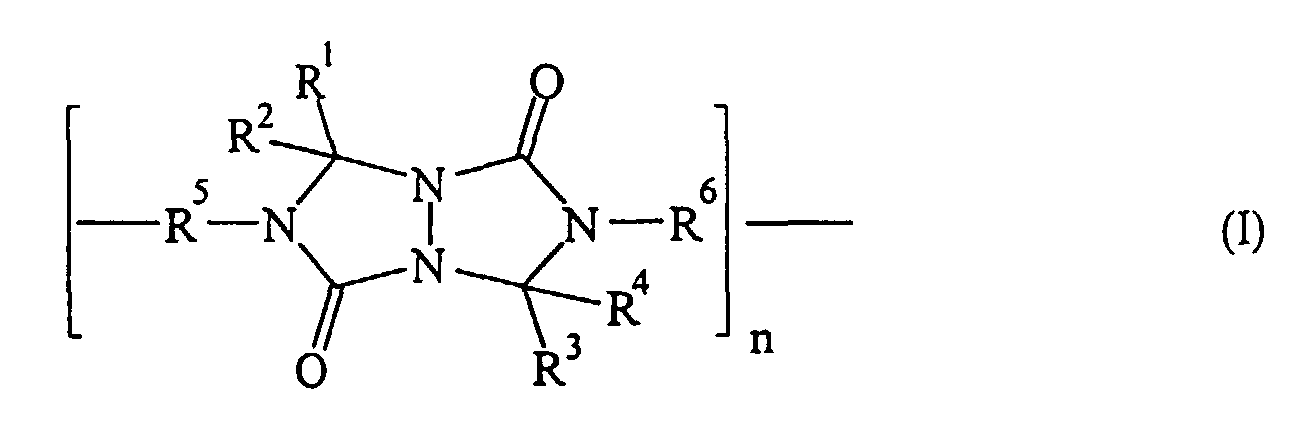
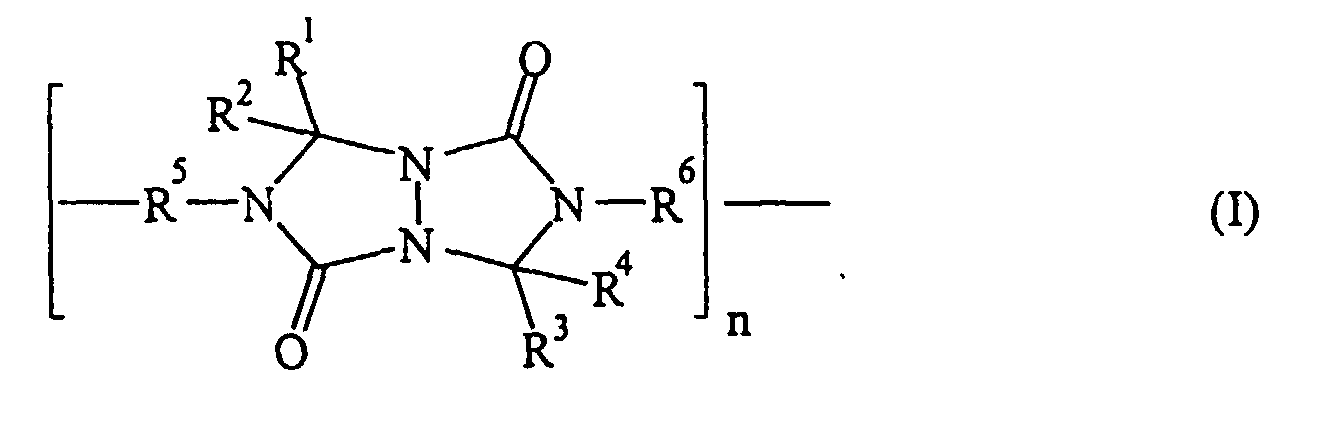
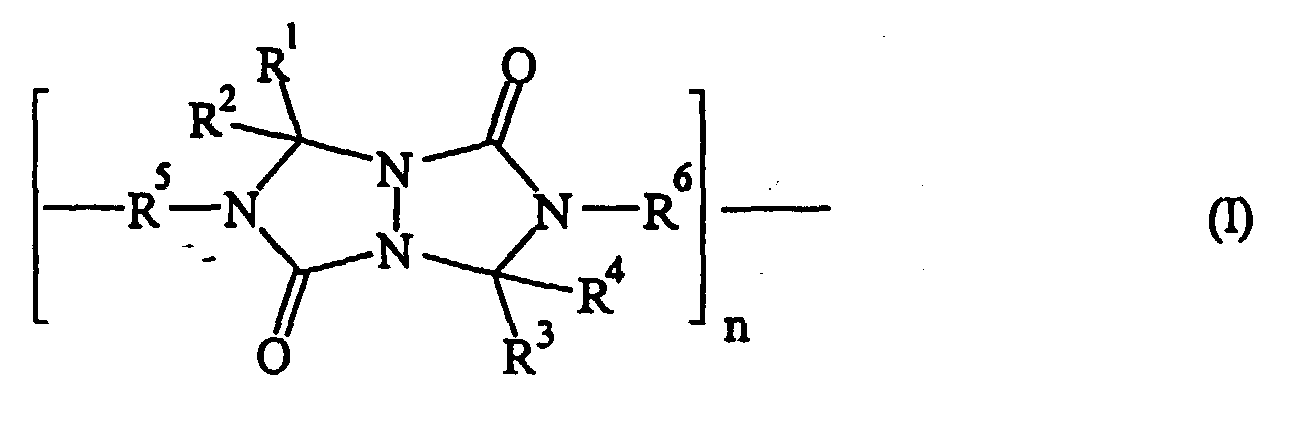
- a binder composition comprising at least one inorganic filler and a thermoplastic block copolyurethane or a mixture of two or more thermoplastic block copolyurethanes with at least one soft segment (A) and at least one hard segment (B), at least one hard segment being a structural element according to the general Formula I.
- R 1 and R 3 are the same or different, substituted or unsubstituted aromatic or heteroaromatic radicals having 4 to 40 carbon atoms and R 2 and R 4 are hydrogen or R 1 , R 2 , R 3 and R 4 are im are essentially fully fluorinated alkyl groups having 1 to 10 carbon atoms, R 5 and R 6 are identical or different, substituted or unsubstituted, linear or branched aliphatic or optionally substituted cycloaliphatic or optionally substituted aromatic radicals having 4 to 40 C atoms and n is is a number from 1 to 100.
- binder composition as used in the context of the present Text used relates to compositions that contain at least one Have binders and at least one inorganic filler.
- a binder is used in the context of the present invention Understand polymer or a mixture of two or more polymers, according to chemical or physical drying is essential to the construction of a Magnetic storage medium are involved.
- the present invention may contain only one polymer, i. H., a certain type of polymer molecule, with individual molecules this variety only by its different molecular weight, which is in the Framework obtained according to the chosen polymerization method Set molecular weight distribution, differentiate.
- the chemical Composition of such polymer molecules is when in the binder only a single type of polymer molecule is essentially identical.
- the binder according to the present invention can also be two or have more different types of polymer molecules. Different Types of polymer molecules can, for example, in their Molecular weight distribution, in their molecular weight or in their distinguish chemical composition. However, it is also possible that the different types of polymer molecules in two or more of distinguish between the properties mentioned.
- a hard segment is a Understand segment of a thermoplastic polyurethane molecule, wherein the Hard segment has a glass transition temperature of at least about 50 ° C.
- a soft segment is a Segment of a polyurethane molecule understood that covalently with a Hard segment is connected and has a glass transition temperature that below the use temperature of one of the polymers according to the invention produced magnetic recording medium, for example less than about 30 ° C, preferably less than about 20 ° C.
- an anchor group is a understood functional group that leads to interactions with ionic or non-ionic, polar compounds.
- Anchor groups understood such functional groups, the interactions with the surface of inorganic filler materials, especially with the Surface of inorganic magnetic or magnetizable pigments are able to accept.
- thermoplastic block copolyurethane as "thermoplastic polyurethanes” or simply referred to as “polyurethanes”.
- Polyurethanes that have no thermoplastic properties or none Block copolymers are expressly mentioned below as such characterized.
- an “inorganic filler” is understood to mean a particulate filler which has a particle size of approximately 100 nm to approximately 1 mm.
- Suitable inorganic fillers are, for example, chalk, titanium dioxide, silicon dioxide and further minerals, metals, carbon black or especially magnetic or magnetizable pigments, for example oxidic pigments such as ⁇ -Fe 2 O 3 , ⁇ -Fe 3 O 4 , CrO 2 , Co -modified Fe 2 O 3 or metallic pigments such as Fe, Co and Ni.
- oxidic pigments such as ⁇ -Fe 2 O 3 , ⁇ -Fe 3 O 4 , CrO 2 , Co -modified Fe 2 O 3 or metallic pigments such as Fe, Co and Ni.
- other elements or compounds can be added to the pigments mentioned.
- thermoplastic polyurethanes contained in the binder compositions according to the invention each have at least one hard segment (B) which has at least one structural element of the general formula I. having.
- R 1 and R 3 represent identical or different, substituted or unsubstituted aromatic or heteroaromatic radicals having 4 to 40 carbon atoms and
- R 2 and R 4 represent hydrogen or R 1 , R 2 , R 3 and R 4 essentially fully fused alkyl groups with 1 to 10 carbon atoms.
- radicals R 2 and R 4 represent one or two of the following radicals:
- radicals R 2 and R 4 are identical. In a further preferred embodiment of the invention, the radicals R 2 and R 4 are methoxyphenyl or trimethoxyphenyl. In a further preferred embodiment of the invention, the radicals R 2 and R 4 are hydrogen.
- radicals R 5 and R 6 stand for identical or different, substituted or unsubstituted, linear or branched aliphatic or optionally substituted cycloaliphatic or optionally substituted aromatic radicals having about 4 to about 40 C atoms.
- Suitable aliphatic radicals are, for example, butylene, pentylene, hexylene, heptylene, octylene, nonylene, decylene and the higher homologues of this series, as can be obtained by extending the hydrocarbon chains mentioned by one CH 2 group each.
- radicals R 5 and R 6 are divalent aliphatic cyclic radicals such as cyclohexylene, dicyclohexylmethylene or 3,3,5-trimethylcyclohexylene.
- R 5 and R 6 represent optionally substituted identical or different linear or branched aliphatic radicals with 4 to 10 C atoms or optionally substituted aromatic radicals with 6 to 18 C atoms.
- radicals R 5 and R 6 are toluylene, tetramethylxylylene, naphthylene, tetrahydronaphthylene or diphenylene methane.
- Hard segments (B), as are present in the thermoplastic polyurethanes in the context of the present invention, are produced by criss-cross cycloaddition between an azine and two polyisocyanates.
- diisocyanates as polyisocyanates
- isocyanates with a functionality of more than 2 or mixtures thereof can also be used.
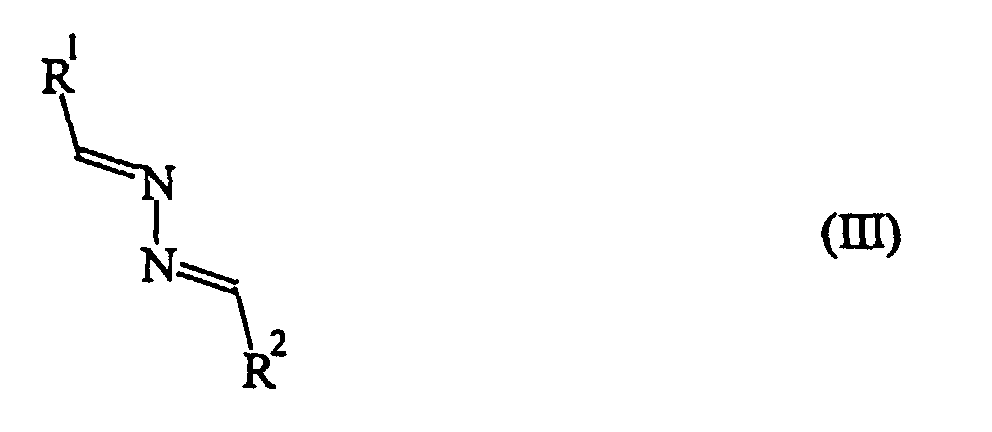
- Azines of the general formula III are used to prepare the thermoplastic polyurethanes which can be used in the binder compositions according to the invention, in particular to prepare the hard segments (B) contained in these thermoplastic polyurethanes wherein R 1 and R 2 have the meaning given above.
- p-methoxybenzaldazine or trimethoxybenzaldazine is used as azine of the general formula III.
- the reaction of the azine of the general formula III to the corresponding hard segment (B) is carried out with a polyisocyanate or a mixture of two or more polyisocyanates.
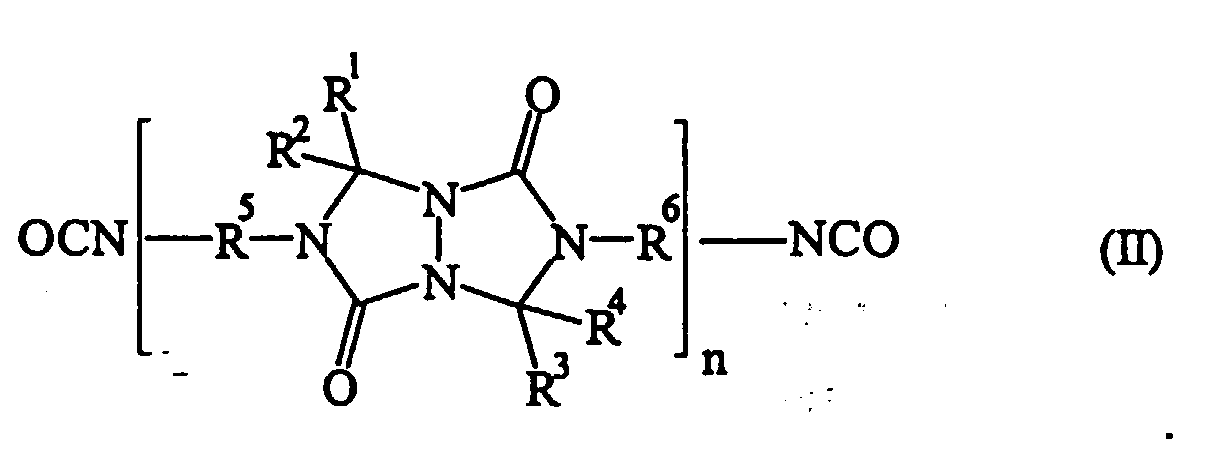
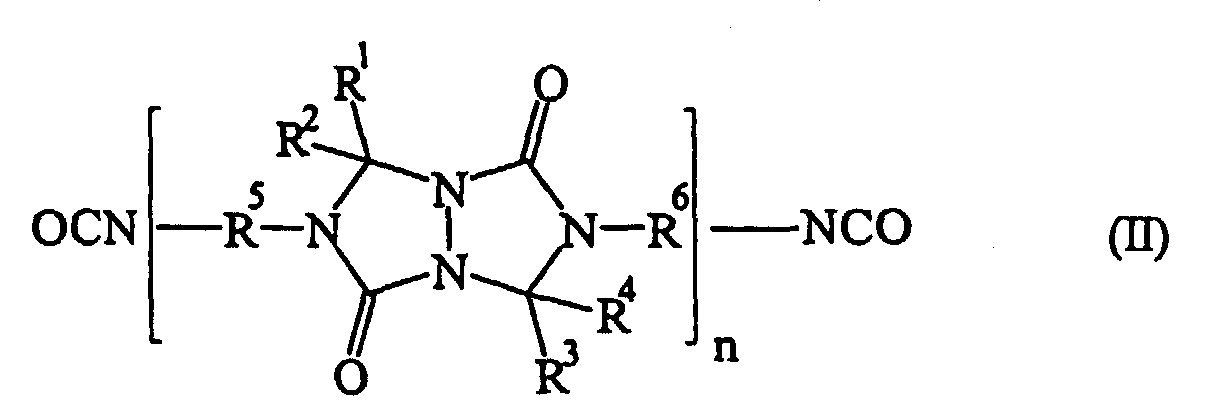
- oligomeric or polymeric compounds can be prepared which have two isocyanate end groups according to the above reaction scheme.
- Such compounds correspond to the general formula II
- the molecular weights of the so available for the production of hard segments (B) polymeric diisocyanates suitable in thermoplastic polyurethanes general formula II can in the context of the present invention about 500 up to about 30,000. Depending on the azines used and the Diisocyanates used can have different molecular weights realize.
- the Production of the hard segments (B) used compounds of the general Formula II has a molecular weight of about 1000 to about 20,000, for example about 1100 to about 18,000.
- those used to produce the hard segments (B) Compounds of general formula II have a molecular weight of about 1200 to about 5000, especially about 1300 to about 3000.
- diisocyanates which, when reacted with an azine, lead to polymeric diisocyanates according to general formula II which meet the above-mentioned specifications are suitable for the preparation of the compounds of general formula II.
- linear aliphatic isocyanates such as 1,4-tetramethylene diisocyanate, 1,5-pentamethylene diisocyanate or 1,6-hexamethylene diisocyanate
- aliphatic cyclic diisocyanates such as 1,4-cyclohexylene diisocyanate, dicyclohexylmethane diisocyanate or isophorone diisocyanate (IPDI) are used.
- aromatic diisocyanates such as tolylene-2,4-diisocyanate (2,4-TDI), toluene-2,6-diisocyanate (2,6-TDI), the mixture of isomers of the latter two diisocyanates, m-tetramethylxylylene diisocyanate (TMXDI), p-tetramethylxylylene diisocyanate, 1,5-naphthylene diisocyanate, 1,5-tetrahydronaphthylene diisocyanate, 2,2'-diphenylmethane diisocyanate, 2,4'-diphenylmethane diisocyanate and 4,4'-diphenylmethane diisocyanate as well as the above-mentioned mixtures of two or more Diisocyanates.
- aromatic diisocyanates such as tolylene-2,4-diisocyanate (2,4-TDI), toluene-2,6-diiso
- thermoplastic polyurethane that is a structural element according to the general formula I in the hard segment (B) is in the frame the present invention a compound of general formula II with a implemented as a soft segment (A) suitable compound, the at least two towards the isocyanate groups of the compound of general formula II below Formation of a covalent bond has reactive functional groups Y.
- the polyurethane according to the invention contains at least one type of soft segment A.
- the thermoplastic polyurethane two or more different types of Contains soft segments A.
- Soft segments A can be, for example, identical soft segments act, that is, soft segments that are essentially identical have chemical structure.
- two or more different Soft segments A are used. So one can in the context of a The thermoplastic polyurethane used in the binder for example a polyester and a polyether as soft segments A exhibit.
- soft segments A are all polymers which dissolve in the solvents used and preferably have a T g of below 20 ° C.
- the compounds mentioned which are suitable for use as soft segments A. have at least one functional group Y. In a preferred one Embodiments of the invention have those suitable as soft segments A. Compounds at least two functional groups Y. In another preferred embodiment of the invention are the functional groups Y terminal at the connections suitable for use as soft segment A. appropriate.
- Y stands for a functional group that is capable of reacting with an NCO group to form a covalent bond.
- Y is OH, NH 2 , NHR, SH or COOH, where R is a linear or branched, saturated or unsaturated alkyl radical having 1 to 24 carbon atoms or an aryl radical having 6 to 24 carbon atoms .
- Y stands for a OH, NH or NR group, especially for an OH group.
- Y stands for a OH, NH or NR group, especially for an OH group.
- OH group shown another compared to NCO groups reactive functional group, for example one of the others for Y mentioned functional groups, as far as a corresponding connection exists or can be produced.
- Polyesters suitable for forming soft segments are, for example predominantly linear polymers with terminal OH groups, preferably those with two or three, in particular with two OH end groups.
- the polyester polyols can be easily achieved by esterification of linear or branched, saturated or unsaturated aliphatic or correspondingly suitable aromatic dicarboxylic acids with 4 to about 15 carbon atoms, preferably 4 to about 10 carbon atoms with glycols, preferably glycols with about 2 to about 25 carbon atoms or by polymerizing lactones with about 3 to about 20 carbon atoms produce.
- dicarboxylic acids examples include glutaric acid, Pimelic acid, suberic acid, sebacic acid, dodecanoic acid and preferably Adipic acid or succinic acid, or mixtures of two or more of them use the dicarboxylic acids mentioned.
- Suitable aromatic dicarboxylic acids are Terephthalic acid, isophthalic acid, phthalic acid or mixtures of two or more of these dicarboxylic acids. Mixtures of one or several of the aromatic dicarboxylic acids mentioned with aliphatic or further aromatic dicarboxylic acids, for example with diphenic acid, Pentadienic acid, succinic acid or adipic acid.
- polyester polyols it may be advantageous if corresponding acid derivatives such as carboxylic anhydrides instead of the dicarboxylic acids, Esters, especially methyl esters, or carboxylic acid chlorides use if available.
- corresponding acid derivatives such as carboxylic anhydrides instead of the dicarboxylic acids, Esters, especially methyl esters, or carboxylic acid chlorides use if available.
- Suitable polyester polyols are by reacting dicarboxylic acids with corresponding glycols can be produced.
- Glycols suitable for polyester polyols are linear or branched, saturated or unsaturated, aliphatic or aromatic glycols.
- these are Diethylene glycol, 1,2-ethanediol, 1,3-propanediol, 2-methyl-1,3-propanediol, 1,4-butanediol, 1,5-pentanediol, 1,6-hexanediol, 1,7-heptanediol, 1,8-octanediol, 1,9-nonanediol, 1,10-decanediol and the corresponding higher homologues, such as by gradually extending the carbon chain of these Let compounds form, for example 2,2,4-trimethylpentanediol-1,5, 2,2-dimethylpropanediol-1,3, 1,4-dimethylolcyclohexane, 1,4-diethanolcyclohexane, 2-methyl-2-butyl-1,3-propanediol, 2,2-dimethyl-1,4-butanediol, 1,4-dimethylo
- 2,2-bis (4-hydroxyphenylene) propane Bisphenol A
- thermoplastic polyurethanes can said polyester polyols alone or as a mixture of two or more of the polyester polyols mentioned in different proportions Production of the thermoplastic polyurethanes are used.
- lactones ⁇ , ⁇ -dimethyl- ⁇ -propiolactone, for example, are suitable for the production of the polyester polyols, ⁇ -butyrolactone and ⁇ -caprolactone.
- Polyether polyols are essentially linear, in In the sense of the above-mentioned substances containing OH groups Understood ether bonds.
- Suitable polyether polyols can for example by polymerization of cyclic ethers such as tetrahydrofuran or by Implementation of one or more alkylene oxides with 2 to 4 carbon atoms in the Alkylene radical with a starter molecule that has two active hydrogen atoms has to be produced.
- Suitable alkylene oxides are, for example Ethylene oxide, 1,2-propylene oxide, epichlorohydrin, 1,2-butylene oxide or 2,3-butylene oxide or mixtures of two or more of them.
- polyester polyols and polyether polyols and their preparation are mentioned for example EP-B 0 416 386.
- soft segments A for example, polycarbonates can also be used.
- polycarbonates are used, which in are essentially linear and have at least two, preferably terminal, OH groups.
- the production of corresponding polycarbonate polyols takes place, for example, by implementing one of the above-mentioned difunctional ones Alcohols or a mixture of two or more such difunctional Alcohols with phosgene.
- Suitable polycarbonate polyols for example those based on 1,6-hexanediol base and its preparation are described, for example, in US-A 4,131,731.
- thermoplastic polyurethane-containing soft segments for example also aliphatic alcohols with three or more functional groups and 3 up to about 15, preferably about 3 to about 10 carbon atoms in the preparation of the Soft segments are used.
- Suitable connections are accordingly for example trimethylolpropane, triethylolpropane, glycerin, pentaerythritol, Sorbitol, mannitol and other sugar alcohols with up to about 10 OH groups per Molecule. They can also be used to manufacture the soft segments corresponding derivatives of the compounds mentioned, as characterized by.
- Polyester used as a soft segment (A) which results from a conversion of Adipic acid or isophthalic acid and or their mixture with 1,6-hexanediol or Cyclohexanedimethanol or a mixture thereof are available.
- the soft segments have (A) Glass transition temperatures from about -50 ° C to about 20 ° C. In a Another preferred embodiment of the invention is the glass transition temperatures the soft segments (A) in a range from about -30 ° C to about 0 ° C. To the desired mechanical properties of the invention To ensure binding agent, the soft segment (A) should Have molecular weights from about 500 to about 25,000 g / mol. In a preferred embodiment of the invention, soft segments (A) used which have a molecular weight of about 2000 to about 10,000 g / mol, have, for example, about 3000 to about 7000 g / mol.
- connection classes can already be used in a soft segment (A) suitable molecular weight range.
- Compounds of the abovementioned classes of compounds for the production of To use soft segments (A) which have a molecular weight that below the molecular weight suitable for use as a soft segment (A) or desired molecular weight.
- compounds of the above Connection classes through implementation with corresponding di or higher functional connections until the required or to extend the desired molecular weight.
- difunctional dicarboxylic acids Epoxy compounds or diisocyanates one being preferred Embodiment of the present invention diisocyanates are used.
- such di- or higher functional compounds used leading to a glass transition temperature of the extended soft segment (A), which are within the desired range.
- compounds for increasing the molecular weight in the case mentioned in the production of the soft segments (A) diisocyanates preferably those used with 6 to 30 carbon atoms.
- linear aliphatic diisocyanates such as 1,4-tetramethylene diisocyanate, 1,5-pentamethylene diisocyanate or 1,6-hexamethylene diisocyanate; aliphatic cyclic diisocyanates such as 1,4-cyclohexylene diisocyanate, dicyclohexyl methane diisocyanate or Isophorone diisocyanate (IPDI); aromatic diisocyanates such as tolylene-2,4-diisocyanate (2,4-TDI), toluene-2,6-diisocyanate (2,6-TDI), the mixture of isomers of the latter two diisocyanates, m-tetramethylxylylene diisocyanate (TMXDI), p-tetramethylxylylene diisocyanate, 1,5-naphthylene diisocyanate, 1,5-tetrahydronaphthylene diisocyanate
- molecular weight low molecular weight diols are used.
- these are diethylene glycol, 1,2-ethanediol, 1,3-propanediol, 2-methyl-1,3-propanediol, 1,4-butanediol, 1,5-pentanediol, 1,6-hexanediol, 1,7-heptanediol, 1,8-octanediol, 1,9-nonanediol, 1,10-decanediol as well as the corresponding higher homologs as they stand out gradual extension of the carbon chain of the compounds mentioned can be formed and, for example, 2,2,4-trimethylpentanediol-1,5, 2,2-dimethylpropanediol-1,3, 1,4-dimethylolcyclohexane, 1,4-diethanolcyclohexane, 2-methyl-2-butyl-1,3-
- low molecular weight amino compounds are present.
- primary amino compounds with two to about 20, for example 2 to about 12 carbon atoms such as ethylamine, n-propylamine, i-propylamine, n-propylamine, sec-propylamine, tert-butylamine, 1-aminoisobutane, substituted Amines with two to about 20 carbon atoms, such as 2- (N, N-dimethylamino) -1-aminoethane, Aminomercaptans such as 1-amino-2-mercaptoethane, aliphatic Amino alcohols having 2 to about 20, preferably 2 to about 12, carbon atoms, for example methanolamine, 1-amino-3,3-dimethyl-pentan-5-ol, 2-aminohexan-2 ', 2 '' diethanolamine, 1-amino-2,5-dimethylcyclohexan
- the to build up the hard segments and / or soft segments in the Compounds used in thermoplastic polyurethanes can optionally have anchor groups.
- Anchor groups are anionic or cationic functional groups or their salts understood the attractive interactions with polar Surfaces, for example with surfaces of inorganic fillers, come in.
- suitable anchor groups are carboxyl groups, Sulfonic acid groups, phosphonic acid groups, phosphoric acid groups or suitable salts of such groups, quaternary amino groups or derivatives, such as e.g. an ester, a primary, secondary or tert. Amine or two or more of the each mentioned anchor groups or a mixture of two or more of the mentioned anchor groups.
- the anchor groups are in the specialist known way introduced.
- the hard segments have (B) glass transition temperatures greater than about 50 ° C to about 160 ° C. In a further preferred embodiment of the invention Glass transition temperatures of the hard segments (B) in a range of about 100 ° C to about 155 ° C, for example in a range from about 110 ° C to about 150 ° C. To the desired mechanical properties of the invention To ensure binding agent, the hard segments (B) should be a Have molecular weights from about 350 to about 15,000 g / mol.
- hard segments (B) used which have a molecular weight of about 500 to about 10,000 g / mol, for example about 800 to about 4,000 g / mol or about 1000 to about 2500 have g / mol.
- the production of the soft segments (A) is according to the usual rules of organic polymer chemistry performed. If a polyester as a soft segment, a polyether, a polycarbonate, a polyacetal or other than Soft segment usable connection with functional groups Y used If so, their production is carried out according to customary methods known to the person skilled in the art Methods of polymer chemistry carried out. Should various of the above, Connections that can be used as a soft segment with one another due to a low molecular weight of the individual compounds are connected, so this happens depending on the one used for chain extension difunctional compound, also according to the usual, in the organic Chemistry known rules for the respective functional groups.
- the implementation of the compounds suitable as soft segments with the as Compounds of the general formula II suitable for hard segments can be found in be made in a known manner, preferably at temperatures of about 0 to about 120 ° C.
- the ratio of the two components will advantageously chosen so that the ratio of Y to NCO groups is about 2 to about 1.
- the usual rules of polymer chemistry can be followed the molecular weight by appropriate variations of the ratio mentioned of the thermoplastic polyurethanes obtained within wide limits Taxes.
- component L is therefore a Compound used, which is suitable for the formation of hard segments (B), the have a structural element of the general formula I.
- component M a connection is used, which is used in the context of the present text as Formation of soft segments (A) has been described suitably.
- Appropriate Components M accordingly have a structure Y-M-Y, where Y already has the meaning given above.
- Another object of the present invention is accordingly a method for producing a binder composition according to the invention, in which an inorganic filler and a thermoplastic block copolyurethane or a mixture of two or more thermoplastic block copolyurethanes with at least one soft segment (A) and at least one hard segment (B), wherein at least one hard segment is a structural element according to general formula I.
- R 1 and R 3 are the same or different, substituted or unsubstituted aromatic or heteroaromatic radicals having 4 to 40 carbon atoms and R 2 and R 4 are hydrogen or R 1 , R 2 , R 3 and R 4 are im are essentially fully fluorinated alkyl groups having 1 to 10 carbon atoms, R 5 and R 6 are identical or different, substituted or unsubstituted, linear or branched aliphatic or optionally substituted cycloaliphatic or optionally substituted aromatic radicals having 4 to 40 C atoms and n is is a number from 1 to 100, are mixed together.
- thermoplastic polyurethane has a molecular weight of about 3,000 to about 150,000 g / mol, preferably 10,000 to 60,000 g / mol.
- the reaction can optionally be carried out in the presence of a catalyst be made.
- a catalyst be made.
- Suitable catalysts are organometallic compounds such as dibutyltin dilaurate and metal salts such as tin octoate, lead octoate or zinc stearate.
- the amount of catalyst present during the reactions is generally about 1 to about 500 ppm by weight.
- a solvent or diluent is usually not required.
- a Solvent or a mixture of two or more solvents used are, for example, hydrocarbons, in particular Toluene, xylene or cyclohexane, esters, especially ethyl glycol acetate, Ethyl acetate or butyl acetate, amides, especially dimethylformamide or N-methylpyrrolidone, Sulfoxides, especially dimethyl sulfoxide, ethers, in particular Diisopropyl ether or methyl tert-butyl ether or preferably cyclic ethers, especially tetrahydrofuran or dioxane.
- thermoplastic polyurethanes which acts as end groups functional groups Y carries.
- thermoplastic Polyurethanes according to general formula II can do this Compounds containing isocyanate groups reactive with end groups such groups Y difunctional compounds with chain extension be implemented.
- Corresponding difunctional compounds of the general Formula X-Z-X have functional groups X compared to the functional ones Groups Y reactive groups. Examples of such functional groups X are in primarily the isocyanate groups that are preferred Embodiment of the present invention can be used. Depending on the type of functional group Y, however, X can also be reactive towards Y for others functional groups, for example epoxy groups, carboxylic acid groups, Carboxylic acid anhydrides or carboxylic acid halides.
- Z shows as functional Groups X or at least two epoxy, OH, NCO or COOH groups non-reactive mixture of two or more of them.
- the binder composition according to the invention contains at least one thermoplastic polyurethane which has at least one hard segment (B), wherein at least one of the hard segments (B) is a structural element according to the has general formula II.
- the present invention contains the binder composition according to the invention such a thermoplastic polyurethane or a mixture two or more such thermoplastic polyurethanes in an amount of at least about 1% by weight, preferably at least about 5% by weight, in particular at least about 10% by weight, based on the total Binder composition.
- the binder of the invention can also be a further polyurethane thermoplastic polyurethane without a corresponding structural element of general formula I or a mixture of two or more such thermoplastic polyurethanes included.
- the binder compositions of the invention in addition to the already mentioned thermoplastic polyurethane with structural elements according to the general formula I or a mixture of two or more such polyurethanes and at least one other polymer.
- the binders according to the invention can, in addition to those mentioned thermoplastic polyurethanes or mixtures thereof still another Contain polymer or a mixture of two or more other polymers.
- Polymers include polyurethanes, polyacrylates, polyester polyurethanes, Poly (meth) acrylaturethanes, polymethacrylates, polyacrylamides, polymers or Copolymers of vinyl monomers such as styrene, vinyl chloride, vinyl acetate, Vinyl propionate, binder based on vinyl formals, cellulose-containing Polymers such as cellulose esters, especially cellulose nitrates, cellulose acetates, Cellulose acetopropionate or cellulose acetobutyrate, phenoxy resins or Epoxy resins, as can be obtained in a manner known per se, or Mixtures of two or more of them.
- the binder compositions of the invention contain the thermoplastic polyurethanes with a structural element according to the general formula I usually in an amount of up to about 100% by weight Further polymers can be used in a proportion of up to about 80% by weight, for example up to about 70, 60, 50, 40, 30 wt .-%, or below, in Binder according to the invention may be included.
- binder compositions of the invention are both as Dispersing binders can also be used as top-up binders.
- the binders according to the invention contain a magnetic pigment or a mixture of two or more magnetic pigments.
- Suitable magnetic pigments are the customary oxidic pigments such as ⁇ -Fe 2 O 3 , ⁇ -Fe 3 O 4 , CrO 2 , co-modified Fe 2 O 3 or metallic pigments such as Fe, Co and Ni.
- further elements or compounds can be admixed to these pigments.
- the binders according to the invention can also contain fillers, Dispersing aids, other additives such as lubricants, carbon black or contain non-magnetic inorganic or organic pigments.
- thermoplastic polyurethane or a mixture of two or more of the above-mentioned thermoplastic polyurethanes with a magnetic pigment or a mixture of two or more magnetic pigments for example in admixture with one or more solvents and optionally together with fillers, dispersing aids, other binders and other additives such as lubricants, carbon black or non-magnetic inorganic or organic pigments are dispersed together.
- the main components in the Magnetic dispersion in particular the pigments and the binder first mixed with a little solvent to a dough-like mass and then intimately with each other, e.g. B. by kneading, mixed and only then dispersed.
- carboxylic acids with about 10 to about 20 carbon atoms for example, carboxylic acids with about 10 to about 20 carbon atoms, in particular stearic acid or palmitic acid or derivatives of Carboxylic acids such as their salts, esters or amides, or mixtures of two or more of it can be used.
- non-magnetic inorganic additives are Aluminum oxide, silicon dioxide, titanium dioxide or zirconium dioxide, as non-magnetic organic pigments, for example polyethylene or Polypropylene into consideration.
- the binders according to the invention can be used in magnetic recording media, for example, on conventional rigid or flexible Carrier materials are applied.
- carrier materials for example films made of linear polyesters such as polyethylene terephthalate, Polyethylene naphthalate, which generally has strengths from about 4 to about 200 Have micrometers, in particular about 5 to about 36 microns.
- the invention also relates to the use of a binder according to the invention or one prepared according to the invention Binder for the production of magnetic recording media and a such recording medium per se.
- recording media to mention in particular:
- Video cassettes for both professional and consumer use; Audio cassettes, both for the professional and end user area, e.g. B. Digital Audio tape; Floppy disks; Floppy disk; ZIP disk; Magnetic stripe.
- Azine and diisocyanate are weighed in a ratio of 0.6 to 1.0 and in the Melt reacted at 165 ° C 175 ° C until the theoretical NCO content is reached is.
- the mechanism of implementation is a criss-cross cycloaddition.
- the cycloaddition products are brittle, crystal clear and slightly yellowish resins.
- Dispersion tests were carried out with binders 6 and 7.
- a magnetic pigment DOWA HW 31 with a binder (see Table 3) and stearic acid as a dispersing agent were predispersed in a manner known to the person skilled in the art.
- the gloss as a quality feature of the dispersions of this first phase was measured and the dispersion was then completed in phase 2 by adding the binder 6 or 7.
- Gloss values of the dispersions obtained with binders 6 and 7 Phase 1 Phase 2 gloss (phase 1 / phase 2) binder Binder 6 Binder 7 CA 151 HT (Morton) 130/144 130/145 Acrylic-based binder 120/126 120/129
- phase 2 is reduced in comparison to phase 1. This means that the quality of the dispersion is reduced.
- the magnetic pigment DOWA HW 31 and the binder CA 151 HT (from Morton) and the dispersing aid stearic acid were predispersed in a manner known to the person skilled in the art.
- the gloss as a quality feature of the dispersion in phase 1 was measured, and the dispersion in phase 2 was then completed by adding a binder based on polyurethane without anchor groups.
- Phase 1 Gloss (phase 1 / phase 2) binder PU-based binder without anchor groups CA 151 HT (Morton) 105/88
Landscapes
- Chemical & Material Sciences (AREA)
- Organic Chemistry (AREA)
- Health & Medical Sciences (AREA)
- Chemical Kinetics & Catalysis (AREA)
- Medicinal Chemistry (AREA)
- Polymers & Plastics (AREA)
- Polyurethanes Or Polyureas (AREA)
- Adhesives Or Adhesive Processes (AREA)
- Compositions Of Macromolecular Compounds (AREA)
- Paints Or Removers (AREA)
- Magnetic Record Carriers (AREA)
Abstract
Description




| Chemischer Aufbau und physikalische Daten der Bindemittel 1 bis 9 | ||||
| Polydiisocyanat (Hartsegment) | Weichsegment | |||
| E 1010 Mw = 1000 g/mol | VP 9184 Mw = 1000 g/mol | AC 800 Mw = 800 g/mol | Poly THF Mw = 1000 g/mol | |
| 2 | Bindemittel 1 | |||
| Glasübergangs-temp. [°C] | 43 | |||
| Molekularge-wicht [g/mol] | 15.000 | |||
| Pendelhärte | 70 | |||
| 1 | Bindemittel 2 | Bindemittel 3 | Bindemittel 4 | Bindemittel 5 |
| Glasübergangs-temp. [°C] | 26 | 43 | 87 | 26 |
| Molekularge-wicht [g/mol] | 24.000 | 22.000 | 18.000 | 21.000 |
| Pendelhärte | 63 | 169 | 234 | 27 |
| 3 | Bindemittel 6 | Bindemittel 7 | Bindemittel 8 | Bindemittel 9 |
| Glasübergangs-temp. [°C] | 27 | 47 | 79 | 40 |
| Molekularge-wicht [g/mol] | 33.000 | 39.000 | 20.000 | 24.000 |
| Pendelhärte [s] nach DIN 53157 | 74 | 149 | 212 | 47 |
| Glanzwerte der mit den Bindemitteln 6 und 7 erhaltenen Dispersionen | ||
| Phase 1 | Phase 2 Glanz (Phase 1/Phase 2) | |
| Bindemittel | Bindemittel 6 | Bindemittel 7 |
| CA 151 HT (Fa. Morton) | 130/144 | 130/145 |
| Bindemittel auf Acrylatbasis | 120/126 | 120/129 |
| Phase 1 | Glanz (Phase 1/Phase 2) |
| Bindemittel | Bindemittel auf PU-Basis ohne Ankergruppen |
| CA 151 HT (Fa. Morton) | 105/88 |
Claims (11)
- Bindemittelzusammensetzung, mindestens enthaltend einen anorganischen Füllstoff und ein thermoplastisches Blockcopolyurethan oder ein Gemisch aus zwei oder mehr thermoplastischen Blockcopolyurethanen mit jeweils mindestens einem Weichsegment (A) und mindestens einem Hartsegment (B), wobei in mindestens einem Hartsegment (B) ein Strukturelement gemäß der allgemeinen Formel Ienthalten ist, worin R1 und R3 für gleiche oder unterschiedliche substituierte oder unsubstituierte aromatische oder heteroaromatische Reste mit 4 bis 40 C-Atomen und R2 und R4 für Wasserstoff stehen oder R1, R2, R3 und R4 für im wesentlichen vollständig fluorierte Alkylgruppen mit 1 bis 10 C-Atomen stehen, R5 und R6 für gleiche oder unterschiedliche, substituierte oder unsubstituierte, lineare oder verzweigte aliphatische oder gegebenenfalls substituierte cycloaliphatische oder gegebenenfalls substituierte aromatische Reste mit 4 bis 40 C-Atomen und n für eine Zahl von 1 bis 100 steht.

- Bindemittelzusammensetzung nach Anspruch 1, dadurch gekennzeichnet, daß R1 und R3 für Methoxybenzyl oder Trimethoxybenzyl und R2 und R4 für Wasserstoff stehen.
- Bindemittelzusammensetzung nach Anspruch 1 oder 2, dadurch gekennzeichnet, daß R5 und R6 für gegebenenfalls substituierte gleiche oder unterschiedliche lineare oder verzweigte aliphatische Reste mit 4 bis 10 C-Atomen oder gegebenenfalls substituierte aromatische Reste mit 6 bis 18 C-Atomen stehen.
- Bindemittelzusammensetzung nach einem der Ansprüche 1 bis 3, dadurch gekennzeichnet, daß als anorganischer Füllstoff ein magnetisches oder magnetisierbares Pigment enthalten ist.
- Bindemittelzusammensetzung nach einem der Ansprüche 1 bis 4, dadurch gekennzeichnet, daß sie außer dem thermoplastischen Blockcopolyurethan oder dem Gemisch aus zwei oder mehr thermoplastischen Blockcopolyurethanen noch mindestens ein weiteres Polymeres enthält.
- Bindemittelzusammensetzung nach Anspruch 5, dadurch gekennzeichnet, daß sie als mindestens ein weiteres Polymeres ein Polymeres aus der Gruppe enthaltend Polyacrylate, Polyesterpolyurethane, Poly(meth)acrylaturethane, Polymethacrylate, Polyacrylamide, Polymere oder Copolymere aus Vinylmonomeren, wie Styrol, Vinylchlorid, Vinylacetat, Vinylpropionat, Bindemittel auf Basis von Vinylformalen, cellulosehaltige Polymere, Celluloseester, Cellulosenitrate, Celluloseacetate, Celluloseacetopropionat oder Celluloseacetobutyrat, Phenoxyharze oder Epoxyharze oder Gemische aus zwei oder mehr davon enthält.
- Bindemittelzusammensetzung nach einem der Ansprüche 1 bis 6, dadurch gekennzeichnet, daß sie das thermoplastische Blockcopolymere oder das Gemisch aus zwei oder mehr thermoplastischen Blockcopolymeren mit einem Strukturelement gemäß Formel I im Hartsegment (B) in einer Menge bis 100 Gew.-%, bezogen auf die gesamte Bindemittelzusammensetzung, enthält.
- Bindemittelzusammensetzung nach einem der Ansprüche 1 bis 7, enthaltend einen anorganischen Füllstoff und ein thermoplastisches Polyurethan mit mindestens einem Weichsegment (A) und einem Hartsegment (B), wobei das thermoplastische Polyurethan durch Umsetzung von mindestens zwei Komponenten L und M, bei dereingesetzt wird, erhältlich ist.a) als Komponente L eine Verbindung der allgemeinen Formel IIworin R1, R2, R3, R4, R5, R6 und n die bereits oben angegebene Bedeutung haben und
 b) als Komponente M eine mindestens difunktionelle, gegenüber Isocyanatgruppen unter Ausbildung einer kovalenten Bindung reaktionsfähige Verbindung mit einem Molekulargewicht von mindestens 300
- Bindemittelzusammensetzung nach Anspruch 8, dadurch gekennzeichnet, daß als Komponente Y ein gegenüber Isocyanatgruppen mindestens difunktioneller Polyester, Polyether, ein Polyacetal, ein Polycarbonat, ein Polyacrylat, ein Polymethacrylat oder ein Polyvinylpolymeres oder ein Gemisch aus zwei oder mehr davon, eingesetzt wird.
- Verfahren zur Herstellung einer Bindemittelzusammensetzung nach einem der Ansprüche 1 bis 9, bei dem ein anorganischer Füllstoff und ein thermoplastisches Blockcopolyurethan oder ein Gemisch aus zwei oder mehr thermoplastischen Blockcopolyurethanen mit mindestens einem Weichsegment (A) und mindestens einem Hartsegment (B), wobei mindestens ein Hartsegment ein Strukturelement gemäß der allgemeinen Formel Iaufweist, worin R1 und R3 für gleiche oder unterschiedliche, substituierte oder unsubstituierte aromatische oder heteroaromatische Reste mit 4 bis 40 C-Atomen und R2 und R4 für Wasserstoff stehen oder R1, R2, R3 und R4 für im wesentlichen vollständig fluorierte Alkylgruppen mit 1 bis 10 C-Atomen stehen, R5 und R6 für gleiche oder unterschiedliche, substituierte oder unsubstituierte, lineare oder verzweigte aliphatische oder gegebenenfalls substituierte cycloaliphatische oder gegebenenfalls substituierte aromatische Reste mit 4 bis 40 C-Atomen und n für eine Zahl von 1 bis 100 steht, miteinander vermischt werden.
- Verwendung einer Bindemittelzusammensetzung nach einem der Ansprüche 1 bis 10 zur Herstellung von magnetischen Aufzeichnungsmedien.
Applications Claiming Priority (2)
| Application Number | Priority Date | Filing Date | Title |
|---|---|---|---|
| DE19945401 | 1999-09-22 | ||
| DE19945401A DE19945401C2 (de) | 1999-09-22 | 1999-09-22 | Füllstoffhaltige Bindemittelzusammensetzung, Verfahren zu deren Herstellung und deren Verwendung |
Publications (2)
| Publication Number | Publication Date |
|---|---|
| EP1086970A2 true EP1086970A2 (de) | 2001-03-28 |
| EP1086970A3 EP1086970A3 (de) | 2001-10-10 |
Family
ID=7922899
Family Applications (1)
| Application Number | Title | Priority Date | Filing Date |
|---|---|---|---|
| EP00118219A Withdrawn EP1086970A3 (de) | 1999-09-22 | 2000-09-01 | Füllstoffhaltige Bindemittelzusammensetzung, Verfahren zu deren Herstellung und deren Verwendung |
Country Status (6)
| Country | Link |
|---|---|
| US (1) | US6433070B1 (de) |
| EP (1) | EP1086970A3 (de) |
| JP (1) | JP2001192612A (de) |
| KR (1) | KR20010050586A (de) |
| DE (1) | DE19945401C2 (de) |
| NO (1) | NO20004714L (de) |
Family Cites Families (7)
| Publication number | Priority date | Publication date | Assignee | Title |
|---|---|---|---|---|
| DE1044405B (de) * | 1957-07-18 | 1958-11-20 | Bayer Ag | Verfahren zur Herstellung von in organischen Loesungsmitteln loeslichen, hoehermolekularen zwei oder mehr Isocyanatgruppen aufweisenden harzartigen Additionsprodukten |
| GB1285710A (en) * | 1968-12-24 | 1972-08-16 | Internat Chemical Ind Ltd | New polymers |
| US4131731A (en) | 1976-11-08 | 1978-12-26 | Beatrice Foods Company | Process for preparing polycarbonates |
| DE3929165A1 (de) | 1989-09-02 | 1991-03-07 | Basf Ag | Magnetische aufzeichnungstraeger |
| DE4103170A1 (de) * | 1991-02-02 | 1992-08-06 | Bayer Ag | Ein verfahren zur herstellung von modifizierten polyisocyanaten, die nach diesem verfahren erhaltenden polyisocyanate und ihre verwendung |
| JP2672783B2 (ja) * | 1994-05-05 | 1997-11-05 | モートン インターナショナル,インコーポレイティド | アミノアルキルホスホネートを含む磁気記録用バインダー |
| DE19626824A1 (de) * | 1996-07-03 | 1998-01-08 | Emtec Magnetics Gmbh | Magnetische Aufzeichnungsmaterialien |
-
1999
- 1999-09-22 DE DE19945401A patent/DE19945401C2/de not_active Expired - Fee Related
-
2000
- 2000-09-01 EP EP00118219A patent/EP1086970A3/de not_active Withdrawn
- 2000-09-14 US US09/661,795 patent/US6433070B1/en not_active Expired - Fee Related
- 2000-09-21 NO NO20004714A patent/NO20004714L/no not_active Application Discontinuation
- 2000-09-21 JP JP2000287112A patent/JP2001192612A/ja active Pending
- 2000-09-22 KR KR1020000055757A patent/KR20010050586A/ko not_active Abandoned
Also Published As
| Publication number | Publication date |
|---|---|
| DE19945401C2 (de) | 2002-02-07 |
| NO20004714L (no) | 2001-03-23 |
| US6433070B1 (en) | 2002-08-13 |
| DE19945401A1 (de) | 2001-04-05 |
| KR20010050586A (ko) | 2001-06-15 |
| JP2001192612A (ja) | 2001-07-17 |
| NO20004714D0 (no) | 2000-09-21 |
| EP1086970A3 (de) | 2001-10-10 |
Similar Documents
| Publication | Publication Date | Title |
|---|---|---|
| EP0033900B1 (de) | Magnetische Aufzeichnungsträger | |
| DE69615705T2 (de) | Carbonsäure-funktionalität aufweisende polyurethan-polymere sowie ihre mischungen verwendet in magnetischen aufzeichnungsmedien | |
| EP0142798B1 (de) | Magnetische Aufzeichnungsträger | |
| DE19945401C2 (de) | Füllstoffhaltige Bindemittelzusammensetzung, Verfahren zu deren Herstellung und deren Verwendung | |
| EP0150005B1 (de) | Magnetisches Speichermedium | |
| EP1086967A2 (de) | Blockcopolymeres Polyurethan, Verfahren zu dessen Herstellung sowie daraus hergestellte Bindemittel und Formkörper | |
| DE68909002T2 (de) | Magnetischer Aufzeichnungsträger. | |
| EP1126441A1 (de) | Bindemittelzusammensetzung für ein magnetisches Aufzeichnungsmedium | |
| EP0490223B1 (de) | Magnetische Aufzeichnungsträger | |
| US6914118B2 (en) | Polyurethane method for the production thereof and binding agent produced therefrom | |
| WO2002052549A1 (de) | Verwendung von poly(meth)acrylatbausteinen mit sulfonatgruppen in bindemitteln für magnetspeichermedien | |
| EP0414111B1 (de) | Magnetischer Aufzeichnungsträger | |
| EP1042748B1 (de) | Magnetischer aufzeichnungsträger auf der basis eines hydroxyl- und aminogruppenhaltigen polyurethanpräpolymers | |
| EP1126442A1 (de) | Bindemittelzusammensetzung für ein magnetisches Aufzeichnungsmedium | |
| DE69219616T2 (de) | Vinylchlorid und heterozyklische, thion funktionelle polyurethan polymermischungen und ihre verwendung in magnetischen aufzeichnungstraegern | |
| DE19734893A1 (de) | Lösungsmittelfrei herstellbare Polyurethane und ihre Verwendung als Bindemittel für magnetische Aufzeichnungsträger | |
| DE2414803C3 (de) | Verfahren zur Herstellung eines magnetisierbaren Speichermediums | |
| JPH06340846A (ja) | 磁気記録媒体用ポリウレタン樹脂バインダー | |
| JP3189253B2 (ja) | 磁気記録媒体用ポリウレタン樹脂バインダーの製造方法 | |
| DE19626824A1 (de) | Magnetische Aufzeichnungsmaterialien | |
| JPH0474773B2 (de) | ||
| EP0601471A1 (de) | Magnetische Aufzeichnungsträger | |
| DD241150A1 (de) | Verfahren zur herstellung von magnetogrammtraegern |
Legal Events
| Date | Code | Title | Description |
|---|---|---|---|
| PUAI | Public reference made under article 153(3) epc to a published international application that has entered the european phase |
Free format text: ORIGINAL CODE: 0009012 |
|
| AK | Designated contracting states |
Kind code of ref document: A2 Designated state(s): AT BE CH CY DE DK ES FI FR GB GR IE IT LI LU MC NL PT SE |
|
| AX | Request for extension of the european patent |
Free format text: AL;LT;LV;MK;RO;SI |
|
| PUAL | Search report despatched |
Free format text: ORIGINAL CODE: 0009013 |
|
| AK | Designated contracting states |
Kind code of ref document: A3 Designated state(s): AT BE CH CY DE DK ES FI FR GB GR IE IT LI LU MC NL PT SE |
|
| AX | Request for extension of the european patent |
Free format text: AL;LT;LV;MK;RO;SI |
|
| RIC1 | Information provided on ipc code assigned before grant |
Free format text: 7C 08G 18/78 A, 7G 11B 5/702 B, 7C 08L 75/04 B, 7C 08G 18/67 B |
|
| 17P | Request for examination filed |
Effective date: 20020410 |
|
| AKX | Designation fees paid |
Free format text: AT BE CH CY DE DK ES FI FR GB GR IE IT LI LU MC NL PT SE |
|
| RAP1 | Party data changed (applicant data changed or rights of an application transferred) |
Owner name: EMTEC MAGNETICS GMBH |
|
| STAA | Information on the status of an ep patent application or granted ep patent |
Free format text: STATUS: THE APPLICATION IS DEEMED TO BE WITHDRAWN |
|
| 18D | Application deemed to be withdrawn |
Effective date: 20050401 |