EP1086298B1 - Turbine nozzle vane - Google Patents
Turbine nozzle vane Download PDFInfo
- Publication number
- EP1086298B1 EP1086298B1 EP99923991A EP99923991A EP1086298B1 EP 1086298 B1 EP1086298 B1 EP 1086298B1 EP 99923991 A EP99923991 A EP 99923991A EP 99923991 A EP99923991 A EP 99923991A EP 1086298 B1 EP1086298 B1 EP 1086298B1
- Authority
- EP
- European Patent Office
- Prior art keywords
- blade
- nozzle
- end wall
- line
- tip end
- Prior art date
- Legal status (The legal status is an assumption and is not a legal conclusion. Google has not performed a legal analysis and makes no representation as to the accuracy of the status listed.)
- Expired - Lifetime
Links
- 238000009826 distribution Methods 0.000 description 25
- 230000003068 static effect Effects 0.000 description 14
- 230000007423 decrease Effects 0.000 description 6
- 238000010586 diagram Methods 0.000 description 5
- 230000000694 effects Effects 0.000 description 4
- 230000002411 adverse Effects 0.000 description 3
- 238000005206 flow analysis Methods 0.000 description 3
- 239000012530 fluid Substances 0.000 description 3
- 230000008859 change Effects 0.000 description 2
- 238000004519 manufacturing process Methods 0.000 description 2
- 238000011144 upstream manufacturing Methods 0.000 description 2
- 230000003247 decreasing effect Effects 0.000 description 1
- 230000001419 dependent effect Effects 0.000 description 1
- 238000006073 displacement reaction Methods 0.000 description 1
- 238000005265 energy consumption Methods 0.000 description 1
- 238000005516 engineering process Methods 0.000 description 1
- 230000007246 mechanism Effects 0.000 description 1
- 230000004048 modification Effects 0.000 description 1
- 238000012986 modification Methods 0.000 description 1
- 238000010248 power generation Methods 0.000 description 1
- 230000002829 reductive effect Effects 0.000 description 1
- 230000003313 weakening effect Effects 0.000 description 1
Images



Classifications
-
- F—MECHANICAL ENGINEERING; LIGHTING; HEATING; WEAPONS; BLASTING
- F01—MACHINES OR ENGINES IN GENERAL; ENGINE PLANTS IN GENERAL; STEAM ENGINES
- F01D—NON-POSITIVE DISPLACEMENT MACHINES OR ENGINES, e.g. STEAM TURBINES
- F01D5/00—Blades; Blade-carrying members; Heating, heat-insulating, cooling or antivibration means on the blades or the members
- F01D5/12—Blades
- F01D5/14—Form or construction
-
- F—MECHANICAL ENGINEERING; LIGHTING; HEATING; WEAPONS; BLASTING
- F01—MACHINES OR ENGINES IN GENERAL; ENGINE PLANTS IN GENERAL; STEAM ENGINES
- F01D—NON-POSITIVE DISPLACEMENT MACHINES OR ENGINES, e.g. STEAM TURBINES
- F01D5/00—Blades; Blade-carrying members; Heating, heat-insulating, cooling or antivibration means on the blades or the members
- F01D5/12—Blades
- F01D5/14—Form or construction
- F01D5/141—Shape, i.e. outer, aerodynamic form
- F01D5/145—Means for influencing boundary layers or secondary circulations
Definitions
- the present invention relates to a turbine nozzle, and more particularly to a turbine nozzle having an array of nozzle blades disposed circumferentially in an annular passage defined between an inner ring and an outer ring of a diaphragm and fixed to the inner and outer rings of the diaphragm.
- the internal losses in each of the turbine stages include a blade profile loss, a secondary flow loss, and a leakage loss.
- the proportion of the secondary flow loss is large in a turbine stage where an aspect ratio (blade height/blade chord) is small and a blade height is small. Therefore, it is effective to reduce the secondary flow loss for thereby improving the performance of the turbine.
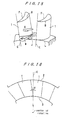
- a flow G flowing in between nozzle blades 1 is subject to a force caused by a pressure gradient from a pressure surface F to a suction surface B in each of the nozzle blades 1.
- the force caused by the pressure gradient and a centrifugal force caused by the turning of the flow are in balance.
- a flow in a boundary layer near the turbine end wall has a low level of kinetic energy, and hence is carried from the pressure surface F to the suction surface B by the force caused by the pressure gradient as indicated by the arrows J.
- the flow collides with the suction surface B and rolls up, thus forming a flow passage vortex W.
- the flow passage vortex W accumulates a low-energy fluid in the end wall boundary layer to thereby generate a non-uniform energy distribution downstream of the nozzle blade. Although the non-uniform energy distribution is uniformized downstream of the nozzle blade, a large energy loss is generated during its uniformization.
- E represents a radial line
- L represents a hub end wall.
- blades 1 are inclined at an angle ⁇ to the radial line E for thereby weakening an blade-to-blade pressure gradient near the hub end wall of the blade.
- reference numeral 2 represents an outer ring
- reference numeral 3 represents an inner ring.
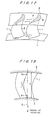
- nozzle blades 1 are curved at their opposite ends to orient the pressure surfaces F to the end wall.
- U represents an outer diameter surface.
- ⁇ t represents the angle between the tangent to the blade stacking line 1 at the tip end wall and radial line E
- ⁇ r represents the angle between the tangent to the blade stacking line 1 at the hub end wall and radial line E
- h represents a blade height
- Another conventional technology involves an inclined or curved surface imparted to a nozzle blade across its entire height for thereby controlling the secondary flow, as disclosed in Japanese laid-open patent publication No. 10-77801.
- the nozzle blade In order to control the pressure gradient with the above conventional arrangements, the nozzle blade needs to be largely inclined or curved, and hence efforts to meet such a requirement tend to cause problems in the manufacturing process or in the mechanical strength of the nozzle blades.
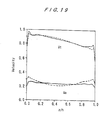
- a flow distribution at the outlet of the blades is liable to differ greatly from a flow distribution on blades which are neither curved nor inclined.
- the graph shown in FIG. 19 indicates that flow velocity distributions of an ordinary blade (indicated by the solid-line curves) and those of a curved blade (indicated by the broken-line curves) differ at the opposite ends of the blades.
- nozzle blades are of a curved shape and are combined with conventional rotor blades positioned downstream of the nozzle blades, then flows from the nozzle blades do not match the rotor blades, and the curved nozzle blades may not be effective. In such a case, new rotor blades capable of matching flows from the outlet of the curved nozzle blades are required, and thus such an arrangement cannot meet a wide range of applications
- EP-A-0833060 shows a blade for an axial fluid machine for lowering a secondary flow loss which is caused when a blade cascade disposed along the axial direction of a rotational shaft passes through a working fluid to thereby improve the efficiency of the blade cascade.
- Projecting blade portions bulging continuously from a leading edge are formed at a root portion and a tip Portion of a blade.
- the projecting blade portions are formed by axis reference lines which extend from the root portion and the tip Portion of the blade toward the main stream side and axis reference lines having arcshaped curved surfaces which are connected to the leading edge of the blade. Specifically, the projecting blade portions bulge from the leading edge toward the upstream side, but not inside the flow passage.
- EP-A-0661413 shows an axial cascade for improving the efficiency scale of a turbine. Rotor blades are shown, which are curved concavely against the flow direction.
- a turbine nozzle comprising: an array of nozzle blades (1) disposed circumferentially in an annular passage (4) defined between inner and outer rings of a diaphragm and fixed to the inner and outer rings of the diaphragm; and a flow passage defined between a pressure surface (F) and a suction surface (B) of adjacent ones of the nozzle blades, a cross section of the flow passage including predetermined ranges extending along a blade height from the inner and outer diameter surfaces (hub and tip end walls) and defined by a curved line, and another range defined by a substantially straight line.
- the turbine nozzle according to the present invention is clearly different in structure from the nozzle blade disclosed in Japanese laid-open patent publication No. 10-77801.
- a turbine nozzle comprising: an array of nozzle blades (1) disposed circumferentially in an annular passage (4) defined between inner and outer rings of a diaphragm and fixed to the inner and outer rings of the diaphragm; a pressure surface (F) in each of the nozzle blades facing the tip end wall of the turbine diaphragm in a predetermined range in the meridional direction of the nozzle blade and in a predetermined range between the tip end wall and a midspan of a blade, and the pressure surface facing the hub end wall of the turbine diaphragm in a predetermined range between the hub end wall and the midspan of the blade; a suction surface (B) in each of the nozzle blades facing the hub end wall of the turbine diaphragm in a predetermined range in the meridional direction of the nozzle blade and in a predetermined range between the tip end wall and a midspan of the blade, and the suction surface facing the tip end wall
- the predetermined range may comprise a range corresponding to at least 30 % of a meridional width (Cx) of the nozzle blade from a leading edge (1f) of the nozzle blade in a meridional direction (x).
- the predetermined range may comprise a range corresponding to 20 to 40 % of the blade height (h) from the hub end wall (L) of the nozzle blade (1), and a range corresponding to 20 to 40 % of the blade height (h) from the tip end wall (U) of the nozzle blade (1).
- the pressure surface (F) of the nozzle blade (1) is arranged to face the tip end wall at the tip end wall side, i.e. , is curved to face the tip end wall, and is arranged to face the hub end wall at the hub end wall side, i.e., is curved to face the hub end wall, and the suction surface (B) of the nozzle blade (1) is arranged to face the hub end wall at the tip end wall side, i.e. , is curved to face the hub end wall, and is arranged to face the tip end wall at the hub end wall side, i.e., is curved to face the tip end wall.
- a line (1p) on the pressure surface and a line (1s) on the suction surface along the height of the nozzle blade (1) have central portions (S) which are preferably defined by substantially straight lines except for the range (C1) corresponding to 20 to 40 % from the hub end wall (L) along the height (h) of the nozzle blade (1) and the range (C2) corresponding to 20 to 40 % from the tip end wall (U) along the height (h) of the nozzle blade (1).
- a line on the pressure surface (F) and a line on the suction surface (B) in the cross section of the flow passage in an arbitrary meridional position in a range of at least 30 % from a leading edge (1f) of the nozzle blade along a meridional width (Cx) of the nozzle blade have central portions which are preferably defined by substantially straight lines except for the range (C1) corresponding to 20 to 40 % from the hub end wall (L) along the height (h) of the nozzle blade (1) and the range (C2) corresponding to 20 to 40 % from the tip end wall (U) along the height (h) of the nozzle blade (1).
- the cross section of the flow passage is defined by a line on said pressure surface (F) and a line on said suction surface (B) in a meridional position within a range of at least 30 % from a leading edge (1f) of the nozzle blade (1) along a meridional width (Cx) of the nozzle blade (1), each of the lines comprising a substantially straight line in a central region of the nozzle blade.
- the distance (Sh) from an intersection (Pt1) between the line (C1) on the pressure surface or the suction surface and the hub end wall (L) to an intersection (Pc1) between an extension (SE1) of the central portion (S) on the pressure surface or the suction surface defined by the substantially straight line and the hub end wall (L), and the distance (St) from an intersection (Pt2) between the line (C2 ) on the pressure surface or the suction 0 surface and the tip end wall (U) to an intersection (Pc2) between an extension (SE2) of the central portion (S) and the tip end wall (U) have a maximum value at the leading edge (1f) of the nozzle blade, and at least 4 % of the blade height (h) in a position at 30 % of the meridional width from the leading edge of the nozzle blade.
- the maximum value of the distances (Sh, St) at the leading edge (1f) of the nozzle blade (1) should be preferably in the range of from 5 to 15 % of the blade height (h).
- n is an integer of 0 or greater which is of a numerical value including all higher-order terms that are not negligibly small.
- a turbine nozzle comprises an array of nozzle blades 1 in a circumferential direction (y) in an annular passage 4 defined between an inner ring 3 and an outer ring 2 of a diaphragm.
- the nozzle blades 1 have hub and tip end walls L, U on their opposite ends which are fixed respectively to an outer diameter surface (tip end wall) of the inner ring 3 and an inner diameter surface (hub end wall) of the outer ring 2.
- the turbine nozzle is shown in perspective in FIG. 1 and viewed from a position upstream of the turbine nozzle.
- Each of the nozzle blades 1 has a blade profile section or an aerofoil section, and has a pressure surface F and a suction surface B.
- a flow passage defined between the pressure surface F and the suction surface B of adjacent ones of the nozzle blades 1 has a cross section 4a in an arbitrary meridional position.
- the cross section 4a has a lateral edge defined by a line 1p on the pressure surface F and an opposite lateral edge defined by a line 1s on the suction surface B.
- Each nozzle blade 1 has a width Cx in its meridional direction (x). In FIG. 1, z represents radial direction.
- the line 1p on the pressure surface F and the line 1s on the suction surface B which form the cross section 4a are composed of straight or curved lines C1, C2 facing the hub end wall L and the tip end wall U, respectively.
- Other portions of the lines 1p, 1s than the ranges Lh, Lt, i.e. , central portions of the lines 1p, 1s, are composed of a straight line S.
- the ranges Lh, Lt corresponding to 20 to 40 % of the blade height h inwardly from the hub and tip end walls L, U are defined by the straight or curved line C (C1, C2: parabola in the illustrated embodiment) inclined from the pressure surface F to the suction surface B toward the ends L, U.
- the displacements from the straight portion S on the hub and tip end walls L, U i.e., the distance Sh from an intersection Pt1 between the inclined line C1 and the hub end wall L to an intersection Pc1 between an extension SE1 (indicated by a dotted line in FIG. 2) of the straight portion S and the hub end wall L, and the distance St from an intersection Pt2 between the inclined line C2 and the tip end wall U to an intersection Pc2 between an extension SE2 (indicated by a dotted line in FIG. 2) of the straight portion S and the outer diameter surface U, have a maximum value at the leading edge 1f of the nozzle blade, and are progressively decreased toward the trailing edge of the nozzle blade.
- FIG. 3 various examples in changes in the distances St, Sh to the meridional direction (x) are shown by characteristic curves (a), (b), (c), (d), (e) and (f).
- the horizontal axis represents x/Cx
- the vertical axis represents Sh/h, St/h.-
- x/Cx is defined as meridional distance from the leading edge nondimensionalyzed by blade meridional width Cx.
- FIGS. 4A through 4D Changes in the cross section of the flow passage in the meridional direction with respect to the conventional nozzle blade (represented by the characteristic curve (a)) are shown in FIGS. 4A through 4D. Changes in the cross section of the flow passage in the meridional direction with respect to an inventive nozzle blade (represented by the characteristic curve (e)) are shown in FIGS. 5A through 5D.
- the nozzle blades according to the present invention suffer smaller losses than the conventional nozzle blade regardless of the magnitudes of the ranges Lh, Lt, and particularly the loss is minimum in the ranges of 0.2 ⁇ Lh/h, Lt/h ⁇ 0.4.
- FIG. 8 shows the nozzle blades represented by the characteristic curves (a) - (e) and having different distances Sh, St at the leading edge thereof, and FIG. 9 shows total pressure losses, calculated by a viscous flow analysis, of those nozzle blades.
- the nozzle blades represented by the characteristic curves (b) - (e) where Sh/h is up to about 0.16 at the leading edge thereof suffer smaller losses than the conventional nozzle blade.
- the nozzle blades represented by the characteristic curves (b) - (d) are preferable because the loss is minimum particularly in the ranges of 0.05 ⁇ Sh/h ⁇ 0.15.
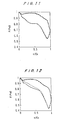
- FIGS. 10 through 13 show detailed results of analytical calculations on the conventional ordinary nozzle blade and the nozzle blade according to the present invention.
- the horizontal axis represents z/h
- the vertical axis represents the total pressure loss.
- FIG. 11 shows a distribution of static pressures on a blade surface at the midspan of the blade
- FIG. 12 shows a distribution of static pressures on a blade surface at the hub end wall of the turbine diaphragm.
- the horizontal axis represents x/Cx
- the vertical axis represents P/PsO (surface pressure nondimensionalyzed by static pressure at the nozzle inlet). It can be seen from FIGS.
- Contour lines of static pressures in the cross section 4a of the flow passage in the conventional nozzle blade and the inventive nozzle blade are shown in FIGS. 14A and 14B.
- the contour lines of the static pressures are distributed in substantially parallel with the line 1p on the pressure surface F and the line 1s on the suction surface B.
- the static pressure at the center of the blade height and the static pressures on the hub and tip end walls L, U are substantially the same.
- the distribution of static pressures across the blade height near the line 1s on the suction surface B is greater by Sh, St than that at the center of the blade height (the region of the straight portion S shown in FIG. 2) in the vicinity of the hub end wall L and the tip end wall U. Therefore, the blade loading decreases because the static pressure near the line 1s on the suction surface B increases in the vicinity of the hub end wall L and the tip end wall U.
- the broken-line arrows SF1, SF2 indicate secondary flows near the both end walls directed from the line 1p on the pressure surface F to the line 1s on the suction surface B in the cross section 4a of the flow passage.
- the secondary flows SF1, SF2 are produced by the pressure difference (the blade loading) between the pressure surface F and the suction surface B in the vicinity of the hub end wall L and the tip end wall U, and the intensity of the secondary flows SF1, SF2 is proportional to the magnitude of the blade loading. Therefore, in the inventive nozzle blade that is capable of making the blade loading smaller in the vicinity of the hub end wall L and the tip end wall U than the conventional nozzle blade, the secondary flow is more suppressed than on the conventional nozzle blade, and hence the loss caused by the secondary flow can be reduced.
- the turbine nozzle does not adversely affect the rotor blades positioned downstream of the turbine stage.
- the turbine nozzle according to the present invention is capable of suppressing a secondary flow at the ends of nozzle blades for thereby reducing a loss caused by the secondary flow. Further, the turbine nozzle according to the present invention provides a velocity distribution at the nozzle outlet which is the same as that of the ordinary nozzle blades, and thus does not adversely affect the rotor blades positioned downstream of the turbine nozzle.
- the present invention is suitable for a turbine which is used for driving various machines such as an electric generator in a power generating plant.
Landscapes
- Engineering & Computer Science (AREA)
- Mechanical Engineering (AREA)
- General Engineering & Computer Science (AREA)
- Physics & Mathematics (AREA)
- Fluid Mechanics (AREA)
- Turbine Rotor Nozzle Sealing (AREA)
Applications Claiming Priority (3)
| Application Number | Priority Date | Filing Date | Title |
|---|---|---|---|
| JP16483398 | 1998-06-12 | ||
| JP16483398 | 1998-06-12 | ||
| PCT/JP1999/003101 WO1999064725A1 (en) | 1998-06-12 | 1999-06-10 | Turbine nozzle vane |
Publications (2)
| Publication Number | Publication Date |
|---|---|
| EP1086298A1 EP1086298A1 (en) | 2001-03-28 |
| EP1086298B1 true EP1086298B1 (en) | 2004-10-20 |
Family
ID=15800805
Family Applications (1)
| Application Number | Title | Priority Date | Filing Date |
|---|---|---|---|
| EP99923991A Expired - Lifetime EP1086298B1 (en) | 1998-06-12 | 1999-06-10 | Turbine nozzle vane |
Country Status (7)
| Country | Link |
|---|---|
| US (1) | US6491493B1 (https=) |
| EP (1) | EP1086298B1 (https=) |
| JP (1) | JP4315597B2 (https=) |
| KR (1) | KR100566759B1 (https=) |
| CN (1) | CN1163662C (https=) |
| DE (1) | DE69921320T2 (https=) |
| WO (1) | WO1999064725A1 (https=) |
Cited By (1)
| Publication number | Priority date | Publication date | Assignee | Title |
|---|---|---|---|---|
| CN104508255A (zh) * | 2012-07-26 | 2015-04-08 | Ihi供应系统国际有限责任公司 | 用于涡轮机的能调节的导向器,用于废气涡轮增压机的涡轮机和废气涡轮增压机 |
Families Citing this family (34)
| Publication number | Priority date | Publication date | Assignee | Title |
|---|---|---|---|---|
| US6398489B1 (en) * | 2001-02-08 | 2002-06-04 | General Electric Company | Airfoil shape for a turbine nozzle |
| JP4484396B2 (ja) * | 2001-05-18 | 2010-06-16 | 株式会社日立製作所 | タービン動翼 |
| US6921246B2 (en) * | 2002-12-20 | 2005-07-26 | General Electric Company | Methods and apparatus for assembling gas turbine nozzles |
| JP4269723B2 (ja) * | 2003-03-12 | 2009-05-27 | 株式会社Ihi | タービンノズル |
| FR2853022B1 (fr) * | 2003-03-27 | 2006-07-28 | Snecma Moteurs | Aube de redresseur a double courbure |
| DE10352788A1 (de) * | 2003-11-12 | 2005-06-30 | Mtu Aero Engines Gmbh | Gasturbine |
| JP4724034B2 (ja) * | 2005-03-31 | 2011-07-13 | 株式会社東芝 | 軸流タービン |
| EP1710397B1 (en) | 2005-03-31 | 2014-06-11 | Kabushiki Kaisha Toshiba | Bowed nozzle vane |
| US8016551B2 (en) | 2005-11-03 | 2011-09-13 | Honeywell International, Inc. | Reverse curved nozzle for radial inflow turbines |
| JP4838733B2 (ja) * | 2007-01-12 | 2011-12-14 | 三菱重工業株式会社 | ガスタービンの翼構造 |
| GB0704426D0 (en) * | 2007-03-08 | 2007-04-18 | Rolls Royce Plc | Aerofoil members for a turbomachine |
| GB201011854D0 (en) * | 2010-07-14 | 2010-09-01 | Isis Innovation | Vane assembly for an axial flow turbine |
| US8602727B2 (en) * | 2010-07-22 | 2013-12-10 | General Electric Company | Turbine nozzle segment having arcuate concave leading edge |
| US8684684B2 (en) * | 2010-08-31 | 2014-04-01 | General Electric Company | Turbine assembly with end-wall-contoured airfoils and preferenttial clocking |
| US8342009B2 (en) | 2011-05-10 | 2013-01-01 | General Electric Company | Method for determining steampath efficiency of a steam turbine section with internal leakage |
| EP2787181B1 (en) * | 2011-11-30 | 2019-01-09 | Mitsubishi Heavy Industries, Ltd. | Radial turbine |
| US20140064951A1 (en) * | 2012-09-05 | 2014-03-06 | Renee J. Jurek | Root bow geometry for airfoil shaped vane |
| US20140072433A1 (en) * | 2012-09-10 | 2014-03-13 | General Electric Company | Method of clocking a turbine by reshaping the turbine's downstream airfoils |
| US10087760B2 (en) * | 2013-04-24 | 2018-10-02 | Hamilton Sundstrand Corporation | Turbine nozzle and shroud for air cycle machine |
| US9435221B2 (en) | 2013-08-09 | 2016-09-06 | General Electric Company | Turbomachine airfoil positioning |
| US9896950B2 (en) | 2013-09-09 | 2018-02-20 | Rolls-Royce Deutschland Ltd & Co Kg | Turbine guide wheel |
| US9638041B2 (en) | 2013-10-23 | 2017-05-02 | General Electric Company | Turbine bucket having non-axisymmetric base contour |
| US9670784B2 (en) | 2013-10-23 | 2017-06-06 | General Electric Company | Turbine bucket base having serpentine cooling passage with leading edge cooling |
| US9797258B2 (en) | 2013-10-23 | 2017-10-24 | General Electric Company | Turbine bucket including cooling passage with turn |
| US9528379B2 (en) | 2013-10-23 | 2016-12-27 | General Electric Company | Turbine bucket having serpentine core |
| US9551226B2 (en) | 2013-10-23 | 2017-01-24 | General Electric Company | Turbine bucket with endwall contour and airfoil profile |
| US10352180B2 (en) * | 2013-10-23 | 2019-07-16 | General Electric Company | Gas turbine nozzle trailing edge fillet |
| US20150110617A1 (en) * | 2013-10-23 | 2015-04-23 | General Electric Company | Turbine airfoil including tip fillet |
| CN104454028A (zh) * | 2014-11-14 | 2015-03-25 | 东方电气集团东方汽轮机有限公司 | 提高汽轮发电机组采暖供热季节运行效率的方法 |
| KR101941807B1 (ko) | 2015-02-10 | 2019-01-23 | 미츠비시 히타치 파워 시스템즈 가부시키가이샤 | 터빈 및 가스 터빈 |
| US10107108B2 (en) | 2015-04-29 | 2018-10-23 | General Electric Company | Rotor blade having a flared tip |
| DE102018211673A1 (de) * | 2018-07-12 | 2020-01-16 | Continental Automotive Gmbh | Leitschaufel und mit einer solchen versehene Turbinenanordnung |
| KR20220085206A (ko) | 2020-12-15 | 2022-06-22 | 박준우 | 초음파 수위센서와 접촉식 수위센서 및 사람감지센서를 융합한 차량 침수 모니터링 |
| CN115875086B (zh) * | 2023-01-04 | 2025-07-18 | 中国科学院工程热物理研究所 | 一种低展弦比高压涡轮端弯导流叶片及具有其的涡轮机 |
Family Cites Families (15)
| Publication number | Priority date | Publication date | Assignee | Title |
|---|---|---|---|---|
| GB200269A (en) * | 1922-04-29 | 1923-07-12 | Giuseppe Belluzzo | Improvements relating to steam turbines |
| US2801790A (en) * | 1950-06-21 | 1957-08-06 | United Aircraft Corp | Compressor blading |
| DE2034890A1 (de) | 1969-07-21 | 1971-02-04 | Rolls Royce Ltd Derby, Derbyshire (Großbritannien) | Schaufel fur Axialstromungsmaschinen |
| JPS58128403A (ja) | 1982-01-27 | 1983-08-01 | Toshiba Corp | 蒸気タ−ビンの動翼 |
| DE3514122A1 (de) * | 1985-04-19 | 1986-10-23 | MAN Gutehoffnungshütte GmbH, 4200 Oberhausen | Verfahren zur herstellung einer leitschaufel fuer ein turbinen- oder verdichter-leitrad und nach dem verfahren hergestellte leitschaufel |
| JPH01106903A (ja) | 1987-10-21 | 1989-04-24 | Toshiba Corp | タービンノズル |
| JPH06229205A (ja) * | 1993-02-02 | 1994-08-16 | Toshiba Corp | タービンノズル |
| DE4344189C1 (de) * | 1993-12-23 | 1995-08-03 | Mtu Muenchen Gmbh | Axial-Schaufelgitter mit gepfeilten Schaufelvorderkanten |
| GB9417406D0 (en) * | 1994-08-30 | 1994-10-19 | Gec Alsthom Ltd | Turbine blade |
| JPH0925897A (ja) * | 1995-07-11 | 1997-01-28 | Mitsubishi Heavy Ind Ltd | 軸流圧縮機の静翼 |
| JPH1061405A (ja) | 1996-08-22 | 1998-03-03 | Hitachi Ltd | 軸流形ターボ機械の静翼 |
| JPH1077801A (ja) | 1996-09-04 | 1998-03-24 | Mitsubishi Heavy Ind Ltd | 低アスペクト比翼列 |
| JPH10103002A (ja) | 1996-09-30 | 1998-04-21 | Toshiba Corp | 軸流流体機械用翼 |
| JP3397599B2 (ja) | 1996-10-28 | 2003-04-14 | 株式会社日立製作所 | 軸流型タービン翼群 |
| JPH10196303A (ja) | 1997-01-16 | 1998-07-28 | Mitsubishi Heavy Ind Ltd | 高性能翼 |
-
1999
- 1999-06-10 DE DE69921320T patent/DE69921320T2/de not_active Expired - Lifetime
- 1999-06-10 EP EP99923991A patent/EP1086298B1/en not_active Expired - Lifetime
- 1999-06-10 US US09/719,398 patent/US6491493B1/en not_active Expired - Lifetime
- 1999-06-10 KR KR1020007014115A patent/KR100566759B1/ko not_active Expired - Lifetime
- 1999-06-10 JP JP2000553704A patent/JP4315597B2/ja not_active Expired - Lifetime
- 1999-06-10 CN CNB998084859A patent/CN1163662C/zh not_active Expired - Lifetime
- 1999-06-10 WO PCT/JP1999/003101 patent/WO1999064725A1/en not_active Ceased
Cited By (1)
| Publication number | Priority date | Publication date | Assignee | Title |
|---|---|---|---|---|
| CN104508255A (zh) * | 2012-07-26 | 2015-04-08 | Ihi供应系统国际有限责任公司 | 用于涡轮机的能调节的导向器,用于废气涡轮增压机的涡轮机和废气涡轮增压机 |
Also Published As
| Publication number | Publication date |
|---|---|
| WO1999064725A1 (en) | 1999-12-16 |
| CN1308706A (zh) | 2001-08-15 |
| DE69921320T2 (de) | 2005-10-27 |
| JP4315597B2 (ja) | 2009-08-19 |
| KR20010052802A (ko) | 2001-06-25 |
| US6491493B1 (en) | 2002-12-10 |
| DE69921320D1 (de) | 2004-11-25 |
| EP1086298A1 (en) | 2001-03-28 |
| CN1163662C (zh) | 2004-08-25 |
| KR100566759B1 (ko) | 2006-03-31 |
| JP2002517666A (ja) | 2002-06-18 |
Similar Documents
| Publication | Publication Date | Title |
|---|---|---|
| EP1086298B1 (en) | Turbine nozzle vane | |
| US5277549A (en) | Controlled reaction L-2R steam turbine blade | |
| US5906474A (en) | Turbine blade | |
| US5352092A (en) | Light weight steam turbine blade | |
| US6036438A (en) | Turbine nozzle | |
| JP3174736U (ja) | 蒸気タービンの案内ブレード | |
| US5342170A (en) | Axial-flow turbine | |
| CN113153446B (zh) | 一种涡轮导向器及具有其的大膨胀比向心涡轮 | |
| EP2339115A2 (en) | Turbine rotor assembly and steam turbine | |
| US5035578A (en) | Blading for reaction turbine blade row | |
| US11885350B2 (en) | Outflow region of a compressor, compressor having an outflow region of said type, and turbocharger having the compressor | |
| KR100802121B1 (ko) | 터빈장치 | |
| CN119053793A (zh) | 串联定子 | |
| US20180030835A1 (en) | Turbine and gas turbine | |
| EP0270723A1 (en) | Impeller for a radial turbomachine | |
| JP3604533B2 (ja) | 軸流圧縮機用翼 | |
| US12480530B2 (en) | Centrifugal acceleration stabilizer | |
| JP2003065198A (ja) | 水力機械 | |
| JP3423850B2 (ja) | 軸流タービン | |
| US20200277870A1 (en) | Axial Flow Turbine | |
| JPH1061405A (ja) | 軸流形ターボ機械の静翼 | |
| CN113062775A (zh) | 一种低稠度向心叶轮及具有其的大膨胀比向心涡轮 | |
| GB2323896A (en) | Turbine blade interface with end-block | |
| JPH0452365B2 (https=) |
Legal Events
| Date | Code | Title | Description |
|---|---|---|---|
| PUAI | Public reference made under article 153(3) epc to a published international application that has entered the european phase |
Free format text: ORIGINAL CODE: 0009012 |
|
| 17P | Request for examination filed |
Effective date: 20001212 |
|
| AK | Designated contracting states |
Kind code of ref document: A1 Designated state(s): CH DE FR GB IT LI NL |
|
| 17Q | First examination report despatched |
Effective date: 20021120 |
|
| GRAP | Despatch of communication of intention to grant a patent |
Free format text: ORIGINAL CODE: EPIDOSNIGR1 |
|
| GRAS | Grant fee paid |
Free format text: ORIGINAL CODE: EPIDOSNIGR3 |
|
| GRAA | (expected) grant |
Free format text: ORIGINAL CODE: 0009210 |
|
| AK | Designated contracting states |
Kind code of ref document: B1 Designated state(s): CH DE FR GB IT LI NL |
|
| REG | Reference to a national code |
Ref country code: GB Ref legal event code: FG4D |
|
| REG | Reference to a national code |
Ref country code: CH Ref legal event code: EP |
|
| REF | Corresponds to: |
Ref document number: 69921320 Country of ref document: DE Date of ref document: 20041125 Kind code of ref document: P |
|
| REG | Reference to a national code |
Ref country code: CH Ref legal event code: NV Representative=s name: E. BLUM & CO. PATENTANWAELTE |
|
| ET | Fr: translation filed | ||
| PLBE | No opposition filed within time limit |
Free format text: ORIGINAL CODE: 0009261 |
|
| STAA | Information on the status of an ep patent application or granted ep patent |
Free format text: STATUS: NO OPPOSITION FILED WITHIN TIME LIMIT |
|
| 26N | No opposition filed |
Effective date: 20050721 |
|
| PGFP | Annual fee paid to national office [announced via postgrant information from national office to epo] |
Ref country code: CH Payment date: 20070614 Year of fee payment: 9 |
|
| PGFP | Annual fee paid to national office [announced via postgrant information from national office to epo] |
Ref country code: NL Payment date: 20070617 Year of fee payment: 9 |
|
| REG | Reference to a national code |
Ref country code: CH Ref legal event code: PFA Owner name: EBARA CORPORATION Free format text: EBARA CORPORATION#11-1, HANEDA ASAHI-CHO#OHTA-KU, TOKYO 144-8510 (JP) -TRANSFER TO- EBARA CORPORATION#11-1, HANEDA ASAHI-CHO#OHTA-KU, TOKYO 144-8510 (JP) |
|
| REG | Reference to a national code |
Ref country code: CH Ref legal event code: PL |
|
| NLV4 | Nl: lapsed or anulled due to non-payment of the annual fee |
Effective date: 20090101 |
|
| PG25 | Lapsed in a contracting state [announced via postgrant information from national office to epo] |
Ref country code: NL Free format text: LAPSE BECAUSE OF NON-PAYMENT OF DUE FEES Effective date: 20090101 |
|
| PG25 | Lapsed in a contracting state [announced via postgrant information from national office to epo] |
Ref country code: LI Free format text: LAPSE BECAUSE OF NON-PAYMENT OF DUE FEES Effective date: 20080630 Ref country code: CH Free format text: LAPSE BECAUSE OF NON-PAYMENT OF DUE FEES Effective date: 20080630 |
|
| REG | Reference to a national code |
Ref country code: FR Ref legal event code: PLFP Year of fee payment: 18 |
|
| REG | Reference to a national code |
Ref country code: FR Ref legal event code: PLFP Year of fee payment: 19 |
|
| REG | Reference to a national code |
Ref country code: FR Ref legal event code: PLFP Year of fee payment: 20 |
|
| PGFP | Annual fee paid to national office [announced via postgrant information from national office to epo] |
Ref country code: DE Payment date: 20180530 Year of fee payment: 20 |
|
| PGFP | Annual fee paid to national office [announced via postgrant information from national office to epo] |
Ref country code: FR Payment date: 20180511 Year of fee payment: 20 |
|
| PGFP | Annual fee paid to national office [announced via postgrant information from national office to epo] |
Ref country code: GB Payment date: 20180606 Year of fee payment: 20 Ref country code: IT Payment date: 20180625 Year of fee payment: 20 |
|
| REG | Reference to a national code |
Ref country code: DE Ref legal event code: R071 Ref document number: 69921320 Country of ref document: DE |
|
| REG | Reference to a national code |
Ref country code: GB Ref legal event code: PE20 Expiry date: 20190609 |
|
| PG25 | Lapsed in a contracting state [announced via postgrant information from national office to epo] |
Ref country code: GB Free format text: LAPSE BECAUSE OF EXPIRATION OF PROTECTION Effective date: 20190609 |