EP1077500B1 - Alkalischer Akkumulator mit Ni(OH)2 enthaltenden positiven Elektroden - Google Patents
Alkalischer Akkumulator mit Ni(OH)2 enthaltenden positiven Elektroden Download PDFInfo
- Publication number
- EP1077500B1 EP1077500B1 EP00114811A EP00114811A EP1077500B1 EP 1077500 B1 EP1077500 B1 EP 1077500B1 EP 00114811 A EP00114811 A EP 00114811A EP 00114811 A EP00114811 A EP 00114811A EP 1077500 B1 EP1077500 B1 EP 1077500B1
- Authority
- EP
- European Patent Office
- Prior art keywords
- electrolyte
- coooh
- storage battery
- coo
- dmg
- Prior art date
- Legal status (The legal status is an assumption and is not a legal conclusion. Google has not performed a legal analysis and makes no representation as to the accuracy of the status listed.)
- Expired - Lifetime
Links
- 229910021508 nickel(II) hydroxide Inorganic materials 0.000 title claims abstract description 5
- 239000002184 metal Substances 0.000 claims abstract description 4
- 229910052751 metal Inorganic materials 0.000 claims abstract description 4
- 229910021503 Cobalt(II) hydroxide Inorganic materials 0.000 claims abstract 2
- 229910018916 CoOOH Inorganic materials 0.000 claims description 25
- 239000003792 electrolyte Substances 0.000 claims description 23
- 239000003446 ligand Substances 0.000 claims description 23
- 239000008139 complexing agent Substances 0.000 claims description 18
- KCXVZYZYPLLWCC-UHFFFAOYSA-N EDTA Chemical compound OC(=O)CN(CC(O)=O)CCN(CC(O)=O)CC(O)=O KCXVZYZYPLLWCC-UHFFFAOYSA-N 0.000 claims description 8
- -1 CoO Chemical class 0.000 claims description 5
- HZAXFHJVJLSVMW-UHFFFAOYSA-N 2-Aminoethan-1-ol Chemical compound NCCO HZAXFHJVJLSVMW-UHFFFAOYSA-N 0.000 claims description 4
- JGUQDUKBUKFFRO-CIIODKQPSA-N dimethylglyoxime Chemical compound O/N=C(/C)\C(\C)=N\O JGUQDUKBUKFFRO-CIIODKQPSA-N 0.000 claims description 4
- 150000001869 cobalt compounds Chemical class 0.000 claims description 3
- PIICEJLVQHRZGT-UHFFFAOYSA-N Ethylenediamine Chemical compound NCCN PIICEJLVQHRZGT-UHFFFAOYSA-N 0.000 claims description 2
- 150000001412 amines Chemical class 0.000 claims description 2
- QMLGNDFKJAFKGZ-UHFFFAOYSA-N dicyclohexano-24-crown-8 Chemical compound O1CCOCCOCCOC2CCCCC2OCCOCCOCCOC2CCCCC21 QMLGNDFKJAFKGZ-UHFFFAOYSA-N 0.000 claims description 2
- 150000002923 oximes Chemical class 0.000 claims description 2
- ORIHZIZPTZTNCU-YVMONPNESA-N salicylaldoxime Chemical compound O\N=C/C1=CC=CC=C1O ORIHZIZPTZTNCU-YVMONPNESA-N 0.000 claims description 2
- 229910017052 cobalt Inorganic materials 0.000 claims 3
- 239000010941 cobalt Substances 0.000 claims 3
- GUTLYIVDDKVIGB-UHFFFAOYSA-N cobalt atom Chemical compound [Co] GUTLYIVDDKVIGB-UHFFFAOYSA-N 0.000 claims 3
- VTWKXBJHBHYJBI-VURMDHGXSA-N (nz)-n-benzylidenehydroxylamine Chemical compound O\N=C/C1=CC=CC=C1 VTWKXBJHBHYJBI-VURMDHGXSA-N 0.000 claims 1
- 125000002887 hydroxy group Chemical group [H]O* 0.000 claims 1
- 125000000468 ketone group Chemical group 0.000 claims 1
- IVMYJDGYRUAWML-UHFFFAOYSA-N cobalt(II) oxide Inorganic materials [Co]=O IVMYJDGYRUAWML-UHFFFAOYSA-N 0.000 abstract 1
- PXHVJJICTQNCMI-UHFFFAOYSA-N nickel Substances [Ni] PXHVJJICTQNCMI-UHFFFAOYSA-N 0.000 description 20
- WMFOQBRAJBCJND-UHFFFAOYSA-M Lithium hydroxide Chemical compound [Li+].[OH-] WMFOQBRAJBCJND-UHFFFAOYSA-M 0.000 description 8
- 230000003647 oxidation Effects 0.000 description 6
- 238000007254 oxidation reaction Methods 0.000 description 6
- 238000004090 dissolution Methods 0.000 description 5
- 229910052759 nickel Inorganic materials 0.000 description 5
- 238000012986 modification Methods 0.000 description 4
- 230000004048 modification Effects 0.000 description 4
- BFDHFSHZJLFAMC-UHFFFAOYSA-L nickel(ii) hydroxide Chemical compound [OH-].[OH-].[Ni+2] BFDHFSHZJLFAMC-UHFFFAOYSA-L 0.000 description 4
- 230000015572 biosynthetic process Effects 0.000 description 3
- 238000006243 chemical reaction Methods 0.000 description 3
- 150000001875 compounds Chemical class 0.000 description 3
- NLXLAEXVIDQMFP-UHFFFAOYSA-N Ammonia chloride Chemical compound [NH4+].[Cl-] NLXLAEXVIDQMFP-UHFFFAOYSA-N 0.000 description 2
- 229910005813 NiMH Inorganic materials 0.000 description 2
- 239000000654 additive Substances 0.000 description 2
- 238000001636 atomic emission spectroscopy Methods 0.000 description 2
- QVGXLLKOCUKJST-UHFFFAOYSA-N atomic oxygen Chemical compound [O] QVGXLLKOCUKJST-UHFFFAOYSA-N 0.000 description 2
- 238000002484 cyclic voltammetry Methods 0.000 description 2
- 238000011161 development Methods 0.000 description 2
- 230000018109 developmental process Effects 0.000 description 2
- 238000011835 investigation Methods 0.000 description 2
- 229910052760 oxygen Inorganic materials 0.000 description 2
- 239000001301 oxygen Substances 0.000 description 2
- 239000002245 particle Substances 0.000 description 2
- 239000004810 polytetrafluoroethylene Substances 0.000 description 2
- 229920001343 polytetrafluoroethylene Polymers 0.000 description 2
- 239000000843 powder Substances 0.000 description 2
- 239000000243 solution Substances 0.000 description 2
- 229910020599 Co 3 O 4 Inorganic materials 0.000 description 1
- 229910002640 NiOOH Inorganic materials 0.000 description 1
- 239000011149 active material Substances 0.000 description 1
- 239000000956 alloy Substances 0.000 description 1
- 229910045601 alloy Inorganic materials 0.000 description 1
- OJIJEKBXJYRIBZ-UHFFFAOYSA-N cadmium nickel Chemical compound [Ni].[Cd] OJIJEKBXJYRIBZ-UHFFFAOYSA-N 0.000 description 1
- 239000006229 carbon black Substances 0.000 description 1
- 230000009918 complex formation Effects 0.000 description 1
- 238000010668 complexation reaction Methods 0.000 description 1
- 230000008021 deposition Effects 0.000 description 1
- 238000007599 discharging Methods 0.000 description 1
- 239000011262 electrochemically active material Substances 0.000 description 1
- 238000006056 electrooxidation reaction Methods 0.000 description 1
- 238000002474 experimental method Methods 0.000 description 1
- 239000000706 filtrate Substances 0.000 description 1
- 239000006260 foam Substances 0.000 description 1
- 229910052987 metal hydride Inorganic materials 0.000 description 1
- 239000000203 mixture Substances 0.000 description 1
- 230000001590 oxidative effect Effects 0.000 description 1
- 230000008092 positive effect Effects 0.000 description 1
- 239000000047 product Substances 0.000 description 1
- 238000006479 redox reaction Methods 0.000 description 1
- RPACBEVZENYWOL-XFULWGLBSA-M sodium;(2r)-2-[6-(4-chlorophenoxy)hexyl]oxirane-2-carboxylate Chemical compound [Na+].C=1C=C(Cl)C=CC=1OCCCCCC[C@]1(C(=O)[O-])CO1 RPACBEVZENYWOL-XFULWGLBSA-M 0.000 description 1
- 239000000126 substance Substances 0.000 description 1
- 239000000758 substrate Substances 0.000 description 1
- 239000010414 supernatant solution Substances 0.000 description 1
- 238000012360 testing method Methods 0.000 description 1
- 230000007704 transition Effects 0.000 description 1
Images
Classifications
-
- H—ELECTRICITY
- H01—ELECTRIC ELEMENTS
- H01M—PROCESSES OR MEANS, e.g. BATTERIES, FOR THE DIRECT CONVERSION OF CHEMICAL ENERGY INTO ELECTRICAL ENERGY
- H01M10/00—Secondary cells; Manufacture thereof
- H01M10/24—Alkaline accumulators
- H01M10/26—Selection of materials as electrolytes
-
- H—ELECTRICITY
- H01—ELECTRIC ELEMENTS
- H01M—PROCESSES OR MEANS, e.g. BATTERIES, FOR THE DIRECT CONVERSION OF CHEMICAL ENERGY INTO ELECTRICAL ENERGY
- H01M4/00—Electrodes
- H01M4/02—Electrodes composed of, or comprising, active material
- H01M4/36—Selection of substances as active materials, active masses, active liquids
- H01M4/48—Selection of substances as active materials, active masses, active liquids of inorganic oxides or hydroxides
- H01M4/52—Selection of substances as active materials, active masses, active liquids of inorganic oxides or hydroxides of nickel, cobalt or iron
-
- Y—GENERAL TAGGING OF NEW TECHNOLOGICAL DEVELOPMENTS; GENERAL TAGGING OF CROSS-SECTIONAL TECHNOLOGIES SPANNING OVER SEVERAL SECTIONS OF THE IPC; TECHNICAL SUBJECTS COVERED BY FORMER USPC CROSS-REFERENCE ART COLLECTIONS [XRACs] AND DIGESTS
- Y02—TECHNOLOGIES OR APPLICATIONS FOR MITIGATION OR ADAPTATION AGAINST CLIMATE CHANGE
- Y02E—REDUCTION OF GREENHOUSE GAS [GHG] EMISSIONS, RELATED TO ENERGY GENERATION, TRANSMISSION OR DISTRIBUTION
- Y02E60/00—Enabling technologies; Technologies with a potential or indirect contribution to GHG emissions mitigation
- Y02E60/10—Energy storage using batteries
Definitions
- the invention relates to an alkaline accumulator with a substantially Ni (OH) 2 containing positive electrode containing cobalt compounds such as CoO, Co (OH) 2 or Co metal.
- Nickel hydroxide Ni (OH) 2 represents the electrochemically active material of the positive electrodes of nickel cadmium and nickel metal hydride batteries, the equation for the charge / discharge reaction is: Ni (OH) 2 + OH - ⁇ NiOOH + H 2 O + e -
- the capacity of the positive electrode depends to a great extent on the quality of the scaffold, which ensures the electrical connection of the Ni (OH) 2 particles.
- fine nickel powder is added to the nickel hydroxide to obtain a conductive paste.
- cobalt compounds such as CoO, Co (OH) 2 or Co-metal, which are at least partially soluble in the electrolyte and transferred during the first charge of the cell in conductive CoOOH, one obtains cycle-stable cells with high utilization of the nickel hydroxide.
- the mass utilization of a positive ground electrode can thereby be increased from about 200 mAh / g Ni (OH) 2 to 250 mAh / g Ni (OH) 2 .
- the cycle stability is significantly improved by the additives.
- the extent of the influence depends on the amount of the Co compound added (see, for example, US Re 34,752) and also on their type, ie Co (OH) 2 , CoO, Co 3 O 4 , etc.
- the reason for this is the different solubility the respective compounds in the electrolyte because the better the solubility the higher the mass utilization.
- the invention is based on the object, the content of Co compounds in the electrode low and to suppress the formation of poorly soluble, poorly conductive CoOOH and thus increasing the cycle stability of accumulators of the type mentioned.
- Compliance with these conditions can be achieved by the choice of the invention Complexing agent, on the other hand by maintaining a certain concentration of these Complexing agent in the electrolyte.
- the concentration must be high enough to dissolve the on the other hand, it must be so low that it does not sufficient to dissolve the entire CoOOH's of the scaffold.
- Co and Ni are chemically very similar, of course, the active material Ni (OH) 2 is affected by the complexing agent, it can, for example, Ni in complexed form go into solution.
- the choice of the right ligand and the use in the right concentration is also of particular importance in this respect.
- this similarity between Co and Ni with respect to their behavior towards the respective ligands could also have positive aspects, for example the dissolution of NiO x cover layers on the substrate, be it foam or Ni powder.
- complexing agents were investigated: Used complexing agents Complexing agent (ligand) amines ethylenediamine s ethanolamine ea ethylenediaminetetraacetic edta oxime Dimethylglyoxime (Na salt) dmg Benzaldyhydoxim ba
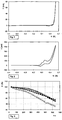
- FIG. 1 shows a cyclic voltammogram using the example of edta dissolved in lye (without co-additives). From a certain potential, depending on the type of complexing agent, an increase in the current is observed, caused by the development of O 2 at the Ni working electrode. Otherwise, there are no peaks which indicate redox reactions of the ligand.
- reaction vessel 0.5 g of chemically oxidized ⁇ -CoOOH is mixed with 10 ml of an electrolyte, which contains a defined amount of the ligands to be examined. Subsequently, the reaction vessel hermetically sealed and stored at room temperature for 7d. The supernatant solution becomes filtered off, and by AES (atomic emission spectroscopy) for complexed dissolved Co's examined.
- AES atomic emission spectroscopy
- Standard electrolyte button cells without added complexing agents reach 90% of their initial capacity after 266 cycles.
- the C / 5 capacity reaches 90% of its initial value after about 420 cycles, in the case of edta after 395 cycles, in the case of ba after 374 cycles, in the case of ea after 344 cycles and in the case of en 311 cycles.
- the complexing agents mentioned in Table 4 for example, salicylaldoxime or N, N-bis (salicylidene) ethylenediamine are also suitable.
- FIG. 3 The influence of the concentration on the cycle behavior is illustrated by FIG . 3 using the example of dmg .
- Plotted is the normalized to 100% capacity over the number of cycles, where: ⁇ a cell without dmg, ⁇ a cell with a dmg content of 32.9 mmol / L, (rhombus) a cell with a dmg content of 8.23 mmol / L and ⁇ a cell with a dmg content of 0.823 mmol / L.
- the figure shows that even small amounts of dmg improve cycle life. Even with a concentration of the ligand in the electrolyte of 0.823 mmol / L, a significant increase in the cycle life is achieved. In this case, 80% of the initial capacity is reached at approximately 570 cycles, whereas cells without complex images already reach the value of 80% of their initial capacity after 410 cycles.
Landscapes
- Engineering & Computer Science (AREA)
- Manufacturing & Machinery (AREA)
- Chemical & Material Sciences (AREA)
- Chemical Kinetics & Catalysis (AREA)
- Electrochemistry (AREA)
- General Chemical & Material Sciences (AREA)
- Battery Electrode And Active Subsutance (AREA)
- Secondary Cells (AREA)
Description
- sie müssen im Elektrolyten hinreichend lange stabil sein
- sie dürfen keinen schädlichen Einfluß auf die Zelle ausüben, z.B. eine überproportionale Erhöhung der Selbstentladung oder Auflösung von Ni(OH)2
- eine Abscheidung von leitfähigem CoOOH aus den entsprechenden Co-Komplexen sollte möglich sein
| Eingesetzte Komplexbildner | |
| Komplexbildner (Ligand) | |
| Amine | |
| Ethylendiamin | en |
| Ethanolamin | ea |
| Ethylendiamintetraessigsäure | edta |
| Oxime | |
| Dimethylglyoxim (Na-Salz) | dmg |
| Benzaldyhydoxim | ba |
| Beispiele zur Löslichkeit von chemisch oxidiertem β-CoOOH in ligandenhaltigem Elektolyt | ||
| CoOOH | ||
| Ligand | cLigand [mol/L] | cCogelöst [mg/L] |
| en | 1.66 | 18 |
| edta | 0.34 | 614 |
| dmg | 0.33 | 4230 |
| ohne | 0.00 | n.n. |
| n.n. - nicht nachweisbar |
- Positive Elektrode:
- 1.80 g Masse (65% Ni(OH)2 + 5% CoO + 30% Ni-Pulver T 255)
- Negative Elektrode:
- 2.20 g einer Mischung aus 97% AB5-Legierung, 2% Ruß und 1 % PTFE
- Separator:
- PE/PP-Vlies
- Elektrolyt:
- 6.5 n KOH + 0.5 n LiOH, 350 µl je Knopfzelle
- Elektroden 2 h bei 20°C in Elektrolyt lagern
- Zellenbau
- Zellen 1 d bei 45°C lagern, 15 h mit C/15 bei Raumtemp. laden, 1 d bei 45°C lagern, Restentladung mit C/5 bis 1.0 V
- 1 Zyklus: Laden, 15 h mit C/10, Entladen mit C/5 bis 1.0 V
- 9 Zyklen: Laden 7 h mit C/5, Entladen mit C/5 bis 1.0 V
- 24 Zyklen: Laden 3 h mit C/2, Entladen mit C/2 bis 1.0 V + 1 Zyklus Laden 7 h mit C/5, Entladen mit C/5 bis 1.0 V; dies ist n-mal zu wiederholen
| Masseausnutzung von Ni(OH)2 in NiMH- Knopfzellen mit Liganden im Elektrolyten, gezeigt an einigen typischen Beispielen | ||||
| Ligand | c Ligand [mmol/L] | c Ligand [%] | CoO-Gehalt [%] | C [% Std.] |
| kein | 0.0 | 0 | 5 | 100 |
| en | 16.6 | 0.1 | 5 | 100 |
| ea | 16.4 | 0.1 | 5 | 100 |
| edta | 34.2 | 1.0 | 5 | 100 |
| dmg | 32.9 | 1.0 | 5 | 101 |
| dmg | 8.23 | 0.25 | 5 | 102 |
| dmg | 0.823 | 0.025 | 5 | 102 |
| ba | 8.25 | 0.1 | 5 | 100 |
| Zyklenlebensdauer von NiMH-Knopfzellen mit ligandenhaltigen Elektrolyten, aufgezeigt an einigen charakteristischen Beispielen | ||
| Ligand | c Ligand [mmol/L] | C/5-Zyklen bis 90% |
| kein | 0.0 | 266 |
| en | 16.6 | 311 |
| ea | 16.4 | 344 |
| edta | 34.2 | 395 |
| dmg | 32.9 | 415 |
| dmg | 8.23 | 427 |
| dmg | 0.823 | 357 |
| ba | 8.25 | 374 |
Claims (4)
- Alkalischer Akkumulator mit einer im Wesentlichen Ni(OH)2 enthaltenden positiven Elektrode, die Cobaltverbindungen wie CoO, Co(OH)2 oder Co-Metall enthält, und mit einem Elektrolyten, dadurch gekennzeichnet, dass im Elektrolyten ein zur Auflösung von chemisch oxidiertem, schwer löslichem CoOOH geeigneter organischer Komplexbildner gelöst ist, der in einer Konzentration von 0,003 bis 0,4 mol % der Gesamtmenge an Cobalt im Akkumulator enthalten ist.
- Alkalischer Akkumulator nach Anspruch 1, dadurch gekennzeichnet, dass der Cobaltkomplexbildner ein ein- bis zweizähniger Ligand mit Amin-, Hydroxy-, Oxim-, und/oder Ketogruppen ist.
- Alkalischer Akkumulator nach Anspruch 1 oder 2, dadurch gekennzeichnet, dass der Cobaltkomplexbildner aus der Gruppe bestehend aus Ethylendiamin, Ethanolamin, Ethylendiamintetraessigsäure, Dimethylglyoxim oder Bezaldehydoxim, Salicylaldoxim und N,N-Bis-(salicyliden)-ethylendiamin ausgewählt ist.
- Akkumulator nach Anspruch 3, dadurch gekennzeichnet, dass 0,025 bis 0,25 % Dimethylglyoxim im Elektrolyt enthalten sind.
Applications Claiming Priority (2)
| Application Number | Priority Date | Filing Date | Title |
|---|---|---|---|
| DE19939369 | 1999-08-19 | ||
| DE19939369A DE19939369A1 (de) | 1999-08-19 | 1999-08-19 | Alkalischer Akkumulator mit Ni(OH)¶2¶ enthaltenden positiven Elektroden |
Publications (2)
| Publication Number | Publication Date |
|---|---|
| EP1077500A1 EP1077500A1 (de) | 2001-02-21 |
| EP1077500B1 true EP1077500B1 (de) | 2005-05-11 |
Family
ID=7918921
Family Applications (1)
| Application Number | Title | Priority Date | Filing Date |
|---|---|---|---|
| EP00114811A Expired - Lifetime EP1077500B1 (de) | 1999-08-19 | 2000-07-11 | Alkalischer Akkumulator mit Ni(OH)2 enthaltenden positiven Elektroden |
Country Status (4)
| Country | Link |
|---|---|
| EP (1) | EP1077500B1 (de) |
| AT (1) | ATE295617T1 (de) |
| DE (2) | DE19939369A1 (de) |
| ES (1) | ES2239972T3 (de) |
Family Cites Families (4)
| Publication number | Priority date | Publication date | Assignee | Title |
|---|---|---|---|---|
| JPS58184274A (ja) * | 1982-04-21 | 1983-10-27 | Fujikura Ltd | 二次電池 |
| FR2632121A1 (fr) * | 1988-05-25 | 1989-12-01 | Berger Michel | Procede de fabrication d'electrodes pour accumulateurs alcalins |
| EP0353837B1 (de) * | 1988-07-19 | 1994-07-27 | Yuasa Corporation | Nickelelektrode für eine alkalische Batterie |
| JP3579131B2 (ja) * | 1995-06-27 | 2004-10-20 | 三洋電機株式会社 | アルカリ蓄電池用ニッケル活物質の製造方法及びアルカリ蓄電池用非焼結式ニッケル極の製造方法 |
-
1999
- 1999-08-19 DE DE19939369A patent/DE19939369A1/de not_active Withdrawn
-
2000
- 2000-07-11 AT AT00114811T patent/ATE295617T1/de not_active IP Right Cessation
- 2000-07-11 DE DE50010272T patent/DE50010272D1/de not_active Expired - Fee Related
- 2000-07-11 ES ES00114811T patent/ES2239972T3/es not_active Expired - Lifetime
- 2000-07-11 EP EP00114811A patent/EP1077500B1/de not_active Expired - Lifetime
Also Published As
| Publication number | Publication date |
|---|---|
| EP1077500A1 (de) | 2001-02-21 |
| DE19939369A1 (de) | 2001-02-22 |
| ATE295617T1 (de) | 2005-05-15 |
| DE50010272D1 (de) | 2005-06-16 |
| ES2239972T3 (es) | 2005-10-16 |
Similar Documents
| Publication | Publication Date | Title |
|---|---|---|
| DE69603532T2 (de) | Sekundärzelle mit nichtwässrigem Elektrolyten und elektrochemischem Pendel | |
| DE69117068T2 (de) | Wasserstoff-speicherelektrode, nickelelektrode und nickel-wasserstoffbatterie | |
| DE60036154T2 (de) | Wiederaufladbare Spinell-Lithiumbatterien mit einer verbesserten Lebensdauer bei erhöhter Temperatur | |
| DE68912566T2 (de) | Alkalische Sammlerbatterie mit einer wasserstoffabsorbierenden Legierung. | |
| DE69635695T2 (de) | Nickel positivelektrode für alkalische Speicherbatterie und gasdichte Nickel-Metallhydrid Speicherbatterie | |
| DE3725629A1 (de) | Galvanisches element | |
| DE3520108A1 (de) | Positive sammlerelektrode fuer akkumulatoren mit alkalischem elektrolyten | |
| DE3586223T2 (de) | Herstellungsmethode einer gasdichtverschlossenen metalloxid-wasserstoffspeicherzelle. | |
| DE4019946C2 (de) | Zelle mit einer positiven Polyanilin-Elektrode | |
| DE68905098T2 (de) | Lithiumsekundaerzelle. | |
| DE69607808T2 (de) | Nickel-Positivelektrode und alkalische Speicherbatterie diese verwendend | |
| DE69835938T2 (de) | Positives aktives Material für alkalische Speicherbatterie | |
| EP0658948B1 (de) | Elektrischer Nickel-Metallhydrid Akkumulator mit graphitenthaltender Nickelhydroxidelektrode | |
| DE69215725T2 (de) | Wasserstoffspeicherlegierung und ihre Verwendung bei einer Elektrode | |
| DE19606879A1 (de) | Verfahren zur Herstellung einer alkalischen Sekundärbatterie, Pluselektrode dafür und hauptgeladene alkalische Sekundärbatterie | |
| EP1077500B1 (de) | Alkalischer Akkumulator mit Ni(OH)2 enthaltenden positiven Elektroden | |
| EP0948826A1 (de) | Verfahren und anode zur verbesserung der leistungsdichte von lithiumsekundärbatterien | |
| DE2933404A1 (de) | Negative elektrode | |
| DE2835836C3 (de) | Alkalische quecksilberfreie galvanische Sekundärzelle mit einem negativen Zwischenseparator | |
| DE19548745C2 (de) | Geschlossene Zink-Alkali-Sekundärbatterie | |
| EP0658947A1 (de) | NI/Metallhydrid-Sekundärelement | |
| DE4004759C2 (de) | ||
| EP1182718B1 (de) | Ni/Metallhydrid-Sekundärelement | |
| EP0552441B1 (de) | Gasdicht verschlossener alkalischer Akkumulator in Knopfzellenform | |
| DE19610523A1 (de) | Wasserstoffspeicherlegierungsanode und Verfahren zu deren Herstellung |
Legal Events
| Date | Code | Title | Description |
|---|---|---|---|
| PUAI | Public reference made under article 153(3) epc to a published international application that has entered the european phase |
Free format text: ORIGINAL CODE: 0009012 |
|
| AK | Designated contracting states |
Kind code of ref document: A1 Designated state(s): AT BE CH CY DE DK ES FI FR GB GR IE IT LI LU MC NL PT SE |
|
| AX | Request for extension of the european patent |
Free format text: AL;LT;LV;MK;RO;SI |
|
| 17P | Request for examination filed |
Effective date: 20010216 |
|
| AKX | Designation fees paid |
Free format text: AT BE CH CY DE DK ES FI FR GB GR IE IT LI LU MC NL PT SE |
|
| RAP1 | Party data changed (applicant data changed or rights of an application transferred) |
Owner name: VARTA AUTOMOTIVE SYSTEMS GMBH |
|
| 17Q | First examination report despatched |
Effective date: 20040413 |
|
| GRAP | Despatch of communication of intention to grant a patent |
Free format text: ORIGINAL CODE: EPIDOSNIGR1 |
|
| GRAS | Grant fee paid |
Free format text: ORIGINAL CODE: EPIDOSNIGR3 |
|
| GRAA | (expected) grant |
Free format text: ORIGINAL CODE: 0009210 |
|
| AK | Designated contracting states |
Kind code of ref document: B1 Designated state(s): AT BE CH CY DE DK ES FI FR GB GR IE IT LI LU MC NL PT SE |
|
| PG25 | Lapsed in a contracting state [announced via postgrant information from national office to epo] |
Ref country code: IT Free format text: LAPSE BECAUSE OF FAILURE TO SUBMIT A TRANSLATION OF THE DESCRIPTION OR TO PAY THE FEE WITHIN THE PRESCRIBED TIME-LIMIT;WARNING: LAPSES OF ITALIAN PATENTS WITH EFFECTIVE DATE BEFORE 2007 MAY HAVE OCCURRED AT ANY TIME BEFORE 2007. THE CORRECT EFFECTIVE DATE MAY BE DIFFERENT FROM THE ONE RECORDED. Effective date: 20050511 Ref country code: IE Free format text: LAPSE BECAUSE OF FAILURE TO SUBMIT A TRANSLATION OF THE DESCRIPTION OR TO PAY THE FEE WITHIN THE PRESCRIBED TIME-LIMIT Effective date: 20050511 Ref country code: FI Free format text: LAPSE BECAUSE OF FAILURE TO SUBMIT A TRANSLATION OF THE DESCRIPTION OR TO PAY THE FEE WITHIN THE PRESCRIBED TIME-LIMIT Effective date: 20050511 Ref country code: NL Free format text: LAPSE BECAUSE OF FAILURE TO SUBMIT A TRANSLATION OF THE DESCRIPTION OR TO PAY THE FEE WITHIN THE PRESCRIBED TIME-LIMIT Effective date: 20050511 |
|
| REG | Reference to a national code |
Ref country code: GB Ref legal event code: FG4D Free format text: NOT ENGLISH |
|
| REG | Reference to a national code |
Ref country code: CH Ref legal event code: EP |
|
| REG | Reference to a national code |
Ref country code: IE Ref legal event code: FG4D Free format text: LANGUAGE OF EP DOCUMENT: GERMAN |
|
| REF | Corresponds to: |
Ref document number: 50010272 Country of ref document: DE Date of ref document: 20050616 Kind code of ref document: P |
|
| PG25 | Lapsed in a contracting state [announced via postgrant information from national office to epo] |
Ref country code: LU Free format text: LAPSE BECAUSE OF NON-PAYMENT OF DUE FEES Effective date: 20050711 Ref country code: CY Free format text: LAPSE BECAUSE OF FAILURE TO SUBMIT A TRANSLATION OF THE DESCRIPTION OR TO PAY THE FEE WITHIN THE PRESCRIBED TIME-LIMIT Effective date: 20050711 Ref country code: AT Free format text: LAPSE BECAUSE OF NON-PAYMENT OF DUE FEES Effective date: 20050711 |
|
| PG25 | Lapsed in a contracting state [announced via postgrant information from national office to epo] |
Ref country code: LI Free format text: LAPSE BECAUSE OF NON-PAYMENT OF DUE FEES Effective date: 20050731 Ref country code: BE Free format text: LAPSE BECAUSE OF NON-PAYMENT OF DUE FEES Effective date: 20050731 Ref country code: CH Free format text: LAPSE BECAUSE OF NON-PAYMENT OF DUE FEES Effective date: 20050731 Ref country code: MC Free format text: LAPSE BECAUSE OF NON-PAYMENT OF DUE FEES Effective date: 20050731 |
|
| ET | Fr: translation filed | ||
| PG25 | Lapsed in a contracting state [announced via postgrant information from national office to epo] |
Ref country code: SE Free format text: LAPSE BECAUSE OF FAILURE TO SUBMIT A TRANSLATION OF THE DESCRIPTION OR TO PAY THE FEE WITHIN THE PRESCRIBED TIME-LIMIT Effective date: 20050811 Ref country code: DK Free format text: LAPSE BECAUSE OF FAILURE TO SUBMIT A TRANSLATION OF THE DESCRIPTION OR TO PAY THE FEE WITHIN THE PRESCRIBED TIME-LIMIT Effective date: 20050811 Ref country code: GR Free format text: LAPSE BECAUSE OF FAILURE TO SUBMIT A TRANSLATION OF THE DESCRIPTION OR TO PAY THE FEE WITHIN THE PRESCRIBED TIME-LIMIT Effective date: 20050811 |
|
| GBT | Gb: translation of ep patent filed (gb section 77(6)(a)/1977) |
Effective date: 20050908 |
|
| REG | Reference to a national code |
Ref country code: ES Ref legal event code: FG2A Ref document number: 2239972 Country of ref document: ES Kind code of ref document: T3 |
|
| PG25 | Lapsed in a contracting state [announced via postgrant information from national office to epo] |
Ref country code: PT Free format text: LAPSE BECAUSE OF FAILURE TO SUBMIT A TRANSLATION OF THE DESCRIPTION OR TO PAY THE FEE WITHIN THE PRESCRIBED TIME-LIMIT Effective date: 20051019 |
|
| NLV1 | Nl: lapsed or annulled due to failure to fulfill the requirements of art. 29p and 29m of the patents act | ||
| REG | Reference to a national code |
Ref country code: IE Ref legal event code: FD4D |
|
| REG | Reference to a national code |
Ref country code: CH Ref legal event code: PL |
|
| PLBE | No opposition filed within time limit |
Free format text: ORIGINAL CODE: 0009261 |
|
| STAA | Information on the status of an ep patent application or granted ep patent |
Free format text: STATUS: NO OPPOSITION FILED WITHIN TIME LIMIT |
|
| 26N | No opposition filed |
Effective date: 20060214 |
|
| PGFP | Annual fee paid to national office [announced via postgrant information from national office to epo] |
Ref country code: DE Payment date: 20070714 Year of fee payment: 8 |
|
| PGFP | Annual fee paid to national office [announced via postgrant information from national office to epo] |
Ref country code: ES Payment date: 20070725 Year of fee payment: 8 |
|
| BERE | Be: lapsed |
Owner name: VARTA AUTOMOTIVE SYSTEMS G.M.B.H. Effective date: 20050731 |
|
| PGFP | Annual fee paid to national office [announced via postgrant information from national office to epo] |
Ref country code: FR Payment date: 20070718 Year of fee payment: 8 |
|
| PGFP | Annual fee paid to national office [announced via postgrant information from national office to epo] |
Ref country code: GB Payment date: 20080723 Year of fee payment: 9 |
|
| PG25 | Lapsed in a contracting state [announced via postgrant information from national office to epo] |
Ref country code: DE Free format text: LAPSE BECAUSE OF NON-PAYMENT OF DUE FEES Effective date: 20090203 |
|
| REG | Reference to a national code |
Ref country code: FR Ref legal event code: ST Effective date: 20090331 |
|
| PG25 | Lapsed in a contracting state [announced via postgrant information from national office to epo] |
Ref country code: FR Free format text: LAPSE BECAUSE OF NON-PAYMENT OF DUE FEES Effective date: 20080731 |
|
| REG | Reference to a national code |
Ref country code: ES Ref legal event code: FD2A Effective date: 20080712 |
|
| PG25 | Lapsed in a contracting state [announced via postgrant information from national office to epo] |
Ref country code: ES Free format text: LAPSE BECAUSE OF NON-PAYMENT OF DUE FEES Effective date: 20080712 |
|
| GBPC | Gb: european patent ceased through non-payment of renewal fee |
Effective date: 20090711 |
|
| PG25 | Lapsed in a contracting state [announced via postgrant information from national office to epo] |
Ref country code: GB Free format text: LAPSE BECAUSE OF NON-PAYMENT OF DUE FEES Effective date: 20090711 |