EP1076458A2 - Twin-Konverter - Google Patents
Twin-Konverter Download PDFInfo
- Publication number
- EP1076458A2 EP1076458A2 EP00115642A EP00115642A EP1076458A2 EP 1076458 A2 EP1076458 A2 EP 1076458A2 EP 00115642 A EP00115642 A EP 00115642A EP 00115642 A EP00115642 A EP 00115642A EP 1076458 A2 EP1076458 A2 EP 1076458A2
- Authority
- EP
- European Patent Office
- Prior art keywords
- twin
- broadband
- frequency band
- output
- converter
- Prior art date
- Legal status (The legal status is an assumption and is not a legal conclusion. Google has not performed a legal analysis and makes no representation as to the accuracy of the status listed.)
- Granted
Links
Images
Classifications
-
- H—ELECTRICITY
- H04—ELECTRIC COMMUNICATION TECHNIQUE
- H04H—BROADCAST COMMUNICATION
- H04H40/00—Arrangements specially adapted for receiving broadcast information
- H04H40/18—Arrangements characterised by circuits or components specially adapted for receiving
- H04H40/27—Arrangements characterised by circuits or components specially adapted for receiving specially adapted for broadcast systems covered by groups H04H20/53 - H04H20/95
- H04H40/90—Arrangements characterised by circuits or components specially adapted for receiving specially adapted for broadcast systems covered by groups H04H20/53 - H04H20/95 specially adapted for satellite broadcast receiving
-
- H—ELECTRICITY
- H04—ELECTRIC COMMUNICATION TECHNIQUE
- H04H—BROADCAST COMMUNICATION
- H04H20/00—Arrangements for broadcast or for distribution combined with broadcast
- H04H20/53—Arrangements specially adapted for specific applications, e.g. for traffic information or for mobile receivers
- H04H20/61—Arrangements specially adapted for specific applications, e.g. for traffic information or for mobile receivers for local area broadcast, e.g. instore broadcast
- H04H20/63—Arrangements specially adapted for specific applications, e.g. for traffic information or for mobile receivers for local area broadcast, e.g. instore broadcast to plural spots in a confined site, e.g. MATV [Master Antenna Television]
-
- H—ELECTRICITY
- H04—ELECTRIC COMMUNICATION TECHNIQUE
- H04N—PICTORIAL COMMUNICATION, e.g. TELEVISION
- H04N21/00—Selective content distribution, e.g. interactive television or video on demand [VOD]
- H04N21/60—Network structure or processes for video distribution between server and client or between remote clients; Control signalling between clients, server and network components; Transmission of management data between server and client, e.g. sending from server to client commands for recording incoming content stream; Communication details between server and client
- H04N21/61—Network physical structure; Signal processing
- H04N21/6106—Network physical structure; Signal processing specially adapted to the downstream path of the transmission network
- H04N21/6143—Network physical structure; Signal processing specially adapted to the downstream path of the transmission network involving transmission via a satellite
-
- H—ELECTRICITY
- H04—ELECTRIC COMMUNICATION TECHNIQUE
- H04N—PICTORIAL COMMUNICATION, e.g. TELEVISION
- H04N7/00—Television systems
- H04N7/20—Adaptations for transmission via a GHz frequency band, e.g. via satellite
-
- H—ELECTRICITY
- H04—ELECTRIC COMMUNICATION TECHNIQUE
- H04N—PICTORIAL COMMUNICATION, e.g. TELEVISION
- H04N5/00—Details of television systems
- H04N5/44—Receiver circuitry for the reception of television signals according to analogue transmission standards
- H04N5/4446—IF amplifier circuits specially adapted for B&W TV
Definitions
- the invention relates to a twin converter according to the preamble of claim 1.
- Twin converters enable not just one, but two connected participants independently of each other, for example the broadband broadcast via ASTRA satellites Signal program offer to receive because of frequency range of 10.7 to 12.75 GHz broadcast there be received independently by each of the two participants can.
- such twin receivers with two Local oscillators or two local oscillator frequencies operable that allow both the lower of the Satellite broadcast frequency band as well as the upper one broadcast frequency band in an overlapping for the connected receivers can receive the intermediate frequency range (IF area) to implement.
- IF area intermediate frequency range
- each of the two can be connected to such a twin receiver connected participants independently select whether it via vertically or horizontally polarized signals programs broadcast in a lower or upper frequency band range wants to receive.
- the switchover takes place as is known in the form of a voltage level switching signal from 13 or 14 volts to 18, for example Volts and by feeding a sound signal of, for example 0 kHz or 22 kHz.
- Such a receiving system and use of a twin converter can then only be used to a very limited extent expand to a community antenna system, where for example four or more than four connected Participants with the interposition of one or more cascaded switching matrix arrangement independently Can receive programs.
- a community antenna system where for example four or more than four connected Participants with the interposition of one or more cascaded switching matrix arrangement independently Can receive programs.
- only two area levels could be received if, for example, at an output of the converter the vertically polarized programs in the lower frequency band and at the other output the horizontally polarized ones Programs also in the lower frequency band queue.
- a twin converter has therefore already been proposed been in normal twin operation only receiving two reception area levels allowed, namely for example independent reception of vertical or horizontal polarized signals in the lower frequency band. So that were the analog programs, but not those in upper frequency band broadcast digital programs receivable.
- Such a converter could become a broadband feed system expanded for a community antenna system be, for example by adding a Satellite crossover with a converter.
- the four outputs formed are in a fixed assignment the vertical lower, the horizontal lower, the vertical upper and horizontal upper frequency band spectrum to receive, so that by adding one or several cascaded switch matrix circuits four or more than four participants independently of one another the whole Frequency spectrum could receive.
- the solution according to the invention becomes a twin converter provided that it is connected to each of two Participants allowed all four area levels receive. Nevertheless, the twin converter according to the invention can also to a broadband feeding system for one Community antenna system can be expanded without new converter circuitry is needed.
- this is achieved in that of the two in a conventional twin converter receivable lower frequency bands at each output at least a polarization encompassing the lower frequency band not narrowband but broadband.
- a narrow-band lower vertical frequency band at one exit there is, for example, the whole Broadband frequency spectrum in the IF level Signal corresponding to the vertical received Polarizations.
- the narrow-band lower frequency band with respect to the horizontal polarization broadband signal with regard to the received horizontal Polarizations indicate that the lower and upper frequency band includes.
- the upper and lower frequency band otherwise in the IF frequency level for example, up to 950 MHz 1950 MHz or from 1100 MHz to 2100 MHz is implemented, includes the broadband implementation on one or the other different output once for the vertical and the horizontal Received signal a broadband implementation of, for example 950 MHz to 3000 MHz.
- the upper frequency spectrum can do this Broadband signal can not be received, but without Significance is because of an appropriate switchover this upper frequency band range by switching into one other reception area level in the usual area of for example, 1100 MHz to 2100 MHz is implemented and is receivable about it.
- the broadband layout of the twin converter allows but then a problem-free expansion to a broadband Community antenna system, in which then both exits be preset so that the broadband vertical and at the other exit the broadband horizontal signal is present.
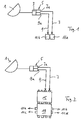
- Figure 1 is a schematic representation of a satellite antenna with a feed system 3 and a downstream Twin converter 5 shown, on its two derivatives 7 and 9 in twin operation, one participant 11a and 11b are connected.
- the frequency band from 10.7 to 11.7 GHz for example also as the lower frequency band and the subsequent one Range from 11.7 to 12.75 GHz also as the upper frequency band can be designated.
- Switching between the four frequency band ranges is carried out by each of the two participants 11a, 11b one from its receiver via leads 7 or 9 of the outputs 7a and 9a of the twin converter Supply voltage, for example in the amount of 13 volts or 18 Volt.
- the low voltage level can be, for example, as Switching voltage to receive vertical polarization and the higher voltage level, for example, as a switchover signal to receive the horizontal polarizations serve.
- Switching from the lower to the upper frequency band range can for example by switching from 0 kHz on a switching tone of 22 kHz.
- the twin converter according to the invention now has the following reception areas as a function of the following switching signals, which are shown in the table below:
- Band 950-3000 MHz Output 2 (9a) 13 V / 0 kHz vertical.
- the four different frequency band ranges can be selected, at the first output 7a a lower frequency band, in the exemplary embodiment shown the lower horizontal frequency band is not narrowband only for receiving frequencies from 950 to for example 1950 MHz, but broadband to receive the whole Frequency spectrum in the IF level from 950 to 3000 MHz is designed.
- reception level namely the complementary one Reception level for receiving the vertical lower Polarization at the other output also not narrowband, but designed broadband and includes that in the IF level implemented entire received frequency spectrum from 950 to 3000 MHz.
- This can be done by using one of the switch setting shown in the table above be, it is only necessary that at a corresponding supply voltage for operation at an output of the twin converter is fed in and in the other Output 0 volts present.
Landscapes
- Engineering & Computer Science (AREA)
- Signal Processing (AREA)
- Physics & Mathematics (AREA)
- Astronomy & Astrophysics (AREA)
- General Physics & Mathematics (AREA)
- Multimedia (AREA)
- Input Circuits Of Receivers And Coupling Of Receivers And Audio Equipment (AREA)
- Glass Compositions (AREA)
Abstract
- der Twin-Konverter (5) ist so aufgebaut, dass im Twin-Betrieb an dessen einem Ausgang (7a) bezüglich einer der vier empfangbaren Bereichsebenen nicht nur das vertikale untere, sondern das gesamte vertikale breitbandige Frequenzbandspektrum ansteht und am anderen Ausgang (9a) bezüglich einer der vier empfangbaren Bereichsebenen nicht nur das horizontale untere, sondern das gesamte horizontale breitbandige Frequenzbandspektrum ansteht, und
- im breitbandigen Gemeinschaftsantennenanlagenbetrieb ist der Twin-Konverter (5) so einstellbar, dass an seinem einen Ausgang (7a) das breitbandige Frequenzbandspektrum zum Empfang der vertikalen und am anderen Ausgang (9a) das breitbandige Frequenzbandspektrum zum Empfang der horizontalen Polarisation ansteht.
Description
- Figur 1 :
- eine schematische Satellitenempfangsanlage für den Twin-Betrieb; und
- Figur 2
- eine entsprechend erweiterte Anlage für eine Gemeinschaftsantennenanlage.
| Schaltsignale | empfangenes Band | |
| Ausgang 1 (7a) | 13 V / 0 kHz | unteres vertikales Band |
| 18 V / 0 kHz | horizont. Band 950-3000 MHz | |
| 13 V / 22 kHz | vertikales oberes Band | |
| 18 V / 22 kHz | horizontales oberes Band | |
| 0 V | horizont. Band 950- 3000 MHz | |
| Ausgang 2 (9a) | 13 V / 0 kHz | vertikal. Band 950-3000 MHz |
| 18 V / 0 kHz | horizontales unteres Band | |
| 13 V / 22 kHz | vertikales oberes Band | |
| 18 V / 22 kHz | horizontales oberes Band | |
| 0 V | vertikal. Band 950-3000 MHz |
Claims (2)
- Twin-Konverter mit den folgenden Merkmalenan den beiden Ausgängen (7a, 9a) können zwei Teilnehmer (11a, 11b) unabhängig voneinander zumindest vier Empfangsbereiche empfangen, nämlich zum einen die vertikal und zum anderen die horizontal polarisierten Signale einmal in einem unteren und zum anderen in einem oberen Frequenzbandbereich, gekennzeichnet durch die folgenden weiteren Merkmaleder Twin-Konverter ist zu einer breitbandigen Gemeinschaftsantennenanlage erweiterbar, über die für mehrere anschließbare Teilnehmer (11) unabhängig voneinander sowohl das untere sowie das obere zum einen vertikal und zum anderen horizontal polarisierte Frequenzspektrum empfangbar ist,der Twin-Konverter (5) ist so aufgebaut, dass im Twin-Betrieb an dessen einem Ausgang (7a) bezüglich einer der vier empfangbaren Bereichsebenen nicht nur das vertikale untere, sondern das gesamte vertikale breitbandige Frequenzbandspektrum ansteht und am anderen Ausgang (9a) bezüglich einer der vier empfangbaren Bereichsebenen nicht nur das horizontale untere, sondern das gesamte horizontale breitbandige Frequenzbandspektrum ansteht, undim breitbandigen Gemeinschaftsantennenanlagenbetrieb ist der Twin-Konverter (5) so einstellbar, dass an seinem einen Ausgang (7a) das breitbandige Frequenzbandspektrum zum Empfang der vertikalen und am anderen Ausgang (9a) das breitbandige Frequenzbandspektrum zum Empfang der horizontalen Polarisation ansteht.
- Konverter nach einem der Ansprüche 1 bis 3, dadurch gekennzeichnet, dass im breitbandigen Gemeinschaftsantennenanlagenbetrieb eine Energieversorgung des Twin-Konverters über nur einen Ausgang (7a oder 9a) ausreichend ist und das breitbandige vertikale bzw. breitbandige horizontale Ausgangssignal am betreffenden Ausgang (7a, 9a) auch dann anliegt, wenn an dem jeweils anderen Ausgang eine (9a, 7a) 0 Volt Schaltspannung anliegt.
Priority Applications (1)
| Application Number | Priority Date | Filing Date | Title |
|---|---|---|---|
| DK00115642T DK1076458T3 (da) | 1999-08-12 | 2000-07-20 | Twin-konverter |
Applications Claiming Priority (2)
| Application Number | Priority Date | Filing Date | Title |
|---|---|---|---|
| DE29914050U | 1999-08-12 | ||
| DE29914050U DE29914050U1 (de) | 1999-08-12 | 1999-08-12 | Twin-Konverter |
Publications (3)
| Publication Number | Publication Date |
|---|---|
| EP1076458A2 true EP1076458A2 (de) | 2001-02-14 |
| EP1076458A3 EP1076458A3 (de) | 2001-09-12 |
| EP1076458B1 EP1076458B1 (de) | 2005-04-06 |
Family
ID=8077378
Family Applications (1)
| Application Number | Title | Priority Date | Filing Date |
|---|---|---|---|
| EP00115642A Expired - Lifetime EP1076458B1 (de) | 1999-08-12 | 2000-07-20 | Twin-Konverter |
Country Status (5)
| Country | Link |
|---|---|
| EP (1) | EP1076458B1 (de) |
| AT (1) | ATE292875T1 (de) |
| DE (2) | DE29914050U1 (de) |
| DK (1) | DK1076458T3 (de) |
| ES (1) | ES2238226T3 (de) |
Cited By (1)
| Publication number | Priority date | Publication date | Assignee | Title |
|---|---|---|---|---|
| WO2003094397A1 (de) * | 2002-05-03 | 2003-11-13 | Kathrein Werke Ag | Verfahren sowie vorrichtung zur erzeugung zumindest eines transponders in der satelliten-zwischenfrequenz-ebene |
Families Citing this family (1)
| Publication number | Priority date | Publication date | Assignee | Title |
|---|---|---|---|---|
| DE20021703U1 (de) * | 2000-12-22 | 2001-03-22 | Kathrein-Werke Kg, 83022 Rosenheim | Twin-Konverteranordnung |
Family Cites Families (2)
| Publication number | Priority date | Publication date | Assignee | Title |
|---|---|---|---|---|
| DE19543717A1 (de) * | 1995-06-19 | 1997-01-02 | Anna Detterbeck | Verfahren und Vorrichtung zur Verarbeitung und Übertragung von Hochfrequenzsignalen |
| DE29716786U1 (de) * | 1997-09-18 | 1997-11-27 | Yen, Kerl, Chung Li, Taoyuan | Satellitenfrequenzdemultiplexer mit Signalteilung am Welleneingang |
-
1999
- 1999-08-12 DE DE29914050U patent/DE29914050U1/de not_active Expired - Lifetime
-
2000
- 2000-07-20 DK DK00115642T patent/DK1076458T3/da active
- 2000-07-20 EP EP00115642A patent/EP1076458B1/de not_active Expired - Lifetime
- 2000-07-20 AT AT00115642T patent/ATE292875T1/de active
- 2000-07-20 ES ES00115642T patent/ES2238226T3/es not_active Expired - Lifetime
- 2000-07-20 DE DE50009966T patent/DE50009966D1/de not_active Expired - Lifetime
Cited By (1)
| Publication number | Priority date | Publication date | Assignee | Title |
|---|---|---|---|---|
| WO2003094397A1 (de) * | 2002-05-03 | 2003-11-13 | Kathrein Werke Ag | Verfahren sowie vorrichtung zur erzeugung zumindest eines transponders in der satelliten-zwischenfrequenz-ebene |
Also Published As
| Publication number | Publication date |
|---|---|
| EP1076458B1 (de) | 2005-04-06 |
| DE50009966D1 (de) | 2005-05-12 |
| DE29914050U1 (de) | 1999-11-11 |
| ATE292875T1 (de) | 2005-04-15 |
| ES2238226T3 (es) | 2005-09-01 |
| DK1076458T3 (da) | 2005-06-27 |
| EP1076458A3 (de) | 2001-09-12 |
Similar Documents
| Publication | Publication Date | Title |
|---|---|---|
| DE19749120C2 (de) | Satelliten-Empfangsanlage sowie zugehöriges Verfahren zum Betrieb einer Antennen-Empfangsanlage | |
| DE3247082A1 (de) | Abstimmschaltungsanordnung vom pll-typ | |
| EP1050920B1 (de) | Quatro-Konverter | |
| DE69522126T2 (de) | Tuner für Satelliten-Rundfunkempfänger | |
| EP1076458B1 (de) | Twin-Konverter | |
| DE102007011401B3 (de) | Einkabel-Satelliten-Empfangssystem | |
| DE4335616C2 (de) | Satellitenempfangsanlage | |
| DE3021225A1 (de) | Abstimmvorrichtung | |
| EP0757489A2 (de) | Satelliten-Empfangsanlage mit steuerbarer Kopfstation | |
| EP1502371B1 (de) | Verfahren sowie vorrichtung zur erzeugung zumindest einer transponderfrequenz in der satelliten-zwischenfrequenz-ebene | |
| DE69724916T2 (de) | Videokommunikationsnetzwerk | |
| DE19713124C2 (de) | Satelliten-Empfangsanlage | |
| EP1217836B1 (de) | Twin-Konverteranordnung | |
| DE60120837T2 (de) | Zwischenfrequenzabstimmschaltung eines Fernsehtuners, wobei FM-Empfang möglich ist | |
| EP1076457B1 (de) | Satellitenempfangsanlage mit Zuschaltgerät | |
| DE4128947C2 (de) | Gerät für Satellitenempfangsanlagen | |
| DE3204172A1 (de) | Fernsehempfaenger-schaltung zur demodulation von nach verschiedenen sendenormen ausgestrahlten tonsignalen | |
| DE3020135C2 (de) | Schaltungsanordnung für die selbsttätige Einstellung eines Funkempfängers auf einen Sender | |
| DE4335617C2 (de) | Satellitenempfangsanlage | |
| EP1110317B1 (de) | Rundfunkempfangsgerät | |
| DE4243967A1 (de) | Umschalteinrichtung für Satellitenempfangsanlagen | |
| DE20211276U1 (de) | Schaltvorrichtung für eine Satelliten-Empfangsanlage | |
| DE2906059A1 (de) | Frequenzsynthese-steuersystem | |
| DE931712C (de) | Fernsehempfaenger zum Empfang von Sendungen in invertierten Kanaelen | |
| DE3034530A1 (de) | Abstimmvorrichtung |
Legal Events
| Date | Code | Title | Description |
|---|---|---|---|
| PUAI | Public reference made under article 153(3) epc to a published international application that has entered the european phase |
Free format text: ORIGINAL CODE: 0009012 |
|
| AK | Designated contracting states |
Kind code of ref document: A2 Designated state(s): AT BE CH CY DE DK ES FI FR GB GR IE IT LI LU MC NL PT SE |
|
| AX | Request for extension of the european patent |
Free format text: AL;LT;LV;MK;RO;SI |
|
| PUAL | Search report despatched |
Free format text: ORIGINAL CODE: 0009013 |
|
| AK | Designated contracting states |
Kind code of ref document: A3 Designated state(s): AT BE CH CY DE DK ES FI FR GB GR IE IT LI LU MC NL PT SE |
|
| AX | Request for extension of the european patent |
Free format text: AL;LT;LV;MK;RO;SI |
|
| RIC1 | Information provided on ipc code assigned before grant |
Free format text: 7H 04N 7/20 A, 7H 04H 1/00 B |
|
| 17P | Request for examination filed |
Effective date: 20011213 |
|
| AKX | Designation fees paid |
Free format text: AT BE CH CY DE DK ES FI FR GB GR IE IT LI LU MC NL PT SE |
|
| GRAP | Despatch of communication of intention to grant a patent |
Free format text: ORIGINAL CODE: EPIDOSNIGR1 |
|
| GRAS | Grant fee paid |
Free format text: ORIGINAL CODE: EPIDOSNIGR3 |
|
| GRAA | (expected) grant |
Free format text: ORIGINAL CODE: 0009210 |
|
| AK | Designated contracting states |
Kind code of ref document: B1 Designated state(s): AT BE CH CY DE DK ES FI FR GB GR IE IT LI LU MC NL PT SE |
|
| PG25 | Lapsed in a contracting state [announced via postgrant information from national office to epo] |
Ref country code: FI Free format text: LAPSE BECAUSE OF FAILURE TO SUBMIT A TRANSLATION OF THE DESCRIPTION OR TO PAY THE FEE WITHIN THE PRESCRIBED TIME-LIMIT Effective date: 20050406 Ref country code: IE Free format text: LAPSE BECAUSE OF FAILURE TO SUBMIT A TRANSLATION OF THE DESCRIPTION OR TO PAY THE FEE WITHIN THE PRESCRIBED TIME-LIMIT Effective date: 20050406 |
|
| REG | Reference to a national code |
Ref country code: GB Ref legal event code: FG4D Free format text: NOT ENGLISH |
|
| REG | Reference to a national code |
Ref country code: CH Ref legal event code: EP |
|
| GBT | Gb: translation of ep patent filed (gb section 77(6)(a)/1977) |
Effective date: 20050406 |
|
| REG | Reference to a national code |
Ref country code: IE Ref legal event code: FG4D Free format text: LANGUAGE OF EP DOCUMENT: GERMAN |
|
| REF | Corresponds to: |
Ref document number: 50009966 Country of ref document: DE Date of ref document: 20050512 Kind code of ref document: P |
|
| REG | Reference to a national code |
Ref country code: CH Ref legal event code: NV Representative=s name: SCHMAUDER & PARTNER AG PATENTANWALTSBUERO |
|
| REG | Reference to a national code |
Ref country code: GR Ref legal event code: EP Ref document number: 20050401657 Country of ref document: GR |
|
| REG | Reference to a national code |
Ref country code: DK Ref legal event code: T3 |
|
| PG25 | Lapsed in a contracting state [announced via postgrant information from national office to epo] |
Ref country code: SE Free format text: LAPSE BECAUSE OF FAILURE TO SUBMIT A TRANSLATION OF THE DESCRIPTION OR TO PAY THE FEE WITHIN THE PRESCRIBED TIME-LIMIT Effective date: 20050706 |
|
| PG25 | Lapsed in a contracting state [announced via postgrant information from national office to epo] |
Ref country code: CY Free format text: LAPSE BECAUSE OF FAILURE TO SUBMIT A TRANSLATION OF THE DESCRIPTION OR TO PAY THE FEE WITHIN THE PRESCRIBED TIME-LIMIT Effective date: 20050720 Ref country code: LU Free format text: LAPSE BECAUSE OF NON-PAYMENT OF DUE FEES Effective date: 20050720 |
|
| PG25 | Lapsed in a contracting state [announced via postgrant information from national office to epo] |
Ref country code: MC Free format text: LAPSE BECAUSE OF NON-PAYMENT OF DUE FEES Effective date: 20050731 |
|
| REG | Reference to a national code |
Ref country code: ES Ref legal event code: FG2A Ref document number: 2238226 Country of ref document: ES Kind code of ref document: T3 |
|
| PG25 | Lapsed in a contracting state [announced via postgrant information from national office to epo] |
Ref country code: PT Free format text: LAPSE BECAUSE OF FAILURE TO SUBMIT A TRANSLATION OF THE DESCRIPTION OR TO PAY THE FEE WITHIN THE PRESCRIBED TIME-LIMIT Effective date: 20050908 |
|
| REG | Reference to a national code |
Ref country code: IE Ref legal event code: FD4D |
|
| PLBE | No opposition filed within time limit |
Free format text: ORIGINAL CODE: 0009261 |
|
| STAA | Information on the status of an ep patent application or granted ep patent |
Free format text: STATUS: NO OPPOSITION FILED WITHIN TIME LIMIT |
|
| ET | Fr: translation filed | ||
| 26N | No opposition filed |
Effective date: 20060110 |
|
| REG | Reference to a national code |
Ref country code: CH Ref legal event code: PCAR Free format text: SCHMAUDER & PARTNER AG PATENT- UND MARKENANWAELTE VSP;ZWAENGIWEG 7;8038 ZUERICH (CH) |
|
| PGFP | Annual fee paid to national office [announced via postgrant information from national office to epo] |
Ref country code: NL Payment date: 20130722 Year of fee payment: 14 Ref country code: ES Payment date: 20130722 Year of fee payment: 14 Ref country code: DK Payment date: 20130724 Year of fee payment: 14 Ref country code: BE Payment date: 20130722 Year of fee payment: 14 Ref country code: GR Payment date: 20130729 Year of fee payment: 14 |
|
| PGFP | Annual fee paid to national office [announced via postgrant information from national office to epo] |
Ref country code: GB Payment date: 20130723 Year of fee payment: 14 Ref country code: FR Payment date: 20130719 Year of fee payment: 14 |
|
| PGFP | Annual fee paid to national office [announced via postgrant information from national office to epo] |
Ref country code: IT Payment date: 20130729 Year of fee payment: 14 |
|
| PGFP | Annual fee paid to national office [announced via postgrant information from national office to epo] |
Ref country code: CH Payment date: 20140722 Year of fee payment: 15 |
|
| REG | Reference to a national code |
Ref country code: DK Ref legal event code: EBP Effective date: 20140731 |
|
| REG | Reference to a national code |
Ref country code: NL Ref legal event code: V1 Effective date: 20150201 |
|
| GBPC | Gb: european patent ceased through non-payment of renewal fee |
Effective date: 20140720 |
|
| PG25 | Lapsed in a contracting state [announced via postgrant information from national office to epo] |
Ref country code: NL Free format text: LAPSE BECAUSE OF NON-PAYMENT OF DUE FEES Effective date: 20150201 |
|
| REG | Reference to a national code |
Ref country code: GR Ref legal event code: ML Ref document number: 20050401657 Country of ref document: GR Effective date: 20150204 |
|
| REG | Reference to a national code |
Ref country code: FR Ref legal event code: ST Effective date: 20150331 |
|
| PG25 | Lapsed in a contracting state [announced via postgrant information from national office to epo] |
Ref country code: IT Free format text: LAPSE BECAUSE OF NON-PAYMENT OF DUE FEES Effective date: 20140720 |
|
| PG25 | Lapsed in a contracting state [announced via postgrant information from national office to epo] |
Ref country code: GR Free format text: LAPSE BECAUSE OF NON-PAYMENT OF DUE FEES Effective date: 20150204 Ref country code: FR Free format text: LAPSE BECAUSE OF NON-PAYMENT OF DUE FEES Effective date: 20140731 Ref country code: GB Free format text: LAPSE BECAUSE OF NON-PAYMENT OF DUE FEES Effective date: 20140720 |
|
| PG25 | Lapsed in a contracting state [announced via postgrant information from national office to epo] |
Ref country code: DK Free format text: LAPSE BECAUSE OF NON-PAYMENT OF DUE FEES Effective date: 20140731 |
|
| REG | Reference to a national code |
Ref country code: ES Ref legal event code: FD2A Effective date: 20150826 |
|
| PG25 | Lapsed in a contracting state [announced via postgrant information from national office to epo] |
Ref country code: ES Free format text: LAPSE BECAUSE OF NON-PAYMENT OF DUE FEES Effective date: 20140721 |
|
| PGFP | Annual fee paid to national office [announced via postgrant information from national office to epo] |
Ref country code: AT Payment date: 20150722 Year of fee payment: 16 |
|
| REG | Reference to a national code |
Ref country code: CH Ref legal event code: PL |
|
| PG25 | Lapsed in a contracting state [announced via postgrant information from national office to epo] |
Ref country code: LI Free format text: LAPSE BECAUSE OF NON-PAYMENT OF DUE FEES Effective date: 20150731 Ref country code: CH Free format text: LAPSE BECAUSE OF NON-PAYMENT OF DUE FEES Effective date: 20150731 |
|
| PGFP | Annual fee paid to national office [announced via postgrant information from national office to epo] |
Ref country code: DE Payment date: 20160721 Year of fee payment: 17 |
|
| REG | Reference to a national code |
Ref country code: AT Ref legal event code: MM01 Ref document number: 292875 Country of ref document: AT Kind code of ref document: T Effective date: 20160720 |
|
| PG25 | Lapsed in a contracting state [announced via postgrant information from national office to epo] |
Ref country code: AT Free format text: LAPSE BECAUSE OF NON-PAYMENT OF DUE FEES Effective date: 20160720 |
|
| PG25 | Lapsed in a contracting state [announced via postgrant information from national office to epo] |
Ref country code: BE Free format text: LAPSE BECAUSE OF NON-PAYMENT OF DUE FEES Effective date: 20140731 |
|
| REG | Reference to a national code |
Ref country code: DE Ref legal event code: R119 Ref document number: 50009966 Country of ref document: DE |
|
| PG25 | Lapsed in a contracting state [announced via postgrant information from national office to epo] |
Ref country code: DE Free format text: LAPSE BECAUSE OF NON-PAYMENT OF DUE FEES Effective date: 20180201 |