EP1069492A2 - Sicherheitsmodul zur Überwachung der Systemsicherheit und Verfahren - Google Patents
Sicherheitsmodul zur Überwachung der Systemsicherheit und Verfahren Download PDFInfo
- Publication number
- EP1069492A2 EP1069492A2 EP00250184A EP00250184A EP1069492A2 EP 1069492 A2 EP1069492 A2 EP 1069492A2 EP 00250184 A EP00250184 A EP 00250184A EP 00250184 A EP00250184 A EP 00250184A EP 1069492 A2 EP1069492 A2 EP 1069492A2
- Authority
- EP
- European Patent Office
- Prior art keywords
- security module
- security
- validation
- system state
- data
- Prior art date
- Legal status (The legal status is an assumption and is not a legal conclusion. Google has not performed a legal analysis and makes no representation as to the accuracy of the status listed.)
- Withdrawn
Links
Images

Classifications
-
- G—PHYSICS
- G06—COMPUTING OR CALCULATING; COUNTING
- G06F—ELECTRIC DIGITAL DATA PROCESSING
- G06F21/00—Security arrangements for protecting computers, components thereof, programs or data against unauthorised activity
- G06F21/50—Monitoring users, programs or devices to maintain the integrity of platforms, e.g. of processors, firmware or operating systems
- G06F21/57—Certifying or maintaining trusted computer platforms, e.g. secure boots or power-downs, version controls, system software checks, secure updates or assessing vulnerabilities
-
- G—PHYSICS
- G07—CHECKING-DEVICES
- G07B—TICKET-ISSUING APPARATUS; FARE-REGISTERING APPARATUS; FRANKING APPARATUS
- G07B17/00—Franking apparatus
- G07B17/00733—Cryptography or similar special procedures in a franking system
-
- G—PHYSICS
- G06—COMPUTING OR CALCULATING; COUNTING
- G06F—ELECTRIC DIGITAL DATA PROCESSING
- G06F2207/00—Indexing scheme relating to methods or arrangements for processing data by operating upon the order or content of the data handled
- G06F2207/72—Indexing scheme relating to groups G06F7/72 - G06F7/729
- G06F2207/7219—Countermeasures against side channel or fault attacks
-
- G—PHYSICS
- G07—CHECKING-DEVICES
- G07B—TICKET-ISSUING APPARATUS; FARE-REGISTERING APPARATUS; FRANKING APPARATUS
- G07B17/00—Franking apparatus
- G07B17/00185—Details internally of apparatus in a franking system, e.g. franking machine at customer or apparatus at post office
- G07B17/00193—Constructional details of apparatus in a franking system
- G07B2017/00233—Housing, e.g. lock or hardened casing
-
- G—PHYSICS
- G07—CHECKING-DEVICES
- G07B—TICKET-ISSUING APPARATUS; FARE-REGISTERING APPARATUS; FRANKING APPARATUS
- G07B17/00—Franking apparatus
- G07B17/00185—Details internally of apparatus in a franking system, e.g. franking machine at customer or apparatus at post office
- G07B17/00193—Constructional details of apparatus in a franking system
- G07B2017/00258—Electronic hardware aspects, e.g. type of circuits used
-
- G—PHYSICS
- G07—CHECKING-DEVICES
- G07B—TICKET-ISSUING APPARATUS; FARE-REGISTERING APPARATUS; FRANKING APPARATUS
- G07B17/00—Franking apparatus
- G07B17/00185—Details internally of apparatus in a franking system, e.g. franking machine at customer or apparatus at post office
- G07B17/00314—Communication within apparatus, personal computer [PC] system, or server, e.g. between printhead and central unit in a franking machine
- G07B2017/00322—Communication between components/modules/parts, e.g. printer, printhead, keyboard, conveyor or central unit
-
- G—PHYSICS
- G07—CHECKING-DEVICES
- G07B—TICKET-ISSUING APPARATUS; FARE-REGISTERING APPARATUS; FRANKING APPARATUS
- G07B17/00—Franking apparatus
- G07B17/00185—Details internally of apparatus in a franking system, e.g. franking machine at customer or apparatus at post office
- G07B17/00314—Communication within apparatus, personal computer [PC] system, or server, e.g. between printhead and central unit in a franking machine
- G07B2017/00338—Error detection or handling
-
- G—PHYSICS
- G07—CHECKING-DEVICES
- G07B—TICKET-ISSUING APPARATUS; FARE-REGISTERING APPARATUS; FRANKING APPARATUS
- G07B17/00—Franking apparatus
- G07B17/00185—Details internally of apparatus in a franking system, e.g. franking machine at customer or apparatus at post office
- G07B17/00362—Calculation or computing within apparatus, e.g. calculation of postage value
- G07B2017/00395—Memory organization
-
- G—PHYSICS
- G07—CHECKING-DEVICES
- G07B—TICKET-ISSUING APPARATUS; FARE-REGISTERING APPARATUS; FRANKING APPARATUS
- G07B17/00—Franking apparatus
- G07B17/00185—Details internally of apparatus in a franking system, e.g. franking machine at customer or apparatus at post office
- G07B17/00362—Calculation or computing within apparatus, e.g. calculation of postage value
- G07B2017/00395—Memory organization
- G07B2017/00403—Memory zones protected from unauthorized reading or writing
-
- G—PHYSICS
- G07—CHECKING-DEVICES
- G07B—TICKET-ISSUING APPARATUS; FARE-REGISTERING APPARATUS; FRANKING APPARATUS
- G07B17/00—Franking apparatus
- G07B17/00733—Cryptography or similar special procedures in a franking system
- G07B2017/00959—Cryptographic modules, e.g. a PC encryption board
- G07B2017/00967—PSD [Postal Security Device] as defined by the USPS [US Postal Service]
Definitions
- the invention relates to a security module for monitoring the System security, in accordance with the preamble of claim 1 specified type and for a method for monitoring the System security in accordance with the preamble of claim 13 specified type.
- a postal security module is especially for use in a franking machine or Mail processing machine or computer with mail processing function suitable.
- Modern franking machines, or other devices for franking from Postgut are using a printer to print the postage stamp on the postal matter, with a control for controlling the printing and the peripheral components of the franking machine, with an accounting unit for billing postal charges that are in non-volatile Stores are kept, and a cryptographic unit Secure postage data.
- the accounting unit and / or the unit for securing the printing of the postage data can be implemented by a security module (EP 789 333 A2).
- the processor of the security module is an OTP, for example (One Time Programmable), which sensitive data, such as cryptographic Key that saves read-out.
- OTP for example (One Time Programmable)
- the invention has for its object a for a security module to achieve maximum security.
- a procedure is to be found which with maximum effort ensures maximum security for allows definable areas and functions of a system, and which universal, d. H. with minimal adjustment effort different electronic systems can be used.
- the method is to be used in franking machines, for example, for the special security requirements apply because the monetary values Billing data must be manipulable.
- the object is with the features of claim 1 for an arrangement and solved with the features of claim 13 for a method.
- a modular structure of the security procedure provides for a two-stage, overlapping check, which basically differentiates between static and dynamic states of the system.
- the data, functions and patterns stored in non-volatile memory areas are suitable for mapping a system status.
- Predetermined sub-areas of the memory can be assigned to specific data processing units and the data stored therein create an image which is characteristic of the status of the system that has been reached.
- Predetermined sub-areas of the memory can be assigned to specific images that are reached one after the other in time.
- the validation of a system status in the event of dynamic changes is based on the overlapping processing of data from at least parts of the test pattern, functional scope or memory area used individually or in combination with one another.
- the overlapping processing consists in mutually exchanging the data supplied by one specific data processing unit and the data supplied by another specific data processing unit and, in one embodiment, a redundant security function on the exchanged data by both data processing units.
- the results of the redundant data processing must be comparable for an unmanipulated and error-free system.
- a security module for a data processing system for example a franking machine, performs its function, for example a billing of the postal charges and / or its cryptographic security.
- the security module has a module processor and a hardware accounting unit.
- the security module is characterized by its own signaling means which, when directly controlled by the processor of the security module, allow a statement to be made about the current status of the security module.
- the signaling of the module status is only activated when the safety module is supplied with system voltage in order to protect an internal battery.
- the processor can also monitor or check the work of the hardware accounting unit. It is not intended to check the settlement itself for accuracy. Can also by one Pattern "comparison of a definable memory area, no backward mapping of the postal registers can be achieved, since the checksums are formed over the data of the entire security-relevant memory area. Because the focus is not on system availability, but on the reliable detection of malfunctions or failures and a suitable reaction on how it is the case with particularly security-sensitive, rather time-uncritical processes.
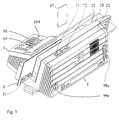
- FIG. 1 is a perspective view of the franking machine from FIG shown at the back.
- the franking machine consists of a meter 1 and a base 2.
- the latter is with a chip card read / write unit 70 equipped, which is arranged behind the guide plate 20 and from the Upper housing edge 22 is accessible.
- a chip card 49 is turned upwards inserted into the slot 72 below.
- the guide plate is in contact with the input data a franking stamp 31 printed.
- the letter feed opening is through a transparent plate 21 and the guide plate 20 laterally limited.
- the module is plugged onto the main board of the meter of the franking machine or another suitable device. It is preferably housed within the meter housing, which is designed as a safety housing.
- the meter housing is advantageously constructed so that the user can still see the status display of the security module from the outside through an opening 109, the opening 109 extending to the user interface 88, 89 of the meter 1.
- the display is controlled directly by the module's internal processor and is therefore not easily manipulated from the outside.
- the display is constantly active in the operating state, so that the application of the system voltage Us + to the processor of the safety module is sufficient to activate the display in order to be able to read the module state.
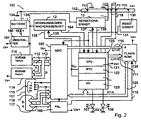
- FIG. 2 shows a block diagram of the postal security module PSM 100 in a preferred variant.
- the negative pole of the battery 134 is grounded and a pin P23 of the contact group 102.
- the positive pole of the battery 134 is connected via line 193 to one input of voltage changeover switch 180 and line 191 carrying system voltage is connected to the other input of voltage changeover switch 180.
- the SL-389 / P is suitable as a battery 134 for a lifespan of up to 3.5 years or the SL-386 / P for a lifespan of up to 6 years with a maximum power consumption by the PSM 100 commercially available circuit type ADM 8693ARN can be used.
- the output of the voltage changeover switch 180 is connected to a voltage monitoring unit 12 and a detection unit 13 via the line 136.
- the voltage monitoring unit 12 and the detection unit 13 are in communication with the pins 1, 2, 4 and 5 of the processor 120 via the lines 135, 164 and 137, 139.
- the output of the voltage switch 180 is also present via the line 136 at the supply input of a first memory SRAM, which becomes a non-volatile memory NVRAM 116 of a first technology due to the existing battery 134.
- the security module is connected to the franking machine via the system bus 115, 117, 118.
- Processor 120 can communicate with a remote data center through the system bus and modem 83.
- the billing is carried out by the ASIC 150.
- the postal accounting data are stored in non-volatile memories of different technologies.
- System voltage is present at the supply input of a second memory NV-RAM 114.
- This second technology preferably comprises a RAM and an EEPROM, the latter automatically taking over the data content in the event of a system power failure.
- the NVRAM 114 of the second technology is connected to the corresponding address and data inputs of the ASIC 150 via an internal address and data bus 112, 113.
- the ASIC 150 contains at least one hardware accounting unit for the calculation of the postal data to be stored.
- An access logic for the ASIC 150 is accommodated in the programmable array logic (PAL) 160.
- the ASIC 150 is controlled by the PAL 160 logic.
- An address and control bus 117, 115 from the main board of meter 1 is connected to corresponding pins of the logic PAL 160 and the PAL 160 generates at least one control signal for the ASIC 150 and one control signal 119 for the program memory FLASH 128.
- the processor 120 works Program stored in the FLASH 128.
- the processor 120, FLASH 28, ASIC 12 and PAL 160 are connected to one another via an internal system bus which contains lines 110, 111, 126, 119 for data, address and control signals.
- the RESET unit 130 is connected via line 131 to pin 3 of the Processor 120 and connected to a pin of the ASIC's 150.
- the Processor 120 and the ASIC 150 are when the Supply voltage through a reset generation in the RESET unit 130 reset.
- the processor 120 internally has a processing unit CPU 121, one Real time clock RTC 122, a RAM unit 124 and an input / output unit 125 on.
- the processor 120 of the security module 100 is via a Internal data bus 126 with a FLASH 128 and with the ASIC 150 connected.
- the FLASH 128 serves as program memory and is included System voltage Us + supplied. For example, it is a 128 Kbyte FLASH memory type AM29F010-45EC.
- the ASIC 150 of the postal security module 100 delivers via an internal module Address bus 110 addresses 0 through 7 to the corresponding address inputs of the FLASH 128.
- the processor 120 of the security module 100 delivers the addresses 8 to 15 to the via an internal address bus 111 corresponding address inputs of the FLASH 128.
- the ASIC 150 of the Security module 100 is located above contact group 101 of the interface with data bus 118, with address bus 117 and control bus 115 the main board of the meter 1 in communication connection.
- the voltage switch 180 gives as the output voltage on the Line 136 for the voltage monitoring unit 12 and memory 116 that of its input voltages further, the greater than the other is. Due to the possibility of depending on the circuit described of the level of the voltages Us + and Ub + automatically with the To feed the larger of the two can during normal operation Battery 134 can be replaced without data loss.
- the RTC real-time clock 122 and the memory RAM 124 are powered by an operating voltage line 138 supplies. This voltage is from the voltage monitoring unit 12 generated.
- the battery of the franking machine feeds outside during idle times the normal operation in the aforementioned manner with the real-time clock 122 Date and / or time registers and / or static RAM (SRAM) 124, which holds security-relevant data.
- the battery voltage drops during battery operation below a certain limit, from the circuit 12 is the feed point for RTC and SRAM with ground connected. This means that the voltage is on the RTC and on the SRAM then at 0V.
- the SRAM 124 e.g. important contains cryptographic keys, is deleted very quickly.
- the registers of the RTC 122 and the current time are also deleted and the current date will be lost.
- the circuit of the voltage monitoring unit 12 is, for example dimensioned so that any drop in battery voltage on the Line 136 below the specified 2.6 V threshold to respond the circuit 12 leads. Simultaneously with the indication of undervoltage the battery, the circuit 12 changes to a self-holding state, in to which it remains even when the voltage is increased afterwards. It delivers also a status signal 164. The next time the module is switched on the processor can query the status of the circuit (status signal) and thus and / or through the evaluation of the content of the deleted The memory suggests that the battery voltage in the meantime has fallen below a certain value. The processor can Reset monitoring circuit 12, i.e. "make sharp. Latter responds to a control signal on line 135.
- the line 136 at the input of the battery observer 12 also supplies a detection unit 13 with operating or battery voltage.
- the processor 120 queries the state of the detection unit 13 via the line 139 or the detection unit 13 is triggered or set by the processor 120 via the line 137. After setting, a static check for connection is carried out. For this purpose, a ground potential is queried via a line 192, which is present at connection P4 of the interface of the postal security module PSM 100 and can only be queried if the security module 100 is properly inserted.
- the ground potential of the negative pole 104 of the battery 134 of the postal security module PSM 100 is connected to the connection P23 of the interface 8 and can thus be queried by the detection unit 13 at the connection P4 of the interface via the line 192.
- Cables are connected to pins 6 and 7 of processor 120, which only form a conductor loop 18 when a security module 100 is plugged in, for example on the main circuit board of meter 1.
- changing signal levels are applied by the processor 120 at very irregular time intervals to the pins 6, 7 and looped back over the loop.
- the processor 120 is equipped with the input / output unit 125, whose connections pins 8, 9 for outputting at least one signal for Signaling the state of the security module 100 serve.
- To the Pins 8 and 9 are I / O ports of the input / output unit 125, to which Internal signal means are connected, for example colored Light emitting diodes LEDs 107, 108. These signal the module status with a security module plugged onto the main board of meter 1 100 through an opening 109 in the meter housing.
- the security modules can assume various states in their life cycle. For example, be detected whether the module is valid contains cryptographic keys. Furthermore, it is also important to distinguish whether the module is working or defective. The exact type and number of module states is dependent on the functions implemented in the Module and depending on the implementation.
- FIG. 3 shows the mechanical structure of the security module in side view.
- the security module is designed as a multi-chip module, i.e. several functional units are on a printed circuit board 106 interconnected.
- the security module 100 is with a hard potting compound 105 potted, the battery 134 of the security module 100 exchangeable outside the sealing compound 105 on a printed circuit board 106 is arranged.
- it is with a potting material 105 potted that the signaling means 107, 108 from the potting material protrudes at a first point and that the circuit board 106 with the inserted battery 134 protrudes to the side of a second location.
- the Circuit board 106 also has battery contact terminals 103 and 104 for the connection of the poles of the battery 134, preferably on the Component side above the circuit board 106. It is provided that to connect the PSM 100 postal security module to the Motherboard of meter 1, the contact groups 101 and 102 below the Printed circuit board 106 (conductor track side) of the security module 100 are.
- the ASIC 150 user circuit is higher than the first Contact group 101 - in a manner not shown - with the system bus one Control device 1 in communication connection and the second Contact group 102 serves to supply safety module 100 with the system voltage.
- the security module is on the main board inserted, then it is preferably within the meter housing arranged so that the signal means 107, 108 near a Opening 109 is or protrudes into this.
- the meter case is so advantageously constructed so that the user can view the status of the Security module can still see from the outside.
- the two LEDs 107 and 108 of the signaling means are via two output signals of the I / O ports on pins 8, 9 of processor 120 are controlled. Both LEDs are housed in a common component housing (Bicolor LED), which is why the dimensions or diameter the opening can remain relatively small and of the order of magnitude Signal means is. In principle, three different colors can be displayed (red, green, orange), depending on which the LED's individually or simultaneously can be controlled.
- the LEDs are also used to differentiate the status individually or together flashing, if necessary controlled alternately flashing, see above that a variety of different conditions can be distinguished, in which at least one of the LEDs is activated.
- FIG. 4 is a top view of the postal security module shown.
- the potting compound 105 surrounds a first part in a cuboid shape the circuit board 106, while a second part of the circuit board 106 for the replaceable battery 134 remains free of potting compound.
- the battery contact terminals 103 and 104 are here from the battery covered.
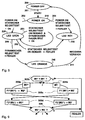
- a green lit LED 107 signals an OK state 220, but a lit LED 108 signals an error state 230 as a result of an at least static self-test.
- the result of such a self-test known per se cannot be falsified because of the direct signaling via the LEDs 107, 108.
- the ongoing check in dynamic operation would determine the error and signal it as state 240 with orange LEDs. Booting is required after switching off / on, otherwise no other operation can be carried out.
- state 260 The case that the installation of a key was forgotten during manufacture is signaled as state 260, for example with a flashing green LED 107.
- state 250 The case that a long time watchdog timer has expired is also signaled as status 250 by a flashing red LED.
- the long time watchdog timer has expired if the data center has not been contacted for a long time, for example to reload a credit.
- State 250 is also reached when the safety module has been disconnected from the meter. Additional status displays for the states 270, 280, 290 are optionally provided for various other tests.
- FIG. 6 shows an illustration of the testing of the integrity of the system for statically and dynamically changeable states.
- a turned off System in state 200 goes through the transition after switching on Start 201 in state 210, in which of the security modules a static self-test is carried out as soon as the operating voltage is present.
- transition 202 where the self-test is OK If the result is correct, the state 220 LED turns green achieved brilliant. Starting from the latter state is a if necessary repeated static self-test and a dynamic self-test feasible.
- Such a transition 203 or 206 either leads back to status 220 LED green when OK or to status 240 LED orange in the event of an error.
- transition 211 the switched-on device has a static Executes self-test
- transition 204 in the event of an error Condition 230 LED red.
- a static self-test can be carried out on demand in the event of an error via transition 205 to status 230 LED red to lead.
- LED green can not shown further transitions 207, 208, 209 to the further states 270 (with flashing orange LED's signaling), 280 (with red glowing / orange blinking LEDs indicate) and 290 (with green glowing / orange blinking LED's).
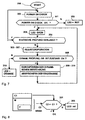
- FIG. 7 shows a flow diagram for checking the integrity of the system.
- the microprocessor CPU 121 is programmed by a corresponding program stored in the flash 128 to carry out the aforementioned self-tests, a power-on self-test being carried out in a first step 300 after the start 299 and then a question being asked in step 301 as to whether the power on Self-test has given an OK. If this is the case, in step 302 the green LED 107 is controlled by the microprocessor CPU 121 via an I / O port 125 to light up. Otherwise, in step 303, the red LED 108 is controlled by the microprocessor CPU 121 via an I / O port 125 to light up.
- Step 302 branches to query 304, in which it is checked whether a further static check is required. If this is the case, the method branches back to step 300. Otherwise, at least one register operation is carried out in steps 305-307 and then a branch is made to query 308, in which it is checked whether the actual state is valid or correct. In the course of the register operation or afterwards, a dynamic check is carried out. If this is not proceeding properly or is faulty, then a branch is made from query step 308 to step 315 and both the green LED 107 and the red LED 108 are controlled by the microprocessor CPU 121 via an I / O port 125 in a luminous manner. This gives the overall impression that the LEDs are orange.
- step 308 if the actual state is satisfactory, a dynamic calculation is carried out in steps 309-314 and the results are subsequently stored. From the last step, branching back to script 302. This results in a two-stage check on demand. For the dynamic calculation, it is sufficient for the microprocessor CPU 121 to test only partial functions at different times using the same or a different calculation method, whereby both calculation methods must of course lead to the same check result OK or DEFECT or ERROR.
- the safety-relevant functions F In a system with the memory area M and a large number of functions F, a safety-relevant sub-area M and F protected against malfunctions and failures.
- the safety-relevant functions F as far as they are not exclusively in the memory area M work in such a way that they unambiguous check marks (Pattern) of their (successful) mode of operation in the system in the memory area M depict.
- the security method now basically differentiates between two different system states: the static one, in which the content of the memory area M not changed and the dynamic, in which a change in the memory area M he follows.
- the security method according to the invention provides for overlapping processing with validation of the system state that is now taking place.
- the memory area M Redundant design and contains at least two figures M1 corresponding in type and scope and - in the static state - also corresponding in content and M2 in the form of data stored in sub memory areas M 1 'and M 2 '.
- the address management of sub-areas M 1 and M 2 to M x of the area M made such that at least always the last current and validated state - e.g. B. M1 - is available in the memory area M 1 '.
- B. M2 - In the memory area M 2 ', it is provided as a first option, in particular if external influence on the system by third parties can be ruled out, that the currently changing process from the functional scope F - e.g. B. F1 - Execute several times in order to be formed by meanwhile Pattern "Cx over the data in the area M 2 as well as the comparison of the temporarily saved pattern results, the new state M2 to take over as validated and the state M1 consequently to be overwritten by subsequent changes.
- the security process has its own intelligence to use at least some functions from F in order to execute a volatile mirror image of M2 in the first step and then the associated mirror pattern Cx for comparison with the Original ".
- a saved pattern C1 was generated and validated for the first time by a system initialization.
- the microprocessor 120 controls the LED signaling glowing red (font 303).
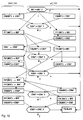
- Steps 305 and 306 of the flowchart for checking the integrity of the system shown in FIG. 7 can be divided into sub-steps.
- the memory area M is redundant as memory area M. executed, both of which correspond in type and scope and - in the static state - also in terms of the data content, which is illustrated by sub-step 305a. Otherwise there is an error, ie the figures M1 and M1 do not correspond.
- both memory areas M1 ', M1 treated separately, each by a safety function F1 ', F1 is executed, which changes the data content, so that the images M2 and M2 arise.
- FIG. 10 shows an overlapping processing in combination with overlapping checksums and / or with overlapping operations shown.
- the dynamic self-test can be performed according to the Security requirements carried out in various variations become.
- the microprocessor (120) is programmed to program is an overlapping one with dynamic changes in the system state Perform processing of at least part of the used Range of functions or the test pattern used. Subsequently validation always takes place. It is intended to be overlapping Processing of at least parts of the test pattern used, the Functional range or memory area in combination with each other for subsequent validation.
- the data processing system in particular a Franking machine
- the security module can also be another Have design that allows it, for example, on the The main board of a personal computer can be plugged in as a PC franking device controls a commercially available printer.
Landscapes
- Engineering & Computer Science (AREA)
- Theoretical Computer Science (AREA)
- Physics & Mathematics (AREA)
- General Physics & Mathematics (AREA)
- Computer Hardware Design (AREA)
- General Engineering & Computer Science (AREA)
- Computer Security & Cryptography (AREA)
- Software Systems (AREA)
- Storage Device Security (AREA)
- Devices For Checking Fares Or Tickets At Control Points (AREA)
- Alarm Systems (AREA)
Abstract
Description

Die Validierung eines Systemzustands bei dynamischen Änderungen beruht auf der überlappenden Verarbeitung von Daten aus mindestens Teilen des verwendeten Prüfpattern, Funktionsumfanges oder Speicherbereiches einzeln oder in Kombination miteinander. Die überlappende Verarbeitung besteht in einem gegenseitigem Vertauschen der von der einen bestimmten Datenverarbeitungseinheit gelieferten Daten und der von einer anderen bestimmten Datenverarbeitungseinheit gelieferten Daten und in einer Ausführung jeweils einer redundanten Sicherheitsfunktion auf die vertauschten Daten durch beide Datenverarbeitungseinheiten. Die Ergebnisse der redundanten Datenverarbeitung müssen bei einem unmanipulierten und fehlerfrei arbeitenden System vergleichbar sein.
Ein Sicherheitsmodul für eine Datenverarbeitungsanlage, beispielsweise eine Frankiermaschine, nimmt deren Funktion, beispielsweise einer Abrechnung der Postgebühren und/oder deren kryptografische Absicherung war. Das Sicherheitsmodul hat einen Modulprozessor und eine Hardware-Abrecheneinheit. Das Sicherheitsmodul ist erfindungsgemäß durch eigene Signalmittel gekennzeichnet, die bei direkter Ansteuerung vom Prozessor des Sicherheitsmoduls eine Aussage über den aktuellen Zustand des Sicherheitsmoduls gestatten. Die Signalisierung des Modulzustandes wird nur bei Versorgung des Sicherheitsmoduls mit Systemspannung aktiviert, um eine interne Batterie zu schonen. Der Prozessor kann auch die Arbeit der Hardware-Abrecheneinheit überwachen oder überprüfen. Es ist nicht beabsichtigt, die Abrechnung selbst auf Richtigkeit nachzuprüfen. Auch kann durch einen
- Figur 1,
- Perspektivische Ansicht der Frankiermaschine von hinten,
- Figur 2,
- Blockschaltbild des Sicherheitsmoduls,
- Figur 3,
- Seitenansicht des Sicherheitsmoduls,
- Figur 4,
- Draufsicht auf das Sicherheitsmodul,
- Figur 5,
- Tabelle für Statussignalisierung,
- Figur 6,
- Darstellung der Prüfung der Integrität des Systems für statische und dynamisch änderbare Zustände,
- Figur 7,
- Flußdiagramm für die Prüfung der Integrität des Systems,
- Figur 8,
- Darstellung der statischen Prüfung,
- Figur 9 und 10,
- Darstellung der überlappenden Verarbeitung.
Die Anzeige wird direkt vom modulinternen Prozessor gesteuert und ist so von außen nicht ohne weiteres manipulierbar. Die Anzeige ist im Betriebszustand ständig aktiv, so daß das Anlegen der Systemspannung Us+ an den Prozessor des Sicherheitsmoduls ausreicht, die Anzeige zu aktivieren, um den Modulzustand ablesen zu können.
Das Sicherheitsmodul steht mit der Frankiermaschine über den Systembus 115, 117, 118 in Verbindung. Der Prozessor 120 kann über den Systembus und ein Modem 83 in Kommunikationsverbindung mit einer entfernten Datenzentrale eintreten. Die Abrechnung wird vom ASIC 150 vollzogen. Die postalischen Abrechnungsdaten werden in nichtflüchtigen Speichern unterschiedlicher Technologie gespeichert.
Am Versorgungseingang eines zweiten Speichers NV-RAM 114 liegt Systemspannung an. Hierbei handelt es sich um einen nichtflüchtigen Speicher NVRAM einer zweiten Technologie, (SHADOW-RAM). Diese zweiten Technologie umfaßt vorzugsweise ein RAM und ein EEPROM, wobei letzteres die Dateninhalte bei Systemspannungsausfall automatisch übernimmt. Der NVRAM 114 der zweiten Technologie ist mit den entsprechenden Adress- und Dateneingängen des ASIC's 150 über einen internen Adreß- und Datenbus 112, 113 verbunden.
Ein Adreß- und Steuerbus 117, 115 von der Hauptplatine des Meters 1 ist an entsprechenden Pins der Logik PAL 160 angeschlossen und die PAL 160 erzeugt mindestens ein Steuersignal für das ASIC 150 und ein Steuersignal 119 für den Programmspeicher FLASH 128. Der Prozessor 120 arbeitet ein Programm ab, das im FLASH 128 gespeichert ist. Der Prozessor 120, FLASH 28, ASIC 12 und PAL 160 sind über einen modulinternen Systembus miteinander verbunden, der Leitungen 110, 111, 126, 119 für Daten-, Adreß- und Steuersignale enthält.
An den Pins 6 und 7 des Prozessors 120 sind Leitungen angeschlossen, welche nur bei einem, beispielsweise an die Hauptplatine des Meters 1, gesteckten Sicherheitsmodul 100 eine Leiterschleife 18 bilden. Zur dynamischen Prüfung des Zustandes des Angeschlossenseins des postalischen Sicherheitsmoduls PSM 100 an der Hauptplatine des Meters 1 werden vom Prozessor 120 wechselnde Signalpegel in ganz unregelmäßigen Zeitabständen an die Pin's 6, 7 angelegt und über die Schleife zurückgeschleift.
Beispielsweise für den Fall, daß zwischenzeitlich die im Sicherheitsmodul gespeicherten Schlüssel verloren gingen, würde die laufende Überprüfung im dynamischen Betrieb den Fehler feststellen und als den Zustand 240 mit orange leuchtenden LED's signalisieren. Nach einem Aus/Einschalten ist ein Booten erforderlich, da anderenfalls keine andere Operation mehr ausgeführt werden kann. Der Fall, daß bei der Herstel-lung die Installation eines Schlüssels vergessen wurde, wird als Zustand 260 beispielsweise mit einer grün blinkenden LED 107 signalisiert. Auch der Fall, daß ein long time watchdog-Timer abgelaufen ist, wird als Zu-stand 250 durch eine rot blinkende LED signalisiert. Der long time watchdog-Timer ist abgelaufen, wenn lange Zeit die Datenzentrale nicht mehr kontaktiert wurde, beispielsweise um ein Guthaben nachzuladen. Der Zustand 250 wird ebenfalls erreicht, wenn das Sicherheitsmodul vom Meter getrennt wurde.
Weitere Zustandsanzeigen für die Zustände 270, 280, 290 sind optional für verschiedene weitere Prüfungen vorgesehen.
Vom Schritt 302 wird auf die Abfrage 304 verzweigt, in welcher geprüft wird, ob eine weitere statische Prüfung verlangt wird. Ist das der Fall, so wird zum Schritt 300 zurückverzweigt. Anderenfalls wird in den Schritten 305 - 307 mindestens eine Registeroperation durchgeführt und dann wird auf die Abfrage 308 verzweigt, in welcher geprüft wird, ob der Ist-Zustand gültig bzw. ordnungsgemäß ist. Im Verlauf der Registeroperation oder anschließend, wird eine dynamische Prüfung durchgeführt. Wenn diese nicht ordnungsgemäß verläuft oder fehlerbehaftet ist, dann wird vom Abfrageschritt 308 zum Schritt 315 verzweigt und beide, die grüne LED 107 und die rote LED 108, werden vom Mikroprozessor CPU 121 über ein I/O-Port 125 leuchtend gesteuert. Somit ergibt sich der Gesamteindruck, daß die LED's orange leuchten. Anschließend an den Abfrageschritt 308 wird bei einem zufriedenstellenden Ist-Zustand in den Schritten 309-314 eine dynamische Berechnung und nachfolgend ein Abspeichern der Ergebnisse durchgeführt. Vom letzten Schritt wird zum Schrift 302 zurückverzweigt. Dadurch ergibt sich on demand eine zweistufige Prüfung. Für die dynamische Berechnung ist es ausreichend, wenn zur Prüfung vom Mikroprozessor CPU 121 nur Teilfunktionen zeitlich versetzt auf dem gleichen oder auf einem anderen Rechenweg nachvollzogen werden, wobei selbstverständlich beide Rechenwege zum selben Überprüfungsergebnis OK oder DEFECT bzw. ERROR führen müssen.

Interessant ist nun die Betrachtung der zweiten, dynamischen Systemstufe, in der sich der Speicherinhalt M
Eine weitere Möglichkeit besteht darin, daß das Sicherheitsverfahren über eigene Intelligenz verfügt, um mindestens einige Funktionen aus F

Anderenfalls liegt ein Fehler vor, d.h. die Abbildungen M1
Es ist weiterhin vorteilhaft, daß zur Ausführung des Sicherheitsverfahrens der bereits vorhandene Systemprozessor genutzt wird, was jedoch nicht ausschließt, daß auch das gesamte Sicherheitsverfahren in
Claims (20)
- Sicherheitsmodul zur Überwachung der Systemsicherheit, mit einer ersten und zweiten Datenverarbeitungseinheit (120),(150) die mit weiteren Funktionseinheiten (114, 116, 150) verschaltet sind, gekennzeichnet dadurch, dass ein nichtflüchtiger Speicher separate Bereiche für Daten aufweist, die von beiden Datenverarbeitungseinheiten erzeugt werden, dass die eine von der anderen Datenverarbeitungseinheit überwacht wird, wobei eine Sicherheitsfunktion ausgeführt wird und wobei bei einer dynamischen Änderung des Systemzustands die erste Datenverarbeitungseinheit (120) zur überlappenden Verarbeitung mit zwischenzeitlich stattfindender Validierung des Systemzustands programmiert ist, wobei Daten den Systemzustand abbilden und wobei die überlappende Verarbeitung in einem gegenseitigem Vertauschen der von beiden Datenverarbeitungseinheiten gelieferten Daten und in einer Ausführung jeweils einer redundanten Sicherheitsfunktion auf die vertauschten Daten durch die beiden Datenverarbeitungseinheiten besteht.
- Sicherheitsmodul, nach Anspruch 1, gekennzeichnet dadurch, daß die erste Datenverarbeitungseinheit ein Mikroprozessor (120) und die zweite Datenverarbeitungseinheit zur hardwaremäßigen Abrechnung vorgesehene Funktionseinheit (150) ist, wobei der Mikroprozessor (120) die Überwachungsfunktion ausübt.
- Sicherheitsmodul, nach Anspruch 2, gekennzeichnet dadurch, daß der Mikroprozessor (120) programmiert ist, bei dynamischen Änderungen des Systemzustands eine überlappende Verarbeitung von Daten von mindestens einem Teil des verwendeten Speicherbereiches zur anschließenden Validierung durchzuführen.
- Sicherheitsmodul, nach Anspruch 2, gekennzeichnet dadurch, daß der Mikroprozessor (120) programmiert ist, bei dynamischen Änderungen des Systemzustands eine überlappende Verarbeitung von Funktionen von mindestens einem Teil des verwendeten Funktionsumfanges zur anschließenden Validierung durchzuführen.
- Sicherheitsmodul, nach Anspruch 2, gekennzeichnet dadurch, daß der Mikroprozessor (120) programmiert ist, bei dynamischen Änderungen des Systemzustands eine überlappende Verarbeitung von Pattern von mindestens einem Teil des verwendeten Prüfpattern zur anschließenden Validierung durchzuführen.
- Sicherheitsmodul, nach Anspruch 2, gekennzeichnet dadurch, daß der Mikroprozessor (120) programmiert ist, bei dynamischen Änderungen des Systemzustands eine überlappenden Verarbeitung von mindestens Teilen des verwendeten Prüfpattern, Funktionsumfanges oder Speicherbereiches in Kombination miteinander zur anschließenden Validierung durchzuführen.
- Sicherheitsmodul, nach einem der Ansprüche 1 bis 6, gekennzeichnet dadurch, daß der Mikroprozessor (120) programmiert ist, die Validierung des Systemzustands mehrfach in Zwischenschritten durchzuführen.
- Sicherheitsmodul, nach Anspruch 2, gekennzeichnet dadurch, daß der Mikroprozessor (120) programmiert ist, einen statischen Systemzustand wiederholend mit einem statischen Selbsttest zu überprüfen.
- Sicherheitsmodul, nach Anspruch 2, gekennzeichnet dadurch, daß der Mikroprozessor (120) zur Signalisierung des Modulzustandes ein Signalmittel (107, 108) ansteuert, welches ein Bestandteil des Sicherheitsmoduls ist und durch das Vergußmaterial (105) einer Leiterplatte (106) hindurchragt und daß ein umgebendes Sicherheitsgehäuse zur Signalisierung des Modulzustandes eine Öffnung (109) aufweist.
- Sicherheitsmodul, nach Anspruch 9, gekennzeichnet dadurch, daß sich die Öffnung (109) zur Bedienoberfläche (88, 89) eines Meters (1) erstreckt und daß die Abmaße bzw. der Durchmesser der Öffnung in der Größenordnung des Signalmittels liegt.
- Sicherheitsmodul, nach einem der Ansprüche 9 bis 10, gekennzeichnet dadurch, daß das Signalmittel als Anzeigeeinheit realisiert ist.
- Sicherheitsmodul, nach Anspruch 11, gekennzeichnet dadurch, daß die Anzeigeeinheit eine oder mehrere oder mehrfarbige Leuchtdioden (LED's) einschließt.
- Verfahren zur Überwachung der Systemsicherheit mittels einem Sicherheitsmodul, gekennzeichnet dadurch, daß der Aufbau des Sicherheitsverfahrens eine zweistufige Prüfung mit Validierung des Systemzustandes vorsieht, wobei die grundsätzlich zwischen statischen und dynamischen Zuständen des Systems unterschieden wird und wobei eine überlappende Verarbeitung von Daten beim dynamischen Selbsttest erfolgt, bei dem durch einen Patternvergleich eines definierbaren Speicherbereichs die Integrität des Systems zeitlich wiederholend überprüft wird.
- Verfahren, nach Anspruch 13, gekennzeichnet dadurch, daß die Validierung des Systemzustands bei dynamischen Änderungen aus der überlappenden Verarbeitung von mindestens einem Teil des verwendeten Speicherbereiches besteht.
- Verfahren, nach Anspruch 13, gekennzeichnet dadurch, daß die Validierung des Systemzustands bei dynamischen Änderungen aus der überlappenden Verarbeitung von mindestens einem Teil des verwendeten Funktionsumfanges besteht.
- Verfahren, nach Anspruch 13, gekennzeichnet dadurch, daß die Validierung des Systemzustands bei dynamischen Änderungen aus der überlappenden Verarbeitung von mindestens einem Teil des verwendeten Prüfpattern besteht.
- Verfahren, nach Anspruch 13, gekennzeichnet dadurch, daß die Validierung des Systemzustands bei dynamischen Änderungen aus der überlappenden Verarbeitung von mindestens Teilen des verwendeten Prüfpattern, Funktionsumfanges oder Speicherbereiches in Kombination miteinander besteht.
- Verfahren, nach Anspruch 13, gekennzeichnet dadurch, daß die Validierung des Systemzustands mehrfach in Zwischenschritten erfolgt.
- Verfahren, nach Anspruch 13, gekennzeichnet dadurch, daß im Ergebnis der Prüfung eine Signalisierung des Modulzustandes aktiviert wird, wenn die Versorgung des Sicherheitsmoduls mit Systemspannung gewährleistet ist.
- Verfahren, nach Anspruch 19, gekennzeichnet dadurch, daß die Leuchtdioden LED's zur Zustandsunterscheidung blinkend gesteuert werden.
Applications Claiming Priority (2)
| Application Number | Priority Date | Filing Date | Title |
|---|---|---|---|
| DE19928061 | 1999-06-15 | ||
| DE19928061A DE19928061C2 (de) | 1999-06-15 | 1999-06-15 | Sicherheitsmodul zur Überwachung der Systemsicherheit und Verfahren |
Publications (2)
| Publication Number | Publication Date |
|---|---|
| EP1069492A2 true EP1069492A2 (de) | 2001-01-17 |
| EP1069492A3 EP1069492A3 (de) | 2006-04-19 |
Family
ID=7911801
Family Applications (1)
| Application Number | Title | Priority Date | Filing Date |
|---|---|---|---|
| EP00250184A Withdrawn EP1069492A3 (de) | 1999-06-15 | 2000-06-09 | Sicherheitsmodul zur Überwachung der Systemsicherheit und Verfahren |
Country Status (3)
| Country | Link |
|---|---|
| US (1) | US6351220B1 (de) |
| EP (1) | EP1069492A3 (de) |
| DE (1) | DE19928061C2 (de) |
Families Citing this family (4)
| Publication number | Priority date | Publication date | Assignee | Title |
|---|---|---|---|---|
| DE102004027517B4 (de) * | 2004-06-03 | 2007-05-10 | Francotyp-Postalia Gmbh | Anordnung und Verfahren zur Ansteuerung eines Thermotransferdruckkopfes |
| US8245068B2 (en) * | 2006-10-27 | 2012-08-14 | Freescale Semiconductor, Inc. | Power supply monitoring method and system |
| US9009860B2 (en) * | 2011-11-03 | 2015-04-14 | Cram Worldwide, Llc | Tamper resistance extension via tamper sensing material housing integration |
| US9720716B2 (en) * | 2013-03-12 | 2017-08-01 | Intel Corporation | Layered virtual machine integrity monitoring |
Citations (7)
| Publication number | Priority date | Publication date | Assignee | Title |
|---|---|---|---|---|
| EP0789333A2 (de) | 1996-01-31 | 1997-08-13 | Francotyp-Postalia Aktiengesellschaft & Co. | Frankiermaschine |
| EP0417447B1 (de) | 1989-09-12 | 1997-10-29 | International Business Machines Corporation | Datenschutz durch Feststellen von Einbruch in elektronischen Anlagen |
| DE29905219U1 (de) | 1999-03-12 | 1999-06-17 | Francotyp-Postalia AG & Co., 16547 Birkenwerder | Sicherheitsmodul mit Statussignalisierung |
| DE19816571A1 (de) | 1998-04-07 | 1999-10-14 | Francotyp Postalia Gmbh | Anordnung für den Zugriffsschutz für Sicherheitsmodule |
| DE19816572A1 (de) | 1998-04-07 | 1999-10-14 | Francotyp Postalia Gmbh | Anordnung für einen Sicherheitsmodul |
| DE19912780A1 (de) | 1999-03-12 | 2000-09-14 | Francotyp Postalia Gmbh | Anordnung für ein Sicherheitsmodul |
| DE19912781A1 (de) | 1999-03-12 | 2000-11-23 | Francotyp Postalia Gmbh | Verfahren zum Schutz eines Sicherheitsmoduls und Anordnung zur Durchführung des Verfahrens |
Family Cites Families (11)
| Publication number | Priority date | Publication date | Assignee | Title |
|---|---|---|---|---|
| US4253158A (en) * | 1979-03-28 | 1981-02-24 | Pitney Bowes Inc. | System for securing postage printing transactions |
| US4812994A (en) * | 1985-08-06 | 1989-03-14 | Pitney Bowes Inc. | Postage meter locking system |
| EP0615211B1 (de) | 1993-03-11 | 1998-02-04 | Francotyp-Postalia Aktiengesellschaft & Co. | Verfahren zum Speichern sicherheitsrelevanter Daten |
| DE4315732C1 (de) * | 1993-05-11 | 1994-06-01 | Siemens Nixdorf Inf Syst | Verfahren zum authentischen Booten und Testen der Integrität von Software auf PC-Architekturen |
| DE4344476A1 (de) * | 1993-12-21 | 1995-06-22 | Francotyp Postalia Gmbh | Verfahren zur Verbesserung der Sicherheit von Frankiermaschinen |
| US5572429A (en) * | 1994-12-05 | 1996-11-05 | Hunter; Kevin D. | System for recording the initialization and re-initialization of an electronic postage meter |
| DE19534530A1 (de) * | 1995-09-08 | 1997-03-13 | Francotyp Postalia Gmbh | Verfahren zur Absicherung von Daten und Programmcode einer elektronischen Frankiermaschine |
| US6169804B1 (en) * | 1996-11-21 | 2001-01-02 | Pitney Bowes Inc. | Method for verifying the expected postage security device and its status |
| US5946672A (en) * | 1997-06-12 | 1999-08-31 | Pitney Bowes Inc. | Electronic postage meter system having enhanced clock security |
| US6023690A (en) * | 1997-06-12 | 2000-02-08 | Pitney Bowes Inc. | Method and apparatus for securely resetting a real time clock in a postage meter |
| US6044364A (en) * | 1997-12-08 | 2000-03-28 | Pitney Bowes Inc. | Method and apparatus for ensuring for the correct accounting of postage dispensed by a postage meter |
-
1999
- 1999-06-15 DE DE19928061A patent/DE19928061C2/de not_active Expired - Fee Related
-
2000
- 2000-06-09 EP EP00250184A patent/EP1069492A3/de not_active Withdrawn
- 2000-06-14 US US09/594,002 patent/US6351220B1/en not_active Expired - Fee Related
Patent Citations (7)
| Publication number | Priority date | Publication date | Assignee | Title |
|---|---|---|---|---|
| EP0417447B1 (de) | 1989-09-12 | 1997-10-29 | International Business Machines Corporation | Datenschutz durch Feststellen von Einbruch in elektronischen Anlagen |
| EP0789333A2 (de) | 1996-01-31 | 1997-08-13 | Francotyp-Postalia Aktiengesellschaft & Co. | Frankiermaschine |
| DE19816571A1 (de) | 1998-04-07 | 1999-10-14 | Francotyp Postalia Gmbh | Anordnung für den Zugriffsschutz für Sicherheitsmodule |
| DE19816572A1 (de) | 1998-04-07 | 1999-10-14 | Francotyp Postalia Gmbh | Anordnung für einen Sicherheitsmodul |
| DE29905219U1 (de) | 1999-03-12 | 1999-06-17 | Francotyp-Postalia AG & Co., 16547 Birkenwerder | Sicherheitsmodul mit Statussignalisierung |
| DE19912780A1 (de) | 1999-03-12 | 2000-09-14 | Francotyp Postalia Gmbh | Anordnung für ein Sicherheitsmodul |
| DE19912781A1 (de) | 1999-03-12 | 2000-11-23 | Francotyp Postalia Gmbh | Verfahren zum Schutz eines Sicherheitsmoduls und Anordnung zur Durchführung des Verfahrens |
Also Published As
| Publication number | Publication date |
|---|---|
| DE19928061C2 (de) | 2003-08-28 |
| DE19928061A1 (de) | 2000-12-28 |
| EP1069492A3 (de) | 2006-04-19 |
| US6351220B1 (en) | 2002-02-26 |
Similar Documents
| Publication | Publication Date | Title |
|---|---|---|
| EP1035517B1 (de) | Verfahren zum Schutz eines Sicherheitsmoduls und Anordnung zur Durchführung des Verfahrens | |
| EP1035516B1 (de) | Anordnung für ein Sicherheitsmodul | |
| DE3729345A1 (de) | Sicherheitsgehaeuse mit elektronischer anzeige fuer ein wertdrucksystem | |
| EP0762337A2 (de) | Verfahren und Anordnung zur Erhöhung der Manipulationssicherheit von kritischen Daten | |
| DE4445053C2 (de) | Frankiermaschineninterne Schnittstellenschaltung | |
| EP0762335B1 (de) | Verfahren zur Veränderung der in Speicherzellen geladenen Daten einer elektronischen Frankiermaschine | |
| DE4139197C2 (de) | Halbleiter-Speichereinheit und Datenverarbeitungssystem mit einer Halbleiter-Speichereinheit | |
| EP1278164B1 (de) | Anordnung und Verfahren zum Andern der Funktionalität eines Sicherheitsmoduls | |
| EP1035518B1 (de) | Anordnung zum Schutz eines Sicherheitsmoduls | |
| DE19928057B4 (de) | Sicherheitsmodul und Verfahren zur Sicherung der Postregister vor Manipulation | |
| EP1035513B1 (de) | Sicherheitsmodul mit Statussignalisierung | |
| DE19928061C2 (de) | Sicherheitsmodul zur Überwachung der Systemsicherheit und Verfahren | |
| EP1209631B1 (de) | Anordnung zur Stromversorgung für einen Sicherheitsbereich eines Gerätes | |
| DE19534530A1 (de) | Verfahren zur Absicherung von Daten und Programmcode einer elektronischen Frankiermaschine | |
| EP0560714B1 (de) | Frankiermaschine | |
| DE20112350U1 (de) | Anordnung zum Schutz eines Sicherheitsmoduls | |
| DE10213009A1 (de) | Verfahren zum elektronischen Testen von Speichermodulen | |
| DE3875269T2 (de) | Koppelvorrichtung fuer nichtfluechtige speicher in einer elektronischen maschine und ihre anwendung in frankiermaschinen. | |
| DE69425546T2 (de) | Dynamisch programmierbarer Zeitzählen | |
| DE4217830A1 (de) | Verfahren zum Betreiben einer Datenverarbeitungsanlage | |
| DE202006008952U1 (de) | Anordnung zum Wechseln von Kundendaten einer Frankiermaschine | |
| DE19534529C2 (de) | Verfahren zur Erhöhung der Manipulationssicherheit von kritischen Daten | |
| DE10061665A1 (de) | Verfahren zur Ermittlung eines Erfordernis zum Austausch eines Bauteils und Anordnung zur Durchführung des Verfahrens | |
| DE19534527C2 (de) | Verfahren zur Erhöhung der Manipulationssicherheit von kritischen Daten | |
| EP0645710A2 (de) | Verfahren zur Funktionsprüfung signaltechnisch nicht sicherer Speicher für mindestens zweikanalig abgespeicherte Nutzdaten und Einrichtung zur Durchführung des Verfahrens |
Legal Events
| Date | Code | Title | Description |
|---|---|---|---|
| PUAI | Public reference made under article 153(3) epc to a published international application that has entered the european phase |
Free format text: ORIGINAL CODE: 0009012 |
|
| AK | Designated contracting states |
Kind code of ref document: A2 Designated state(s): AT BE CH CY DE DK ES FI FR GB GR IE IT LI LU MC NL PT SE |
|
| AX | Request for extension of the european patent |
Free format text: AL;LT;LV;MK;RO;SI |
|
| RAP1 | Party data changed (applicant data changed or rights of an application transferred) |
Owner name: FRANCOTYP-POSTALIA AG & CO. KG |
|
| RAP1 | Party data changed (applicant data changed or rights of an application transferred) |
Owner name: FRANCOTYP-POSTALIA GMBH |
|
| PUAL | Search report despatched |
Free format text: ORIGINAL CODE: 0009013 |
|
| AK | Designated contracting states |
Kind code of ref document: A3 Designated state(s): AT BE CH CY DE DK ES FI FR GB GR IE IT LI LU MC NL PT SE |
|
| AX | Request for extension of the european patent |
Extension state: AL LT LV MK RO SI |
|
| RIC1 | Information provided on ipc code assigned before grant |
Ipc: G07B 17/00 20060101AFI20060301BHEP |
|
| 17P | Request for examination filed |
Effective date: 20060505 |
|
| 17Q | First examination report despatched |
Effective date: 20061113 |
|
| AKX | Designation fees paid |
Designated state(s): CH DE FR GB IT LI |
|
| STAA | Information on the status of an ep patent application or granted ep patent |
Free format text: STATUS: THE APPLICATION IS DEEMED TO BE WITHDRAWN |
|
| 18D | Application deemed to be withdrawn |
Effective date: 20120103 |