EP1069098A1 - Verfahren zur Herstellung von Cyclododecatrienen mit Rückführung des Katalysators - Google Patents
Verfahren zur Herstellung von Cyclododecatrienen mit Rückführung des Katalysators Download PDFInfo
- Publication number
- EP1069098A1 EP1069098A1 EP00114749A EP00114749A EP1069098A1 EP 1069098 A1 EP1069098 A1 EP 1069098A1 EP 00114749 A EP00114749 A EP 00114749A EP 00114749 A EP00114749 A EP 00114749A EP 1069098 A1 EP1069098 A1 EP 1069098A1
- Authority
- EP
- European Patent Office
- Prior art keywords
- catalyst
- trans
- catalyst system
- cyclododecatriene
- cdt
- Prior art date
- Legal status (The legal status is an assumption and is not a legal conclusion. Google has not performed a legal analysis and makes no representation as to the accuracy of the status listed.)
- Granted
Links
- 239000003054 catalyst Substances 0.000 title claims abstract description 67
- 238000000034 method Methods 0.000 title claims abstract description 22
- 230000008569 process Effects 0.000 title claims abstract description 10
- XRLIZCVYAYNXIF-UHFFFAOYSA-N cyclododeca-1,3,5-triene Chemical class C1CCCC=CC=CC=CCC1 XRLIZCVYAYNXIF-UHFFFAOYSA-N 0.000 title claims abstract description 9
- 238000004064 recycling Methods 0.000 title description 7
- 230000015572 biosynthetic process Effects 0.000 title description 6
- 238000003786 synthesis reaction Methods 0.000 title description 6
- KAKZBPTYRLMSJV-UHFFFAOYSA-N Butadiene Chemical compound C=CC=C KAKZBPTYRLMSJV-UHFFFAOYSA-N 0.000 claims abstract description 44
- 238000006243 chemical reaction Methods 0.000 claims abstract description 20
- RRKODOZNUZCUBN-CCAGOZQPSA-N (1z,3z)-cycloocta-1,3-diene Chemical compound C1CC\C=C/C=C\C1 RRKODOZNUZCUBN-CCAGOZQPSA-N 0.000 claims abstract description 12
- 238000004821 distillation Methods 0.000 claims abstract description 10
- 239000002904 solvent Substances 0.000 claims abstract description 7
- PXHVJJICTQNCMI-UHFFFAOYSA-N Nickel Chemical compound [Ni] PXHVJJICTQNCMI-UHFFFAOYSA-N 0.000 claims description 17
- ZOLLIQAKMYWTBR-RYMQXAEESA-N cyclododecatriene Chemical compound C/1C\C=C\CC\C=C/CC\C=C\1 ZOLLIQAKMYWTBR-RYMQXAEESA-N 0.000 claims description 15
- 239000010936 titanium Substances 0.000 claims description 9
- RTAQQCXQSZGOHL-UHFFFAOYSA-N Titanium Chemical compound [Ti] RTAQQCXQSZGOHL-UHFFFAOYSA-N 0.000 claims description 8
- 229910052719 titanium Inorganic materials 0.000 claims description 8
- 229910052759 nickel Inorganic materials 0.000 claims description 6
- 239000006227 byproduct Substances 0.000 claims description 5
- 150000002816 nickel compounds Chemical class 0.000 claims description 5
- XJDNKRIXUMDJCW-UHFFFAOYSA-J titanium tetrachloride Chemical group Cl[Ti](Cl)(Cl)Cl XJDNKRIXUMDJCW-UHFFFAOYSA-J 0.000 claims description 4
- 238000000926 separation method Methods 0.000 claims description 3
- 150000003609 titanium compounds Chemical class 0.000 claims description 3
- 238000002360 preparation method Methods 0.000 claims description 2
- 230000009885 systemic effect Effects 0.000 claims description 2
- SHWZFQPXYGHRKT-FDGPNNRMSA-N (z)-4-hydroxypent-3-en-2-one;nickel Chemical group [Ni].C\C(O)=C\C(C)=O.C\C(O)=C\C(C)=O SHWZFQPXYGHRKT-FDGPNNRMSA-N 0.000 claims 1
- 239000000203 mixture Substances 0.000 claims 1
- 238000004519 manufacturing process Methods 0.000 abstract 1
- 229910052723 transition metal Inorganic materials 0.000 description 9
- 150000003624 transition metals Chemical class 0.000 description 8
- SDRZFSPCVYEJTP-UHFFFAOYSA-N 1-ethenylcyclohexene Chemical compound C=CC1=CCCCC1 SDRZFSPCVYEJTP-UHFFFAOYSA-N 0.000 description 6
- 238000002474 experimental method Methods 0.000 description 5
- XRLIZCVYAYNXIF-CRQXNEITSA-N C1CCC\C=C\C=C\C=C\CC1 Chemical compound C1CCC\C=C\C=C\C=C\CC1 XRLIZCVYAYNXIF-CRQXNEITSA-N 0.000 description 4
- OKTJSMMVPCPJKN-UHFFFAOYSA-N Carbon Chemical compound [C] OKTJSMMVPCPJKN-UHFFFAOYSA-N 0.000 description 4
- 239000002815 homogeneous catalyst Substances 0.000 description 4
- 239000003446 ligand Substances 0.000 description 4
- 229910052751 metal Inorganic materials 0.000 description 4
- 239000002184 metal Substances 0.000 description 4
- 150000002902 organometallic compounds Chemical class 0.000 description 4
- UHOVQNZJYSORNB-UHFFFAOYSA-N Benzene Chemical compound C1=CC=CC=C1 UHOVQNZJYSORNB-UHFFFAOYSA-N 0.000 description 3
- OKKJLVBELUTLKV-UHFFFAOYSA-N Methanol Chemical compound OC OKKJLVBELUTLKV-UHFFFAOYSA-N 0.000 description 3
- 238000009835 boiling Methods 0.000 description 3
- 150000001875 compounds Chemical class 0.000 description 3
- 238000001704 evaporation Methods 0.000 description 3
- 230000008020 evaporation Effects 0.000 description 3
- 125000002524 organometallic group Chemical group 0.000 description 3
- 239000011541 reaction mixture Substances 0.000 description 3
- XLYOFNOQVPJJNP-UHFFFAOYSA-N water Substances O XLYOFNOQVPJJNP-UHFFFAOYSA-N 0.000 description 3
- 238000010626 work up procedure Methods 0.000 description 3
- CMAOLVNGLTWICC-UHFFFAOYSA-N 2-fluoro-5-methylbenzonitrile Chemical compound CC1=CC=C(F)C(C#N)=C1 CMAOLVNGLTWICC-UHFFFAOYSA-N 0.000 description 2
- CSCPPACGZOOCGX-UHFFFAOYSA-N Acetone Chemical compound CC(C)=O CSCPPACGZOOCGX-UHFFFAOYSA-N 0.000 description 2
- VYZAMTAEIAYCRO-UHFFFAOYSA-N Chromium Chemical compound [Cr] VYZAMTAEIAYCRO-UHFFFAOYSA-N 0.000 description 2
- VEXZGXHMUGYJMC-UHFFFAOYSA-N Hydrochloric acid Chemical compound Cl VEXZGXHMUGYJMC-UHFFFAOYSA-N 0.000 description 2
- XYFCBTPGUUZFHI-UHFFFAOYSA-N Phosphine Chemical compound P XYFCBTPGUUZFHI-UHFFFAOYSA-N 0.000 description 2
- WYURNTSHIVDZCO-UHFFFAOYSA-N Tetrahydrofuran Chemical compound C1CCOC1 WYURNTSHIVDZCO-UHFFFAOYSA-N 0.000 description 2
- 229910052782 aluminium Inorganic materials 0.000 description 2
- 238000013459 approach Methods 0.000 description 2
- 239000003638 chemical reducing agent Substances 0.000 description 2
- 229910052804 chromium Inorganic materials 0.000 description 2
- 239000011651 chromium Substances 0.000 description 2
- 238000010924 continuous production Methods 0.000 description 2
- 230000000694 effects Effects 0.000 description 2
- GCPCLEKQVMKXJM-UHFFFAOYSA-N ethoxy(diethyl)alumane Chemical compound CCO[Al](CC)CC GCPCLEKQVMKXJM-UHFFFAOYSA-N 0.000 description 2
- BMGNSKKZFQMGDH-FDGPNNRMSA-L nickel(2+);(z)-4-oxopent-2-en-2-olate Chemical compound [Ni+2].C\C([O-])=C\C(C)=O.C\C([O-])=C\C(C)=O BMGNSKKZFQMGDH-FDGPNNRMSA-L 0.000 description 2
- 230000000737 periodic effect Effects 0.000 description 2
- 239000000047 product Substances 0.000 description 2
- 239000000126 substance Substances 0.000 description 2
- RYSXWUYLAWPLES-MTOQALJVSA-N (Z)-4-hydroxypent-3-en-2-one titanium Chemical compound [Ti].C\C(O)=C\C(C)=O.C\C(O)=C\C(C)=O.C\C(O)=C\C(C)=O.C\C(O)=C\C(C)=O RYSXWUYLAWPLES-MTOQALJVSA-N 0.000 description 1
- JQCVPZXMGXKNOD-UHFFFAOYSA-N 1,2-dibenzylbenzene Chemical compound C=1C=CC=C(CC=2C=CC=CC=2)C=1CC1=CC=CC=C1 JQCVPZXMGXKNOD-UHFFFAOYSA-N 0.000 description 1
- VHUUQVKOLVNVRT-UHFFFAOYSA-N Ammonium hydroxide Chemical compound [NH4+].[OH-] VHUUQVKOLVNVRT-UHFFFAOYSA-N 0.000 description 1
- VEQPNABPJHWNSG-UHFFFAOYSA-N Nickel(2+) Chemical compound [Ni+2] VEQPNABPJHWNSG-UHFFFAOYSA-N 0.000 description 1
- LCKIEQZJEYYRIY-UHFFFAOYSA-N Titanium ion Chemical compound [Ti+4] LCKIEQZJEYYRIY-UHFFFAOYSA-N 0.000 description 1
- 230000004913 activation Effects 0.000 description 1
- 150000001298 alcohols Chemical class 0.000 description 1
- XAGFODPZIPBFFR-UHFFFAOYSA-N aluminium Chemical compound [Al] XAGFODPZIPBFFR-UHFFFAOYSA-N 0.000 description 1
- 239000000908 ammonium hydroxide Substances 0.000 description 1
- BRPQOXSCLDDYGP-UHFFFAOYSA-N calcium oxide Chemical compound [O-2].[Ca+2] BRPQOXSCLDDYGP-UHFFFAOYSA-N 0.000 description 1
- 239000000292 calcium oxide Substances 0.000 description 1
- ODINCKMPIJJUCX-UHFFFAOYSA-N calcium oxide Inorganic materials [Ca]=O ODINCKMPIJJUCX-UHFFFAOYSA-N 0.000 description 1
- 230000003197 catalytic effect Effects 0.000 description 1
- 230000008859 change Effects 0.000 description 1
- 229910052729 chemical element Inorganic materials 0.000 description 1
- 229940125904 compound 1 Drugs 0.000 description 1
- 238000006074 cyclodimerization reaction Methods 0.000 description 1
- 238000000354 decomposition reaction Methods 0.000 description 1
- 230000007423 decrease Effects 0.000 description 1
- 238000006471 dimerization reaction Methods 0.000 description 1
- 230000002349 favourable effect Effects 0.000 description 1
- 238000011049 filling Methods 0.000 description 1
- 238000004508 fractional distillation Methods 0.000 description 1
- 229910001385 heavy metal Inorganic materials 0.000 description 1
- 239000000543 intermediate Substances 0.000 description 1
- 230000002427 irreversible effect Effects 0.000 description 1
- 239000007791 liquid phase Substances 0.000 description 1
- 150000002739 metals Chemical class 0.000 description 1
- 238000002156 mixing Methods 0.000 description 1
- 230000003647 oxidation Effects 0.000 description 1
- 238000007254 oxidation reaction Methods 0.000 description 1
- OJMIONKXNSYLSR-UHFFFAOYSA-N phosphorous acid Chemical compound OP(O)O OJMIONKXNSYLSR-UHFFFAOYSA-N 0.000 description 1
- 229910000073 phosphorus hydride Inorganic materials 0.000 description 1
- 239000002798 polar solvent Substances 0.000 description 1
- 229920001223 polyethylene glycol Polymers 0.000 description 1
- 238000012545 processing Methods 0.000 description 1
- 230000009467 reduction Effects 0.000 description 1
- 238000011160 research Methods 0.000 description 1
- 238000009751 slip forming Methods 0.000 description 1
- 239000007858 starting material Substances 0.000 description 1
- 239000000725 suspension Substances 0.000 description 1
- YLQBMQCUIZJEEH-UHFFFAOYSA-N tetrahydrofuran Natural products C=1C=COC=1 YLQBMQCUIZJEEH-UHFFFAOYSA-N 0.000 description 1
- 150000003608 titanium Chemical class 0.000 description 1
- -1 transition metal salt Chemical class 0.000 description 1
- 239000002351 wastewater Substances 0.000 description 1
Images
Classifications
-
- C—CHEMISTRY; METALLURGY
- C07—ORGANIC CHEMISTRY
- C07C—ACYCLIC OR CARBOCYCLIC COMPOUNDS
- C07C2/00—Preparation of hydrocarbons from hydrocarbons containing a smaller number of carbon atoms
- C07C2/02—Preparation of hydrocarbons from hydrocarbons containing a smaller number of carbon atoms by addition between unsaturated hydrocarbons
- C07C2/42—Preparation of hydrocarbons from hydrocarbons containing a smaller number of carbon atoms by addition between unsaturated hydrocarbons homo- or co-oligomerisation with ring formation, not being a Diels-Alder conversion
- C07C2/44—Preparation of hydrocarbons from hydrocarbons containing a smaller number of carbon atoms by addition between unsaturated hydrocarbons homo- or co-oligomerisation with ring formation, not being a Diels-Alder conversion of conjugated dienes only
- C07C2/46—Catalytic processes
-
- C—CHEMISTRY; METALLURGY
- C07—ORGANIC CHEMISTRY
- C07C—ACYCLIC OR CARBOCYCLIC COMPOUNDS
- C07C2/00—Preparation of hydrocarbons from hydrocarbons containing a smaller number of carbon atoms
- C07C2/02—Preparation of hydrocarbons from hydrocarbons containing a smaller number of carbon atoms by addition between unsaturated hydrocarbons
- C07C2/42—Preparation of hydrocarbons from hydrocarbons containing a smaller number of carbon atoms by addition between unsaturated hydrocarbons homo- or co-oligomerisation with ring formation, not being a Diels-Alder conversion
- C07C2/44—Preparation of hydrocarbons from hydrocarbons containing a smaller number of carbon atoms by addition between unsaturated hydrocarbons homo- or co-oligomerisation with ring formation, not being a Diels-Alder conversion of conjugated dienes only
- C07C2/46—Catalytic processes
- C07C2/465—Catalytic processes with hydrides or organic compounds
-
- C—CHEMISTRY; METALLURGY
- C07—ORGANIC CHEMISTRY
- C07C—ACYCLIC OR CARBOCYCLIC COMPOUNDS
- C07C2527/00—Catalysts comprising the elements or compounds of halogens, sulfur, selenium, tellurium, phosphorus or nitrogen; Catalysts comprising carbon compounds
- C07C2527/06—Halogens; Compounds thereof
- C07C2527/135—Compounds comprising a halogen and titanum, zirconium, hafnium, germanium, tin or lead
-
- C—CHEMISTRY; METALLURGY
- C07—ORGANIC CHEMISTRY
- C07C—ACYCLIC OR CARBOCYCLIC COMPOUNDS
- C07C2531/00—Catalysts comprising hydrides, coordination complexes or organic compounds
- C07C2531/16—Catalysts comprising hydrides, coordination complexes or organic compounds containing coordination complexes
- C07C2531/22—Organic complexes
-
- C—CHEMISTRY; METALLURGY
- C07—ORGANIC CHEMISTRY
- C07C—ACYCLIC OR CARBOCYCLIC COMPOUNDS
- C07C2601/00—Systems containing only non-condensed rings
- C07C2601/18—Systems containing only non-condensed rings with a ring being at least seven-membered
- C07C2601/20—Systems containing only non-condensed rings with a ring being at least seven-membered the ring being twelve-membered
-
- Y—GENERAL TAGGING OF NEW TECHNOLOGICAL DEVELOPMENTS; GENERAL TAGGING OF CROSS-SECTIONAL TECHNOLOGIES SPANNING OVER SEVERAL SECTIONS OF THE IPC; TECHNICAL SUBJECTS COVERED BY FORMER USPC CROSS-REFERENCE ART COLLECTIONS [XRACs] AND DIGESTS
- Y02—TECHNOLOGIES OR APPLICATIONS FOR MITIGATION OR ADAPTATION AGAINST CLIMATE CHANGE
- Y02P—CLIMATE CHANGE MITIGATION TECHNOLOGIES IN THE PRODUCTION OR PROCESSING OF GOODS
- Y02P20/00—Technologies relating to chemical industry
- Y02P20/50—Improvements relating to the production of bulk chemicals
- Y02P20/584—Recycling of catalysts
Definitions
- the invention relates to a preferably continuous production process of cyclododecatrienes (CDT) on one containing in particular nickel or titanium Catalyst system with separation of the crude cyclododecatrienes by distillation and Recycling of the catalyst.
- CDT cyclododecatrienes
- transition metals are catalytically active in the form of organometallic complexes in which the central atom is the Has oxidation level 0.
- organometallic complexes made from a transition metal salt and a reducing agent.
- a transition metal salt for reduction is usually an organometallic compound from the 1st - 3rd group of Periodic table used.
- Titanium catalysts has become particularly the implementation of titanium tetrachloride or titanium acetylacetonate with an aluminum organyl has proven to be favorable (US 3 878 258, U.S. 3,655,795, both E.I.
- the reaction In the large-scale synthesis of CDT with a homogeneous catalyst the reaction usually takes place in a continuous process with or several mixing kettles. Part of the reaction mixture is continuously formed discharged from the reactors. Unreacted educt is used in the workup recovered and together with fresh butadiene in the reaction process returned. With the reactor discharge, part of the catalyst also becomes diverted. The concentration of catalyst in the reactor is therefore usually constant by continuously adding fresh catalyst components held.
- 86: 17321 and CA 86: 17322) are suitable for this, in particular methanol (JP 7 442 496, Toyo Soda Co., cited from CA 82: 139521) and methanolic hydrochloric acid (DE 19 42 729, Mitsubishi Petrochemical Co.) used.
- the catalyst can also be decomposed using acetone (JP 43 013 451, Toyo Rayon, cited from CA 70: 77450) or with a suspension of calcium oxide in water (NL 6 603 264, Shell Int.Research Maatschappij N.V.).
- acetone JP 43 013 451, Toyo Rayon, cited from CA 70: 77450
- a suspension of calcium oxide in water NL 6 603 264, Shell Int.Research Maatschappij N.V.
- Ube Industries note that the CDT formed can only be incompletely obtained if Water is used to decompose the catalyst.
- the industrial cyclodimerization of 1,3-butadiene to cyclooctadiene (COD) takes place in the liquid phase on a nickel (0) complex.
- the homogeneous catalyst consists of the transition metal and a bulky donor ligand, typically a phosphine or a phosphite. From this catalyst system is known that it can be partially recovered and used multiple times.
- the reactor discharge is usually carried out in a fractional distillation worked up. Unreacted educt, COD and low-boiling By-products separated. There remains a higher boiling residue in which the catalyst is dissolved. This residue is in the reaction process retracted and the catalyst used for renewed butadiene dimerization. Only after several cycles did the proportion of high boilers change so much Reaction mixture enriched that the catalyst with the high boiler fraction must be removed and rejected.
- CDT (1,5,9-cyclododecatriene), which is in the trans-trans-trans, cis-trans-trans and cis-cis-trans isomer form arises, is a recycling of the catalyst on an industrial scale Scale has not yet been described. Only a few are known Examples with batch-wise driving style, in which a multiple Attempted to use the catalyst on a laboratory scale. In DE 30 21 791 A1 describes that the catalyst is first adsorbed on activated carbon and is later filtered off together with the activated carbon. This procedure has turned out however not proven in practice as the catalyst only works in this way partially recovered.
- Example 3 describes that the Ni (0) -COD complex after the reaction in the presence of the solvent benzene in the bottom of the high-boiling Collects distillation products and still has a residual activity Butadiene has, so that it can be used again for the cydization. It however, no further information about catalyst recycling is given.
- Example 7 DE-OS 28 25 341 it is mentioned that the catalyst after the reaction in the presence of the solvent and moderator dibenzylbenzene a distillation at 80 ° C and 0.5 Torr collected in the residue and this still in two other approaches were used. After the third approach, the Catalyst, however, clearly in activity.
- the invention therefore relates to a process for the preparation of cyclododecatrienes from 1,3-butadiene in the presence of cyclooctadiene and / or Cyclododecatriene with one containing in particular nickel or titanium Catalyst in which the catalyst system after separation of the crude cyclododecatrienes by distillation returned and only the one removed with the high boilers Catalyst is replaced by fresh catalyst.
- nickel (II) or Compounds containing titanium (IV) are used.
- a nickel compound be the nickel acetylacetonate and as an example of a titanium compound Called titanium tetrachloride.
- the reaction is carried out with catalyst concentrations between 0.01 mmol / l and 40 mmol / l catalyst, preferably between 0.05 mmol / l and 10 mmol / l catalyst (based on nickel or titanium).
- Organometallic compounds are used as catalyst activation Compounds with metals from the 1st - 3rd group of the periodic table of the chemical elements, especially of aluminum, are used. As special preferred compounds are ethoxydiethyl aluminum and Called ethyl aluminum sesquichloride.
- the ratio of the organometallic compound to the nickel compound becomes as follows chosen that the molar ratio of nickel to metal of the organometallic Connection is 1: 3 to 1: 6.
- the molar ratio of titanium to metal is that organometallic compound 1:10 to 1:40.
- the reaction temperature is 60 ° C to 120 ° C, preferably 70 ° C to 115 ° C. A temperature higher than 120 ° C should be avoided because a higher proportion of by-products is formed and irreversible damage to the catalyst system can occur at temperatures> 120 ° C.
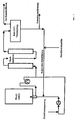
- the return of the catalyst (circular mode) is shown schematically in Figure 1.
- the reaction mixture coming from the secondary reactors is released into the vacuum container (raw CDT evaporation) and at a temperature of 90 ° C to 120 ° C and a pressure of 2 mbar to 40 mbar in residues of unreacted butadiene, raw cyclododecatrienes (with COD and VCH) and high boilers separated by distillation with catalyst.
- the distillate removed from the raw CDT evaporation is fed to the pure distillation. After a small part of the residue has been removed (contact removal), the catalyst is returned to the main reactor with the addition of fresh catalyst (fresh contact supply).
- fresh catalyst fresh contact supply
- the recycling takes place to 50% to 100%, preferably 80% to 98%, particularly preferably 90% to 95%.
- the reactor system can be filled for the first time, for example, via the butadiene feed line.
- the reaction can be carried out batchwise or preferably continuously become.
- the solvents already present in the system serve as solvents for the catalyst system Substances, mainly cyclooctadiene and / or cyclododecatriene.
- the reaction is therefore carried out free of non-systemic solvents.
- the recycling of the catalyst was approximately 95%.
- the total conversion of butadiene in the main reactor was approximately 94%. In the He hardly changed any post-reactors.
- the overall selectivity for cyclododecatriene was 88.5%.
- the space-time yield was 5 - 9 kg CDT / h ⁇ m 3 .
- the space-time yield was 14-18 kg CDT / h ⁇ m 3 .
- the space-time yield was 14-18 kg CDT / h ⁇ m 3 .
- the experiment was carried out like experiment 2. However, the temperature was 98 ° C. The total conversion of butadiene in the main reactor was 98.3%. In the post-reactors, it rose to 99.1%.
- the overall selectivity for cyclododecatriene was 90.5%.
- the selectivities are given in Table IV. Selectivities % Cyclooctadiene-1.5 4.0 Vinylcyclohexene 1.5 Trans-trans-trans-cyclododecatriene 60.0 Cis-cis-trans cyclododecatriene 16.5 Cis-trans-trans-cyclododecatriene 14.0 High boilers 4.0
- the space-time yield was 14-18 kg CDT / h ⁇ m 3 .
Landscapes
- Chemical & Material Sciences (AREA)
- Organic Chemistry (AREA)
- Chemical Kinetics & Catalysis (AREA)
- Organic Low-Molecular-Weight Compounds And Preparation Thereof (AREA)
- Low-Molecular Organic Synthesis Reactions Using Catalysts (AREA)
- Catalysts (AREA)
Abstract
Description
Die Rückführung des Katalysators (Kreisfahrweise) ist in der Abbildung 1 schematisch dargestellt. Das Reaktionsgemisch wird aus den Nachreaktoren kommend in den Vakuumbehälter (Roh-CDT-Verdampfung) entspannt und bei einer Temperatur von 90 °C bis 120 °C und einem Druck von 2 mbar bis 40 mbar in Reste unumgesetzten Butadiens, Roh-Cyclododecatriene (mit COD und VCH) und Hochsieder mit Katalysator destillativ getrennt. Das aus der Roh-CDT-Verdampfung abgeführte Destillat wird der Reindestillation zugeführt.
Nach eventueller Ausschleusung eines kleinen Teils des Rückstandes (Kontaktausschleusung), wird der Katalysator unter eventueller Zufuhr frischen Katalysators (Frischkontaktzufuhr) vor den Hauptreaktor zurückgeführt. Die Rückführung erfolgt zu 50 % bis 100 %, vorzugsweise zu 80 % bis 98 %, besonders bevorzugt zu 90 % bis 95 %.
Die erstmalige Füllung des Reaktorsystems kann zum Beispiel über die Leitung Butadieneinspeisung erfolgen.
| Selektivitäten | |
| % | |
| Cyclooctadien-1,5 | 4,0 |
| Vinylcyclohexen | 4,0 |
| Trans-trans-trans-Cyclododecatrien | 69,5 |
| Cis-cis-trans-Cyclododecatrien | 11,5 |
| Cis-trans-trans-Cyclododecatrien | 7,5 |
| Hochsieder | 3,5 |
Der Gesamtumsatz an Butadien im Hauptreaktor betrug 94,3 %. In den Nachreaktoren stieg er bis auf 96,3 % an.
Die Gesamtselektivität für Cyclododecatrien (trans-trans-trans, cis-cis-trans und cis-trans-trans) lag bei 84 %.
Die Selektivitäten sind in der Tabelle II angegeben.
| Selektivitäten | |
| % | |
| Cyclooctadien-1,5 | 4,0 |
| Vinylcyclohexen | 4,0 |
| Trans-trans-trans-Cyclododecatrien | 64,5 |
| Cis-cis-trans-Cyclododecatrien | 11,5 |
| Cis-trans-trans-Cyclododecatrien | 8,0 |
| Hochsieder | 8,0 |
Der Gesamtumsatz an Butadien im Hauptreaktor betrug 96,2 %. In den Nachreaktoren stieg er bis auf 98 % an.
Die Gesamtselektivität für Cyclododecatrien (trans-trans-trans, cis-cis-trans und cis-trans-trans) lag bei 90 %.
Die Selektitiväten sind in der Tabelle III angegeben.
| Selektivitäten | |
| % | |
| Cyclooctadien-1,5 | 4,5 |
| Vinylcyclohexen | 1,5 |
| Trans-trans-trans-Cyclododecatrien | 59,5 |
| Cis-cis-trans-Cyclododecatrien | 16,5 |
| Cis-trans-trans-Cyclododecatrien | 14,0 |
| Hochsieder | 4,0 |
Der Gesamtumsatz an Butadien im Hauptreaktor betrug 98,3 %. In den Nachreaktoren stieg er bis auf 99,1 % an.
Die Selektivitäten sind in der Tabelle IV angegeben.
| Selektivitäten | |
| % | |
| Cyclooctadien-1,5 | 4,0 |
| Vinylcyclohexen | 1,5 |
| Trans-trans-trans-Cyclododecatrien | 60,0 |
| Cis-cis-trans-Cyclododecatrien | 16,5 |
| Cis-trans-trans-Cyclododecatrien | 14,0 |
| Hochsieder | 4,0 |
Die Selektivitäten sind in Tabelle V angegeben.
| Selektivitäten | |
| % | |
| Cyclooctadien-1,5 | 1,6 |
| Vinylcyclohexen | 1,2 |
| Trans-trans-trans-Cyciododecatrien | 0,7 |
| Cis-cis-trans-Cyclododecatrien | 0,1 |
| Cis-trans-trans-Cyclododecatrien | 93,4 |
| Hochsieder | 3,0 |
Claims (12)
- Verfahren zur Herstellung von Cyclododecatrienen aus 1,3-Butadien in Gegenwart eines Katalysatorsystems,
dadurch gekennzeichnet, daß die Umsetzung von 1,3-Butadien in Gegenwart von Cyclooctadien und/oder Cyclododecatrien frei von systemfremden Lösemitteln durchgeführt wird und das Katalysatorsystem nach destillativer Abtrennung der Roh-Cyclododecatriene zu 50 % bis 100 % zurückgeführt wird. - Verfahren nach Anspruch 1,
dadurch gekennzeichnet, daß das Katalysatorsystem zu 80 % bis 98 % zurückgeführt wird. - Verfahren nach Anspruch 1,
dadurch gekennzeichnet, daß das Katalysatorsystem zu 90 % bis 95 % zurückgeführt wird. - Verfahren nach einem der Ansprüche 1 bis 3,
dadurch gekennzeichnet, daß das Katalysatorsystem Nickelverbindungen enthält. - Verfahren nach Anspruch 4,
dadurch gekennzeichnet, daß die Ausgangs-Nickelverbindung für das Katalysatorsystem Nickelacetylacetonat ist. - Verfahren nach einem der Ansprüche 1 bis 3,
dadurch gekennzeichnet, daß das Katalysatorsystem Titanverbindungen enthält. - Verfahren nach Anspruch 6,
dadurch gekennzeichnet, daß die Ausgangs-Titanverbindung für das Katalysatorsystem Titantetrachlorid ist. - Verfahren nach einem der Ansprüch 1 bis 7,
dadurch gekennzeichnet, daß das Verfahren kontinuierlich durchgeführt wird. - Verfahren nach einem der Ansprüche 1 bis 8,
dadurch gekennzeichnet, daß die Reaktion bei Temperaturen zwischen 60 °C und 120 °C durchgeführt wird. - Verfahren nach einem der Ansprüche 1 bis 9,
dadurch gekennzeichnet, daß das Gemisch aus Roh-Cyclododecatrien und Katalysatorsystem sowie Nebenprodukten in den Vakuumbehälter entspannt und bei einer Temperatur von 90 °C bis 120 °C und einem Druck von 2 bis 40 mbar destillativ getrennt wird. - Verfahren nach einem der Ansprüche 1 bis 10,
dadurch gekennzeichnet, daß im Prozeß entstehende Hochsieder aus dem laufenden Prozeß ausgeschleust werden und der mit den Hochsiedern ausgeschleuste Katalysator durch die entsprechende Menge an frischem Katalysator ersetzt wird. - Verfahren nach einem der Ansprüche 1 bis 11,
dadurch gekennzeichnet, daß die Katalysatorkonzentration so gewählt wird, daß 0,01 mmol/l bis 40 mmol/l Nickel oder Titan im Reaktionssystem enthalten sind.
Applications Claiming Priority (4)
| Application Number | Priority Date | Filing Date | Title |
|---|---|---|---|
| DE19932577 | 1999-07-13 | ||
| DE19932577 | 1999-07-13 | ||
| DE10002460 | 2000-01-21 | ||
| DE10002460A DE10002460A1 (de) | 1999-07-13 | 2000-01-21 | Verfahren zur Herstellung von Cyclododecatrienen mit Rückführung des Katalysators |
Publications (2)
| Publication Number | Publication Date |
|---|---|
| EP1069098A1 true EP1069098A1 (de) | 2001-01-17 |
| EP1069098B1 EP1069098B1 (de) | 2003-06-04 |
Family
ID=26003955
Family Applications (1)
| Application Number | Title | Priority Date | Filing Date |
|---|---|---|---|
| EP00114749A Expired - Lifetime EP1069098B1 (de) | 1999-07-13 | 2000-07-08 | Verfahren zur Herstellung von Cyclododecatrienen mit Rückführung des Katalysators |
Country Status (6)
| Country | Link |
|---|---|
| US (1) | US6403851B1 (de) |
| EP (1) | EP1069098B1 (de) |
| JP (1) | JP3712597B2 (de) |
| AT (1) | ATE242190T1 (de) |
| CA (1) | CA2313709A1 (de) |
| ES (1) | ES2197041T3 (de) |
Cited By (3)
| Publication number | Priority date | Publication date | Assignee | Title |
|---|---|---|---|---|
| EP1860086A1 (de) * | 2006-05-10 | 2007-11-28 | Evonik Degussa GmbH | Verfahren zur Herstellung von Cyclododecatrien |
| WO2009092683A3 (de) * | 2008-01-25 | 2009-09-24 | Basf Se | METHODE ZUR SELEKTIVEN GROßTECHNISCHEN HERSTELLUNG VON 1,5,9 CYCLODODECATRIEN |
| WO2009092682A3 (de) * | 2008-01-25 | 2009-10-01 | Basf Se | Verfahren und vorrichtung zur destillativen aufarbeitung von 1,5,9-cyclododecatrien und gewinnung von cdt mit hoher reinheit |
Families Citing this family (10)
| Publication number | Priority date | Publication date | Assignee | Title |
|---|---|---|---|---|
| DE10161038A1 (de) * | 2001-12-12 | 2003-06-26 | Degussa | pH-Wert geregeltes Polyamidpulver für Kosmetikanwendungen |
| DE10248406A1 (de) * | 2002-10-17 | 2004-04-29 | Degussa Ag | Laser-Sinter-Pulver mit Titandioxidpartikeln, Verfahren zu dessen Herstellung und Formkörper, hergestellt aus diesem Laser-Sinterpulver |
| DE10251790A1 (de) * | 2002-11-07 | 2004-05-19 | Degussa Ag | Polyamidpulver mit dauerhafter, gleichbleibend guter Rieselfähigkeit |
| DE10344469A1 (de) * | 2003-09-25 | 2005-04-14 | Degussa Ag | Coammoximierung von Ketonen |
| DE102004054477A1 (de) | 2004-11-11 | 2006-05-24 | Degussa Ag | Verfahren zur Herstellung von Trimethylcyclododecatrien |
| DE202004018390U1 (de) * | 2004-11-27 | 2005-02-17 | Degussa Ag | Thermoplastische Kunststoffpulverformulierung für Beschichtungen mit einem metallischen, insbesondere edelstahlähnlichen Farbeindruck |
| DE102004062761A1 (de) * | 2004-12-21 | 2006-06-22 | Degussa Ag | Verwendung von Polyarylenetherketonpulver in einem dreidimensionalen pulverbasierenden werkzeuglosen Herstellverfahren, sowie daraus hergestellte Formteile |
| DE102005033379A1 (de) | 2005-07-16 | 2007-01-18 | Degussa Ag | Verwendung von cyclischen Oligomeren in einem formgebenden Verfahren und Formkörper, hergestellt nach diesem Verfahren |
| KR101158865B1 (ko) * | 2010-05-04 | 2012-06-25 | 여천엔씨씨 주식회사 | 1,3-부타디엔의 삼량화 반응용 티탄계 촉매 |
| CN115073256B (zh) * | 2022-07-26 | 2023-01-13 | 中国天辰工程有限公司 | 一种用于丁二烯连续低聚反应的工艺 |
Citations (4)
| Publication number | Priority date | Publication date | Assignee | Title |
|---|---|---|---|---|
| DE1283836B (de) * | 1959-12-22 | 1968-11-28 | Studiengesellschaft Kohle Mbh | Verfahren zur Herstellung von hauptsaechlich Cyclododekatrien-(1,5,9) enthaltenden Produkten durch Cyclooligomerisation von 1, 3-Diolefinen |
| US3723553A (en) * | 1971-12-27 | 1973-03-27 | Goodrich Co B F | Cyclotrimerization of butadiene, using nickel catalyst |
| DE2825341A1 (de) * | 1978-06-09 | 1979-12-20 | Huels Chemische Werke Ag | Verfahren zur herstellung von cyclododecatrien-1.5.9 |
| US4270016A (en) * | 1979-06-01 | 1981-05-26 | Tolstikov Genrikh A | Method of preparing trans-, trans-, trans-1,5,9-cyclododecatriene |
Family Cites Families (11)
| Publication number | Priority date | Publication date | Assignee | Title |
|---|---|---|---|---|
| NL129407C (de) * | 1963-01-09 | 1900-01-01 | ||
| US3381045A (en) | 1965-06-29 | 1968-04-30 | Du Pont | Cyclododecatriene 1, 5, 9 process |
| US3642924A (en) | 1968-08-23 | 1972-02-15 | Mitsubishi Petrochemical Co | Process for producing cyclic trimers of dienes |
| US3641187A (en) | 1968-09-13 | 1972-02-08 | Mitsubishi Petrochemical Co | Production of cyclic trimers of dienes |
| JPS5021461B1 (de) | 1969-03-24 | 1975-07-23 | ||
| US3655795A (en) | 1971-01-11 | 1972-04-11 | Du Pont | Trimerization of butadiene |
| US3878258A (en) | 1974-07-11 | 1975-04-15 | Du Pont | Preparation of cyclododecatriene |
| DE3021795A1 (de) | 1980-06-11 | 1981-12-24 | Chemische Werke Hüls AG, 4370 Marl | Verfahren zur herstellung von cyclododecatrien-1.5.9. |
| DE3021840A1 (de) | 1980-06-11 | 1982-01-21 | Chemische Werke Hüls AG, 4370 Marl | Verfahren zur herstellung von cyclododecatrien-1.5.9. |
| JP2617843B2 (ja) * | 1991-10-29 | 1997-06-04 | 宇部興産株式会社 | シクロドデカトリエンの製法 |
| DE19708946A1 (de) | 1997-03-05 | 1998-09-10 | Huels Chemische Werke Ag | Herstellung von Polyamid-Fällpulvern mit enger Korngrößenverteilung und niedriger Porosität |
-
2000
- 2000-07-08 AT AT00114749T patent/ATE242190T1/de not_active IP Right Cessation
- 2000-07-08 ES ES00114749T patent/ES2197041T3/es not_active Expired - Lifetime
- 2000-07-08 EP EP00114749A patent/EP1069098B1/de not_active Expired - Lifetime
- 2000-07-10 JP JP2000208651A patent/JP3712597B2/ja not_active Expired - Fee Related
- 2000-07-11 CA CA002313709A patent/CA2313709A1/en not_active Abandoned
- 2000-07-13 US US09/615,911 patent/US6403851B1/en not_active Expired - Lifetime
Patent Citations (4)
| Publication number | Priority date | Publication date | Assignee | Title |
|---|---|---|---|---|
| DE1283836B (de) * | 1959-12-22 | 1968-11-28 | Studiengesellschaft Kohle Mbh | Verfahren zur Herstellung von hauptsaechlich Cyclododekatrien-(1,5,9) enthaltenden Produkten durch Cyclooligomerisation von 1, 3-Diolefinen |
| US3723553A (en) * | 1971-12-27 | 1973-03-27 | Goodrich Co B F | Cyclotrimerization of butadiene, using nickel catalyst |
| DE2825341A1 (de) * | 1978-06-09 | 1979-12-20 | Huels Chemische Werke Ag | Verfahren zur herstellung von cyclododecatrien-1.5.9 |
| US4270016A (en) * | 1979-06-01 | 1981-05-26 | Tolstikov Genrikh A | Method of preparing trans-, trans-, trans-1,5,9-cyclododecatriene |
Cited By (4)
| Publication number | Priority date | Publication date | Assignee | Title |
|---|---|---|---|---|
| EP1860086A1 (de) * | 2006-05-10 | 2007-11-28 | Evonik Degussa GmbH | Verfahren zur Herstellung von Cyclododecatrien |
| US8168841B2 (en) | 2006-05-10 | 2012-05-01 | Evonik Degussa Gmbh | Process for preparing cyclododecatriene |
| WO2009092683A3 (de) * | 2008-01-25 | 2009-09-24 | Basf Se | METHODE ZUR SELEKTIVEN GROßTECHNISCHEN HERSTELLUNG VON 1,5,9 CYCLODODECATRIEN |
| WO2009092682A3 (de) * | 2008-01-25 | 2009-10-01 | Basf Se | Verfahren und vorrichtung zur destillativen aufarbeitung von 1,5,9-cyclododecatrien und gewinnung von cdt mit hoher reinheit |
Also Published As
| Publication number | Publication date |
|---|---|
| EP1069098B1 (de) | 2003-06-04 |
| JP3712597B2 (ja) | 2005-11-02 |
| CA2313709A1 (en) | 2001-01-13 |
| US6403851B1 (en) | 2002-06-11 |
| JP2001055349A (ja) | 2001-02-27 |
| ES2197041T3 (es) | 2004-01-01 |
| ATE242190T1 (de) | 2003-06-15 |
Similar Documents
| Publication | Publication Date | Title |
|---|---|---|
| EP2391597B1 (de) | Verfahren zur herstellung von reinem cyclododecanon | |
| EP1663932B1 (de) | Verfahren zur herstellung von cyclododecanon | |
| EP1069098B1 (de) | Verfahren zur Herstellung von Cyclododecatrienen mit Rückführung des Katalysators | |
| EP2892869B1 (de) | Verfahren zur herstellung von menthon aus isopulegol | |
| EP2041059B1 (de) | Verfahren zur herstellung von cyclischen ketonen | |
| DD301736A7 (de) | Verfahren zur herstellung von phenol | |
| EP1667952A2 (de) | Verfahren zur herstellung eines ketons | |
| EP0987239B1 (de) | Verfahren zur Synthese alpha-substituierter Ringsysteme | |
| DE10357718A1 (de) | Verfahren zur Herstellung von Tricyclodecandialdehyd | |
| EP2041060B1 (de) | Verfahren zur herstellung von cyclischen ketonen | |
| DE2533320A1 (de) | Verfahren zur herstellung von aldehyden | |
| EP2038245B1 (de) | Verfahren zur reinigung von cyclischen ketonen | |
| EP3083528B1 (de) | Verfahren zur aufarbeitung eines reaktionsgemischs (rg), das cyclododecatrien und ein aktives katalysatorsystem enthält | |
| EP2041061B1 (de) | Reinigung von Cyclododecanon durch thermisches Behandeln | |
| DE10258316A1 (de) | Verfahren zur Herstellung von1,6-Hexandiol | |
| EP1843994B1 (de) | Verfahren zur herstellung von trimethylcyclododecatrien unter verwendung eines titan-katalysators | |
| DE10002460A1 (de) | Verfahren zur Herstellung von Cyclododecatrienen mit Rückführung des Katalysators | |
| DE69901192T2 (de) | Verfahren zur herstellung von cyclopropanmethylamin | |
| EP1904430B1 (de) | Verfahren zur hydrierung von aldehydhaltigen stoffströmen | |
| DE60117846T2 (de) | Herstellung von 6-aminocaprinsäurealkylestern | |
| EP0222988B1 (de) | Verfahren zur Herstellung von Hydroxymethylcyclopropan (Cyclopropylmethanol) | |
| DE69309980T2 (de) | Verfahren zur Herstellung eines Cycloalkanon und/oder einem Cycloalkanol | |
| DE19515991A1 (de) | Verfahren zur Herstellung von Ketonen aus olefinisch ungesättigten Verbindungen | |
| DE1194410B (de) | Verfahren zur Herstellung von vorwiegend alicyclischen Oligomeren von 1, 3-Dienen | |
| EP0994837A1 (de) | Verfahren zur herstellung von butenylethern |
Legal Events
| Date | Code | Title | Description |
|---|---|---|---|
| PUAI | Public reference made under article 153(3) epc to a published international application that has entered the european phase |
Free format text: ORIGINAL CODE: 0009012 |
|
| 17P | Request for examination filed |
Effective date: 20000708 |
|
| AK | Designated contracting states |
Kind code of ref document: A1 Designated state(s): AT BE CH CY DE DK ES FI FR GB GR IE IT LI LU MC NL PT SE |
|
| AX | Request for extension of the european patent |
Free format text: AL;LT;LV;MK;RO;SI |
|
| RAP1 | Party data changed (applicant data changed or rights of an application transferred) |
Owner name: DEGUSSA AG |
|
| AKX | Designation fees paid |
Free format text: AT BE CH CY DE DK ES FI FR GB GR IE IT LI LU MC NL PT SE |
|
| 17Q | First examination report despatched |
Effective date: 20020226 |
|
| GRAH | Despatch of communication of intention to grant a patent |
Free format text: ORIGINAL CODE: EPIDOS IGRA |
|
| GRAH | Despatch of communication of intention to grant a patent |
Free format text: ORIGINAL CODE: EPIDOS IGRA |
|
| GRAA | (expected) grant |
Free format text: ORIGINAL CODE: 0009210 |
|
| AK | Designated contracting states |
Designated state(s): AT BE CH CY DE DK ES FI FR GB GR IE IT LI LU MC NL PT SE |
|
| PG25 | Lapsed in a contracting state [announced via postgrant information from national office to epo] |
Ref country code: IT Free format text: LAPSE BECAUSE OF FAILURE TO SUBMIT A TRANSLATION OF THE DESCRIPTION OR TO PAY THE FEE WITHIN THE PRESCRIBED TIME-LIMIT;WARNING: LAPSES OF ITALIAN PATENTS WITH EFFECTIVE DATE BEFORE 2007 MAY HAVE OCCURRED AT ANY TIME BEFORE 2007. THE CORRECT EFFECTIVE DATE MAY BE DIFFERENT FROM THE ONE RECORDED. Effective date: 20030604 Ref country code: GB Free format text: LAPSE BECAUSE OF FAILURE TO SUBMIT A TRANSLATION OF THE DESCRIPTION OR TO PAY THE FEE WITHIN THE PRESCRIBED TIME-LIMIT Effective date: 20030604 Ref country code: FI Free format text: LAPSE BECAUSE OF FAILURE TO SUBMIT A TRANSLATION OF THE DESCRIPTION OR TO PAY THE FEE WITHIN THE PRESCRIBED TIME-LIMIT Effective date: 20030604 Ref country code: IE Free format text: LAPSE BECAUSE OF FAILURE TO SUBMIT A TRANSLATION OF THE DESCRIPTION OR TO PAY THE FEE WITHIN THE PRESCRIBED TIME-LIMIT Effective date: 20030604 Ref country code: NL Free format text: LAPSE BECAUSE OF FAILURE TO SUBMIT A TRANSLATION OF THE DESCRIPTION OR TO PAY THE FEE WITHIN THE PRESCRIBED TIME-LIMIT Effective date: 20030604 |
|
| REG | Reference to a national code |
Ref country code: GB Ref legal event code: FG4D Free format text: NOT ENGLISH |
|
| REG | Reference to a national code |
Ref country code: CH Ref legal event code: EP Ref country code: CH Ref legal event code: NV Representative=s name: SCHMAUDER & PARTNER AG PATENTANWALTSBUERO |
|
| PG25 | Lapsed in a contracting state [announced via postgrant information from national office to epo] |
Ref country code: LU Free format text: LAPSE BECAUSE OF NON-PAYMENT OF DUE FEES Effective date: 20030708 Ref country code: AT Free format text: LAPSE BECAUSE OF NON-PAYMENT OF DUE FEES Effective date: 20030708 Ref country code: CY Free format text: LAPSE BECAUSE OF FAILURE TO SUBMIT A TRANSLATION OF THE DESCRIPTION OR TO PAY THE FEE WITHIN THE PRESCRIBED TIME-LIMIT Effective date: 20030708 |
|
| REG | Reference to a national code |
Ref country code: IE Ref legal event code: FG4D Free format text: GERMAN |
|
| REF | Corresponds to: |
Ref document number: 50002422 Country of ref document: DE Date of ref document: 20030710 Kind code of ref document: P |
|
| PG25 | Lapsed in a contracting state [announced via postgrant information from national office to epo] |
Ref country code: MC Free format text: LAPSE BECAUSE OF NON-PAYMENT OF DUE FEES Effective date: 20030731 |
|
| PG25 | Lapsed in a contracting state [announced via postgrant information from national office to epo] |
Ref country code: PT Free format text: LAPSE BECAUSE OF FAILURE TO SUBMIT A TRANSLATION OF THE DESCRIPTION OR TO PAY THE FEE WITHIN THE PRESCRIBED TIME-LIMIT Effective date: 20030904 Ref country code: DK Free format text: LAPSE BECAUSE OF FAILURE TO SUBMIT A TRANSLATION OF THE DESCRIPTION OR TO PAY THE FEE WITHIN THE PRESCRIBED TIME-LIMIT Effective date: 20030904 Ref country code: GR Free format text: LAPSE BECAUSE OF FAILURE TO SUBMIT A TRANSLATION OF THE DESCRIPTION OR TO PAY THE FEE WITHIN THE PRESCRIBED TIME-LIMIT Effective date: 20030904 Ref country code: SE Free format text: LAPSE BECAUSE OF FAILURE TO SUBMIT A TRANSLATION OF THE DESCRIPTION OR TO PAY THE FEE WITHIN THE PRESCRIBED TIME-LIMIT Effective date: 20030904 |
|
| NLV1 | Nl: lapsed or annulled due to failure to fulfill the requirements of art. 29p and 29m of the patents act | ||
| GBV | Gb: ep patent (uk) treated as always having been void in accordance with gb section 77(7)/1977 [no translation filed] |
Effective date: 20030604 |
|
| REG | Reference to a national code |
Ref country code: ES Ref legal event code: FG2A Ref document number: 2197041 Country of ref document: ES Kind code of ref document: T3 |
|
| REG | Reference to a national code |
Ref country code: IE Ref legal event code: FD4D |
|
| ET | Fr: translation filed | ||
| PLBE | No opposition filed within time limit |
Free format text: ORIGINAL CODE: 0009261 |
|
| STAA | Information on the status of an ep patent application or granted ep patent |
Free format text: STATUS: NO OPPOSITION FILED WITHIN TIME LIMIT |
|
| 26N | No opposition filed |
Effective date: 20040305 |
|
| REG | Reference to a national code |
Ref country code: CH Ref legal event code: PCAR Free format text: SCHMAUDER & PARTNER AG PATENT- UND MARKENANWAELTE VSP;ZWAENGIWEG 7;8038 ZUERICH (CH) |
|
| REG | Reference to a national code |
Ref country code: CH Ref legal event code: PFA Owner name: EVONIK DEGUSSA GMBH Free format text: DEGUSSA AG#BENNIGSENPLATZ 1#40474 DUESSELDORF (DE) -TRANSFER TO- EVONIK DEGUSSA GMBH#RELLINGHAUSER STRASSE 1-11#45128 ESSEN (DE) |
|
| REG | Reference to a national code |
Ref country code: FR Ref legal event code: CJ Ref country code: FR Ref legal event code: CD Ref country code: FR Ref legal event code: CA |
|
| PGFP | Annual fee paid to national office [announced via postgrant information from national office to epo] |
Ref country code: ES Payment date: 20130729 Year of fee payment: 14 Ref country code: BE Payment date: 20130719 Year of fee payment: 14 Ref country code: CH Payment date: 20130719 Year of fee payment: 14 |
|
| PGFP | Annual fee paid to national office [announced via postgrant information from national office to epo] |
Ref country code: FR Payment date: 20130722 Year of fee payment: 14 |
|
| REG | Reference to a national code |
Ref country code: CH Ref legal event code: PL |
|
| REG | Reference to a national code |
Ref country code: FR Ref legal event code: ST Effective date: 20150331 |
|
| PG25 | Lapsed in a contracting state [announced via postgrant information from national office to epo] |
Ref country code: CH Free format text: LAPSE BECAUSE OF NON-PAYMENT OF DUE FEES Effective date: 20140731 Ref country code: LI Free format text: LAPSE BECAUSE OF NON-PAYMENT OF DUE FEES Effective date: 20140731 |
|
| PG25 | Lapsed in a contracting state [announced via postgrant information from national office to epo] |
Ref country code: FR Free format text: LAPSE BECAUSE OF NON-PAYMENT OF DUE FEES Effective date: 20140731 |
|
| REG | Reference to a national code |
Ref country code: ES Ref legal event code: FD2A Effective date: 20150826 |
|
| PG25 | Lapsed in a contracting state [announced via postgrant information from national office to epo] |
Ref country code: ES Free format text: LAPSE BECAUSE OF NON-PAYMENT OF DUE FEES Effective date: 20140709 |
|
| PG25 | Lapsed in a contracting state [announced via postgrant information from national office to epo] |
Ref country code: BE Free format text: LAPSE BECAUSE OF NON-PAYMENT OF DUE FEES Effective date: 20140731 |
|
| PGFP | Annual fee paid to national office [announced via postgrant information from national office to epo] |
Ref country code: DE Payment date: 20190719 Year of fee payment: 20 |
|
| REG | Reference to a national code |
Ref country code: DE Ref legal event code: R081 Ref document number: 50002422 Country of ref document: DE Owner name: EVONIK OPERATIONS GMBH, DE Free format text: FORMER OWNER: EVONIK DEGUSSA GMBH, 40474 DUESSELDORF, DE |