EP1067126A2 - Tetracyclische Acetale - Google Patents
Tetracyclische Acetale Download PDFInfo
- Publication number
- EP1067126A2 EP1067126A2 EP00113135A EP00113135A EP1067126A2 EP 1067126 A2 EP1067126 A2 EP 1067126A2 EP 00113135 A EP00113135 A EP 00113135A EP 00113135 A EP00113135 A EP 00113135A EP 1067126 A2 EP1067126 A2 EP 1067126A2
- Authority
- EP
- European Patent Office
- Prior art keywords
- oil
- methyl
- dimethyl
- ethyl
- alpha
- Prior art date
- Legal status (The legal status is an assumption and is not a legal conclusion. Google has not performed a legal analysis and makes no representation as to the accuracy of the status listed.)
- Granted
Links
Classifications
-
- C—CHEMISTRY; METALLURGY
- C07—ORGANIC CHEMISTRY
- C07D—HETEROCYCLIC COMPOUNDS
- C07D307/00—Heterocyclic compounds containing five-membered rings having one oxygen atom as the only ring hetero atom
- C07D307/77—Heterocyclic compounds containing five-membered rings having one oxygen atom as the only ring hetero atom ortho- or peri-condensed with carbocyclic rings or ring systems
- C07D307/93—Heterocyclic compounds containing five-membered rings having one oxygen atom as the only ring hetero atom ortho- or peri-condensed with carbocyclic rings or ring systems condensed with a ring other than six-membered
Definitions
- fragrances Despite a large number of existing fragrances, the perfume industry does further need for new fragrances, beyond their olfactory properties have additional positive secondary properties, e.g. higher stability, have higher yield, better adhesion, etc.
- acetals are particularly useful as fragrances in perfumes can be used.
- Lower alkyl generally represents methyl, ethyl, n-propyl, iso-propyl, n-butyl or iso-butyl.
- Methyl and ethyl are particularly preferred.
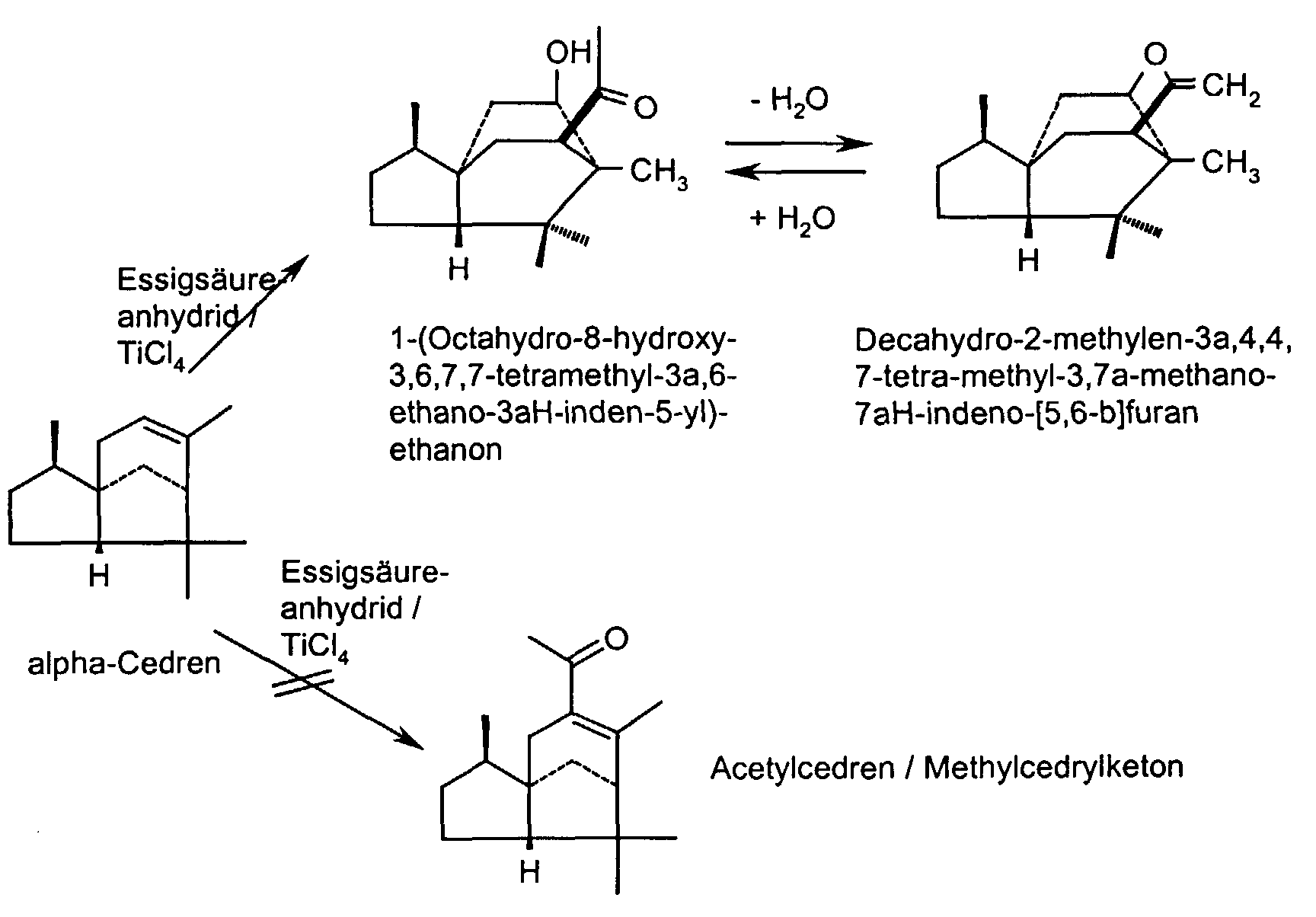
- the new tetracyclic acetals are prepared in a manner known per se starting from alpha-cedren, which is reacted with acetic anhydride in the presence of titanium tetrachloride as a stronger Lewis acid. It does not form as in the reaction with acidic catalysts such. B. phosphoric acid the so-called.
- the pure ketone is odorless; the enol ether has only a weak link to the sesquiterpene hydrocarbon fraction of cedarwood oil ( Cedarwood oil terpenes ”) pronounced smell.
- the acetals according to the invention are generally present as a mixture of two isomers.
- these acetals are suitable excellent for use as fragrances.
- the hydroxy ketone 1- (octahydro-8-hydroxy-3,6,7,7-tetramethyl-3a, 6-ethano-3aH-inden-5-yl) -ethanone, or the enol ether decahydro-2-methylene-3a, 4,4,7-tetramethyl-3,7a-methano-7aH-indeno [5,6-b] furan or a mixture of both is combined with one lower alcohol added, the cheapest being the alcohol in question in excess is used and at the same time serves as a solvent. But it can also another inert solvent can be added.
- the reaction can be in one wide temperature range, z. B. between -25 ° and + 150 ° C, possibly below Print. A temperature range between 20 ° and 80 ° C. is preferred.
- the acetals according to the invention are obtained as a residue; if necessary, the alcoholic solution can be used directly.
- the acetals according to the invention can be used as individual substances in a variety of Products are used; they can be particularly advantageous with others Combine fragrances to create novel perfume compositions.
- fragrances with which the acetals according to the invention can advantageously be combined can be found, for example, in S Arctander , Perfume and Flavor Materials , Vol . I and II , Montclair , N. J. , 1969 , self-published or K. Bauer , D. Garbe and H. Surburg , Common Fragrance and Flavor Materials , 3 rd . Ed ., Wiley-VCH , Weinheim 1997 .
- Extracts from natural raw materials such as essential oils, concretes, absolute, resins, resinoids, balms, tinctures such as B. Ambratincture; Amyris oil; Angelica seed oil; Angelica root oil; Anise oil; Valerian oil; Basil oil; Baummoos -Absolue; Bay oil; Mugwort oil; Benzoeresin; Bergamot oil; Beeswax absolute; Birch tar oil; Bitter almond oil; Savory oil; Bucco leaf oil; Cabreuva oil; Cade oil; Calmus oil; Camphor oil; Cananga oil; Cardamom oil; Cascarilla oil; Cassia oil; Cassie absolute; Castoreum-absolue; Cedar leaf oil; Cedarwood oil; Cistus oil; Citronell oil; Lemon oil; Copaiva balm; Copaiva balsam oil; Coriander oil; Costus root oil; Cumin oil; Cypress oil; Davana oil; Dill herb oil; Dill seed oil; Eau de brouts absolute;
- the perfume oils containing the acetals according to the invention can be in liquid form Form, undiluted or diluted with a solvent used for perfuming become.
- Suitable solvents for this are e.g. Ethanol, isopropanol, Diethylene glycol monoethyl ether, glycerin, propylene glycol, 1,2-butylene glycol, Dipropylene glycol, diethyl phthalate, triethyl citrate, isopropyl myristate etc.
- the perfume oils containing the acetals according to the invention can be a carrier be adsorbed, both for a fine distribution of the fragrance in the product as well as for a controlled release during use worries.
- Such supports can be porous inorganic materials such as light sulfate, Silica gels, zeolites, gypsum, clays, clay granules, gas concrete etc. or organic Materials like woods and cellulose-based fabrics.
- perfume oils containing the acetals according to the invention can also be microencapsulated, spray dried, as inclusion complexes or as extrusion products are available and added in this form to the product to be perfumed.
- the properties of the perfume oils modified in this way can be modified by so-called Coating "can be further optimized with suitable materials with a view to a more targeted fragrance release, for which purpose wax-like plastics such as polyvinyl alcohol are preferably used.
- the microencapsulation of the perfume oils can for example by the so-called Coacervation procedures using capsule materials e.g. made of polyurethane-like Fabrics or soft gelatin.
- the spray-dried perfume oils can, for example, by spray drying one containing the perfume oil Emulsion or dispersion are prepared, modified as carriers Starches, proteins, dextrin and vegetable gums can be used.
- Inclusion complexes can e.g. by entering dispersions of the Perfume oil and cyclodextrins or urea derivatives in a suitable solvent, e.g. Water.
- Extrusion products can go through Fusion of the perfume oils with a suitable waxy substance and through Extrusion with subsequent solidification, if necessary in a suitable solvent, e.g. Isopropanol can be obtained.
- the amount used is that of the invention Acetals 0.05 to 50% by weight, preferably 0.5 to 20%, based on the total Perfume oil.
- the perfume oils containing the acetals according to the invention can be concentrated Form, in solutions or in the modified form described above for the production of e.g. Perfume Extraits, Eau de perfumes, Eau de Toilettes, Aftershave, eau de colognes, pre-shave products, splash colognes and perfumed Refreshing wipes and perfuming acidic, alkaline and neutral detergents, e.g.
- Skin creams and lotions face creams and lotions, Sunscreen creams and lotions, after-sun creams and lotions, hand creams and lotions, foot creams and lotions, depilatory creams and lotions, aftershave creams and lotions, tanning creams and lotions, hair care products such as.
- Hair sprays, hair gels, setting hair lotions, hair rinses, permanent and semi-permanent hair dye hair styling agents such as cold waves and hair straighteners, hair lotions, hair creams and lotions, Deodorants and antiperspirants such as Armpit sprays, roll-ons, deodorants, Deocremes, products of decorative cosmetics such as Eye shadows, nail polishes, Make-ups, lipsticks, mascara and candles, lamp oils, incense sticks, Insecticides, repellents, fuels.
- One focus of the use of the acetals according to the invention is because of their Stability in the alkaline range when perfuming soaps and detergents.
- the inventive ones stand out Acetals through a fragrance compared to previously used increased substantivity, i.e. due to an increased windability and an increased Adhesion of the fragrance to the washed fiber.
- the amount of perfume composition can 0.1 to 40 wt .-%, preferably 0.5 to 20 wt .-%, based on the whole product.
Landscapes
- Chemical & Material Sciences (AREA)
- Organic Chemistry (AREA)
- Fats And Perfumes (AREA)
- Cosmetics (AREA)
- Heterocyclic Carbon Compounds Containing A Hetero Ring Having Oxygen Or Sulfur (AREA)
- Disinfection, Sterilisation Or Deodorisation Of Air (AREA)
- Steroid Compounds (AREA)
Abstract
Description

- R
- Niederalkyl bedeutet.


Extrakte aus natürlichen Rohstoffen wie Etherische Öle, Concretes, Absolues, Resine, Resinoide, Balsame, Tinkturen wie z. B. Ambratinktur; Amyrisöl; Angelicasamenöl; Angelicawurzelöl; Anisöl; Baldrianöl; Basilikumöl; Baummoos -Absolue; Bayöl; Beifußöl; Benzoeresin; Bergamotteöl; Bienenwachs-Absolue; Birkenteeröl; Bittermandelöl; Bohnenkrautöl; Buccoblätteröl; Cabreuvaöl; Cadeöl; Calmusöl; Campheröl; Canangaöl; Cardamomenöl; Cascarillaöl; Cassiaöl; Cassie-Absolue; Castoreum-absolue; Cedernblätteröl; Cedernholzöl; Cistusöl; Citronellöl; Citronenöl; Copaivabalsam; Copaivabalsamöl; Corianderöl; Costuswurzelöl; Cuminöl; Cypressenöl; Davanaöl; Dillkrautöl; Dillsamenöl; Eau de brouts-Absolue; Eichenmoos-Absolue; Elemiöl; Estragonöl; Eucalyptus-citriodora-Öl; Eucalyptusöl; Fenchelöl ; Fichtennadelöl; Galbanumöl; Galbanumresin; Geraniumöl; Grapefruitöl; Guajakholzöl; Gurjunbalsam; Gurjunbalsamöl; Helichrysum-Absolue; Helichrysumöl; Ingweröl; Iriswurzel-Absolue; Iriswurzelöl; Jasmin-Absolue; Kalmusöl; Kamillenöl blau; Kamillenöl römisch; Karottensamenöl; Kaskarillaöl; Kiefernadelöl; Krauseminzöl; Kümmelöl; Labdanumöl; Labdanum-Absolue; Labdanumresin; Lavandin-Absolue; Lavandinöl ; Lavendel-Absolue; Lavendelöl; Lemongrasöl; Liebstocköl; Limetteöl destilliert; Limetteöl gepreßt; Linaloeöl; Litsea-cubeba-Öl; Lorbeerblätteröl; Macisöl; Majoranöl; Mandarinenöl; Massoirindenöl; Mimosa-Absolue; Moschuskörneröl; Moschustinktur; Muskateller-Salbei-Öl; Muskatnußöl; Myrrhen-Absolue; Myrrhenöl; Myrtenöl; Nelkenblätteröl; Nelkenblütenöl; Neroliöl; Olibanum-Absolue; Olibanumöl; Opopanaxöl; Orangenblüten-Absolue; Orangenöl; Origanumöl; Palmarosaöl; Patchouliöl; Perillaöl; Perubalsamöl; Petersilienblätteröl; Petersiliensamenöl; Petitgrainöl; Pfefferminzöl; Pfefferöl; Pimentöl; Pineöl; Poleyöl; Rosen-Absolue; Rosenholzöl; Rosenöl; Rosmarinöl; Salbeiöl dalmatinisch; Salbeiöl spanisch; Sandelholzöl; Selleriesamenöl; Spiklavendelöl; Sternanisöl; Styraxöl; Tagetesöl; Tannennadelöl; Tea-tree-Öl; Terpentinöl; Thymianöl; Tolubalsam; Tonka-Absolue; Tuberosen-Absolue; Vanilleextrakt; Veilchenblätter-Absolue; Verbenaöl; Vetiveröl; Wacholderbeeröl; Weinhefenöl; Wermutöl; Wintergrünöl; Ylangöl; Ysopöl; Zibet-Absolue; Zimtblätteröl; Zimtrindenöl; sowie Fraktionen davon, bzw. daraus isolierten Inhaltsstoffen;
| Agrumex HC H&R | 20 |
| Ambroxid H&R | 5 |
| Benzylsalicylat | 150 |
| Citral | 15 |
| Citrylal H&R | 5 |
| CPD supra H&R 50% in TEC | 20 |
| Cumarin | 10 |
| Dihydromyrcenol | 100 |
| Evernyl Givaudan-Roure | 5 |
| Firbalsam Absolue | 15 |
| Freesiol H&R | 15 |
| Geranitnl H&R | 5 |
| Hedion Firmenich | 40 |
| Hexylsalicylat | 25 |
| Isoananat H&R | 5 |
| Isobornylacetat | 55 |
| Lavandinöl Grosso | 20 |
| Lilial Givaudan-Roure | 10 |
| Linalool | 75 |
| Linalylacetat | 100 |
| Orangenöl weiß | 100 |
| Patchoulyöl farbl. | 10 |
| Sandolen H&R | 10 |
| Vertocitral H&R | 5 |
3,85 (dd, J = 6.6, 1.3, 1H); 3,83 (s, 3H, O-CH3); 1,51 (s, 3H); 1,1 (s, 3H); 0,94 (s, 3H); 0,84 (d, J = 7.3; 3H); 0,75 (s, 3H).
3,81 (dd, J = 7.4, 1.5; 1H); 3,30 (s, 3H, O-CH3); 1,41 (s, 3H); 1,40 (s, 3H); 0,96 (s, 3H); 0,77 (s, 3H); 0,73 (d, J = 7.3; 3H).
Isomer A: 263 (4, M+-15);246 (30); 204 (18); 161(26); 119(100); 43(54).
Isomer B: 263 (4, M+-15);246 (20); 204 (26); 161(34); 119(100); 43(48).
3,83 (qd, J = 9.2, 7.1; 1H); 3,53 (qd, J = 9.2, 7.0; 1H);1,45 (s, 3H); 1,42 (s, 3H); 1,19 (t, J = 7,1; 3H); 0,74 (d, J = 7.3; 3H); 0,98 (s, 3H); 0,78 (s, 3H).
3,91 (qd, J = 9.2, 7.1; 1H); 3,55 (qd, J = 9.2, 7.0; 1H); 1,54 (s, 3H); 1,11 (s, 3H); 1,19 (t, J = 7,1; 3H); 0,87 (d, J = 7.3; 3H); 0,95 (s, 3H); 0,76 (s, 3H).
Isomer A: 277 (3, M+-15);246 (22); 204 (18); 161(27); 119(100); 43(62).
Isomer B: 277 (3, M+-15);246 (14); 204 (22); 161(38); 119(100); 43(60).
Claims (4)
- 2-Alkoxydecahydro-2,3a,4,4,7-pentamethyl-3,7a-methano-7aH-indeno[5,6-b]furane,
worin- R
- eine geradkettige oder verzweigte Alkyl- oder Alkenylgruppe mit 1
bis 5 C-Atomen und einer Doppelbindung bedeutet.

- Verfahren zur Herstellung von 2-Alkoxydecahydro-2,3a,4,4,7-pentamethyl-3,7a-methano-7aH-indeno[5,6-b]furanen durch Umsetzung von Decahydro-2-methylen-3a,4,4,7-tetramethyl-3,7a-methano-7aH-indeno[5,6-b]furan oder 1-(Octahydro-8-hydroxy-3,6,7,7-tetramethyl-3a,6-ethano-3aH-inden-5-yl)ethanon mit Alkoholen gemäß Anspruch 1.
- Verwendung von 2-Alkoxydecahydro-2,3a,4,4,7-pentamethyl-3,7a-methano-7aH-indeno[5,6-b]furanen gemäß Anspruch 1 als Riechstoffe.
- Parfümöle enthaltend 2-Alkoxydecahydro-2,3a,4,4,7-pentamethyl-3,7a-methano-7aH-indeno[5,6-b]furanen gemäß Anspruch 1.
Applications Claiming Priority (2)
| Application Number | Priority Date | Filing Date | Title |
|---|---|---|---|
| DE19931709 | 1999-07-08 | ||
| DE19931709A DE19931709A1 (de) | 1999-07-08 | 1999-07-08 | Neue tetracyclische Acetale |
Publications (3)
| Publication Number | Publication Date |
|---|---|
| EP1067126A2 true EP1067126A2 (de) | 2001-01-10 |
| EP1067126A3 EP1067126A3 (de) | 2001-07-11 |
| EP1067126B1 EP1067126B1 (de) | 2005-12-21 |
Family
ID=7913999
Family Applications (1)
| Application Number | Title | Priority Date | Filing Date |
|---|---|---|---|
| EP00113135A Expired - Lifetime EP1067126B1 (de) | 1999-07-08 | 2000-06-29 | Tetracyclische Acetale |
Country Status (6)
| Country | Link |
|---|---|
| US (1) | US6420334B1 (de) |
| EP (1) | EP1067126B1 (de) |
| JP (1) | JP3334708B2 (de) |
| AT (1) | ATE313536T1 (de) |
| DE (2) | DE19931709A1 (de) |
| ES (1) | ES2255918T3 (de) |
Families Citing this family (5)
| Publication number | Priority date | Publication date | Assignee | Title |
|---|---|---|---|---|
| EP1170005B1 (de) * | 2000-02-10 | 2009-01-07 | Kao Corporation | Verwendung von sesquiterpenalkohol zur regulierung des autonomen nervensystems |
| WO2002003941A1 (fr) * | 2000-07-10 | 2002-01-17 | Firmenich Sa | Utilisation du (1-ethoxyethoxy)cyclododecane dans une composition parfumante a titre d'agent fixateur et/ou amplificateur de parfum |
| US7763238B2 (en) * | 2002-01-16 | 2010-07-27 | Monell Chemical Senses Center | Olfactory adaptation and cross-adapting agents to reduce the perception of body odors |
| US6897244B2 (en) * | 2002-07-03 | 2005-05-24 | Board Of Supervisors Of Louisiana State University And Agricultural And Mechanical College | Dihydronootkatone and tetrahydronootkatone as repellents to arthropods |
| JP6600116B1 (ja) * | 2019-07-19 | 2019-10-30 | 高砂香料工業株式会社 | 香料組成物 |
Family Cites Families (3)
| Publication number | Priority date | Publication date | Assignee | Title |
|---|---|---|---|---|
| DE4029424A1 (de) * | 1990-09-17 | 1992-03-19 | Henkel Kgaa | Isomere 11-oxa-tricyclo(7.3.0.0(pfeil hoch)2(pfeil hoch)(pfeil hoch),(pfeil hoch)(pfeil hoch)6(pfeil hoch))dodecen-derivate, deren herstellung und verwendung als riechstoffe, sowie diese enthaltende riechstoff-kompositionen |
| US5441930A (en) | 1990-09-17 | 1995-08-15 | Henkel Kommanditgesellschaft Auf Aktien | Isomeric 11-oxatricyclo[7.3.02,6]dodecene derivatives, their production and their use as fragrances and fragrance compositions containing them |
| DE19704484A1 (de) * | 1997-02-06 | 1998-09-03 | Dragoco Gerberding Co Ag | Cyclische Cedren-Acetale, ihre Herstellung und ihre Verwendung |
-
1999
- 1999-07-08 DE DE19931709A patent/DE19931709A1/de not_active Withdrawn
-
2000
- 2000-06-26 JP JP2000191231A patent/JP3334708B2/ja not_active Expired - Fee Related
- 2000-06-29 ES ES00113135T patent/ES2255918T3/es not_active Expired - Lifetime
- 2000-06-29 DE DE50011888T patent/DE50011888D1/de not_active Expired - Fee Related
- 2000-06-29 AT AT00113135T patent/ATE313536T1/de not_active IP Right Cessation
- 2000-06-29 EP EP00113135A patent/EP1067126B1/de not_active Expired - Lifetime
- 2000-06-30 US US09/609,042 patent/US6420334B1/en not_active Expired - Fee Related
Also Published As
| Publication number | Publication date |
|---|---|
| DE19931709A1 (de) | 2001-01-11 |
| EP1067126B1 (de) | 2005-12-21 |
| ATE313536T1 (de) | 2006-01-15 |
| ES2255918T3 (es) | 2006-07-16 |
| JP3334708B2 (ja) | 2002-10-15 |
| EP1067126A3 (de) | 2001-07-11 |
| US6420334B1 (en) | 2002-07-16 |
| JP2001048883A (ja) | 2001-02-20 |
| DE50011888D1 (de) | 2006-01-26 |
Similar Documents
| Publication | Publication Date | Title |
|---|---|---|
| US20060166857A1 (en) | 4,8-Dimethyl-7-nonen-2-one and 4,8-dimethylnonan-2-one used as perfumes | |
| EP3197987A1 (de) | Verwendung von isomerenreinem oder hoch isomerenangereichertem cis- oder trans-(2-isobutyl-4-methyl-tetrahydropyran-4-yl)acetat | |
| EP1492759B1 (de) | Alicyclische ester mit moschusgeruch | |
| EP1111029A2 (de) | Parfümkompositionen enthaltend 4,8-Dimethyl-3,7-nonadien-2-on | |
| EP1747186B1 (de) | Riechstoffmischung umfassend 3-Methylbenzylisobutyrat | |
| EP1654246B1 (de) | Acetale, ihre verwendung als riechstoffe und verfahren zu ihrer herstellung | |
| EP1313692B1 (de) | Neue makrocyclische ketone | |
| EP1849759B1 (de) | Sandelriechstoffe | |
| EP1215189A1 (de) | Verfahren zur Herstellung von Isolongifolanol | |
| EP1067126B1 (de) | Tetracyclische Acetale | |
| EP1599434B1 (de) | 4-cyclohexyl-2-butanol als riechstoff | |
| WO2005012222A1 (de) | Alicyclische ester mit moschusgeruch | |
| DE102008000275A1 (de) | Alkenacetale und ihre Verwendung als Riechstoffe | |
| EP3112448B1 (de) | Derivate des 1-(4-methylcyclohexyl)-ethanols | |
| EP1761618A1 (de) | Verwendung eines gemisches von cis- und trans-3-methyl-g-decalacton sowie riechstoffkompositionen und parfümierte artikel umfassend ein solches gemisch | |
| EP1648526B1 (de) | Cis-3,3,5-trimethylcyclohexylester | |
| EP3153494A1 (de) | Verwendung neuartiger gemische von (e/z)-cyclopentadecenon-isomeren, deren herstellung und deren verwendung als aromastoff | |
| DE10229474A1 (de) | Neue Riechstoffe und Verfahren zu ihrer Herstellung | |
| DE10222025A1 (de) | Neue ungesättigte makrocyclische Oxalactone | |
| DE10106421A1 (de) | Verfahren zur Herstellung von Isolongifolanol | |
| DE10325628A1 (de) | 2-Methyl-5-phenylpentanal als Rosenriechstoff |
Legal Events
| Date | Code | Title | Description |
|---|---|---|---|
| PUAI | Public reference made under article 153(3) epc to a published international application that has entered the european phase |
Free format text: ORIGINAL CODE: 0009012 |
|
| AK | Designated contracting states |
Kind code of ref document: A2 Designated state(s): AT BE CH CY DE DK ES FI FR GB GR IE IT LI LU MC NL PT SE |
|
| AX | Request for extension of the european patent |
Free format text: AL;LT;LV;MK;RO;SI |
|
| PUAL | Search report despatched |
Free format text: ORIGINAL CODE: 0009013 |
|
| RIC1 | Information provided on ipc code assigned before grant |
Free format text: 7C 07D 307/93 A, 7A 61K 7/46 B, 7C 11B 9/00 B |
|
| AK | Designated contracting states |
Kind code of ref document: A3 Designated state(s): AT BE CH CY DE DK ES FI FR GB GR IE IT LI LU MC NL PT SE |
|
| AX | Request for extension of the european patent |
Free format text: AL;LT;LV;MK;RO;SI |
|
| 17P | Request for examination filed |
Effective date: 20020111 |
|
| AKX | Designation fees paid |
Free format text: AT BE CH CY DE DK ES FI FR GB GR IE IT LI LU MC NL PT SE |
|
| RAP1 | Party data changed (applicant data changed or rights of an application transferred) |
Owner name: SYMRISE GMBH & CO. KG |
|
| 17Q | First examination report despatched |
Effective date: 20040312 |
|
| GRAP | Despatch of communication of intention to grant a patent |
Free format text: ORIGINAL CODE: EPIDOSNIGR1 |
|
| GRAS | Grant fee paid |
Free format text: ORIGINAL CODE: EPIDOSNIGR3 |
|
| GRAA | (expected) grant |
Free format text: ORIGINAL CODE: 0009210 |
|
| AK | Designated contracting states |
Kind code of ref document: B1 Designated state(s): AT BE CH CY DE DK ES FI FR GB GR IE IT LI LU MC NL PT SE |
|
| PG25 | Lapsed in a contracting state [announced via postgrant information from national office to epo] |
Ref country code: NL Free format text: LAPSE BECAUSE OF FAILURE TO SUBMIT A TRANSLATION OF THE DESCRIPTION OR TO PAY THE FEE WITHIN THE PRESCRIBED TIME-LIMIT Effective date: 20051221 Ref country code: FI Free format text: LAPSE BECAUSE OF FAILURE TO SUBMIT A TRANSLATION OF THE DESCRIPTION OR TO PAY THE FEE WITHIN THE PRESCRIBED TIME-LIMIT Effective date: 20051221 Ref country code: IE Free format text: LAPSE BECAUSE OF FAILURE TO SUBMIT A TRANSLATION OF THE DESCRIPTION OR TO PAY THE FEE WITHIN THE PRESCRIBED TIME-LIMIT Effective date: 20051221 |
|
| REG | Reference to a national code |
Ref country code: GB Ref legal event code: FG4D Free format text: NOT ENGLISH |
|
| REG | Reference to a national code |
Ref country code: CH Ref legal event code: EP Ref country code: CH Ref legal event code: NV Representative=s name: E. BLUM & CO. PATENTANWAELTE |
|
| GBT | Gb: translation of ep patent filed (gb section 77(6)(a)/1977) |
Effective date: 20051221 |
|
| REG | Reference to a national code |
Ref country code: IE Ref legal event code: FG4D Free format text: LANGUAGE OF EP DOCUMENT: GERMAN |
|
| REF | Corresponds to: |
Ref document number: 50011888 Country of ref document: DE Date of ref document: 20060126 Kind code of ref document: P |
|
| PG25 | Lapsed in a contracting state [announced via postgrant information from national office to epo] |
Ref country code: GR Free format text: LAPSE BECAUSE OF FAILURE TO SUBMIT A TRANSLATION OF THE DESCRIPTION OR TO PAY THE FEE WITHIN THE PRESCRIBED TIME-LIMIT Effective date: 20060321 Ref country code: DK Free format text: LAPSE BECAUSE OF FAILURE TO SUBMIT A TRANSLATION OF THE DESCRIPTION OR TO PAY THE FEE WITHIN THE PRESCRIBED TIME-LIMIT Effective date: 20060321 Ref country code: SE Free format text: LAPSE BECAUSE OF FAILURE TO SUBMIT A TRANSLATION OF THE DESCRIPTION OR TO PAY THE FEE WITHIN THE PRESCRIBED TIME-LIMIT Effective date: 20060321 |
|
| PG25 | Lapsed in a contracting state [announced via postgrant information from national office to epo] |
Ref country code: PT Free format text: LAPSE BECAUSE OF FAILURE TO SUBMIT A TRANSLATION OF THE DESCRIPTION OR TO PAY THE FEE WITHIN THE PRESCRIBED TIME-LIMIT Effective date: 20060522 |
|
| NLV1 | Nl: lapsed or annulled due to failure to fulfill the requirements of art. 29p and 29m of the patents act | ||
| PGFP | Annual fee paid to national office [announced via postgrant information from national office to epo] |
Ref country code: FR Payment date: 20060621 Year of fee payment: 7 |
|
| PGFP | Annual fee paid to national office [announced via postgrant information from national office to epo] |
Ref country code: GB Payment date: 20060626 Year of fee payment: 7 |
|
| PGFP | Annual fee paid to national office [announced via postgrant information from national office to epo] |
Ref country code: CH Payment date: 20060627 Year of fee payment: 7 |
|
| PGFP | Annual fee paid to national office [announced via postgrant information from national office to epo] |
Ref country code: ES Payment date: 20060628 Year of fee payment: 7 |
|
| PG25 | Lapsed in a contracting state [announced via postgrant information from national office to epo] |
Ref country code: MC Free format text: LAPSE BECAUSE OF NON-PAYMENT OF DUE FEES Effective date: 20060630 Ref country code: BE Free format text: LAPSE BECAUSE OF NON-PAYMENT OF DUE FEES Effective date: 20060630 |
|
| PGFP | Annual fee paid to national office [announced via postgrant information from national office to epo] |
Ref country code: IT Payment date: 20060630 Year of fee payment: 7 |
|
| PGFP | Annual fee paid to national office [announced via postgrant information from national office to epo] |
Ref country code: DE Payment date: 20060704 Year of fee payment: 7 |
|
| REG | Reference to a national code |
Ref country code: ES Ref legal event code: FG2A Ref document number: 2255918 Country of ref document: ES Kind code of ref document: T3 |
|
| REG | Reference to a national code |
Ref country code: IE Ref legal event code: FD4D |
|
| ET | Fr: translation filed | ||
| PLBE | No opposition filed within time limit |
Free format text: ORIGINAL CODE: 0009261 |
|
| STAA | Information on the status of an ep patent application or granted ep patent |
Free format text: STATUS: NO OPPOSITION FILED WITHIN TIME LIMIT |
|
| 26N | No opposition filed |
Effective date: 20060922 |
|
| REG | Reference to a national code |
Ref country code: CH Ref legal event code: PFA Owner name: SYMRISE GMBH & CO. KG Free format text: SYMRISE GMBH & CO. KG#MUEHLENFELDSTRASSE 1#37603 HOLZMINDEN (DE) -TRANSFER TO- SYMRISE GMBH & CO. KG#MUEHLENFELDSTRASSE 1#37603 HOLZMINDEN (DE) |
|
| PG25 | Lapsed in a contracting state [announced via postgrant information from national office to epo] |
Ref country code: AT Free format text: LAPSE BECAUSE OF NON-PAYMENT OF DUE FEES Effective date: 20060629 |
|
| BERE | Be: lapsed |
Owner name: SYMRISE G.M.B.H. & CO. KG Effective date: 20060630 |
|
| REG | Reference to a national code |
Ref country code: CH Ref legal event code: PL |
|
| GBPC | Gb: european patent ceased through non-payment of renewal fee |
Effective date: 20070629 |
|
| REG | Reference to a national code |
Ref country code: FR Ref legal event code: ST Effective date: 20080229 |
|
| PG25 | Lapsed in a contracting state [announced via postgrant information from national office to epo] |
Ref country code: DE Free format text: LAPSE BECAUSE OF NON-PAYMENT OF DUE FEES Effective date: 20080101 Ref country code: CH Free format text: LAPSE BECAUSE OF NON-PAYMENT OF DUE FEES Effective date: 20070630 Ref country code: LI Free format text: LAPSE BECAUSE OF NON-PAYMENT OF DUE FEES Effective date: 20070630 |
|
| PG25 | Lapsed in a contracting state [announced via postgrant information from national office to epo] |
Ref country code: GB Free format text: LAPSE BECAUSE OF NON-PAYMENT OF DUE FEES Effective date: 20070629 |
|
| PG25 | Lapsed in a contracting state [announced via postgrant information from national office to epo] |
Ref country code: LU Free format text: LAPSE BECAUSE OF NON-PAYMENT OF DUE FEES Effective date: 20060629 |
|
| REG | Reference to a national code |
Ref country code: ES Ref legal event code: FD2A Effective date: 20070630 |
|
| PG25 | Lapsed in a contracting state [announced via postgrant information from national office to epo] |
Ref country code: FR Free format text: LAPSE BECAUSE OF NON-PAYMENT OF DUE FEES Effective date: 20070702 |
|
| PG25 | Lapsed in a contracting state [announced via postgrant information from national office to epo] |
Ref country code: ES Free format text: LAPSE BECAUSE OF NON-PAYMENT OF DUE FEES Effective date: 20070630 |
|
| PG25 | Lapsed in a contracting state [announced via postgrant information from national office to epo] |
Ref country code: CY Free format text: LAPSE BECAUSE OF FAILURE TO SUBMIT A TRANSLATION OF THE DESCRIPTION OR TO PAY THE FEE WITHIN THE PRESCRIBED TIME-LIMIT Effective date: 20051221 |
|
| PG25 | Lapsed in a contracting state [announced via postgrant information from national office to epo] |
Ref country code: IT Free format text: LAPSE BECAUSE OF NON-PAYMENT OF DUE FEES Effective date: 20070629 |