EP1065293B1 - Method of controlling thickness and aluminum content of a diffusion aluminide coating - Google Patents
Method of controlling thickness and aluminum content of a diffusion aluminide coating Download PDFInfo
- Publication number
- EP1065293B1 EP1065293B1 EP00305475A EP00305475A EP1065293B1 EP 1065293 B1 EP1065293 B1 EP 1065293B1 EP 00305475 A EP00305475 A EP 00305475A EP 00305475 A EP00305475 A EP 00305475A EP 1065293 B1 EP1065293 B1 EP 1065293B1
- Authority
- EP
- European Patent Office
- Prior art keywords
- aluminum
- coating
- substrate
- diffusion aluminide
- gas
- Prior art date
- Legal status (The legal status is an assumption and is not a legal conclusion. Google has not performed a legal analysis and makes no representation as to the accuracy of the status listed.)
- Expired - Lifetime
Links
- 238000000576 coating method Methods 0.000 title claims description 116
- 239000011248 coating agent Substances 0.000 title claims description 104
- 229910052782 aluminium Inorganic materials 0.000 title claims description 80
- XAGFODPZIPBFFR-UHFFFAOYSA-N aluminium Chemical compound [Al] XAGFODPZIPBFFR-UHFFFAOYSA-N 0.000 title claims description 75
- 238000000034 method Methods 0.000 title claims description 43
- 229910000951 Aluminide Inorganic materials 0.000 title claims description 38
- 238000009792 diffusion process Methods 0.000 title claims description 36
- 239000000758 substrate Substances 0.000 claims description 30
- 239000007789 gas Substances 0.000 claims description 29
- 230000000694 effects Effects 0.000 claims description 22
- XKRFYHLGVUSROY-UHFFFAOYSA-N Argon Chemical compound [Ar] XKRFYHLGVUSROY-UHFFFAOYSA-N 0.000 claims description 8
- 238000005269 aluminizing Methods 0.000 claims description 8
- 229910000601 superalloy Inorganic materials 0.000 claims description 5
- 238000001947 vapour-phase growth Methods 0.000 claims description 5
- 229910052786 argon Inorganic materials 0.000 claims description 4
- 230000003247 decreasing effect Effects 0.000 claims 1
- 239000000463 material Substances 0.000 description 18
- PXHVJJICTQNCMI-UHFFFAOYSA-N Nickel Chemical compound [Ni] PXHVJJICTQNCMI-UHFFFAOYSA-N 0.000 description 12
- 239000012190 activator Substances 0.000 description 12
- XEEYBQQBJWHFJM-UHFFFAOYSA-N Iron Chemical compound [Fe] XEEYBQQBJWHFJM-UHFFFAOYSA-N 0.000 description 8
- 239000000654 additive Substances 0.000 description 7
- 230000000996 additive effect Effects 0.000 description 7
- 230000008901 benefit Effects 0.000 description 6
- 239000000203 mixture Substances 0.000 description 6
- 229910052759 nickel Inorganic materials 0.000 description 6
- 230000003647 oxidation Effects 0.000 description 6
- 238000007254 oxidation reaction Methods 0.000 description 6
- 239000012071 phase Substances 0.000 description 6
- BASFCYQUMIYNBI-UHFFFAOYSA-N platinum Chemical compound [Pt] BASFCYQUMIYNBI-UHFFFAOYSA-N 0.000 description 6
- -1 aluminum halide Chemical class 0.000 description 5
- 229910045601 alloy Inorganic materials 0.000 description 4
- 239000000956 alloy Substances 0.000 description 4
- 238000005229 chemical vapour deposition Methods 0.000 description 4
- 230000007613 environmental effect Effects 0.000 description 4
- 229910052742 iron Inorganic materials 0.000 description 4
- 229910052751 metal Inorganic materials 0.000 description 4
- 239000002184 metal Substances 0.000 description 4
- 239000000843 powder Substances 0.000 description 4
- 239000002585 base Substances 0.000 description 3
- 229910052697 platinum Inorganic materials 0.000 description 3
- 230000008439 repair process Effects 0.000 description 3
- IRPGOXJVTQTAAN-UHFFFAOYSA-N 2,2,3,3,3-pentafluoropropanal Chemical compound FC(F)(F)C(F)(F)C=O IRPGOXJVTQTAAN-UHFFFAOYSA-N 0.000 description 2
- KLZUFWVZNOTSEM-UHFFFAOYSA-K Aluminum fluoride Inorganic materials F[Al](F)F KLZUFWVZNOTSEM-UHFFFAOYSA-K 0.000 description 2
- NPXOKRUENSOPAO-UHFFFAOYSA-N Raney nickel Chemical compound [Al].[Ni] NPXOKRUENSOPAO-UHFFFAOYSA-N 0.000 description 2
- PNEYBMLMFCGWSK-UHFFFAOYSA-N aluminium oxide Inorganic materials [O-2].[O-2].[O-2].[Al+3].[Al+3] PNEYBMLMFCGWSK-UHFFFAOYSA-N 0.000 description 2
- 229910017052 cobalt Chemical group 0.000 description 2
- 239000010941 cobalt Chemical group 0.000 description 2
- GUTLYIVDDKVIGB-UHFFFAOYSA-N cobalt atom Chemical group [Co] GUTLYIVDDKVIGB-UHFFFAOYSA-N 0.000 description 2
- 238000005260 corrosion Methods 0.000 description 2
- 230000007797 corrosion Effects 0.000 description 2
- 238000000151 deposition Methods 0.000 description 2
- 230000008021 deposition Effects 0.000 description 2
- TWNQGVIAIRXVLR-UHFFFAOYSA-N oxo(oxoalumanyloxy)alumane Chemical compound O=[Al]O[Al]=O TWNQGVIAIRXVLR-UHFFFAOYSA-N 0.000 description 2
- 239000002245 particle Substances 0.000 description 2
- 230000001681 protective effect Effects 0.000 description 2
- 239000012808 vapor phase Substances 0.000 description 2
- 229910000838 Al alloy Inorganic materials 0.000 description 1
- QGZKDVFQNNGYKY-UHFFFAOYSA-O Ammonium Chemical compound [NH4+] QGZKDVFQNNGYKY-UHFFFAOYSA-O 0.000 description 1
- UFHFLCQGNIYNRP-UHFFFAOYSA-N Hydrogen Chemical compound [H][H] UFHFLCQGNIYNRP-UHFFFAOYSA-N 0.000 description 1
- 229910001508 alkali metal halide Inorganic materials 0.000 description 1
- 150000008045 alkali metal halides Chemical class 0.000 description 1
- 230000015572 biosynthetic process Effects 0.000 description 1
- 238000006243 chemical reaction Methods 0.000 description 1
- 230000007423 decrease Effects 0.000 description 1
- 230000001419 dependent effect Effects 0.000 description 1
- 239000000945 filler Substances 0.000 description 1
- 238000010438 heat treatment Methods 0.000 description 1
- 239000001257 hydrogen Substances 0.000 description 1
- 229910052739 hydrogen Inorganic materials 0.000 description 1
- 239000011261 inert gas Substances 0.000 description 1
- 239000004615 ingredient Substances 0.000 description 1
- 230000002452 interceptive effect Effects 0.000 description 1
- 238000011835 investigation Methods 0.000 description 1
- 150000002739 metals Chemical class 0.000 description 1
- 229910000907 nickel aluminide Inorganic materials 0.000 description 1
- 239000008188 pellet Substances 0.000 description 1
- 238000007581 slurry coating method Methods 0.000 description 1
Images
Classifications
-
- C—CHEMISTRY; METALLURGY
- C23—COATING METALLIC MATERIAL; COATING MATERIAL WITH METALLIC MATERIAL; CHEMICAL SURFACE TREATMENT; DIFFUSION TREATMENT OF METALLIC MATERIAL; COATING BY VACUUM EVAPORATION, BY SPUTTERING, BY ION IMPLANTATION OR BY CHEMICAL VAPOUR DEPOSITION, IN GENERAL; INHIBITING CORROSION OF METALLIC MATERIAL OR INCRUSTATION IN GENERAL
- C23C—COATING METALLIC MATERIAL; COATING MATERIAL WITH METALLIC MATERIAL; SURFACE TREATMENT OF METALLIC MATERIAL BY DIFFUSION INTO THE SURFACE, BY CHEMICAL CONVERSION OR SUBSTITUTION; COATING BY VACUUM EVAPORATION, BY SPUTTERING, BY ION IMPLANTATION OR BY CHEMICAL VAPOUR DEPOSITION, IN GENERAL
- C23C16/00—Chemical coating by decomposition of gaseous compounds, without leaving reaction products of surface material in the coating, i.e. chemical vapour deposition [CVD] processes
- C23C16/06—Chemical coating by decomposition of gaseous compounds, without leaving reaction products of surface material in the coating, i.e. chemical vapour deposition [CVD] processes characterised by the deposition of metallic material
- C23C16/08—Chemical coating by decomposition of gaseous compounds, without leaving reaction products of surface material in the coating, i.e. chemical vapour deposition [CVD] processes characterised by the deposition of metallic material from metal halides
- C23C16/12—Deposition of aluminium only
-
- C—CHEMISTRY; METALLURGY
- C23—COATING METALLIC MATERIAL; COATING MATERIAL WITH METALLIC MATERIAL; CHEMICAL SURFACE TREATMENT; DIFFUSION TREATMENT OF METALLIC MATERIAL; COATING BY VACUUM EVAPORATION, BY SPUTTERING, BY ION IMPLANTATION OR BY CHEMICAL VAPOUR DEPOSITION, IN GENERAL; INHIBITING CORROSION OF METALLIC MATERIAL OR INCRUSTATION IN GENERAL
- C23C—COATING METALLIC MATERIAL; COATING MATERIAL WITH METALLIC MATERIAL; SURFACE TREATMENT OF METALLIC MATERIAL BY DIFFUSION INTO THE SURFACE, BY CHEMICAL CONVERSION OR SUBSTITUTION; COATING BY VACUUM EVAPORATION, BY SPUTTERING, BY ION IMPLANTATION OR BY CHEMICAL VAPOUR DEPOSITION, IN GENERAL
- C23C10/00—Solid state diffusion of only metal elements or silicon into metallic material surfaces
- C23C10/06—Solid state diffusion of only metal elements or silicon into metallic material surfaces using gases
- C23C10/08—Solid state diffusion of only metal elements or silicon into metallic material surfaces using gases only one element being diffused
Definitions
- the present invention relates to processes for forming protective diffusion aluminide coatings. More particularly, this invention relates to a process for controlling the thickness and aluminum content of a diffusion aluminide coating by controlling aluminum activity during the coating process.
- Diffusion aluminide coatings have particularly found widespread use for superalloy components of gas turbine engines. These coatings are generally formed by such methods as diffusing aluminum deposited by chemical vapor deposition (CVD) or slurry coating, or by a diffusion process such as pack cementation, above-pack, or vapor (gas) phase deposition.
- CVD chemical vapor deposition
- slurry coating or by a diffusion process such as pack cementation, above-pack, or vapor (gas) phase deposition.
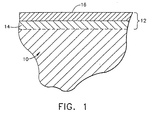
- a diffusion aluminide coating 12 generally has two distinct zones, the outermost of which is an additive layer 16 containing an environmentally-resistant intermetallic represented by MAI, where M is iron, nickel or cobalt, depending on the substrate material.
- MAI intermetallic is the result of deposited aluminum and an outward diffusion of iron, nickel or cobalt from the substrate 10.
- the additive layer 16 Beneath the additive layer 16 is a diffusion zone 14 comprising various intermetallic and metastable phases that form during the coating reaction as a result of diffusional gradients and changes in elemental solubility in the local region of the substrate 10. During high temperature exposure in air, the additive layer 16 forms a protective aluminum oxide (alumina) scale or layer (not shown) that inhibits oxidation of the diffusion coating 12 and the underlying substrate 10.
- alumina aluminum oxide
- Diffusion processes generally entail reacting the surface of a component with an aluminum-containing gas composition. Examples of such processes are described in EP 0 731 187A, US 5,368,888 and US 5,658,614.
- the aluminum-containing gas composition is produced by heating a powder mixture of an aluminum-containing source (donor) material, a carrier (activator) such as an ammonium or alkali metal halide, and an inert filler such as calcined alumina.
- the ingredients of the powder mixture are mixed and then packed and pressed around the component to be treated, after which the component and powder mixture are heated to a temperature sufficient to vaporize and react the activator with the source material to form the volatile aluminum halide, which then reacts at the surface of the component to form the diffusion aluminide coating.
- Aluminum-containing source materials for vapor phase deposition processes can be aluminum alloy particles or an aluminum halide. If the source material is an aluminum halide, a separate activator is not required. The source material is placed out of contact with the surface to be aluminized. As with pack cementation, vapor phase aluminizing (VPA) is performed at a temperature at which the aluminum halide will react at the surface of the component to form a diffusion aluminide coating.
- VPA vapor phase aluminizing
- the rate at which a diffusion aluminide coating develops on a substrate is dependent on the aluminum activity of the process.
- CVD processes and those VPA processes where the source material is in the form of particles (e.g., chunks or pellets) with a fixed alloy composition have a constant aluminum activity as long as source material and sufficient activator are available.
- aluminum activity decreases uncontrollably with time during pack cementation and other above-pack processes as a result of the reduced availability of the aluminum source material and/or activator over time.
- the rate at which the activator is depleted in pack cementation and above-pack processes increases with process-related anomalies, such as extended preheat times often required to heat the large mass of powder.
- aluminide coating thickness can be better controlled with VPA and CVD processes than pack cementation and above-pack processes.
- the aluminum content of the coating cannot be controlled to any certain degree during coating with existing aluminizing process.
- a process for forming a diffusion aluminide coating comprising the steps of placing a substrate in a coating chamber; providing within the coating chamber, an aluminum-containing vapor having a substantially constant aluminum activity; flowing an inert or reducing gas into and through the coating chamber; and producing a diffusion aluminide coating on the substrate by contacting the substrate with the aluminum-containing vapor to cause a portion of the aluminum-containing vapor to react with and deposit aluminum on the substrate while maintaining the substantially constant aluminum activity of the aluminum-containing vapor within the coating chamber, and while controlling the rate at which the aluminum is deposited on the substrate by altering the flow rate of the gas through the coating chamber so that a portion of the unreacted aluminum containing vapor is swept from the coating chamber by the gas, and so that greater amounts of the unreacted aluminum-containing vapor are swept from the coating chamber with higher gas flow rates.
- the process of this invention is able to produce a diffusion aluminide coating whose thickness can be accurately controlled, as well as its aluminum content through the coating thickness.
- a diffusion aluminide coating can be produced whose thickness and aluminum content can be tailored for a particular application.
- a coating can be produced to exhibit a reduced rate of coating growth and improved environmental resistance as a result of being initially deposited to be an outward-type aluminide coating characterized by a relatively low aluminum content near the original substrate surface, and with an increasing aluminum content toward the coating surface.
- the ability to rejuvenate a diffusion aluminide coating on a component is the rate controlling step for coating growth.
- the driving force for coating growth is significant since the aluminum level is controlled by alloy chemistry.
- the driving force for aluminum deposition is a function of the aluminum level remaining in the coating. Areas with significant aluminum levels in the existing coating will have minimal coating growth, while areas with existing coating that is depleted in aluminum will increase in aluminum content with slight coating growth. As a result, excessive coating thickness is avoided on those surfaces with the original coating.
- the present invention provides a cost effective aluminizing method that is compatible with existing aluminizing processes and equipment.
- the method can be selectively implemented without interfering with the process flow of other components that do not require the benefits of this invention.
- Figure 1 is a cross-sectional view of a substrate with an outward-type diffusion aluminide coating.
- the present invention is generally applicable to components that operate within thermally and chemically hostile environments, and are therefore subjected to oxidation and hot corrosion.
- Notable examples of such components include the high and low pressure turbine nozzles, blades and shrouds of gas turbine engines. While the advantages of this invention will be described with reference to gas turbine engine hardware, the teachings of the invention are generally applicable to any component on which an aluminide coating may be used to protect the component from its environment.
- Figure 1 represents an outward-type diffusion aluminide coating 12 that can be produced by the method of this invention.
- the coating 12 is shown as overlying a substrate 10, which is typically the base material of the component protected by the coating 12.
- Typical materials for the substrate 10 (and therefore the component) include nickel, iron and cobalt-base superalloys, though other alloys could be used.
- the aluminide coating 12 is generally characterized by an additive layer 16 that overlies a diffusion zone 14, the former of which contains an oxidation-resistant MAl intermetallic phase, such as the nickel-aluminide beta phase (NiAl).
- the additive layer 16 may also contain other intermetallic phases, depending on whether other metals were deposited or otherwise present on the substrate 10 prior to aluminizing.
- the additive layer 16 may include Ptal 2 or platinum in solution in the MAI phase if platinum was plated on the substrate 10.
- An inward-type diffusion aluminide coating would generally differ from the outward-type coating 12 shown in Figure 1 by having a thicker additive layer that primarily extends into and below the original substrate surface, but is otherwise compositionally similar. Diffusion aluminide coatings of both types form an aluminum oxide scale (not shown) on their surface during exposure to engine environments. The oxide scale inhibits oxidation of the aluminide coating 12 and substrate 10.
- a suitable thickness for the coating 12 is typically about 25 to 125 micrometers (about 0.001-0.005 inch).
- the coating 12 is formed by an aluminizing technique characterized by a substantially constant aluminum activity. While vapor phase deposition will be described as being particularly well suited for use with this invention, it is foreseeable that other VPA processes that provide a substantially constant aluminum activity could be used or developed for use with the method of this invention.
- Vapor phase deposition processes are well known in the art, and are conventionally carried out in an inert or reducing atmosphere within a coating chamber (retort) containing the component to be coated, an aluminum source (donor) material and one or more activators that, with the source material, generate the coating vapors (e.g., volatile aluminum halide) that react at the surface of the component to form the diffusion aluminide coating.
- an inert gas such as argon or a reducing gas such as hydrogen is flowed through the chamber at a rate to alter the amount of unreacted aluminum in the chamber, such that the coating rate and aluminum content of the coating can be tailored to meet the particular requirements of the coating.
- the highest desired aluminum activity for the coating process is established by the choice of source material and activator(s) used for the coating process, and the effective aluminum activity at any given time is controlled by metering the gas flow into the chamber.
- the use of a source material with a minimum aluminum content of 25 weight percent and the use of aluminum fluoride as the activator provides for a relatively high aluminum activity, which can be effectively reduced by flowing argon gas through the chamber at a minimum rate of 10 SCFH (about 0.283 m 3 /hr).
- An application that benefits from the method of this invention is where minimized coating growth potential is desired during engine service on a component.
- an outward-type aluminide coating is preferred where nickel diffusion during coating formation is such to minimize interdiffusion of aluminum from the coating and nickel from the substrate (i.e., coating growth) during subsequent exposure to elevated temperatures.
- a high aluminum content is desired at the surface of the coating to promote environmental resistance.
- source materials and one or more activators are selected to achieve a high maximum aluminum activity during coating.
- a relatively high gas flow e.g., about 20 SCFH (about 0.57 m 3 /hr) is selected to effectively lower the aluminum activity such that the desired outward-type coating structure is formed during the majority of the coating run.
- the gas flow rate is then reduced or even eliminated toward the end of the coating run to increase aluminum activity and cause the external surface of the coating to be enriched in aluminum.
- components such as turbine airfoils are repaired when returned from service, an example of which is the weld repair of a blade tip.
- the new metal at the blade tip requires a full coating to meet the minimum coating thickness established for the blade.
- those surface regions of the blade that were not repaired may still have all or part of the original aluminide coating, and therefore would likely exceed the maximum thickness allowed if subjected to the same coating conditions as the uncoated regions.
- gas flow into the coating chamber is tailored to promote coating growth on the bare metal surfaces of the blade, while minimizing coating growth on the coated surfaces.
- turbine blades with surfaces coated and uncoated by diffusion aluminide and platinum aluminide coatings were processed using CrAl alloy as the source material and aluminum fluoride as the activator in a retort with a volume of about 1.13 m 3 .
- Argon gas was flowed into the retort at rates of between 10 and 30 SCFH (about 0.3 to about 0.9 m 3 /hr), while the blades were being coated by vapor phase aluminizing at about 1038 to 1080°C over a period of about two to six hours.
- the aluminum activity within the retort was established by the aluminum source and activator, such that the diffusion of aluminum into the bare surfaces of the blades determined the maximum coating growth rate, while gas flow rate through the retort was adjusted to minimize coating growth on the coated regions of the blades. As a result, the final thicknesses of the aluminide coatings fell within the minimum and maximum limits established for the blades.
Landscapes
- Chemical & Material Sciences (AREA)
- Organic Chemistry (AREA)
- Engineering & Computer Science (AREA)
- Materials Engineering (AREA)
- Mechanical Engineering (AREA)
- Metallurgy (AREA)
- Chemical Kinetics & Catalysis (AREA)
- General Chemical & Material Sciences (AREA)
- Chemical Vapour Deposition (AREA)
- Turbine Rotor Nozzle Sealing (AREA)
- Solid-Phase Diffusion Into Metallic Material Surfaces (AREA)
- Catalysts (AREA)
- Other Surface Treatments For Metallic Materials (AREA)
Applications Claiming Priority (4)
| Application Number | Priority Date | Filing Date | Title |
|---|---|---|---|
| US14165999P | 1999-06-30 | 1999-06-30 | |
| US141659P | 1999-06-30 | ||
| US09/417,468 US6334907B1 (en) | 1999-06-30 | 1999-10-13 | Method of controlling thickness and aluminum content of a diffusion aluminide coating |
| US417468 | 1999-10-13 |
Publications (2)
| Publication Number | Publication Date |
|---|---|
| EP1065293A1 EP1065293A1 (en) | 2001-01-03 |
| EP1065293B1 true EP1065293B1 (en) | 2004-11-24 |
Family
ID=26839328
Family Applications (1)
| Application Number | Title | Priority Date | Filing Date |
|---|---|---|---|
| EP00305475A Expired - Lifetime EP1065293B1 (en) | 1999-06-30 | 2000-06-29 | Method of controlling thickness and aluminum content of a diffusion aluminide coating |
Country Status (8)
| Country | Link |
|---|---|
| US (1) | US6334907B1 (enExample) |
| EP (1) | EP1065293B1 (enExample) |
| JP (1) | JP4615677B2 (enExample) |
| BR (1) | BR0002912A (enExample) |
| DE (1) | DE60016095T2 (enExample) |
| PL (1) | PL195224B1 (enExample) |
| SG (1) | SG91289A1 (enExample) |
| TR (1) | TR200001845A3 (enExample) |
Families Citing this family (22)
| Publication number | Priority date | Publication date | Assignee | Title |
|---|---|---|---|---|
| US6488986B2 (en) * | 2001-01-29 | 2002-12-03 | General Electric Company | Combined coat, heat treat, quench method for gas turbine engine components |
| US6560870B2 (en) * | 2001-05-08 | 2003-05-13 | General Electric Company | Method for applying diffusion aluminide coating on a selective area of a turbine engine component |
| US7113430B2 (en) * | 2002-05-31 | 2006-09-26 | Freescale Semiconductor, Inc. | Device for reducing sub-threshold leakage current within a high voltage driver |
| US6969457B2 (en) * | 2002-10-21 | 2005-11-29 | General Electric Company | Method for partially stripping a coating from the surface of a substrate, and related articles and compositions |
| US7026011B2 (en) † | 2003-02-04 | 2006-04-11 | General Electric Company | Aluminide coating of gas turbine engine blade |
| US20040180232A1 (en) * | 2003-03-12 | 2004-09-16 | General Electric Company | Selective region vapor phase aluminided superalloy articles |
| US7122224B2 (en) * | 2003-06-11 | 2006-10-17 | General Electric Company | Methods and apparatus for turbine engine component coating |
| US7163718B2 (en) | 2003-10-15 | 2007-01-16 | General Electric Company | Method of selective region vapor phase aluminizing |
| JP4907072B2 (ja) * | 2003-10-15 | 2012-03-28 | ゼネラル・エレクトリック・カンパニイ | 選択的領域気相アルミナイズ方法 |
| US7078073B2 (en) * | 2003-11-13 | 2006-07-18 | General Electric Company | Method for repairing coated components |
| US7094444B2 (en) * | 2003-11-13 | 2006-08-22 | General Electric Company | Method for repairing coated components using NiAl bond coats |
| US7371426B2 (en) * | 2003-11-13 | 2008-05-13 | General Electric Company | Method for repairing components using environmental bond coatings and resultant repaired components |
| US7587818B2 (en) * | 2004-12-23 | 2009-09-15 | General Electric Company | Repair of gas turbine blade tip without recoating the repaired blade tip |
| SG127768A1 (en) * | 2005-05-27 | 2006-12-29 | Turbine Overhaul Services Priv | Thermal barrier coating |
| US7371428B2 (en) * | 2005-11-28 | 2008-05-13 | Howmet Corporation | Duplex gas phase coating |
| US20070134418A1 (en) * | 2005-12-14 | 2007-06-14 | General Electric Company | Method for depositing an aluminum-containing layer onto an article |
| JP5481993B2 (ja) * | 2009-07-23 | 2014-04-23 | 株式会社Ihi | アルミナイズド処理方法 |
| US8318251B2 (en) * | 2009-09-30 | 2012-11-27 | General Electric Company | Method for coating honeycomb seal using a slurry containing aluminum |
| US9718255B2 (en) | 2011-11-03 | 2017-08-01 | Barson Composites Corporation | Corrosion-resistant diffusion coatings |
| CA2882788C (en) | 2014-02-26 | 2019-01-22 | Endurance Technologies, Inc. | Coating compositions, methods and articles produced thereby |
| WO2016045043A1 (en) * | 2014-09-25 | 2016-03-31 | General Electric Company | Method for selective aluminide diffusion coating removal |
| US9896585B2 (en) * | 2014-10-08 | 2018-02-20 | General Electric Company | Coating, coating system, and coating method |
Family Cites Families (8)
| Publication number | Priority date | Publication date | Assignee | Title |
|---|---|---|---|---|
| JP2610914B2 (ja) * | 1987-12-15 | 1997-05-14 | 株式会社日立製作所 | 耐熱部材内部のアルミニウム被覆方法およびその装置 |
| US5221354A (en) * | 1991-11-04 | 1993-06-22 | General Electric Company | Apparatus and method for gas phase coating of hollow articles |
| EP0731187A1 (en) | 1995-03-07 | 1996-09-11 | Turbine Components Corporation | Method of forming a protective diffusion layer on nickel, cobalt and iron based alloys |
| JPH0967192A (ja) * | 1995-08-28 | 1997-03-11 | Sharp Corp | 気相成長装置 |
| US5897966A (en) * | 1996-02-26 | 1999-04-27 | General Electric Company | High temperature alloy article with a discrete protective coating and method for making |
| JPH1072658A (ja) * | 1996-08-30 | 1998-03-17 | Ishikawajima Harima Heavy Ind Co Ltd | 金属材のアルミニウム拡散コーティング方法及びその装置 |
| JP3285783B2 (ja) * | 1996-12-19 | 2002-05-27 | 三菱重工業株式会社 | 高耐食性翼及びその製造方法 |
| US6168874B1 (en) | 1998-02-02 | 2001-01-02 | General Electric Company | Diffusion aluminide bond coat for a thermal barrier coating system and method therefor |
-
1999
- 1999-10-13 US US09/417,468 patent/US6334907B1/en not_active Expired - Fee Related
-
2000
- 2000-06-23 SG SG200003544A patent/SG91289A1/en unknown
- 2000-06-27 PL PL341017A patent/PL195224B1/pl not_active IP Right Cessation
- 2000-06-28 BR BR0002912-2A patent/BR0002912A/pt not_active Application Discontinuation
- 2000-06-28 JP JP2000193695A patent/JP4615677B2/ja not_active Expired - Fee Related
- 2000-06-28 TR TR2000/01845A patent/TR200001845A3/tr unknown
- 2000-06-29 EP EP00305475A patent/EP1065293B1/en not_active Expired - Lifetime
- 2000-06-29 DE DE60016095T patent/DE60016095T2/de not_active Expired - Lifetime
Also Published As
| Publication number | Publication date |
|---|---|
| SG91289A1 (en) | 2002-09-17 |
| US6334907B1 (en) | 2002-01-01 |
| JP2001064763A (ja) | 2001-03-13 |
| PL195224B1 (pl) | 2007-08-31 |
| PL341017A1 (en) | 2001-01-02 |
| DE60016095D1 (de) | 2004-12-30 |
| BR0002912A (pt) | 2001-01-30 |
| TR200001845A2 (tr) | 2001-05-21 |
| TR200001845A3 (tr) | 2001-05-21 |
| EP1065293A1 (en) | 2001-01-03 |
| DE60016095T2 (de) | 2005-12-22 |
| JP4615677B2 (ja) | 2011-01-19 |
Similar Documents
| Publication | Publication Date | Title |
|---|---|---|
| EP1065293B1 (en) | Method of controlling thickness and aluminum content of a diffusion aluminide coating | |
| EP2060653B1 (en) | Slurry diffusion aluminide coating composition and process | |
| EP1055742B1 (en) | Process for simultaneously aluminizing nickel-base and cobalt-base superalloys | |
| US8318251B2 (en) | Method for coating honeycomb seal using a slurry containing aluminum | |
| EP1079073B1 (en) | Modified diffusion aluminide coating for internal surfaces of gas turbine components | |
| Mevrel et al. | Pack cementation processes | |
| US6440496B1 (en) | Method of forming a diffusion aluminide coating | |
| EP2612951B1 (en) | Method for making a honeycomb seal | |
| EP0267143A2 (en) | Method for applying aluminide coatings to superalloys | |
| US6602356B1 (en) | CVD aluminiding process for producing a modified platinum aluminide bond coat for improved high temperature performance | |
| US6929825B2 (en) | Method for aluminide coating of gas turbine engine blade | |
| EP0545661A2 (en) | Substrate stabilization of diffusion aluminide coated nickel-based superalloys | |
| EP1528117B1 (en) | Diffusion coating process | |
| US6332931B1 (en) | Method of forming a diffusion aluminide-hafnide coating | |
| US7026011B2 (en) | Aluminide coating of gas turbine engine blade | |
| EP1895019B1 (en) | Method and apparatus for controlling diffusion coating of internal passages | |
| US20010053413A1 (en) | Aluminiding of a metallic surface using an aluminum-modified maskant, and alminum-modified maskant | |
| US6673709B2 (en) | Formation of an aluminide coating, incorporating a reactive element, on a metal substrate |
Legal Events
| Date | Code | Title | Description |
|---|---|---|---|
| PUAI | Public reference made under article 153(3) epc to a published international application that has entered the european phase |
Free format text: ORIGINAL CODE: 0009012 |
|
| AK | Designated contracting states |
Kind code of ref document: A1 Designated state(s): DE FR GB |
|
| AX | Request for extension of the european patent |
Free format text: AL;LT;LV;MK;RO;SI |
|
| 17P | Request for examination filed |
Effective date: 20010703 |
|
| AKX | Designation fees paid |
Free format text: DE FR GB |
|
| 17Q | First examination report despatched |
Effective date: 20020625 |
|
| GRAP | Despatch of communication of intention to grant a patent |
Free format text: ORIGINAL CODE: EPIDOSNIGR1 |
|
| GRAS | Grant fee paid |
Free format text: ORIGINAL CODE: EPIDOSNIGR3 |
|
| GRAA | (expected) grant |
Free format text: ORIGINAL CODE: 0009210 |
|
| AK | Designated contracting states |
Kind code of ref document: B1 Designated state(s): DE FR GB |
|
| REG | Reference to a national code |
Ref country code: GB Ref legal event code: FG4D |
|
| REF | Corresponds to: |
Ref document number: 60016095 Country of ref document: DE Date of ref document: 20041230 Kind code of ref document: P |
|
| PGFP | Annual fee paid to national office [announced via postgrant information from national office to epo] |
Ref country code: FR Payment date: 20050617 Year of fee payment: 6 |
|
| ET | Fr: translation filed | ||
| PLBE | No opposition filed within time limit |
Free format text: ORIGINAL CODE: 0009261 |
|
| STAA | Information on the status of an ep patent application or granted ep patent |
Free format text: STATUS: NO OPPOSITION FILED WITHIN TIME LIMIT |
|
| 26N | No opposition filed |
Effective date: 20050825 |
|
| REG | Reference to a national code |
Ref country code: FR Ref legal event code: ST Effective date: 20070228 |
|
| PG25 | Lapsed in a contracting state [announced via postgrant information from national office to epo] |
Ref country code: FR Free format text: LAPSE BECAUSE OF NON-PAYMENT OF DUE FEES Effective date: 20060630 |
|
| PGFP | Annual fee paid to national office [announced via postgrant information from national office to epo] |
Ref country code: DE Payment date: 20120627 Year of fee payment: 13 |
|
| PGFP | Annual fee paid to national office [announced via postgrant information from national office to epo] |
Ref country code: GB Payment date: 20120625 Year of fee payment: 13 |
|
| GBPC | Gb: european patent ceased through non-payment of renewal fee |
Effective date: 20130629 |
|
| REG | Reference to a national code |
Ref country code: DE Ref legal event code: R119 Ref document number: 60016095 Country of ref document: DE Effective date: 20140101 |
|
| PG25 | Lapsed in a contracting state [announced via postgrant information from national office to epo] |
Ref country code: GB Free format text: LAPSE BECAUSE OF NON-PAYMENT OF DUE FEES Effective date: 20130629 Ref country code: DE Free format text: LAPSE BECAUSE OF NON-PAYMENT OF DUE FEES Effective date: 20140101 |