EP1064014B1 - Arzneimittel zur vermeidung oder behandlung von papillomavirus-spezifischem tumor - Google Patents
Arzneimittel zur vermeidung oder behandlung von papillomavirus-spezifischem tumor Download PDFInfo
- Publication number
- EP1064014B1 EP1064014B1 EP99916884A EP99916884A EP1064014B1 EP 1064014 B1 EP1064014 B1 EP 1064014B1 EP 99916884 A EP99916884 A EP 99916884A EP 99916884 A EP99916884 A EP 99916884A EP 1064014 B1 EP1064014 B1 EP 1064014B1
- Authority
- EP
- European Patent Office
- Prior art keywords
- hpv
- protein
- use according
- cells
- fusion protein
- Prior art date
- Legal status (The legal status is an assumption and is not a legal conclusion. Google has not performed a legal analysis and makes no representation as to the accuracy of the status listed.)
- Expired - Lifetime
Links
Images


Classifications
-
- C—CHEMISTRY; METALLURGY
- C12—BIOCHEMISTRY; BEER; SPIRITS; WINE; VINEGAR; MICROBIOLOGY; ENZYMOLOGY; MUTATION OR GENETIC ENGINEERING
- C12N—MICROORGANISMS OR ENZYMES; COMPOSITIONS THEREOF; PROPAGATING, PRESERVING, OR MAINTAINING MICROORGANISMS; MUTATION OR GENETIC ENGINEERING; CULTURE MEDIA
- C12N7/00—Viruses; Bacteriophages; Compositions thereof; Preparation or purification thereof
-
- A—HUMAN NECESSITIES
- A61—MEDICAL OR VETERINARY SCIENCE; HYGIENE
- A61K—PREPARATIONS FOR MEDICAL, DENTAL OR TOILETRY PURPOSES
- A61K39/00—Medicinal preparations containing antigens or antibodies
- A61K39/12—Viral antigens
-
- A—HUMAN NECESSITIES
- A61—MEDICAL OR VETERINARY SCIENCE; HYGIENE
- A61P—SPECIFIC THERAPEUTIC ACTIVITY OF CHEMICAL COMPOUNDS OR MEDICINAL PREPARATIONS
- A61P31/00—Antiinfectives, i.e. antibiotics, antiseptics, chemotherapeutics
- A61P31/12—Antivirals
-
- A—HUMAN NECESSITIES
- A61—MEDICAL OR VETERINARY SCIENCE; HYGIENE
- A61P—SPECIFIC THERAPEUTIC ACTIVITY OF CHEMICAL COMPOUNDS OR MEDICINAL PREPARATIONS
- A61P35/00—Antineoplastic agents
-
- C—CHEMISTRY; METALLURGY
- C07—ORGANIC CHEMISTRY
- C07K—PEPTIDES
- C07K14/00—Peptides having more than 20 amino acids; Gastrins; Somatostatins; Melanotropins; Derivatives thereof
- C07K14/005—Peptides having more than 20 amino acids; Gastrins; Somatostatins; Melanotropins; Derivatives thereof from viruses
-
- A—HUMAN NECESSITIES
- A61—MEDICAL OR VETERINARY SCIENCE; HYGIENE
- A61K—PREPARATIONS FOR MEDICAL, DENTAL OR TOILETRY PURPOSES
- A61K39/00—Medicinal preparations containing antigens or antibodies
- A61K2039/51—Medicinal preparations containing antigens or antibodies comprising whole cells, viruses or DNA/RNA
- A61K2039/525—Virus
- A61K2039/5258—Virus-like particles
-
- A—HUMAN NECESSITIES
- A61—MEDICAL OR VETERINARY SCIENCE; HYGIENE
- A61K—PREPARATIONS FOR MEDICAL, DENTAL OR TOILETRY PURPOSES
- A61K39/00—Medicinal preparations containing antigens or antibodies
- A61K2039/58—Medicinal preparations containing antigens or antibodies raising an immune response against a target which is not the antigen used for immunisation
- A61K2039/585—Medicinal preparations containing antigens or antibodies raising an immune response against a target which is not the antigen used for immunisation wherein the target is cancer
-
- C—CHEMISTRY; METALLURGY
- C07—ORGANIC CHEMISTRY
- C07K—PEPTIDES
- C07K2319/00—Fusion polypeptide
-
- C—CHEMISTRY; METALLURGY
- C12—BIOCHEMISTRY; BEER; SPIRITS; WINE; VINEGAR; MICROBIOLOGY; ENZYMOLOGY; MUTATION OR GENETIC ENGINEERING
- C12N—MICROORGANISMS OR ENZYMES; COMPOSITIONS THEREOF; PROPAGATING, PRESERVING, OR MAINTAINING MICROORGANISMS; MUTATION OR GENETIC ENGINEERING; CULTURE MEDIA
- C12N2710/00—MICROORGANISMS OR ENZYMES; COMPOSITIONS THEREOF; PROPAGATING, PRESERVING, OR MAINTAINING MICROORGANISMS; MUTATION OR GENETIC ENGINEERING; CULTURE MEDIA dsDNA viruses
- C12N2710/00011—Details
- C12N2710/20011—Papillomaviridae
- C12N2710/20022—New viral proteins or individual genes, new structural or functional aspects of known viral proteins or genes
-
- C—CHEMISTRY; METALLURGY
- C12—BIOCHEMISTRY; BEER; SPIRITS; WINE; VINEGAR; MICROBIOLOGY; ENZYMOLOGY; MUTATION OR GENETIC ENGINEERING
- C12N—MICROORGANISMS OR ENZYMES; COMPOSITIONS THEREOF; PROPAGATING, PRESERVING, OR MAINTAINING MICROORGANISMS; MUTATION OR GENETIC ENGINEERING; CULTURE MEDIA
- C12N2710/00—MICROORGANISMS OR ENZYMES; COMPOSITIONS THEREOF; PROPAGATING, PRESERVING, OR MAINTAINING MICROORGANISMS; MUTATION OR GENETIC ENGINEERING; CULTURE MEDIA dsDNA viruses
- C12N2710/00011—Details
- C12N2710/20011—Papillomaviridae
- C12N2710/20034—Use of virus or viral component as vaccine, e.g. live-attenuated or inactivated virus, VLP, viral protein
Definitions
- the present invention relates the use of at least one fusion protein of at least one L1 protein of one or at least one C-terminally deleted E7 protein of one or more papillomaviruses or multiple papillomaviruses deleted from 38 to 43 amino acids, said Fusion protein does not contain papillomavirus nonspecific epitopes, and optionally suitable additives and / or adjuvants for the manufacture of a medicament for the Human application to induce a specific cytotoxic T cell (CTL) response on the one hand for the prevention of HPV-specific tumors and on the other hand for Regression of pre-existing human papillomavirus (HPV) -specific tumors.
- CTL cytotoxic T cell
- the papillomaviruses also called wart viruses, are double-stranded DNA viruses with a genome size of about 8000 base pairs and an icosahedral-shaped one Capsid with a diameter of about 55 nm.
- various human papillomavirus types are known, some of which, e.g. HPV-16, HPV-18, HPV-31, HPV-33, HPV-39, HPV-45, HPV-52 or HPV-58, Malignant tumors and others, e.g. HPV-6, HPV-11 or HPV-42, benign Can cause tumors.
- the genome of papillomaviruses can be divided into three areas: the first The field concerns a noncoding region that regulates the Contains transcription and replication of the virus.
- the second region, so-called E- (Early) Region contains various protein-coding sections E1-E7, from which e.g. the E6 protein and the E7 protein for the transformation of Epithelial cells is responsible and the E1 protein is responsible for the DNA copy number controlled.
- the E6 and E7 regions are so-called oncogenes, which are also expressed in malignantly degenerated cells.
- the third region, too Called the L (late) region contains two protein-coding sections L1 and L2, which code for structural components of the virus capsid.
- the L1 protein is too over 90% present in the viral capsid, with the ratio of L1: L2 in the general is 30: 1.
- HPV-6 and HPV-11 are among others. blamed for genital warts, some Papillomavirus types such as HPV-16, HPV-18, HPV-31, HPV-33, HPV-39, HPV-45, HPV-52 and HPV-58 are associated with malignant tumors of the anogenital tract associated, In over 50% of cases, HPV-16 is associated with cervical cancer (Cervical carcinoma). HPV-16 is therefore the main risk factor for the education of cervical neoplasias. In addition, the immune system plays an important role in the progress of the disease. So are probably cellular Immune responses and in particular antigen-specific T lymphocytes important for the defense mechanism.
- VLPs virus-like particles
- the VLPs were able to produce neutralizing antibodies in different animal systems are used.
- the formation of virus-neutralizing antibodies are of lesser clinical importance when the Viral infection has already taken place as virus-infected for elimination Cells a virus-specific cytotoxic T-cell (CTL) response to be necessary seems. Therefore, it was called chimeric papillomavirus-like particles (CVLPs) consisting of a chimeric L1 E7 protein (Müller, M. et al.
- CVLPs induce an E7-specific CTL response in mice, though experiments failed, antibody through Immunizing mice with CVLPs against E7 (Müller, M. et al. (1997), supra). Furthermore, neutralizing antibodies from HPVassozi believing Disorders in patients the immune response to administered L1 protein to limit (Müller, M. et al. (1997), supra).
- CVLPs are for the Development of a vaccine remains interesting because of the MHC molecules Class I E7 proteins from tumor cells target molecules of CTLs.
- CVLPs consisting of HPV-16L1 plus HPV-16L2 fused to the full-length HPV 16E7 protein, which protect against the outgrowth of epithelial E7-expressing tumor cells after immunization of C57B1 / 6 mice, but with cytotoxic T cells. Cells were not detected and thus the induction of the immune response seems less efficient.
- VLPs or CVLPs are generally carried out by genetic engineering Expression of the corresponding genes coding for one or more L proteins or L and E proteins in suitable expression systems.
- the corresponding Genes are described, for example, in Kirnbaum, R et al. (1994) J. Virol., 67, 6929-6936 described or available via the EMBL database.
- the access numbers are e.g. for HPV18: PAPHPV18; for HPV31: PAPPPH31; for HPV33: PAPPPH33 or for HPV58: PAPPPH58.
- Suitable expression systems are, for example, genetically modified yeasts, e.g. Saccharomyces (cerevisiae), Pichia (pastoris), Kluyvermyces (lactis), Schizosaccharomyces (pombe) or Hansenula (polymorpha) (Carter, J.J. et al. (1991), Virology, 182, 513), insect cells, e.g. Trichoplusia ni high five (see, for example, Müller et al., (1997), supra) or prokaryotic cells (see, for example, WO 96/11272).
- yeasts e.g. Saccharomyces (cerevisiae), Pichia (pastoris), Kluyvermyces (lactis), Schizosaccharomyces (pombe) or Hansenula (polymorpha)
- insect cells e.g. Trichoplusia ni high five (see, for example, Müller et al., (1997), supra)
- inclusion bodies Inclusion Bodies
- capsids the so-called capsomers
- the object of the present invention was therefore to provide a medicament avoided with the effective human papillomavirus-specific tumor or can be handled, which can be easily prepared and that for the Authorization seems suitable as a medicinal product.
- the subject of the present invention is therefore the use of at least one fusion protein of at least one L1 protein of one or at least one C-terminally deleted E7 protein of one or more papillomaviruses or multiple papillomaviruses deleted from 38 to 43 amino acids, said Fusion protein does not contain papillomavirus nonspecific epitopes, and optionally suitable additives and / or adjuvants for the manufacture of a medicament for the Human application to induce a specific cytotoxic T cell (CTL) response on the one hand for the prevention of HPV-specific tumors and on the other hand for Regression of pre-existing human papillomavirus (HPV) -specific tumors.
- CTL cytotoxic T cell
- papillomavirus nonspecific epitopes for the purposes of the present invention
- epitopes in the fusion protein which by a Foreign protein, by post-translational modifications or by a Misfolding of the papillomavirus-specific proteins are caused.
- papillomavirus nonspecific epitopes are one cause of while inducing neutralizing antibodies or CTL immune responses but a papillomavirus-specific tumor is not effectively prevented or can be combated because of unspecific antibodies or CTLs the immunological effect is attenuated or immunological Side effects interfere with the action of the actual active ingredient.
- the medicament described preferably acts to avoid or Treatment of benign or malignant tumor, especially laryngeal, Cervix, penis, vulvar or anal carcinoma, including their precursors, such as e.g. high-grade CIN (cervical intraepithelial neoplasia).
- benign or malignant tumor especially laryngeal, Cervix, penis, vulvar or anal carcinoma, including their precursors, such as e.g. high-grade CIN (cervical intraepithelial neoplasia).
- the described Drug no adjuvant i. no substance that enhances the immunity of Papillomavirus-specific protein increases, in particular the presence an L1 protein, especially from L1, already sufficiently enhances immunity.
- This property is particularly useful when approved as a drug or Diagnostic beneficial as the only one of the regulatory agencies approved immunostimulating materials are currently aluminum salts.
- capsids and capsomers As mentioned above, another major problem with the Use of capsids and capsomers as drugs their bad Solubility. For example, capsids or capsomers of HPV-16 tend to Aggregation, which significantly reduces the solubility. The partly Low solubility of the capsids or capsomers not only leads to a loss in yield, but also to a difficult application as a medicine.
- the described contains Medicinal products as a suitable additive or excipient 0.3 to 4 M, preferably 0.4 to 3 M, in particular 0.5 to 2 M, especially 1 to 2 M of a salt having a pH of 7.3 to 7.45, preferably 7.4.
- this saline solution is that the fusion protein remains in solution or dispersed as a suspension, i. generally more than approx. 90%, especially more than about 95% of the fusion protein in solution and also fall not for a period of at least about 12 hours. That too is Fusion protein by centrifugation at a maximum of 5000 g not essential sedimented.
- the salt is generally an alkali or alkaline earth salt, preferably a Halide or phosphate, especially an alkali halide, especially NaCl and / or KCI.
- the use of NaCl is especially for the production a pharmaceutical formulation preferred.
- the pH of the drug is generally adjusted with a suitable organic or inorganic buffer, e.g. preferably with a phosphate buffer, Tris buffer (tris (hydroxymethyl) aminomethane), HEPES buffer ([4- (2-hydroxyethyl) piperazino) ethanesulfonic acid] or MOPS buffer (3-morpholino-1-propanesulfonic acid).
- a suitable organic or inorganic buffer e.g. preferably with a phosphate buffer, Tris buffer (tris (hydroxymethyl) aminomethane), HEPES buffer ([4- (2-hydroxyethyl) piperazino) ethanesulfonic acid] or MOPS buffer (3-morpholino-1-propanesulfonic acid).
- a suitable organic or inorganic buffer e.g. preferably with a phosphate buffer, Tris buffer (tris (hydroxymethyl) aminomethane), HEPES buffer ([4- (2-hydroxyethyl) piperazino)
- detergents e.g. Triton X-100 or sodium deoxycholate
- polyols such as.
- polyethylene glycol or glycerol sugars, such as. As sucrose or glucose, zwitterionic Compounds, such.
- amino acids such as glycine or taurine or in particular Betaine and / or a protein, such as. B. bovine or human serum albumin.
- Other additives and / or adjuvants are protease inhibitors, e.g. aprotinin, ⁇ -aminocaproic acid or pepstatin A. Preferred are those additives which do not induce immunological side effects.
- L1 / L2 protein and E protein are understood in the sense of present invention both the full-length proteins and their mutants, such as B. deletion mutants.
- the described Fusion protein is a deleted L1 protein.
- the deletion has the advantage that in the deleted Area particularly effective other proteins, such as papillomavirus-specific E-protein sequences can be inserted, causing the Extend the scope of the composition of the invention.
- Particularly preferred is an L protein having a C-terminal deletion and in particular a C-terminally deleted L1 protein.
- the C-terminal deletion has the advantage that the efficiency of the formation of virus-like particles increased since the nuclear localization signal located at the C-terminus is deleted.
- the C-terminal deletion is therefore preferably up to 35 Amino acids, in particular 25 to about 35 amino acids, especially 32 to 34 amino acids. For example, a 32 amino acid long C-terminal Deletion of the HPV-16 L1 protein sufficient to prevent the formation of virus-like Particles to increase by at least about tenfold.
- the E7 protein is also deleted, because these constructs are linked to deleted L protein preferably capsomers and / or capsids can form.
- a particularly preferred construct is, for example, E7 with the N-terminal amino acids 1 to 60, since this construct contains a mouse epitope for the activation of cytotoxic T-lymphocytes, which is located in the region of amino acids 49-57.
- Another preferred construct is E7 with the N-terminal amino acids 1 to 55, which in combination with deleted L protein forms capsomeres and capsids preferentially, since this construct does not contain E7-specific sequences in the region of amino acids 56-70, which inhibit the formation can interfere with capsids.
- Particularly preferred is a 32 amino acid C-terminal deleted L1 protein of HPV-16 which is linked to an E7 protein of HPV-16 with amino acids 1-55 or 1-60.
- a particularly preferred embodiment of the present invention is therefore an L1 ⁇ CE7 1-x fusion protein, preferably in the form of a CVLP s , in particular HPV16, where x is an integer from 55 to 60 inclusive, and in particular a L1 ⁇ CE7 1-55 or LIACE7 1-60 fusion protein.
- the described papillomavirus-specific Fusion protein is present in the form of a capsid and / or capsomer, since by the Capside and / or capsomeres and in particular by the proportion of L protein the immune response can be significantly increased.
- fusion proteins which are suitable for capsid and / or capsomer formation, are therefore, for example Fusion proteins from deleted L1 and E7 are preferred.
- Capsids are for the purposes of the present invention viral or virus-like Structures in a generally icosahedral form, generally speaking 72 capsomers are constructed.
- Capsomers are proteins assembled in the sense of the present invention containing at least one papillomavirus structural protein, preferably L1 or Deletions of L1. For example, 5 fusion proieine invention to a capsomer, which in turn assemble into a capsid can.
- a suitable cell containing a suitable expression vector suitable for said Encoded fusion protein, cultured under suitable conditions, the Isolated expression product and optionally suitable additional and / or Added adjuvants.
- the expression vectors may be, for example, prokaryotic or eukaryotic expression vectors.
- prokaryotic expression vectors for expression in E. coli are, for example, the vectors pGEM or pUC-Derviate (see, for example, WO96 / 11272).
- eukaryotic expression vectors are for expression in Saccharomyces cerevisiae z.
- the vectors p426Met25. or p426GAL1 (Mumberg et al., (1994) Nucl. Acids Res., 22, 5767-5768, Carter, JJ et al. (1991) supra) and for expression in insect cells, e.g.
- Baculovirus vectors in particular the Autographa californica virus, as disclosed in EP-B1-0 127 839 or EP-B 1-0 549 721 (see, for example, also WO94 / 20137), and for expression in mammalian cells z.
- the vectors Rc / CMV and Re / RSV or SV40 vectors, which are all commonly available.
- baculovirus expression systems such as The Baculo Gold TM Transfection Kit from Pharmingen or the Bac-to-Bac TM Baculovirus expression system from Gibco BRL. Further suitable expression systems are recombinant vaccinia viruses (see, for example, WO 93/02184).
- the expression vectors also contain for the respective host cell suitable promoters, such as. B. the trp promoter for expression in E. coli (see, for example, EP-B1-0 154 133), the ADH2 promoter for expression in yeasts (Russel et al. (1983), J. Biol. Chem. 258, 2674-2682), the baculovirus polyhedrin promoter for expression in insect cells (see, e.g., EP-B 1-0127 839 or U.S. 5,004,687) or the SV40 early promoter or LTR promoters z. From MMTV (mouse mammary tumor virus; Lee et al. (1981) Nature 214, 228-232).
- suitable promoters such as. B. the trp promoter for expression in E. coli (see, for example, EP-B1-0 154 133), the ADH2 promoter for expression in yeasts (Russel et al. (1983), J. Biol. Chem. 258, 2674
- Suitable host cells are, for example, the E. coli strains DH5, HB101 or BL21, the yeast strains Saccharomyces, Pichia, Kluyvermyces, Schizosaccharomyces or Hansenula (Carter, J.J. et al. (1991), Virology, 182, 513), the insect cell line Lepidopteran, e.g. From Spodoptera frugiperda, Trichoplusia ni, Rachiplusia ou or Galleria Mellonela or the animal cells COS, C127, Vero, 293 and HeLa, all of which are commonly available (see eg. WO94 / 00152).
- proteins can be amplified by PCR (polymerase chain reaction) isolated and cloned from a library.
- PCR polymerase chain reaction
- An HPV 16 L1 sequence is also disclosed, for example, in WO94 / 05792.
- the sequence of the 98th Amino acid-long HPV16 E7 protein is described by Seedorf et al. (1985) Virology, 145, 181-185.
- nucleic acids is direct from the papiflomavirus-specific genes Warts or tumors to be isolated by PCR. Suitable primers for the E6 and E7 genes from HPV-16 and HPV-18 are e.g. In WO93 / 21958. Further References for the desired nucleic acids are, for example, Kirnbaum, R. et al. (1994), supra and those already mentioned in the EMBL database deposited clones.
- the expression vector is so designed that the expressed fusion protein can not be separated by the Vector caused amino acids is extended. This is for example achieved by mutagenesis in a PCR reaction by means of suitable primer oligonucleotides unwanted nucleotides necessary for additional amino acids can be removed (Ho et al. (1989) Gene, 77, 51-59). In this way One obtains a fusion protein which is free from additional amino acids and thus free of possibly additional foreign epitopes, the immunological Can cause side reactions.
- the drug can be administered orally, parenterally, e.g. subcutaneously, intramuscularly or via the mucous membrane, in liquid or suspended form, in Form of an elixir or as capsules, preferably as Injection or infusion solution.
- parenterally e.g. subcutaneously, intramuscularly or via the mucous membrane, in liquid or suspended form, in Form of an elixir or as capsules, preferably as Injection or infusion solution.
- an adjuvant which is particularly advantageous.
- Another object of the present invention therefore relates to Use of the described formulation as injection or Infusion.
- Injection solutions are generally used if only relatively small amounts of a solution or suspension, for example about 1 to about 20 ml, to be supplied to the organism. Infusion solutions are generally then used when a larger amount of a solution or suspension, for example, one or more liters to be applied. As opposed to Solution for infusion given only a few milliliters of injectable solutions, make slight deviations from the pH and the osmotic pressure the blood or the tissue fluid during injection not or only insignificant with regard to the sensation of pain. A dilution the formulation according to the invention before use is therefore generally not mandatory. When applying larger amounts, however, should shortly before the application, the formulation of the invention are diluted so far that an at least approximately isotonic solution is obtained. An example of one Isotonic solution is a 0.9% sodium chloride solution. At the infusion can the dilution for example with sterile water during the application e.g. via a so-called bypass.
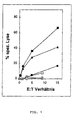
- Figure 1 shows an E7-specific CTL response generated after immunization with 1 ⁇ g L1E7 1-60 CVLPs.
- the isolated spleen cells of mice immunized with L1E7 1-60 CVLPs (filled sign) and HBS buffer (open label) were stimulated once in vitro with irradiated RMA-E7 cells and after five days in a standard four-hour 51 Cr release cytotoxicity test
- the following target cells were tested: RMA-E7 cells (squares), E7 49-57 peptide-loaded RMA cells (triangular) and RMA cells (circles). The results are expressed as specific lysis in%.
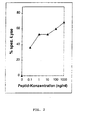
- Figure 2 shows the result of a titration test performed on an E7-specific CTL line obtained after vaccinating a C57BL / 6 mouse with 20 ⁇ g L1E7 1-60 CVLPs and three times in vitro stimulation with RMA-E7 transfectants.
- the peptide concentration was between 100 pg and 1 ⁇ g / ml.
- the ratio of cells to target cells was 30: 1.
- Figure 3 shows the protection of C57BL / 6 mice against the growth of TC-1 tumor cells.
- Mice (5 per group) were immunized sc with either 10 ⁇ g L1E7 1-60 CVLPs (triangular), 10 ⁇ g L1 ⁇ C VLPs (circles), or HBS buffer (squares). Two weeks later, sc6x10 4 TC-1 tumor cells per mouse were inoculated into the left flank of the mice. The mice were checked twice a week.
- Figure 4 shows the prevention of growth of TC-1 tumor by L1E7 1-60 CVLPs.
- C57BL / 6 mice (5 per group) were inoculated into the left flank of 6 x 10 4 TC-1 tumor cells per mouse. Two weeks later, the mice were immunized with a sc injection of 10 ⁇ g L1E7 1-60 CVLPs (triangles), 10 ⁇ g L1 ⁇ CVLPs (circles) or HBS buffer (squares).
- HPV 16L1 open reading frame (ORF) was removed from the plasmid HPV-16-114 / k-L1 / L2-pSynxtVI - (Kirnbauer, R et al (1994) J. Virol 67, 6929th.) was excised with the restriction endonuclease BglII and cloned into the vector pUC19 (New England Biolabs) in the BamHI site.
- HPV-16L1 ⁇ C For the production of HPV-16L1 ⁇ C, two primers were designed which are complementary to HPV-16L1 ORF.
- the first primer has the sequence and the second primer
- Both primers encode 5 'an EcoRV restriction enzyme site. In the downstream primers are followed by a TAA on the EcoRV site Translation stop codon to the last 34 amino acids of HPV16L1 ORF too delete.
- the PCR reaction was performed to remove the entire L1 ORF and to amplify the entire vector.
- the linear product was EcoRV cleaved, circularized with T4 DNA ligase and transformed E. coli DH5 ⁇ cells. The clones were analyzed for the presence of an EcoRV site.
- the construct pUCHPV16L1 ⁇ C obtained was used to construct the ORF of HPV16E7 1-50 in the EcoRV site to clone.
- primers with a 5'EcoRV restriction enzyme site were used for cloning the fragment.
- the following primer pair was used:
- the PCR products were cleaved with EcoRV and inserted into the EcoRV site of the inserted modified L1 gene.
- HPV16L1 ⁇ C * E7 1-52 contains the first 52 amino acids of HPV16E7.
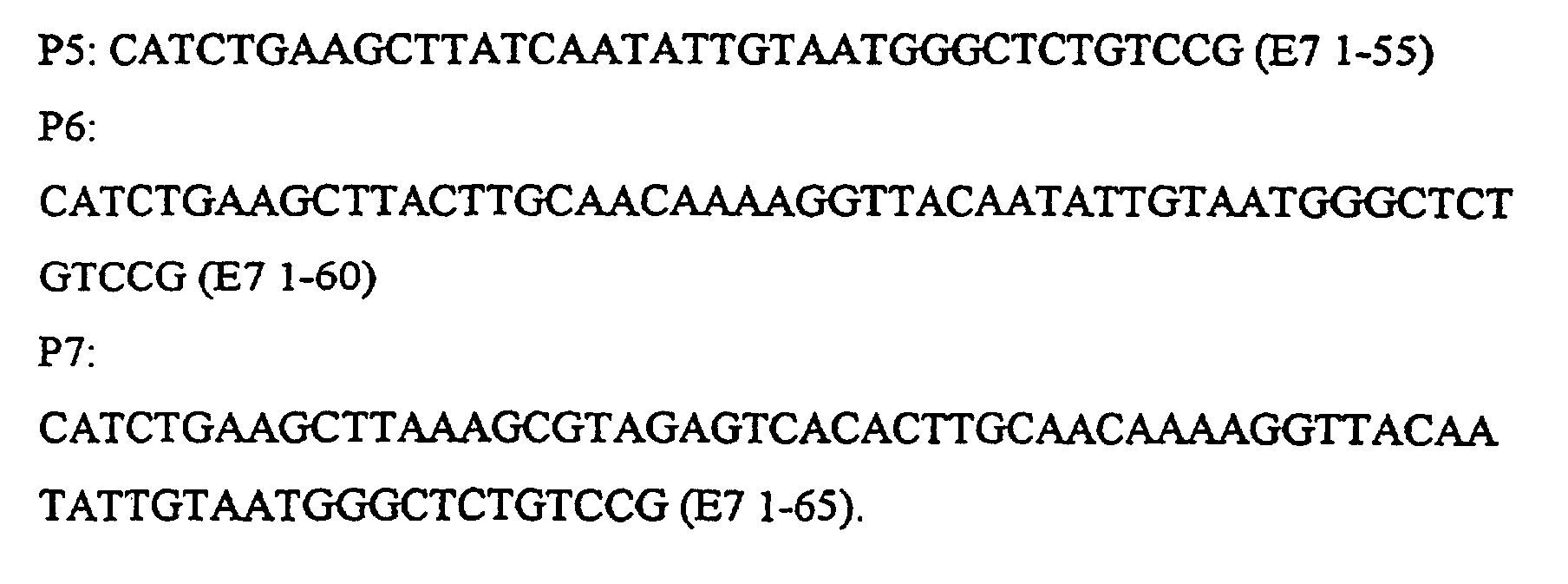
- Clone HPV16L1 ⁇ C * E7 1-52 was used to prepare clones HPV16L1 ⁇ C * E7 1-55, 1-60 and 1-65 using primer P1 in combination with P5, P6 and P7.
- HPV16L1 ⁇ C * E7 1-70 was made with clone HPV16L1 ⁇ C * E7 1-65 and primers P1 and P8.
- Spodoptera frugiperda (Sf9) cells were grown as monolayers or in suspension culture in TNM-FH insect medium (Sigma, Deisenhofen) with 10% fetal calf serum and 2 mM glutamine.
- Recombinant baculoviruses HPV16L1 ⁇ CE7 1-x were transfected into Sf9 cells by co-transfection of 10 ⁇ g of the recombinant plasmids and 2 ⁇ g of linearized baculo-gold DNA (Pharmingen, San Diego, CA). Recombinant viruses were purified according to the manufacturer's instructions.
- Sf9 cells were infected with recombinant baculovirus and a multiplicity of infection (moi) of 5 to 10. After incubation, the medium was removed and the cells were washed with PBS (140 mM NaCl, 2.7 mM Kcl, 8.1 mM Na 2 PO 4 , 1.5 mM KH 2 O 4 , pH 7.2). The cells were then lysed in SDS sample buffer and tested by SDS gel chromatography and immunoblot assay.
- moi multiplicity of infection
- Trichoplusia ni (TN) High Five cells were grown at 27 ° C to a density of 1-1.5 x 10 6 cells per ml in Ex-Cell 405 serum-free medium (JRH, Biosciences, Lennexa, KS).
- JRH Biosciences, Lennexa, KS
- a 400 ml culture was harvested and infected with a moi of 2 to 5 with recombinant baculoviruses for one hour with periodic inversions. Up to 240 ml of medium was added and the cells grew for 3 to 4 days.
- the cells were then pelleted and resuspended in 10 ml of extraction buffer (10 mM MgCl 2 , 1-50 mM CaCl 2 , 150 mM NaCl, 20 mM Hepes, 0.01% Triton (optional), pH 7.4) and for 45 seconds sonicated at 60 watts. After centrifugation at 10,000 rpm in the Sorvall SS34 rotor, the pellet was dissolved in the 6 ml extraction buffer, sonicated at 60 watts for 30 seconds, and recentrifuged. The supernatants were combined and applied to a two-step gradient of 40% (w / v) sucrose and 57.5% (w / v) CsCl.
- the C57BL / 6-derived mouse cells TC-1 are primary lung epithelial cells of C57BL / 6 mice transfected with the oncogenes HPV-16 E6 and E7 and c-Ha-ras (Lin, K.-Y. (1996), supra).
- RMA Loatrenn & Karre (1985) J. Exp. Med., 162, 1745-1757
- the processing defects Cell line RMA-S are C57BL / 6 thymoma cells.
- the HPV-16 E7 transfected RMA-E7 is described in Speidel, K. et al. (1997) Eur. J. Immunol., 27 (9), 2391-2399, described.
- TC-1 cells were grown in RPMI-1640 supplemented with 10% FCS, 2-ME, L-glutamine and antibiotics, cultured. 0.8 mg / ml G418 (Gibco BRL, Gaithersburg, MD) was used for the cultivation of RMA-E7 transfectants added. TC-1 cells additionally grew in the presence of 0.4 mg / ml G418, 0.2 mg / ml hygromycin and 1 mM sodium pyruvate.
- CTL cytotoxic T cell
- Spleen cells were prepared 10-14 days after immunization, 2-4x10 7 spleen cells were cocultivated with 10 5 irradiated (200 Gy) syngeneic RMA-E7 transfectants per ml. After 5 days, the first 51 Cr release cytotoxicity test was performed.
- the spleen cells were restimulated weekly in 24-well plates with 2x10 5 irradiated RMA-E7 transfectants per well as stimulator cells and 5x10 6 irradiated (33 Gy) C57BL / 6 spleen cells per well as feeder cells.
- effector T cells were added to 1x10 4 51 Cr-labeled target cells per well on a 96 well plate with different effector cell to target cell ratio (E: T).
- the target cells were labeled with Na 2 51 CrO 4 (100 ⁇ Ci per 2 x 10 6 cells) for one hour at 37 ° C.
- the peptide having the sequence RAHYNIVTF (amino acid 49-57 of HPV-16 E7, Feltkamp, MCW et al., 1993, Eur. J. Immunol., 23, 2242-2249) was incubated at a concentration of 50 ⁇ M during this incubation added.
- Spleen cell stimulation was repeated at weekly intervals. As shown in Figure 1, immunization with 1 ⁇ g of L1 ⁇ CE7 resulted in 1-60 CVLPs, ie the carboxy-terminal 34 amino acids of HPV-16 L1 were replaced by amino acids 1-60 of HPV-16 E7, to a strong E7 specific CTL response.
- L1 ⁇ CE7 1-60 CVLP contains a known H2-D b -T cell epitope of the E7 protein (E7 49-57 , Feltkamp, MCW et al. (1993), supra). To confirm the obtained E7 specificity of the CTLs, they were therefore tested against RMA cells loaded with the peptide E7 49-57 . CTLs that recognize RMA-E7 transfectants displayed specific cytotoxic activity against E7 49-57 RMA or RMA-S target cells. The measured specific lysis varied between 21.2-25% after five days (E: T ratio 8: 1-15: 1, see Fig. 1).
- Spleen cells isolated from C57BL / 6 mice after treatment with L1 ⁇ CE7 1-55 CVLPs did not recognize RMA-E7 cells, even when the mice were vaccinated with an increasing dose of up to 250 ⁇ g were.
- mice C57BL / 6 mice (3-5 per group) received 1 sc injection of 10 ⁇ g L1 ⁇ CE7 1-60 CVLPs, 10 ⁇ g L1 ⁇ CE7 1-55 CVLPs, 10 ⁇ g L1 ⁇ C VLPs, or an equivalent volume of HBS buffer without adjuvant.
- mice were inoculated into the left flank with 6 x 10 4 TC-1 cells suspended in 200 ⁇ l of PBS. For 2 months, the tumor size was measured twice a week until the mice were killed.
- mice vaccinated with HBS buffer, L1 ⁇ C VLPs or L1 ⁇ CE7 1-55 CVLPs was on average 80.5%.
- Vaccination with L1 ⁇ C CVLPs did not protect against the tumor, although delayed tumor growth was observed (see Figure 3).
- E7-specific lysis of RMA-E7 target cells was between 0-21% in tumor-bearing mice (mean 14%, E: T ratio 5: 1-24: 1), and between 0 and 22.2 % (Mean 10.4%, E: T ratio 7: 1-40: 1) in tumor-free mice.
- an E7-specific CTL response between 29.1 and 49.8% (mean 36.9%, E: T ratio 11 : 1-24: 1) after the 2nd stimulation.
- mice Two weeks after inoculation of 6 x 10 4 TC-1 cells (sc), the mice (5 per group) received a single injection of 10 ⁇ g L1 ⁇ CE7 1-60 CVLPs, 10 ⁇ g VLP L1 ⁇ C or HBS buffer without adjuvant.
- the tumor development of control mice treated with either HBS or immunized with VLP L1 ⁇ C was only 60% (3 of each group, 6/10).
- all mice (5/5) vaccinated with L1 ⁇ CE7 1-60 CVLPs generated an immune response against the established tumors and remained tumor free for 2 months after tumor cell injection.
Landscapes
- Health & Medical Sciences (AREA)
- Life Sciences & Earth Sciences (AREA)
- Chemical & Material Sciences (AREA)
- Organic Chemistry (AREA)
- General Health & Medical Sciences (AREA)
- Medicinal Chemistry (AREA)
- Virology (AREA)
- Genetics & Genomics (AREA)
- Pharmacology & Pharmacy (AREA)
- Animal Behavior & Ethology (AREA)
- Public Health (AREA)
- Veterinary Medicine (AREA)
- Biochemistry (AREA)
- Zoology (AREA)
- Nuclear Medicine, Radiotherapy & Molecular Imaging (AREA)
- Chemical Kinetics & Catalysis (AREA)
- Bioinformatics & Cheminformatics (AREA)
- Engineering & Computer Science (AREA)
- Immunology (AREA)
- Wood Science & Technology (AREA)
- Microbiology (AREA)
- General Chemical & Material Sciences (AREA)
- Mycology (AREA)
- Oncology (AREA)
- Gastroenterology & Hepatology (AREA)
- Biophysics (AREA)
- Molecular Biology (AREA)
- Proteomics, Peptides & Aminoacids (AREA)
- Communicable Diseases (AREA)
- Epidemiology (AREA)
- General Engineering & Computer Science (AREA)
- Biotechnology (AREA)
- Biomedical Technology (AREA)
- Medicines Containing Antibodies Or Antigens For Use As Internal Diagnostic Agents (AREA)
- Peptides Or Proteins (AREA)
- Medicines That Contain Protein Lipid Enzymes And Other Medicines (AREA)
- Micro-Organisms Or Cultivation Processes Thereof (AREA)
Abstract
Description



Claims (14)
- Verwendung mindestens eines Fusionsproteins aus mindestens einem L1-Protein eines oder mehrerer Papillomaviren und mindestens einem C-terminal deletierten E7-Protein eines oder mehrerer Papillomaviren, bei dem 38 bis 43 Aminosäuren deletiert sind, wobei das Fusionsprotein keine Papillomavirus-unspezifischen Epitope enthält, und gegebenenfalls geeignete Zusatzund/oder Hilfsstoffe zur Herstellung eines Arzneimittels für die Anwendung am Menschen zur Induktion einer spezifischen zytotoxischen T-Zell (CTL)-Antwort einerseits zur Verhinderung von HPV-spezifischen Tumoren und andererseits zur Regression von bereits bestehenden humanen Papillomavirus (HPV)-spezifischen Tumoren.
- Verwendung nach Anspruch 1, dadurch gekennzeichnet, dass der Tumor ein Larynx-, Cervix-, Penis-, Vulva- oder Analcarcinom ist.
- Verwendung nach Anspruch 1 oder 2, dadurch gekennzeichnet, dass das Arzneimittel kein Adjuvans enthält.
- Verwendung nach einem der Ansprüche 1-3, dadurch gekennzeichnet, dass der Zusatz- oder Hilfsstoff 0,3 bis 4 M, vorzugsweise 0,4 bis 3 M, insbesondere 0,5 bis 2 M, vor allem 1 bis 2 M eines Salzes mit einem pH-Wert von 7,3 bis 7,45, vorzugsweise 7,4 ist.
- Verwendung nach Anspruch 4, dadurch gekennzeichnet, dass das Salz ein Alkali- oder Erdalkatisalz ist, vorzugsweise ein Halogenid oder Phosphat, insbesondere ein Alkalihalogenid, vor allem NaCl und/oder KCl.
- Verwendung nach Anspruch 4 oder 5, dadurch gekennzeichnet, dass der pH-Wert mit einem Puffer eingestellt wird, vorzugsweise mit einem Phosphat-Puffer, Tris-Puffer, HEPES-Puffer oder MOPS-Puffer.
- Verwendung nach einem der Ansprüche 1-6, dadurch gekennzeichnet, dass das L1-Protein ein deletiertes L1-Protein ist.
- Verwendung nach Anspruch 7, dadurch gekennzeichnet, dass das L1-Protein ein C-terminal deletiertes L1-Protein ist.
- Verwendung nach Anspruch 7 oder 8, dadurch gekennzeichnet, dass bis zu 35 Aminosäuren vom L1-Protein deletiert sind, vorzugsweise 25 bis 35 Aminosäuren, insbesondere 32 bis 34 Aminosäuren.
- Verwendung nach einem der Ansprüche 1-9, dadurch gekennzeichnet, dass das Fusionsprotein in Form eines Capsids und/oder Capsomers vorliegt.
- Verwendung nach einem der Ansprüche 1-10, dadurch gekennzeichnet, dass das HPV ausgewählt ist aus HPV-6, HPV-11, HPV-16, HPV-18, HPV-31, HPV-33, HPV-35, HPV-39, HPV-42, HPV-45, HPV-52 und/oder HPV-58.
- Verwendung nach Anspruch 11 in Form einer Kombinationsvakzine, dadurch gekennzeichnet, dass die Papillomaviren ausgewählt sind aus HPV-16 und HPV-18; oder HPV-18, HPV-31, HPV-45 und HPV-58; oder HPV-6 und PPV-11.
- Verwendung nach einem der Ansprüche 1-12, dadurch gekennzeichnet, dass das Fusionsprotein ein L1ΔCE71-x-Fusionsprotein, vorzugsweise in Form eines CVLP, insbesondere von HPV-16 ist, wobei x eine ganze Zahl von 55 bis einschließlich 60 bedeutet.
- Verwendung nach Anspruch 13, dadurch gekennzeichnet, dass das Fusionsprotein ein L1ΔCE71-55- oder L1ΔCE71-60-Fusionsprotein ist.
Applications Claiming Priority (3)
| Application Number | Priority Date | Filing Date | Title |
|---|---|---|---|
| DE19812941A DE19812941A1 (de) | 1998-03-24 | 1998-03-24 | Arzneimittel zur Vermeidung oder Behandlung von Papillomavirusspezifischem Tumor |
| DE19812941 | 1998-03-24 | ||
| PCT/EP1999/001996 WO1999048518A2 (de) | 1998-03-24 | 1999-03-24 | Arzneimittel zur vermeidung oder behandlung von papillomavirus-specifischem tumor |
Publications (2)
| Publication Number | Publication Date |
|---|---|
| EP1064014A2 EP1064014A2 (de) | 2001-01-03 |
| EP1064014B1 true EP1064014B1 (de) | 2005-02-02 |
Family
ID=7862148
Family Applications (1)
| Application Number | Title | Priority Date | Filing Date |
|---|---|---|---|
| EP99916884A Expired - Lifetime EP1064014B1 (de) | 1998-03-24 | 1999-03-24 | Arzneimittel zur vermeidung oder behandlung von papillomavirus-spezifischem tumor |
Country Status (12)
| Country | Link |
|---|---|
| EP (1) | EP1064014B1 (de) |
| JP (1) | JP2002509863A (de) |
| AR (1) | AR014768A1 (de) |
| AT (1) | ATE288279T1 (de) |
| AU (1) | AU755242B2 (de) |
| CA (1) | CA2323573A1 (de) |
| DE (2) | DE19812941A1 (de) |
| DK (1) | DK1064014T3 (de) |
| ES (1) | ES2237913T3 (de) |
| MX (1) | MXPA00009282A (de) |
| PT (1) | PT1064014E (de) |
| WO (1) | WO1999048518A2 (de) |
Families Citing this family (4)
| Publication number | Priority date | Publication date | Assignee | Title |
|---|---|---|---|---|
| SE514982C2 (sv) * | 1999-09-30 | 2001-05-28 | Active Biotech Ab | Bärare innehållande ett huvudkapsidprotein L1 från humant papillomavirus samt dess användning |
| DE10059630A1 (de) * | 2000-12-01 | 2002-06-06 | Medigene Ag | Arzneimittel zur Vermeidung oder Behandlung von durch humanen Papillomavirus-Typ 18-hervorgerufenem Tumor |
| DK1506222T3 (da) † | 2002-05-17 | 2009-07-06 | Univ Cape Town | Kimæriske, humane papillomavirus16 L1-proteiner omfattende et L2-peptid, viruslignende partikler fremstillet deraf samt en fremgangsmåde til at fremstille partiklerne |
| JP5186678B2 (ja) * | 2005-10-13 | 2013-04-17 | 財団法人ヒューマンサイエンス振興財団 | 経皮抗原投与のための抗原キット |
Family Cites Families (1)
| Publication number | Priority date | Publication date | Assignee | Title |
|---|---|---|---|---|
| DE4435907C2 (de) * | 1994-10-07 | 1997-07-24 | Lutz Prof Dr Gissmann | Papillomavirusähnliche Partikel und deren Anwendung |
-
1998
- 1998-03-24 DE DE19812941A patent/DE19812941A1/de not_active Ceased
-
1999
- 1999-03-24 AT AT99916884T patent/ATE288279T1/de not_active IP Right Cessation
- 1999-03-24 ES ES99916884T patent/ES2237913T3/es not_active Expired - Lifetime
- 1999-03-24 PT PT99916884T patent/PT1064014E/pt unknown
- 1999-03-24 WO PCT/EP1999/001996 patent/WO1999048518A2/de not_active Ceased
- 1999-03-24 MX MXPA00009282A patent/MXPA00009282A/es active IP Right Grant
- 1999-03-24 EP EP99916884A patent/EP1064014B1/de not_active Expired - Lifetime
- 1999-03-24 DE DE59911556T patent/DE59911556D1/de not_active Expired - Fee Related
- 1999-03-24 JP JP2000537565A patent/JP2002509863A/ja active Pending
- 1999-03-24 AU AU35214/99A patent/AU755242B2/en not_active Ceased
- 1999-03-24 DK DK99916884T patent/DK1064014T3/da active
- 1999-03-24 AR ARP990101310A patent/AR014768A1/es unknown
- 1999-03-24 CA CA002323573A patent/CA2323573A1/en not_active Abandoned
Also Published As
| Publication number | Publication date |
|---|---|
| AU3521499A (en) | 1999-10-18 |
| EP1064014A2 (de) | 2001-01-03 |
| DK1064014T3 (da) | 2005-05-30 |
| AU755242B2 (en) | 2002-12-05 |
| DE19812941A1 (de) | 1999-10-07 |
| AR014768A1 (es) | 2001-03-28 |
| JP2002509863A (ja) | 2002-04-02 |
| MXPA00009282A (es) | 2002-12-13 |
| WO1999048518A2 (de) | 1999-09-30 |
| ES2237913T3 (es) | 2005-08-01 |
| ATE288279T1 (de) | 2005-02-15 |
| PT1064014E (pt) | 2005-06-30 |
| DE59911556D1 (de) | 2005-03-10 |
| WO1999048518A3 (de) | 1999-12-02 |
| CA2323573A1 (en) | 1999-09-30 |
Similar Documents
| Publication | Publication Date | Title |
|---|---|---|
| DE69836753T2 (de) | Papilloma virus capsomere impfstoff-formulierungen und deren verwendungen | |
| DE69434383T2 (de) | Herstellung von menschlichem papillomavirus hüllprotein und virus-ähnlichen teilchen | |
| DE69532532T2 (de) | Chimerische papillomavirus-ahnliche partikel | |
| EP0809700B1 (de) | Papillomavirusähnliche partikel, fusionsproteine sowie verfahren zu deren herstellung | |
| DE69835294T2 (de) | Methode zur in vitro auseinander- und wiederzusammensetzung von papillomavirus virusähnlichen teilchen (vlps) | |
| DE69333859T2 (de) | Sich selbst-zusammenbauende rekombinante hpv16 papillomavirus hüllproteine | |
| DE60016765T2 (de) | Synthetische papillomavirus gene, welche für expression in menschlichen zellen optimiert sind | |
| DE60126737T2 (de) | Modifizierte HPV E6- und E7-Gene und -Proteine als Impfstoff | |
| US20030021806A1 (en) | Papilloma virus capsomere vaccine formulations and method of use | |
| US20020039584A1 (en) | Papilloma virus capsomere vaccine formulations and methods of use | |
| DE69933875T2 (de) | Protein-verabreichungssystem, das dem menschlichen papillomavirus ähnliche partikel benützt. | |
| US6991795B1 (en) | Protein delivery system using human papillomavirus virus-like particles | |
| DE10059630A1 (de) | Arzneimittel zur Vermeidung oder Behandlung von durch humanen Papillomavirus-Typ 18-hervorgerufenem Tumor | |
| EP1181312A1 (de) | Zytotoxische t-zellepitope des papillomavirus l1-proteins und ihre verwendung in diagnostik und therapie | |
| US20040081661A1 (en) | Papillomavirus truncated L1 protein and fusion protein constructs | |
| EP1064014A2 (de) | Arzneimittel zur vermeidung oder behandlung von papillomavirus-spezifischem tumor | |
| EP1066321A2 (de) | Formulierung mit papillomavirus-spezifischem protein, seine herstellung und verwendung | |
| DE4435907A1 (de) | Papillomavirusähnliche Partikel, Fusionsproteine sowie Verfahren zu deren Herstellung | |
| US6926897B1 (en) | Medicament for the avoidance or treatment of papillomavirus-specific tumour | |
| DE29824556U1 (de) | Formulierung mit Papillomavirus-spezifischem Protein | |
| EP1183367B1 (de) | Zytotoxisches t-zellepitop des papillomavirus l1-proteins und seine verwendung in diagnostik und therapie | |
| DE19526752A1 (de) | Hocheffiziente Bildung von Papillomavirusähnlichen Partikeln |
Legal Events
| Date | Code | Title | Description |
|---|---|---|---|
| PUAI | Public reference made under article 153(3) epc to a published international application that has entered the european phase |
Free format text: ORIGINAL CODE: 0009012 |
|
| 17P | Request for examination filed |
Effective date: 20001024 |
|
| AK | Designated contracting states |
Kind code of ref document: A2 Designated state(s): AT BE CH CY DE DK ES FI FR GB GR IE IT LI LU MC NL PT SE |
|
| 17Q | First examination report despatched |
Effective date: 20020411 |
|
| GRAP | Despatch of communication of intention to grant a patent |
Free format text: ORIGINAL CODE: EPIDOSNIGR1 |
|
| RIC1 | Information provided on ipc code assigned before grant |
Ipc: 7A 61P 35/00 B Ipc: 7A 61K 39/12 B Ipc: 7A 61K 38/16 A |
|
| GRAS | Grant fee paid |
Free format text: ORIGINAL CODE: EPIDOSNIGR3 |
|
| GRAA | (expected) grant |
Free format text: ORIGINAL CODE: 0009210 |
|
| AK | Designated contracting states |
Kind code of ref document: B1 Designated state(s): AT BE CH CY DE DK ES FI FR GB GR IE IT LI LU MC NL PT SE |
|
| REG | Reference to a national code |
Ref country code: GB Ref legal event code: FG4D Free format text: NOT ENGLISH |
|
| REG | Reference to a national code |
Ref country code: CH Ref legal event code: EP |
|
| REG | Reference to a national code |
Ref country code: IE Ref legal event code: FG4D Free format text: GERMAN |
|
| REF | Corresponds to: |
Ref document number: 59911556 Country of ref document: DE Date of ref document: 20050310 Kind code of ref document: P |
|
| REG | Reference to a national code |
Ref country code: CH Ref legal event code: NV Representative=s name: PATENTANWAELTE SCHAAD, BALASS, MENZL & PARTNER AG |
|
| REG | Reference to a national code |
Ref country code: SE Ref legal event code: TRGR |
|
| REG | Reference to a national code |
Ref country code: GR Ref legal event code: EP Ref document number: 20050401322 Country of ref document: GR |
|
| REG | Reference to a national code |
Ref country code: DK Ref legal event code: T3 |
|
| REG | Reference to a national code |
Ref country code: PT Ref legal event code: SC4A Free format text: AVAILABILITY OF NATIONAL TRANSLATION Effective date: 20050426 |
|
| GBT | Gb: translation of ep patent filed (gb section 77(6)(a)/1977) |
Effective date: 20050609 |
|
| REG | Reference to a national code |
Ref country code: ES Ref legal event code: FG2A Ref document number: 2237913 Country of ref document: ES Kind code of ref document: T3 |
|
| PLBE | No opposition filed within time limit |
Free format text: ORIGINAL CODE: 0009261 |
|
| STAA | Information on the status of an ep patent application or granted ep patent |
Free format text: STATUS: NO OPPOSITION FILED WITHIN TIME LIMIT |
|
| 26N | No opposition filed |
Effective date: 20051103 |
|
| ET | Fr: translation filed | ||
| PGFP | Annual fee paid to national office [announced via postgrant information from national office to epo] |
Ref country code: ES Payment date: 20080326 Year of fee payment: 10 Ref country code: DK Payment date: 20080318 Year of fee payment: 10 Ref country code: CH Payment date: 20080320 Year of fee payment: 10 |
|
| PGFP | Annual fee paid to national office [announced via postgrant information from national office to epo] |
Ref country code: SE Payment date: 20080320 Year of fee payment: 10 Ref country code: PT Payment date: 20080313 Year of fee payment: 10 Ref country code: MC Payment date: 20080317 Year of fee payment: 10 Ref country code: LU Payment date: 20080320 Year of fee payment: 10 Ref country code: IE Payment date: 20080320 Year of fee payment: 10 Ref country code: GB Payment date: 20080318 Year of fee payment: 10 Ref country code: FI Payment date: 20080325 Year of fee payment: 10 |
|
| PGFP | Annual fee paid to national office [announced via postgrant information from national office to epo] |
Ref country code: CY Payment date: 20080313 Year of fee payment: 10 |
|
| PGFP | Annual fee paid to national office [announced via postgrant information from national office to epo] |
Ref country code: FR Payment date: 20080314 Year of fee payment: 10 Ref country code: DE Payment date: 20080529 Year of fee payment: 10 |
|
| PGFP | Annual fee paid to national office [announced via postgrant information from national office to epo] |
Ref country code: BE Payment date: 20080321 Year of fee payment: 10 |
|
| PGFP | Annual fee paid to national office [announced via postgrant information from national office to epo] |
Ref country code: IT Payment date: 20080329 Year of fee payment: 10 |
|
| PGFP | Annual fee paid to national office [announced via postgrant information from national office to epo] |
Ref country code: NL Payment date: 20080318 Year of fee payment: 10 |
|
| PGFP | Annual fee paid to national office [announced via postgrant information from national office to epo] |
Ref country code: GR Payment date: 20080326 Year of fee payment: 10 |
|
| BERE | Be: lapsed |
Owner name: *MEDIGENE A.G. Effective date: 20090331 |
|
| REG | Reference to a national code |
Ref country code: PT Ref legal event code: MM4A Free format text: LAPSE DUE TO NON-PAYMENT OF FEES Effective date: 20090924 |
|
| PG25 | Lapsed in a contracting state [announced via postgrant information from national office to epo] |
Ref country code: PT Free format text: LAPSE BECAUSE OF NON-PAYMENT OF DUE FEES Effective date: 20090924 Ref country code: MC Free format text: LAPSE BECAUSE OF NON-PAYMENT OF DUE FEES Effective date: 20090331 Ref country code: FI Free format text: LAPSE BECAUSE OF NON-PAYMENT OF DUE FEES Effective date: 20090324 |
|
| REG | Reference to a national code |
Ref country code: CH Ref legal event code: PL |
|
| REG | Reference to a national code |
Ref country code: DK Ref legal event code: EBP |
|
| EUG | Se: european patent has lapsed | ||
| GBPC | Gb: european patent ceased through non-payment of renewal fee |
Effective date: 20090324 |
|
| PGFP | Annual fee paid to national office [announced via postgrant information from national office to epo] |
Ref country code: AT Payment date: 20090721 Year of fee payment: 11 |
|
| NLV4 | Nl: lapsed or anulled due to non-payment of the annual fee |
Effective date: 20091001 |
|
| REG | Reference to a national code |
Ref country code: FR Ref legal event code: ST Effective date: 20091130 |
|
| PG25 | Lapsed in a contracting state [announced via postgrant information from national office to epo] |
Ref country code: CY Free format text: LAPSE BECAUSE OF NON-PAYMENT OF DUE FEES Effective date: 20090324 |
|
| REG | Reference to a national code |
Ref country code: IE Ref legal event code: MM4A |
|
| PG25 | Lapsed in a contracting state [announced via postgrant information from national office to epo] |
Ref country code: LI Free format text: LAPSE BECAUSE OF NON-PAYMENT OF DUE FEES Effective date: 20090331 Ref country code: IE Free format text: LAPSE BECAUSE OF NON-PAYMENT OF DUE FEES Effective date: 20090324 Ref country code: DE Free format text: LAPSE BECAUSE OF NON-PAYMENT OF DUE FEES Effective date: 20091001 Ref country code: CH Free format text: LAPSE BECAUSE OF NON-PAYMENT OF DUE FEES Effective date: 20090331 |
|
| PG25 | Lapsed in a contracting state [announced via postgrant information from national office to epo] |
Ref country code: BE Free format text: LAPSE BECAUSE OF NON-PAYMENT OF DUE FEES Effective date: 20090331 Ref country code: NL Free format text: LAPSE BECAUSE OF NON-PAYMENT OF DUE FEES Effective date: 20091001 |
|
| PG25 | Lapsed in a contracting state [announced via postgrant information from national office to epo] |
Ref country code: GB Free format text: LAPSE BECAUSE OF NON-PAYMENT OF DUE FEES Effective date: 20090324 Ref country code: FR Free format text: LAPSE BECAUSE OF NON-PAYMENT OF DUE FEES Effective date: 20091123 Ref country code: DK Free format text: LAPSE BECAUSE OF NON-PAYMENT OF DUE FEES Effective date: 20090331 |
|
| REG | Reference to a national code |
Ref country code: ES Ref legal event code: FD2A Effective date: 20090325 |
|
| PG25 | Lapsed in a contracting state [announced via postgrant information from national office to epo] |
Ref country code: GR Free format text: LAPSE BECAUSE OF NON-PAYMENT OF DUE FEES Effective date: 20091002 |
|
| PG25 | Lapsed in a contracting state [announced via postgrant information from national office to epo] |
Ref country code: ES Free format text: LAPSE BECAUSE OF NON-PAYMENT OF DUE FEES Effective date: 20090325 |
|
| PG25 | Lapsed in a contracting state [announced via postgrant information from national office to epo] |
Ref country code: AT Free format text: LAPSE BECAUSE OF NON-PAYMENT OF DUE FEES Effective date: 20100324 |
|
| PG25 | Lapsed in a contracting state [announced via postgrant information from national office to epo] |
Ref country code: IT Free format text: LAPSE BECAUSE OF NON-PAYMENT OF DUE FEES Effective date: 20090324 |
|
| PG25 | Lapsed in a contracting state [announced via postgrant information from national office to epo] |
Ref country code: LU Free format text: LAPSE BECAUSE OF NON-PAYMENT OF DUE FEES Effective date: 20090324 |
|
| PG25 | Lapsed in a contracting state [announced via postgrant information from national office to epo] |
Ref country code: SE Free format text: LAPSE BECAUSE OF NON-PAYMENT OF DUE FEES Effective date: 20090325 |