EP1063587A2 - Mikroprozessor zur Ausführung von gewöhnlichen, als auch speziellen Verzweigungsbefehlen - Google Patents
Mikroprozessor zur Ausführung von gewöhnlichen, als auch speziellen Verzweigungsbefehlen Download PDFInfo
- Publication number
- EP1063587A2 EP1063587A2 EP00113413A EP00113413A EP1063587A2 EP 1063587 A2 EP1063587 A2 EP 1063587A2 EP 00113413 A EP00113413 A EP 00113413A EP 00113413 A EP00113413 A EP 00113413A EP 1063587 A2 EP1063587 A2 EP 1063587A2
- Authority
- EP
- European Patent Office
- Prior art keywords
- subroutine
- specific area
- microcomputer
- instruction
- branch instruction
- Prior art date
- Legal status (The legal status is an assumption and is not a legal conclusion. Google has not performed a legal analysis and makes no representation as to the accuracy of the status listed.)
- Withdrawn
Links
Images




Classifications
-
- G—PHYSICS
- G06—COMPUTING OR CALCULATING; COUNTING
- G06F—ELECTRIC DIGITAL DATA PROCESSING
- G06F9/00—Arrangements for program control, e.g. control units
- G06F9/06—Arrangements for program control, e.g. control units using stored programs, i.e. using an internal store of processing equipment to receive or retain programs
- G06F9/30—Arrangements for executing machine instructions, e.g. instruction decode
- G06F9/30003—Arrangements for executing specific machine instructions
- G06F9/3005—Arrangements for executing specific machine instructions to perform operations for flow control
- G06F9/30054—Unconditional branch instructions
Definitions
- the present invention relates to a microcomputer which executes various instructions of a program stored in its built-in memory or in an external memory.
- a microcomputer executes a real arithmetic operation (i.e, a calculation using real numbers).
- a real arithmetic operation i.e, a calculation using real numbers.
- one method is to incorporate an auxiliary arithmetic unit to the microcomputer, wherein the auxiliary arithmetic unit is dedicated to the real arithmetic processing.
- Another method is to perform software calculations based on a plurality of CPU instructions.
- the former method is not preferable in that the chip size becomes large and the cost increases due to addition of the hardware dedicated to the real arithmetic processing. Accordingly, the latter method is generally preferable.
- a conventional microcomputer runs a real arithmetic processing program as a subroutine, so that the microcomputer when executing a main routine or the like can jump to this subroutine (in other words, so that the microcomputer can invoke the real arithmetic subroutine) to execute the real processing.
- a recently used RISC computer i.e., a reduced (or restricted) instruction set computer, implements a branch or a jump to the subroutine in accordance with a plurality of instructions or in accordance with a long instruction whose length is longer than a minimum instruction length.
- the minimum instruction is shortest in bit length.
- the long instruction is not less than 4 bytes when the minimum instruction is 2 bytes.
- a branch instruction used for jumping to a subroutine, is set to be able to jump to an arbitrary address in an entire memory space.
- the bit length of an address portion in this branch instruction tends to be long.
- the address portion in a branch instruction is called "operand" which is a data portion representing the branch address. This is why a plurality of instructions or a long instruction is required in executing a branch instruction in the above-described RISC computer.
- the memory space is an address space accessibly by the microcomputer.
- an ordinary branch instruction has a length longer than the minimum instruction length.
- completely reading the branch instruction requires a plurality of accesses to the memory.
- the external memories are slow in their response speeds. Therefore, in accordance with the number of accesses to the external memory, the processing time becomes more longer in accomplishing the reading and execution of the branch instruction.
- the start timing for the real arithmetic subroutine is delayed.
- the above explanation is based on an example of the real arithmetic processing.
- the integer division processing and the bit data processing are executed in accordance with a software rather than using a dedicated hardware.
- the integer division processing is the arithmetic processing for dividing an integer by another integer.
- the bit data processing is the bit arithmetic processing using bit data.
- the present invention has an object to provide a microcomputer capable of running a subroutine for executing at least one of the real arithmetic processing, the integer division processing and the bit data processing, wherein a required program size can be reduced and, when the programs are stored in an external memory, real time executability of each processing can be improved.
- the present invention provides a microcomputer comprising a built-in memory and is accessible to an external memory via a bus.
- the program to be executed in the microcomputer is stored in the built-in memory or in the external memory.
- the microcomputer of the present invention executes a specific area branch instruction as an executable instruction.
- the specific area branch instruction is a special branch instruction which is restricted to jump to only a specific area of a memory space and is a single instruction having a minimum instruction length.
- the microcomputer of the present invention allocates a selected subroutine to the specific area of the memory.
- the selected subroutine is one of a real arithmetic subroutine for executing the real arithmetic processing, an integer division subroutine for executing the integer division processing, and a bit handling subroutine for executing the bit data processing.
- a program of the microcomputer is configured to jump to the selected subroutine (i.e., any one of the real arithmetic subroutine, the integer division subroutine, and the bit handling subroutine) allocated to the specific area in response to the specific area branch instruction.
- the microcomputer of the present invention substantially restricts the jump area of the specific area branch instruction to the specific area in the entire memory space.
- the specific area branch instruction is a single instruction having the minimum instruction length.
- the subroutine, allocated to the specific area of the memory is selected from the group consisting of the real arithmetic subroutine, the integer division subroutine, and the bit handling subroutine.
- the subroutine allocated to the specific area is invoked in response to the specific area branch instruction.
- the microcomputer of the present invention can reduce the required program size to a level corresponding to the minimum instruction length, in invoking any one of the real arithmetic subroutine, the integer division subroutine, and the bit handling subroutine (or in branching to any one of these subroutines).
- the microcomputer can reduce the overall program size, thereby enabling its built-in memory to store all of the necessary programs.
- the present invention makes it possible to use a built-in memory having a smaller storage capacity.
- the microcomputer of the present invention can invoke any one of the real arithmetic subroutine, the integer division subroutine, and the bit handling subroutine with a minimum increase of the execution time. In other words, in starting each subroutine, the microcomputer of the present invention can suppress a delay time to a minimum level. And, the microcomputer of the present invention can improve the real time executability in each of the real arithmetic processing, the integer division processing, and the bit arithmetic processing.
- Fig. 1 is a block diagram showing an arrangement of a RISC microcomputer 1 in accordance with the present invention.
- the microcomputer 1 of the preferred embodiment comprises a CPU 2 and a built-in memory 3.
- the CPU 2 comprises an arithmetic section 7 which performs various calculations (addition/subtraction, logic operation, shift operation etc.), a control section 8 which decodes instructions and controls the arithmetic section 7 to execute the various calculations, and a register section 9 comprising various registers and program counters.
- the built-in memory 3 stores programs to be executed in the CPU 2 as well as data referred to during the execution of these programs.
- the CPU 2 is connected to the built-in memory 3 via an address bus 4 and a data bus 5 which are provided in the microcomputer 1.
- the microcomputer 1 of this embodiment is connectable with an external memory 6 via the address bus 4 and the data bus 5.
- other control lines (not shown) extend out of the CPU 2.
- the microcomputer 1 has terminals (not shown) through which the buses 4, 5 and the control lines of the CPU 2 are further extendable out of the microcomputer 1.
- the external memory 6 is connectable to the address bus 4, the data bus 5, and the control lines thus extended out of the microcomputer 1.
- the microcomputer 1 of this embodiment handles each of a real arithmetic processing program, an integer division processing program, and a bit data processing program as a subroutine.
- the microcomputer when executing other routine, can jump to (i.e., invoke) a subroutine to execute the designated processing.
- the microcomputer 1 of this embodiment executes a specific area branch instruction "JM" which serves as a branch instruction for invoking a designated subroutine. As shown in Fig.
- the branch instruction "JM” consists of an instruction portion of 4 bits (i.e., an instruction code section indicating the content of the designated processing) and a succeeding address portion of 12 bits (i.e., a data section indicating a branch address).
- the branch instruction "JM” is a single instruction having a minimum instruction length (2 bytes in this embodiment).
- the jump portion of each branch instruction "JM” is limited to a predetermined specific area 12 of a memory space 10.
- control section 8 in the CPU 2 reads a specific area branch instruction "JM" from the built-in memory 6 or from the external memory 6.
- the specific area branch instruction "JM” comprises a predetermined data in its leading 4-bit portion.
- the control section 8 causes the arithmetic section 7 to calculate an address in the specific area 12. This address is designated by an address portion of the specific area branch instruction "JM.”
- the control section 8 causes the register section 9 to set the obtained address to a program counter in the register section 9.
- the processing procedure branches (jumps) to the obtained address of the specific area 12 designated by the address portion of the specific area branch instruction "JM.”
- the microcomputer 1 of this embodiment obtains a 14-bit data by multiplying 4 with the 12-bit data constituting the address portion of the specific area branch instruction "JM.” Then, a 10-bit data consisting of all "0" bits is added to a higher order side of the obtained 14-bit data. A 24-bit data thus obtained represents the branch address.
- Fig. 2B shows an allocation of instructions and subroutines in the memory space 10 including the specific area 12.
- Two real arithmetic subroutines 14-1 and 14-2 each executing the real arithmetic processing, an integer division subroutine 16 executing the integer division processing, and a bit handling subroutine 18 executing the bit data processing are respectively allocated to the specific area 12.
- the memory space 10 stores a plurality of specific area branch instructions JM-1 to JM-6 allocated in other routines.
- the processing procedure of CPU 2 branches to a corresponding one of the subroutines 14-1, 14-2, 16 and 18 in accordance with each of the specific area branch instructions JM-1 to JM-6.
- the specific area branch instruction JM-1 invokes the real arithmetic subroutine 14-1.
- Each of the specific area branch instructions JM-4 and JM-5 invokes the other real arithmetic subroutine 14-2.
- Each of the specific area branch instructions JM-2 and JM-3 invokes the integer division subroutine 16.
- the specific area branch instruction JM-6 invokes the bit handling subroutine 18.
- the bit handling subroutine 18 executes bit calculations as bit data processing, for example by carrying out a logical OR and a logical AND or the like between arbitrary bits in a bit stream.
- the microcomputer 1 of this embodiment executes an ordinary branch instruction "JS” which invokes a subroutine.
- the ordinary branch instruction "JS” is a single instruction of 4 bytes consisting of a 8-bit instruction portion and a 24-bit address portion.
- the ordinary branch instruction "JS” can jump to an arbitrary address in the entire memory space 10. More specifically, an ordinary branch instruction JS-1 invokes a subroutine 20-1. Each of ordinary branch instructions JS-2 and JS-3 invokes another subroutine 20-2.
- the ordinary branch instruction "JS" its 24-bit address portion is used to designate an arbitrary address in the entire memory space 10 as a branch address.
- the ordinary branch instruction "JS” has an instruction length (4 bytes) which is two times the minimum instruction length.
- Fig. 5 shows an operation of the microcomputer 1 performed for executing the ordinary branch instruction "JS."
- time durations of T1 to T7 respectively show one cycle of an internal clock (i.e., CPU clock) which corresponds to one state (i.e., a basic cycle) in the operation of CPU 2.
- the upper first and second lines of Fig. 5 show the operation of the microcomputer 1 under a condition where the programs are stored in the built-in memory 3.
- the first state T1 is used for reading the higher-order two bytes of the ordinary branch instruction "JS.”
- the second state T2 is used for reading the lower-order two bytes of the ordinary branch instruction "JS.”
- the third state T3 is used for executing internal processing to decode the ordinary branch instruction "JS" and to calculate the address.
- the fourth state T4 is used for reading an instruction of a branch address designated by the ordinary branch instruction "JS.”
- the programs are storable in the external memory 6.
- the first and second states T1 and T2 are used for reading the higher-order two bytes of the ordinary branch instruction "JS.”
- the third and fourth states T3 and T4 are used for reading the lower-order two bytes of the ordinary branch instruction "JS.”
- the fifth state T5 is for executing the internal processing to decode the ordinary branch instruction "JS" and to calculate the address.
- the sixth and seventh states T6 and T 7 are used for reading an instruction of a branch address designated by the ordinary branch instruction "JS.”
- the execution time To required in invoking each of the real arithmetic subroutine, the integer division subroutine and the bit handling subroutine is not negligible.
- the execution time To is longer than the execution time Ti, where Ti is required in the case of using the built-in memory 3 for storing the programs.
- CPU 2 must access the external memory 6 twice (in other words, CPU 2 must execute two instruction reading cycles consecutively).
- the execution time To becomes longer as the access number increases. Therefore, the start timing will be significantly delayed in executing each of the real arithmetic subroutine, the integer division subroutine and the bit handling subroutine. In other words, the real time executability of each processing will be fairly worsened.
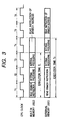
- Fig. 3 shows an operation of the microcomputer 1 of this embodiment performed for executing the specific area branch instruction "JM.”
- time durations of T1 to T6 respectively show one cycle of an internal clock (i.e., CPU clock) which corresponds to one state (i.e., a basic cycle) in the operation of CPU 2.
- the upper first and second lines of Fig. 3 show the operation of the microcomputer 1 under a condition where the programs are stored in the built-in memory 3.
- the first state T1 is used for reading all of the specific area branch instruction "JM.”
- the second and third states T2 and T3 are used for executing internal processing to decode the specific area branch instruction "JM” and to calculate the address.
- the fourth state T4 is used for reading an instruction of a branch address designated by the specific area branch instruction "JM.”
- the internal processing uses two states ranging from T2 to T3 because the microcomputer 1 executes the programs based on a so-called "pipeline processing." These two states are dedicated to the pipeline processing so that the pipeline processing can flow smoothly.
- One of two states T2 and T3 is a dormant period in which no substantial processing is executed, or a waiting period used for executing other instruction.
- the programs are storable in the external memory 6.
- the first and second states T1 and T2 are used for reading all of the specific area branch instruction "JM.”
- the first and second states T1 and T2 cooperatively constitute a single reading cycle.
- the third and fourth states T3 and T4 are used for executing the internal processing to decode the specific area branch instruction "JM" and to calculate the address.
- the fifth and sixth states T5 and T6 are used for reading an instruction of a branch address designated by the specific area branch instruction "JM.”
- the microcomputer 1 of this embodiment allocates the real arithmetic subroutines 14-1 and 14-2, the integer division subroutine 16, and the bit handling subroutine 18 to the specific area 12 in the memory space 10.
- the microcomputer 1 can jump to the specific area 12 in response to the specific area branch instruction "JM.”
- the microcomputer 1 can invoke a corresponding one of the subroutines 14-1, 14-2, 16 and 18 in accordance with each of the specific area branch instructions JM-1 to JM-6 disposed in other routines.
- the microcomputer 1 of this embodiment substantially restricts the jump area of the specific area branch instruction "JM" to the specific area 12 in the entire memory space 10.
- the specific area branch instruction "JM” is configured to be a single instruction having the minimum instruction length, as shown in Fig. 2A.
- the real arithmetic subroutine, the integer division subroutine, and the bit handling subroutine are allocated to the specific area 12, as shown in Fig. 2B.
- Each of the real arithmetic subroutine, the integer division subroutine, and the bit handling subroutine is invoked in response to a corresponding one of the specific area branch instructions JM-1 to JM-6.
- the microcomputer 1 of this embodiment can reduce the required program size to a level of two bytes corresponding to the minimum instruction length, in invoking any one of the real arithmetic subroutine, the integer division subroutine, and the bit handling subroutine (or in branching to any one of these subroutines).
- the microcomputer 1 can reduce the overall program size, thereby enabling its built-in memory 3 to store all of the necessary programs.
- this embodiment makes it possible to reduce a required storage capacity of the built-in memory 3.
- the microcomputer 1 of this embodiment can invoke any one of the real arithmetic subroutine, the integer division subroutine, and the bit handling subroutine with a minimum increase of the execution time To. In other words, in starting each subroutine, the microcomputer 1 of this embodiment can suppress a delay time to a minimum level. And, the microcomputer 1 of this embodiment can improve the real time executability in each of the real arithmetic processing, the integer division processing, and the bit arithmetic processing.
- the minimum instruction length is 2 bytes.
- the present invention is similarly applicable to other microcomputers having the minimum instruction length of 1 byte or 4 bytes.
- the present invention can obtain the above-described effects whenever the program is configured so as to allocate at least one of the real arithmetic subroutine, the integer division subroutine, and the bit handling subroutine to the specific area of the memory.
Landscapes
- Engineering & Computer Science (AREA)
- Software Systems (AREA)
- Theoretical Computer Science (AREA)
- Physics & Mathematics (AREA)
- General Engineering & Computer Science (AREA)
- General Physics & Mathematics (AREA)
- Executing Machine-Instructions (AREA)
- Microcomputers (AREA)
Applications Claiming Priority (4)
| Application Number | Priority Date | Filing Date | Title |
|---|---|---|---|
| JP17706599 | 1999-06-23 | ||
| JP17706599 | 1999-06-23 | ||
| JP2000152590 | 2000-05-24 | ||
| JP2000152590A JP2001067335A (ja) | 1999-06-23 | 2000-05-24 | マイクロコンピュータ |
Publications (2)
| Publication Number | Publication Date |
|---|---|
| EP1063587A2 true EP1063587A2 (de) | 2000-12-27 |
| EP1063587A3 EP1063587A3 (de) | 2001-01-03 |
Family
ID=26497740
Family Applications (1)
| Application Number | Title | Priority Date | Filing Date |
|---|---|---|---|
| EP00113413A Withdrawn EP1063587A3 (de) | 1999-06-23 | 2000-06-23 | Mikroprozessor zur Ausführung von gewöhnlichen, als auch speziellen Verzweigungsbefehlen |
Country Status (3)
| Country | Link |
|---|---|
| US (1) | US6697938B1 (de) |
| EP (1) | EP1063587A3 (de) |
| JP (1) | JP2001067335A (de) |
Cited By (1)
| Publication number | Priority date | Publication date | Assignee | Title |
|---|---|---|---|---|
| WO2013013100A1 (en) * | 2011-07-19 | 2013-01-24 | Qualcomm Incorporated | Table call instruction for frequently called functions |
Family Cites Families (14)
| Publication number | Priority date | Publication date | Assignee | Title |
|---|---|---|---|---|
| US3366929A (en) * | 1964-12-30 | 1968-01-30 | Ibm | Computing system embodying flexible subroutine capabilities |
| US4363091A (en) | 1978-01-31 | 1982-12-07 | Intel Corporation | Extended address, single and multiple bit microprocessor |
| JPS54104251A (en) * | 1978-02-02 | 1979-08-16 | Toshiba Corp | Data processor |
| US5274820A (en) * | 1989-08-14 | 1993-12-28 | International Business Machines Corporation | Method and system for eliminating operation codes from intermediate prolog instructions |
| JPH04305736A (ja) | 1991-04-02 | 1992-10-28 | Nec Corp | マイクロプロセッサ |
| US5313634A (en) * | 1992-07-28 | 1994-05-17 | International Business Machines Corporation | Computer system branch prediction of subroutine returns |
| JPH06150023A (ja) * | 1992-11-06 | 1994-05-31 | Hitachi Ltd | マイクロコンピュータ及びマイクロコンピュータシステム |
| JPH07114469A (ja) * | 1993-10-18 | 1995-05-02 | Mitsubishi Electric Corp | データ処理装置 |
| US5864689A (en) * | 1995-12-05 | 1999-01-26 | Advanced Micro Devices, Inc. | Microprocessor configured to selectively invoke a microcode DSP function or a program subroutine in response to a target address value of branch instruction |
| US5721945A (en) * | 1996-05-06 | 1998-02-24 | Advanced Micro Devices | Microprocessor configured to detect a DSP call instruction and to direct a DSP to execute a routine corresponding to the DSP call instruction |
| JPH10171665A (ja) * | 1996-12-09 | 1998-06-26 | Toshiba Corp | ジャンプコード・ジェネレータ、割り込みプログラム選択装置、割り込みプログラム選択方式、及び計算機 |
| EP0848323B1 (de) * | 1996-12-10 | 2004-02-25 | Texas Instruments Incorporated | Verbesserte Verzweigungsvorhersage in einem Pipelinemikroprozessor |
| US6167506A (en) | 1997-11-17 | 2000-12-26 | Advanced Micro Devices, Inc. | Replacing displacement in control transfer instruction with encoding indicative of target address, including offset and target cache line location |
| US6170054B1 (en) * | 1998-11-16 | 2001-01-02 | Intel Corporation | Method and apparatus for predicting target addresses for return from subroutine instructions utilizing a return address cache |
-
2000
- 2000-05-24 JP JP2000152590A patent/JP2001067335A/ja active Pending
- 2000-06-21 US US09/598,320 patent/US6697938B1/en not_active Expired - Fee Related
- 2000-06-23 EP EP00113413A patent/EP1063587A3/de not_active Withdrawn
Cited By (2)
| Publication number | Priority date | Publication date | Assignee | Title |
|---|---|---|---|---|
| WO2013013100A1 (en) * | 2011-07-19 | 2013-01-24 | Qualcomm Incorporated | Table call instruction for frequently called functions |
| US9116685B2 (en) | 2011-07-19 | 2015-08-25 | Qualcomm Incorporated | Table call instruction for frequently called functions |
Also Published As
| Publication number | Publication date |
|---|---|
| JP2001067335A (ja) | 2001-03-16 |
| EP1063587A3 (de) | 2001-01-03 |
| US6697938B1 (en) | 2004-02-24 |
Similar Documents
| Publication | Publication Date | Title |
|---|---|---|
| JP2810068B2 (ja) | プロセッサシステム、コンピュータシステム及び命令処理方法 | |
| KR100328162B1 (ko) | 정보처리회로와마이크로컴퓨터와전자기기 | |
| JP2834837B2 (ja) | プログラマブルコントローラ | |
| US5485587A (en) | Data processor calculating branch target address of a branch instruction in parallel with decoding of the instruction | |
| US6560697B2 (en) | Data processor having repeat instruction processing using executed instruction number counter | |
| EP0762272A2 (de) | Mikroprozessoren und diese enthaltendes Gerät | |
| EP0489266A2 (de) | Rechner und Verfahren zur sofortigen Berechnungsausführung | |
| US20050283589A1 (en) | Data processor | |
| KR100578010B1 (ko) | 정보처리회로,마이크로컴퓨터및전자기기 | |
| US6557093B2 (en) | Stack oriented data processing device | |
| US5924114A (en) | Circular buffer with two different step sizes | |
| US6223275B1 (en) | Microprocessor with reduced instruction set limiting the address space to upper 2 Mbytes and executing a long type register branch instruction in three intermediate instructions | |
| JP3345787B2 (ja) | データ処理装置 | |
| EP0240606B1 (de) | Verarbeitungssystem in Pipelinestruktur und Mikroprozessor mit einem derartigen System | |
| JP4502532B2 (ja) | データ処理装置 | |
| US6697938B1 (en) | Microcomputer executing an ordinary branch instruction and a special branch instruction | |
| US6502181B1 (en) | Method and apparatus for an enhanced processor | |
| EP2124147B1 (de) | Mehrprozessorsystem und Programmausführungsverfahren im System | |
| EP1035471A1 (de) | Rechnersystem | |
| JPH04104350A (ja) | マイクロプロセッサ | |
| US5649229A (en) | Pipeline data processor with arithmetic/logic unit capable of performing different kinds of calculations in a pipeline stage | |
| JP3102399B2 (ja) | データ処理装置及び方法 | |
| JP3147884B2 (ja) | 記憶装置及び情報処理装置 | |
| JP2636821B2 (ja) | 並列処理装置 | |
| EP0650614B1 (de) | Architektur eines digitalsignalprozessors. |
Legal Events
| Date | Code | Title | Description |
|---|---|---|---|
| PUAI | Public reference made under article 153(3) epc to a published international application that has entered the european phase |
Free format text: ORIGINAL CODE: 0009012 |
|
| PUAL | Search report despatched |
Free format text: ORIGINAL CODE: 0009013 |
|
| AK | Designated contracting states |
Kind code of ref document: A2 Designated state(s): DE FR GB |
|
| AX | Request for extension of the european patent |
Free format text: AL;LT;LV;MK;RO;SI |
|
| AK | Designated contracting states |
Kind code of ref document: A3 Designated state(s): AT BE CH CY DE DK ES FI FR GB GR IE IT LI LU MC NL PT SE |
|
| AX | Request for extension of the european patent |
Free format text: AL;LT;LV;MK;RO;SI |
|
| 17P | Request for examination filed |
Effective date: 20010425 |
|
| AKX | Designation fees paid |
Free format text: DE FR GB |
|
| 17Q | First examination report despatched |
Effective date: 20060829 |
|
| GRAP | Despatch of communication of intention to grant a patent |
Free format text: ORIGINAL CODE: EPIDOSNIGR1 |
|
| STAA | Information on the status of an ep patent application or granted ep patent |
Free format text: STATUS: THE APPLICATION IS DEEMED TO BE WITHDRAWN |
|
| 18D | Application deemed to be withdrawn |
Effective date: 20100105 |