EP1059522A1 - Method and apparatus for examining fluids of biological origin - Google Patents
Method and apparatus for examining fluids of biological origin Download PDFInfo
- Publication number
- EP1059522A1 EP1059522A1 EP99810517A EP99810517A EP1059522A1 EP 1059522 A1 EP1059522 A1 EP 1059522A1 EP 99810517 A EP99810517 A EP 99810517A EP 99810517 A EP99810517 A EP 99810517A EP 1059522 A1 EP1059522 A1 EP 1059522A1
- Authority
- EP
- European Patent Office
- Prior art keywords
- spectrum
- concentration
- extinction
- hemoglobin
- bilirubin
- Prior art date
- Legal status (The legal status is an assumption and is not a legal conclusion. Google has not performed a legal analysis and makes no representation as to the accuracy of the status listed.)
- Withdrawn
Links
Images




Classifications
-
- G—PHYSICS
- G01—MEASURING; TESTING
- G01N—INVESTIGATING OR ANALYSING MATERIALS BY DETERMINING THEIR CHEMICAL OR PHYSICAL PROPERTIES
- G01N21/00—Investigating or analysing materials by the use of optical means, i.e. using sub-millimetre waves, infrared, visible or ultraviolet light
- G01N21/17—Systems in which incident light is modified in accordance with the properties of the material investigated
- G01N21/25—Colour; Spectral properties, i.e. comparison of effect of material on the light at two or more different wavelengths or wavelength bands
- G01N21/27—Colour; Spectral properties, i.e. comparison of effect of material on the light at two or more different wavelengths or wavelength bands using photo-electric detection ; circuits for computing concentration
- G01N21/274—Calibration, base line adjustment, drift correction
Definitions
- the present invention relates to a method for examining a fluid according to the preamble of claim 1. It relates further to devices for executing the method.
- In vitro interferences arise from the fact that biochemical analysis are performed in the complex matrices that make up biological fluids, e.g. serum, plasma or urine. These fluids contain numerous compounds that either have chemical groups that can react with the test reagents or can have the physical or spectral properties of the target analyte. Further, the chemical composition of body fluids can vary with the nature and the extent of disease processes. In vitro interferences can be classified into two classes: spectral and chemical interference.
- hemolysis The most commonly observed interferences are hemolysis, icteria, and lipemia. Some 30 % of samples obtained from clinic or hospitalized patients are hemolyzed, icteric, or lipemic. Main reasons for hemolysis are unskilled blood taking or sample preparation, for icteria the jaunice disease, and for lipemia fat nutrition before blood taking.
- sample quality monitoring is the determination of the interfering substances hemoglobin, bilirubin, and lipid prior to conducting fully automated clinical laboratory tests in order to provide meaningful and accurate test results. If a sample is sufficiently contaminated with interference substances, the test may either not be conducted or the test result may be flagged to be not reliable. Particularly, such a test is desirable in connection with the use of clinical-chemical analyzers which perform most of the analysis of a sample merely full automatically and without respecting special circumstances as regards individual blood samples.
- a method and device for semi-quantitative sample quality monitoring of hemoglobin and bilirubin using multiple wavelength measurements on diluted serum samples has been disclosed in US-4,263,512.
- the method suffers from non-quantitative determination of the interference concentrations and from the need of specific sample conditioning.
- Alternative methods are chromatographic or clinical-chemical determination of the interference concentrations. The first suffers from high measurement time and delicate instrumentation, whereas the second is not suited for reagentless measurement.
- the combination or superposition of the extinction spectrum of this first one of the components in a pure state and a function approximating the background extinction is fitted to the measured spectrum of the fluid to be analyzed in a wavelength range, where the component to be determined shows a significant or characteristic shape of its extinction curve.
- the function approximating the background extinction may e.g. be a straight line, and in this case, the wavelength range is preferably chosen where the expected background extinction spectrum is similar to a straight line.
- Sample quality monitoring of blood serum or plasma by optical absorption spectroscopy in the visible and near IR range is investigated.
- the evaluation is performed by the method according to the present invention, yielding the content of the hemoglobin and bilirubin. Lack of a reproducible relation between light-scattering and lipid concentration inhibits quantitative determination of the lipid concentration by optical absorption spectroscopy.
- a differential extinction spectrum which is obtained from subtracting the hemoglobin and bilirubin contributions from the extinction spectrum of the target sample. It contains the spectral contributions of the lipid and the matrix, e.g. the blood serum or plasma, which can then be investigated for spectral anomalies.
- the method is experimentally investigated using a series of 125 synthetic test samples and a series of 92 real blood sera. Accuracy and reproducibility of the technique versus the performance of the spectroscopic measurement device are analyzed.
- the basic setup for optical absorption spectroscopy for sample quality monitoring is shown in Fig. 1.
- the beam 1 of a multiple optical wavelength light source 2 is collimated by lens 3, which directs the light of spectral intensity I o ( ⁇ ) to the target sample.
- the optical path in the target sample is denoted by d.
- Lens 4 collects the transmitted light of intensity I( ⁇ ), which is then detected by a spectral wavelength analyzer, symbolized by its input 5.
- E g is the extinction characteristic of the matrix, e.g. blood serum or plasma.
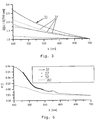
- Figure 2 shows the extinction coefficients K h 10 of hemoglobin, K b 11 of bilirubin, and K l 12 of lipid (Intralipid 20% [Pharmacia, Sweden]) in the visible and near IR range.
- the extinction spectrum E g 13 of a standard blood serum (Control Serum N (human) [Hoffmann-La Roche, Switzerland]) is also shown in Fig. 2 (dashed line).
- the solid line 30 refers to the reference solution of Intralipid, the broken lines 31 refer to several samples of real whole blood sera after subtraction of the extinction contribution by hemoglobin and bilirubin.
- E diff is obtained from subtracting the hemoglobin and bilirubin contributions from the measured extinction spectrum.
- E diff represents the sum of the spectral contributions of the lipid (E l ) and the matrix (E g ) , and may additionally be investigated for spectral anomalies over the whole spectral range.
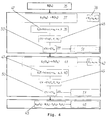
- the hemoglobin concentration is determined 38 from the measured extinction spectrum E( ⁇ ) 35 in the approximate wavelength range ⁇ rh ⁇ [545, 575] nm, where the hemoglobin has typical spectral characteristics and the bilirubin contribution is quasi negligible (Fig. 2).
- the bilirubin concentration is determined from the measured extinction spectrum E( ⁇ ) 35 in the wavelength range ⁇ rb ⁇ [480, 545] nm.
- CV lim a critical to weak reproducibility 51 of the results, i. e. concentrations and differential spectrum. Consequently, the measurement would e.g. be disregarded, repeated, or assigned reduced reliability.
- the bloc diagram in Fig. 4 summarizes the proposed measurement and evaluation method for sample quality monitoring.
- Sample quality monitoring based on optical absorption spectroscopy as shown in Fig. 1, has been experimentally investigated using a state-of-the-art spectrometer (Cary V, VARIAN, Australia).
- the collimated beam had an approximate spot size of 5 ⁇ 2 mm 2 .
- the hemoglobin concentration C h has been obtained from linear least squares fitting the model in Eqs.
- the differential extinction spectrum E diff has been obtained from Eq. (7).
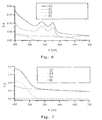
- Figure 5 shows the experimentally measured extinction spectrum E( ⁇ ) of a typical real whole blood serum 55.
- the best fitting extinction models for hemoglobin 57 and bilirubin 59 in Eqs. (3) and (5) are represented by crosses and dots, respectively.
- the differential extinction spectrum E diff ( ⁇ n ) 60 is also shown by the dashed line.
- Figs. 6 and 7 show other examples of real whole blood serum samples, namely with a high hemoglobin content respectively an highly icteric sample. Furthermore, in Fig. 6, the differential spectrum shows an anomalous differential spectrum which is merely constant with additionally an increased extinction with increasing wavelength above about 650 nm.
- the continuous line 62 is the measured spectrum
- the dashed line 64 and the dotted line 65 are the hemoglobin respectively the bilirubin contributions
- the dash-dotted line 66 is the differential spectrum, each time calculated from the results according to the described method.
- the hemoglobin and bilirubin concentrations of a series of 125 independent test samples have been determined.
- the samples have been synthesized using a standard blood serum (Control Serum N (human) [Hoffmann-La Roche, Switzerland]) to which hemoglobin (Hemolysat [Hoffmann-La Roche, Switzerland]), bilirubin (B-4126 mixed isomers [Sigma, Switzerland]) and lipid (Intralipid 20% [Pharmacia, Sweden]) have been added.
- the optically measured hemoglobin 70 and bilirubin 72 concentrations versus added concentrations are represented in Fig. 8 and 9.
- the hemoglobin and bilirubin concentrations of a series of 92 real whole blood sera have then been optically determined.
- the concentrations have been determined by clinical-chemical analysis(Cobas® Integra 700 analyzer, [Hoffmann-La Roche, Switzerland]).
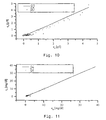
- Figures 10 and 11 show the optically versus clinical-chemically determined hemoglobin [bilirubin] concentrations 90 [91].
- the sensitivity of the method is approximately C h,min ⁇ 0.5 g/l hemoglobin and C b,min ⁇ 2 mg/dl bilirubin.
- the clinical-chemical method has also limited accuracy; namely the bilirubin concentrations (Fig. 11) show better correlation than the hemoglobin concentrations (Fig. 10), although the accuracy of the optically measured bilirubin concentration is affected by the accuracy of the hemoglobin concentration determination (sequential determination of hemoglobin and bilirubin, see above).
- the light was spectroscopically analyzed by a low cost, plane-concave spectrometer PCS [CSEM-Z, Switzerland] with spectral resolution ⁇ ⁇ 8 nm.
- the hemoglobin concentration C h has been obtained from linear least squares fitting the model in Eqs.
- the differential extinction spectrum E diff has been obtained from Eq. (7).
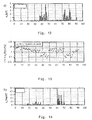
- Figures 16 and 17 show the PCS versus the state-of-the-art (Cary V) spectroscopically measured hemoglobin respectively bilirubin concentrations of the set of 92 blood sera of Figs. 10, 11 and 12 to 15. In the case of hemoglobin (Fig.
- the examination of the samples yields a result indicating an anomalous condition of the sample, there may be generated by the examining device, e. g., one or more of the following signals or responses:
- the described method may be implemented in various arrangements, preferably in connection with an automated analyzer, e g. as follows:
Landscapes
- Physics & Mathematics (AREA)
- Engineering & Computer Science (AREA)
- Mathematical Physics (AREA)
- Theoretical Computer Science (AREA)
- Spectroscopy & Molecular Physics (AREA)
- Health & Medical Sciences (AREA)
- Life Sciences & Earth Sciences (AREA)
- Chemical & Material Sciences (AREA)
- Analytical Chemistry (AREA)
- Biochemistry (AREA)
- General Health & Medical Sciences (AREA)
- General Physics & Mathematics (AREA)
- Immunology (AREA)
- Pathology (AREA)
- Investigating Or Analysing Biological Materials (AREA)
- Investigating Or Analysing Materials By Optical Means (AREA)
Priority Applications (5)
| Application Number | Priority Date | Filing Date | Title |
|---|---|---|---|
| EP99810517A EP1059522A1 (en) | 1999-06-11 | 1999-06-11 | Method and apparatus for examining fluids of biological origin |
| PCT/EP2000/005237 WO2000077494A1 (en) | 1999-06-11 | 2000-06-07 | Method and apparatus for examining fluids of biological origin |
| US10/018,080 US6882425B1 (en) | 1999-06-11 | 2000-06-07 | Method and apparatus for examining fluids of biological origin |
| JP2001503504A JP2003502631A (ja) | 1999-06-11 | 2000-06-07 | 生物学的由来流体を試験する方法及び装置 |
| EP00936867A EP1185852A1 (en) | 1999-06-11 | 2000-06-07 | Method and apparatus for examining fluids of biological origin |
Applications Claiming Priority (1)
| Application Number | Priority Date | Filing Date | Title |
|---|---|---|---|
| EP99810517A EP1059522A1 (en) | 1999-06-11 | 1999-06-11 | Method and apparatus for examining fluids of biological origin |
Publications (1)
| Publication Number | Publication Date |
|---|---|
| EP1059522A1 true EP1059522A1 (en) | 2000-12-13 |
Family
ID=8242873
Family Applications (2)
| Application Number | Title | Priority Date | Filing Date |
|---|---|---|---|
| EP99810517A Withdrawn EP1059522A1 (en) | 1999-06-11 | 1999-06-11 | Method and apparatus for examining fluids of biological origin |
| EP00936867A Ceased EP1185852A1 (en) | 1999-06-11 | 2000-06-07 | Method and apparatus for examining fluids of biological origin |
Family Applications After (1)
| Application Number | Title | Priority Date | Filing Date |
|---|---|---|---|
| EP00936867A Ceased EP1185852A1 (en) | 1999-06-11 | 2000-06-07 | Method and apparatus for examining fluids of biological origin |
Country Status (4)
| Country | Link |
|---|---|
| US (1) | US6882425B1 (enExample) |
| EP (2) | EP1059522A1 (enExample) |
| JP (1) | JP2003502631A (enExample) |
| WO (1) | WO2000077494A1 (enExample) |
Cited By (8)
| Publication number | Priority date | Publication date | Assignee | Title |
|---|---|---|---|---|
| WO2006040387A1 (en) * | 2004-10-11 | 2006-04-20 | Thermo Fisher Scientific Oy | Method for automatically detecting factors that disturb analysis by a photometer |
| EP2549264A1 (de) | 2011-07-18 | 2013-01-23 | Siemens Healthcare Diagnostics Products GmbH | Verfahren und System zum Bestimmen der Konzentration von Substanzen in Körperflüssigkeiten |
| CN105116156A (zh) * | 2015-07-22 | 2015-12-02 | 江苏英诺华医疗技术有限公司 | 一种优化的适合医学检验的生化检测方法 |
| EP3051272A2 (de) | 2015-01-27 | 2016-08-03 | Siemens Healthcare Diagnostics Products GmbH | Verfahren zur bestimmung von lipiden und anderen störsubstanzen in körperflüssigkeitsproben |
| CN106018400A (zh) * | 2015-03-31 | 2016-10-12 | 希森美康株式会社 | 样本分析装置、样本分析方法及控制装置 |
| EP3165900A1 (en) | 2015-11-09 | 2017-05-10 | F. Hoffmann-La Roche AG | Multi-wavelength illumination for spectral interference detection |
| EP3290905A1 (en) * | 2016-09-05 | 2018-03-07 | F. Hoffmann-La Roche AG | Signal offset determination and correction |
| EP3591378A1 (de) | 2018-07-03 | 2020-01-08 | Siemens Healthcare Diagnostics Products GmbH | Verfahren zur bestimmung von lipiden, hämoglobin und bilirubin in körperflüssigkeitsproben |
Families Citing this family (10)
| Publication number | Priority date | Publication date | Assignee | Title |
|---|---|---|---|---|
| JP4496838B2 (ja) * | 2004-04-28 | 2010-07-07 | 日立化成工業株式会社 | 分光装置及び全反射ラマン分光装置 |
| US7375815B2 (en) * | 2004-10-12 | 2008-05-20 | Agilent Technologies, Inc. | Optical devices, systems and method for producing a collimated light path |
| WO2008077007A1 (en) * | 2006-12-19 | 2008-06-26 | Cytyc Corporation | Method for analyzing blood content of cytological specimens |
| EP1987762A1 (de) * | 2007-05-03 | 2008-11-05 | F.Hoffmann-La Roche Ag | Oximeter |
| CN102216784B (zh) * | 2008-11-17 | 2014-07-09 | 株式会社日立高新技术 | 自动分析装置 |
| EP3974838B1 (en) * | 2009-08-13 | 2026-04-22 | Siemens Healthcare Diagnostics Inc. | Methods for ascertaining physical dimensions in liquid samples and containers to be analyzed by a clinical analyzer |
| WO2014021917A1 (en) * | 2012-07-30 | 2014-02-06 | Fenwal, Inc. | Optical detection of lipids |
| WO2018144633A1 (en) * | 2017-01-31 | 2018-08-09 | Theranos Ip Company, Llc | Methods and devices for improved signal detection from biological samples |
| EP3655757B1 (en) | 2017-07-19 | 2025-04-16 | Siemens Healthcare Diagnostics, Inc. | Apparatus and method for specimen characterization using hyperspectral imaging |
| WO2020103051A1 (zh) * | 2018-11-21 | 2020-05-28 | 北京普利生仪器有限公司 | 样本吸光度差的测量方法、样本分析仪和存储介质 |
Citations (3)
| Publication number | Priority date | Publication date | Assignee | Title |
|---|---|---|---|---|
| WO1991004470A1 (en) * | 1989-09-22 | 1991-04-04 | Ada Technologies, Inc. | Spectrometer for performing measurements in a fluid stream |
| EP0562800A2 (en) * | 1992-03-24 | 1993-09-29 | Shimadzu Corporation | Determining a base line of a measurement curve |
| EP0915338A2 (en) * | 1997-11-10 | 1999-05-12 | Jeacle Limited | Photometric analysis of water suspensions |
Family Cites Families (10)
| Publication number | Priority date | Publication date | Assignee | Title |
|---|---|---|---|---|
| DE2847176C2 (de) | 1977-10-31 | 1982-05-06 | Hitachi, Ltd., Tokyo | Verfahren zur photometrischen Bestimmung von Substanzen im Blutserum |
| JPS5463785A (en) * | 1977-10-31 | 1979-05-22 | Hitachi Ltd | Colorimetric analysis method |
| GB2020009B (en) * | 1978-04-08 | 1982-12-01 | Bodenseewerk Perkin Elmer Co | Apparatus for determining the concentration of components of a sample |
| DE3043984A1 (de) * | 1980-11-21 | 1982-06-03 | Langhals, Heinz, Dr., 5880 Lüdenscheid | Verfahren zur bestimmung der zusammensetzung binaerer fluessigkeitsgemische |
| US5137023A (en) * | 1990-04-19 | 1992-08-11 | Worcester Polytechnic Institute | Method and apparatus for monitoring blood analytes noninvasively by pulsatile photoplethysmography |
| US5424840A (en) * | 1992-07-21 | 1995-06-13 | The State Of Oregon Acting By And Through The State Board Of Higher Education On Behalf Of Oregon State University | In situ chlorophyl absorption meter |
| US5573952A (en) * | 1994-08-12 | 1996-11-12 | E. I. Du Pont De Nemours And Company | Process for controlling concentration of a solution of a solvent and polymer |
| DE4433827C2 (de) * | 1994-09-22 | 1999-01-07 | Zeiss Carl Jena Gmbh | Anordnung und Verfahren zur Messung von Stoffparametern in Schichten von Medien, insbesondere zur eichungsfreien in vivo Messung der Sauerstoffsättigung in optisch zugängigen Blutgefäßen |
| US6195158B1 (en) | 1995-11-21 | 2001-02-27 | Cme Telemetrix Inc. | Apparatus and method for rapid spectrophotometric pre-test screen of specimen for a blood analyzer |
| JPH1164217A (ja) * | 1997-08-26 | 1999-03-05 | Iseki & Co Ltd | 分光分析機における成分量検出装置 |
-
1999
- 1999-06-11 EP EP99810517A patent/EP1059522A1/en not_active Withdrawn
-
2000
- 2000-06-07 EP EP00936867A patent/EP1185852A1/en not_active Ceased
- 2000-06-07 JP JP2001503504A patent/JP2003502631A/ja active Pending
- 2000-06-07 WO PCT/EP2000/005237 patent/WO2000077494A1/en not_active Ceased
- 2000-06-07 US US10/018,080 patent/US6882425B1/en not_active Expired - Fee Related
Patent Citations (3)
| Publication number | Priority date | Publication date | Assignee | Title |
|---|---|---|---|---|
| WO1991004470A1 (en) * | 1989-09-22 | 1991-04-04 | Ada Technologies, Inc. | Spectrometer for performing measurements in a fluid stream |
| EP0562800A2 (en) * | 1992-03-24 | 1993-09-29 | Shimadzu Corporation | Determining a base line of a measurement curve |
| EP0915338A2 (en) * | 1997-11-10 | 1999-05-12 | Jeacle Limited | Photometric analysis of water suspensions |
Cited By (18)
| Publication number | Priority date | Publication date | Assignee | Title |
|---|---|---|---|---|
| US7663738B2 (en) | 2004-10-11 | 2010-02-16 | Thermo Fisher Scientific Oy | Method for automatically detecting factors that disturb analysis by a photometer |
| WO2006040387A1 (en) * | 2004-10-11 | 2006-04-20 | Thermo Fisher Scientific Oy | Method for automatically detecting factors that disturb analysis by a photometer |
| US9395300B2 (en) | 2011-07-18 | 2016-07-19 | Siemens Healthcare Diagnostics Products Gmbh | Method and system for determining the concentration of substances in body fluids |
| EP2549264A1 (de) | 2011-07-18 | 2013-01-23 | Siemens Healthcare Diagnostics Products GmbH | Verfahren und System zum Bestimmen der Konzentration von Substanzen in Körperflüssigkeiten |
| WO2013010970A1 (de) | 2011-07-18 | 2013-01-24 | Siemens Healthcare Diagnostics Products Gmbh | Verfahren und system zum bestimmen der konzentration von substanzen in körperflüssigkeiten |
| CN103649721A (zh) * | 2011-07-18 | 2014-03-19 | 西门子医学诊断产品有限责任公司 | 用于确定体液内物质浓度的方法和系统 |
| EP3051271A1 (de) | 2015-01-27 | 2016-08-03 | Siemens Healthcare Diagnostics Products GmbH | Verfahren zur Bestimmung von Lipiden und anderen Störsubstanzen in Körperflüssigkeitsproben |
| EP3051272A2 (de) | 2015-01-27 | 2016-08-03 | Siemens Healthcare Diagnostics Products GmbH | Verfahren zur bestimmung von lipiden und anderen störsubstanzen in körperflüssigkeitsproben |
| CN105823739A (zh) * | 2015-01-27 | 2016-08-03 | 西门子医学诊断产品有限责任公司 | 用于确定体液样本中脂质和其他干扰物质的方法 |
| EP3051272A3 (de) * | 2015-01-27 | 2016-10-26 | Siemens Healthcare Diagnostics Products GmbH | Verfahren zur bestimmung von lipiden und anderen störsubstanzen in körperflüssigkeitsproben |
| US9594076B2 (en) | 2015-01-27 | 2017-03-14 | Siemens Healthcare Diagnostics Products Gmbh | Method for determining lipids and other interfering substances in body fluid samples |
| CN106018400A (zh) * | 2015-03-31 | 2016-10-12 | 希森美康株式会社 | 样本分析装置、样本分析方法及控制装置 |
| CN106018400B (zh) * | 2015-03-31 | 2019-01-22 | 希森美康株式会社 | 样本分析装置、样本分析方法及控制装置 |
| CN105116156A (zh) * | 2015-07-22 | 2015-12-02 | 江苏英诺华医疗技术有限公司 | 一种优化的适合医学检验的生化检测方法 |
| EP3165900A1 (en) | 2015-11-09 | 2017-05-10 | F. Hoffmann-La Roche AG | Multi-wavelength illumination for spectral interference detection |
| EP3290905A1 (en) * | 2016-09-05 | 2018-03-07 | F. Hoffmann-La Roche AG | Signal offset determination and correction |
| US10458997B2 (en) | 2016-09-05 | 2019-10-29 | Roche Diagnostics Operations, Inc. | Signal offset determination and correction |
| EP3591378A1 (de) | 2018-07-03 | 2020-01-08 | Siemens Healthcare Diagnostics Products GmbH | Verfahren zur bestimmung von lipiden, hämoglobin und bilirubin in körperflüssigkeitsproben |
Also Published As
| Publication number | Publication date |
|---|---|
| JP2003502631A (ja) | 2003-01-21 |
| EP1185852A1 (en) | 2002-03-13 |
| WO2000077494A1 (en) | 2000-12-21 |
| US6882425B1 (en) | 2005-04-19 |
Similar Documents
| Publication | Publication Date | Title |
|---|---|---|
| US6882425B1 (en) | Method and apparatus for examining fluids of biological origin | |
| JP3994143B2 (ja) | 血液分析器のための検体の迅速な分光光度法の予備検査鑑別方法及び装置 | |
| US7663738B2 (en) | Method for automatically detecting factors that disturb analysis by a photometer | |
| US4125372A (en) | Method and device for testing liquids | |
| US5083283A (en) | Method of determining calibration curve and apparatus using calibaration curve | |
| US6353471B1 (en) | Method and apparatus for non-destructive screening of specimen integrity | |
| US4669878A (en) | Automatic monochromator-testing system | |
| CA1127865A (en) | Method and device for analysis with color identification test paper | |
| US6522398B2 (en) | Apparatus for measuring hematocrit | |
| CN101487792B (zh) | 现场用牛奶质量分析装置及方法 | |
| EP0769691A2 (en) | Apparatus for urine analysis | |
| EP0975976B1 (en) | Calibrator material for instruments which measure interferents in serum and plasma specimens | |
| EP0762109A2 (en) | Method of and apparatus for measuring lactic acid in organism | |
| US20070190637A1 (en) | Apparatus for handling fluids | |
| EP1023583B1 (en) | Method for measurement of blood substitutes | |
| JP2023539444A (ja) | 内蔵光源を有する回路板 | |
| JP4366261B2 (ja) | 測定反応過程の異常の有無判定方法,該方法を実行可能な自動分析装置及び該方法のプログラムを記憶した記憶媒体 | |
| CA2323442C (en) | Method and apparatus for measuring proteins | |
| JP2005127757A (ja) | 自動分析装置 | |
| EP0186704A1 (en) | Automatic monochromator-testing system | |
| US20020110487A1 (en) | Apparatus and method for handling fluids | |
| JPH0735744A (ja) | 尿の分析方法 | |
| KR101893219B1 (ko) | 체액분석 방법 및 이를 이용한 체액분석 시스템 | |
| RU242753U1 (ru) | Анализатор качества молока | |
| DE19735144A1 (de) | Reflexionsfluorimeter |
Legal Events
| Date | Code | Title | Description |
|---|---|---|---|
| PUAI | Public reference made under article 153(3) epc to a published international application that has entered the european phase |
Free format text: ORIGINAL CODE: 0009012 |
|
| AK | Designated contracting states |
Kind code of ref document: A1 Designated state(s): AT BE CH CY DE DK ES FI FR GB GR IE IT LI LU MC NL PT SE |
|
| AX | Request for extension of the european patent |
Free format text: AL;LT;LV;MK;RO;SI |
|
| AKX | Designation fees paid | ||
| STAA | Information on the status of an ep patent application or granted ep patent |
Free format text: STATUS: THE APPLICATION IS DEEMED TO BE WITHDRAWN |
|
| REG | Reference to a national code |
Ref country code: DE Ref legal event code: 8566 |
|
| 18D | Application deemed to be withdrawn |
Effective date: 20010614 |