EP1044018B1 - Tumorvakzine für muc1-positive karzinome - Google Patents
Tumorvakzine für muc1-positive karzinome Download PDFInfo
- Publication number
- EP1044018B1 EP1044018B1 EP98966819A EP98966819A EP1044018B1 EP 1044018 B1 EP1044018 B1 EP 1044018B1 EP 98966819 A EP98966819 A EP 98966819A EP 98966819 A EP98966819 A EP 98966819A EP 1044018 B1 EP1044018 B1 EP 1044018B1
- Authority
- EP
- European Patent Office
- Prior art keywords
- vaccine according
- amino acids
- muc1
- glycosylation
- tumour vaccine
- Prior art date
- Legal status (The legal status is an assumption and is not a legal conclusion. Google has not performed a legal analysis and makes no representation as to the accuracy of the status listed.)
- Expired - Lifetime
Links
Images

Classifications
-
- A—HUMAN NECESSITIES
- A61—MEDICAL OR VETERINARY SCIENCE; HYGIENE
- A61P—SPECIFIC THERAPEUTIC ACTIVITY OF CHEMICAL COMPOUNDS OR MEDICINAL PREPARATIONS
- A61P35/00—Antineoplastic agents
-
- A—HUMAN NECESSITIES
- A61—MEDICAL OR VETERINARY SCIENCE; HYGIENE
- A61K—PREPARATIONS FOR MEDICAL, DENTAL OR TOILETRY PURPOSES
- A61K39/00—Medicinal preparations containing antigens or antibodies
- A61K39/0005—Vertebrate antigens
- A61K39/0011—Cancer antigens
- A61K39/001169—Tumor associated carbohydrates
- A61K39/00117—Mucins, e.g. MUC-1
Definitions
- the invention relates to novel tumor vaccines based on the molecular structure of human epithelial mucin (MUC1). Field of application of the invention is the immunotherapy of carcinomas.
- MUC1 human epithelial mucin
- Epithelial mucins are glycoproteins with repetitive amino acid sequences and a high carbohydrate content, some of which are membrane-bound, some are secreted and occur on many glandular epithelia.
- the best known epithelial mucin is the membrane-bound MUC1, also described as PEM, PUM, EMA, MAM-6, PAS-O or episialin ( Finn, O., et al., Immunol. Ref. 145: 61, 1995 ) whose extracellular part consists of a variable number of repeating units of 20 amino acids, the so-called "tandem repeats".
- the MUC1 is not a tumor-specific molecule per se; its suitability as a tumor antigen is based on the fact that its carbohydrate content in tumors is qualitatively and quantitatively changed ( Burchell, J., and Taylor-Papadimitriou, J., Epith. Cell Biol. 2: 155, 1993 ). In doing so, new epitopes appear, which are perceived by the immune system (humoral and cellular defense). After surgical removal of the primary tumor (or after radiation or chemotherapy), it must generally be assumed that tumor cells remain in the body ("minimal residual disease"). These tumor cells, which pose a potential hazard, are controlled by various endogenous mechanisms whose efficacy can be enhanced by adjuvant immunotherapy. The most effective adjuvant immunotherapy is vaccination. Two prerequisites are required for this: first, that a suitable target antigen (epitope) is present on the tumor cells, and second, that it is possible to produce a highly immunogenic, preferably synthetic form of a vaccine.
- a suitable target antigen epitope
- Non-glycosylated oligo-repeat peptides of MUC1 represent a suitable target antigen in a number of common carcinomas ( Apostolopoulos, V., and McKenzie, IFC, Crit. Rev. Immunol. 14: 293, 1994 ).
- the immuno-dominant region of the MUC1 is the motif PDTRPAP, which is present on every tandem repeat.
- PDTRPAP the motif of the MUC1
- previous attempts to develop a vaccine based on a single tandem repeat have not been successful. According to the current state of knowledge, a minimum length of the peptide is required for the formation of the immunogenic conformation of the peptide, which is only achieved with 3-5 tandem repeats ( Fontenot, JD, et al., J.Biomol.Struct.Dyn.
- Liu, X. et al. discloses a MUC + peptide (GVTSAPDTRPAPGSTA) with increased antigenicity, glycosylated on threonine 3 and / or serine 4, as well as tumor vaccines (Glycoconjugate Journal, 12: 607, 1995 ).
- the invention is based on the object of developing a tumor vaccine based on the molecular structure of the human epithelial mucin MUC1, which is particularly suitable for combating tumor therapies remaining in the body after other therapies.
- glycopeptides designated A1 to A12 are listed in Table 1. They correspond to an overlapping tandem repeat of the MUC1 and contain 5 potential glycosylation sites (3x Thr, 2x Ser); A1-A9 contain an additional Ala. The glycopeptides differ in the number and position of the glycosylation sites (see Table 1).
- A1-A9 carry the Thomsen-Friedenreich antigen (TF) ⁇ -D-Gal (1-3) aD-GalNAc-O- R as glycans, while All and A12 carry only aD-GalNAc-OR (the Tn antigen)
- the antibodies used are: A76-A / C7 (mouse, IgG1, epitope: APDTRPAP) and MF06 (mouse, IgG1, epitope DTRPAP) (see: Rye, PD, Price, MR, eds., ISOBM TD-4 International Workshop on Monoclonal Antibodies against MUC1, Tumor Biol. 19, Suppl.1, 1998 ).
Landscapes
- Health & Medical Sciences (AREA)
- Life Sciences & Earth Sciences (AREA)
- Pharmacology & Pharmacy (AREA)
- Veterinary Medicine (AREA)
- Public Health (AREA)
- Chemical & Material Sciences (AREA)
- General Health & Medical Sciences (AREA)
- Medicinal Chemistry (AREA)
- Animal Behavior & Ethology (AREA)
- Epidemiology (AREA)
- Mycology (AREA)
- Microbiology (AREA)
- Immunology (AREA)
- Oncology (AREA)
- Molecular Biology (AREA)
- Chemical Kinetics & Catalysis (AREA)
- General Chemical & Material Sciences (AREA)
- Nuclear Medicine, Radiotherapy & Molecular Imaging (AREA)
- Organic Chemistry (AREA)
- Medicines Containing Antibodies Or Antigens For Use As Internal Diagnostic Agents (AREA)
- Peptides Or Proteins (AREA)
Description
- Die Erfindung betrifft neuartige Tumorvakzinen auf der Grundlage der Molekülstruktur des menschlichen epithelialen Muzins (MUC1). Anwendungsgebiet der Erfindung ist die Immuntherapie von Karzinomen.
- Epitheliale Muzine sind Glykoproteine mit repetitiven Aminosäuresequenzen und einem hohen Kohlenhydratanteil, die teils membrangebunden sind, teils sezerniert werden und auf vielen Drüsenepithelien vorkommen. Das am besten bekannte epitheliale Muzin ist das membrangebundene MUC1, auch als PEM, PUM, EMA, MAM-6, PAS-O oder Episialin beschrieben (Finn, O., et al., Immunol.Reviews 145:61, 1995), dessen extrazellulärer Teil aus einer variablen Anzahl sich wiederholender Einheiten aus 20 Aminosäuren besteht, den sogenannten "Tandem-Repeats". Das MUC1 ist an sich kein tumorspezifisches Molekül; seine Eignung als Tumorantigen beruht darauf, daß sein Kohlenhydratanteil bei Tumoren qualitativ und quantitativ verändert ist (Burchell,J., und Taylor-Papadimitriou,J., Epith.Cell Biol. 2:155, 1993). Dabei treten neue Epitope auf, die vom Immunsystem (humorale und zelluläre Abwehr) wahrgenommen werden.
Nach operativer Entfernung des Primärtumors (bzw. nach Strahlen- oder Chemotherapie) muß in der Regel davon ausgegangen werden, daß noch Tumorzellen im Körper verbleiben ("minimal residual disease"). Diese Tumorzellen, die eine potentielle Gefahr darstellen, werden durch verschiedene körpereigene Mechanismen bekämpft, deren Wirksamkeit durch eine adjuvante Immuntherapie verstärkt werden kann. Die effektivste adjuvante Immuntherapie ist die Vakzinierung. Zwei Voraussetzungen sind hierfür erforderlich: erstens, daß ein geeignetes Zielantigen (Epitop) auf den Tumorzellen vorhanden ist, und zweitens, daß es gelingt, eine möglichst stark immunogene, vorzugsweise synthetische Form einer Vakzine herzustellen. - Nicht-glykosylierte Oligo-Repeat-Peptide des MUC1 stellen ein geeignetes Zielantigen bei einer Reihe häufiger Karzinome dar (Apostolopoulos, V., und McKenzie,I.F.C., Crit.Rev.Immunol. 14:293, 1994). Die immundominante Region des MUC1 ist das Motiv PDTRPAP, das auf jedem Tandem-Repeat vorhanden ist. Bisherige Versuche, eine Vakzine auf der Basis eines einzelnen Tandem-Repeats zu entwickeln, waren jedoch nicht erfolgreich. Nach dem bisherigen Stand des Wissens ist für das Zustandekommen der immunogenen Konformation des Peptids eine Mindestlänge des Peptids erforderlich, die erst bei 3-5 Tandem-Repeats erreicht wird (Fontenot,J.D., et al., J.Biomol.Struct.Dyn. 13:245, 1995). Liu, X. et al. offenbart ein MUC + Peptid (GVTSAPDTRPAPGSTA) mit erhöhter Antigenität, glycosyliert am Threonin 3 oder/und Serin 4, sowie Tumorvakzine .(Glycoconjungate Journal, 12: 607, 1995).
- Der Erfindung liegt die Aufgabe zugrunde, auf der Basis der Molekülstruktur des menschlichen epithelialen Mucins MUC1 eine Tumorvakzine zu entwickeln, die insbesondere zur Bekämpfung von nach anderen Therapien im Körper noch verbliebenen Tumorzellen geeignet ist.
- Bei der immunologischen Untersuchung synthetischer Glykopeptide, die einem Tandem-Repeat des MUC1 entsprechen, wurde überraschend gefunden, daß die Glykosylierung des Threonins innerhalb der immundominanten Region PDTRPAP mit α-GalNAc die Antigenität signifikant erhöht. Bisher war davon ausgegangen worden, daß diese Position bei nativem MUC1 nicht glykosyliert ist. Zu dieser Schlußfolgerung hatten die Annahme, daß eine Glykosylierung die Erkennung von Peptidepitopen in der Regel behindert, sowie Ergebnisse von in-vitro-Glykosylierungsversuchen (Stadie, T., et al., Eur.J.Biochem. 229: 140(1995)) geführt. Neueste Untersuchungen (Müller,S., et al., J.Biol.Chem. 272:24780, 1997) zeigen allerdings, daß das Threonin im PDTRPAP-Motiv in vivo sehr wohl glykosyliert sein kann. Aus den genannten neuen Ergebnissen wird geschlossen, daß die Antigenität (und im Zusammenhang damit auch die Immunogenität) des MUC1-Tandem-Repeats durch Glykosylierung des Thr im PDTRPAP-Motiv mittels GalNAc oder einem kurzen Oligosaccharid erheblich erhöht wird. Dadurch wird die immunogene Konformation der immundominanten Region bereits von einem einzelnen Tandem-Repeat erreicht. Die Antigenität des glykosylierten PDTRPAP-Motivs in einem Monorepeat übertrifft sogar die des oligomeren, nicht glykosylierten Peptids.
Auf der Basis dieser Entdeckung wird vorgeschlagen, Tumorvakzinen verschiedener Molekülgrößen zu entwickeln, die am Thr des PDTRPAP-Motivs durch GalNAc oder ein geeignetes kurzkettiges Oligosaccharid glykosyliert sind. Die Aufgabe der Erfindung wird gemäß Anspruch 1 gelöst, die Unteransprüche sind Vorzugsvarianten. - Die Erfindung soll nachstehend durch ein Ausführungsbeispiel näher erläutert werden.
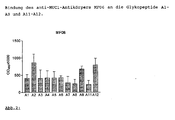
- Im folgenden wird die Bindung von monoklonalen Antikörpern gegen das immundominante Motiv PDTRPAP des epithelialen Muzins (MUC1) an synthetische Glykopeptide dieses Muzins mit einer Länge von 20 bzw. 21 Aminosäuren in einem Festphasen-Immunoassay (ELISA) untersucht. Die Glykopeptide mit den Bezeichnungen A1 bis A12 sind in Tabelle 1 aufgeführt. Sie entsprechen einem überlappenden Tandem-Repeat des MUC1 und enthalten 5 potentielle Glykosylierungsstellen (3x Thr, 2x Ser); A1-A9 enthalten ein zusätzliches Ala. Die Glykopeptide unterscheiden sich in der Zahl und Position der Glykosylierungsstellen (siehe Tabelle 1). A1-A9 tragen als Glykane das Thomsen-Friedenreich-Antigen (TF) β-D-Gal(1-3)a-D-GalNAc-O-R, während All und A12 lediglich a-D-GalNAc-O-R (das Tn-Antigen) tragen. Die benutzten Antikörper sind: A76-A/C7 (Maus, IgG1, Epitop: APDTRPAP) und MF06 (Maus, IgG1, Epitop DTRPAP) (siehe: Rye,P.D., Price,M.R., eds., ISOBM TD-4 International Workshop on Monoclonal Antibodies against MUC1, Tumor Biol. 19, Suppl.1, 1998).

- Die Ergebnisse zeigen, daß die in Position 10 glykosylierten Peptide mit den beiden im Beispiel gezeigten Antikörpern signifikant stärker binden als Peptide, die an dieser Stelle nicht glykosyliert sind. Glykosylierungen an anderen Positionen sind ohne Einfluß. Substitution durch Tn oder TF ist gleichwertig. Das in diesem Beispiel demonstrierte Bindungsverhalten wird von anderen MUC1-Antikörpern geteilt; es gibt aber auch Ausnahmen. Die deutlich erhöhte Antigenität der in Position 10 glykosylierten Peptide läßt sich auch in Inhibitionsversuchen zeigen.
Die Ergebnisse zeigen, daß eine Glykosylierung der immundominanten Region des MUC1-Peptids mittels Tn oder TF die Antigenität signifikant erhöht.
Claims (7)
- Tumorvakzine, enthaltend vom menschlichen epithelialen Muzin MUC1 abgeleitete synthetische Peptide mit der Sequenz PDTRPAP und einer Länge von wenigstens 7 Aminosäuren und maximal 120 Aminosäuren, die am Threonin der enthaltenen immundominanten Regionen PDTRPAP eine O-Glykosylierung mit dem Monosaccharid GalNAc oder mit einem kurzkettigen Oligosaccharid aufweisen, dadurch gekennzeichnet, dass die Glykosylierung durch α-D-GalNAc erfolgt ist.
- Tumorvakzine nach Anspruch 1, dadurch gekennzeichnet, dass die synthetischen Peptide mindestens die immundominante Region PDTRPAP und gegebenenfalls weitere benachbarte Aminosäuren beinhalten.
- Tumorvakzine nach Anspruch 1, dadurch gekennzeichnet, dass die synthetischen Peptide eine Länge von > 20 Aminosäuren, haben.
- Tumorvakzine nach Anspruch 2, dadurch gekennzeichnet, dass die synthetischen Peptide eine Länge von 40-120 Aminosäuren haben.
- Tumorvakzine nach Anspruch 1 bis 4, dadurch gekennzeichnet, dass die Glykosylierung durch ein Disaccharid erfolgt.
- Tumorvakzine nach Anspruch 1 bis 3 und 5, dadurch gekennzeichnet, dass die Glykosylierung durch β-D-Gal(1-3)α-D-GalNAc erfolgt.
- Verwendung der Tumorvakzine nach Anspruch 1 bis 6 zur Herstellung eines Mittels für die Bekämpfung von Tumorzellen aus Mamma-, colorectalen oder Pankreas-karzinomen im Sinne einer aktiven spezifischen Immunisierung.
Applications Claiming Priority (3)
| Application Number | Priority Date | Filing Date | Title |
|---|---|---|---|
| DE19758400 | 1997-12-30 | ||
| DE19758400A DE19758400A1 (de) | 1997-12-30 | 1997-12-30 | Tumorvakzine für MUC1-positive Karzinome |
| PCT/DE1998/003819 WO1999034824A2 (de) | 1997-12-30 | 1998-12-30 | Tumorvakzine für muc1-positive karzinome |
Publications (2)
| Publication Number | Publication Date |
|---|---|
| EP1044018A2 EP1044018A2 (de) | 2000-10-18 |
| EP1044018B1 true EP1044018B1 (de) | 2009-07-22 |
Family
ID=7853690
Family Applications (1)
| Application Number | Title | Priority Date | Filing Date |
|---|---|---|---|
| EP98966819A Expired - Lifetime EP1044018B1 (de) | 1997-12-30 | 1998-12-30 | Tumorvakzine für muc1-positive karzinome |
Country Status (5)
| Country | Link |
|---|---|
| US (1) | US7342094B1 (de) |
| EP (1) | EP1044018B1 (de) |
| JP (1) | JP2002500197A (de) |
| DE (2) | DE19758400A1 (de) |
| WO (1) | WO1999034824A2 (de) |
Families Citing this family (11)
| Publication number | Priority date | Publication date | Assignee | Title |
|---|---|---|---|---|
| IL125608A0 (en) | 1998-07-30 | 1999-03-12 | Yeda Res & Dev | Tumor associated antigen peptides and use of same as anti-tumor vaccines |
| GB9904695D0 (en) * | 1999-03-01 | 1999-04-21 | Imp Cancer Res Tech | Peptide |
| EP1182210A1 (de) * | 2000-08-17 | 2002-02-27 | BASTERT, Gunter, Prof.Dr.med.Dr.h.c. | Epitope des tumorassoziierten MUC1 Antigens |
| AU2003266236A1 (en) * | 2002-07-22 | 2004-02-09 | Nemod Immuntherapie Ag | Method for the production of an immunostimulating mucin (muc1) |
| JP2010505775A (ja) | 2006-10-04 | 2010-02-25 | クーベンハヴンス・ユニヴェルシテット | Muc1に対する癌特異的な免疫反応の産生及び癌特異的muc1抗体 |
| US9156906B2 (en) | 2008-02-26 | 2015-10-13 | The Regents Of The University Of California | Glycopeptides and methods of making and using them |
| US9588121B2 (en) | 2009-11-06 | 2017-03-07 | Go Therapeutics, Inc. | Method for early detection of cancer |
| US9346867B2 (en) | 2010-04-19 | 2016-05-24 | Sumitomo Bakelite Co., Ltd. | Cancer-related glycopeptide epitopes, antibodies and methods of use |
| CN109010809A (zh) | 2011-08-17 | 2018-12-18 | 全球免疫股份有限公司 | 酵母-muc1免疫治疗组合物及其用途 |
| AU2014340201B2 (en) | 2013-10-23 | 2019-02-21 | The United States Of America, As Represented By The Secretary, Department Of Health And Human Services | HLA-A24 agonist epitopes of MUC1-C oncoprotein and compositions and methods of use |
| GB201406767D0 (en) | 2014-04-15 | 2014-05-28 | Cancer Rec Tech Ltd | Humanized anti-Tn-MUC1 antibodies anf their conjugates |
Family Cites Families (5)
| Publication number | Priority date | Publication date | Assignee | Title |
|---|---|---|---|---|
| CA1339204C (en) * | 1987-01-07 | 1997-08-05 | Joyce Taylor-Papadimitriou | Mucin core polypeptide, antibodies and probes |
| EP0442926A1 (de) * | 1988-11-10 | 1991-08-28 | Imperial Cancer Research Technology Limited | Polypeptide |
| JP2518683B2 (ja) * | 1989-03-08 | 1996-07-24 | 国際電信電話株式会社 | 画像合成方法及びその装置 |
| AUPM322393A0 (en) * | 1993-12-24 | 1994-01-27 | Austin Research Institute, The | Mucin carbohydrate compounds and their use in immunotherapy |
| US6465220B1 (en) * | 1998-12-21 | 2002-10-15 | Glycozym Aps | Glycosylation using GalNac-T4 transferase |
-
1997
- 1997-12-30 DE DE19758400A patent/DE19758400A1/de not_active Ceased
-
1998
- 1998-12-30 EP EP98966819A patent/EP1044018B1/de not_active Expired - Lifetime
- 1998-12-30 DE DE59814379T patent/DE59814379D1/de not_active Expired - Lifetime
- 1998-12-30 JP JP2000527271A patent/JP2002500197A/ja active Pending
- 1998-12-30 WO PCT/DE1998/003819 patent/WO1999034824A2/de not_active Ceased
-
2000
- 2000-06-29 US US09/606,910 patent/US7342094B1/en not_active Expired - Fee Related
Also Published As
| Publication number | Publication date |
|---|---|
| WO1999034824A3 (de) | 1999-10-14 |
| US7342094B1 (en) | 2008-03-11 |
| DE59814379D1 (de) | 2009-09-03 |
| DE19758400A1 (de) | 1999-07-01 |
| WO1999034824A2 (de) | 1999-07-15 |
| JP2002500197A (ja) | 2002-01-08 |
| EP1044018A2 (de) | 2000-10-18 |
Similar Documents
| Publication | Publication Date | Title |
|---|---|---|
| DE69527050T2 (de) | Bispezifische moleküle mit klinischer verwendbarkeit | |
| DE3889536T2 (de) | Behandlung von krebs mit somatostatin und mit analogen davon. | |
| DE60018761T2 (de) | Therapeutischer antikörper gegen das muc-1-antigen und verfahren zu dessen verwendung | |
| CA1251134A (en) | Biologically active substance with hormonal properties, process for its production and application of histones for medical purposes | |
| DE69434324T2 (de) | Mucin-Mannan-Konjugate und ihre immunotherapeutische Anwendung | |
| WO1999034824A2 (de) | Tumorvakzine für muc1-positive karzinome | |
| DE3650088T2 (de) | Inhibin und dessen reinigung. | |
| WO1999032620A9 (de) | Insulin-like growth factor binding protein fragmente und ihre verwendung | |
| DE69110060T2 (de) | In der humantherapie nützliche substanzen peptidischer natur. | |
| DE68926916T2 (de) | 14-Beta-gal Sauger-Lectin | |
| DE19917195B4 (de) | Peptid zur Auslösung einer Immunreaktion gegen Tumorzellen, diese enthaltende pharmzeutische Zusammensetzungen, dessen Verwendungen, dafür codierende Nukleinsäure und diese Nukleinsäure enthaltender Expressionsvektor | |
| DE60215627T2 (de) | Impfstoff zur modulation zwischen t1 und t2 immunantworten | |
| EP0637964B1 (de) | Medikamente zur tumortherapie mit kontrolliertem und reguliertem immunsystem sowie verwendung der einzelsubstanzen zur kombinierten therapie | |
| DE69712907T2 (de) | Immunogene tlp-zusammensetzung | |
| EP1529060B1 (de) | Verfahren zur herstellung eines immunstimulatorischen muzins (muc1) | |
| DE4038189A1 (de) | Humanes, epididymis-spezifisches polypeptid und dessen verwendung zur therapie und diagnose maennlicher infertilitaet | |
| EP1151005B1 (de) | Peptid-varianten des tumormarkers muc1 und ihre verwendung | |
| EP1448224A2 (de) | Verwendung von selektin-bindenden wirkstoffen zur behandlung von entzündlichen- und tumor-erkrankungen | |
| DE60223232T2 (de) | Mucinpeptid mit immunstärkenden eigenschaften | |
| AT410637B (de) | Verwendung von polyklonalen immunglobulinen | |
| DE4231675C2 (de) | Mittel zur Steigerung der Ausbeute von Antikörpern in der Immunologie | |
| DE69839163T2 (de) | Methode zur Feststellung der therapeutischen Aktivität eines MBP-Fragments | |
| US6458761B2 (en) | Synthetic, statistic thymic peptide combination and its use as a preparation with immunological and/or endocrinological effect | |
| EP1287831A1 (de) | Antigen-Mimotope und Vakzine gegen Krebserkrankungen | |
| DE69930854T2 (de) | Von lipocortin-1 abgeleitete entzündungshemmende wirkstoffe |
Legal Events
| Date | Code | Title | Description |
|---|---|---|---|
| PUAI | Public reference made under article 153(3) epc to a published international application that has entered the european phase |
Free format text: ORIGINAL CODE: 0009012 |
|
| 17P | Request for examination filed |
Effective date: 20000719 |
|
| AK | Designated contracting states |
Kind code of ref document: A2 Designated state(s): AT BE CH DE DK ES FI FR GB IE IT LI NL SE |
|
| 17Q | First examination report despatched |
Effective date: 20050615 |
|
| 17Q | First examination report despatched |
Effective date: 20050615 |
|
| GRAP | Despatch of communication of intention to grant a patent |
Free format text: ORIGINAL CODE: EPIDOSNIGR1 |
|
| RIC1 | Information provided on ipc code assigned before grant |
Ipc: A61P 35/00 20060101ALI20090108BHEP Ipc: A61K 39/00 20060101AFI20090108BHEP |
|
| GRAS | Grant fee paid |
Free format text: ORIGINAL CODE: EPIDOSNIGR3 |
|
| GRAA | (expected) grant |
Free format text: ORIGINAL CODE: 0009210 |
|
| AK | Designated contracting states |
Kind code of ref document: B1 Designated state(s): AT BE CH DE DK ES FI FR GB IE IT LI NL SE |
|
| REG | Reference to a national code |
Ref country code: GB Ref legal event code: FG4D Free format text: NOT ENGLISH |
|
| REG | Reference to a national code |
Ref country code: CH Ref legal event code: EP |
|
| REG | Reference to a national code |
Ref country code: IE Ref legal event code: FG4D |
|
| REF | Corresponds to: |
Ref document number: 59814379 Country of ref document: DE Date of ref document: 20090903 Kind code of ref document: P |
|
| REG | Reference to a national code |
Ref country code: CH Ref legal event code: NV Representative=s name: BOVARD AG PATENTANWAELTE |
|
| NLV1 | Nl: lapsed or annulled due to failure to fulfill the requirements of art. 29p and 29m of the patents act | ||
| PG25 | Lapsed in a contracting state [announced via postgrant information from national office to epo] |
Ref country code: SE Free format text: LAPSE BECAUSE OF FAILURE TO SUBMIT A TRANSLATION OF THE DESCRIPTION OR TO PAY THE FEE WITHIN THE PRESCRIBED TIME-LIMIT Effective date: 20090722 Ref country code: FI Free format text: LAPSE BECAUSE OF FAILURE TO SUBMIT A TRANSLATION OF THE DESCRIPTION OR TO PAY THE FEE WITHIN THE PRESCRIBED TIME-LIMIT Effective date: 20090722 Ref country code: ES Free format text: LAPSE BECAUSE OF FAILURE TO SUBMIT A TRANSLATION OF THE DESCRIPTION OR TO PAY THE FEE WITHIN THE PRESCRIBED TIME-LIMIT Effective date: 20091102 |
|
| PG25 | Lapsed in a contracting state [announced via postgrant information from national office to epo] |
Ref country code: NL Free format text: LAPSE BECAUSE OF FAILURE TO SUBMIT A TRANSLATION OF THE DESCRIPTION OR TO PAY THE FEE WITHIN THE PRESCRIBED TIME-LIMIT Effective date: 20090722 |
|
| REG | Reference to a national code |
Ref country code: IE Ref legal event code: FD4D |
|
| PG25 | Lapsed in a contracting state [announced via postgrant information from national office to epo] |
Ref country code: IE Free format text: LAPSE BECAUSE OF FAILURE TO SUBMIT A TRANSLATION OF THE DESCRIPTION OR TO PAY THE FEE WITHIN THE PRESCRIBED TIME-LIMIT Effective date: 20090722 Ref country code: DK Free format text: LAPSE BECAUSE OF FAILURE TO SUBMIT A TRANSLATION OF THE DESCRIPTION OR TO PAY THE FEE WITHIN THE PRESCRIBED TIME-LIMIT Effective date: 20090722 |
|
| PLBE | No opposition filed within time limit |
Free format text: ORIGINAL CODE: 0009261 |
|
| STAA | Information on the status of an ep patent application or granted ep patent |
Free format text: STATUS: NO OPPOSITION FILED WITHIN TIME LIMIT |
|
| 26N | No opposition filed |
Effective date: 20100423 |
|
| BERE | Be: lapsed |
Owner name: MAX-DELBRUCK-CENTRUM FUR MOLEKULARE MEDIZIN Effective date: 20091231 |
|
| PG25 | Lapsed in a contracting state [announced via postgrant information from national office to epo] |
Ref country code: BE Free format text: LAPSE BECAUSE OF NON-PAYMENT OF DUE FEES Effective date: 20091231 |
|
| REG | Reference to a national code |
Ref country code: CH Ref legal event code: PFA Owner name: MAX-DELBRUECK-CENTRUM FUER MOLEKULARE MEDIZIN Free format text: MAX-DELBRUECK-CENTRUM FUER MOLEKULARE MEDIZIN#ROBERT-ROESSLE-STRASSE 10#13125 BERLIN (DE) -TRANSFER TO- MAX-DELBRUECK-CENTRUM FUER MOLEKULARE MEDIZIN#ROBERT-ROESSLE-STRASSE 10#13125 BERLIN (DE) |
|
| PG25 | Lapsed in a contracting state [announced via postgrant information from national office to epo] |
Ref country code: IT Free format text: LAPSE BECAUSE OF FAILURE TO SUBMIT A TRANSLATION OF THE DESCRIPTION OR TO PAY THE FEE WITHIN THE PRESCRIBED TIME-LIMIT Effective date: 20090722 |
|
| PG25 | Lapsed in a contracting state [announced via postgrant information from national office to epo] |
Ref country code: AT Free format text: LAPSE BECAUSE OF NON-PAYMENT OF DUE FEES Effective date: 20091230 |
|
| REG | Reference to a national code |
Ref country code: FR Ref legal event code: PLFP Year of fee payment: 18 |
|
| PGFP | Annual fee paid to national office [announced via postgrant information from national office to epo] |
Ref country code: DE Payment date: 20160225 Year of fee payment: 18 |
|
| REG | Reference to a national code |
Ref country code: FR Ref legal event code: PLFP Year of fee payment: 19 |
|
| REG | Reference to a national code |
Ref country code: DE Ref legal event code: R231 Ref document number: 59814379 Country of ref document: DE |
|
| PG25 | Lapsed in a contracting state [announced via postgrant information from national office to epo] |
Ref country code: DE Free format text: LAPSE BECAUSE OF THE APPLICANT RENOUNCES Effective date: 20170520 |
|
| REG | Reference to a national code |
Ref country code: FR Ref legal event code: PLFP Year of fee payment: 20 |
|
| PGFP | Annual fee paid to national office [announced via postgrant information from national office to epo] |
Ref country code: FR Payment date: 20171219 Year of fee payment: 20 |
|
| PGFP | Annual fee paid to national office [announced via postgrant information from national office to epo] |
Ref country code: CH Payment date: 20171221 Year of fee payment: 20 Ref country code: GB Payment date: 20171221 Year of fee payment: 20 |
|
| REG | Reference to a national code |
Ref country code: CH Ref legal event code: PL |
|
| REG | Reference to a national code |
Ref country code: GB Ref legal event code: PE20 Expiry date: 20181229 |
|
| PG25 | Lapsed in a contracting state [announced via postgrant information from national office to epo] |
Ref country code: GB Free format text: LAPSE BECAUSE OF EXPIRATION OF PROTECTION Effective date: 20181229 |