EP1041537A2 - Druckbeständige Wandler - Google Patents
Druckbeständige Wandler Download PDFInfo
- Publication number
- EP1041537A2 EP1041537A2 EP00301527A EP00301527A EP1041537A2 EP 1041537 A2 EP1041537 A2 EP 1041537A2 EP 00301527 A EP00301527 A EP 00301527A EP 00301527 A EP00301527 A EP 00301527A EP 1041537 A2 EP1041537 A2 EP 1041537A2
- Authority
- EP
- European Patent Office
- Prior art keywords
- transducer
- plate
- backing plate
- active material
- region
- Prior art date
- Legal status (The legal status is an assumption and is not a legal conclusion. Google has not performed a legal analysis and makes no representation as to the accuracy of the status listed.)
- Withdrawn
Links
Images


Classifications
-
- G—PHYSICS
- G01—MEASURING; TESTING
- G01V—GEOPHYSICS; GRAVITATIONAL MEASUREMENTS; DETECTING MASSES OR OBJECTS; TAGS
- G01V1/00—Seismology; Seismic or acoustic prospecting or detecting
- G01V1/16—Receiving elements for seismic signals; Arrangements or adaptations of receiving elements
- G01V1/18—Receiving elements, e.g. seismometer, geophone or torque detectors, for localised single point measurements
- G01V1/186—Hydrophones
-
- G—PHYSICS
- G01—MEASURING; TESTING
- G01H—MEASUREMENT OF MECHANICAL VIBRATIONS OR ULTRASONIC, SONIC OR INFRASONIC WAVES
- G01H11/00—Measuring mechanical vibrations or ultrasonic, sonic or infrasonic waves by detecting changes in electric or magnetic properties
- G01H11/06—Measuring mechanical vibrations or ultrasonic, sonic or infrasonic waves by detecting changes in electric or magnetic properties by electric means
- G01H11/08—Measuring mechanical vibrations or ultrasonic, sonic or infrasonic waves by detecting changes in electric or magnetic properties by electric means using piezoelectric devices
-
- G—PHYSICS
- G01—MEASURING; TESTING
- G01V—GEOPHYSICS; GRAVITATIONAL MEASUREMENTS; DETECTING MASSES OR OBJECTS; TAGS
- G01V1/00—Seismology; Seismic or acoustic prospecting or detecting
- G01V1/38—Seismology; Seismic or acoustic prospecting or detecting specially adapted for water-covered areas
-
- G—PHYSICS
- G10—MUSICAL INSTRUMENTS; ACOUSTICS
- G10K—SOUND-PRODUCING DEVICES; METHODS OR DEVICES FOR PROTECTING AGAINST, OR FOR DAMPING, NOISE OR OTHER ACOUSTIC WAVES IN GENERAL; ACOUSTICS NOT OTHERWISE PROVIDED FOR
- G10K9/00—Devices in which sound is produced by vibrating a diaphragm or analogous element, e.g. fog horns, vehicle hooters or buzzers
- G10K9/12—Devices in which sound is produced by vibrating a diaphragm or analogous element, e.g. fog horns, vehicle hooters or buzzers electrically operated
- G10K9/122—Devices in which sound is produced by vibrating a diaphragm or analogous element, e.g. fog horns, vehicle hooters or buzzers electrically operated using piezoelectric driving means
-
- G—PHYSICS
- G10—MUSICAL INSTRUMENTS; ACOUSTICS
- G10K—SOUND-PRODUCING DEVICES; METHODS OR DEVICES FOR PROTECTING AGAINST, OR FOR DAMPING, NOISE OR OTHER ACOUSTIC WAVES IN GENERAL; ACOUSTICS NOT OTHERWISE PROVIDED FOR
- G10K9/00—Devices in which sound is produced by vibrating a diaphragm or analogous element, e.g. fog horns, vehicle hooters or buzzers
- G10K9/18—Details, e.g. bulbs, pumps, pistons, switches or casings
- G10K9/20—Sounding members
Definitions
- the present invention relates to a pressure tolerant transducer for transforming energy from one form to another, for example for transforming electrical energy into acoustic energy or vice versa.
- Transducers for example acoustic transducers, are well known in the prior art.
- a flexural plate sound transducer comprising a housing having an open central volume, a flexural plate attached around an inner surface of the housing and extending across the central volume, at least one piezoelectric element attached to a surface of the flexural plate.
- a mechanical hinge is formed near an outer periphery of the flexural plate and extends around the flexural plate. The mechanical hinge is formed such as to cause the flexural plate to move in a substantially piston-like manner when the piezoelectric element is energised.
- the flexural plate and its associated at least one piezoelectric element are of uniform thickness except in the region where the hinge is formed.
- a piezo-ceramic sound transducer comprising a metal membrane onto which is bonded in a central region thereof a piezo-ceramic slice.
- the membrane includes a support ring at a peripheral region thereof, and also a concentric ring-form compliant grove in the membrane between the slice and the support ring.
- the membrane is of uniform thickness even in the grove.
- the hydrophone comprises two sensing elements where each element is composed of lead zirconate titanate and includes a plurality of columnar voids.
- the elements are bonded to an associated substrate material in the form of a backing plate.
- the voids are located in the hydrophone between the backing plate and the elements, the voids forming compressible cavities.
- transducer structures known in the art often experience difficulties coping with relatively elevated environmental pressures applied thereto.
- the inventors have developed an alternative transducer exhibiting enhanced resilience to elevated environmental pressure, for example as experienced at a depth in the order of 200 m in aquatic environments.
- the present invention seeks to provide a transducer incorporating a plate structure which is so constructed that it provides a workably low resonant frequency and which is capable of operating under extreme conditions, for example at large depths underwater in the order of 200 m.
- a transducer comprising:
- the invention provides the advantage that the transducer is capable of being used in applications where the transducer is exposed to relatively high external pressures.
- a transducer of the invention which acts in use to transform electrical energy into acoustic energy may be utilised as a 'projector' in a sonar system where the acoustic energy is broadcast into water.
- the transducer of the invention may be utilised as a hydrophone in a sonar system where it acts to transform acoustic energy into electrical energy.
- transducer examples include diver-to-diver, ship-to-diver and ship-to-ship communications systems, and ships in these contexts should be understood to include 'submarines'.
- the transducer with which the present invention is concerned is of the type which includes a plate structure comprising a backing plate to at least one side, namely a major surface, of which an active material is applied.
- an active material is defined as:
- the active material When the transducer is in use, the active material is deformed by the application of energy in one form and converts that energy into a different form.
- an alternating potential is applied to the two major surfaces of the active material plate via metal electrodes.
- Such excitation produces an alternating electrical field across the thickness of the active material plate.
- the plate In response to this field, the plate attempts to expand or contract in the direction of its plane, that is radially in the case of a disc-shaped plate.
- the backing plate to which the active material plate is bonded, constrains most of the said strain at or near the bond line.
- the side of the active material plate remote from the bond line however, remains reasonably free to expand and contract.
- the composite plate therefore undergoes periodic flexure. In the case of an underwater projector, this movement is communicated to the surrounding water, and the energy is propagated away as sound.
- such a transducer is sometimes referred to as a 'bender'.
- the invention provides an improved plate structure which overcomes problems associated with conventional prior art plate structures.
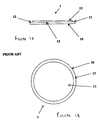
- Figure 1A shows a section through one face of a prior art plate structure
- Figure 1B is a plan view of the plate structure of Figure 1A.
- the plate structure 1 comprises a backing plate 10 which is flat and of uniform thickness.
- the backing plate 10 is generally symmetrical; the plate 10 is shown as circular but other shapes are possible.
- Attached to at least one side of the backing plate 10 is a layer 11 of the active material, for example a polarised electrostrictive material.
- the layer 11 as shown itself takes the form of a circular plate which is flat and of uniform thickness and which is attached to the backing plate 12 by suitable attachment means 13.
- the layer 11 is of such a size that there is an annular area 12 of the backing plate 10 adjacent the outer circumference thereof which is free of active material, although such an area does not necessarily have to be provided.
- the backing plate 10 may be supported on a support structure which can take various forms as shown below.
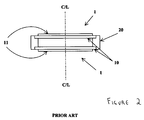
- FIG. 2 it is known to utilise two plate structures of a type illustrated in Figure 1 in a transducer.
- the two structures 1 are separated by an annular support element 20 which is affixed at or near the outer circumference of the backing plate(s) 10 to support and separate the two plate structures.
- the space between the plate structures can be filled with a gas (for example air) or liquid.
- a requirement of a sonar device is that it shall be capable of delivering useful quantities of acoustic power, with a reasonable level of efficiency.
- the achievement of a low fundamental resonance frequency requires, therefore, large mass and/or large compliance.
- the compliance of the device is approximately proportional to ⁇ 1/(thickness) 3 ⁇ of the active material plate and the backing plate; therefore thickening a plate in order to allow the device to operate at greater maximum depth will reduce its effective compliance substantially more than it will increase its effective mass, hence raising the fundamental resonance frequency of the device. There is, therefore, a conflict between the requirements to operate the transducer at a considerable depth and at low fundamental resonance frequency.
- the present invention seeks to provide a transducer incorporating a plate structure which is so constructed that it resolves this conflict and which is capable of operating under extreme conditions, for example at large depths underwater in the order of 200 m.
- the backing plate is of non-uniform thickness.
- the backing plate is supported around its periphery on a support member.
- the backing plate may be thicker at a central region thereof than at an edge region thereof.
- the backing plate may be formed with an outer lip portion of increased thickness relative to an inner region, and in such an arrangement the lip may be bonded to the support structure.
- the active material may be encapsulated in a layer of a polymer material.
- the transducer may have a recess adapted to receive a flexible elongate tensile member, for example a cable; such a recess may be formed in the layer of polymer material.
- the support member may support two backing plates and associated active layers, the second major surfaces of the backing plates and the support structure defining a common region substantially isolated from any external pressure incident on the layers of active material.
- a hydrophone and/or projector may comprise a plurality of transducers as delineated above wherein two said transducers are linked by a cable, and wherein prior to deployment the cable is stored in a recess about the active layer with adjacent transducers being arranged together in close proximity such as to provide a housing for the cable prior to deployment.
- the invention provides a transducer for converting one form of energy into another form of energy comprising a plate structure comprising a backing plate to at least one side of which is affixed an active material which plate structure incorporates a recess adapted to receive a flexible elongate tensile member.
- the transducer of the invention may be operable in use to convert electrical energy into acoustic energy and/or may be operable in use to convert acoustic energy into electrical energy.
- the transducer of the invention may be used underwater and may be included in a sonar system.
- the transducer with which the present invention is concerned operates to convert one form of energy to another form of energy by means of the deformation of a material, referred to as an 'active' material, supported on a backing plate. Because the transducer functions by deformation, the transducer may be referred to in the art as a 'bender'.
- the active material is caused to resonate in such a way that the energy conversion takes place in a controlled and predictable manner.
- the bender transducer if used as a transmitter, it will usually be driven within its resonant bandwidth. This is usually considered to be the resonance frequency ( ⁇ 0 ) itself, and to the -3dB points in terms of the device's maximum electrical conductance (G max ), that is between the frequencies at which the conductance equals G max /2, though other definitions may be applied.
- the device may be used at resonance, or it may be used across a wide frequency band well below ⁇ 0 .
- a bender transducer may, in particular, be used under water either as a transmitter, namely as a "projector”, or as a receiver, namely as a “hydrophone”, or as both.
- the device will be driven with an electrical field alternating at the frequency at which the sound is desired. If it is used as a receiver, it will respond to incoming alternating pressure waves, that is sound, at whatever frequency or frequencies they happen to be, and the device will produce corresponding electrical signals oscillating at the same frequency or frequencies respectively.
- Figures 1A and 1B illustrate diagrammatically a section through a conventional plate structure 1 for use in such a transducer and Figure 2 illustrates the plate structure supported on a support element.
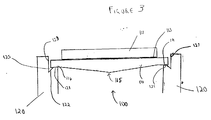
- FIG. 3 a plate structure 100 for a transducer according to the invention.
- the plate structure 100 comprises a steel backing plate 110 of substantially circular shape.
- a layer 111 of active material in the form of a plate is affixed by affixing means 113, for example an adhesive or solder.
- the backing plate 110 instead of being of uniform thickness as in the prior art arrangement has a non-uniform thickness. More particularly, the plate 110 has its greatest thickness at the centre thereof so that the plate comes to a point 115 and the thickness diminishes from the centre towards the outer circumference thereof.
- a region 114 of reduced and substantially uniform thickness At an adjacent outer circumference of the backing plate there is formed a region 114 of reduced and substantially uniform thickness.
- the active material may be of any suitable composition.
- it may be:
- an alternating voltage is applied across each side of each active material plate, usually in the same amplitude to each plate in such a phase relation between one plates and its nearest adjacent plate(s) that the plates flex in opposite directions; for example, the phase relation can be ⁇ radians out of phase between one plate and its nearest adjacent plate(s), the plates being electrically connected.
- incoming acoustic energy will deform the active material plate which generates electrical signals which can be amplified and analysed.
- a polarised electrostrictive material will be affixed to its backing plate after having been raised above a transition temperature, namely its "Curie" temperature, when a polarising electric field will be applied across it. This polarisation is necessary for the material to function in a transducer.
- application of stress induced by for example hydrostatic depth pressure, will depolarise the material rendering it useless for its function in a transducer; the transducer will not thereafter be able to convert electrical energy into mechanical strain or vice versa.
- the plate structure of Figure 3 is modified in that the central region 135 of the backing plate 130 on the side opposite to that to which layer 111 is attached is flattened so that a plateau 135 is formed in that region rather than the point 125 of Figure 3.
- the overall thickness of the plate structure is thereby reduced and this allows a plurality of such plate structures to be packed into a smaller volume than would otherwise be the case; such packing will be described in more detail later.
- the layer of active material is shown as a plate it can be formed on the backing plate by any suitable means
- the layer, namely the plate, of active material may also or alternatively be of variable thickness.
- the plate structure may be 'tuned' to any specific fundamental resonance frequency.
- theoretical tuning of the device may be accomplished by means of finite/boundary element analysis. Such analysis should be followed by construction of a corresponding prototype device.
- a further benefit of the invention is that equalisation of stress and strain distribution in the active material plate will bring about utilisation of a greater volume of the active material plate for the conversion of electrical energy to acoustic energy, and acoustic energy to electrical energy, hence improving the efficiency of the device.
- the plate structure may be supported on a support, for example a spacer which incorporates a passive mass.
- both Figures 3 and 4 show the respective plate structures 110, 130 mounted on a support structure 120.
- this support structure will conveniently be of annular form but other forms are possible.
- the backing plate is secured to the support structure by any suitable means, for example by resin adhesive bonding or by utilising solder.
- the support structure may further support a second composite plate structure opposed to the first; such a composite structure is illustrated in Figure 7.
- the support structure 120 is of generally columnar section but has a portion cut-away at its end adjacent the outer edge region of the backing plate 110. More especially the cut-away portion is formed to provide a planar section 121 which is attached to a planar edge region 114 of the backing plate 110; the cut-away portion further comprises an angled portion 122 and an axially extending portion 123.
- a recess 125 is formed in the support 120 adjacent to the outer edge region of the backing plate. As shown, this recess 125 is of generally triangular cross-section but it is to be understood that other forms are possible.
- the plate structure when the plate structure resonates by moving in a pivoting back-and-forth motion; during such movement, interengaging portions of the edge region of the backing plate 110, 130 and of the support structure form a hinge arrangement.
- the effective compliance of the transducer is increased. Indeed, the dimensions of the recess may be chosen to tune the transducer to the required fundamental resonance frequency.
- Figure 5 shows a modification of the plate structure of Figure 3 or Figure 4 in which the radially outer region of the backing plate 170 of a composite plate structure is formed with a region 180 of increased thickness.
- the region constitutes an axially extending projection whose radially outer surface 181 engages the axially extending portion 123 of the support structure. It provides an increased area for attachment, for example attachment by bonding, to the support structure which is important for preventing detachment of the plate structure from the support under conditions of high electrical drive at low hydrostatic pressure, for example at shallow depths in the order of 1 to 10 m, without increasing the maximum thickness of the composite plate structure.
- the projection is also useful in production of the backing plate since it provides a means by which the plate can be held during lathe-turning operations for example.
- the transducer is immersed in an electrically insulating liquid, such as castor oil, enclosed within an acoustically-transparent container.
- an electrically insulating liquid such as castor oil
- the live parts of the transducer are encapsulated in an acoustically-transparent polymer such as polyurethane; this method can be refined such that the recess for the flexible elongate member may actually be formed within the polymeric encapsulation.
- the recess is illustrated in Figure 6; further details of embodiments of the invention incorporating such a recess are given later.
- transducers utilising the plate structure as described above may be used together; where the transducer is used in a sonar system, the transducers may be deployed under water.
- transducers will conventionally be connected together by a flexible elongate tensile member which, for example, may take the form of an electrically conducting cable.
- the plate structures as delineated above may be modified to provide a storage means for this tensile member when a plurality of transducers for deployment together are stored prior to deployment, for example stacked in a tubular container.
- the outer edge region of the plate structure may be formed with a recess to receive the tensile member and in the case of circular backing plates the recess will preferably be of annular form extending circumferentially of the backing plate.
- the composite plate structure 200 comprises a backing plate 201 whose thickness varies across the plate. Its thickness diminishes from the centre 202 of the plate 201 towards the edge region 203 thereof. At the edge region 203 the plate is formed with a region 208 of increased thickness which is bonded to a support structure 220. Affixed to the surface 204 of the backing plate 201 is plate 210 formed of active material which plate 210 itself may be of variable thickness thereacross. The exposed surfaces of the plate 210 are covered in an acoustically-transparent polymer 230 such as a polyurethane applied, for example by casting with the aid of a mould tool or by dip-coating.
- an acoustically-transparent polymer 230 such as a polyurethane applied, for example by casting with the aid of a mould tool or by dip-coating.
- the coating 230 of polymer also extends over part of the exposed edge region 203 of the backing plate 201 although the upper surface 205 of region 203 need not be coated.
- the coating 230 is formed in such a way that a recess 231 is provided therein.
- the recess 231 is provided adjacent the outer edge region 203 of the backing plate 201 and is of annular form; it is bounded by the polymer coating 230 on three sides and is open at the top whereby to be able to receive a flexible elongate tensile member 240. In effect the tensile member 240 is nested in use in the recess 231.
- the tensile member may be connected to an electrical driving source or body 300 as illustrated in Figure 9.
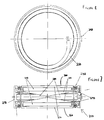
- Figure 7 shows a section through a transducer 250 with two opposed composite plate structures 260 affixed to a support structure 270.
- the volume 280 defined between the plate structures 260 and the support structure 270 is filled with a suitable substance which could be a liquid, a gas (for example air), or a foamed material.
- a suitable substance which could be a liquid, a gas (for example air), or a foamed material.
- the transducer may be provided with a valve 290 provided in the support structure for ingress/egress of the gas or liquid.
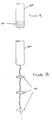
- Figure 9 is a diagrammatic illustration of transducers stacked in a tubular container 300 prior to deployment in an underwater environment.
- the plate structures are arranged immediately adjacent one another with the tensile members arranged in the recesses.
- Figure 10 shows the transducers as deployed, with the elongate tensile members therebetween extended.
Landscapes
- Physics & Mathematics (AREA)
- Engineering & Computer Science (AREA)
- Life Sciences & Earth Sciences (AREA)
- Acoustics & Sound (AREA)
- General Physics & Mathematics (AREA)
- Remote Sensing (AREA)
- Environmental & Geological Engineering (AREA)
- Geology (AREA)
- General Life Sciences & Earth Sciences (AREA)
- Multimedia (AREA)
- Geophysics (AREA)
- Oceanography (AREA)
- Transducers For Ultrasonic Waves (AREA)
- Measuring Fluid Pressure (AREA)
Applications Claiming Priority (2)
| Application Number | Priority Date | Filing Date | Title |
|---|---|---|---|
| GB9907692A GB2348564B (en) | 1999-04-01 | 1999-04-01 | Transducers |
| GB9907692 | 1999-04-01 |
Publications (2)
| Publication Number | Publication Date |
|---|---|
| EP1041537A2 true EP1041537A2 (de) | 2000-10-04 |
| EP1041537A3 EP1041537A3 (de) | 2004-12-01 |
Family
ID=10850938
Family Applications (1)
| Application Number | Title | Priority Date | Filing Date |
|---|---|---|---|
| EP00301527A Withdrawn EP1041537A3 (de) | 1999-04-01 | 2000-02-25 | Druckbeständige Wandler |
Country Status (5)
| Country | Link |
|---|---|
| US (1) | US6404106B1 (de) |
| EP (1) | EP1041537A3 (de) |
| AU (1) | AU764795B2 (de) |
| CA (1) | CA2300765C (de) |
| GB (1) | GB2348564B (de) |
Families Citing this family (7)
| Publication number | Priority date | Publication date | Assignee | Title |
|---|---|---|---|---|
| US6923537B2 (en) * | 2002-08-09 | 2005-08-02 | Gentex Corporation | Eyewear for ballistic and light protection |
| US6637877B1 (en) | 2002-08-09 | 2003-10-28 | Gentex Corporation | Eyewear for ballistic and light protection |
| US7154813B2 (en) * | 2003-07-19 | 2006-12-26 | Qortek, Inc. | Pressure sensitive sensor for real-time reconfigurable sonar applications |
| US7206258B1 (en) | 2005-04-13 | 2007-04-17 | United States Of America As Represented By The Secretary Of The Navy | Dual response acoustical sensor system |
| FR2920535B1 (fr) * | 2007-08-30 | 2009-11-27 | Hill Rom Ind Sa | Capteur de detection et de mesure de pressions incorporant au moins une cellule resistive de detection de forces |
| FR2946427B1 (fr) * | 2009-06-05 | 2011-09-30 | Hill Rom Ind Sa | Capteur de pression comprenant une cellule capacitive et dispositif de support en comportant. |
| US10488542B2 (en) | 2014-12-02 | 2019-11-26 | Pgs Geophysical As | Use of external driver to energize a seismic source |
Citations (4)
| Publication number | Priority date | Publication date | Assignee | Title |
|---|---|---|---|---|
| US3360664A (en) | 1964-10-30 | 1967-12-26 | Gen Dynamics Corp | Electromechanical apparatus |
| US3663933A (en) | 1970-07-02 | 1972-05-16 | Us Navy | Protective band for bilaminar transducer with slotted spacer ring |
| US4747192A (en) * | 1983-12-28 | 1988-05-31 | Kabushiki Kaisha Toshiba | Method of manufacturing an ultrasonic transducer |
| US5724315A (en) | 1996-05-29 | 1998-03-03 | The United States Of America As Represented By The Secretary Of The Navy | Omnidirectional ultrasonic microprobe hydrophone |
Family Cites Families (8)
| Publication number | Priority date | Publication date | Assignee | Title |
|---|---|---|---|---|
| US2967956A (en) * | 1955-04-19 | 1961-01-10 | Gulton Ind Inc | Transducer |
| US3206558A (en) * | 1961-09-22 | 1965-09-14 | Erie Technological Prod Inc | Microphone |
| US3988620A (en) * | 1971-11-26 | 1976-10-26 | Aquatronics, Inc. | Transducer having enhanced acceleration cancellation characteristics |
| JPH0834649B2 (ja) * | 1986-03-31 | 1996-03-29 | 日本特殊陶業株式会社 | 圧電送受波器 |
| DE3629093A1 (de) * | 1986-08-27 | 1988-03-10 | Stettner & Co | Piezokeramischer schallwandler |
| JPH0632552B2 (ja) * | 1989-02-13 | 1994-04-27 | 株式会社海藤製作所 | 複合形圧電振動素子 |
| US4999819A (en) * | 1990-04-18 | 1991-03-12 | The Pennsylvania Research Corporation | Transformed stress direction acoustic transducer |
| US5956293A (en) * | 1997-05-27 | 1999-09-21 | Raytheon Company | Flexural plate sound transducer having low resonant frequency |
-
1999
- 1999-04-01 GB GB9907692A patent/GB2348564B/en not_active Expired - Fee Related
-
2000
- 2000-02-25 EP EP00301527A patent/EP1041537A3/de not_active Withdrawn
- 2000-03-16 CA CA002300765A patent/CA2300765C/en not_active Expired - Fee Related
- 2000-03-30 AU AU24210/00A patent/AU764795B2/en not_active Ceased
- 2000-04-03 US US09/541,932 patent/US6404106B1/en not_active Expired - Lifetime
Patent Citations (4)
| Publication number | Priority date | Publication date | Assignee | Title |
|---|---|---|---|---|
| US3360664A (en) | 1964-10-30 | 1967-12-26 | Gen Dynamics Corp | Electromechanical apparatus |
| US3663933A (en) | 1970-07-02 | 1972-05-16 | Us Navy | Protective band for bilaminar transducer with slotted spacer ring |
| US4747192A (en) * | 1983-12-28 | 1988-05-31 | Kabushiki Kaisha Toshiba | Method of manufacturing an ultrasonic transducer |
| US5724315A (en) | 1996-05-29 | 1998-03-03 | The United States Of America As Represented By The Secretary Of The Navy | Omnidirectional ultrasonic microprobe hydrophone |
Also Published As
| Publication number | Publication date |
|---|---|
| CA2300765C (en) | 2009-12-15 |
| US6404106B1 (en) | 2002-06-11 |
| AU764795B2 (en) | 2003-08-28 |
| GB2348564A (en) | 2000-10-04 |
| GB9907692D0 (en) | 1999-05-26 |
| GB2348564B (en) | 2003-06-18 |
| CA2300765A1 (en) | 2000-10-01 |
| EP1041537A3 (de) | 2004-12-01 |
| AU2421000A (en) | 2000-10-05 |
Similar Documents
| Publication | Publication Date | Title |
|---|---|---|
| EP2844400B1 (de) | Ultrabreiter bandpasswandler mit dual-elektrode | |
| US5196755A (en) | Piezoelectric panel speaker | |
| US6232702B1 (en) | Flextensional metal-ceramic composite transducer | |
| US3370187A (en) | Electromechanical apparatus | |
| US4072871A (en) | Electroacoustic transducer | |
| US6614143B2 (en) | Class V flextensional transducer with directional beam patterns | |
| EP0258948A2 (de) | Biegungsscheibenwandler mit einer resonanten Kavität | |
| US20080212807A1 (en) | Micromachined Acoustic Transducers | |
| JP2023549917A (ja) | 超音波トランスデューサアレイデバイス | |
| JP7253094B1 (ja) | 圧電スピーカ | |
| AU764795B2 (en) | Pressure tolerant transducer | |
| US3460061A (en) | Electroacoustic transducer with improved shock resistance | |
| KR101765000B1 (ko) | 지향성 스피커용 압전 트랜스듀서 및 이를 포함하는 지향성 스피커 | |
| Newnham et al. | Cymbal transducers: a review | |
| JP2008244895A (ja) | 屈曲型送受波器 | |
| US7453772B2 (en) | Flexural cylinder projector | |
| CA3042089C (en) | Acoustic transducer | |
| JP6514079B2 (ja) | 音響発生器 | |
| Sadeghpour et al. | Coupled piezoelectric bulk-micromachined ultrasound trasndcuer (cpb-mut): An ultrasound transducer with enhanced pressure response in liquid and dense medium | |
| JPH0311898A (ja) | 送受波器 | |
| JP5309941B2 (ja) | 音響トランスデューサ | |
| KR102915200B1 (ko) | 다중공진 플렉스텐셔널 저주파 음향 프로젝터 | |
| JPS6143098A (ja) | 低周波水中超音波送波器 | |
| JPH0448038B2 (de) | ||
| JP2024070453A (ja) | 送受波装置および送受波方法 |
Legal Events
| Date | Code | Title | Description |
|---|---|---|---|
| PUAI | Public reference made under article 153(3) epc to a published international application that has entered the european phase |
Free format text: ORIGINAL CODE: 0009012 |
|
| AK | Designated contracting states |
Kind code of ref document: A2 Designated state(s): AT BE CH CY DE DK ES FI FR GB GR IE IT LI LU MC NL PT SE |
|
| AX | Request for extension of the european patent |
Free format text: AL;LT;LV;MK;RO;SI |
|
| RAP1 | Party data changed (applicant data changed or rights of an application transferred) |
Owner name: THALES UNDERWATER SYSTEMS LIMITED |
|
| PUAL | Search report despatched |
Free format text: ORIGINAL CODE: 0009013 |
|
| AK | Designated contracting states |
Kind code of ref document: A3 Designated state(s): AT BE CH CY DE DK ES FI FR GB GR IE IT LI LU MC NL PT SE |
|
| AX | Request for extension of the european patent |
Extension state: AL LT LV MK RO SI |
|
| 17P | Request for examination filed |
Effective date: 20050525 |
|
| AKX | Designation fees paid |
Designated state(s): AT BE CH CY DE DK ES FI FR GB GR IE IT LI LU MC NL PT SE |
|
| 17Q | First examination report despatched |
Effective date: 20080520 |
|
| RAP1 | Party data changed (applicant data changed or rights of an application transferred) |
Owner name: THALES HOLDINGS UK PLC |
|
| RAP1 | Party data changed (applicant data changed or rights of an application transferred) |
Owner name: THALES HOLDINGS UK PLC |
|
| STAA | Information on the status of an ep patent application or granted ep patent |
Free format text: STATUS: THE APPLICATION IS DEEMED TO BE WITHDRAWN |
|
| 18D | Application deemed to be withdrawn |
Effective date: 20180706 |