EP1040890B1 - Powder material for powder plasma overlaying and powder plasma overlaying metal - Google Patents
Powder material for powder plasma overlaying and powder plasma overlaying metal Download PDFInfo
- Publication number
- EP1040890B1 EP1040890B1 EP99970349A EP99970349A EP1040890B1 EP 1040890 B1 EP1040890 B1 EP 1040890B1 EP 99970349 A EP99970349 A EP 99970349A EP 99970349 A EP99970349 A EP 99970349A EP 1040890 B1 EP1040890 B1 EP 1040890B1
- Authority
- EP
- European Patent Office
- Prior art keywords
- welding
- amount
- powder
- metal
- build
- Prior art date
- Legal status (The legal status is an assumption and is not a legal conclusion. Google has not performed a legal analysis and makes no representation as to the accuracy of the status listed.)
- Expired - Lifetime
Links
Images

Classifications
-
- C—CHEMISTRY; METALLURGY
- C22—METALLURGY; FERROUS OR NON-FERROUS ALLOYS; TREATMENT OF ALLOYS OR NON-FERROUS METALS
- C22C—ALLOYS
- C22C33/00—Making ferrous alloys
- C22C33/02—Making ferrous alloys by powder metallurgy
- C22C33/0257—Making ferrous alloys by powder metallurgy characterised by the range of the alloying elements
- C22C33/0278—Making ferrous alloys by powder metallurgy characterised by the range of the alloying elements with at least one alloying element having a minimum content above 5%
- C22C33/0285—Making ferrous alloys by powder metallurgy characterised by the range of the alloying elements with at least one alloying element having a minimum content above 5% with Cr, Co, or Ni having a minimum content higher than 5%
-
- B—PERFORMING OPERATIONS; TRANSPORTING
- B23—MACHINE TOOLS; METAL-WORKING NOT OTHERWISE PROVIDED FOR
- B23K—SOLDERING OR UNSOLDERING; WELDING; CLADDING OR PLATING BY SOLDERING OR WELDING; CUTTING BY APPLYING HEAT LOCALLY, e.g. FLAME CUTTING; WORKING BY LASER BEAM
- B23K35/00—Rods, electrodes, materials, or media, for use in soldering, welding, or cutting
- B23K35/22—Rods, electrodes, materials, or media, for use in soldering, welding, or cutting characterised by the composition or nature of the material
- B23K35/24—Selection of soldering or welding materials proper
- B23K35/30—Selection of soldering or welding materials proper with the principal constituent melting at less than 1550°C
- B23K35/3053—Fe as the principal constituent
- B23K35/308—Fe as the principal constituent with Cr as next major constituent
-
- C—CHEMISTRY; METALLURGY
- C23—COATING METALLIC MATERIAL; COATING MATERIAL WITH METALLIC MATERIAL; CHEMICAL SURFACE TREATMENT; DIFFUSION TREATMENT OF METALLIC MATERIAL; COATING BY VACUUM EVAPORATION, BY SPUTTERING, BY ION IMPLANTATION OR BY CHEMICAL VAPOUR DEPOSITION, IN GENERAL; INHIBITING CORROSION OF METALLIC MATERIAL OR INCRUSTATION IN GENERAL
- C23C—COATING METALLIC MATERIAL; COATING MATERIAL WITH METALLIC MATERIAL; SURFACE TREATMENT OF METALLIC MATERIAL BY DIFFUSION INTO THE SURFACE, BY CHEMICAL CONVERSION OR SUBSTITUTION; COATING BY VACUUM EVAPORATION, BY SPUTTERING, BY ION IMPLANTATION OR BY CHEMICAL VAPOUR DEPOSITION, IN GENERAL
- C23C4/00—Coating by spraying the coating material in the molten state, e.g. by flame, plasma or electric discharge
- C23C4/04—Coating by spraying the coating material in the molten state, e.g. by flame, plasma or electric discharge characterised by the coating material
- C23C4/06—Metallic material
- C23C4/073—Metallic material containing MCrAl or MCrAlY alloys, where M is nickel, cobalt or iron, with or without non-metal elements
-
- B—PERFORMING OPERATIONS; TRANSPORTING
- B23—MACHINE TOOLS; METAL-WORKING NOT OTHERWISE PROVIDED FOR
- B23K—SOLDERING OR UNSOLDERING; WELDING; CLADDING OR PLATING BY SOLDERING OR WELDING; CUTTING BY APPLYING HEAT LOCALLY, e.g. FLAME CUTTING; WORKING BY LASER BEAM
- B23K35/00—Rods, electrodes, materials, or media, for use in soldering, welding, or cutting
- B23K35/02—Rods, electrodes, materials, or media, for use in soldering, welding, or cutting characterised by mechanical features, e.g. shape
- B23K35/0255—Rods, electrodes, materials, or media, for use in soldering, welding, or cutting characterised by mechanical features, e.g. shape for use in welding
Definitions
- the present invention relates to powder materials for use in powder plasma build-up welding for the purpose of imparting corrosion resistance and abrasion resistance to furnace pipes, furnace wall panels, or the like, in industrial recovery boilers in paper mills or the like.
- the present invention also relates to metals formed by powder plasma build-up welding.
- a material for build-up welding containing 18% Cr has been used on the surface of members being subjected to build-up welding in a furnace pipe panel, which is a combination of a plurality of carbon steel pipes, in view of corrosion resistance and abrasion resistance under the corrosive environment of smelt at a high temperature.
- a furnace pipe panel which is a combination of a plurality of carbon steel pipes, in view of corrosion resistance and abrasion resistance under the corrosive environment of smelt at a high temperature.
- covered electrodes for shielded arc welding containing 18% Cr and wires for gas-shielded arc welding (hereinafter referred to as "MAG welding wires”) containing 18% Cr have been conventionally used.
- Document JP-A-58141890 discloses a covered electrode of chromium stainless steel.
- the electrode disclosed in this document is a covered electrode in which the core wire is covered with flux mainly composed of calcite (CaCO 3 ) and fluorite (CaF 2 ).
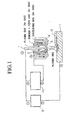
- Fig. 1 shows basic constitution of a conventionally known device for powder plasma build-up welding.
- a pilot arc power source 10 is connected between a tungsten electrode 1 and a nozzle 2, and a direct current power source 12 is connected between the tungsten electrode 1 and a base metal 11.
- An intermediate nozzle 3 is disposed outside the nozzle 2, and an outer nozzle 4 is disposed outside the intermediate nozzle 3.
- a plasma gas for example, Ar gas
- a powder material for build-up welding together with a feed gas for example, Ar gas
- a shielding gas for example, Ar gas
- Fig. 2 shows a situation in which powder plasma welding is being performed on a carbon steel pipe. That is, a plasma arc is generated between the carbon steel pipe 5 (for example, JIS STB410) and a plasma welding torch 6 which faces the carbon steel pipe 5, and a powder material supplied is fused in sequence to form a molten pool 7. By gradually moving the plasma welding torch 6, the molten pool.7 is solidified to form a welded metal.
- a plasma arc is generated between the carbon steel pipe 5 (for example, JIS STB410) and a plasma welding torch 6 which faces the carbon steel pipe 5, and a powder material supplied is fused in sequence to form a molten pool 7.
- the molten pool.7 is solidified to form a welded metal.
- a characteristic of the powder plasma build-up welding is that this method can achieve a maximum amount of deposition of 4 to 6 kg/1 hr in contrast to the shielded arc welding or MAG welding method, which can achieve a maximum amount of deposition of only 3 kg/1 hr.
- this method can achieve highly efficient welding.
- the powder plasma build-up method can limit decrease in the amount of Cr in the metal formed by build-up welding.
- the powder plasma build-up method can provide a welded metal of high quality, which does not have welding defects such as blow holes and incomplete fusion.
- the present invention provides a powder material for powder plasma build-up welding which can exhibit excellent corrosion resistance and bending properties when it is subjected to a powder plasma build-up welding method, which is a highly efficient welding method, in build-up welding for imparting corrosion resistance and abrasion resistance to furnace pipes and furnace wall panels for recovery boilers.
- a welded metal which is obtained from a powder material for powder plasma build-up welding comprising C in an amount of 0.06 to 0.15%, Si in an amount of 0.2 to 1.0%, Mn in an amount of 0.2 to 1.0%, Cr in an amount of 17 to 30%, Nb in an amount of 0.6 to 1.5%, Ni in an amount of not more than 0.5%, and the balance consisting of Fe and unavoidable impurities wherein said powder material comprises Al in an amount of 0.03 to 0.15% by weight and/or Ti in an amount of 0.08 to 0.18% by weight has excellent corrosion resistance and bending properties.
- the Cr content is basically 17 to 30%.
- a material having a high Cr content hereinafter occasionally referred to as "25Cr material”
- a material having a low Cr content hereinafter occasionally referred to as "18Cr material”
- corrosive loss of the built-up metal is moderate, for the purpose of reducing cost.
- 25Cr material is characterized by comprising C in an amount of 0.06 to 0.15%, Si in an amount of 0.2 to 1.0%, Mn in an amount of 0.2 to 1.0%, Cr in an amount of 23 to 30%, Nb in an amount of 0.6 to 1.5%, Ni in an amount of not more than 0.5%, and the balance consisting of Fe and unavoidable impurities
- 18Cr material is characterized by comprising C in an amount of 0.06 to 0.15%, Si in an amount of 0.2 to 1.0%, Mn in an amount of 0.2 to 1.0%, Cr in an amount of 17 to 23%, Nb in an amount of 0.6 to 1.5%, Ni in an amount of not more than 0.5%, and the balance consisting of Fe and unavoidable impurities.
- the powder material according to the present invention is not limited exclusively to the powder of an alkyl which has the above composition, but also includes a mixture of various metal powder or alloy powder as long as the mixture provides the above composition.
- the powder material of the present invention may normally be prepared with a grain size of approximately 63 to 500 ⁇ m for powder plasma build-up welding, however, this grain size is not a limitation of the present invention.
- C is an indispensable element for having the crystal grains of the welded metal fine by forming a carbide such as NbC and TiC.
- the C content is determined to be not less than 0.06% since the strength of the welded metal would be poor if the C content is less than 0.06%.
- the C content is determined to be not more than 0.15% since too much C causes the welded metal structure to be extremely rigid.
- a preferable range of C is 0.06 to 0.12%
- Si is an element which is included for deoxidation. If the Si content is less than 0.2%, the deoxidation effect is insufficient. On the other hand, it is necessary that the Si content be an amount of not more than 1.0% since too much Si would degrade the toughness of the deposited metal. A preferable range of Si is 0.3 to 0.8%.
- Mn is an element which is effective in deoxidation, securing strength, and improvement in toughness. However, the deoxidation effect would be insufficient if the Mn content is less than 0.2%. Alternatively, the Mn content must be an amount of not more than 1.0% since too much Mn would result in causing the structure to be rigid and a decrease in toughness. A preferable range of Mn is 0.3 to 0.8%.
- Cr is a fundamental component for securing corrosion resistance and high temperature strength.
- an allowable amount of Cr according to the present invention is in the range of 17 to 30%
- a 25Cr material; which contains Cr in an amount in the range of 23 to 30% is preferably used where corrosive loss of the built-up metal is relatively severe
- a 18Cr material, which contains Cr in an amount in the range of 17 to 23% is preferably used where corrosive loss of the built-up metal is relatively moderate also taking the cost and the ratio of dilution with the base metal into account.
- Ni as well as C and Mn is an element which forms austenite.
- Cr is in an amount in the range of 17 to 30%, excessive addition of Ni causes martensite structure and causes the structure to be rigid, with which suitable bending properties cannot be obtained. Accordingly, the Ni content is determined to be not more than 0.5%.
- Nb combines with C to form a fine and stable precipitate (carbide), which allows the size of the crystal grains of the welded metal to be as fine as 100 ⁇ m. Since the crystal grains are formed finely, suitable bending properties and toughness can be obtained.
- the amount of Nb corresponding to the amount of C in the range of 0.06 to 0.15% is 0.48 to 1.5%.
- Nb is less than 0.6%, the crystal grains of the welding material cannot be formed finely, and good bending properties and toughness cannot be obtained.
- Nb relates to welding workability (such as the flowability of the molten metal in a molten pool and the stability of the arc) and addition of Nb in an amount exceeding 1.5% would considerably degrade the welding stability.
- the Nb content is determined to be 0.6 to 1.5%.
- a preferable Nb content is 0.7 to 1.3%.
- the above material according to the present invention may contain Al or Ti or both, in which the amount of Al is 0.03 to 0.15%, and the amount of Ti is 0.08 to 0.18%.
- Al contributes as a deoxidizer and contributes with Nb to making the crystal grains fine.
- Al in an amount less than 0.03% would make the crystal grains of the welded metal bulky and unable to obtain good bending properties.
- Al in an amount exceeding 0.15% would increase slag in the molten pool, which degrades flowability of the molten metal and causes welding workability to deteriorate. Accordingly, the Al content is determined to be 0.03 to 0.15%.
- Ti acts as a deoxidizer, and contributes with Nb to making the crystal grains fine.
- Ti in an amount less than 0.08% would make the crystal grains of the welded metal bulky and would make it impossible to obtain good bending properties.
- Ti in an amount exceeding 0.18% would increase the amount of slag in the molten pool, which degrades the flowability of the molten metal and causes welding workability to deteriorate. Accordingly, the Ti content is determined to be 0.08 to 0.18%.
- a welded metal obtained using the above powder material for powder plasma build-up welding according to the present invention comprises C in an amount of 0.06 to 0.15%, Si in an amount of 0.2 to 1.0%, Mn in an amount of 0.2 to 1.0%, Cr in an amount of 17 to 30%, Nb in an amount of 0.6 to 1.5%, Ni in an amount of not more than 0.5% by weight, and the balance consisting of Fe and unavoidable impurities, and the metal having a crystal grain size not larger than 100 ⁇ m, and thus the welded metal has excellent corrosion resistance and bending properties.
- alloy powder materials having various chemical compositions were used in powder plasma welding on carbon steel pipes (material: STB410; outer diameter: ⁇ 63.5 mm; pipe thickness: 6.3 mm) having the chemical composition shown in Table 1, and welding workability after build-up welding and face-bend test (bending properties) were evaluated.
- the alloy powder material was obtained by the gas atomization method.
- Table 1 C Si Mn P S Cr Ni Nb Al Ti Note Carbon steel pipe STB410 0.21 0.19 0.63 0.01 0.002 - - - - - ⁇ 13.5 ⁇ 6.3t Fe Bal. (% by weight)
- each of arc stability, the shape of bead, separatability of slag, and occurrence of spatter were evaluated, and according to overall judgement, if the welding workability was good, o was assigned, whereas if it was not good, ⁇ was assigned.
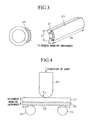
- a test piece having the shape as shown in Fig. 3 was cut out, and a face-bend test was conducted as shown in Fig. 4 in line with the "Method of Bending Test for Metal Materials" according to JIS Z 2248, in which the welded metal was on the side which is stretched.
- numeral 21 indicates the base metal
- numeral 23 indicates the metal formed by build-up welding
- numeral 25 indicates a fulcrum
- numeral 27 indicates a presser metal.
- a bending angle of 60° or greater for a test piece which is untreated after welding is judged acceptable in view of thermal stresses after welding, bending stresses during conveyance of the furnace pipe panel, and the bending process of the panel for the bottom of the furnace.
- Powder plasma build-up welding was conducted according to the above using an alloy powder material (grain size: 63 to 500 ⁇ m) having the chemical composition shown in Table 3. Evaluation and test results for each test sample are also shown in Table 3.
- Test samples Nos. 1-1 to 1-5 in Table 3 are examples which meet the requirements defined by the present invention, and they showed good results with respect to both welding workability and bending properties.
- test samples Nos. 1-6 to 1-13 are comparative examples which fail to meet one of the requirements of the present invention.
- Test sample No. 1-14 is a comparative base metal of SUS304, which was used in a corrosion test as described below.
- test sample No. 1-15 a conventional 18Cr build-up material (all metal components deposited using a MAG welding wire) was used.
- Test sample No. 1-6 in which the C content was 0.17%, exceeding the upper limit according to the present invention, had a welded metal structure which was markedly rigid and exhibited poor bending properties.
- Test sample No. 1-7 in which the Si content was 1.40%, exceeding the upper limit according to the present invention, had its toughness degraded and exhibited poor bending properties.
- Test sample No. 1-8 in which the Mn content was 1.51%, exceeding the upper limit according to the present invention, had a welded metal structure which was rigid and had its toughness degraded, and as a result exhibited poor bending properties.
- Test sample No. 1-9 showed satisfactory results with regard to welding workability and bending properties. However, since test sample No. 1-9 had a low Cr content, it did not possess desirable corrosion resistance in the corrosion test described below.
- Test samples Nos. 1-10 and 1-11 in which the Ni contents exceeded the upper limit according to the present invention, had a welded metal structure which was markedly rigid and did not exhibit good bending properties.
- Test sample No. 1-12 in which the Nb content was 0.42%, which is less than the lower limit according to the present invention, had bulky crystal grains and did not possess good bending properties.
- test sample No. 1-13 in which the Nb content was 1.70%, exceeding the upper limit according to the present invention, produced a large amount of fumes, and its welding workability was degraded markedly.
- a corrosion test and dilution ratio evaluation were conducted for the above test samples Nos. 1-1, 1-3, 1-14, and 1-15.
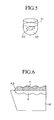
- a test sample 35 was immersed in crushed smelt 33 inside a crucible 31 as shown in Fig. 5, a test gas (1% SO 2 - 2% O 2 - 15% CO 2 - N 2 bal) at 400°C was run through the crushed smelt 33 for 100 hours, and thereafter the amount of corrosive loss of the built-up metal was measured.
- a test gas 1% SO 2 - 2% O 2 - 15% CO 2 - N 2 bal
- the dilution ratio was obtained by the following formula, in which the dilution ratio is the ratio of area b to the sum of area a and area b, area a being the area of the welded metal 43 on the base metal 41 while area b is the area of the welded metal 43 which is diffused in the base metal 41 in the cross section of the test sample as shown in Fig. 6.
- Dilution ratio n % b a + b ⁇ 100
- Test sample No. 1-15 in which a conventional 18Cr build-up material was used, had a dilution ratio higher than that according to the powder plasma build-up welding method, since it is formed by the MAG welding method.
- the Cr content in the single-layer metal formed by build-up welding in test sample No. 1-15 was 14.0%. Table 4 Test sample No.
- Example 1-1 14.6 5.1 Dilution Ratio 15.0% 1-3 16.0 4.0 Dilution Ratio 14.5% Comparative Example 1-14 (18.9) 2.4 SUS304 comparative base metal 1-15 14.0 5.5 18Cr welding material; Dilution Ratio 25% Number in ( ) indicates percentages of Cr in plate.
- test samples Nos. 1-1 and 1-3 display their corrosion resistance as nearly equivalent to those of conventional 18Cr welding materials.
- the present invention provides an excellent powder plasma build-up welding material which did not conventionally exist.
- the present invention can result in high efficiency in carrying out build-up welding for furnace evaporation pipes in recovery boilers and can make it possible to perform build-up welding of high quality, for which the dilution ratio is lower than that of conventional MAG welding methods.
- the present invention can retard loss of built-up metal from furnace pipes due to smelt and can achieve a longer life for the furnace pipes.
- Powder plasma build-up welding was conducted using an alloy powder material (grain size: 63 to 500 ⁇ m) having the chemical composition shown in Table 5. Evaluation and test results for each test sample are also shown in Table 5.
- Test samples Nos. 2-1 to 2-5 in Table 5 are examples which meet the requirements defined by the present invention, and they showed good results with respect to both welding workability and bending properties.
- Test sample No. 2-6 which had an Al content exceeding the upper limit, showed poor flowability of molten metal in the molten pool, and thus the welding workability was poor.
- Powder plasma build-up welding was conducted using an alloy powder material (grain size: 63 to 500 ⁇ m) having the chemical composition shown in Table 6. Evaluation and test results for each test sample are also shown in Table 6.
- Test samples Nos. 3-1 to 3-5 in Table 6 are examples which meet the requirements defined by the present invention, and they showed good results with respect to both welding workability and bending properties.
- test sample No. 3-6 in which the Ti content exceeds the upper limit, produced a large amount of slag and showed poor flowability of molten metal in the molten pool, and thus the welding workability was poor.
- Powder plasma build-up welding was conducted using an alloy powder material (grain size: 63 to 500 ⁇ m) having the chemical composition shown in Table 7. Evaluation and test results for each test sample are also shown in Table 7.
- Test samples Nos. 4-1 to 4-5 in Table 7 are examples which meet the requirements defined by the present invention, and all of them showed a face-bending angle of 180°, which indicates an excellent bending property.
- Example 4 Comparison of Example 4 with Example 2 (in which only Al was added) and Example 3 (in which only Ti was added) shows that the addition of Al and Ti together will result in a better bending angle in the face-bend test compared with the addition of either one of them alone.
- Test sample No. 4-6 which had an Al content exceeding the upper limit, showed poor flowability of molten metal in the molten pool, and thus the welding workability was poor.
- Test sample No. 4-7 which had a Ti content exceeding the upper limit, produced a large amount of slag and showed poor flowability of molten metal in the molten pool, and thus the welding workability was poor.
- Powder plasma build-up welding was conducted using an alloy powder material (grain size: 63 to 500 ⁇ m) having the chemical composition shown in Table 8. Evaluation and test results for each test sample are also shown in Table 8. In addition, for some test samples, the corrosion test and the dilution ratio evaluation were conducted in a manner similar to Example 1.
- Test samples Nos. 5-1 to 5-5 in Table 8 are examples which meet the requirements defined by the present invention, and they showed good results with respect to both welding workability and bending properties. In contrast, test samples Nos. 5-6 to 5-13 are comparative examples which fail to meet one of the requirements of the present invention.
- Test sample No. 5-14 is a comparative base metal of SUS310, which was used in the corrosion test.
- Test sample No. 5-15 is a comparative base metal of SUS304.
- a conventional 18Cr build-up material all metal components deposited using a MAG welding wire was used.
- Table 9 shows that the corrosion resistance of the single-layer metals formed by build-up welding in test samples Nos. 5-1 and 5-3, in which the materials according to the present invention were used, was nearly equivalent to that of SUS310S comparative base metal (No. 5-14), and was superior to that of a welded metal formed from a conventional 18Cr welding material (No. 5-16).
- Table 9 Sample No.
- the present invention provides an excellent powder plasma build-up welding material which did not previously exist.
- the present invention can result in high efficiency in carrying out build-up welding for furnace evaporation pipes in recovery boilers and can make it possible to perform build-up welding of high quality, for which the dilution ratio is lower than that of conventional MAG welding methods.
- the present invention provides corrosion resistance superior to that of current 18Cr build-up materials, the present invention can retard loss of built-up metal from furnace pipes due to smelt and can achieve a longer life for the furnace pipes.
- Powder plasma build-up welding was conducted using an alloy powder material (grain size: 63 to 500 ⁇ m) having the chemical composition shown in Table 10. Evaluation and test results for each test sample are also shown in Table 10.
- Test samples Nos. 6-1 to 6-5 in Table 10 are examples which meet the requirements defined by the present invention, and they showed good results with respect to both welding workability and bending properties.
- Test sample No. 6-6 which had an Al content exceeding the upper limit, showed poor flowability of molten metal in the molten pool, and thus the welding workability was poor.
- Powder plasma build-up welding was conducted using an alloy powder material (grain size: 63 to 500 ⁇ m) having the chemical composition shown in Table 11. Evaluation and test results for each test sample are also shown in Table 11.
- Test samples Nos. 7-1 to 7-5 in Table 11 are examples which meet the requirements defined by the present invention, and they showed good results with respect to both welding workability and bending properties.
- test sample No. 7-6 in which the Ti content exceeds the upper limit, produced a large amount of slag and showed poor flowability of molten metal in the molten pool, and thus the welding workability was poor.
- Powder plasma build-up welding was conducted using an alloy powder material (grain size: 63 to 500 ⁇ m) having the chemical composition shown in Table 12. Evaluation and test results for each test sample are also shown in Table 12.
- Test samples Nos. 8-1 to 8-5 in Table 12 are examples which meet the requirements defined by the present invention, and all of them showed a face-bending angle of 180°, which indicates an excellent bending property.
- Example 8 Comparison of Example 8 with Example 6 (in which only Al was added) and Example 7 (in which only Ti was added) shows that the addition of Al and Ti together will result in a better bending angle in the face-bend test compared with the addition of either one of them alone.
- Test sample No. 8-6 which had an Al content exceeding the upper limit, showed poor flowability of molten metal in the molten pool, and thus the welding workability was poor.
- Test sample No. 8-7 which had a Ti content exceeding the upper limit, produced a large amount of slag and showed poor flowability of molten metal in the molten pool, and thus the welding workability was poor.
- the present invention can provide a metal formed by powder plasma build-up welding which possesses excellent corrosion resistance and bending properties.
Landscapes
- Chemical & Material Sciences (AREA)
- Engineering & Computer Science (AREA)
- Mechanical Engineering (AREA)
- Materials Engineering (AREA)
- Metallurgy (AREA)
- Organic Chemistry (AREA)
- Plasma & Fusion (AREA)
- Chemical Kinetics & Catalysis (AREA)
- Physics & Mathematics (AREA)
- Arc Welding In General (AREA)
- Nonmetallic Welding Materials (AREA)
- Coating By Spraying Or Casting (AREA)
- Powder Metallurgy (AREA)
Applications Claiming Priority (3)
| Application Number | Priority Date | Filing Date | Title |
|---|---|---|---|
| JP29115098A JP3900230B2 (ja) | 1998-10-13 | 1998-10-13 | 粉体プラズマ肉盛溶接用粉末材料及び粉体プラズマ肉盛溶接金属 |
| JP29115098 | 1998-10-13 | ||
| PCT/JP1999/005615 WO2000021711A1 (fr) | 1998-10-13 | 1999-10-12 | Materiau en poudre pour le recouvrement de plasma en poudre et metal de recouvrement du plasma en poudre |
Publications (3)
| Publication Number | Publication Date |
|---|---|
| EP1040890A1 EP1040890A1 (en) | 2000-10-04 |
| EP1040890A4 EP1040890A4 (en) | 2004-08-11 |
| EP1040890B1 true EP1040890B1 (en) | 2007-03-21 |
Family
ID=17765100
Family Applications (1)
| Application Number | Title | Priority Date | Filing Date |
|---|---|---|---|
| EP99970349A Expired - Lifetime EP1040890B1 (en) | 1998-10-13 | 1999-10-12 | Powder material for powder plasma overlaying and powder plasma overlaying metal |
Country Status (8)
| Country | Link |
|---|---|
| US (1) | US6334977B1 (enExample) |
| EP (1) | EP1040890B1 (enExample) |
| JP (1) | JP3900230B2 (enExample) |
| CN (1) | CN1112980C (enExample) |
| BR (1) | BR9907047A (enExample) |
| CA (1) | CA2314325C (enExample) |
| ID (1) | ID26030A (enExample) |
| WO (1) | WO2000021711A1 (enExample) |
Families Citing this family (12)
| Publication number | Priority date | Publication date | Assignee | Title |
|---|---|---|---|---|
| US8629371B2 (en) * | 2005-05-02 | 2014-01-14 | National Research Council Of Canada | Method and apparatus for fine particle liquid suspension feed for thermal spray system and coatings formed therefrom |
| JP4890609B2 (ja) * | 2007-03-02 | 2012-03-07 | 新日本製鐵株式会社 | 電縫鋼管の製造方法および高Siまたは高Cr含有電縫鋼管 |
| WO2008111150A1 (ja) * | 2007-03-12 | 2008-09-18 | Mitsubishi Heavy Industries, Ltd. | 弁装置 |
| EP2650398B8 (de) | 2012-04-11 | 2015-05-13 | Oerlikon Metco AG, Wohlen | Spritzpulver mit einer superferritischen Eisenbasisverbindung, sowie ein Substrat, insbesondere Bremsscheibe mit einer thermischen Spritzschicht |
| CN103060797B (zh) * | 2013-01-14 | 2015-01-07 | 北京工业大学 | 一种等离子熔覆高熵合金涂层的制备方法 |
| CN104611665B (zh) * | 2014-12-16 | 2018-05-11 | 广东省新材料研究所 | 一种在大尺寸弯管类工件上热喷涂制备涂层的方法 |
| CN105821338A (zh) * | 2016-06-13 | 2016-08-03 | 苏州双金实业有限公司 | 一种能够耐高温的钢 |
| JP7153488B2 (ja) * | 2018-07-09 | 2022-10-14 | 山陽特殊製鋼株式会社 | 肉盛用又は溶射用の粉末 |
| EP3875631A4 (en) * | 2018-11-02 | 2022-02-23 | Nissan Motor Co., Ltd. | SLIDING ELEMENT THERMAL SPRAY COATING AND SLIDE DEVICE PROVIDED WITH SAID SLIDING ELEMENT THERMAL SPRAY COATING |
| EP4008471A1 (de) * | 2020-12-02 | 2022-06-08 | Fronius International GmbH | Verfahren und schweissvorrichtung mit detektion von elektrischen kontakten bei einem schweissprozess |
| CN112626517A (zh) * | 2020-12-15 | 2021-04-09 | 赣州乾屹铭金属材料有限公司 | 一种采用等离子熔覆的高性能搅拌叶片生产工艺 |
| CN117697227A (zh) * | 2023-12-28 | 2024-03-15 | 西安核设备有限公司 | 一种用于核电压力容器内壁耐腐蚀堆焊层及制备方法 |
Family Cites Families (6)
| Publication number | Priority date | Publication date | Assignee | Title |
|---|---|---|---|---|
| AT330226B (de) * | 1971-12-23 | 1976-06-25 | Ver Edelstahlwerke Ag | Hitzebestandiger und schweissfester ferritischer stahl |
| JPS58141890A (ja) * | 1982-02-15 | 1983-08-23 | Kobe Steel Ltd | クロム系ステンレス被覆ア−ク溶接棒 |
| GB8713695D0 (en) * | 1987-06-11 | 1987-07-15 | Beecham Group Plc | Process |
| JP2528668B2 (ja) * | 1987-09-09 | 1996-08-28 | 株式会社クボタ | プラズマ粉体溶接肉盛用複合溶接材 |
| DE4447514C2 (de) * | 1994-01-14 | 1996-07-25 | Castolin Sa | Verfahren zur Herstellung eines Hilfsmittels zum thermischen Spritzen und seine Verwendung als Pulverfüllung von Fülldraht |
| JP3442940B2 (ja) * | 1996-09-27 | 2003-09-02 | 三菱重工業株式会社 | 25Cr肉盛溶接用被覆アーク溶接棒 |
-
1998
- 1998-10-13 JP JP29115098A patent/JP3900230B2/ja not_active Expired - Fee Related
-
1999
- 1999-10-12 BR BR9907047-2A patent/BR9907047A/pt not_active IP Right Cessation
- 1999-10-12 EP EP99970349A patent/EP1040890B1/en not_active Expired - Lifetime
- 1999-10-12 CN CN99801813A patent/CN1112980C/zh not_active Expired - Fee Related
- 1999-10-12 ID IDW20001363A patent/ID26030A/id unknown
- 1999-10-12 CA CA002314325A patent/CA2314325C/en not_active Expired - Fee Related
- 1999-10-12 WO PCT/JP1999/005615 patent/WO2000021711A1/ja not_active Ceased
- 1999-10-12 US US09/581,166 patent/US6334977B1/en not_active Expired - Lifetime
Also Published As
| Publication number | Publication date |
|---|---|
| CN1287518A (zh) | 2001-03-14 |
| EP1040890A1 (en) | 2000-10-04 |
| EP1040890A4 (en) | 2004-08-11 |
| US6334977B1 (en) | 2002-01-01 |
| JP3900230B2 (ja) | 2007-04-04 |
| ID26030A (id) | 2000-11-16 |
| CA2314325C (en) | 2003-06-17 |
| CN1112980C (zh) | 2003-07-02 |
| CA2314325A1 (en) | 2000-04-20 |
| JP2000117485A (ja) | 2000-04-25 |
| WO2000021711A1 (fr) | 2000-04-20 |
| BR9907047A (pt) | 2000-10-10 |
Similar Documents
| Publication | Publication Date | Title |
|---|---|---|
| JP3476125B2 (ja) | 2相ステンレス鋼溶接用フラックス入りワイヤ | |
| US6300596B1 (en) | Flux-cored wire for gas-flow-shielded welding | |
| EP0867256B1 (en) | Welding material for stainless steels | |
| US6042782A (en) | Welding material for stainless steels | |
| JP5387192B2 (ja) | ガスシールド溶接用フラックス入りワイヤ | |
| KR20010021263A (ko) | 고강도 저합금 내열강 | |
| KR20080035473A (ko) | 저합금 내열강용 가스 실드 아크 용접용 플럭스 함유와이어 | |
| US6334977B1 (en) | Powder material for powder plasma overlaying and powder plasma overlaying metal | |
| US5688420A (en) | Low-hydrogen-type covered arc welding electrode for high strength CR-MO steels | |
| EP1112804B1 (en) | Welding material and arc welding method for low carbon martensitic stainless steel | |
| EP4365326A1 (en) | Submerged arc welding method | |
| JP3329261B2 (ja) | 高温高強度鋼用溶接材料および溶接継手 | |
| EP0812646B1 (en) | Method of manufacturing large diameter welded steel pipe having high strength and toughness | |
| EP4596165A1 (en) | Solid wire and method for producing weld joint | |
| EP4353404A1 (en) | Metal-cored wire for submerged arc welding and submerged arc welding method using same | |
| EP4596168A1 (en) | Weld metal, weld joint, and weld structure | |
| JP2007290016A (ja) | 靭性および耐sr割れ性に優れた溶接金属 | |
| EP4039404A1 (en) | Flux-cored wire, weld metal, gas shielded arc welding method, and welding joint production method | |
| JP3038778B2 (ja) | 高硬度肉盛用溶接ワイヤ | |
| JP3329262B2 (ja) | 耐再熱割れ性に優れる溶接材料および溶接継手 | |
| JPH0760481A (ja) | 高Cr高Nオーステナイト鋼用溶接材料 | |
| US20050095165A1 (en) | Weld filler metal that reduces residual stress and distortion | |
| JP2003231950A (ja) | フェライト系ステンレス鋼の溶接構造物 | |
| JP3194207B2 (ja) | 高Crフェライト系耐熱鋼用被覆アーク溶接棒 | |
| JP3411805B2 (ja) | 耐食性に優れたフィン及びヒレ用鉄鋼材料 |
Legal Events
| Date | Code | Title | Description |
|---|---|---|---|
| PUAI | Public reference made under article 153(3) epc to a published international application that has entered the european phase |
Free format text: ORIGINAL CODE: 0009012 |
|
| 17P | Request for examination filed |
Effective date: 20000627 |
|
| AK | Designated contracting states |
Kind code of ref document: A1 Designated state(s): AT BE CH CY DE DK ES FI FR GB GR IE IT LI LU MC NL PT SE |
|
| RBV | Designated contracting states (corrected) |
Designated state(s): FI SE |
|
| REG | Reference to a national code |
Ref country code: DE Ref legal event code: 8566 |
|
| A4 | Supplementary search report drawn up and despatched |
Effective date: 20040630 |
|
| 17Q | First examination report despatched |
Effective date: 20050307 |
|
| GRAP | Despatch of communication of intention to grant a patent |
Free format text: ORIGINAL CODE: EPIDOSNIGR1 |
|
| GRAS | Grant fee paid |
Free format text: ORIGINAL CODE: EPIDOSNIGR3 |
|
| GRAA | (expected) grant |
Free format text: ORIGINAL CODE: 0009210 |
|
| AK | Designated contracting states |
Kind code of ref document: B1 Designated state(s): FI SE |
|
| REG | Reference to a national code |
Ref country code: SE Ref legal event code: TRGR |
|
| PLBE | No opposition filed within time limit |
Free format text: ORIGINAL CODE: 0009261 |
|
| STAA | Information on the status of an ep patent application or granted ep patent |
Free format text: STATUS: NO OPPOSITION FILED WITHIN TIME LIMIT |
|
| 26N | No opposition filed |
Effective date: 20071227 |
|
| PGFP | Annual fee paid to national office [announced via postgrant information from national office to epo] |
Ref country code: SE Payment date: 20091007 Year of fee payment: 11 Ref country code: FI Payment date: 20091014 Year of fee payment: 11 |
|
| PG25 | Lapsed in a contracting state [announced via postgrant information from national office to epo] |
Ref country code: FI Free format text: LAPSE BECAUSE OF NON-PAYMENT OF DUE FEES Effective date: 20101012 |
|
| PG25 | Lapsed in a contracting state [announced via postgrant information from national office to epo] |
Ref country code: SE Free format text: LAPSE BECAUSE OF NON-PAYMENT OF DUE FEES Effective date: 20101013 |