EP1024595A2 - Datendiskriminator - Google Patents
Datendiskriminator Download PDFInfo
- Publication number
- EP1024595A2 EP1024595A2 EP00300609A EP00300609A EP1024595A2 EP 1024595 A2 EP1024595 A2 EP 1024595A2 EP 00300609 A EP00300609 A EP 00300609A EP 00300609 A EP00300609 A EP 00300609A EP 1024595 A2 EP1024595 A2 EP 1024595A2
- Authority
- EP
- European Patent Office
- Prior art keywords
- signal
- time
- varying
- input
- input signal
- Prior art date
- Legal status (The legal status is an assumption and is not a legal conclusion. Google has not performed a legal analysis and makes no representation as to the accuracy of the status listed.)
- Withdrawn
Links
Images



Classifications
-
- H—ELECTRICITY
- H03—ELECTRONIC CIRCUITRY
- H03K—PULSE TECHNIQUE
- H03K5/00—Manipulating of pulses not covered by one of the other main groups of this subclass
- H03K5/01—Shaping pulses
- H03K5/08—Shaping pulses by limiting; by thresholding; by slicing, i.e. combined limiting and thresholding
- H03K5/082—Shaping pulses by limiting; by thresholding; by slicing, i.e. combined limiting and thresholding with an adaptive threshold
- H03K5/086—Shaping pulses by limiting; by thresholding; by slicing, i.e. combined limiting and thresholding with an adaptive threshold generated by feedback
- H03K5/088—Shaping pulses by limiting; by thresholding; by slicing, i.e. combined limiting and thresholding with an adaptive threshold generated by feedback modified by switching, e.g. by a periodic signal or by a signal in synchronism with the transitions of the output signal
-
- H—ELECTRICITY
- H03—ELECTRONIC CIRCUITRY
- H03K—PULSE TECHNIQUE
- H03K5/00—Manipulating of pulses not covered by one of the other main groups of this subclass
- H03K5/01—Shaping pulses
- H03K5/08—Shaping pulses by limiting; by thresholding; by slicing, i.e. combined limiting and thresholding
- H03K5/082—Shaping pulses by limiting; by thresholding; by slicing, i.e. combined limiting and thresholding with an adaptive threshold
- H03K5/084—Shaping pulses by limiting; by thresholding; by slicing, i.e. combined limiting and thresholding with an adaptive threshold modified by switching, e.g. by a periodic signal or by a signal in synchronism with the transitions of the output signal
-
- H—ELECTRICITY
- H03—ELECTRONIC CIRCUITRY
- H03K—PULSE TECHNIQUE
- H03K5/00—Manipulating of pulses not covered by one of the other main groups of this subclass
- H03K5/125—Discriminating pulses
- H03K5/1252—Suppression or limitation of noise or interference
Definitions
- the present invention relates to an apparatus and a method for discriminating between valid data pulses and random noise, and in particular, an apparatus and a method for recognizing valid data pulses in a remote control signal.
- the user operates a remote control signal transmitter, usually contained within a key fob, to transmit an encoded message to a signal receiver disposed inside the vehicle.
- the remote control signals comprise RF signals that correspond to an encoded message that conforms to a particular signal protocol.
- the signal receiver comprises components that receive and process the remote control signals, and usually includes a super heterodyne receiver ("SHR").
- SHR super heterodyne receiver
- a micro controller coupled to the signal receiver decodes the received message and determines whether the received message includes a valid access code. If the access code is valid, the micro controller unlocks the automobile's locks.
- Modem vehicles utilize increased amounts of current in the vehicle off state which taxes the vehicle battery. Electronic systems must operate more efficiently to reduce current draw from the vehicle battery.
- the signal receiver remains continuously energized in order to allow the user to unlock the signal receiver and may generate false interrupt request signals.
- a SHR also may generate occasional random logic level noise pulses due to the high sensitivity of the receiver. Filtering out the random wise pulses using software algorithms is problematic because the micro controller must first be energized in order to service the interrupt request signal. Frequent noise pulses may require the controller to be frequently energized in order to service the interrupt request signals and thereby draws current. Thus, both the signal receiver and the micro controller may draw significant current.
- an apparatus and a method for discriminating between valid data pulses and noise pulses in a remote control system In particular, what is needed is an apparatus and a method for filtering out noise pulses from a signal receiver such that power to the signal receiver can be cycled without causing the signal receiver to frequently generate and send false interrupt request signals to a micro controller.
- An object of the present invention is to fulfill the need referred to above.
- this objective is obtained by providing a data discriminator circuit for filtering out noise pulses from a signal receiver.
- the present data discriminator circuit filters out noise pulses and generates an interrupt request signal when a designated data stream is detected.
- the present data discriminator circuit comprises an input element adapted to receive an input signal, a first signal output element coupled to the input element and adapted to provide a first time-varying signal in response to the input signal, and a second signal output element coupled to the input element and adapted to provide a second time-varying signal in response to the input signal.
- a comparator is coupled to the first and second signal output elements and adapted to provide an interrupt request signal in response to a predetermined relationship between the first and second time-varying signals.
- the first and second signal output elements comprise first and second RC networks that provide the first and second time varying signals to the comparator in response to an input signal.
- the first and second RC networks are arranged so that the second time varying signal increases at a faster rate than the first time varying signal in response to the input signal.
- the comparator generates an interrupt request signal when the second time varying signal exceeds the first time varying signal.
- a DC offset is added to the first varying signal so that the first time varying signal initially exceeds the second time varying signal.
- a switch is also coupled to the first and second signal output elements and ground level, and connects the second output to ground level when the first time varying signal reaches a threshold level.
- FIG. 1 shows a signal receiver 20 that receives RF signal from a user activated transmitter 22, such as a key fob.
- the signal receiver 20 may be used in a vehicle for remotely actuating door lock actuators 24.
- the signal receiver 20 includes an RF receiver 26, preferably a super heterodyne receiver ("SHR"), where the RF signal form the transmitter is demodulated.
- the RF signal contains data packets that include a wake up pulse and encoded data having the coded bits necessary to actuate the locks, which is discussed in more detail below.
- a free running power cycling oscillator 28 is connected to the SHR 26 for turning the SHR 26 on and off while the SHR 26 is waiting to receive data thereby conserving power.
- the SHR 26 is connected to a micro controller 30 and the present invention data discriminator 32 for providing an input signal to each.
- an interrupt request was sent from the SHR 26 to the micro controller 30 each time any signal was received, which turned on the micro controller 30 to determine whether there was valid data in the signal.
- noise is filtered from the input signal sent by the SHR 26 so that only signals containing valid data generate an interrupt request signal that turns on the micro controller 30. In this manner, the interrupt request signal no longer comes directly from the SHR 26, but is instead generated by the data discriminator 32 after it has determined that the input signal from the SHR 26 is valid data and not noise.
- the micro controller 30 is connected to the oscillator 28 so that once the micro controller 30 receives the interrupt request signal the oscillator 28 is shut down so that the SHR will continue to send data to the micro controller 30 for processing.
- circuit 40 illustrates a data discriminator circuit in accordance with the present invention. Circuit 40 receives an input signal from the SHR 26 via input terminal DATA and provides an interrupt request signal to the micro controller 30 via output terminal IRQ when a valid data stream is detected.
- SHRs and micro controllers are well known in the art and will not be disclosed in detail here. It is to be understood that the present invention is suitable for use with any receiver capable of receiving and processing remote control signals and any micro controller capable of processing the received messages and providing control functions.
- circuit 40 generates the interrupt request signal when four bits encoded in the so-called Manchester message format is received at input DATA.
- the period for each bit is about 500 us, or a based rate of approximately 1000 bits per second, with a 50% duty the bit value is determined by a transition at the 50% point.
- a transition from high to low represents a "0" and a transition from low to high represents a "1".
- the component values of circuit 40 may be adjusted as desired to respond to different message validation formats, i.e., receipt of a different number of bits.
- the input signal from the SHR 26 is received at input element DATA and provided to operational amplifier V1A through the signal output elements described below.
- Input DATA is coupled to common anode dual diode D2.
- Cathode 1 of diode D2 is coupled to a first signal output element 44 that includes RC network comprising resistor R3 and capacitor C1 which in turn is coupled to positive input 3 of a comparator 46, or op-amp V1A.
- Cathode 2 of diode D2 is coupled to a second signal output element 48 that includes RC network comprising resistor R6 and capacitor C2 which in turn is coupled to negative input 2 of op-amp V1A.
- Resistor R3 and capacitor C1 determine the time constant for controlling the rate of increase in voltage at positive input 3 when the input signal at input DATA is high.
- Capacitor C1 discharges via a complex network that consists of R4, R9, R10, D1 and T1 when the input signal at input DATA is low. It is to be understood that high and low input signals refers to those input signals that cause the voltage at inputs 2 and 3 to increase and decrease, respectfully, and not to specific voltage levels.
- VCC, resistors R1 and R2, and diode D3 provide a continuous DC offset 50 at positive input 3.
- Resistor R6 and capacitor C2 determine the time constant for controlling the rate of increase in voltage at negative input 2 when the input signal at input DATA is high.
- Capacitor C2 discharges via resistor R7 when the input signal at input DATA is low.
- Capacitor C2 may also discharge through an active discharge element 52 via resistor R8 and transistor T1 when transistor T1 is turned ON. It can be seen that turning ON transistor T1 prevents the voltage at negative input 2 from exceeding the voltage at positive input 3.
- Transistor T1 is turned ON when the voltage at positive input 3 exceeds a predetermined threshold level.
- Resistors R9 and R10 establish the bias voltage at the base of transistor T1. Diode D1 provides thermal stability.
- Op-amp V1A generates an interrupt request signal at output IRQ by providing a low output signal when the voltage at negative input 2 exceeds the voltage at positive input 3.
- circuit 40 the values of R3, R6, C1 and C2 are selected so that the voltage at negative input 2 increases at a faster rate than the voltage at positive input 3 when the input signal at input DATA is high. Also the values of R4 and R7 are selected so that the voltage at negative input 2 decreases at a slower rate than the voltage at positive input 3 when the input signal at input DATA is low.
- the voltage at positive input 3 is initially higher than the voltage at negative input 2 due to the continuous DC offset. Therefore, a series of data pulses must be received at input DATA before the voltage at negative input 2 exceeds the voltage at positive input 3, and thereby generate an interrupt request signal. In the present embodiment, at least four successive valid data pulses must be received before an interrupt signal is generated.
- circuit 40 may be adapted for use with other message protocols by adjusting the component values to reflect an alternative data pulse arrangement that must be received before an interrupt request signal is generated.
- Circuit 40 operates as follows.
- the input voltage at positive input 3 of op-amp V1A begins to increase in accordance with the time constant determined by R3 and C1.
- the input voltage at negative input 2 of op-amp V1A begins to increase in accordance with the time constant determined by R6 and C2.
- the time constants R3*C1 and R6*C2 are set so that the input voltage at negative input 2 increases at a faster rate than the input voltage at positive input 3.
- the magnitude of the input at input 3 initially remains above the magnitude of the input at negative input 2 due to the DC bias provided through R1, D3 and R2, and thus, the output IRQ remains high.
- C1 and C2 discharge through their respective discharge paths.
- each successive data pulse applies more charge to C1 and C2.
- the voltage at negative input 2 becomes greater than the voltage at positive input 3.
- output 1 of op-amp V1A goes low, thereby generating an interrupt request signal at output IRQ. Therefore, at least four data pulses must be received before circuit 40 generates an interrupt request signal. This is shown in Fig. 5, wherein the interrupt request signal 56 is generated upon receipt of the fourth data pulse 58.
- Inputs 60 and 62 illustrate the input signals to positive input 3 and negative input 2, respectively, wherein the interrupt request signal 56 is generated when input 62 exceeds input 60.
- the voltage at negative input 2 will not exceed the voltage at positive input 3. This is due to the fact that the DC bias at positive input 3 and the relative discharge rates of capacitors C1 and C2 will maintain the voltage differential at inputs 2 and 3.
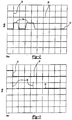
- the voltage differential at inputs 2 and 3 prevents op-amp V1A from generating an interrupt request. This is shown in Figs. 6 and 7, wherein the output 66 at IRQ remains high in spite of noise pulses 68 and 70 at DATA from turning the SHR on, shown by signal 72.
- Fig. 8 illustrates that noise 74 at DATA from turning on the SHR 26 will not send an interrupt request 76 until the wake up pulse 78 is received..
- the receiver may be adapted to receive other types of remote control signals, including, but not limited to, IR or ultrasonic signals.
- circuit 40 may be incorporated as a portion of the signal receiver or the micro controller in a single integrated package. Accordingly, it is intended that the invention not be limited to the described embodiment, but that it includes all modifications encompassed within the spirit of the following claims.
Landscapes
- Physics & Mathematics (AREA)
- Nonlinear Science (AREA)
- Dc Digital Transmission (AREA)
- Selective Calling Equipment (AREA)
Applications Claiming Priority (2)
| Application Number | Priority Date | Filing Date | Title |
|---|---|---|---|
| US11765399P | 1999-01-28 | 1999-01-28 | |
| US117653 | 1999-01-28 |
Publications (2)
| Publication Number | Publication Date |
|---|---|
| EP1024595A2 true EP1024595A2 (de) | 2000-08-02 |
| EP1024595A3 EP1024595A3 (de) | 2004-06-30 |
Family
ID=22374082
Family Applications (1)
| Application Number | Title | Priority Date | Filing Date |
|---|---|---|---|
| EP00300609A Withdrawn EP1024595A3 (de) | 1999-01-28 | 2000-01-27 | Datendiskriminator |
Country Status (1)
| Country | Link |
|---|---|
| EP (1) | EP1024595A3 (de) |
Cited By (1)
| Publication number | Priority date | Publication date | Assignee | Title |
|---|---|---|---|---|
| US7529602B2 (en) | 2004-10-04 | 2009-05-05 | Denso Corporation | Vehicle-installed remote control unit |
Family Cites Families (3)
| Publication number | Priority date | Publication date | Assignee | Title |
|---|---|---|---|---|
| GB1455253A (en) * | 1972-11-04 | 1976-11-10 | Dunlop Ltd | Signal detection circuit |
| US3875516A (en) * | 1973-10-26 | 1975-04-01 | Rank Organisation Ltd | Discriminator circuits |
| US4942393A (en) * | 1988-05-27 | 1990-07-17 | Lectron Products, Inc. | Passive keyless entry system |
-
2000
- 2000-01-27 EP EP00300609A patent/EP1024595A3/de not_active Withdrawn
Cited By (1)
| Publication number | Priority date | Publication date | Assignee | Title |
|---|---|---|---|---|
| US7529602B2 (en) | 2004-10-04 | 2009-05-05 | Denso Corporation | Vehicle-installed remote control unit |
Also Published As
| Publication number | Publication date |
|---|---|
| EP1024595A3 (de) | 2004-06-30 |
Similar Documents
| Publication | Publication Date | Title |
|---|---|---|
| US7890229B2 (en) | Method and device for waking users of a bus system, and corresponding users | |
| US6100814A (en) | Remote control wake up detector system | |
| US7205777B2 (en) | Capacitive proximity switch | |
| KR100428880B1 (ko) | 자동차용전자제어장치및그장치의제어방법 | |
| US6198913B1 (en) | Automatic wake-up device for radio automatic recognition terminal and communication method using the terminal | |
| US6690259B2 (en) | Security system to enable authenticated access of an individual to a protected area | |
| JP4288154B2 (ja) | 受動通信装置及び受動アクセス制御システム | |
| JPH10105309A (ja) | マイクロコントローラを有する電子装置のバス相互接続した動作のための装置及びその利用 | |
| US8832474B2 (en) | Slave circuit of a LIN bus and method for operation | |
| JPH0832510A (ja) | 移動通信装置の起動方法,移動通信装置及び固定通信装置 | |
| JP3666596B2 (ja) | バッテリ充放電処理システム、及び車両用セキュリティシステム | |
| JP3256920B2 (ja) | 多重伝送装置 | |
| JPWO2002001695A1 (ja) | バッテリ充放電処理システム | |
| US6925576B2 (en) | Control unit and multiplex communication system using the same | |
| GB2403878A (en) | Data slicer with peak detector and clamping circuit to prevent false response to ambient noise signals | |
| WO2007080383A1 (en) | Electronic access control device | |
| US6160842A (en) | Device and method for serially communicating | |
| JP2001090403A (ja) | 解錠装置 | |
| CN214474560U (zh) | 电动车显示集成系统及电动车 | |
| JP2002339610A (ja) | 車両用キーレスエントリシステム及びその増設ユニット | |
| JP2002004663A (ja) | 自動車のドアロック制御システム | |
| JP2005045451A (ja) | パッシブキーレスエントリ装置 | |
| JP2953161B2 (ja) | 間欠動作装置 | |
| JPH0795222A (ja) | 通信装置 | |
| JPH0810955B2 (ja) | 車輌用錠のリモ−トコントロ−ル用送信装置 |
Legal Events
| Date | Code | Title | Description |
|---|---|---|---|
| PUAI | Public reference made under article 153(3) epc to a published international application that has entered the european phase |
Free format text: ORIGINAL CODE: 0009012 |
|
| AK | Designated contracting states |
Kind code of ref document: A2 Designated state(s): AT BE CH CY DE DK ES FI FR GB GR IE IT LI LU MC NL PT SE |
|
| AX | Request for extension of the european patent |
Free format text: AL;LT;LV;MK;RO;SI |
|
| 17P | Request for examination filed |
Effective date: 20001018 |
|
| RAP1 | Party data changed (applicant data changed or rights of an application transferred) |
Owner name: SIEMENS AUTOMOTIVE CORPORATION |
|
| PUAL | Search report despatched |
Free format text: ORIGINAL CODE: 0009013 |
|
| AK | Designated contracting states |
Kind code of ref document: A3 Designated state(s): AT BE CH CY DE DK ES FI FR GB GR IE IT LI LU MC NL PT SE |
|
| AX | Request for extension of the european patent |
Extension state: AL LT LV MK RO SI |
|
| STAA | Information on the status of an ep patent application or granted ep patent |
Free format text: STATUS: THE APPLICATION IS DEEMED TO BE WITHDRAWN |
|
| 18D | Application deemed to be withdrawn |
Effective date: 20040803 |