EP1024217A2 - Thermisches Verbinden von Nassfasern auf Zellulosebasis - Google Patents
Thermisches Verbinden von Nassfasern auf Zellulosebasis Download PDFInfo
- Publication number
- EP1024217A2 EP1024217A2 EP00101423A EP00101423A EP1024217A2 EP 1024217 A2 EP1024217 A2 EP 1024217A2 EP 00101423 A EP00101423 A EP 00101423A EP 00101423 A EP00101423 A EP 00101423A EP 1024217 A2 EP1024217 A2 EP 1024217A2
- Authority
- EP
- European Patent Office
- Prior art keywords
- fabric
- cellulose
- fibers
- psi
- substances
- Prior art date
- Legal status (The legal status is an assumption and is not a legal conclusion. Google has not performed a legal analysis and makes no representation as to the accuracy of the status listed.)
- Granted
Links
Images

Classifications
-
- D—TEXTILES; PAPER
- D04—BRAIDING; LACE-MAKING; KNITTING; TRIMMINGS; NON-WOVEN FABRICS
- D04H—MAKING TEXTILE FABRICS, e.g. FROM FIBRES OR FILAMENTARY MATERIAL; FABRICS MADE BY SUCH PROCESSES OR APPARATUS, e.g. FELTS, NON-WOVEN FABRICS; COTTON-WOOL; WADDING ; NON-WOVEN FABRICS FROM STAPLE FIBRES, FILAMENTS OR YARNS, BONDED WITH AT LEAST ONE WEB-LIKE MATERIAL DURING THEIR CONSOLIDATION
- D04H3/00—Non-woven fabrics formed wholly or mainly of yarns or like filamentary material of substantial length
- D04H3/08—Non-woven fabrics formed wholly or mainly of yarns or like filamentary material of substantial length characterised by the method of strengthening or consolidating
- D04H3/14—Non-woven fabrics formed wholly or mainly of yarns or like filamentary material of substantial length characterised by the method of strengthening or consolidating with bonds between thermoplastic yarns or filaments produced by welding
-
- D—TEXTILES; PAPER
- D04—BRAIDING; LACE-MAKING; KNITTING; TRIMMINGS; NON-WOVEN FABRICS
- D04H—MAKING TEXTILE FABRICS, e.g. FROM FIBRES OR FILAMENTARY MATERIAL; FABRICS MADE BY SUCH PROCESSES OR APPARATUS, e.g. FELTS, NON-WOVEN FABRICS; COTTON-WOOL; WADDING ; NON-WOVEN FABRICS FROM STAPLE FIBRES, FILAMENTS OR YARNS, BONDED WITH AT LEAST ONE WEB-LIKE MATERIAL DURING THEIR CONSOLIDATION
- D04H1/00—Non-woven fabrics formed wholly or mainly of staple fibres or like relatively short fibres
- D04H1/40—Non-woven fabrics formed wholly or mainly of staple fibres or like relatively short fibres from fleeces or layers composed of fibres without existing or potential cohesive properties
- D04H1/54—Non-woven fabrics formed wholly or mainly of staple fibres or like relatively short fibres from fleeces or layers composed of fibres without existing or potential cohesive properties by welding together the fibres, e.g. by partially melting or dissolving
Definitions
- This invention relates to the thermal bonding of fibers in fabrics and webs fibers, and in particular to the thermal bonding of fibers in fabrics or webs made of cellulose esters, cellulose ethers, or mixtures of fibers made of cellulose esters and/or ethers and fibers made of other substances.
- Cellulose esters is particular interest are cellulose acetate and cellulose triacetate.
- Fabrics or fiber webs made of or containing cellulose esters and/or ethers, and in particular cellulose acetate and cellulose triacetate, can undergo a thermal bonding treatment to thereby cause the CA fibers of the fabric or web to bond to one another and/or to other fibers in the fabric or web.
- CA cellulose esters and/or ethers
- a thermal bonding treatment to thereby cause the CA fibers of the fabric or web to bond to one another and/or to other fibers in the fabric or web.
- calendering a thermal process known in the art as "calendering”.
- calendering such calendering processes are carried out on material having a low moisture content.
- the calendering process is performed by passing the fabric or web between a pair of rollers which exert a pressure on the fabric. Typically, one or both of the rollers is heated to a selected temperature to accomplish the calendering.
- a calendering process for applying a coating to a fabric is described in the Encyclopedia of Polymer Science and Engineering , Vol. 6 (Wiley-Interscience, John Wiley & Sons, New York 1986), pages 639-640 and ibid ., Vol. 2, pages 606-622.
- a calendering process to bond fibers of a material to one another and/or to fibers made of other materials are carried out in a similar manner using calender rollers heated to a selected temperature appropriate for the fiber(s) to be bonded. In the calendering process, the combination of the temperature and the pressure exerted by the rollers causes the fibers to soften and/or melt, and to bond to themselves or to other fibers in the fabric or material being calendered.
- cellulose acetate fabrics may be used in apparel where their draping qualities are desired. Embrittlement of the fibers stiffens the fabric and the draping quality is lost.
- high temperature bonding results in greater energy costs, bonding non-uniformity from roller distortion, and imposes high machinery maintenance costs, for example, seals, bearings, roller distortion caused bowing of the rollers at their center due to the heats required which results in the need for more frequent roller replacement, and similar items.
- U.S. Patent No. 2,692,420 to Bamber et al. describes the production of felts from a combination of (1) wool or other animal fibers capable of felting and (2) cellulose acetate fibers. Bamber recites the difficulty encountered in preparing such felts and teaches treating such felt mixtures with organic softening agents to soften the cellulose acetate fibers before felting, and thereby facilitating the felting process.
- U.S. Patent 2,277,049 to Reed (cited above), in addition to disclosing a calendering temperature of 232 °C, also discloses the use of various organic solvents to soften binding fibers in a fabric which is a mixture of binding fibers and cotton. Reed finds the use of such solvents is objectionable. Additionally, Reed also discloses water wetting a fabric that has been heat calendered in order to soften the still calendered fabric. This water wetting is post-calendering and does not influence the calendering temperature employed.
- U.S. Patent No. 5,783,39 to Duckett et al describes the use of acetone vapor to lower the softening temperature of cellulose acetate fibers in order to lower calendering temperature. While lower bonding temperatures may be achieved using the method of Duckett et al., the use of acetone vapors creates a fire and explosive hazard which is not desirable in commercial operations.
- U.S. Patent No. 2, 673,163 to Rohm describes adding water to bulk cellulose esters such as cellulose acetate flake in order to lower the melting point of the ester prior to extruding it through an orifice such as in a melt spinning process.
- the amount of water incorporated in the molten mass is above the normal "regain" moisture of the dry ester, typically in the range of 0.5-10%.
- the preferred moisture content is at 8-9% with a hydrolyzed cellulose acetate derivative, and at about 6% with cellulose triacetate.” (See Rohm, column 2, lines 2-5.)
- Cellulose acetate fibers are known to bond at temperatures of about 220 °C.
- the use of organic softening agents such as described by Bamber can lower this temperature, but the use of such organic substances with acetate fabric is undesirable from worker safety, both economic and environmental considerations.
- organic chemical plasticizers the art generally does not teach a satisfactory method of reducing the temperature at which cellulose acetate or cellulose triacetate fibers can be bonded to one another in a fabric or to fibers of other materials which may be present in a fabric or web.
- water is acting as a plasticizer.
- the invention discloses a process for bonding fabric and web fibers of cellulose esters and/or cellulose ethers to one another and/or to fibers made of other selected substances which may be present in the fabric or web.
- the fabric or web is water wetted and passed between at least one pair and optionally a plurality of pairs of calendering rollers which are heated to a temperature of from about 130°C to about 210 °C, preferably from about 150°C to about 190 °C, said rollers also exerting a pressure on the fabric of from about 20 to about 5000 psi, preferably from about 50 to about 1000 psi.
- the water content of the wetted fabric is from about 20% to about 600% of the fabric dry weight.
- Material may be passed between the calendering rollers at any commercially viable rate of speed. typically, this speed is from about 0.5 to about 200 meters per minute.
- the fibers of the other selected substances present in the fabric may be selected from the group consisting of cellulose fibers from wood pulp, flax and similar natural products, rayon, polyesters, wool, cotton, silk, polyamides, polyacrylates, polymethacrylates, polyolefins and similar polymers known to those skilled in the art which are appropriate for blending with fibers of cellulose acetate and/or cellulose triacetate.
- the quantity of such other fibers in the fabric may be from about 1% to about 90% of the total weight of the fabric.
- cellulose acetate As used herein, the terms “cellulose acetate”, “acetate” and “CA” means a cellulose ester or ether wherein either the acid portion of the ester or the “ethereal” portion of the cellulose ether is an alkane or alkene moiety of five or less carbon atoms and the degree of substitution of the ester/ether groups for cellulose hydroxyl groups is from about 2.2 to about 2.65, a value of 3.0 being the theoretical maximum.
- cellulose triacetate or “triacetate” signifies a degree of substitution of from about 2.65 to 3.0.
- alkanoic and alkenoic acids examples include propanoic, butanoic, butenoic; isopropanoic, isopropenoic, pentanoic, neopentanoic, formic, acetic and similar acids.
- ethereal groups which may form the cellulose ether include methyl, ethyl, propyl, isopropyl, butyl, isopropenyl, butenyl, pentyl, neopentyl, pentenyl and similar C 5 or lower groups, said groups replacing the cellulose hydroxyl hydrogens.
- Both cellulose acetate and cellulose triacetate, alone or in combination with one other or with fibers of other selected material, may be used in the process of the invention.
- the wet calendering process of the invention can be use with fabrics and webs made of cellulose esters and ethers, and includes fabrics made of mixtures of cellulose esters/ethers and mixtures of such cellulose esters/ethers with fibers made from other substances.
- fiber made from other selected substances include fibers made from natural products (e.g., wood pulp, cotton, silk, wool and similar fibers), polyolefins, polyesters, rayon and polyamides.
- Preferred cellulose esters/ethers are cellulose acetate and triacetate.
- fabric and “material”, when used in connection with calendering process of the invention, may be used interchangeably herein.
- the terms denote a fabric or material containing fibers of cellulose esters/ethers, either alone or in combination with one another, or with fibers made of other selected substances as described herein.
- Preferred cellulose esters/ethers are cellulose acetate and triacetate.
- “Fabric” as used herein can be woven, knitted or non-woven, such non-woven fabrics denoting webs of fibers which may have been calendered by methods other than those of this invention or which have been in which the fibers have been entangled or bonded by hydroentanglement, resin bonding, needle punching and similar methods known to those skilled in the art. "Fabric” further includes non-woven webs of fibers in which the fibers have not been entangled or bonded by methods known in the art.
- the calendering rollers used in practicing the invention are heated rollers and can have either a smooth surface, or an embossed or patterned surface.
- both rollers may have smooth surfaces, one can be smooth and one embossed, and both can be embossed.
- the rollers can be heated to the selected temperature by any means known in the art. For example, electrically or by passing a heated fluid through the rollers.
- calendering temperature and pressure, and the amount of water in the material being calendered will all effect the degree of bonding which is obtained.
- speed at which the material is passed through the calendering rollers will also effect the degree of bonding, the faster the speed the lower the degree of bonding obtained.
- the calendering temperature may range from about 130 C° to about 210 °C, preferably from about 150 °C to 190 °C.
- the water content in the fabric or material being calendered can vary from about 20% to about 600% of the material weight based on the weight of the dry material.
- the pressured exerted by the calendering rollers on the material may range from about 20 to about 5000 psi, preferably from about 50 to about 1000 psi.
- the rate at which the material passes through the calendering rollers may range from about 0.5 to 200 meters per minutes, preferably from about 25 to about 150 meters per minute.
- the exact combination of temperature, pressure, water content and material speed may readily be varied by one skilled in the art to achieve a material having a selected set of physical characteristics such as strength, density, stiffness and degree of fiber bonding.
- One skilled in the art will also be readily able to see that it is possible to achieve a given set of characteristics under different sets of conditions. For example, at a specified material speed and roller pressure, a specified degree of fiber bonding and resulting material strength could be achieved by varying the temperature and water content of the material.
- the materials which can be calendered according to the process of the invention can be any assembly of fibers: woven, non-woven, web, knitted or similar material containing cellulose esters/ethers.
- materials made of cellulose esters/ethers alone, or cellulose esters/ethers blended with other materials such as natural product fibers, rayon, polyolefins, polyesters, polyamides, polyacrylates, polymethacrylates and liquid crystalline polymers and similar polymeric materials known to those skilled in the can used in practicing the invention.
- Particularly preferred, in addition to materials made of cellulose esters/ethers are blends containing polyesters, polyolefins, polyacrylates, polymethacrylates, cotton, wool, silk, wood pulp, cellulose fibers such as flax and similar substances.
- cellulose acetate or triacetate in the examples should be understood to mean cellulose esters/ethers generally as described herein.
- sheets of fiber webs were fed to a laboratory scale calendering apparatus.
- the fiber webs were prepared on carding machines, Rando web machines or were wet-laid on a hand-sheet former.
- the pressures utilized in these laboratory experiments 500 to 5000 psi, is recognized as being higher than those which will be used in typical large scale commercial equipment.
- Such large scale commercial equipment typically used calendering pressures of about 10 or 20 psi to about 2000 psi, preferably about 50 to about 1000 psi.
- Material is fed to such commercial equipment at rated from about 0.5 to about 200 meters per minute, or higher, preferably from about 25 to about 150 meters per minute.
- Example 1 was carried out using 3 osy (ounce per square yard) random dry laid webs of 60% rayon and 40% CA.
- the rayon and CA fibers used in forming the web were 11 ⁇ 2 inch trilobal fibers of 1.5 and 1.7 dpf (denier per filament), respectively.
- Calender bonding was performed at the temperatures and pressures given in Table 1 with the web passing through the rollers at the rate of one (1) meter per minute. No water was added to the web. Bonding temperature is in degrees Centigrade. Bonding Pressure is in psi. Peak load is in lb/inch and measures the force required to break a one (1) inch strip of fabric. Strain at break is in percentage and measures the amount that a strip of fabric extends or stretches before it breaks.
- Peak Loads and Strain at Break are desirable. It is desirable to obtain such values at the lowest possible bonding temperatures and bonding pressures. Bonding Temperature °C Bonding Pressure psi Tensile Properties Peak Load Strain at Break 230 2500 8.5 8.2 230 1000 4.9 3.4 225 2500 7.5 6.9 225 1000 4.7 4.2 220 2500 3.6 5.7 220 1000 0.8 9.7 210 2500 1.5 5.2 210 1000 0.6 3.9
- Table 1 illustrates the tensile properties of webs of unattached rayon and cellulose acetate fibers which have been calendered, without the addition of added water as taught by the invention, between smooth rollers at the temperatures and pressures indicated.
- the rayon/CA web bonded in Table 1 were "dry", that is, they contained a regain, equilibrium moisture content of about 6%.
- bonding temperatures of 230 °C and higher pressures webs containing CA are converted into structures of appreciable strength as indicated by the Peak Load and Strain at Break values. At temperatures greater than 230 °C even stronger structures can be formed, but such higher temperatures can lead to discoloration of the materials.
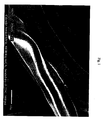
- Fig. 1 illustrates the type of discrete bonding that can be formed between two CA fibers or a CA fiber and a rayon fiber when bonded at 225 °C and a pressure of 1000 psi as in Table 1. It is noted that when smooth calender rollers are used as in these examples, stronger, tougher webs are formed from blends of bonding/non-bonding fibers (e.g., CA/rayon) then when the webs are made of 100% bonding fiber. With smooth calender rollers, 100% bonding fibers can become over bonded resulting in very stiff fabrics (materials) or can even be converted from a fibrous structure into a film-like sheet.
- bonding/non-bonding fibers e.g., CA/rayon
- Calender rollers with a bonding pattern are often used with webs of 100% bonding fibers, and also with blends of bonding/non-bonding fibers, to obtain structures with a balance of properties that are different from those obtained with smooth rollers.
- bonding patterns There are many type of bonding patterns known in the art and any of these can be with the invention. The different bonding patterns have a wide range of bonding areas.
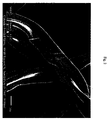
- Fig. 2 also based on webs bonded according to the conditions of Table 1, illustrate the calendering of "dry" CA containing webs at less severe conditions, for example, a temperature of 210 °C and 1000 psi.
- Fig. 2 shows that under these conditions, "dry" CA fibers deform and form some tack bonds, but the discrete bonds such as are shown in Fig. 1 are not formed.
- the data in Fig. 2 thus illustrates that when "dry" CA fibers are calendered, temperatures in excess for 210 °C are required for good bond formation.
- Example 2 was carried out to measure the tensile properties of 3 osy cross-lapped card webs of a blend of 80% rayon and 20% cellulose acetate, 11 ⁇ 2 inch trilobal fibers which were dipped in water for one minute, vacuum extracted to remove excess water and calendered between smooth rollers. Web material was passed between the rollers at a rate of one meter per minute at the temperatures and pressures specified in Table 2. The water content of the web at calendering varied from less than 200% to greater than 600% of the dry web weight. Sample Bonding Temp.
- Example 3 was carried out to measure the tensile properties of 3 osy random, dry laid webs of a blend of 11 ⁇ 2 inch fibers of 1.5 dpf rayon and 1.7 dpf cellulose acetate that were dipped in water, vacuum extracted to remove excess water and calendered between smooth rollers at the temperatures and pressures specified in Table 3. Web material passed between the rollers at a rate of one meter per minute. "None added” signified that the web was not dipped and the moisture content was the normal regain moisture content. Fiber webs of varying size were weighed before dipping in water and after vacuum extraction to determine the water content of the web.
- the data in Table 3 indicates that strong structures are formed from webs containing CA at temperatures as low as 150 °C. At higher calendering pressures, it is believed likely that strong structures can also be formed at temperatures below 150 °C For example, it is believed that at a temperature of 130 °C and a pressure of 3000-5000 psi a structure can be formed with the strength of a web calendered at 170 °C and 1000 psi.
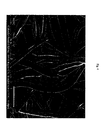
- Fig. 3 illustrates a 60/40 rayon/CA web wet calender bonded at 170 °C and 1000 psi.
- the CA fiber in the web has flowed extensively, While such fabric might have limited utility, the results are indicative of the good bonding which can be achieved at this low temperature and at low pressures. Good bonding is expected at very low roller pressures, for example, 20-50 psi. This is commercially advantageous and will allow for the formation of less dense structures.
- Fig. 4 when compared to Fig. 1, indicates that more bonding occurred at 150 °C with a wetted web than occurred at 225 °C with a non-wetted web.
- Example 4 was carried out to measure the tensile properties of 3 osy card webs of 1 9 / 16 inch fibers of 100% 1.8 dpf cellulose acetate that were sprayed with water just prior to calendering. Calendering was done between smooth rollers at the temperatures and pressures specified in Table 3. Web material passed between the rollers at a rate of one meter per minute. "None" signifies that the web was not sprayed with water and the moisture content was the normal regain moisture content. Approximately one-half of the water sprayed was applied to each side of the web. Sample Bonding Web Dry Wt.
- the data in Table 4 indicates the bonding that is achieved using 100% CA with and without added water. No second type of fiber was present in the web in order to eliminate any complications in interpreting the data due to the second fiber's water adsorption characteristics. The data indicates that there is a noticeable change in the strength of calendered structures when as little as 20% water is present in the structure prior to calendering.
- Example 5 was performed to determine the tensile properties of 2 osy webs of 80% 1.5 dpf rayon and 20% 2.3 dpf CA.
- the web was formed using 1 ⁇ 2 inch crennulated-round fibers that were wet laid in water, vacuum extracted to remove excess water and calendered between smooth rollers at the temperatures and pressures indicated in Table 5.
- Web material was fed to the roller at the rate of one meter per minute.
- Wet Laid Web treatment Calendering Tensile properties °C Pressure Peak Load Strain at Break 1. Oven dried at 100°C before calendering. 165 1000 Insufficient strength to test. 2. Calendered without vacuum extraction. 165 1000 6.7 4.4 3. Vacuum extracted and calendered. 165 1000 7.9 4.0 4. Vacuum extracted and air dried for 10 min. before calendering. 165 1000 9.2 7.5 5. Vacuum extracted and calendered. 190 1000 11.6 6.2
- Table 5 illustrates the physical properties of wet laid web containing rayon and CA.
- a calendering temperature of 165 °C no cohesive strength developed in the web.
- significant strength developed upon calendering. While the amount of water was not measured in Sample 4, it is reasonable to assume that in Sample 4 some of the water content evaporated and that better bonding resulted from a somewhat lowered water content as compared to the samples which were not allowed to air dry. Air drying for 10 minutes, or more, can will reduce the amount of water present in the web.
- the fabric in addition to spraying or dipping the fabric to water wet it, other methods can be used to arrive at an optimum water content for optimum fabric properties at a specified set on bonding temperatures, roller pressure and calender speed.
- the fabric can be wetted and then passed though a chamber having a specified temperature and moisture content to equilibrate the water content at some specified level.
- a steam chamber can also be used to wet the fabric.
- a carded web of cellulose triacetate is formed according to method known in the art.
- the web is comprised of fiber of 2.5 dpf and is of a weight of 3 osy.
- Samples of the web are calendered dry and after wetting in accordance with the invention.
- Wetted fabric has a water content of about 200% to about 600% of the dry weight of the fabric in accordance with the invention.
- Calendering of the wetted samples is done temperatures of 190 °C and roller pressures of 1000 psi.
- the web is passed through the calendering rollers at a rate of 0.2 meter per minute to bond the triacetate fibers to one another.
Landscapes
- Engineering & Computer Science (AREA)
- Textile Engineering (AREA)
- Nonwoven Fabrics (AREA)
- Treatment Of Fiber Materials (AREA)
- Paper (AREA)
- Artificial Filaments (AREA)
Applications Claiming Priority (2)
| Application Number | Priority Date | Filing Date | Title |
|---|---|---|---|
| US240073 | 1988-09-02 | ||
| US09/240,073 US6224811B1 (en) | 1999-01-29 | 1999-01-29 | Thermal bonding of wet cellulose based fibers |
Publications (3)
| Publication Number | Publication Date |
|---|---|
| EP1024217A2 true EP1024217A2 (de) | 2000-08-02 |
| EP1024217A3 EP1024217A3 (de) | 2002-11-06 |
| EP1024217B1 EP1024217B1 (de) | 2005-08-03 |
Family
ID=22905010
Family Applications (1)
| Application Number | Title | Priority Date | Filing Date |
|---|---|---|---|
| EP00101423A Expired - Lifetime EP1024217B1 (de) | 1999-01-29 | 2000-01-25 | Thermisches Verbinden von Nassfasern auf Zellulosebasis |
Country Status (7)
| Country | Link |
|---|---|
| US (1) | US6224811B1 (de) |
| EP (1) | EP1024217B1 (de) |
| JP (1) | JP2000226759A (de) |
| CN (1) | CN1099482C (de) |
| AT (1) | ATE301206T1 (de) |
| DE (1) | DE60021636T2 (de) |
| ES (1) | ES2245623T3 (de) |
Cited By (3)
| Publication number | Priority date | Publication date | Assignee | Title |
|---|---|---|---|---|
| WO2010012734A3 (en) * | 2008-08-01 | 2010-03-25 | L'oreal | Cosmetic product application device comprising kapok fibres and associated method of production |
| US8461066B2 (en) | 2007-08-02 | 2013-06-11 | Celanese Acetate Llc | Nonwoven from bulked filament tow |
| WO2018017652A1 (en) | 2016-07-22 | 2018-01-25 | Eastman Chemical Company | Cellulose ester compositions for calendering |
Families Citing this family (4)
| Publication number | Priority date | Publication date | Assignee | Title |
|---|---|---|---|---|
| DE102010015858B4 (de) * | 2010-03-08 | 2012-01-26 | Andritz Küsters Gmbh | Verfestigungsverfahren einer Filamente aus thermoplastischem Material umfassenden Lage zu einer Vliesbahn sowie Thermobonding-Kalander |
| US11118313B2 (en) | 2019-03-21 | 2021-09-14 | Eastman Chemical Company | Ultrasonic welding of wet laid nonwoven compositions |
| JP2023521105A (ja) | 2020-04-16 | 2023-05-23 | ザ プロクター アンド ギャンブル カンパニー | 有孔不織布 |
| WO2021208009A1 (en) * | 2020-04-16 | 2021-10-21 | The Procter & Gamble Company | Process for producing deformed nonwoven |
Family Cites Families (11)
| Publication number | Priority date | Publication date | Assignee | Title |
|---|---|---|---|---|
| GB469463A (en) * | 1934-10-17 | 1937-07-26 | British Celanese | Improvements in the treatment of textile materials |
| US2277049A (en) | 1939-11-06 | 1942-03-24 | Kendall & Co | Textile fabric and method of making same |
| US2692420A (en) | 1946-03-12 | 1954-10-26 | Celanese Corp | Treatment of fibrous material |
| GB666368A (en) * | 1948-10-02 | 1952-02-13 | Celanese Corp | Improvements in the treatment of cellulose acetate textile materials |
| BE498083A (de) | 1949-09-14 | |||
| US3096557A (en) * | 1961-01-03 | 1963-07-09 | Du Pont | Process for hot-wet calendering fabrics |
| US4396452A (en) * | 1978-12-21 | 1983-08-02 | Monsanto Company | Process for point-bonding organic fibers |
| US4306929A (en) * | 1978-12-21 | 1981-12-22 | Monsanto Company | Process for point-bonding organic fibers |
| US4576852A (en) * | 1983-10-18 | 1986-03-18 | Phillips Petroleum Company | Fusion of thermoplastic fabrics |
| JPS61132664A (ja) * | 1984-11-27 | 1986-06-20 | 日本バイリーン株式会社 | ポリビニルアルコ−ル系繊維を含む不織布の製造方法 |
| US5783505A (en) | 1996-01-04 | 1998-07-21 | The University Of Tennessee Research Corporation | Compostable and biodegradable compositions of a blend of natural cellulosic and thermoplastic biodegradable fibers |
-
1999
- 1999-01-29 US US09/240,073 patent/US6224811B1/en not_active Expired - Fee Related
-
2000
- 2000-01-25 DE DE60021636T patent/DE60021636T2/de not_active Expired - Fee Related
- 2000-01-25 EP EP00101423A patent/EP1024217B1/de not_active Expired - Lifetime
- 2000-01-25 AT AT00101423T patent/ATE301206T1/de not_active IP Right Cessation
- 2000-01-25 ES ES00101423T patent/ES2245623T3/es not_active Expired - Lifetime
- 2000-01-27 CN CN00101689A patent/CN1099482C/zh not_active Expired - Fee Related
- 2000-01-27 JP JP2000018220A patent/JP2000226759A/ja active Pending
Cited By (5)
| Publication number | Priority date | Publication date | Assignee | Title |
|---|---|---|---|---|
| US8461066B2 (en) | 2007-08-02 | 2013-06-11 | Celanese Acetate Llc | Nonwoven from bulked filament tow |
| US9297099B2 (en) | 2007-08-02 | 2016-03-29 | Celanese Acetate Llc | Nonwoven from bulked filament tow |
| WO2010012734A3 (en) * | 2008-08-01 | 2010-03-25 | L'oreal | Cosmetic product application device comprising kapok fibres and associated method of production |
| WO2018017652A1 (en) | 2016-07-22 | 2018-01-25 | Eastman Chemical Company | Cellulose ester compositions for calendering |
| US11816964B2 (en) | 2016-07-22 | 2023-11-14 | Eastman Chemical Company | Cellulose ester compositions for calendering |
Also Published As
| Publication number | Publication date |
|---|---|
| DE60021636T2 (de) | 2006-05-24 |
| CN1099482C (zh) | 2003-01-22 |
| EP1024217B1 (de) | 2005-08-03 |
| CN1264765A (zh) | 2000-08-30 |
| EP1024217A3 (de) | 2002-11-06 |
| US6224811B1 (en) | 2001-05-01 |
| ES2245623T3 (es) | 2006-01-16 |
| DE60021636D1 (de) | 2005-09-08 |
| ATE301206T1 (de) | 2005-08-15 |
| JP2000226759A (ja) | 2000-08-15 |
Similar Documents
| Publication | Publication Date | Title |
|---|---|---|
| US3511747A (en) | Bonded textile materials | |
| KR880000384B1 (ko) | 폴리(테트라플루오로에틸렌)과 글래스 스테이플 섬유의 균질 혼합물 | |
| US3639195A (en) | Bonded fibrous materials and method for making them | |
| US3501369A (en) | Nonwoven fabric and method of making the same | |
| JP3119283B2 (ja) | 不織布ボンディング方法 | |
| US3658579A (en) | Flame-retardant, bonded nonwoven fibrous product employing a binder comprising an ethylene/vinyl chloride interpolymer and an ammonium polyphosphate | |
| JPH0219223B2 (de) | ||
| US3752733A (en) | Bonded nonwoven fibrous product | |
| EP1024217B1 (de) | Thermisches Verbinden von Nassfasern auf Zellulosebasis | |
| DE2655136B2 (de) | Verfahren zur Herstellung eines Bindefasern enthaltenden Nalivlieses | |
| DE2644904A1 (de) | Verfahren zur herstellung von faservliesen | |
| US20060080816A1 (en) | Method and machine for producing a nonwoven fabric with reduction of displacement speed of the compacted mat | |
| EP1891256B1 (de) | Hochelastischer, dimensionsmässig rückstellbarer vliesstoff | |
| US3394047A (en) | Process of forming water-laid felts containing hollow-viscose, textile, and synthetic fibers | |
| US3925287A (en) | Ethylene/vinyl chloride interpolymers | |
| JPS6152262B2 (de) | ||
| CN119748981B (zh) | 石墨烯抗菌中底布及其制备方法和应用 | |
| US3758429A (en) | Ethylene vinyl chloride n methhylol acrylamide | |
| KR20210086953A (ko) | 컴파운드 페이퍼의 생산방법 및 컴파운드 페이퍼 | |
| US3922424A (en) | Non-woven fibrous material bonded with ethylene/vinyl chloride interpolymers | |
| US3647615A (en) | Ethylene/vinyl chloride/n-methylol acrylamide | |
| US3515634A (en) | Method of producing a fibrous fleece base material from three types of fibers | |
| US3843580A (en) | Ethylene/vinyl chloride/n-methylolacrylamide/n-(alkoxymethyl)acrylamide latices | |
| CA2448937C (en) | Method for consolidating a material web made from wood pulp | |
| EP0013127B1 (de) | Verfahren zur Herstellung nicht-gewebter Stoffe durch Bindung organischer Fasern |
Legal Events
| Date | Code | Title | Description |
|---|---|---|---|
| PUAI | Public reference made under article 153(3) epc to a published international application that has entered the european phase |
Free format text: ORIGINAL CODE: 0009012 |
|
| AK | Designated contracting states |
Kind code of ref document: A2 Designated state(s): AT BE CH CY DE DK ES FI FR GB GR IE IT LI LU MC NL PT SE |
|
| AX | Request for extension of the european patent |
Free format text: AL;LT;LV;MK;RO;SI |
|
| PUAL | Search report despatched |
Free format text: ORIGINAL CODE: 0009013 |
|
| AK | Designated contracting states |
Kind code of ref document: A3 Designated state(s): AT BE CH CY DE DK ES FI FR GB GR IE IT LI LU MC NL PT SE |
|
| AX | Request for extension of the european patent |
Free format text: AL;LT;LV;MK;RO;SI |
|
| RIC1 | Information provided on ipc code assigned before grant |
Free format text: 7D 04H 1/54 A, 7D 04H 3/14 B, 7D 06C 15/02 B, 7B 29C 43/24 B |
|
| 17P | Request for examination filed |
Effective date: 20021219 |
|
| 17Q | First examination report despatched |
Effective date: 20030213 |
|
| AKX | Designation fees paid |
Designated state(s): AT BE CH CY DE DK ES FI FR GB GR IE IT LI LU MC NL PT SE |
|
| GRAP | Despatch of communication of intention to grant a patent |
Free format text: ORIGINAL CODE: EPIDOSNIGR1 |
|
| GRAS | Grant fee paid |
Free format text: ORIGINAL CODE: EPIDOSNIGR3 |
|
| GRAA | (expected) grant |
Free format text: ORIGINAL CODE: 0009210 |
|
| AK | Designated contracting states |
Kind code of ref document: B1 Designated state(s): AT BE CH CY DE DK ES FI FR GB GR IE IT LI LU MC NL PT SE |
|
| PG25 | Lapsed in a contracting state [announced via postgrant information from national office to epo] |
Ref country code: AT Free format text: LAPSE BECAUSE OF FAILURE TO SUBMIT A TRANSLATION OF THE DESCRIPTION OR TO PAY THE FEE WITHIN THE PRESCRIBED TIME-LIMIT Effective date: 20050803 Ref country code: LI Free format text: LAPSE BECAUSE OF FAILURE TO SUBMIT A TRANSLATION OF THE DESCRIPTION OR TO PAY THE FEE WITHIN THE PRESCRIBED TIME-LIMIT Effective date: 20050803 Ref country code: FI Free format text: LAPSE BECAUSE OF FAILURE TO SUBMIT A TRANSLATION OF THE DESCRIPTION OR TO PAY THE FEE WITHIN THE PRESCRIBED TIME-LIMIT Effective date: 20050803 Ref country code: CH Free format text: LAPSE BECAUSE OF FAILURE TO SUBMIT A TRANSLATION OF THE DESCRIPTION OR TO PAY THE FEE WITHIN THE PRESCRIBED TIME-LIMIT Effective date: 20050803 Ref country code: BE Free format text: LAPSE BECAUSE OF FAILURE TO SUBMIT A TRANSLATION OF THE DESCRIPTION OR TO PAY THE FEE WITHIN THE PRESCRIBED TIME-LIMIT Effective date: 20050803 Ref country code: NL Free format text: LAPSE BECAUSE OF FAILURE TO SUBMIT A TRANSLATION OF THE DESCRIPTION OR TO PAY THE FEE WITHIN THE PRESCRIBED TIME-LIMIT Effective date: 20050803 |
|
| REG | Reference to a national code |
Ref country code: GB Ref legal event code: FG4D |
|
| REG | Reference to a national code |
Ref country code: CH Ref legal event code: EP |
|
| REG | Reference to a national code |
Ref country code: IE Ref legal event code: FG4D |
|
| REF | Corresponds to: |
Ref document number: 60021636 Country of ref document: DE Date of ref document: 20050908 Kind code of ref document: P |
|
| PG25 | Lapsed in a contracting state [announced via postgrant information from national office to epo] |
Ref country code: GR Free format text: LAPSE BECAUSE OF FAILURE TO SUBMIT A TRANSLATION OF THE DESCRIPTION OR TO PAY THE FEE WITHIN THE PRESCRIBED TIME-LIMIT Effective date: 20051103 Ref country code: SE Free format text: LAPSE BECAUSE OF FAILURE TO SUBMIT A TRANSLATION OF THE DESCRIPTION OR TO PAY THE FEE WITHIN THE PRESCRIBED TIME-LIMIT Effective date: 20051103 Ref country code: DK Free format text: LAPSE BECAUSE OF FAILURE TO SUBMIT A TRANSLATION OF THE DESCRIPTION OR TO PAY THE FEE WITHIN THE PRESCRIBED TIME-LIMIT Effective date: 20051103 |
|
| PG25 | Lapsed in a contracting state [announced via postgrant information from national office to epo] |
Ref country code: PT Free format text: LAPSE BECAUSE OF FAILURE TO SUBMIT A TRANSLATION OF THE DESCRIPTION OR TO PAY THE FEE WITHIN THE PRESCRIBED TIME-LIMIT Effective date: 20060103 |
|
| REG | Reference to a national code |
Ref country code: ES Ref legal event code: FG2A Ref document number: 2245623 Country of ref document: ES Kind code of ref document: T3 |
|
| PG25 | Lapsed in a contracting state [announced via postgrant information from national office to epo] |
Ref country code: IE Free format text: LAPSE BECAUSE OF NON-PAYMENT OF DUE FEES Effective date: 20060125 |
|
| PG25 | Lapsed in a contracting state [announced via postgrant information from national office to epo] |
Ref country code: LU Free format text: LAPSE BECAUSE OF NON-PAYMENT OF DUE FEES Effective date: 20060131 Ref country code: MC Free format text: LAPSE BECAUSE OF NON-PAYMENT OF DUE FEES Effective date: 20060131 |
|
| PGFP | Annual fee paid to national office [announced via postgrant information from national office to epo] |
Ref country code: IT Payment date: 20060131 Year of fee payment: 7 |
|
| NLV1 | Nl: lapsed or annulled due to failure to fulfill the requirements of art. 29p and 29m of the patents act | ||
| PGFP | Annual fee paid to national office [announced via postgrant information from national office to epo] |
Ref country code: FR Payment date: 20060202 Year of fee payment: 7 |
|
| PGFP | Annual fee paid to national office [announced via postgrant information from national office to epo] |
Ref country code: ES Payment date: 20060210 Year of fee payment: 7 |
|
| REG | Reference to a national code |
Ref country code: CH Ref legal event code: PL |
|
| ET | Fr: translation filed | ||
| PLBE | No opposition filed within time limit |
Free format text: ORIGINAL CODE: 0009261 |
|
| STAA | Information on the status of an ep patent application or granted ep patent |
Free format text: STATUS: NO OPPOSITION FILED WITHIN TIME LIMIT |
|
| 26N | No opposition filed |
Effective date: 20060504 |
|
| REG | Reference to a national code |
Ref country code: IE Ref legal event code: MM4A |
|
| PGFP | Annual fee paid to national office [announced via postgrant information from national office to epo] |
Ref country code: DE Payment date: 20070131 Year of fee payment: 8 |
|
| REG | Reference to a national code |
Ref country code: FR Ref legal event code: ST Effective date: 20061230 |
|
| GBPC | Gb: european patent ceased through non-payment of renewal fee |
Effective date: 20070125 |
|
| PG25 | Lapsed in a contracting state [announced via postgrant information from national office to epo] |
Ref country code: GB Free format text: LAPSE BECAUSE OF NON-PAYMENT OF DUE FEES Effective date: 20070125 |
|
| REG | Reference to a national code |
Ref country code: ES Ref legal event code: FD2A Effective date: 20070126 |
|
| PG25 | Lapsed in a contracting state [announced via postgrant information from national office to epo] |
Ref country code: FR Free format text: LAPSE BECAUSE OF NON-PAYMENT OF DUE FEES Effective date: 20060131 |
|
| PG25 | Lapsed in a contracting state [announced via postgrant information from national office to epo] |
Ref country code: ES Free format text: LAPSE BECAUSE OF NON-PAYMENT OF DUE FEES Effective date: 20070126 |
|
| PG25 | Lapsed in a contracting state [announced via postgrant information from national office to epo] |
Ref country code: DE Free format text: LAPSE BECAUSE OF NON-PAYMENT OF DUE FEES Effective date: 20080801 |
|
| PGFP | Annual fee paid to national office [announced via postgrant information from national office to epo] |
Ref country code: GB Payment date: 20060206 Year of fee payment: 7 |
|
| PG25 | Lapsed in a contracting state [announced via postgrant information from national office to epo] |
Ref country code: CY Free format text: LAPSE BECAUSE OF FAILURE TO SUBMIT A TRANSLATION OF THE DESCRIPTION OR TO PAY THE FEE WITHIN THE PRESCRIBED TIME-LIMIT Effective date: 20050803 |
|
| PG25 | Lapsed in a contracting state [announced via postgrant information from national office to epo] |
Ref country code: IT Free format text: LAPSE BECAUSE OF NON-PAYMENT OF DUE FEES Effective date: 20070125 |