EP1018564B1 - Produit en acier inoxydable presentant une excellente activite antimicrobienne et procede de production de celui-ci - Google Patents
Produit en acier inoxydable presentant une excellente activite antimicrobienne et procede de production de celui-ci Download PDFInfo
- Publication number
- EP1018564B1 EP1018564B1 EP99923888A EP99923888A EP1018564B1 EP 1018564 B1 EP1018564 B1 EP 1018564B1 EP 99923888 A EP99923888 A EP 99923888A EP 99923888 A EP99923888 A EP 99923888A EP 1018564 B1 EP1018564 B1 EP 1018564B1
- Authority
- EP
- European Patent Office
- Prior art keywords
- percent
- weight
- optionally
- stainless steel
- antibacterial properties
- Prior art date
- Legal status (The legal status is an assumption and is not a legal conclusion. Google has not performed a legal analysis and makes no representation as to the accuracy of the status listed.)
- Expired - Lifetime
Links
- 229910001220 stainless steel Inorganic materials 0.000 title claims description 88
- 239000010935 stainless steel Substances 0.000 title claims description 76
- 238000004519 manufacturing process Methods 0.000 title claims description 12
- 230000000845 anti-microbial effect Effects 0.000 title 1
- NDVLTYZPCACLMA-UHFFFAOYSA-N silver oxide Chemical compound [O-2].[Ag+].[Ag+] NDVLTYZPCACLMA-UHFFFAOYSA-N 0.000 claims description 74
- 230000000844 anti-bacterial effect Effects 0.000 claims description 72
- 229910052709 silver Inorganic materials 0.000 claims description 45
- 239000004332 silver Substances 0.000 claims description 45
- BQCADISMDOOEFD-UHFFFAOYSA-N Silver Chemical compound [Ag] BQCADISMDOOEFD-UHFFFAOYSA-N 0.000 claims description 44
- 229910001923 silver oxide Inorganic materials 0.000 claims description 37
- XEEYBQQBJWHFJM-UHFFFAOYSA-N Iron Chemical compound [Fe] XEEYBQQBJWHFJM-UHFFFAOYSA-N 0.000 claims description 34
- PXHVJJICTQNCMI-UHFFFAOYSA-N Nickel Chemical compound [Ni] PXHVJJICTQNCMI-UHFFFAOYSA-N 0.000 claims description 32
- IJGRMHOSHXDMSA-UHFFFAOYSA-N Atomic nitrogen Chemical compound N#N IJGRMHOSHXDMSA-UHFFFAOYSA-N 0.000 claims description 30
- 239000011651 chromium Substances 0.000 claims description 24
- 229910052804 chromium Inorganic materials 0.000 claims description 23
- 238000000034 method Methods 0.000 claims description 23
- 229910052720 vanadium Inorganic materials 0.000 claims description 23
- LEONUFNNVUYDNQ-UHFFFAOYSA-N vanadium atom Chemical compound [V] LEONUFNNVUYDNQ-UHFFFAOYSA-N 0.000 claims description 23
- VYZAMTAEIAYCRO-UHFFFAOYSA-N Chromium Chemical compound [Cr] VYZAMTAEIAYCRO-UHFFFAOYSA-N 0.000 claims description 22
- RYGMFSIKBFXOCR-UHFFFAOYSA-N Copper Chemical compound [Cu] RYGMFSIKBFXOCR-UHFFFAOYSA-N 0.000 claims description 22
- 239000010949 copper Substances 0.000 claims description 22
- 229910052802 copper Inorganic materials 0.000 claims description 22
- 229910052742 iron Inorganic materials 0.000 claims description 17
- RTAQQCXQSZGOHL-UHFFFAOYSA-N Titanium Chemical compound [Ti] RTAQQCXQSZGOHL-UHFFFAOYSA-N 0.000 claims description 16
- 239000012535 impurity Substances 0.000 claims description 16
- 229910052759 nickel Inorganic materials 0.000 claims description 16
- 239000010955 niobium Substances 0.000 claims description 16
- 239000010936 titanium Substances 0.000 claims description 16
- 229910052719 titanium Inorganic materials 0.000 claims description 16
- ZOXJGFHDIHLPTG-UHFFFAOYSA-N Boron Chemical compound [B] ZOXJGFHDIHLPTG-UHFFFAOYSA-N 0.000 claims description 15
- OKTJSMMVPCPJKN-UHFFFAOYSA-N Carbon Chemical compound [C] OKTJSMMVPCPJKN-UHFFFAOYSA-N 0.000 claims description 15
- ZOKXTWBITQBERF-UHFFFAOYSA-N Molybdenum Chemical compound [Mo] ZOKXTWBITQBERF-UHFFFAOYSA-N 0.000 claims description 15
- OAICVXFJPJFONN-UHFFFAOYSA-N Phosphorus Chemical compound [P] OAICVXFJPJFONN-UHFFFAOYSA-N 0.000 claims description 15
- QCWXUUIWCKQGHC-UHFFFAOYSA-N Zirconium Chemical compound [Zr] QCWXUUIWCKQGHC-UHFFFAOYSA-N 0.000 claims description 15
- 229910052782 aluminium Inorganic materials 0.000 claims description 15
- XAGFODPZIPBFFR-UHFFFAOYSA-N aluminium Chemical compound [Al] XAGFODPZIPBFFR-UHFFFAOYSA-N 0.000 claims description 15
- 229910052796 boron Inorganic materials 0.000 claims description 15
- 229910052799 carbon Inorganic materials 0.000 claims description 15
- 239000010941 cobalt Substances 0.000 claims description 15
- 229910017052 cobalt Inorganic materials 0.000 claims description 15
- GUTLYIVDDKVIGB-UHFFFAOYSA-N cobalt atom Chemical compound [Co] GUTLYIVDDKVIGB-UHFFFAOYSA-N 0.000 claims description 15
- WPBNNNQJVZRUHP-UHFFFAOYSA-L manganese(2+);methyl n-[[2-(methoxycarbonylcarbamothioylamino)phenyl]carbamothioyl]carbamate;n-[2-(sulfidocarbothioylamino)ethyl]carbamodithioate Chemical compound [Mn+2].[S-]C(=S)NCCNC([S-])=S.COC(=O)NC(=S)NC1=CC=CC=C1NC(=S)NC(=O)OC WPBNNNQJVZRUHP-UHFFFAOYSA-L 0.000 claims description 15
- 229910052750 molybdenum Inorganic materials 0.000 claims description 15
- 239000011733 molybdenum Substances 0.000 claims description 15
- 229910052758 niobium Inorganic materials 0.000 claims description 15
- GUCVJGMIXFAOAE-UHFFFAOYSA-N niobium atom Chemical compound [Nb] GUCVJGMIXFAOAE-UHFFFAOYSA-N 0.000 claims description 15
- 229910052757 nitrogen Inorganic materials 0.000 claims description 15
- 229910052698 phosphorus Inorganic materials 0.000 claims description 15
- 239000011574 phosphorus Substances 0.000 claims description 15
- 229910052710 silicon Inorganic materials 0.000 claims description 15
- 239000010703 silicon Substances 0.000 claims description 15
- WFKWXMTUELFFGS-UHFFFAOYSA-N tungsten Chemical compound [W] WFKWXMTUELFFGS-UHFFFAOYSA-N 0.000 claims description 15
- 229910052721 tungsten Inorganic materials 0.000 claims description 15
- 239000010937 tungsten Substances 0.000 claims description 15
- 229910052726 zirconium Inorganic materials 0.000 claims description 15
- 229910000963 austenitic stainless steel Inorganic materials 0.000 claims description 12
- 229910001105 martensitic stainless steel Inorganic materials 0.000 claims description 12
- 238000005266 casting Methods 0.000 claims description 11
- 238000009749 continuous casting Methods 0.000 claims description 10
- NINIDFKCEFEMDL-UHFFFAOYSA-N Sulfur Chemical compound [S] NINIDFKCEFEMDL-UHFFFAOYSA-N 0.000 claims description 9
- 229910052717 sulfur Inorganic materials 0.000 claims description 9
- 239000011593 sulfur Substances 0.000 claims description 9
- 238000005097 cold rolling Methods 0.000 claims description 5
- 238000005098 hot rolling Methods 0.000 claims description 5
- 239000002994 raw material Substances 0.000 claims description 5
- 229910000831 Steel Inorganic materials 0.000 description 41
- 239000010959 steel Substances 0.000 description 41
- 230000007797 corrosion Effects 0.000 description 27
- 238000005260 corrosion Methods 0.000 description 27
- 241000894006 Bacteria Species 0.000 description 22
- 230000000052 comparative effect Effects 0.000 description 20
- 238000011156 evaluation Methods 0.000 description 19
- 239000000203 mixture Substances 0.000 description 15
- 238000012360 testing method Methods 0.000 description 13
- 239000010410 layer Substances 0.000 description 12
- 239000000126 substance Substances 0.000 description 10
- 229910052751 metal Inorganic materials 0.000 description 9
- 239000002184 metal Substances 0.000 description 9
- 238000005498 polishing Methods 0.000 description 9
- 230000009467 reduction Effects 0.000 description 8
- 238000000137 annealing Methods 0.000 description 6
- 239000002245 particle Substances 0.000 description 6
- 241000588724 Escherichia coli Species 0.000 description 5
- 229910052946 acanthite Inorganic materials 0.000 description 5
- 229910045601 alloy Inorganic materials 0.000 description 5
- 239000000956 alloy Substances 0.000 description 5
- 230000000694 effects Effects 0.000 description 5
- XUARKZBEFFVFRG-UHFFFAOYSA-N silver sulfide Chemical compound [S-2].[Ag+].[Ag+] XUARKZBEFFVFRG-UHFFFAOYSA-N 0.000 description 5
- 229940056910 silver sulfide Drugs 0.000 description 5
- FAPWRFPIFSIZLT-UHFFFAOYSA-M Sodium chloride Chemical compound [Na+].[Cl-] FAPWRFPIFSIZLT-UHFFFAOYSA-M 0.000 description 4
- 230000001580 bacterial effect Effects 0.000 description 4
- 239000010960 cold rolled steel Substances 0.000 description 4
- 230000002708 enhancing effect Effects 0.000 description 4
- 230000002401 inhibitory effect Effects 0.000 description 4
- 238000002386 leaching Methods 0.000 description 4
- 150000002739 metals Chemical class 0.000 description 4
- 238000009628 steelmaking Methods 0.000 description 4
- 230000003247 decreasing effect Effects 0.000 description 3
- JEIPFZHSYJVQDO-UHFFFAOYSA-N iron(III) oxide Inorganic materials O=[Fe]O[Fe]=O JEIPFZHSYJVQDO-UHFFFAOYSA-N 0.000 description 3
- 229910000734 martensite Inorganic materials 0.000 description 3
- 238000005554 pickling Methods 0.000 description 3
- 239000000243 solution Substances 0.000 description 3
- 229910020641 Co Zr Inorganic materials 0.000 description 2
- LFQSCWFLJHTTHZ-UHFFFAOYSA-N Ethanol Chemical compound CCO LFQSCWFLJHTTHZ-UHFFFAOYSA-N 0.000 description 2
- 239000003242 anti bacterial agent Substances 0.000 description 2
- 229910001566 austenite Inorganic materials 0.000 description 2
- 244000052616 bacterial pathogen Species 0.000 description 2
- 230000015556 catabolic process Effects 0.000 description 2
- 239000011248 coating agent Substances 0.000 description 2
- 238000000576 coating method Methods 0.000 description 2
- 238000006731 degradation reaction Methods 0.000 description 2
- 238000010894 electron beam technology Methods 0.000 description 2
- 238000005516 engineering process Methods 0.000 description 2
- 239000011572 manganese Substances 0.000 description 2
- 235000015097 nutrients Nutrition 0.000 description 2
- 239000000049 pigment Substances 0.000 description 2
- 239000008213 purified water Substances 0.000 description 2
- 238000007670 refining Methods 0.000 description 2
- 238000011160 research Methods 0.000 description 2
- 229910000108 silver(I,III) oxide Inorganic materials 0.000 description 2
- 239000011780 sodium chloride Substances 0.000 description 2
- 239000002436 steel type Substances 0.000 description 2
- XLYOFNOQVPJJNP-UHFFFAOYSA-N water Chemical compound O XLYOFNOQVPJJNP-UHFFFAOYSA-N 0.000 description 2
- 229910000859 α-Fe Inorganic materials 0.000 description 2
- 229920001817 Agar Polymers 0.000 description 1
- 229920000742 Cotton Polymers 0.000 description 1
- JPVYNHNXODAKFH-UHFFFAOYSA-N Cu2+ Chemical compound [Cu+2] JPVYNHNXODAKFH-UHFFFAOYSA-N 0.000 description 1
- 229910000519 Ferrosilicon Inorganic materials 0.000 description 1
- 206010016952 Food poisoning Diseases 0.000 description 1
- 208000019331 Foodborne disease Diseases 0.000 description 1
- 239000001888 Peptone Substances 0.000 description 1
- 108010080698 Peptones Proteins 0.000 description 1
- 241000607142 Salmonella Species 0.000 description 1
- 238000005299 abrasion Methods 0.000 description 1
- 239000008272 agar Substances 0.000 description 1
- 238000004458 analytical method Methods 0.000 description 1
- 230000003466 anti-cipated effect Effects 0.000 description 1
- 239000007864 aqueous solution Substances 0.000 description 1
- QVGXLLKOCUKJST-UHFFFAOYSA-N atomic oxygen Chemical compound [O] QVGXLLKOCUKJST-UHFFFAOYSA-N 0.000 description 1
- 239000004566 building material Substances 0.000 description 1
- 229940043430 calcium compound Drugs 0.000 description 1
- 150000001674 calcium compounds Chemical class 0.000 description 1
- 238000006243 chemical reaction Methods 0.000 description 1
- 238000004140 cleaning Methods 0.000 description 1
- 239000011247 coating layer Substances 0.000 description 1
- 229910001431 copper ion Inorganic materials 0.000 description 1
- 238000012136 culture method Methods 0.000 description 1
- 238000005262 decarbonization Methods 0.000 description 1
- 230000007547 defect Effects 0.000 description 1
- 230000000593 degrading effect Effects 0.000 description 1
- 238000006477 desulfuration reaction Methods 0.000 description 1
- 230000023556 desulfurization Effects 0.000 description 1
- 239000002270 dispersing agent Substances 0.000 description 1
- 238000005363 electrowinning Methods 0.000 description 1
- 238000000227 grinding Methods 0.000 description 1
- 238000010438 heat treatment Methods 0.000 description 1
- 239000007970 homogeneous dispersion Substances 0.000 description 1
- 238000003754 machining Methods 0.000 description 1
- 239000000463 material Substances 0.000 description 1
- 235000013372 meat Nutrition 0.000 description 1
- 229910052760 oxygen Inorganic materials 0.000 description 1
- 239000001301 oxygen Substances 0.000 description 1
- 238000002161 passivation Methods 0.000 description 1
- 235000019319 peptone Nutrition 0.000 description 1
- 238000003825 pressing Methods 0.000 description 1
- 238000012545 processing Methods 0.000 description 1
- 229920006395 saturated elastomer Polymers 0.000 description 1
- -1 silver ions Chemical class 0.000 description 1
- 238000004544 sputter deposition Methods 0.000 description 1
- 238000011282 treatment Methods 0.000 description 1
- 238000005406 washing Methods 0.000 description 1
Images
Classifications
-
- C—CHEMISTRY; METALLURGY
- C22—METALLURGY; FERROUS OR NON-FERROUS ALLOYS; TREATMENT OF ALLOYS OR NON-FERROUS METALS
- C22C—ALLOYS
- C22C38/00—Ferrous alloys, e.g. steel alloys
-
- C—CHEMISTRY; METALLURGY
- C22—METALLURGY; FERROUS OR NON-FERROUS ALLOYS; TREATMENT OF ALLOYS OR NON-FERROUS METALS
- C22C—ALLOYS
- C22C38/00—Ferrous alloys, e.g. steel alloys
- C22C38/18—Ferrous alloys, e.g. steel alloys containing chromium
- C22C38/40—Ferrous alloys, e.g. steel alloys containing chromium with nickel
- C22C38/46—Ferrous alloys, e.g. steel alloys containing chromium with nickel with vanadium
-
- C—CHEMISTRY; METALLURGY
- C22—METALLURGY; FERROUS OR NON-FERROUS ALLOYS; TREATMENT OF ALLOYS OR NON-FERROUS METALS
- C22C—ALLOYS
- C22C38/00—Ferrous alloys, e.g. steel alloys
- C22C38/002—Ferrous alloys, e.g. steel alloys containing In, Mg, or other elements not provided for in one single group C22C38/001 - C22C38/60
-
- C—CHEMISTRY; METALLURGY
- C22—METALLURGY; FERROUS OR NON-FERROUS ALLOYS; TREATMENT OF ALLOYS OR NON-FERROUS METALS
- C22C—ALLOYS
- C22C38/00—Ferrous alloys, e.g. steel alloys
- C22C38/18—Ferrous alloys, e.g. steel alloys containing chromium
- C22C38/40—Ferrous alloys, e.g. steel alloys containing chromium with nickel
Definitions
- the present invention relates to stainless steel. More particularly, the present invention relates to stainless steel having antibacterial properties which is suitably used for life related apparatuses, such as kitchen fixtures, medical apparatuses, electric appliances, chemical apparatuses, and building materials, and also relates to a manufacturing method therefor.
- the steel according to the present invention are in forms including sheets, strips, pipes, and wires.
- antibacterial characteristics materials provided with inhibitory effects on bacterial growth (hereinafter referred to as antibacterial characteristics) by using these metals have been proposed.
- a stainless steel sheet having superior Antibacterial properties is disclosed; on the surfaces of the stainless steel sheet, metal layers or alloy layers of chromium, titanium, nickel, iron and the like containing silver and/or copper are formed by magnetic sputtering.
- metal layers or alloy layers formed containing 19 to 60 percent by weight of silver is preferable.
- austenitic stainless steel enhancing antibacterial properties by adding 1.1 to 3.5 percent by weight of copper as disclosed in Japanese Unexamined Patent Application Publication No. 8-104953 ; martensitic stainless steel enhancing antibacterial properties by adding 0.3 to 5 percent by weight of copper as disclosed in Japanese Unexamined Patent Application Publication No. 8-104952 ; and ferritic stainless steel enhancing antibacterial properties by adding 0.4 to 3.0 percent by weight of copper as disclosed in Japanese Unexamined Patent Application Publication No. 9-170053 .
- Objects of the present invention are to provide stainless steel and a manufacturing method therefor by solving the problems in the conventional technologies.
- the stainless steel of the present invention has superior antibacterial properties and corrosion resistance, and continue to have superior antibacterial properties even after currently employed surface processing is performed, such as polishing.
- the inventors of the present invention found that the steel provided with the optimum amount of silver homogeneously dispersed therein had stable antibacterial properties for applications in which the steel was subject to mold pressing and polishing, and in which the surfaces of the steel were scrubbed or abraded during use.
- the present invention was accomplished based on the above knowledge in conjunction with further research therefor.
- a stainless steel, having antibacterial properties comprises:
- a second aspect of the invention is that the stainless steel, having the antibacterial properties according to the first aspect of the invention, further comprises 0.001 to 1.0 percent by weight of vanadium.
- a third aspect of the invention is the stainless steel, having the antibacterial properties according to the first aspect to the second aspect of the invention, wherein the silver content is not less than 0.001 and is less than 0.05 percent by weight of the stainless steel.
- a fourth aspect of the invention is the stainless steel, having the antibacterial properties according to the second aspect of the invention, wherein the vanadium content is 0.001 to 0.30 percent by weight of the stainless steel.
- a fifth aspect of the invention is the stainless steel having the antibacterial properties according to the first aspect to the fourth aspect of the invention, wherein the stainless steel is in the form of any one of a sheet, a strip, a pipe, and a wire.
- a sixth aspect of the invention is a method for manufacturing a stainless steel raw material, comprising the steps of:
- a seventh aspect of the invention is the method for manufacturing the stainless steel according to the sixth aspect of the invention, in which the molten stainless steel further comprises 0.001 to 1.0 percent by weight of vanadium.
- An eighth aspect of the invention is that the method for manufacturing the stainless steel, having antibacterial properties according to the sixth aspect and the seventh aspect of the invention, further comprises the steps of hot rolling and cold rolling.
- the composition of the stainless steel of the present invention is selected from the group consisting of an austenitic stainless steel, a ferritic stainless steel, and a martensitic stainless steel.
- the chemical composition of the austenitic stainless steel is as follows; 0.001 to 0.1 percent by weight of carbon, not more than 2.0 percent by weight of silicon, not more than 2.0 percent by weight of manganese, not more than 0.1 percent by weight of phosphorus, 10 to 35 percent by weight of chromium, 6 to 15 percent by weight of nickel, 0.001 to 0.1 percent by weight of nitrogen, and the balance being iron and incidental impurities.
- the chemical composition of the ferritic stainless steel is as follows; 0.0001 to 0.1 percent by weight of carbon, not more than 1.0 percent by weight of silicon, not more than 2.0 percent by weight of manganese, not more than 0.1 percent by weight of phosphorus, 10 to 50 percent by weight of chromium, not more than 0.10 percent by weight of nitrogen, and the balance being iron and incidental impurities.
- the chemical composition of the martensitic stainless steel is as follows; 0.001 to 1.0 percent by weight of carbon, not more than 1.0 percent by weight of silicon, not more than 2.0 percent by weight of manganese, not more than 0.1 percent by weight of phosphorus, 10 to 19 percent by weight of chromium, 0.001 to 0.1 percent by weight of nitrogen, and the balance being iron and incidental impurities.
- one or more elements selected from the group of aluminum, not more than 1.5 percent by weight; titanium, not more than 1.0 percent by weight; niobium, not more than 1.0 percent by weight; tungsten, not more than 0.3 percent by weight; zirconium, not more than 1.0 percent by weight; nickel, not more than 3.0 percent by weight; molybdenum, not more than 3.0 percent by weight; copper, not more than 1.0 percent by weight; cobalt, 0.001 to 0.5 percent by weight; and boron, not more than 0.01 percent by weight may be included in the martensitic stainless steel.
- the stainless steel having the composition described above includes 0.001 to 0.30 percent by weight of silver, or further includes 0.001 to 1.0 percent by weight of vanadium.
- the stainless steel includes not less than 0.0005 percent by weight of a silver oxide, the amount of the silver oxide being not more than 1.1 times that of the silver (percent by weight) in the stainless steel. According to the composition described above, stable and extremely superior antibacterial properties can be obtained without degradation of corrosion resistance. Chromium: Not Less Than 10 Percent by Weight
- the reason the chromium content is determined to be not less than 10 percent by weight is that corrosion resistance is poor when the chromium content is less than 10 percent by weight.
- the upper limit of the chromium content is not specifically set; however, not more than 50 percent by weight of chromium is preferable in view of workability and productivity.
- Silver is a most important element of the present invention, having an inhibitory effect on bacterial growth and enhancing antibacterial properties. These effects of the silver are observed at amounts of not less than 0.001 percent by weight; however, when the silver content exceeds 0.30 percent by weight, corrosion resistance is degraded and surface defects increase during hot rolling. In addition, there is a disadvantage in terms of cost due to addition of a large amount of expensive silver. Hence, the silver content is specified to be in the range of 0.001 to 0.30 percent by weight. More preferably, the silver content is less than 0.05 percent by weight.
- Silver contained in the stainless steel is present in the form of silver (Ag) particles, a silver oxide, and a silver sulfide. According to the understanding of the inventors of the present invention, the antibacterial properties are superior in the order of a silver oxide > silver particles > a silver sulfide, and therefore, most of the silver in the present invention is to be present in the form of a silver oxide in order to markedly enhance antibacterial properties.
- the stainless steel according to the present invention contains not less than 0.0005 percent by weight of a silver oxide, the amount of the silver oxide being not more than 1.1 times that of the silver (percent by weight) in the stainless steel.
- the silver oxide is always present on the surfaces of the steel, that is, not only on the surfaces of the steel at the time of shipment, but also on the surfaces thereof after polishing, machining, and grinding, and on the surfaces thereof which are newly exposed by abrasion during use. Accordingly, the growth of bacteria is inhibited and antibacterial properties are enhanced.
- the silver oxide is, for example, AgO or Ag 2 O.
- the upper limit of the content of the silver oxide is determined to be not more than 1.1 times the amount of the silver (percent by weight) in the stainless steel. Specific forms of the silver oxide in the stainless steel of the present invention are not required; however, since the silver oxide particles exceeding 500 ⁇ m may cause degradation of corrosion resistance and workability, a size which is not greater than 500 ⁇ m is preferable.
- the amount of the silver oxide generated in the stainless steel according to the present invention is measured by an inclusion analysis using an electroextraction method, or is measured on a random sectional surface of a test piece sampled from the steel by la field emission Auger electron spectroscope or an electron beam microanalyser.
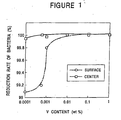
- 0.001 to 1.0 percent by weight of vanadium is preferably contained.
- Measured results of the antibacterial properties at the surface and at the center of a 1.0 mm-thickness BA (Bright Annealing) product of the stainless steel influenced by addition of vanadium is shown in Fig. 1 .
- the BA product was obtained from a slab of 16.2%-Cr stainless steel containing 0.042 percent by weight of silver through the steps of hot rolling, annealing for a hot-rolled plate (850°C ⁇ 60 seconds), cold-rolling, and bright annealing (850°C ⁇ 60 seconds).
- the vanadium in the range of 0.001 to 1.0 percent by weight is preferable. More preferably, the range is 0.001 to 0.30 percent by weight, and further preferably the range is 0.01 to 0.25 percent by weight.
- the stainless steel according to the present invention is composed of the chemical compositions in the ranges described above, and iron and incidental impurities as the balance.
- a preferably manufacturing method is, for example, a secondary refining by SS-VOD (Strongly Stirred Vacuum Oxygen Decarbonization) following the step of the steel making technique by using a steel converter, an electric furnace, and the like.
- SS-VOD Longly Stirred Vacuum Oxygen Decarbonization
- a molten stainless steel is manufactured by a known steel making technique, in which the molten stainless steel having a stainless steel composition, provided with not less than 10 percent by weight of chromium, further contains 0.001 to 0.30 percent by weight of silver, or still further contains 0.001 to 1.0 percent by weight of vanadium.
- the molten steel thus manufactured can be made in steel raw material by using known casting methods; however, in view of productivity and quality, continuous casting is preferably employed.
- the casting rate is determined to be in the range of 0.8 to 1.6 m/min.
- the sulfur content in molten stainless steel is determined to be not more than 0.015 percent by weight, and more preferably, not more than 0.010 percent by weight.
- the casting rate in the continuous casting is preferably in the range of 0.8 to 1.6 m/min.
- the sulfur content in the molten stainless steel is not more than 0.015 percent by weight, more preferably not more than 0.010 percent by weight, concomitant with the casting rate being 0.8 to 1.6 m/min.
- An adjustment of the sulfur content in the molten stainless steel may be performed by known refining methods and is not particularly specified; however, a desulfurization method by adding a ferrosilicon and calcium compounds in steel converters and/or VOD furnaces is preferable.
- the sulfur content in the molten stainless steel is more than 0.015 percent by weight, silver sulfide generated by reactions with the silver increase, and antibacterial properties are degraded because the amount of the silver oxide generated, having superior antibacterial properties, is decreased. Accordingly, in order to obtain superior antibacterial properties, the sulfur content in the molten steel is preferably not more than 0.015 percent by weight.
- steel raw materials are manufactured from the molten stainless steel having the above-described compositions by continuous casting, preferably under the conditions described above, and if necessary, are subjected to heat treatment at a predetermined temperature followed by hot-rolling, hot-rolled sheets of a given thickness thereby being obtained.
- the hot-rolled sheets are, if necessary, annealed at 700 to 1,200°C and are applied to desired applications as hot-rolled sheets or cold-rolled sheets having desired thickness processed by the following cold rolling.
- the cold-rolled sheets are manufactured preferably through annealing at 700 to 1,200°C and, if necessary, through pickling.
- Slabs (steel raw material) 200 mm thickness were prepared by a continuous casting method at various casting speeds from stainless steel having chemical compositions shown in Tables 1 and 2 made by a steel making technique, and the slabs were heated and hot-rolled, so that hot-rolled steel sheets 4 mm thickness were obtained.
- the hot-rolled steel sheets were annealed at 700 to 1,200°C and were treated by pickling followed by cold rolling, and cold-rolled steel sheets 0.8 mm thickness were thereby obtained.
- cold-rolled sheets having various surface finishes were prepared.
- the annealing temperatures employed for the cold-rolled steel sheets were 1,000 to 1,200°C for austenitic stainless steel, 800 to 1,100°C for ferritic stainless steel, 750 to 1,000°C for martensitic stainless steel.
- Some of the stainless steel sheets were treated by polishing based on the Japanese Industrial Standard (hereinafter referred to as JIS) R6001, and #320 and #400 surface finished stainless sheets were prepared.
- JIS Japanese Industrial Standard
- Antibacterial properties were evaluated in accordance with the film adhesion method defined by the Study Group on Silver and Other Inorganic Antibacterial Agents.
- the procedure of the film adhesion method by the Study Group on Silver and Other Inorganic Antibacterial Agents are as follows.
- Antibacterial properties were evaluated by a reduction rate of bacteria as defined by the following equation.
- Reduction rate ( % ) 100 ⁇ ( Number of bacteria in the control - Number of bacteria after the evaluation ) / Number of bacteria in the control
- the number of bacteria in the control is the number of living bacteria after the evaluations of antibacterial properties using stainless steel sheets containing no silver.
- the stainless steel sheets containing no silver used for the evaluations were SUS 430 (Steel No. 40) of ferritic stainless steel, SUS 304 (Steel No. 13) of austenitic stainless steel, and SUS 410 (Steel No. 23) of martensitic stainless steel.
- the initial number of bacteria from each test piece was approximately 2.3 ⁇ 10 5 cfu/piece.
- the number of bacteria after the evaluation was the number of living bacteria counted.
- Persistency of antibacterial properties was also evaluated using the same method described above by using the test pieces used for the evaluation of corrosion resistance.
- Corrosion resistance was evaluated by the salt-dry-wet complex cycle test.
- One cycle of the test is composed of treatments 1 and 2 as described below.
- the predetermined numbers of cycle were 10 cycles for ferritic stainless steel, 30 cycles for austenitic stainless steel, and 5 cycles for martensitic stainless steel.
- the present invention provides stainless steel having superior antibacterial properties without degrading corrosion resistance and maintaining the antibacterial properties even after surface finishing, such as polishing, is performed. Therefore, advantages in terms of industrial uses of the stainless steel can therefore be obtained.
- the stainless steel according to the present invention is suitably used for applications, after forming and polishing are performed, focusing on sanitary aspects in moist environments, such as application in kitchens and baths. Table 1 Steel No.
- Type Chemical composition (wt%) Remarks C Si Mn P 8 Cr N Al Mo Cu Ni Ti Nb B W Co Zr Ag V 11 Austenite 0.05 0.31 1.05 0.03 0.006 19.2 0.04 0.002 0.04 0.30 8.30 - - - - - 0.042 - Example of the present invention 12 0.05 0.30 1.04 0.03 0.005 18.2 0.04 0.002 0.04 0.31 8.20 - - - 0.01 0.12 - 0.035 0.04 Example of the present invention 13 0.05 0.29 1.05 0.03 0.006 18.5 0.04 0.001 0.04 0.30 8.30 - - - - - - - Comparative example 14 0.04 0.33 1.03 0.03 0.005 18.2 0.04.
- Type Continuous casting rate Amount of silver oxide Surface finish level Corrosion resistance Antibacterial characteristics Remarks m/min Ratio of rust Before corrosion resistance evaluation After corrosion resistance After evaluation (wt%) area (%) Number of living bacteria (cfu/piece) Reduction rate of bacteria (%) Number of living bacteria (cfu/piece) Reduction rate of bacteria (%) 31 Ferrite 1.2 0.020 2B 7 ⁇ 10 >99.9 1.5 ⁇ 10 4 99.5
- Example of the present 32 1.1 0.031 BA 2 ⁇ 10 >99.9 ⁇ 10 >99.9
- Comparative example 33
Landscapes
- Chemical & Material Sciences (AREA)
- Engineering & Computer Science (AREA)
- Materials Engineering (AREA)
- Mechanical Engineering (AREA)
- Metallurgy (AREA)
- Organic Chemistry (AREA)
- Agricultural Chemicals And Associated Chemicals (AREA)
- Heat Treatment Of Sheet Steel (AREA)
- Heat Treatment Of Steel (AREA)
Claims (8)
- Acier inoxydable présentant des propriétés antibactériennes, comprenant .0,001 à 0,30 pour cent en poids d'argent ;pas moins de 0,0005 pour cent en poids d'un oxyde d'argent, la quantité de l'oxyde d'argent n'étant pas supérieure à 1,1 fois la quantité de l'argent ; pas plus de 0,015 pour cent en poids de soufre ; et
facultativement 0,001 à 1,0 pour cent en poids de vanadium ;
dans lequel ledit acier inoxydable est choisi dans le groupe constitué par un acier inoxydable austénitique comprenant 0,001 à 0,1 pour cent en poids de carbone, pas plus de 2,0 pour cent en poids de silicium, pas plus de 2,0 pour cent en poids de manganèse, pas plus de 0,1 pour cent en poids de phosphore, 10 à 35 pour cent en poids de chrome, 6 à 15 pour cent en poids de nickel, 0,001 à 0,1 pour cent en poids d'azote, facultativement pas plus de 3,0 pour cent en poids de molybdène, facultativement pas plus de 1,0 pour cent en poids de cuivre ; facultativement pas plus de 0,30 pour cent en poids de tungstène ; facultativement pas plus de 0,3 pour cent en poids d'aluminium ; facultativement pas plus de 1,0 pour cent en poids de titane ; facultativement pas plus de 1,0 pour cent en poids de niobium ; facultativement pas plus de 1,0 pour cent en poids de zirconium ; facultativement 0,001 à 0,5 pour cent en poids de cobalt ; facultativement pas plus de 0,01 pour cent en poids de bore, et le reste étant du fer et des impuretés accidentelles ;
un acier inoxydable ferritique comprenant 0,0001 à 0,1 pour cent en poids de carbone, pas plus de 1,0 pour cent en poids de silicium, pas plus de 2,0 pour cent en poids de manganèse, pas plus de 0,1 pour cent en poids de phosphore, 10 à 50 pour cent en poids de chrome, pas plus de 0,10 pour cent en poids d'azote, facultativement pas plus de 0,3 pour cent en poids d'aluminium, facultativement pas plus de 1,0 pour cent en poids de nickel ; facultativement pas plus de 3,0 pour cent en poids de molybdène ; facultativement pas plus de 1,0 pour cent en poids de titane ; facultativement pas plus de 1,0 pour cent en poids de niobium ; facultativement pas plus de 1,0 pour cent en poids de zirconium ; facultativement pas plus de 1,0 pour cent en poids de cuivre ; facultativement pas plus de 0,30 pour cent en poids de tungstène ; facultativement 0,001 à 0,5 pour cent en poids de cobalt ; facultativement pas plus de 0,01 pour cent en poids de bore, et le reste étant du fer et des impuretés accidentelles ; et
un acier inoxydable martensitique comprenant 0,001 à 1, 0 pour cent en poids de carbone, pas plus de 1,0 pour cent en poids de silicium, pas plus de 2,0 pour cent en poids de manganèse, pas plus de 0,1 pour cent en poids de phosphore, 10 à 19 pour cent en poids de chrome, 0,001 à 0,1 pour cent en poids d'azote, facultativement pas plus de 1,5 pour cent en poids d'aluminium, facultativement pas plus de 1,0 pour cent en poids de titane ; facultativement pas plus de 1,0 pour cent en poids de niobium ; facultativement pas plus de 0,3 pour cent en poids de tungstène ; facultativement pas plus de 1,0 pour cent en poids de zirconium ; facultativement pas plus de 3,0 pour cent en poids de nickel ; facultativement pas plus de 3,0 pour cent en poids de molybdène ; facultativement pas plus de 1,0 pour cent en poids de cuivre ; facultativement 0,001 à 0,5 pour cent en poids de cobalt ; facultativement pas plus de 0,01 pour cent en poids de bore, et le reste étant du fer et des impuretés accidentelles. - Acier inoxydable présentant des propriétés antibactériennes selon la revendication 1, comprenant 0,001 à 1,0 pour cent en poids de vanadium.
- Acier inoxydable présentant des propriétés antibactériennes selon l'une quelconque des revendications 1 et 2, dans lequel la teneur en argent est de 0,001 pour cent en poids à moins de 0,05 pour cent en poids.
- Acier inoxydable présentant des propriétés antibactériennes selon la revendication 2, dans lequel la teneur en vanadium est de 0,001 à 0,30 pour cent en poids.
- Acier inoxydable présentant des propriétés antibactériennes selon l'une quelconque des revendications 1 à 4, lequel acier inoxydable est sous la forme de l'un quelconque parmi une tôle, une bande, d'un tuyau et d'un fil.
- Procédé de fabrication d'une matière première en acier inoxydable présentant des propriétés antibactériennes, comprenant les étapes consistant à :contrôler des quantités de 0,001 à 0,30 pour cent en poids d'argent, et pas plus de 0,015 pour cent en poids de soufre, facultativement 0,001 à 1,0 pour cent en poids de vanadium, dans un acier inoxydable fondu ; dans lequel ledit acier inoxydable est choisi dans le groupe constitué par un acier inoxydable austénitique comprenant 0,001 à 0,1 pour cent en poids de carbone, pas plus de 2,0 pour cent en poids de silicium, pas plus de 2,0 pour cent en poids de manganèse, pas plus de 0,1 pour cent en poids de phosphore, 10 à 35 pour cent en poids de chrome, 6 à 15 pour cent en poids de nickel, 0,001 à 0,1 pour cent en poids d'azote, facultativement pas plus de 3,0 pour cent en poids de molybdène, facultativement pas plus de 1,0 pour cent en poids de cuivre ; facultativement pas plus de 0,30 pour cent en poids de tungstène ; facultativement pas plus de 0,3 pour cent en poids d'aluminium ; facultativement pas plus de 1,0 pour cent en poids de titane ; facultativement pas plus de 1,0 pour cent en poids de niobium ; facultativement pas plus de 1,0 pour cent en poids de zirconium ; facultativement 0,001 à 0,5 pour cent en poids de cobalt ; facultativement pas plus de 0,01 pour cent en poids de bore, et le reste étant du fer et des impuretés accidentelles ;un acier inoxydable ferritique comprenant 0,0001 à 0,1 pour cent en poids de carbone, pas plus de 1,0 pour cent en poids de silicium, pas plus de 2,0 pour cent en poids de manganèse, pas plus de 0,1 pour cent en poids de phosphore, 10 à 50 pour cent en poids de chrome, pas plus de 0,10 pour cent en poids d'azote, facultativement pas plus de 0,3 pour cent en poids d'aluminium, facultativement pas plus de 1,0 pour cent en poids de nickel ; facultativement pas plus de 3,0 pour cent en poids de molybdène ; facultativement pas plus de 1,0 pour cent en poids de titane ; facultativement pas plus de 1,0 pour cent en poids de niobium ; facultativement pas plus de 1,0 pour cent en poids de zirconium ; facultativement pas plus de 1,0 pour cent en poids de cuivre ; facultativement pas plus de 0,30 pour cent en poids de tungstène ; facultativement 0,001 à 0,5 pour cent en poids de cobalt ; facultativement pas plus de 0,01 pour cent en poids de bore, et le reste étant du fer et des impuretés accidentelles ; etun acier inoxydable martensitique comprenant 0,001 à 1, 0 pour cent en poids de carbone, pas plus de 1,0 pour cent en poids de silicium, pas plus de 2,0 pour cent en poids de manganèse, pas plus de 0,1 pour cent en poids de phosphore, 10 à 19 pour cent en poids de chrome, 0,001 à 0,1 pour cent en poids d'azote, facultativement pas plus de 1,5 pour cent en poids d'aluminium, facultativement pas plus de 1,0 pour cent en poids de titane ; facultativement pas plus de 1,0 pour cent en poids de niobium ; facultativement pas plus de 0,3 pour cent en poids de tungstène ; facultativement pas plus de 1,0 pour cent en poids de zirconium ; facultativement pas plus de 3,0 pour cent en poids de nickel ; facultativement pas plus de 3,0 pour cent en poids de molybdène ; facultativement pas plus de 1,0 pour cent en poids de cuivre ; facultativement 0,001 à 0,5 pour cent en poids de cobalt ; facultativement pas plus de 0,01 pour cent en poids de bore, et le reste étant du fer et des impuretés accidentelles eteffectuer une coulée continue de l'acier inoxydable fondu à une vitesse de coulée de 0,8 à 1,6 m/min.
- Procédé de fabrication d'un acier inoxydable présentant des propriétés antibactériennes selon la revendication 6, dans lequel l'acier inoxydable fondu comprend 0,001 à 1,0 pour cent en poids de vanadium.
- Procédé de fabrication d'un acier inoxydable présentant des propriétés antibactériennes selon l'une quelconque des revendications 6 et 7, comprenant en outre des étapes de laminage à chaud et de laminage à froid.
Applications Claiming Priority (3)
| Application Number | Priority Date | Filing Date | Title |
|---|---|---|---|
| JP15809198 | 1998-06-05 | ||
| JP15809198 | 1998-06-05 | ||
| PCT/JP1999/002972 WO1999064640A1 (fr) | 1998-06-05 | 1999-06-03 | Produit en acier inoxydable presentant une excellente activite antimicrobienne et procede de production de celui-ci |
Publications (3)
| Publication Number | Publication Date |
|---|---|
| EP1018564A1 EP1018564A1 (fr) | 2000-07-12 |
| EP1018564A4 EP1018564A4 (fr) | 2002-03-20 |
| EP1018564B1 true EP1018564B1 (fr) | 2008-12-24 |
Family
ID=15664110
Family Applications (1)
| Application Number | Title | Priority Date | Filing Date |
|---|---|---|---|
| EP99923888A Expired - Lifetime EP1018564B1 (fr) | 1998-06-05 | 1999-06-03 | Produit en acier inoxydable presentant une excellente activite antimicrobienne et procede de production de celui-ci |
Country Status (8)
| Country | Link |
|---|---|
| US (1) | US6306341B1 (fr) |
| EP (1) | EP1018564B1 (fr) |
| KR (1) | KR100404675B1 (fr) |
| CN (1) | CN1097098C (fr) |
| CA (1) | CA2297091A1 (fr) |
| DE (1) | DE69940148D1 (fr) |
| TW (1) | TW444060B (fr) |
| WO (1) | WO1999064640A1 (fr) |
Families Citing this family (24)
| Publication number | Priority date | Publication date | Assignee | Title |
|---|---|---|---|---|
| US6929705B2 (en) | 2001-04-30 | 2005-08-16 | Ak Steel Corporation | Antimicrobial coated metal sheet |
| JP2003021012A (ja) * | 2001-07-10 | 2003-01-24 | Futaba Industrial Co Ltd | 燃料タンク及びその製造方法 |
| US7842434B2 (en) | 2005-06-15 | 2010-11-30 | Ati Properties, Inc. | Interconnects for solid oxide fuel cells and ferritic stainless steels adapted for use with solid oxide fuel cells |
| US8158057B2 (en) | 2005-06-15 | 2012-04-17 | Ati Properties, Inc. | Interconnects for solid oxide fuel cells and ferritic stainless steels adapted for use with solid oxide fuel cells |
| US7981561B2 (en) | 2005-06-15 | 2011-07-19 | Ati Properties, Inc. | Interconnects for solid oxide fuel cells and ferritic stainless steels adapted for use with solid oxide fuel cells |
| US20040040863A1 (en) * | 2002-08-29 | 2004-03-04 | Micron Technology, Inc. | Systems for electrolytic removal of metals from substrates |
| US6783657B2 (en) * | 2002-08-29 | 2004-08-31 | Micron Technology, Inc. | Systems and methods for the electrolytic removal of metals from substrates |
| CA2460585A1 (fr) * | 2003-05-16 | 2004-11-16 | Exciton Technologies Inc. | Produits de revetement par depot, materiaux composites et methodes de production connexes |
| CN1304627C (zh) * | 2004-04-30 | 2007-03-14 | 麦桥 | 一种表面抗菌、耐磨不锈钢制品及其制备方法 |
| US20050284548A1 (en) * | 2004-06-25 | 2005-12-29 | Chi-Shang Huang | Stainless steel product having excellent antibacterial activity and method for production thereof |
| US7807028B2 (en) * | 2005-03-09 | 2010-10-05 | Xstrata Queensland Limited | Stainless steel electrolytic plates |
| EP2374912A4 (fr) | 2008-12-17 | 2016-03-02 | Master Technology Company Limited | Revêtement antibactérien, ses procédés de préparation et pièce métallique contenant le revêtement |
| TWI399440B (zh) * | 2009-06-17 | 2013-06-21 | Metal Ind Res & Dev Ct | Method of Casting Casting of Refined Stainless Steel |
| TWI533913B (zh) | 2010-01-18 | 2016-05-21 | 季利恩歐柏木質部水對策有限責任公司 | 固定暗渠濾磚之設備及方法 |
| CN102327080A (zh) * | 2011-07-28 | 2012-01-25 | 广东联塑科技实业有限公司 | 一种不锈钢水槽 |
| CN102534410A (zh) * | 2012-02-24 | 2012-07-04 | 宝山钢铁股份有限公司 | 一种含银奥氏体抗菌不锈钢及其制造方法 |
| CN106756600A (zh) * | 2016-12-19 | 2017-05-31 | 浙江安胜科技股份有限公司 | 一种不锈钢抗菌保温容器 |
| FR3077602B1 (fr) | 2018-02-05 | 2021-01-15 | Plastic Omnium Advanced Innovation & Res | Systeme d'injection de solution aqueuse pour vehicule |
| CN114207159B (zh) * | 2019-07-31 | 2023-10-24 | 杰富意钢铁株式会社 | 奥氏体-铁素体系双相不锈钢板 |
| US11761068B2 (en) | 2019-11-22 | 2023-09-19 | Blue Point Materials Research LLC | 3D printable stainless steel alloy with antibacterial properties for orthopedic implants |
| CN112322986A (zh) * | 2020-11-20 | 2021-02-05 | 宝钢德盛不锈钢有限公司 | 一种抗菌奥氏体不锈钢 |
| CN114606433A (zh) * | 2020-12-08 | 2022-06-10 | 香港大学 | 一种利用快速凝固过程制备抗菌不锈钢的方法及其应用 |
| CN117737566B (zh) * | 2023-12-21 | 2024-07-19 | 河北恩泉环境工程有限公司 | 一种抗菌稀土不锈钢材料的制备方法及系统 |
| CN118291973B (zh) * | 2024-06-05 | 2024-09-06 | 太原科技大学 | 一种含铜抗菌马氏体不锈钢涂层及其制备方法 |
Family Cites Families (8)
| Publication number | Priority date | Publication date | Assignee | Title |
|---|---|---|---|---|
| DE1083842B (de) * | 1954-07-28 | 1960-06-23 | Mannesmann Ag | Verfahren zum Behandeln von hochlegiertem Stahlpulver, insbesondere Chrom- oder Chrom-Nickel-Stahlpulver |
| GB1183656A (en) * | 1967-03-15 | 1970-03-11 | Du Pont | Ductile Corrosion-Resistant Alloys. |
| DE69410555T2 (de) * | 1993-09-03 | 1999-01-28 | Sanyo Special Alloys, Ltd., Tochigi | Nichtmagnetische Eisenlegierung mit ausgezeichneter Korrosionsbeständigkeit und Bearbeitbarkeit |
| JPH09249948A (ja) * | 1996-03-13 | 1997-09-22 | Nisshin Steel Co Ltd | 抗菌性及び意匠性に優れたステンレス鋼 |
| JP3706219B2 (ja) * | 1997-03-19 | 2005-10-12 | 日新製鋼株式会社 | Ag及びCuを含有するオーステナイト系抗菌ステンレス鋼 |
| JP3710589B2 (ja) * | 1997-03-19 | 2005-10-26 | 日新製鋼株式会社 | Ag含有抗菌ステンレス鋼板及び製造方法 |
| JPH1129879A (ja) * | 1997-05-12 | 1999-02-02 | Mitsubishi Materials Corp | 抗菌処理した金属材料及びその抗菌処理方法 |
| JP3227405B2 (ja) * | 1997-06-25 | 2001-11-12 | 川崎製鉄株式会社 | 抗菌性に優れたフェライト系ステンレス鋼 |
-
1999
- 1999-06-02 TW TW088109158A patent/TW444060B/zh active
- 1999-06-03 KR KR10-2000-7000831A patent/KR100404675B1/ko not_active Expired - Fee Related
- 1999-06-03 EP EP99923888A patent/EP1018564B1/fr not_active Expired - Lifetime
- 1999-06-03 CN CN99800934A patent/CN1097098C/zh not_active Expired - Fee Related
- 1999-06-03 WO PCT/JP1999/002972 patent/WO1999064640A1/fr not_active Ceased
- 1999-06-03 US US09/463,830 patent/US6306341B1/en not_active Expired - Fee Related
- 1999-06-03 CA CA002297091A patent/CA2297091A1/fr not_active Abandoned
- 1999-06-03 DE DE69940148T patent/DE69940148D1/de not_active Expired - Lifetime
Also Published As
| Publication number | Publication date |
|---|---|
| CN1097098C (zh) | 2002-12-25 |
| EP1018564A1 (fr) | 2000-07-12 |
| CN1272889A (zh) | 2000-11-08 |
| WO1999064640A1 (fr) | 1999-12-16 |
| US6306341B1 (en) | 2001-10-23 |
| KR20010022258A (ko) | 2001-03-15 |
| TW444060B (en) | 2001-07-01 |
| KR100404675B1 (ko) | 2003-11-07 |
| EP1018564A4 (fr) | 2002-03-20 |
| CA2297091A1 (fr) | 1999-12-16 |
| DE69940148D1 (de) | 2009-02-05 |
Similar Documents
| Publication | Publication Date | Title |
|---|---|---|
| US6306341B1 (en) | Stainless steel product having excellent antimicrobial activity and method for production thereof | |
| KR100313171B1 (ko) | 향균성이향상된스테인레스강의사용방법 | |
| US6391253B1 (en) | Stainless steel having excellent antibacterial property and method for producing the same | |
| CN101289726A (zh) | 一种双相抗菌不锈钢及其制造方法 | |
| KR100516260B1 (ko) | 항균성이 우수한 스테인레스 강재 및 그의 제조 방법 | |
| JP3227405B2 (ja) | 抗菌性に優れたフェライト系ステンレス鋼 | |
| JP2000192259A (ja) | 抗菌性に優れたステンレス鋼材およびその製造方法 | |
| US20050284548A1 (en) | Stainless steel product having excellent antibacterial activity and method for production thereof | |
| JP3227418B2 (ja) | 抗菌性および耐リジング性に優れたフェライト系ステンレス鋼 | |
| JP3165407B2 (ja) | 抗菌性に優れたステンレス鋼材 | |
| JP3229577B2 (ja) | 抗菌性に優れたオーステナイト系ステンレス鋼 | |
| JP3165422B2 (ja) | 抗菌性に優れたステンレス鋼材およびその製造方法 | |
| JP3398620B2 (ja) | 抗菌性に優れたステンレス鋼材およびその製造方法 | |
| JPH10140295A (ja) | 抗菌性に優れたステンレス鋼材およびその製造方法 | |
| KR100328036B1 (ko) | 페라이트계향균스테인레스강및그제조방법 | |
| JP3201750B2 (ja) | 抗菌性に優れたステンレス鋼材の製造方法 | |
| JP2954868B2 (ja) | Cu含有ステンレス鋼の抗菌性改善方法 | |
| JP2000129406A (ja) | 耐微生物腐食性に優れたCr含有鉄基合金材 | |
| JPH11279744A (ja) | 抗菌性に優れたステンレス鋼製品及びその製造方法 | |
| JPH08225895A (ja) | 抗菌性に優れたマルテンサイト系ステンレス鋼 | |
| JPH11256239A (ja) | 抗菌性に優れたステンレス鋼板及びその製造方法 | |
| JPH11335810A (ja) | 抗菌性を有するステンレス鋼板の製造方法 |
Legal Events
| Date | Code | Title | Description |
|---|---|---|---|
| PUAI | Public reference made under article 153(3) epc to a published international application that has entered the european phase |
Free format text: ORIGINAL CODE: 0009012 |
|
| 17P | Request for examination filed |
Effective date: 20000203 |
|
| AK | Designated contracting states |
Kind code of ref document: A1 Designated state(s): DE FR GB |
|
| A4 | Supplementary search report drawn up and despatched |
Effective date: 20020204 |
|
| AK | Designated contracting states |
Kind code of ref document: A4 Designated state(s): DE FR GB |
|
| 17Q | First examination report despatched |
Effective date: 20021031 |
|
| APBN | Date of receipt of notice of appeal recorded |
Free format text: ORIGINAL CODE: EPIDOSNNOA2E |
|
| APBR | Date of receipt of statement of grounds of appeal recorded |
Free format text: ORIGINAL CODE: EPIDOSNNOA3E |
|
| RAP1 | Party data changed (applicant data changed or rights of an application transferred) |
Owner name: JFE STEEL CORPORATION |
|
| APAA | Appeal reference recorded |
Free format text: ORIGINAL CODE: EPIDOS REFN |
|
| APAF | Appeal reference modified |
Free format text: ORIGINAL CODE: EPIDOSCREFNE |
|
| APBT | Appeal procedure closed |
Free format text: ORIGINAL CODE: EPIDOSNNOA9E |
|
| GRAP | Despatch of communication of intention to grant a patent |
Free format text: ORIGINAL CODE: EPIDOSNIGR1 |
|
| GRAS | Grant fee paid |
Free format text: ORIGINAL CODE: EPIDOSNIGR3 |
|
| GRAA | (expected) grant |
Free format text: ORIGINAL CODE: 0009210 |
|
| AK | Designated contracting states |
Kind code of ref document: B1 Designated state(s): DE FR GB |
|
| REG | Reference to a national code |
Ref country code: GB Ref legal event code: FG4D |
|
| REF | Corresponds to: |
Ref document number: 69940148 Country of ref document: DE Date of ref document: 20090205 Kind code of ref document: P |
|
| PLBE | No opposition filed within time limit |
Free format text: ORIGINAL CODE: 0009261 |
|
| STAA | Information on the status of an ep patent application or granted ep patent |
Free format text: STATUS: NO OPPOSITION FILED WITHIN TIME LIMIT |
|
| 26N | No opposition filed |
Effective date: 20090925 |
|
| GBPC | Gb: european patent ceased through non-payment of renewal fee |
Effective date: 20090603 |
|
| PG25 | Lapsed in a contracting state [announced via postgrant information from national office to epo] |
Ref country code: GB Free format text: LAPSE BECAUSE OF NON-PAYMENT OF DUE FEES Effective date: 20090603 |
|
| PGFP | Annual fee paid to national office [announced via postgrant information from national office to epo] |
Ref country code: FR Payment date: 20110630 Year of fee payment: 13 |
|
| PGFP | Annual fee paid to national office [announced via postgrant information from national office to epo] |
Ref country code: DE Payment date: 20110831 Year of fee payment: 13 |
|
| REG | Reference to a national code |
Ref country code: FR Ref legal event code: ST Effective date: 20130228 |
|
| PG25 | Lapsed in a contracting state [announced via postgrant information from national office to epo] |
Ref country code: DE Free format text: LAPSE BECAUSE OF NON-PAYMENT OF DUE FEES Effective date: 20130101 Ref country code: FR Free format text: LAPSE BECAUSE OF NON-PAYMENT OF DUE FEES Effective date: 20120702 |
|
| REG | Reference to a national code |
Ref country code: DE Ref legal event code: R119 Ref document number: 69940148 Country of ref document: DE Effective date: 20130101 |