EP1008616B1 - W/O-Emulsionen, enthaltend aminofunktionelle Organopolysiloxane - Google Patents
W/O-Emulsionen, enthaltend aminofunktionelle Organopolysiloxane Download PDFInfo
- Publication number
- EP1008616B1 EP1008616B1 EP99123638A EP99123638A EP1008616B1 EP 1008616 B1 EP1008616 B1 EP 1008616B1 EP 99123638 A EP99123638 A EP 99123638A EP 99123638 A EP99123638 A EP 99123638A EP 1008616 B1 EP1008616 B1 EP 1008616B1
- Authority
- EP
- European Patent Office
- Prior art keywords
- amino
- emulsions
- organopolysiloxanes
- group
- hydrocarbyl
- Prior art date
- Legal status (The legal status is an assumption and is not a legal conclusion. Google has not performed a legal analysis and makes no representation as to the accuracy of the status listed.)
- Expired - Lifetime
Links
Images

Classifications
-
- C—CHEMISTRY; METALLURGY
- C08—ORGANIC MACROMOLECULAR COMPOUNDS; THEIR PREPARATION OR CHEMICAL WORKING-UP; COMPOSITIONS BASED THEREON
- C08J—WORKING-UP; GENERAL PROCESSES OF COMPOUNDING; AFTER-TREATMENT NOT COVERED BY SUBCLASSES C08B, C08C, C08F, C08G or C08H
- C08J3/00—Processes of treating or compounding macromolecular substances
- C08J3/02—Making solutions, dispersions, lattices or gels by other methods than by solution, emulsion or suspension polymerisation techniques
- C08J3/09—Making solutions, dispersions, lattices or gels by other methods than by solution, emulsion or suspension polymerisation techniques in organic liquids
-
- C—CHEMISTRY; METALLURGY
- C08—ORGANIC MACROMOLECULAR COMPOUNDS; THEIR PREPARATION OR CHEMICAL WORKING-UP; COMPOSITIONS BASED THEREON
- C08J—WORKING-UP; GENERAL PROCESSES OF COMPOUNDING; AFTER-TREATMENT NOT COVERED BY SUBCLASSES C08B, C08C, C08F, C08G or C08H
- C08J2383/00—Characterised by the use of macromolecular compounds obtained by reactions forming in the main chain of the macromolecule a linkage containing silicon with or without sulfur, nitrogen, oxygen, or carbon only; Derivatives of such polymers
- C08J2383/04—Polysiloxanes
-
- C—CHEMISTRY; METALLURGY
- C08—ORGANIC MACROMOLECULAR COMPOUNDS; THEIR PREPARATION OR CHEMICAL WORKING-UP; COMPOSITIONS BASED THEREON
- C08J—WORKING-UP; GENERAL PROCESSES OF COMPOUNDING; AFTER-TREATMENT NOT COVERED BY SUBCLASSES C08B, C08C, C08F, C08G or C08H
- C08J2383/00—Characterised by the use of macromolecular compounds obtained by reactions forming in the main chain of the macromolecule a linkage containing silicon with or without sulfur, nitrogen, oxygen, or carbon only; Derivatives of such polymers
- C08J2383/04—Polysiloxanes
- C08J2383/08—Polysiloxanes containing silicon bound to organic groups containing atoms other than carbon, hydrogen, and oxygen
Definitions
- the invention relates to W / O emulsions comprising amino-functional organopolysiloxanes.
- DE 44 24 914 A1 relates to amino-functional organopolysiloxanes which contain groups of the general formula (III) -R 2 -NR 3 (CH 2 ) m NR 4 R 5 have, wherein R 2 is a bivalent C 1 to C 18 hydrocarbon radical, R 3 is a hydrogen atom or an optionally fluorine-, chlorine- or bromine-substituted C 1 - to C 10 -alkyl radical, R 5 is an optionally fluorine-, chlorine- or bromine-substituted C 1 - to C 10 -alkyl radical and m is the value 2, 3 or 4.
- the amino-functional organopolysiloxanes may be used as equipment be used by organic fibers.
- EP 0 450 656 A1 relates generally to car polishes and their components.
- O / W emulsions are known, for the production of car polish, cleaning agents for glass ceramic panels, textile treatment products, shoe care products, Cosmetics or hair gel use find.
- O / W emulsion is that this by applying water or moisture on the treated surface by re-emulsion can be rinsed off.
- the object of the present invention was in the provision of stable emulsions, which are compared to the state the technology insensitive to re-emulsion through renewed contact with water or moisture.
- amino-functional organosiloxanes according to Claim 1 are usually no further emulsifiers required. In many cases, these compounds pose simultaneously active ingredient and emulsifier, so that the concentration can be reduced to other components.
- the invention used amino-functional organopolysiloxanes thus act as a self-emulsifier.
- An essential feature of the emulsions consists of the W / O structure, which is opposite in the The prior art known O / W emulsions the serious Has the advantage of a longer weather resistance. On Car polish or a car care product or a wax preservation remains, compared to commercially available O / W-based products, thus longer on the paint surface, when exposed to a humid environment.
- the amount of aminofunctional organopolysiloxanes according to claim 1 can in the W / O emulsions according to the invention in a wide range can be varied. Particularly preferred in the sense The present invention is when the said emulsions 1 to 60 wt .-%, depending on the application of said Organopolysiloxanes containing. In the event that the amount of Organopolysiloxanes is set too low, is not sufficient Emulsifying effect to recognize. On the other hand, too to avoid high concentrations of emulsifier, as no further Raw materials would be workable and the limit of economic acceptable would be exceeded.
- Particularly preferred according to the present invention include the emulsions in addition to the amino-functional organopolysiloxanes no further emulsifiers. Especially in this case The organopolysiloxanes then act as an active ingredient and emulsifier simultaneously.
- the emulsions according to the invention comprise in particular car polish, Cleaning agents for glass ceramic fields, textile treatment agents, Shoe polish, cosmetics or hair gel.
- the amino-functional organopolysiloxanes according to the invention are in the emulsions per se in the prior art known other ingredients used, for example cationic surfactants, oils, abrasives, waxes, conditioners, Dyes and odors.
- a particularly preferred car polish contains, for example 1 to 10 wt .-%, in particular 3 to 5 wt .-% of the inventive amino-functional organopolysiloxanes.
- a cleaner for glass ceramics 3 to 20 wt .-%, in particular 8 to 15 wt .-% of the inventive amino-functional organopolysiloxanes in addition to known other ingredients, especially abrasives and waxes, contain.
- the amine content was 0.6% by weight.
- the amine content was 0.3 wt .-%.
- Comparative Example 1 Comparative Example 2 (commercial care cleaner for ceramic hotplates) Comparative Example 3 (commercial care product for ceramic hotplates)
- Example 3 1.0 Comparative Example 1 1.4 Comparative Example 2 3.4 Comparative Example 3 1.8
- Example 3 1.4 Comparative Example 1 2.4 Comparative Example 2 4.3 Comparative Example 3 2.8
- Aminosiloxane (according to Example 1) 15.0% aromatics-free gasoline, (Shellsol®TD) boiling range 172 to 185 ° C (ASTM D 1078) 63.0% water 5.0% Methyl silicone oil (TEGILOXAN®350) 2.0% carnauba 5.0% Abrasive (Sillitin®N 85 or Alcoa®P 15)
- ester wax emulsion 12% (Hoechst) 20.0%
- Example 4 The comparison of Example 4 with Comparative Example 4 was in Based on “Test 2/86" and "Quality standards for car care and -therapiesstoff "" S ⁇ FW / June 78 "carried out and assessed.
- a used painted bulletin board was cleaned and with treated the car polishes to be tested.
- the recycled Test panel was weathered for 6 weeks. During this time was the test sheet at regular intervals (twice a week) subjected to a shampoo wash. The following criteria were assessed: Detergent resistance, gloss, hydrophobicity and beading effect.
- Car polishes containing only silicone oil showed one significant quality loss after about 5 wash cycles.
- Car polishes that have the predetermined number of 12 wash cycles with really good results contained 5% aminosiloxane.
Landscapes
- Chemical & Material Sciences (AREA)
- Dispersion Chemistry (AREA)
- Health & Medical Sciences (AREA)
- Chemical Kinetics & Catalysis (AREA)
- Medicinal Chemistry (AREA)
- Polymers & Plastics (AREA)
- Organic Chemistry (AREA)
- Compositions Of Macromolecular Compounds (AREA)
- Silicon Polymers (AREA)
- Detergent Compositions (AREA)
- Cosmetics (AREA)
- Emulsifying, Dispersing, Foam-Producing Or Wetting Agents (AREA)
Description
R2 einen zweiwertigen C1- bis C18-Kohlenwasserstoffrest,
R3 ein Wasserstoffatom oder einen gegebenenfalls Fluor-, Chlor- oder Brom-substituierten C1- bis C10-Alkylrest,
R5 einen gegebenenfalls Fluor-, Chlor- oder Brom-substituierten C1- bis C10-Alkylrest und
m die Werte 2, 3 oder 4 bedeuten.



| 15,0 % | Aminosiloxan gemäß Beispiel 1 (0,6 % N) |
| 5,0 % | Decamethylcyclopentasiloxan (TEGO®Polish Additiv 5) |
| 10,0 % | Methylsilikonöl (TEGILOXAN®350) |
| 20,0 % | Abrasiv (Sillitin®N 85 oder Alcoa®P 15) |
| 50,0 % | Wasser |
| 38,0 % | nichtionogene, aminofunktionelle Silikonölemulsion, enthaltend 40 % eines Aminosiloxans (1 % N), 2 % PEG-20 Glyceryllaurat, 6 % Cocamidopropylbetain und 52 % Wasser |
| 1,0 % | Esterwachs |
| 38,8 % | Wasser |
| 15,0 % | Abrasiv (Sillitin® N 85 oder Alcoa®P 15) |
| 0,2 % | Verdicker (Carbomer® 140) |
| 2,0 % | Lemonoil |
| Vergleichsbeispiel 1 | |
| Vergleichsbeispiel 2 | (handelsüblicher Pflegereiniger für Keramikkochplatten) |
| Vergleichsbeispiel 3 | (handelsübliches Pflegemittel für Keramikkochplatten) |
| leicht | Note 1 |
| schwierig | Note 3 |
| gar nicht (ohne Hilfsmittel) | Note 5 |
| Beispiel 3 | 1,0 |
| Vergleichsbeispiel 1 | 1,4 |
| Vergleichsbeispiel 2 | 3,4 |
| Vergleichsbeispiel 3 | 1,8 |
| sehr gut | nahezu nicht vorhanden oder leicht abwischbar (1) |
| gut | mit nassem Schwamm und Spülmittel entfernbar (2) |
| befriedigend | mit Scheuermilch entfernbar (3) |
| ausreichend | mit entsprechendem Schaber entfernbar (4) |
| mangelhaft | nur unter Zuhilfenahme von kombinierten Reinigungsmaßnahmen entfernbar (5) |
| ungenügend | nicht entfernbar (6) |
| Beispiel 3 | 1,4 |
| Vergleichsbeispiel 1 | 2,4 |
| Vergleichsbeispiel 2 | 4,3 |
| Vergleichsbeispiel 3 | 2,8 |
| 10,0 % | Aminosiloxan (gemäß Beispiel 1) |
| 15,0 % | aromatenfreies Benzin, (Shellsol®TD) Siedebereich 172 bis 185 °C (ASTM D 1078) |
| 63,0 % | Wasser |
| 5,0 % | Methylsilikonöl (TEGILOXAN®350) |
| 2,0 % | Carnaubawachs |
| 5,0 % | Abrasiv (Sillitin®N 85 oder Alcoa®P 15) |
| 33,3 % | handelsübliche Esterwachsemulsion 12 %ig (Hoechst) |
| 20,0 % | handelsübliche Aminosiloxanemulsion, enthaltend 35 % Aminosiloxan, 10 % Cocamidopropylbetain, 2 % PEG-20 Glyceryllaurat und 53 % Wasser (TEGO®Polish Additiv (11/59 Emulsion: Aminosiloxan 7 % Aktivgehalt) |
| 41,5 % | Wasser |
| 5,0 % | Abrasiv (Sillitin®N 85 oder Alcoa®P 15) |
| 0,2 % | handelsüblicher Verdicker (Carbomer® 140) |
Claims (4)
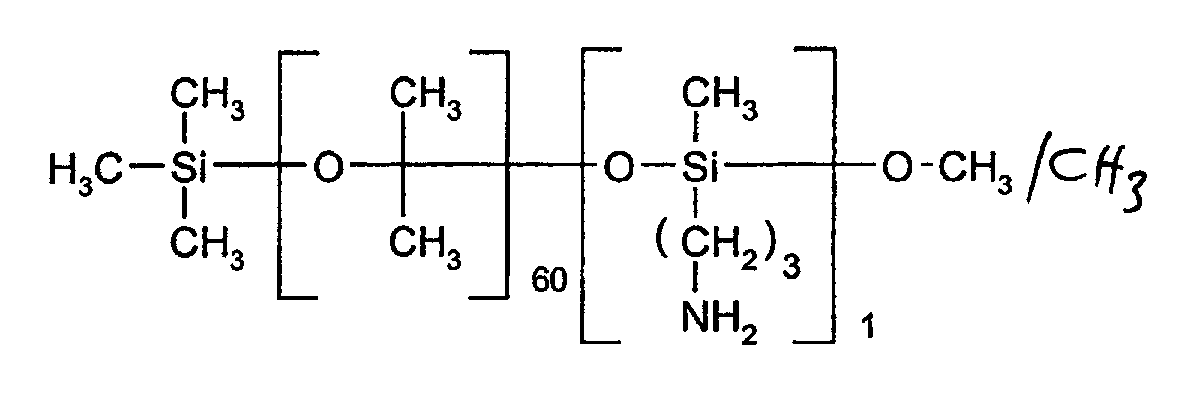
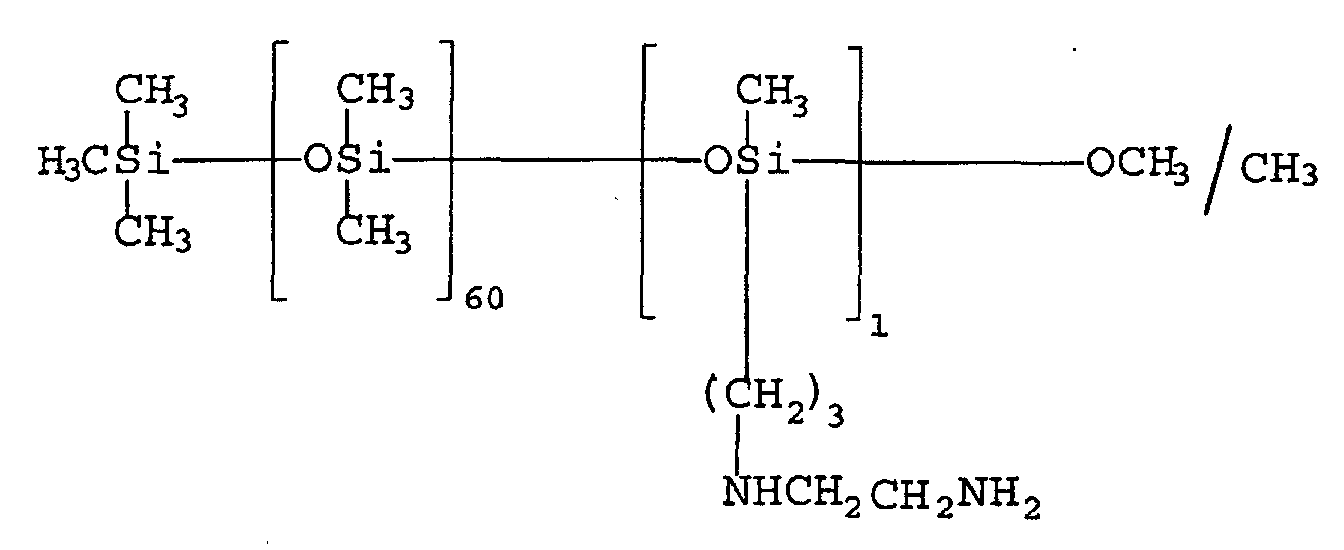
- W/O-Emulsionen, enthaltend aminofunktionelle Organopolysiloxane der allgemeinen Formelnoder

- Emulsionen nach Anspruch 1, enthaltend 1 bis 60 Gew.-% aminofunktionelle Organosiloxane.
- Emulsionen nach einem der Ansprüche 1 bis 2, enthaltend keine weiteren Emulgatoren.
- Emulsionen nach einem der Ansprüche 1 bis 3, umfassend Autopoliturmittel, Reinigungsmittel für Glaskeramikfelder, Textilbehandlungsmittel, Schuhpflegemittel, Kosmetika und Haargel.
Applications Claiming Priority (2)
| Application Number | Priority Date | Filing Date | Title |
|---|---|---|---|
| DE19856930 | 1998-12-10 | ||
| DE19856930 | 1998-12-10 |
Publications (3)
| Publication Number | Publication Date |
|---|---|
| EP1008616A2 EP1008616A2 (de) | 2000-06-14 |
| EP1008616A3 EP1008616A3 (de) | 2001-05-02 |
| EP1008616B1 true EP1008616B1 (de) | 2004-08-25 |
Family
ID=7890584
Family Applications (1)
| Application Number | Title | Priority Date | Filing Date |
|---|---|---|---|
| EP99123638A Expired - Lifetime EP1008616B1 (de) | 1998-12-10 | 1999-11-27 | W/O-Emulsionen, enthaltend aminofunktionelle Organopolysiloxane |
Country Status (7)
| Country | Link |
|---|---|
| US (1) | US20030053975A1 (de) |
| EP (1) | EP1008616B1 (de) |
| JP (1) | JP2000169588A (de) |
| AT (1) | ATE274544T1 (de) |
| CA (1) | CA2292140A1 (de) |
| DE (1) | DE59910338D1 (de) |
| ES (1) | ES2226269T3 (de) |
Cited By (1)
| Publication number | Priority date | Publication date | Assignee | Title |
|---|---|---|---|---|
| US10593006B2 (en) | 2015-07-10 | 2020-03-17 | De La Rue International Limited | Methods of manufacturing security documents and security devices |
Families Citing this family (11)
| Publication number | Priority date | Publication date | Assignee | Title |
|---|---|---|---|---|
| DE102004040266A1 (de) | 2004-08-19 | 2006-02-23 | Wacker-Chemie Gmbh | Öl-in-Wasser Emulsionen von Aminosiloxanen |
| US20080019939A1 (en) * | 2006-07-20 | 2008-01-24 | Alberto-Culver Company | Conditioner formulation |
| DE102006039901A1 (de) * | 2006-08-25 | 2008-02-28 | Renate Marquardt | Neuartige hoch wasserhaltige Polyurethane, Verfahren zur ihrer Herstellung und Anwendung |
| US9427603B2 (en) | 2008-02-11 | 2016-08-30 | The Procter & Gamble Company | Process for reducing hair damage upon treatment of hair by heat |
| EP2090295B2 (de) * | 2008-02-11 | 2018-08-22 | The Procter and Gamble Company | Verfahren und Zusammensetzung zur Verringerung der Haartrocknungszeit |
| EP2619272B1 (de) * | 2010-09-20 | 2017-12-06 | The Procter and Gamble Company | Fluorpolymerfreie oberflächenschutzzusammensetzung |
| JP2013543543A (ja) * | 2010-09-20 | 2013-12-05 | ザ プロクター アンド ギャンブル カンパニー | 非フルオロポリマー表面保護組成物 |
| EP2431402B1 (de) * | 2010-09-20 | 2013-09-18 | Wacker Chemie AG | Aminoalkylgruppen aufweisende Polyorganosiloxane und Siliconharze enthaltende Mischungen |
| GB201703823D0 (en) | 2017-03-09 | 2017-04-26 | Safeguard Europe Ltd | Water-in-oil emulsion compositions |
| CN111374625B (zh) * | 2018-12-28 | 2022-07-15 | 青岛海尔洗衣机有限公司 | 一种洗鞋设备的控制方法 |
| US20230079912A1 (en) * | 2021-09-08 | 2023-03-16 | Momentive Performance Materials Inc. | Aqueous surface treating composition |
Family Cites Families (2)
| Publication number | Priority date | Publication date | Assignee | Title |
|---|---|---|---|---|
| US4973643A (en) * | 1989-12-11 | 1990-11-27 | Siltech Inc. | Ether amine fuctional silicone polymers |
| JP3523950B2 (ja) * | 1995-12-04 | 2004-04-26 | タイホー工業株式会社 | 車両塗装面用処理剤 |
-
1999
- 1999-11-27 EP EP99123638A patent/EP1008616B1/de not_active Expired - Lifetime
- 1999-11-27 AT AT99123638T patent/ATE274544T1/de not_active IP Right Cessation
- 1999-11-27 ES ES99123638T patent/ES2226269T3/es not_active Expired - Lifetime
- 1999-11-27 DE DE59910338T patent/DE59910338D1/de not_active Expired - Lifetime
- 1999-12-07 JP JP11347461A patent/JP2000169588A/ja active Pending
- 1999-12-08 US US09/457,449 patent/US20030053975A1/en not_active Abandoned
- 1999-12-08 CA CA002292140A patent/CA2292140A1/en not_active Abandoned
Cited By (2)
| Publication number | Priority date | Publication date | Assignee | Title |
|---|---|---|---|---|
| US10593006B2 (en) | 2015-07-10 | 2020-03-17 | De La Rue International Limited | Methods of manufacturing security documents and security devices |
| US10861121B2 (en) | 2015-07-10 | 2020-12-08 | De La Rue International Limited | Methods of manufacturing security documents and security devices |
Also Published As
| Publication number | Publication date |
|---|---|
| US20030053975A1 (en) | 2003-03-20 |
| EP1008616A2 (de) | 2000-06-14 |
| ATE274544T1 (de) | 2004-09-15 |
| DE59910338D1 (de) | 2004-09-30 |
| EP1008616A3 (de) | 2001-05-02 |
| JP2000169588A (ja) | 2000-06-20 |
| CA2292140A1 (en) | 2000-06-10 |
| ES2226269T3 (es) | 2005-03-16 |
Similar Documents
| Publication | Publication Date | Title |
|---|---|---|
| DE1493380C3 (de) | ||
| EP0879840B1 (de) | Polyhydroxyorganyl-, insbesondere Zucker- oder Zuckerderivatreste und Polyoxyalkylenreste aufweisende Organopolysiloxane | |
| DE69506848T2 (de) | Hydrolisierte silan-emulsionen und ihre verwendung zum imprägnieren von oberflächen | |
| DE2936678C2 (de) | Poliermittel | |
| EP0164668B1 (de) | Betaingruppen enthaltende Siloxane, deren Herstellung und Verwendung in Haarpflegemitteln | |
| DE3417912C1 (de) | Betaingruppen enthaltende Siloxane,deren Herstellung und Verwendung in kosmetischen Zubereitungen | |
| DE69733519T2 (de) | Blockcopolymere auf basis von silikonen und aminopolyalkylenoxiden | |
| EP0036597B1 (de) | Schaumdämpfungsmittel und dessen Verwendung in Kunstharz-, Lack- und Farbdispersionen | |
| DE2645282C3 (de) | Haarkosmetikum | |
| DE19749380A1 (de) | Aminosiloxanhaltige Zusammensetzungen | |
| DE2354759B2 (de) | Gemisch von oberflächenaktiven Stoffen | |
| EP0612754A1 (de) | Organopolysiloxanpolyether und deren Verwendung als hydrolysestabile Netzmittel in wässrigen Systemen | |
| DE69907421T2 (de) | Mittel für die reinigung harter oberflächen | |
| DE2645890B2 (de) | Siliciumorganische Verbindungen und diese enthaltende Textilf aserpräparationen | |
| DE2404138B2 (de) | Zusatz für Poliermittel | |
| EP1008616A2 (de) | W/O-Emulsionen, enthaltend aminofunktionelle Organopolysiloxane | |
| DE69930633T2 (de) | Verwendung einer funktionalisierten siliconzusammensetzung zur herstellung von wasser- und/oder ölabweisenden beschichtungen und imprägnierungen mit einer niedrigen oberflächenenergie | |
| EP0867462B1 (de) | Neuartige Siloxanblockcopolymere mit verknüpften Siloxanblöcken | |
| DE1108917B (de) | Organosiloxymethylalkane | |
| DE3321289A1 (de) | Siloxanzusammensetzung in form einer emulsion von wasser-in-oel und ihre verwendung zur reinigung und konditionierung der oberflaeche eines gegenstandes aus glaskeramik | |
| DE2952756C2 (de) | Verfahren zur haftungsmindernden Ausrüstung von Glaskeramik-Oberflächen und dafür geeignetes Mittel | |
| EP4263462B1 (de) | Verdünnungsstabile wässrige zusammensetzung zur massenhydrophobierung von mineralischen baustoffen | |
| DE69706314T2 (de) | Reinigungsmittel mit kationischen monoalkkytensiden | |
| DE69105251T2 (de) | Verwendung von polyorganosiloxangepfropftem Polyester als Mittel zum Oberflächenschutz. | |
| DE102014216380A1 (de) | Emulsionen von Aminosiloxanen und Silicaten |
Legal Events
| Date | Code | Title | Description |
|---|---|---|---|
| PUAI | Public reference made under article 153(3) epc to a published international application that has entered the european phase |
Free format text: ORIGINAL CODE: 0009012 |
|
| 17P | Request for examination filed |
Effective date: 19991208 |
|
| AK | Designated contracting states |
Kind code of ref document: A2 Designated state(s): AT BE CH CY DE DK ES FI FR GB GR IE IT LI LU MC NL PT SE |
|
| AX | Request for extension of the european patent |
Free format text: AL;LT;LV;MK;RO;SI |
|
| PUAL | Search report despatched |
Free format text: ORIGINAL CODE: 0009013 |
|
| AK | Designated contracting states |
Kind code of ref document: A3 Designated state(s): AT BE CH CY DE DK ES FI FR GB GR IE IT LI LU MC NL PT SE |
|
| AX | Request for extension of the european patent |
Free format text: AL;LT;LV;MK;RO;SI |
|
| AKX | Designation fees paid |
Free format text: AT BE CH CY DE DK ES FI FR GB GR IE IT LI LU MC NL PT SE |
|
| 17Q | First examination report despatched |
Effective date: 20020916 |
|
| GRAP | Despatch of communication of intention to grant a patent |
Free format text: ORIGINAL CODE: EPIDOSNIGR1 |
|
| GRAS | Grant fee paid |
Free format text: ORIGINAL CODE: EPIDOSNIGR3 |
|
| GRAA | (expected) grant |
Free format text: ORIGINAL CODE: 0009210 |
|
| AK | Designated contracting states |
Kind code of ref document: B1 Designated state(s): AT BE CH CY DE DK ES FI FR GB GR IE IT LI LU MC NL PT SE |
|
| PG25 | Lapsed in a contracting state [announced via postgrant information from national office to epo] |
Ref country code: IE Free format text: LAPSE BECAUSE OF FAILURE TO SUBMIT A TRANSLATION OF THE DESCRIPTION OR TO PAY THE FEE WITHIN THE PRESCRIBED TIME-LIMIT Effective date: 20040825 Ref country code: FI Free format text: LAPSE BECAUSE OF FAILURE TO SUBMIT A TRANSLATION OF THE DESCRIPTION OR TO PAY THE FEE WITHIN THE PRESCRIBED TIME-LIMIT Effective date: 20040825 Ref country code: CY Free format text: LAPSE BECAUSE OF FAILURE TO SUBMIT A TRANSLATION OF THE DESCRIPTION OR TO PAY THE FEE WITHIN THE PRESCRIBED TIME-LIMIT Effective date: 20040825 |
|
| REG | Reference to a national code |
Ref country code: GB Ref legal event code: FG4D Free format text: NOT ENGLISH |
|
| REG | Reference to a national code |
Ref country code: CH Ref legal event code: EP |
|
| REG | Reference to a national code |
Ref country code: IE Ref legal event code: FG4D Free format text: GERMAN |
|
| REF | Corresponds to: |
Ref document number: 59910338 Country of ref document: DE Date of ref document: 20040930 Kind code of ref document: P |
|
| PG25 | Lapsed in a contracting state [announced via postgrant information from national office to epo] |
Ref country code: SE Free format text: LAPSE BECAUSE OF FAILURE TO SUBMIT A TRANSLATION OF THE DESCRIPTION OR TO PAY THE FEE WITHIN THE PRESCRIBED TIME-LIMIT Effective date: 20041125 Ref country code: GR Free format text: LAPSE BECAUSE OF FAILURE TO SUBMIT A TRANSLATION OF THE DESCRIPTION OR TO PAY THE FEE WITHIN THE PRESCRIBED TIME-LIMIT Effective date: 20041125 Ref country code: DK Free format text: LAPSE BECAUSE OF FAILURE TO SUBMIT A TRANSLATION OF THE DESCRIPTION OR TO PAY THE FEE WITHIN THE PRESCRIBED TIME-LIMIT Effective date: 20041125 |
|
| PG25 | Lapsed in a contracting state [announced via postgrant information from national office to epo] |
Ref country code: LU Free format text: LAPSE BECAUSE OF NON-PAYMENT OF DUE FEES Effective date: 20041127 |
|
| PG25 | Lapsed in a contracting state [announced via postgrant information from national office to epo] |
Ref country code: MC Free format text: LAPSE BECAUSE OF NON-PAYMENT OF DUE FEES Effective date: 20041130 |
|
| GBT | Gb: translation of ep patent filed (gb section 77(6)(a)/1977) |
Effective date: 20050119 |
|
| REG | Reference to a national code |
Ref country code: ES Ref legal event code: FG2A Ref document number: 2226269 Country of ref document: ES Kind code of ref document: T3 |
|
| RAP2 | Party data changed (patent owner data changed or rights of a patent transferred) |
Owner name: GOLDSCHMIDT GMBH |
|
| REG | Reference to a national code |
Ref country code: IE Ref legal event code: FD4D |
|
| REG | Reference to a national code |
Ref country code: CH Ref legal event code: PFA Owner name: GOLDSCHMIDT GMBH Free format text: GOLDSCHMIDT AG#GOLDSCHMIDTSTRASSE 100#45127 ESSEN (DE) -TRANSFER TO- GOLDSCHMIDT GMBH#GOLDSCHMIDTSTRASSE 100#45127 ESSEN (DE) |
|
| NLT2 | Nl: modifications (of names), taken from the european patent patent bulletin |
Owner name: GOLDSCHMIDT GMBH |
|
| ET | Fr: translation filed | ||
| PLBE | No opposition filed within time limit |
Free format text: ORIGINAL CODE: 0009261 |
|
| STAA | Information on the status of an ep patent application or granted ep patent |
Free format text: STATUS: NO OPPOSITION FILED WITHIN TIME LIMIT |
|
| 26N | No opposition filed |
Effective date: 20050526 |
|
| REG | Reference to a national code |
Ref country code: FR Ref legal event code: CJ Ref country code: FR Ref legal event code: CD |
|
| PGFP | Annual fee paid to national office [announced via postgrant information from national office to epo] |
Ref country code: CH Payment date: 20051114 Year of fee payment: 7 |
|
| PGFP | Annual fee paid to national office [announced via postgrant information from national office to epo] |
Ref country code: AT Payment date: 20051115 Year of fee payment: 7 |
|
| PG25 | Lapsed in a contracting state [announced via postgrant information from national office to epo] |
Ref country code: AT Free format text: LAPSE BECAUSE OF NON-PAYMENT OF DUE FEES Effective date: 20061127 |
|
| PG25 | Lapsed in a contracting state [announced via postgrant information from national office to epo] |
Ref country code: LI Free format text: LAPSE BECAUSE OF NON-PAYMENT OF DUE FEES Effective date: 20061130 Ref country code: CH Free format text: LAPSE BECAUSE OF NON-PAYMENT OF DUE FEES Effective date: 20061130 |
|
| REG | Reference to a national code |
Ref country code: CH Ref legal event code: PL |
|
| PG25 | Lapsed in a contracting state [announced via postgrant information from national office to epo] |
Ref country code: PT Free format text: LAPSE BECAUSE OF NON-PAYMENT OF DUE FEES Effective date: 20050125 |
|
| REG | Reference to a national code |
Ref country code: FR Ref legal event code: CD |
|
| PGFP | Annual fee paid to national office [announced via postgrant information from national office to epo] |
Ref country code: NL Payment date: 20091112 Year of fee payment: 11 |
|
| REG | Reference to a national code |
Ref country code: NL Ref legal event code: TD Effective date: 20100223 Ref country code: NL Ref legal event code: SD Effective date: 20100223 |
|
| PGFP | Annual fee paid to national office [announced via postgrant information from national office to epo] |
Ref country code: BE Payment date: 20091224 Year of fee payment: 11 |
|
| BERE | Be: lapsed |
Owner name: *GOLDSCHMIDT G.M.B.H. Effective date: 20101130 |
|
| REG | Reference to a national code |
Ref country code: NL Ref legal event code: V1 Effective date: 20110601 |
|
| PG25 | Lapsed in a contracting state [announced via postgrant information from national office to epo] |
Ref country code: BE Free format text: LAPSE BECAUSE OF NON-PAYMENT OF DUE FEES Effective date: 20101130 Ref country code: NL Free format text: LAPSE BECAUSE OF NON-PAYMENT OF DUE FEES Effective date: 20110601 |
|
| REG | Reference to a national code |
Ref country code: DE Ref legal event code: R081 Ref document number: 59910338 Country of ref document: DE Owner name: EVONIK DEGUSSA GMBH, DE Free format text: FORMER OWNER: EVONIK GOLDSCHMIDT GMBH, 45127 ESSEN, DE Effective date: 20131024 |
|
| REG | Reference to a national code |
Ref country code: GB Ref legal event code: 732E Free format text: REGISTERED BETWEEN 20140320 AND 20140326 |
|
| REG | Reference to a national code |
Ref country code: ES Ref legal event code: PC2A Owner name: EVONIK DEGUSSA GMBH Effective date: 20140424 |
|
| REG | Reference to a national code |
Ref country code: FR Ref legal event code: TP Owner name: EVONIK DEGUSSA GMBH, DE Effective date: 20140411 |
|
| REG | Reference to a national code |
Ref country code: FR Ref legal event code: PLFP Year of fee payment: 17 |
|
| REG | Reference to a national code |
Ref country code: FR Ref legal event code: PLFP Year of fee payment: 18 |
|
| REG | Reference to a national code |
Ref country code: FR Ref legal event code: PLFP Year of fee payment: 19 |
|
| PGFP | Annual fee paid to national office [announced via postgrant information from national office to epo] |
Ref country code: DE Payment date: 20181120 Year of fee payment: 20 |
|
| PGFP | Annual fee paid to national office [announced via postgrant information from national office to epo] |
Ref country code: ES Payment date: 20181218 Year of fee payment: 20 Ref country code: IT Payment date: 20181126 Year of fee payment: 20 Ref country code: FR Payment date: 20181123 Year of fee payment: 20 Ref country code: GB Payment date: 20181120 Year of fee payment: 20 |
|
| REG | Reference to a national code |
Ref country code: DE Ref legal event code: R071 Ref document number: 59910338 Country of ref document: DE |
|
| REG | Reference to a national code |
Ref country code: DE Ref legal event code: R081 Ref document number: 59910338 Country of ref document: DE Owner name: EVONIK OPERATIONS GMBH, DE Free format text: FORMER OWNER: EVONIK DEGUSSA GMBH, 45128 ESSEN, DE |
|
| REG | Reference to a national code |
Ref country code: GB Ref legal event code: PE20 Expiry date: 20191126 |
|
| PG25 | Lapsed in a contracting state [announced via postgrant information from national office to epo] |
Ref country code: GB Free format text: LAPSE BECAUSE OF EXPIRATION OF PROTECTION Effective date: 20191126 |
|
| REG | Reference to a national code |
Ref country code: ES Ref legal event code: FD2A Effective date: 20210129 |
|
| PG25 | Lapsed in a contracting state [announced via postgrant information from national office to epo] |
Ref country code: ES Free format text: LAPSE BECAUSE OF EXPIRATION OF PROTECTION Effective date: 20191128 |