EP1007751B1 - A cermet having a binder with improved plasticity, a method for the manufacture and use therof - Google Patents
A cermet having a binder with improved plasticity, a method for the manufacture and use therof Download PDFInfo
- Publication number
- EP1007751B1 EP1007751B1 EP98937709A EP98937709A EP1007751B1 EP 1007751 B1 EP1007751 B1 EP 1007751B1 EP 98937709 A EP98937709 A EP 98937709A EP 98937709 A EP98937709 A EP 98937709A EP 1007751 B1 EP1007751 B1 EP 1007751B1
- Authority
- EP
- European Patent Office
- Prior art keywords
- binder
- cermet
- cobalt
- iron
- nickel
- Prior art date
- Legal status (The legal status is an assumption and is not a legal conclusion. Google has not performed a legal analysis and makes no representation as to the accuracy of the status listed.)
- Expired - Lifetime
Links
- 239000011230 binding agent Substances 0.000 title claims abstract description 155
- 239000011195 cermet Substances 0.000 title claims description 145
- 238000000034 method Methods 0.000 title claims description 19
- 238000004519 manufacturing process Methods 0.000 title claims description 5
- 230000009466 transformation Effects 0.000 claims abstract description 14
- 238000000844 transformation Methods 0.000 claims abstract description 5
- 239000000463 material Substances 0.000 claims description 110
- PXHVJJICTQNCMI-UHFFFAOYSA-N Nickel Chemical compound [Ni] PXHVJJICTQNCMI-UHFFFAOYSA-N 0.000 claims description 65
- XEEYBQQBJWHFJM-UHFFFAOYSA-N Iron Chemical compound [Fe] XEEYBQQBJWHFJM-UHFFFAOYSA-N 0.000 claims description 63
- GUTLYIVDDKVIGB-UHFFFAOYSA-N cobalt atom Chemical compound [Co] GUTLYIVDDKVIGB-UHFFFAOYSA-N 0.000 claims description 37
- 229910017052 cobalt Inorganic materials 0.000 claims description 33
- 239000010941 cobalt Substances 0.000 claims description 33
- 238000005245 sintering Methods 0.000 claims description 33
- 229910052759 nickel Inorganic materials 0.000 claims description 26
- 229910052742 iron Inorganic materials 0.000 claims description 24
- 239000000203 mixture Substances 0.000 claims description 24
- 239000010936 titanium Substances 0.000 claims description 19
- 239000000843 powder Substances 0.000 claims description 16
- 229910052719 titanium Inorganic materials 0.000 claims description 16
- RTAQQCXQSZGOHL-UHFFFAOYSA-N Titanium Chemical compound [Ti] RTAQQCXQSZGOHL-UHFFFAOYSA-N 0.000 claims description 15
- WFKWXMTUELFFGS-UHFFFAOYSA-N tungsten Chemical compound [W] WFKWXMTUELFFGS-UHFFFAOYSA-N 0.000 claims description 12
- 229910052721 tungsten Inorganic materials 0.000 claims description 12
- 239000010937 tungsten Substances 0.000 claims description 12
- UONOETXJSWQNOL-UHFFFAOYSA-N tungsten carbide Chemical compound [W+]#[C-] UONOETXJSWQNOL-UHFFFAOYSA-N 0.000 claims description 12
- 150000001247 metal acetylides Chemical class 0.000 claims description 11
- 229910052804 chromium Inorganic materials 0.000 claims description 10
- 239000011651 chromium Substances 0.000 claims description 10
- 238000000280 densification Methods 0.000 claims description 10
- 229910052758 niobium Inorganic materials 0.000 claims description 10
- 239000010955 niobium Substances 0.000 claims description 10
- 229910052715 tantalum Inorganic materials 0.000 claims description 10
- VYZAMTAEIAYCRO-UHFFFAOYSA-N Chromium Chemical compound [Cr] VYZAMTAEIAYCRO-UHFFFAOYSA-N 0.000 claims description 9
- ZOKXTWBITQBERF-UHFFFAOYSA-N Molybdenum Chemical compound [Mo] ZOKXTWBITQBERF-UHFFFAOYSA-N 0.000 claims description 9
- QCWXUUIWCKQGHC-UHFFFAOYSA-N Zirconium Chemical compound [Zr] QCWXUUIWCKQGHC-UHFFFAOYSA-N 0.000 claims description 9
- 229910052735 hafnium Inorganic materials 0.000 claims description 9
- VBJZVLUMGGDVMO-UHFFFAOYSA-N hafnium atom Chemical compound [Hf] VBJZVLUMGGDVMO-UHFFFAOYSA-N 0.000 claims description 9
- 238000003754 machining Methods 0.000 claims description 9
- 229910052750 molybdenum Inorganic materials 0.000 claims description 9
- 239000011733 molybdenum Substances 0.000 claims description 9
- GUCVJGMIXFAOAE-UHFFFAOYSA-N niobium atom Chemical compound [Nb] GUCVJGMIXFAOAE-UHFFFAOYSA-N 0.000 claims description 9
- GUVRBAGPIYLISA-UHFFFAOYSA-N tantalum atom Chemical compound [Ta] GUVRBAGPIYLISA-UHFFFAOYSA-N 0.000 claims description 9
- 229910052720 vanadium Inorganic materials 0.000 claims description 9
- LEONUFNNVUYDNQ-UHFFFAOYSA-N vanadium atom Chemical compound [V] LEONUFNNVUYDNQ-UHFFFAOYSA-N 0.000 claims description 9
- 229910052726 zirconium Inorganic materials 0.000 claims description 9
- 238000010276 construction Methods 0.000 claims description 8
- 238000005520 cutting process Methods 0.000 claims description 8
- 238000005065 mining Methods 0.000 claims description 7
- 150000004767 nitrides Chemical class 0.000 claims description 7
- 239000012535 impurity Substances 0.000 claims description 5
- 239000006104 solid solution Substances 0.000 claims description 4
- 230000007717 exclusion Effects 0.000 claims 2
- 229910000531 Co alloy Inorganic materials 0.000 claims 1
- 229910000640 Fe alloy Inorganic materials 0.000 claims 1
- 229910000990 Ni alloy Inorganic materials 0.000 claims 1
- 239000004033 plastic Substances 0.000 abstract description 12
- 239000013078 crystal Substances 0.000 abstract description 3
- 238000005482 strain hardening Methods 0.000 abstract description 3
- 238000009826 distribution Methods 0.000 description 17
- 230000000052 comparative effect Effects 0.000 description 15
- 238000004627 transmission electron microscopy Methods 0.000 description 12
- 238000005452 bending Methods 0.000 description 11
- 238000002149 energy-dispersive X-ray emission spectroscopy Methods 0.000 description 9
- 229910052751 metal Inorganic materials 0.000 description 8
- 239000002184 metal Substances 0.000 description 8
- 230000008901 benefit Effects 0.000 description 6
- 239000011248 coating agent Substances 0.000 description 6
- 238000000576 coating method Methods 0.000 description 6
- 238000001513 hot isostatic pressing Methods 0.000 description 6
- 238000003801 milling Methods 0.000 description 6
- OKTJSMMVPCPJKN-UHFFFAOYSA-N Carbon Chemical compound [C] OKTJSMMVPCPJKN-UHFFFAOYSA-N 0.000 description 5
- 238000003917 TEM image Methods 0.000 description 5
- 229910052799 carbon Inorganic materials 0.000 description 5
- 230000007797 corrosion Effects 0.000 description 5
- 238000005260 corrosion Methods 0.000 description 5
- XKRFYHLGVUSROY-UHFFFAOYSA-N Argon Chemical compound [Ar] XKRFYHLGVUSROY-UHFFFAOYSA-N 0.000 description 4
- IJGRMHOSHXDMSA-UHFFFAOYSA-N Atomic nitrogen Chemical compound N#N IJGRMHOSHXDMSA-UHFFFAOYSA-N 0.000 description 4
- 238000004458 analytical method Methods 0.000 description 4
- 239000012298 atmosphere Substances 0.000 description 4
- 230000003287 optical effect Effects 0.000 description 4
- 230000003647 oxidation Effects 0.000 description 4
- 238000007254 oxidation reaction Methods 0.000 description 4
- 238000003825 pressing Methods 0.000 description 4
- 239000000126 substance Substances 0.000 description 4
- 229910001339 C alloy Inorganic materials 0.000 description 3
- UFHFLCQGNIYNRP-UHFFFAOYSA-N Hydrogen Chemical compound [H][H] UFHFLCQGNIYNRP-UHFFFAOYSA-N 0.000 description 3
- 230000015572 biosynthetic process Effects 0.000 description 3
- 238000005229 chemical vapour deposition Methods 0.000 description 3
- 125000004122 cyclic group Chemical group 0.000 description 3
- 239000007789 gas Substances 0.000 description 3
- 230000007246 mechanism Effects 0.000 description 3
- 150000002739 metals Chemical class 0.000 description 3
- 238000012360 testing method Methods 0.000 description 3
- QGZKDVFQNNGYKY-UHFFFAOYSA-N Ammonia Chemical compound N QGZKDVFQNNGYKY-UHFFFAOYSA-N 0.000 description 2
- MCMNRKCIXSYSNV-UHFFFAOYSA-N Zirconium dioxide Chemical compound O=[Zr]=O MCMNRKCIXSYSNV-UHFFFAOYSA-N 0.000 description 2
- 229910052768 actinide Inorganic materials 0.000 description 2
- 150000001255 actinides Chemical class 0.000 description 2
- 238000005275 alloying Methods 0.000 description 2
- 229910052786 argon Inorganic materials 0.000 description 2
- 239000012300 argon atmosphere Substances 0.000 description 2
- QVGXLLKOCUKJST-UHFFFAOYSA-N atomic oxygen Chemical compound [O] QVGXLLKOCUKJST-UHFFFAOYSA-N 0.000 description 2
- 238000012512 characterization method Methods 0.000 description 2
- 238000005336 cracking Methods 0.000 description 2
- 230000001419 dependent effect Effects 0.000 description 2
- 230000001627 detrimental effect Effects 0.000 description 2
- 229910003460 diamond Inorganic materials 0.000 description 2
- 239000010432 diamond Substances 0.000 description 2
- 239000001257 hydrogen Substances 0.000 description 2
- 229910052739 hydrogen Inorganic materials 0.000 description 2
- NPURPEXKKDAKIH-UHFFFAOYSA-N iodoimino(oxo)methane Chemical compound IN=C=O NPURPEXKKDAKIH-UHFFFAOYSA-N 0.000 description 2
- 229910052747 lanthanoid Inorganic materials 0.000 description 2
- 150000002602 lanthanoids Chemical class 0.000 description 2
- 238000011068 loading method Methods 0.000 description 2
- 229910000734 martensite Inorganic materials 0.000 description 2
- 238000004452 microanalysis Methods 0.000 description 2
- 229910052757 nitrogen Inorganic materials 0.000 description 2
- 229910052760 oxygen Inorganic materials 0.000 description 2
- 239000001301 oxygen Substances 0.000 description 2
- 239000002245 particle Substances 0.000 description 2
- 239000012071 phase Substances 0.000 description 2
- 229910021332 silicide Inorganic materials 0.000 description 2
- 239000007787 solid Substances 0.000 description 2
- 230000000087 stabilizing effect Effects 0.000 description 2
- MTPVUVINMAGMJL-UHFFFAOYSA-N trimethyl(1,1,2,2,2-pentafluoroethyl)silane Chemical compound C[Si](C)(C)C(F)(F)C(F)(F)F MTPVUVINMAGMJL-UHFFFAOYSA-N 0.000 description 2
- 229910052582 BN Inorganic materials 0.000 description 1
- PZNSFCLAULLKQX-UHFFFAOYSA-N Boron nitride Chemical compound N#B PZNSFCLAULLKQX-UHFFFAOYSA-N 0.000 description 1
- 229910020630 Co Ni Inorganic materials 0.000 description 1
- 229910002440 Co–Ni Inorganic materials 0.000 description 1
- 229910025794 LaB6 Inorganic materials 0.000 description 1
- 229910003271 Ni-Fe Inorganic materials 0.000 description 1
- 240000007817 Olea europaea Species 0.000 description 1
- 229910052581 Si3N4 Inorganic materials 0.000 description 1
- 229910003564 SiAlON Inorganic materials 0.000 description 1
- XUIMIQQOPSSXEZ-UHFFFAOYSA-N Silicon Chemical compound [Si] XUIMIQQOPSSXEZ-UHFFFAOYSA-N 0.000 description 1
- NRTOMJZYCJJWKI-UHFFFAOYSA-N Titanium nitride Chemical compound [Ti]#N NRTOMJZYCJJWKI-UHFFFAOYSA-N 0.000 description 1
- 238000007545 Vickers hardness test Methods 0.000 description 1
- 229910009043 WC-Co Inorganic materials 0.000 description 1
- QSJRLTAPBBPGQN-UHFFFAOYSA-N [Co].[W].[C] Chemical compound [Co].[W].[C] QSJRLTAPBBPGQN-UHFFFAOYSA-N 0.000 description 1
- KGWWEXORQXHJJQ-UHFFFAOYSA-N [Fe].[Co].[Ni] Chemical compound [Fe].[Co].[Ni] KGWWEXORQXHJJQ-UHFFFAOYSA-N 0.000 description 1
- ZVLDJSZFKQJMKD-UHFFFAOYSA-N [Li].[Si] Chemical compound [Li].[Si] ZVLDJSZFKQJMKD-UHFFFAOYSA-N 0.000 description 1
- 229910045601 alloy Inorganic materials 0.000 description 1
- 239000000956 alloy Substances 0.000 description 1
- UQZIWOQVLUASCR-UHFFFAOYSA-N alumane;titanium Chemical compound [AlH3].[Ti] UQZIWOQVLUASCR-UHFFFAOYSA-N 0.000 description 1
- 229910052782 aluminium Inorganic materials 0.000 description 1
- XAGFODPZIPBFFR-UHFFFAOYSA-N aluminium Chemical compound [Al] XAGFODPZIPBFFR-UHFFFAOYSA-N 0.000 description 1
- PNEYBMLMFCGWSK-UHFFFAOYSA-N aluminium oxide Inorganic materials [O-2].[O-2].[O-2].[Al+3].[Al+3] PNEYBMLMFCGWSK-UHFFFAOYSA-N 0.000 description 1
- 229910021529 ammonia Inorganic materials 0.000 description 1
- 238000000498 ball milling Methods 0.000 description 1
- 230000004888 barrier function Effects 0.000 description 1
- 238000009412 basement excavation Methods 0.000 description 1
- 230000005540 biological transmission Effects 0.000 description 1
- -1 carbon Chemical compound 0.000 description 1
- 238000005255 carburizing Methods 0.000 description 1
- 239000004568 cement Substances 0.000 description 1
- 239000000919 ceramic Substances 0.000 description 1
- 239000002131 composite material Substances 0.000 description 1
- 238000007906 compression Methods 0.000 description 1
- 238000007739 conversion coating Methods 0.000 description 1
- 238000001816 cooling Methods 0.000 description 1
- PMHQVHHXPFUNSP-UHFFFAOYSA-M copper(1+);methylsulfanylmethane;bromide Chemical compound Br[Cu].CSC PMHQVHHXPFUNSP-UHFFFAOYSA-M 0.000 description 1
- 230000007547 defect Effects 0.000 description 1
- 238000005516 engineering process Methods 0.000 description 1
- 230000007613 environmental effect Effects 0.000 description 1
- 238000001125 extrusion Methods 0.000 description 1
- 238000000227 grinding Methods 0.000 description 1
- 238000007731 hot pressing Methods 0.000 description 1
- 230000002706 hydrostatic effect Effects 0.000 description 1
- 239000004615 ingredient Substances 0.000 description 1
- 238000001746 injection moulding Methods 0.000 description 1
- 229910052500 inorganic mineral Inorganic materials 0.000 description 1
- 230000003993 interaction Effects 0.000 description 1
- UGKDIUIOSMUOAW-UHFFFAOYSA-N iron nickel Chemical group [Fe].[Ni] UGKDIUIOSMUOAW-UHFFFAOYSA-N 0.000 description 1
- 238000000462 isostatic pressing Methods 0.000 description 1
- 239000007788 liquid Substances 0.000 description 1
- 239000007791 liquid phase Substances 0.000 description 1
- 230000005415 magnetization Effects 0.000 description 1
- 229910001092 metal group alloy Inorganic materials 0.000 description 1
- 239000011707 mineral Substances 0.000 description 1
- 239000002086 nanomaterial Substances 0.000 description 1
- QJGQUHMNIGDVPM-UHFFFAOYSA-N nitrogen group Chemical group [N] QJGQUHMNIGDVPM-UHFFFAOYSA-N 0.000 description 1
- 238000000399 optical microscopy Methods 0.000 description 1
- JMANVNJQNLATNU-UHFFFAOYSA-N oxalonitrile Chemical compound N#CC#N JMANVNJQNLATNU-UHFFFAOYSA-N 0.000 description 1
- 239000012188 paraffin wax Substances 0.000 description 1
- 239000003209 petroleum derivative Substances 0.000 description 1
- 230000008569 process Effects 0.000 description 1
- 230000001681 protective effect Effects 0.000 description 1
- 239000003870 refractory metal Substances 0.000 description 1
- 239000011435 rock Substances 0.000 description 1
- 238000005096 rolling process Methods 0.000 description 1
- 238000004626 scanning electron microscopy Methods 0.000 description 1
- 229910052710 silicon Inorganic materials 0.000 description 1
- 239000010703 silicon Substances 0.000 description 1
- HQVNEWCFYHHQES-UHFFFAOYSA-N silicon nitride Chemical compound N12[Si]34N5[Si]62N3[Si]51N64 HQVNEWCFYHHQES-UHFFFAOYSA-N 0.000 description 1
- 238000007569 slipcasting Methods 0.000 description 1
- 238000007582 slurry-cast process Methods 0.000 description 1
- 239000000243 solution Substances 0.000 description 1
- 238000010561 standard procedure Methods 0.000 description 1
- 238000007655 standard test method Methods 0.000 description 1
- 239000007858 starting material Substances 0.000 description 1
- 229910000601 superalloy Inorganic materials 0.000 description 1
- 239000004094 surface-active agent Substances 0.000 description 1
- 238000010345 tape casting Methods 0.000 description 1
- 238000007740 vapor deposition Methods 0.000 description 1
Images





Classifications
-
- C—CHEMISTRY; METALLURGY
- C22—METALLURGY; FERROUS OR NON-FERROUS ALLOYS; TREATMENT OF ALLOYS OR NON-FERROUS METALS
- C22C—ALLOYS
- C22C29/00—Alloys based on carbides, oxides, nitrides, borides, or silicides, e.g. cermets, or other metal compounds, e.g. oxynitrides, sulfides
-
- C—CHEMISTRY; METALLURGY
- C22—METALLURGY; FERROUS OR NON-FERROUS ALLOYS; TREATMENT OF ALLOYS OR NON-FERROUS METALS
- C22C—ALLOYS
- C22C29/00—Alloys based on carbides, oxides, nitrides, borides, or silicides, e.g. cermets, or other metal compounds, e.g. oxynitrides, sulfides
- C22C29/005—Alloys based on carbides, oxides, nitrides, borides, or silicides, e.g. cermets, or other metal compounds, e.g. oxynitrides, sulfides comprising a particular metallic binder
-
- C—CHEMISTRY; METALLURGY
- C22—METALLURGY; FERROUS OR NON-FERROUS ALLOYS; TREATMENT OF ALLOYS OR NON-FERROUS METALS
- C22C—ALLOYS
- C22C19/00—Alloys based on nickel or cobalt
- C22C19/07—Alloys based on nickel or cobalt based on cobalt
-
- C—CHEMISTRY; METALLURGY
- C22—METALLURGY; FERROUS OR NON-FERROUS ALLOYS; TREATMENT OF ALLOYS OR NON-FERROUS METALS
- C22C—ALLOYS
- C22C29/00—Alloys based on carbides, oxides, nitrides, borides, or silicides, e.g. cermets, or other metal compounds, e.g. oxynitrides, sulfides
- C22C29/02—Alloys based on carbides, oxides, nitrides, borides, or silicides, e.g. cermets, or other metal compounds, e.g. oxynitrides, sulfides based on carbides or carbonitrides
- C22C29/06—Alloys based on carbides, oxides, nitrides, borides, or silicides, e.g. cermets, or other metal compounds, e.g. oxynitrides, sulfides based on carbides or carbonitrides based on carbides, but not containing other metal compounds
- C22C29/067—Alloys based on carbides, oxides, nitrides, borides, or silicides, e.g. cermets, or other metal compounds, e.g. oxynitrides, sulfides based on carbides or carbonitrides based on carbides, but not containing other metal compounds comprising a particular metallic binder
-
- Y—GENERAL TAGGING OF NEW TECHNOLOGICAL DEVELOPMENTS; GENERAL TAGGING OF CROSS-SECTIONAL TECHNOLOGIES SPANNING OVER SEVERAL SECTIONS OF THE IPC; TECHNICAL SUBJECTS COVERED BY FORMER USPC CROSS-REFERENCE ART COLLECTIONS [XRACs] AND DIGESTS
- Y10—TECHNICAL SUBJECTS COVERED BY FORMER USPC
- Y10S—TECHNICAL SUBJECTS COVERED BY FORMER USPC CROSS-REFERENCE ART COLLECTIONS [XRACs] AND DIGESTS
- Y10S977/00—Nanotechnology
- Y10S977/70—Nanostructure
- Y10S977/773—Nanoparticle, i.e. structure having three dimensions of 100 nm or less
- Y10S977/775—Nanosized powder or flake, e.g. nanosized catalyst
- Y10S977/777—Metallic powder or flake
Definitions
- Cermets are composite materials comprised of a hard component, which may or may not be interconnected three dimensionally, and a binder that ties together or binds the hard component.
- a traditional cermet is a tungsten carbide (WC) cermet (WC-cermet), also known as cobalt cemented tungsten carbide and WC-Co.
- the hard component is WC while the binder is cobalt (Co-binder) as, for example, a cobalt-tungsten-carbon alloy. This Co-binder is about 98 weight percent (wt.%) cobalt.
- Cobalt is the major binder for cermets.
- about 15 percent of the world's annual primary cobalt market is used in the manufacture of hard materials including WC-cermets.
- About 26 percent of the world's annual primary cobalt market is used in the manufacture of superalloys developed for advanced aircraft turbine engines-a factor contributing to cobalt being designated a strategic material.
- Up to about 45 percent of the world's primary cobalt production is located in politically unstable regions.
- WC-cermecs having an iron rich Fe-Co-Ni-binder were strengthened by stabilizing a body centered cubic (bcc) structure in the Fe-Co-Ni-binder.
- This bcc structure was achieved by a martensitic transformation.
- Prakash et al. focus on iron rich martensitic binder alloys, they are disclosing just one Co-Ni-Fe-binder consisting of 50 wt.% cobalt, 25 wt.% nickel, and 25 wt.% iron.
- Guilemany et al. studied the mechanical properties of WC-cermets having a Co-binder and enhanced corrosion resistant WC-cermets having a nickel rich nickel-iron substituted Co-binder at high binder contents made by sintering followed by HIPping. (see e.g., Guilemany et al., "Mechanical-Property Relationships of Co/WC and Co-Ni-Fe/WC Hard Metal Alloys," Int. J. of Refractory & Hard Materials (1993-1994) 12, 199-206).
- cobalt is interesting since it is allotropic - that is, at temperatures greater than about 417°C, pure cobalt's atoms are arranged in a face centered cubic (fcc) structure and at temperatures less than about 417°C, pure cobalt's atoms are arranged in a hexagonal close packed (hcp) structure.
- fcc face centered cubic
- hcp hexagonal close packed
- Alloying cobalt may temporarily suppress the fcc ⁇ hcp transformation stabilizing the fcc structure.
- Co-binder For example, it is known that alloying cobalt with tungsten and carbon to form a Co-W-C alloy (Co-binder) temporarily stabilizes the fcc structure. (See e.g., W. Dawihl et al., Kobalt 22 (1964) 16). It is well known however, that subjecting a Co-W-C alloy (Co-binder) to stress and/or strain induces the fcc ⁇ hcp transformation. (See e.g., U.
- Applicants have determined that in cermets the presence of the hcp structure in the binder can be detrimental since this can result in the embrittlement of the binder. Thus, it would be desirable to find a binder that not only provides cost savings and cost predictability but also does not exhibit embrittlement mechanisms such as local fcc ⁇ hcp transformations.
- the present invention is directed to a cermet having a binder having a fcc structure, with improved plasticity (the plastic binder possesses reduced work hardening) that is stable even under high stress and/or strain conditions.
- the cermet of the present invention also satisfies the need for a low cost cermet having improved cost predictability.
- the cermet comprises a hard component and a binder with improved plasticity that improves the crack resistance of the cermet.
- the cermet having the plastic binder may have a lower hardness
- the overall hardness of the inventive cermet may be adjusted by varying the grain size distribution of the hard component and/or amount of the hard component without sacrificing strength and/or toughness.
- the hard component amount is increased to increase the hardness of the cermet without sacrificing strength and/or toughness the cermet.
- One advantage of the cermet of the present invention includes improved crack resistance and reliability, which may be attributed to the plasticity of the binder, relative to a comparable cermet having a Co-binder.
- Another advantage of the cermet of the present invention includes improved corrosion resistance and/or oxidation resistance relative to a comparable cermet having a Co-binder.
- the cermet of the present invention is defined in claim 1 and comprises at least one hard component and a cobalt-nickel-iron-binder (Co-Ni-Fe-binder).
- the Co-Ni-Fe-binder comprises 40 wt.% to 90 wt.% cobalt, the remainder of said binder consisting of nickel and iron and incidental impurities, with a nickel content of at least 4 wt.% but no more than 36 wt.% of said binder and an iron content of at least 4 wt.% but no more than 36 wt.% of said binder, with said binder having a Ni:Fe ratio of 1.5:1 to 1:1.5; with a cermet, however, being disclaimed which comprises a Co-Ni-Fe-binder consisting of 50 wt.% cobalt, 25 wt.% nickel, and 25 wt.% iron.
- the Co-Ni-Fe-binder substantially comprises a face centered cubic (fcc) crystal structure and does not experience stress or strain induced phase transformation when subjected to plastic deformation.
- said Co-Ni-Fe-binder substantially is austenitic.
- This cermet having a Co-Ni-Fe-binder may be produced at a lower and less fluctuating cost than a cermet having a Co-binder.
- Advantages of cermets having a Co-Ni-Fe-binder include improved crack resistance and reliability, and improved corrosion resistance and/or oxidation resistance, both relative to comparable cermets having a Co-binder.
- the plastic binder of the present invention is unique in that even when subjected to plastic deformation, the binder maintains its fcc crystal structure and avoids stress and/or strain induced transformations.
- Applicants have measured strength and fatigue performance in cermets having Co-Ni-Fe-binders up to as much as about 2400 megapascal (MPa) for bending strength and up to as much as about 1550 MPa for cyclic fatigue (200,000 cycles in bending at about room temperature).
- MPa megapascal
- Applicants believe that substantially no stress and/or strain induced phase transformations occur in the Co-Ni-Fe-binder up to those stress and/or strain levels that leads to superior performance.
- the cermet of the present invention having a binder with improved plasticity comprises at least one hard component and a binder which, when combined with the at least one hard component, possess improved properties including, for example, improved resistance to subcritical crack growth under cycle fatigue, improved strength, and, optionally, improved oxidation resistance and/or improved corrosion resistance.
- the cermet of the present invention may exhibit corrosion resistance and/or oxidation resistance in an environment (e.g., a solid, a liquid, a gas, or any combination of the preceding) due to either (1) chemical inertness of the cermet, (2) formation of a protective barrier on the cermet from the interactions of the environment and the cermet, or (3) both.
- an environment e.g., a solid, a liquid, a gas, or any combination of the preceding
- a more preferred composition of the Co-Ni-Fe-binder comprises a Ni:Fe ratio of about 1:1.
- An even more preferred composition of the Co-Ni-Fe-binder comprises a cobalt:nickel:iron ratio of about 1.8:1:1.
- Co-Ni-Fe-binder may comprise incidental impurities emanating from starting materials, powder metalurgical, milling and/or sintering processes as well as environmental influences.
- the binder content of the cermets of the present invention is dependent on such factors as the composition and/or geometry of the hard component, the use of the cermet, and the composition of the binder.
- the binder content may comprise about 0.2 wt.% to 35 wt.% (preferably 3 wt.% to 30 wt.%)
- the binder content may comprise about 0.3 wt.% to 25 wt.% (preferably 3 wt.% to 20 wt.%).
- the binder content when an inventive WC-cermet having Co-Ni-Fe-binder is used as a pick-style tool for mining and construction, the binder content may comprise about 5 wt.% to 27 wt.% (preferably about 5 wt.% to 19 wt.%); and when an inventive WC-cermet having Co-Ni-Fe-binder is used as a rotary tool for mining and construction, the binder content may comprise about 5 wt.% to 19 wt (preferably about 5 wt.% to 15 wt.%); and when an inventive WC-cermet having Co-Ni-Fe-binder is used as a screw head punch, the binder content may comprise about 8 wt.% to 30 wt.% (preferably about 10 wt.% to 25 wt.%); and when an inventive cermet having Co-Ni-Fe-binder is used as a cutting tool for chip forming machining of workpiece materials, the binder content may comprise about 2
- a hard component may comprise at least one of borides, carbides, nitrides, carbonitrides, oxides, silicides, their mixtures, their solid solutions or combinations of the proceedings.
- the metal of the at least one of borides, carbides, nitrides, oxides, or silicides may include one or more metals from international union of pure and applied chemistry (IUPAC) groups 2, 3, (including lanthanides, actinides), 4, 5, 6, 7, 8, 9, 10, 11, 12, 13, and 14.
- IUPAC pure and applied chemistry
- the at least one hard component may comprise carbides, nitrides, carbonitrides their mixtures, their solid solutions, or any combinations of the preceding.
- the metal of the carbides, nitrides, and carbonitrides may comprise one or more metals of IUPAC groups 3, including lanthanides and actinides, 4, 5, and 6; and more preferably, one or more of titanium, zirconium, hafnium, vanadium, niobium, tantalum, chromium, molybdenum, and tungsten.
- inventive cermets may be referred to by the composition making up a majority of the hard component.
- the cermet may be designated a carbide-cermet.
- a majority of the hard component comprises tungsten carbide (WC)
- the cermet may be designated a tungsten carbide cermet or WC-cermet.
- cermets may be called, for example, boride-cermets, nitride-cermets, oxide-cermets, silicide-cermets, carbonitride-cermets, oxynitride-cermets.
- the cermet may be designated a titanium carbonitride cermet or TiCN-cermet.
- TiCN titanium carbonitride
- the grain size of the hard component of the cermet having a high plasticity binder may range in size from submicron to about 100 micrometers ( ⁇ m) or greater.
- Submicrometer includes nanostructured materials having structural features ranging from about 1 nanometer to about 100 namometers (0.1 ⁇ m) or more. It will be appreciated by those skilled in the art that the grain size of the hard component of the cermets of the present invention is dependent on such factors as the composition and/or geometry of the hard component, the use of the cermet, and the composition of the binder.
- the grain size of the hard component may comprise about 0.1 ⁇ m to about 40 ⁇ m
- the grain size of the hard component may comprise about 0.5 ⁇ m to about 6 ⁇ m.
- the grain size of the hard component may comprise about 1 ⁇ m to about 30 ⁇ m (preferably about 1 ⁇ m to about 25 ⁇ m) ; and when an inventive WC-cermet having Co-Ni-Fe-binder is used as a screw head punch, the grain size of the hard component may comprise about 1 ⁇ m to about 25 ⁇ m (preferably about 1 ⁇ m to about 15 ⁇ m); and when an inventive cermet having Co-Ni-Fe-binder is used as a cutting tool for chip forming machining of workpiece materials, the grain size of the hard component may comprise about 0.1 ⁇ m to 40 ⁇ m (preferably about 0.5 ⁇ m to 10 ⁇ m); and when an inventive cermet having Co-Ni-Fe-binder is used as an elongate rotary tool for machining materials, the grain size of
- a binder content range of about 0.2 wt.% to 35 wt.% encompasses about 1 wt.% increments thereby specifically including about 0.2 wt.%, 1 wt.%, 2 wt.%, 3 wt.%, ... 33 wt.%, 34 wt.% and 35 wt.% binder.
- the cobalt content range of about 40 wt.% to 90 wt.% encompasses about 1 wt.% increments thereby specifically including 40 wt.%, 41 wt.%, 42 wt.%, ... 88 wt.%, 89 wt.%, and 90 wt.% while the nickel and iron content ranges of about 4 wt.% to 36 wt.% each encompass about 1 wt.% increments thereby specifically including 4 wt.%, 5 wt.%, 6 wt.%, ... 34 wt. %,35 wt.%, and 36 wt.%.
- a Ni:Fe ratio range of about 1.5:1 to 1:1.5 encompasses about 0.1 increments thereby specifically including 1.5:1, 1.4:1, ... 1:1, ... 1:1.4, and 1:1.5).
- a hard component grain size range of about 0.1 ⁇ m to about 40 ⁇ m encompasses about 1 ⁇ m increments thereby specifically including about 1 ⁇ m, 2 ⁇ m, 3 ⁇ m, ... 38 ⁇ m, 39 ⁇ m, and 40 ⁇ m.
- a cermet of the present invention may be used either with or without a coating depending upon the cermets use. If the cermet is to be used with a coating, then the cermet is coated with a coating that exhibits suitable properties such as, for example, lubricity, wear resistance, satisfactory adherence to the cermet, chemical inertness with workpiece materials at use temperatures, and a coefficient of thermal expansion that is compatible with that of the cermet (i.e., compatible thermo-physical properties). The coating may be applied via CVD and/or PVD techniques.
- Examples of the coating material may be selected from the following, which is not intended to be all-inclusive: alumina, zirconia, aluminum oxynitride, silicon oxynitride, SiAlON, the borides of the elements for IUPAC groups 4, 5, and 6, the carbonitrides of the elements from IUPAC groups 4, 5, and 6, including titanium carbonitride, the nitrides of the elements from IUPAC groups 4, 5, and 6 including titanium nitride, the carbides of the elements from IUPAC groups 4, 5, and 6 including titanium carbide, cubic boron nitride, silicon nitride, carbon nitride, aluminum nitride, diamond, diamond like carbon, and titanium aluminum nitride.
- the cermets of the present invention may be made from a powder blend comprising a powder hard component and a powder binder that may be consolidated by any forming means including, for example, pressing, for example, uniaxial, biaxial, triaxial, hydrostatic, or wet bag (e.g., isostatic pressing) either at room temperature or at elevated temperature (e.g., hot pressing, hot isostatic pressing), pouring; injection molding; extrusion; tape casting; slurry casting; slip casting; or and any combination of the preceding.
- pressing for example, uniaxial, biaxial, triaxial, hydrostatic, or wet bag
- isostatic pressing either at room temperature or at elevated temperature
- hot pressing, hot isostatic pressing hot isostatic pressing
- pouring injection molding; extrusion; tape casting; slurry casting; slip casting; or and any combination of the preceding.
- a powder blend may be formed prior to, during, and/or after densification.
- Prior densification forming techniques may include any of the above mentioned means as well as green machining or plastic forming the green body or their combinations.
- Post densification forming techniques may include any machining operations such as grinding, electron discharge machining, brush honing, cutting ...etc.
- a green body comprising a powder blend may then be densified by any means that is compatible with making a cermet of the present invention.
- a preferred means comprises liquid phase sintering.
- Such means include vacuum sintering, pressure sintering (also known as sinter-HIP), hot isostatic pressing (HIPping), etc. These means are performed at a temperature and/or pressure sufficient to produce a substantially theoretically dense article having minimal porosity.
- such temperatures may include temperatures ranging from about 1300°C (2373°F) to about 1760°C (3200°F) and preferably, from about 1400°C (2552°F) to about 1600°C (2912°F).
- Densification pressures may range from about zero (0) kPa (zero (0) psi) to about 206 MPa (30 ksi).
- pressure sintering as so known as sinter-HIP
- sinter-HIP pressure sintering
- HIPping may be performed at from about 68 MPa (10 ksi) to about 206 MPa (30 ksi) at temperatures from about 1,310°C (2373°F) to about 1760°C (3200°F).
- Densification may be done in the absence of an atmosphere, i.e., vacuum; or in an inert atmosphere, e.g., one or more gasses of IUPAC group 18; in carburizing atmospheres; in nitrogenous atmospheres, e.g., nitrogen, forming gas (96% nitrogen, 4% hydrogen), ammonia, etc.; or in a reducing gas mixture, e.g., H 2 /H 2 O, CO/CO 2 , CO/H 2 /CO 2 /H 2 O, etc.; or any combination of the preceding.
- cermets were made using commercially available ingredients (as described in, for example, "World Directory and Handbook of HARDMETALS AND HARD MATERIALS" Sixth Edition).
- Material 8 a WC-cermet of Table 1, was made from an about 10 kilogram (kg) batch of starting powders that comprised of about 89.9 wt.% WC (-80+400 mesh [particle size between about 38 ⁇ m and 180 ⁇ m] macrocrystalline tungsten carbide from Kennametal Inc.
- This batch to which was added about 2.1 wt.% paraffin wax and about 0.3 wt.% surfactant, was combined with about 4.5 liters of naphtha ("LACOLENE" petroleum distillates, Ashland Chemical Co., Columbus, OH) for wet ball milling for about 16 hours.
- the milled mixture was dried in a sigma blade drier, drymilled using a Fritzmill, and pelletized to produce a pressing powder having a Scott density of about 25 X 10 6 kg/m 3 (63.4 grams/inch 3 ).
- the pressing powder exhibited good flow characteristics during the formation into square plate green bodies (based on style SNG433 inserts) by pressing.
- the green bodies were placed in an vacuum sintering furnace on dedicated furnace furniture for densification.
- the furnace and its contents in a hydrogen atmosphere evacuated to about 0.9 kilopascal (kPa) [7 torr], were heated from about room temperature to about 180°C (350°F) in about 9/12 of an hour under vacuum and held for about 3/12 of an hour; heated to about 370°C (700°F) in about 9/12 of an hour and held for about 4/12 of an hour; heated to about 430°C (800°F) in about 5/12 of an hour and held for about 4/12 of an hour; heated to about 540°C (1000°F) in about 5/12 of an hour and held for about 2/12 of an hour; heated to about 590°C (1100°F) in about 4/12 of an hour; then, with the hydrogen gas shut off, heated to about 1,120°C (2050°F) in about 16/12 of an hour and held for about 4/12 of an hour under a vacuum ranging from about 15 micrometers to about 23 micrometers;
- Table 2 summarizes the density (g/cm 3 ) , the magnetic saturation (0.1 ⁇ Tm 3 /kg), the coercive force (Oe, measured substantially according to International Standard ISO 3326: Hardmetals-Determination of (the magnetization) coercivity the subject matter of which is herein incorporated by reference in its entirety in the present application), the hardness (Hv 30 , measured substantially according to International Standard ISO 3878: Hardmetals-Vickers hardness test the subject matter of which is herein incorporated by reference in its entirety in the present application), the transverse rupture strength (MPa, measured substantially according to International Standard ISO 3327/Type B: Hardmetals-Determination of transverse rupture strength the subject matter of which is herein incorporated by reference in its entirety in the present application), and the porosity (measured substantially according to International Standard ISO 4505: Hardmetals-Metallographic determination of porosity and
- thermal conductivity th.cond, calories/centimeter-second-degree-centigrade (cal/(cm ⁇ s ⁇ °C), determined substantially by using a pulsed laser technique
- Hot Vickers Hardness at 20°C, 200°C, 400°C, 600°C, and 800°C HV100/10, determined by indenting cermet samples a temperature using an about 100 gram load for about 10 seconds
- chemical analysis of the binder wt.%, determined using x-fluorescence [only Co, Ni, and Fe are in the binder; Ta, Ti, Nb, and Cr are assumed to be carbides and thus part of the hard components; the remainder to 100 wt.% being WC or TiCN as given in Table 1 for the respective material-#, plus incidental impurities, if any.]).
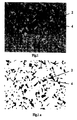
- FIG. 1 is an optical photomicrograph of the microstructure of a prior art WC-cermet having a tungsten carbide hard component 4 and a Co-binder 2 made by vacuum sintering at about 1550°C (Material 10 Prior Art).
- FIG. 1 is an optical photomicrograph of the microstructure of a prior art WC-cermet having a tungsten carbide hard component 4 and a Co-binder 2 made by vacuum sintering at about 1550°C (Material 10 Prior Art).
- FIGS. 1a and 2a are optical photomicrographs of the microstructure of a WC-cermet having a tungsten carbide hard component 4 and a Co-Ni-Fe-binder 6 also made by vacuum sintering at about 1550°C (Material 10).
- the microstructures appear substantially the same.
- the volume percent of the binder (determined substantially by measuring the area percent of black) in the Material 10 Prior Art and Material 10 measured about 12.8 and 11.9 at about 1875 X (6.4 ⁇ m), illustrated in FIGS. 1a and 2a respectively. Additional values measured about 13.4 and 14.0 at about 1200 X (10 ⁇ m) respectively.
- the area percent of the binder for Material 9 Prior Art and Material 9 measured about 15.3 and 15.1 at about 1200 X (10 ⁇ m) respectively.
- the area percent of the binder in the Material 11 Prior Art and Material 11 measured 14.6, 15.1 at about 1200 X (10 ⁇ m) respectively.
- FIGS. 3 through 10 correlate of the distribution of elements (determined in a scanning electron microscope by energy dispersive spectroscopy using a JSM-6400 scanning electron microscope (Model No. ISM65-3, JEOL LTD, Tokyo, Japan) equipped with a LaB 6 cathode electron gun system and an energy dispersive x-ray system with a silicon-lithium detector (Oxford Instruments Inc., Analytical System Division, Microanalysis Group, Bucks, England) in a sample of Material 9 to its microstructural features.
- FIG. 3 is a backscattered electron image (BEI) of the microstructure of Material 9 comprising a Co-Ni-Fe-binder 6, WC hard component 4, and a titanium carbide hard component 10.
- BEI backscattered electron image
- FIG. 4 through 10 are the element distribution maps for tungsten (W), carbon (C), oxygen (O), cobalt (Co), nickel (Ni), iron (Fe), and titanium (Ti), respectively, corresponding to the microstructure of FIG. 3.
- the coincidence of Co, Ni, and Fe demonstrates their presence as the binder.
- the lack of coincidence of Co, Ni, and Fe with W demonstrates that Co-Ni-Fe-binder cements the tungsten carbide.
- the area in FIG. 10 showing a concentration of Ti in combination with the same area in the BEI of FIG. 3 suggests the presence of a titanium containing carbide.
- Planar stacking faults 12 are seem throughout the Co-binder 2 with high stacking fault concentration regions 14. Each stacking fault represents a thin layer of fcc ⁇ hcp transformed Co-binder. These high stacking fault concentration regions represent significantly fcc ⁇ hcp transformed Co-binder.
- planar stacking faults is that the Co-binder has a low stacking fault energy. Consequently the imposition of a stress and/or strain induces the transformation of an otherwise fcc structure to a hcp structure, hardening the Co-binder.
- FIG. 13 shows a TEM image of the Co-Ni-Fe-binder 2 of Material 11.
- FIG. 13 shows dislocations 16.
- the Co-Ni-Fe-binder of Material 11 has a high stacking fault energy that suppresses the formation of planar stacking faults. Further, applicants believe that the stacking fault energy is of a level that permits unconstrained dislocation movement.
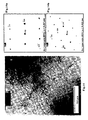
- FIGS. 14a and 14b show a comparative TEM photomicrograph, the results of selected area diffraction (SAD) along the [03 1 ] zone axis, and the results of SAD along the [101] zone axis for the Co-Ni-Fe-binder of Material 11.
- the SAD results of FIGS. 14a and 14b are characteristic of a fcc structure and the absence of the hcp structure. Accordingly, the imposition of a stress and/or strain on the Co-Ni-Fe-binder generated nonplanar defects such as the dislocation 16. Such behavior indicates that there is greater plastic deformation in the Co-Ni-Fe-binder than in the Co-binder.
- FIGS. 15 and 15a show a crack 22 that formed in the Co-binder 4, the crack orientation 20 and 20', and its coincidence with the stacking fault orientation 18 and 18'.
- FIGS. 16 and 16a show the benefits of the plasticity of the Co-Ni-Fe-binder.
- These TEM images show a single dislocation 38, dislocation slip marks 26 on the TEM thin section surface, and the high density of nonplanar, unconstrained-dislocations which is characteristic for high plastic deformation 24 of the Co-Ni-Fe-binder 6.
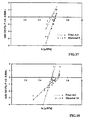
- FIG. 17 presents the Weibull distribution plot of the TRS for Material 9 Prior Art having a Co-binder (represented by open circles “O")and Material 9 (represented by dots " ⁇ ").
- FIG. 18 presents the Weibull distribution plot of the TRS Material 10 Prior Art having a Co-binder (represented by open circles “O")and Material 10 (represented by dots " ⁇ ").
- FIG. 19 presents the Weibull distribution plot of the transverse rupture strengths (TRS) for Material 12 Prior Art having a Co-binder (represented by open circles “O")and Material 12 (represented by dots " ⁇ ").
- TRS transverse rupture strengths
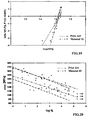
- FIG. 20 shows the stress amplitude ( ⁇ max ) as a function of cycles to failure at room temperature in air for Material 10 Prior Art (represented by open circles “O") and Material 10 (represented by dots " ⁇ ").
- FIG. 21 shows the stress amplitude ( ⁇ max ) as a function of cycles to failure tested at 700°C in air for the prior art comparison for Material 10 Prior Art (represented by open circles “"O") and Material 10 (.represented by dots “ ⁇ ”).
- FIG. 22 shows low cycle fatigue performance data (stress amplitude [ ⁇ max ] as a function of cycles to failure tested) at 700°C in an argon atmosphere for Material 10 Prior Art (represented by open circles “O") and Material 10 (represented by dots “ ⁇ ”).
- Material 10 had at least as long a fatigue life as Material 10 Prior Art and generally an improved life.
- Material 10 posses a superior fatigue life.
- three tests were stopped (designated " ⁇ ⁇ " in FIG. 20) at the defined infinate lifetime defined as 200,000 cycles.
- FIG. 22 clearly demonstrates that Materials 10 has a superior fatigue life for the same stress level at elevated temperatures.
- the cermets of the present invention may be used for materials manipulation or removal including, for example, mining, construction, agricultural, and metal removal applications.
- Some examples of agricultural applications include seed boots, inserts for agricultural tools, disc blades, stump cutters or grinders, furrowing tools, and earth working tools.
- Some examples of mining and construction applications include cutting or digging tools, earth augers, mineral or rock drills, construction equipment blades, rolling cutters, earth working tools, comminution machines, and excavation tools.
- materials removal applications include drills, endmills, reamers, treading tools, materials cutting or milling inserts, materials cutting or milling inserts incorporating chip control features, and materials cutting or milling inserts comprising coating applied by any of chemical vapor deposition (CVD), pressure vapor deposition (PVD), conversion coating, etc.
- CVD chemical vapor deposition
- PVD pressure vapor deposition
- a specific example of the use of the cermets of the present invention includes the use of Material 3 of Table 1 as a screw head punch. Cermets used as screw head punches must possess high impact toughness. Material 3, a WC-cermet comprising about 22 wt.% Co-Ni-Fe-binder was tested against Material 4 Prior Art, a WC-cermet comprising about 27 wt.% Co-binder.
- Screw head punches made from Material 3 consistently out performed screw head punches made from Material 4 Prior Art - producing 60,000-90,000 screws versus 30,000-50,000 screws. Further, it was noted that Material 3 was more readily machined (e.g., chip form) than Material 4 Prior Art.
Landscapes
- Chemical & Material Sciences (AREA)
- Engineering & Computer Science (AREA)
- Materials Engineering (AREA)
- Mechanical Engineering (AREA)
- Metallurgy (AREA)
- Organic Chemistry (AREA)
- Powder Metallurgy (AREA)
- Cutting Tools, Boring Holders, And Turrets (AREA)
- Adhesives Or Adhesive Processes (AREA)
- Pharmaceuticals Containing Other Organic And Inorganic Compounds (AREA)
- Polysaccharides And Polysaccharide Derivatives (AREA)
- Compositions Of Oxide Ceramics (AREA)
- Manufacture Of Alloys Or Alloy Compounds (AREA)
Applications Claiming Priority (3)
| Application Number | Priority Date | Filing Date | Title |
|---|---|---|---|
| US08/918,993 US6024776A (en) | 1997-08-27 | 1997-08-27 | Cermet having a binder with improved plasticity |
| US918993 | 1997-08-27 | ||
| PCT/IB1998/001298 WO1999010549A1 (en) | 1997-08-27 | 1998-08-20 | A cermet having a binder with improved plasticity, a method for the manufacture and use therof |
Publications (2)
| Publication Number | Publication Date |
|---|---|
| EP1007751A1 EP1007751A1 (en) | 2000-06-14 |
| EP1007751B1 true EP1007751B1 (en) | 2004-07-14 |
Family
ID=25441306
Family Applications (1)
| Application Number | Title | Priority Date | Filing Date |
|---|---|---|---|
| EP98937709A Expired - Lifetime EP1007751B1 (en) | 1997-08-27 | 1998-08-20 | A cermet having a binder with improved plasticity, a method for the manufacture and use therof |
Country Status (15)
| Country | Link |
|---|---|
| US (1) | US6024776A (https=) |
| EP (1) | EP1007751B1 (https=) |
| JP (1) | JP4528437B2 (https=) |
| KR (1) | KR100523288B1 (https=) |
| CN (1) | CN1094988C (https=) |
| AT (1) | ATE271137T1 (https=) |
| AU (1) | AU735565B2 (https=) |
| BR (1) | BR9814439B1 (https=) |
| CA (1) | CA2302354C (https=) |
| DE (2) | DE1007751T1 (https=) |
| ES (1) | ES2149145T1 (https=) |
| PL (1) | PL186563B1 (https=) |
| RU (1) | RU2212464C2 (https=) |
| WO (1) | WO1999010549A1 (https=) |
| ZA (1) | ZA987573B (https=) |
Cited By (1)
| Publication number | Priority date | Publication date | Assignee | Title |
|---|---|---|---|---|
| US8523976B2 (en) | 2006-09-22 | 2013-09-03 | H.C. Starck Gmbh | Metal powder |
Families Citing this family (48)
| Publication number | Priority date | Publication date | Assignee | Title |
|---|---|---|---|---|
| US6170917B1 (en) * | 1997-08-27 | 2001-01-09 | Kennametal Inc. | Pick-style tool with a cermet insert having a Co-Ni-Fe-binder |
| JP3652087B2 (ja) * | 1997-10-28 | 2005-05-25 | 日本特殊陶業株式会社 | サーメット工具及びその製造方法 |
| SE519235C2 (sv) * | 1999-01-29 | 2003-02-04 | Seco Tools Ab | Hårdmetall med härbar bindefas |
| DE19907749A1 (de) | 1999-02-23 | 2000-08-24 | Kennametal Inc | Gesinterter Hartmetallkörper und dessen Verwendung |
| SE519832C2 (sv) * | 1999-05-03 | 2003-04-15 | Sandvik Ab | Titanbaserad karbonitridlegering med bindefas av kobolt för lätt finbearbetning |
| SE519834C2 (sv) * | 1999-05-03 | 2003-04-15 | Sandvik Ab | Titanbaserad karbonitridlegering med bindefas av kobolt för seghetskrävande finbearbetning |
| SE519830C2 (sv) * | 1999-05-03 | 2003-04-15 | Sandvik Ab | Titanbaserad karbonitridlegering med bindefas av kobolt för finbearbetning |
| JP2001049378A (ja) * | 1999-06-03 | 2001-02-20 | Ngk Spark Plug Co Ltd | 耐摩耗性超硬合金焼結体及びその製造方法 |
| SE521488C2 (sv) | 2000-12-22 | 2003-11-04 | Seco Tools Ab | Belagt skär med järn-nickel-baserad bindefas |
| TWI291458B (en) * | 2001-10-12 | 2007-12-21 | Phild Co Ltd | Method and device for producing titanium-containing high performance water |
| EP1997575B1 (en) | 2001-12-05 | 2011-07-27 | Baker Hughes Incorporated | Consolidated hard material and applications |
| DE10213963A1 (de) * | 2002-03-28 | 2003-10-09 | Widia Gmbh | Hartmetall- oder Cermet-Schneidwerkstoff sowie Verfahren zur zerspanenden Bearbeitung von Cr-haltigen Metallwerkstücken |
| US6911063B2 (en) * | 2003-01-13 | 2005-06-28 | Genius Metal, Inc. | Compositions and fabrication methods for hardmetals |
| US7645315B2 (en) * | 2003-01-13 | 2010-01-12 | Worldwide Strategy Holdings Limited | High-performance hardmetal materials |
| US20070034048A1 (en) * | 2003-01-13 | 2007-02-15 | Liu Shaiw-Rong S | Hardmetal materials for high-temperature applications |
| US20050072269A1 (en) * | 2003-10-03 | 2005-04-07 | Debangshu Banerjee | Cemented carbide blank suitable for electric discharge machining and cemented carbide body made by electric discharge machining |
| DE10356470B4 (de) * | 2003-12-03 | 2009-07-30 | Kennametal Inc. | Zirkonium und Niob enthaltender Hartmetallkörper und Verfahren zu seiner Herstellung und seine Verwendung |
| US7163657B2 (en) * | 2003-12-03 | 2007-01-16 | Kennametal Inc. | Cemented carbide body containing zirconium and niobium and method of making the same |
| US7857188B2 (en) * | 2005-03-15 | 2010-12-28 | Worldwide Strategy Holding Limited | High-performance friction stir welding tools |
| AT501801B1 (de) * | 2005-05-13 | 2007-08-15 | Boehlerit Gmbh & Co Kg | Hartmetallkörper mit zähem oberflächenbereich |
| US7887747B2 (en) * | 2005-09-12 | 2011-02-15 | Sanalloy Industry Co., Ltd. | High strength hard alloy and method of preparing the same |
| US7575620B2 (en) * | 2006-06-05 | 2009-08-18 | Kennametal Inc. | Infiltrant matrix powder and product using such powder |
| SE0602494L (sv) * | 2006-11-22 | 2008-05-23 | Sandvik Intellectual Property | Metod att tillverka en sintrat kropp, en pulverblandning och en sintrad kropp |
| DE102007017306A1 (de) | 2007-04-11 | 2008-10-16 | H.C. Starck Gmbh | Längliches Hartmetallwerkzeug mit Eisenbasis-Binder |
| RU2333009C1 (ru) * | 2007-04-16 | 2008-09-10 | Государственное образовательное учреждение высшего профессионального образования "Московский государственный институт стали и сплавов" (технологический университет) | Многофункциональные биосовместимые наноструктурные пленки для медицины |
| RU2354785C1 (ru) * | 2007-08-20 | 2009-05-10 | Открытое акционерное общество "Международный Институт Индустриальной Собственности" | Способ изготовления шва строительного раствора, шов строительного раствора, оснастка для изготовления шва строительного раствора и строительный конструктивный элемент |
| CN102137954A (zh) * | 2008-08-29 | 2011-07-27 | 昭和电工株式会社 | 表面被覆的金属陶瓷构件及其制造方法 |
| US20100104861A1 (en) * | 2008-10-24 | 2010-04-29 | David Richard Siddle | Metal-forming tools comprising cemented tungsten carbide and methods of using same |
| US20110061944A1 (en) | 2009-09-11 | 2011-03-17 | Danny Eugene Scott | Polycrystalline diamond composite compact |
| US8834594B2 (en) | 2011-12-21 | 2014-09-16 | Kennametal Inc. | Cemented carbide body and applications thereof |
| CN103902669B (zh) * | 2014-03-17 | 2017-06-16 | 华中科技大学 | 一种基于不同存储介质的分离式文件系统 |
| EP2955241B1 (en) * | 2014-06-12 | 2024-01-24 | Maschinenfabrik Gustav Eirich GmbH & Co. KG | Method for manufacturing a cemented carbide or cermet body |
| JP6315197B2 (ja) * | 2014-09-26 | 2018-04-25 | 三菱マテリアル株式会社 | 複合焼結体切削工具 |
| TWI518185B (zh) * | 2014-10-28 | 2016-01-21 | 財團法人工業技術研究院 | 碳化物/結合金屬之複合粉體 |
| US9725794B2 (en) | 2014-12-17 | 2017-08-08 | Kennametal Inc. | Cemented carbide articles and applications thereof |
| US10287824B2 (en) | 2016-03-04 | 2019-05-14 | Baker Hughes Incorporated | Methods of forming polycrystalline diamond |
| CN106435322B (zh) * | 2016-11-02 | 2019-04-09 | 中南大学 | 一种低成本高性能WC-Fe-Ni-Co-Cr硬质合金辊环 |
| RU2753565C2 (ru) * | 2017-05-01 | 2021-08-17 | ЭРЛИКОН МЕТКО (ЮЭс) ИНК. | Буровое долото, способ изготовления корпуса бурового долота, композит с металлической матрицей и способ изготовления композита с металлической матрицей |
| US11396688B2 (en) | 2017-05-12 | 2022-07-26 | Baker Hughes Holdings Llc | Cutting elements, and related structures and earth-boring tools |
| US11292750B2 (en) | 2017-05-12 | 2022-04-05 | Baker Hughes Holdings Llc | Cutting elements and structures |
| JP7185844B2 (ja) * | 2018-02-13 | 2022-12-08 | 三菱マテリアル株式会社 | TiN基焼結体およびTiN基焼結体製切削工具 |
| US11536091B2 (en) | 2018-05-30 | 2022-12-27 | Baker Hughes Holding LLC | Cutting elements, and related earth-boring tools and methods |
| JP7008906B2 (ja) * | 2018-09-06 | 2022-02-10 | 三菱マテリアル株式会社 | TiN基焼結体およびTiN基焼結体製切削工具 |
| US12109625B2 (en) | 2018-09-28 | 2024-10-08 | Mitsubishi Materials Corporation | Surface-coated TiN-based cermet cutting tool in which hard coating layer exhibits excellent chipping resistance |
| AT522605B1 (de) * | 2019-05-23 | 2021-02-15 | Boehlerit Gmbh & Co Kg | Hartmetalleinsatz |
| CN110512131B (zh) * | 2019-09-05 | 2021-07-27 | 四川轻化工大学 | 一种整体金属陶瓷合金棒材及其制备方法与应用 |
| CN112375951B (zh) * | 2019-09-10 | 2022-08-02 | 湖北中烟工业有限责任公司 | 一种金属陶瓷发热材料及其制备方法 |
| CN111378888B (zh) * | 2020-01-02 | 2021-11-12 | 四川轻化工大学 | 一种纳米粒子界面强化的高氮含量Ti(C,N)基金属陶瓷材质及其制备方法 |
Family Cites Families (23)
| Publication number | Priority date | Publication date | Assignee | Title |
|---|---|---|---|---|
| US34180A (en) * | 1862-01-14 | Improvement in mowing-machines | ||
| US2162574A (en) * | 1937-05-15 | 1939-06-13 | Gen Electric | Hard metal alloy |
| US2202821A (en) * | 1938-02-05 | 1940-06-04 | Ramet Corp | Hard metal alloy |
| FR1543214A (fr) * | 1966-06-14 | 1968-10-25 | Ford France | Procédé de fabrication d'un matériau compact à base de carbure de tungstène et matériau en résultant |
| US3514271A (en) * | 1968-07-23 | 1970-05-26 | Du Pont | Iron-,nickel-,and cobalt-bonded nitride cutting tools |
| US3816081A (en) * | 1973-01-26 | 1974-06-11 | Gen Electric | ABRASION RESISTANT CEMENTED TUNGSTEN CARBIDE BONDED WITH Fe-C-Ni-Co |
| US4049380A (en) * | 1975-05-29 | 1977-09-20 | Teledyne Industries, Inc. | Cemented carbides containing hexagonal molybdenum |
| USRE34180E (en) | 1981-03-27 | 1993-02-16 | Kennametal Inc. | Preferentially binder enriched cemented carbide bodies and method of manufacture |
| JPS6039408U (ja) * | 1983-08-24 | 1985-03-19 | 三菱マテリアル株式会社 | 一部非研削超硬ドリル |
| US4556424A (en) * | 1983-10-13 | 1985-12-03 | Reed Rock Bit Company | Cermets having transformation-toughening properties and method of heat-treating to improve such properties |
| DE3574738D1 (de) * | 1984-11-13 | 1990-01-18 | Santrade Ltd | Gesinterte hartmetallegierung zum gesteinsbohren und zum schneiden von mineralien. |
| SU1783853A1 (ru) * | 1990-12-26 | 1995-10-27 | Всесоюзный научно-исследовательский и проектный институт тугоплавких металлов и твердых сплавов | Шихта для получения спеченного твердого сплава |
| US5468278A (en) * | 1992-11-11 | 1995-11-21 | Hitachi Metals, Ltd. | Cermet alloy |
| GB2273301B (en) * | 1992-11-20 | 1996-10-30 | Smith International | Improved cage protection for rock bits |
| US5821441A (en) * | 1993-10-08 | 1998-10-13 | Sumitomo Electric Industries, Ltd. | Tough and corrosion-resistant tungsten based sintered alloy and method of preparing the same |
| SE502930C2 (sv) * | 1994-07-21 | 1996-02-26 | Sandvik Ab | Metod för tillverkning av pulver av hårdmaterial av WC och Co och/eller Ni |
| US5541006A (en) * | 1994-12-23 | 1996-07-30 | Kennametal Inc. | Method of making composite cermet articles and the articles |
| SE513978C2 (sv) * | 1994-12-30 | 2000-12-04 | Sandvik Ab | Belagt hårdmetallskär för skärande metallbearbetning |
| JPH08302441A (ja) * | 1995-05-02 | 1996-11-19 | Sumitomo Electric Ind Ltd | 耐衝撃工具用超硬合金 |
| JPH09111391A (ja) * | 1995-10-11 | 1997-04-28 | Hitachi Tool Eng Ltd | 金型用超硬合金 |
| JP3309897B2 (ja) * | 1995-11-15 | 2002-07-29 | 住友電気工業株式会社 | 超硬質複合部材およびその製造方法 |
| BE1009811A3 (fr) * | 1995-12-08 | 1997-08-05 | Union Miniere Sa | Poudre prealliee et son utilisation dans la fabrication d'outils diamantes. |
| DE29617040U1 (de) * | 1996-10-01 | 1997-01-23 | United Hardmetal GmbH, 72160 Horb | WC-Hartlegierung |
-
1997
- 1997-08-27 US US08/918,993 patent/US6024776A/en not_active Expired - Lifetime
-
1998
- 1998-08-20 ES ES98937709T patent/ES2149145T1/es active Pending
- 1998-08-20 JP JP2000507854A patent/JP4528437B2/ja not_active Expired - Fee Related
- 1998-08-20 DE DE1007751T patent/DE1007751T1/de active Pending
- 1998-08-20 RU RU2000107838/02A patent/RU2212464C2/ru not_active IP Right Cessation
- 1998-08-20 CA CA002302354A patent/CA2302354C/en not_active Expired - Fee Related
- 1998-08-20 BR BRPI9814439-1A patent/BR9814439B1/pt not_active IP Right Cessation
- 1998-08-20 WO PCT/IB1998/001298 patent/WO1999010549A1/en not_active Ceased
- 1998-08-20 CN CN98808541A patent/CN1094988C/zh not_active Expired - Fee Related
- 1998-08-20 AT AT98937709T patent/ATE271137T1/de not_active IP Right Cessation
- 1998-08-20 AU AU86416/98A patent/AU735565B2/en not_active Ceased
- 1998-08-20 KR KR10-2000-7001772A patent/KR100523288B1/ko not_active Expired - Fee Related
- 1998-08-20 EP EP98937709A patent/EP1007751B1/en not_active Expired - Lifetime
- 1998-08-20 DE DE69825057T patent/DE69825057T2/de not_active Expired - Lifetime
- 1998-08-20 PL PL98338829A patent/PL186563B1/pl not_active IP Right Cessation
- 1998-08-21 ZA ZA987573A patent/ZA987573B/xx unknown
Cited By (1)
| Publication number | Priority date | Publication date | Assignee | Title |
|---|---|---|---|---|
| US8523976B2 (en) | 2006-09-22 | 2013-09-03 | H.C. Starck Gmbh | Metal powder |
Also Published As
| Publication number | Publication date |
|---|---|
| US6024776A (en) | 2000-02-15 |
| JP4528437B2 (ja) | 2010-08-18 |
| CA2302354C (en) | 2007-07-17 |
| CN1094988C (zh) | 2002-11-27 |
| ATE271137T1 (de) | 2004-07-15 |
| CA2302354A1 (en) | 1999-03-04 |
| ES2149145T1 (es) | 2000-11-01 |
| WO1999010549A1 (en) | 1999-03-04 |
| DE69825057D1 (de) | 2004-08-19 |
| RU2212464C2 (ru) | 2003-09-20 |
| BR9814439A (pt) | 2000-10-03 |
| DE69825057T2 (de) | 2005-08-25 |
| AU8641698A (en) | 1999-03-16 |
| EP1007751A1 (en) | 2000-06-14 |
| KR100523288B1 (ko) | 2005-10-21 |
| KR20010023148A (ko) | 2001-03-26 |
| AU735565B2 (en) | 2001-07-12 |
| DE1007751T1 (de) | 2001-02-08 |
| ZA987573B (en) | 1998-10-05 |
| PL338829A1 (en) | 2000-11-20 |
| JP2001514326A (ja) | 2001-09-11 |
| BR9814439B1 (pt) | 2011-07-26 |
| PL186563B1 (pl) | 2004-01-30 |
| CN1268188A (zh) | 2000-09-27 |
Similar Documents
| Publication | Publication Date | Title |
|---|---|---|
| EP1007751B1 (en) | A cermet having a binder with improved plasticity, a method for the manufacture and use therof | |
| EP2099945B1 (en) | Cubic boron nitride compacts | |
| US9187809B2 (en) | Tough coated hard particles consolidated in a tough matrix material | |
| US4022584A (en) | Sintered cermets for tool and wear applications | |
| US20120210822A1 (en) | Cemented carbide and process for producing same | |
| WO1994026469A1 (en) | Group ivb boride based cutting tools | |
| US20040079191A1 (en) | Hard alloy and W-based composite carbide powder used as starting material | |
| WO2023114632A1 (en) | Cemented carbide and cermet compositions having a high-entropy-alloy binder | |
| US7128774B2 (en) | Cutting tool | |
| KR20250128975A (ko) | 초경합금 절삭 공구 | |
| MXPA00000983A (en) | A cermet having a binder with improved plasticity, a method for the manufacture and use therof | |
| JP4413022B2 (ja) | 複合酸化物分散焼結合金 | |
| JPH1192852A (ja) | 粒内金属分散強化wc含有超硬合金およびその製法 | |
| Mosbah | Sintering, microstructure and properties of WC-FeAl composite materials | |
| Gorla | Impact resistance and energies of intermetallic bonded diamond composites and polycrystalline diamond compacts and their comparison | |
| Wora-uaychai et al. | Effect of Tertiary Carbide on Mechanical Properties of TiC-20Ni-15WC Cermets | |
| Al-Hazza | Synthesizing a nanocomposite tungsten carbide-cobalt metal oxide | |
| JPH02122030A (ja) | サーメット工具の製造方法 |
Legal Events
| Date | Code | Title | Description |
|---|---|---|---|
| PUAI | Public reference made under article 153(3) epc to a published international application that has entered the european phase |
Free format text: ORIGINAL CODE: 0009012 |
|
| 17P | Request for examination filed |
Effective date: 20000323 |
|
| AK | Designated contracting states |
Kind code of ref document: A1 Designated state(s): AT BE CH CY DE DK ES FI FR GB IT LI LU NL PT SE |
|
| TCAT | At: translation of patent claims filed | ||
| EL | Fr: translation of claims filed | ||
| REG | Reference to a national code |
Ref country code: ES Ref legal event code: BA2A Ref document number: 2149145 Country of ref document: ES Kind code of ref document: T1 |
|
| TCNL | Nl: translation of patent claims filed | ||
| DET | De: translation of patent claims | ||
| GRAP | Despatch of communication of intention to grant a patent |
Free format text: ORIGINAL CODE: EPIDOSNIGR1 |
|
| GRAS | Grant fee paid |
Free format text: ORIGINAL CODE: EPIDOSNIGR3 |
|
| GRAA | (expected) grant |
Free format text: ORIGINAL CODE: 0009210 |
|
| AK | Designated contracting states |
Kind code of ref document: B1 Designated state(s): AT BE CH CY DE DK ES FI FR GB IT LI LU NL PT SE |
|
| PG25 | Lapsed in a contracting state [announced via postgrant information from national office to epo] |
Ref country code: NL Free format text: LAPSE BECAUSE OF FAILURE TO SUBMIT A TRANSLATION OF THE DESCRIPTION OR TO PAY THE FEE WITHIN THE PRESCRIBED TIME-LIMIT Effective date: 20040714 Ref country code: LI Free format text: LAPSE BECAUSE OF FAILURE TO SUBMIT A TRANSLATION OF THE DESCRIPTION OR TO PAY THE FEE WITHIN THE PRESCRIBED TIME-LIMIT Effective date: 20040714 Ref country code: IT Free format text: LAPSE BECAUSE OF FAILURE TO SUBMIT A TRANSLATION OF THE DESCRIPTION OR TO PAY THE FEE WITHIN THE PRESCRIBED TIME-LIMIT;WARNING: LAPSES OF ITALIAN PATENTS WITH EFFECTIVE DATE BEFORE 2007 MAY HAVE OCCURRED AT ANY TIME BEFORE 2007. THE CORRECT EFFECTIVE DATE MAY BE DIFFERENT FROM THE ONE RECORDED. Effective date: 20040714 Ref country code: FI Free format text: LAPSE BECAUSE OF FAILURE TO SUBMIT A TRANSLATION OF THE DESCRIPTION OR TO PAY THE FEE WITHIN THE PRESCRIBED TIME-LIMIT Effective date: 20040714 Ref country code: CY Free format text: LAPSE BECAUSE OF FAILURE TO SUBMIT A TRANSLATION OF THE DESCRIPTION OR TO PAY THE FEE WITHIN THE PRESCRIBED TIME-LIMIT Effective date: 20040714 Ref country code: CH Free format text: LAPSE BECAUSE OF FAILURE TO SUBMIT A TRANSLATION OF THE DESCRIPTION OR TO PAY THE FEE WITHIN THE PRESCRIBED TIME-LIMIT Effective date: 20040714 Ref country code: BE Free format text: LAPSE BECAUSE OF FAILURE TO SUBMIT A TRANSLATION OF THE DESCRIPTION OR TO PAY THE FEE WITHIN THE PRESCRIBED TIME-LIMIT Effective date: 20040714 Ref country code: AT Free format text: LAPSE BECAUSE OF FAILURE TO SUBMIT A TRANSLATION OF THE DESCRIPTION OR TO PAY THE FEE WITHIN THE PRESCRIBED TIME-LIMIT Effective date: 20040714 |
|
| REG | Reference to a national code |
Ref country code: GB Ref legal event code: FG4D |
|
| REG | Reference to a national code |
Ref country code: CH Ref legal event code: EP |
|
| REF | Corresponds to: |
Ref document number: 69825057 Country of ref document: DE Date of ref document: 20040819 Kind code of ref document: P |
|
| PG25 | Lapsed in a contracting state [announced via postgrant information from national office to epo] |
Ref country code: LU Free format text: LAPSE BECAUSE OF NON-PAYMENT OF DUE FEES Effective date: 20040820 |
|
| PG25 | Lapsed in a contracting state [announced via postgrant information from national office to epo] |
Ref country code: DK Free format text: LAPSE BECAUSE OF FAILURE TO SUBMIT A TRANSLATION OF THE DESCRIPTION OR TO PAY THE FEE WITHIN THE PRESCRIBED TIME-LIMIT Effective date: 20041014 |
|
| PG25 | Lapsed in a contracting state [announced via postgrant information from national office to epo] |
Ref country code: ES Free format text: LAPSE BECAUSE OF FAILURE TO SUBMIT A TRANSLATION OF THE DESCRIPTION OR TO PAY THE FEE WITHIN THE PRESCRIBED TIME-LIMIT Effective date: 20041025 |
|
| REG | Reference to a national code |
Ref country code: SE Ref legal event code: TRGR |
|
| NLV1 | Nl: lapsed or annulled due to failure to fulfill the requirements of art. 29p and 29m of the patents act | ||
| REG | Reference to a national code |
Ref country code: CH Ref legal event code: PL |
|
| PLBE | No opposition filed within time limit |
Free format text: ORIGINAL CODE: 0009261 |
|
| STAA | Information on the status of an ep patent application or granted ep patent |
Free format text: STATUS: NO OPPOSITION FILED WITHIN TIME LIMIT |
|
| ET | Fr: translation filed | ||
| 26N | No opposition filed |
Effective date: 20050415 |
|
| PG25 | Lapsed in a contracting state [announced via postgrant information from national office to epo] |
Ref country code: PT Free format text: LAPSE BECAUSE OF NON-PAYMENT OF DUE FEES Effective date: 20041214 |
|
| PGFP | Annual fee paid to national office [announced via postgrant information from national office to epo] |
Ref country code: DE Payment date: 20140813 Year of fee payment: 17 |
|
| PGFP | Annual fee paid to national office [announced via postgrant information from national office to epo] |
Ref country code: GB Payment date: 20140820 Year of fee payment: 17 Ref country code: FR Payment date: 20140808 Year of fee payment: 17 Ref country code: SE Payment date: 20140826 Year of fee payment: 17 |
|
| REG | Reference to a national code |
Ref country code: DE Ref legal event code: R119 Ref document number: 69825057 Country of ref document: DE |
|
| REG | Reference to a national code |
Ref country code: SE Ref legal event code: EUG |
|
| GBPC | Gb: european patent ceased through non-payment of renewal fee |
Effective date: 20150820 |
|
| PG25 | Lapsed in a contracting state [announced via postgrant information from national office to epo] |
Ref country code: SE Free format text: LAPSE BECAUSE OF NON-PAYMENT OF DUE FEES Effective date: 20150821 |
|
| REG | Reference to a national code |
Ref country code: FR Ref legal event code: ST Effective date: 20160429 |
|
| PG25 | Lapsed in a contracting state [announced via postgrant information from national office to epo] |
Ref country code: GB Free format text: LAPSE BECAUSE OF NON-PAYMENT OF DUE FEES Effective date: 20150820 Ref country code: DE Free format text: LAPSE BECAUSE OF NON-PAYMENT OF DUE FEES Effective date: 20160301 |
|
| PG25 | Lapsed in a contracting state [announced via postgrant information from national office to epo] |
Ref country code: FR Free format text: LAPSE BECAUSE OF NON-PAYMENT OF DUE FEES Effective date: 20150831 |