EP1000904B1 - Method for recovering phosphate from sludge and system therefor - Google Patents
Method for recovering phosphate from sludge and system therefor Download PDFInfo
- Publication number
- EP1000904B1 EP1000904B1 EP99121644A EP99121644A EP1000904B1 EP 1000904 B1 EP1000904 B1 EP 1000904B1 EP 99121644 A EP99121644 A EP 99121644A EP 99121644 A EP99121644 A EP 99121644A EP 1000904 B1 EP1000904 B1 EP 1000904B1
- Authority
- EP
- European Patent Office
- Prior art keywords
- sludge
- phosphate
- recovering
- seed crystal
- dewatering
- Prior art date
- Legal status (The legal status is an assumption and is not a legal conclusion. Google has not performed a legal analysis and makes no representation as to the accuracy of the status listed.)
- Expired - Lifetime
Links
- 239000010802 sludge Substances 0.000 title claims description 225
- NBIIXXVUZAFLBC-UHFFFAOYSA-K phosphate Chemical compound [O-]P([O-])([O-])=O NBIIXXVUZAFLBC-UHFFFAOYSA-K 0.000 title claims description 157
- 229910019142 PO4 Inorganic materials 0.000 title claims description 152
- 239000010452 phosphate Substances 0.000 title claims description 151
- 238000000034 method Methods 0.000 title claims description 58
- 239000000463 material Substances 0.000 claims description 72
- 239000013078 crystal Substances 0.000 claims description 66
- 238000011084 recovery Methods 0.000 claims description 50
- BHPQYMZQTOCNFJ-UHFFFAOYSA-N Calcium cation Chemical compound [Ca+2] BHPQYMZQTOCNFJ-UHFFFAOYSA-N 0.000 claims description 45
- 229910001424 calcium ion Inorganic materials 0.000 claims description 45
- OAICVXFJPJFONN-UHFFFAOYSA-N Phosphorus Chemical compound [P] OAICVXFJPJFONN-UHFFFAOYSA-N 0.000 claims description 36
- 229910052698 phosphorus Inorganic materials 0.000 claims description 36
- 239000011574 phosphorus Substances 0.000 claims description 36
- 239000007788 liquid Substances 0.000 claims description 34
- XLYOFNOQVPJJNP-UHFFFAOYSA-N water Substances O XLYOFNOQVPJJNP-UHFFFAOYSA-N 0.000 claims description 30
- 239000002699 waste material Substances 0.000 claims description 29
- 239000002562 thickening agent Substances 0.000 claims description 23
- 239000010865 sewage Substances 0.000 claims description 20
- 230000008719 thickening Effects 0.000 claims description 17
- 239000000378 calcium silicate Substances 0.000 claims description 15
- 229910052918 calcium silicate Inorganic materials 0.000 claims description 15
- OYACROKNLOSFPA-UHFFFAOYSA-N calcium;dioxido(oxo)silane Chemical compound [Ca+2].[O-][Si]([O-])=O OYACROKNLOSFPA-UHFFFAOYSA-N 0.000 claims description 15
- 238000006243 chemical reaction Methods 0.000 claims description 15
- 230000029087 digestion Effects 0.000 claims description 15
- 229920000388 Polyphosphate Polymers 0.000 claims description 7
- 239000001205 polyphosphate Substances 0.000 claims description 7
- 235000011176 polyphosphates Nutrition 0.000 claims description 7
- 239000000470 constituent Substances 0.000 claims description 6
- 239000000126 substance Substances 0.000 claims description 6
- 238000002425 crystallisation Methods 0.000 claims description 5
- 230000008025 crystallization Effects 0.000 claims description 5
- 229940043430 calcium compound Drugs 0.000 claims description 3
- 150000001674 calcium compounds Chemical class 0.000 claims description 3
- UGGQKDBXXFIWJD-UHFFFAOYSA-N calcium;dihydroxy(oxo)silane;hydrate Chemical compound O.[Ca].O[Si](O)=O UGGQKDBXXFIWJD-UHFFFAOYSA-N 0.000 claims description 3
- 239000000203 mixture Substances 0.000 claims description 3
- MKTRXTLKNXLULX-UHFFFAOYSA-P pentacalcium;dioxido(oxo)silane;hydron;tetrahydrate Chemical compound [H+].[H+].O.O.O.O.[Ca+2].[Ca+2].[Ca+2].[Ca+2].[Ca+2].[O-][Si]([O-])=O.[O-][Si]([O-])=O.[O-][Si]([O-])=O.[O-][Si]([O-])=O.[O-][Si]([O-])=O.[O-][Si]([O-])=O MKTRXTLKNXLULX-UHFFFAOYSA-P 0.000 claims description 3
- 239000010456 wollastonite Substances 0.000 claims description 3
- 229910052882 wollastonite Inorganic materials 0.000 claims description 3
- 235000021317 phosphate Nutrition 0.000 description 136
- 229910052588 hydroxylapatite Inorganic materials 0.000 description 19
- XYJRXVWERLGGKC-UHFFFAOYSA-D pentacalcium;hydroxide;triphosphate Chemical compound [OH-].[Ca+2].[Ca+2].[Ca+2].[Ca+2].[Ca+2].[O-]P([O-])([O-])=O.[O-]P([O-])([O-])=O.[O-]P([O-])([O-])=O XYJRXVWERLGGKC-UHFFFAOYSA-D 0.000 description 19
- 238000001556 precipitation Methods 0.000 description 14
- 239000000047 product Substances 0.000 description 12
- 230000003247 decreasing effect Effects 0.000 description 11
- AXCZMVOFGPJBDE-UHFFFAOYSA-L calcium dihydroxide Chemical compound [OH-].[OH-].[Ca+2] AXCZMVOFGPJBDE-UHFFFAOYSA-L 0.000 description 10
- 239000000920 calcium hydroxide Substances 0.000 description 10
- 235000011116 calcium hydroxide Nutrition 0.000 description 10
- 229910001861 calcium hydroxide Inorganic materials 0.000 description 10
- HEMHJVSKTPXQMS-UHFFFAOYSA-M Sodium hydroxide Chemical compound [OH-].[Na+] HEMHJVSKTPXQMS-UHFFFAOYSA-M 0.000 description 9
- 239000011575 calcium Substances 0.000 description 8
- 239000007787 solid Substances 0.000 description 8
- 230000001105 regulatory effect Effects 0.000 description 7
- VYPSYNLAJGMNEJ-UHFFFAOYSA-N Silicium dioxide Chemical compound O=[Si]=O VYPSYNLAJGMNEJ-UHFFFAOYSA-N 0.000 description 6
- 238000001723 curing Methods 0.000 description 6
- 238000000926 separation method Methods 0.000 description 6
- 239000004568 cement Substances 0.000 description 5
- 238000010586 diagram Methods 0.000 description 5
- 239000013081 microcrystal Substances 0.000 description 5
- -1 orthophosphate ions Chemical class 0.000 description 5
- OYPRJOBELJOOCE-UHFFFAOYSA-N Calcium Chemical compound [Ca] OYPRJOBELJOOCE-UHFFFAOYSA-N 0.000 description 4
- UXVMQQNJUSDDNG-UHFFFAOYSA-L Calcium chloride Chemical compound [Cl-].[Cl-].[Ca+2] UXVMQQNJUSDDNG-UHFFFAOYSA-L 0.000 description 4
- 229910052791 calcium Inorganic materials 0.000 description 4
- 239000001110 calcium chloride Substances 0.000 description 4
- 229910001628 calcium chloride Inorganic materials 0.000 description 4
- 235000011148 calcium chloride Nutrition 0.000 description 4
- 239000000701 coagulant Substances 0.000 description 4
- 239000003337 fertilizer Substances 0.000 description 4
- 238000005243 fluidization Methods 0.000 description 4
- 229910052567 struvite Inorganic materials 0.000 description 4
- CKMXBZGNNVIXHC-UHFFFAOYSA-L ammonium magnesium phosphate hexahydrate Chemical compound [NH4+].O.O.O.O.O.O.[Mg+2].[O-]P([O-])([O-])=O CKMXBZGNNVIXHC-UHFFFAOYSA-L 0.000 description 3
- 230000000694 effects Effects 0.000 description 3
- 239000000706 filtrate Substances 0.000 description 3
- 239000012530 fluid Substances 0.000 description 3
- 239000002245 particle Substances 0.000 description 3
- 235000011121 sodium hydroxide Nutrition 0.000 description 3
- 239000006228 supernatant Substances 0.000 description 3
- QGZKDVFQNNGYKY-UHFFFAOYSA-N Ammonia Chemical compound N QGZKDVFQNNGYKY-UHFFFAOYSA-N 0.000 description 2
- IJGRMHOSHXDMSA-UHFFFAOYSA-N Atomic nitrogen Chemical compound N#N IJGRMHOSHXDMSA-UHFFFAOYSA-N 0.000 description 2
- 235000008733 Citrus aurantifolia Nutrition 0.000 description 2
- 235000011941 Tilia x europaea Nutrition 0.000 description 2
- 239000003795 chemical substances by application Substances 0.000 description 2
- 230000001276 controlling effect Effects 0.000 description 2
- 239000006185 dispersion Substances 0.000 description 2
- 230000005484 gravity Effects 0.000 description 2
- 239000004571 lime Substances 0.000 description 2
- 238000004519 manufacturing process Methods 0.000 description 2
- 239000000843 powder Substances 0.000 description 2
- 239000002994 raw material Substances 0.000 description 2
- 239000004576 sand Substances 0.000 description 2
- 239000000377 silicon dioxide Substances 0.000 description 2
- 239000002002 slurry Substances 0.000 description 2
- 239000002351 wastewater Substances 0.000 description 2
- 229910021532 Calcite Inorganic materials 0.000 description 1
- VEXZGXHMUGYJMC-UHFFFAOYSA-M Chloride anion Chemical compound [Cl-] VEXZGXHMUGYJMC-UHFFFAOYSA-M 0.000 description 1
- JLVVSXFLKOJNIY-UHFFFAOYSA-N Magnesium ion Chemical compound [Mg+2] JLVVSXFLKOJNIY-UHFFFAOYSA-N 0.000 description 1
- DIZPMCHEQGEION-UHFFFAOYSA-H aluminium sulfate (anhydrous) Chemical compound [Al+3].[Al+3].[O-]S([O-])(=O)=O.[O-]S([O-])(=O)=O.[O-]S([O-])(=O)=O DIZPMCHEQGEION-UHFFFAOYSA-H 0.000 description 1
- 229910021529 ammonia Inorganic materials 0.000 description 1
- MXZRMHIULZDAKC-UHFFFAOYSA-L ammonium magnesium phosphate Chemical compound [NH4+].[Mg+2].[O-]P([O-])([O-])=O MXZRMHIULZDAKC-UHFFFAOYSA-L 0.000 description 1
- 230000015572 biosynthetic process Effects 0.000 description 1
- 210000000988 bone and bone Anatomy 0.000 description 1
- 230000015556 catabolic process Effects 0.000 description 1
- 238000006731 degradation reaction Methods 0.000 description 1
- 238000012851 eutrophication Methods 0.000 description 1
- 238000001914 filtration Methods 0.000 description 1
- 239000010881 fly ash Substances 0.000 description 1
- 239000004088 foaming agent Substances 0.000 description 1
- 239000008187 granular material Substances 0.000 description 1
- 239000010440 gypsum Substances 0.000 description 1
- 229910052602 gypsum Inorganic materials 0.000 description 1
- 230000007062 hydrolysis Effects 0.000 description 1
- 238000006460 hydrolysis reaction Methods 0.000 description 1
- 150000002500 ions Chemical class 0.000 description 1
- RUTXIHLAWFEWGM-UHFFFAOYSA-H iron(3+) sulfate Chemical compound [Fe+3].[Fe+3].[O-]S([O-])(=O)=O.[O-]S([O-])(=O)=O.[O-]S([O-])(=O)=O RUTXIHLAWFEWGM-UHFFFAOYSA-H 0.000 description 1
- 229910000360 iron(III) sulfate Inorganic materials 0.000 description 1
- 229910001425 magnesium ion Inorganic materials 0.000 description 1
- 230000014759 maintenance of location Effects 0.000 description 1
- 229910052757 nitrogen Inorganic materials 0.000 description 1
- 238000010899 nucleation Methods 0.000 description 1
- 230000002093 peripheral effect Effects 0.000 description 1
- 239000002686 phosphate fertilizer Substances 0.000 description 1
- 239000002367 phosphate rock Substances 0.000 description 1
- 150000003013 phosphoric acid derivatives Chemical class 0.000 description 1
- 229920000137 polyphosphoric acid Polymers 0.000 description 1
- 229920006395 saturated elastomer Polymers 0.000 description 1
- 239000010801 sewage sludge Substances 0.000 description 1
- 239000002893 slag Substances 0.000 description 1
- 238000001179 sorption measurement Methods 0.000 description 1
- 238000003911 water pollution Methods 0.000 description 1
Images




Classifications
-
- C—CHEMISTRY; METALLURGY
- C05—FERTILISERS; MANUFACTURE THEREOF
- C05B—PHOSPHATIC FERTILISERS
- C05B15/00—Organic phosphatic fertilisers
-
- C—CHEMISTRY; METALLURGY
- C02—TREATMENT OF WATER, WASTE WATER, SEWAGE, OR SLUDGE
- C02F—TREATMENT OF WATER, WASTE WATER, SEWAGE, OR SLUDGE
- C02F11/00—Treatment of sludge; Devices therefor
-
- C—CHEMISTRY; METALLURGY
- C02—TREATMENT OF WATER, WASTE WATER, SEWAGE, OR SLUDGE
- C02F—TREATMENT OF WATER, WASTE WATER, SEWAGE, OR SLUDGE
- C02F1/00—Treatment of water, waste water, or sewage
- C02F1/52—Treatment of water, waste water, or sewage by flocculation or precipitation of suspended impurities
-
- C—CHEMISTRY; METALLURGY
- C02—TREATMENT OF WATER, WASTE WATER, SEWAGE, OR SLUDGE
- C02F—TREATMENT OF WATER, WASTE WATER, SEWAGE, OR SLUDGE
- C02F11/00—Treatment of sludge; Devices therefor
- C02F11/02—Biological treatment
- C02F11/04—Anaerobic treatment; Production of methane by such processes
-
- C—CHEMISTRY; METALLURGY
- C05—FERTILISERS; MANUFACTURE THEREOF
- C05B—PHOSPHATIC FERTILISERS
- C05B17/00—Other phosphatic fertilisers, e.g. soft rock phosphates, bone meal
-
- C—CHEMISTRY; METALLURGY
- C05—FERTILISERS; MANUFACTURE THEREOF
- C05F—ORGANIC FERTILISERS NOT COVERED BY SUBCLASSES C05B, C05C, e.g. FERTILISERS FROM WASTE OR REFUSE
- C05F7/00—Fertilisers from waste water, sewage sludge, sea slime, ooze or similar masses
-
- Y—GENERAL TAGGING OF NEW TECHNOLOGICAL DEVELOPMENTS; GENERAL TAGGING OF CROSS-SECTIONAL TECHNOLOGIES SPANNING OVER SEVERAL SECTIONS OF THE IPC; TECHNICAL SUBJECTS COVERED BY FORMER USPC CROSS-REFERENCE ART COLLECTIONS [XRACs] AND DIGESTS
- Y02—TECHNOLOGIES OR APPLICATIONS FOR MITIGATION OR ADAPTATION AGAINST CLIMATE CHANGE
- Y02A—TECHNOLOGIES FOR ADAPTATION TO CLIMATE CHANGE
- Y02A40/00—Adaptation technologies in agriculture, forestry, livestock or agroalimentary production
- Y02A40/10—Adaptation technologies in agriculture, forestry, livestock or agroalimentary production in agriculture
- Y02A40/20—Fertilizers of biological origin, e.g. guano or fertilizers made from animal corpses
-
- Y—GENERAL TAGGING OF NEW TECHNOLOGICAL DEVELOPMENTS; GENERAL TAGGING OF CROSS-SECTIONAL TECHNOLOGIES SPANNING OVER SEVERAL SECTIONS OF THE IPC; TECHNICAL SUBJECTS COVERED BY FORMER USPC CROSS-REFERENCE ART COLLECTIONS [XRACs] AND DIGESTS
- Y02—TECHNOLOGIES OR APPLICATIONS FOR MITIGATION OR ADAPTATION AGAINST CLIMATE CHANGE
- Y02W—CLIMATE CHANGE MITIGATION TECHNOLOGIES RELATED TO WASTEWATER TREATMENT OR WASTE MANAGEMENT
- Y02W30/00—Technologies for solid waste management
- Y02W30/40—Bio-organic fraction processing; Production of fertilisers from the organic fraction of waste or refuse
Definitions
- the present invention relates to methods for recovering phosphate from sludge when sewage is treated using activated sludge at sewage treatment plants, in which, by treating waste sludge or mixed sludge of waste sludge and sludge from primary settling basins in an anaerobic condituon, phosphate contained in the waste sludge are released into solution, and phosphate in the solution are recovered.
- the invention also relates to systems for recovering phosphate from sludge.
- FIG. 9 shows an example of a system for treating sewage and sludge conventionally adopted in such sewage treatment plants.
- sand, coarse refuse, etc. are removed at a sand separation basin.
- suspended solids are settled in a primary settling basin, and supernatant is obtained.
- the supernatant is treated in a biological reaction tank in an aerobic condition, using activated sludge. Organic substances in the supernatant are primarily removed thereby.
- mixed liquor suspended solids are separated into activated sludge and treated water.
- the activated sludge is fed to a subsequent stage, and the separated treated water is discharged from the plant as effluent.
- the separated activated sludge is separated into return sludge and waste sludge.
- the return sludge is returned to the biological reaction tank and is reused as activated sludge.
- the waste sludge is treated in a sludge treatment system.
- the waste sludge generated in the water treatment system and sludge from the primary settling basin are thickened individually or as a mixture of both in the sludge treatment system, and separation between thick sludge and liquid separated by thickening is achieved.
- the liquid separated by thickening is returned to the water treatment system.
- the separated thick sludge is subjected to dewatering treatment and is separated into liquid separated by dewatering and dewatered sludge.
- the liquid separated by dewatering is returned to the water treatment system as sidestreams.
- the separated dewatered sludge is disposed of in landfills, by incineration, or other appropriate methods.
- the treated water contains substances, such as phosphorus and nitrogen, which are responsible for eutrophication. Therefore, the treated water is a contributing factor to red tide and the like in lakes, enclosed coastal sea areas, etc.
- an anaerobic tank may be provided before the aerobic biological reaction tank.
- activated sludge accumulates phosphate (orthophosphate ions) as polyphosphate, and the phosphorus concentration in the effluent is reduced.
- phosphate may be released from the waste sludge depending on a thickening method, resulting in increases in the phosphate concentration in the liquid separated by thickening and liquid separated by dewatering.
- the liquid separated by thickening and liquid separated by dewatering having increased phosphate concentrations are returned to the water treatment system as sidestreams. As a result, effects of reducing the phosphorus concentration in the effluent are reduced.
- An anaerobic digestion tank may be provided subsequently to a thickener.
- a dewatering apparatus when digested sludge which has been digested at the anaerobic digestion tank is transported to a dewatering apparatus, reactions take place among phosphorus, magnesium ion, ammonia, etc., released into the solution by anaerobic digestion, and magnesium ammonium phosphate crystals, ie. struvite are precipitated in pipes and pumps. As the precipitation progresses, accidents such as clogging of the sludge transport facility may occur.
- coagulating agents such as lime, aluminum sulfate, ferric sulfate, and polyaluminum chloride
- coagulating agents are used in sludge treatment processes.
- the amount of sludge is increased due to the added coagulant. Consequently, final disposal expenses for sludge associated with sewage treatment are increased.
- products formed by reactions between the coagulant and phosphate are chemically stable, they are not reusable for fertilizers. The products are contained in the dewatered sludge at the end.
- a method for recovering phosphate from sludge includes the processes of treating sludge discharged from a water treatment system at a sewage treatment plant in an anaerobic condition to release phosphate in the sludge into solution, and recovering phosphate in the solution using a seed crystal material.
- the sludge includes, for example, waste sludge generated in the water treatment system, and mixed sludge of waste sludge and raw sludge.
- the treatment in an anaerobic condition is performed, for example, by injecting sludge into an anaerobic tank and retaining it in the anaerobic tank for a predetermined period of time.
- phosphate polyphosphate
- solids waste sludge
- Phosphate released into the solution are recovered, using a seed crystal material, for example, as hydroxyapatite crystals on the surface thereof.
- the seed crystal material for example, a substantially spherical material containing a calcium silicate hydrate as a major constituent is used.
- the calcium silicate hydrate may be at least one selected from the group consisting of tobermorite, xonotlite, hillebrandite, and wollastonite.
- a seed crystal material disclosed in Japanese Unexamined Patent Publication No. 9-308877 may be used.
- a calcium silicate hydrate is attached to the surface of a honeycomb core.
- autoclaved lightweight concrete ALC may also be used. In the production of ALC, a calcic material and a silicic material are used as major materials, and after water and a foaming agent are added thereto, autoclave curing is performed.
- the treatment in an anaerobic condition and the recovery of phosphate may be performed separately or in the same tank.
- a method for recovering phosphate from sludge according to the first aspect of the invention further includes the process of digesting the sludge treated in an anaerobic condition in an anaerobic digestion tank, and dewatering and separating the digested sludge into dewatered sludge and liquid separated by dewatering.
- the process of recovering phosphate using a seed crystal material includes a process of adjusting the calcium ion concentration in the solution to a range from 80 to 150 mg/l.
- the calcium ion concentration for adjusting calcium ions in the solution to be treated is less than 80 mg/l, the calcium ion concentration is insufficient, resulting in a decrease in the phosphate recovering efficiency. Even if the concentration is set at more than 150 mg/l, the efficiency is not increased, which is uneconomical. Products resulting from precipitation of calcium ions are also generated, and more sludge requiring disposal is produced.
- the process of recovering phosphate using a seed crystal material includes a process of adjusting the pH of the solution to a range from 7.5 to 9.0.
- the treatment in an anaerobic condition is performed simultaneously with the recovery of phosphate using a seed crystal material.
- the seed crystal material flows in the sludge solution.
- the seed crystal material in a method for recovering phosphate from sludge according to the sixth aspect of the invention, contains a calcium silicate hydrate as a major constituent and is formed in a substantially spherical shape.
- a method for recovering phosphate from sludge includes the process of treating sludge discharged from a water treatment system at a sewage treatment plant in an anaerobic condition to release phosphate in the sludge into solution, separating the sludge treated in an anaerobic condition into thickened sludge and thickener effluent, dewatering and separating the thickened sludge into dewatered sludge and dewatering effluent, and recovering phosphate contained in the dewatering effluent and the thickener effluent.
- Thickening of the sludge may be performed by any method such as gravity thickening, floatation thickening, and centrifugal thickening.
- the water content in the sludge can be decreased by thickening.
- the phosphorus content in the thickened sludge can be decreased.
- Separation by dewatering may also be performed by any method.
- rock phosphate, bone black, silica, calcite and ALC may be employed as seeding materials.
- a method for recovering phosphate from sludge according to the eighth aspect of the invention further includes the process of digesting the thickened sludge at an anaerobic digestion tank, and dewatering and separating the digested sludge into dewatered sludge and dewatering effluent.
- the process of recovering phosphates includes a process of adjusting the calcium ion concentration in the solution to a range from 80 to 150 mg/l.
- the calcium ion concentration for adjusting calcium ions in sludge slurry is preferably set at 80 to 150 mg/l. If the calcium ion concentration is less than 80 mg/l, the calcium ion concentration may be insufficient depending on the characteristics of the sludge to be treated, resulting in a decrease in the phosphate recovering efficiency. Even if the concentration is set at more than 150 mg/l, no effect is obtained and inorganic sludge is increased.
- the process of recovering phosphate includes a process of adjusting the pH of the solution to a range from 7.5 to 9.0.
- a seed crystal material is used in the process of recovering phosphate.
- seed crystal material As the seed crystal material, as described above, various types of materials may be used.
- the seed crystal material in a method for recovering phosphate from sludge according to the twelfth aspect of the invention, contains a calcium silicate hydrate as a major constituent and is formed in a substantially spherical shape.
- a system for recovering phosphate from sludge includes a phosphorus-releasing means for treating waste sludge drawn from a water treatment system at a sewage treatment plant in an anaerobic condition to release polyphosphate accumulated in sluge into bulk liquid, a dewatering and separating means for separating the sludge mixed liquor containing the solution including the released phosphate into dewatering effluent and dewatered sludge, a calcium ion concentration-adjusting means for adjusting the calcium ion concentration in the dewatering effluent, a pH-adjusting means for adjusting the pH of the dewatering effluent, and a means for recovering phosphate from the calcium ion concentration-adjusted, pH-adjusted effluent of dewatering process.
- a system for recovering phosphate from sludge includes a phosphorus-releasing means for treating waste sludge drawn from a water treatment system at a sewage treatment plant in an anaerobic condition to release pollyphosphate accumulated in sluge into bulk liqud, a thickening means for thickening and separating the sludge mixed liquor containing the solution including the released phosphate into thickener effluent and thickened sludge, a dewatering and separating means for separating the thickened sludge into dewatering effluent and dewatered sludge, a calcium ion concentration-adjusting means for adding a water soluble calcium compound to the thickener effluent and the dewatering effluent to adjust the calcium ion concentration therein, a pH-adjusting means for adding an alkaline substance to the thickener effluent and the dewatering effluent to adjust the pH thereof, and a
- a system for recovering phosphate from sludge according to the fifteenth aspect of the invention further includes an anaerobic digesting means for digesting the thickened sludge.
- the means in a system for recovering phosphate from sludge according to any one of the fourteenth to sixteenth aspects of the invention, includes a seed crystal material for recovering phosphate by crystallizing reaction.
- a system for recovering phosphate from waste sludge includes a recovery tank for receiving waste sludge drawn from a water treatment system at a sewage treatment plant, a phosphorus-releasing means for treating the waste sludge in an anaerobic condition in the recovery tank to release polyphosphate into bulk liqud, a calcium ion concentration-adjusting means for adjusting the calcium ion concentration in the liquid containing phosphate, a pH-adjusting means for adjusting the pH of the liquid, and a means for recovering phosphate from the liquid.
- the releasing and recovery of phosphate in waste sludge or mixed sludge can be performed in the same tank, whereby, a thickening tank can be omitted.
- the means in a system for recovering phosphate from sludge according to the eighteenth aspect of the invention, includes a seed crystal material for recovering phosphate by crystallizing reaction.
- the seed crystal material comes into contact with the sludge in a fluid state for crystallization.
- a system for recovering phosphate from sludge according to any one of the eighteenth to twentieth aspects of the invention further includes a thickening means for thickening and separating the sludge dephosphorized by the dephosphorizing means into thickener effluent and thickened sludge, and an anaerobic digesting means for digesting the thickened sludge.
- the seed crystal material contains a calcium silicate hydrate as a major constituent and is formed in a substantially spherical shape.
- the calcium silicate hydrate is at least one selected from the group consisting of tobermorite, xonotlite, hillebrandite, and wollastonite.
- the calcium ion concentration-adjusting means adjusts the calcium ion concentration to a range from 80 to 150 mg/l.
- the calcium ion concentration for adjusting calcium ions in the raw water to be treated is preferably set at 80 to 150 mg/l. If the calcium ion concentration is less than 80 mg/l, the calcium ion concentration is insufficient, resulting in a decrease in the phosphate recovering efficiency. Even if the concentration is set at more than 150 mg/l, the efficiency is not increased, which is uneconomical. Products resulting from precipitation of calcium ions are also generated, and sludge to be disposed of is thereby increased.
- the pH-adjusting means adjusts the pH to a range from 7.5 to 9.0.
- the calcium ion concentration and the pH may be simultaneously adjusted.
- the pH is not greatly increased, and when calcium ions are excessively increased, the pH increases.
- the simplification of the apparatus and a reduction in the chemical cost by use of calcium hydroxide can be achieved.
- the seed crystal material By adjusting the calcium ion amount to be added to the thickener effluent and the dewatering effluent as well as the pH, the seed crystal material can be used with high efficiency for a long period of time.
- used seed crystal material can be reused as silicic fertilizers, phosphate fertilizers.
- the used seed crystal material can also be used for phosphate industry.
- the dewatered sludge treated with the system in accordance with the present invention has a low phosphorus component content, when it is used as a raw material for cement, the degradation of cement by harmful phosphorus components can be avoided.
- FIG. 1 is a flow sheet which shows a structure of an overall system for recovering phosphate in accordance with a first embodiment of the present invention.
- numeral 1 represents an anaerobic phosphorus-releasing tank
- numeral 2 represents a thickener
- numeral 3 represents an anaerobic digestion tank
- numeral 4 represents a dewatering apparatus
- numeral 5 represents a Ca addition tank
- numeral 6 represents a phosphate recovery tank.
- waste sludge or mixed sludge of waste sludge and raw sludge generated at waste water streams is supplied.
- phosphorus components in particular, polyphosphate, are released from solids of the sludge as orthophosphate into the bulk liquid.
- the target treating time for releasing is set, for example, at approximately 1 to 2 hours in the case of mixed sludge, although there are variations depending on the characteristics of the sludge. If it is less than 1 hour, the treating time is too short, resulting in insufficient release of phosphate. Although there is no particular problem if the treating time exceeds 2 hours, since an increase in the phosphate release becomes slow, the overall treatment efficiency is decreased, and the volume of the anaerobic phosphorus-releasing tank 1 becomes too large.
- the sludge mixed liquor including the released phosphate is fed to the thickener 2, and in the thickener 2, the sludge is separated into thickened sludge and thickener effluent, for example, with a centrifugal thickener.
- the thickened sludge is fed to the anaerobic digestion tank 3, and the thickener effluent is fed to the Ca addition tank 5.
- phosphorus as a biological constituent of the thickened sludge is digested and is dissolved into the liquid as orthophosphate.
- the digested sludge is fed to the dewatering apparatus 4.
- the fed digested sludge is dewatered and separated into dewatered sludge and dewatering effluent.
- the dewatered sludge having a decreased phosphorus content is discharged out of the system, and dewatering effluent is fed to the Ca addition tank 5.
- a predetermined amount of a water soluble calcium compound e.g., calcium chloride, CaCl2
- a water soluble calcium compound e.g., calcium chloride, CaCl2
- the calcium ion concentration in the mixed liquid is adjusted to a range from 80 to 150 mg/l.
- the mixed liquid in which the calcium ion concentration has been adjusted as described above, is fed to the phosphate recovery tank 6.
- an alkaline agent such as calcium hydroxide or caustic soda, is supplied so that the pH is set at 7.5 to 9.0.
- a seed crystal material including a calcium silicate hydrate is stored in the phosphate recovery tank 6.
- the pH-adjusted liquid is brought into contact with the seed crystal material to generate hydroxyapatite crystals on the surface of the seed crystal material. After the seed crystal material is used for a predetermined period of time, it is replaced with new material, and thus, phosphate are recovered.
- the timing for replacing the seed crystal material may be determined by the point when the content of phosphorus components crystallized on the material becomes equal to the value of a phosphate fertilizer.
- FIG. 2 is a schematic diagram which shows the phosphate recovery tank 6 and its peripheral equipment.
- a seed crystal material 7 is stored in the phosphate recovery tank 6, and a pH sensor 8 is provided in the vicinity of the water surface.
- the pH sensor 8 detects the pH of the liquid, and the detected signals are input to a pH controller 9.
- the pH controller 9 performs operations based on the detected pH and the target value, and controls the closing and opening of a regulating valve 11.
- the closing and opening of the regulating valve 11 is electrically controlled.
- the regulating valve 11 is opened, and when the pH satisfies the target value, the valve 11 is closed.
- Liquid from the phosphate recovery tank 6 is circulated and supplied through a circulating pipe 12, and a circulating pump 13 is provided in the middle of the circulating pipe 12.
- the seed crystal material zone may be set as a fixed bed, expanded bed, or fluidized bed.
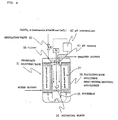
- FIGs. 3 and 4 show a second embodiment of the present invention.
- a phosphate recovery tank 31 in which mixed sludge is fed, the release of phosphate in an anaerobic condition and the recovery of phosphate with a seed crystal material are simultaneously performed.
- the seed crystal material is kept in a fluid state in the tank 31.
- Ca(OH)2 is supplied to the phosphate recovery tank 31 to adjust the pH and the calcium ion concentration of the sludge mixed liquor.
- the sludge mixed liquor discharged from the phosphate recovery tank 31 (mixed sludge have decreased phosphorus content) is thickened in a thickener 32 and is separated into thickened sludge and thickener effluent.
- the thickened sludge is fed to an anaerobic digestion tank 33, and phosphate are further released therein.
- the digested sludge is dewatered at a dewatering apparatus 34 and is separated into dewatered sludge having a decreased phosphorus content and dewatering effluent.
- the dewatering effluent is returned to the phosphate recovery tank 31, and phosphate are recovered.
- a cylindrical bulkhead 35 is provided in the center of the tank, and a motor-driven agitating blade 36 is provided in the bulkhead 35.
- a fluidizing zone 38 including a seed crystal material 37 and sludge is provided, and the seed crystal material 37 fluidiz in the sludge.
- a filter 39 for example, composed of a wire mesh cylinder, is fixed on the upper end of the bulkhead 35, and the filter 39 prevents the spherical seed crystal material 37 from flowing into the bulkhead 35.
- Numeral 40 represents a regulating valve for controlling the feed rate of Ca(OH)2, and numeral 41 represents a pH sensor.
- the detected value by the pH sensor 41 is input to a pH controller 42, and the pH controller 42 controls the closing and opening of the regulating valve 40 so that the pH of the sludge solution is controlled within a proper range.
- the pH controller 42 controls the closing and opening of the regulating valve 40 so that the pH of the sludge solution is controlled within a proper range.
- the calcium ion concentration is set at approximately 80 to 150 mg/l, although there are variations depending on the characteristics of the mixed sludge.
- the calcium ion concentration is set at approximately 80 to 150 mg/l.
- the phosphate released from the sludge are brought into contact with the filled seed crystal material 37, and hydroxyapatite crystals are produced on the surface of the seed crystal material 37 by crystallizing reaction. After the seed crystal material in which hydroxyapatite crystals have been produced is used for a predetermined period of time, it is replaced with new agent, and thus, phosphate are recovered.
- a granular seed crystal material 37 is filled up, and it is, in a broad sense, in a fluid state (including a fountaining state), in which the seed crystal material 37 flows according to the flow of the liquid.
- the fluidization conditions, etc. depend on factors such as specific gravity and particle size of the seed crystal material to be used, and on viscosity of the liquid.
- the method for producing such a seed crystal material includes a step of granulating by tumbling, using powder made of a silicic material and powder made of a calcic material (for example, producing spherules having diameters of approximately 1 to 15 mm), a process of curing the granulated material in moist air, and a process of autoclave curing (for example, curing in an autoclave at 180 - C, at 10 atm).
- the silicic material and calcic material preferably, silica, diatom earth, acidearth, blast furnace slag, fly ash, cement, gypsum, calcined lime, or the like is used.
- the autoclave curing is a curing method which is primarily used for concrete products, in which pressure and heat effects of saturated steam are used together.
- the seed crystal material is in a substantially spherical shape, and a calcium silicate hydrate as the precipitation site for hydroxyapatite is formed on the entire surface thereof. Therefore, the contact area of the calcium silicate hydrate as the precipitation site for hydroxyapatite with water containing phosphate is increased, resulting in significantly high efficiency of phosphate adsorption.
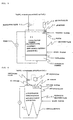
- FIG. 5 A third embodiment of the present invention is shown in FIG. 5.
- a fluidizing zone is formed without using an agitating blade.
- Sludge fed to a phosphate recovery tank 51 is forced to be fed into a dispersion chamber 53 in the recovery tank 51 by a pump 52.
- the sludge is fed to a fluidization chamber 55 through a distributor (perforated plate) 54 provided on the top of the dispersion chamber 53.
- a seed crystal material is filled in the fluidization chamber 55, and a fluidizing zone is formed by fountaining of the sludge fed through the distributor 54.
- Numeral 56 represents a filter
- numeral 57 represents a pH sensor
- numeral 58 represents a pH controller
- numeral 59 represents a regulating valve for a pipe for feeding calcium hydroxide.
- An upflow is generated by forcibly circulating the sludge slurry by the pump 52, and crystallization is performed in the fluidization chamber 55.
- crystallization is performed in the fluidization chamber 55.
- FIG. 6 A fourth embodiment of the present invention is shown in FIG. 6.
- conical sections 62 are provided on the bottom of a phosphate recovery tank 61, and circulated sludge is fed to the bottoms of the conical sections 62 to fluidize a seed crystal material 7 filled in the tank 61.
- the method for removing phosphate, etc., is the same as that in the third embodiment shown in FIG. 5.
- the diameter is gradually increased toward the top of the recovery tank, the flow rate in the tank is gradually decreased, thus ceasing the formation of the fluidizing zone. Therefore, the seed crystal material and sludge are separated from each other, and the load of a separating filter provided on the top can be reduced.
- methods for recovering phosphate from sludge and systems therefor in accordance with the present invention are applicable to waste water streams of biological phosphorus removal processes.
- a phosphate recovery tank in accordance with the present invention as an anaerobic tank itself or between an anaerobic tank and an aerobic tank, the concentration of phosphate to be fed to the aerobic tank can be reduced by treating the phosphate released from return sludge in the anaerobic tank with a seed crystal material.
- the phosphate concentration in the effluent discharged from the sewage treatment system can be reduced.
- Raw sludge and waste sludge (phosphorus content: 4.0%) generated at a sewage treatment plant were collected, and mixed sludge (phosphorus content: 2.5%) in which the raw sludge and the waste sludge were mixed at a ratio of 1:1, on the dry weight basis, and the waste sludge were used as samples.
- Each sample was filled in a 500 ml Erlenmeyer flask, and the flask was closed.
- the sample in the flask was stirred with a laboratory stirrer for 30 minutes, 60 minutes, 90 minutes, 150 minutes, 240 minutes, and 24 hours, followed by filtration.
- the orthophosphate concentration in the filtrate was measured, and the phosphate release rate at each point in the 24 hour-released amount was calculated. The results thereof are shown in Table 1.
- the target treating time for mixed sludge in an anaerobic phosphorus-releasing tank is set at approximately 1 to 2 hours.
- Thick, dewatered filtrate of mixed sludge of waste sludge and raw sludge was treated with an experimental apparatus shown in FIG. 2.
- the flow rate of a circulating pump 13 was controlled so that an expanded bed with an expansion coefficient of 125% was formed.
- the thick, dewatered filtrate was supplied so that the space velocity was 1 / hour.
- a calcium silicate hydrate (average particle size: 1.2 mm, maximum diameter: 2.4 mm, bulk density: 1.2) as seed crystal material was filled in the reaction section of the apparatus, and an expanded bed was formed.
- the recovery rate is 30%, 80%, 90%, and 90%, respectively.
- the pH adjusted by calcium hydroxide is 8.0 to 9.0
- the calcium ion concentration is 110 mg/l, which is within the preferable concentration range of 80 to 150 mg/l.
Landscapes
- Chemical & Material Sciences (AREA)
- Organic Chemistry (AREA)
- Engineering & Computer Science (AREA)
- Environmental & Geological Engineering (AREA)
- Life Sciences & Earth Sciences (AREA)
- Water Supply & Treatment (AREA)
- Hydrology & Water Resources (AREA)
- Chemical Kinetics & Catalysis (AREA)
- General Chemical & Material Sciences (AREA)
- Oil, Petroleum & Natural Gas (AREA)
- Health & Medical Sciences (AREA)
- Molecular Biology (AREA)
- Removal Of Specific Substances (AREA)
Description

Claims (9)
- A method for recovering phosphate from sludge, comprising the process steps of:whereby the crystallization comprises the step of adjusting the pH of the solution to a range from 7.5 to 9.0. and the step of adjusting the calcium ion concentration in the solution to a range from 80 to 150 mg/l.mixing sludge drawn from a water treatment system at a sewage treatment plant with raw sludge drawn from a first settling tank at a water sewage treatment plant; treating the mixture in an anaerobic condition to release polyphosphate accumulated in the sludge into bulk liquid; andrecovering phosphate in the solution using a seed crystal material.
- The method for recovering phosphate from sludge according to Claim 1, further comprising the processes of digesting the sludge treated in an anaerobic digestion tank; and dewatering and separating the digested sludge into dewatered sludge and dewatering effluent.
- The method for recovering phosphate from sludge according to any one of Claims 1 or 2, wherein the treatment in the anaerobic condition is performed simultaneously with the recovery of phosphate using the seed crystal material.
- The method for recovering phosphate from sludge according to any one of Claims 1 to 3, wherein the seed crystal material flows in the sludge solution.
- The method for recovering phosphate from sludge according to Claim 4, wherein the seed crystal material comprises a calcium silicate hydrate as a major constituent and is formed in a substantially spherical shape.
- The method for recovering phosphate from sludgeaccording to Claim 5, wherein the calcium silicate hydrate is at least one selected from the group consisting of tobermorite, xonotlite, hillebrandite, and wollastonite.
- A system for recovering phosphate from sludge comprising:a mixing means for mixing waste sludge drawn from a water treatment system at a sewage treatment plant with raw sludge drawn from a first settling tank at a water sewage treatment plant;phosphorus-releasing means (1) for treating the mixture in an anaerobic condition to release phosphate into the bulk liquid;a thickening means (2) for thickening and separating the sludge containing the liquid including the released phosphate into thickener effluentand thickened sludge;a dewatering andseparating means (4) for separating the thickened sludge into dewatering effluent and dewatered sludge;a calcium ion concentration-adjusting means (5) for adding a water soluble calcium compound to the liquid separated by thickener effluent and dewatering effluent to adjust the calcium ion concentration therein;a pH-adjusting means (9) for adding an alkaline substance to the thickener effluent and the dewatering effluentto adjust the pH thereof; anda crystallizing means (6) for recovering phosphate from the calcium ion concentration-adjusted, pH-adjusted effluents of thickener and dewatering apparatus.
- The system for recovering phosphate from sludge according to Claim 7, further comprising an anaerobic digesting means (3) for digesting the thickened sludge.
- The system for recovering phosphate from sludge according to any one of Claims 7 or 8 , wherein the crystallizing means comprises a seed crystal material for recovering phosphate by crystallizing reaction.
Applications Claiming Priority (4)
| Application Number | Priority Date | Filing Date | Title |
|---|---|---|---|
| JP32105198 | 1998-11-11 | ||
| JP32105198A JP3480904B2 (en) | 1998-11-11 | 1998-11-11 | Method and apparatus for recovering phosphorus from sludge |
| JP18975299 | 1999-07-02 | ||
| JP11189752A JP2001017999A (en) | 1999-07-02 | 1999-07-02 | Method and apparatus for recovering phosphorus from sludge |
Publications (3)
| Publication Number | Publication Date |
|---|---|
| EP1000904A2 EP1000904A2 (en) | 2000-05-17 |
| EP1000904A3 EP1000904A3 (en) | 2001-04-11 |
| EP1000904B1 true EP1000904B1 (en) | 2005-05-04 |
Family
ID=26505666
Family Applications (1)
| Application Number | Title | Priority Date | Filing Date |
|---|---|---|---|
| EP99121644A Expired - Lifetime EP1000904B1 (en) | 1998-11-11 | 1999-10-30 | Method for recovering phosphate from sludge and system therefor |
Country Status (4)
| Country | Link |
|---|---|
| US (1) | US6338799B1 (en) |
| EP (1) | EP1000904B1 (en) |
| KR (1) | KR100640698B1 (en) |
| DE (1) | DE69925090T2 (en) |
Cited By (1)
| Publication number | Priority date | Publication date | Assignee | Title |
|---|---|---|---|---|
| DE102011016826A1 (en) * | 2011-04-12 | 2012-10-18 | Karlsruher Institut für Technologie | Plant and process for the recovery of phosphorus from wastewater |
Families Citing this family (27)
| Publication number | Priority date | Publication date | Assignee | Title |
|---|---|---|---|---|
| KR100432321B1 (en) * | 2002-08-13 | 2004-05-20 | 엔바이로텍 주식회사 | Method for advanced wastewater treatment without excess sludge using sludge disintegration |
| US6994782B2 (en) * | 2003-09-09 | 2006-02-07 | North Carolina State University | Apparatus for removing phosphorus from waste lagoon effluent |
| US6982036B2 (en) * | 2003-07-21 | 2006-01-03 | Ch2M Hill, Inc. | Chemically enhanced primary sludge fermentation method |
| KR100593833B1 (en) * | 2004-05-06 | 2006-06-28 | 한국화학연구원 | Separation and recovery method of ultra-high purity phosphoric acid from semiconductor waste etching solution |
| US7513684B2 (en) * | 2005-02-17 | 2009-04-07 | Parker-Hannifin Corporation | Calcium silicate hydrate material for use as ballast in thermostatic expansion valve |
| US7396453B1 (en) * | 2005-04-19 | 2008-07-08 | Procorp Enterprises, Llc | Hydraulically integrated solids/liquid separation system for wastewater treatment |
| GB2430793A (en) * | 2005-09-29 | 2007-04-04 | Bookham Technology Plc | Bragg grating reflection strength control |
| US7927493B2 (en) * | 2007-05-11 | 2011-04-19 | Ch2M Hill, Inc. | Low phosphorus water treatment methods |
| KR100837698B1 (en) * | 2007-09-03 | 2008-06-13 | 주식회사 피엠씨코리아 | Sludge Advanced Treatment System and Method |
| DE102008013980B3 (en) * | 2008-03-12 | 2009-10-08 | P. C. S. Pollution Control Service Gmbh | Process for wastewater treatment and wastewater treatment plant |
| US8153006B1 (en) | 2008-06-05 | 2012-04-10 | Procorp Enterprises, Llc | Anaerobic treatment process for ethanol production |
| KR101021213B1 (en) * | 2009-07-28 | 2011-03-11 | 주식회사 환경시설관리공사 | Phosphorus removal and recovery apparatus for wastewater effluent using zirconium ferrite filling cartridge filter |
| US8721887B2 (en) | 2009-12-07 | 2014-05-13 | Ch2M Hill, Inc. | Method and system for treating wastewater |
| DE102010022381A1 (en) * | 2010-06-01 | 2011-12-01 | Tu Darmstadt | Mixture for reducing the formation of magnesium ammonium phosphate (struvite) in sewage treatment plants |
| DE102010033145A1 (en) * | 2010-08-03 | 2012-02-09 | Envirochemie Gmbh | Apparatus and method for the selective separation of inorganic cargo from an anaerobic wastewater treatment system |
| GB201113313D0 (en) * | 2011-08-02 | 2011-09-14 | Univ Belfast | Controlled release fertiliser |
| FR3012128B1 (en) * | 2013-10-18 | 2016-01-01 | Saur | PROCESS FOR TREATING WASTEWATER |
| CN105688814A (en) * | 2016-03-18 | 2016-06-22 | 中国科学院生态环境研究中心 | Method for preparing phosphorus-removing adsorbent by utilizing sludge of sewage treatment plant |
| KR102025867B1 (en) * | 2017-07-13 | 2019-09-27 | 씨제이제일제당 주식회사 | A method for recovering and recycling phosphoric acid from a fermentation liquor or a fermentation waste liquor |
| CN109320006B (en) * | 2018-09-10 | 2023-09-15 | 江苏澳洋环境科技有限公司 | A black and smelly river treatment system |
| EP3626684A1 (en) * | 2018-09-20 | 2020-03-25 | SUEZ Groupe | Method for phosphorus recovery and ammonium abatement from wastewater |
| FR3092105B1 (en) * | 2019-01-28 | 2022-08-12 | Suez Groupe | Process and installation for the recovery of phosphorus in a sludge effluent from wastewater |
| DE102019102700A1 (en) * | 2019-02-04 | 2020-08-06 | Cnp-Technology Water And Biosolids Gmbh | Process for the recovery of phosphorus |
| US11944951B2 (en) * | 2020-06-23 | 2024-04-02 | The United States Of America, As Represented By The Secretary Of Agriculture | Composition and method for reducing ammonia and soluble phosphorus in runoff and leaching from animal manure |
| CN112119953B (en) * | 2020-09-18 | 2022-08-02 | 哈尔滨工程大学 | An intelligently controlled device for promoting the induction and growth of marine sessile organisms |
| CN113248089A (en) * | 2021-06-25 | 2021-08-13 | 山东建筑大学 | Residual sludge phosphorus digestion and dissolution coupled phosphate recovery device and sludge treatment method |
| US12312266B1 (en) | 2021-07-06 | 2025-05-27 | Brown And Caldwell | System and method for wastewater treatment |
Family Cites Families (11)
| Publication number | Priority date | Publication date | Assignee | Title |
|---|---|---|---|---|
| US3716484A (en) * | 1971-05-10 | 1973-02-13 | Michigan Chem Corp | Process for substantial removal of phosphates from wastewaters |
| US3965002A (en) * | 1975-04-02 | 1976-06-22 | Betz Laboratories, Inc. | Process for reducing dissolved inorganic orthophosphates to PPB levels in aqueous systems |
| US4076515A (en) * | 1975-07-09 | 1978-02-28 | Rickard M David | Method for treatment of digester supernatant and other streams in wastewater treatment facilities |
| NL187312C (en) * | 1978-05-18 | 1991-08-16 | Dhv Raadgevend Ing | METHOD FOR DEPOSPHATING WATER. |
| JPS56150500A (en) * | 1980-04-25 | 1981-11-20 | Ebara Infilco Co Ltd | Disposal of sludge |
| US5651891A (en) * | 1989-08-02 | 1997-07-29 | Polytechnic University | Wastewater treatment process |
| US5279637A (en) * | 1990-10-23 | 1994-01-18 | Pcl Environmental Inc. | Sludge treatment system |
| JP2591921B2 (en) * | 1994-12-05 | 1997-03-19 | 東曹産業株式会社 | Method for producing alkali metal phosphate |
| DE19505884A1 (en) * | 1995-02-21 | 1996-08-22 | Adalbert Dr Ing Nagy | Water treatment process and small-scale assembly removes phosphate ions |
| JPH10321051A (en) | 1997-05-16 | 1998-12-04 | Furukawa Electric Co Ltd:The | Lightweight low sag overhead wire |
| JPH11189752A (en) | 1997-12-26 | 1999-07-13 | Mitsui Chem Inc | Adhesive substrate for fixing tile and production of tile unit |
-
1999
- 1999-10-30 EP EP99121644A patent/EP1000904B1/en not_active Expired - Lifetime
- 1999-10-30 DE DE1999625090 patent/DE69925090T2/en not_active Expired - Lifetime
- 1999-11-08 KR KR19990049211A patent/KR100640698B1/en not_active Expired - Lifetime
- 1999-11-10 US US09/437,134 patent/US6338799B1/en not_active Expired - Lifetime
Cited By (1)
| Publication number | Priority date | Publication date | Assignee | Title |
|---|---|---|---|---|
| DE102011016826A1 (en) * | 2011-04-12 | 2012-10-18 | Karlsruher Institut für Technologie | Plant and process for the recovery of phosphorus from wastewater |
Also Published As
| Publication number | Publication date |
|---|---|
| DE69925090D1 (en) | 2005-06-09 |
| DE69925090T2 (en) | 2005-09-22 |
| KR100640698B1 (en) | 2006-10-31 |
| EP1000904A3 (en) | 2001-04-11 |
| KR20000035299A (en) | 2000-06-26 |
| EP1000904A2 (en) | 2000-05-17 |
| US6338799B1 (en) | 2002-01-15 |
Similar Documents
| Publication | Publication Date | Title |
|---|---|---|
| US6338799B1 (en) | Method for recovering phosphate from sludge and system therefor | |
| Giesen | Crystallisation process enables environmental friendly phosphate removal at low costs | |
| Le et al. | Struvite recovery from swine wastewater using fluidized-bed homogeneous granulation process | |
| US4917802A (en) | Method for treating waste water | |
| Laridi et al. | Laboratory and pilot-scale phosphate and ammonium removal by controlled struvite precipitation following coagulation and flocculation of swine wastewater | |
| US20210317016A1 (en) | Methods and apparatus for nutrient and water recovery from waste streams | |
| US6063279A (en) | Waste water treatment method and equipment being able to treat hydrogen peroxide, phosphorus, fluorine and organic-matters with high efficiency | |
| EP1849751B1 (en) | Apparatus for treating wastewater and sludge | |
| JP4519485B2 (en) | Phosphorus recovery method and apparatus | |
| Eggers et al. | Full-scale experiences with phosphate crystallization in a Crystalactor® | |
| US3546111A (en) | Waste treatment | |
| JP3480904B2 (en) | Method and apparatus for recovering phosphorus from sludge | |
| JP3504248B2 (en) | Advanced treatment method for liquids containing fluorine compounds | |
| Heinzmann et al. | Induced magnesium ammonia phosphate precipitation to prevent incrustations and measures for phosphorus recovery | |
| US20130200301A1 (en) | Mixture for reducing the formation of magnesium ammonium phosphate (struvite) in clarification plants | |
| JPS6242677B2 (en) | ||
| Yigit et al. | Phosphate recovery potential from wastewater by chemical precipitation at batch conditions | |
| Mitani et al. | Struvite recovery from wastewater having low phosphate concentration | |
| JP4568391B2 (en) | Fluidized bed crystallization reactor | |
| CZ326394A3 (en) | Phosphorus removing method | |
| JP4368159B2 (en) | Method for treating wastewater containing phosphate | |
| JPS62250990A (en) | Treatment of waste water containing phosphate ion | |
| JP2003230899A (en) | Method and apparatus for recovering phosphorus from sludge | |
| WO2021006737A1 (en) | Recovery of phosphorous | |
| JP2003230899A5 (en) |
Legal Events
| Date | Code | Title | Description |
|---|---|---|---|
| PUAI | Public reference made under article 153(3) epc to a published international application that has entered the european phase |
Free format text: ORIGINAL CODE: 0009012 |
|
| AK | Designated contracting states |
Kind code of ref document: A2 Designated state(s): DE FR GB NL |
|
| AX | Request for extension of the european patent |
Free format text: AL;LT;LV;MK;RO;SI |
|
| PUAL | Search report despatched |
Free format text: ORIGINAL CODE: 0009013 |
|
| AK | Designated contracting states |
Kind code of ref document: A3 Designated state(s): AT BE CH CY DE DK ES FI FR GB GR IE IT LI LU MC NL PT SE |
|
| AX | Request for extension of the european patent |
Free format text: AL;LT;LV;MK;RO;SI |
|
| RIC1 | Information provided on ipc code assigned before grant |
Free format text: 7C 02F 11/04 A, 7C 02F 1/52 B, 7B 01D 9/00 B, 7C 05F 7/00 B |
|
| 17P | Request for examination filed |
Effective date: 20010917 |
|
| AKX | Designation fees paid |
Free format text: DE FR GB NL |
|
| 17Q | First examination report despatched |
Effective date: 20030402 |
|
| GRAP | Despatch of communication of intention to grant a patent |
Free format text: ORIGINAL CODE: EPIDOSNIGR1 |
|
| RAP1 | Party data changed (applicant data changed or rights of an application transferred) |
Owner name: MORIYAMA, KATSUMI Owner name: MITSUBISHI MATERIALS CORPORATION |
|
| GRAS | Grant fee paid |
Free format text: ORIGINAL CODE: EPIDOSNIGR3 |
|
| GRAA | (expected) grant |
Free format text: ORIGINAL CODE: 0009210 |
|
| AK | Designated contracting states |
Kind code of ref document: B1 Designated state(s): DE FR GB NL |
|
| REG | Reference to a national code |
Ref country code: GB Ref legal event code: FG4D |
|
| REF | Corresponds to: |
Ref document number: 69925090 Country of ref document: DE Date of ref document: 20050609 Kind code of ref document: P |
|
| ET | Fr: translation filed | ||
| PLBE | No opposition filed within time limit |
Free format text: ORIGINAL CODE: 0009261 |
|
| STAA | Information on the status of an ep patent application or granted ep patent |
Free format text: STATUS: NO OPPOSITION FILED WITHIN TIME LIMIT |
|
| 26N | No opposition filed |
Effective date: 20060207 |
|
| REG | Reference to a national code |
Ref country code: FR Ref legal event code: PLFP Year of fee payment: 17 |
|
| REG | Reference to a national code |
Ref country code: FR Ref legal event code: PLFP Year of fee payment: 18 |
|
| REG | Reference to a national code |
Ref country code: FR Ref legal event code: PLFP Year of fee payment: 19 |
|
| REG | Reference to a national code |
Ref country code: FR Ref legal event code: PLFP Year of fee payment: 20 |
|
| PGFP | Annual fee paid to national office [announced via postgrant information from national office to epo] |
Ref country code: NL Payment date: 20181019 Year of fee payment: 20 |
|
| PGFP | Annual fee paid to national office [announced via postgrant information from national office to epo] |
Ref country code: DE Payment date: 20181019 Year of fee payment: 20 |
|
| PGFP | Annual fee paid to national office [announced via postgrant information from national office to epo] |
Ref country code: GB Payment date: 20181019 Year of fee payment: 20 Ref country code: FR Payment date: 20181022 Year of fee payment: 20 |
|
| REG | Reference to a national code |
Ref country code: DE Ref legal event code: R071 Ref document number: 69925090 Country of ref document: DE Ref country code: NL Ref legal event code: MK Effective date: 20191029 |
|
| REG | Reference to a national code |
Ref country code: GB Ref legal event code: PE20 Expiry date: 20191029 |
|
| PG25 | Lapsed in a contracting state [announced via postgrant information from national office to epo] |
Ref country code: GB Free format text: LAPSE BECAUSE OF EXPIRATION OF PROTECTION Effective date: 20191029 |