EP0995495A1 - Electrostatic control for contact between gases and solid particles - Google Patents
Electrostatic control for contact between gases and solid particles Download PDFInfo
- Publication number
- EP0995495A1 EP0995495A1 EP99308244A EP99308244A EP0995495A1 EP 0995495 A1 EP0995495 A1 EP 0995495A1 EP 99308244 A EP99308244 A EP 99308244A EP 99308244 A EP99308244 A EP 99308244A EP 0995495 A1 EP0995495 A1 EP 0995495A1
- Authority
- EP
- European Patent Office
- Prior art keywords
- particles
- space
- gases
- discharge
- electrodes
- Prior art date
- Legal status (The legal status is an assumption and is not a legal conclusion. Google has not performed a legal analysis and makes no representation as to the accuracy of the status listed.)
- Withdrawn
Links
- 239000002245 particle Substances 0.000 title abstract description 377
- 239000007789 gas Substances 0.000 title abstract description 298
- 239000007787 solid Substances 0.000 title abstract description 111
- 238000000034 method Methods 0.000 abstract description 73
- 238000012546 transfer Methods 0.000 abstract description 38
- 230000033001 locomotion Effects 0.000 abstract description 24
- 230000001737 promoting effect Effects 0.000 abstract description 6
- 239000010419 fine particle Substances 0.000 abstract description 5
- 230000008569 process Effects 0.000 description 62
- 239000000428 dust Substances 0.000 description 53
- 150000002500 ions Chemical class 0.000 description 36
- 239000003570 air Substances 0.000 description 32
- CDBYLPFSWZWCQE-UHFFFAOYSA-L Sodium Carbonate Chemical compound [Na+].[Na+].[O-]C([O-])=O CDBYLPFSWZWCQE-UHFFFAOYSA-L 0.000 description 23
- 238000013461 design Methods 0.000 description 23
- 230000005684 electric field Effects 0.000 description 21
- 239000003344 environmental pollutant Substances 0.000 description 21
- 231100000719 pollutant Toxicity 0.000 description 21
- 230000000694 effects Effects 0.000 description 20
- 239000011521 glass Substances 0.000 description 20
- 230000001965 increasing effect Effects 0.000 description 18
- 239000000463 material Substances 0.000 description 18
- 230000002829 reductive effect Effects 0.000 description 17
- 238000006243 chemical reaction Methods 0.000 description 16
- 238000002347 injection Methods 0.000 description 16
- 239000007924 injection Substances 0.000 description 16
- XLYOFNOQVPJJNP-UHFFFAOYSA-N water Substances O XLYOFNOQVPJJNP-UHFFFAOYSA-N 0.000 description 16
- 230000008901 benefit Effects 0.000 description 14
- 230000005484 gravity Effects 0.000 description 14
- 239000012717 electrostatic precipitator Substances 0.000 description 13
- 239000013529 heat transfer fluid Substances 0.000 description 13
- 239000000203 mixture Substances 0.000 description 13
- 235000019738 Limestone Nutrition 0.000 description 12
- 239000006028 limestone Substances 0.000 description 12
- 239000000446 fuel Substances 0.000 description 11
- 230000006870 function Effects 0.000 description 11
- 238000002156 mixing Methods 0.000 description 11
- 239000000470 constituent Substances 0.000 description 10
- 239000012530 fluid Substances 0.000 description 10
- 238000004519 manufacturing process Methods 0.000 description 10
- 230000009467 reduction Effects 0.000 description 10
- 238000006722 reduction reaction Methods 0.000 description 10
- 238000005367 electrostatic precipitation Methods 0.000 description 9
- 238000000926 separation method Methods 0.000 description 9
- VTYYLEPIZMXCLO-UHFFFAOYSA-L Calcium carbonate Chemical compound [Ca+2].[O-]C([O-])=O VTYYLEPIZMXCLO-UHFFFAOYSA-L 0.000 description 8
- 230000009471 action Effects 0.000 description 8
- 230000006698 induction Effects 0.000 description 8
- 239000013618 particulate matter Substances 0.000 description 8
- 239000012716 precipitator Substances 0.000 description 8
- 238000001179 sorption measurement Methods 0.000 description 8
- 239000012212 insulator Substances 0.000 description 7
- 239000007788 liquid Substances 0.000 description 7
- 239000002994 raw material Substances 0.000 description 7
- OKTJSMMVPCPJKN-UHFFFAOYSA-N Carbon Chemical compound [C] OKTJSMMVPCPJKN-UHFFFAOYSA-N 0.000 description 6
- 230000015572 biosynthetic process Effects 0.000 description 6
- 238000002485 combustion reaction Methods 0.000 description 6
- 238000001816 cooling Methods 0.000 description 6
- 230000007423 decrease Effects 0.000 description 6
- 238000009826 distribution Methods 0.000 description 6
- 238000001035 drying Methods 0.000 description 6
- 238000002844 melting Methods 0.000 description 6
- 230000008018 melting Effects 0.000 description 6
- 229910000029 sodium carbonate Inorganic materials 0.000 description 6
- 238000004140 cleaning Methods 0.000 description 5
- 238000010438 heat treatment Methods 0.000 description 5
- 239000000126 substance Substances 0.000 description 5
- VYPSYNLAJGMNEJ-UHFFFAOYSA-N Silicium dioxide Chemical compound O=[Si]=O VYPSYNLAJGMNEJ-UHFFFAOYSA-N 0.000 description 4
- 230000001133 acceleration Effects 0.000 description 4
- 239000002253 acid Substances 0.000 description 4
- 229910000019 calcium carbonate Inorganic materials 0.000 description 4
- 239000004568 cement Substances 0.000 description 4
- 239000006063 cullet Substances 0.000 description 4
- 238000009472 formulation Methods 0.000 description 4
- 235000017550 sodium carbonate Nutrition 0.000 description 4
- 239000002594 sorbent Substances 0.000 description 4
- HGUFODBRKLSHSI-UHFFFAOYSA-N 2,3,7,8-tetrachloro-dibenzo-p-dioxin Chemical compound O1C2=CC(Cl)=C(Cl)C=C2OC2=C1C=C(Cl)C(Cl)=C2 HGUFODBRKLSHSI-UHFFFAOYSA-N 0.000 description 3
- MWUXSHHQAYIFBG-UHFFFAOYSA-N Nitric oxide Chemical compound O=[N] MWUXSHHQAYIFBG-UHFFFAOYSA-N 0.000 description 3
- PMZURENOXWZQFD-UHFFFAOYSA-L Sodium Sulfate Chemical compound [Na+].[Na+].[O-]S([O-])(=O)=O PMZURENOXWZQFD-UHFFFAOYSA-L 0.000 description 3
- 239000011449 brick Substances 0.000 description 3
- 238000001354 calcination Methods 0.000 description 3
- 239000000919 ceramic Substances 0.000 description 3
- 239000003245 coal Substances 0.000 description 3
- 230000002939 deleterious effect Effects 0.000 description 3
- 230000001419 dependent effect Effects 0.000 description 3
- 238000005516 engineering process Methods 0.000 description 3
- 238000001914 filtration Methods 0.000 description 3
- 239000006066 glass batch Substances 0.000 description 3
- 239000008187 granular material Substances 0.000 description 3
- 230000007246 mechanism Effects 0.000 description 3
- 239000006060 molten glass Substances 0.000 description 3
- 239000000243 solution Substances 0.000 description 3
- 230000001052 transient effect Effects 0.000 description 3
- UGFAIRIUMAVXCW-UHFFFAOYSA-N Carbon monoxide Chemical compound [O+]#[C-] UGFAIRIUMAVXCW-UHFFFAOYSA-N 0.000 description 2
- 238000003723 Smelting Methods 0.000 description 2
- NINIDFKCEFEMDL-UHFFFAOYSA-N Sulfur Chemical compound [S] NINIDFKCEFEMDL-UHFFFAOYSA-N 0.000 description 2
- 239000005864 Sulphur Substances 0.000 description 2
- 238000010521 absorption reaction Methods 0.000 description 2
- 230000002378 acidificating effect Effects 0.000 description 2
- 229910052782 aluminium Inorganic materials 0.000 description 2
- XAGFODPZIPBFFR-UHFFFAOYSA-N aluminium Chemical compound [Al] XAGFODPZIPBFFR-UHFFFAOYSA-N 0.000 description 2
- PNEYBMLMFCGWSK-UHFFFAOYSA-N aluminium oxide Inorganic materials [O-2].[O-2].[O-2].[Al+3].[Al+3] PNEYBMLMFCGWSK-UHFFFAOYSA-N 0.000 description 2
- 239000012080 ambient air Substances 0.000 description 2
- 238000004458 analytical method Methods 0.000 description 2
- 230000003466 anti-cipated effect Effects 0.000 description 2
- 239000002956 ash Substances 0.000 description 2
- QVGXLLKOCUKJST-UHFFFAOYSA-N atomic oxygen Chemical compound [O] QVGXLLKOCUKJST-UHFFFAOYSA-N 0.000 description 2
- 230000009286 beneficial effect Effects 0.000 description 2
- 230000033228 biological regulation Effects 0.000 description 2
- 239000011575 calcium Substances 0.000 description 2
- GBAOBIBJACZTNA-UHFFFAOYSA-L calcium sulfite Chemical compound [Ca+2].[O-]S([O-])=O GBAOBIBJACZTNA-UHFFFAOYSA-L 0.000 description 2
- 235000010261 calcium sulphite Nutrition 0.000 description 2
- 239000004295 calcium sulphite Substances 0.000 description 2
- 230000015556 catabolic process Effects 0.000 description 2
- 238000006555 catalytic reaction Methods 0.000 description 2
- 239000007795 chemical reaction product Substances 0.000 description 2
- 239000004020 conductor Substances 0.000 description 2
- 230000003247 decreasing effect Effects 0.000 description 2
- 230000018044 dehydration Effects 0.000 description 2
- 238000006297 dehydration reaction Methods 0.000 description 2
- 230000001627 detrimental effect Effects 0.000 description 2
- GNTDGMZSJNCJKK-UHFFFAOYSA-N divanadium pentaoxide Chemical compound O=[V](=O)O[V](=O)=O GNTDGMZSJNCJKK-UHFFFAOYSA-N 0.000 description 2
- 230000005662 electromechanics Effects 0.000 description 2
- 230000002708 enhancing effect Effects 0.000 description 2
- 239000003546 flue gas Substances 0.000 description 2
- 239000002803 fossil fuel Substances 0.000 description 2
- 238000005816 glass manufacturing process Methods 0.000 description 2
- 230000003993 interaction Effects 0.000 description 2
- 230000000670 limiting effect Effects 0.000 description 2
- 239000007791 liquid phase Substances 0.000 description 2
- 238000011068 loading method Methods 0.000 description 2
- 229910052751 metal Inorganic materials 0.000 description 2
- 239000002184 metal Substances 0.000 description 2
- 229910052760 oxygen Inorganic materials 0.000 description 2
- 239000001301 oxygen Substances 0.000 description 2
- 239000002244 precipitate Substances 0.000 description 2
- 239000000047 product Substances 0.000 description 2
- 238000012552 review Methods 0.000 description 2
- 239000004576 sand Substances 0.000 description 2
- 238000005201 scrubbing Methods 0.000 description 2
- 239000011343 solid material Substances 0.000 description 2
- 239000012798 spherical particle Substances 0.000 description 2
- 230000003068 static effect Effects 0.000 description 2
- 238000003860 storage Methods 0.000 description 2
- 229910052815 sulfur oxide Inorganic materials 0.000 description 2
- 230000007704 transition Effects 0.000 description 2
- 239000002918 waste heat Substances 0.000 description 2
- 239000002699 waste material Substances 0.000 description 2
- BVKZGUZCCUSVTD-UHFFFAOYSA-M Bicarbonate Chemical class OC([O-])=O BVKZGUZCCUSVTD-UHFFFAOYSA-M 0.000 description 1
- 241001474374 Blennius Species 0.000 description 1
- OYPRJOBELJOOCE-UHFFFAOYSA-N Calcium Chemical compound [Ca] OYPRJOBELJOOCE-UHFFFAOYSA-N 0.000 description 1
- 235000008733 Citrus aurantifolia Nutrition 0.000 description 1
- MYMOFIZGZYHOMD-UHFFFAOYSA-N Dioxygen Chemical compound O=O MYMOFIZGZYHOMD-UHFFFAOYSA-N 0.000 description 1
- 238000009626 Hall-Héroult process Methods 0.000 description 1
- DGAQECJNVWCQMB-PUAWFVPOSA-M Ilexoside XXIX Chemical compound C[C@@H]1CC[C@@]2(CC[C@@]3(C(=CC[C@H]4[C@]3(CC[C@@H]5[C@@]4(CC[C@@H](C5(C)C)OS(=O)(=O)[O-])C)C)[C@@H]2[C@]1(C)O)C)C(=O)O[C@H]6[C@@H]([C@H]([C@@H]([C@H](O6)CO)O)O)O.[Na+] DGAQECJNVWCQMB-PUAWFVPOSA-M 0.000 description 1
- 235000011941 Tilia x europaea Nutrition 0.000 description 1
- 240000008042 Zea mays Species 0.000 description 1
- 235000005824 Zea mays ssp. parviglumis Nutrition 0.000 description 1
- 235000002017 Zea mays subsp mays Nutrition 0.000 description 1
- 238000005299 abrasion Methods 0.000 description 1
- 239000000654 additive Substances 0.000 description 1
- 239000000853 adhesive Substances 0.000 description 1
- 230000001070 adhesive effect Effects 0.000 description 1
- 238000005054 agglomeration Methods 0.000 description 1
- 230000002776 aggregation Effects 0.000 description 1
- 238000003915 air pollution Methods 0.000 description 1
- 239000004411 aluminium Substances 0.000 description 1
- 238000013459 approach Methods 0.000 description 1
- 230000003416 augmentation Effects 0.000 description 1
- 239000000987 azo dye Substances 0.000 description 1
- 229910052791 calcium Inorganic materials 0.000 description 1
- 150000004649 carbonic acid derivatives Chemical class 0.000 description 1
- 239000003054 catalyst Substances 0.000 description 1
- 230000003197 catalytic effect Effects 0.000 description 1
- 238000010531 catalytic reduction reaction Methods 0.000 description 1
- 235000013339 cereals Nutrition 0.000 description 1
- 239000003153 chemical reaction reagent Substances 0.000 description 1
- 230000002860 competitive effect Effects 0.000 description 1
- 239000012141 concentrate Substances 0.000 description 1
- 238000010276 construction Methods 0.000 description 1
- 238000011109 contamination Methods 0.000 description 1
- 235000005822 corn Nutrition 0.000 description 1
- 238000000151 deposition Methods 0.000 description 1
- 230000008021 deposition Effects 0.000 description 1
- 238000010586 diagram Methods 0.000 description 1
- 239000010459 dolomite Substances 0.000 description 1
- 229910000514 dolomite Inorganic materials 0.000 description 1
- 238000005203 dry scrubbing Methods 0.000 description 1
- 238000010410 dusting Methods 0.000 description 1
- 238000010292 electrical insulation Methods 0.000 description 1
- 238000004924 electrostatic deposition Methods 0.000 description 1
- 239000010881 fly ash Substances 0.000 description 1
- 238000004952 furnace firing Methods 0.000 description 1
- 239000000156 glass melt Substances 0.000 description 1
- 239000005431 greenhouse gas Substances 0.000 description 1
- 238000000227 grinding Methods 0.000 description 1
- 239000011551 heat transfer agent Substances 0.000 description 1
- 229910001385 heavy metal Inorganic materials 0.000 description 1
- 239000012535 impurity Substances 0.000 description 1
- 239000004615 ingredient Substances 0.000 description 1
- 230000000977 initiatory effect Effects 0.000 description 1
- 229910052500 inorganic mineral Inorganic materials 0.000 description 1
- 238000009413 insulation Methods 0.000 description 1
- 239000004571 lime Substances 0.000 description 1
- 239000001095 magnesium carbonate Substances 0.000 description 1
- 235000014380 magnesium carbonate Nutrition 0.000 description 1
- ZLNQQNXFFQJAID-UHFFFAOYSA-L magnesium carbonate Chemical compound [Mg+2].[O-]C([O-])=O ZLNQQNXFFQJAID-UHFFFAOYSA-L 0.000 description 1
- 229910000021 magnesium carbonate Inorganic materials 0.000 description 1
- VTHJTEIRLNZDEV-UHFFFAOYSA-L magnesium dihydroxide Chemical compound [OH-].[OH-].[Mg+2] VTHJTEIRLNZDEV-UHFFFAOYSA-L 0.000 description 1
- 239000000347 magnesium hydroxide Substances 0.000 description 1
- 229910001862 magnesium hydroxide Inorganic materials 0.000 description 1
- 238000010309 melting process Methods 0.000 description 1
- 230000005012 migration Effects 0.000 description 1
- 238000013508 migration Methods 0.000 description 1
- 239000011707 mineral Substances 0.000 description 1
- 235000010755 mineral Nutrition 0.000 description 1
- 239000010446 mirabilite Substances 0.000 description 1
- 239000010813 municipal solid waste Substances 0.000 description 1
- 230000035515 penetration Effects 0.000 description 1
- 230000000737 periodic effect Effects 0.000 description 1
- 239000003208 petroleum Substances 0.000 description 1
- 239000002006 petroleum coke Substances 0.000 description 1
- 230000000704 physical effect Effects 0.000 description 1
- 239000000843 powder Substances 0.000 description 1
- 238000001556 precipitation Methods 0.000 description 1
- 230000002265 prevention Effects 0.000 description 1
- 238000011112 process operation Methods 0.000 description 1
- 230000001172 regenerating effect Effects 0.000 description 1
- 230000004044 response Effects 0.000 description 1
- 230000002441 reversible effect Effects 0.000 description 1
- 230000000630 rising effect Effects 0.000 description 1
- 238000009991 scouring Methods 0.000 description 1
- 239000000377 silicon dioxide Substances 0.000 description 1
- 239000011734 sodium Substances 0.000 description 1
- 229910052708 sodium Inorganic materials 0.000 description 1
- GEHJYWRUCIMESM-UHFFFAOYSA-L sodium sulfite Chemical compound [Na+].[Na+].[O-]S([O-])=O GEHJYWRUCIMESM-UHFFFAOYSA-L 0.000 description 1
- 239000011949 solid catalyst Substances 0.000 description 1
- 239000012265 solid product Substances 0.000 description 1
- 238000001228 spectrum Methods 0.000 description 1
- XTQHKBHJIVJGKJ-UHFFFAOYSA-N sulfur monoxide Chemical class S=O XTQHKBHJIVJGKJ-UHFFFAOYSA-N 0.000 description 1
- 229910052720 vanadium Inorganic materials 0.000 description 1
- NWONKYPBYAMBJT-UHFFFAOYSA-L zinc sulfate Chemical compound [Zn+2].[O-]S([O-])(=O)=O NWONKYPBYAMBJT-UHFFFAOYSA-L 0.000 description 1
- 239000011686 zinc sulphate Substances 0.000 description 1
- 235000009529 zinc sulphate Nutrition 0.000 description 1
Images



Classifications
-
- C—CHEMISTRY; METALLURGY
- C03—GLASS; MINERAL OR SLAG WOOL
- C03B—MANUFACTURE, SHAPING, OR SUPPLEMENTARY PROCESSES
- C03B3/00—Charging the melting furnaces
- C03B3/02—Charging the melting furnaces combined with preheating, premelting or pretreating the glass-making ingredients, pellets or cullet
- C03B3/023—Preheating
-
- B—PERFORMING OPERATIONS; TRANSPORTING
- B01—PHYSICAL OR CHEMICAL PROCESSES OR APPARATUS IN GENERAL
- B01D—SEPARATION
- B01D53/00—Separation of gases or vapours; Recovering vapours of volatile solvents from gases; Chemical or biological purification of waste gases, e.g. engine exhaust gases, smoke, fumes, flue gases, aerosols
- B01D53/02—Separation of gases or vapours; Recovering vapours of volatile solvents from gases; Chemical or biological purification of waste gases, e.g. engine exhaust gases, smoke, fumes, flue gases, aerosols by adsorption, e.g. preparative gas chromatography
- B01D53/06—Separation of gases or vapours; Recovering vapours of volatile solvents from gases; Chemical or biological purification of waste gases, e.g. engine exhaust gases, smoke, fumes, flue gases, aerosols by adsorption, e.g. preparative gas chromatography with moving adsorbents, e.g. rotating beds
- B01D53/10—Separation of gases or vapours; Recovering vapours of volatile solvents from gases; Chemical or biological purification of waste gases, e.g. engine exhaust gases, smoke, fumes, flue gases, aerosols by adsorption, e.g. preparative gas chromatography with moving adsorbents, e.g. rotating beds with dispersed adsorbents
-
- B—PERFORMING OPERATIONS; TRANSPORTING
- B01—PHYSICAL OR CHEMICAL PROCESSES OR APPARATUS IN GENERAL
- B01D—SEPARATION
- B01D53/00—Separation of gases or vapours; Recovering vapours of volatile solvents from gases; Chemical or biological purification of waste gases, e.g. engine exhaust gases, smoke, fumes, flue gases, aerosols
- B01D53/32—Separation of gases or vapours; Recovering vapours of volatile solvents from gases; Chemical or biological purification of waste gases, e.g. engine exhaust gases, smoke, fumes, flue gases, aerosols by electrical effects other than those provided for in group B01D61/00
-
- B—PERFORMING OPERATIONS; TRANSPORTING
- B01—PHYSICAL OR CHEMICAL PROCESSES OR APPARATUS IN GENERAL
- B01D—SEPARATION
- B01D53/00—Separation of gases or vapours; Recovering vapours of volatile solvents from gases; Chemical or biological purification of waste gases, e.g. engine exhaust gases, smoke, fumes, flue gases, aerosols
- B01D53/34—Chemical or biological purification of waste gases
- B01D53/46—Removing components of defined structure
- B01D53/48—Sulfur compounds
- B01D53/50—Sulfur oxides
- B01D53/501—Sulfur oxides by treating the gases with a solution or a suspension of an alkali or earth-alkali or ammonium compound
- B01D53/504—Sulfur oxides by treating the gases with a solution or a suspension of an alkali or earth-alkali or ammonium compound characterised by a specific device
-
- B—PERFORMING OPERATIONS; TRANSPORTING
- B01—PHYSICAL OR CHEMICAL PROCESSES OR APPARATUS IN GENERAL
- B01D—SEPARATION
- B01D53/00—Separation of gases or vapours; Recovering vapours of volatile solvents from gases; Chemical or biological purification of waste gases, e.g. engine exhaust gases, smoke, fumes, flue gases, aerosols
- B01D53/34—Chemical or biological purification of waste gases
- B01D53/46—Removing components of defined structure
- B01D53/48—Sulfur compounds
- B01D53/50—Sulfur oxides
- B01D53/508—Sulfur oxides by treating the gases with solids
-
- B—PERFORMING OPERATIONS; TRANSPORTING
- B01—PHYSICAL OR CHEMICAL PROCESSES OR APPARATUS IN GENERAL
- B01D—SEPARATION
- B01D53/00—Separation of gases or vapours; Recovering vapours of volatile solvents from gases; Chemical or biological purification of waste gases, e.g. engine exhaust gases, smoke, fumes, flue gases, aerosols
- B01D53/34—Chemical or biological purification of waste gases
- B01D53/46—Removing components of defined structure
- B01D53/68—Halogens or halogen compounds
- B01D53/685—Halogens or halogen compounds by treating the gases with solids
-
- B—PERFORMING OPERATIONS; TRANSPORTING
- B01—PHYSICAL OR CHEMICAL PROCESSES OR APPARATUS IN GENERAL
- B01J—CHEMICAL OR PHYSICAL PROCESSES, e.g. CATALYSIS OR COLLOID CHEMISTRY; THEIR RELEVANT APPARATUS
- B01J19/00—Chemical, physical or physico-chemical processes in general; Their relevant apparatus
- B01J19/08—Processes employing the direct application of electric or wave energy, or particle radiation; Apparatus therefor
- B01J19/087—Processes employing the direct application of electric or wave energy, or particle radiation; Apparatus therefor employing electric or magnetic energy
- B01J19/088—Processes employing the direct application of electric or wave energy, or particle radiation; Apparatus therefor employing electric or magnetic energy giving rise to electric discharges
-
- F—MECHANICAL ENGINEERING; LIGHTING; HEATING; WEAPONS; BLASTING
- F26—DRYING
- F26B—DRYING SOLID MATERIALS OR OBJECTS BY REMOVING LIQUID THEREFROM
- F26B17/00—Machines or apparatus for drying materials in loose, plastic, or fluidised form, e.g. granules, staple fibres, with progressive movement
- F26B17/12—Machines or apparatus for drying materials in loose, plastic, or fluidised form, e.g. granules, staple fibres, with progressive movement with movement performed solely by gravity, i.e. the material moving through a substantially vertical drying enclosure, e.g. shaft
- F26B17/14—Machines or apparatus for drying materials in loose, plastic, or fluidised form, e.g. granules, staple fibres, with progressive movement with movement performed solely by gravity, i.e. the material moving through a substantially vertical drying enclosure, e.g. shaft the materials moving through a counter-current of gas
-
- F—MECHANICAL ENGINEERING; LIGHTING; HEATING; WEAPONS; BLASTING
- F26—DRYING
- F26B—DRYING SOLID MATERIALS OR OBJECTS BY REMOVING LIQUID THEREFROM
- F26B17/00—Machines or apparatus for drying materials in loose, plastic, or fluidised form, e.g. granules, staple fibres, with progressive movement
- F26B17/12—Machines or apparatus for drying materials in loose, plastic, or fluidised form, e.g. granules, staple fibres, with progressive movement with movement performed solely by gravity, i.e. the material moving through a substantially vertical drying enclosure, e.g. shaft
- F26B17/16—Machines or apparatus for drying materials in loose, plastic, or fluidised form, e.g. granules, staple fibres, with progressive movement with movement performed solely by gravity, i.e. the material moving through a substantially vertical drying enclosure, e.g. shaft the materials passing down a heated surface, e.g. fluid-heated closed ducts or other heating elements in contact with the moving stack of material
-
- F—MECHANICAL ENGINEERING; LIGHTING; HEATING; WEAPONS; BLASTING
- F26—DRYING
- F26B—DRYING SOLID MATERIALS OR OBJECTS BY REMOVING LIQUID THEREFROM
- F26B25/00—Details of general application not covered by group F26B21/00 or F26B23/00
- F26B25/001—Handling, e.g. loading or unloading arrangements
- F26B25/002—Handling, e.g. loading or unloading arrangements for bulk goods
-
- F—MECHANICAL ENGINEERING; LIGHTING; HEATING; WEAPONS; BLASTING
- F26—DRYING
- F26B—DRYING SOLID MATERIALS OR OBJECTS BY REMOVING LIQUID THEREFROM
- F26B7/00—Drying solid materials or objects by processes using a combination of processes not covered by a single one of groups F26B3/00 and F26B5/00
- F26B7/002—Drying solid materials or objects by processes using a combination of processes not covered by a single one of groups F26B3/00 and F26B5/00 using an electric field and heat
-
- B—PERFORMING OPERATIONS; TRANSPORTING
- B01—PHYSICAL OR CHEMICAL PROCESSES OR APPARATUS IN GENERAL
- B01D—SEPARATION
- B01D2253/00—Adsorbents used in seperation treatment of gases and vapours
- B01D2253/10—Inorganic adsorbents
- B01D2253/104—Alumina
-
- B—PERFORMING OPERATIONS; TRANSPORTING
- B01—PHYSICAL OR CHEMICAL PROCESSES OR APPARATUS IN GENERAL
- B01D—SEPARATION
- B01D2253/00—Adsorbents used in seperation treatment of gases and vapours
- B01D2253/30—Physical properties of adsorbents
- B01D2253/302—Dimensions
- B01D2253/304—Linear dimensions, e.g. particle shape, diameter
-
- B—PERFORMING OPERATIONS; TRANSPORTING
- B01—PHYSICAL OR CHEMICAL PROCESSES OR APPARATUS IN GENERAL
- B01D—SEPARATION
- B01D2257/00—Components to be removed
- B01D2257/20—Halogens or halogen compounds
- B01D2257/204—Inorganic halogen compounds
- B01D2257/2045—Hydrochloric acid
-
- B—PERFORMING OPERATIONS; TRANSPORTING
- B01—PHYSICAL OR CHEMICAL PROCESSES OR APPARATUS IN GENERAL
- B01D—SEPARATION
- B01D2257/00—Components to be removed
- B01D2257/20—Halogens or halogen compounds
- B01D2257/204—Inorganic halogen compounds
- B01D2257/2047—Hydrofluoric acid
-
- B—PERFORMING OPERATIONS; TRANSPORTING
- B01—PHYSICAL OR CHEMICAL PROCESSES OR APPARATUS IN GENERAL
- B01D—SEPARATION
- B01D2257/00—Components to be removed
- B01D2257/30—Sulfur compounds
- B01D2257/302—Sulfur oxides
-
- B—PERFORMING OPERATIONS; TRANSPORTING
- B01—PHYSICAL OR CHEMICAL PROCESSES OR APPARATUS IN GENERAL
- B01D—SEPARATION
- B01D2257/00—Components to be removed
- B01D2257/80—Water
-
- B—PERFORMING OPERATIONS; TRANSPORTING
- B01—PHYSICAL OR CHEMICAL PROCESSES OR APPARATUS IN GENERAL
- B01D—SEPARATION
- B01D2258/00—Sources of waste gases
- B01D2258/02—Other waste gases
- B01D2258/0241—Other waste gases from glass manufacture plants
-
- B—PERFORMING OPERATIONS; TRANSPORTING
- B01—PHYSICAL OR CHEMICAL PROCESSES OR APPARATUS IN GENERAL
- B01D—SEPARATION
- B01D2258/00—Sources of waste gases
- B01D2258/02—Other waste gases
- B01D2258/0283—Flue gases
- B01D2258/0291—Flue gases from waste incineration plants
-
- B—PERFORMING OPERATIONS; TRANSPORTING
- B01—PHYSICAL OR CHEMICAL PROCESSES OR APPARATUS IN GENERAL
- B01D—SEPARATION
- B01D2259/00—Type of treatment
- B01D2259/40—Further details for adsorption processes and devices
- B01D2259/40011—Methods relating to the process cycle in pressure or temperature swing adsorption
- B01D2259/40077—Direction of flow
- B01D2259/40081—Counter-current
-
- B—PERFORMING OPERATIONS; TRANSPORTING
- B01—PHYSICAL OR CHEMICAL PROCESSES OR APPARATUS IN GENERAL
- B01D—SEPARATION
- B01D2259/00—Type of treatment
- B01D2259/40—Further details for adsorption processes and devices
- B01D2259/40083—Regeneration of adsorbents in processes other than pressure or temperature swing adsorption
- B01D2259/40088—Regeneration of adsorbents in processes other than pressure or temperature swing adsorption by heating
- B01D2259/4009—Regeneration of adsorbents in processes other than pressure or temperature swing adsorption by heating using hot gas
-
- B—PERFORMING OPERATIONS; TRANSPORTING
- B01—PHYSICAL OR CHEMICAL PROCESSES OR APPARATUS IN GENERAL
- B01D—SEPARATION
- B01D53/00—Separation of gases or vapours; Recovering vapours of volatile solvents from gases; Chemical or biological purification of waste gases, e.g. engine exhaust gases, smoke, fumes, flue gases, aerosols
- B01D53/26—Drying gases or vapours
- B01D53/261—Drying gases or vapours by adsorption
-
- B—PERFORMING OPERATIONS; TRANSPORTING
- B01—PHYSICAL OR CHEMICAL PROCESSES OR APPARATUS IN GENERAL
- B01J—CHEMICAL OR PHYSICAL PROCESSES, e.g. CATALYSIS OR COLLOID CHEMISTRY; THEIR RELEVANT APPARATUS
- B01J2208/00—Processes carried out in the presence of solid particles; Reactors therefor
- B01J2208/00008—Controlling the process
- B01J2208/00734—Controlling static charge
-
- B—PERFORMING OPERATIONS; TRANSPORTING
- B01—PHYSICAL OR CHEMICAL PROCESSES OR APPARATUS IN GENERAL
- B01J—CHEMICAL OR PHYSICAL PROCESSES, e.g. CATALYSIS OR COLLOID CHEMISTRY; THEIR RELEVANT APPARATUS
- B01J2219/00—Chemical, physical or physico-chemical processes in general; Their relevant apparatus
- B01J2219/08—Processes employing the direct application of electric or wave energy, or particle radiation; Apparatus therefor
- B01J2219/0803—Processes employing the direct application of electric or wave energy, or particle radiation; Apparatus therefor employing electric or magnetic energy
- B01J2219/0805—Processes employing the direct application of electric or wave energy, or particle radiation; Apparatus therefor employing electric or magnetic energy giving rise to electric discharges
- B01J2219/0845—Details relating to the type of discharge
- B01J2219/0849—Corona pulse discharge
-
- B—PERFORMING OPERATIONS; TRANSPORTING
- B01—PHYSICAL OR CHEMICAL PROCESSES OR APPARATUS IN GENERAL
- B01J—CHEMICAL OR PHYSICAL PROCESSES, e.g. CATALYSIS OR COLLOID CHEMISTRY; THEIR RELEVANT APPARATUS
- B01J2219/00—Chemical, physical or physico-chemical processes in general; Their relevant apparatus
- B01J2219/08—Processes employing the direct application of electric or wave energy, or particle radiation; Apparatus therefor
- B01J2219/0873—Materials to be treated
- B01J2219/0881—Two or more materials
- B01J2219/0886—Gas-solid
-
- Y—GENERAL TAGGING OF NEW TECHNOLOGICAL DEVELOPMENTS; GENERAL TAGGING OF CROSS-SECTIONAL TECHNOLOGIES SPANNING OVER SEVERAL SECTIONS OF THE IPC; TECHNICAL SUBJECTS COVERED BY FORMER USPC CROSS-REFERENCE ART COLLECTIONS [XRACs] AND DIGESTS
- Y02—TECHNOLOGIES OR APPLICATIONS FOR MITIGATION OR ADAPTATION AGAINST CLIMATE CHANGE
- Y02P—CLIMATE CHANGE MITIGATION TECHNOLOGIES IN THE PRODUCTION OR PROCESSING OF GOODS
- Y02P40/00—Technologies relating to the processing of minerals
- Y02P40/50—Glass production, e.g. reusing waste heat during processing or shaping
Definitions
- the present invention relates to the art of promoting direct contact between gases and solids. Many industrial processes utilise direct contact between gases and solids to achieve heat and/or mass transfer. Typical applications include:
- gases encompasses substantially pure gas as well as gas mixtures
- solid particles which have the properties of an ideal reactor as set out above.
- the present invention provides a method for promoting contact between gases and solid particles comprising the steps of:
- the invention also provides apparatus for promoting contact between gases and solid particles, comprising:
- One application of the present invention is to provide a method and apparatus for preheating glass batch material utilising waste heat from a glass melting furnace exhaust gases. It is a further object or benefit of such embodiments of the present invention simultaneously to collect acidic gases and particulate pollutants from the exhaust gases.
- Another application of the present invention is to provide a dry method and apparatus for removing acidic gases, including sulfur oxides, from combustion exhaust gases by contact with solid particles of a scrubbing medium comprising a material selected from the group of mono, bi, and trivalent metal carbonates, bicarbonates, and oxides, including calcium carbonate. It is a further object or benefit of such embodiments of the present invention simultaneously to capture particulate matter from the exhaust gases.
- Another application of the present invention is to provide a method and apparatus for collection of high electrical resistivity dusts from exhaust gases by electrostatic precipitation using low or medium resistivity solid particles as recycled additives.
- One aspect of the present invention is directed to a method or process for promoting contact between solid particles and gases which includes the following steps:
- Another aspect of the present invention is directed to an apparatus for carrying out the foregoing process.
- the collection electrode may be a circular cylindrical tube and the discharge electrode a wire.
- Fine dust pollutants in the gases can be removed from the gases and removed from the region along with the solid particles.
- Gaseous pollutants introduced with the gases may be chemically reacted with the solid particles to form a solid reaction product which is removed from the region with the solid particles.
- Heat from the gases may be transferred to the solid particles.
- the gases may be introduced to the region near its bottom and removed from its top, the solids are introduced near the top and removed from the bottom so that the gas and solids flow in directions countercurrent to each other.
- the gases can flow at velocities greater than the terminal velocity of the solid particles.
- the periodic reduction of potential difference may suitably be achieved by a spark gap device.
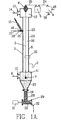
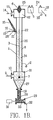
- FIG 1A illustrates an embodiment of apparatus in accordance with the invention, which apparatus will be referred to as the Pulse Particle Precipitator (PPP) apparatus.
- the PPP apparatus consists of a round cylindrical tube 1 made of electrically conductive material whose axis is vertically oriented.
- the tube has a diameter of about 250 mm, but other tube diameters, such as those in the range of 50 to 500 mm, may be used.
- the tube is connected to an electrical ground 2.
- a small diameter metallic wire 3 is axially oriented and centrally located within the tube. Optimally, this wire will be approximately 2 to 3 mm diameter, but diameters in the range of 0.5 to 6 mm may also be used.
- the wire 3 is supported from its top by insulator 6.
- a weight 7 is generally attached to the bottom end of the wire, to keep it in tension and centered in tube 1.
- This wire is connected to a high voltage DC power supply which consists of high voltage generator 4 and high voltage switch 5.
- Mains power 18 is transformed into DC high voltage 24, referenced to electrical ground 30 in the generator 4, which is of conventional design.
- DC high voltage 24 from the generator 4 is passed through the high voltage switch 5, the function of which will be described later.
- the switched DC high voltage power 25 is then connected to wire 3 via feed through insulator bushing 6.
- the application of high electrical potential difference between the wire 3 and tube 1 produces an electric field in the space 20 within the tube. Because the wire 3 has a small radius, the electric field concentrates near it and generates a gas plasma and produces gaseous ions. The gaseous ions are then propelled from the wire to the internal surface 8 of the tube. This flow of gaseous ions is termed corona discharge. Such an arrangement is common in the art of electrostatic precipitation.
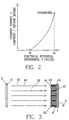
- FIG. 2 is a typical graphical representation of the relationship between the potential difference V (as measured in volts) applied to the wire and the flow of ions through the gas. Because the ions carry electrical charges, their flow results in an electrical current density J (measured in amperes per square meter).
- V t threshold voltage
- J current density
- V t and V s depend upon a multitude of parameters characterising the gas stream, including chemical constituents, temperature, suspended dust loading, dust deposits on the electrodes, etc. As such it is virtually impossible to predict these with good accuracy, but inevitably they are easy to detect empirically. However, it should be understood that the exact values of V t and V s constantly vary with time.
- gases 9 enter the device through port 10 to inlet plenum 11. They then flow through tube 1 from the bottom to the top and discharge into outlet plenum 12. The treated gases 14 then leave the device through port 13.
- Any fine particulate matter (which we shall refer as dust particles) carried by the inlet gases 9 will be electrostatically precipitated onto the internal surface 8 of the tube by means consistent with conventional electrostatic precipitator theory. It is understood that this process transpires in two steps. First, the dust particles receive electrostatic charge by impact of ions from the above described corona discharge. This step only occurs when V>V t . Then, the charged dust particles experience a force due to the strong electric field which propels them to the inner surface 8 of the tube. This force exists when V ⁇ V t as well as V>V t .
- the solid particles 15 are introduced to the inside of the tube via an injector 16 which discharges through a hole 21 in the tube wall.
- injector 16 is a pneumatic type where a small amount of compressed air 17 passes through nozzle 26 and blows the solid particles through the hole 21. With such an injector, the rate of solid particle feed into the tube 1 can be easily controlled by varying the amount of compressed air 17.
- Solid particles 15 may be supplied to the injector 16 from conventional hoppers, storage silos, conveyors and the like.
- the injected particles 22 are quickly deposited onto the internal walls of tube 1 by means of electrostatic precipitation with the same process as previously described for fine dust particles.
- the solid particles then form a layer 23 on the inner surface 8 of tube 1. It is important to note that the solid particles are precipitated onto the tube walls much faster than the fine dust particles. Their larger size allows them to acquire greater amounts of electrostatic charge and thus they are propelled more strongly towards the tube inner surface 8.
- the solid particles move downward through tube 1, fail through inlet plenum 11 and are gathered by hopper 27 into pipe 28.
- Treated solid particles 19 can be fed out of the device by feeder 29, which can be of conventional design.
- a screw auger 33 is rotated by motor 31, the speed of which controls the rate at which treated particles are discharged 32 from the device. If this rate is properly controlled, a quantity of particles 19 will be maintained in pipe 28 to act as a pressure seal so that gases in plenum 11 cannot escape the device through feeder 29.
- the particles 34 from layer 23 are periodically projected out into the flowing gases to achieve intimate contact with the upwardly flowing gases. This is achieved by operating the high voltage switch 5 so as to reduce the applied potential difference V to less than V t . Then these particles 34 are electrostatically repelled from the inner surface 8 of tube 1. At a subsequent time, the high voltage switch 5 reverts to its original position so that V>V t and the particles are electrostatically re-deposited to form layer 23, again as depicted in FIG 1A.
- the motion of particles depicted in FIG. 1A and 1B is cyclically repeated many times during typical residence time of both the gas and solid particles moving through the device.
- U t is defined as the steady state velocity that a particle will achieve when if falls through still gas under the action of gravity.
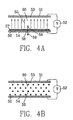
- FIG. 3 is a magnified view of the section 35 of FIG. 1A.
- space 20 is filled with an ion current flow 40 from the corona discharge as previously described.
- the wire 3 carries negative charges 41.
- the flowing gaseous ions 42 will also carry negative charges.
- the ion flow 40 in the corona discharge will necessarily cause an electrical current flow through the layer of particles 23 deposited on the inner surface 8 of the tube. This current flow will necessarily create an electrical potential difference between the free exposed surface of the layer and the collection electrode, with the generation of net electrical charges.
- the strength of the electrostatic force depends upon the product of the current density, J p (Amperes per square meter) flowing through the particle layer and the electric field strength E p (Volts per meter) which exists in the particle layer.
- J p Amperes per square meter
- E p Volts per meter
- the current density J p in the particle layer is necessarily the same as the ion flow 40 current density J i from the corona discharge. Thus, so long as V>Vt is applied to the wire, the electrostatic adhesion force will be present.
- the magnitude of force F p can be adjusted by adjusting the voltage applied to the wire 3 from the high voltage power supply 4.
- the corona discharge ion current density J i then varies as per FIG. 2. Because of the principle of conservation of charge, the particle layer current density J p is necessarily the same as J i .
- the electrostatic adhesion force in the particle layer F p is then proportional to J p 2 .
- the electrostatic adhesion force F p is, as shown in Figure 3, horizontal and directed towards the inner surface 8 of the tube.
- the particle layer also responds to the force of gravity F g which is vertically downward. If the electrostatic adhesion force is strong enough, the particle layer is pressed against the tube surface 8 to create friction which opposes the tendency of the particle layer to move downward by gravity. The total gravitational force depends upon the particle layer thickness t . If the friction force exceeds the gravitational force, the layer will remain fixed in place. If the friction force is decreased (by reducing the electrostatic adhesion force) or the gravitational force is increased (by increasing the layer thickness), the particle layer will move downward under gravity.
- the particle layer adhesion force can be large enough to hold the particle layer motionless. If the current density is decreased, the particle layer thickness is increased, or the particle bulk resistivity is reduced, then the particle layer will migrate downward in a creeping fashion. The velocity of this creeping motion depends upon how much the adhesion force is reduced below that which holds the layer static. While the nominal description of the invention assumes no such downward creeping motion, it should be understood that moderate amounts of creep could still be consistent with good operation of the invention. It is the intent of the invention that the particles move downward within the tube, which is primarily achieved during the time that the particles are dispersed into the space 20.
- Creep during the time particles are adhered to the surface 8 still achieves the desired downward motion, but the heat and mass transfer between gas and particles during creeping downward motion is significantly less than when the particles are dispersed into space 20. Still, effective overall operation could be realised with finite amounts of creep incorporated into the design.
- the speed at which the particles are propelled upward depends on the difference between the repulsive force and the gravitational force. If the potential difference V is slowly increased, the particle will lift off when its charge level is just sufficient to counteract gravity and it will then move relatively slowly. If the potential difference can be rapidly increased, and the electrical resistance between the particle and the surface is small to allow charges to transfer (induction charging) within this rapid time, the particle can acquire charges greatly in excess of that necessary to just balance gravity and it will move rapidly. Generally for this to occur, the characteristic time of the increase in potential difference and the characteristic time of the charge transfer must be substantially less than the mechanical response time of the particle, that is the time it requires to move away from the surface.
- the rate at which charge can transfer from the surface 50 to the particles 56 depends upon the electrical resistance between the two, which in turn depends upon the electrical resistivity of the materials.
- electrical resistivity In general we will be concerned with surfaces necessarily made of highly conductive materials. But the particles will generally be dictated by the process to achieve various chemical activities, so their electrical resistivities will vary from application to application. Electrical resistivity can also vary with temperature, minor gas constituents and moisture, etc.
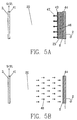
- FIG. 5B is the same system shown at a later time. Now the particles 48, which originally formed the layer 23, are repelled from the surface 8 and are attracted and move toward wire 3. As well, they are repelled from each other to form a dispersed cloud which fills the space 20 between the wire 3 and the surface 8.
- FIG. 5C is the same system at a still later time.
- the potential difference is increased so that again V > V t .
- This re-establishes the flow of gaseous ions 42 which cause the particles 48 in the cloud to become negatively charged by ion impact.
- These particles now experience electrostatic forces which move them toward the surface 8.
- FIG. 5D is the same system a short time later. V is still greater than V t , so gaseous ion flow 42 is maintained. Now the particles have all been driven to and deposited onto the surface 8 to reform the particle layer 12. As described previously, electrostatic forces 45 adhere the particle layer 23 to surface 8.
- Such a process can be cyclically repeated by causing the potential difference to vary according to a square wave as shown in FIG. 6.
- the potential difference is at V1 , which is significantly greater than V t (V1> V t )
- the ion flow current density is J1 .
- the ion flow causes the particles 48 in the dispersed cloud to become electrostatically charged with negative polarity. Particles then experience electrostatic forces which move them so that they are deposited onto surface 8. As long as they are held in a particle layer 23 on the surface 8 by the electrostatic adhesion forces 45 resulting from the current density J1.
- the transition time associated with V changing from V1 to V2 is called ⁇ T .
- the particles in the layer 23 acquire positive charges 46 by induction. It is important that ⁇ T be less than the time required for the particle layer to move away from surface 8, so substantial charges can be induced on the particles.
- Particles are then repelled from the like charged inner surface 8 and dispersed by mutual repulsion in the space between surface 8 and wire 3 during time T2 . It is important that wire 3 maintain a substantial potential difference from surface 8, otherwise the particles would not be strongly repelled from surface 8 and attracted to wire 3 and thus propelled into the space. Optimally, the potential difference will be reduced to a level just below V2 ⁇ V t , so that maximum electrostatic forces are achieved.
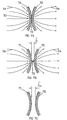
- FIG. 7A is an extremely magnified view of the contact point between two spherical particles 71 and 72. It is assumed that electrical current 74 is flowing from one particle 71, through the point of contact 70 between the particles, and to the other particle 72. Because the area of the contact point 70 becomes infinitely small, the passage of finite electrical currents 74 (amperes) would require the local current density at the contact point (amperes per square meter) to become infinitely large. Localised high current densities generate localised high electric field strengths near the contact point 70.
- the gas plasma region can have dimensions typically 1/10 th the radius of the particles 71 and 72.
- ⁇ c Determining the maximum separation, ⁇ c , which can maintain the gas plasma is a complex function of the precise particle contact geometry, particle resistivity and the amount of current flow. However, it is reasonable to assume that the electrical contact will be maintained throughout a particle separation of about 1/10 th its radius, which is the approximate size of the initial gas plasma region for particles in contact with each other as in FIG. 7A.
- both the switching time, ⁇ T, and the charge transfer time must be less than ⁇ c . It becomes an engineering issue to design a high voltage switch which can make the transition between V p and V t with time ⁇ T ⁇ ⁇ c .
- the charge transfer time though is dependent upon the physical nature of the particles, which are typically dictated by the process.
- the charge transfer time for particle layers is usually referred to as the charge relaxation time ⁇ r and can be expressed as:
- a conventional power supply 4 (see FIG. 1A), such as a transformer-rectifier or high frequency power switching device, receives mains power 18 and generates a constant high voltage 24 of value V1 .
- An electrically conducting armature 80 is rotated on a shaft 81 between two electrode contacts 82 and 83. When the armature is in position shown in FIG.
- the high voltage from 24 is directly connected from terminal 82 to terminal 83 with very little voltage drop so that output voltage 25 is of value
- the small gaps between the armature 80 the terminals 82 and 83 will be filled with gas plasma arcs 84 and 85 which provide little resistance to current flow.
- the gaps are still small enough that the plasma arcs 84 and 85 are maintained and a low impedance path for current flow is maintained.
- the armature has rotated enough so that the gaps are too large for the plasma arc to be maintained. It is the characteristic of plasma arcs that they provide a very low impedance path for current flow when the arc is maintained, but rapidly switch to a very low impedance path for current flow when the arc is extinguished. This occurs at the instant of time shown in FIG. 7C. Now the gaps 86 and 87 are too large to maintain the plasma arc. This switching time is typically on the order of nanoseconds.
- V out will be equal to 24 ( V1 ) for virtually any amount of current flow. In the context of our PPP process, this will correspond to time T1 in FIG. 6.
- the spark gap device is designed to reduce the potential difference to a level precisely at V ⁇ V t , no matter what the actual value of V t is. Reduction of the potential difference to a level above V t will not typically produce the "pith ball" effect, and is thus optimal in the present process.
- V t can be constantly varying during normal operation of the process so the mechanism by which the spark gap device automatically reduces potential difference to just below the current value of V t is important.
- the strength of the "pith ball" effect depends upon the square of the applied potential difference, so it is important for process optimisation that the potential difference not be reduced much less than V ⁇ V t . , otherwise the repulsive forces on the particles in layer 23 would be unnecessarily small and the effectiveness of the device would suffer correspondingly.
- the time required for the armature to rotate from position 8C to 8D corresponds to T2 in FIG. 6. During this time (where V2 ⁇ V t ) .
- the time required for the armature to rotate from position 8D to 8B to 8C corresponds to T1 in FIG 6. During this time It can be readily seen that by choice of the armature geometry and rotational frequency, any desired values of time periods T1 and T2 can be achieved for operation of the PPP process.
- the increase rates and reset voltage difference can be operator set to optimise the process.
- the result is a power supply which will produce occasional sparkover, but will operate with an average voltage near the current sparkover point. Such momentary sparks will not affect the PPP process detrimentally, so long as the spark frequency is not excessive.
- the spark gap is a unique device for this application in that it can provide both the required rapid switching transient times as previously described, and it will automatically result in the potential of the wire being reduced to a value just below the threshold of corona discharge V t , no matter what the actual value of V t might be at that moment in time.
- the actual value of V t is constantly varying as a result of variations in gas temperature, composition, dust loadings, etc., so this feature is especially fortuitous in the switching device.
- the special advantages of the PPP process can be illuminated by an analysis of the motion of the solid particles within the device.
- T2 when the particles are propelled into the space between the inner surface 8 and the wire 3, the particles are moved horizontally under the action of electrostatic forces, but they are also free to move under action of gravity and drag from upwardly flowing gases.
- the particles are uniformly dispersed by virtue of the mutual electrostatic repulsion of the individual particles.
- the full surface area of all the particles is exposed to the gases and particles are dispersed to all regions of the gas flow.
- the distance that the particles are propelled into the gas stream is determined by the magnitude of the potential difference V2 and the duration of time T2 .
- V2 the potential difference
- T2 the duration of time
- the particles will necessarily travel downward through tube 1, alternately being driven (and adhered) to the collection electrode and then propelled out into the gas stream where they fall by gravity.
- the bulk rate of descent can be controlled by the timing of the "square wave" of the applied voltage as shown in FIG. 6. For shorter periods of T1 and longer periods of T2 , the particles will spend more time falling through the gas and will migrate downward at a faster bulk rate. For longer periods of T1 and shorter periods of T2 , the particles will spend more time adhered to the collecting electrode and will migrate downward at a slower bulk rate.
- the effect can be explained as the result of two unique fluid mechanical phenomena.
- enough solids are treated in the system such that they form a layer on the collecting electrode which can be several particles thick.
- the particles behave as an assemblage of particles, not as individual particles. Their bulk mass exceeds the fluid drag on their bulk, and as a result, they move downward. In fact, their downward motion actually induces downward gas motion in the vicinity of the collecting electrode as the assemblage of particles drags the gas down with it.
- the duration time of T2 be short enough that the particles will not have enough time to accelerate up to the gas velocity and travel upward. In practice, this time is typically 0.1 to 1.0 seconds for the particle sizes of interest.
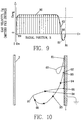
- FIG. 9 shows the gas velocity as a function of radial position from the center.
- Gas velocities 90 are fairly constant across much of the tube, and are in excess of the average velocity U avg ,. Typically, these gas velocities will exceed the particle terminal velocity by several times.
- the velocity 88 decreases to zero, then actually reverses direction 91 in close proximity to the wall. This is due to the drag of the falling assemblage of particles on the gas. As will be discussed later, this has an important effect on the good functioning of the device.
- the trajectory of a given particle is also interesting.
- a single particle 92 is held in a stationary (or slowly creeping) position 93, where it is adhered to the wall by the ion current flow.
- T2 V ⁇ V t
- it first travels downward 94 and away from the wall with the assemblage of particles upon initial repulsion from tube 1. Subsequently, the particles disperse into the rising gas stream, and begin decelerating 95 from their downward motion, stop their vertical motion, and begin accelerating 96 upward by drag of the gas.
- slip velocity that is the relative velocity between gas and particle
- transfer rates increase strongly with increasing "slip velocity”.
- Heat and mass transfer are limited by the formation of a fluid boundary layer at the surface of the solid. Any heat or mass must diffuse through this layer. The thickness of this layer decreases with increasing slip velocity, thus the improved heat and mass transfer rates.
- the slip velocity is limited to the terminal velocity of the particle, as previously discussed.
- the overall slip velocity is best analysed as the vector sum of a vertical component and a horizontal component.
- the vertical component of the slip velocity is greater than the particle terminal velocity for much of the cycle, due to the fact that the particle-gas interaction is in a transient acceleration mode. Even more important is the fact that the horizontal velocity of the particle through the gas can be quite high.
- the horizontal motion results from the electrostatic forces of the charged particle in the strong electric field. Typically, velocities on particles resulting from these electrostatic forces can be 10 to 20 times greater than the particle terminal velocity. Thus the slip velocity in the horizontal direction can be 10 to 20 times greater than is normally encountered in other types of gas-solid contact devices.
- the PPP Because of the ability of the PPP to operate with slip velocities several times the particle terminal velocity, it can exhibit heat and mass transfer performance many times greater than competitive devices. The repeated action of exposure to the gas stream under high slip velocity conditions results in the excellent heat and mass transfer rates attainable.
- any gas-solid contact device will generate dust. That is because any supply of solid granular material invariably includes a portion of fine material, whose terminal velocity is less than the gas flow velocity. These particles will be carried away with the gas flow. As well, abrasion within the device will create small particles in the device, which will also be carried away with the gas.
- the electric mobility of charged particles is proportional to particle size. This results from the fact that the magnitude of the electrostatic charge induced on the particle is proportional to the square of its diameter, while the fluid mechanical drag on a particle is proportional to the first power of its diameter (for particle sizes of interest).
- small particles are repelled more slowly from the collecting electrode surface and travel a shorter distance away from the tube surface 8 than for larger particles.
- the voltage cycle switches over from T2 to T1 , they are then precipitated back onto the electrode.
- a larger sized particle 92 might travel according to the trajectory shown and the distance of the point corresponding to 97 would be as shown. But a smaller sized particle 61 would reach its maximum distance 62 from the tube 1 and would spend much of its time in the region 91 of downward gas motion, or region 63 of reduced gas velocity. Thus the continual downward migration of the smaller sized particles through tube 1 is maintained.
- the radially inward horizontal velocity of any given particle during T2 will normally be less than the radially outward horizontal velocity during period T1 .
- the amount of charge which can be applied to the particle by the corona discharge ion flow (during T1 ) exceeds that which can result from induction (during T2 ), based on fundamental principles.
- the field strength in space 20 is necessarily greater during T1 than during T2 , because V ⁇ V t during T2 and V>V t during T1 .
- gases 6 flow upward through tube 1 .
- Solid particles 15 are introduced near the top of the tube through an injector 16 and travel downward inside the tube with descent rate, mixing rate, and transfer (heat and/or mass) rate controllable by the periodicity of the high voltage square-wave applied to the wire. Even though particles are introduced at one location on the tube wall, the cyclical electrostatic deposition and repulsion spreads the particles uniformly around the circumference of the tube. Quite a wide range of regimes of behaviour can be achieved. Generally, tube diameter, length, voltages, switching cycles, gas velocity, and particle sizes will be chosen (if not constrained by the process) to produce the desired results of heat and/or mass transfer, fine dust collection efficiency, gas cleaning by adsorption or chemical reaction, etc.
- gas velocities can be less than or greater than the particle terminal velocity, while maintaining a net downward motion of the particles. This allows the process designer to choose the velocity from a wide rage of options. In general it is anticipated that high velocities will be chosen in order to reduce size and cost of the equipment. High velocities also improve heat and mass transfer rates.
- particle sizes can be chosen from a wide range, with limitations imposed by the particle electromechanics of the adhesion/repulsion processes. Particles of size less than about 50 ⁇ m will exhibit "natural" adhesion forces (London van der Waals', liquid capillary and/or solid bridges, etc.) which exceed the "pith ball” repulsive forces, and thus cannot be repelled from the collecting electrode surface. It should be noted that a spectrum of particle sizes can be handled, and that these smaller particle sizes less than 50 ⁇ m can be included without detrimental performance, particularly when the larger sizes comprise a majority of the material.
- Particles larger than about 2 mm diameter will typically have gravitational forces which preclude them from being adhered to the collection electrode by the ion current flow.
- the resulting electrostatic forces are typically not strong enough to counteract the gravitational force and these particles will simply fall through the tube. They can be passed through the system without affecting the function with respect to other properly sized particles, but they will not typically be very effective at providing desired transfer rates between themselves and the upwardly flowing gases.
- the cycle of solid particle projection into the gas stream and electrostatic precipitation from the gas to the collecting electrode wall results in excellent mixing between the gas and solids.
- the particle motion necessarily creates gas turbulence transverse to the primary direction of flow. Any given particle makes many excursions into the gas stream during its residence time in the PPP. Likewise, any molecule of gas is exposed to many passes of the solids during its residence time in the device. Because relatively small particles can be utilised, large contact surface areas are realised and the contact between gas and solid surface is extensive. Slip velocity can be made very large, thus optimising heat and mass transfer.
- Pressure drop can be designed by simple adjustment of the cycle times for the voltage. It is clear that during the period T1 the solid particles are held against the collecting electrode and the gas has unimpeded flow upward through the tube with little pressure drop. During the T2 period of the cycle, the particles will be projected into the gas flow, and there will be drag on the gas to accelerate them. Thus, pressure drop will depend upon frequency and duration of the T2 periods.
- the gas temperature will typically vary with vertical position inside the tube. In the case of hot gases transferring heat to colder particles, the gas temperature will be highest at the bottom of the tube and decrease at higher elevation. It is well know that the electrical breakdown strength of gases, that is the electric field strength at the incipience of sparkover, decreases with increasing gas temperature. Since the potential difference between the wire 3 and the tube 1 is necessarily the same for the entire length of the tube, it is likely that electrical sparkover will occur at the lower end of the tube at voltages well below that which would cause sparkover at the upper (cooler) end of the tube. As has been described, optimal performance is obtained when the potential difference V1 be as close as possible to the sparkover voltage, V s .
- sparkover voltage depends upon tube diameter, with high sparkover voltages for larger diameter tubes. Therefore, it is probable in these cases, that it would be advantageous to provide a tube of tapering diameter with smaller diameter at the top and larger diameter at the bottom in order that electric field strengths be near their optimum for the entire length of the tube.
- the PPP process can be adapted to advantageously achieve other functions will now be described.
- the basic apparatus of the PPP is similar to a traditional wire-pipe type electrostatic precipitator. These devices have been used for nearly a century for capture of fine dust and are very efficient, even for submicron sized dust particles.
- This basic electrostatic precipitation function is maintained in the PPP.
- the efficiency of a precipitator for a given volumetric flow of exhaust gases is related to both the collecting electrode surface area and the square of the applied voltage.
- the PPP gives an even greater fine dust collection efficiency than would a conventional wire-pipe precipitator of the same dimensions. This is due to the presence of the solid particles and the fact that they act as additional collection sites for the fine dust.
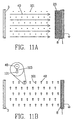
- Fine dust 101 is electrostatically charged to negative polarity due to the ion current flow 40 during the period T1. Also, during this period, the charged fine dust is electrostatically driven towards the particle layer 23 on inner surface 8 of the tube 1. This is conventional electrostatic precipitator theory.
- the agglomerate of the two particles behaves essentially like the larger particle and is precipitated onto the tube surface 8.
- the fine particles 101 are now imbedded in the particle layer 23.
- the solid particles will act as scavengers, traveling through the gas stream during T2 and gathering fine particulate matter, then returning to the collection electrodes during T1 .
- the collection effect of the solid particles will be superimposed on the collection of the tube inner surface by normal electrostatic precipitation. Since their surface area is many times greater than the inner surface 8 area, the collection efficiency of the device will be much better than that for the tube alone.
- the possibility that the PPP can offer collection efficiency in excess of normal electrostatic precipitators with similar dimensions opens the possibility that the device can be used as a stand alone fine dust collector, where the solid particles are introduced only for their effect at enhancing fine particulate capture efficiency.
- a further advantage of such a fine dust collection device is that it could be designed to achieve good performance for high resistivity dusts.
- Many industrial air pollution sources emit fine dust particles of high electrical resistivity, which have proved troublesome to collect in conventional electrostatic precipitators.
- High resistivity dust layers on the collection electrodes in the precipitator produces "back-corona” whereby positive gaseous ions are emitted from the ash coated collection electrode into the gas stream.
- These positive ions have a cancelling effect on the precipitator's normal operation of negative ions flowing from the discharge electrode. The overall effect can be severely detrimental to performance.
- these problems occur when the bulk resistivity ⁇ of the ash layer is greater than 1 x 10 8 ⁇ -m.
- PPP can be utilised to remedy this problem.
- Particles 15 injected into the device may be 200-500 ⁇ m size and of bulk electrical resistivity ⁇ ⁇ 1 x 10 7 ⁇ -m.
- a good example would be glass particles because of their low cost and control of resistivity by adjustment of chemical composition, especially sodium content.
- the deposited layer on the collection electrode will be a mixture of the larger particles and the high resistivity dust. If the amount of particles introduced to the PPP is such that more than half of the material in the layer are the large particles, the overall resistivity of the layer will be very nearly that of the large particles. Then the deleterious effects of the high resistivity particulate will be defeated and good precipitator efficiency will be obtained.
- the mixture of large particles and collected fine dust exiting the bottom of the PPP can easily be separated by size. Because of the wide difference in sizes (large particles > 200 ⁇ m, fly ash ⁇ 10 ⁇ m) this can be done effectively by conventional means, such as screen classifier.
- the large particles can be recycled to the top of the PPP for reuse and the fine dust disposed of.
- Tube 1 is encased by a second larger concentric tube 105, creating a space 106 between the tubes.
- Space 106 is filled with air, water, or other heat transfer fluid.
- Ports 107 and 108 allow for the heat transfer fluid to be introduced and removed from space 106, thus resulting in a flow of heat transfer fluid through the space.
- the gases 9 flowing through the inside of tube 1 being hot gases of temperature greater than that of the heat transfer fluid 110 entering the device, heat will be transferred from the hot gases to the heat transfer fluid so that the temperature of heat transfer fluid leaving the device 109 is greater than that of fluid entering 108.
- This type of device is commonly known as a double shell heat exchanger.
- the device is further developed to function as the previously described PPP process, with solid particles 15 introduced to the inside of tube 1 through injector 16, the particles will alternately be in contact with the hot gases in space 20 (as in FIG. 1B) and the inner surface 8.
- the particles When the particles are dispersed in the space 20 the particles will be heated by the hot gases.
- the particles When the particles are in contact with surface 8, they will transfer some of their heat to tube 1, which in turn will transfer heat to the heat transfer fluid flowing through space 106.
- the heat transfer rate from the hot gases to the heat transfer fluid is improved in several ways.
- the particles carry heat from the hot gases to the inner surface 8.
- the corona discharge itself creates a "corona wind" turbulence in the gas stream.
- the flow of charged ions actually induces gas flow transverse to its overall vertical upward flow direction. This transverse gas flow improves the heat transfer rate.
- the movement of particles towards and away from the inner surface 8 also induces turbulence in the gas flow which serves to improve the heat transfer.
- the continual scouring action of the solid particles against the inner surface of the tube 1 prevents dust build-ups. Excessive stationary dust build-ups are known to have severe deleterious effects on heat transfer rates because they act as a insulation. Prevention of the formation of these thermally insulating dust layers can substantially improve heat transfer performance.
- Another possibility is operation with the inner surface 8 at a temperature below the dew point of the gas stream.
- Most industrial gas streams contain water to varying degrees.
- the dew point is defined as the temperature at which water is condensed from the gas stream onto a surface to form a liquid phase. If a double shell heat exchanger is provided as above, and the space 106 is provided with a heat transfer fluid of sufficiently low temperature that the inner surface 8 of tube 1 is at a temperature below the dew point of the gas stream, a liquid film of water is developed on the surface 8. Normally, this situation is avoided in industrial equipment, since the water will combine with fine dust and form mud-like deposits on the surface. Upon drying, these deposits will become hard and impossible to clean.
- the inner surface 8 can be operated at temperatures below the dew point. A water film will form, but the particles in layer 23 deposited on the surface will pick up the water by direct contact. Then when the particles are subsequently dispersed into the hot gases (not shown) the water will be evaporated, leaving the particles dry. Generally, the time average temperature of the particles as they cycle between the surface 8 and the hot gases must be above the dew point, in order to provide drying, but the particle surface will alternately be wetted and dried. The inner surface 8 of the tube will continually be forming the water film, but the particles will continuously be carrying away the water. The rates of liquid water formation and drying must be balanced.
- the PPP process can be advantageously applied if the solid particles 15 consist of the desired sorbent material. During the transient time when the particle surface is wet, these pollutants will be absorbed by the water on the particle, then the absorbed pollutants will react with the solid sorbent in a liquid phase reaction, generally forming a solid precipitate.
- a single tube as described above may not be capable of handling sufficient quantities of gases and solids for many industrial applications.
- a PPP device may be constructed with many such tubes.
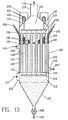
- FIG. 13 is a sectional view of a PPP module 162.
- An array of tubes is provided, with gases flowing through them in parallel. Gases 111 enter a lower plenum 112 through port 133. Gases in the lower plenum are distributed and flow upward through a plurality of tubes 113. Gases exit the tubes at the top and are gathered in an upper plenum 114.
- the gases 116 are discharged to atmosphere via an integral stack 115 at the top of the plenum. It is generally possible to discharge gases directly to atmosphere because of the lack of residual dust in the discharged gases. Alternatively, gases could exit the upper plenum 114 through a port for further handling, such as to a fan (not shown).
- the number of tubes in both the width dimension and depth dimension of the module which could be included in such an array.
- the number of tubes for a given application will be chosen based upon the solid particle and/or gas flow rates required so that each tube handles the optimum quantity of solids and/or gases.
- a frame 117 above the tubes is suspended from one or more support bars 118 which extend through penetrations 119 in the outlet plenum wall.
- the support bars are attached to brackets 121 which in turn rest on ceramic insulators 120.
- This assembly is enclosed in housing 122.
- the ceramic insulators allow for mechanical support of the frame while maintaining electrical insulation from the rest of the equipment.
- the entire insulator assembly can be purged with air to prevent contamination of the ceramic insulators with dust or other impurities.
- High voltage power supply is connected to any one of the brackets 121 by conventional means (not shown). Such high voltage power is then supplied to the frame and wires 123 attached to it. Such arrangements are common in electrostatic precipitators.
- each set of wires will have its own separate frame 117 and 124 and its own separate power supply. Such arrangements are also common in electrostatic precipitators.
- Individual wires 123 are hung from frame 117 in such a way that they extend through the center of each tube and are axially aligned.
- a second frame 124 is in the lower plenum and the wires 123 are connected to this as well.
- This lower frame is not supported by insulators, but rather is free hanging.
- Wires 123 are attached to the frame to assure proper centering of each wire in each tube.
- the second frame also acts as a weight at the bottom on the wires to assure that they are in tension and hang straight through the center of each tube.
- the array of tubes is enclosed with walls 125.
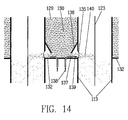
- the top and bottom ends of the tubes are fitted with tube sheets 126 and 127 respectively which prevent gases from flowing between the tubes.
- a port 128 in the side of the device positioned below tube sheet 126 allows solid particles 129 to be introduced to the space 130 between the tubes and the wall 125. If necessary, additional ports 131 may be employed to assure distribution of particles to all the tubes.
- a third tube sheet 132 prevents the particles in space 130 from falling to the bottom of the device and thus the particles fill space 130 above the third tube sheet 132. Tube sheet 132 is positioned just below the point of solid particle injection into the tubes.
- FIG. 14 is a close-up view of area 134 of FIG. 13.
- each of the tubes 113 is provided with a hole 135 to allow particles to be introduced to its inside.
- space 130 is filled with particles 129.
- Baffles 136 are provided so that particles will not fall through the holes due to their angle of repose.
- Nozzles 137 are located opposite each hole in such a way that they are covered by the particles 129 in their angle of repose below the baffle.
- Compressed air 138 is supplied to each nozzle causing a jet 139 of air to emanate from each nozzle, directed to pass through the hole 135.
- This jet of air will entrain particles 129 and thereby inject them into the space 140 between wire 123 and tube 113.
- the rate of particle injection will be monotonically related to the quantity of air passing through the nozzle 137. If properly designed, relatively small quantities of air are required to control relatively large amounts of particles.
- Valves (not shown), which can be located outside of the module, can be used to control the amount of air to each nozzle, thus in turn controlling the amount of particles injected into each of the tubes 113.
- particles 141 exit the bottom of each tube and drop through the inlet plenum 112 by gravity.
- the inlet plenum is fitted with an inverted pyramidal shaped hopper 142 so that falling particles 141 are gathered to a single location for discharge 143 from the device through airlock valve 149.
- Other types of solids discharge schemes may also be employed.
- this device is similar to so-called wire-pipe precipitators.
- a common problem in these type of devices is assuring equal distribution of inlet gases 111 into each of the tubes 113. Inlet gases enter horizontally and must turn by 90o to enter the tubes. Because of inertia of the gases, the distribution between the various tubes is often highly non-uniform. This is because the individual tubes provide very little resistance (pressure drop) to the flow of gases. Non-uniform gas flow distribution can lead to poor performance of the precipitator, since process efficiency is usually strongly dependent upon the gas velocity in each tube.
- the typical engineering solution has been to perform flow modeling studies of the inlet plenum and use baffles, turning vanes and the like to distribute the gases uniformly. This often leads to various problems due to interference of the baffles with the high voltage frame 124, dust build-ups and pluggages on the baffles, and the fact that process variables may not match those assumed during the flow modeling studies or may vary with time during process operation.
- the PPP device offers an advantageous solution to this problem. Due to the presence of particles inside the tubes and their repeated acceleration by the upwardly flowing gases, there is a monotonic relationship between gas flow velocity and pressure drop for each tube. Thus, if the inlet plenum design causes gases to preferentially flow through some of the tubes, the resulting increased pressure drop of those tubes would favor diversion of some of these excess gases to other tubes. This is contrary to conventional electrostatic precipitators where the tubes provide essentially zero pressure drop.
- the pressure drop of each tube monotonically depends upon the amount of particles injected into that tube, that is if more particles are injected, then the pressure drop is greater.
- the pneumatic injection scheme allows for control of the particle injection rate to each tube.
- the injection rate of particles to that tube can be increased by increasing the compressed air supply to that nozzle. This would have the effect of increasing the gas pressure drop across this tube and consequentially diverting gases from this tube to other tubes.
- the PPP device can be "tuned-up" to provide differing particle injection rates to each of the tubes to compensate for the intrinsic tendencies of the inlet plenum design to non-uniformly distribute gases to the various tubes. This would result in operation where the gas flow distribution is more uniform than it would be without particle injection, and also an operation where the ratio of gas to solids flow in each tube could be made essentially the same for all the tubes. It would be expected that this would be desirable for optimal process efficiency.
- Such a scheme could be manually implemented for cases where there is very little process variation with time. Then the deleterious effects of the inlet plenum on gas flow distribution could be compensated for.
- Alternatively, such a scheme could be automated for processes which are time varying. Flow rate of each tube would be measured, then the valves for compressed air supply to each of the nozzles 137 would be automatically adjusted to compensate for increases or decreases of gas flow. For example, in an application where heat is transferred from the gases to the particles, the outlet gas temperature of each tube could be monitored with a thermocouple. If the temperature increased (an indication of increased gas flow through that tube) the valve for particle injection to that tube would be opened more to increase the particle injection rate. The increased particle injection would both decrease gas flow rate through the tube and also cool the gases more.
- heat transfer fluid 144 is introduced the module through port 145 and flows through space 146 around the outside of tubes 113.
- Space 146 is bounded at the top by tube sheet 132 and at the bottom by tube sheet 127 and at the sides by walls 125.
- Heat transfer fluid 144 is heated (or cooled, depending upon the application) by the gases 111 flowing upward through the inside of the tubes 113.
- Heated fluid 147 exits the module through port 148.
- a countercurrent flow is established with heat transfer fluid 144 flowing from top to bottom and gases 111 flowing from bottom to top, but many flow patterns are possible which would depend upon the specifics of the application at hand.
- additional tube sheets and ports could be provided to cause the heat transfer fluid to follow a serpentine path around the tubes. Such schemes are well known in the field of heat exchanger design.
- the glass melting process is chosen for the example because particle-solid heat and mass transfer, fine particle capture and acid gas reduction from the gas stream and heat exchanger functions are all utilised.
- Glass is made by heating and melting a mixture of solid raw materials to a liquid state.
- the melting is done inside of a furnace and necessarily requires substantial amounts of heat.
- this heat is generated by the combustion of fossil fuels with the exhaust gases from the combustion leaving the furnace.
- Exhaust gas temperatures immediately after the furnace are quite high, typically 1300-1450°C.
- Combustion air preheaters are normally included which recover some of the heat in these gases. Even so, gas temperatures at the discharge to atmosphere are quite high, thus substantial amounts of heat are wasted.
- the cost of fuel for the furnace is a major component in the cost of making glass.
- the raw materials for glass are typically called batch.
- Batch generally refers to an assemblage of various pulverous materials including silica sand, limestone, soda ash, salt cake, and a variety of other minor ingredients.
- the material and mixture ratios are carefully chosen to produce glass of the desired properties and quality. Generally these materials are prepared in a finely divided form to promote their melting rates. Sizes are typically 100 to 200 ⁇ m diameter with a maximum size of 1 mm.
- recycled glass either from the factory or from external sources is used as a raw material. This recycled glass is called cullet. Cullet can be pulverised to result in sizes less than 1 mm and mixed with the batch.
- the word "batch” will be used to mean either batch alone, or the mixture of batch and pulverised cullet.
- the PPP can be advantageously used to preheat the batch using heat from the exhaust gases.
- the amount of fuel required for heating and melting them in the furnace can be reduced.
- This fuel reduction can represent a substantial economic benefit to the glass making process and also reduces the emission of the so-called green house gases (such as CO 2 ) simply because less fuel is burned.
- pollutant emissions such as fine dust, SO 2 , HCl, and HF can be reduced with high efficiency to satisfy stringent regulations.
- SO 2 , HCl, and HF emissions can be reduced because most glass batch contains substantial amounts of material which is chemically reactive with these acid gases, specifically soda ash (Na 2 CO 3 ) and limestone (CaCO 3 ).
- Fossil fuel fired glass furnaces are of several different designs. When air is combusted with fuel, the air is typically preheated in regenerative or recuperative heat exchangers, utilising some of the waste heat exiting the furnace. Essentially pure oxygen can also be used for combustion, with the following advantages and disadvantages:
- FIG. 15 is a schematic flow diagram of the process.
- Glass furnace 150 is heated by oxygen-fuel burners 151 to produce exhaust gases 152 which exit the furnace through port 153.
- the glass furnace is generally a refractory brick structure with a bath of molten glass 154 in its bottom. Molten glass leaves the furnace through throat 157 and is then formed into the desired glass product in forming machines, not shown.
- Exhaust gases then flow through flue channel 155, which is also of refractory brick construction.
- Exhaust gases 156 in the flue channel are generally at temperatures of 1300oC to 1450oC.
- Cooling air 158 is added to the flue channel through port 159 to produce a diluted exhaust gas stream 160 which leaves the flue channel through pod 161.
- the cooling air quantity is chosen so that the diluted exhaust gas stream 160 is of the optimum temperature for the PPP process.
- the temperature will be limited by the physical properties of the batch, specifically the softening temperature where batch constituents begin to melt. Typically, this softening temperature is about 600oC, so this would limit the inlet gas temperature to the PPP module.
- Cooled gases 163 exit the module through integral stack 115 and are discharged to atmosphere. Fine dust and acid gas pollutants are removed from the gases prior to discharge by the PPP.
- Ambient air 164 is delivered to port 145 of the module via blower 165 for subsequent heating.
- heat from gases 160 is transferred to air 164, producing heated air 166 exiting the module through port 148.
- Heated air 166 is directed to flow through pneumatic conveying pipe 167.
- Batch 168 is delivered to silo 169 by conventional conveying means such as belt conveyors, bucket elevators and the like, where it is stored for use in the furnace.
- Feeder 170 which can be of several types such as screw, vibratory, belt, etc., feeds batch from the silo 169 into the pneumatic conveying pipe 167 at a controlled rate.
- Heated air 166 conveys the batch to the separation chamber 171 located above or near the top of the module. During the conveyance, intimate mixing of the heated air with the batch dries the batch and turbulence of the conveyance breaks up any agglomerations of the batch, so individual particles are realised.
- batch contains components such as soda ash and salt cake which are hygroscopic, deliquescent and/or water soluble
- the batch must be dried before delivery into the module 162.
- the batch 168 delivered to the silo contains moisture.
- Batch moisture can result from unintentional addition, such as from outside storage of materials and exposure to rainfall, from intentional addition to reduce fugitive dust generation upon handling or to promote mixing of the various batch constituents, or from absorption of moisture from humid air.
- subsequent drying of the batch can lead to caking and build-ups on equipment surfaces, formation of clumps and the like which would render downstream equipment inoperable. Dry and warmed batch can be handled easily through pipes, hoppers, etc. where moist batch could not.
- the separation chamber 171 which functions like either a settling chamber or inertial separator, dry batch 172 is dropped out and cooled air 174 exits through port 173. In the preferred embodiment, this cooled air 174 becomes the cooling air 158 added to the flue channel. However, in some cases, it may be necessary to add additional ambient air 175 to assure proper temperatures in the process. Because the separation chamber 171 is not perfectly efficient at removing batch particles from air, some batch (generally the finer particle sizes) will exit the separation chamber along with the cooled air 174. This batch dust is then introduced to the inlet plenum of the PPP module and is subsequently captured and added back to the bulk of the batch delivered to the furnace.
- Dry batch is then directed to port 128 of the PPP module where it fills space 130 (see Figure 3) and is then available for injection into the various tubes.
- feeder 170 is equipped with a variable speed motor 176 or other drive means to allow adjustment of feed rate. This feed rate will be continuously adjusted in order to maintain dry batch supply to the module so that port 128 is always in a flooded condition and all the injection points inside the PPP module are supplied with dry batch.
- Dry batch is injected into the various tubes comprising the PPP module and travels downward through the tubes as discussed above, contacting the gas flowing upwardly through the tubes. Heat is transferred from the gases to the batch particles. Because of the efficient countercurrent design, exiting batch can be at a temperature near the inlet gas temperature. This is especially important in light of the batch softening temperature limitations. If inlet gas temperatures were higher than the softening temperature of the batch, the possibility of the creation of "hot spots" and subsequent melting of batch inside of the module would exist. Therefore, only a countercurrent device is capable of heating batch to temperatures approaching the softening temperature without risking actual softening of batch inside the device.
- SO 2 , SO 3 , HCl, and HF are chemically reacted with the soda ash and limestone constituents in the gas to form solid products of reaction, thus reducing the amount of these pollutants which are emitted to atmosphere.
- a typical reaction is: SO 2 (g) + Na 2 CO 3 (s) ⁇ Na 2 SO 3 (s) + CO 2 (g)
- Fine dust is formed in the furnace and enters the PPP module with inlet gases 160. This fine dust is captured electrostatically in the tubes of the PPP module and moves downward through the tubes along with the batch particles.
- the charging machine is a mechanical feeder/distributor which controls the rate of addition of batch materials to the furnace.
- the feed rate of charging machine 178 is controlled to maintain an appropriate level of molten glass batch 154 inside of the furnace.
- Compressed air supply (not shown) to the pneumatic injection nozzles 137 is controlled to provide batch injection rates to the tubes so that pipe 177 is maintained in a flooded condition, that is with the top level of heated batch somewhere inside of the pipe.
- hot batch is always available to the charging machine as required, and a pressure seal is maintained between the charging machine and the bottom hopper 142 of the PPP module.
- the pressure seal results from the pipe being filled with batch which prevents the inadvertent flow of exhaust gases through pipe 177.
- the captured pollutants are returned to the glass melt 154 along with the heated batch, but notably they are typically normal constituents of the batch formulation.
- the formulation of the batch 168 delivered to the silo must be compensated accordingly to maintain the proper chemical input to the furnace.
- the batch formulation which is delivered is different from that which would have been delivered if the PPP process were not utilised, the difference being the pollutant materials which would otherwise be allowed to leave the furnace and be discharged to the atmosphere.
- Cooling air 158 can be added to the flue channel via an ejector, which is common in the glass industry. Cooling air is injected at high velocity and in such a direction that its inertia boosts the flow of the exhaust gases. Alternatively, a fan can be added at some appropriate location in the exhaust gas flow system.
Landscapes
- Engineering & Computer Science (AREA)
- Chemical & Material Sciences (AREA)
- Chemical Kinetics & Catalysis (AREA)
- General Chemical & Material Sciences (AREA)
- Oil, Petroleum & Natural Gas (AREA)
- Analytical Chemistry (AREA)
- General Engineering & Computer Science (AREA)
- Health & Medical Sciences (AREA)
- Mechanical Engineering (AREA)
- Biomedical Technology (AREA)
- Environmental & Geological Engineering (AREA)
- Organic Chemistry (AREA)
- Dispersion Chemistry (AREA)
- General Health & Medical Sciences (AREA)
- Toxicology (AREA)
- Materials Engineering (AREA)
- Physical Or Chemical Processes And Apparatus (AREA)
- Treating Waste Gases (AREA)
- Devices And Processes Conducted In The Presence Of Fluids And Solid Particles (AREA)
Applications Claiming Priority (2)
| Application Number | Priority Date | Filing Date | Title |
|---|---|---|---|
| GB9822755A GB2343387B (en) | 1998-10-20 | 1998-10-20 | Electrostatically controlled process for contacting of gases and solid particles |
| GB9822755 | 1998-10-20 |
Publications (1)
| Publication Number | Publication Date |
|---|---|
| EP0995495A1 true EP0995495A1 (en) | 2000-04-26 |
Family
ID=10840804
Family Applications (1)
| Application Number | Title | Priority Date | Filing Date |
|---|---|---|---|
| EP99308244A Withdrawn EP0995495A1 (en) | 1998-10-20 | 1999-10-19 | Electrostatic control for contact between gases and solid particles |
Country Status (3)
| Country | Link |
|---|---|
| EP (1) | EP0995495A1 (enExample) |
| JP (1) | JP2000140614A (enExample) |
| GB (1) | GB2343387B (enExample) |
Cited By (13)
| Publication number | Priority date | Publication date | Assignee | Title |
|---|---|---|---|---|
| WO2006084539A1 (de) * | 2005-01-12 | 2006-08-17 | Horst Grochowski | Verfahren zum reinigen von abgasen eines glasschmelzprozesses, insbesondere für gläser für lcd-bildschirme |
| WO2007072049A3 (en) * | 2005-12-22 | 2008-04-24 | Blaze Venture Technologies Ltd | Particle binding |
| US7527675B2 (en) | 2006-09-13 | 2009-05-05 | United Technologies Corporation | Electrostatic particulate separation system and device |
| EP1567258A4 (en) * | 2002-11-12 | 2010-06-30 | Kang Ho Ahn | APPARATUS AND METHOD FOR PRODUCING CORONAL DISCHARGE PARTICLES |
| WO2010139331A3 (en) * | 2009-06-03 | 2011-04-14 | Asj Holding Aps | A system and a method for the withdrawal of particulate solid matter from a pressurized container containing a gas, and use thereof |
| US8051680B2 (en) | 2007-09-28 | 2011-11-08 | Praxair Technology, Inc. | Heating glassmaking materials with radiative heat transfer |
| US8056366B2 (en) | 2006-03-31 | 2011-11-15 | Praxair Technology, Inc. | Method for preheating glassmaking materials |
| TWI410385B (zh) * | 2008-11-18 | 2013-10-01 | Corning Inc | 藉由靜電沉澱減少鉑凝結 |
| KR101321113B1 (ko) | 2011-08-29 | 2013-10-23 | 한국기계연구원 | 유해성 가스 처리용 와이어-실린더형 플라즈마 반응기 |
| CN109126401A (zh) * | 2017-06-15 | 2019-01-04 | 浙江大学 | 炭循环装置和净化装置 |
| CN110929430A (zh) * | 2019-12-31 | 2020-03-27 | 浙江交通职业技术学院 | 柴油机颗粒捕集器中随机填充碳化硅颗粒的模量计算方法 |
| CN111871141A (zh) * | 2020-08-09 | 2020-11-03 | 盐城工学院 | 一种扇形管道式超细颗粒凝并器 |
| CN117537596A (zh) * | 2023-11-09 | 2024-02-09 | 江苏轩达高分子材料有限公司 | 一种聚酯纤维的制备方法及设备 |
Families Citing this family (2)
| Publication number | Priority date | Publication date | Assignee | Title |
|---|---|---|---|---|
| GB2526627A (en) * | 2014-05-30 | 2015-12-02 | Novaerus Patents Ltd | A plasma coil electrostatic precipitator assembly for air disinfection and pollution control |
| KR101710273B1 (ko) * | 2015-07-16 | 2017-02-27 | 한밭대학교 산학협력단 | 미세입자 처리용 유전체 장벽 방전장치 |
Citations (6)
| Publication number | Priority date | Publication date | Assignee | Title |
|---|---|---|---|---|
| US4338113A (en) * | 1981-03-19 | 1982-07-06 | Owens-Corning Fiberglas Corporation | Method for controlling particulate emissions |
| US4349367A (en) * | 1981-03-31 | 1982-09-14 | Ppg Industries, Inc. | Method of recovering waste heat from furnace flue gases using a granular heat exchange means |
| US4668489A (en) * | 1984-01-30 | 1987-05-26 | Efb Inc. | Method for treating gas streams |
| WO1994006563A1 (en) * | 1992-09-21 | 1994-03-31 | Edmeston Ab | Method for pollution emission reduction from glass melting furnace |
| US5609736A (en) * | 1995-09-26 | 1997-03-11 | Research Triangle Institute | Methods and apparatus for controlling toxic compounds using catalysis-assisted non-thermal plasma |
| WO1998025860A1 (en) * | 1996-12-13 | 1998-06-18 | Sandvik Aktiebolag (Publ) | Method and apparatus which removes odor and pollutants when preparing cullet for use in an electrostatic bed filter |
Family Cites Families (14)
| Publication number | Priority date | Publication date | Assignee | Title |
|---|---|---|---|---|
| GB398724A (en) * | 1933-02-03 | 1933-09-21 | Siemens Lurgi Cottrell Elektro | Process for the electrical separation of suspended particles from gaseous fluids |
| GB408489A (en) * | 1933-07-18 | 1934-04-12 | Res Corp Of New York | Improvements in or relating to the electrical precipitation of suspended particles from gaseous fluids |
| JPS5354167A (en) * | 1976-10-27 | 1978-05-17 | Hitachi Ltd | Cleaning apparatus for exhaust gas of combustion |
| DE2942223A1 (de) * | 1978-10-30 | 1980-05-14 | Combustion Power | Verfahren und vorrichtung zum entfernen von festkoerpern aus gasen |
| GB2068659B (en) * | 1980-02-02 | 1984-09-19 | Cottrell Res Inc | Control of electrostatic precipitators |
| JPS60137432A (ja) * | 1983-12-26 | 1985-07-22 | Agency Of Ind Science & Technol | 高温気流のイオン化強化方法 |
| US4695358A (en) * | 1985-11-08 | 1987-09-22 | Florida State University | Method of removing SO2, NOX and particles from gas mixtures using streamer corona |
| JP2649340B2 (ja) * | 1986-06-10 | 1997-09-03 | 増田 佳子 | 極短パルス高電圧加電式ガス浄化装置 |
| DE58900899D1 (de) * | 1988-05-14 | 1992-04-09 | C S Kneifel Kg | Elektrostatischer staubabscheider. |
| JPH03151040A (ja) * | 1989-11-09 | 1991-06-27 | Shishido Seidenki Kk | イオン生成装置 |
| JPH07229418A (ja) * | 1994-02-21 | 1995-08-29 | Hitachi Ltd | 排ガス浄化装置 |
| JPH10113538A (ja) * | 1996-10-10 | 1998-05-06 | Nissin Electric Co Ltd | 光触媒併用放電ガス処理装置 |
| JPH10118519A (ja) * | 1996-10-15 | 1998-05-12 | Nhk Spring Co Ltd | 空気清浄機 |
| JP3358485B2 (ja) * | 1997-03-26 | 2002-12-16 | 三菱自動車工業株式会社 | 希薄燃焼内燃エンジンの排気浄化装置 |
-
1998
- 1998-10-20 GB GB9822755A patent/GB2343387B/en not_active Expired - Fee Related
-
1999
- 1999-10-19 EP EP99308244A patent/EP0995495A1/en not_active Withdrawn
- 1999-10-20 JP JP11298840A patent/JP2000140614A/ja active Pending
Patent Citations (6)
| Publication number | Priority date | Publication date | Assignee | Title |
|---|---|---|---|---|
| US4338113A (en) * | 1981-03-19 | 1982-07-06 | Owens-Corning Fiberglas Corporation | Method for controlling particulate emissions |
| US4349367A (en) * | 1981-03-31 | 1982-09-14 | Ppg Industries, Inc. | Method of recovering waste heat from furnace flue gases using a granular heat exchange means |
| US4668489A (en) * | 1984-01-30 | 1987-05-26 | Efb Inc. | Method for treating gas streams |
| WO1994006563A1 (en) * | 1992-09-21 | 1994-03-31 | Edmeston Ab | Method for pollution emission reduction from glass melting furnace |
| US5609736A (en) * | 1995-09-26 | 1997-03-11 | Research Triangle Institute | Methods and apparatus for controlling toxic compounds using catalysis-assisted non-thermal plasma |
| WO1998025860A1 (en) * | 1996-12-13 | 1998-06-18 | Sandvik Aktiebolag (Publ) | Method and apparatus which removes odor and pollutants when preparing cullet for use in an electrostatic bed filter |
Cited By (19)
| Publication number | Priority date | Publication date | Assignee | Title |
|---|---|---|---|---|
| EP1567258A4 (en) * | 2002-11-12 | 2010-06-30 | Kang Ho Ahn | APPARATUS AND METHOD FOR PRODUCING CORONAL DISCHARGE PARTICLES |
| WO2006084539A1 (de) * | 2005-01-12 | 2006-08-17 | Horst Grochowski | Verfahren zum reinigen von abgasen eines glasschmelzprozesses, insbesondere für gläser für lcd-bildschirme |
| US7790126B2 (en) | 2005-01-12 | 2010-09-07 | Horst Grochowski | Method for purifying waste gases of a glass melting process, particularly for glasses for LCD display |
| US8288089B2 (en) | 2005-12-22 | 2012-10-16 | Fixed Phage Limited | Particle binding |
| US9138716B2 (en) | 2005-12-22 | 2015-09-22 | Fixed Phage Limited | Particle binding |
| WO2007072049A3 (en) * | 2005-12-22 | 2008-04-24 | Blaze Venture Technologies Ltd | Particle binding |
| EP2596862A3 (en) * | 2005-12-22 | 2013-09-25 | Fixed Phage Limited | Particle binding |
| US8056366B2 (en) | 2006-03-31 | 2011-11-15 | Praxair Technology, Inc. | Method for preheating glassmaking materials |
| US7527675B2 (en) | 2006-09-13 | 2009-05-05 | United Technologies Corporation | Electrostatic particulate separation system and device |
| US8051680B2 (en) | 2007-09-28 | 2011-11-08 | Praxair Technology, Inc. | Heating glassmaking materials with radiative heat transfer |
| TWI410385B (zh) * | 2008-11-18 | 2013-10-01 | Corning Inc | 藉由靜電沉澱減少鉑凝結 |
| WO2010139331A3 (en) * | 2009-06-03 | 2011-04-14 | Asj Holding Aps | A system and a method for the withdrawal of particulate solid matter from a pressurized container containing a gas, and use thereof |
| KR101321113B1 (ko) | 2011-08-29 | 2013-10-23 | 한국기계연구원 | 유해성 가스 처리용 와이어-실린더형 플라즈마 반응기 |
| CN109126401A (zh) * | 2017-06-15 | 2019-01-04 | 浙江大学 | 炭循环装置和净化装置 |
| CN109126401B (zh) * | 2017-06-15 | 2023-11-24 | 浙江大学 | 炭循环装置和净化装置 |
| CN110929430A (zh) * | 2019-12-31 | 2020-03-27 | 浙江交通职业技术学院 | 柴油机颗粒捕集器中随机填充碳化硅颗粒的模量计算方法 |
| CN110929430B (zh) * | 2019-12-31 | 2023-04-11 | 浙江交通职业技术学院 | 柴油机颗粒捕集器中随机填充碳化硅颗粒的模量计算方法 |
| CN111871141A (zh) * | 2020-08-09 | 2020-11-03 | 盐城工学院 | 一种扇形管道式超细颗粒凝并器 |
| CN117537596A (zh) * | 2023-11-09 | 2024-02-09 | 江苏轩达高分子材料有限公司 | 一种聚酯纤维的制备方法及设备 |
Also Published As
| Publication number | Publication date |
|---|---|
| GB9822755D0 (en) | 1998-12-16 |
| GB2343387A (en) | 2000-05-10 |
| GB2343387B (en) | 2001-02-28 |
| JP2000140614A (ja) | 2000-05-23 |
Similar Documents
| Publication | Publication Date | Title |
|---|---|---|
| EP0995495A1 (en) | Electrostatic control for contact between gases and solid particles | |
| EP0660807B1 (en) | Method, apparatus and module for batch preheating and pollution abatement in glass manufacture | |
| AU772030B2 (en) | Electrostatic batch preheater | |
| US4668489A (en) | Method for treating gas streams | |
| US5137546A (en) | Process and apparatus for electrostatic purification of dust- and pollutant-containing exhaust gases in multiple-field precipitators | |
| US5591412A (en) | Electrostatic gun for injection of an electrostatically charged sorbent into a polluted gas stream | |
| AU734376B2 (en) | Method and apparatus for separation of unburned carbon from fly ash | |
| AU7394994A (en) | Hopper system and electrostatic gun for injection of an electrostatically charged sorbent into a polluted gas stream | |
| US5529762A (en) | Method for pollution emission reduction from glass melting furnaces | |
| US3365858A (en) | Combined heat interchanger and electrostatic precipitator | |
| MXPA00005778A (es) | Intercambiador de calor de lecho lluvioso y metodos de uso. | |
| US4600414A (en) | Apparatus for removing contaminants from heated gases | |
| US4542000A (en) | Method for treating gas streams | |
| JPH07505823A (ja) | 気体や液体から浮遊する微粒子を除去する方法および装置 | |
| JP2000140614A5 (enExample) | ||
| US4290786A (en) | Apparatus for removing particulate matter from a gas stream | |
| Turner et al. | Sizing and costing of electrostatic precipitators: Part I. Sizing considerations | |
| US4976934A (en) | Nested, recirculating-fiber filter | |
| WO1999015466A2 (en) | Glass furnace exhaust gas filter combined with raw material preheater | |
| JPS625221Y2 (enExample) | ||
| Alexander | Electrostatic Batch Preheating Technology | |
| Arrowsmith et al. | Air pollution control from the mineral processing industries |
Legal Events
| Date | Code | Title | Description |
|---|---|---|---|
| PUAI | Public reference made under article 153(3) epc to a published international application that has entered the european phase |
Free format text: ORIGINAL CODE: 0009012 |
|
| AK | Designated contracting states |
Kind code of ref document: A1 Designated state(s): AT BE CH CY DE DK ES FI FR GB GR IE IT LI LU MC NL PT SE |
|
| AX | Request for extension of the european patent |
Free format text: AL;LT;LV;MK;RO;SI |
|
| 17P | Request for examination filed |
Effective date: 20001006 |
|
| AKX | Designation fees paid |
Free format text: AT BE CH CY DE DK ES FI FR GB GR IE IT LI LU MC NL PT SE |
|
| GRAP | Despatch of communication of intention to grant a patent |
Free format text: ORIGINAL CODE: EPIDOSNIGR1 |
|
| STAA | Information on the status of an ep patent application or granted ep patent |
Free format text: STATUS: THE APPLICATION IS DEEMED TO BE WITHDRAWN |
|
| 18D | Application deemed to be withdrawn |
Effective date: 20051213 |