EP0989185B1 - Methode zum Spalten von spezifischen Nucleinsäuresequenzen - Google Patents
Methode zum Spalten von spezifischen Nucleinsäuresequenzen Download PDFInfo
- Publication number
- EP0989185B1 EP0989185B1 EP99306806A EP99306806A EP0989185B1 EP 0989185 B1 EP0989185 B1 EP 0989185B1 EP 99306806 A EP99306806 A EP 99306806A EP 99306806 A EP99306806 A EP 99306806A EP 0989185 B1 EP0989185 B1 EP 0989185B1
- Authority
- EP
- European Patent Office
- Prior art keywords
- nucleic acid
- cleavage
- target nucleic
- probe
- specific
- Prior art date
- Legal status (The legal status is an assumption and is not a legal conclusion. Google has not performed a legal analysis and makes no representation as to the accuracy of the status listed.)
- Expired - Lifetime
Links
Images


Classifications
-
- C—CHEMISTRY; METALLURGY
- C12—BIOCHEMISTRY; BEER; SPIRITS; WINE; VINEGAR; MICROBIOLOGY; ENZYMOLOGY; MUTATION OR GENETIC ENGINEERING
- C12N—MICROORGANISMS OR ENZYMES; COMPOSITIONS THEREOF; PROPAGATING, PRESERVING, OR MAINTAINING MICROORGANISMS; MUTATION OR GENETIC ENGINEERING; CULTURE MEDIA
- C12N15/00—Mutation or genetic engineering; DNA or RNA concerning genetic engineering, vectors, e.g. plasmids, or their isolation, preparation or purification; Use of hosts therefor
- C12N15/09—Recombinant DNA-technology
- C12N15/11—DNA or RNA fragments; Modified forms thereof; Non-coding nucleic acids having a biological activity
- C12N15/113—Non-coding nucleic acids modulating the expression of genes, e.g. antisense oligonucleotides; Antisense DNA or RNA; Triplex- forming oligonucleotides; Catalytic nucleic acids, e.g. ribozymes; Nucleic acids used in co-suppression or gene silencing
-
- A—HUMAN NECESSITIES
- A61—MEDICAL OR VETERINARY SCIENCE; HYGIENE
- A61K—PREPARATIONS FOR MEDICAL, DENTAL OR TOILETRY PURPOSES
- A61K41/00—Medicinal preparations obtained by treating materials with wave energy or particle radiation ; Therapies using these preparations
- A61K41/0042—Photocleavage of drugs in vivo, e.g. cleavage of photolabile linkers in vivo by UV radiation for releasing the pharmacologically-active agent from the administered agent; photothrombosis or photoocclusion
-
- C—CHEMISTRY; METALLURGY
- C07—ORGANIC CHEMISTRY
- C07H—SUGARS; DERIVATIVES THEREOF; NUCLEOSIDES; NUCLEOTIDES; NUCLEIC ACIDS
- C07H21/00—Compounds containing two or more mononucleotide units having separate phosphate or polyphosphate groups linked by saccharide radicals of nucleoside groups, e.g. nucleic acids
-
- C—CHEMISTRY; METALLURGY
- C12—BIOCHEMISTRY; BEER; SPIRITS; WINE; VINEGAR; MICROBIOLOGY; ENZYMOLOGY; MUTATION OR GENETIC ENGINEERING
- C12N—MICROORGANISMS OR ENZYMES; COMPOSITIONS THEREOF; PROPAGATING, PRESERVING, OR MAINTAINING MICROORGANISMS; MUTATION OR GENETIC ENGINEERING; CULTURE MEDIA
- C12N15/00—Mutation or genetic engineering; DNA or RNA concerning genetic engineering, vectors, e.g. plasmids, or their isolation, preparation or purification; Use of hosts therefor
- C12N15/09—Recombinant DNA-technology
- C12N15/10—Processes for the isolation, preparation or purification of DNA or RNA
-
- C—CHEMISTRY; METALLURGY
- C12—BIOCHEMISTRY; BEER; SPIRITS; WINE; VINEGAR; MICROBIOLOGY; ENZYMOLOGY; MUTATION OR GENETIC ENGINEERING
- C12Q—MEASURING OR TESTING PROCESSES INVOLVING ENZYMES, NUCLEIC ACIDS OR MICROORGANISMS; COMPOSITIONS OR TEST PAPERS THEREFOR; PROCESSES OF PREPARING SUCH COMPOSITIONS; CONDITION-RESPONSIVE CONTROL IN MICROBIOLOGICAL OR ENZYMOLOGICAL PROCESSES
- C12Q1/00—Measuring or testing processes involving enzymes, nucleic acids or microorganisms; Compositions therefor; Processes of preparing such compositions
- C12Q1/68—Measuring or testing processes involving enzymes, nucleic acids or microorganisms; Compositions therefor; Processes of preparing such compositions involving nucleic acids
- C12Q1/6813—Hybridisation assays
- C12Q1/6827—Hybridisation assays for detection of mutation or polymorphism
- C12Q1/683—Hybridisation assays for detection of mutation or polymorphism involving restriction enzymes, e.g. restriction fragment length polymorphism [RFLP]
-
- C—CHEMISTRY; METALLURGY
- C12—BIOCHEMISTRY; BEER; SPIRITS; WINE; VINEGAR; MICROBIOLOGY; ENZYMOLOGY; MUTATION OR GENETIC ENGINEERING
- C12N—MICROORGANISMS OR ENZYMES; COMPOSITIONS THEREOF; PROPAGATING, PRESERVING, OR MAINTAINING MICROORGANISMS; MUTATION OR GENETIC ENGINEERING; CULTURE MEDIA
- C12N2310/00—Structure or type of the nucleic acid
- C12N2310/30—Chemical structure
- C12N2310/35—Nature of the modification
- C12N2310/351—Conjugate
- C12N2310/3511—Conjugate intercalating or cleaving agent
-
- Y—GENERAL TAGGING OF NEW TECHNOLOGICAL DEVELOPMENTS; GENERAL TAGGING OF CROSS-SECTIONAL TECHNOLOGIES SPANNING OVER SEVERAL SECTIONS OF THE IPC; TECHNICAL SUBJECTS COVERED BY FORMER USPC CROSS-REFERENCE ART COLLECTIONS [XRACs] AND DIGESTS
- Y10—TECHNICAL SUBJECTS COVERED BY FORMER USPC
- Y10S—TECHNICAL SUBJECTS COVERED BY FORMER USPC CROSS-REFERENCE ART COLLECTIONS [XRACs] AND DIGESTS
- Y10S436/00—Chemistry: analytical and immunological testing
- Y10S436/80—Fluorescent dyes, e.g. rhodamine
-
- Y—GENERAL TAGGING OF NEW TECHNOLOGICAL DEVELOPMENTS; GENERAL TAGGING OF CROSS-SECTIONAL TECHNOLOGIES SPANNING OVER SEVERAL SECTIONS OF THE IPC; TECHNICAL SUBJECTS COVERED BY FORMER USPC CROSS-REFERENCE ART COLLECTIONS [XRACs] AND DIGESTS
- Y10—TECHNICAL SUBJECTS COVERED BY FORMER USPC
- Y10T—TECHNICAL SUBJECTS COVERED BY FORMER US CLASSIFICATION
- Y10T436/00—Chemistry: analytical and immunological testing
- Y10T436/14—Heterocyclic carbon compound [i.e., O, S, N, Se, Te, as only ring hetero atom]
- Y10T436/142222—Hetero-O [e.g., ascorbic acid, etc.]
- Y10T436/143333—Saccharide [e.g., DNA, etc.]
Definitions
- the present invention relates to a method of sequence-specifically cleaving nucleic acids as the gene-constituting substance, and is applicable in the fields of clinical diagnosis, cloning of useful genes and exploration of unknown genes.
- nucleic acids it is common to cleave nucleic acids at specific sequences in molecular biology and its applications. For example, when a vector carrying a gene encoding a desired protein is constructed for production of the desired protein in microorganisms such as Escherichia coli , human cells or other animal cells, it is necessary to cleave a nucleic acid as the gene at a specific sequence with a restriction enzyme.
- restriction enzymes which recognize base sequences in nucleic acids and cleave inter-nucleotide linkages, are commonly used, and hundreds of restriction enzymes have already been known.
- restriction enzymes When restriction enzymes are used, it is necessary to select a restriction enzyme which recognizes a specific sequence to cleave. However, even hundreds of known restriction enzymes are not enough to cleave nucleic acids at any sequences. For example, a promising cancer treatment by specific cleavage of a target cancer gene with the aim of hindering the development of the cancer gene requires a restriction enzyme which specifically cleaves a specific sequence in the cancer gene to be cleaved to attain the aim, but it is possible that there is no restriction enzyme that recognizes and cleaves the specific sequence.
- the object of the present invention is to provide a method of specifically cleaving a specific nucleic acid sequence in a double-stranded DNA (hereinafter referred to as a target nucleic acid) which enables cleavage of a specific nucleic acid sequence without using a restriction enzyme.
- a target nucleic acid a double-stranded DNA
- the present invention provides a method of specifically cleaving a double-stranded DNA (a target nucleic acid) at a specific nucleic acid sequence, which comprises irradiating a solution containing at least the target nucleic acid, a nucleic acid probe (a single-stranded oligonucleotide) linked to an intercalater and 0.1 to 1.0 mM spermine with light of an absorption wavelength of the intercalater, wherein said intercalater is a fluorescent intercalative dye.
- Fig. 1 is a scheme explaining preparation of YO-PY-1.
- Fig. 2 shows fluorescence enhancement of YO-PU-1 upon formation of a double strand with a complementary strand DS-1.
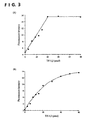
- Fig. 3 shows fluorescence enhancement of YO-PY-1 upon formation of a triple strand with a double strand formed by TH-1 and TH-2 in the presence of spermine (A) and in the absence of spermine (B).
- Fig. 4 shows a cleavage pattern of labeled TH-4 obtained by electrophoresis of the double-stranded DNA formed by TH-3 and TH-4 after cleavage by YO-PY-1.
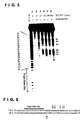
- Fig. 5 shows a cleavage pattern of labeled TH-3 obtained by electrophoresis of the double-stranded DNA formed by TH-3 and TH-4 after cleavage by YO-PY-1.
- arrows indicate the cleavage sites by YO-PY-1 in the double stranded DNA formed by TH-3 and TH-4.
- nucleic acid probe a single-stranded DNA
- rules of base selection for the designing are already known well (Takashi Ito, Protein, Nucleic Acid and Enzyme, Vol. 38, No. 3, pp.541-550, 1993).
- Beal and Dervan (Science Vol. 251 page 1360 - 13633; 1991) describe the determination of relative orientations of the DNA strands within a purine - purine - pyrimidine triple helix using affinity cleavage.
- concentration of multivalent cations such as Mg + or spermine affected the binding of a purine-rich oligonucleotide in the major groove of helical DNA antiparallel to the Watson-Crick purine strand.
- the present applicant reported a fluorescent intercalative dye-linked probe obtained by linking a fluorescent intercalative dye to a single-stranded oligonucleotide having a nucleic acid sequence specifically hybridizable with a specific sequence in a single-stranded target nucleic acid so that the fluorescent dye intercalates into the double strand formed by hybridization of the specific nucleic acid sequence and changes its fluorescent characteristic (Japanese Patent Application JP7-185599, EP-A-714986, Nucleic Acid Research, 24(24), pp.4992-4997, 1996).
- the hybrid of the intercalater-linked nucleic acid probe and the target nucleic acid is sometimes referred to as a cleavage probe, and the single-stranded oligonucleotide in the cleavage probe is sometimes referred to simply as a nucleic acid probe.
- WO88/04301 describes photocleavage of DNA using acridine labelled oligonucleotides.
- the method disclosed requires treatment with hot piperidine after irradiation at 300 nm..
- the double stranded DNA was cleaved in the presence of spermine and acridine.
- WO96/40253 discloses RNA photocleavage using texaphyrins and a hot piperidine.
- the hybridization of the oligonucleotide - texaphyrin conjugates to their complementary sequence of RNA or DNA causes site specific photomodification at guanine residues. This results in site specific photocleavage.
- oligopyrimidines covalently linked to ellipticine derivatives to form duplex or triplex structures with target single stranded oligopurine sequences.
- the oligopyrimidines can also bind to duplex DNA at homopurine - homopyrimidine sequences where they form local triplexes. Irradiation of such complexes at wavelengths longer than 300 nm induced cleavage of the target bases in a close proximity to the dye and cross linking of the target sequence to the derivatised oligonucleotide. In some examples the irradiated samples were treated with hot piperidine which degraded 50% of the cross linked material.
- the present inventors have recently found that when a target nucleic acid is irradiated with light with a specific wavelength in the presence of spermine after addition of an intercalater-linked nucleic acid probe having a nucleic acid sequence specifically hybridizable with a specific nucleic acid sequence in the double-stranded DNA as a cleavage probe, the intercalater intercalates into the target nucleic acid and absorbs the light of the specific wavelength to cleave the target nucleic acid where the cleavage probe binds, namely at the specific nucleic acid sequence.
- any substance that intercalates into a double-stranded DNA may be used as the intercalater without any particular restriction.
- fluorescent intercalative dyes such as thiazole orange and oxazole yellow may be mentioned.
- the intercalater can be covalently linked to the nucleic acid probe, optionally via a linker of an appropriate length.
- a linker molecule that does not hinder the intercalater from intercalating into the target nucleic acid may be used without any particular restriction
- a particularly preferable linker is a bifunctional hydrocarbon having functional groups at both ends for easiness of linkage between the two.
- a commercial reagent C6-Thimolmodifier, Clontech
- the intercalater may be linked to any sites of the nucleic acid probe, including the 5' end, the 3' end and the middle of the nucleic acid probe without any particular restriction, as long as the linkage neither hinders the cleavage probe from binding to the specific nucleic acid sequence in the target nucleic acid nor hinders the linked intercalater from intercalating into the target nucleic acid.
- the target nucleic acid is cleaved at the site to which the cleavage probe specifically binds, namely at the specific nucleic acid sequence.
- the length of the linker and the location of the linked intercalater in the cleavage probe are crucial for control of the cleavage site in the target nucleic acid. Namely, for example, when the cleavage probe has an intercalater at the end, the target nucleic acid is cleaved several bases to tens of bases away from the end of the specific nucleic acid sequence in the target nucleic acid, depending on the length of the linker.
- the nucleic acid probe as a constituent of the cleavage probe is preferably a single-stranded oligonucleotide of 6 to 100 nucleotides long, preferably 10 to 30 nucleotides long, to secure the specificity for the specific nucleic acid sequence in the target nucleic acid.
- the specific nucleic acid sequence in the target nucleic acid is a base sequence containing the site in the target nucleic acid to be cleaved by the method of the present invention and can be determined arbitrarily.
- a double-stranded nucleic acid not to be cleaved coexists with the target nucleic acid to be cleaved
- it is preferred to select a base sequence peculiar to the target nucleic acid in other words, absent in the other nucleic acid
- selection of T, and C or 5-methylcytosine, as the bases assigned to A-T pairs, and G-C pairs, respectively, in the target nucleic acid permits formation of a stable triple strand of the Pyr-Pur-Pyr type.
- the target nucleic acid is cleaved at the specific nucleic acid sequence when irradiated with light of a specific wavelength after addition of the cleavage probe in the presence of spermine.
- the amount of the cleavage probe coexisting with the target nucleic acid though the cleavage probe works well when the amount of the cleavage probe is much the same as the estimated amount of the target nucleic acid, the target nucleic acid is cleaved efficiently when 10 to 100 times as much of the cleavage probe is used.
- the amount (final concentration) of spermine to be used is about 0.1 mM to 1.0 mM, preferably about 0.5 mM.
- the irradiation light is not particularly restricted so long as it contains a ray of the specific absorption wavelength of the intercalater.
- the intercalater is oxazole yellow
- light of 490 nm may be mentioned as the light of the specific wavelength.
- Oligonucleotides DS-1, TH-1, Th-2, TH-3 and Th-4 were prepared by a commercial DNA synthesizer. The base sequences of the respective oligonucleotides are shown below.
- oligonucleotides PU-1 and PY-1 were prepared by a DNA synthesizer by using a commercial reagent (C6-ThiolModifier, trade name, Clontech) by a conventional method.
- C6-ThiolModifier trade name, Clontech
- the base sequences of PU-1 and PY-1 are shown below.
- PU-1 prepared in Example 1 was purified by high-speed liquid chromatography by a conventional method. Dithiothreitol (10 ⁇ M, 20 ⁇ L) was added to the fraction containing PU-1 to give solution A.
- Oxazole yellow (YO(CH 2 ) 3 I) prepared as disclosed in the literature (Japanese Patent Application JP7-185599, EP-A-713986, Nucleic Acids Research, 24(24), pp.4992-4997, 1996) was added to a liquid mixture of DMA (200 ⁇ l), 1.0 M phosphate buffer (pH 10.0, 300 ⁇ l) and water (500 ⁇ l) was mixed with to saturation to give solution B.
- Solution A and solution B were mixed in a ratio of 3:1, allowed to react in the presence of argon for 2 hours and subjected to liquid chromatography through a gel filtration column (Sephadex G-25, Pharmacia) using TEAA buffer pH 7.0 containing 5% acetonitrile as the eluent for purification.
- the YO-PY-1 isolated in fractions was concentrated, dissolved in distilled water and purified again by high speed liquid chromatography in a conventional manner, and the YO-PU-1 in fractions was evaporated to dryness under reduced pressure.
- the concentration of YO-PU-1 was determined from the absorbance at 260 nm.
- YO-PY-1 prepared in Example 1 was also subjected to a similar procedure to give YO-PY-1.
- the base sequences of the respective nucleic acid probes are shown below (* indicates 5-methylcytosine).
- Fig. 1 is a scheme showing the preparation of these cleavage nucleic acid probes (intercalater-linked nucleic acid probes).
- DS-1 prepared in Example 1 was added to Tris-HCl buffer (20 mM, pH 7.5, 50 ⁇ l) containing YO-PU-1 (30 pmol), and the resulting liquid mixture was heated to 90°C for annealing and allowed to cool to room temperature. Then, the same Tris-HCl buffer (500 ml) as mentioned above was further added, and the fluorescence was measured at an excitation wavelength of 490 nm and an emission wavelength of 510 nm. The results are shown in Fig. 2.
- Fig. 2 indicates specific binding of the cleavage probe to DS-1.
- TH-1 and TH-2 prepared in Example 1 were added to Tris-HCl buffer (20 mM, pH 7.5, 50 ⁇ l), and the resulting liquid mixture was heated to 90°C for annealing and allowed to cool to room temperature to form a double-stranded DNA (a target nucleic acid).
- the resulting target nucleic acid and YO-PY-1 were added to Tris-acetate buffer (25 mM, pH 5.1, 100 ⁇ l) containing NaCl (50 mM), MgCl 2 (20 mM) and spermine (0.5 mM) and incubated at 25°C for 30 minutes.
- cleavage probe specifically formed a triple strand with the target nucleic acid, and that the presence of spermine was effective in its formation. It was also confirmed that the fluorescent intercalative dye as the intercalater in the cleavage probe enhanced the fluorescence upon formation of the triple strand.
- TH-3 or TH-4 prepared in Example 1 The 5' end of either TH-3 or TH-4 prepared in Example 1 was labeled by using T4 polynucleotide kinase and [y-32P]-ATP (32P-labeled ATP).
- the labeled strand was mixed with the unlabeled complementary strand, and the mixture was heated to 90°C for annealing and then allowed to cool to room temperature to form a double-stranded DNA (a target nucleic acid).
- the resulting target nucleic acid (4 mM, containing about 100K cpm of the labeled strand) was added to Tris-HCl buffer (50 mM, pH 5.8, 1 ml) containing NaCl (50 mM) , MgCl 2 (20 mM), spermine (0.5 mM) and 10 equivalents or 100 equivalents of YO-PY-1, then incubated at 20°C for 30 minutes and irradiated with visible light at the same temperature.
- the DNA was precipitated from the liquid mixture by addition of ethanol and dried under reduced pressure. A portion of the sample containing 20K cpm of the labeled strand was subjected to electrophoresis on 12% denatured polyacrylamide gel at 2000V for 3 hours and then autoradiography on an X-ray film. The results are shown in Fig. 4 to 6.
- the arrows in the figures indicate the locations of the cleavage sites in the target nucleic acid. It can be seen that the cleavage probe cleaved the target nucleic acid site-specifically, and that the target nucleic acid can be cleaved at an arbitrary site (specific nucleic acid sequence) through selection of the base sequence of the nucleic acid probe.
- the present invention provides a method of specifically cleaving a double-stranded DNA at a specific nucleic acid sequence (an arbitrary sequence).
- a specific nucleic acid sequence an arbitrary sequence.
- the method is useful not only in such fields as cloning of useful genes and exploration of unknown genes but also in promising fields such as gene diagnosis and gene therapy.
- the target double-stranded DNA can be cleaved merely by addition of the cleavage probe to a sample and subsequent irradiation with light of a specific wavelength in the presence of spermine for about 1 hour, it is possible to meet the general demand for speed and simplicity, and because it involves no skilled operations, there is no possibility that different results are obtained by different operators.
- the present invention because DNA double strands are not cleaved until irradiation with light of a specific wavelength, it is possible to arbitrarily select the timing of cleavage even if the target nucleic acid coexists with the cleavage probe.
- the method can be so designed as to avoid damage to double-stranded DNA having a specific nucleic acid sequence or a similar sequence which is not to be cleaved.
- the intercalater-linked nucleic acid probe used as the cleavage probe in the present invention has a characteristic that the intercalater enhances the fluorescence intensity upon hybridization of the probe with the target nucleic acid, for example, it is possible to introduce the cleavage probe to cells in a tissue containing the target nucleic acid and then irradiate the cleavage probe with light of a specific wavelength preferable for the cleavage in the present invention after confirmation of binding of the cleavage probe to the target nucleic acid, based on the fluorescence from the cells.
Landscapes
- Chemical & Material Sciences (AREA)
- Health & Medical Sciences (AREA)
- Life Sciences & Earth Sciences (AREA)
- Engineering & Computer Science (AREA)
- Genetics & Genomics (AREA)
- Organic Chemistry (AREA)
- Bioinformatics & Cheminformatics (AREA)
- Molecular Biology (AREA)
- Biotechnology (AREA)
- Zoology (AREA)
- Wood Science & Technology (AREA)
- Biomedical Technology (AREA)
- Biochemistry (AREA)
- General Health & Medical Sciences (AREA)
- General Engineering & Computer Science (AREA)
- Biophysics (AREA)
- Physics & Mathematics (AREA)
- Microbiology (AREA)
- Proteomics, Peptides & Aminoacids (AREA)
- Plant Pathology (AREA)
- Immunology (AREA)
- Analytical Chemistry (AREA)
- Crystallography & Structural Chemistry (AREA)
- Medicinal Chemistry (AREA)
- Pharmacology & Pharmacy (AREA)
- Epidemiology (AREA)
- Animal Behavior & Ethology (AREA)
- Public Health (AREA)
- Veterinary Medicine (AREA)
- Measuring Or Testing Involving Enzymes Or Micro-Organisms (AREA)
- Saccharide Compounds (AREA)
Claims (1)
- Verfahren zum spezifischen Spalten einer doppelsträngigen DNA (einer Zielnucleinsäure) an einer spezifischen Nucleinsäuresequenz, wobei das Verfahren das Bestrahlen einer Lösung, die mindestens die Zielnucleinsäure, eine Nucleinsäuresonde (ein einzelsträngiges Oligonucleotid), verbunden mit einem Interkalator, und 0,1 bis 1,0 mM Spermin enthält, mit Licht mit einer Absorptionswellenlänge des Interkalators umfasst, wobei der Interkalator ein fluoreszierender interkalierender Farbstoff ist.
Applications Claiming Priority (2)
| Application Number | Priority Date | Filing Date | Title |
|---|---|---|---|
| JP24545398A JP4207258B2 (ja) | 1998-08-31 | 1998-08-31 | 特定核酸配列の切断方法 |
| JP24545398 | 1998-08-31 |
Publications (2)
| Publication Number | Publication Date |
|---|---|
| EP0989185A1 EP0989185A1 (de) | 2000-03-29 |
| EP0989185B1 true EP0989185B1 (de) | 2004-06-16 |
Family
ID=17133898
Family Applications (1)
| Application Number | Title | Priority Date | Filing Date |
|---|---|---|---|
| EP99306806A Expired - Lifetime EP0989185B1 (de) | 1998-08-31 | 1999-08-26 | Methode zum Spalten von spezifischen Nucleinsäuresequenzen |
Country Status (4)
| Country | Link |
|---|---|
| US (1) | US6228656B1 (de) |
| EP (1) | EP0989185B1 (de) |
| JP (1) | JP4207258B2 (de) |
| DE (1) | DE69918010T2 (de) |
Cited By (1)
| Publication number | Priority date | Publication date | Assignee | Title |
|---|---|---|---|---|
| US9410172B2 (en) | 2013-09-16 | 2016-08-09 | General Electric Company | Isothermal amplification using oligocation-conjugated primer sequences |
Families Citing this family (2)
| Publication number | Priority date | Publication date | Assignee | Title |
|---|---|---|---|---|
| DE10162176B4 (de) * | 2000-12-13 | 2006-03-23 | Institut für Physikalische Hochtechnologie e.V. | Verfahren zum simultanen positionsspezifischen Schneiden von DNA |
| US7313660B2 (en) * | 2003-09-04 | 2007-12-25 | Lsi Corporation | Data stream frequency reduction and/or phase shift |
Family Cites Families (4)
| Publication number | Priority date | Publication date | Assignee | Title |
|---|---|---|---|---|
| FR2586704B1 (fr) * | 1985-09-04 | 1987-12-18 | Centre Nat Rech Scient | Nouveaux composes comportant une sequence d'oligonucleotide liee a un agent d'intercalation et a un groupe chimique activable, leur synthese et leurs applications a titre de nucleases artificielles specifiques de sequences. centre national de la recherche scientifique (cnrs) |
| JPH01502187A (ja) * | 1986-12-02 | 1989-08-03 | サントル・ナシオナル・ド・ラ・ルシェルシュ・シアンティフィック・(セ・エヌ・エール・エス) | α―オリゴヌクレオチド |
| JP3189000B2 (ja) * | 1994-12-01 | 2001-07-16 | 東ソー株式会社 | 特定核酸配列の検出方法 |
| US5714328A (en) * | 1995-06-07 | 1998-02-03 | Board Of Regents, The University Of Texas System | RNA photocleavage using texaphyrins |
-
1998
- 1998-08-31 JP JP24545398A patent/JP4207258B2/ja not_active Expired - Fee Related
-
1999
- 1999-08-26 DE DE69918010T patent/DE69918010T2/de not_active Expired - Lifetime
- 1999-08-26 EP EP99306806A patent/EP0989185B1/de not_active Expired - Lifetime
- 1999-08-30 US US09/385,377 patent/US6228656B1/en not_active Expired - Lifetime
Non-Patent Citations (1)
| Title |
|---|
| BEAL P.A.; DERVAN P.B.: "Second structural motif for recognition of DNA by oligonucleotide-directed triple-helix formation", SCIENCE, vol. 251, 15 March 1991 (1991-03-15), WASHINGTON, US, pages 1360 - 1363, XP000775705, DOI: doi:10.1126/science.2003222 * |
Cited By (1)
| Publication number | Priority date | Publication date | Assignee | Title |
|---|---|---|---|---|
| US9410172B2 (en) | 2013-09-16 | 2016-08-09 | General Electric Company | Isothermal amplification using oligocation-conjugated primer sequences |
Also Published As
| Publication number | Publication date |
|---|---|
| JP4207258B2 (ja) | 2009-01-14 |
| US6228656B1 (en) | 2001-05-08 |
| JP2000125869A (ja) | 2000-05-09 |
| DE69918010D1 (de) | 2004-07-22 |
| EP0989185A1 (de) | 2000-03-29 |
| DE69918010T2 (de) | 2005-07-07 |
Similar Documents
| Publication | Publication Date | Title |
|---|---|---|
| US5789155A (en) | Process for identifying nucleic acids and triple helices formed thereby | |
| US5874555A (en) | Triple helices and processes for making same | |
| US5660988A (en) | Cycling probe cleavage detection of nucleic acid sequences | |
| ES2375764T3 (es) | Endonucleasas fen-1, mezclas y procedimientos de escisión. | |
| EP0695305B1 (de) | Verfahren zur darstellung von oligonukleotiden | |
| US6046004A (en) | Solution hybridization of nucleic acids with antisense probes having modified backbones | |
| Koehl et al. | Construction of plasmids containing a unique acetylaminofluorene adduct located within a mutation hot spot: A new probe for frameshift mutagenesis | |
| US20070059690A1 (en) | "Met/fret based method of target nucleic acid detection whereby the donor/acceptor moieties are on complementary strands" | |
| JPH08511684A (ja) | 熱安定性dnaポリメラーゼ由来の5’ヌクレアーゼ | |
| JP2008514197A (ja) | ゲノムアッセイ | |
| JP3194969B2 (ja) | ポリヌクレオチド検出用プローブ及び検出方法 | |
| JPH10500572A (ja) | 標的核酸を検出する方法 | |
| JPWO1998013524A1 (ja) | ポリヌクレオチド検出用プローブ及び検出方法 | |
| JPH11506932A (ja) | 点変異の検出及びインビトロ突然変異誘発のための核酸修復酵素方法 | |
| EP0989185B1 (de) | Methode zum Spalten von spezifischen Nucleinsäuresequenzen | |
| WO1990008838A1 (en) | Labeling of nucleic acids with fluorescent markers | |
| Li et al. | ACCELERATED PAPER: Nucleotide level detection of cyclobutane pyrimidine dimers using oligonucleotides and magnetic beads to facilitate labelling of DNA fragments incised at the dimers and chemical sequencing reference ladders | |
| AU2002330708B2 (en) | Aptamers containing sequences of nucleic acids or nucleic acid analogues bound homologously, or in novel complexes | |
| Guo et al. | Adenine affects the structure and stability of telomeric sequences. | |
| JPH09508281A (ja) | 生物学的液体中のppbより下のレベルのオリゴヌクレオチドの検出方法 | |
| Diegelman et al. | Chemical and Enzymatic Methods for Preparing Circular Single‐Stranded DNAs | |
| WO1993018187A1 (en) | Triple helix recognition of dna | |
| Avignolo et al. | Biotinylation of double stranded DNA after transamination | |
| Stiege et al. | Intra-RNA cross-linking in Escherichia coli 30S ribosomal subunits: selective isolation of cross-linked products by hybridization to specific cDNA fragments | |
| Hejmadi et al. | Alkali‐labile photolesions mapping to purine sites in ultraviolet‐irradiated DNA |
Legal Events
| Date | Code | Title | Description |
|---|---|---|---|
| PUAI | Public reference made under article 153(3) epc to a published international application that has entered the european phase |
Free format text: ORIGINAL CODE: 0009012 |
|
| 17P | Request for examination filed |
Effective date: 19990924 |
|
| AK | Designated contracting states |
Kind code of ref document: A1 Designated state(s): DE FR GB IT |
|
| AX | Request for extension of the european patent |
Free format text: AL;LT;LV;MK;RO;SI |
|
| AKX | Designation fees paid |
Free format text: DE FR GB IT |
|
| 17Q | First examination report despatched |
Effective date: 20030613 |
|
| GRAP | Despatch of communication of intention to grant a patent |
Free format text: ORIGINAL CODE: EPIDOSNIGR1 |
|
| GRAS | Grant fee paid |
Free format text: ORIGINAL CODE: EPIDOSNIGR3 |
|
| GRAA | (expected) grant |
Free format text: ORIGINAL CODE: 0009210 |
|
| AK | Designated contracting states |
Kind code of ref document: B1 Designated state(s): DE FR GB IT |
|
| REG | Reference to a national code |
Ref country code: GB Ref legal event code: FG4D |
|
| REF | Corresponds to: |
Ref document number: 69918010 Country of ref document: DE Date of ref document: 20040722 Kind code of ref document: P |
|
| ET | Fr: translation filed | ||
| PLBE | No opposition filed within time limit |
Free format text: ORIGINAL CODE: 0009261 |
|
| STAA | Information on the status of an ep patent application or granted ep patent |
Free format text: STATUS: NO OPPOSITION FILED WITHIN TIME LIMIT |
|
| 26N | No opposition filed |
Effective date: 20050317 |
|
| PGFP | Annual fee paid to national office [announced via postgrant information from national office to epo] |
Ref country code: DE Payment date: 20130821 Year of fee payment: 15 |
|
| PGFP | Annual fee paid to national office [announced via postgrant information from national office to epo] |
Ref country code: FR Payment date: 20130808 Year of fee payment: 15 Ref country code: GB Payment date: 20130821 Year of fee payment: 15 |
|
| PGFP | Annual fee paid to national office [announced via postgrant information from national office to epo] |
Ref country code: IT Payment date: 20130809 Year of fee payment: 15 |
|
| REG | Reference to a national code |
Ref country code: DE Ref legal event code: R119 Ref document number: 69918010 Country of ref document: DE |
|
| GBPC | Gb: european patent ceased through non-payment of renewal fee |
Effective date: 20140826 |
|
| PG25 | Lapsed in a contracting state [announced via postgrant information from national office to epo] |
Ref country code: IT Free format text: LAPSE BECAUSE OF NON-PAYMENT OF DUE FEES Effective date: 20140826 |
|
| REG | Reference to a national code |
Ref country code: DE Ref legal event code: R119 Ref document number: 69918010 Country of ref document: DE Effective date: 20150303 |
|
| REG | Reference to a national code |
Ref country code: FR Ref legal event code: ST Effective date: 20150430 |
|
| PG25 | Lapsed in a contracting state [announced via postgrant information from national office to epo] |
Ref country code: GB Free format text: LAPSE BECAUSE OF NON-PAYMENT OF DUE FEES Effective date: 20140826 Ref country code: DE Free format text: LAPSE BECAUSE OF NON-PAYMENT OF DUE FEES Effective date: 20150303 |
|
| PG25 | Lapsed in a contracting state [announced via postgrant information from national office to epo] |
Ref country code: FR Free format text: LAPSE BECAUSE OF NON-PAYMENT OF DUE FEES Effective date: 20140901 |