EP0987595B1 - Verfahren zur Herstellung von Hydroxy-substituierten Hydroxylaminen und diese enthaltende Farbentwickler - Google Patents
Verfahren zur Herstellung von Hydroxy-substituierten Hydroxylaminen und diese enthaltende Farbentwickler Download PDFInfo
- Publication number
- EP0987595B1 EP0987595B1 EP99202873A EP99202873A EP0987595B1 EP 0987595 B1 EP0987595 B1 EP 0987595B1 EP 99202873 A EP99202873 A EP 99202873A EP 99202873 A EP99202873 A EP 99202873A EP 0987595 B1 EP0987595 B1 EP 0987595B1
- Authority
- EP
- European Patent Office
- Prior art keywords
- hydroxylamine
- group
- carbon atoms
- reaction
- substituted
- Prior art date
- Legal status (The legal status is an assumption and is not a legal conclusion. Google has not performed a legal analysis and makes no representation as to the accuracy of the status listed.)
- Expired - Lifetime
Links
- -1 hydroxy-substituted hydroxylamines Chemical class 0.000 title claims description 39
- 238000004519 manufacturing process Methods 0.000 title description 3
- 238000006243 chemical reaction Methods 0.000 claims description 91
- 239000003963 antioxidant agent Substances 0.000 claims description 40
- 239000000243 solution Substances 0.000 claims description 39
- 125000004432 carbon atom Chemical group C* 0.000 claims description 33
- 239000000203 mixture Substances 0.000 claims description 31
- AVXURJPOCDRRFD-UHFFFAOYSA-N Hydroxylamine Chemical compound ON AVXURJPOCDRRFD-UHFFFAOYSA-N 0.000 claims description 30
- 230000003078 antioxidant effect Effects 0.000 claims description 29
- 238000000034 method Methods 0.000 claims description 26
- 125000000217 alkyl group Chemical group 0.000 claims description 24
- CTKINSOISVBQLD-UHFFFAOYSA-N Glycidol Chemical group OCC1CO1 CTKINSOISVBQLD-UHFFFAOYSA-N 0.000 claims description 23
- 239000003795 chemical substances by application Substances 0.000 claims description 22
- 125000002768 hydroxyalkyl group Chemical group 0.000 claims description 13
- 125000003118 aryl group Chemical group 0.000 claims description 11
- 125000000753 cycloalkyl group Chemical group 0.000 claims description 11
- 239000001257 hydrogen Substances 0.000 claims description 11
- 229910052739 hydrogen Inorganic materials 0.000 claims description 11
- 125000004435 hydrogen atom Chemical group [H]* 0.000 claims description 10
- 239000007864 aqueous solution Substances 0.000 claims description 8
- 125000001997 phenyl group Chemical group [H]C1=C([H])C([H])=C(*)C([H])=C1[H] 0.000 claims description 8
- 239000012458 free base Substances 0.000 claims description 7
- 125000001188 haloalkyl group Chemical group 0.000 claims description 6
- IDLCGKHZBNSVKN-UHFFFAOYSA-N 3-[2,3-dihydroxypropyl(hydroxy)amino]propane-1,2-diol Chemical compound OCC(O)CN(O)CC(O)CO IDLCGKHZBNSVKN-UHFFFAOYSA-N 0.000 claims description 5
- 238000002156 mixing Methods 0.000 claims description 5
- 125000001309 chloro group Chemical group Cl* 0.000 claims description 4
- 125000000113 cyclohexyl group Chemical group [H]C1([H])C([H])([H])C([H])([H])C([H])(*)C([H])([H])C1([H])[H] 0.000 claims description 4
- 125000003627 8 membered carbocyclic group Chemical group 0.000 claims description 3
- WSNMPAVSZJSIMT-UHFFFAOYSA-N COc1c(C)c2COC(=O)c2c(O)c1CC(O)C1(C)CCC(=O)O1 Chemical compound COc1c(C)c2COC(=O)c2c(O)c1CC(O)C1(C)CCC(=O)O1 WSNMPAVSZJSIMT-UHFFFAOYSA-N 0.000 claims description 3
- GOOHAUXETOMSMM-UHFFFAOYSA-N Propylene oxide Chemical compound CC1CO1 GOOHAUXETOMSMM-UHFFFAOYSA-N 0.000 claims description 3
- AAVHHYWBSVSPPN-UHFFFAOYSA-N (2-methyloxiran-2-yl)methanol Chemical compound OCC1(C)CO1 AAVHHYWBSVSPPN-UHFFFAOYSA-N 0.000 claims description 2
- XJBQHGGFOBLJDF-UHFFFAOYSA-N (3-benzyloxiran-2-yl)methanol Chemical compound OCC1OC1CC1=CC=CC=C1 XJBQHGGFOBLJDF-UHFFFAOYSA-N 0.000 claims description 2
- LFKLPJRVSHJZPL-UHFFFAOYSA-N 1,2:7,8-diepoxyoctane Chemical compound C1OC1CCCCC1CO1 LFKLPJRVSHJZPL-UHFFFAOYSA-N 0.000 claims description 2
- KRXBXCNTGQFLEN-UHFFFAOYSA-N 2-[(1,3-dihydroxy-4-phenylbutan-2-yl)-hydroxyamino]-4-phenylbutane-1,3-diol Chemical compound C=1C=CC=CC=1CC(O)C(CO)N(O)C(CO)C(O)CC1=CC=CC=C1 KRXBXCNTGQFLEN-UHFFFAOYSA-N 0.000 claims description 2
- SHKUUQIDMUMQQK-UHFFFAOYSA-N 2-[4-(oxiran-2-ylmethoxy)butoxymethyl]oxirane Chemical compound C1OC1COCCCCOCC1CO1 SHKUUQIDMUMQQK-UHFFFAOYSA-N 0.000 claims description 2
- GIJYZWJXXKQHME-UHFFFAOYSA-N 3-[(2,3-dihydroxy-2-methylpropyl)-hydroxyamino]-2-methylpropane-1,2-diol Chemical compound OCC(O)(C)CN(O)CC(C)(O)CO GIJYZWJXXKQHME-UHFFFAOYSA-N 0.000 claims description 2
- BRLQWZUYTZBJKN-UHFFFAOYSA-N Epichlorohydrin Chemical compound ClCC1CO1 BRLQWZUYTZBJKN-UHFFFAOYSA-N 0.000 claims description 2
- IAYPIBMASNFSPL-UHFFFAOYSA-N Ethylene oxide Chemical compound C1CO1 IAYPIBMASNFSPL-UHFFFAOYSA-N 0.000 claims description 2
- VDUIPQNXOQMTBF-UHFFFAOYSA-N n-ethylhydroxylamine Chemical compound CCNO VDUIPQNXOQMTBF-UHFFFAOYSA-N 0.000 claims description 2
- CPQCSJYYDADLCZ-UHFFFAOYSA-N n-methylhydroxylamine Chemical compound CNO CPQCSJYYDADLCZ-UHFFFAOYSA-N 0.000 claims description 2
- ODHYIQOBTIWVRZ-UHFFFAOYSA-N n-propan-2-ylhydroxylamine Chemical compound CC(C)NO ODHYIQOBTIWVRZ-UHFFFAOYSA-N 0.000 claims description 2
- 150000002924 oxiranes Chemical class 0.000 claims 6
- 150000002118 epoxides Chemical class 0.000 description 25
- 239000000376 reactant Substances 0.000 description 18
- 150000002443 hydroxylamines Chemical class 0.000 description 13
- 150000001875 compounds Chemical class 0.000 description 11
- 239000011541 reaction mixture Substances 0.000 description 11
- MTHSVFCYNBDYFN-UHFFFAOYSA-N diethylene glycol Chemical compound OCCOCCO MTHSVFCYNBDYFN-UHFFFAOYSA-N 0.000 description 9
- 239000000047 product Substances 0.000 description 9
- 229910052709 silver Inorganic materials 0.000 description 9
- 239000004332 silver Substances 0.000 description 9
- 238000012545 processing Methods 0.000 description 8
- 239000006227 byproduct Substances 0.000 description 7
- 239000000126 substance Substances 0.000 description 7
- IJGRMHOSHXDMSA-UHFFFAOYSA-N Atomic nitrogen Chemical compound N#N IJGRMHOSHXDMSA-UHFFFAOYSA-N 0.000 description 6
- WVDDGKGOMKODPV-UHFFFAOYSA-N Benzyl alcohol Chemical compound OCC1=CC=CC=C1 WVDDGKGOMKODPV-UHFFFAOYSA-N 0.000 description 6
- LYCAIKOWRPUZTN-UHFFFAOYSA-N Ethylene glycol Chemical compound OCCO LYCAIKOWRPUZTN-UHFFFAOYSA-N 0.000 description 6
- HEMHJVSKTPXQMS-UHFFFAOYSA-M Sodium hydroxide Chemical compound [OH-].[Na+] HEMHJVSKTPXQMS-UHFFFAOYSA-M 0.000 description 6
- 125000002887 hydroxy group Chemical group [H]O* 0.000 description 6
- 235000019645 odor Nutrition 0.000 description 6
- 239000003960 organic solvent Substances 0.000 description 6
- 238000010992 reflux Methods 0.000 description 6
- 238000011160 research Methods 0.000 description 6
- 239000000463 material Substances 0.000 description 5
- LFQSCWFLJHTTHZ-UHFFFAOYSA-N Ethanol Chemical compound CCO LFQSCWFLJHTTHZ-UHFFFAOYSA-N 0.000 description 4
- WCUXLLCKKVVCTQ-UHFFFAOYSA-M Potassium chloride Chemical compound [Cl-].[K+] WCUXLLCKKVVCTQ-UHFFFAOYSA-M 0.000 description 4
- 238000003556 assay Methods 0.000 description 4
- 238000011161 development Methods 0.000 description 4
- 239000000839 emulsion Substances 0.000 description 4
- 125000001495 ethyl group Chemical group [H]C([H])([H])C([H])([H])* 0.000 description 4
- 125000002496 methyl group Chemical group [H]C([H])([H])* 0.000 description 4
- 229910052757 nitrogen Inorganic materials 0.000 description 4
- 230000003647 oxidation Effects 0.000 description 4
- 238000007254 oxidation reaction Methods 0.000 description 4
- IOLCXVTUBQKXJR-UHFFFAOYSA-M potassium bromide Chemical compound [K+].[Br-] IOLCXVTUBQKXJR-UHFFFAOYSA-M 0.000 description 4
- 238000002360 preparation method Methods 0.000 description 4
- 238000000926 separation method Methods 0.000 description 4
- 125000001424 substituent group Chemical group 0.000 description 4
- XLYOFNOQVPJJNP-UHFFFAOYSA-N water Substances O XLYOFNOQVPJJNP-UHFFFAOYSA-N 0.000 description 4
- KWYUFKZDYYNOTN-UHFFFAOYSA-M Potassium hydroxide Chemical compound [OH-].[K+] KWYUFKZDYYNOTN-UHFFFAOYSA-M 0.000 description 3
- 150000001298 alcohols Chemical class 0.000 description 3
- 239000007844 bleaching agent Substances 0.000 description 3
- 239000007795 chemical reaction product Substances 0.000 description 3
- 238000004587 chromatography analysis Methods 0.000 description 3
- 239000012141 concentrate Substances 0.000 description 3
- 230000000694 effects Effects 0.000 description 3
- 125000004029 hydroxymethyl group Chemical group [H]OC([H])([H])* 0.000 description 3
- 238000002955 isolation Methods 0.000 description 3
- 125000001624 naphthyl group Chemical group 0.000 description 3
- 150000003839 salts Chemical class 0.000 description 3
- FVAUCKIRQBBSSJ-UHFFFAOYSA-M sodium iodide Chemical compound [Na+].[I-] FVAUCKIRQBBSSJ-UHFFFAOYSA-M 0.000 description 3
- 230000003381 solubilizing effect Effects 0.000 description 3
- GTOOAPLRWMOITA-UHFFFAOYSA-N 2-(4-amino-n-ethyl-3-methylanilino)ethyl hydrogen sulfate Chemical compound OS(=O)(=O)OCCN(CC)C1=CC=C(N)C(C)=C1 GTOOAPLRWMOITA-UHFFFAOYSA-N 0.000 description 2
- 125000000954 2-hydroxyethyl group Chemical group [H]C([*])([H])C([H])([H])O[H] 0.000 description 2
- 238000005033 Fourier transform infrared spectroscopy Methods 0.000 description 2
- UFHFLCQGNIYNRP-UHFFFAOYSA-N Hydrogen Chemical compound [H][H] UFHFLCQGNIYNRP-UHFFFAOYSA-N 0.000 description 2
- BQCADISMDOOEFD-UHFFFAOYSA-N Silver Chemical compound [Ag] BQCADISMDOOEFD-UHFFFAOYSA-N 0.000 description 2
- 239000002253 acid Substances 0.000 description 2
- QVGXLLKOCUKJST-UHFFFAOYSA-N atomic oxygen Chemical compound [O] QVGXLLKOCUKJST-UHFFFAOYSA-N 0.000 description 2
- 239000002585 base Substances 0.000 description 2
- 235000019445 benzyl alcohol Nutrition 0.000 description 2
- 125000001797 benzyl group Chemical group [H]C1=C([H])C([H])=C(C([H])=C1[H])C([H])([H])* 0.000 description 2
- 125000002837 carbocyclic group Chemical group 0.000 description 2
- 239000003638 chemical reducing agent Substances 0.000 description 2
- 125000001511 cyclopentyl group Chemical group [H]C1([H])C([H])([H])C([H])([H])C([H])(*)C1([H])[H] 0.000 description 2
- 239000008367 deionised water Substances 0.000 description 2
- 229910021641 deionized water Inorganic materials 0.000 description 2
- 150000002334 glycols Chemical class 0.000 description 2
- 125000000623 heterocyclic group Chemical group 0.000 description 2
- 125000001449 isopropyl group Chemical group [H]C([H])([H])C([H])(*)C([H])([H])[H] 0.000 description 2
- NPKFETRYYSUTEC-UHFFFAOYSA-N n-[2-(4-amino-n-ethyl-3-methylanilino)ethyl]methanesulfonamide Chemical compound CS(=O)(=O)NCCN(CC)C1=CC=C(N)C(C)=C1 NPKFETRYYSUTEC-UHFFFAOYSA-N 0.000 description 2
- NJHNNLREFCWCRT-UHFFFAOYSA-N n-[2-(4-amino-n-ethyl-3-methylanilino)ethyl]methanesulfonamide;sulfuric acid;hydrate Chemical compound O.OS(O)(=O)=O.OS(O)(=O)=O.OS(O)(=O)=O.CS(=O)(=O)NCCN(CC)C1=CC=C(N)C(C)=C1.CS(=O)(=O)NCCN(CC)C1=CC=C(N)C(C)=C1 NJHNNLREFCWCRT-UHFFFAOYSA-N 0.000 description 2
- 125000002347 octyl group Chemical group [H]C([*])([H])C([H])([H])C([H])([H])C([H])([H])C([H])([H])C([H])([H])C([H])([H])C([H])([H])[H] 0.000 description 2
- 230000009965 odorless effect Effects 0.000 description 2
- 229910052760 oxygen Inorganic materials 0.000 description 2
- 239000001301 oxygen Substances 0.000 description 2
- 125000001147 pentyl group Chemical group C(CCCC)* 0.000 description 2
- BWHMMNNQKKPAPP-UHFFFAOYSA-L potassium carbonate Chemical compound [K+].[K+].[O-]C([O-])=O BWHMMNNQKKPAPP-UHFFFAOYSA-L 0.000 description 2
- 239000001103 potassium chloride Substances 0.000 description 2
- 235000011164 potassium chloride Nutrition 0.000 description 2
- 230000035484 reaction time Effects 0.000 description 2
- 239000000523 sample Substances 0.000 description 2
- 229920006395 saturated elastomer Polymers 0.000 description 2
- JHJLBTNAGRQEKS-UHFFFAOYSA-M sodium bromide Chemical compound [Na+].[Br-] JHJLBTNAGRQEKS-UHFFFAOYSA-M 0.000 description 2
- 239000007858 starting material Substances 0.000 description 2
- 125000000999 tert-butyl group Chemical group [H]C([H])([H])C(*)(C([H])([H])[H])C([H])([H])[H] 0.000 description 2
- 125000003944 tolyl group Chemical group 0.000 description 2
- ZIBGPFATKBEMQZ-UHFFFAOYSA-N triethylene glycol Chemical compound OCCOCCOCCO ZIBGPFATKBEMQZ-UHFFFAOYSA-N 0.000 description 2
- 238000005406 washing Methods 0.000 description 2
- 125000005023 xylyl group Chemical group 0.000 description 2
- GVEYRUKUJCHJSR-UHFFFAOYSA-N (4-azaniumyl-3-methylphenyl)-ethyl-(2-hydroxyethyl)azanium;sulfate Chemical compound OS(O)(=O)=O.OCCN(CC)C1=CC=C(N)C(C)=C1 GVEYRUKUJCHJSR-UHFFFAOYSA-N 0.000 description 1
- AYLDJQABCMPYEN-UHFFFAOYSA-N (4-azaniumylphenyl)-diethylazanium;sulfate Chemical compound OS(O)(=O)=O.CCN(CC)C1=CC=C(N)C=C1 AYLDJQABCMPYEN-UHFFFAOYSA-N 0.000 description 1
- BHKKSKOHRFHHIN-MRVPVSSYSA-N 1-[[2-[(1R)-1-aminoethyl]-4-chlorophenyl]methyl]-2-sulfanylidene-5H-pyrrolo[3,2-d]pyrimidin-4-one Chemical compound N[C@H](C)C1=C(CN2C(NC(C3=C2C=CN3)=O)=S)C=CC(=C1)Cl BHKKSKOHRFHHIN-MRVPVSSYSA-N 0.000 description 1
- 125000004066 1-hydroxyethyl group Chemical group [H]OC([H])([*])C([H])([H])[H] 0.000 description 1
- CLTJWARXZZUZLT-UHFFFAOYSA-N 2-[4-(2-ethylhydrazinyl)phenyl]ethanol;sulfuric acid Chemical compound OS(O)(=O)=O.CCNNC1=CC=C(CCO)C=C1 CLTJWARXZZUZLT-UHFFFAOYSA-N 0.000 description 1
- CDAWCLOXVUBKRW-UHFFFAOYSA-N 2-aminophenol Chemical class NC1=CC=CC=C1O CDAWCLOXVUBKRW-UHFFFAOYSA-N 0.000 description 1
- 125000001340 2-chloroethyl group Chemical group [H]C([H])(Cl)C([H])([H])* 0.000 description 1
- NEAQRZUHTPSBBM-UHFFFAOYSA-N 2-hydroxy-3,3-dimethyl-7-nitro-4h-isoquinolin-1-one Chemical class C1=C([N+]([O-])=O)C=C2C(=O)N(O)C(C)(C)CC2=C1 NEAQRZUHTPSBBM-UHFFFAOYSA-N 0.000 description 1
- 125000003469 3-methylhexyl group Chemical group [H]C([H])([H])C([H])([H])C([H])([H])C([H])(C([H])([H])[H])C([H])([H])C([H])([H])* 0.000 description 1
- ZNBNBTIDJSKEAM-UHFFFAOYSA-N 4-[7-hydroxy-2-[5-[5-[6-hydroxy-6-(hydroxymethyl)-3,5-dimethyloxan-2-yl]-3-methyloxolan-2-yl]-5-methyloxolan-2-yl]-2,8-dimethyl-1,10-dioxaspiro[4.5]decan-9-yl]-2-methyl-3-propanoyloxypentanoic acid Chemical compound C1C(O)C(C)C(C(C)C(OC(=O)CC)C(C)C(O)=O)OC11OC(C)(C2OC(C)(CC2)C2C(CC(O2)C2C(CC(C)C(O)(CO)O2)C)C)CC1 ZNBNBTIDJSKEAM-UHFFFAOYSA-N 0.000 description 1
- 125000004203 4-hydroxyphenyl group Chemical group [H]OC1=C([H])C([H])=C(*)C([H])=C1[H] 0.000 description 1
- 0 C*(**)(C1)C1N Chemical compound C*(**)(C1)C1N 0.000 description 1
- VEXZGXHMUGYJMC-UHFFFAOYSA-M Chloride anion Chemical compound [Cl-] VEXZGXHMUGYJMC-UHFFFAOYSA-M 0.000 description 1
- 229910019142 PO4 Inorganic materials 0.000 description 1
- 229910021607 Silver chloride Inorganic materials 0.000 description 1
- GSEJCLTVZPLZKY-UHFFFAOYSA-N Triethanolamine Chemical compound OCCN(CCO)CCO GSEJCLTVZPLZKY-UHFFFAOYSA-N 0.000 description 1
- 150000007513 acids Chemical class 0.000 description 1
- 125000002015 acyclic group Chemical group 0.000 description 1
- 239000000654 additive Substances 0.000 description 1
- 238000013019 agitation Methods 0.000 description 1
- 125000001931 aliphatic group Chemical group 0.000 description 1
- 229910001508 alkali metal halide Inorganic materials 0.000 description 1
- 150000008045 alkali metal halides Chemical class 0.000 description 1
- 150000001412 amines Chemical class 0.000 description 1
- 238000004458 analytical method Methods 0.000 description 1
- 239000012736 aqueous medium Substances 0.000 description 1
- 230000001580 bacterial effect Effects 0.000 description 1
- 238000004061 bleaching Methods 0.000 description 1
- 150000001642 boronic acid derivatives Chemical class 0.000 description 1
- 238000005282 brightening Methods 0.000 description 1
- 125000001246 bromo group Chemical group Br* 0.000 description 1
- 239000000872 buffer Substances 0.000 description 1
- 150000001720 carbohydrates Chemical class 0.000 description 1
- 229910052799 carbon Inorganic materials 0.000 description 1
- 150000004649 carbonic acid derivatives Chemical class 0.000 description 1
- 125000003178 carboxy group Chemical group [H]OC(*)=O 0.000 description 1
- 125000004218 chloromethyl group Chemical group [H]C([H])(Cl)* 0.000 description 1
- 238000001816 cooling Methods 0.000 description 1
- 125000004122 cyclic group Chemical group 0.000 description 1
- 125000000640 cyclooctyl group Chemical group [H]C1([H])C([H])([H])C([H])([H])C([H])([H])C([H])(*)C([H])([H])C([H])([H])C1([H])[H] 0.000 description 1
- 125000002704 decyl group Chemical group [H]C([H])([H])C([H])([H])C([H])([H])C([H])([H])C([H])([H])C([H])([H])C([H])([H])C([H])([H])C([H])([H])C([H])([H])* 0.000 description 1
- 238000013461 design Methods 0.000 description 1
- 150000001470 diamides Chemical class 0.000 description 1
- 230000008034 disappearance Effects 0.000 description 1
- 238000009826 distribution Methods 0.000 description 1
- 238000001035 drying Methods 0.000 description 1
- 239000000975 dye Substances 0.000 description 1
- 239000003205 fragrance Substances 0.000 description 1
- 150000004820 halides Chemical class 0.000 description 1
- 125000005843 halogen group Chemical group 0.000 description 1
- 125000005842 heteroatom Chemical group 0.000 description 1
- 125000004051 hexyl group Chemical group [H]C([H])([H])C([H])([H])C([H])([H])C([H])([H])C([H])([H])C([H])([H])* 0.000 description 1
- 229940042795 hydrazides for tuberculosis treatment Drugs 0.000 description 1
- 150000002429 hydrazines Chemical class 0.000 description 1
- 150000003840 hydrochlorides Chemical class 0.000 description 1
- 125000004356 hydroxy functional group Chemical group O* 0.000 description 1
- 229910000378 hydroxylammonium sulfate Inorganic materials 0.000 description 1
- 125000004464 hydroxyphenyl group Chemical group 0.000 description 1
- 238000011065 in-situ storage Methods 0.000 description 1
- 230000006698 induction Effects 0.000 description 1
- 238000011031 large-scale manufacturing process Methods 0.000 description 1
- 229910003002 lithium salt Inorganic materials 0.000 description 1
- 159000000002 lithium salts Chemical class 0.000 description 1
- INHCSSUBVCNVSK-UHFFFAOYSA-L lithium sulfate Inorganic materials [Li+].[Li+].[O-]S([O-])(=O)=O INHCSSUBVCNVSK-UHFFFAOYSA-L 0.000 description 1
- 229910052751 metal Inorganic materials 0.000 description 1
- 239000002184 metal Substances 0.000 description 1
- HZLWFIJOVZGQGO-UHFFFAOYSA-N n-[2-(4-amino-3-methylanilino)ethyl]methanesulfonamide Chemical compound CC1=CC(NCCNS(C)(=O)=O)=CC=C1N HZLWFIJOVZGQGO-UHFFFAOYSA-N 0.000 description 1
- PHUSZTNVOIISNY-UHFFFAOYSA-N n-[2-(4-amino-3-methylanilino)ethyl]methanesulfonamide;sulfuric acid Chemical compound OS(O)(=O)=O.CC1=CC(NCCNS(C)(=O)=O)=CC=C1N PHUSZTNVOIISNY-UHFFFAOYSA-N 0.000 description 1
- 125000004433 nitrogen atom Chemical group N* 0.000 description 1
- 231100000252 nontoxic Toxicity 0.000 description 1
- 230000003000 nontoxic effect Effects 0.000 description 1
- 230000003287 optical effect Effects 0.000 description 1
- 150000002923 oximes Chemical class 0.000 description 1
- 125000004430 oxygen atom Chemical group O* 0.000 description 1
- 150000004989 p-phenylenediamines Chemical class 0.000 description 1
- 150000002989 phenols Chemical class 0.000 description 1
- 235000021317 phosphate Nutrition 0.000 description 1
- 150000003013 phosphoric acid derivatives Chemical class 0.000 description 1
- 229920001467 poly(styrenesulfonates) Polymers 0.000 description 1
- 229920000768 polyamine Polymers 0.000 description 1
- 229920005862 polyol Polymers 0.000 description 1
- 150000003077 polyols Chemical class 0.000 description 1
- 229910000027 potassium carbonate Inorganic materials 0.000 description 1
- BHZRJJOHZFYXTO-UHFFFAOYSA-L potassium sulfite Chemical compound [K+].[K+].[O-]S([O-])=O BHZRJJOHZFYXTO-UHFFFAOYSA-L 0.000 description 1
- 235000019252 potassium sulphite Nutrition 0.000 description 1
- 125000001436 propyl group Chemical group [H]C([*])([H])C([H])([H])C([H])([H])[H] 0.000 description 1
- 150000003242 quaternary ammonium salts Chemical class 0.000 description 1
- 238000005070 sampling Methods 0.000 description 1
- 238000013341 scale-up Methods 0.000 description 1
- 239000003352 sequestering agent Substances 0.000 description 1
- 238000007086 side reaction Methods 0.000 description 1
- HKZLPVFGJNLROG-UHFFFAOYSA-M silver monochloride Chemical compound [Cl-].[Ag+] HKZLPVFGJNLROG-UHFFFAOYSA-M 0.000 description 1
- 235000009518 sodium iodide Nutrition 0.000 description 1
- 239000002904 solvent Substances 0.000 description 1
- 238000001228 spectrum Methods 0.000 description 1
- 239000003381 stabilizer Substances 0.000 description 1
- 230000000087 stabilizing effect Effects 0.000 description 1
- 238000003860 storage Methods 0.000 description 1
- 125000000547 substituted alkyl group Chemical group 0.000 description 1
- LSNNMFCWUKXFEE-UHFFFAOYSA-L sulfite Chemical class [O-]S([O-])=O LSNNMFCWUKXFEE-UHFFFAOYSA-L 0.000 description 1
- 125000000472 sulfonyl group Chemical group *S(*)(=O)=O 0.000 description 1
- 150000003467 sulfuric acid derivatives Chemical class 0.000 description 1
- 239000004094 surface-active agent Substances 0.000 description 1
- RBTVSNLYYIMMKS-UHFFFAOYSA-N tert-butyl 3-aminoazetidine-1-carboxylate;hydrochloride Chemical compound Cl.CC(C)(C)OC(=O)N1CC(N)C1 RBTVSNLYYIMMKS-UHFFFAOYSA-N 0.000 description 1
- 239000000080 wetting agent Substances 0.000 description 1
Images



Classifications
-
- G—PHYSICS
- G03—PHOTOGRAPHY; CINEMATOGRAPHY; ANALOGOUS TECHNIQUES USING WAVES OTHER THAN OPTICAL WAVES; ELECTROGRAPHY; HOLOGRAPHY
- G03C—PHOTOSENSITIVE MATERIALS FOR PHOTOGRAPHIC PURPOSES; PHOTOGRAPHIC PROCESSES, e.g. CINE, X-RAY, COLOUR, STEREO-PHOTOGRAPHIC PROCESSES; AUXILIARY PROCESSES IN PHOTOGRAPHY
- G03C7/00—Multicolour photographic processes or agents therefor; Regeneration of such processing agents; Photosensitive materials for multicolour processes
- G03C7/30—Colour processes using colour-coupling substances; Materials therefor; Preparing or processing such materials
- G03C7/407—Development processes or agents therefor
- G03C7/413—Developers
-
- C—CHEMISTRY; METALLURGY
- C07—ORGANIC CHEMISTRY
- C07C—ACYCLIC OR CARBOCYCLIC COMPOUNDS
- C07C239/00—Compounds containing nitrogen-to-halogen bonds; Hydroxylamino compounds or ethers or esters thereof
- C07C239/08—Hydroxylamino compounds or their ethers or esters
- C07C239/12—Hydroxylamino compounds or their ethers or esters having nitrogen atoms of hydroxylamino groups further bound to carbon atoms of hydrocarbon radicals substituted by singly-bound oxygen atoms
Definitions
- the present invention relates to a method of making hydroxylamine derivatives that can be used as antioxidants in color photographic developing compositions. This invention also relates to color developing compositions containing the antioxidants.
- Color developing solutions are used to process color photographic materials such as color photographic films and papers to provide the desired color images.
- Such solutions generally contain color developing agents, for example 4-amino-3-methyl-N-( ⁇ -methanesulfonamidoethyl)aniline, as reducing agents to react with color forming couplers in the photographic materials to form the desired dyes.
- color developing agents are susceptible to oxidation by dissolved oxygen.
- An antioxidant is conventionally included in the color developing solutions to preserve the oxidation state of the color developing agent and thereby maintain useful color developing activity.
- antioxidants include hydroxylamines, hydroxamic acids, oximes, nitroxy radicals, hydrazines, hydrazides, phenols, saccharides, various simple amines, polyamines, quaternary ammonium salts, ⁇ -hydroxy ketones, alcohols, diamides and disulfonamides.
- antioxidants must be soluble in aqueous media, non-toxic to living organisms, low cost and non-silver halide developers.
- it is desirable that antioxidants react slowly with oxygen and rapidly with oxidized color developing agent, but not so rapidly that color development is retarded.
- the antioxidant must not promote bacterial growth.
- such compounds are also odorless.
- hydroxylamine derivatives have significant vapor pressure at room temperatures, and thus have a characteristic unpleasant odor.
- Considerable work has been carried out to improve various features of these compounds, including their water-solubility so odors are minimized.
- various solubilizing groups including hydroxyl, carboxyl and sulfonyl groups have been included in such compounds through simple reactions to reduce the odor problem.
- Known procedures for preparing hydroxylamine derivatives having solubilizing groups, including hydroxyl groups typically include one or more synthetic reaction steps and isolation of the product that is then added to color developing solutions.
- a simplified method to provide odorless color developer antioxidants is described in US-A-5,508,155 and its counterpart patents. This method involves the reaction of a salt of hydroxylamine or a mono-substituted hydroxylamine derivative with a particular epoxide at room temperature for at least 8 hours (preferably up to 24 hours). The resulting product can be used in a color developing composition without isolation.
- This invention also provides the aqueous reaction solution resulting from the noted production method, and a working strength color developing composition comprising a photographic color developing agent, and a reaction solution of a hydroxylamine antioxidant obtained as described above.
- This invention further provides a method for preparing a photographic color developing composition comprising:
- a method for photographic processing comprises treating an imagewise exposed, color photographic silver halide element with the color developing composition described above.
- the present invention provides a highly useful color developing composition that is stable to aerial oxidation because of the presence of a suitable hydroxy-substituted hydroxylamine as the antioxidant. Moreover, this antioxidant is highly water-soluble, thereby reducing the objectionable odor that might otherwise be present.
- the solubilizing groups are added to the hydroxylamine starting material in a rapid and simple synthetic procedure using an epoxide as a co-reactant.
- the resulting reaction solution contains fewer by-products, and can be mixed with a color developing agent without the need to isolate the antioxidant from its reaction solution. Because of fewer by-products, the reaction solution can more readily be assayed for product using titrimetric and chromatographic methods.
- the advantages outlined above are achieved by using the free base form of the hydroxylamine (or its mono-substituted derivative) in the reaction rather than the more common hydroxylamine salt (such as a hydroxylamine sulfate).
- the epoxide is added to an aqueous reaction solution at a rate sufficient to maintain a higher reaction temperature due to the exotherm from the reaction.
- the total amount of reactants is controlled to achieve highest stability and reduced by-products so that the molar ratio of epoxide to hydroxylamine reactant is from 2:1 to 2:1.2.
- the color developing compositions of this invention are prepared by mixing a photographic color developing agent with a hydroxy-substituted hydroxylamine antioxidant prepared as described below.
- the antioxidant is prepared from the reactants in a reaction solution and used in that reaction solution without separation therefrom. In this manner, the antioxidant has been prepared in situ, and not separated in any manner from the reaction solution before its use. It is not necessary, however, that the reaction solution containing the reactants be used immediately. Rather, it can be stored for later use, or mixed with the color developing agent and then stored for later use.
- separation is meant any physical or chemical means for taking the hydroxy-substituted hydroxylamine reaction product from the reaction solution prior to use with the color developing agent. This costly and time consuming separation step(s) is avoided with the practice of this invention.
- the color developing composition resulting from mixing the antioxidant reaction solution with a color developing agent can be used as a working strength photoprocessing bath or replenisher, or it can be formulated in a concentrated form.
- Mono-substituted hydroxylamines useful as one reactant in the practice of the present invention can be generally defined as "hydroxylamines" having one monovalent aliphatic or aromatic substituent connected to the nitrogen atom. Such substituents are well understood in the art as including monovalent acyclic or cyclic hydrocarbon groups, aromatic carbocyclic groups, and monovalent heterocyclic groups. Monosubstituted hydroxylamines are described, for example, in US-A-5,091,292, US-A-5,094,937, and US-A-5,100, 765.
- the useful hydroxylamines can be defined as R"N(OH)H wherein R" is hydrogen, a substituted or unsubstituted alkyl group of 1 to 10 carbon atoms (such as methyl, ethyl, propyl, isopropyl, hydroxymethyl, 2-hydroxyethyl, pentyl, t-butyl, benzyl and octyl), a substituted or unsubstituted cycloalkyl group of 5 to 10 carbon atoms (such as cyclopentyl, cyclohexyl, 4-methyl-cyclohexyl and cyclooctyl) or a substituted or unsubstituted aryl group of 6 to 10 carbon atoms (such as phenyl, naphthyl, xylyl, 4-hydroxyphenyl and tolyl).
- R is hydrogen, a substituted or unsubstituted alkyl group of 1 to 10 carbon atoms (such as
- Particularly useful mono-substituted hydroxylamines include, but are not limited to, N-methylhydroxylamine, N-isopropylhydroxylamine, and N-ethylhydroxylamine.
- hydroxylamine or the mono-substituted derivatives used in the invention be in the free base form, meaning that they are not present as acid salts, such as sulfates or hydrochlorides.
- acid salts such as sulfates or hydrochlorides.
- hydroxylamine or mono-substituted hydroxylamines described above are reacted under suitable conditions (described below) with a mono-, di-, tri- or tetra-substituted epoxide, that is, epoxides having one to four substituents on the two carbons in the epoxide ring.
- epoxides having one to four substituents on the two carbons in the epoxide ring.
- substituents include those described above in the definition of the hydroxylamines.
- these epoxides can be defined as having structure (II): wherein R' is hydrogen, or an alkyl group of 1 to 10 carbon atoms (such as methyl, ethyl, isopropyl, t -butyl, pentyl, hexyl, benzyl, octyl, decyl and 3-methylhexyl).
- alkyl group is meant any unsubstituted linear or branched alkyl group having the noted carbon atoms, as well as a linear or branched alkyl group substituted with one or more phenyl or hydroxyphenyl groups, as long as the maximum number of carbon atoms is not exceeded.
- R' is a substituted or unsubstituted alkyl group of 1 to 7 carbon atoms, and more preferably, the alkyl group has 1 to 3 carbon atoms.
- R' can also be a substituted or unsubstituted haloalkyl group of 1 to 10 carbon atoms (such as those alkyl groups described above with one or more hydrogen atoms replaced with one or more halo atoms).
- the haloalkyl group can have one or more halo substituents chosen from chloro and bromo.
- the haloalkyl group has 1 to 3 carbon atoms and one or two chloro substituents, and more preferably, it has a single chloro group. In this category of R' groups, most preferably, it is chloromethyl or 2-chloroethyl.
- R' can further be a substituted or unsubstituted hydroxyalkyl group of 1 to 10 carbon atoms (such as hydroxymethyl, 2-hydroxyethyl, 1-hydroxyethyl, 2-hydroxypropyl, 2,3-dihydroxypropyl, 1-hydroxyoctyl and 1,3-dihydroxydecyl).
- hydroxyalkyl group is meant an alkyl group having the noted carbon atoms substituted with one or more hydroxy groups anywhere on the molecule that is technically possible, and optionally one or more other substituents as described above for the "alkyl group”.
- R' is an unsubstituted. hydroxyalkyl group of 1 to 3 carbon atoms having only one hydroxyl group, and more preferably, it is hydroxymethyl.
- R' can also be an aryl group having 6 to 10 carbon atoms in the ring structure (such as phenyl, xylyl, tolyl, naphthyl and 4-4-hydroxyphenyl).
- aryl group is meant an unsubstituted phenyl or naphthyl group, or one of those groups having one or more alkyl (as defined above) or hydroxy groups at any position of the ring that does not interfere with the reactive properties or solubility of the epoxide.
- the aryl group can also include a phenyl ring having non-aromatic carbocyclic or heterocyclic ring structures fused thereto.
- R' is an aryl group, it is a substituted or unsubstituted phenyl group, and more preferably it is phenyl.
- R' can also be a cycloalkyl group having 5 to 10 carbon atoms in the ring structure (such as cyclopentyl, cyclohexyl, 4-methylcyclohexyl and 3-hydroxycyclohexyl).
- cycloalkyl group is meant any unsubstituted cycloalkyl having the requisite carbon atoms, as well as cycloalkyl rings substituted with one or more alkyl (as defined above) or hydroxyl groups.
- R' is cyclohexyl.
- R 1 and R 2 are independently hydrogen, a substituted or unsubstituted alkyl group of 1 to 2 carbon atoms (that is a methyl or ethyl group that can be substituted as described above for "alkyl group”), or a substituted or unsubstituted hydroxyalkyl group of I to 2 carbon atoms (that is methyl or ethyl having one or more hydroxy substituents).
- R 1 and R 2 together can represent the carbon atoms necessary to complete a 5- to 8-membered saturated or partially saturated carbocyclic ring structure (of one or more fused rings) which can be unsubstituted or substituted with one or more alkyl groups of I to 3 carbon atoms (as defined above) or one or more hydroxyalkyl groups of 1 to 3 carbon atoms (as defined above).
- partially saturated is meant that the ring structure contains at least one double bond, but the ring structure is not aromatic.
- Particularly useful epoxides in the practice of this invention include the following compounds: glycidol, ethylene oxide, propylene oxide, 2-methyl-2,3-epoxy-1-propanol, 4-phenyl-2,3-epoxy-1-butanol, 1, 4-butanediol diglycidyl ether, epichlorohydrin and 1,2,7,8-diepoxyoctane. Glycidol is most preferred.
- hydroxylamine antioxidants useful in the practice of this invention are prepared using the following general procedure and conditions.
- One or more hydroxylamines (in free base form) as defined above are provided in an aqueous solution.
- the concentration in the solution can vary, but is generally up to 17 mol/l, and more typically from 1 to 5 mol/l.
- One or more epoxides as defined above are then added to the solution for reaction.
- the rate of reaction is controlled so that the reaction is as rapid as possible, but slow enough to control the expected exotherm and to prevent refluxing.
- the addition rate of the epoxide(s) to the reaction solution is at least 0.1 mol %/min, and preferably from 0.1 to 4 mol %/min.
- the rate of addition can thus vary considerably depending upon the reaction rate of a particular set of reactants, the reaction temperature desired and the desired yield.
- the "mol %/min" rate is in reference to the total moles of epoxide to be used in the reaction.
- Epoxide addition can be continuous or intermittent depending the particular equipment and reactants used, and the ability of the operator
- Reaction begins immediately upon addition of epoxide, and it may be allowed to continue beyond its addition.
- the time of reaction can vary depending upon many factors including the given set of reactants, reaction temperature, desired yield and mode of epoxide addition.
- the reaction temperature can be carried out at any suitable temperature, but lower reaction temperatures tend make the reaction impractically slow.
- the reaction temperature is generally maintained at 50°C or more, and preferably it is from 70 to 95°C.
- This higher reaction temperature allows for a more rapid reaction, and can be provided by the reaction exotherm or by using externally applied heat.
- the reaction can be begun at considerably lower temperature while allowing the exotherm to raise the temperature of the reaction mixture to the desired level.
- the reaction solution can be preheated to the desired reaction temperature before addition of the epoxide(s).
- the reaction solution containing the antioxidant reaction product can be used to prepare color developing compositions without isolation, or it can be diluted or concentrated for storage and later use.
- the reactants used in making the antioxidant can be obtained from a number of commercial sources, including but not limited to, Nissin Chemical Company, Dixie Chemical Company, Angus Chemicals, BASF, and Aldrich Chemical Company. Alternatively, it would not be difficult for a skilled worker to make the noted epoxides or mono-substituted hydroxylamines using known procedures and readily available starting materials.
- the resulting hydroxylamine antioxidants can be defined by the structure (I) wherein R', R 1 , R 2 , X 1 , X 2 , m and n are as defined above.
- Specific di-substituted hydroxylamine antioxidants prepared by and useful in this invention include, but are not limited to: N,N-bis(2,3-dihydroxypropyl)-hydroxylamine, N,N-bis(2-methyl-2,3-dihydroxypropyl)hydroxylamine and N,N-bis(1-hydroxymethyl-2-hydroxy-3-phenylpropyl)hydroxylamine.
- the first compound is preferred.
- More than one antioxidant can be simultaneously prepared and included in the color developing compositions of this invention by reacting the appropriate multiple epoxides and mono-substituted hydroxylamines in the reaction solution. Preferably, however, only one antioxidant is prepared and used for each color developing composition.
- the color developing compositions of the present invention include one or more color developing agents, of which there are hundreds of possibilities.
- Useful classes of such materials include, but are not limited to, aminophenols, p-phenylenediamines (especially N,N-dialkyl- p -phenylenediamines) and others which are well known in the art. Further details of such materials are provided in Research Disclosure, publication 38957, pages 592-639 (September, 1996), and references cited therein. Research Disclosure is a publication of Kenneth Mason Publications Ltd., Dudley House, 12 North Street, Emsworth, Hampshire PO10 7DQ England (also available from Emsworth Design Inc., 121 West 19th Street, New York, N.Y. 10011). This reference will be referred to hereinafter as "Research Disclosure”.
- Particularly useful color developing agents include, but are not limited to, N,N-diethyl p -phenylenediamine sulfate (KODAK Color Developing Agent CD-2), 4-amino-3-methyl-N-(2-methane sulfonamidoethyl)aniline sulfate, 4-(N-ethyl-N- ⁇ -hydroxyethylamino)-2-methylaniline sulfate (KODAK Color Developing Agent CD-4), p -hydroxyethylethylaminoaniline sulfate, 4-(N-ethyl-N-2-methanesulfonylaminoethyl)-2-methylphenylenediamine sesquisulfate or 4-amino-3-methyl-N-ethyl-N-( ⁇ -methanesulfonamidoethyl)aniline (KODAK Color Developing Agent CD-3), 4-(N-ethyl-N-2-methan
- the color developing composition can be easily prepared by mixing a suitable color developing agent (in a suitable solution) with a portion of the original reaction solution (diluted or concentrated) containing the antioxidant as described above. Water can be added to the resulting composition to provide the desired concentrations, and the pH can be adjusted to the desired value with a suitable chemical base (such as sodium hydroxide).
- a suitable chemical base such as sodium hydroxide
- hydroxylamine antioxidant and color developing agent generally and preferably present in the color developing compositions of this invention are listed in the following table. These ranges are considered approximate. Generally, the molar ratio of antioxidant to color developing agent can vary widely but is usually from 0.1:1 to 4:1. COMPONENT GENERAL AMOUNT (mol/l) PREFERRED AMOUNT (mol/l) Hydroxylamine antioxidant 0.0001 - 1 0.005 - 0.5 Color developing agent 0.0001 - 1 0.01 - 1
- the color developing composition of this invention can further include one or more of a variety of other addenda which are commonly used in such compositions, such as alkali metal halides (such as potassium chloride, potassium bromide, sodium bromide and sodium iodide), metal sequestering agents (such as aminopolycarboxylic acids), buffers to maintain pH from 9 to 13 (preferably from 9 to 11), such as carbonates, phosphates and borates, sulfites, development accelerators, fragrances, optical brightening agents, wetting agents, surfactants and water-soluble or water-dispersible couplers as would be understood by one skilled in the art (see for example, Research Disclosure, noted above).
- alkali metal halides such as potassium chloride, potassium bromide, sodium bromide and sodium iodide
- metal sequestering agents such as aminopolycarboxylic acids
- buffers to maintain pH from 9 to 13 preferably from 9 to 11
- Another useful component of the color developing composition is a photographically inactive, water-miscible or water-soluble, straight-chain organic solvent that is capable of dissolving color developing agents in their free base forms.
- organic solvents can be used singly or in combination, and preferably each has a molecular weight of at least 50, and preferably at least 100, and generally 200 or less and preferably 150 or less.
- Such preferred solvents generally have from 2 to 10 carbon atoms (preferably from 2 to 6 carbon atoms, and more preferably from 4 to 6 carbon atoms), and can additionally contain at least two nitrogen or oxygen atoms, or at least one of each heteroatom.
- the organic solvents are substituted with at least one hydroxy functional group, and preferably at least two of such groups. They are straight-chain molecules, not cyclic molecules.
- photographically inactive is meant that the organic solvents provide no substantial positive or negative effect upon the color developing function of the concentrate.
- Useful organic solvents include, but are not limited to, polyols including glycols (such as ethylene glycol, diethylene glycol and triethylene glycol), polyhydroxyamines (including polyalcoholamines), and alcohols (such as ethanol and benzyl alcohol). Glycols are preferred with ethylene glycol, diethylene glycol and triethylene glycol being most preferred. Of the alcohols, ethanol and benzyl alcohol are most preferred. The most preferred organic solvent is diethylene glycol.
- the color developing composition of this invention can be formulated as working strength solutions in processing tanks, replenishers, or concentrates, for any suitable photoprocessing use.
- the color developing composition of this invention has obvious utility to provide color development in an imagewise exposed color photographic silver halide element comprising'a support and one or more silver halide emulsion layers containing an imagewise distribution of developable silver halide emulsion grains.
- a wide variety of types of photographic elements can be processed using the present invention, the types of elements being well known in the art (see Research Disclosure, noted above).
- the invention can be used to process color photographic silver halide papers or other "display" elements, particularly color papers having high silver chloride (greater than 90 mol% chloride based on total silver) photosensitive emulsions.
- the color developing compositions can also be used in processing of color reversal films and papers.
- Color development is generally carried out by contacting the element under suitable time and temperature conditions, in suitable processing equipment, to produce the desired color image. Additional processing steps can then be carried out using conventional procedures, including but not limited to, steps to desilver the element (bleaching and fixing or bleach/fixing), washing (or rinsing), stabilizing and drying, in any particular desired order. Useful processing steps, conditions, and materials are well known (see for example, Research Disclosure noted above).
- This example demonstrates a typical procedure for preparing antioxidants according to the present invention.
- a two-liter, three necked flask equipped with a mechanical stirrer and blade, a reflux condenser, thermometer, nitrogen inlet and an addition funnel was charged with a 50% aqueous hydroxylamine solution (209.4 ml, 234.53 g, 3.547 moles), and diluted with 547 ml of deionized water.
- the solution was warmed to 60°C using an oil bath.
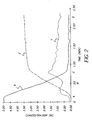
- the reaction was monitored using an FTIR probe by circulating the solution through an IR cell and taking spectra every three minutes. The concentration of each species was calculated after each sampling from a distinct peak for each species and was graphed with time (see FIG. 4).
- FIG. 3 shows the results for a reaction mixture that was preheated to 50°C before glycidol addition.
- the hydroxylamine reactant remained stable at that temperature, and reacted steadily upon addition of epoxide as it was added.
- the glycidol concentration was maintained at low levels throughout the reaction, thus giving undesirable by-products little time to form.
- Point “A” 40 minutes was the time glycidol addition was begun.
- point “B” 95 minutes
- glycidol addition was complete and the reaction temperature had risen to 62°C.
- point “C” (220 minutes) the reaction was complete and the reaction temperature had dropped to 50°C.
- FIG. 4 shows the results from Example 1 in which the reaction mixture was preheated to 60°C, followed by glycidol addition that was rapid enough to bring the reaction mixture to reflux.
- reaction was essentially instantaneous with no further reaction product formed after glycidol addition was completed. It may not be desirable in every instance to bring the reaction mixture to reflux, but the reaction temperature can be readily monitored to maintain an optimum reaction temperature for this set of reactants of from 60 to 90°C.
- A 40 minutes
- glycidol addition was begun.
- the reaction temperature had increased to 80°C and the glycidol rate of addition was increased.
- C 80 minutes
- the reaction temperature had increased to 100°C
- D 140 minutes
- a twelve-liter, three necked flask equipped with a mechanical stirrer and blade, a reflux condenser, thermometer, nitrogen inlet and an addition funnel was charged with a 50% aqueous hydroxylamine solution (1675 ml, 1.875 kg, 28.375 moles), and diluted with 4375 ml of deionized water.
- Example 1 was repeated except that propylene oxide was used in place of glycidol at the same molar amount relative to the hydroxylamine reactant. Analysis showed that the desired substituted hydroxylamine product was obtained.
- Example 3 The color developing composition of Example 3 was used to process samples of a color photographic silver halide color paper, namely KODAK EDGE 7 Color Paper, which had been imagewise exposed. After bleach/fixing using the commercially available EKTACOLOR Bleach/Fix processing solution and washing, suitable color images were obtained.
Landscapes
- Chemical & Material Sciences (AREA)
- Organic Chemistry (AREA)
- Physics & Mathematics (AREA)
- General Physics & Mathematics (AREA)
- Silver Salt Photography Or Processing Solution Therefor (AREA)
- Organic Low-Molecular-Weight Compounds And Preparation Thereof (AREA)
- Anti-Oxidant Or Stabilizer Compositions (AREA)
Claims (6)
- Verfahren zur Herstellung eines Antioxidationsmittels mit folgender Struktur I:worin R' für Wasserstoff, eine Alkylgruppe, eine Haloalkylgruppe, eine Hydroxyalkylgruppe, eine Cycloalkylgruppe oder eine Arylgruppe steht und X1 für -C(OH)R2CHR1-,
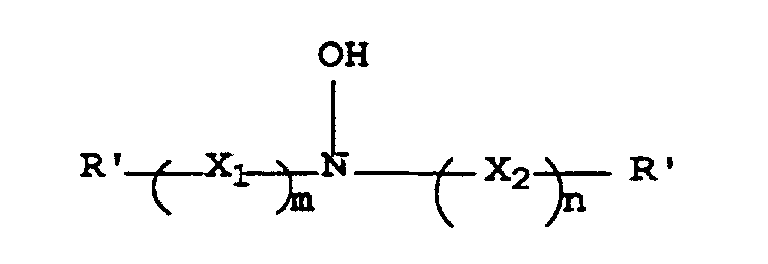
X2 für -CHR1C(OH)R2-, R1 und R2 jeweils unabhängig für Wasserstoff, eine Alkylgruppe oder eine Hydroxyalkylgruppe stehen oder R1 und R2 zusammen die Kohlenstoffatome darstellen, die notwendig sind, um einen 5- bis 8-gliedrigen carbozyklischen Ring zu bilden, und worin m und n jeweils 1 sind,
wobei das Verfahren das Hinzufügen eines Epoxids mit folgender Struktur II umfasstworin R', R1 und R2 wie zuvor definiert sind,
zu einer wässrigen Lösung von Hydroxylamin oder einem monosubstituierten Hydroxylamin in freier Basenform in einer Menge derart, dass die Reaktionstemperatur der Reaktionslösung bei mindestens 50°C bleibt und dass das Molverhältnis der Gesamtmenge des Epoxids, das dem Hydroxylamin oder dem monosubstituierten Hydroxylamin zugesetzt wird, zwischen 2:1 und 2:1.2 beträgt. - Verfahren nach Anspruch 1, worin R' für eine Alkylgruppe von 1 bis 7 Kohlenstoffatomen, eine Haloalkylgruppe von 1 bis 3 Kohlenstoffatomen und einen oder zwei Chlorsubstituenten steht, eine Hydroxyalkylgruppe von 1 bis 3 Kohlenstoffatomen, eine Cyclohexylgruppe oder eine phenylgruppe und worin R1 und R2 unabhängig für eine Alkylgruppe von 1 bis 2 Kohlenstoffatomen oder ein Hydroxyalkyl von 1 bis 2 Kohlenstoffatomen stehen.
- Verfahren nach Anspruch 1 oder 2, worin das Hydroxylamin oder das monosubstituierte Hydroxylamin Hydroxylamin, N-Methylhydroxylamin, N-Isopropylhydroxylamin oder N-Ethylhydroxylamin ist und das Epoxid Glycidol, Ethylenoxid, Propylenoxid, 2-Methyl-2,3-Epoxy-1-Propanol, 4-Phenyl-2,3-Epoxy-1-Butanol, 1,4-Butandioldiglycidylether, Epichlorhydrin oder 1,2,7,8-Diepoxyoctan ist.
- Verfahren nach Anspruch 1 bis 3, worin die Reaktionstemperatur der Reaktionslösung bei 70 bis 90°C gehalten wird und das Epoxid der wässrigen Lösung von Hydroxylamin oder monosubstituierten Hydroxylamin mit einer Menge von 0,1 bis 4 Mol %/min zugegeben wird.
- Verfahren nach einem der Ansprüche 1 bis 4, worin das Antioxidationsmittel der Struktur I N,N-Bis(2,3-Dihydroxypropyl)hydroxylamin, N,N-Bis(2-Methyl-2,3-Dihydroxypropyl)hydroxylamin oder N,N-Bis(1-Hydroxymethyl-2-Hydroxy-3-Phenylpropyl)hydroxylamin ist.
- Verfahren zur Herstellung einer fotografischen Farbentwicklungszusammensetzung mit folgenden Schritten:A) Herstellen eines Antioxidationsmittels mit der Struktur I:worin R' für Wasserstoff, eine Alkylgruppe, eine Hydroxyalkylgruppe, eine Cycloalkylgruppe oder eine Arylgruppe steht, X1 steht für -C(OH)R2CHR1-, X2 steht für -CHR1C(OH)R2-, R1 und R2 stehen unabhängig für Wasserstoff, eine Alkylgruppe oder eine Hydroxyalkylgruppe, oder R1 und R2 stellen gemeinsam die Kohlenstoffe dar, die notwendig sind, um einen 5- bis 8-gliedrigen carbozyklischen Ring zu bilden, und m und n sind jeweils 1,
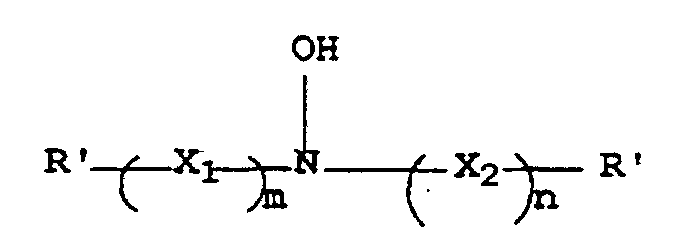
Hinzufügen eines Epoxids mit folgender Struktur IIworin R', R1 und R2 wie zuvor definiert sind,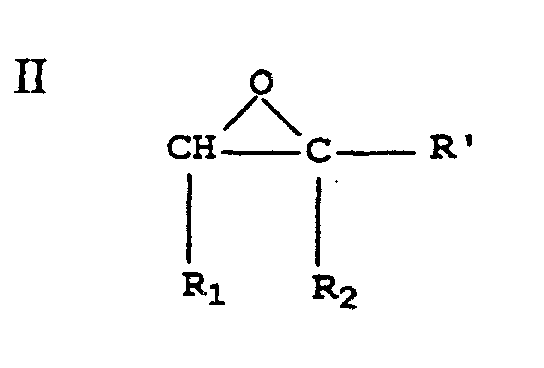
zu einer wässrigen Lösung von Hydroxylamin oder einem monosubstituierten Hydroxylamin in freier Basenform in einer Menge derart, dass die Reaktionstemperatur der Reaktionslösung bei mindestens 50 °C bleibt und dass das Molverhältnis der Gesamtmenge des Epoxids, das dem Hydroxylamin oder dem monosubstituierten Hydroxylamin zugesetzt wird, zwischen 2:1 und 2:1,2 beträgt; undB) Mischen des Antioxidationsmittels mit einem fotografischen Farbentwicklungsmittel, ohne das Antioxidationsmittel aus der Reaktionslösung zu trennen.
Applications Claiming Priority (2)
| Application Number | Priority Date | Filing Date | Title |
|---|---|---|---|
| US09/153,681 US6028225A (en) | 1998-09-15 | 1998-09-15 | Method of making hydroxy-substituted hydroxylamines and color developers containing same |
| US153681 | 1998-09-15 |
Publications (2)
| Publication Number | Publication Date |
|---|---|
| EP0987595A1 EP0987595A1 (de) | 2000-03-22 |
| EP0987595B1 true EP0987595B1 (de) | 2004-06-16 |
Family
ID=22548271
Family Applications (1)
| Application Number | Title | Priority Date | Filing Date |
|---|---|---|---|
| EP99202873A Expired - Lifetime EP0987595B1 (de) | 1998-09-15 | 1999-09-03 | Verfahren zur Herstellung von Hydroxy-substituierten Hydroxylaminen und diese enthaltende Farbentwickler |
Country Status (4)
| Country | Link |
|---|---|
| US (1) | US6028225A (de) |
| EP (1) | EP0987595B1 (de) |
| JP (1) | JP2000086606A (de) |
| DE (1) | DE69918008T2 (de) |
Families Citing this family (5)
| Publication number | Priority date | Publication date | Assignee | Title |
|---|---|---|---|---|
| KR100678340B1 (ko) | 2004-12-09 | 2007-02-07 | 한국기초과학지원연구원 | 특정 금속이온에 대해 선택적 발색성을 갖는 화합물 |
| CN105837465A (zh) * | 2016-03-29 | 2016-08-10 | 威海翔宇环保科技股份有限公司 | 一种苯乙烯阻聚剂的合成 |
| CN112159333A (zh) * | 2020-10-15 | 2021-01-01 | 济宁康德瑞化工科技有限公司 | 一种双羟丙基羟胺的制备方法 |
| CN115724762B (zh) * | 2021-08-31 | 2024-01-05 | 中国石油化工股份有限公司 | 一种制备二异丙醇基羟胺的方法、系统和得到的产品 |
| CN116574027A (zh) * | 2023-06-08 | 2023-08-11 | 济宁康德瑞化工科技有限公司 | 一种n-异丙基-n-羟丙基羟胺的合成方法 |
Family Cites Families (4)
| Publication number | Priority date | Publication date | Assignee | Title |
|---|---|---|---|---|
| US4892804A (en) * | 1986-01-24 | 1990-01-09 | Eastman Kodak Company | Photographic color developing compositions which are especially useful with high chloride photographic elements |
| US5354646A (en) * | 1986-03-26 | 1994-10-11 | Konishiroku Photo Industry Co., Ltd. | Method capable of rapidly processing a silver halide color photographic light-sensitive material |
| US5508155A (en) * | 1994-12-22 | 1996-04-16 | Eastman Kodak Company | Photographic color developers containing odorless antioxidants formed in situ from reaction of hydroxylamine and epoxide and use of same |
| EP0761647A3 (de) * | 1995-08-25 | 1997-05-07 | Eastman Kodak Co | Verbessertes Verfahren zur Herstellung von Hydroxylaminen aus vinylischen Verbindungen ohne basische Neutralisation und dadurch erhaltenes Reaktionsgemisch |
-
1998
- 1998-09-15 US US09/153,681 patent/US6028225A/en not_active Expired - Fee Related
-
1999
- 1999-09-03 EP EP99202873A patent/EP0987595B1/de not_active Expired - Lifetime
- 1999-09-03 DE DE69918008T patent/DE69918008T2/de not_active Expired - Fee Related
- 1999-09-14 JP JP11260210A patent/JP2000086606A/ja active Pending
Also Published As
| Publication number | Publication date |
|---|---|
| JP2000086606A (ja) | 2000-03-28 |
| DE69918008T2 (de) | 2005-06-30 |
| DE69918008D1 (de) | 2004-07-22 |
| US6028225A (en) | 2000-02-22 |
| EP0987595A1 (de) | 2000-03-22 |
Similar Documents
| Publication | Publication Date | Title |
|---|---|---|
| EP0980024B1 (de) | Photographisches einteiliges homogenes Farbentwicklerkonzentrat und Herstellungsmethode | |
| EP1037105A1 (de) | Farbentwicklung mit niedriger Nachfüllquote, in der ein chloridionenfreies Farbentwicklerkonzentrat verwendet wird | |
| US5620835A (en) | Method for preparing photographic color developer and reaction mixture useful in same | |
| EP0591934B1 (de) | Photographische Verarbeitungszusammensetzung und photographisches Verarbeitungsverfahren | |
| EP0987595B1 (de) | Verfahren zur Herstellung von Hydroxy-substituierten Hydroxylaminen und diese enthaltende Farbentwickler | |
| JPS6318729B2 (de) | ||
| EP1099980B1 (de) | Gegenüber Calciumionen stabiles photographisches Farbentwicklerkonzentrat und Erzeugungsverfahren | |
| US4737450A (en) | Method for bleach-fixing of photographic elements | |
| US5578427A (en) | Container having photographic conditioning solution concentrate | |
| EP0530921B1 (de) | Photographische Farbentwicklerzusammensetzung enthaltend eine Alpha-Aminosäure für verbesserte Stabilität der Lösung | |
| US4717649A (en) | Photographic bleach-fixing compositions | |
| US5827635A (en) | High temperature color development of photographic silver bromoiodide color negative films using stabilized color developer solution | |
| JP2001142185A (ja) | 写真用発色現像組成物 | |
| EP0999471B1 (de) | Eine von Lithium- und Magnesiumionen freie Farbentwicklerzusammensetzung und Methode zur photographischen Verarbeitung | |
| US5962204A (en) | Photographic reversal process prebleach concentrate container | |
| US6077653A (en) | Photographic developing compositions and methods of using 1,4-cyclohexanediones as antioxidants | |
| EP0759190A1 (de) | Alkylhydroxylaminderivate und ihre verwendung als antioxydantien in photographischen farbentwicklern und bearbeitungsverfahren | |
| US5821037A (en) | Photographic developer-amplifier composition | |
| JP2000206657A (ja) | 発色現像用組成物 | |
| US6919170B2 (en) | Method of manufacturing a bleach composition for processing a color photographic material | |
| US6958208B2 (en) | Methods of providing color photographic image using acidic stop and rinse solutions | |
| US20060093970A1 (en) | Combinations of preservatives and sequestrants to avoid formation of isonitrile malodor | |
| HK1023821A (en) | Homogeneous single-part photographic color developing concentrate and method of making | |
| JPH06148843A (ja) | 写真用処理組成物および処理方法 |
Legal Events
| Date | Code | Title | Description |
|---|---|---|---|
| PUAI | Public reference made under article 153(3) epc to a published international application that has entered the european phase |
Free format text: ORIGINAL CODE: 0009012 |
|
| AK | Designated contracting states |
Kind code of ref document: A1 Designated state(s): BE CH DE FR GB IT LI |
|
| AX | Request for extension of the european patent |
Free format text: AL;LT;LV;MK;RO;SI |
|
| 17P | Request for examination filed |
Effective date: 20000822 |
|
| AKX | Designation fees paid |
Free format text: BE CH DE FR GB IT LI |
|
| 17Q | First examination report despatched |
Effective date: 20030324 |
|
| GRAP | Despatch of communication of intention to grant a patent |
Free format text: ORIGINAL CODE: EPIDOSNIGR1 |
|
| GRAS | Grant fee paid |
Free format text: ORIGINAL CODE: EPIDOSNIGR3 |
|
| GRAA | (expected) grant |
Free format text: ORIGINAL CODE: 0009210 |
|
| RBV | Designated contracting states (corrected) |
Designated state(s): DE FR GB |
|
| AK | Designated contracting states |
Kind code of ref document: B1 Designated state(s): DE FR GB |
|
| REG | Reference to a national code |
Ref country code: GB Ref legal event code: FG4D |
|
| REF | Corresponds to: |
Ref document number: 69918008 Country of ref document: DE Date of ref document: 20040722 Kind code of ref document: P |
|
| PGFP | Annual fee paid to national office [announced via postgrant information from national office to epo] |
Ref country code: GB Payment date: 20040812 Year of fee payment: 6 |
|
| PGFP | Annual fee paid to national office [announced via postgrant information from national office to epo] |
Ref country code: FR Payment date: 20040902 Year of fee payment: 6 |
|
| PGFP | Annual fee paid to national office [announced via postgrant information from national office to epo] |
Ref country code: DE Payment date: 20040930 Year of fee payment: 6 |
|
| ET | Fr: translation filed | ||
| PLBE | No opposition filed within time limit |
Free format text: ORIGINAL CODE: 0009261 |
|
| STAA | Information on the status of an ep patent application or granted ep patent |
Free format text: STATUS: NO OPPOSITION FILED WITHIN TIME LIMIT |
|
| 26N | No opposition filed |
Effective date: 20050317 |
|
| PG25 | Lapsed in a contracting state [announced via postgrant information from national office to epo] |
Ref country code: GB Free format text: LAPSE BECAUSE OF NON-PAYMENT OF DUE FEES Effective date: 20050903 |
|
| PG25 | Lapsed in a contracting state [announced via postgrant information from national office to epo] |
Ref country code: DE Free format text: LAPSE BECAUSE OF NON-PAYMENT OF DUE FEES Effective date: 20060401 |
|
| GBPC | Gb: european patent ceased through non-payment of renewal fee |
Effective date: 20050903 |
|
| PG25 | Lapsed in a contracting state [announced via postgrant information from national office to epo] |
Ref country code: FR Free format text: LAPSE BECAUSE OF NON-PAYMENT OF DUE FEES Effective date: 20060531 |
|
| REG | Reference to a national code |
Ref country code: FR Ref legal event code: ST Effective date: 20060531 |