EP0986471B1 - Plaque d'impression numerique a masque thermique - Google Patents
Plaque d'impression numerique a masque thermique Download PDFInfo
- Publication number
- EP0986471B1 EP0986471B1 EP98923446A EP98923446A EP0986471B1 EP 0986471 B1 EP0986471 B1 EP 0986471B1 EP 98923446 A EP98923446 A EP 98923446A EP 98923446 A EP98923446 A EP 98923446A EP 0986471 B1 EP0986471 B1 EP 0986471B1
- Authority
- EP
- European Patent Office
- Prior art keywords
- areas
- photosensitive layer
- soluble
- layer
- mask
- Prior art date
- Legal status (The legal status is an assumption and is not a legal conclusion. Google has not performed a legal analysis and makes no representation as to the accuracy of the status listed.)
- Expired - Lifetime
Links
- 238000007639 printing Methods 0.000 title claims description 57
- 239000010410 layer Substances 0.000 claims description 215
- 230000005855 radiation Effects 0.000 claims description 106
- 230000000873 masking effect Effects 0.000 claims description 63
- 239000007788 liquid Substances 0.000 claims description 40
- 239000012736 aqueous medium Substances 0.000 claims description 38
- 238000000034 method Methods 0.000 claims description 33
- 239000000758 substrate Substances 0.000 claims description 32
- 239000011229 interlayer Substances 0.000 claims description 30
- 239000003086 colorant Substances 0.000 claims description 18
- 230000008859 change Effects 0.000 claims description 11
- 230000000694 effects Effects 0.000 claims description 11
- 239000004816 latex Substances 0.000 claims description 11
- 229920000126 latex Polymers 0.000 claims description 11
- 239000000463 material Substances 0.000 claims description 11
- -1 sulphonamido groups Chemical group 0.000 claims description 10
- 239000011230 binding agent Substances 0.000 claims description 9
- 229920000642 polymer Polymers 0.000 claims description 9
- 229910052782 aluminium Inorganic materials 0.000 claims description 5
- XAGFODPZIPBFFR-UHFFFAOYSA-N aluminium Chemical compound [Al] XAGFODPZIPBFFR-UHFFFAOYSA-N 0.000 claims description 5
- 229920001296 polysiloxane Polymers 0.000 claims description 5
- 239000000975 dye Substances 0.000 claims description 4
- 230000005660 hydrophilic surface Effects 0.000 claims description 4
- 239000011258 core-shell material Substances 0.000 claims description 3
- 239000002245 particle Substances 0.000 claims description 3
- 239000000049 pigment Substances 0.000 claims description 3
- 125000002887 hydroxy group Chemical group [H]O* 0.000 claims description 2
- 239000011358 absorbing material Substances 0.000 claims 1
- 125000003277 amino group Chemical group 0.000 claims 1
- 125000002843 carboxylic acid group Chemical group 0.000 claims 1
- 239000008206 lipophilic material Substances 0.000 claims 1
- 239000000203 mixture Substances 0.000 description 26
- PLXMOAALOJOTIY-FPTXNFDTSA-N Aesculin Natural products OC[C@@H]1[C@@H](O)[C@H](O)[C@@H](O)[C@H](O)[C@H]1Oc2cc3C=CC(=O)Oc3cc2O PLXMOAALOJOTIY-FPTXNFDTSA-N 0.000 description 20
- 238000000576 coating method Methods 0.000 description 19
- 239000011248 coating agent Substances 0.000 description 17
- 239000000243 solution Substances 0.000 description 14
- 239000006229 carbon black Substances 0.000 description 13
- 239000006185 dispersion Substances 0.000 description 13
- XLYOFNOQVPJJNP-UHFFFAOYSA-N water Substances O XLYOFNOQVPJJNP-UHFFFAOYSA-N 0.000 description 13
- PPBRXRYQALVLMV-UHFFFAOYSA-N Styrene Chemical compound C=CC1=CC=CC=C1 PPBRXRYQALVLMV-UHFFFAOYSA-N 0.000 description 11
- MYRTYDVEIRVNKP-UHFFFAOYSA-N 1,2-Divinylbenzene Chemical compound C=CC1=CC=CC=C1C=C MYRTYDVEIRVNKP-UHFFFAOYSA-N 0.000 description 10
- KFZMGEQAYNKOFK-UHFFFAOYSA-N Isopropanol Chemical compound CC(C)O KFZMGEQAYNKOFK-UHFFFAOYSA-N 0.000 description 10
- 230000003595 spectral effect Effects 0.000 description 10
- 230000008569 process Effects 0.000 description 9
- IJGRMHOSHXDMSA-UHFFFAOYSA-N Atomic nitrogen Chemical compound N#N IJGRMHOSHXDMSA-UHFFFAOYSA-N 0.000 description 6
- 150000001875 compounds Chemical class 0.000 description 6
- 229920001577 copolymer Polymers 0.000 description 6
- 239000007864 aqueous solution Substances 0.000 description 5
- VOZRXNHHFUQHIL-UHFFFAOYSA-N glycidyl methacrylate Chemical compound CC(=C)C(=O)OCC1CO1 VOZRXNHHFUQHIL-UHFFFAOYSA-N 0.000 description 5
- 239000000178 monomer Substances 0.000 description 5
- 239000012670 alkaline solution Substances 0.000 description 4
- 150000002148 esters Chemical class 0.000 description 4
- 229920005989 resin Polymers 0.000 description 4
- 239000011347 resin Substances 0.000 description 4
- YCUVUDODLRLVIC-VPHDGDOJSA-N sudan black b Chemical compound C1=CC(=C23)NC(C)(C)NC2=CC=CC3=C1\N=N\C(C1=CC=CC=C11)=CC=C1\N=N\C1=CC=CC=C1 YCUVUDODLRLVIC-VPHDGDOJSA-N 0.000 description 4
- WSFSSNUMVMOOMR-UHFFFAOYSA-N Formaldehyde Chemical compound O=C WSFSSNUMVMOOMR-UHFFFAOYSA-N 0.000 description 3
- OKKJLVBELUTLKV-UHFFFAOYSA-N Methanol Chemical compound OC OKKJLVBELUTLKV-UHFFFAOYSA-N 0.000 description 3
- 230000015572 biosynthetic process Effects 0.000 description 3
- 238000006243 chemical reaction Methods 0.000 description 3
- 239000008367 deionised water Substances 0.000 description 3
- 229910021641 deionized water Inorganic materials 0.000 description 3
- 238000003384 imaging method Methods 0.000 description 3
- 229910052757 nitrogen Inorganic materials 0.000 description 3
- 229920002554 vinyl polymer Polymers 0.000 description 3
- NIXOWILDQLNWCW-UHFFFAOYSA-N 2-Propenoic acid Natural products OC(=O)C=C NIXOWILDQLNWCW-UHFFFAOYSA-N 0.000 description 2
- PYSRRFNXTXNWCD-UHFFFAOYSA-N 3-(2-phenylethenyl)furan-2,5-dione Chemical compound O=C1OC(=O)C(C=CC=2C=CC=CC=2)=C1 PYSRRFNXTXNWCD-UHFFFAOYSA-N 0.000 description 2
- NLHHRLWOUZZQLW-UHFFFAOYSA-N Acrylonitrile Chemical compound C=CC#N NLHHRLWOUZZQLW-UHFFFAOYSA-N 0.000 description 2
- SOGAXMICEFXMKE-UHFFFAOYSA-N Butylmethacrylate Chemical compound CCCCOC(=O)C(C)=C SOGAXMICEFXMKE-UHFFFAOYSA-N 0.000 description 2
- OFOBLEOULBTSOW-UHFFFAOYSA-N Malonic acid Chemical class OC(=O)CC(O)=O OFOBLEOULBTSOW-UHFFFAOYSA-N 0.000 description 2
- CERQOIWHTDAKMF-UHFFFAOYSA-M Methacrylate Chemical compound CC(=C)C([O-])=O CERQOIWHTDAKMF-UHFFFAOYSA-M 0.000 description 2
- GYCMBHHDWRMZGG-UHFFFAOYSA-N Methylacrylonitrile Chemical compound CC(=C)C#N GYCMBHHDWRMZGG-UHFFFAOYSA-N 0.000 description 2
- 239000004793 Polystyrene Substances 0.000 description 2
- 229920000147 Styrene maleic anhydride Polymers 0.000 description 2
- 239000003513 alkali Substances 0.000 description 2
- 125000000217 alkyl group Chemical group 0.000 description 2
- ROOXNKNUYICQNP-UHFFFAOYSA-N ammonium persulfate Chemical compound [NH4+].[NH4+].[O-]S(=O)(=O)OOS([O-])(=O)=O ROOXNKNUYICQNP-UHFFFAOYSA-N 0.000 description 2
- 239000011324 bead Substances 0.000 description 2
- 125000002915 carbonyl group Chemical group [*:2]C([*:1])=O 0.000 description 2
- 238000004581 coalescence Methods 0.000 description 2
- 125000000664 diazo group Chemical group [N-]=[N+]=[*] 0.000 description 2
- 239000000839 emulsion Substances 0.000 description 2
- 239000012948 isocyanate Substances 0.000 description 2
- 150000002513 isocyanates Chemical class 0.000 description 2
- 238000004519 manufacturing process Methods 0.000 description 2
- 229910052751 metal Inorganic materials 0.000 description 2
- 239000002184 metal Substances 0.000 description 2
- 238000002156 mixing Methods 0.000 description 2
- 229920001490 poly(butyl methacrylate) polymer Polymers 0.000 description 2
- 238000006116 polymerization reaction Methods 0.000 description 2
- 229920002223 polystyrene Polymers 0.000 description 2
- 239000011342 resin composition Substances 0.000 description 2
- 230000035945 sensitivity Effects 0.000 description 2
- 229910052709 silver Inorganic materials 0.000 description 2
- 239000004332 silver Substances 0.000 description 2
- 239000007787 solid Substances 0.000 description 2
- 238000003860 storage Methods 0.000 description 2
- 150000003440 styrenes Chemical class 0.000 description 2
- 239000004094 surface-active agent Substances 0.000 description 2
- 238000009736 wetting Methods 0.000 description 2
- HFVMEOPYDLEHBR-UHFFFAOYSA-N (2-fluorophenyl)-phenylmethanol Chemical compound C=1C=CC=C(F)C=1C(O)C1=CC=CC=C1 HFVMEOPYDLEHBR-UHFFFAOYSA-N 0.000 description 1
- BFKCBRGTWYBWTD-UHFFFAOYSA-N (2-methylprop-2-enoylamino) 2-methoxyacetate Chemical compound COCC(=O)ONC(=O)C(C)=C BFKCBRGTWYBWTD-UHFFFAOYSA-N 0.000 description 1
- SMZOUWXMTYCWNB-UHFFFAOYSA-N 2-(2-methoxy-5-methylphenyl)ethanamine Chemical compound COC1=CC=C(C)C=C1CCN SMZOUWXMTYCWNB-UHFFFAOYSA-N 0.000 description 1
- JKNCOURZONDCGV-UHFFFAOYSA-N 2-(dimethylamino)ethyl 2-methylprop-2-enoate Chemical compound CN(C)CCOC(=O)C(C)=C JKNCOURZONDCGV-UHFFFAOYSA-N 0.000 description 1
- IWTYTFSSTWXZFU-UHFFFAOYSA-N 3-chloroprop-1-enylbenzene Chemical compound ClCC=CC1=CC=CC=C1 IWTYTFSSTWXZFU-UHFFFAOYSA-N 0.000 description 1
- NIXOWILDQLNWCW-UHFFFAOYSA-M Acrylate Chemical class [O-]C(=O)C=C NIXOWILDQLNWCW-UHFFFAOYSA-M 0.000 description 1
- VHUUQVKOLVNVRT-UHFFFAOYSA-N Ammonium hydroxide Chemical compound [NH4+].[OH-] VHUUQVKOLVNVRT-UHFFFAOYSA-N 0.000 description 1
- LSNNMFCWUKXFEE-UHFFFAOYSA-M Bisulfite Chemical compound OS([O-])=O LSNNMFCWUKXFEE-UHFFFAOYSA-M 0.000 description 1
- OKTJSMMVPCPJKN-UHFFFAOYSA-N Carbon Chemical compound [C] OKTJSMMVPCPJKN-UHFFFAOYSA-N 0.000 description 1
- 229920005929 JONCRYL® 89 Polymers 0.000 description 1
- CERQOIWHTDAKMF-UHFFFAOYSA-N Methacrylic acid Chemical compound CC(=C)C(O)=O CERQOIWHTDAKMF-UHFFFAOYSA-N 0.000 description 1
- CNCOEDDPFOAUMB-UHFFFAOYSA-N N-Methylolacrylamide Chemical compound OCNC(=O)C=C CNCOEDDPFOAUMB-UHFFFAOYSA-N 0.000 description 1
- ISWSIDIOOBJBQZ-UHFFFAOYSA-N Phenol Chemical compound OC1=CC=CC=C1 ISWSIDIOOBJBQZ-UHFFFAOYSA-N 0.000 description 1
- 239000004952 Polyamide Substances 0.000 description 1
- 239000004698 Polyethylene Substances 0.000 description 1
- 239000004743 Polypropylene Substances 0.000 description 1
- XUIMIQQOPSSXEZ-UHFFFAOYSA-N Silicon Chemical compound [Si] XUIMIQQOPSSXEZ-UHFFFAOYSA-N 0.000 description 1
- DBMJMQXJHONAFJ-UHFFFAOYSA-M Sodium laurylsulphate Chemical compound [Na+].CCCCCCCCCCCCOS([O-])(=O)=O DBMJMQXJHONAFJ-UHFFFAOYSA-M 0.000 description 1
- 229910000831 Steel Inorganic materials 0.000 description 1
- KDYFGRWQOYBRFD-UHFFFAOYSA-N Succinic acid Natural products OC(=O)CCC(O)=O KDYFGRWQOYBRFD-UHFFFAOYSA-N 0.000 description 1
- XTXRWKRVRITETP-UHFFFAOYSA-N Vinyl acetate Chemical class CC(=O)OC=C XTXRWKRVRITETP-UHFFFAOYSA-N 0.000 description 1
- 238000002679 ablation Methods 0.000 description 1
- DHKHKXVYLBGOIT-UHFFFAOYSA-N acetaldehyde Diethyl Acetal Natural products CCOC(C)OCC DHKHKXVYLBGOIT-UHFFFAOYSA-N 0.000 description 1
- 125000002777 acetyl group Chemical class [H]C([H])([H])C(*)=O 0.000 description 1
- 239000002253 acid Substances 0.000 description 1
- 239000000908 ammonium hydroxide Substances 0.000 description 1
- 229910001870 ammonium persulfate Inorganic materials 0.000 description 1
- 239000008135 aqueous vehicle Substances 0.000 description 1
- 125000003710 aryl alkyl group Chemical group 0.000 description 1
- 125000003118 aryl group Chemical group 0.000 description 1
- IVRMZWNICZWHMI-UHFFFAOYSA-N azide group Chemical group [N-]=[N+]=[N-] IVRMZWNICZWHMI-UHFFFAOYSA-N 0.000 description 1
- 125000003178 carboxy group Chemical group [H]OC(*)=O 0.000 description 1
- 150000001732 carboxylic acid derivatives Chemical class 0.000 description 1
- 150000001735 carboxylic acids Chemical class 0.000 description 1
- 239000002131 composite material Substances 0.000 description 1
- 238000009833 condensation Methods 0.000 description 1
- 230000005494 condensation Effects 0.000 description 1
- 238000007334 copolymerization reaction Methods 0.000 description 1
- IPZMDJYHJNHGML-UHFFFAOYSA-N diphenylazanium;hydrogen sulfate Chemical compound OS(O)(=O)=O.C=1C=CC=CC=1NC1=CC=CC=C1 IPZMDJYHJNHGML-UHFFFAOYSA-N 0.000 description 1
- 238000004945 emulsification Methods 0.000 description 1
- 239000011521 glass Substances 0.000 description 1
- 229910002804 graphite Inorganic materials 0.000 description 1
- 239000010439 graphite Substances 0.000 description 1
- 238000010438 heat treatment Methods 0.000 description 1
- 230000002209 hydrophobic effect Effects 0.000 description 1
- 230000031700 light absorption Effects 0.000 description 1
- 238000001459 lithography Methods 0.000 description 1
- VZCYOOQTPOCHFL-UPHRSURJSA-N maleic acid Chemical compound OC(=O)\C=C/C(O)=O VZCYOOQTPOCHFL-UPHRSURJSA-N 0.000 description 1
- 239000011976 maleic acid Substances 0.000 description 1
- 239000008204 material by function Substances 0.000 description 1
- 239000002609 medium Substances 0.000 description 1
- 150000002734 metacrylic acid derivatives Chemical class 0.000 description 1
- RBQRWNWVPQDTJJ-UHFFFAOYSA-N methacryloyloxyethyl isocyanate Chemical compound CC(=C)C(=O)OCCN=C=O RBQRWNWVPQDTJJ-UHFFFAOYSA-N 0.000 description 1
- 239000002687 nonaqueous vehicle Substances 0.000 description 1
- XNGIFLGASWRNHJ-UHFFFAOYSA-N o-dicarboxybenzene Natural products OC(=O)C1=CC=CC=C1C(O)=O XNGIFLGASWRNHJ-UHFFFAOYSA-N 0.000 description 1
- 238000007645 offset printing Methods 0.000 description 1
- 230000003287 optical effect Effects 0.000 description 1
- RPQRDASANLAFCM-UHFFFAOYSA-N oxiran-2-ylmethyl prop-2-enoate Chemical compound C=CC(=O)OCC1CO1 RPQRDASANLAFCM-UHFFFAOYSA-N 0.000 description 1
- ZFACJPAPCXRZMQ-UHFFFAOYSA-N phthalic acid Chemical compound OC(=O)C1=CC=CC=C1C(O)=O.OC(=O)C1=CC=CC=C1C(O)=O ZFACJPAPCXRZMQ-UHFFFAOYSA-N 0.000 description 1
- IEQIEDJGQAUEQZ-UHFFFAOYSA-N phthalocyanine Chemical compound N1C(N=C2C3=CC=CC=C3C(N=C3C4=CC=CC=C4C(=N4)N3)=N2)=C(C=CC=C2)C2=C1N=C1C2=CC=CC=C2C4=N1 IEQIEDJGQAUEQZ-UHFFFAOYSA-N 0.000 description 1
- 239000002985 plastic film Substances 0.000 description 1
- 229920006255 plastic film Polymers 0.000 description 1
- 229920002037 poly(vinyl butyral) polymer Polymers 0.000 description 1
- 229920000058 polyacrylate Polymers 0.000 description 1
- 229920002647 polyamide Polymers 0.000 description 1
- 229920000767 polyaniline Polymers 0.000 description 1
- 229920000728 polyester Polymers 0.000 description 1
- 229920000573 polyethylene Polymers 0.000 description 1
- 229920000139 polyethylene terephthalate Polymers 0.000 description 1
- 239000005020 polyethylene terephthalate Substances 0.000 description 1
- 229920001155 polypropylene Polymers 0.000 description 1
- 229920000128 polypyrrole Polymers 0.000 description 1
- 229920000123 polythiophene Polymers 0.000 description 1
- 229920002635 polyurethane Polymers 0.000 description 1
- 239000004814 polyurethane Substances 0.000 description 1
- 238000002360 preparation method Methods 0.000 description 1
- 125000002924 primary amino group Chemical group [H]N([H])* 0.000 description 1
- QTECDUFMBMSHKR-UHFFFAOYSA-N prop-2-enyl prop-2-enoate Chemical compound C=CCOC(=O)C=C QTECDUFMBMSHKR-UHFFFAOYSA-N 0.000 description 1
- 239000011241 protective layer Substances 0.000 description 1
- 239000011541 reaction mixture Substances 0.000 description 1
- 229910052710 silicon Inorganic materials 0.000 description 1
- 239000010703 silicon Substances 0.000 description 1
- 239000002356 single layer Substances 0.000 description 1
- 239000010959 steel Substances 0.000 description 1
- 125000003011 styrenyl group Chemical group [H]\C(*)=C(/[H])C1=C([H])C([H])=C([H])C([H])=C1[H] 0.000 description 1
- 239000000126 substance Substances 0.000 description 1
- 239000001384 succinic acid Substances 0.000 description 1
- 125000001273 sulfonato group Chemical group [O-]S(*)(=O)=O 0.000 description 1
- CXVGEDCSTKKODG-UHFFFAOYSA-N sulisobenzone Chemical class C1=C(S(O)(=O)=O)C(OC)=CC(O)=C1C(=O)C1=CC=CC=C1 CXVGEDCSTKKODG-UHFFFAOYSA-N 0.000 description 1
- VZCYOOQTPOCHFL-UHFFFAOYSA-N trans-butenedioic acid Natural products OC(=O)C=CC(O)=O VZCYOOQTPOCHFL-UHFFFAOYSA-N 0.000 description 1
- 230000007704 transition Effects 0.000 description 1
- 238000009281 ultraviolet germicidal irradiation Methods 0.000 description 1
- 239000003981 vehicle Substances 0.000 description 1
- 229920001567 vinyl ester resin Polymers 0.000 description 1
- 125000000391 vinyl group Chemical group [H]C([*])=C([H])[H] 0.000 description 1
Images


Classifications
-
- B—PERFORMING OPERATIONS; TRANSPORTING
- B41—PRINTING; LINING MACHINES; TYPEWRITERS; STAMPS
- B41C—PROCESSES FOR THE MANUFACTURE OR REPRODUCTION OF PRINTING SURFACES
- B41C1/00—Forme preparation
- B41C1/10—Forme preparation for lithographic printing; Master sheets for transferring a lithographic image to the forme
- B41C1/1008—Forme preparation for lithographic printing; Master sheets for transferring a lithographic image to the forme by removal or destruction of lithographic material on the lithographic support, e.g. by laser or spark ablation; by the use of materials rendered soluble or insoluble by heat exposure, e.g. by heat produced from a light to heat transforming system; by on-the-press exposure or on-the-press development, e.g. by the fountain of photolithographic materials
- B41C1/1016—Forme preparation for lithographic printing; Master sheets for transferring a lithographic image to the forme by removal or destruction of lithographic material on the lithographic support, e.g. by laser or spark ablation; by the use of materials rendered soluble or insoluble by heat exposure, e.g. by heat produced from a light to heat transforming system; by on-the-press exposure or on-the-press development, e.g. by the fountain of photolithographic materials characterised by structural details, e.g. protective layers, backcoat layers or several imaging layers
-
- B—PERFORMING OPERATIONS; TRANSPORTING
- B41—PRINTING; LINING MACHINES; TYPEWRITERS; STAMPS
- B41C—PROCESSES FOR THE MANUFACTURE OR REPRODUCTION OF PRINTING SURFACES
- B41C2201/00—Location, type or constituents of the non-imaging layers in lithographic printing formes
- B41C2201/04—Intermediate layers
-
- B—PERFORMING OPERATIONS; TRANSPORTING
- B41—PRINTING; LINING MACHINES; TYPEWRITERS; STAMPS
- B41C—PROCESSES FOR THE MANUFACTURE OR REPRODUCTION OF PRINTING SURFACES
- B41C2210/00—Preparation or type or constituents of the imaging layers, in relation to lithographic printing forme preparation
- B41C2210/02—Positive working, i.e. the exposed (imaged) areas are removed
-
- B—PERFORMING OPERATIONS; TRANSPORTING
- B41—PRINTING; LINING MACHINES; TYPEWRITERS; STAMPS
- B41C—PROCESSES FOR THE MANUFACTURE OR REPRODUCTION OF PRINTING SURFACES
- B41C2210/00—Preparation or type or constituents of the imaging layers, in relation to lithographic printing forme preparation
- B41C2210/04—Negative working, i.e. the non-exposed (non-imaged) areas are removed
-
- B—PERFORMING OPERATIONS; TRANSPORTING
- B41—PRINTING; LINING MACHINES; TYPEWRITERS; STAMPS
- B41C—PROCESSES FOR THE MANUFACTURE OR REPRODUCTION OF PRINTING SURFACES
- B41C2210/00—Preparation or type or constituents of the imaging layers, in relation to lithographic printing forme preparation
- B41C2210/06—Developable by an alkaline solution
-
- B—PERFORMING OPERATIONS; TRANSPORTING
- B41—PRINTING; LINING MACHINES; TYPEWRITERS; STAMPS
- B41C—PROCESSES FOR THE MANUFACTURE OR REPRODUCTION OF PRINTING SURFACES
- B41C2210/00—Preparation or type or constituents of the imaging layers, in relation to lithographic printing forme preparation
- B41C2210/16—Waterless working, i.e. ink repelling exposed (imaged) or non-exposed (non-imaged) areas, not requiring fountain solution or water, e.g. dry lithography or driography
-
- B—PERFORMING OPERATIONS; TRANSPORTING
- B41—PRINTING; LINING MACHINES; TYPEWRITERS; STAMPS
- B41C—PROCESSES FOR THE MANUFACTURE OR REPRODUCTION OF PRINTING SURFACES
- B41C2210/00—Preparation or type or constituents of the imaging layers, in relation to lithographic printing forme preparation
- B41C2210/24—Preparation or type or constituents of the imaging layers, in relation to lithographic printing forme preparation characterised by a macromolecular compound or binder obtained by reactions involving carbon-to-carbon unsaturated bonds, e.g. acrylics, vinyl polymers
Definitions
- This invention relates to long impression life, laser imageable lithographic printing plates and to the method for their production. More particularly, this invention relates to lithographic printing plates for wet and waterless offset lithographic printing which can be imagewise exposed using a digitally controlled infrared laser beam.
- Lithography and offset printing methods have long been combined in a compatible marriage of great convenience for the printing industry for economical high speed, high quality image duplication in small runs and large.
- Known art available to the industry for image transfer to a lithographic plate is voluminous but dominated by the photographic process wherein a hydrophilic plate is treated with a photosensitive coating, exposed via a film image and developed to produce a printable, oleophilic image on the plate for use in traditional wet lithographic printing processes employing an aqueous fountain solution.
- waterless lithographic printing plates i.e., plates that require no fountain solution, have been developed wherein a plate is photographically produced which has oleophilic image areas and complimentary areas which are both hydrophobic and oleophobic.
- Such waterless plates overcome difficulties typically encountered with the traditional wet process such as the unwanted mixing and emulsification of fountain solution and ink.
- Patent 5,340,699 European Patent Publication 599510, and International Publication WO 20429/96.
- Such single layer plates which typically are sensitive to infrared lasers represent a compromise between printing performance and laser sensitivity and require additional heating or curing steps to provide an acceptable printing image
- Another class of laser sensitive plates are composed of a conventional photosensitive lithographic plate which has a laser sensitive mask forming layer over the photosensitive layer of the plate such as those disclosed in U.S. Patents 5,330,875 and 5,512,420 wherein the mask layer is a silver halide emulsion, and International Publication WO 97/00777 wherein the mask layer is a thermal ablation mask. While such laser sensitive mask/plate systems produce plates with conventional printing performance, such silver halide systems are expensive to make and process and must be handled in a dark room under dim red light; and such ablative masks requires very high laser exposures resulting in slow imaging speed.
- thermally-imagable digital printing plate of this invention which is a radiation sensitive plate structure comprising in the order given:
- An added embodiment of this invention is a method for digitally producing a lithographic printing plate comprising:
- Another embodiment of this invention is a waterless, radiation sensitive plate comprising in the order given:
- the novel lithographic plates of the present invention permit the direct formation of printable images on plates by digital computerization without the intervening formation of a photographic image with a quality that allows the plates to be used for high volume printing applications of 50,000 to 1,000,000 or more copies.
- IR infrared
- the lithographic printing plate of this invention is a radiation sensitive plate structure which comprises a substrate; a photosensitive layer which changes solubility in a developer liquid upon exposure to actinic radiation; and a thermally sensitive masking layer which is opaque to the actinic radiation and is soluble or dispersible in an aqueous medium.
- the thermally sensitive masking layer comprises a disperse phase comprising a heat softenable component which is insoluble in the aqueous medium; a continuous phase comprising a polymeric binder which is soluble or swellable in the aqueous medium; and a colorant which strongly absorbs radiant energy and converts the radiant energy to heat.
- the combination of the substrate and the photosensitive layer, along with any ancillary intermediate layers may constitute any conventional lithographic plate structure which is sensitive to actinic radiation such as ultraviolet (UV) radiation.
- Such conventional lithographic plate structures include positive working plates with photosolubilizable layers; negative working plates in which the photosensitive layers are insolubilized; as well as such plates which are intended for use with or without an aqueous fountain solution.
- the thermally sensitive masking layer may be applied over any of the commercial lithographic printing plate structures to provide the thermally-imagable digital printing plate of this invention.
- the substrate or support for the printing plate of this invention may be any of those supports or substrates that are commonly used as supports in the manufacture of lithographic printing plates. Examples include metal plates such as aluminum, composite metal plates, plastic films such as polyethylene terephthalate, paper and the like. Preferably the substrate is aluminum particularly for such plates having long press life.
- the substrate surface may be treated or sub-coated with a material which provides either a hydrophilic character to the substrate surface for use with a fountain solution, or lipophilic character to the substrate surface for use in a "waterless” printing process.
- an aluminum substrate may be electrochemically treated to provide a grained surface and enhance hydrophilicity of the surface for use with fountain solutions.
- the foregoing substrates are converted to photochemically presensitized (PS) lithographic plates by coating the plates with a material to form a photosensitive layer which is sensitive to actinic radiation at contact speed.
- actinic radiation as used herein is intended to mean radiation such as ultraviolet (UV) radiation, which can induce a chemical change in the material.
- the photosensitive layer, on the substrate comprises a coating sensitive to actinic radiation which yields a lipophilic image and includes radiation sensitive coatings conventionally used in radiation sensitive lithographic printing plates.
- lipophilic as used herein is intended to mean a surface which receives oily ink and repels water, such as for use in printing in the presence of a fountain solution.
- compositions constituting such radiation sensitive coatings are described in U.S. Patents 4,299,912; 4,350,753; 4,348,471 and 3,635,709.
- These sensitive compositions include by example without limitation: compositions comprising one or more diazo resins; compositions comprising one or more o-napthoquinonediazide compounds; compositions comprising one or more radiation sensitive azide compounds; compositions comprising one or more polymers containing an alpha, beta unsaturated carbonyl group in the main or side chain thereof; and photopolymerizable compositions comprising one or more addition polymerizable unsaturated compounds.
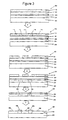
- the photosensitive layer which changes solubility in a developer liquid upon exposure to actinic radiation is meant to include both positive-working and negative-working photosensitive layers in the lithographic printing plates of this invention as illustrated in Figures 1 and 2 respectively.
- a positive-working photosensitive layer is intended to mean any photosensitive layer which is insoluble in a developer liquid and is rendered soluble in the developer liquid upon exposure to actinic radiation.
- the composition of the photosensitive layer ,104 when exposed to actinic radiation such as UV, undergoes a chemical reaction in the exposed areas ,134, whereby the exposed areas, 134, become soluble and removeable.
- An example of a positive-working resin composition which can be developed with an aqueous alkaline solution is one which contains a radiation sensitive material such as o-napthoquinonediazide.
- negative-working photosensitive layer is intended to mean any photosensitive layer which is soluble in the developer liquid and is rendered insoluble in the developer liquid upon exposure to actinic radiation.
- actinic radiation such as UV
- the composition of the photosensitive layer, 204 when exposed to actinic radiation such as UV, undergoes a chemical reaction in the exposed areas, 234, whereby the exposed areas, 234, become insoluble leaving the unexposed areas soluble or dispersible.
- negative-working resin compositions which can be developed following UV radiation exposure include polyvinylcinnamate, vinyl polymers containing an aromatic azide group and the like. Negative-working compositions useful in this invention are described in U.S. Patents 4,483,758 and 4,447,512, assigned to Polychrome Corporation.
- compositions consist of a diazo resin based on diphenyl amine sulfate condensate with formaldehyde and isolated as the 2-hydroxy-4-methoxy-benzophenone-5-sulfonic acid salt. Also included are polymers with alpha, beta unsaturated carbonyl groups in the main or side chain.
- Presensitized lithographic plates useful in the present invention include Vector plates, Virage plates, Winner plate, Vista-M plate, Vista-XLR plate and Vitesse/HSP plate as well as the plates disclosed in the following examples each of which may be obtained from the Polychrome Corporation.
- Lithographic plates used in the present invention typically have speeds between about 100 and 400 mJ/cm 2 .
- Positive and negative working waterless plates have a structure which differs from conventional wet plates in that the photosensitive layer is overcoated with a silicone layer which in turn is laminated with strippable protective layer.
- the silicon layer is lipophobic and repels oily ink, whereas the photosensitive layer at least after imaging, is lipophilic.
- Such waterless plates are described in U.S. Patents 3,894,873; 4,259,905 and 4,342,820. Waterless TorayTM plates of these types are available from Polychrome Corporation.
- the masking layer is the outermost layer of the radiation sensitive plate structure of this invention.
- the thermally sensitive masking layer is opaque to the actinic radiation which activates the photosensitive layer, and is soluble or dispersible in an aqueous medium.
- the thermally sensitive masking layer comprises a disperse phase comprising a heat softenable component which is insoluble in the aqueous medium; a continuous phase comprising a polymeric binder which is soluble or swellable in the aqueous medium; and a colorant which strongly absorbs radiant energy and converts the radiant energy to heat.
- the disperse phase comprises a heat-softenable component which is insoluble in an aqueous solution such as an alkaline solution.
- the disperse phase may be a microgel, a latex, a polymeric bead, or the like, and may contain one or more reactive groups.
- the disperse phase typically is an oleophilic polymer or oligomer preferably having a minimum softening temperature above ambient temperature, and it may be an addition polymer or copolymer comprising residues derived from one or more monomers such as styrene, substituted styrenes, esters of acrylic acid and methacrylic acid, vinyl halides, acrylonitrile, methacrylonitrile, vinyl esters, and the like.
- the disperse phase may also be a condensation polymer such as a polyester, a polyamide, a polyurethane, and the like.
- the polymer or copolymer may also contain one or more residues from multifunctional monomers such as glycidyl acrylate and methacrylate, allyl acrylate and methacrylate, divinylbenzene, chloromethyl styrene, isocyanate and blocked isocyanate functional materials, e.g., isocyanatoethyl methacrylate and its phenol blocked derivative, amino functional monomers, e.g., dimethylaminoethyl methacrylate, methacrylamido glycolate methyl ether, N-methylol acrylamide and its derivatives.
- the continuous phase comprises a heat-softenable component which is soluble or dispersible in an aqueous solution such as an alkaline solution.
- the continuous phase is polymeric and preferably contains carboxylic acid, sulfonic acid, or other groups capable of conferring solubility, or at least swellability, in aqueous alkaline solutions.
- Particularly suitable materials for the continuous phase include: copolymers derived from copolymerization of one or more ethylenically unsaturated carboxylic acids with one or more of styrene, substituted styrenes, acrylate and methacrylate esters, acrylonitrile, methacrylonitrile, or vinyl acetate; dicarboxylic acid half-esters of hydroxyl group-containing polymers, such as phthalic, succinic or maleic acid half esters of polyvinyl acetal, particularly of polyvinyl butyral; and alkyl or aralkyl half esters of styrene-maleic anhydride or alkyvinylether- maleic anhydride copolymers, particularly alkyl half esters of styrene-maleic anhydride copolymers such as Scripset® 540 (Monsanto).
- the colorant may be any pigment or dyestuff which can absorb incident laser radiation, particularly infrared laser radiation.
- suitable laser radiation absorbing colorants include carbon black and graphite; and phthalocyanine, croconium and squarylium type dyestuffs; carboxy or sulfonate substituted polypyrrole, polythiophene or polyaniline; and mixtures thereof.
- a preferred colorant is carbon black pigment.
- the colorant may be dispersed in either the continuous phase or the disperse phase of the masking layer; or it may be dispersed in the masking layer as a separate phase.
- An example of a colorant dispersed in the continuous phase is Microlith black CWA (a product of Ciba-Geigy) which is carbon black dispersed in alkali soluble resin.
- the masking layer may additionally contain one or more ultraviolet absorbing compounds to enhance the opacity to actinic radiation of the mask layer.
- ultraviolet absorbing compounds include Sudan Black B, Sudan Blue, FlexoBlue, and the like.
- any additional UV absorbing compound is dissolved in either the continuous phase or disperse phase of the masking layer.
- the colorant is present in the masking layer in an amount which is effective to cause coalescence of the coating under the influence of incident high intensity laser radiation.
- the colorant, as well as any additional UV absorbing compound, are present in the masking layer in sufficient amounts to render the masking layer opaque to incident actinic radiation.
- the masking layer should have an optical density of about 2 or greater in the spectral region of the incident radiation.
- the masking layer may be formed over the printing plate top surface using any conventional coating procedure with either aqueous or non-aqueous vehicles or mixtures thereof. It is important, however, that the disperse phase should be insoluble in the chosen vehicle or mixture.
- the disperse phase and continuous phase may be prepared by simple mixing of preformed components, i.e., after particle formation; or may be prepared using core-shell polymerization methods as described in Keaveney et al., U.S. Patent 5,114,479.
- a lithographic printing plate for use in printing operations with a fountain solution may be produced by the method of this invention using a computer controlled digitally modulated laser beam to directly image the plate.
- the method of this invention comprises:
- a radiation sensitive plate structure 100 is provided which is comprised of a substrate 106, e.g., an aluminum plate with a hydrophilic surface; a photosensitive layer 104 which is insoluble in the developer liquid and is rendered soluble in the developer liquid upon exposure to actinic radiation; and a thermally sensitive masking layer 102 which is opaque to the actinic radiation and is soluble or dispersible in an aqueous medium.
- a substrate 106 e.g., an aluminum plate with a hydrophilic surface
- a photosensitive layer 104 which is insoluble in the developer liquid and is rendered soluble in the developer liquid upon exposure to actinic radiation
- a thermally sensitive masking layer 102 which is opaque to the actinic radiation and is soluble or dispersible in an aqueous medium.
- This plate may have additional ancillary layers such as removeable coversheets to protect the plate during storage and preliminary handling, as well as subbing and/or interlayers to enhance the proper functioning of the plate structure, e.g.,
- step (B) the masking layer 102 is image-wise exposed to a digitally modulated beam of a radiant energy, such as an IR laser beam. While IR laser beams are preferred, other high intensity lasers with outputs in the visible or UV may be used particularly when the thermally sensitive masking layer 102 contains carbon black as the colorant.
- a computer controlled laser beam is directed at sequential areas of the masking layer and the intensity of the beam is modulated so that image areas 114 of the masking layer which are exposed to a high intensity of the laser energy are insolublized in an aqueous developer medium.
- a sequence of soluble mask areas 116 and insoluble mask areas 114 are formed in the exposed mask layer 112 of the plate 110.
- step (C) the exposed masking layer 112 is developed by removing the soluble mask image areas 116 of the mask layer from the photosensitive layer 104 by treatment with the aqueous medium such as an alkaline aqueous solution, to form an opaque image mask 122 on the photosensitive layer 104 of the laser imaged plate 120.
- step (D) areas of the insoluble photosensitive layer 104 not covered by the opaque image mask, are uniformly exposed to actinic radiation, such as by flood exposure of the laser imaged plate 120 to UV radiation.
- This flood exposure effects a solubility change to form complimentary soluble and insoluble image areas in the photosensitive layer 134 so that the areas of the photosensitive layer 136 not covered by the opaque image mask 122 which were exposed to the actinic radiation are soluble in a developer liquid such as an alkaline aqueous solution.
- the exposed photosensitive layer 134 is developed by treatment with the developer liquid to remove the soluble areas 136 of the exposed photosensitive layer 134 from surface areas 146 of the substrate 106 to form the lithographic printing plate 140.
- the uncovered surface areas 146 of the substrate 106 forms a hydrophilic surface receptive to wetting by a fountain solution and surface areas 142 of the opaque image mask 122 form the lipophilic printing areas of the lithographic printing plate 140.
- the opaque image mask 122 functions as the printing areas, it is advantageous for the insolubilized mask to contain reactive components which may be activated by subsequent thermal or irradiation treatment to improve its printing performance characteristics.
- the opaque image mask 122 can be removed from the insoluble image areas of the photosensitive layer after step (D) and either before, during or after step (E).
- the uncovered surface areas 164 of the developed photosensitive layer 144 form the lipophilic printing areas of the lithographic printing plate 160.
- the opaque image mask 122 may be removed with the same developer as used in step (E) or with a developer having a different activity depending on whether the mask is removed prior to or after development.
- a radiation sensitive plate structure 200 is similar to the radiation sensitive plate structure 100 of Figure 1 except that the photosensitive layer 204 is soluble or dispersible in a developer liquid and is rendered insoluble upon exposure to actinic radiation.
- the photosensitive layer 204 is soluble or dispersible in a developer liquid and is rendered insoluble upon exposure to actinic radiation.
- Each of these layers of the radiation sensitive plate structure 200 have been described in detail supra.
- This plate may have additional ancillary layers such as removeable coversheets to protect the plate during storage and preliminary handling; as well as subbing and/or interlayers to enhance the proper functioning of the plate structure, e.g., to provide suitable surface, adhesion, etc. layer characteristics to the structure.
- Steps (B) and (C) for preparing the opaque image mask 122 in the laser imaged plate 220 are the same as the corresponding steps described supra in reference to Figure 1.
- step (D) areas of the soluble photosensitive layer 204 not covered by the opaque image mask 122, are uniformly exposed to actinic radiation, such as by flood exposure of the laser imaged plate 220 to UV radiation.
- This flood exposure effects a solubility change to form complimentary insoluble and soluble image areas in the photosensitive layer 234 so that the areas of the photosensitive layer 236 not covered by the opaque image mask 122 which were exposed to the actinic radiation are insoluble in a developer liquid such as an alkaline aqueous solution.
- step (E) the exposed photosensitive layer 234 is developed by treatment with the developer liquid to remove the unexposed soluble image areas of the photosensitive layer 234, along with the overlying opaque image mask 122, from surface areas 166 of the substrate 106 to form the lithographic printing plate 240.
- the uncovered surface areas 166 of the substrate 106 forms a hydrophilic surface receptive to wetting by a fountain solution; and surface areas 244 of the developed photosensitive layer, form the lipophilic printing areas of the lithographic printing plate 240.
- a waterless lithographic printing plate for use in printing operations without a fountain solution may be produced by the method of this invention using a computer controlled digitally modulated laser beam to directly image the plate.
- the method of this embodiment comprises:
- a radiation sensitive plate structure 300 is provided which is comprised of a substrate 306 , which may have a lipophilic surface; a photosensitive layer 204; a transparent polymeric interlayer 305 comprised of a lipophobic material such as silicone; a transparent strippable polymeric film 301 such as polyethylene or polypropylene; and a thermally sensitive masking layer 102 which is opaque to the actinic radiation and is soluble or dispersible in an aqueous medium.
- a substrate 306 which may have a lipophilic surface
- a photosensitive layer 204
- a transparent polymeric interlayer 305 comprised of a lipophobic material such as silicone
- a transparent strippable polymeric film 301 such as polyethylene or polypropylene
- a thermally sensitive masking layer 102 which is opaque to the actinic radiation and is soluble or dispersible in an aqueous medium.
- This plate may have additional ancillary layers such as subbing and/or interlayers to enhance the proper functioning
- Steps (B) and (C) for preparing the opaque image mask 122 in the laser imaged plate 320 are the same as the corresponding steps described supra in reference to Figure 1.
- step (D) areas of the soluble photosensitive layer 204 not covered by the opaque image mask 122, are uniformly exposed through the transparent polymeric interlayer 305 and strippable polymeric film 301, to actinic radiation, such as by flood exposure of the laser imaged plate 220 to UV radiation. This flood exposure effects an adhesion change between the photosensitive layer 204 and the interlayer 305 so that image areas 236 in the photosensitive layer 234 not covered by the opaque image mask 122 which were exposed to the actinic radiation are permanently adhered to overlying portions of the transparent polymeric interlayer 305.
- step (E) the strippable polymeric film 301 along with the overlying opaque image mask 122 are peeled from the transparent polymeric interlayer 305 to provide an imaged plate structure 340.
- step (F) of this embodiment areas of the interlayer 305 overlying unexposed image areas of the photosensitive layer 234 are removed with a developing liquid to provide a waterless lithographic printing plate 360 having lipophobic areas 365 and complimentary lipophilic printing areas 366 on the surface of the photosensitive layer 234.
- the photosensitive layer 234 may be flood exposed to actinic radiation after step (F) to insolubilize or harden the layer to provide a more durable printing surface.
- both unexposed image areas of the photosensitive layer 234 along with the overlying areas of the interlayer 305 are removed, e.g., by treatment with an alkaline aqueous developer solution, during step (F) from the surface of the substrate 306.
- the complimentary uncovered surface areas form the oleophilic printing surface for the waterless printing plate.
- the opaque mask layer is applied directly onto the surface of the lipophobic interlayer and the sensitized waterless plate is processed as described supra in reference to Figure 3 except that the mask image is removed with a developer liquid therefor.
- An IR laser sensitive printing plate having an insoluble photosensitive layer was prepared as follows:
- a reactive microgel was prepared from an initiator-surfactant mixture of 3.04 g sodium dodecyl sulfate, 1.66 g ammonium persulfate, and 520 g deionized (DI) water; and a monomer mixture of 147.4 g styrene, 9.6 g glycidyl methacrylate, and 7.7 g divinylbenzene (55%).
- the initiator-surfactant mixture was stirred mechanically in a 2 liter round bottom flask under nitrogen, and heated to 70°C. The monomer mix was added dropwise during 105 minutes. The polymerization was allowed to continue for 3 additional hours under nitrogen at 70 °C.
- a microgel latex was obtained containing 24.5% solids.
- a carbon black dispersion was prepared as follows: 120 g of DI water, 160 g of isopropanol and 40 g of ammonium hydroxide (28-30% NH 3 ) were added to 80 g Microlith black CWA (a product of Ciba-Geigy). Microlith black CWA is specified as carbon black dispersed in alkali soluble resin. The mixture was shaken with steel beads by a high speed shaker for one hour and then passed through a shot mill for three consecutive times. A liquid dispersion was obtained containing 19.2% solids.
- PC 955 negative developer (a product of Polychrome Corporation) diluted to 10% in water
- PC 4000 positive developer (a product of Polychrome Corporation) gave a high quality image in which the laser exposed area became the image layer.
- An IR laser sensitive printing plate having a soluble photosensitive layer which becomes insoluble by UV irradiation was prepared by coating a carbon black dispersion prepared as in Example 1 onto the photosensitive surface of a Polychrome Winner negative plate (a product of Polychrome Corporation) and dried to give an opaque layer with a coating weight of 1.2 g/m 2 .
- the opaque coating was laser imaged, developed and flood exposed to UV radiation as described in Example 1.
- a second development in a PC 952 negative developer (a product of Polychrome Corporation), removed both the laser exposed image areas and the underlying unexposed areas of the soluble sensitive layer to give a high quality image in which the printing image comprised the areas not exposed to laser irradiation.
- An IR laser sensitive waterless printing plate was prepared by coating a carbon black dispersion prepared as in Example 1 onto a transparent coversheet of a Toray® positive waterless plate (a product of Toray Corporation) and dried to give an opaque layer with a coating weight of 1.2 g/m 2 .
- This waterless plate was composed of a substrate, a photosensitive layer which is insolubilized by UV radiation, a silicone layer and a removeable transparent coversheet.
- the opaque coating was laser imaged, developed and flood exposed to UV radiation as described in Example 1.
- the cover sheet together with the overlying black image was peeled from the plate surface and the plate was developed in a Toray positive waterless developer (HP-7N) to remove overlying areas of the silicone layer from the unexposed areas of the photosensitive layer to give a high quality image in which the unexposed areas of the photosensitive layer became the ink receptive image areas.
- HP-7N Toray positive waterless developer
- a dye containing fortified latex which was synthesized in accordance with the procedure as described in example II of US Patent 5,114,479 except that a Sudan Black B dispersion was prepared as follows: 300 g Joncryl 89 (Available from SC Johnson polymer) which is a styrenated acrylic polymer emulsion, having MW 200,000 and acid number 50, and 20 g of DI water were mixed in a conventional lab glass container. The reaction mixture was heated to 55 ° C under nitrogen. Then 10 g of Sudan Black B was added at 55°C and the mixture was further heated to 93 ° C for three hours. The dispersion was cooled and filtered at 55°C.
- a Sudan Black B dispersion was prepared as follows: 300 g Joncryl 89 (Available from SC Johnson polymer) which is a styrenated acrylic polymer emulsion, having MW 200,000 and acid number 50, and 20 g of DI water were mixed in a conventional lab glass container. The reaction mixture was
- a coating solution was prepared by dissolving 23.9 g (47.12% non-volatile) of the dye containing core-shell latex, 200.3 g of DI water, 100.9 g of methanol and 38.2 g of (18.6% non-volatile) carbon black dispersion of Example 1. The mixture was stirred for 15 minutes and then the solution was whirler coated on a Polychrome positive (T-41) plate at 70 rpm and dried at 60° C for 3 minutes to produce a plate having a coating weight 1.2 to 1.3 g/m 2 .
- the plate was imaged by a YAG laser (1064 nm) on a Gerber Cresent/42T Platesetter or by an IR diode laser (830 nm) on CREO Trendsetter. After the first development with developer PC-955, the plate was flood exposed to UV light at 220 mJ/cm 2 , followed by a second development in a PC-3000 positive developer (a product of Polychrome Corporation). An image was obtained corresponding to the laser exposed area.
- Example 4 was repeated except that the dispersion contained 4.42 g of Sudan Blue 670 and 5.58 g of FlexoBlue in place of Sudan Black B. An image was obtained on the plate which corresponded to the laser exposed area.
- a polystyrene latex was prepared by the method described in Example 1 except that neither glycidyl methacrylate nor divinylbenzene was added.
- PC 955 negative developer (a product of the Polychrome Corporation) diluted to 120% in water
- the plate was flood exposed to UV radiation using a conventional contact exposure frame.
- PC 4000 positive developer (a product of the Polychrome Corporation) gave an image for both the 1064 nm and 830 nm laser imaged plates in which the laser exposed area became image layer.
- a copolymer latex of styrene and glycidyl methacrylate was prepared in the same way as described in Example 1 except that 1 part of glycidyl methacrylate vs. 15 parts of styrene was added, and no divinylbenzene was added.
- a poly(n-butyl methacrylate) latex was prepared in the same way as described in Example 1 except that styrene was replaced by n-butyl methacrylate, and neither glycidyl methacrylate nor divinylbenzene was added.
- PC 955 negative developer (a product of the Polychrome Corporation) diluted to 10% in water
- the plate was flood exposed to UV radiation using a conventional contact exposure frame.
- PC 4000 positive developer (a product of the Polychrome Corporation) gave an image for both the 1064 nm and 830 nm laser imaged plates in which the laser exposed area became image layer.
Landscapes
- Physics & Mathematics (AREA)
- Optics & Photonics (AREA)
- Thermal Sciences (AREA)
- Engineering & Computer Science (AREA)
- Manufacturing & Machinery (AREA)
- Photosensitive Polymer And Photoresist Processing (AREA)
- Manufacture Or Reproduction Of Printing Formes (AREA)
- Materials For Photolithography (AREA)
Claims (24)
- Structure de plaque sensible à un rayonnement comprenant, dans cet ordre :(1) un substrat ;(2) une couche photosensible qui change de solubilité dans un liquide révélateur par exposition à un rayonnement actinique ;(3) une couche de masquage sensible à la chaleur qui est opaque au rayonnement actinique et qui est soluble ou dispersable dans un milieu aqueux, dans laquelle la couche de masquage sensible à la chaleur comprend :(i) une phase dispersée comprenant un constituant susceptible d'être ramolli à la chaleur qui est insoluble dans le milieu aqueux ;(ii) une phase continue comprenant un liant polymère qui est soluble ou gonflable dans le milieu aqueux ; et(iii) une matière colorante qui absorbe fortement l'énergie rayonnante et convertit l'énergie rayonnante en chaleur.
- Structure de plaque sensible à un rayonnement selon la revendication 1 dans laquelle le substrat possède une surface hydrophile qui est contiguë à la couche photosensible.
- Structure de plaque sensible à un rayonnement selon la revendication 2 dans laquelle le substrat est une plaque d'aluminium.
- Structure de plaque sensible à un rayonnement selon la revendication 1 dans laquelle la couche photosensible est insoluble dans le liquide révélateur et est rendue soluble dans le liquide révélateur par exposition à un rayonnement actinique.
- Structure de plaque sensible à un rayonnement selon la revendication 1 dans laquelle la couche photosensible est soluble dans le liquide révélateur et est rendue insoluble dans le liquide révélateur par exposition à un rayonnement actinique.
- Structure de plaque sensible à un rayonnement selon la revendication 1 dans laquelle le constituant susceptible d'être ramolli à la chaleur est une particule de latex polymère, un microgel polymère, une particule polymère à noyau et enveloppe, ou une combinaison de ceux-ci.
- Structure de plaque sensible à un rayonnement selon la revendication 1 dans laquelle le liant polymère est un polymère contenant des groupes hydroxyle, des groupes amino, des groupes acide carboxylique, des groupes sulfonamido, ou une combinaison de ceux-ci.
- Structure de plaque sensible à un rayonnement selon la revendication 1 dans laquelle la matière colorante comprend un pigment, un colorant, ou une combinaison de ceux-ci.
- Structure de plaque sensible à un rayonnement selon la revendication 1 dans laquelle la couche de masquage sensible à la chaleur contient un matériau absorbant les ultraviolets.
- Structure de plaque sensible à un rayonnement selon la revendication 1 dans laquelle une couche polymère intermédiaire est placée entre la couche photosensible (2) et la couche de masquage sensible à la chaleur (3).
- Structure de plaque sensible à un rayonnement selon la revendication 10 dans laquelle la couche polymère intermédiaire est composée d'un matériau lipophobe.
- Structure de plaque sensible à un rayonnement selon la revendication 10 dans laquelle la couche polymère intermédiaire est composée d'un matériau de silicone.
- Structure de plaque sensible à un rayonnement selon la revendication 12 dans laquelle un film polymère est placé entre la couche polymère intermédiaire et la couche de masquage sensible à la chaleur (3).
- Structure de plaque sensible à un rayonnement selon la revendication 1 dans laquelle une sous-couche hydrophile est placée entre le substrat (1) et la couche photosensible (2).
- Procédé de production numérique d'une plaque d'impression lithographique comprenant les étapes consistant à :A) se procurer une plaque sensible à un rayonnement comprenant, dans cet ordre :(1) un substrat ;(2) une couche photosensible qui change de solubilité dans un liquide révélateur par exposition à un rayonnement actinique ;(3) une couche de masquage sensible à la chaleur qui est opaque au rayonnement actinique et qui est soluble ou dispersable dans un milieu aqueux, dans laquelle la couche de masquage sensible à la chaleur comprend(i) une phase dispersée comprenant un constituant susceptible d'être ramolli à la chaleur qui est insoluble dans le milieu aqueux ;(ii) une phase continue comprenant un liant polymère qui est soluble ou gonflable dans le milieu aqueux ; et(iii) une matière colorante qui absorbe fortement l'énergie rayonnante et convertit l'énergie rayonnante en chaleur,B) exposer selon une image la couche de masquage à un faisceau d'énergie rayonnante ayant une intensité, en dirigeant le faisceau sur des zones séquentielles de la couche de masquage et en modulant l'intensité du faisceau pour que les zones d'image de la couche de masquage qui sont exposées à une forte intensité de l'énergie rayonnante soient insolubilisées dans le milieu aqueux, ce qui permet de former une séquence de zones de masque solubles et de zones de masque insolubles ;C) développer la couche de masquage en éliminant de la couche photosensible les zones de masque solubles de la couche de masque par traitement avec le milieu aqueux pour former un masque d'image opaque sur la couche photosensible;D) exposer uniformément à un rayonnement actinique les zones de la couche photosensible non recouvertes du masque d'image opaque, pour réaliser un changement de solubilité dans le liquide révélateur afin de former des zones solubles et des zones insolubles complémentaires dans la couche photosensible ;E) développer la couche photosensible par traitement avec le liquide révélateur pour éliminer les zones solubles de la couche photosensible afin de former la plaque d'impression lithographique.
- Procédé selon la revendication 15 dans lequel la couche photosensible est insoluble dans le liquide révélateur, dans lequel, après l'étape (D), les zones de la couche photosensible non recouvertes du masque d'image opaque qui sont exposées au rayonnement actinique sont solubles dans le liquide révélateur ; et dans lequel, au cours de l'étape (E), les zones solubles de la couche photosensible sont éliminées du substrat.
- Procédé selon la revendication 16 dans lequel, après l'étape (D) et avant, pendant ou après l'étape (E), les zones de masque insolubles du masque d'image opaque sont éliminées des zones d'image insolubles de la couche photosensible.
- Procédé selon la revendication 15 dans lequel la couche photosensible est soluble dans le liquide révélateur, dans lequel, après l'étape (D), les zones de la couche photosensible non recouvertes du masque d'image opaque qui sont exposées au rayonnement actinique sont insolubles dans le liquide révélateur; et dans lequel, durant l'étape (E), l'image de masque insoluble du masque d'image opaque et les zones solubles de la couche photosensible sont éliminées du substrat.
- Procédé selon la revendication 15 dans lequel le faisceau d'énergie rayonnante est un faisceau laser infrarouge.
- Procédé selon la revendication 15 dans lequel le rayonnement actinique est un rayonnement ultraviolet ou de la lumière visible.
- Procédé de production numérique d'une plaque d'impression lithographique sans mouillage comprenant les étapes consistant à :A) se procurer une plaque sensible à un rayonnement comprenant, dans cet ordre :(1) un substrat;(2) une couche photosensible(2') une couche polymère intermédiaire transparente composée d'un matériau lipophobe dans lequel, du fait de l'exposition à un rayonnement actinique, la solubilité de la couche photosensible dans un liquide révélateur change, l'adhérence de la couche photosensible à la couche polymère intermédiaire transparente change, ou bien à la fois la solubilité et l'adhérence changent ; et(3) une couche de masquage sensible à la chaleur qui est opaque au rayonnement actinique et qui est soluble ou dispersable dans un milieu aqueux, dans laquelle la couche de masquage sensible à la chaleur comprend :(i) une phase dispersée comprenant un constituant susceptible d'être ramolli à la chaleur qui est insoluble dans le milieu aqueux ;(ii) une phase continue comprenant un liant polymère qui est soluble ou gonflable dans le milieu aqueux ; et(iii) une matière colorante qui absorbe fortement l'énergie rayonnante et convertit l'énergie rayonnante en chaleur,B) exposer selon une image la couche de masquage à un faisceau d'énergie rayonnante ayant une intensité, en dirigeant le faisceau sur des zones séquentielles de la couche de masquage et en modulant l'intensité du faisceau pour que les zones d'image de la couche de masquage qui sont exposées à une forte intensité de l'énergie rayonnante soient insolubilisées dans le milieu aqueux, ce qui permet de former une séquence de zones de masque solubles et de zones de masque insolubles ;C) développer la couche de masquage en éliminant de la couche photosensible les zones de masque solubles de la couche de masque par traitement avec le milieu aqueux pour former un masque d'image opaque sur la couche photosensible;D) exposer uniformément à un rayonnement actinique les zones de la couche photosensible non recouvertes du masque d'image opaque, pour réaliser un changement d'adhérence entre la couche photosensible et la couche intermédiaire ou pour réaliser un changement de solubilité dans le liquide révélateur afin de former des zones exposées et des zones non exposées complémentaires dans la couche photosensible ;E) éliminer les zones de recouvrement de la couche intermédiaire, soit des zones exposées, soit des zones non exposées de la couche photosensible, afin de former des zones d'image et des zones sans image complémentaires.
- Procédé selon la revendication 21 dans lequel la couche photosensible est un matériau lipophile.
- Procédé selon la revendication 21 dans lequel, durant l'étape (D), des zones solubles et des zones d'image insolubles complémentaires sont formées dans la couche photosensible et, durant l'étape (E), les zones solubles sont éliminées de la couche photosensible par traitement avec le liquide révélateur en même temps que les zones de recouvrement de la couche intermédiaire, pour former la plaque d'impression lithographique.
- Procédé selon la revendication 21 dans lequel un film polymère transparent pelable est intercalé entre la couche intermédiaire transparente (2') et la couche de masquage sensible à la chaleur ; et dans lequel, après l'étape (D) et avant l'étape (E), le film polymère transparent pelable est éliminé de la couche polymère intermédiaire en même temps que le masque d'image opaque.
Applications Claiming Priority (3)
| Application Number | Priority Date | Filing Date | Title |
|---|---|---|---|
| US863770 | 1997-05-27 | ||
| US08/863,770 US5948596A (en) | 1997-05-27 | 1997-05-27 | Digital printing plate comprising a thermal mask |
| PCT/US1998/009956 WO1998053994A1 (fr) | 1997-05-27 | 1998-05-15 | Plaque d'impression numerique a masque thermique |
Publications (2)
| Publication Number | Publication Date |
|---|---|
| EP0986471A1 EP0986471A1 (fr) | 2000-03-22 |
| EP0986471B1 true EP0986471B1 (fr) | 2003-08-20 |
Family
ID=25341748
Family Applications (1)
| Application Number | Title | Priority Date | Filing Date |
|---|---|---|---|
| EP98923446A Expired - Lifetime EP0986471B1 (fr) | 1997-05-27 | 1998-05-15 | Plaque d'impression numerique a masque thermique |
Country Status (4)
| Country | Link |
|---|---|
| US (1) | US5948596A (fr) |
| EP (1) | EP0986471B1 (fr) |
| DE (1) | DE69817345T2 (fr) |
| WO (1) | WO1998053994A1 (fr) |
Families Citing this family (25)
| Publication number | Priority date | Publication date | Assignee | Title |
|---|---|---|---|---|
| GB9709404D0 (en) * | 1997-05-10 | 1997-07-02 | Du Pont Uk | Improvements in or relating to the formation of images |
| US6153353A (en) * | 1998-03-14 | 2000-11-28 | Agfa-Gevaert, N.V. | Method for making positive working printing plates from a heat mode sensitive imaging element |
| US6192799B1 (en) * | 1998-04-15 | 2001-02-27 | Agfa-Gevaert, N.V. | Heat mode sensitive imaging element for making positive working printing plates |
| DE19834745A1 (de) * | 1998-08-01 | 2000-02-03 | Agfa Gevaert Ag | Strahlungsempfindliches Gemisch mit IR-absorbierenden, anionischen Cyaninfarbstoffen und damit hergestelltes Aufzeichnungsmaterial |
| BR9901906B1 (pt) | 1998-09-21 | 2008-11-18 | composiÇço para revestimento sensÍvel a radiaÇço étil para chapas de impressço litogrÁfica e similares. | |
| US6479207B1 (en) * | 1999-04-22 | 2002-11-12 | Konica Corporation | Printing plate element and production method thereof |
| US6245481B1 (en) * | 1999-10-12 | 2001-06-12 | Gary Ganghui Teng | On-press process of lithographic plates having a laser sensitive mask layer |
| EP1156369A4 (fr) * | 1999-12-09 | 2006-12-06 | Toray Industries | Materiau et procede de fabrication pour plaque d'impression a resine photosensible |
| JP2001281856A (ja) | 2000-01-24 | 2001-10-10 | Fuji Photo Film Co Ltd | 赤外線感応性画像形成材料 |
| JP4119597B2 (ja) * | 2000-05-17 | 2008-07-16 | 富士フイルム株式会社 | 平版印刷版原版 |
| US6458511B1 (en) * | 2000-06-07 | 2002-10-01 | Kodak Polychrome Graphics Llc | Thermally imageable positive-working lithographic printing plate precursor and method for imaging |
| CN100459242C (zh) * | 2001-08-07 | 2009-02-04 | 3M创新有限公司 | 锂离子电池用的改进的正极组合物 |
| US6660449B2 (en) * | 2001-10-19 | 2003-12-09 | Eastman Kodak Company | Heat-sensitive compositions and imaging member containing carbon black and methods of imaging and printing |
| US7695875B2 (en) * | 2002-02-05 | 2010-04-13 | Koninklijke Philips Electronics | Photo-sensitive composition |
| DE602005007336D1 (de) * | 2004-03-26 | 2008-07-17 | Presstek Inc | Druckglieder mit löslichkeitsübergangsschichten und verwandte verfahren |
| US7856985B2 (en) | 2005-04-22 | 2010-12-28 | Cynosure, Inc. | Method of treatment body tissue using a non-uniform laser beam |
| US8500895B2 (en) | 2006-05-22 | 2013-08-06 | Marken-Imaje Corporation | Methods of marking and related structures and compositions |
| US7586957B2 (en) | 2006-08-02 | 2009-09-08 | Cynosure, Inc | Picosecond laser apparatus and methods for its operation and use |
| EP2393625A1 (fr) * | 2009-02-03 | 2011-12-14 | Abbott Cardiovascular Systems Inc. | Procédé amélioré de coupe au laser pour former des stents |
| EP2393627B1 (fr) | 2009-02-03 | 2018-05-09 | Abbott Cardiovascular Systems Inc. | Système laser à faisceaux multiples pour former des stents |
| EP2393628B1 (fr) * | 2009-02-03 | 2017-06-21 | Abbott Cardiovascular Systems Inc. | Système de découpe au laser amélioré |
| US8556511B2 (en) | 2010-09-08 | 2013-10-15 | Abbott Cardiovascular Systems, Inc. | Fluid bearing to support stent tubing during laser cutting |
| KR102136901B1 (ko) | 2012-04-18 | 2020-07-22 | 싸이노슈어, 엘엘씨 | 피코초 레이저 장치 및 그를 사용한 표적 조직의 치료 방법 |
| EP2973894A2 (fr) | 2013-03-15 | 2016-01-20 | Cynosure, Inc. | Systèmes de rayonnement optique picoseconde et procédés d'utilisation |
| CN112042066A (zh) | 2018-02-26 | 2020-12-04 | 赛诺秀股份有限公司 | 调q倾腔亚纳秒激光器 |
Family Cites Families (23)
| Publication number | Priority date | Publication date | Assignee | Title |
|---|---|---|---|---|
| US3635709A (en) * | 1966-12-15 | 1972-01-18 | Polychrome Corp | Light-sensitive lithographic plate |
| GB1231183A (fr) * | 1967-05-12 | 1971-05-12 | ||
| US3642475A (en) * | 1967-10-02 | 1972-02-15 | Agfa Gevaert Nv | Method of recording and reproducing information |
| JPS5426923B2 (fr) * | 1972-03-21 | 1979-09-06 | ||
| GB1489308A (en) * | 1974-03-18 | 1977-10-19 | Scott Paper Co | Laser imagable dry planographic printing plate blank |
| JPS54163101A (en) * | 1978-06-14 | 1979-12-25 | Toray Industries | Nonnwaterrrequiring flat printing plate material* and printing plate |
| JPS5625739A (en) * | 1979-08-07 | 1981-03-12 | Fuji Photo Film Co Ltd | Preparation of printing plate |
| US4342820A (en) * | 1980-12-10 | 1982-08-03 | Toray Industries, Inc. | Dry planographic printing plate and preparation thereof |
| US4348471A (en) * | 1981-06-15 | 1982-09-07 | Polychrome Corporation | Positive acting composition yielding pre-development high visibility image after radiation exposure comprising acid free novolak, diazo oxide and acid sensitive dyestuff |
| US4350753A (en) * | 1981-06-15 | 1982-09-21 | Polychrome Corporation | Positive acting composition yielding pre-development high visibility image after radiation exposure comprising radiation sensitive diazo oxide and haloalkyl-s-triazine with novolak and dyestuff |
| US4483758A (en) * | 1982-01-25 | 1984-11-20 | Polychrome Corporation | Method for making a negative working lithographic printing plate |
| US4447512A (en) * | 1982-01-25 | 1984-05-08 | Polychrome Corporation | Method for making a negative working lithographic printing plate |
| JPH01194239A (ja) * | 1988-01-26 | 1989-08-04 | Nec Corp | ブラウン管の再生方法 |
| JPH0359558A (ja) * | 1989-07-28 | 1991-03-14 | Konica Corp | 湿し水不要の感光性平版印刷版の製版方法 |
| US5114479A (en) * | 1990-06-29 | 1992-05-19 | Basf Corporation | Dye-latex combinations and use in aqueous inks |
| GB9110418D0 (en) * | 1991-05-14 | 1991-07-03 | Du Pont Howson Ltd | Radiation-sensitive material |
| GB2273366B (en) * | 1992-11-18 | 1996-03-27 | Du Pont | Forming images on radiation-sensitive plates |
| US5330875A (en) * | 1993-05-05 | 1994-07-19 | Sun Chemical Corporation | Process for producing negative and positive original images on a bilevel printing plate utilizing non-silver halide layer and silver halide overlayer |
| US5372915A (en) * | 1993-05-19 | 1994-12-13 | Eastman Kodak Company | Method of making a lithographic printing plate containing a resole resin and a novolac resin in the radiation sensitive layer |
| CA2171472C (fr) * | 1994-07-11 | 2002-02-26 | Konica Corporation | Planche d'impression lithographique presensibilisee et methode de preparation de cette planche |
| GB9426206D0 (en) * | 1994-12-23 | 1995-02-22 | Horsell Plc | Lithographic plate |
| US5512420A (en) * | 1995-02-22 | 1996-04-30 | Sun Chemical Corporation | Waterless presensitized plate comprising four layers |
| US6143470A (en) * | 1995-06-23 | 2000-11-07 | Nguyen; My T. | Digital laser imagable lithographic printing plates |
-
1997
- 1997-05-27 US US08/863,770 patent/US5948596A/en not_active Expired - Fee Related
-
1998
- 1998-05-15 WO PCT/US1998/009956 patent/WO1998053994A1/fr not_active Ceased
- 1998-05-15 DE DE69817345T patent/DE69817345T2/de not_active Expired - Fee Related
- 1998-05-15 EP EP98923446A patent/EP0986471B1/fr not_active Expired - Lifetime
Also Published As
| Publication number | Publication date |
|---|---|
| DE69817345D1 (de) | 2003-09-25 |
| DE69817345T2 (de) | 2004-06-09 |
| WO1998053994A1 (fr) | 1998-12-03 |
| US5948596A (en) | 1999-09-07 |
| EP0986471A1 (fr) | 2000-03-22 |
Similar Documents
| Publication | Publication Date | Title |
|---|---|---|
| US5948596A (en) | Digital printing plate comprising a thermal mask | |
| JP3390996B2 (ja) | 画像形成における、もしくは画像形成に関連する改良 | |
| US6060217A (en) | Thermal lithographic printing plates | |
| US6130026A (en) | Waterless lithographic plates | |
| EP1023176B1 (fr) | Planches d'impression lithographique comprenant une matiere de conversion photothermique | |
| US6143470A (en) | Digital laser imagable lithographic printing plates | |
| EP0518487B1 (fr) | Matériaux sensibles aux rayonnements | |
| US6312866B1 (en) | Formation of images | |
| EP0803771A1 (fr) | Méthode pour la fabrication d'une plaque lithographique utilisant un élément formateur d'image contenant un masque thermosensible | |
| US7998659B2 (en) | Photosensitive laminated original printing plate for letterpress printing and process for producing letterpress printing plate using the photosensitive laminated original printing plate | |
| JP2003262953A (ja) | 平版印刷版原版 | |
| EP0924065B1 (fr) | Elément pour l'enregistrement de l'image sans ablation et sans résidu pour la fabrication de plaques lithographiques | |
| EP1015244B1 (fr) | Planche d'impression lithographique, sans traitement, imageable par laser | |
| WO1998040212A1 (fr) | Plaques lithographiques munies d'une couche sol-gel | |
| EP0803772A3 (fr) | Elément formateur d'image et procédé pour la fabrication d'une plaque lithographique avec cet élément | |
| EP0803770B1 (fr) | Elément formateur d'images et procédé pour la fabrication d'une plaque lithographique avec cet élément | |
| EP0966355B1 (fr) | Procede permettant de produire une image sur une plaque lithographique au moyen d'un laser de haute intensite | |
| JPH0958143A (ja) | 平版印刷用原版及び平版印刷版の作製方法 | |
| CN111103764A (zh) | 一种阴图平印版前体 | |
| EP0966354B1 (fr) | Plaques lithographiques munies d'une couche sol-gel | |
| JPH11265059A (ja) | 平版印刷版を作製するための画像形成要素 | |
| JPH11254855A (ja) | 平版印刷版を与えるための感熱性非融蝕性で廃棄物のない画像形成要素 | |
| JPS6045422B2 (ja) | 感光性平版材の製版方法 | |
| JP2000275822A (ja) | 感光性組成物および感光性平版印刷版材料 |
Legal Events
| Date | Code | Title | Description |
|---|---|---|---|
| PUAI | Public reference made under article 153(3) epc to a published international application that has entered the european phase |
Free format text: ORIGINAL CODE: 0009012 |
|
| 17P | Request for examination filed |
Effective date: 19991221 |
|
| AK | Designated contracting states |
Kind code of ref document: A1 Designated state(s): DE FR GB |
|
| RIN1 | Information on inventor provided before grant (corrected) |
Inventor name: KEAVENEY, WILLIAM, P. Inventor name: SARAIYA, SHASHIKANT Inventor name: DO, THI Inventor name: HARMS, TORE, H. Inventor name: PAPPAS, S., PETER Inventor name: SHIMAZU, KEN-ICHI Inventor name: ZHONG, XING-FU |
|
| GRAG | Despatch of communication of intention to grant |
Free format text: ORIGINAL CODE: EPIDOS AGRA |
|
| 17Q | First examination report despatched |
Effective date: 20020215 |
|
| GRAG | Despatch of communication of intention to grant |
Free format text: ORIGINAL CODE: EPIDOS AGRA |
|
| GRAG | Despatch of communication of intention to grant |
Free format text: ORIGINAL CODE: EPIDOS AGRA |
|
| GRAH | Despatch of communication of intention to grant a patent |
Free format text: ORIGINAL CODE: EPIDOS IGRA |
|
| GRAH | Despatch of communication of intention to grant a patent |
Free format text: ORIGINAL CODE: EPIDOS IGRA |
|
| GRAA | (expected) grant |
Free format text: ORIGINAL CODE: 0009210 |
|
| AK | Designated contracting states |
Designated state(s): DE FR GB |
|
| REG | Reference to a national code |
Ref country code: GB Ref legal event code: FG4D |
|
| REF | Corresponds to: |
Ref document number: 69817345 Country of ref document: DE Date of ref document: 20030925 Kind code of ref document: P |
|
| PG25 | Lapsed in a contracting state [announced via postgrant information from national office to epo] |
Ref country code: GB Free format text: LAPSE BECAUSE OF NON-PAYMENT OF DUE FEES Effective date: 20040515 |
|
| PGFP | Annual fee paid to national office [announced via postgrant information from national office to epo] |
Ref country code: DE Payment date: 20040528 Year of fee payment: 7 |
|
| ET | Fr: translation filed | ||
| PLBE | No opposition filed within time limit |
Free format text: ORIGINAL CODE: 0009261 |
|
| STAA | Information on the status of an ep patent application or granted ep patent |
Free format text: STATUS: NO OPPOSITION FILED WITHIN TIME LIMIT |
|
| 26N | No opposition filed |
Effective date: 20040524 |
|
| GBPC | Gb: european patent ceased through non-payment of renewal fee |
Effective date: 20040515 |
|
| PG25 | Lapsed in a contracting state [announced via postgrant information from national office to epo] |
Ref country code: FR Free format text: LAPSE BECAUSE OF NON-PAYMENT OF DUE FEES Effective date: 20050131 |
|
| REG | Reference to a national code |
Ref country code: FR Ref legal event code: ST |
|
| PG25 | Lapsed in a contracting state [announced via postgrant information from national office to epo] |
Ref country code: DE Free format text: LAPSE BECAUSE OF NON-PAYMENT OF DUE FEES Effective date: 20051201 |