EP0978128B1 - Flammwidrige zusammensetzung zur herstellung von elektrischen kabeln mit isolations- und/oder funktionserhalt - Google Patents
Flammwidrige zusammensetzung zur herstellung von elektrischen kabeln mit isolations- und/oder funktionserhalt Download PDFInfo
- Publication number
- EP0978128B1 EP0978128B1 EP98924199A EP98924199A EP0978128B1 EP 0978128 B1 EP0978128 B1 EP 0978128B1 EP 98924199 A EP98924199 A EP 98924199A EP 98924199 A EP98924199 A EP 98924199A EP 0978128 B1 EP0978128 B1 EP 0978128B1
- Authority
- EP
- European Patent Office
- Prior art keywords
- filler
- melting
- ceramising
- composition
- composition according
- Prior art date
- Legal status (The legal status is an assumption and is not a legal conclusion. Google has not performed a legal analysis and makes no representation as to the accuracy of the status listed.)
- Expired - Lifetime
Links
- 238000009413 insulation Methods 0.000 title claims abstract description 29
- 150000001875 compounds Chemical class 0.000 title abstract description 39
- 239000000945 filler Substances 0.000 claims abstract description 72
- 238000002844 melting Methods 0.000 claims abstract description 42
- 230000008018 melting Effects 0.000 claims abstract description 37
- 238000005245 sintering Methods 0.000 claims abstract description 11
- 239000000203 mixture Substances 0.000 claims description 106
- 239000011521 glass Substances 0.000 claims description 91
- 239000000919 ceramic Substances 0.000 claims description 31
- 229920001558 organosilicon polymer Polymers 0.000 claims description 30
- 229920002379 silicone rubber Polymers 0.000 claims description 20
- 239000004945 silicone rubber Substances 0.000 claims description 16
- 229910052500 inorganic mineral Inorganic materials 0.000 claims description 15
- 239000011707 mineral Substances 0.000 claims description 15
- 239000004020 conductor Substances 0.000 claims description 14
- 238000002161 passivation Methods 0.000 claims description 14
- 239000002245 particle Substances 0.000 claims description 11
- 239000000080 wetting agent Substances 0.000 claims description 11
- 238000000034 method Methods 0.000 claims description 10
- 229920001971 elastomer Polymers 0.000 claims description 8
- 239000000344 soap Substances 0.000 claims description 8
- VTYYLEPIZMXCLO-UHFFFAOYSA-L Calcium carbonate Chemical compound [Ca+2].[O-]C([O-])=O VTYYLEPIZMXCLO-UHFFFAOYSA-L 0.000 claims description 7
- 239000003513 alkali Substances 0.000 claims description 7
- 239000003431 cross linking reagent Substances 0.000 claims description 7
- 229910052751 metal Inorganic materials 0.000 claims description 7
- 239000002184 metal Substances 0.000 claims description 7
- 230000008569 process Effects 0.000 claims description 7
- 239000000470 constituent Substances 0.000 claims description 6
- 239000000654 additive Substances 0.000 claims description 5
- 239000000835 fiber Substances 0.000 claims description 5
- TWNQGVIAIRXVLR-UHFFFAOYSA-N oxo(oxoalumanyloxy)alumane Chemical compound O=[Al]O[Al]=O TWNQGVIAIRXVLR-UHFFFAOYSA-N 0.000 claims description 5
- BPQQTUXANYXVAA-UHFFFAOYSA-N Orthosilicate Chemical compound [O-][Si]([O-])([O-])[O-] BPQQTUXANYXVAA-UHFFFAOYSA-N 0.000 claims description 4
- 229910052782 aluminium Inorganic materials 0.000 claims description 4
- XAGFODPZIPBFFR-UHFFFAOYSA-N aluminium Chemical compound [Al] XAGFODPZIPBFFR-UHFFFAOYSA-N 0.000 claims description 4
- 229910000019 calcium carbonate Inorganic materials 0.000 claims description 4
- 230000009970 fire resistant effect Effects 0.000 claims description 3
- 239000011810 insulating material Substances 0.000 claims description 3
- ZLNQQNXFFQJAID-UHFFFAOYSA-L magnesium carbonate Chemical compound [Mg+2].[O-]C([O-])=O ZLNQQNXFFQJAID-UHFFFAOYSA-L 0.000 claims description 3
- 150000001451 organic peroxides Chemical class 0.000 claims description 3
- 239000004033 plastic Substances 0.000 claims description 3
- 229920003023 plastic Polymers 0.000 claims description 3
- 239000005060 rubber Substances 0.000 claims description 3
- 239000002131 composite material Substances 0.000 claims description 2
- 238000001125 extrusion Methods 0.000 claims description 2
- 238000004898 kneading Methods 0.000 claims description 2
- 239000001095 magnesium carbonate Substances 0.000 claims description 2
- 229910000021 magnesium carbonate Inorganic materials 0.000 claims description 2
- 238000005096 rolling process Methods 0.000 claims description 2
- 239000004411 aluminium Substances 0.000 claims 1
- 125000005587 carbonate group Chemical group 0.000 claims 1
- 230000014759 maintenance of location Effects 0.000 claims 1
- 238000004804 winding Methods 0.000 claims 1
- 239000012752 auxiliary agent Substances 0.000 abstract 1
- 239000003795 chemical substances by application Substances 0.000 abstract 1
- 230000004927 fusion Effects 0.000 abstract 1
- 230000002265 prevention Effects 0.000 abstract 1
- 239000010410 layer Substances 0.000 description 36
- 239000000463 material Substances 0.000 description 35
- 229920000642 polymer Polymers 0.000 description 31
- VYPSYNLAJGMNEJ-UHFFFAOYSA-N Silicium dioxide Chemical compound O=[Si]=O VYPSYNLAJGMNEJ-UHFFFAOYSA-N 0.000 description 24
- 239000003063 flame retardant Substances 0.000 description 19
- RNFJDJUURJAICM-UHFFFAOYSA-N 2,2,4,4,6,6-hexaphenoxy-1,3,5-triaza-2$l^{5},4$l^{5},6$l^{5}-triphosphacyclohexa-1,3,5-triene Chemical compound N=1P(OC=2C=CC=CC=2)(OC=2C=CC=CC=2)=NP(OC=2C=CC=CC=2)(OC=2C=CC=CC=2)=NP=1(OC=1C=CC=CC=1)OC1=CC=CC=C1 RNFJDJUURJAICM-UHFFFAOYSA-N 0.000 description 18
- 238000012423 maintenance Methods 0.000 description 15
- 238000012360 testing method Methods 0.000 description 15
- 239000010445 mica Substances 0.000 description 14
- 229910052618 mica group Inorganic materials 0.000 description 14
- 230000006870 function Effects 0.000 description 13
- 239000000377 silicon dioxide Substances 0.000 description 12
- 235000012239 silicon dioxide Nutrition 0.000 description 12
- 238000004132 cross linking Methods 0.000 description 9
- 238000000926 separation method Methods 0.000 description 9
- GWEVSGVZZGPLCZ-UHFFFAOYSA-N Titan oxide Chemical compound O=[Ti]=O GWEVSGVZZGPLCZ-UHFFFAOYSA-N 0.000 description 8
- 239000004744 fabric Substances 0.000 description 8
- 238000004519 manufacturing process Methods 0.000 description 8
- 239000000843 powder Substances 0.000 description 8
- 229910004298 SiO 2 Inorganic materials 0.000 description 7
- 235000010755 mineral Nutrition 0.000 description 7
- 239000000126 substance Substances 0.000 description 7
- 238000005452 bending Methods 0.000 description 5
- 230000015572 biosynthetic process Effects 0.000 description 5
- 238000005336 cracking Methods 0.000 description 5
- 239000000806 elastomer Substances 0.000 description 5
- 238000002474 experimental method Methods 0.000 description 5
- 239000011159 matrix material Substances 0.000 description 5
- 239000000155 melt Substances 0.000 description 5
- 229920001296 polysiloxane Polymers 0.000 description 5
- 229910000679 solder Inorganic materials 0.000 description 5
- 238000007669 thermal treatment Methods 0.000 description 5
- 229910018072 Al 2 O 3 Inorganic materials 0.000 description 4
- RYGMFSIKBFXOCR-UHFFFAOYSA-N Copper Chemical compound [Cu] RYGMFSIKBFXOCR-UHFFFAOYSA-N 0.000 description 4
- XLOMVQKBTHCTTD-UHFFFAOYSA-N Zinc monoxide Chemical compound [Zn]=O XLOMVQKBTHCTTD-UHFFFAOYSA-N 0.000 description 4
- 239000003054 catalyst Substances 0.000 description 4
- 230000000052 comparative effect Effects 0.000 description 4
- 238000000354 decomposition reaction Methods 0.000 description 4
- 229910000464 lead oxide Inorganic materials 0.000 description 4
- 239000002557 mineral fiber Substances 0.000 description 4
- YEXPOXQUZXUXJW-UHFFFAOYSA-N oxolead Chemical compound [Pb]=O YEXPOXQUZXUXJW-UHFFFAOYSA-N 0.000 description 4
- BASFCYQUMIYNBI-UHFFFAOYSA-N platinum Chemical compound [Pt] BASFCYQUMIYNBI-UHFFFAOYSA-N 0.000 description 4
- 230000002829 reductive effect Effects 0.000 description 4
- 239000000779 smoke Substances 0.000 description 4
- 239000004408 titanium dioxide Substances 0.000 description 4
- BIKXLKXABVUSMH-UHFFFAOYSA-N trizinc;diborate Chemical compound [Zn+2].[Zn+2].[Zn+2].[O-]B([O-])[O-].[O-]B([O-])[O-] BIKXLKXABVUSMH-UHFFFAOYSA-N 0.000 description 4
- 229910000272 alkali metal oxide Inorganic materials 0.000 description 3
- WNROFYMDJYEPJX-UHFFFAOYSA-K aluminium hydroxide Chemical compound [OH-].[OH-].[OH-].[Al+3] WNROFYMDJYEPJX-UHFFFAOYSA-K 0.000 description 3
- 230000004888 barrier function Effects 0.000 description 3
- 239000005388 borosilicate glass Substances 0.000 description 3
- DQXBYHZEEUGOBF-UHFFFAOYSA-N but-3-enoic acid;ethene Chemical compound C=C.OC(=O)CC=C DQXBYHZEEUGOBF-UHFFFAOYSA-N 0.000 description 3
- 238000006243 chemical reaction Methods 0.000 description 3
- 238000005253 cladding Methods 0.000 description 3
- 239000004927 clay Substances 0.000 description 3
- 238000013329 compounding Methods 0.000 description 3
- 238000001816 cooling Methods 0.000 description 3
- KZHJGOXRZJKJNY-UHFFFAOYSA-N dioxosilane;oxo(oxoalumanyloxy)alumane Chemical compound O=[Si]=O.O=[Si]=O.O=[Al]O[Al]=O.O=[Al]O[Al]=O.O=[Al]O[Al]=O KZHJGOXRZJKJNY-UHFFFAOYSA-N 0.000 description 3
- 230000000694 effects Effects 0.000 description 3
- 239000005038 ethylene vinyl acetate Substances 0.000 description 3
- 238000011156 evaluation Methods 0.000 description 3
- 239000006260 foam Substances 0.000 description 3
- 238000002955 isolation Methods 0.000 description 3
- 230000007246 mechanism Effects 0.000 description 3
- 229910044991 metal oxide Inorganic materials 0.000 description 3
- 150000004706 metal oxides Chemical class 0.000 description 3
- 229910052863 mullite Inorganic materials 0.000 description 3
- 230000006855 networking Effects 0.000 description 3
- 229920001200 poly(ethylene-vinyl acetate) Polymers 0.000 description 3
- 230000003449 preventive effect Effects 0.000 description 3
- 238000012545 processing Methods 0.000 description 3
- 239000000047 product Substances 0.000 description 3
- 230000003014 reinforcing effect Effects 0.000 description 3
- 229920001169 thermoplastic Polymers 0.000 description 3
- 239000004416 thermosoftening plastic Substances 0.000 description 3
- XLYOFNOQVPJJNP-UHFFFAOYSA-N water Substances O XLYOFNOQVPJJNP-UHFFFAOYSA-N 0.000 description 3
- WRXCBRHBHGNNQA-UHFFFAOYSA-N (2,4-dichlorobenzoyl) 2,4-dichlorobenzenecarboperoxoate Chemical compound ClC1=CC(Cl)=CC=C1C(=O)OOC(=O)C1=CC=C(Cl)C=C1Cl WRXCBRHBHGNNQA-UHFFFAOYSA-N 0.000 description 2
- OYPRJOBELJOOCE-UHFFFAOYSA-N Calcium Chemical compound [Ca] OYPRJOBELJOOCE-UHFFFAOYSA-N 0.000 description 2
- CURLTUGMZLYLDI-UHFFFAOYSA-N Carbon dioxide Chemical compound O=C=O CURLTUGMZLYLDI-UHFFFAOYSA-N 0.000 description 2
- 229920002943 EPDM rubber Polymers 0.000 description 2
- UIIMBOGNXHQVGW-UHFFFAOYSA-M Sodium bicarbonate Chemical compound [Na+].OC([O-])=O UIIMBOGNXHQVGW-UHFFFAOYSA-M 0.000 description 2
- 229910000831 Steel Inorganic materials 0.000 description 2
- 230000009471 action Effects 0.000 description 2
- CEGOLXSVJUTHNZ-UHFFFAOYSA-K aluminium tristearate Chemical compound [Al+3].CCCCCCCCCCCCCCCCCC([O-])=O.CCCCCCCCCCCCCCCCCC([O-])=O.CCCCCCCCCCCCCCCCCC([O-])=O CEGOLXSVJUTHNZ-UHFFFAOYSA-K 0.000 description 2
- 229940063655 aluminum stearate Drugs 0.000 description 2
- -1 bayerite Chemical compound 0.000 description 2
- 239000005385 borate glass Substances 0.000 description 2
- 239000011575 calcium Substances 0.000 description 2
- 229910010293 ceramic material Inorganic materials 0.000 description 2
- 238000002468 ceramisation Methods 0.000 description 2
- 238000000576 coating method Methods 0.000 description 2
- 238000010276 construction Methods 0.000 description 2
- 229910052802 copper Inorganic materials 0.000 description 2
- 239000010949 copper Substances 0.000 description 2
- 230000006378 damage Effects 0.000 description 2
- 230000000368 destabilizing effect Effects 0.000 description 2
- JKWMSGQKBLHBQQ-UHFFFAOYSA-N diboron trioxide Chemical compound O=BOB=O JKWMSGQKBLHBQQ-UHFFFAOYSA-N 0.000 description 2
- 238000009792 diffusion process Methods 0.000 description 2
- 239000010433 feldspar Substances 0.000 description 2
- 230000004907 flux Effects 0.000 description 2
- 239000003517 fume Substances 0.000 description 2
- 229910052900 illite Inorganic materials 0.000 description 2
- 230000006872 improvement Effects 0.000 description 2
- 239000004615 ingredient Substances 0.000 description 2
- 238000009434 installation Methods 0.000 description 2
- 239000012774 insulation material Substances 0.000 description 2
- 150000002500 ions Chemical class 0.000 description 2
- NLYAJNPCOHFWQQ-UHFFFAOYSA-N kaolin Chemical compound O.O.O=[Al]O[Si](=O)O[Si](=O)O[Al]=O NLYAJNPCOHFWQQ-UHFFFAOYSA-N 0.000 description 2
- 229910052622 kaolinite Inorganic materials 0.000 description 2
- 238000002156 mixing Methods 0.000 description 2
- 238000012986 modification Methods 0.000 description 2
- 230000004048 modification Effects 0.000 description 2
- VGIBGUSAECPPNB-UHFFFAOYSA-L nonaaluminum;magnesium;tripotassium;1,3-dioxido-2,4,5-trioxa-1,3-disilabicyclo[1.1.1]pentane;iron(2+);oxygen(2-);fluoride;hydroxide Chemical compound [OH-].[O-2].[O-2].[O-2].[O-2].[O-2].[F-].[Mg+2].[Al+3].[Al+3].[Al+3].[Al+3].[Al+3].[Al+3].[Al+3].[Al+3].[Al+3].[K+].[K+].[K+].[Fe+2].O1[Si]2([O-])O[Si]1([O-])O2.O1[Si]2([O-])O[Si]1([O-])O2.O1[Si]2([O-])O[Si]1([O-])O2.O1[Si]2([O-])O[Si]1([O-])O2.O1[Si]2([O-])O[Si]1([O-])O2.O1[Si]2([O-])O[Si]1([O-])O2.O1[Si]2([O-])O[Si]1([O-])O2 VGIBGUSAECPPNB-UHFFFAOYSA-L 0.000 description 2
- 239000000615 nonconductor Substances 0.000 description 2
- 230000036961 partial effect Effects 0.000 description 2
- 229910052697 platinum Inorganic materials 0.000 description 2
- 238000007639 printing Methods 0.000 description 2
- 230000009467 reduction Effects 0.000 description 2
- 230000002787 reinforcement Effects 0.000 description 2
- 150000003839 salts Chemical class 0.000 description 2
- 150000004760 silicates Chemical class 0.000 description 2
- 239000011734 sodium Substances 0.000 description 2
- 238000005476 soldering Methods 0.000 description 2
- 230000000087 stabilizing effect Effects 0.000 description 2
- 239000010959 steel Substances 0.000 description 2
- 231100000331 toxic Toxicity 0.000 description 2
- 230000002588 toxic effect Effects 0.000 description 2
- 210000003462 vein Anatomy 0.000 description 2
- 239000011787 zinc oxide Substances 0.000 description 2
- ZFZQOKHLXAVJIF-UHFFFAOYSA-N zinc;boric acid;dihydroxy(dioxido)silane Chemical compound [Zn+2].OB(O)O.O[Si](O)([O-])[O-] ZFZQOKHLXAVJIF-UHFFFAOYSA-N 0.000 description 2
- QIJNJJZPYXGIQM-UHFFFAOYSA-N 1lambda4,2lambda4-dimolybdacyclopropa-1,2,3-triene Chemical compound [Mo]=C=[Mo] QIJNJJZPYXGIQM-UHFFFAOYSA-N 0.000 description 1
- DMWVYCCGCQPJEA-UHFFFAOYSA-N 2,5-bis(tert-butylperoxy)-2,5-dimethylhexane Chemical compound CC(C)(C)OOC(C)(C)CCC(C)(C)OOC(C)(C)C DMWVYCCGCQPJEA-UHFFFAOYSA-N 0.000 description 1
- XMNIXWIUMCBBBL-UHFFFAOYSA-N 2-(2-phenylpropan-2-ylperoxy)propan-2-ylbenzene Chemical compound C=1C=CC=CC=1C(C)(C)OOC(C)(C)C1=CC=CC=C1 XMNIXWIUMCBBBL-UHFFFAOYSA-N 0.000 description 1
- PNEYBMLMFCGWSK-UHFFFAOYSA-N Alumina Chemical compound [O-2].[O-2].[O-2].[Al+3].[Al+3] PNEYBMLMFCGWSK-UHFFFAOYSA-N 0.000 description 1
- 229910052582 BN Inorganic materials 0.000 description 1
- 239000004342 Benzoyl peroxide Substances 0.000 description 1
- OMPJBNCRMGITSC-UHFFFAOYSA-N Benzoylperoxide Chemical compound C=1C=CC=CC=1C(=O)OOC(=O)C1=CC=CC=C1 OMPJBNCRMGITSC-UHFFFAOYSA-N 0.000 description 1
- ZOXJGFHDIHLPTG-UHFFFAOYSA-N Boron Chemical compound [B] ZOXJGFHDIHLPTG-UHFFFAOYSA-N 0.000 description 1
- PZNSFCLAULLKQX-UHFFFAOYSA-N Boron nitride Chemical compound N#B PZNSFCLAULLKQX-UHFFFAOYSA-N 0.000 description 1
- DGAQECJNVWCQMB-PUAWFVPOSA-M Ilexoside XXIX Chemical compound C[C@@H]1CC[C@@]2(CC[C@@]3(C(=CC[C@H]4[C@]3(CC[C@@H]5[C@@]4(CC[C@@H](C5(C)C)OS(=O)(=O)[O-])C)C)[C@@H]2[C@]1(C)O)C)C(=O)O[C@H]6[C@@H]([C@H]([C@@H]([C@H](O6)CO)O)O)O.[Na+] DGAQECJNVWCQMB-PUAWFVPOSA-M 0.000 description 1
- 229910018068 Li 2 O Inorganic materials 0.000 description 1
- FYYHWMGAXLPEAU-UHFFFAOYSA-N Magnesium Chemical compound [Mg] FYYHWMGAXLPEAU-UHFFFAOYSA-N 0.000 description 1
- 229910039444 MoC Inorganic materials 0.000 description 1
- 239000006057 Non-nutritive feed additive Substances 0.000 description 1
- OAICVXFJPJFONN-UHFFFAOYSA-N Phosphorus Chemical compound [P] OAICVXFJPJFONN-UHFFFAOYSA-N 0.000 description 1
- ZLMJMSJWJFRBEC-UHFFFAOYSA-N Potassium Chemical compound [K] ZLMJMSJWJFRBEC-UHFFFAOYSA-N 0.000 description 1
- 229910052581 Si3N4 Inorganic materials 0.000 description 1
- HCHKCACWOHOZIP-UHFFFAOYSA-N Zinc Chemical compound [Zn] HCHKCACWOHOZIP-UHFFFAOYSA-N 0.000 description 1
- YKTSYUJCYHOUJP-UHFFFAOYSA-N [O--].[Al+3].[Al+3].[O-][Si]([O-])([O-])[O-] Chemical compound [O--].[Al+3].[Al+3].[O-][Si]([O-])([O-])[O-] YKTSYUJCYHOUJP-UHFFFAOYSA-N 0.000 description 1
- GNKTZDSRQHMHLZ-UHFFFAOYSA-N [Si].[Si].[Si].[Ti].[Ti].[Ti].[Ti].[Ti] Chemical compound [Si].[Si].[Si].[Ti].[Ti].[Ti].[Ti].[Ti] GNKTZDSRQHMHLZ-UHFFFAOYSA-N 0.000 description 1
- 238000005299 abrasion Methods 0.000 description 1
- 230000002378 acidificating effect Effects 0.000 description 1
- 239000000853 adhesive Substances 0.000 description 1
- 230000001070 adhesive effect Effects 0.000 description 1
- 150000004645 aluminates Chemical class 0.000 description 1
- ANBBXQWFNXMHLD-UHFFFAOYSA-N aluminum;sodium;oxygen(2-) Chemical compound [O-2].[O-2].[Na+].[Al+3] ANBBXQWFNXMHLD-UHFFFAOYSA-N 0.000 description 1
- 229910021486 amorphous silicon dioxide Inorganic materials 0.000 description 1
- 229940045985 antineoplastic platinum compound Drugs 0.000 description 1
- 239000012298 atmosphere Substances 0.000 description 1
- 238000001266 bandaging Methods 0.000 description 1
- 239000002585 base Substances 0.000 description 1
- 229910001038 basic metal oxide Inorganic materials 0.000 description 1
- 229910001680 bayerite Inorganic materials 0.000 description 1
- 230000008901 benefit Effects 0.000 description 1
- 235000019400 benzoyl peroxide Nutrition 0.000 description 1
- 239000011230 binding agent Substances 0.000 description 1
- 229910001593 boehmite Inorganic materials 0.000 description 1
- 229910052796 boron Inorganic materials 0.000 description 1
- 229910052791 calcium Inorganic materials 0.000 description 1
- 229910052799 carbon Inorganic materials 0.000 description 1
- 239000001569 carbon dioxide Substances 0.000 description 1
- 229910002092 carbon dioxide Inorganic materials 0.000 description 1
- 150000004649 carbonic acid derivatives Chemical class 0.000 description 1
- JYYOBHFYCIDXHH-UHFFFAOYSA-N carbonic acid;hydrate Chemical class O.OC(O)=O JYYOBHFYCIDXHH-UHFFFAOYSA-N 0.000 description 1
- 230000015556 catabolic process Effects 0.000 description 1
- 230000003197 catalytic effect Effects 0.000 description 1
- 150000001768 cations Chemical class 0.000 description 1
- 239000004568 cement Substances 0.000 description 1
- 230000008859 change Effects 0.000 description 1
- 238000012512 characterization method Methods 0.000 description 1
- 239000002800 charge carrier Substances 0.000 description 1
- 230000002925 chemical effect Effects 0.000 description 1
- 239000007795 chemical reaction product Substances 0.000 description 1
- 238000002485 combustion reaction Methods 0.000 description 1
- 229920001577 copolymer Polymers 0.000 description 1
- PMHQVHHXPFUNSP-UHFFFAOYSA-M copper(1+);methylsulfanylmethane;bromide Chemical compound Br[Cu].CSC PMHQVHHXPFUNSP-UHFFFAOYSA-M 0.000 description 1
- 229910052593 corundum Inorganic materials 0.000 description 1
- 239000010431 corundum Substances 0.000 description 1
- 230000001808 coupling effect Effects 0.000 description 1
- 239000013078 crystal Substances 0.000 description 1
- 238000002425 crystallisation Methods 0.000 description 1
- 230000008025 crystallization Effects 0.000 description 1
- 230000003247 decreasing effect Effects 0.000 description 1
- 230000006735 deficit Effects 0.000 description 1
- 230000003111 delayed effect Effects 0.000 description 1
- 238000013461 design Methods 0.000 description 1
- 230000006866 deterioration Effects 0.000 description 1
- 235000014113 dietary fatty acids Nutrition 0.000 description 1
- 238000011038 discontinuous diafiltration by volume reduction Methods 0.000 description 1
- KPUWHANPEXNPJT-UHFFFAOYSA-N disiloxane Chemical class [SiH3]O[SiH3] KPUWHANPEXNPJT-UHFFFAOYSA-N 0.000 description 1
- 238000010292 electrical insulation Methods 0.000 description 1
- 230000007613 environmental effect Effects 0.000 description 1
- 229920001038 ethylene copolymer Polymers 0.000 description 1
- 238000000605 extraction Methods 0.000 description 1
- 239000000194 fatty acid Substances 0.000 description 1
- 229930195729 fatty acid Natural products 0.000 description 1
- 150000004665 fatty acids Chemical class 0.000 description 1
- 239000011152 fibreglass Substances 0.000 description 1
- 239000012634 fragment Substances 0.000 description 1
- 235000021588 free fatty acids Nutrition 0.000 description 1
- 125000000524 functional group Chemical group 0.000 description 1
- 239000007789 gas Substances 0.000 description 1
- 229910001679 gibbsite Inorganic materials 0.000 description 1
- 239000003365 glass fiber Substances 0.000 description 1
- 230000009477 glass transition Effects 0.000 description 1
- 238000010438 heat treatment Methods 0.000 description 1
- 238000006459 hydrosilylation reaction Methods 0.000 description 1
- XLYOFNOQVPJJNP-UHFFFAOYSA-M hydroxide Chemical compound [OH-] XLYOFNOQVPJJNP-UHFFFAOYSA-M 0.000 description 1
- FAHBNUUHRFUEAI-UHFFFAOYSA-M hydroxidooxidoaluminium Chemical compound O[Al]=O FAHBNUUHRFUEAI-UHFFFAOYSA-M 0.000 description 1
- 125000002887 hydroxy group Chemical group [H]O* 0.000 description 1
- 230000008595 infiltration Effects 0.000 description 1
- 238000001764 infiltration Methods 0.000 description 1
- 239000011256 inorganic filler Substances 0.000 description 1
- 229910003475 inorganic filler Inorganic materials 0.000 description 1
- 238000005304 joining Methods 0.000 description 1
- 239000011133 lead Substances 0.000 description 1
- 239000007788 liquid Substances 0.000 description 1
- 239000011777 magnesium Substances 0.000 description 1
- 229910052749 magnesium Inorganic materials 0.000 description 1
- HCWCAKKEBCNQJP-UHFFFAOYSA-N magnesium orthosilicate Chemical compound [Mg+2].[Mg+2].[O-][Si]([O-])([O-])[O-] HCWCAKKEBCNQJP-UHFFFAOYSA-N 0.000 description 1
- 239000000395 magnesium oxide Substances 0.000 description 1
- CPLXHLVBOLITMK-UHFFFAOYSA-N magnesium oxide Inorganic materials [Mg]=O CPLXHLVBOLITMK-UHFFFAOYSA-N 0.000 description 1
- 239000000391 magnesium silicate Substances 0.000 description 1
- 229910052919 magnesium silicate Inorganic materials 0.000 description 1
- 235000019792 magnesium silicate Nutrition 0.000 description 1
- AXZKOIWUVFPNLO-UHFFFAOYSA-N magnesium;oxygen(2-) Chemical compound [O-2].[Mg+2] AXZKOIWUVFPNLO-UHFFFAOYSA-N 0.000 description 1
- 239000002075 main ingredient Substances 0.000 description 1
- 150000001247 metal acetylides Chemical class 0.000 description 1
- 229910000000 metal hydroxide Inorganic materials 0.000 description 1
- 150000004692 metal hydroxides Chemical class 0.000 description 1
- 150000002739 metals Chemical class 0.000 description 1
- 125000002496 methyl group Chemical group [H]C([H])([H])* 0.000 description 1
- 238000001000 micrograph Methods 0.000 description 1
- 239000012229 microporous material Substances 0.000 description 1
- 239000012764 mineral filler Substances 0.000 description 1
- 150000004767 nitrides Chemical class 0.000 description 1
- 230000006911 nucleation Effects 0.000 description 1
- 238000010899 nucleation Methods 0.000 description 1
- 150000003961 organosilicon compounds Chemical class 0.000 description 1
- 239000011574 phosphorus Substances 0.000 description 1
- 229910052698 phosphorus Inorganic materials 0.000 description 1
- 239000000049 pigment Substances 0.000 description 1
- 239000004014 plasticizer Substances 0.000 description 1
- 150000003058 platinum compounds Chemical class 0.000 description 1
- 229920000098 polyolefin Polymers 0.000 description 1
- 239000011148 porous material Substances 0.000 description 1
- 239000011591 potassium Substances 0.000 description 1
- 229910052700 potassium Inorganic materials 0.000 description 1
- CHWRSCGUEQEHOH-UHFFFAOYSA-N potassium oxide Chemical compound [O-2].[K+].[K+] CHWRSCGUEQEHOH-UHFFFAOYSA-N 0.000 description 1
- 229910001950 potassium oxide Inorganic materials 0.000 description 1
- 239000002243 precursor Substances 0.000 description 1
- 238000002360 preparation method Methods 0.000 description 1
- 238000003672 processing method Methods 0.000 description 1
- 230000002250 progressing effect Effects 0.000 description 1
- 230000001681 protective effect Effects 0.000 description 1
- 230000009993 protective function Effects 0.000 description 1
- 238000000197 pyrolysis Methods 0.000 description 1
- 230000001105 regulatory effect Effects 0.000 description 1
- 239000012779 reinforcing material Substances 0.000 description 1
- 229920005989 resin Polymers 0.000 description 1
- 239000011347 resin Substances 0.000 description 1
- 239000004065 semiconductor Substances 0.000 description 1
- 230000035945 sensitivity Effects 0.000 description 1
- 238000007493 shaping process Methods 0.000 description 1
- 239000005368 silicate glass Substances 0.000 description 1
- 229910052710 silicon Inorganic materials 0.000 description 1
- 239000010703 silicon Substances 0.000 description 1
- HQVNEWCFYHHQES-UHFFFAOYSA-N silicon nitride Chemical compound N12[Si]34N5[Si]62N3[Si]51N64 HQVNEWCFYHHQES-UHFFFAOYSA-N 0.000 description 1
- 229920002050 silicone resin Polymers 0.000 description 1
- 229910052708 sodium Inorganic materials 0.000 description 1
- 229910001388 sodium aluminate Inorganic materials 0.000 description 1
- 235000017557 sodium bicarbonate Nutrition 0.000 description 1
- 229910000030 sodium bicarbonate Inorganic materials 0.000 description 1
- 238000007711 solidification Methods 0.000 description 1
- 230000008023 solidification Effects 0.000 description 1
- 230000007480 spreading Effects 0.000 description 1
- 238000003892 spreading Methods 0.000 description 1
- 238000003860 storage Methods 0.000 description 1
- 239000002344 surface layer Substances 0.000 description 1
- 239000004094 surface-active agent Substances 0.000 description 1
- 238000001149 thermolysis Methods 0.000 description 1
- 239000002341 toxic gas Substances 0.000 description 1
- 230000007704 transition Effects 0.000 description 1
- MTPVUVINMAGMJL-UHFFFAOYSA-N trimethyl(1,1,2,2,2-pentafluoroethyl)silane Chemical compound C[Si](C)(C)C(F)(F)C(F)(F)F MTPVUVINMAGMJL-UHFFFAOYSA-N 0.000 description 1
- UONOETXJSWQNOL-UHFFFAOYSA-N tungsten carbide Chemical compound [W+]#[C-] UONOETXJSWQNOL-UHFFFAOYSA-N 0.000 description 1
- 238000009423 ventilation Methods 0.000 description 1
- 125000000391 vinyl group Chemical group [H]C([*])=C([H])[H] 0.000 description 1
- 238000004073 vulcanization Methods 0.000 description 1
- 229910052725 zinc Inorganic materials 0.000 description 1
- 239000011701 zinc Substances 0.000 description 1
Images


Classifications
-
- H—ELECTRICITY
- H01—ELECTRIC ELEMENTS
- H01B—CABLES; CONDUCTORS; INSULATORS; SELECTION OF MATERIALS FOR THEIR CONDUCTIVE, INSULATING OR DIELECTRIC PROPERTIES
- H01B7/00—Insulated conductors or cables characterised by their form
- H01B7/17—Protection against damage caused by external factors, e.g. sheaths or armouring
- H01B7/29—Protection against damage caused by extremes of temperature or by flame
- H01B7/295—Protection against damage caused by extremes of temperature or by flame using material resistant to flame
-
- C—CHEMISTRY; METALLURGY
- C08—ORGANIC MACROMOLECULAR COMPOUNDS; THEIR PREPARATION OR CHEMICAL WORKING-UP; COMPOSITIONS BASED THEREON
- C08K—Use of inorganic or non-macromolecular organic substances as compounding ingredients
- C08K9/00—Use of pretreated ingredients
- C08K9/04—Ingredients treated with organic substances
-
- C—CHEMISTRY; METALLURGY
- C09—DYES; PAINTS; POLISHES; NATURAL RESINS; ADHESIVES; COMPOSITIONS NOT OTHERWISE PROVIDED FOR; APPLICATIONS OF MATERIALS NOT OTHERWISE PROVIDED FOR
- C09K—MATERIALS FOR MISCELLANEOUS APPLICATIONS, NOT PROVIDED FOR ELSEWHERE
- C09K21/00—Fireproofing materials
- C09K21/02—Inorganic materials
-
- C—CHEMISTRY; METALLURGY
- C09—DYES; PAINTS; POLISHES; NATURAL RESINS; ADHESIVES; COMPOSITIONS NOT OTHERWISE PROVIDED FOR; APPLICATIONS OF MATERIALS NOT OTHERWISE PROVIDED FOR
- C09K—MATERIALS FOR MISCELLANEOUS APPLICATIONS, NOT PROVIDED FOR ELSEWHERE
- C09K21/00—Fireproofing materials
- C09K21/14—Macromolecular materials
-
- H—ELECTRICITY
- H01—ELECTRIC ELEMENTS
- H01B—CABLES; CONDUCTORS; INSULATORS; SELECTION OF MATERIALS FOR THEIR CONDUCTIVE, INSULATING OR DIELECTRIC PROPERTIES
- H01B3/00—Insulators or insulating bodies characterised by the insulating materials; Selection of materials for their insulating or dielectric properties
- H01B3/18—Insulators or insulating bodies characterised by the insulating materials; Selection of materials for their insulating or dielectric properties mainly consisting of organic substances
- H01B3/30—Insulators or insulating bodies characterised by the insulating materials; Selection of materials for their insulating or dielectric properties mainly consisting of organic substances plastics; resins; waxes
- H01B3/46—Insulators or insulating bodies characterised by the insulating materials; Selection of materials for their insulating or dielectric properties mainly consisting of organic substances plastics; resins; waxes silicones
Definitions
- the invention relates to compositions or compounds for Manufacture of fire safety cables with insulation and / or function maintenance.
- the invention further relates to Fire safety cable with insulation and / or functional integrity, which using such compositions or Compounds are made.
- Fire safety cables are electrical cables that are based on their constitution also in the event of fire, among other things remain functional for a limited period of time and one Prevent fire spreading in buildings via the cable should. Maintaining the functionality particularly relevant Circuits is of the highest interest to ensure adequate Rescue and control measures and the Guarantee damage to people and property and the fire fighting teams the greatest possible Enable fire fighting success. About that Fire safety cables must also be designed in this way be that there is little smoke, if possible low fire load as well as a low load with toxic gases is guaranteed.
- German regulations require DIN 4102 part 12 a much harder test.
- This method is not limited to the "laboratory scale", but requires the testing of a complete cable system under approximately realistic conditions in a test bench by at least 3 m in length. This way others too Influencing factors, such as those acting on the cable mechanical forces are taken into account. These can, for example due to deformation or partial failure of the Carrying system or by the installation-related Laying the cables in arches and the associated Fixations occur.
- the environmental conditions included in the test It also changes the composition of the furnace atmosphere depends on burning individual parts of cables and others in the oven components, for example zinc coatings the carrying device.
- E 90 unit temperature-time curve
- E 90 unit temperature-time curve
- This category is used for cables in, for example Water pressure booster systems for fire fighting water supply, in Ventilation systems in security staircases, interior Stairwells, lift shafts and engine rooms from Fire service lifts, in smoke and heat extraction systems and in Fire service lifts required.
- flame retardant Compositions as described in DE 44 37 596 and EP 0 708 455 A1 describe, based on organosilicon polymers with ceramizable fillers, to which a wetting agent for the filler, for example metal soaps like Aluminum soaps being added show the greatest flame protection effect so far (Functional maintenance class E 90) with acceptable processing and expense.
- a wetting agent for the filler for example metal soaps like Aluminum soaps being added show the greatest flame protection effect so far (Functional maintenance class E 90) with acceptable processing and expense.
- the specially added wetting agent has the task, on the one hand, of maximum Content of ceramicizing filler continues to guarantee adjustable viscosity and secondly a special coupling effect between ceramic To ensure filler and the polymer matrix.
- JP-A-05-254912 discloses a ceramicizable flame retardant composition for the manufacture of fire safety cables, which comprises an organosilicon polymer, a ceramicizing filler and a mineral component.
- WO-A-86/03329 describes a flame-retardant cable sheathing from organic and inorganic components including Glass fiber tapes known, above 950 ° C through the decomposition of the organic components and that Melt the inorganic components a glass-like Foam is formed.
- JP-A-53-016758 discloses a flame retardant composition from an organosilicon polymer, a Glass powder and a mica powder, without information on a Make the glass powder melt.
- thermoplastic compositions with a high amount of filler are described in EP-A-0 054 424, EP-A-0 082 407 and WO 93/2056, which are based, for example, on the use of ethylene vinyl acetate and aluminum hydroxide and in the manufacture of fire-resistant cables used for the petrochemical industry.
- a disadvantage of such filled polymers is, however, generally a limited protective action, which quickly subsides, especially at high temperatures, and leads to the destruction of all polymer structures, including the wire insulation, within a few minutes.
- the latter materials therefore do not allow use in areas in which a high level of function maintenance, for example the function maintenance class E 90, is required due to special requirements, so that their use is restricted to areas of less critical requirements.
- German utility model G 81 09 304 describes electrical cables whose cores, which are enclosed by a sheath, have a two-layer insulation made from an outer insulating layer of thermoplastic or elastomeric insulating material, such as ethylene vinyl acetate, and an inner insulating layer made from extruded silicone rubber.
- German utility model G 92 16 599 describes electrical cables, the conductors of which are surrounded by a silicone rubber and a non-crosslinked ethylene vinyl acetate as a wire sheath; a banding with applied ceramic material is wrapped around this wire sheath as a flame barrier. But even such isolations do not allow functional maintenance that meets particularly high requirements.
- DE-A-37 13 267 describes flame-retardant compositions on the Base of silicone rubber in pourable or in one Elastomer hardenable form, the finely divided titanium dioxide and possibly silicon dioxide, catalytic amounts of finely divided Platinum and an extinguishing substance such as sodium bicarbonate contain.
- the latter uses carbon dioxide in the elastomer fire retardant extinguishing gas free that the elastomer below its decomposition temperature to a mechanically stable, microporous material foams.
- the mechanical strength the foam structure is due to the presence of titanium dioxide conditionally, in an amount of about five Parts by weight per 100 parts by weight of silicone rubber is present.
- Insulating components have a longer functionality in the event of a fire and improved tracking resistance, still do not meet high requirements.
- curable compositions which contain a highly viscous polydiorganosiloxane, a reinforcing silicon dioxide filler, a copolymer of R 3 SiO 0.5 and SiO 2 units, the rest R being for example a methyl group, and Contain mica and an organoperoxide.
- the proportion of the elastomer-stabilizing silicon dioxide filler is between 5 and 75 parts by weight per 100 parts by weight of polydiorganosiloxane.
- the proportion of mica which is said to improve the integrity of the insulation under fire conditions, is between 85 and 100 parts by weight per 100 parts by weight of polydiorganosiloxane.
- excessive amounts of mica for example over 220 parts by weight, lead to difficulties in processing and to poorer mechanical properties of the hardened elastomer.
- DE-A-30 08 084 describes compositions which are used up to 700 parts by weight of polyorganosiloxane up to 300 parts by weight have a ceramic-forming filler. To after the crosslinking of the mixture has sufficient elasticity and to ensure flexibility of the product, the However, the filler content should not exceed 100 parts by weight.
- US-A-4,288,360 and US-A-3,862,082 include Silicone rubbers curable, flame retardant masses on the Base of polyorganosiloxanes with inorganic, for example oxidic fillers such as titanium dioxide used as reinforcing materials act.
- oxidic fillers such as titanium dioxide used as reinforcing materials act.
- filler concentrations do not allow any adequate function maintenance under extreme conditions, on the other hand, the resulting filled polyorganosiloxane compositions for handling under normal conditions still unsatisfactory mechanical properties.
- US-A-5 227 586 also includes up to temperatures Flame retardant electrical cables resistant to 1000 ° C, in which are different from an insulating material such as silicone rubber surrounded electrical conductor in a sheath of two superimposed flame barrier layers, for example Mica layers are located. Furthermore describes the CH-A-683 213 electrical cables with insulation and / or Function maintenance in which the individual wires with an in consisting essentially of fiberglass tape and mica flakes first bandaging are wrapped. This bandage is Insulated with halogen-free polymer, the finally a second bandage made of glass yarn is surrounded.
- an insulating material such as silicone rubber surrounded electrical conductor in a sheath of two superimposed flame barrier layers, for example Mica layers are located.
- CH-A-683 213 electrical cables with insulation and / or Function maintenance in which the individual wires with an in consisting essentially of fiberglass tape and mica flakes first bandaging are wrapped. This bandage is Insulated with halogen-free polymer, the finally a second bandage made of glass yarn is surrounded
- the object of the present invention is to provide an inexpensive compared to the above materials in lower layer thickness and thus with improved efficiency usable and easy to process material to make available, in particular for manufacturing of electrical cables with high insulation and / or function maintenance is suitable, but also applications in preventive fire protection in general, such as for fire protection cladding, enables excellent.
- the material should continue excellent even at normal use temperatures have mechanical properties.
- composition according to claim 1 dissolved, a ceramicizable flame-retardant composition, containing at least one organosilicon Polymer, at least one ceramizable filler and at least one melting and re-solidifying or melting and ceramizing or melting and crystallizing, mineral component, which in an im Comparison to the sintering temperature of the ceramic filler lower temperature melts and further as defined in claim 1, and optionally further Auxiliaries and additives.
- the invention also relates to electrical wires or Cable with insulation and / or functional integrity, but also Preventive fire protection applications in general, such as Fire protection cladding, junction boxes or connecting sleeves, the at least one component based contain this ceramizable composition.
- the invention is based on the knowledge that in known Compositions in the event of fire are often critical Temperature range between the destabilizing decomposition the organosilicon polymer structure and stabilizing Sintering processes of the filler components observed protection during which there is no optimal protection.
- the composition according to the invention makes this Temperature range minimized.
- the high mechanical strength of the flame-retardant compositions which is responsible for sufficiently high insulation and / or functional integrity in the event of a fire, is achieved according to the proven principle of a compound provided with a wetting agent.
- the silicon dioxide (SiO 2 ) which is freely available when the organosilicon polymer is burned or in the compound reacts with the ceramizing filler (s) in a sintering reaction which, according to electron microscopic examinations, takes place in the form of surface layer sintering of the substances normally present in powder form.
- the critical temperature range described above between the destabilizing decomposition of the organosilicon polymer structure and the onset of first stabilizing sintering and ceramization processes, during which no maximum stability of the composition is achieved, can be achieved according to the invention by the novel addition of at least one melting and re-solidifying or ceramizing or crystallizing mineral component with a lower melting point than the sintering temperature of the ceramic filler, as defined in claim 1, can be significantly reduced.
- the principle of operation is based on a shift in the reaction and solidification mechanisms to lower temperatures, which depends on the softening point of the glass or clay component. This is associated with an increase in plasticity and improvement in crack formation and crack propagation behavior.
- the flame-retardant properties in the critical temperature ranges described above can also be further improved by a suitable choice of two or more “glasses” and / or “clays”.
- a "glass” is understood in the sense of the present Invention of a melt solidified without crystallization whose atoms are a short-range but not a long-range order exhibit. Their education usually occurs when the speed of "nucleation" in one Melt below their melting point compared to that Cooling rate of the molten substance is small.
- the invention contains Composition a wetting agent for the ceramizing Filler (claim 2).
- the flame retardant composition has at least one wetting agent for the ceramizing fillers, in particular surfactants, natural or synthetic amphiphilic chemical substances, Find use.
- the component (s) e.g. the glass (s)
- the component (s) as distributed, granular particles incorporated into the composition (Claim 3).
- the property of solidifying glassily from the melt flow show e.g. Mixtures of acidic oxides (silicon dioxide, boron trioxide, Aluminum trioxide, etc.), which is a three-dimensional Form a network with basic oxides (sodium, potassium, Magnesium, lead, calcium, zinc oxide or similar).
- the main ingredient such glasses is silicon dioxide.
- the siloxane bridges become mono- or divalent cations partially split. The more separation points of this type are present, the lower the softening or Melting point of the glass.
- Silicon can also pass through other network-forming ions tw. be replaced (e.g. trivalent boron or aluminum or pentavalent phosphorus). It is then the so-called "silicate glasses”.
- Glasses suitable according to the invention are glass frits and crystallizing glasses like the ones in general are commercially available.
- so-called crystallizing glasses used which are characterized by a reconsolidation from the melting phase at high temperatures distinguished.
- Fire-retardant glass frit for example in powder form, is used as a glass component in a mixture with low-alkali glasses.
- Glass frits which melt progressively over a temperature interval of 350 to 900 ° C. are particularly preferred, so that the base material is systematically enclosed and thus protected against fire.
- Such particularly preferred glass frits typically have a refractive index between 1.4 and 1.7, in particular between 1.5 and 1.6.
- Their average particle size is between 2 and 70 ⁇ m, in particular between 2 and 50 ⁇ m. They typically have a specific surface area of 0.5 to 2 mm 2 / g.
- the glass frits then typically form a closed, crystalline-glass barrier against smoke, toxic fumes and flames. Temperatures of up to 1100 ° C. can be endured in this way without the material according to the invention itself developing smoke or toxic fumes.
- a mixture of glass frits and low-alkali glasses is used as the low-melting glass component, which has a melting point of less than 750 ° C.
- mixtures of lead-free and low-alkali glasses with glass frit have a higher melting temperature than the glass frit alone, which often melts at temperatures below 500 ° C.
- the high alkali content, optionally also the high lead oxide content, of the glass frit which is disadvantageous for the electrical insulation properties of the composition according to the invention used, for example, in the insulation layer of fire protection cables, can be reduced by the admixture of the less alkali glass.
- the glass frit used is in particular in the form of frit powder.
- the frit powder for the mixture has a density between 2.5 and 3.0 g / cm 3 and an average grain diameter of approx. 50 ⁇ m.
- crystallizing Glass solders have an increased tendency to crystallize. While of the soldering process they go into a ceramic-like, polycrystalline Condition about. This creates a stronger thermal Reloading of the solder joint possible. Only at; only when strong temperature increase beyond the soldering temperature the crystals begin to melt again.
- the two names glass solders and passivation glass relate primarily to the different uses of the respective types of glass. So it is application-oriented Designations. Glass solder is used for joining glass, ceramics or metal, passivation glass for the surface protection of semiconductor components. When comparing the two application areas used glass types melt the glass solders in the Usually at lower temperatures than the passivation glasses.
- the melted glass layers of passivation glasses offer reliable protection against mechanical and / or chemical effects.
- the passivation glasses are typically zinc borate or zinc borosilicate glasses or lead silicate or lead borosilicate glasses with a low proportion of alkali metal oxide concentrations.
- a composition which, as the low-melting glaze component, has at least one crystallizing passivation glass with an alkali metal oxide content of less than 600 ppm and a melting temperature of not higher than 710 ° C.
- Low-oxide zinc borate or zinc borosilicate glasses are particularly preferred. They have glass transition temperatures between 510 and 570 ° C, softening temperatures between 590 and 660 ° C and melting temperatures between 650 and 710 ° C.
- Crystallizing zinc borate glasses with a low proportion of lead oxide are very particularly preferred.
- This lead oxide content is typically below 5% by weight, the lead oxide being essentially firmly integrated into the glass structure.
- the main constituents of zinc borate glasses are more than 20% by weight of ZnO and B 2 O 3 and more than 5% by weight of SiO 2 .
- the passivation glasses are characterized by an extremely low proportion of effective alkali metal oxide concentrations. This fraction is preferably less than 600 ppm, very particularly preferably less than 200 ppm Na 2 O, less than 200 ppm K 2 O and less than 50 ppm Li 2 O.
- the passivation glass is typically in a grain size of 99% ⁇ 40 ⁇ m and approx. 50% ⁇ 8 ⁇ m.
- the density of the passivation glass is preferably between 3.4 and 3.9 g / cm 3 .
- Ceramic surfaces can be provided with the glassy coatings known from a wide variety of use and utility applications.
- melting phases of PbO- and / or B 2 O 3 -containing glazes from 500 ° C can occur.
- "Glaze” is defined based on the application. Ceramic particles can be dissolved in the melting phase and bonded to one another using a glaze. This effect is based on the fact that glazes are generally more flux-rich than the "fragments”, which is why they have a dissolving effect on the ceramic surface. In this way, filler grain binding can be achieved by loosening the ceramic particle surface in the melting phase.
- the particles incorporated into the compounds, in particular Particles of the above-mentioned materials melt under the influence of heat, for example due to a Fire, even at low temperatures (depending on the type already at 400 ° C).
- the melted phase diffuses into the adjacent areas of mainly made of metal oxide fillers existing grain structure.
- the grain structures favor this diffusion process through the Formation of a capillary action.
- the liquid allow Glass phases between the grain structures of the fillers and those already available to varying degrees Powdery breakdown products of organosilicon Polymers a kind of plastic behavior. This will Stresses from the stress mechanism in part Deformation or flow effectively absorbed.
- the solidifying influence exerted by the glass phase in Dependency of the glass / glaze and metal oxide type by a Dissolving the grain surface of the metal oxides in the glass (primary) component get supported.
- the viscosity of the melt will thereby increasing what overall is much less System sensitivity, including against draining and freely movable charge carriers due to low-viscosity melt flow, contributes.
- the composition according to the invention free from or poor electrically conductive components, e.g. Ions. Especially in the molten state it represents a minimal Concentration of such components is important Characteristic. It is therefore in the invention Composition of such glasses / glazes preferred, their proportion of electrically conductive inclusion materials, i.e. especially as low as possible. It is also always consider the application. A recipe for use in a fire alarm cable that is used in a Voltage of 110 V is checked, a higher proportion have conductive components as a low-voltage cable, that is tested at 380 V.
- compositions are particularly preferred with 1 to 70 parts by weight of the glass (s) or the glaze (s) (claim 4). Very particularly preferred are those compositions whose proportion of glass or Glaze component (s) between 10 and 60 parts by weight per 100 Parts by weight of the organosilicon polymer (s) is. Compositions with are particularly preferred 20 to 50 parts by weight of the glass or glaze component (s) per 100 parts by weight of the organosilicon polymer (s).
- the proportion of the glass (glasses) used or Glaze (s) in the flame-retardant compounds can essential of their type and the concentration of ceramizing Depending on the filler, always on the desired property (e.g. the strength as mechanical property) that is appropriate for the application it is important to optimize, is turned off. Not at all final overview of properties of compositions with certain filler proportions, certain Proportion of a glaze or glaze component (always also a combination of two or more glaze or glaze components is possible), also depending on the type of Glass or glaze component, tables 1 and 2 provide. In summary, it should be noted that the respective application the choice of the glass or glaze component or their concentration in the composition determined.
- Electron microscope images also show a positive one Influence of glass deposits on the, by increased mechanical stress caused cracking within the Compounds. So the tendency to crack formation is above all significantly reduced in combination with such materials, which has a significantly higher coefficient of thermal expansion have, for example metals such as copper wire.
- metals such as copper wire.
- glazed area is deprived of energy from the crack. This Dissipation of the crack energy leads to crack deflection, crack branches or to stop the crack from progressing.
- tears could run together a glass storage literally blocked and thus in their connection and extensive expansion literally be prevented. This is how a complete separation of the ceramic layer prevented or delayed.
- the invention compared to compounds without added / s low melting glass (s) or glaze (s) in normal Use, i.e. at room and usage temperature (e.g. up to 90 ° C), no unfavorable properties regarding the Plasticity, cross-linking (vulcanization), stretching after networking and susceptibility to cracking.
- kaolinite e.g. kaolinite, Illite
- a low-melting and ceramicizing component be incorporated into the composition (e.g. kaolinite, Illite).
- kaolinite e.g. kaolinite, Illite
- Silicon dioxide is formed with volume reduction and pore formation, Corundum and amorphous scaly mullite.
- Around 950 ° C is formed by liquefying the feldspar Melting phase in which amorphous silicon dioxide and dissolve amorphous mullite. They also form potassium oxide (e.g. from feldspar or illite) and silicon dioxide a glass, the smaller one after cooling the ceramic product Ceramic particles can cement.
- potassium oxide e.g. from feldspar or illite
- the organosilicon polymers used are expediently the commercially available, preferably elastic or elasticizable, polymers known in this field, such as polyorganosilazanes, polyorganosiloxanes (silicones), for example silicone resins, silicone rubbers, and silicone rubbers, such as HTV silicone rubber. Polyorganosiloxanes (silicones) are preferred.
- the organosilicon polymers can be present alone or in mixtures and vary in their free silicon dioxide (SiO 2 ) content, but are preferably the matrix for the ceramicizing fillers. Organosilicon polymers with an average silicon dioxide content are preferred, as used in HTV Silicone rubbers with a Shore A hardness of 40-80 are present.
- Polyorganosiloxanes with low or medium viscosities are particularly suitable, since they allow a high content of ceramicizing or, if appropriate, also non-ceramicizing fillers. Highly viscous polymers with a lower maximum content of ceramizing fillers are also used, for example in components of fire protection cables with less stringent safety requirements.
- the group of generally suitable organosilicon polymers includes both molecules with functional groups suitable for crosslinking, such as hydroxyl or vinyl functions, and those without crosslinkable functions; the composition according to the invention can be present in uncrosslinked, crosslinked or partially crosslinked form both in the initial state and in the finished end product.
- the form of the composition also depends on the desired filler concentration insofar as the filler concentration increases with increasing filler concentration down to a quasi thermoplastic property profile, while at lower concentrations there is at least partial crosslinking.
- the ceramizing fillers are all made with silicon dioxide suitable ceramic-forming compounds, for example Silicates such as aluminum silicate, titanium silicate and Magnesium silicate, aluminates, such as sodium aluminate, nitrides, such as silicon nitride, boron nitride and aluminum nitride, carbides, such as tungsten carbide, titanium carbide and molybdenum carbide.
- Silicates such as aluminum silicate, titanium silicate and Magnesium silicate
- aluminates such as sodium aluminate
- nitrides such as silicon nitride, boron nitride and aluminum nitride
- carbides such as tungsten carbide, titanium carbide and molybdenum carbide.
- oxides such as magnesium oxide, titanium dioxide and in particular aluminum oxide (claim 5) or mixed oxides are preferred, in particular mixed oxides of Al 2 O 3 and SiO 2 , for example mullite (3 Al 2 O 3 x 2 SiO 2 ).
- the ceramicizing fillers can be used both in the pure form of the abovementioned substances and in their mixtures, with oxides being used in principle with preference.
- ceramizing fillers also includes their precursor compounds, ie substances which, for example, pass into the fillers described above under the action of heat.
- the various modifications of the aluminum hydroxide such as bayerite, hydrargillite, boehmite and diaspor, can be used, which change to aluminum oxide when heated.
- the ceramicizing substances are preferably used as such.
- the ceramizing filler is expediently in finely powdered form with a specific surface area of approximately 0.5-10.0 m 2 / g, preferably 1.0-5.0 m 2 / g, and an average grain size of approximately 0.5-4.0 ⁇ m. preferably 1.5-2.5 ⁇ m.
- the amount of the filler is chosen according to the intended use and the requirements for maintaining the function.
- the composition advantageously contains at least 50 parts by weight per 100 parts by weight of the organosilicon polymer (s), particularly preferably at least 100 parts by weight and very particularly preferably at least 200 to 300 parts by weight of ceramicizing filler.
- the upper limit of the filler concentration is determined by the practical circumstances, including the choice of the organosilicon polymer (s), and is approximately 450 to 500 parts by weight per 100 parts by weight of organosilicon polymer (s). Suitable filler concentrations are expediently in the range from 100 to 500 parts by weight, with higher requirements from 200 to 500 parts by weight, and preferably from 250 to 400 parts by weight per 100 parts by weight of the organosilicon polymer (s). A high mineral filler content is generally preferred.
- Embodiment metal soaps are preferred Embodiment metal soaps; particularly preferred are aluminum soaps (claim 7). It is about for metal soaps, as is common in the trade, for example with melting ranges from 100 ° C to 150 ° C, are available, especially salts of higher fatty acids. Aluminum stearate is particularly preferred.
- the metal soaps can also be raw with a more or less large amount of free fatty acids be used.
- the proportion of the wetting agent depends on the concentration of the ceramizing filler and is appropriate at least 0.5 part by weight per 100 parts by weight of the organosilicon polymer / s and advantageously at least 3 parts by weight.
- Appropriate amounts of wetting agent are in the range from 0.5 to 25, in particular from 1 to 20, for example from 3 to 15 parts by weight per 100 parts by weight of the organosilicon polymer (s).
- the flame-retardant composition has one or more auxiliaries and / or additives.
- these auxiliaries and additives include additional non-ceramic fillers and crosslinking agents (claim 8).
- Particularly preferred non-ceramizing inorganic fillers are carbonates, in particular calcium carbonate (CaCO 3 ) or magnesium carbonate (MgCO 3 ) (claim 9), mixtures of calcium and magnesium carbonate or their mixed salts, such as Mg-Ca carbonate hydrates, which also combine can be used with conventional, already known polymer compounds. Calcium carbonate is very particularly preferably used.
- the proportion of non-ceramizing fillers is expediently up to 200 parts by weight, preferably up to 150 parts by weight, for example 10-100 parts by weight of filler per 100 parts by weight of the organosilicon polymer (s).
- the practical upper limit for the total amount of ceramicizing and non-ceramicizing fillers in the composition according to the invention, as described above, is about 450 to 500 parts by weight per 100 parts by weight of the organosilicon polymer (s).
- composition according to the invention further auxiliaries and additives, in particular processing aids, Plasticizers, crosslinking catalysts or Containing crosslinking agents and pigments.
- the Composition also customary, commercially available crosslinking agents contain.
- organic peroxides (claim 10), as in the Crosslinking of silicones correspond to the state of the art, preferably benzoyl peroxide, 2,4-dichlorobenzoyl peroxide, Dicumyl peroxide or 2,5-dimethyl-2,5-di [t-butylperoxy] hexane, or crosslinking catalysts, for example addition catalysts, like finely divided platinum or platinum compounds, used.
- the amount of crosslinking agent (s) in if necessary, the composition is expediently up to 5 parts by weight, for example 0.5 to 5 parts by weight; preferably 1 to 3 parts by weight per 100 parts by weight of the organosilicon polymer (s).
- composition according to the invention with at least one organosilicon polymer, at least one ceramizable Filler, at least one wetting agent for the ceramizing filler and at least one melting and re-solidifying or crystallizing or ceramicizing glass / glaze or clay is preferred as so-called ceramic polymer compound, i.e. as processable Mix, before, but can also be a - for example uncrosslinked - preliminary stage of such a compound represent.
- ceramic polymer compound i.e. as processable Mix
- the invention contains Composition of mineral fibers, in particular Silicate, glass or ceramic fibers (claim 11).
- This non-flammable, mineral fibers can either be used as Fabric together with the compound form a laminate structure or disordered in the compound.
- composition of the invention can according to the in the state also known in the art for other highly filled mixtures Mixing or compounding process, i.e. train of the glass / glaze together with the ceramic Filler in the remaining ingredients, for example with conventional kneading machines or on conventional rubber rolling mills, are produced and processed (claim 12). Also conventional processing methods, such as extrusion or coextrusion, are more specific considering Factors such as increased abrasion behavior of the compound, possible.
- crosslinking agents for example organic Peroxides may be compounded added to the composition.
- a networking of Polymer matrix is advantageously carried out by known methods after shaping at elevated temperature. The However, networking can be more functional in the presence of suitable Groups also take place according to other mechanisms, for example via a hydrosilylation reaction in the presence suitable addition catalysts.
- composition according to the invention with the glass / glaze or clay is preferred in flame retardant insulation materials, especially preferred for fire safety cables, and here entirely particularly preferred in the field of core insulation, the common wire sheathing or gusset, the separating layers, i.e. the layers between the conductor and the insulation, the intermediate and outer coats and the inlays used. But it is also for use as a filler or separating layer in connection sleeves and junction boxes or for fire protection cladding in the area of preventive fire protection predestined (claim 13).
- Another object of the invention are electrical wires or single or multi-core electrical cables with insulation and / or function maintenance, the at least one component based on a ceramicizable composition a melting and re-solidifying or ceramicizing or crystallizing mineral component one of claims 1 to 11 included (claim 14).
- these are electrical Cores or cables that have at least one component based on a ceramicizable composition own a glass / glaze, in combination with a Component made of silicone rubber before (claim 15).
- the electrical wire or the electrical cable in the component, that based on the ceramizable according to the invention Composition is made, in addition a mineral Fiber and is therefore available as a fiber composite (Claim 16).
- a very particularly preferred embodiment of the electrical Wire or the electrical cable is then present, if it is the ingredient based on the invention ceramicizable composition around the separating layer, which is applied to the electrical conductor acts (claim 17).
- composition manufactured interface for the electrical Core or cable with an applied insulation layer preferably made of silicone rubber or other halogen-free Rubber or plastics, or mixtures based thereon provided (claim 18).
- Cables differ in the usual installation and not using conventional cables. That too Stripping the conductor is not a problem.
- the powdered ceramizing fillers are by their embedding not recognizable as such in the polymer matrix.
- the properties of the polymer determine the appearance the cable. Refurbishing the ceramic Fillers in a compound allow processing such as it with other conventional highly filled materials is known.
- the cables have both at normal operating temperatures as well as in the ceramized state in case of fire excellent mechanical properties, especially high ones Elongation at break and little cracking (flaking).
- the Polymer compound according to the invention also represents an inexpensive Alternative to the known materials used In particular, the use can be more expensive Materials such as mica bandages are eliminated.
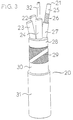
- Fig. 1 shows an example of the structure of an electrical Wire 5 represents.
- the wire shown consists of an electrical Conductor 1, a separation layer 2 and an insulation 3 in Combination with a reinforcing fabric or a braid 4, with either the separating layer 2 or the insulation 3 or both from the ceramic polymer compound according to the invention are trained.
- the electrical conductor 1 of the wire 5 applied separation layer 2 from the invention Composition.
- This separation layer 2 can in the event of fire significant function-maintaining layer and at the same time also represent an insulating layer.
- the wall thickness a separation layer depends on the requirements of the Function maintenance from and is expediently at least 0.3 mm preferably at least 0.4 mm.
- Over the separation layer 2 are the actual insulation 3 of the electrical Core 5 and a reinforcing fabric or braid 4, wherein the order of insulation 3 and reinforcement fabric or Braid 4 over the separating layer 2 may also be interchanged can.
- the insulation 3 can consist of all the usual and permissible materials, for example from the on this Known in the field halogen-free crosslinkable and non-crosslinkable Insulation materials, e.g. Ethylene-propylene-diene terpolymers (EPDM rubbers).
- the insulation 3 consists of a silicone rubber, so that the separation layer 2 made of ceramic polymer compound into one Insulation made of silicone rubber is integrated.
- the isolation 3 can also itself from ceramic polymer compound consist. In both cases there will be further improvement the maintenance of the function is achieved.
- the Isolation 3 with a reinforcement fabric or braid 4 combined that from a non-flammable mineral Material, preferably mineral fibers made of silicates, glass and ceramics.
- Fig. 2 shows an example of the construction of a multi-core electrical cable 10.
- the cable 10 includes electrical Cores 11, 12, 13 and 14, a common core sheathing or a gusset 15 and an outer jacket 16 which over the common core sheath 15 is applied.
- At least one Part of this electrical cable is based on the polymer compounds according to the invention produced.
- the electrical wires for example be constructed according to the wires 5 shown in FIG. 1 can, a separation layer based on the invention Composition.
- the common core covering (gusset) 15 alone or together with the separating layers of the wires, the inventive ceramic polymer compound.
- a gusset out of one flame-retardant halogen-free polymer compound becomes special preferably used.
- the ceramic Polymer compound in combination with a fabric tape made of temperature-resistant mineral materials.
- the outer jacket 16 usually consists of conventional ones Materials, for example halogen-free filled Polymers, but can alternatively also be used of the ceramic polymer compound.
- Fig. 3 shows an example of the construction of a multi-core electrical cable 20 with a concentric conductor 29 represents.
- the cable shown comprises four wires 21, 22, 23 and 24, which in turn consists of an electrical conductor 25, one Separating layer 26 and an insulation 27 exist.
- the veins but can also have a structure according to that described in FIG. 1 Have wire 5.
- the cable can also Inlets such as the center insert 32 shown here exhibit.
- the veins and the bypass are of a common one Wire sheath or a gusset 28 surrounded.
- Above the common core sheath (gusset) 28 is a concentric electrical conductor 29, for example a wound copper wire or a copper tape coil.
- On this electrical conductor 29 is a further separating layer 30 applied, over which a jacket 31 is located.
- one or more components are one such electrical cable using the ceramic Polymer compounds manufactured.
- a preferred one Embodiment consists of at least one of the separating layers 26 and 30 from the ceramic polymer compound according to the invention.
- the separating layer 26 preferably consists of the electrical one Core made of ceramic polymer compound and is in insulation 27 made of silicone rubber is integrated.
- the common core sheath (Gusset) 28 either alone or together with the by-pass 32 based on the ceramic polymer compound.
- the outer jacket 31 usually consists of conventional ones Materials, for example halogen-free filled polymers, can alternatively also use the ceramic polymer compounds.
- Preparation of the mixtures 300 to 350 parts by weight of Al 2 O 3 and 3 to 10 parts by weight of melted aluminum stearate were - depending on the example - premixed with a laboratory kneader.
- the respective mixture was then mixed with 100 parts by weight of HTV silicone rubber, Shore A 60 hardness, optionally with 10 to 30 parts by weight of glass frit or crystallizing passivation glass (as in Examples 1 to 12, but no glass component was added to the compositions in Comparative Examples 1 and 2) added) and compounded with 1.5 parts by weight of 2,4-dichlorobenzoyl peroxide.
- the compounding can also be carried out in one one-step process.
- the fillers are weighed and together in one Mixing mixer mixed.
- the silicone rubber is on a Kneaded roller as "fur” and then the filler mixture abandoned and then incorporated. Compounding is done on a roller.
- the compound strands were by means of Stamp printing test examined for its structural strength:
- the strands were here at temperatures up to 900 ° C heated and then cooled again. It comes with Temperatures up to 500 ° C are a critical temperature range in front.
- the silicone is already complete at this temperature burned, the ceramization or melting reaction but has not yet taken place.
- the results that the bearable load in the stamp printing test are in Table 1 reproduced.
- the exterior was also Characterization of the appearance of the sample surfaces. To check the mechanical properties a round specimen lengthways on a steel plate (45x45 mm) placed and with a flat steel stamp (diameter 12 mm) until the break. The evaluation takes place at Breakage or a reduction in diameter of the round DUT up to 1.0 mm.
- the material strands with a diameter of 2 mm +/- 0.1 mm were also used according to in-house procedures Determination of material shrinkage, structural Behavior and mechanical properties according to the thermal treatment used. For this, the matrix component at 150 ° C and a holding time of approx. 10-15 min networked in a heating cabinet.
- the measured value is the distance d (in mm) between the parallel sections of a U-shaped Half-arch strand section, in which a straight Scribing takes place on the tensile surface of the strand.
- a value of d 0 mm means that the samples reach the system allow the two parallel legs to bend without tearing.
- the respectively measured bending diameter is in the table 2 (column B) for the compositions shown.
- the linear shrinkage was determined with the help of cross-linked strands with a length of 20 cm. This was followed by thermal treatment in such a way that the strands were placed on a refractory plate of an oven. The furnace was heated at 50 K / min to a final temperature of 1000 ° C. The holding time was 180 minutes, followed by free cooling. The material shrinkage was calculated by measuring the strands (with the length L) before and after the thermal treatment. The shrinkage results from the following formula 100% - L [cm] x 100% 20 cm
- the structural strength (SF) can be improved by incorporating 30 phr of crystallizing passivation glass into the composition.
- Optimal structural strength is achieved in the case of a filler content of 350 phr (test example 6 in Table 1).
- a reduction in the proportion of crystallizing passivation glass or in filler leads, alone or in combination, to a deterioration in the structural strength (for example in the case of compositions 9 and 10 in Table 1).
- the structural strength values are significantly better than in the two comparative tests.
- a comparable result for the structural strength is also observed for the compositions which have glass frits as glass components (test examples 1 and 5 in table 1 which are not within the range of claim 1).
- compositions with a high proportion of glass components show also when checking other mechanical Properties have no disadvantages despite their increased strength when tearing or cracking the compositions in the comparative experiments (Table 2).
- the compositions of the experimental examples stand out 1 (20 phr glass frit; not in the range of claim 1) and 6, 7 or 8 (in all 30 phr crystallizing passivation glass) the best mechanical properties.
- the share of The filler remains with the results Strength in the course of manual bending and breaking tests, in terms of tear behavior and in terms of Cracking without major importance.
- the measure the material shrinkage also the filler content in one constant proportion of the glass component significantly (e.g. Comparison of compositions 2 and 5 in Table 2; not in the range of claim 1). at the same proportion of glass component increases Material shrinkage with decreasing filler content (see e.g. Composition 2 in Table 2; not in the range of claim 1).
- Cables and wires of the type according to the invention are suitable for increased use applications and allow a stripped-down design with at least the same quality.
- the use of the teaching according to the invention for cables with the task of maintaining functionality in the event of a fire means that the function-giving layer thickness when using the compound according to the invention with a low-melting component is approx. 50% compared to the compounds from the prior art, i.e. without the low-melting component, can be reduced.
- This has considerable advantages in terms of equipment, namely slimmer cables and better handling, with the same quality and reduces the production costs.
Landscapes
- Chemical & Material Sciences (AREA)
- Organic Chemistry (AREA)
- Materials Engineering (AREA)
- Engineering & Computer Science (AREA)
- Medicinal Chemistry (AREA)
- Polymers & Plastics (AREA)
- Physics & Mathematics (AREA)
- Spectroscopy & Molecular Physics (AREA)
- Health & Medical Sciences (AREA)
- Chemical Kinetics & Catalysis (AREA)
- Inorganic Chemistry (AREA)
- Insulated Conductors (AREA)
- Compositions Of Macromolecular Compounds (AREA)
- Macromonomer-Based Addition Polymer (AREA)
Description
Um im Brandfall einen Isolations- und/oder Funktionserhalt der elektrischen Kabel zu gewährleisten, kommen hochtemperaturfeste Materialien zum Einsatz. In diesem Zusammenhang sind Isolierschichten auf der Basis von Silikatfasern bzw. Silikonkautschuk bekannt. Hierbei wird die elektrische Isolatoreigenschaft und Hitzebeständigkeit von Siliziumdioxid (SiO2) ausgenutzt, welches bei der Verbrennung (Pyrolyse) der siliziumorganischen Verbindungen entsteht. So beschreibt das Deutsche Gebrauchsmuster G 81 09 304 elektrische Kabel, deren von einem Mantel umschlossene Adern eine zweischichtige Isolierung aus einer äußeren Isolierschicht eines thermoplastischen oder elastomeren Isoliermaterials, wie beispielsweise Ethylenvinylacetat, und einer inneren Isolierschicht aus extrudiertem Silicongummi aufweisen.
Ferner beschreibt das Deutsche Gebrauchsmuster G 92 16 599 elektrische Kabel, deren Leiter von einem Silikongummi und einem nicht vernetzten Ethylenvinylacetat als Adernumhüllung umgeben sind; um diese Adernumhüllung ist als Flammbarriere eine Bandierung mit aufgebrachtem Keramikmaterial gewickelt.
Aber auch solche Isolationen erlauben keinen Funktionserhalt, der besonders hohen Anforderungen genügt.
300 bis 350 Gewichtsteile Al2O3 und 3 bis 10 Gewichtsteile aufgeschmolzenes Aluminiumstearat wurden - je nach Beispiel - mit einem Laborkneter vorgemischt. Anschließend wurde die jeweilige Mischung mit 100 Gewichtsteilen HTV-Silikonkautschuk, Härte Shore A 60, gegebenenfalls mit 10 bis 30 Gewichtsteilen Glasfritte oder kristallisierendem Passivierungsglas versetzt (so in den Beispielen 1 bis 12, dagegen wurde zu den Zusammensetzungen in den Vergleichsbeispielen 1 und 2 keine Glaskomponente hinzugefügt) und mit 1,5 Gewichtsteilen 2,4-Dichlorbenzoylperoxid compoundiert.
Folgendes Bewertungsschema wurde zugrundegelegt:
Ein vergleichbares Ergebnis für die Strukturfestigkeit wird auch bei den Zusammensetzungen, die als Glaskomponenten Glasfritten aufweisen, beobachtet (Versuchsbeispiele 1 und 5 in Tabelle 1 die nicht im Bereich von Anspruch 1 liegen).


Claims (18)
- Keramisierbare flammwidrige Zusammensetzung, enthaltend mindestens ein siliziumorganisches Polymer und mindestens einen keramisierenden Füllstoff sowie eine schmelzende und wiedererstarrende oder schmelzende und keramisierende oder schmelzende und kristallisierende mineralische Komponente, deren Schmelzpunkt niedriger ist als die Sintertemperatur des keramisierenden Füllstoffs, dadurch gekennzeichnet, daß die mineralische Komponente ausgewählt ist aus einer Mischung, die aus Glasfritten und alkaliarmen Gläsern besteht und einen Schmelzpunkt von weniger als 750°C aufweist, und aus einem kristallisierenden Passivierungsglas mit einem Alkaligehalt von weniger als 600 ppm, das eine Schmelztemperatur von nicht höher als 710°C aufweist.
- Zusammensetzung nach Anspruch 1, dadurch gekennzeichnet, daß sie mindestens ein Benetzungsmittel für den keramisierenden Füllstoff enthält.
- Zusammensetzung nach Anspruch 1 oder 2, dadurch gekennzeichnet, daß die mineralische Komponente, deren Schmelzpunkt niedriger ist als die Sintertemperatur des keramisierenden Füllstoffs, als verteilte körnige Partikel in der Zusammensetzung eingearbeitet ist.
- Zusammensetzung nach einem der vorgenannten Ansprüche, dadurch gekennzeichnet, daß der Anteil der mineralischen Komponente, deren Schmelzpunkt niedriger ist als die Sintertemperatur des keramisierenden Füllstoffs, mindestens 1,0 Gewichtsteile, vorzugsweise 1,0 bis 70 Gewichtsteile, pro 100 Gewichtsteile des/der siliziumorganischen Polymers/e beträgt.
- Zusammensetzung nach einem der vorgenannten Ansprüche, dadurch gekennzeichnet, daß der keramisierende Füllstoff ein Oxid, vorzugsweise Aluminiumoxid (Al2O3), ist.
- Zusammensetzung nach einem der vorgenannten Ansprüche, dadurch gekennzeichnet, daß der Anteil an keramisierendem Füllstoff in der Zusammensetzung wenigstens 50 Gewichtsteile pro 100 Gewichtsteile des/der siliziumorganischen Polymers/e beträgt.
- Zusammensetzung nach einem der vorgenannten Ansprüche, dadurch gekennzeichnet, daß das Benetzungsmittel eine Metallseife, vorzugsweise eine Aluminiumseife ist.
- Zusammensetzung nach einem der vorgenannten Ansprüche, dadurch gekennzeichnet, daß sie einen oder mehrere Hilfs- und/oder Zusatzstoffe, insbesondere zusätzliche nichtkeramisierende Füllstoffe und Vernetzungsmittel, umfaßt.
- Zusammensetzung nach Anspruch 8, dadurch gekennzeichnet, daß der nichtkeramisierende Füllstoff ein Carbonat, insbesondere CaCO3 und/oder MgCO3, ist.
- Zusammensetzung nach Anspruch 8, dadurch gekennzeichnet, daß das Vernetzungsmittel ein organisches Peroxid ist.
- Zusammensetzung nach einem der vorgenannten Ansprüche, dadurch gekennzeichnet, daß sie mineralische Fasern, insbesondere Silikat-, Glas- oder Keramikfasern, umfaßt.
- Verfahren zur Herstellung einer Zusammensetzung nach einem der vorgenannten Ansprüche, dadurch gekennzeichnet, daß man die schmelzende und wiedererstarrende oder schmelzende und keramisierende oder schmelzende und kristallisierende mineralische Komponente, deren Schmelzpunkt niedriger ist als die Sintertemperatur des keramisierenden Füllstoffs, zusammen mit dem keramisierenden Füllstoff, insbesondere auf einem Walzwerk oder einer Knetmaschine oder durch Extrusion, in die übrigen Bestandteile einarbeitet.
- Verwendung einer Zusammensetzung nach einem der Ansprüche 1 bis 11 zur Herstellung von flammwidrigen Isoliermaterialien, insbesondere in Brandsicherheitskabeln vor allem als Trennschichten, Mäntel, gemeinsame Aderumhüllungen oder Zwickel, Isolationen oder Beiläufe, in Verbindungsmuffen oder in Verteilerdosen.
- Elektrische Ader oder elektrisches Kabel mit Isolations- und/oder Funktionserhalt, welche(s) wenigstens einen Bestandteil auf der Basis der keramisierbaren Zusammensetzung mit mindestens einer schmelzenden und wiedererstarrenden oder schmelzenden und keramisierenden oder schmelzenden und kristallisierenden mineralischen Komponente nach einem der Ansprüche 1 bis 11 enthält.
- Ader oder Kabel nach Anspruch 14, worin der Bestandteil auf Basis der keramisierbaren Zusammensetzung in Kombination mit einer Komponente aus Silikonkautschuk vorliegt.
- Ader oder Kabel nach Anspruch 14 oder 15, worin der Bestandteil auf Basis der keramisierbaren Zusammensetzung eine mineralische Faser enthält und als Faserverbundstoff vorliegt.
- Ader oder Kabel nach einem der Ansprüche 14 bis 16, worin der Bestandteil auf Basis der keramisierbaren Zusammensetzung eine auf den elektrischen Leiter aufgebrachte Trennschicht ist.
- Ader oder Kabel nach Anspruch 17, worin auf die Trennschicht eine Isolationsschicht aus Silikonkautschuk, anderen halogenfreien Kautschuktypen, Kunststoffen oder Mischungen auf deren Basis aufgebracht ist.
Applications Claiming Priority (3)
| Application Number | Priority Date | Filing Date | Title |
|---|---|---|---|
| DE19717645A DE19717645C2 (de) | 1997-04-25 | 1997-04-25 | Keramisierbare flammwidrige Zusammensetzung, Verfahren zur Herstellung und deren Verwendung |
| DE19717645 | 1997-04-25 | ||
| PCT/EP1998/002440 WO1998049693A1 (de) | 1997-04-25 | 1998-04-24 | Flammwidrige zusammensetzung zur herstellung von elektrischen kabeln mit isolations- und/oder funktionserhalt |
Publications (2)
| Publication Number | Publication Date |
|---|---|
| EP0978128A1 EP0978128A1 (de) | 2000-02-09 |
| EP0978128B1 true EP0978128B1 (de) | 2003-02-05 |
Family
ID=7827815
Family Applications (1)
| Application Number | Title | Priority Date | Filing Date |
|---|---|---|---|
| EP98924199A Expired - Lifetime EP0978128B1 (de) | 1997-04-25 | 1998-04-24 | Flammwidrige zusammensetzung zur herstellung von elektrischen kabeln mit isolations- und/oder funktionserhalt |
Country Status (6)
| Country | Link |
|---|---|
| EP (1) | EP0978128B1 (de) |
| AT (1) | ATE232330T1 (de) |
| AU (1) | AU7648098A (de) |
| DE (2) | DE19717645C2 (de) |
| IL (1) | IL132539A0 (de) |
| WO (1) | WO1998049693A1 (de) |
Cited By (4)
| Publication number | Priority date | Publication date | Assignee | Title |
|---|---|---|---|---|
| DE102005052045A1 (de) * | 2005-10-31 | 2007-05-03 | CCS Technology, Inc., Wilmington | Optisches Kabel und Verfahren zum Herstellen eines optischen Kabels |
| DE102006006941A1 (de) * | 2006-02-14 | 2007-08-23 | Brandenburger Isoliertechnik Gmbh & Co. | Hitze- und Feuerisoliermaterial |
| EP2784112A1 (de) | 2013-03-28 | 2014-10-01 | Dätwyler Cabling Solutions AG | Dispersionen zur Herstellung einer feuerfesten Schutz- und Isolationsbeschichtung |
| US10014094B2 (en) | 2013-12-19 | 2018-07-03 | Leoni Kabel Holding Gmbh | Cable and method for the production thereof |
Families Citing this family (22)
| Publication number | Priority date | Publication date | Assignee | Title |
|---|---|---|---|---|
| DE19908818A1 (de) * | 1999-03-01 | 2000-09-07 | Huber & Suhner Ag Pfaeffikon | Keramisierende flammwidrige Isolationsmischung für Kabel |
| DE29913737U1 (de) | 1999-08-06 | 2000-02-10 | Habia Cable GmbH, 40217 Düsseldorf | Hochtemperaturresistentes Kabel |
| DE19943116C2 (de) * | 1999-09-09 | 2002-03-28 | Siemens Ag | Elektrische und/oder optische Ader sowie Kabel |
| US6781062B2 (en) † | 1999-11-30 | 2004-08-24 | Pirelli Kabel & Systeme Gmbh & Co. Kg | Electrical cable having a hardgrade-epr insulation |
| DE20011862U1 (de) | 2000-07-10 | 2000-10-26 | Kabelwerk Eupen Ag, Eupen | Brandsicherheitskabel |
| CH695840A5 (de) * | 2000-12-12 | 2006-09-15 | Studer Draht & Kabelwerk Ag | Verfahren zur Herstellung eines Kabels und nach diesem Verfahren hergestelltes Kabel. |
| FR2837614B1 (fr) * | 2002-03-22 | 2004-06-18 | Nexans | Composition isolante pour cable electrique de securite |
| DE10242254A1 (de) * | 2002-09-12 | 2004-03-25 | Nexans | Elektrisches Kabel zum Anschluß von bewegbaren elektrischen Verbrauchern |
| NO319061B1 (no) * | 2003-05-15 | 2005-06-13 | Nexans | Blyfri elektrisk kabel med hoy spesifikk vekt |
| US7015260B2 (en) * | 2003-06-04 | 2006-03-21 | E.I. Du Pont De Nemours And Company | High temperature polymeric materials containing corona resistant composite filler, and methods relating thereto |
| DE10345955A1 (de) * | 2003-10-02 | 2005-04-21 | Nexans | Isoliermaterial auf der Basis von polymerem Kunststoff |
| DE102005023765B4 (de) * | 2004-05-19 | 2009-04-09 | Facab Lynen Gmbh & Co. Kg | Verfahren zur Herstellung einer flammwidrigen Zusammensetzung für die Ausbildung von flammwidrigen Isolierungen für elektrische Leiter |
| DE102004040265A1 (de) * | 2004-08-19 | 2006-02-23 | Wacker-Chemie Gmbh | Mineralfasern enthaltende Siliconkautschukzusammensetzung |
| US7538275B2 (en) * | 2005-02-07 | 2009-05-26 | Rockbestos Surprenant Cable Corp. | Fire resistant cable |
| ES2381622T3 (es) * | 2008-05-30 | 2012-05-30 | Prysmian Kabel Und Systeme Gmbh | Estructura de hilo para cables que en caso de incendio mantiene sus funciones y su aislamiento |
| DE102009009743A1 (de) | 2009-02-19 | 2010-08-26 | BÖWE-ELEKTRIK GmbH | Kabel sowie Verfahren und Vorrichtung zur Kabelentmantelung |
| FR2946789B1 (fr) * | 2009-06-11 | 2017-01-13 | Nexans | Cable electrique apte a assurer la continuite de distribution electrique en cas d'incendie. |
| AU2014405826B2 (en) | 2014-09-12 | 2020-09-17 | Prysmian S.P.A. | Fire resistant cable with ceramifiable layer |
| CN104505154B (zh) * | 2014-12-03 | 2016-09-28 | 湖北亿佳欧电子陶瓷股份有限公司 | 陶瓷化防火绝缘电缆及绝缘层材料的制备方法 |
| CN109949991B (zh) * | 2019-04-02 | 2020-08-04 | 黑龙江工业学院 | 5芯bttz矿物绝缘防火电缆 |
| CN119864202A (zh) * | 2025-01-08 | 2025-04-22 | 浙江高远电缆有限公司 | 一种柔性陶瓷化矿物质绝缘高阻燃防火电缆及其加工工艺 |
| CN121662498B (zh) * | 2026-01-27 | 2026-04-28 | 锐洋集团东北电缆有限公司 | 一种低烟无卤陶瓷化硅橡胶复合耐火电缆及其制备方法 |
Family Cites Families (8)
| Publication number | Priority date | Publication date | Assignee | Title |
|---|---|---|---|---|
| JPS5316758A (en) * | 1976-07-30 | 1978-02-16 | Nitto Electric Ind Co Ltd | Electrical insulating resin compositions |
| JPS5950181B2 (ja) * | 1979-03-07 | 1984-12-06 | ト−レ・シリコ−ン株式会社 | 高温でセラミツク化するシリコ−ン組成物 |
| JPS55120658A (en) * | 1979-03-13 | 1980-09-17 | Toray Silicone Co Ltd | Silicone composition forming ceramic at high temperature |
| DE3336089A1 (de) * | 1983-10-04 | 1985-04-18 | Franz Hoffmann & Söhne KG Chemische Fabrik, 8858 Neuburg | Fuellstoffkombination fuer organische polymere |
| FR2573910B1 (fr) * | 1984-11-29 | 1987-06-19 | Habia Cable | Revetement isolant souple resistant au feu pour conduites, fils et cables electriques |
| JPH05254912A (ja) * | 1992-03-10 | 1993-10-05 | Sumitomo Electric Ind Ltd | 耐火性組成物 |
| DE9216599U1 (de) * | 1992-12-07 | 1993-02-18 | Dietz, Volker, 8011 Baldham | Hochtemperaturbeständiges Kabel |
| DE4437596A1 (de) * | 1994-10-20 | 1996-04-25 | Daetwyler Ag | Flammwidrige Zusammensetzung zur Herstellung von elektrischen Kabeln mit Isolations- und/oder Funktionserhalt |
-
1997
- 1997-04-25 DE DE19717645A patent/DE19717645C2/de not_active Expired - Lifetime
-
1998
- 1998-04-24 IL IL13253998A patent/IL132539A0/xx unknown
- 1998-04-24 DE DE59807121T patent/DE59807121D1/de not_active Expired - Lifetime
- 1998-04-24 AT AT98924199T patent/ATE232330T1/de active
- 1998-04-24 AU AU76480/98A patent/AU7648098A/en not_active Abandoned
- 1998-04-24 EP EP98924199A patent/EP0978128B1/de not_active Expired - Lifetime
- 1998-04-24 WO PCT/EP1998/002440 patent/WO1998049693A1/de not_active Ceased
Cited By (4)
| Publication number | Priority date | Publication date | Assignee | Title |
|---|---|---|---|---|
| DE102005052045A1 (de) * | 2005-10-31 | 2007-05-03 | CCS Technology, Inc., Wilmington | Optisches Kabel und Verfahren zum Herstellen eines optischen Kabels |
| DE102006006941A1 (de) * | 2006-02-14 | 2007-08-23 | Brandenburger Isoliertechnik Gmbh & Co. | Hitze- und Feuerisoliermaterial |
| EP2784112A1 (de) | 2013-03-28 | 2014-10-01 | Dätwyler Cabling Solutions AG | Dispersionen zur Herstellung einer feuerfesten Schutz- und Isolationsbeschichtung |
| US10014094B2 (en) | 2013-12-19 | 2018-07-03 | Leoni Kabel Holding Gmbh | Cable and method for the production thereof |
Also Published As
| Publication number | Publication date |
|---|---|
| EP0978128A1 (de) | 2000-02-09 |
| DE59807121D1 (de) | 2003-03-13 |
| AU7648098A (en) | 1998-11-24 |
| ATE232330T1 (de) | 2003-02-15 |
| IL132539A0 (en) | 2001-03-19 |
| DE19717645A1 (de) | 1998-10-29 |
| DE19717645C2 (de) | 2001-01-18 |
| WO1998049693A1 (de) | 1998-11-05 |
Similar Documents
| Publication | Publication Date | Title |
|---|---|---|
| DE19717645C2 (de) | Keramisierbare flammwidrige Zusammensetzung, Verfahren zur Herstellung und deren Verwendung | |
| EP0708455B2 (de) | Flammwidrige Zusammensetzung zur Herstellung von elektrischen Kabeln mit Isolations- und/oder Funktionserhalt | |
| DE60316373T2 (de) | Isolierende Zusammensetzung für ein Sicherheits-Stromkabel | |
| DE68904568T2 (de) | Flammhemmende aethylenpolymer-mischungen. | |
| EP0618950B1 (de) | Brandschutzmasse und ihre verwendung | |
| DE112004002371B4 (de) | Vernetzte flammhemmende Harzzusammensetzung und deren Verwendung in einem nichthalogenhaltigen Draht | |
| DE2463184C2 (de) | Elektrischer Leiter mit einer dielektrischen polymeren Isolation | |
| DE102008057062A1 (de) | Nichthalogenharz-Zusammensetzung, isoliertes elektrisches Kabel und Kabelstrang | |
| EP0943647A1 (de) | Flammwidrige Kunststoffmischung und Verfahren zur Herstellung eines Füllstoffs | |
| KR20070055425A (ko) | 내화성 케이블 | |
| DE1694346A1 (de) | Polyaethylenmassen und damit ueberzogene Kabel | |
| DE69823602T2 (de) | Siliconzusammensetzung mit verbesserter Hochtemperaturtoleranz | |
| WO1979000683A1 (fr) | Melange polymere libre d'halogene et non-inflammable, ainsi que son utilisation | |
| AT391107B (de) | Verbundbauteil, bestehend aus mindestens zwei teilen aus unterschiedlichen fasermaterialien | |
| DE3204387C2 (de) | Feuerfester, nicht härtender Kitt | |
| DE69902705T3 (de) | Feuerfestes und halogenfreies sicherheitskabel | |
| EP0589461B1 (de) | Feuerfestes Material, Verfahren zu seiner Herstellung und seine Verwendung | |
| DE69605606T2 (de) | Kabel mit hoher Flammfestigkeit und Rauchentwicklungsbeständigkeit | |
| EP1033725A1 (de) | Keramisierende flammwidrige Isolationsmischung für Kabel | |
| EP1213325B1 (de) | Flammwidrige, halogenfreie Polymermischung | |
| DE10322363B4 (de) | Brandschutzzusammensetzung | |
| DE3853170T2 (de) | Endothermisches Brandschutzmaterial. | |
| DE69212010T2 (de) | Teilweise kristallisierbare Glaszusammensetzungen | |
| DE112006001102B4 (de) | Halogenfreie isolierte Leitung und Kabelbaum | |
| DE60005995T2 (de) | Hitzehärtbare polysiloxanzusammensetzungen , insbesondere zur herstellung von elektrischen drähten und kabeln |
Legal Events
| Date | Code | Title | Description |
|---|---|---|---|
| PUAI | Public reference made under article 153(3) epc to a published international application that has entered the european phase |
Free format text: ORIGINAL CODE: 0009012 |
|
| 17P | Request for examination filed |
Effective date: 19991124 |
|
| AK | Designated contracting states |
Kind code of ref document: A1 Designated state(s): AT BE CH DE GB IE LI LU NL |
|
| 17Q | First examination report despatched |
Effective date: 20010418 |
|
| GRAG | Despatch of communication of intention to grant |
Free format text: ORIGINAL CODE: EPIDOS AGRA |
|
| GRAG | Despatch of communication of intention to grant |
Free format text: ORIGINAL CODE: EPIDOS AGRA |
|
| GRAH | Despatch of communication of intention to grant a patent |
Free format text: ORIGINAL CODE: EPIDOS IGRA |
|
| GRAH | Despatch of communication of intention to grant a patent |
Free format text: ORIGINAL CODE: EPIDOS IGRA |
|
| GRAA | (expected) grant |
Free format text: ORIGINAL CODE: 0009210 |
|
| RIC1 | Information provided on ipc code assigned before grant |
Free format text: 7H 01B 7/29 A, 7C 08K 3/22 B, 7H 01B 3/46 B |
|
| AK | Designated contracting states |
Designated state(s): AT BE CH DE GB IE LI LU NL |
|
| REG | Reference to a national code |
Ref country code: GB Ref legal event code: FG4D Free format text: NOT ENGLISH |
|
| REG | Reference to a national code |
Ref country code: CH Ref legal event code: EP |
|
| REG | Reference to a national code |
Ref country code: IE Ref legal event code: FG4D Free format text: GERMAN |
|
| REF | Corresponds to: |
Ref document number: 59807121 Country of ref document: DE Date of ref document: 20030313 Kind code of ref document: P |
|
| GBT | Gb: translation of ep patent filed (gb section 77(6)(a)/1977) | ||
| REG | Reference to a national code |
Ref country code: CH Ref legal event code: NV Representative=s name: DR. LUSUARDI AG |
|
| PLBE | No opposition filed within time limit |
Free format text: ORIGINAL CODE: 0009261 |
|
| STAA | Information on the status of an ep patent application or granted ep patent |
Free format text: STATUS: NO OPPOSITION FILED WITHIN TIME LIMIT |
|
| 26N | No opposition filed |
Effective date: 20031106 |
|
| PGFP | Annual fee paid to national office [announced via postgrant information from national office to epo] |
Ref country code: NL Payment date: 20050418 Year of fee payment: 8 |
|
| PGFP | Annual fee paid to national office [announced via postgrant information from national office to epo] |
Ref country code: LU Payment date: 20050425 Year of fee payment: 8 Ref country code: IE Payment date: 20050425 Year of fee payment: 8 |
|
| PG25 | Lapsed in a contracting state [announced via postgrant information from national office to epo] |
Ref country code: IE Free format text: LAPSE BECAUSE OF NON-PAYMENT OF DUE FEES Effective date: 20060424 |
|
| PG25 | Lapsed in a contracting state [announced via postgrant information from national office to epo] |
Ref country code: LU Free format text: LAPSE BECAUSE OF NON-PAYMENT OF DUE FEES Effective date: 20060430 |
|
| PG25 | Lapsed in a contracting state [announced via postgrant information from national office to epo] |
Ref country code: NL Free format text: LAPSE BECAUSE OF NON-PAYMENT OF DUE FEES Effective date: 20061101 |
|
| NLV4 | Nl: lapsed or anulled due to non-payment of the annual fee |
Effective date: 20061101 |
|
| REG | Reference to a national code |
Ref country code: IE Ref legal event code: MM4A |
|
| REG | Reference to a national code |
Ref country code: CH Ref legal event code: PFA Owner name: DAETWYLER AG KABEL + SYSTEME Free format text: DAETWYLER AG KABEL + SYSTEME# #CH-6460 ALTDORF (CH) -TRANSFER TO- DAETWYLER AG KABEL + SYSTEME# #CH-6460 ALTDORF (CH) |
|
| PGFP | Annual fee paid to national office [announced via postgrant information from national office to epo] |
Ref country code: GB Payment date: 20170425 Year of fee payment: 20 Ref country code: CH Payment date: 20170425 Year of fee payment: 20 |
|
| PGFP | Annual fee paid to national office [announced via postgrant information from national office to epo] |
Ref country code: AT Payment date: 20170427 Year of fee payment: 20 Ref country code: BE Payment date: 20170427 Year of fee payment: 20 |
|
| PGFP | Annual fee paid to national office [announced via postgrant information from national office to epo] |
Ref country code: DE Payment date: 20170629 Year of fee payment: 20 |
|
| REG | Reference to a national code |
Ref country code: DE Ref legal event code: R071 Ref document number: 59807121 Country of ref document: DE |
|
| REG | Reference to a national code |
Ref country code: CH Ref legal event code: PL |
|
| REG | Reference to a national code |
Ref country code: GB Ref legal event code: PE20 Expiry date: 20180423 |
|
| REG | Reference to a national code |
Ref country code: AT Ref legal event code: MK07 Ref document number: 232330 Country of ref document: AT Kind code of ref document: T Effective date: 20180424 Ref country code: BE Ref legal event code: MK Effective date: 20180424 |
|
| PG25 | Lapsed in a contracting state [announced via postgrant information from national office to epo] |
Ref country code: GB Free format text: LAPSE BECAUSE OF EXPIRATION OF PROTECTION Effective date: 20180423 |