EP0976548A2 - Matte, koextrudierte Polyesterfolie, Verfahren zu ihrer Herstellung und ihre Verwendung - Google Patents
Matte, koextrudierte Polyesterfolie, Verfahren zu ihrer Herstellung und ihre Verwendung Download PDFInfo
- Publication number
- EP0976548A2 EP0976548A2 EP99114665A EP99114665A EP0976548A2 EP 0976548 A2 EP0976548 A2 EP 0976548A2 EP 99114665 A EP99114665 A EP 99114665A EP 99114665 A EP99114665 A EP 99114665A EP 0976548 A2 EP0976548 A2 EP 0976548A2
- Authority
- EP
- European Patent Office
- Prior art keywords
- film
- film according
- mixture
- layer
- acid
- Prior art date
- Legal status (The legal status is an assumption and is not a legal conclusion. Google has not performed a legal analysis and makes no representation as to the accuracy of the status listed.)
- Granted
Links
Classifications
-
- B—PERFORMING OPERATIONS; TRANSPORTING
- B32—LAYERED PRODUCTS
- B32B—LAYERED PRODUCTS, i.e. PRODUCTS BUILT-UP OF STRATA OF FLAT OR NON-FLAT, e.g. CELLULAR OR HONEYCOMB, FORM
- B32B27/00—Layered products comprising a layer of synthetic resin
- B32B27/36—Layered products comprising a layer of synthetic resin comprising polyesters
-
- B—PERFORMING OPERATIONS; TRANSPORTING
- B32—LAYERED PRODUCTS
- B32B—LAYERED PRODUCTS, i.e. PRODUCTS BUILT-UP OF STRATA OF FLAT OR NON-FLAT, e.g. CELLULAR OR HONEYCOMB, FORM
- B32B27/00—Layered products comprising a layer of synthetic resin
- B32B27/06—Layered products comprising a layer of synthetic resin as the main or only constituent of a layer, which is next to another layer of the same or of a different material
- B32B27/08—Layered products comprising a layer of synthetic resin as the main or only constituent of a layer, which is next to another layer of the same or of a different material of synthetic resin
-
- B—PERFORMING OPERATIONS; TRANSPORTING
- B32—LAYERED PRODUCTS
- B32B—LAYERED PRODUCTS, i.e. PRODUCTS BUILT-UP OF STRATA OF FLAT OR NON-FLAT, e.g. CELLULAR OR HONEYCOMB, FORM
- B32B27/00—Layered products comprising a layer of synthetic resin
- B32B27/18—Layered products comprising a layer of synthetic resin characterised by the use of special additives
- B32B27/20—Layered products comprising a layer of synthetic resin characterised by the use of special additives using fillers, pigments, thixotroping agents
-
- C—CHEMISTRY; METALLURGY
- C08—ORGANIC MACROMOLECULAR COMPOUNDS; THEIR PREPARATION OR CHEMICAL WORKING-UP; COMPOSITIONS BASED THEREON
- C08J—WORKING-UP; GENERAL PROCESSES OF COMPOUNDING; AFTER-TREATMENT NOT COVERED BY SUBCLASSES C08B, C08C, C08F, C08G or C08H
- C08J5/00—Manufacture of articles or shaped materials containing macromolecular substances
- C08J5/18—Manufacture of films or sheets
-
- B—PERFORMING OPERATIONS; TRANSPORTING
- B32—LAYERED PRODUCTS
- B32B—LAYERED PRODUCTS, i.e. PRODUCTS BUILT-UP OF STRATA OF FLAT OR NON-FLAT, e.g. CELLULAR OR HONEYCOMB, FORM
- B32B2307/00—Properties of the layers or laminate
- B32B2307/50—Properties of the layers or laminate having particular mechanical properties
- B32B2307/514—Oriented
- B32B2307/518—Oriented bi-axially
-
- B—PERFORMING OPERATIONS; TRANSPORTING
- B32—LAYERED PRODUCTS
- B32B—LAYERED PRODUCTS, i.e. PRODUCTS BUILT-UP OF STRATA OF FLAT OR NON-FLAT, e.g. CELLULAR OR HONEYCOMB, FORM
- B32B2367/00—Polyesters, e.g. PET, i.e. polyethylene terephthalate
-
- B—PERFORMING OPERATIONS; TRANSPORTING
- B32—LAYERED PRODUCTS
- B32B—LAYERED PRODUCTS, i.e. PRODUCTS BUILT-UP OF STRATA OF FLAT OR NON-FLAT, e.g. CELLULAR OR HONEYCOMB, FORM
- B32B2439/00—Containers; Receptacles
- B32B2439/70—Food packaging
-
- B—PERFORMING OPERATIONS; TRANSPORTING
- B32—LAYERED PRODUCTS
- B32B—LAYERED PRODUCTS, i.e. PRODUCTS BUILT-UP OF STRATA OF FLAT OR NON-FLAT, e.g. CELLULAR OR HONEYCOMB, FORM
- B32B2519/00—Labels, badges
-
- Y—GENERAL TAGGING OF NEW TECHNOLOGICAL DEVELOPMENTS; GENERAL TAGGING OF CROSS-SECTIONAL TECHNOLOGIES SPANNING OVER SEVERAL SECTIONS OF THE IPC; TECHNICAL SUBJECTS COVERED BY FORMER USPC CROSS-REFERENCE ART COLLECTIONS [XRACs] AND DIGESTS
- Y10—TECHNICAL SUBJECTS COVERED BY FORMER USPC
- Y10S—TECHNICAL SUBJECTS COVERED BY FORMER USPC CROSS-REFERENCE ART COLLECTIONS [XRACs] AND DIGESTS
- Y10S428/00—Stock material or miscellaneous articles
- Y10S428/91—Product with molecular orientation
-
- Y—GENERAL TAGGING OF NEW TECHNOLOGICAL DEVELOPMENTS; GENERAL TAGGING OF CROSS-SECTIONAL TECHNOLOGIES SPANNING OVER SEVERAL SECTIONS OF THE IPC; TECHNICAL SUBJECTS COVERED BY FORMER USPC CROSS-REFERENCE ART COLLECTIONS [XRACs] AND DIGESTS
- Y10—TECHNICAL SUBJECTS COVERED BY FORMER USPC
- Y10T—TECHNICAL SUBJECTS COVERED BY FORMER US CLASSIFICATION
- Y10T428/00—Stock material or miscellaneous articles
- Y10T428/26—Web or sheet containing structurally defined element or component, the element or component having a specified physical dimension
- Y10T428/263—Coating layer not in excess of 5 mils thick or equivalent
- Y10T428/264—Up to 3 mils
- Y10T428/265—1 mil or less
-
- Y—GENERAL TAGGING OF NEW TECHNOLOGICAL DEVELOPMENTS; GENERAL TAGGING OF CROSS-SECTIONAL TECHNOLOGIES SPANNING OVER SEVERAL SECTIONS OF THE IPC; TECHNICAL SUBJECTS COVERED BY FORMER USPC CROSS-REFERENCE ART COLLECTIONS [XRACs] AND DIGESTS
- Y10—TECHNICAL SUBJECTS COVERED BY FORMER USPC
- Y10T—TECHNICAL SUBJECTS COVERED BY FORMER US CLASSIFICATION
- Y10T428/00—Stock material or miscellaneous articles
- Y10T428/31504—Composite [nonstructural laminate]
- Y10T428/31551—Of polyamidoester [polyurethane, polyisocyanate, polycarbamate, etc.]
- Y10T428/31565—Next to polyester [polyethylene terephthalate, etc.]
-
- Y—GENERAL TAGGING OF NEW TECHNOLOGICAL DEVELOPMENTS; GENERAL TAGGING OF CROSS-SECTIONAL TECHNOLOGIES SPANNING OVER SEVERAL SECTIONS OF THE IPC; TECHNICAL SUBJECTS COVERED BY FORMER USPC CROSS-REFERENCE ART COLLECTIONS [XRACs] AND DIGESTS
- Y10—TECHNICAL SUBJECTS COVERED BY FORMER USPC
- Y10T—TECHNICAL SUBJECTS COVERED BY FORMER US CLASSIFICATION
- Y10T428/00—Stock material or miscellaneous articles
- Y10T428/31504—Composite [nonstructural laminate]
- Y10T428/31551—Of polyamidoester [polyurethane, polyisocyanate, polycarbamate, etc.]
- Y10T428/31616—Next to polyester [e.g., alkyd]
-
- Y—GENERAL TAGGING OF NEW TECHNOLOGICAL DEVELOPMENTS; GENERAL TAGGING OF CROSS-SECTIONAL TECHNOLOGIES SPANNING OVER SEVERAL SECTIONS OF THE IPC; TECHNICAL SUBJECTS COVERED BY FORMER USPC CROSS-REFERENCE ART COLLECTIONS [XRACs] AND DIGESTS
- Y10—TECHNICAL SUBJECTS COVERED BY FORMER USPC
- Y10T—TECHNICAL SUBJECTS COVERED BY FORMER US CLASSIFICATION
- Y10T428/00—Stock material or miscellaneous articles
- Y10T428/31504—Composite [nonstructural laminate]
- Y10T428/31678—Of metal
- Y10T428/31681—Next to polyester, polyamide or polyimide [e.g., alkyd, glue, or nylon, etc.]
-
- Y—GENERAL TAGGING OF NEW TECHNOLOGICAL DEVELOPMENTS; GENERAL TAGGING OF CROSS-SECTIONAL TECHNOLOGIES SPANNING OVER SEVERAL SECTIONS OF THE IPC; TECHNICAL SUBJECTS COVERED BY FORMER USPC CROSS-REFERENCE ART COLLECTIONS [XRACs] AND DIGESTS
- Y10—TECHNICAL SUBJECTS COVERED BY FORMER USPC
- Y10T—TECHNICAL SUBJECTS COVERED BY FORMER US CLASSIFICATION
- Y10T428/00—Stock material or miscellaneous articles
- Y10T428/31504—Composite [nonstructural laminate]
- Y10T428/31786—Of polyester [e.g., alkyd, etc.]
-
- Y—GENERAL TAGGING OF NEW TECHNOLOGICAL DEVELOPMENTS; GENERAL TAGGING OF CROSS-SECTIONAL TECHNOLOGIES SPANNING OVER SEVERAL SECTIONS OF THE IPC; TECHNICAL SUBJECTS COVERED BY FORMER USPC CROSS-REFERENCE ART COLLECTIONS [XRACs] AND DIGESTS
- Y10—TECHNICAL SUBJECTS COVERED BY FORMER USPC
- Y10T—TECHNICAL SUBJECTS COVERED BY FORMER US CLASSIFICATION
- Y10T428/00—Stock material or miscellaneous articles
- Y10T428/31504—Composite [nonstructural laminate]
- Y10T428/31786—Of polyester [e.g., alkyd, etc.]
- Y10T428/31797—Next to addition polymer from unsaturated monomers
Definitions
- the invention relates to a biaxially oriented polyester film with a base layer, the consists of at least 80 wt .-% of a thermoplastic polyester, and at least one matt top layer, which is a mixture or a blend of two Contains polyester components I and II.
- the invention further relates to a method for the production of the film and its use.
- the packaging industry has a high need for transparent, high-gloss Plastic films such as biaxially oriented polypropylene or biaxially oriented Polyester films.
- transparent, high-gloss Plastic films such as biaxially oriented polypropylene or biaxially oriented Polyester films.
- at least one surface layer is not is high-gloss but is characterized by a characteristic matt appearance distinguished and thereby e.g. the packaging a special attractive and therefore gives an effective advertising look.
- EP 346 647 describes a biaxially oriented polyester film which contains at least one top layer containing a filler in a concentration of 0.5 contains up to 50%, the diameter of this filler in a certain Relation to the layer thickness of the top layer. Furthermore, the cover layer has a certain thickness and a certain degree of crystallization, which with the help of Raman spectroscopy is determined.
- No. 4,399,179 describes a coextruded biaxially oriented polyester film described, which consist of a transparent base layer and at least one matt Layer, which essentially consists of a certain Polyethylene terephthalate copolymer exists and also internal particles with a Contains diameters from 0.3 to 20 ⁇ m in a concentration of 3 to 40%.
- the special copolymer is a processing aid through which the viscosity of the melt contained inside particles is reduced, so that a flawless Extrusion of this layer is possible.
- the mattness of the film is increased by adding the inner particles reached in the corresponding layer.
- EP 0 144 978 describes a self-supporting oriented film made of thermoplastic Described plastic, which one on at least one of its two surfaces continuous polyester coating, which is an aqueous dispersion on the film is applied before the last stretching step.
- the polyester coating consists of a condensation product of various monomers or their Formation of polyesters capable of derivatives, such as isophthalic acid, aliphatic Dicarboxylic acid, sulfomonomers and aliphatic or cycloaliphatic glycol.
- the object of the present invention was therefore to provide a coextruded biaxial oriented and transparent polyester film with at least one matt top layer to provide, which is easy and economical to manufacture, which has good physical properties of the known films and none Disposal problems caused.
- the task is solved by a co-extruded and biaxially oriented polyester film the genus mentioned at the outset, the distinguishing features of which are that the matt top layer is a mixture or a blend of two components I and II contains.
- Component I of the mixture or blend is preferably a Polyethylene terephthalate homopolymer or polyethylene terephthalate copolymer or a mixture of polyethylene terephthalate homo- or copolymers.
- Mixtures within the meaning of the present invention are mechanical To understand mixtures that are made from the individual components. in the in general, the individual components are smaller as pressed molded bodies Size, e.g. lenticular or spherical granules, poured together and with a suitable vibrator mechanically mixed together.
- Another Possibility for creating the mixture is that the respective Components I and II in granulate form separately for the extruder for the top layer according to the invention are fed and the mixture in the extruder, or is carried out in the subsequent melt-carrying systems.
- a blend in the sense of the present invention is an alloy-like composite of individual components I and II, which are no longer in the original Components can be disassembled.
- a blend has properties like a homogeneous one Substance and can be characterized accordingly by suitable parameters.
- the film has at least two layers. It then comprises layers a layer B and the cover layer A according to the invention.
- the top layer according to the invention is characterized by a characteristic matt Surface or optics and is for use as a packaging film or for Well suited for applications in the industrial sector.
- the base layer B of the film preferably consists of at least 90% by weight of a thermoplastic polyester.
- polyesters which consist of at least 90 mol%, preferably at least 95 mol%, of ethylene glycol and terephthalic acid units or of ethylene glycol and naphthalene-2,6-dicarboxylic acid units.
- the remaining monomer units come from other aliphatic, cycloaliphatic or aromatic diols or dicarboxylic acids, as can also occur in layer A (or layer C).
- Suitable other aliphatic diols are, for example, diethylene glycol, triethylene glycol, aliphatic glycols of the general formula HO- (CH 2 ) n -OH, where n represents an integer from 3 to 6 (in particular propane-1,3-diol, butane-1,4) diol, pentane-1,5-diol and hexane-1,6-diol) or branched aliphatic glycols with up to 6 carbon atoms.
- cyclohexanediols in particular cyclohexane-1,4-diol
- cyclohexanediols in particular cyclohexane-1,4-diol
- Suitable other aromatic diols correspond, for example, to the formula HO-C 6 H 4 -XC 6 H 4 -OH, where X is -CH 2 -, -C (CH 3 ) 2 -, -C (CF 3 ) 2 -, -O -, -S- or -SO 2 - stands.
- bisphenols of the formula HO-C 6 H 4 -C 6 H 4 -OH are also very suitable.
- aromatic dicarboxylic acids are preferably benzenedicarboxylic acids, naphthalenedicarboxylic acids (for example naphthalene-1,4- or 1,6-dicarboxylic acid), biphenyl-x, x'-dicarboxylic acids (in particular biphenyl-4,4'-dicarboxylic acid), diphenylacetylene-x, x ' -dicarboxylic acids (especially diphenylacetylene-4,4'-dicarboxylic acid) or stilbene-x, x'-dicarboxylic acids.
- naphthalenedicarboxylic acids for example naphthalene-1,4- or 1,6-dicarboxylic acid
- biphenyl-x, x'-dicarboxylic acids in particular biphenyl-4,4'-dicarboxylic acid
- diphenylacetylene-x, x ' -dicarboxylic acids especially diphenylacetylene
- cyclohexanedicarboxylic acids (in particular cyclohexane-1,4-dicarboxylic acid) should be mentioned.
- aliphatic dicarboxylic acids the (C 3 -C 19 ) alkanedioic acids are particularly suitable, the alkane fraction being straight-chain or branched.
- the production of the polyesters can e.g. according to the transesterification process. It is based on dicarboxylic acid esters and diols, which with the usual Transesterification catalysts, such as zinc, calcium, lithium, magnesium and manganese salts, be implemented.
- the intermediates then become general in the presence conventional polycondensation catalysts, such as antimony trioxide or titanium salts, polycondensed.
- Production can also be carried out using the direct esterification process take place in the presence of polycondensation catalysts. Here you go directly from the dicarboxylic acids and the diols.
- At least one cover layer of the multilayer film according to the invention contains a mixture or a blend of two components I and II, which are described in more detail below, and optionally added additives.
- Component I of the top layer mixture or blend is generally a thermoplastic polyester, especially a polyester like that for the base layer has been described in more detail.
- a polyester polymer for component I of top layer according to the invention has a relatively low viscosity per se having.
- a modified one is used to describe the viscosities of the melts Solvent viscosity (SV value or "solution viscosity") used.
- SV value Solvent viscosity
- solution viscosity For commercially available polyethylene terephthalate, which is used for the production of biaxial are oriented foils, the SV values are in the range of 500 to 1200.
- component I of Cover layer according to the invention in the range from 500 to 800, preferably in the range from 500 to 750, particularly preferably in the range from 500 to 700.
- component I is preferably a PET homo- or copolymer or a Mix of them.
- component II of the top layer mixture is obtained by polycondensation of A) isophthalic acid, B) an aliphatic dicarboxylic acid with the formula HOOC (CH 2 ) n COOH, in which n is in the range from 1 to 11, C) a sulfomonomer containing an alkali metal sulfonate group on the aromatic part of an aromatic dicarboxylic acid and D) at least one aliphatic or cycloaliphatic alkylene glycol having about 2 to 11 carbon atoms.
- the total acid equivalents present should essentially correspond to the total glycol equivalents present on a molar basis.
- Dicarboxylic acids suitable as component B) of the copolyester are e.g. Malon, Adipic, azelaic, glutaric, sebacic, cork, amber and brassylic acid as well Mixtures of these acids or their derivatives capable of forming polyesters. Of the acids mentioned, sebacic acid is preferred.
- sulfomonomers which contain an alkali metal sulfonate group on the aromatic part of an aromatic dicarboxylic acid (component C) are those monomers which correspond to the following general formula:
- Monomers of this type are described in U.S. Patents 3,563,942 and 3,779,993.
- Examples of such monomers are sodium sulphoterephthalic acid, sodium 5-sulfoisophthalic acid, sodium sulfophthalic acid, 5- (p-sodium sulfophenoxy) isophthalic acid, 5- (sodium sulfopropoxy) isophthalic acid and the like monomers and their derivatives capable of forming polyesters, such as eg the dimethyl esters.
- M is preferably Na + , Li + or K + .
- Glycols suitable as component D) are e.g. Ethylene glycol, 1,5-pentanediol, 1,6-hexanediol, Neopentyl glycol, 1,10-decanediol, cyclohexane dimethanol and the like Substances.
- Ethylene glycol is preferably used.
- copolyesters can be made by known polymerization techniques. In general, the procedure is such that the acid components with glycol brought together and heated in the presence of an esterification catalyst be, with the subsequent addition of a polycondensation catalyst.
- components A, B, C and D which are used to produce the mixtures according to the invention, are decisive for achieving the matt top layer.
- Isophthalic acid (component A) to at least about 65 mol% as the acid component to be present.
- Component A is preferred as pure isophthalic acid, which in a Amount of about 70 to 95 mole% is present.
- any acid with the formula mentioned brings satisfactory results, with adipic acid, azelaic acid, sebacic acid, Malonic acid, succinic acid, glutaric acid and mixtures of these acids are preferred become.
- the target amount is within the specified range preferably 1 to 20 mol%, based on the acid components of the mixture I, if component B is contained in the composition.
- the glycol component is present in an approximately stoichiometric amount.
- copolyesters suitable for the purposes of the invention continue to stand out characterized in that they have an acid number below 10, preferably from 0 to 3, an average Mole weight below about 50,000 and SV in the range of about 30 to 700, preferably about 350 to 650.
- the base layer and the cover layer (s) can additionally conventional additives such as Stabilizers and antiblocking agents included. You will be expedient to the polymer or added to the polymer mixture before melting.
- Stabilizers are, for example, phosphorus compounds, such as phosphoric acid or Phosphoric acid ester used.
- Typical antiblocking agents are inorganic and / or organic particles, for example calcium carbonate, amorphous silica, talc, magnesium carbonate, Barium carbonate, calcium sulfate, barium sulfate, lithium phosphate, calcium phosphate, Magnesium phosphate, aluminum oxide, LiF, calcium, barium, zinc or manganese salts the dicarboxylic acids used, carbon black, titanium dioxide, kaolin or crosslinked Polystyrene or acrylate particles.
- pigments are inorganic and / or organic particles, for example calcium carbonate, amorphous silica, talc, magnesium carbonate, Barium carbonate, calcium sulfate, barium sulfate, lithium phosphate, calcium phosphate, Magnesium phosphate, aluminum oxide, LiF, calcium, barium, zinc or manganese salts the dicarboxylic acids used, carbon black, titanium dioxide, kaolin or crosslinked Polystyrene or acrylate particles.
- Antiblocking agents or mixtures of antiblocking agents of the same composition can also be used as additives Antiblocking agents or mixtures of antiblocking agents of the same composition, but different particle sizes can be selected.
- the particles can individual layers in the usual concentrations, e.g. as a glycolic dispersion added during polycondensation or via masterbatches during extrusion become. Pigment concentrations of 0.0001 to have been found to be particularly suitable 10 wt .-% proven.
- Covering layer A has a further advantageous possibility of increasing the degree of matting of the film vary. As the pigment concentration increases, there is usually one Increase in the mattness of the film connected.
- a detailed description of the Antiblocking agents can be found, for example, in EP-A 0 602 964.
- granules from mixture component I and granules from mixture component II are expediently fed directly to the extruder in the desired mixing ratio. It has proven to be expedient to use a twin-screw extruder for the extrusion of the matt cover layer according to the invention, as described, for example, in EP 0 826 478 .
- the two materials can be melted and extruded at about 300 ° C. and with a residence time of about 5 minutes. Under these conditions, transesterification reactions can take place in the extruder, in which further copolymers can form from the homopolymers and the copolymers.
- the polymers for the base layer are expediently via a further extruder fed. Any foreign objects or contaminants can be removed from the Filter off the polymer melt before extrusion.
- the melts are then in one Multi-layer nozzle formed into flat melt films and one above the other layered. Then the multi-layer film with the help of a cooling roller and if necessary, pulled off further rollers and solidified.
- Biaxial stretching is generally carried out sequentially or simultaneously. With sequential stretching, it is preferably only in the longitudinal direction (i.e. in Machine direction) and then in the transverse direction (i.e. perpendicular to Machine direction). This leads to an orientation of the molecular chains.
- the Stretching in the longitudinal direction can be done with the help of two according to the achieve the desired stretch ratio of rollers running at different speeds.
- a corresponding tenter frame is generally used for transverse stretching.
- simultaneous stretching the film is simultaneously cut lengthways and crossways stretched out in a tenter frame.
- the temperature at which the drawing is carried out can be in a relative vary widely and depends on the desired properties of the Foil.
- the longitudinal stretching at 80 to 130 ° C and the Lateral stretching is carried out at 90 to 150 ° C.
- the longitudinal stretch ratio is generally in the range from 2.5: 1 to 6: 1, preferably from 3: 1 to 5.5: 1.
- the Cross-stretch ratio is generally in the range from 3.0: 1 to 5.0: 1, preferably from 3.5: 1 to 4.5: 1. If desired, another can be added to the transverse stretch Connect longitudinal stretching and even a further transverse stretching.
- the film In the subsequent heat setting, the film is held at about 0.1 to 10 s Temperature kept from 150 to 250 ° C. Then the film is in the usual Way wrapped up.
- the film can also be coated on at least one of its surfaces, so that the coating on the finished film has a thickness of 5 to 100 nm, preferably 20 to 70 nm, in particular 30 to 50 nm. Coating is preferred Applied in-line, i.e. during the film manufacturing process, advantageously before the transverse stretch. Application by means of "reverse” is particularly preferred gravure-roll coating "process, in which the coatings are extremely homogeneous Apply in the layer thicknesses mentioned.
- the coatings are preferably applied as solutions, suspensions or dispersions, especially preferably as an aqueous solution, suspension or dispersion.
- the above Coatings give the film surface an additional function, for example the film is sealable, printable, metallizable, sterilizable, antistatic or improve e.g. the aroma barrier or allow adhesion to materials, which would otherwise not adhere to the film surface (e.g. photographic Emulsions).
- the film is sealable, printable, metallizable, sterilizable, antistatic or improve e.g. the aroma barrier or allow adhesion to materials, which would otherwise not adhere to the film surface (e.g. photographic Emulsions).
- substances / compositions that have an additional Giving functionality are:
- the substances / compositions mentioned are a dilute solution, emulsion or dispersion preferably as an aqueous solution, emulsion or dispersion on a or applied both film surfaces and then the solvent evaporates. If the coatings are applied in-line before transverse stretching, heat treatment in transverse stretching and is usually sufficient subsequent heat fixation to volatilize the solvent and the Dry coating. The dried coatings then have the previous ones desired layer thicknesses mentioned.
- the films can be coated, preferably in an off-line process, with metals such as aluminum or ceramic materials such as SiO x or Al x O y . This improves their gas barrier properties in particular.
- the polyester film according to the invention preferably also contains a second one Top layer C.
- Structure, thickness and composition of a second top layer can be selected independently of the existing top layer, whereby the second cover layer also the polymers already mentioned or Polymer mixtures for the base layer or the first cover layer according to the invention May contain, but which are not identical to those of the first cover layer have to.
- the second cover layer can also be other common cover layer polymers contain.
- the base layer may be another layer between the base layer and the top layer (s) Interlayer. It can be made from those described for the base layers Polymers exist. In a particularly preferred embodiment, it exists from the polyester used for the base layer. She can also do that contain the usual additives described.
- the thickness of the intermediate layer is in generally larger than 0.3 ⁇ m and is preferably in the range from 0.5 to 15 ⁇ m, in particular 1.0 to 10 ⁇ m.
- the thickness of the cover layer (s) is generally greater than 0.1 ⁇ m and lies preferably in the range from 0.2 to 6 ⁇ m, in particular 0.3 to 5.5 ⁇ m, especially 0.4 up to 4.5 ⁇ m, the cover layers can be of the same or different thickness.
- the total thickness of the polyester film according to the invention can vary further Limits vary and depend on the intended use. She is preferably 4 to 300 ⁇ m, in particular 5 to 250 ⁇ m, preferably 6 to 200 .mu.m, the base layer preferably accounting for about 40 to 90% the total thickness.
- the film is ideal for packaging light and / or air sensitive Food and luxury goods. It is particularly suitable for the production of Packaging for coffee, in particular ground coffee.
- the film according to the invention is characterized by a low one Gloss, in particular a low gloss of the film surface A, and by a comparatively low turbidity. It also has a good winding and Processing behavior. It is also worth mentioning that the invention
- the top layer can be easily written on with a ballpoint pen, felt-tip pen or fountain pen.
- the gloss of the film surface A is less than 70. In a preferred one Embodiment, the gloss of this side is less than 60 and in one particular preferred embodiment less than 50. This film surface thus conveys a particularly high advertising effect and is therefore suitable especially as an external surface for packaging.
- the haze of the film is less than 40%. In a preferred embodiment the haze of the film is less than 35% and in a particularly preferred one Embodiment less than 30%. Due to the comparatively low turbidity of the Foil (compared to a matt monofilm, see comparative example) can the foil e.g. can be printed in reverse printing or viewing windows can be installed, through e.g. the contents can be seen very well.
- Label as a release film for the production of GRP semi-finished products, as an embossing film or in-mold labeling.
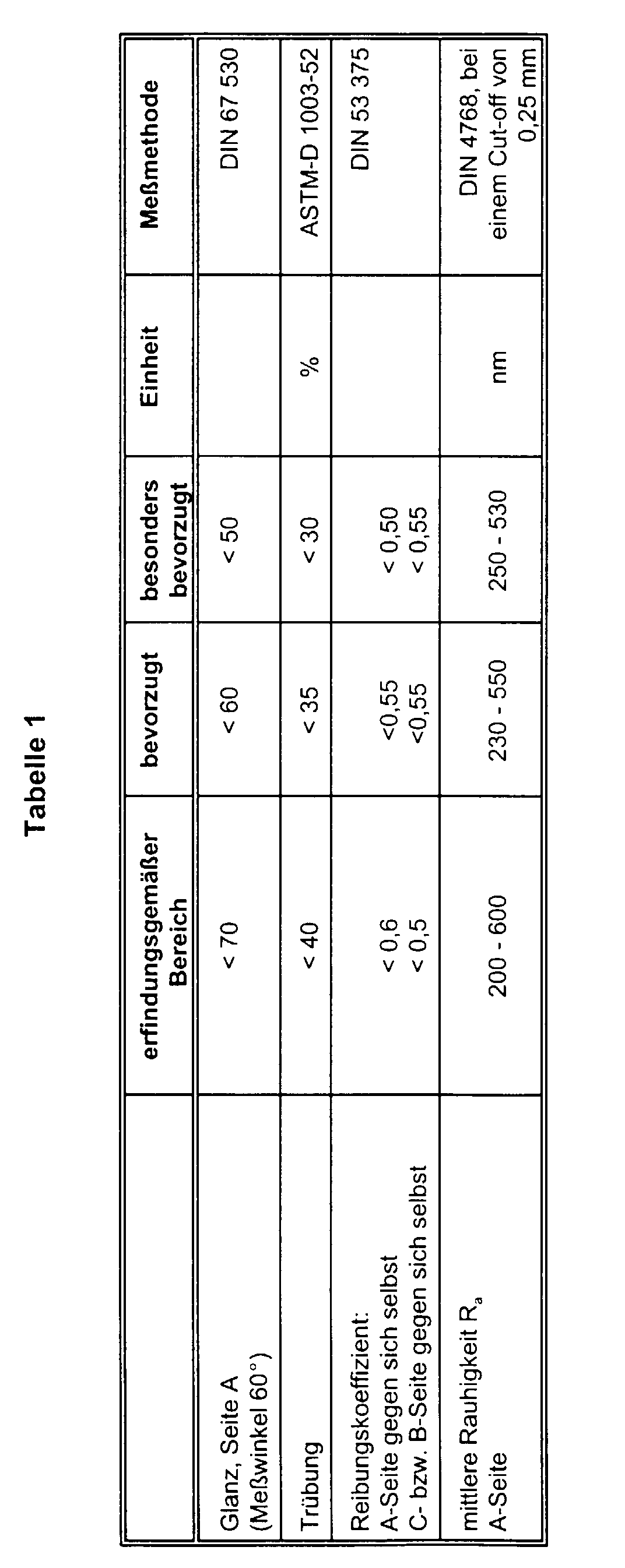
- Table 1 summarizes the most important film properties according to the invention.
- SV solvent viscosity
- the friction was determined according to DIN 53 375.
- the sliding friction number was 14 days measured after production.
- the surface tension was measured using the so-called ink method (DIN 53 364) certainly.
- the haze of the film was measured according to ASTM-D 1003-52.
- the turbidity measurement according to Hölz was determined on the basis of ASTM-D 1003-52, but using Utilization of the optimal measuring range on four superimposed foil layers measured and a 1 ° slit was used instead of a 4 ° pinhole.
- the gloss was determined in accordance with DIN 67 530.
- the reflector value was measured as optical parameter for the surface of a film. Based on the standards ASTM-D 523-78 and ISO 2813 the angle of incidence was set at 20 ° or 60 °. On The light beam hits the flat test surface at the set angle of incidence and is reflected or scattered by this. The on the photoelectronic receiver striking light rays are displayed as a proportional electrical quantity. The The measured value is dimensionless and must be specified with the angle of incidence.
- the roughness R a of the film was determined in accordance with DIN 4768 with a cut-off of 0.25 mm.
- chips made of polyethylene terephthalate were dried at 160 ° C. to a residual moisture content of less than 50 ppm and fed to the extruder for the base layer. Chips of polyethylene terephthalate and a filler were also fed to the extruder for the cover layer C.
- a transparent three-layer film with ABC structure and a total thickness of 12 ⁇ m was then produced by coextrusion and subsequent stepwise orientation in the longitudinal and transverse directions.
- the cover layers each had a thickness of 1.5 ⁇ m.
- Base layer B 95% by weight Polyethylene terephthalate (RT 49 from Hoechst AG) with an SV value of 800 and 5% by weight Masterbatch made from 99% by weight of polyethylene terephthalate and 1.0% by weight of silica particles (®Sylobloc 44 H from Grace) with an average particle size of 4.5 ⁇ m.
- Top layer A 80% by weight Component I and 20% by weight Component II.
- Top layer C 90% by weight Polyethylene terephthalate (RT 49 from Hoechst AG) with an SV value of 800 and 10% by weight Masterbatch made from 99% by weight of polyethylene terephthalate and 1.0% by weight of silica particles (®Sylobloc 44 H from Grace) with an average particle size of 4.5 ⁇ m.
- Top layer A 75% by weight Component I and 25% by weight Component II.
Landscapes
- Chemical & Material Sciences (AREA)
- Engineering & Computer Science (AREA)
- Manufacturing & Machinery (AREA)
- Materials Engineering (AREA)
- Health & Medical Sciences (AREA)
- Chemical Kinetics & Catalysis (AREA)
- Medicinal Chemistry (AREA)
- Polymers & Plastics (AREA)
- Organic Chemistry (AREA)
- Laminated Bodies (AREA)
Abstract
Description
n im Bereich von 1 bis 11 liegt,
C) einem Sulfomonomeren enthaltend eine Alkalimetallsulfonatgruppe an dem aromatischen Teil einer aromatischen Dicarbonsäure und D) wenigstens einem aliphatischen oder cycloaliphatischen Alkylenglykol mit etwa 2 bis 11 Kohlenstoffatomen hergestellt. Die insgesamt anwesenden Säureäquivalente sollen auf molarer Basis im wesentlichen den insgesamt anwesenden Glykoläquivalenten entsprechen.

| Basisschicht B: | |
| 95 Gew.-% | Polyethylenterephthalat (RT 49 von Hoechst AG) mit einem SV-Wert von 800 und |
| 5 Gew.-% | Masterbatch aus 99 Gew.-% Polyethylenterephthalat und 1,0 Gew.-% Kieselsäurepartikel (®Sylobloc 44 H der Firma Grace) mit einer mittleren Teilchengröße von 4,5 µm. |
| Deckschicht A: | |
| 80 Gew.-% | Komponente I und |
| 20 Gew.-% | Komponente II. |
| Deckschicht C: | |
| 90 Gew.-% | Polyethylenterephthalat (RT 49 von Hoechst AG) mit einem SV-Wert von 800 und |
| 10 Gew.-% | Masterbatch aus 99 Gew.-% Polyethylenterephthalat und 1,0 Gew.-% Kieselsäurepartikel (®Sylobloc 44 H der Firma Grace) mit einer mittleren Teilchengröße von 4,5 µm. |
| Extrusion | Temperaturen | Deckschicht | 300 °C |
| Basisschicht | 300 °C | ||
| Temperatur der Abzugswalze | 30 °C | ||
| Düsenspaltweite | 1 mm | ||
| Längsstreckung | Temperatur | 85-135 °C | |
| Längsstreckverhältnis | 4,0 : 1 | ||
| Querstreckung | Temperatur | 85-135 °C | |
| Querstreckverhältnis | 4,0 : 1 | ||
| Fixierung | Temperatur | 230 °C |
| Deckschicht A: | |
| 75 Gew.-% | Komponente I und |
| 25 Gew.-% | Komponente II. |
| 70 Gew.-% | Komponente I und |
| 30 Gew.-% | Komponente II. |
| 60 Gew.-% | Komponente I und |
| 40 Gew.-% | Komponente II. |
| Beispiel Nr. | Mischungsverhä Itnis K I:K II der Deckschicht A | Folie n-dicke (µm) | Deckschichtdicke A/C (µm) | Folienaufbau | Glanz (60° Meßwinkel) | Trübung | |
| A-Seite | C-Seite | ||||||
| 1 | 80:20 | 12 | 1,5/1,5 | ABC | 65 | 175 | 25 |
| 2 | 75:25 | 12 | 1,5/1,5 | ABC | 55 | 175 | 26 |
| 3 | 70:30 | 12 | 1,5/1,5 | ABC | 45 | 175 | 28 |
| 4 | 60:40 | 12 | 1,5/1,5 | ABC | 35 | 175 | 30 |
| VB | 70:30 | 12 | A | 35 | 160 | 70 |
Claims (16)
- Polyesterfolie mit einer Basisschicht, die zu mindestens 80 Gew.-% aus einem thermoplastischen Polyester besteht, und mindestens einer matten Deckschicht, welche eine Mischung bzw. ein Blend aus zwei Komponenten I und II enthält, dadurch gekennzeichnet, daß die Komponente I der Mischung bzw. des Blends im wesentlichen ein Polyethylenterephthalat-Homopolymer oder Polyethylenterephthalat Copolymer oder eine Mischung aus Homo- oder Copolymeren enthält und die Komponente II der Mischung bzw. des Blends aus einem Kondensationsprodukt der folgenden Monomeren bzw. deren zur Bildung von Polyestern befähigten Derivaten besteht:wobei die Prozentangaben jeweils bezogen sind auf die Gesamtmenge der die Komponenten II bildenden Monomeren.A) 65 bis 95 Mol-% Isophthalsäure;B) 0 bis 30 Mol-% wenigstens einer aliphatischen Dicarbonsäure der Formeln im Bereich von 1 bis 11 liegt;C) 5 bis 15 Mol-% wenigstens eines Sulfomonomeren enthaltend eine Alkalimetallsulfonatgruppe an dem aromatischen Teil einer Dicarbonsäure;D) die zur Bildung von 100 Mol-% Kondensat notwendige stöchiometrische Menge eines copolymerisierbaren aliphatischen oder cycloaliphatischen Glykols mit 2 bis 11 Kohlenstoffatomen;
- Folie gemäß Anspruch 1, dadurch gekennzeichnet, daß das Mischungsverhältnis der Komponenten I und II im Bereich von I:II = 10:90 bis 1:11 95:5, vorzugsweise zwischen I:II = 20:80 bis I:II = 95:5 und insbesondere zwischen I:II =30:70 bis I:II =95:5 liegt.
- Folie gemäß einem oder mehreren der Ansprüche 1 und 2, dadurch gekennzeichnet, daß die Deckschicht eine Dicke von 0,2 bis 6,0 µm, vorzugsweise von 0,3 bis 5,5 µm, besonders bevorzugt von 0,4 bis 4,5 µm, aufweist.
- Folie gemäß einem oder mehreren der Ansprüche 1 bis 3, dadurch gekennzeichnet, daß sie zweischichtig ist und aus der Basisschicht und der Deckschicht besteht.
- Folie gemäß einem oder mehreren der Ansprüche 1 bis 3, dadurch gekennzeichnet, daß sie dreischichtig ist und aus der Basisschicht und je einer Deckschicht auf beiden Seiten der Basisschicht besteht.
- Folie gemäß einem oder mehreren der Ansprüche 1 bis 5, dadurch gekennzeichnet, daß die Deckschicht A mit anorganischen Füllstoffen in einer Konzentration von bis zu 10 % pigmentiert ist.
- Folie nach einem oder mehreren der Ansprüche 1 bis 6, dadurch gekennzeichnet, daß sie auf mindestens einer Oberfläche metallisiert oder mit SiOx, AlxOy, Ethylenvinylalkohol, PVDC, Wasserglas, hydrophilischem Polyester, Vinylacetat, Polyvinylacetat, Polyurethan, Alkali- oder Erdalkali- Fettsäuresalze, Butadiencopolymer, (Meth)acrylsäure oder deren Ester oder Silikon beschichtet ist.
- Verfahren zur Herstellung der Folie nach einem oder mehreren der Ansprüche 1 bis 7, umfassend die SchritteHerstellen einer Folie aus Basis- und Deckschicht(en) durch Coextrusion, biaxiales Verstrecken der Folie undThermofixieren der verstreckten Folie.
- Verwendung der Folie nach einem oder mehreren der Ansprüche 1 bis 7 zum Verpacken von Nahrungs- und Genußmitteln.
- Verwendung der Folie nach einem oder mehreren der Ansprüche 1 bis 7 als laminierfähige Folie.
- Verwendung der Folie nach einem oder mehreren der Ansprüche 1 bis 7 als metallisierbare Folie.
- Verwendung der Folie nach einem oder mehreren der Ansprüche 1 bis 7 als bedruckbare Folie.
- Verwendung der Folie nach einem oder mehreren der Ansprüche 1 bis 7 als Label.
- Verwendung der Folie nach einem oder mehreren der Ansprüche 1 bis 7 als Trennfolie zur Herstellung von GFK-Halbzeugen.
- Verwendung der Folie nach einem oder mehreren der Ansprüche 1 bis 7 als Prägefolie.
- Verwendung der Folie nach einem oder mehreren der Ansprüche 1 bis 7 als In-Mold-Label.
Applications Claiming Priority (2)
| Application Number | Priority Date | Filing Date | Title |
|---|---|---|---|
| DE19834603A DE19834603A1 (de) | 1998-07-31 | 1998-07-31 | Matte, koextrudierte Polyesterfolie, Verfahren zu ihrer Herstellung und ihre Verwendung |
| DE19834603 | 1998-07-31 |
Publications (3)
| Publication Number | Publication Date |
|---|---|
| EP0976548A2 true EP0976548A2 (de) | 2000-02-02 |
| EP0976548A3 EP0976548A3 (de) | 2001-01-31 |
| EP0976548B1 EP0976548B1 (de) | 2005-11-09 |
Family
ID=7876016
Family Applications (1)
| Application Number | Title | Priority Date | Filing Date |
|---|---|---|---|
| EP99114665A Expired - Lifetime EP0976548B1 (de) | 1998-07-31 | 1999-07-27 | Matte, koextrudierte Polyesterfolie, Verfahren zu ihrer Herstellung und ihre Verwendung |
Country Status (5)
| Country | Link |
|---|---|
| US (1) | US6358604B1 (de) |
| EP (1) | EP0976548B1 (de) |
| JP (1) | JP2000052523A (de) |
| KR (1) | KR20000012103A (de) |
| DE (2) | DE19834603A1 (de) |
Cited By (16)
| Publication number | Priority date | Publication date | Assignee | Title |
|---|---|---|---|---|
| WO2001053089A1 (de) * | 2000-01-20 | 2001-07-26 | Mitsubishi Polyester Film Gmbh | Matte, uv-stabile, flammhemmend ausgerüstete koextrudierte polyesterfolie, verfahren zu ihrer herstellung und ihre verwendung |
| WO2001053091A1 (de) * | 2000-01-20 | 2001-07-26 | Mitsubishi Polyester Film Gmbh | Matte, uv-stabile, koextrudierte polyesterfolie, verfahren zu ihrer herstellung und ihre verwendung |
| WO2001053090A1 (de) * | 2000-01-20 | 2001-07-26 | Mitsubishi Polyester Film Gmbh | Matte, flammhemmend ausgerüstete koextrudierte polyesterfolie, verfahren zu ihrer herstellung und ihre verwendung |
| WO2001053087A1 (de) * | 2000-01-20 | 2001-07-26 | Mitsubishi Polyester Film Gmbh | Matte, uv-stabile, thermoformbare, koextrudierte polyesterfolie, verfahren zu ihrer herstellung und ihre verwendung |
| WO2001053086A1 (de) * | 2000-01-20 | 2001-07-26 | Mitsubishi Polyester Film Gmbh | Matte, flammhemmend ausgerüstete, thermoformbare koextrudierte polyesterfolie, verfahren zu ihrer herstellung und ihre verwendung |
| WO2001053081A1 (de) * | 2000-01-20 | 2001-07-26 | Mitsubishi Polyester Film Gmbh | Amorphe, mehrschichtige, matte, thermoformbare polyesterfolie, verfahren zu ihrer herstellung und ihre verwendung |
| EP1197327A1 (de) * | 2000-10-14 | 2002-04-17 | Mitsubishi Polyester Film GmbH | Koextrudierte, zumindest einseitig matte, biaxial orientierte Polyesterfolie |
| EP1197326A1 (de) * | 2000-10-14 | 2002-04-17 | Mitsubishi Polyester Film GmbH | Matte, pigmentierte, biaxial orientierte Polyesterfolie |
| WO2002055301A1 (de) * | 2001-01-10 | 2002-07-18 | Mitsubishi Polyester Film Gmbh | Antimikrobiell ausgerüstete, mehrschichtige polyesterfolie mit matter oberfläche |
| EP1197328A3 (de) * | 2000-10-14 | 2003-03-26 | Mitsubishi Polyester Film GmbH | Zumindest einseitig matte, biaxial orientierte Polyesterfolie |
| US6649247B2 (en) * | 2000-02-19 | 2003-11-18 | Mitsubishi Polyester Film Gmbh | Sealable, flame-resistant, co-extruded, biaxially oriented foil that is mat on one side and a method for producing and using same |
| US6797358B2 (en) * | 2000-02-19 | 2004-09-28 | Mitsubishi Polyester Film Gmbh | Unilaterally mat, sealable, UV-stabilized, flame resistant, co-extruded, biaxially oriented polyester film, method for the production and the use thereof |
| US6893706B2 (en) * | 2000-05-11 | 2005-05-17 | Mitsubishi Polyester Film Gmbh | White, biaxially-oriented polyester film with cycloolefin copolymer (COC), which is matt on at least one side, method for production and use thereof |
| WO2006075151A1 (en) * | 2005-01-17 | 2006-07-20 | Dupont Teijin Films Us Ltd Partnership | Breathable, heat-sealable composite polymeric film |
| US7122239B2 (en) * | 2000-07-20 | 2006-10-17 | Mitsubishi Polyester Film Gmbh | Opaque polyester film containing a cyclic olefin copolymer (COC) with good surface attachment, method for producing the same and use thereof |
| EP3569646A1 (de) * | 2018-05-14 | 2019-11-20 | Mitsubishi Polyester Film GmbH | Matte, biaxial orientierte polyesterfolie mit erhöhtem reibungskoeffizient |
Families Citing this family (36)
| Publication number | Priority date | Publication date | Assignee | Title |
|---|---|---|---|---|
| DE50009959D1 (de) * | 1999-05-10 | 2005-05-12 | Mitsubishi Polyester Film Gmbh | Weisse, UV-stabilisierte Folie aus einem kristallisierbaren Thermoplast |
| GB2368810A (en) * | 2000-11-09 | 2002-05-15 | Toppan Printing Co Ltd | Treatment of a surface of a polymer |
| DE10062981A1 (de) * | 2000-12-16 | 2002-06-20 | Mitsubishi Polyester Film Gmbh | Heißsterilisierbare, biaxial orientierte Polyesterfolie mit guter Metallhaftung, Verfahren zu ihrer Herstellung und ihre Verwendung |
| JP4904640B2 (ja) * | 2001-04-06 | 2012-03-28 | 東洋紡績株式会社 | 熱収縮性ポリエステル系フィルム |
| US7070841B2 (en) * | 2001-04-11 | 2006-07-04 | E. I. Du Pont De Nemours And Company | Insulating label stock |
| KR100426256B1 (ko) * | 2002-01-28 | 2004-04-08 | 도레이새한 주식회사 | 이축연신 폴리에스테르 매트필름 |
| KR100439120B1 (ko) * | 2002-01-28 | 2004-07-05 | 도레이새한 주식회사 | 이축연신 폴리에스테르 매트필름 |
| KR100439121B1 (ko) * | 2002-03-19 | 2004-07-05 | 도레이새한 주식회사 | 이축연신 폴리에스테르 필름 |
| US20040024102A1 (en) * | 2002-07-30 | 2004-02-05 | Hayes Richard Allen | Sulfonated aliphatic-aromatic polyetherester films, coatings, and laminates |
| US7144615B2 (en) * | 2003-04-22 | 2006-12-05 | Mitsubishi Polyester Film Gmbh | Coextruded, hot-sealable and peelable polyester film, process for its production and its use |
| US7223459B2 (en) * | 2003-04-22 | 2007-05-29 | Mitsubishi Polyester Film Gmbh | Coextruded, hot-sealable and peelable polyester film, process for its production and its use |
| US7141293B2 (en) * | 2003-04-22 | 2006-11-28 | Mitsubishi Polyester Film Gmbh | Coextruded, hot-sealable and peelable polyester film having high peeling resistance, process for its production and its use |
| US7186452B2 (en) * | 2003-04-22 | 2007-03-06 | Mitsubishi Polyester Film Gmbh | Coextruded, hot-sealable and peelable polyester film having high peeling resistance, process for its production and its use |
| US7815996B2 (en) * | 2003-10-14 | 2010-10-19 | Toray Plastics (America), Inc. | Low gloss and low haze laminated polyester film including talc and method for preparing same |
| US7655291B2 (en) * | 2003-10-14 | 2010-02-02 | Toray Plastics (America), Inc. | Smooth co-extruded polyester film including talc and method for preparing same |
| DE10352430A1 (de) * | 2003-11-10 | 2005-06-09 | Mitsubishi Polyester Film Gmbh | Peelfähige Polyesterfolie mit verbesserter Sauerstoffbarriere, Verfahren zu ihrer Herstellung und ihre Verwendung |
| DE10352431A1 (de) * | 2003-11-10 | 2005-06-09 | Mitsubishi Polyester Film Gmbh | Peelfähige Polyesterfolie mit selbsttätiger Entlüftung, Verfahren zu ihrer Herstellung und ihre Verwendung |
| US7452927B2 (en) * | 2004-01-30 | 2008-11-18 | E. I. Du Pont De Nemours And Company | Aliphatic-aromatic polyesters, and articles made therefrom |
| US7776020B2 (en) * | 2004-03-19 | 2010-08-17 | Kimberly-Clark Worldwide, Inc. | Absorbent articles having an aliphatic-aromatic copolyester film |
| US7153569B2 (en) * | 2004-03-19 | 2006-12-26 | Kimberly-Clark Worldwide, Inc. | Biodegradable aliphatic-aromatic copolyester films |
| JP4846992B2 (ja) * | 2004-06-03 | 2011-12-28 | 株式会社フジシールインターナショナル | プラスチックラベル及びラベル付き容器 |
| US7193029B2 (en) * | 2004-07-09 | 2007-03-20 | E. I. Du Pont De Nemours And Company | Sulfonated copolyetherester compositions from hydroxyalkanoic acids and shaped articles produced therefrom |
| US7144972B2 (en) * | 2004-07-09 | 2006-12-05 | E. I. Du Pont De Nemours And Company | Copolyetherester compositions containing hydroxyalkanoic acids and shaped articles produced therefrom |
| AU2011203494B2 (en) * | 2004-07-09 | 2012-07-26 | E. I. Du Pont De Nemours And Company | Sulfonated copolyetherester compositions from hydroxyalkanoic acids and shaped articles produced therefrom |
| WO2006056706A1 (fr) * | 2004-11-29 | 2006-06-01 | Rhodia Chimie | Composition comprenant un polymere thermoplastique et un agent hydrophilisant |
| US20060127463A1 (en) * | 2004-12-15 | 2006-06-15 | Nugara Peter N | Composite structure including a low vinyl acetate layer |
| WO2007022463A2 (en) * | 2005-08-19 | 2007-02-22 | Advanced Plastics Technologies Luxembourg S.A. | Mono and multi-layer labels |
| US8158230B2 (en) * | 2007-11-06 | 2012-04-17 | Mitsubishi Polyester Film, Inc. | Tamper evident composite film |
| DE102007054132A1 (de) * | 2007-11-14 | 2009-05-20 | Mitsubishi Polyester Film Gmbh | Antimikrobiell ausgerüstete, biaxial orientierte Polyesterfolie |
| US11028299B2 (en) | 2013-11-19 | 2021-06-08 | Mitsubishi Polyester Film, Inc | Anti-powdering and anti-static polymer film for digital printing |
| DE102016205913A1 (de) * | 2016-04-08 | 2017-10-12 | Mitsubishi Polyester Film Gmbh | Biaxial orientierte Polyesterfolie für die Metalllaminierung |
| TR201903662A2 (tr) * | 2019-03-11 | 2019-03-21 | Mondi Kale Nobel Ambalaj Sanayi Ve Ticaret Anonim Sirketi | Tutkal ve benzeri̇ ki̇myasal i̇çermeyen yüzde yüz geri̇ dönüşebi̇li̇r gida ambalaji |
| BR112021020858A2 (pt) * | 2019-05-15 | 2021-12-14 | Ampacet Corp | Artigo termoplástico, métodos para produzir um acabamento fosco e uma superfície resistente à riscagem para uma garrafa de poliéster moldada por sopro, e, garrafa |
| TWI716080B (zh) * | 2019-08-20 | 2021-01-11 | 南亞塑膠工業股份有限公司 | 雙軸延伸聚酯薄膜及其製造方法 |
| CN110483958B (zh) * | 2019-08-20 | 2022-01-28 | 江阴市胜赛色母料有限公司 | 假发用亚光母粒及其制备方法 |
| TWI747051B (zh) * | 2019-09-25 | 2021-11-21 | 南亞塑膠工業股份有限公司 | 雙軸延伸聚酯薄膜及其製造方法 |
Family Cites Families (49)
| Publication number | Priority date | Publication date | Assignee | Title |
|---|---|---|---|---|
| DE742907C (de) | 1941-01-21 | 1943-12-14 | Krupp Ag | Anwendung eines an sich bekannten elektrolytischen Glaenzverfahrens auf Ersatzkauwerkzeuge |
| GB1096064A (en) * | 1965-02-22 | 1967-12-20 | Ici Ltd | Improvements in or relating to laminates |
| US3515626A (en) | 1965-02-22 | 1970-06-02 | Ici Ltd | Thermoplastic laminates having improved surface properties |
| US3958064A (en) | 1971-06-21 | 1976-05-18 | Minnesota Mining And Manufacturing Company | Magnetic recording tape |
| US4042569A (en) | 1974-08-05 | 1977-08-16 | E. I. Du Pont De Nemours And Company | Heat-setting process for polyester film |
| GB1589926A (en) | 1977-03-25 | 1981-05-20 | Bexford Ltd | Coated films |
| JPS57123050A (en) | 1980-12-01 | 1982-07-31 | Toray Industries | Polyester composite film |
| EP0035835B1 (de) | 1980-03-12 | 1984-03-14 | Imperial Chemical Industries Plc | Verbundstoffe aus Polyesterfilmen |
| DE3275959D1 (en) | 1981-03-30 | 1987-05-07 | Teijin Ltd | Magnetic recording medium |
| US4568599A (en) | 1982-03-10 | 1986-02-04 | Toray Industries, Inc. | Laminated film and magnetic recording medium made therewith |
| US4539389A (en) | 1983-03-30 | 1985-09-03 | Teijin Limited | Biaxially oriented polyester film |
| FR2548958B1 (fr) | 1983-07-13 | 1986-03-21 | Rhone Poulenc Films | Films polyesters composites |
| US4493872A (en) | 1983-12-05 | 1985-01-15 | American Hoechst Corporation | Polyester film coated with metal adhesion promoting copolyester |
| IT1229054B (it) | 1984-06-22 | 1991-07-17 | Esseci S R L Societa Costruzio | Metodo fisico per trattare le superfici di laminati plastici poliolefinici, politetrafluorcetilenici, cartoni e fogli metallici come alluminio e banda stagnata, mediante una fiamma prodotta dalla combustione di una miscela di aria con idrocarburi gassosi arricchita con ossigeno, metalli alcalini, vapore di acqua e/o ionizzata |
| EP0479774B1 (de) | 1986-03-07 | 1996-06-26 | Nippon Shokubai Co., Ltd. | Verfahren zur Verbesserung des Gleitvermögens von Polyesterfolie |
| FR2604656B1 (fr) * | 1986-10-06 | 1988-12-09 | Rhone Poulenc Films | Films polyesters composites a adherence amelioree et leur procede d'obtention |
| FR2608506B1 (fr) * | 1986-12-23 | 1989-03-31 | Rhone Poulenc Films | Procede d'obtention de films polyester composites epais a adherence amelioree et nouveaux films composites |
| FR2608507B1 (fr) * | 1986-12-23 | 1989-03-31 | Rhone Poulenc Films | Films polyester composites a adherence amelioree et leur procede d'obtention |
| US5236683A (en) | 1987-01-20 | 1993-08-17 | Mizusawa Industrial Chemicals, Ltd. | Amorphous silica spherical particles |
| US5236680A (en) | 1987-01-20 | 1993-08-17 | Mizusawa Industrial Chemicals, Ltd. | Preparation of amorphous silica-alumina particles by acid-treating spherical P-type zeolite particles crystallized from a sodium aluminosilicate gel |
| AU593677B2 (en) | 1987-06-17 | 1990-02-15 | E.I. Du Pont De Nemours And Company | System for using synchronous secondaries of a linear motor to biaxially draw plastic films |
| JP2517293B2 (ja) | 1987-06-25 | 1996-07-24 | メクト株式会社 | 細胞、組織修復剤 |
| EP0679508B1 (de) | 1988-06-08 | 1999-12-29 | Toray Industries, Inc. | Biaxial orientierte Verbundfolie |
| FR2640984B1 (de) | 1988-12-28 | 1992-09-11 | Rhone Poulenc Films | |
| EP0378154B1 (de) | 1989-01-11 | 1995-11-08 | Toray Industries, Inc. | Biaxial orientierter Polyesterfilm |
| US5093064A (en) | 1989-06-13 | 1992-03-03 | Diafoil Company, Ltd. | Low-shrinkage polyester film and preparation thereof |
| JP2528215B2 (ja) | 1990-12-13 | 1996-08-28 | 帝人株式会社 | 磁気記録媒体用二軸配向ポリエステルフイルム |
| US5336079A (en) | 1991-03-06 | 1994-08-09 | Toray Industries, Inc. | Biaxially oriented laminated film comprising particles in a specific ratio of particle density |
| GB9110590D0 (en) | 1991-05-16 | 1991-07-03 | Ici Plc | Polymeric film |
| GB9110902D0 (en) | 1991-05-21 | 1991-07-10 | Ici Plc | Polymeric film |
| EP0580404B1 (de) | 1992-07-22 | 1999-09-15 | Teijin Limited | Biaxial orentierter, mehrschichtiger Polyesterfilm, geeignet zum Kleben auf Metallblech |
| WO1994013476A1 (en) | 1992-12-09 | 1994-06-23 | Hoechst Aktiengesellschaft | Copolyester film primed with acrylic polymers |
| WO1994013481A1 (en) | 1992-12-09 | 1994-06-23 | Hoechst Aktiengesellschaft | Biaxially oriented copolyester film primed with vinyl acetate polymers |
| JP2989080B2 (ja) | 1992-12-17 | 1999-12-13 | 帝人株式会社 | 磁気記録媒体用積層ポリエステルフイルム |
| EP0604057A1 (de) | 1992-12-23 | 1994-06-29 | Imperial Chemical Industries Plc | Polymerfilm |
| DE69402995T2 (de) | 1993-01-27 | 1998-01-02 | Teijin Ltd | Biaxial orientierter Mehrschichtfilm aus Polyester und magnetischer Aufzeichnungsträger mit demselben Basisfilm |
| US5372879A (en) | 1993-02-22 | 1994-12-13 | Teijin Limited | Biaxially oriented polyester film |
| DE4306155A1 (de) | 1993-02-27 | 1994-09-01 | Hoechst Ag | Transparente, nicht siegelfähige orientierte Polyolefin-Mehrschichtfolie, Verfahren zu ihrer Herstellung und ihre Verwendung |
| JPH0788952A (ja) | 1993-09-28 | 1995-04-04 | Toray Ind Inc | 二軸配向熱可塑性樹脂フイルム |
| EP0685509B1 (de) | 1993-12-10 | 2001-02-28 | Teijin Limited | Durchsichtige folie zur beschichtung einer metalldose |
| US5618609A (en) | 1993-12-22 | 1997-04-08 | Teijin Limited | Biaxially oriented film of polyethylene-2,6-naphthalenedicarboxylate |
| US5656356A (en) | 1994-01-11 | 1997-08-12 | Teijin Limited | Biaxially oriented laminated polyester film |
| US5429785A (en) | 1994-03-01 | 1995-07-04 | E. I. Du Pont De Nemours And Company | Method of making biaxially oriented thermoplastic films |
| JPH0836739A (ja) | 1994-07-22 | 1996-02-06 | Toray Ind Inc | 磁気記録媒体用ポリエステルフィルム |
| JPH08104064A (ja) | 1994-10-05 | 1996-04-23 | Diafoil Co Ltd | 昇華型感熱転写用ポリエステルフィルム |
| US5506014A (en) | 1995-09-01 | 1996-04-09 | Eastman Chemical Company | Pet copolyesters containing succinic and naphthalenedicarboxylic acid moieties having improved barrier properties |
| JPH106456A (ja) * | 1996-06-20 | 1998-01-13 | Toyobo Co Ltd | ポリエステル系多層シート |
| EP1213123B1 (de) | 1996-08-30 | 2005-11-16 | Mitsubishi Polyester Film Corporation | Verfahren zur Herstellung einer Polyesterzusammensetzung |
| US6268052B1 (en) | 1996-09-24 | 2001-07-31 | Mitsubishi Polyester Film Gmbh | Biaxially-oriented pet foil for use for SMD foil capacitors, method for the production of said foil and its use as foil capacitors in SMD technology |
-
1998
- 1998-07-31 DE DE19834603A patent/DE19834603A1/de not_active Withdrawn
-
1999
- 1999-07-26 US US09/361,603 patent/US6358604B1/en not_active Expired - Fee Related
- 1999-07-27 EP EP99114665A patent/EP0976548B1/de not_active Expired - Lifetime
- 1999-07-27 JP JP11212248A patent/JP2000052523A/ja not_active Withdrawn
- 1999-07-27 DE DE59912754T patent/DE59912754D1/de not_active Expired - Fee Related
- 1999-07-30 KR KR1019990031332A patent/KR20000012103A/ko not_active Withdrawn
Cited By (26)
| Publication number | Priority date | Publication date | Assignee | Title |
|---|---|---|---|---|
| WO2001053089A1 (de) * | 2000-01-20 | 2001-07-26 | Mitsubishi Polyester Film Gmbh | Matte, uv-stabile, flammhemmend ausgerüstete koextrudierte polyesterfolie, verfahren zu ihrer herstellung und ihre verwendung |
| US6872461B2 (en) | 2000-01-20 | 2005-03-29 | Mitsubishi Polyester Film Gmbh | Matt, flame-retardant, co-extruded polyester film, a method for the production thereof and the use of the same |
| WO2001053090A1 (de) * | 2000-01-20 | 2001-07-26 | Mitsubishi Polyester Film Gmbh | Matte, flammhemmend ausgerüstete koextrudierte polyesterfolie, verfahren zu ihrer herstellung und ihre verwendung |
| WO2001053087A1 (de) * | 2000-01-20 | 2001-07-26 | Mitsubishi Polyester Film Gmbh | Matte, uv-stabile, thermoformbare, koextrudierte polyesterfolie, verfahren zu ihrer herstellung und ihre verwendung |
| WO2001053086A1 (de) * | 2000-01-20 | 2001-07-26 | Mitsubishi Polyester Film Gmbh | Matte, flammhemmend ausgerüstete, thermoformbare koextrudierte polyesterfolie, verfahren zu ihrer herstellung und ihre verwendung |
| WO2001053081A1 (de) * | 2000-01-20 | 2001-07-26 | Mitsubishi Polyester Film Gmbh | Amorphe, mehrschichtige, matte, thermoformbare polyesterfolie, verfahren zu ihrer herstellung und ihre verwendung |
| US7056573B2 (en) | 2000-01-20 | 2006-06-06 | Mitsubishi Polyester Film Gmbh | Matt, UV-stable, co-extruded polyester film, a method for the production thereof and the use of the same |
| US6872460B2 (en) | 2000-01-20 | 2005-03-29 | Mitsubishi Polyester Film Gmbh | Matt, UV-stable, Thermoformable, co-extruded polyester film, a method for the production thereof and the use of the same |
| WO2001053091A1 (de) * | 2000-01-20 | 2001-07-26 | Mitsubishi Polyester Film Gmbh | Matte, uv-stabile, koextrudierte polyesterfolie, verfahren zu ihrer herstellung und ihre verwendung |
| US6730406B2 (en) | 2000-01-20 | 2004-05-04 | Mitsubishi Polyester Film Gmbh | Matt, UV stable, flame-retardant co-extruded polyester film, a method for the production thereof and the use of the same |
| US6797358B2 (en) * | 2000-02-19 | 2004-09-28 | Mitsubishi Polyester Film Gmbh | Unilaterally mat, sealable, UV-stabilized, flame resistant, co-extruded, biaxially oriented polyester film, method for the production and the use thereof |
| US6649247B2 (en) * | 2000-02-19 | 2003-11-18 | Mitsubishi Polyester Film Gmbh | Sealable, flame-resistant, co-extruded, biaxially oriented foil that is mat on one side and a method for producing and using same |
| US6893706B2 (en) * | 2000-05-11 | 2005-05-17 | Mitsubishi Polyester Film Gmbh | White, biaxially-oriented polyester film with cycloolefin copolymer (COC), which is matt on at least one side, method for production and use thereof |
| US7122239B2 (en) * | 2000-07-20 | 2006-10-17 | Mitsubishi Polyester Film Gmbh | Opaque polyester film containing a cyclic olefin copolymer (COC) with good surface attachment, method for producing the same and use thereof |
| EP1197327A1 (de) * | 2000-10-14 | 2002-04-17 | Mitsubishi Polyester Film GmbH | Koextrudierte, zumindest einseitig matte, biaxial orientierte Polyesterfolie |
| US6630224B2 (en) | 2000-10-14 | 2003-10-07 | Mitsubishi Polyester Film Gmbh | Matt, biaxially oriented polyester film |
| US6627295B2 (en) | 2000-10-14 | 2003-09-30 | Mitsubishi Polyester Film Gmbh | Coextruded, biaxially oriented polyester film having at least one matt side |
| US6607808B2 (en) | 2000-10-14 | 2003-08-19 | Mitsubishi Polyester Film Gmbh | Biaxially oriented polyester film having at least one matt side |
| EP1197328A3 (de) * | 2000-10-14 | 2003-03-26 | Mitsubishi Polyester Film GmbH | Zumindest einseitig matte, biaxial orientierte Polyesterfolie |
| EP1197326A1 (de) * | 2000-10-14 | 2002-04-17 | Mitsubishi Polyester Film GmbH | Matte, pigmentierte, biaxial orientierte Polyesterfolie |
| WO2002055301A1 (de) * | 2001-01-10 | 2002-07-18 | Mitsubishi Polyester Film Gmbh | Antimikrobiell ausgerüstete, mehrschichtige polyesterfolie mit matter oberfläche |
| WO2006075151A1 (en) * | 2005-01-17 | 2006-07-20 | Dupont Teijin Films Us Ltd Partnership | Breathable, heat-sealable composite polymeric film |
| US8415011B2 (en) | 2005-01-17 | 2013-04-09 | Dupont Teijin Films U.S. Limited Partnership | Breathable, heat-sealable composite polymeric film |
| US8936852B2 (en) | 2005-01-17 | 2015-01-20 | Dupont Teijin Films U.S. Limited Partnership | Breathable, heat-sealable composite polymeric film |
| EP3569646A1 (de) * | 2018-05-14 | 2019-11-20 | Mitsubishi Polyester Film GmbH | Matte, biaxial orientierte polyesterfolie mit erhöhtem reibungskoeffizient |
| US10940667B2 (en) | 2018-05-14 | 2021-03-09 | Mitsubishi Polyester Film Gmbh | Biaxially oriented matt polyester film with increased coefficient of friction |
Also Published As
| Publication number | Publication date |
|---|---|
| EP0976548B1 (de) | 2005-11-09 |
| DE19834603A1 (de) | 2000-02-03 |
| US6358604B1 (en) | 2002-03-19 |
| JP2000052523A (ja) | 2000-02-22 |
| KR20000012103A (ko) | 2000-02-25 |
| EP0976548A3 (de) | 2001-01-31 |
| DE59912754D1 (de) | 2005-12-15 |
Similar Documents
| Publication | Publication Date | Title |
|---|---|---|
| EP0976548B1 (de) | Matte, koextrudierte Polyesterfolie, Verfahren zu ihrer Herstellung und ihre Verwendung | |
| EP1274575B1 (de) | Matte, flammhemmend ausgerüstete koextrudierte polyesterfolie, verfahren zu ihrer herstellung und ihre verwendung | |
| EP1261481B1 (de) | Matte, uv-stabile, flammhemmend ausgerüstete koextrudierte polyesterfolie, verfahren zu ihrer herstellung und ihre verwendung | |
| EP1274576B1 (de) | Matte, uv-stabile, thermoformbare, koextrudierte polyesterfolie, verfahren zu ihrer herstellung und ihre verwendung | |
| EP0945258A2 (de) | Siegelfähige Polyesterfolie mit hoher Sauerstoffbarriere, Verfahren zu ihrer Herstellung und ihre Verwendung | |
| DE10051082A1 (de) | Matte, koextrudierte, biaxial orientierte Polyesterfolie | |
| DE19720506A1 (de) | Transparente Polyesterfolie mit hoher Sauerstoffbarriere, Verfahren zu ihrer Herstellung und ihre Verwendung | |
| EP0945256A2 (de) | Transparente Polyesterfolie mit hoher Sauerstoffbarriere, Verfahren zu ihrer Herstellung und ihre Verwendung | |
| DE19813264A1 (de) | Polyesterfolie mit an den Anwendungszweck angepaßter Oberflächentopographie, Verfahren zu ihrer Herstellung und ihre Verwendung | |
| DE10301786A1 (de) | Mehrschichtige transparente, biaxial orientierte Polyesterfolie, Verfahren zu ihrer Herstellung und ihre Verwendung | |
| DE19813270A1 (de) | Polyesterfolie mit hoher Sauerstoffbarriere und verbesserter Haftung zu Metallschichten, Verfahren zu ihrer Herstellung und ihre Verwendung | |
| EP0945259A2 (de) | Verwendung einer transparenten Polyesterfolie als Gas/Aromabarrierefolie | |
| EP2337685B1 (de) | Siegelfähige, biaxial orientierte polyesterfolie | |
| DE10062981A1 (de) | Heißsterilisierbare, biaxial orientierte Polyesterfolie mit guter Metallhaftung, Verfahren zu ihrer Herstellung und ihre Verwendung | |
| EP0945262A2 (de) | Transparente Polyesterfolie mit hoher Sauerstoffbarriere und zusätzlicher Funktionalität, Verfahren zu ihrer Herstellung und ihre Verwendung | |
| EP1179420A2 (de) | Mindestens dreischichtige transparente Polyesterfolie, Verfahren zu ihrer Herstellung und ihre Verwendung | |
| EP1457316A1 (de) | Polyesterfolie mit verbesserter Sauerstoffbarriere und Poly(m-xylol-adipinamid)-haltiger Basisschicht, Verfahren zu ihrer Herstellung und ihre Verwendung | |
| EP1268206B1 (de) | Matte, uv-stabile, koextrudierte polyesterfolie, verfahren zu ihrer herstellung und ihre verwendung | |
| EP1179418A2 (de) | Transparente Polyesterfolie mit hoher Sauerstoffbarriere, Verfahren zu ihrer Herstellung und ihre Verwendung | |
| DE10119023A1 (de) | Mehrschichtige transparente biaxial orientierte Polywsterfolie, Verfahren zu ihrer Herstellung und ihre Verwendung | |
| DE10002151A1 (de) | Amorphe, mehrschichtige, matte, thermoformbare Polyesterfolie, Verfahren zu ihrer Herstellung und ihre Verwendung | |
| EP1274573B1 (de) | Matte, flammhemmend ausgerüstete, thermoformbare koextrudierte polyesterfolie, verfahren zu ihrer herstellung und ihre verwendung | |
| DE10043785A1 (de) | Matte, mehrschichtige Folie aus einem bibenzolmodifizierten Thermoplasten, Verfahren zu ihrer Herstellung und ihre Verwendung |
Legal Events
| Date | Code | Title | Description |
|---|---|---|---|
| PUAI | Public reference made under article 153(3) epc to a published international application that has entered the european phase |
Free format text: ORIGINAL CODE: 0009012 |
|
| AK | Designated contracting states |
Kind code of ref document: A2 Designated state(s): DE FR GB IT LU NL |
|
| AX | Request for extension of the european patent |
Free format text: AL;LT;LV;MK;RO;SI |
|
| PUAL | Search report despatched |
Free format text: ORIGINAL CODE: 0009013 |
|
| AK | Designated contracting states |
Kind code of ref document: A3 Designated state(s): AT BE CH CY DE DK ES FI FR GB GR IE IT LI LU MC NL PT SE |
|
| AX | Request for extension of the european patent |
Free format text: AL;LT;LV;MK;RO;SI |
|
| RIC1 | Information provided on ipc code assigned before grant |
Free format text: 7B 32B 27/36 A, 7C 08L 67/02 B |
|
| 17P | Request for examination filed |
Effective date: 20010731 |
|
| AKX | Designation fees paid |
Free format text: DE FR GB IT LU NL |
|
| 17Q | First examination report despatched |
Effective date: 20030926 |
|
| GRAP | Despatch of communication of intention to grant a patent |
Free format text: ORIGINAL CODE: EPIDOSNIGR1 |
|
| GRAS | Grant fee paid |
Free format text: ORIGINAL CODE: EPIDOSNIGR3 |
|
| GRAA | (expected) grant |
Free format text: ORIGINAL CODE: 0009210 |
|
| AK | Designated contracting states |
Kind code of ref document: B1 Designated state(s): DE FR GB IT LU NL |
|
| PG25 | Lapsed in a contracting state [announced via postgrant information from national office to epo] |
Ref country code: NL Free format text: LAPSE BECAUSE OF FAILURE TO SUBMIT A TRANSLATION OF THE DESCRIPTION OR TO PAY THE FEE WITHIN THE PRESCRIBED TIME-LIMIT Effective date: 20051109 |
|
| REG | Reference to a national code |
Ref country code: GB Ref legal event code: FG4D Free format text: NOT ENGLISH |
|
| REF | Corresponds to: |
Ref document number: 59912754 Country of ref document: DE Date of ref document: 20051215 Kind code of ref document: P |
|
| GBT | Gb: translation of ep patent filed (gb section 77(6)(a)/1977) |
Effective date: 20060228 |
|
| NLV1 | Nl: lapsed or annulled due to failure to fulfill the requirements of art. 29p and 29m of the patents act | ||
| ET | Fr: translation filed | ||
| PLBE | No opposition filed within time limit |
Free format text: ORIGINAL CODE: 0009261 |
|
| STAA | Information on the status of an ep patent application or granted ep patent |
Free format text: STATUS: NO OPPOSITION FILED WITHIN TIME LIMIT |
|
| 26N | No opposition filed |
Effective date: 20060810 |
|
| PGFP | Annual fee paid to national office [announced via postgrant information from national office to epo] |
Ref country code: DE Payment date: 20070719 Year of fee payment: 9 |
|
| PGFP | Annual fee paid to national office [announced via postgrant information from national office to epo] |
Ref country code: LU Payment date: 20070730 Year of fee payment: 9 |
|
| PGFP | Annual fee paid to national office [announced via postgrant information from national office to epo] |
Ref country code: GB Payment date: 20070725 Year of fee payment: 9 |
|
| PGFP | Annual fee paid to national office [announced via postgrant information from national office to epo] |
Ref country code: IT Payment date: 20070730 Year of fee payment: 9 |
|
| PGFP | Annual fee paid to national office [announced via postgrant information from national office to epo] |
Ref country code: FR Payment date: 20070710 Year of fee payment: 9 |
|
| GBPC | Gb: european patent ceased through non-payment of renewal fee |
Effective date: 20080727 |
|
| PG25 | Lapsed in a contracting state [announced via postgrant information from national office to epo] |
Ref country code: DE Free format text: LAPSE BECAUSE OF NON-PAYMENT OF DUE FEES Effective date: 20090203 |
|
| REG | Reference to a national code |
Ref country code: FR Ref legal event code: ST Effective date: 20090331 |
|
| PG25 | Lapsed in a contracting state [announced via postgrant information from national office to epo] |
Ref country code: GB Free format text: LAPSE BECAUSE OF NON-PAYMENT OF DUE FEES Effective date: 20080727 |
|
| PG25 | Lapsed in a contracting state [announced via postgrant information from national office to epo] |
Ref country code: IT Free format text: LAPSE BECAUSE OF NON-PAYMENT OF DUE FEES Effective date: 20080727 Ref country code: FR Free format text: LAPSE BECAUSE OF NON-PAYMENT OF DUE FEES Effective date: 20080731 |
|
| PG25 | Lapsed in a contracting state [announced via postgrant information from national office to epo] |
Ref country code: LU Free format text: LAPSE BECAUSE OF NON-PAYMENT OF DUE FEES Effective date: 20080727 |