EP0964591A2 - Synchronisierung von Basisstationen in einem drahtlosen Telekommunikationssystem - Google Patents
Synchronisierung von Basisstationen in einem drahtlosen Telekommunikationssystem Download PDFInfo
- Publication number
- EP0964591A2 EP0964591A2 EP99304106A EP99304106A EP0964591A2 EP 0964591 A2 EP0964591 A2 EP 0964591A2 EP 99304106 A EP99304106 A EP 99304106A EP 99304106 A EP99304106 A EP 99304106A EP 0964591 A2 EP0964591 A2 EP 0964591A2
- Authority
- EP
- European Patent Office
- Prior art keywords
- timing signal
- base station
- signal
- timing
- phase
- Prior art date
- Legal status (The legal status is an assumption and is not a legal conclusion. Google has not performed a legal analysis and makes no representation as to the accuracy of the status listed.)
- Withdrawn
Links
Images


Classifications
-
- H—ELECTRICITY
- H04—ELECTRIC COMMUNICATION TECHNIQUE
- H04J—MULTIPLEX COMMUNICATION
- H04J3/00—Time-division multiplex systems
- H04J3/02—Details
- H04J3/12—Arrangements providing for calling or supervisory signals
-
- H—ELECTRICITY
- H04—ELECTRIC COMMUNICATION TECHNIQUE
- H04W—WIRELESS COMMUNICATION NETWORKS
- H04W88/00—Devices specially adapted for wireless communication networks, e.g. terminals, base stations or access point devices
- H04W88/08—Access point devices
-
- H—ELECTRICITY
- H04—ELECTRIC COMMUNICATION TECHNIQUE
- H04B—TRANSMISSION
- H04B7/00—Radio transmission systems, i.e. using radiation field
- H04B7/24—Radio transmission systems, i.e. using radiation field for communication between two or more posts
- H04B7/26—Radio transmission systems, i.e. using radiation field for communication between two or more posts at least one of which is mobile
- H04B7/2662—Arrangements for Wireless System Synchronisation
-
- H—ELECTRICITY
- H04—ELECTRIC COMMUNICATION TECHNIQUE
- H04B—TRANSMISSION
- H04B7/00—Radio transmission systems, i.e. using radiation field
- H04B7/24—Radio transmission systems, i.e. using radiation field for communication between two or more posts
- H04B7/26—Radio transmission systems, i.e. using radiation field for communication between two or more posts at least one of which is mobile
- H04B7/2662—Arrangements for Wireless System Synchronisation
- H04B7/2671—Arrangements for Wireless Time-Division Multiple Access [TDMA] System Synchronisation
- H04B7/2678—Time synchronisation
- H04B7/2687—Inter base stations synchronisation
-
- H—ELECTRICITY
- H04—ELECTRIC COMMUNICATION TECHNIQUE
- H04J—MULTIPLEX COMMUNICATION
- H04J3/00—Time-division multiplex systems
- H04J3/02—Details
- H04J3/06—Synchronising arrangements
- H04J3/0635—Clock or time synchronisation in a network
- H04J3/0676—Mutual
-
- H—ELECTRICITY
- H04—ELECTRIC COMMUNICATION TECHNIQUE
- H04J—MULTIPLEX COMMUNICATION
- H04J3/00—Time-division multiplex systems
- H04J3/02—Details
- H04J3/06—Synchronising arrangements
- H04J3/0635—Clock or time synchronisation in a network
- H04J3/0685—Clock or time synchronisation in a node; Intranode synchronisation
Definitions
- the present invention relates to telecommunications in general, and, more particularly, to a technique for synchronizing the timing signals of base stations in a wireless telecommunications system.
- FIG. 1 depicts a schematic diagram of a portion of a wireless telecommunications system in the prior art, which system provides wireless telecommunications service to a number of wireless terminals (e.g., wireless terminals 101-1 through 101-3) that are situated within a geographic region.
- the heart of a wireless telecommunications system is a wireless switching center ("WSC"), which also may be known as a mobile switching center or mobile telephone switching office.
- WSC wireless switching center
- a wireless switching center e.g., WSC 120
- WSC 120 is connected to a plurality of base stations (e.g., base stations 103-1 through 103-5) that are dispersed throughout the geographic region serviced by the system and to the local and long-distance telephone and data networks (e.g., local-office 130, local-office 138 and toll-office 140).
- a wireless switching center is responsible for, among other things, establishing and maintaining a call between a first wireless terminal and a second wireless terminal or, alternatively, between a wireless terminal and a wireline terminal (e.g., wireline terminal 150), which is connected to the system via the local and/or long-distance networks.
- each cell is schematically represented by a hexagon. In practice, however, each cell has an irregular shape that depends on the topography of the terrain surrounding the cell.
- each cell contains a base station, which comprises the radios and antennas that the base station uses to communicate with the wireless terminals in that cell and also comprises the transmission equipment that the base station uses to communicate with the wireless switching center.
- wireless terminal 101-1 when a user of wireless terminal 101-1 desires to transmit information to a user of wireless terminal 101-2, wireless terminal 101-1 transmits a data message bearing the user's information to base station 103-1. The data message is then relayed by base station 103-1 to wireless switching center 120 via wireline 102-1. Because wireless terminal 101-2 is in the cell serviced by base station 103-1, wireless switching center 120 returns the data message back to base station 103-1, which relays it to wireless terminal 101-2.
- Each wireless terminal and each base station comprises a timing signal that it uses for timing its communications with the other.
- the timing signal does not provide the exact time (e.g., 3:18 A.M.), but is a waveform with a constant frequency that establishes a cadence for the wireless terminals and base stations to follow.
- the ease with which a wireless terminal and a base station can communicate is dependent on the degree to which the timing signal in the wireless terminal and the timing signal in the base station are synchronized. In other words, if the timing signal in the wireless terminal and the timing signal in the base station are not synchronized, communication between the wireless terminal and the base station may be difficult or impossible.
- the degree of synchronization of two or more timing signals is not definable by a single parameter. Instead, the degree of synchronization is defined by two parameters: (1) frequency, and (2) phase. To illustrate the relationship and meaning of these two parameters, FIGs. 2 through 4 depicts graphs of pairs illustrative timing signals.
- FIG. 2 depicts a graph of two timing signals that are not synchronized because they have different frequencies.
- FIG. 3 depicts a graph of two timing signals that have the same frequency, but are still not synchronized because they have different phases.
- FIG. 4 depicts a graph of two timing signals that are synchronized because they have the same frequency and the same phase.
- the timing signal in the wireless terminal and the timing signal in the base station must have the same frequency and nearly the same phase.
- the base station transmits its timing signal to the wireless terminal.
- the wireless terminal uses the timing signal from the base station to synchronize its own timing signal. Because the base station directs the wireless terminal to synchronize its timing signal to that of the base station, but the base station does not synchronize its timing signal to that of the wireless terminal, the relationship of the base station and the wireless terminal is asymmetric. In particular, the base station acts like a master and the wireless terminal acts like a slave.
- the timing signal in the wireless terminal is advantageously synchronized with the timing signals in all of the base stations with which it communicates.
- this requires that the timing signals in all of the base stations be synchronized with each other.
- the base stations synchronize their timing signals with each other and the wireless terminal synchronizes its timing signal with that of one of the base stations.
- each base station comprises an independent but highly-accurate timing source, such as a cesium clock whose rate of vibration is well-known and very stable under a wide range of environmental conditions.
- a cesium clock whose rate of vibration is well-known and very stable under a wide range of environmental conditions.
- This technique is advantageous because it effectively ensures that each base station's timing signals are synchronized in frequency.
- This technique is disadvantageous, however, because the independence of the timing sources does nothing to synchronize the timing signals in phase. Therefore, this technique is bound to produce timing signals that are synchronized in frequency, but not phase, such as those shown in FIG. 3.
- the base stations derive their timing signals from a reference timing signal that is transmitted from a single timing source.
- the timing source is located in a wireless switching center and the reference timing signal is transmitted to each base station via the wireline associated with that base station.
- the second technique is advantageous because it effectively ensures that each base station's timing signals are synchronized in frequency. Also like the first technique, the second technique is disadvantageous because the base stations' timing signals are not synchronized in phase.
- the reference timing signal must traverse a different distance from the timing source to each base station. And because the reference timing signal propagates from the timing source to each base station at the same velocity, the reference timing signal arrives at each base station at a slightly different time. The arrival of the timing signal at each base station at a slightly different time exhibits itself as a phase disparity in the respective timing signals at the base stations.
- the present invention is a wireless telecommunications system that is capable of synchronizing the timing signals in the base stations of a wireless telecommunications system, in both frequency and phase.
- each base station derives the frequency of its timing signal from one periodic signal, but the phase of its timing signal from a second periodic signal.
- the base station derives its timing signal based on: (1) the frequency of a reference timing signal, and (2) the phase of a feedback signal.
- the base station accomplishes this by phase aligning the reference timing signal to a feedback signal to create the base station's timing signal.
- the reference timing signal can be obtained from a common timing source or from different timing sources which are designed to have the same frequency.
- the feedback signal is advantageously the confluence of two feedback loops.
- the feedback signal is based on the phase of the base station's own timing signal.
- the feedback signal is based on the phase of the timing signals from one or more nearby base stations.
- the feedback signal is based on the Boolean AND or NAND function of the base station's own timing signal and the timing signals of the nearby base stations.
- each base station in the illustrative embodiment follows this regimen, each base station's timing signal becomes synchronized in both frequency and phase with the timing signals of the nearby base stations.
- FIG. 1 depicts a schematic drawing of a wireless telecommunications in the prior art.
- FIG. 2 depicts a graph of two timing signals that are asynchronous in frequency.
- FIG. 3 depicts a graph of two timing signals that are synchronous in frequency, but asynchronous in phase.
- FIG. 4 depicts a graph of two timing signals that are synchronous.
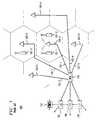
- FIG. 5 depicts a schematic drawing of a portion of the illustrative embodiment of the present invention.
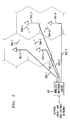
- FIG. 6 depicts a block diagram of the salient components of a base station in accordance with the illustrative embodiment of the present invention.
- FIG. 7 depicts a flowchart of the operation of the illustrative embodiment of the present invention.
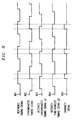
- FIG. 8 depicts a graph of the salient signals and their interrelationship in the illustrative embodiment of the present invention.
- FIG. 5 depicts a schematic diagram of a portion of the illustrative embodiment of the present invention, which provides wireless telecommunications service to one or more wireless terminals within a geographic region.
- the illustrative embodiment comprises: wireless switching center 501, base stations 503-1 through 503-4, and wirelines 502-1 through 502-4, interrelated as shown.
- the illustrative embodiment comprises four base stations, it will be clear to those skilled in the art how to make and use embodiments of the present invention that comprise any number of base stations.
- a reference timing signal is provided to each of base stations 502-1 through 502-4.
- the reference timing signal is a periodic waveform with only two values (e.g., a square wave, etc.).
- the reference timing signal can be provided to each base station by either: (1) a central timing source, or (2) a local timing source.
- a reference timing signal can be provided to one or more base stations from a central timing source, which may be co-located with the wireless switching center and carried to the base stations via a wireline.
- a reference timing signal can be provided to a base station from a local timing source, which is co-located with the base station. It will be clear to those skilled in the art that some of the base stations can receive their reference timing signal from a central timing source while the other base stations receive their reference timing signal from local timing sources. Regardless of the source of each reference timing signal, it is important that each reference timing signal has the same frequency-it is not, however, necessary that they be synchronized in phase.
- each of base stations 502-1 through 502-4 use the reference timing signal it receives to generate a timing signal.
- the timing signal is a periodic waveform with only two values (e.g., a square wave, etc. ). The details of how the timing signal is generated are discussed below in conjunction with FIG. 6.
- the timing signals of the respective base stations are synchronized in both frequency and phase and have four uses:
- Phase-locked loop 601 receives two inputs: (1) a reference timing signal on lead 503- i , and (2) a feedback signal from unanimity gate 603. Phase-locked loop 601 phase aligns the reference timing signal to the feedback signal, in well-known fashion, to create the timing signal.
- the timing signal from phase-locked loop 601 is fed into wireless transmitter 602 and to one input of unanimity gate 603.
- the feeding of the timing signal from phase-locked loop 601 into an input of unanimity gate 603 is, which generates an input to phase-locked loop 601, is one feedback loop used by the illustrative embodiment.
- Wireless transmitter 602 transmits the timing signal via transmit antenna 605, in well-known fashion, to the wireless terminals serviced by base station 503- i and to one or more nearby base stations.
- the nearby base stations use the timing signal transmitted by wireless transmitter 602 to generate their own timings signals, which are transmitted by them and received by receive antenna 606.
- Receive antenna 606 receives the timing signals from n nearby base stations, where n ⁇ 1, and feeds the signals to wireless receivers 604-1 through 604- n .
- Each of wireless receivers 604-1 through 604- n outputs a timing signal from one of the n nearby base stations to unanimity gate 603.
- a feedback signal from unanimity gate 603 is a Boolean function of its inputs.
- a feedback signal from unanimity gate 603 is true, or high, when and only when all of its inputs have the same value.
- unanimity gate 603 can be a Boolean AND gate or a Boolean NAND gate, in well-known fashion.
- the use of the timing signals from other base stations, which are generated based on the timing signal of this base station, to generate the timing signal of this base station is the second feedback loop used by the illustrative embodiment.
- FIG. 7 depicts a flowchart of the operation of the illustrative embodiment, which synchronizes the timing signals of two base stations: base station 502- i and base station 502- j .
- base station 503- i receives a first reference timing signal, as discussed above, in well-known fashion.
- the first reference timing signal is phase aligned with phase-locked loop 601- i to a feedback signal from unanimity gate 603- i , as discussed above.
- the output of the phase-locked loop 601- i is the timing signal for base station 503- i and is fed to unanimity gate 603- i and wireless transmitter 602- i . It will be clear to those skilled in the art how to make and use phase-locked loop 601- i .
- wireless transmitter 602- i transmits the timing signal via transmit antenna 605- i to one or more nearby base stations (e.g., base station 502- j ), in well-known fashion.
- base station 503- i receives n timing signals from n nearby base stations (e.g., base station 502- j ), via n separate control channels, in well-known fashion.
- n nearby base stations e.g., base station 502- j
- n separate control channels e.g., n separate control channels, in well-known fashion.
- each base station transmits a timing signal in a control channel for the benefit of the wireless terminals that it services.
- This timing signal is, as is described above, used by the wireless terminals for synchronizing their own clocks to that of the base station.
- the timing signal is transmitted by the base station in a control channel.
- a control channel is analogous to a traffic channel except that it is used for transmitting timing and other control information instead of telecommunications traffic.
- the control channels from different base stations are distinquishable from each other in that same manner that the traffic channels from different base stations are distinquishable from each other (i.e., the control channels are distinquishable by frequency, time, or orthogonal code).
- each base station 503- i is capable of receiving n timing signals from n nearby base stations in n control channels
- base station 503- i directs each of wireless receivers 604-1 through 604- n to receive and demodulate one of the n incoming timing signals and to provide it to unanimity gate 603- i . It will be clear to those skilled in the art how to make and use base station 503- i so that it receives n timing signals from n other base stations.
- the timing signal from phase-locked loop 601- i is input to unanimity gate 603- i with the n timing signals from n other base stations.
- the feedback signal from unanimity gate 603- i is used in step 711, as discussed above.
- base station 503- j receives a second reference timing signal, as discussed above, in well-known fashion.
- the second reference timing signal is phase aligned with phase-locked loop 601- j to a feedback signal from unanimity gate 603-j, as discussed above.
- the output of the phase-locked loop 601- j is the timing signal for base station 503- j and is fed to unanimity gate 603- j and wireless transmitter 602- j . It will be clear to those skilled in the art how to make and use phase-locked loop 601- j .
- wireless transmitter 602- j transmits the timing signal via transmit antenna 605- j to one or more nearby base stations (e.g., base station 502- i ), in well-known fashion.
- base station 503- j receives n timing signals from n nearby base stations (e.g., base station 502- i ), via n separate control channels, in well-known fashion. For example. in accordance with most air-interface standards (e.g., IS-41, IS-56, IS-95, GSM, etc. ) each base station transmits a timing signal in a control channel for the benefit of the wireless terminals that it services. This timing signal is, as is described above, used by the wireless terminals for synchronizing their own clocks to that of the base station.
- the timing signal is transmitted by the base station in a control channel.
- a control channel is analogous to a traffic channel except that it is used for transmitting timing and other control information instead of telecommunications traffic.
- the control channels from different base stations are distinquishable from each other in that same manner that the traffic channels from different base stations are distinquishable from each other (i. e., the control channels are distinquishable by frequency, time, or orthogonal code).
- each base station 503- j is capable of receiving n timing signals from n nearby base stations in n control channels
- base station 503- j directs each of wireless receivers 604-1 through 604- n to receive and demodulate one of the n incoming timing signals and to provide it to unanimity gate 603- j . It will be clear to those skilled in the art how to make and use base station 503- j so that it receives n timing signals from n other base stations.
- the timing signal from phase-locked loop 601-j is input to unanimity gate 603- j with the n timing signals from n other base stations.
- the feedback signal from unanimity gate 603- j is used in step 721, as discussed above.
- each base station's timing signal becomes synchronized, and will remain synchronized, to every other base station's timing signal.
- FIG. 8 depicts a series of timing signals associated with one base station that help in understanding the illustrative embodiment of the present invention.
- Signal 801 illustrates a reference timing signal as input to phase-locked loop 601- i .
- Signal 802 illustrates the timing signal output from phase-locked loop 601- i , which is phase aligned with the leading edge of signal 805, which is a feedback signal from unanimity gate 603- i .
- Signals 803 and 804 represent timing signals received from other base stations and signal 805 is a Boolean AND function ofthe output of phase-locked loop 601- i and the timing signals received from the other base stations.
Landscapes
- Engineering & Computer Science (AREA)
- Computer Networks & Wireless Communication (AREA)
- Signal Processing (AREA)
- Mobile Radio Communication Systems (AREA)
- Synchronisation In Digital Transmission Systems (AREA)
Applications Claiming Priority (2)
| Application Number | Priority Date | Filing Date | Title |
|---|---|---|---|
| US95173 | 1998-06-10 | ||
| US09/095,173 US6119016A (en) | 1998-06-10 | 1998-06-10 | Synchronizing base stations in a wireless telecommunications system |
Publications (2)
| Publication Number | Publication Date |
|---|---|
| EP0964591A2 true EP0964591A2 (de) | 1999-12-15 |
| EP0964591A3 EP0964591A3 (de) | 2000-12-20 |
Family
ID=22250439
Family Applications (1)
| Application Number | Title | Priority Date | Filing Date |
|---|---|---|---|
| EP99304106A Withdrawn EP0964591A3 (de) | 1998-06-10 | 1999-05-26 | Synchronisierung von Basisstationen in einem drahtlosen Telekommunikationssystem |
Country Status (7)
| Country | Link |
|---|---|
| US (1) | US6119016A (de) |
| EP (1) | EP0964591A3 (de) |
| JP (1) | JP3561180B2 (de) |
| KR (1) | KR100512543B1 (de) |
| AU (1) | AU3390399A (de) |
| BR (1) | BR9907597A (de) |
| CA (1) | CA2270322C (de) |
Cited By (1)
| Publication number | Priority date | Publication date | Assignee | Title |
|---|---|---|---|---|
| EP1298848A3 (de) * | 2001-09-28 | 2003-09-03 | Kabushiki Kaisha Toshiba | Basisstationsvorrichtung und kommunikationsendgerät |
Families Citing this family (21)
| Publication number | Priority date | Publication date | Assignee | Title |
|---|---|---|---|---|
| US5915207A (en) | 1996-01-22 | 1999-06-22 | Hughes Electronics Corporation | Mobile and wireless information dissemination architecture and protocols |
| JP2000050351A (ja) * | 1998-07-27 | 2000-02-18 | Nec Corp | 移動体通信装置および移動体通信における同期確立方法 |
| US6337980B1 (en) | 1999-03-18 | 2002-01-08 | Hughes Electronics Corporation | Multiple satellite mobile communications method and apparatus for hand-held terminals |
| JP2000253446A (ja) * | 1999-03-04 | 2000-09-14 | Matsushita Electric Ind Co Ltd | 基地局装置及びフレーム同期取得方法 |
| US6920309B1 (en) * | 1999-03-18 | 2005-07-19 | The Directv Group, Inc. | User positioning technique for multi-platform communication system |
| US7215954B1 (en) | 1999-03-18 | 2007-05-08 | The Directv Group, Inc. | Resource allocation method for multi-platform communication system |
| US7302224B2 (en) * | 2000-05-03 | 2007-11-27 | The Directv Group, Inc. | Communication system for rebroadcasting electronic content within local area network |
| US6941138B1 (en) | 2000-09-05 | 2005-09-06 | The Directv Group, Inc. | Concurrent communications between a user terminal and multiple stratospheric transponder platforms |
| US6891813B2 (en) | 2000-12-12 | 2005-05-10 | The Directv Group, Inc. | Dynamic cell CDMA code assignment system and method |
| US6999546B2 (en) * | 2000-12-29 | 2006-02-14 | Nokia, Inc. | System and method for timing references for line interfaces |
| US7016325B2 (en) * | 2001-01-18 | 2006-03-21 | Strix Systems, Inc. | Link context mobility method and system for providing such mobility, such as a system employing short range frequency hopping spread spectrum wireless protocols |
| US7151757B2 (en) * | 2001-05-02 | 2006-12-19 | Strix Systems, Inc. | Wireless base station to base station synchronization in a communication system, such as a system employing a short-range frequency hopping or time division duplex scheme |
| US7194010B2 (en) * | 2001-05-02 | 2007-03-20 | Strix Systems, Inc. | Wireless base station to base station synchronization in a communication system, such as a system employing a short range frequency hopping or time division duplex scheme |
| EP1391100A4 (de) | 2001-05-02 | 2009-03-11 | Strix Systems Inc | Nachbarerkennung für drahtlose basisstationen in einem kommunikationssystem, das ein frequenzsprungschema mit kurzer reichweite verwendet |
| WO2003017689A1 (en) * | 2001-08-14 | 2003-02-27 | Flarion Technologies, Inc. | Method and apparatus for wireless network connectivity |
| GB2387516B (en) * | 2002-04-11 | 2005-03-09 | Cambridge Broadband Ltd | Communication system |
| KR100713508B1 (ko) * | 2002-10-24 | 2007-05-02 | 삼성전자주식회사 | 마스터와 다수의 슬레이브들이 유동적 데이터를실시간으로 공유하는 무선 네트워크 및 그 방법 |
| CN1521967A (zh) * | 2003-02-11 | 2004-08-18 | 北京三星通信技术研究有限公司 | 时分复用移动通信系统终端到终端直接通信的同步方法 |
| CN100452898C (zh) * | 2004-03-04 | 2009-01-14 | Ut斯达康通讯有限公司 | 无线基站中的负荷分担方法与系统 |
| US8181057B2 (en) * | 2008-02-22 | 2012-05-15 | Schlumberger Technology Corporation | Time synchronization in units at different locations |
| CN101938824B (zh) * | 2009-06-29 | 2013-01-23 | 中国移动通信集团公司 | 空口同步方法、设备及系统 |
Family Cites Families (15)
| Publication number | Priority date | Publication date | Assignee | Title |
|---|---|---|---|---|
| US3931585A (en) * | 1974-06-17 | 1976-01-06 | Navidyne Corporation | Phase comparison systems employing improved phaselock loop apparatus |
| US4411007A (en) * | 1981-04-29 | 1983-10-18 | The Manitoba Telephone System | Distributed network synchronization system |
| JPH0267033A (ja) * | 1988-09-01 | 1990-03-07 | Fujitsu Ltd | 網同期システム |
| US5201061A (en) * | 1990-07-23 | 1993-04-06 | Motorola, Inc. | Method and apparatus for synchronizing simulcast systems |
| US5426633A (en) * | 1992-06-02 | 1995-06-20 | Nec Corporation | System for processing synchronization signals with phase synchronization in a mobile communication network |
| FI920976A0 (fi) * | 1992-03-05 | 1992-03-05 | Tecnomen Oy | Radiosynkroniseringsfoerfarande foer stoedstationer i ett simulcastingnaet. |
| US5613211A (en) * | 1992-10-07 | 1997-03-18 | Nippon Steel Corporation | Method of establishing inter base-station synchronization and mobile radio communicaton system using the method |
| DE4317895C2 (de) * | 1993-05-28 | 1996-11-14 | Siemens Ag | Verfahren zum Synchronisieren von Basisstationen in einem mehrzellularen, drahtlosen Fernsprechsystem |
| US5349310A (en) * | 1993-06-09 | 1994-09-20 | Alcatel Network Systems, Inc. | Digitally controlled fractional frequency synthesizer |
| JPH0823568A (ja) * | 1994-07-08 | 1996-01-23 | Nec Corp | 無線フレーム同期方式 |
| JP3358335B2 (ja) * | 1994-11-04 | 2002-12-16 | 富士通株式会社 | クロック信号再生回路及び電圧制御発振器の負荷容量制御回路 |
| US5555213A (en) * | 1995-06-29 | 1996-09-10 | Rockwell International Corporation | Interface circuit, system and method for interfacing an electronic device and a synchronous state machine having different clock speeds |
| US5727034A (en) * | 1995-07-26 | 1998-03-10 | Nokia Telecommunications Oy | Apparatus and method for synchronizing base sites individually in a communication system |
| JP2985773B2 (ja) * | 1996-06-10 | 1999-12-06 | 日本電気株式会社 | 無線基地局間同期装置 |
| US5873044A (en) * | 1997-02-21 | 1999-02-16 | Motorola, Inc. | Method and apparatus in a radio communication system for synchronizing transmissions while maintaining full user traffic |
-
1998
- 1998-06-10 US US09/095,173 patent/US6119016A/en not_active Expired - Lifetime
-
1999
- 1999-04-28 CA CA002270322A patent/CA2270322C/en not_active Expired - Fee Related
- 1999-05-26 EP EP99304106A patent/EP0964591A3/de not_active Withdrawn
- 1999-05-31 BR BR9907597-0A patent/BR9907597A/pt not_active IP Right Cessation
- 1999-06-07 KR KR10-1999-0020903A patent/KR100512543B1/ko not_active Expired - Fee Related
- 1999-06-07 AU AU33903/99A patent/AU3390399A/en not_active Abandoned
- 1999-06-10 JP JP16316899A patent/JP3561180B2/ja not_active Expired - Fee Related
Cited By (3)
| Publication number | Priority date | Publication date | Assignee | Title |
|---|---|---|---|---|
| EP1298848A3 (de) * | 2001-09-28 | 2003-09-03 | Kabushiki Kaisha Toshiba | Basisstationsvorrichtung und kommunikationsendgerät |
| US6947768B2 (en) | 2001-09-28 | 2005-09-20 | Kabushiki Kaisha Toshiba | Base station apparatus and terminal apparatus |
| US7277729B2 (en) | 2001-09-28 | 2007-10-02 | Kabushiki Kaisha Toshiba | Base station apparatus and terminal apparatus |
Also Published As
| Publication number | Publication date |
|---|---|
| BR9907597A (pt) | 2000-09-12 |
| JP2000049697A (ja) | 2000-02-18 |
| US6119016A (en) | 2000-09-12 |
| EP0964591A3 (de) | 2000-12-20 |
| CA2270322C (en) | 2002-07-02 |
| JP3561180B2 (ja) | 2004-09-02 |
| KR20000005968A (ko) | 2000-01-25 |
| AU3390399A (en) | 1999-12-23 |
| KR100512543B1 (ko) | 2005-09-06 |
| CA2270322A1 (en) | 1999-12-10 |
Similar Documents
| Publication | Publication Date | Title |
|---|---|---|
| US6119016A (en) | Synchronizing base stations in a wireless telecommunications system | |
| US5898929A (en) | Method and apparatus for synchronizing private radio systems | |
| EP0667069B1 (de) | Anordnung in einem mobilen telekommunikationssystem zur synchronisation der sender der basisstationen | |
| JP2785789B2 (ja) | ディジタル移動通信システム | |
| US5784368A (en) | Method and apparatus for providing a synchronous communication environment | |
| KR0149951B1 (ko) | 스펙트럼의 효율을 증대하기 위한 방법 및 장치 | |
| US8310983B2 (en) | Method and apparatus for performing timing synchronization in a wireless communication system | |
| US6560210B1 (en) | Handing off a wireless terminal in a wireless telecommunications system | |
| EP1458126B1 (de) | Synchronisationsverfahren in einem breitbandigen codemultiplex-mehrfachzugriffskommunikationssystem | |
| KR100429550B1 (ko) | 분산무선시스템에서의 기지국 동기화 장치 및 방법 | |
| CN101384019A (zh) | 实现基站同步的方法、装置和一种基站 | |
| JP2009049591A (ja) | 移動体通信システム | |
| US6788947B2 (en) | Method for synchronization of base stations which are coupled to different switching system parts in a mobile radio network | |
| JP2638295B2 (ja) | Tdmaディジタル移動通信システム | |
| US20070207836A1 (en) | Wireless base station | |
| US7079855B1 (en) | Method for operating a GSM mobile radio system | |
| JPH08205233A (ja) | 基地局間位相同期方法 | |
| JP2001285177A (ja) | 無線電話システムの基地局、無線電話システム | |
| JPH06303182A (ja) | 局間位相同期方式およびこれに用いる装置 | |
| KR100292952B1 (ko) | 이동통신 시스템에서 통화 권역 확장장치 | |
| KR20040060435A (ko) | 광대역 씨디엠에이시스템의 노드 동기화장치 및 그 제어방법 | |
| JPH0787558A (ja) | ディジタルコードレス電話システム | |
| JPH0654895B2 (ja) | 複局送信位相同期方式 | |
| JPH04284031A (ja) | 送受信機 | |
| JPH03235436A (ja) | 移動通信装置 |
Legal Events
| Date | Code | Title | Description |
|---|---|---|---|
| PUAI | Public reference made under article 153(3) epc to a published international application that has entered the european phase |
Free format text: ORIGINAL CODE: 0009012 |
|
| AK | Designated contracting states |
Kind code of ref document: A2 Designated state(s): DE FI FR GB SE |
|
| AX | Request for extension of the european patent |
Free format text: AL;LT;LV;MK;RO;SI |
|
| PUAL | Search report despatched |
Free format text: ORIGINAL CODE: 0009013 |
|
| AK | Designated contracting states |
Kind code of ref document: A3 Designated state(s): AT BE CH CY DE DK ES FI FR GB GR IE IT LI LU MC NL PT SE |
|
| AX | Request for extension of the european patent |
Free format text: AL;LT;LV;MK;RO;SI |
|
| 17P | Request for examination filed |
Effective date: 20010607 |
|
| AKX | Designation fees paid |
Free format text: DE FI FR GB SE |
|
| STAA | Information on the status of an ep patent application or granted ep patent |
Free format text: STATUS: THE APPLICATION HAS BEEN WITHDRAWN |
|
| 18W | Application withdrawn |
Effective date: 20060527 |