EP0959801B1 - Schraubbares implantat - Google Patents
Schraubbares implantat Download PDFInfo
- Publication number
- EP0959801B1 EP0959801B1 EP97903696A EP97903696A EP0959801B1 EP 0959801 B1 EP0959801 B1 EP 0959801B1 EP 97903696 A EP97903696 A EP 97903696A EP 97903696 A EP97903696 A EP 97903696A EP 0959801 B1 EP0959801 B1 EP 0959801B1
- Authority
- EP
- European Patent Office
- Prior art keywords
- thread
- radius
- flank
- max
- implant
- Prior art date
- Legal status (The legal status is an assumption and is not a legal conclusion. Google has not performed a legal analysis and makes no representation as to the accuracy of the status listed.)
- Expired - Lifetime
Links
Images


Classifications
-
- A—HUMAN NECESSITIES
- A61—MEDICAL OR VETERINARY SCIENCE; HYGIENE
- A61C—DENTISTRY; APPARATUS OR METHODS FOR ORAL OR DENTAL HYGIENE
- A61C8/00—Means to be fixed to the jaw-bone for consolidating natural teeth or for fixing dental prostheses thereon; Dental implants; Implanting tools
-
- A—HUMAN NECESSITIES
- A61—MEDICAL OR VETERINARY SCIENCE; HYGIENE
- A61B—DIAGNOSIS; SURGERY; IDENTIFICATION
- A61B17/00—Surgical instruments, devices or methods
- A61B17/56—Surgical instruments or methods for treatment of bones or joints; Devices specially adapted therefor
- A61B17/58—Surgical instruments or methods for treatment of bones or joints; Devices specially adapted therefor for osteosynthesis, e.g. bone plates, screws or setting implements
- A61B17/68—Internal fixation devices, including fasteners and spinal fixators, even if a part thereof projects from the skin
- A61B17/84—Fasteners therefor or fasteners being internal fixation devices
- A61B17/86—Pins or screws or threaded wires; nuts therefor
- A61B17/8625—Shanks, i.e. parts contacting bone tissue
-
- A—HUMAN NECESSITIES
- A61—MEDICAL OR VETERINARY SCIENCE; HYGIENE
- A61C—DENTISTRY; APPARATUS OR METHODS FOR ORAL OR DENTAL HYGIENE
- A61C8/00—Means to be fixed to the jaw-bone for consolidating natural teeth or for fixing dental prostheses thereon; Dental implants; Implanting tools
- A61C8/0018—Means to be fixed to the jaw-bone for consolidating natural teeth or for fixing dental prostheses thereon; Dental implants; Implanting tools characterised by the shape
- A61C8/0022—Self-screwing
-
- A—HUMAN NECESSITIES
- A61—MEDICAL OR VETERINARY SCIENCE; HYGIENE
- A61F—FILTERS IMPLANTABLE INTO BLOOD VESSELS; PROSTHESES; DEVICES PROVIDING PATENCY TO, OR PREVENTING COLLAPSING OF, TUBULAR STRUCTURES OF THE BODY, e.g. STENTS; ORTHOPAEDIC, NURSING OR CONTRACEPTIVE DEVICES; FOMENTATION; TREATMENT OR PROTECTION OF EYES OR EARS; BANDAGES, DRESSINGS OR ABSORBENT PADS; FIRST-AID KITS
- A61F2/00—Filters implantable into blood vessels; Prostheses, i.e. artificial substitutes or replacements for parts of the body; Appliances for connecting them with the body; Devices providing patency to, or preventing collapsing of, tubular structures of the body, e.g. stents
- A61F2/02—Prostheses implantable into the body
- A61F2/30—Joints
- A61F2002/30001—Additional features of subject-matter classified in A61F2/28, A61F2/30 and subgroups thereof
- A61F2002/30316—The prosthesis having different structural features at different locations within the same prosthesis; Connections between prosthetic parts; Special structural features of bone or joint prostheses not otherwise provided for
- A61F2002/30317—The prosthesis having different structural features at different locations within the same prosthesis
- A61F2002/30321—The prosthesis having different structural features at different locations within the same prosthesis differing in roughness
-
- A—HUMAN NECESSITIES
- A61—MEDICAL OR VETERINARY SCIENCE; HYGIENE
- A61F—FILTERS IMPLANTABLE INTO BLOOD VESSELS; PROSTHESES; DEVICES PROVIDING PATENCY TO, OR PREVENTING COLLAPSING OF, TUBULAR STRUCTURES OF THE BODY, e.g. STENTS; ORTHOPAEDIC, NURSING OR CONTRACEPTIVE DEVICES; FOMENTATION; TREATMENT OR PROTECTION OF EYES OR EARS; BANDAGES, DRESSINGS OR ABSORBENT PADS; FIRST-AID KITS
- A61F2/00—Filters implantable into blood vessels; Prostheses, i.e. artificial substitutes or replacements for parts of the body; Appliances for connecting them with the body; Devices providing patency to, or preventing collapsing of, tubular structures of the body, e.g. stents
- A61F2/02—Prostheses implantable into the body
- A61F2/30—Joints
- A61F2/30767—Special external or bone-contacting surface, e.g. coating for improving bone ingrowth
- A61F2/30771—Special external or bone-contacting surface, e.g. coating for improving bone ingrowth applied in original prostheses, e.g. holes or grooves
- A61F2002/3085—Special external or bone-contacting surface, e.g. coating for improving bone ingrowth applied in original prostheses, e.g. holes or grooves with a threaded, e.g. self-tapping, bone-engaging surface, e.g. external surface
-
- A—HUMAN NECESSITIES
- A61—MEDICAL OR VETERINARY SCIENCE; HYGIENE
- A61F—FILTERS IMPLANTABLE INTO BLOOD VESSELS; PROSTHESES; DEVICES PROVIDING PATENCY TO, OR PREVENTING COLLAPSING OF, TUBULAR STRUCTURES OF THE BODY, e.g. STENTS; ORTHOPAEDIC, NURSING OR CONTRACEPTIVE DEVICES; FOMENTATION; TREATMENT OR PROTECTION OF EYES OR EARS; BANDAGES, DRESSINGS OR ABSORBENT PADS; FIRST-AID KITS
- A61F2/00—Filters implantable into blood vessels; Prostheses, i.e. artificial substitutes or replacements for parts of the body; Appliances for connecting them with the body; Devices providing patency to, or preventing collapsing of, tubular structures of the body, e.g. stents
- A61F2/02—Prostheses implantable into the body
- A61F2/30—Joints
- A61F2/30767—Special external or bone-contacting surface, e.g. coating for improving bone ingrowth
- A61F2/30771—Special external or bone-contacting surface, e.g. coating for improving bone ingrowth applied in original prostheses, e.g. holes or grooves
- A61F2002/3085—Special external or bone-contacting surface, e.g. coating for improving bone ingrowth applied in original prostheses, e.g. holes or grooves with a threaded, e.g. self-tapping, bone-engaging surface, e.g. external surface
- A61F2002/30851—Multiple threadings
-
- A—HUMAN NECESSITIES
- A61—MEDICAL OR VETERINARY SCIENCE; HYGIENE
- A61F—FILTERS IMPLANTABLE INTO BLOOD VESSELS; PROSTHESES; DEVICES PROVIDING PATENCY TO, OR PREVENTING COLLAPSING OF, TUBULAR STRUCTURES OF THE BODY, e.g. STENTS; ORTHOPAEDIC, NURSING OR CONTRACEPTIVE DEVICES; FOMENTATION; TREATMENT OR PROTECTION OF EYES OR EARS; BANDAGES, DRESSINGS OR ABSORBENT PADS; FIRST-AID KITS
- A61F2250/00—Special features of prostheses classified in groups A61F2/00 - A61F2/26 or A61F2/82 or A61F9/00 or A61F11/00 or subgroups thereof
- A61F2250/0014—Special features of prostheses classified in groups A61F2/00 - A61F2/26 or A61F2/82 or A61F9/00 or A61F11/00 or subgroups thereof having different values of a given property or geometrical feature, e.g. mechanical property or material property, at different locations within the same prosthesis
- A61F2250/0025—Special features of prostheses classified in groups A61F2/00 - A61F2/26 or A61F2/82 or A61F9/00 or A61F11/00 or subgroups thereof having different values of a given property or geometrical feature, e.g. mechanical property or material property, at different locations within the same prosthesis differing in roughness
Definitions
- the present invention relates to implants for implantation into bone, in particular to dental implants, said implants being provided with threads or an oriented macroroughness.
- oriented macroroughness should be understood to comprise elongated beads which may be continuous or not, which may be oriented along the periphery of a cross-section of the implant or not.
- the oriented macroroughness should have a cross-section or profile specified in the way the thread profile will be defined below and in the appended claims.
- Bone implants are normally made of rigid material, mostly of titanium, which has been shown to have an affinity for bone tissue and which has an excellent biocompability. Bone implants often have a cylindrical, threaded shape and are screwed into bore-holes in the bone tissue which may be pre-tapped or not.
- titanium implants attain a close apposition with the bone tissue which sometimes is called osseointegration.
- Some factors determining the tissue response to a bone implant have been found to be the following: the biocompatibility of the implant material, the implant design, the implant surface, the status of the host bed, the surgical technique and the loading conditions.
- the implant design is concerned, a review of the dental implant literature reveals that implants of a large number of different shapes have been used in the past. It appears as if new implant designs to a great extent have been introduced and evaluated on a trial and error basis. As the reason for an implant failure is multi-factorial, a good design may have been discarded due to for example an improper surgical technique or improper loading conditions. Titanium screw-shaped dental implants were used early in the 1960's, those implants do not appear to have been a success; possibly due to the reasons mentioned above.
- Screw-shaped titanium dental implants dominate the market today.
- Several studies have addressing the relation between macroscopic design and holding power of screws in bone. By far most of them have been made within the orthopaedic discipline and have had an experimental approach. Pullout tests were carried out in the 1950's on dog femurs and tibias using vitallium bone screws with different thread profiles. It was observed that when pulling out a freshly inserted screw, the bone threads did not strip but the screw pulled out a small cone-shaped button of compact bone. Clinical experience shows that a bone plate and its screws are sometimes avulsed from bone. This avulsion is preceded by bone resorbtion. The opinion has been expressed that such a loss of holding power is caused by mechanical factors.
- WO-A- 9306786 describes an endosteal dental implant consisting in an asymmetrical frustoconical screw of which the leading thread flank is almost prependicular to the axis of the implant.
- the second flank is shallower, forming an angle of 30° to a line perpendicular to the axis.
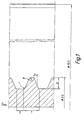
- Fig 1 illustrates how the parameters describing the profile according to the invention are defined.
- the implant shown is a screw-shaped dental implant with a diameter of 3.5 mm.
- the thread profile has two thread flanks and the height of the thread is D.
- the top radius formed at the apex of the thread profile at the intersection of the two thread flanks is designated R, and the bottom radius between two adjacent thread profiles r.
- the thread flanks form an angle v with a plane which is perpendicular to a cross-section of the thread and perpendicular to the surface of the implant body.
- the distance L is defined as the distance between the points of intersection between the two flanks on a thread and the surface of the implant body, the surface of the implant body being defined as the cylindrical surface touching the deepest parts of the threads.
- a standard prior art screw-shaped implant with an overall diameter of 3.5 mm would typically be provided with threads having a height D of about 0.35 mm, a flank angle v of 30°, a top radius R of about 0.065 mm corresponding to about 0.2xD and bottom radius of about 0.05 mm corresponding to about 0.15xD.
- the object of the invention is to equalize and mimimize the stress concentrations in the bone tissue which are a result of the loads on the implant in order to obtain an even stress distribution in the bone tissue so as to avoid resorption of the bone tissue because of high stress concentrations whilst avoiding low stresses that also might cause bone tissue resorption.
- screw threads either having a top radius exceeding 0.4xD or a flank angle exceeding 35° substantially equalizes the stress distribution in the bone tissue surrounding the implant.
- the top radius R should be larger than 0.2xD and smaller than D for 35° ⁇ v ⁇ 55° and 0.05 ⁇ D ⁇ 0.5 mm and larger than 0.4xD and smaller than D for 10° ⁇ v ⁇ 35° and 0.25 ⁇ D ⁇ 0.5 mm.
- the object studied is a vertically oriented screw-like implant with a major diameter of 3.5 mm.
- This implant is built up of identical axisymmetric elements where each element corresponds to one pitch height of a screw.
- the thread is modeled as a ring on each element.
- the profile of the thread as seen in Fig. 1 is characterized by the thread depth ( D ), the top radius ( R ), the flank angle ( v ), the bottom radius ( r ) and a straight part of the length S at the bottom of the thread.
- the length of the curved part of such an element is, as defined above, designated L .
- the bone was assumed to be attached to the inner wall of an outer cylinder with a diameter of 10.5 mm, see Fig. 1. Rotational symmetry was further assumed.
- the implant and the outer cylinder were assumed to be infinitely stiff while the bone was assumed to be a continuum material, isotropic and linearly elastic with a modulus of elasticity (Young's modulus) of 150 GPa and a Poisson's ratio amounting to 0.3.
- Youngng's modulus Youngng's modulus
- the bone-implant interface was frictionless and that only compressive forces could be transmitted between the implant and the bone.
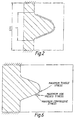
- These interface conditions are modeled by means of contact elements, the lines adjacent to the thread surface in Fig. 2. As is evident from fig. 2 parts of the interface does not have contact elements, the reason being that the interfacial bone at these locations in test runs had turned out to retreated from the implant.
- the load, F which was transmitted from the implant element into the bone tissue was set as a constant ( k ) multiplied with the length ( L + S ) of the implant element which latter was dependent upon the top radius, the flank angle, the bottom radius, the thread depth and the length of the straight part if any.
- the information seeked was the maximum tensile stress, the maximum compressive stress and the maximum von Mieses stress in the bone as a function of the values of the variables used.
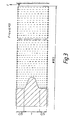
- the implant element was modeled to be completely stiff and fixed, the load F being applied at the further end of the bone as is shown in Fig. 3.
- the element mesh was built up parametrically.
- Each element contained four nodes, the number of degrees of freedom for each node being two.
- the number of elements used in the mesh varied with the length of the straight portion at the bottom of the thread expressed by the coefficient c. With a value of the coefficient c of 0, 0.2-0.4 and 0.8-1.6 the number of elements were 1129, 1305 and 1481 respectively.
- the ratios ⁇ u0 -/ ⁇ u0 + and ⁇ u90 -/ ⁇ u90 + are according to the above 1.45 and 2.61 respectively.
- the ratios ⁇ max -/1.45 and ⁇ max -/2.61 are presented in the results (tables 1-4 and 9-12).
- the ratio ⁇ max -/2 is the value which is of most interest.
- This formula does not take into consideration a situation where the compressive stress of a material differs from the tensile stress.
- An analysis of the results showed that the maximum von Mieses stress regularly was composed of one high compressive principal stress, one compressive stress of intermediate magnitude and one insignificant tensile principle stress. In order to be directly comparable with the maximum tensile stress the maximum von Mieses stress should, as the maximum compressive stress, be divided with a certain factor.
- Tables 1 - 4 show the results of the calculations.
- the values for ⁇ + max generally are less than 2 and for ⁇ max -/1.45 generally are less than 2.75 (which corresponds to a value also less than 2 for ⁇ max -/2) within the rectangles which are drawn with dashed lines in table 1 only but are to correspond to the fields 0.05 mm ⁇ D ⁇ 0.5 mm and 35° ⁇ v ⁇ 55°, the top radius R being larger than 0.2xD but smaller than D; 0.25 mm ⁇ D ⁇ 0.5 mm and 10° ⁇ v ⁇ 35°, R being greater than 0.4xD but smaller than D.
- the calculation results for the parameter fields in which ⁇ + max ⁇ 2 and ⁇ max -/2 ⁇ 2 are illustrated with full lines in the tables.
- Tables 5 - 8 illustrate the effect obtained by the introduction of a distance S between two adjacent threads.
- the part of the distance S which is staight is given as a coefficient to be multiplied with the length L, i. e. the distance defined above between the points where the flanks intersect the body of the implant. If the coefficient is 0 there is no positive effect of the introduction of a straight part.
- the positive effects mainly occur for small flank angles and for relatively large top radii, the parameter fields being shifted slighty to lower top radii for small flank angles as for instance can be seen by comparing tables 3 and 11.
- Tables 9 - 12 show the minimum values for ⁇ + max and the corresponding ⁇ max -/1.45 corresponding to the values given in tables 5 - 8.
- Top radius Flank angle Bottom radius Thread height(D) Straight part at bottom 1 0.03-0.05 37°-43° 0.01-0.025 0.08-0.15 0 2 0.2D-1.0D 35°-55° 0 -0.2D 0.05-0.15 0 3 0.2D-1.0D 35°-55° 0 -0.2D 0.05-0.15 0-1D 4 0.2D-1.0D 35°-55° 0 -0.2D 0.05-0.15 1D-2D 5 0.2D-1.0D 35°-55° 0 -0.2D 0.15-0.25 0 6 0.2D-1.0D 35°-55° 0 -0.2D 0.15-0.25 0-1D 7 0.2D-1.0D 35°-55° 0 -0.2D 0.15-0.25 1D-2D 8 0.2D-1.0D 35°-55° 0 -0.2D 0.15-0.35 0 9 0.2D-1.0D 35°-55° 0 -0.2D 0.25-0.35 0 9 0.2D-1.0D 35
- the distance between adjacent threads is smaller than 3D, preferably smaller than 2D.
- the threads or macroroughness is combined with a microroughness having a pore size of 2 ⁇ to 20 ⁇ , preferably 2 ⁇ to 10 ⁇ .
- a microroughness having a pore size of 2 ⁇ to 20 ⁇ , preferably 2 ⁇ to 10 ⁇ .
- the radius R has been constant and has been real in the above examples.
- the top radius R at the apex is imaginary and defines a the transition point P1 between the straight flank and the curved apex, a first tangent through P1 being directed along said flank, as well as a crest point P2 on the apex in which a second tangent to the curved part is parallel to the longitudinal direction of the implant.
- the curved apex has the shape of curved part originating in said points P1 and P2 and has tangents in said points coinciding with said first and second tangents, and has a radius of curvature R1.
- the radius R1 may for instance increase from a value R min to a value R max or may increase from a value R min to a value R max , then decreasing to a value R min .
- R min should preferably be greater than 0.01 mm and the relationship R max /R min preferably should be greater than 3.
- flank angles of the thread or roughness not necessarily have to be identical even if this is a preferred embodiment. In some applications the angles may be different although both are within the ranges specified, in another applications it may be sufficient that the flank being the most heavily loaded has a flank angle within the ranges specified. The same is valid for the top radius which in similarity may have different values on the respective sides of the thread, both values or only one value being within the ranges specified.
Landscapes
- Health & Medical Sciences (AREA)
- Orthopedic Medicine & Surgery (AREA)
- Life Sciences & Earth Sciences (AREA)
- Animal Behavior & Ethology (AREA)
- Veterinary Medicine (AREA)
- Public Health (AREA)
- General Health & Medical Sciences (AREA)
- Surgery (AREA)
- Oral & Maxillofacial Surgery (AREA)
- Dentistry (AREA)
- Epidemiology (AREA)
- Medical Informatics (AREA)
- Molecular Biology (AREA)
- Heart & Thoracic Surgery (AREA)
- Biomedical Technology (AREA)
- Engineering & Computer Science (AREA)
- Nuclear Medicine, Radiotherapy & Molecular Imaging (AREA)
- Neurology (AREA)
- Prostheses (AREA)
- Dental Prosthetics (AREA)
- Materials For Medical Uses (AREA)
Claims (19)
- Gewinde oder orientierte Makrorauhheit für Knochenimplantate, insbesondere mit Gewinde versehene Zahnimplantate, wobei ein Bereich des genannten Gewindes oder der Rauhheit, d.h. das Profil, eine Höhe D besitzt und zwei Flanken sowie eine abgerundete Spitze, die die beiden Flanken verbindet, aufweist, jede Flanke einen Winkel v mit einer Ebene bildet, die auf dem Querschnitt des Gewindes oder der Rauhheit sowie auf der Oberfläche des Implantatkörpers senkrecht steht, und wobei für jede Flankedadurch gekennzeichnet, dass für jede Flanke der Winkel v im Intervall 10°≤ v ≤ 55° liegt und für alle Flanken, bei denen 10° ≤ v ≤ 35° ist, R einen Wert grösser als 0,4D aufweist, wogegen für alle Flanken, worin 35° ≤ v ≤ 55° ist, R einen Wert grösser als 0,2D besitzt.ein Übergangspunkt P1 zwischen der Flanke und der abgerundeten Spitze definiert ist und eine erste Tangente an der abgerundeten Spitze durch P1 entlang der genannten Flanke verläuft,ein Scheitelpunkt P2 auf der abgerundeten Spitze definiert ist, bei dem eine zweite Tangente an die abgerundete Spitze parallel zur Längsrichtung des Implantats verläuft, undein imaginärer Spitzenradius R an der Spitze einen gekrümmten Bereich definiert, der in den genannten Punkten P1 und P2 beginnt und an diesen Punkten Tangenten aufweist, die mit der genannten ersten und zweiten Tangente zusammenfallen,
- Gewinde oder orientierte Makrorauhheit gemäss Anspruch 1, wobei das genannte Gewinde oder die orientierte Makrorauhheit eine Grundlänge S aufweist, und bei der für 0,15 ≤ D ≤ 0,25 mm, 10° ≤ v ≤ 35° und 0,5 D ≤ S ≤ 2D der Wert R grösser als 0,5D, jedoch kleiner als 0,7D ist.
- Gewinde oder orientierte Makrorauhheit gemäss Anspruch 1, wobei für 0,05 mm ≤ D ≤ 0,5 mm und 35° ≤ v ≤ 55° der Spitzenradius R grösser ist als 0,2D, jedoch kleiner als D, und worin für 0,25 mm ≤ D ≤ 0,5 mm und 35° ≤ v ≤ 55° R grösser ist als 0,4D, jedoch kleiner als D.
- Gewinde oder orientierte Makrorauhheit gemäss Anspruch 3, worin für 0,25 mm ≤ D ≤ 0,5 mm und 10° ≤ v ≤ 35° R grösser ist als 0,6 D, jedoch kleiner als D.
- Gewinde oder orientierte Makrorauhheit gemäss Anspruch 3, worin 0,05 ≤ D ≤ 0,25 mm für 35° ≤ v ≤ 55° ist.
- Gewinde oder orientierte Makrorauhheit gemäss Anspruch 5, worin 0,05 ≤ D, ≤ 0,15 mm für 35° ≤ v ≤ 55° ist.
- Gewinde oder orientierte Makrorauhheit gemäss Anspruch 6, worin 0,05 ≤ D ≤ 0,1 mm für 35° ≤ v ≤ 55° ist.
- Gewinde oder orientierte Makrorauhheit gemäss Anspruch 1, worin ein Grundradius r am Grunde der Vertiefung zwischen zwei benachbarten Gewindegängen oder Rauhheiten gebildet ist und 0,03 ≤ R ≤ 0,05 mm, 37° ≤ v ≤ 43°, 0,01 ≤ r ≤ 0,025 mm und 0,08 ≤ D ≤ 0,15 mm ist.
- Gewinde oder orientierte Makrorauhheit gemäss einem der vorstehenden Ansprüche, worin der Abstand zwischen zwei benachbarten Gewindegängen oder Rauhheiten, von Scheitel zu Scheitel gemessen, kleiner als 3D, vorzugsweise kleiner als 2D ist.
- Gewinde oder orientierte Makrorauhheit nach einem der vorstehenden Ansprüche, worin die abgerundete Spitze einen Krümmungsradius R1 aufweist und der genannte Krümmungsradius R1 konstant und gleich dem genannten imaginären Radius R ist.
- Gewinde oder orientierte Makrorauhheit gemäss einem der Ansprüche 1 bis 9, worin die genannte abgerundete Spitze einen Krümmungsradius R1 besitzt, und für jede Flanke, welche den genannten Übergangspunkt P1 mit dem Scheitelpunkt P2 verbindet, der genannte Krümmungsradius R1 zwischen einem Mindestwert Rmin und einem Höchstwert Rmax schwankt.
- Gewinde oder orientierte Makrorauhheit gemäss Anspruch 11, dadurch gekennzeichnet, dass die Beziehung Rmax/Rmin grösser ist als 3.
- Gewinde oder orientierte Makrorauhheit gemäss Anspruch 11 oder 12, dadurch gekennzeichnet, dass Rmin grösser als 0,01 mm ist.
- Gewinde oder orientierte Makrorauhheit gemäss einem der vorstehenden Ansprüche, dadurch gekennzeichnet, dass das genannte Profil symmetrisch ist.
- Gewinde oder orientierte Makrorauhheit gemäss einem der Ansprüche 1 bis 13, dadurch gekennzeichnet, dass der genannte imaginäre Spitzenradius R oder der Krümmungsradius R1 an einer ersten Gewindeflanke vorhanden ist, die zweite Gewindeflanke mit einem anderen Radius an der Spitze des Gewindes versehen ist, der vom genannten ersten Radius abweicht und eine Tangente aufweist, die mit der genannten zweiten Flanke zusammenfällt, und eine Tangente durch P2, die zur Längsachse des Implantats parallel ist.
- Gewinde oder orientierte Makrorauhheit gemäss einem der Ansprüche 1 bis 13, dadurch gekennzeichnet, dass der genannte imaginäre Spitzenradius R oder der Krümmungsradius R1 an einer ersten Gewindeflanke angeordnet ist, wobei die zweite Gewindeflanke mit einem weiteren Radius am Gewindescheitel versehen ist, der mit dem genannten ersten Radius identisch ist und der eine Tangente aufweist, die mit der genannten zweiten Flanke zusammenfällt, sowie eine Tangente durch P2, die parallel zur Längsachse des Implantats verläuft.
- Gewinde oder orientierte Makrorauhheit gemäss einem der vorstehenden Ansprüche, dadurch gekennzeichnet, dass die genannten Gewinde oder Makrorauhheiten mit einer aufgeprägten Mikrorauhheit versehen sind, welche eine Porengrösse von 2 µ bis 20 µ, vorzugsweise 2 µ bis 10 µ aufweist.
- Implantat, dadurch gekennzeichnet, dass es mindestens zum Teil mit Gewinden oder einer orientierten Makrorauhheit gemäss einem der vorstehenden Ansprüche versehen ist.
- Implantat gemäss Anspruch 18, dadurch gekennzeichnet, dass es mit mindestens einem zusätzlichen, unterschiedlichen Gewinde versehen ist.
Applications Claiming Priority (3)
| Application Number | Priority Date | Filing Date | Title |
|---|---|---|---|
| SE9600517A SE9600517D0 (sv) | 1996-02-13 | 1996-02-13 | Screw thread implant |
| SE9600517 | 1996-02-13 | ||
| PCT/SE1997/000212 WO1997029713A1 (en) | 1996-02-13 | 1997-02-12 | Screw thread implant |
Publications (2)
| Publication Number | Publication Date |
|---|---|
| EP0959801A1 EP0959801A1 (de) | 1999-12-01 |
| EP0959801B1 true EP0959801B1 (de) | 2003-12-03 |
Family
ID=20401367
Family Applications (1)
| Application Number | Title | Priority Date | Filing Date |
|---|---|---|---|
| EP97903696A Expired - Lifetime EP0959801B1 (de) | 1996-02-13 | 1997-02-12 | Schraubbares implantat |
Country Status (21)
| Country | Link |
|---|---|
| US (1) | US6036491A (de) |
| EP (1) | EP0959801B1 (de) |
| JP (1) | JP4374083B2 (de) |
| KR (1) | KR100484687B1 (de) |
| AR (1) | AR005810A1 (de) |
| AT (1) | ATE255376T1 (de) |
| AU (1) | AU702009B2 (de) |
| BR (1) | BR9707507A (de) |
| CA (1) | CA2243086C (de) |
| DE (1) | DE69726608T2 (de) |
| DK (1) | DK0959801T3 (de) |
| ES (1) | ES2212073T3 (de) |
| IL (1) | IL125533A0 (de) |
| IS (1) | IS1799B (de) |
| NO (1) | NO324684B1 (de) |
| PL (1) | PL185735B1 (de) |
| PT (1) | PT959801E (de) |
| RU (1) | RU2181990C2 (de) |
| SE (1) | SE9600517D0 (de) |
| WO (1) | WO1997029713A1 (de) |
| ZA (1) | ZA971181B (de) |
Families Citing this family (33)
| Publication number | Priority date | Publication date | Assignee | Title |
|---|---|---|---|---|
| SE9802572D0 (sv) | 1998-07-17 | 1998-07-17 | Astra Ab | Dental implant |
| SE9802571D0 (sv) | 1998-07-17 | 1998-07-17 | Astra Ab | Implant |
| EP1104753A1 (de) | 1999-12-03 | 2001-06-06 | Dsm N.V. | Verfahren zur Wiedergewinnung der Monomerbestandteile von Nylon aus Teppich |
| TW491714B (en) * | 1999-12-08 | 2002-06-21 | Wen-Jing Shiue | Orthopedic implant having a porous surface and method of making same |
| US7137817B2 (en) * | 2000-12-22 | 2006-11-21 | Quantum Bioengineering, Ltd. | Implant fixation device |
| US6726084B2 (en) * | 2001-06-15 | 2004-04-27 | Lockheed Martin Corporation | Friction stir heating/welding with pin tool having rough distal region |
| SE0102749D0 (sv) | 2001-08-15 | 2001-08-15 | Astra Tech Ab | Implant, arrangement comprising an implant, and method for inserting said implant in bone tissue |
| US6953463B2 (en) * | 2001-10-12 | 2005-10-11 | Hs West Investments, Llc | Interference screws having increased proximal diameter |
| SE523395C2 (sv) | 2001-12-21 | 2004-04-13 | Nobel Biocare Ab | Implantat och förfarande och system för tillhandahållande av sådant implantat |
| SE520756C2 (sv) | 2001-12-21 | 2003-08-19 | Nobel Biocare Ab | Förfarande för att åstadkomma ytstruktur på implantat samt sådant implantat |
| JP3820390B2 (ja) * | 2002-08-26 | 2006-09-13 | 株式会社アイキャット | 人工歯根埋入位置算出方法、人工歯根埋入位置算出装置、コンピュータプログラム及び記録媒体 |
| IL190642A (en) * | 2002-11-13 | 2011-06-30 | Biomet 3I Llc | Dental implant system |
| RU2226080C1 (ru) * | 2002-12-18 | 2004-03-27 | Абдуллаев Фикрет Мавлудинович | Способ стимуляции костеобразования при внутрикостной имплантации |
| US20090233256A1 (en) * | 2008-03-14 | 2009-09-17 | Robert Schroering | Band of Connective Tissue Grooves for Use with a Dental Implant or a Separate Abutment for a Dental Implant |
| US8651863B2 (en) * | 2003-04-01 | 2014-02-18 | Robert Schroering | Band of connective tissue grooves for use with a dental implant or a separate abutment for a dental implant |
| US20040230195A1 (en) * | 2003-05-14 | 2004-11-18 | Inion Ltd. | Soft-tissue screw |
| WO2007025784A2 (en) * | 2005-09-02 | 2007-03-08 | Ziterion Gmbh | Immediate-load dental implants |
| EP1792580A1 (de) * | 2005-09-27 | 2007-06-06 | Ziterion GmbH | Zweiteilige Dentalimplantate aus biocompatiblen Keramiken |
| EP1870054A3 (de) * | 2006-06-12 | 2008-05-14 | Vilardell Purti, S.A. | Zahnimplantat |
| EA010624B1 (ru) * | 2006-10-23 | 2008-10-30 | Производственное Частное Унитарное Предприятие "Верлайн" | Поликомпонентный стоматологический имплантат |
| DE102006054533A1 (de) * | 2006-11-15 | 2008-05-21 | Resoimplant Gmbh | Fixationselement für Knochenfragment |
| US20080234763A1 (en) * | 2007-03-16 | 2008-09-25 | Patterson Chad J | Surgical compression bone screw |
| US8574273B2 (en) | 2009-09-09 | 2013-11-05 | Innovision, Inc. | Bone screws and methods of use thereof |
| JP5922581B2 (ja) * | 2009-10-28 | 2016-05-24 | スミス アンド ネフュー インコーポレーテッド | ねじ切りされた縫合糸アンカー |
| IL201902A (en) | 2009-11-03 | 2012-12-31 | Ben-Zion Karmon | Dental implant |
| EP2510898A1 (de) * | 2011-04-14 | 2012-10-17 | Astra Tech AB | Befestigungsvorrichtung |
| US10201405B2 (en) | 2011-06-28 | 2019-02-12 | Biomet 3I, Llc | System and method of dental implant and interface to abutment for restoration |
| WO2014149746A1 (en) | 2013-03-15 | 2014-09-25 | Innovision, Inc. | Bone screws and methods of use thereof |
| DE102013107630A1 (de) * | 2013-07-17 | 2015-01-22 | Hochschule Koblenz | Zahnimplantat mit koronaler Nutstruktur |
| US10413387B2 (en) * | 2015-01-20 | 2019-09-17 | John Andler | Threaded dental implant |
| US11648037B2 (en) | 2017-05-03 | 2023-05-16 | Advance Research System, Llc | Extension-ready spinal support system with vascular-safe pedicle screw |
| US10646260B2 (en) | 2017-05-03 | 2020-05-12 | Advance Research System, Llc | Extension ready spinal support systems |
| TWI763162B (zh) * | 2020-12-04 | 2022-05-01 | 鐿鈦科技股份有限公司 | 縫合錨釘與其系統及植入方法 |
Family Cites Families (9)
| Publication number | Priority date | Publication date | Assignee | Title |
|---|---|---|---|---|
| DE2659916A1 (de) * | 1976-05-14 | 1977-11-24 | Pfaudler Werke Ag | Verfahren zur herstellung eines implantats mit schleifender oberflaeche |
| EP0209685A3 (de) * | 1985-07-12 | 1988-11-09 | Fischerwerke Arthur Fischer GmbH & Co. KG | Befestigungselement für die Osteosynthes |
| EP0230678A1 (de) * | 1986-01-29 | 1987-08-05 | Massimiliano Barcali | Endosteales Schraubenimplantat |
| JP2580677B2 (ja) * | 1988-02-23 | 1997-02-12 | 三菱マテリアル株式会社 | 人工歯根 |
| SE9102451L (sv) * | 1991-08-27 | 1992-11-16 | Nobelpharma Ab | Skruvformat faestelement av titan foer permanent foerankring i benvaevnad. |
| IT1253481B (it) * | 1991-10-08 | 1995-08-08 | Impianto endoosseo dentario a vite. | |
| SE9202911D0 (sv) * | 1992-10-05 | 1992-10-05 | Astra Ab | Fixture provided with micro-threads |
| SE9203184D0 (sv) * | 1992-10-28 | 1992-10-28 | Astra Ab | Dental implant |
| US5571139A (en) * | 1995-05-19 | 1996-11-05 | Jenkins, Jr.; Joseph R. | Bidirectional suture anchor |
-
1996
- 1996-02-13 SE SE9600517A patent/SE9600517D0/xx unknown
-
1997
- 1997-02-12 EP EP97903696A patent/EP0959801B1/de not_active Expired - Lifetime
- 1997-02-12 IL IL12553397A patent/IL125533A0/xx not_active IP Right Cessation
- 1997-02-12 KR KR10-1998-0706233A patent/KR100484687B1/ko not_active Expired - Lifetime
- 1997-02-12 RU RU98114794/14A patent/RU2181990C2/ru active
- 1997-02-12 ZA ZA9701181A patent/ZA971181B/xx unknown
- 1997-02-12 PL PL97328428A patent/PL185735B1/pl not_active IP Right Cessation
- 1997-02-12 ES ES97903696T patent/ES2212073T3/es not_active Expired - Lifetime
- 1997-02-12 AT AT97903696T patent/ATE255376T1/de active
- 1997-02-12 WO PCT/SE1997/000212 patent/WO1997029713A1/en not_active Ceased
- 1997-02-12 PT PT97903696T patent/PT959801E/pt unknown
- 1997-02-12 JP JP52926197A patent/JP4374083B2/ja not_active Expired - Lifetime
- 1997-02-12 AU AU18170/97A patent/AU702009B2/en not_active Ceased
- 1997-02-12 BR BR9707507A patent/BR9707507A/pt not_active IP Right Cessation
- 1997-02-12 DE DE69726608T patent/DE69726608T2/de not_active Expired - Lifetime
- 1997-02-12 CA CA002243086A patent/CA2243086C/en not_active Expired - Fee Related
- 1997-02-12 DK DK97903696T patent/DK0959801T3/da active
- 1997-02-12 US US08/809,261 patent/US6036491A/en not_active Expired - Lifetime
- 1997-02-13 AR ARP970100575A patent/AR005810A1/es unknown
-
1998
- 1998-07-31 IS IS4815A patent/IS1799B/is unknown
- 1998-08-12 NO NO19983692A patent/NO324684B1/no not_active IP Right Cessation
Also Published As
| Publication number | Publication date |
|---|---|
| AU702009B2 (en) | 1999-02-11 |
| KR19990082500A (ko) | 1999-11-25 |
| WO1997029713A1 (en) | 1997-08-21 |
| DK0959801T3 (da) | 2004-01-26 |
| JP2000504607A (ja) | 2000-04-18 |
| PL328428A1 (en) | 1999-02-01 |
| DE69726608D1 (de) | 2004-01-15 |
| CA2243086C (en) | 2007-06-12 |
| AR005810A1 (es) | 1999-07-14 |
| EP0959801A1 (de) | 1999-12-01 |
| KR100484687B1 (ko) | 2005-11-25 |
| AU1817097A (en) | 1997-09-02 |
| PL185735B1 (pl) | 2003-07-31 |
| ES2212073T3 (es) | 2004-07-16 |
| ZA971181B (en) | 1997-08-13 |
| NO983692D0 (no) | 1998-08-12 |
| RU2181990C2 (ru) | 2002-05-10 |
| NO324684B1 (no) | 2007-12-03 |
| BR9707507A (pt) | 1999-07-27 |
| IS4815A (is) | 1998-07-31 |
| DE69726608T2 (de) | 2004-10-14 |
| PT959801E (pt) | 2004-04-30 |
| JP4374083B2 (ja) | 2009-12-02 |
| ATE255376T1 (de) | 2003-12-15 |
| SE9600517D0 (sv) | 1996-02-13 |
| US6036491A (en) | 2000-03-14 |
| IS1799B (is) | 2002-01-10 |
| IL125533A0 (en) | 1999-03-12 |
| CA2243086A1 (en) | 1997-08-21 |
| NO983692L (no) | 1998-09-29 |
Similar Documents
| Publication | Publication Date | Title |
|---|---|---|
| EP0959801B1 (de) | Schraubbares implantat | |
| US6102956A (en) | Modular endoprosthesis | |
| CN1154441C (zh) | 用于骨头的固定系统 | |
| US20190167324A1 (en) | Method of making a self-cleaning self-cutting implant | |
| US20230398657A1 (en) | Implant with high primary stability and accelerated secondary stability | |
| JP2002542875A (ja) | ブロックできる骨板 | |
| CN102188282A (zh) | 具有弯曲形状螺纹的骨固定系统 | |
| WO2001058336A2 (en) | Intramedullary interlock screw | |
| WO1996018356A1 (en) | Design process for skeletal implants to optimize cellular response | |
| KR20080102188A (ko) | 다중 나사식 뼈스크류 및 방법 | |
| KR20160033143A (ko) | 관상 홈 구조를 갖는 치아 임플란트 | |
| JP7429989B2 (ja) | ヒーリングチャンバーを伴うアンカー | |
| WO2007086622A1 (en) | Fixture | |
| US12383380B2 (en) | Dental implant with improved threading | |
| US4919677A (en) | Prosthetic acetabulum | |
| CN102596094A (zh) | 具有改善的骨结合特性的牙植入体 | |
| US20070009854A1 (en) | Dental or medical implants and method therefor | |
| US20200405353A1 (en) | Assemblable artificial bone plate and artificial bone plate unit | |
| KR102082120B1 (ko) | 임플란트용 픽스쳐 | |
| KR200362463Y1 (ko) | 픽스츄어 | |
| WO2025229696A1 (en) | A dental implant with a gradual change in thread morphology | |
| CN223158421U (zh) | 一种双锥形渐变螺牙骨螺钉 | |
| US20230200951A1 (en) | Dental implant made of a metal or a metal alloy | |
| JP2001523133A (ja) | インプラント装置 | |
| CN121265153A (zh) | 一种分区螺纹运动医学锚钉 |
Legal Events
| Date | Code | Title | Description |
|---|---|---|---|
| PUAI | Public reference made under article 153(3) epc to a published international application that has entered the european phase |
Free format text: ORIGINAL CODE: 0009012 |
|
| 17P | Request for examination filed |
Effective date: 19980914 |
|
| AK | Designated contracting states |
Kind code of ref document: A1 Designated state(s): AT BE CH DE DK ES FI FR GB GR IE IT LI NL PT SE |
|
| RAP1 | Party data changed (applicant data changed or rights of an application transferred) |
Owner name: ASTRAZENECA AB |
|
| 17Q | First examination report despatched |
Effective date: 20020529 |
|
| RAP1 | Party data changed (applicant data changed or rights of an application transferred) |
Owner name: ASTRA TECH AB |
|
| GRAH | Despatch of communication of intention to grant a patent |
Free format text: ORIGINAL CODE: EPIDOS IGRA |
|
| GRAS | Grant fee paid |
Free format text: ORIGINAL CODE: EPIDOSNIGR3 |
|
| GRAA | (expected) grant |
Free format text: ORIGINAL CODE: 0009210 |
|
| AK | Designated contracting states |
Kind code of ref document: B1 Designated state(s): AT BE CH DE DK ES FI FR GB GR IE IT LI NL PT SE |
|
| REG | Reference to a national code |
Ref country code: GB Ref legal event code: FG4D |
|
| REG | Reference to a national code |
Ref country code: CH Ref legal event code: EP |
|
| REG | Reference to a national code |
Ref country code: IE Ref legal event code: FG4D |
|
| REF | Corresponds to: |
Ref document number: 69726608 Country of ref document: DE Date of ref document: 20040115 Kind code of ref document: P |
|
| REG | Reference to a national code |
Ref country code: DK Ref legal event code: T3 |
|
| REG | Reference to a national code |
Ref country code: SE Ref legal event code: TRGR |
|
| REG | Reference to a national code |
Ref country code: GR Ref legal event code: EP Ref document number: 20040400743 Country of ref document: GR |
|
| REG | Reference to a national code |
Ref country code: PT Ref legal event code: SC4A Free format text: AVAILABILITY OF NATIONAL TRANSLATION Effective date: 20040303 Ref country code: CH Ref legal event code: NV Representative=s name: BUGNION S.A. |
|
| REG | Reference to a national code |
Ref country code: ES Ref legal event code: FG2A Ref document number: 2212073 Country of ref document: ES Kind code of ref document: T3 |
|
| ET | Fr: translation filed | ||
| PLBE | No opposition filed within time limit |
Free format text: ORIGINAL CODE: 0009261 |
|
| STAA | Information on the status of an ep patent application or granted ep patent |
Free format text: STATUS: NO OPPOSITION FILED WITHIN TIME LIMIT |
|
| 26N | No opposition filed |
Effective date: 20040906 |
|
| REG | Reference to a national code |
Ref country code: FR Ref legal event code: PLFP Year of fee payment: 20 |
|
| PGFP | Annual fee paid to national office [announced via postgrant information from national office to epo] |
Ref country code: CH Payment date: 20160203 Year of fee payment: 20 Ref country code: IT Payment date: 20160205 Year of fee payment: 20 Ref country code: IE Payment date: 20160201 Year of fee payment: 20 Ref country code: ES Payment date: 20160225 Year of fee payment: 20 Ref country code: DE Payment date: 20160202 Year of fee payment: 20 Ref country code: DK Payment date: 20160203 Year of fee payment: 20 |
|
| PGFP | Annual fee paid to national office [announced via postgrant information from national office to epo] |
Ref country code: SE Payment date: 20160215 Year of fee payment: 20 Ref country code: BE Payment date: 20160201 Year of fee payment: 20 Ref country code: PT Payment date: 20160120 Year of fee payment: 20 Ref country code: FI Payment date: 20160202 Year of fee payment: 20 Ref country code: GR Payment date: 20160208 Year of fee payment: 20 Ref country code: FR Payment date: 20160208 Year of fee payment: 20 Ref country code: AT Payment date: 20160202 Year of fee payment: 20 Ref country code: NL Payment date: 20160212 Year of fee payment: 20 Ref country code: GB Payment date: 20160204 Year of fee payment: 20 |
|
| REG | Reference to a national code |
Ref country code: DE Ref legal event code: R071 Ref document number: 69726608 Country of ref document: DE |
|
| REG | Reference to a national code |
Ref country code: DK Ref legal event code: EUP Effective date: 20170212 |
|
| REG | Reference to a national code |
Ref country code: CH Ref legal event code: PL Ref country code: NL Ref legal event code: MK Effective date: 20170211 |
|
| REG | Reference to a national code |
Ref country code: GB Ref legal event code: PE20 Expiry date: 20170211 |
|
| REG | Reference to a national code |
Ref country code: IE Ref legal event code: MK9A |
|
| REG | Reference to a national code |
Ref country code: SE Ref legal event code: EUG |
|
| REG | Reference to a national code |
Ref country code: AT Ref legal event code: MK07 Ref document number: 255376 Country of ref document: AT Kind code of ref document: T Effective date: 20170212 |
|
| REG | Reference to a national code |
Ref country code: GR Ref legal event code: MA Ref document number: 20040400743 Country of ref document: GR Effective date: 20170213 |
|
| REG | Reference to a national code |
Ref country code: ES Ref legal event code: FD2A Effective date: 20170526 |
|
| PG25 | Lapsed in a contracting state [announced via postgrant information from national office to epo] |
Ref country code: PT Free format text: LAPSE BECAUSE OF EXPIRATION OF PROTECTION Effective date: 20170221 Ref country code: IE Free format text: LAPSE BECAUSE OF EXPIRATION OF PROTECTION Effective date: 20170212 Ref country code: GB Free format text: LAPSE BECAUSE OF EXPIRATION OF PROTECTION Effective date: 20170211 |
|
| PG25 | Lapsed in a contracting state [announced via postgrant information from national office to epo] |
Ref country code: ES Free format text: LAPSE BECAUSE OF EXPIRATION OF PROTECTION Effective date: 20170213 |