EP0959688B1 - Fromages affines et procede de fabrication - Google Patents
Fromages affines et procede de fabrication Download PDFInfo
- Publication number
- EP0959688B1 EP0959688B1 EP98908163A EP98908163A EP0959688B1 EP 0959688 B1 EP0959688 B1 EP 0959688B1 EP 98908163 A EP98908163 A EP 98908163A EP 98908163 A EP98908163 A EP 98908163A EP 0959688 B1 EP0959688 B1 EP 0959688B1
- Authority
- EP
- European Patent Office
- Prior art keywords
- cheese
- crust
- hydrocolloids
- paste
- flora
- Prior art date
- Legal status (The legal status is an assumption and is not a legal conclusion. Google has not performed a legal analysis and makes no representation as to the accuracy of the status listed.)
- Expired - Lifetime
Links
Images


Classifications
-
- A—HUMAN NECESSITIES
- A23—FOODS OR FOODSTUFFS; TREATMENT THEREOF, NOT COVERED BY OTHER CLASSES
- A23C—DAIRY PRODUCTS, e.g. MILK, BUTTER OR CHEESE; MILK OR CHEESE SUBSTITUTES; PREPARATION THEREOF
- A23C19/00—Cheese; Cheese preparations; Making thereof
- A23C19/06—Treating cheese curd after whey separation; Products obtained thereby
- A23C19/068—Particular types of cheese
- A23C19/0682—Mould-ripened or bacterial surface ripened cheeses
-
- A—HUMAN NECESSITIES
- A23—FOODS OR FOODSTUFFS; TREATMENT THEREOF, NOT COVERED BY OTHER CLASSES
- A23C—DAIRY PRODUCTS, e.g. MILK, BUTTER OR CHEESE; MILK OR CHEESE SUBSTITUTES; PREPARATION THEREOF
- A23C19/00—Cheese; Cheese preparations; Making thereof
- A23C19/14—Treating cheese after having reached its definite form, e.g. ripening or smoking
- A23C19/16—Covering the cheese surface, e.g. with wax coating compositions
-
- A—HUMAN NECESSITIES
- A23—FOODS OR FOODSTUFFS; TREATMENT THEREOF, NOT COVERED BY OTHER CLASSES
- A23C—DAIRY PRODUCTS, e.g. MILK, BUTTER OR CHEESE; MILK OR CHEESE SUBSTITUTES; PREPARATION THEREOF
- A23C19/00—Cheese; Cheese preparations; Making thereof
- A23C19/14—Treating cheese after having reached its definite form, e.g. ripening or smoking
- A23C19/16—Covering the cheese surface, e.g. with wax coating compositions
- A23C19/163—Covering the cheese surface, e.g. with wax coating compositions with a non-edible liquid or semi-liquid coating, e.g. wax, polymer dispersions
Definitions
- the invention relates to a new food product. cheese, and more precisely in a ripened cheese with a natural rind peelable and its manufacturing process.
- One of the aims of the invention is to provide a cheese essentially of traditional, refined type, whose properties are conferred essentially by a surface flora leading to the formation a superficial crust, this crust which, thanks to the process of the invention can be detached quickly and easily by "peeling", either by consumer at the time of consumption, either by the manufacturer at stage of production and / or packaging.
- the ability to "peel” or “peelability” will be defined by the fact that after priming, a single gesture is enough to detach and remove the rind from the cheese due to its non-adherence to the dough (like a banana peel).
- ripened cheeses are obtained by the following successive stages: solidification or coagulation of standardized milk or milk concentrate by the action of a coagulating agent, shaping of the curd, whether or not drained in molds, spontaneous or pressure draining allowing to obtain the desired dry extract of the final product, salting or brining, which gives the dough the desired salt content and allows the formation of a surface crust and drying.
- Coagulation takes place either by lowering the pH of the milk to its isoelectric point where it solidifies, either by action of proteolytic enzymes which destruct the casein and allow its gelation.
- acids can be used food, lactic ferments which transform lactose into acid lactic acid lowering pH or acidifying agents such as glucono-delta-lactone.
- the pH of the paste obtained is equal to or less than 5 and the paste of an acidic nature, which allows only the development of an acidophilic surface flora.
- the dough has a higher pH (greater than 5.0), which which only allows the development of a relatively superficial flora neutrophil.
- the ripening time is variable depending on the type of product and is from a few days to a few months. For most cheeses, this final crust, although edible, is often eliminated when consumption due to its thickness, appearance or taste. However, because of its adhesion to the paste, its elimination is not always easy and requires the use of a suitable utensil (knife, scraper).
- the invention therefore proposes to solve the related problems making a thin cheese crust while limiting the risks of surface drying, with the easy elimination of this crust and the development of new products thanks to the dissociation of the nature of the dough and the nature of the flora, offering consumers of cheeses with the characteristics organoleptics of traditional cheeses with natural rind, and possibly also aspects of these.
- the subject of the invention is a ripened cheese according to claim 1.
- the film is maintained on the final product after development of the ripening flora and constitutes a natural rind that can be peeled off.
- the ripened cheese also comprises at least one means for separating the crust consisting of a ribbon of which at least part of the length extends between the cheese dough and the rind, preferably at least one part extending along at least part of the periphery of the dough cheese, and at least one end of which protrudes from the rind.
- the separation means is constituted by a ribbon extending transversely relative to the around the cheese dough.
- the cheese obtained includes two means of separation of the crust constituted respectively by two crisscrossed ribbons.
- the ribbon (s) is (are) made up of at least one film a non-woven and non-degradable material advantageously wide between 5 and 10 mm.
- the width of the film can be equal to the width of the heel.
- a natural peelable crust as described above allows the establishment of such means of separation of the crust made up of ribbons placed around the cheese.
- the film is removed by peeling after the development of ripening flora and cheese paste naked is coated with a cheese coating.
- DE-A-653 344 which describes the application of gelling substances, in particular gelatin on non-cream cheese refined and cannot be refined due to the lack of seeding of the area of the cheese.
- DE-A-623 383 which describes the production of a pectin shell instead of gelatin, on a soft cheese or on processed cheese.
- pectin replaces the layer of gelatin previously described to avoid the drawbacks associated with this last (delamination from the surface of the cheese, hot solubility, medium of culture leading to the proliferation of bacteria, yeasts and molds).
- the objective of said coatings is to ensure the product protection and replace on fresh cheeses or processed cheeses the rind of the cheeses present in the cheeses hard paste with a natural rind.
- WO 86/06588 describing the application on an unripe curd, of an external envelope essentially semi-permeable consisting of a food gel which is an aqueous solution of at least one compound chosen from alginates, carrageenans, gelatin, food proteins or mixtures of these.
- the semi-permeable envelope is applied to a slightly ripened curd from a few hours to a few days and she is seeded with a surface flora.
- the coating of the product with a semi-permeable gel has, in this case, a specific objective, namely the slowing down of the ripening, and improved conservation.
- This document is not intended to provide a crust peelable by coating with a semi-permeable curd gel immediately after draining, preferably before the brining.
- the semi-permeable gels mentioned in this document namely gels based on gelatin, carrageenans, alginates or food proteins, if they are an excellent support for development of a ripening flora are not suitable in conditions used in the previous document for the manufacture of a film detachable by simple peeling and which can serve as a support for a flora refining.
- the solutions should be used at concentrations such that viscosity does not would not be compatible with an industrial process of implementation.
- gelatin is peelable only at very high concentrations, around 400 g per liter, which makes it unusable for the purpose of the invention.
- the viscosity of the aqueous solution is between 0.015 and 0.25 Pa.s, measured for a speed gradient of 152 s -1 at 60 ° C.
- the food gel consists at least in part of gellan gum.
- This polysaccharide can be used alone or in combination mixture, either with polysaccharides from other origins, for example vegetable, either with proteins.
- the mixture will contain at minus 30%, preferably 50% of an original polysaccharide microbial.
- gellan gum which is a polysaccharide of microbial origin in its form deacetylated commercial.
- the food gel according to the invention is chosen so as to that the gel time is preferably not more than 10 seconds, and better at 5 seconds, under the conditions of application selected.
- the film stabilized after standing for approximately 24 hours has advantageously a thickness of 0.3 to 0.5 mm, preferably between 0.2 and 0.5 mm, the terminals being included.
- the invention applies to all types of cheese, the organoleptic characteristics are conferred by the action of a flora of surface, whatever the format, grammage and technology of production of curds or basic cheese dough.
- cheese is meant both defined products by legislation under the term cheeses as dairy products marketed under other names which may contain non-dairy components such as vegetable raw materials or animal.
- the invention relates to all families of cheeses known such as fresh cheeses, soft cheeses, soft cheeses pressed cooked or not, spun dough, etc. which we want to give organoleptic and textural qualities essentially by the action of a surface ripening flora.
- the invention also relates to a manufacturing process ripened cheese: according to claims 15 and 25.
- the invention relates to Fresh soft cheeses, pressed, cooked or not and spun.
- the cheeses are obtained by solidification or coagulation of milk all animal species according to the processes in force in technology cheese.
- Milk standardized in fat and protein matter or the dairy concentrate is preferably pasteurized before undergoing the stage coagulation.
- Gelling or solidification is obtained either by addition of a proteolytic enzyme such as rennet, either by lowering from pH to the isoelectric point of the gel by the action of ferments lactic, food acids or acidifying agents such as glucono-delta-lactone.
- a proteolytic enzyme such as rennet
- the coagulum obtained is then drained. In order to facilitate the expulsion of the whey, it undergoes a cutting and slicing, which makes it possible to obtain curd grains. These latter then undergo a shaping step by an appropriate process. We may include as an example the passage through molding tubes traditionally used or suitable formers. This step allows you to give the cheese the final shape you want to give it.
- the curds After shaping and draining the curds and pressing, in the case of pressed cheeses, the curds are brined then re-dried before being sown in a refining flora chosen according to the aroma and taste that you want to give to the final product.
- the solution hydrocolloids is applied during or after the shaping step curd.
- the hydrocolloid solution is applied partially or fully drained curds, mostly before brining.
- the solution is deposited around it hydrocolloids which gel almost instantly in seconds on the curd by cooling.
- the process consists in coating the curd with a gel according to the invention after the step of pressing but before brining.
- a second alternative of the invention relates to the others types of cheese.
- curds of rennet or lactic origin are hot textured possibly after mixing with others dairy or non-dairy raw materials (milk powder, whey, buttermilk, cream, proteins and lipids of animal origin, etc.) and possibly addition of technological additives such as salts of iron at normal application doses (less than 3% by weight per relative to the total weight of the formulation).
- the textured products obtained are coated with semi-permeable gel during or after forming; they are then sown in a ripening flora chosen according to the aromas and taste that we want to impart to the product.
- the aqueous solution of hydrocolloids is applied before or after the shaping step on the curd obtained according to the first alternative or on the products obtained according to the second alternative, these products being abundant.
- the invention offers the possibility of develop natural rind products from sour curds or enriched rennet or textured curds to aerate the dough.
- the expanded product After expansion by conventional means (air or nitrogen injection), the expanded product is shaped, wrapped in semi-permeable gel, brined, dried, and seeded in a flora adapted to the development of aromatic characteristics of the product that we want to obtain and this without creating the inherent defects in this type of product: formation of a too thick crust peeling off the dough, creating unappetizing contrasts between the crust "Cartoner" and the expanded pulp, superficial deforestation due to implantation of flora, sagging of the product, ...
- the coating of the expanded curd with the gel according to the invention protects during possible brining, drying and maturing, especially if the product requires care in the cellar (turning, brushing, ...), the product weakened due to the operation of the proliferation.
- hydrocolloid solution having the aforementioned characteristics at a temperature between 45 and 95 ° C
- vaporization of the solution hydrocolloids on the drained curd or techniques like co-extrusion where the hydrocolloid solution is co-extruded around a cheese paste, in the latter case, the hydrocolloid solution gels at the time of co-extrusion.
- the coating will be carried out by the depot one or two layers of hydrocolloids.
- the hydrocolloid solution is preferably applied by co-extrusion of the paste and the solution through a forming sector.
- Another possibility is to fill with the product according to alternatives 1 and 2 of the invention, a film consisting of the compound gel polysaccharides, preformed by molding.
- the deposit must allow a stabilized film thickness less than 0.5 mm, preferably between 0.2 and 0.5 mm, necessary and sufficient thickness to ensure perfect "peelability" of the crust.
- the solution of hydrocolloids used is carried out by mixing said hydrocolloid (s) with water at a concentration between 1 and 5% by weight, i.e. concentration between 10 g and 50 g / l.
- micrococcaceae Brevibacterium linens or other corynebacteria can be developed alone or in combination on “acid” pastes in order to give fresh cheeses the tastes and aromas of washed rind cheeses, such as munster. or the Pont-l'Évêque.
- curds coated with semi-permeable gel obtained according to different alternatives will then be sown in a refining flora chosen according to the aromas and the taste that we want to give to the product.
- the semi-permeable film can also be removed, stage of manufacture, by any suitable industrial means and the cheese naked, can then be coated with a coating based on cheese waxes or wax substitutes such as acetoglycerides, coatings or any other suitable material, or pre-cut into individual portions and each portion packaged for marketing.
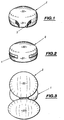
- the cheese according to the invention shown in the figures is made of cheese dough 1 surrounded by a natural rind 2 obtained by the development of a ripening flora implanted on a film previously placed on the surface of the dough; this film responding to features described above.
- the ripened cheese obtained thus has a peelable natural crust 2 and one or more means 3 separation of the crust into regions which may be themselves separated from the dough 1, consisting of one or more ribbon (s) or loop (s) at least part of the length of which extends under the crust.
- This ribbon preferably extends along the periphery 21 of the cheese paste, and for example in the case of a cheese having a general shape of revolution with circular cross-section, it can extend advantageously circumferentially around the region of the dough of larger diameter, as is the case in the figures.
- This configuration is well suited to "soft" cheeses, that is to say of soft consistency and whose dry extract is weaker than that of pressed cheeses.
- the cheese may, alternatively or in addition, contain one or more several ribbon (s) extending transversely relative to the periphery, for example, in the previous case, a ribbon extending along a diameter of an end face 22, of a generator in the form of revolution, with a diameter of the other end face 23 and another generator, at least one end of the tape also projecting out of the crust.
- a transverse ribbon is well suited to shaped cheeses approximately spherical.
- Two or more ribbons for example a perimeter ribbon and a cross ribbon, or cross ribbons, can intersect on the perimeter of the dough or on its faces.
- the ribbons can be made of a woven material, of a braided material with more or less loose mesh or in the form of mesh constituting a net, or of a non-woven and non-degradable material, for example non-woven polyester, but in particular to avoid deformations specific to each of these two types of material, advantageously, they have a composite structure comprising, from the outside towards the inside with reference to the cheese, a film of thermoplastic material of the polyethylene terephthalate type such as that known commercially under the name of PET23, a preferably colored adhesive (for example yellow), and a soft woven material of 30 g / m 2 ; advantageously, the width of the ribbons is between 5 and 10 mm; but it can be different if the shape of the product justifies it, for example having the width of the "heel" in the case of cheeses having the shape of a flattened cylinder. This ensures good adhesion of the tape due to the structure thereof and its wettability, while allowing separation that is both easy and
- the cheese pasta 1 (bare cheese) is transferred to horizontal and orderly and sequential position to a laying of tape and coating.
- FIG. 4A Part of a tape laying and coating station particularly suitable is shown schematically in the figures 4A to 4H.
- This type of tape laying and coating station is good suitable for the production of cheeses with a general shape cylindrical whose cross section is circular or even polygonal around a central axis and whose periphery 21 may even be slightly swollen, and two bases (22, 23) approximately flat or slightly domed at less near their center, the spacing of which corresponds to the thickness cheese paste.
- This item includes groups of conveyor grippers succeeding along a conveying path, intended for the transport of cheeses and for this purpose joined to training means (not shown) to be animated with a preferably rectilinear movement continuous and horizontal during the laying of the tape.
- These groups include each a central "anvil” 51 extending horizontally orthogonally to the conveying direction and two lateral clamps 52, 53 pivoting extending on either side of the anvil 51, the pivot axis of these two clamps 52, 53 being vertical and the clamps being movable in pivot between a position in which they extend substantially parallel to the conveying direction and a position in which they extend parallel to the anvil and its immediate vicinity.
- the post also includes tongs 54, 55 for cheese made up of two spouts arranged opposite each other with a modifiable controlled and mobile spacing parallel below and away from the conveyor path, in a back and forth movement along a predetermined fraction thereof. he also includes a pair of "shuttles" 56, 57 formed by rods approximately cylindrical extending horizontally orthogonally to the conveying path, traversing each, remaining parallel to itself, a closed path in a vertical plane passing through the path of conveying, with a variable mutual spacing also controlled.
- a strip 4 for example six millimeters wide is wound in a reel (not shown) around an extending axis orthogonally to the conveying path below it; we shoot this strip 4 below the conveying path by means of a shuttle, so as to advance it towards anvil 51 immediately downstream if we consider the direction of progression of the gripper groups the along the conveying path, the pair of shuttles 56, 57 then being arranged so that it is at a lower level than the groups clamps, and at this level it is downstream of the strip.
- the cheese pastes 1 being previously horizontal (i.e. positioned with their vertical central axis), successively we first tilt them to make them take a vertical position (axis central horizontal orthogonally to the conveying path) below the conveying path being centered in the thickness direction by relative to the vertical plane passing through the conveying path, and upstream of the strip section 4 which extends at the same level.
- the first vertical cheese dough 1 in starting from downstream is clamped between the clamps 54, 55 kept under pressure respectively against the bases thereof, the ribbon is itself pinched between the anvil 51 and the downstream conveyor clamp 52 extending in parallel at the anvil (closed position), and the shuttles 56, 57 are at a level lower than the cheese paste, the shuttles and the cheese paste being respectively on either side of the strip (FIG. 4A).
- the cheese dough 1 is moved using the clamps 54, 55, always keeping it below the path of conveying at the same distance from it and centered in the direction of the thickness relative to the vertical plane passing through the conveying path, towards strip 4 (downstream), and the pair may be moved of shuttles 56, 57 by maintaining them at the same level also in direction of the strip (upstream), until shuttle 57 upstream comes into contact with the strip; thus the action of cheese dough 1 and that of the upstream shuttle 57 cause the pinched strip to bend between the anvil 51 and the downstream clamp 52 (FIG. 4B).
- the upstream conveyor clamp 53 is then rotated to bring it into contact with the upstream strand 42 of the strip and the movement of this clamp until this upstream strand of the strip 4 is at its pinched turn, between the anvil 51 and the upstream clamp 53 ( Figure 4F).
- the cheeses being balanced on strip 4 between the two strands kept suspended between clamps and anvil they are brought one by one up to a first thermostatically controlled tank containing a coating solution, here a gellan gum solution, grab the links under the holding point, and by a vertical movement, we dip the cheese paste and the part of the ribbon which surrounds its periphery in the solution which constitutes a first soaking operation; then we reassemble the assembly and to obtain good coating regularity, repeat the entire operation of soaking and reassembly in a second thermostatically controlled tank containing a gellan gum solution for a second soaking.
- a coating solution here a gellan gum solution
- the products are brought one by one over a tank containing a suspension of sowing of surface germs (here geotrichum candidum + penicillium camemberti ) and one reproduces the soaking and raising operations of the product already mentioned, in this seeding tank.
- a suspension of sowing of surface germs here geotrichum candidum + penicillium camemberti
- the rounded shapes for the products (whole cylinder or fragmented, sphere etc 7), and weights of 5 to 100 g, are preferred, very diverse shapes and weights lend themselves to laying a ribbon (s) and a coating according to the invention, and more particularly in the range from 5 to 300 grams. Simply, for the heaviest products, preferably we intertwine two ribbons and overwrap the products individually.
- the invention thus makes it possible, by promoting the development accelerated flora, faster and more intense development of organoleptic characteristics without affecting subsequent storage of the product.
- the cheeses obtained are immersed by soaking in a 30 g / l solution of gellan gum marketed under the Kelcogel® brand.
- the coating temperature is 65 ° C and pH 5.5. Gelation takes 3 seconds and the thickness of the stabilized film is 0.3 mm.
- the percentage of solution deposited represents approximately 10% of the weight of the cheese before coating.
- the cheeses are then kept in acidification at a temperature between 23 and 26 ° C for 4 to 6 hours.
- the cheeses are brined 1 to 2 minutes to obtain a salt level between 1.4 and 1.8%.
- the cheeses are sown with a flora made up of a combination of Penicillium candidum and yeasts.
- the cheeses then enter the cellar for brining.
- the mechanical strength properties allow the use of higher temperatures than those traditionally used.
- the refining is carried out at a temperature of 20 to 25 ° C. and at a humidity of 98% RH (relative humidity) without deformation cheeses.
- Refining is carried out in five days versus 10 to 12 days for a traditional ripening of 15 to 20 ° C with the same type of flora.
- the cheeses are stripped of the film by peeling.
- the cheeses are then coated with paraffin wax and packaged in their final packaging.
- a 200 g cylindrical soft cheese is made.
- the curd is obtained by coagulation using rennet, then drained and mold.
- the products at a temperature of 25 ° C are coated by soaking in a gellan gum solution at 30 g / l at pH 5.5 and at a temperature of 55 ° C: this solution is enriched with vitamins and trace elements necessary for the development of flora refining.
- the cheeses are then kept in acidification at a temperature between 23 and 26 ° C for 4 to 6 hours.
- the cheeses are brined for 5 7 minutes to obtain a salt level of between 1.4 and 1.8%, i.e. a ripening time divided by 5 for an uncoated cheese and a setting of equivalent salt.
- the cheeses are dried and sown with a flora made up of a Geotrichum candidum / Brevibacterium linens association .
- the cheeses then enter the cellar for maturing, where they are ripened for a week at temperatures between 20 and 25 ° C and 98% RH and this without deformation of the cheeses. Finally the cheeses are wrapped in cellophane and placed in cardboard boxes for marketing.
- the consumer has a cheese with the characteristics of a natural crust which it can remove by peeling it.
- An acidic curd is prepared by coagulation using lactic ferments of a milk concentrate obtained by ultrafiltration.
- the curd obtained is enriched with cream to obtain a content of 60% fat content of the product expressed in fat / dry.
- Enriched curds is then expanded by injecting nitrogen into the dough by passing through a Mondomix® type device.
- Enriched curds and a 20 g / l food gel solution composed of a mixture of gellan gum and alginates in a ratio 50/50 are transferred to a coextruder allowing to obtain at the outlet balls of 50 g of coated curd.
- the amount of coating is 10% compared to the uncoated curd and the thickness of the deposited film is 0.3 mm.
- the coated expanded cheese is then sown with Penicillium candidum which is left to develop for one week at 15 ° C and 98% RH before packaging the product.
- the naked cheeses having a form rounded as shown in figure 1, with a diameter of 4 cm about and a heel width of about 1.5 cm, are transferred in horizontal and orderly and sequential position to a station tape removal and coating.
- the cheeses are kept balanced on a 6 mm wide non-woven polyester strip.
- the temperature of the coating bath is of 65 ° C and the pH of 5.5.
- the product and the part of the submerged tape are immediately removed from the bath, the gelation takes place in 10 seconds in the open air and the film thickness is 0.3 mm.
- the thickness of the coating is 0.5 mm after gelation.
- the coated product is then brought over a tank comprising a suspension for sowing a mixture composed of Geotrichum Candidum and Penicillium Camemberti, where the operation of soaking and raising the product is reproduced.
- the product is then coated and sown all over its surface including ribbons to the upper side of the product.
- the cheeses are conditioned in celluloic film and grouped in “flow-pack” sachet.
Landscapes
- Life Sciences & Earth Sciences (AREA)
- Chemical & Material Sciences (AREA)
- Engineering & Computer Science (AREA)
- Food Science & Technology (AREA)
- Polymers & Plastics (AREA)
- Dairy Products (AREA)
Description
- une gélification rapide au moment du dépôt sur le caillé partiellement ou totalement égoutté ;
- une résistance mécanique à faible épaisseur permettant d'assurer les étapes ultérieures du procédé tout en maintenant la forme du produit ;
- une bonne aptitude au développement des flores d'affinage ;
- une capacité de transfert des substrats des flores et des composés d'arômes produits par la flore ensemencée ;
- une bonne pelabilité au moment de l'élimination de la croûte.
- pour disposer au moins une partie d'un moyen de séparation de croûte contre la pâte fromagère, on pose la pâte fromagère après égouttage sur une partie d'une bande destinée à constituer un ruban formant le moyen de séparation de croûte ;
- on suspend une pâte fromagère sur une partie d'une bande destinée à constituer un ruban et on plonge l'ensemble dans au moins une solution parmi une solution d'hydrocolloïde(s) et une solution bactérienne de façon à ce qu'au moins une partie du futur ruban soit recouverte d'une couche de cette solution ;
- on coupe la bande pour constituer le ruban en laissant deux extrémités dépasser de la couche d'hydrocolloïde(s) ;
- on ensemence la couche d'hydrocolloïde(s) au moyen d'une flore superficielle d'affinage que l'on laisse développer pendant une durée nécessaire à l'obtention de caractéristiques organoleptiques prédéterminées ;
- on suspend une pâte fromagère sur une partie d'une bande destinée à constituer un ruban et on vaporise l'ensemble par au moins une solution parmi une solution d'hydrocolloïdes et une solution bactérienne de façon à ce qu'au moins une partie du futur ruban soit recouverte d'une couche de cette solution.
- il constitue un milieu de culture pour la flore désirée. En effet, il suffit d'incorporer à la solution d'hydrocolloïde(s) des facteurs de croissance requis (vitamines, acides aminés,...) et de tamponner le gel au pH requis pour permettre le développement de la flore souhaitée ;
- il peut présenter un environnement physico-chimique différent de celui que présenterait le fromage lui-même. Ainsi, on peut très bien concevoir de faire développer des flores neutrophiles sur des caillés acides et vice-versa.
- la figure 1 montre en perspective un fromage affiné selon l'invention à l'issue de sa fabrication ;
- la figure 2 montre en perspective le fromage de la figure 1 auquel a été retiré son moyen de séparation de la croûte pour préparer son pelage ;
- la figure 3 montre en perspective le fromage de la figure 1 dont la croûte a été partiellement séparée de la pâte fromagère et forme deux coques qui n'adhèrent plus à la pâte que par une région d'articulation, et
- les figures 4A à 4H illustrent schématiquement des phases de l'opération de pose du moyen de séparation sur la pâte.
- la réduction du temps d'utilisation des moules « process » dans le cycle de fabrication, du fait qu'il est possible de déposer très tôt dans le cycle de fabrication le gel semi-perméable et que ce dernier assure le maintien de la forme sans le moule ;
- la réduction de la durée du saumurage car le gel semi-perméable accélère les transferts ;
- le maintien de la membrane semi-perméable jusqu'à la consommation du produit car le produit conserve l'aspect d'un fromage à croûte naturelle, la membrane étant peu perceptible à l'oeil du fait de sa faible épaisseur (inférieure à 0,5 mm) ;
- la réalisation des échanges nécessaires entre la flore de surface et le caillé aussi bien de façon centrifuge (nutriments de la pâte fromagère vers la flore) que centripète (migration des composés d'arôme dans la pâte) assurant ainsi l'affinage souhaité au produit tout en permettant de dissocier la nature de la flore de la nature de la pâte ;
- l'accélération de l'affinage (notamment dans les cas où on souhaite retirer la membrane avant emballage) en permettant l'affinage dans des conditions de températures et d'hygrométrie qui seraient incompatibles avec la tenue du produit dans des conditions d'affinage conventionnelles ;
- en ce qui concerne les caillés fragilisés par foisonnement, l'invention permet le développement d'une flore traditionnelle à leur surface en éliminant les défauts inhérents au développement d'une flore directement sur la pâte (difficultés d'assurer des soins en caves, formation d'une croûte trop épaisse, de contrastes peu appétissants entre croûte et pâte,...) ;
- dans le cadre du développement de produits nouveaux, l'invention permet de créer des produits à arôme et texture différents des produits traditionnels par découplage pâte/flore superficielle, et d'affiner par une flore de surface des produits aérés, la membrane servant de « coque », ce qui facilite les soins en cave et rend moins fragile le produit ;
- les avantages pour le consommateur sont indéniables, celui-ci pouvant éliminer la croûte du fromage d'un simple geste en saisissant les extrémités du ruban le cas échéant et en tirant sur ceux-ci jusqu'à dénuder la plus grande partie de la longueur du pourtour de fromage, sans ustensiles et sans pertes de la pâte du fromage.
Claims (31)
- Fromage affiné caractérisé en ce qu'il est obtenu par application sur la masse de fromage d'un film pelable d'épaisseur non supérieure à 0,5 mm formé par un gel alimentaire obtenu à partir d'une solution aqueuse d'un ou plusieurs hydrocolloïdes de concentration comprise entre 1 et 5 % en poids et de viscosité inférieure à 0,300 Pa.s contenant de la gellane, mesurée pour un gradient de vitesse de 152 s-1 à 60°C, sur lequel est mis à développer une flore d'affinage, ledit film étant maintenu sur le produit final ou retiré et éventuellement remplacé par un enrobage.
- Fromage affiné selon la revendication 1, caractérisé en ce que la viscosité de la solution aqueuse d'un ou plusieurs hydrocolloïdes est comprise entre 0,015 et 0,25 Pa.s, mesurée pour un gradient de vitesse de 152 s-1 à 60°C.
- Fromage affiné selon la revendication 1 ou 2, caractérisé en ce que le film est maintenu sur le produit final après développement de la flore d'affinage et constitue une croûte naturelle détachable par pelage, lors de sa consommation.
- Fromage affiné selon l'une quelconque des revendications 1 à 3, caractérisé en ce que le film est retiré par pelage après le développement de la flore d'affinage et la pâte fromagère nue est enrobée au moyen d'un enrobage pour fromages.
- Fromage affiné selon l'une quelconque des revendications précédentes, caractérisé en ce que le gel alimentaire est constitué d'un mélange de gellane avec des polysaccharides d'origine autre que microbienne ou des protéines.
- Fromage affiné selon la revendication 5, caractérisé en ce que le mélange est constitué par au moins 30 % en poids de gellane.
- Fromage affiné selon l'une des revendications 1 à 4, caractérisé en ce que le gel alimentaire est constitué de gomme gellane.
- Fromage affiné selon l'une quelconque des revendications précédentes, caractérisé en ce que le film stabilisé a une épaisseur comprise entre 0,2 et 0,5 mm, de préférence 0,3 et 0,5 mm.
- Fromage affiné selon l'une quelconque des revendications précédentes, caractérisé en ce qu'il comporte en outre au moins un moyen (3) de séparation de la croûte constitué par un ruban dont au moins une partie de la longueur s'étend entre la pâte fromagère et la croûte.
- Fromage selon la revendication 9, caractérisé en ce qu'il comporte un moyen (3) de séparation de la croûte (2) constitué par un ruban s'étendant le long d'au moins une partie du pourtour de la pâte fromagère, et dont au moins une extrémité dépasse hors de la croûte.
- Fromage selon l'une quelconque des revendications 9 et 10, caractérisé en ce qu'il comporte un moyen (3) de séparation de la croûte (2) constitué par un ruban s'étendant transversalement par rapport au pourtour (21) de la pâte fromagère.
- Fromage selon l'une quelconque des revendications 9 à 11, caractérisé en ce qu'il comporte deux moyens (3) de séparation de la croûte (2) constitués respectivement de deux rubans entrecroisés.
- Fromage selon l'une quelconque des revendications 9 à 12, caractérisé en ce que le ruban (3) est constitué d'au moins un film en un matériau non tissé et non dégradable.
- Fromage selon l'une quelconque des revendications 9 à 13 caractérisé en ce que le ruban (3) présente une largeur comprise entre 5 et 10 mm.
- Procédé de fabrication d'un fromage affiné caractérisé en ce que :(1) on constitue une pâte fromagère que l'on met en forme ;(2) on applique sur la masse de la pâte fromagère avant, pendant ou après mise en forme une solution aqueuse d'un ou plusieurs hydrocolloïdes de concentration comprise entre 1 et 5% en poids et de viscosité inférieure à 0,300 Pa.s contenant de la gellane, de préférence entre 0,015 et 0,25 Pa.s, mesurée pour un gradient de vitesse de 152 s-1 à 60°C, et on met à gélifier ;(3) on ensemence la pâte fromagère enrobée d'un gel alimentaire obtenue à l'étape (2) avec une flore d'affinage de surface que l'on laisse développer le temps nécessaire à l'obtention des caractéristiques organoleptiques souhaitées ;(4) éventuellement, on détache par pelage le film formé du gel alimentaire et de la flore microbienne ; et(5) on conditionne le produit final, le cas échéant, après enrobage éventuel du produit de l'étape (4) au moyen d'un enrobage de fromagerie.
- Procédé selon la revendication 15, caractérisé en ce que le temps de gélification est inférieur à 10 secondes, de préférence inférieur à 5 secondes.
- Procédé de fabrication d'un fromage selon la revendication 15, caractérisé en ce que le gel alimentaire est constitué de gomme gellane.
- Procédé de fabrication d'un fromage selon la revendication 15, caractérisé en ce que le gel alimentaire est appliqué sur du caillé, pendant ou après mise en forme de celui-ci.
- Procédé de fabrication d'un fromage selon l'une des revendications 15 à 18, caractérisé en ce que la solution aqueuse d'hydrocolloïdes est appliquée sur du caillé formé partiellement ou totalement égoutté.
- Procédé de fabrication d'un fromage selon les revendications 15 à 19, caractérisé en ce que la solution aqueuse d'hydrocolloïdes est appliquée sur du caillé égoutté avant saumurage.
- Procédé de fabrication d'un fromage selon la revendication 15, caractérisé en ce que la solution aqueuse d'hydrocolloïdes est appliquée sur du caillé, éventuellement enrichi en matières premières d'origine laitière et/ou additifs technologiques avant de subir un traitement de texturation à chaud ou à froid.
- Procédé selon la revendication 15, caractérisé en ce que la solution aqueuse d'hydrocolloïdes est appliquée sur du caillé texturé, éventuellement enrichi ou non, égoutté et foisonné.
- Procédé de fabrication d'un fromage selon la revendication 15, caractérisé en ce que la solution aqueuse d'hydrocolloïdes formant le gel alimentaire est enrichie en vitamines ou oligo-éléments pour favoriser le développement de la flore d'affinage.
- Procédé de fabrication d'un fromage selon l'une quelconque des revendications 15 à 23, caractérisé en ce que la solution aqueuse d'hydrocolloïdes est appliquée sur le caillé par trempage, coextrusion ou pulvérisation.
- Procédé de fabrication d'un fromage affiné caractérisé en ce qu'(a) on constitue une pâte fromagère ;(b) on remplit avec la pâte fromagère un film d'hydrocolloïdes préformé à partir d'une solution aqueuse d'un ou plusieurs hydrocolloïdes de concentration comprise entre 1 et 5 % en poids, et de viscosité inférieure à 0,300 Pa.s contenant de la gellane, de préférence entre 0,015 et 0,25 Pa.s, mesurée pour un gradient de vitesse de 152 s-1 à 60°C.
- Procédé de fabrication d'un fromage affiné selon l'une quelconque des revendications 9 à 14, caractérisé en ce que l'on constitue une pâte fromagère (1) et on dispose au moins une partie d'un moyen (3) de séparation de la croûte (2) contre la pâte fromagère.
- Procédé selon la revendication 26, caractérisé en ce que, pour disposer au moins une partie d'un moyen (3) de séparation de croûte (2) contre la pâte fromagère (1), on pose la pâte fromagère après égouttage sur une partie d'une bande (4) destinée à constituer un ruban (3) formant le moyen (3) de séparation de croûte.
- Procédé selon l'une quelconque des revendications 26 et 27 caractérisé en ce que l'on suspend une pâte fromagère (1) sur une partie d'une bande (4) destinée à constituer un ruban (3) et on plonge l'ensemble dans une solution d'hydrocolloïde(s), et éventuellement dans une solution bactérienne de façon à ce qu'au moins une partie du futur ruban (3) soit recouverte d'une couche de cette(ces) solution(s).
- Procédé selon la revendication 28 caractérisé en ce que l'on coupe la bande (4) pour constituer le ruban (3) en laissant deux extrémités dépasser de la couche d'hydrocolloïde(s).
- Procédé selon l'une quelconque des revendications 28 et 29 caractérisé en ce que l'on ensemence la couche d'hydrocolloïde(s) au moyen d'une flore superficielle d'affinage que l'on laisse développer pendant une durée nécessaire à l'obtention de caractéristiques organoleptiques prédéterminées.
- Procédé selon l'une quelconque des revendications 26 à 30, caractérisé en ce que l'on suspend une pâte fromagère (1) sur une partie d'une bande (4) destinée à constituer un ruban (3) et on vaporise l'ensemble par au moins une solution parmi une solution d'hydrocolloïdes et une solution bactérienne de façon à ce qu'au moins une partie du futur ruban (3) soit recouverte d'une couche de cette solution.
Applications Claiming Priority (3)
| Application Number | Priority Date | Filing Date | Title |
|---|---|---|---|
| FR9701503A FR2759253B1 (fr) | 1997-02-10 | 1997-02-10 | Nouveaux fromages affines et procede de fabrication |
| FR9701503 | 1997-02-10 | ||
| PCT/FR1998/000257 WO1998034493A1 (fr) | 1997-02-10 | 1998-02-10 | Fromages affines et procede de fabrication |
Publications (2)
| Publication Number | Publication Date |
|---|---|
| EP0959688A1 EP0959688A1 (fr) | 1999-12-01 |
| EP0959688B1 true EP0959688B1 (fr) | 2004-01-28 |
Family
ID=9503527
Family Applications (1)
| Application Number | Title | Priority Date | Filing Date |
|---|---|---|---|
| EP98908163A Expired - Lifetime EP0959688B1 (fr) | 1997-02-10 | 1998-02-10 | Fromages affines et procede de fabrication |
Country Status (6)
| Country | Link |
|---|---|
| EP (1) | EP0959688B1 (fr) |
| AT (1) | ATE258381T1 (fr) |
| AU (1) | AU6627098A (fr) |
| DE (1) | DE69821335T2 (fr) |
| FR (1) | FR2759253B1 (fr) |
| WO (1) | WO1998034493A1 (fr) |
Families Citing this family (10)
| Publication number | Priority date | Publication date | Assignee | Title |
|---|---|---|---|---|
| FR2774556B1 (fr) * | 1998-02-10 | 2000-04-28 | Bel Fromageries | Fromage affine et procede de fabrication d'un tel fromage |
| ITRM20040637A1 (it) * | 2004-12-23 | 2005-03-23 | Consiglio Nazionale Ricerche | Sistemi di imballaggio per la conservazione di prodotti caseari freschi, in particolare mozzarella. |
| EP2117333A1 (fr) * | 2007-03-12 | 2009-11-18 | DSM IP Assets B.V. | Enrobages préalables pour aliments |
| NL1037369C2 (nl) * | 2009-10-06 | 2011-04-07 | Kaamps Food Productions B V | Werkwijzen voor het vervaardigen van een kaas, tevens kazen vervaardigd volgens dergelijke werkwijzen. |
| EP3062626B1 (fr) * | 2013-08-19 | 2017-02-22 | Unilever N.V. | Composition alimentaire pourvu d'une couche comprenant un champignon |
| US11369120B2 (en) | 2019-04-22 | 2022-06-28 | David P. J. Eickholt | Coated shell-less cooked egg product and method |
| USD933932S1 (en) | 2019-08-12 | 2021-10-26 | Claire Marie Eickholt | Coated cooked whole egg |
| GB2592645B (en) | 2020-03-05 | 2023-09-13 | Hl Commodity Foods Ltd | Cheese product with carrageenan casing |
| EP3981258B1 (fr) * | 2020-10-12 | 2023-01-25 | Eidgenössisches Departement für Wirtschaft, Bildung und Forschung (WBF) Agroscope | Procédé de lavage de croûte de fromage |
| EP4260708A1 (fr) * | 2022-04-13 | 2023-10-18 | Eidgenössisches Departement für Wirtschaft, Bildung und Forschung (WBF) Agroscope | Produit alimentaire végétalien mûri en surface et son procédé de fabrication |
Family Cites Families (10)
| Publication number | Priority date | Publication date | Assignee | Title |
|---|---|---|---|---|
| DE653344C (de) * | 1935-12-01 | 1937-11-20 | Georg Friedel | Verfahren zur Einsteuerung der Kaesereifung |
| US2641545A (en) * | 1951-04-11 | 1953-06-09 | Kraft Foods Co | Manufacture of soft surface cured cheese |
| CH381466A (de) * | 1961-04-21 | 1964-08-31 | Immler Ohg Geb | Käseumhüllung |
| FR1437562A (fr) * | 1965-03-23 | 1966-05-06 | Enveloppe pour fromages à pâte molle | |
| FR2144550A1 (en) * | 1971-07-05 | 1973-02-16 | Myard Francis | Coating and cording machine for food prods - such as cheeses |
| GR73101B (fr) * | 1980-01-30 | 1984-02-02 | Cpc International Inc | |
| CA1292141C (fr) * | 1985-05-10 | 1991-11-19 | Catherine Marie-Yvonne Fillaud | Procede de fabrication d'un produit alimentaire fromager et produit alimentaireainsi obtenu |
| FR2608901B1 (fr) * | 1986-12-30 | 1991-02-01 | Mero Rousselot Satia | Agent comestible de pelliculage alimentaire, procede d'enrobage des aliments avec cet agent et application a la conservation des aliments |
| NL9300470A (nl) * | 1993-03-16 | 1994-10-17 | Friesland Frico Domo Coop | Kaashuid voor de vochtregulatie en ter bescherming tegen microbiële invloeden. |
| FR2710820B1 (fr) * | 1993-10-05 | 1995-12-22 | Bel Fromageries | Procédé de fabrication de produits par prise en masse ou gélification d'une matière protéique. |
-
1997
- 1997-02-10 FR FR9701503A patent/FR2759253B1/fr not_active Expired - Fee Related
-
1998
- 1998-02-10 DE DE69821335T patent/DE69821335T2/de not_active Expired - Fee Related
- 1998-02-10 AU AU66270/98A patent/AU6627098A/en not_active Abandoned
- 1998-02-10 EP EP98908163A patent/EP0959688B1/fr not_active Expired - Lifetime
- 1998-02-10 AT AT98908163T patent/ATE258381T1/de not_active IP Right Cessation
- 1998-02-10 WO PCT/FR1998/000257 patent/WO1998034493A1/fr not_active Ceased
Also Published As
| Publication number | Publication date |
|---|---|
| WO1998034493A1 (fr) | 1998-08-13 |
| FR2759253A1 (fr) | 1998-08-14 |
| DE69821335D1 (de) | 2004-03-04 |
| AU6627098A (en) | 1998-08-26 |
| FR2759253B1 (fr) | 1999-04-30 |
| EP0959688A1 (fr) | 1999-12-01 |
| DE69821335T2 (de) | 2004-11-11 |
| ATE258381T1 (de) | 2004-02-15 |
Similar Documents
| Publication | Publication Date | Title |
|---|---|---|
| EP0959688A1 (fr) | Fromages affines et procede de fabrication | |
| EP0229078B1 (fr) | Procede de traitement d'un produit alimentaire fromager, produit alimentaire fromager ainsi obtenu et emballage pour la mise en oeuvre du procede | |
| EP0260194B1 (fr) | Procédé et installation de traitement d'un fromage, spécialité fromagère à base d'un fromage ainsi traité et produit alimentaire comportant cette spécialité fromagère | |
| EP1079698B1 (fr) | Produit composite a base de fromage et procede de fabrication | |
| FR2774556A1 (fr) | Fromage affine et procede de fabrication d'un tel fromage | |
| EP0281441B1 (fr) | Procédé de fabrication de fromages fondus à texture originale et fromage fondu obtenu par ce procédé | |
| JP2000355389A (ja) | 剥離性の良好なチーズ包装体、その製造法及びチーズ包装体の集合品 | |
| EP1345497B1 (fr) | Procede de fabrication de fromages | |
| EP1378164B1 (fr) | Procédé de fabrication, par moulage,d'un produit laitier et fromager | |
| FR2650484A1 (fr) | Procede de fabrication d'un produit fromager composite et produits obtenus par ce procede | |
| FR2710820A1 (fr) | Procédé de fabrication de produits par prise en masse ou gélification d'une matière protéique. | |
| EP0240607B1 (fr) | Procédé de fabrication de fromages | |
| EP0760211B1 (fr) | Fromage à croute naturelle avec des éléments figurés et procédé pour sa fabrication | |
| EP1726212B1 (fr) | Nouveau procédé de production d'un fromage à croute naturelle fleurie | |
| EP1277445B1 (fr) | Conditionnement de fromage tranché dans un emballage de type sachet ou barquette operculée | |
| EP3880798A1 (fr) | Nouvelles souches de penicillium camemberti | |
| FR2886518A1 (fr) | Procede de fabrication d'un fromage enrobe et ferme et fromage sterile obtenu | |
| EP0592304B2 (fr) | Procédé de fabrication de fromage | |
| EP0521026A1 (fr) | Fromage a surface murie | |
| FR2823640A1 (fr) | Procede de moulage d'un prefromage et son application a la fabrication d'un produit lacte tel un fromage | |
| JP2000000061A (ja) | プロセスチ−ズ、チ−ズフ−ド又はチ−ズ様食品の包装体 | |
| WO2006131625A1 (fr) | Nouveau systeme de conditionnement de fromages |
Legal Events
| Date | Code | Title | Description |
|---|---|---|---|
| PUAI | Public reference made under article 153(3) epc to a published international application that has entered the european phase |
Free format text: ORIGINAL CODE: 0009012 |
|
| 17P | Request for examination filed |
Effective date: 19990804 |
|
| AK | Designated contracting states |
Kind code of ref document: A1 Designated state(s): AT BE CH DE DK ES FI FR GB GR IE IT LI LU MC NL PT SE |
|
| 17Q | First examination report despatched |
Effective date: 20020904 |
|
| GRAP | Despatch of communication of intention to grant a patent |
Free format text: ORIGINAL CODE: EPIDOSNIGR1 |
|
| GRAS | Grant fee paid |
Free format text: ORIGINAL CODE: EPIDOSNIGR3 |
|
| GRAA | (expected) grant |
Free format text: ORIGINAL CODE: 0009210 |
|
| AK | Designated contracting states |
Kind code of ref document: B1 Designated state(s): AT BE CH DE DK ES FI FR GB GR IE IT LI LU MC NL PT SE |
|
| PG25 | Lapsed in a contracting state [announced via postgrant information from national office to epo] |
Ref country code: IE Free format text: LAPSE BECAUSE OF FAILURE TO SUBMIT A TRANSLATION OF THE DESCRIPTION OR TO PAY THE FEE WITHIN THE PRESCRIBED TIME-LIMIT Effective date: 20040128 Ref country code: FI Free format text: LAPSE BECAUSE OF FAILURE TO SUBMIT A TRANSLATION OF THE DESCRIPTION OR TO PAY THE FEE WITHIN THE PRESCRIBED TIME-LIMIT Effective date: 20040128 Ref country code: AT Free format text: LAPSE BECAUSE OF FAILURE TO SUBMIT A TRANSLATION OF THE DESCRIPTION OR TO PAY THE FEE WITHIN THE PRESCRIBED TIME-LIMIT Effective date: 20040128 |
|
| REG | Reference to a national code |
Ref country code: GB Ref legal event code: FG4D Free format text: NOT ENGLISH |
|
| REG | Reference to a national code |
Ref country code: CH Ref legal event code: EP |
|
| GBT | Gb: translation of ep patent filed (gb section 77(6)(a)/1977) |
Effective date: 20040128 |
|
| REG | Reference to a national code |
Ref country code: IE Ref legal event code: FG4D Free format text: FRENCH |
|
| PG25 | Lapsed in a contracting state [announced via postgrant information from national office to epo] |
Ref country code: MC Free format text: LAPSE BECAUSE OF NON-PAYMENT OF DUE FEES Effective date: 20040228 |
|
| REF | Corresponds to: |
Ref document number: 69821335 Country of ref document: DE Date of ref document: 20040304 Kind code of ref document: P |
|
| PG25 | Lapsed in a contracting state [announced via postgrant information from national office to epo] |
Ref country code: SE Free format text: LAPSE BECAUSE OF FAILURE TO SUBMIT A TRANSLATION OF THE DESCRIPTION OR TO PAY THE FEE WITHIN THE PRESCRIBED TIME-LIMIT Effective date: 20040428 Ref country code: GR Free format text: LAPSE BECAUSE OF FAILURE TO SUBMIT A TRANSLATION OF THE DESCRIPTION OR TO PAY THE FEE WITHIN THE PRESCRIBED TIME-LIMIT Effective date: 20040428 Ref country code: DK Free format text: LAPSE BECAUSE OF FAILURE TO SUBMIT A TRANSLATION OF THE DESCRIPTION OR TO PAY THE FEE WITHIN THE PRESCRIBED TIME-LIMIT Effective date: 20040428 |
|
| PG25 | Lapsed in a contracting state [announced via postgrant information from national office to epo] |
Ref country code: ES Free format text: LAPSE BECAUSE OF FAILURE TO SUBMIT A TRANSLATION OF THE DESCRIPTION OR TO PAY THE FEE WITHIN THE PRESCRIBED TIME-LIMIT Effective date: 20040509 |
|
| REG | Reference to a national code |
Ref country code: IE Ref legal event code: FD4D |
|
| PLBE | No opposition filed within time limit |
Free format text: ORIGINAL CODE: 0009261 |
|
| STAA | Information on the status of an ep patent application or granted ep patent |
Free format text: STATUS: NO OPPOSITION FILED WITHIN TIME LIMIT |
|
| PGFP | Annual fee paid to national office [announced via postgrant information from national office to epo] |
Ref country code: LU Payment date: 20050114 Year of fee payment: 8 |
|
| PGFP | Annual fee paid to national office [announced via postgrant information from national office to epo] |
Ref country code: CH Payment date: 20050117 Year of fee payment: 8 |
|
| PGFP | Annual fee paid to national office [announced via postgrant information from national office to epo] |
Ref country code: NL Payment date: 20050118 Year of fee payment: 8 |
|
| 26N | No opposition filed |
Effective date: 20041029 |
|
| PGFP | Annual fee paid to national office [announced via postgrant information from national office to epo] |
Ref country code: GB Payment date: 20050128 Year of fee payment: 8 |
|
| PGFP | Annual fee paid to national office [announced via postgrant information from national office to epo] |
Ref country code: DE Payment date: 20050208 Year of fee payment: 8 |
|
| PGFP | Annual fee paid to national office [announced via postgrant information from national office to epo] |
Ref country code: BE Payment date: 20050309 Year of fee payment: 8 |
|
| PG25 | Lapsed in a contracting state [announced via postgrant information from national office to epo] |
Ref country code: GB Free format text: LAPSE BECAUSE OF NON-PAYMENT OF DUE FEES Effective date: 20060210 |
|
| PG25 | Lapsed in a contracting state [announced via postgrant information from national office to epo] |
Ref country code: LU Free format text: LAPSE BECAUSE OF NON-PAYMENT OF DUE FEES Effective date: 20060228 Ref country code: LI Free format text: LAPSE BECAUSE OF NON-PAYMENT OF DUE FEES Effective date: 20060228 Ref country code: CH Free format text: LAPSE BECAUSE OF NON-PAYMENT OF DUE FEES Effective date: 20060228 Ref country code: BE Free format text: LAPSE BECAUSE OF NON-PAYMENT OF DUE FEES Effective date: 20060228 |
|
| PGFP | Annual fee paid to national office [announced via postgrant information from national office to epo] |
Ref country code: IT Payment date: 20060228 Year of fee payment: 9 |
|
| PG25 | Lapsed in a contracting state [announced via postgrant information from national office to epo] |
Ref country code: NL Free format text: LAPSE BECAUSE OF NON-PAYMENT OF DUE FEES Effective date: 20060901 Ref country code: DE Free format text: LAPSE BECAUSE OF NON-PAYMENT OF DUE FEES Effective date: 20060901 |
|
| REG | Reference to a national code |
Ref country code: CH Ref legal event code: PL |
|
| GBPC | Gb: european patent ceased through non-payment of renewal fee |
Effective date: 20060210 |
|
| NLV4 | Nl: lapsed or anulled due to non-payment of the annual fee |
Effective date: 20060901 |
|
| BERE | Be: lapsed |
Owner name: *FROMAGERIES BEL Effective date: 20060228 |
|
| PG25 | Lapsed in a contracting state [announced via postgrant information from national office to epo] |
Ref country code: PT Free format text: LAPSE BECAUSE OF NON-PAYMENT OF DUE FEES Effective date: 20040628 |
|
| PGFP | Annual fee paid to national office [announced via postgrant information from national office to epo] |
Ref country code: FR Payment date: 20070216 Year of fee payment: 10 |
|
| REG | Reference to a national code |
Ref country code: FR Ref legal event code: ST Effective date: 20081031 |
|
| PG25 | Lapsed in a contracting state [announced via postgrant information from national office to epo] |
Ref country code: FR Free format text: LAPSE BECAUSE OF NON-PAYMENT OF DUE FEES Effective date: 20080229 |
|
| PG25 | Lapsed in a contracting state [announced via postgrant information from national office to epo] |
Ref country code: IT Free format text: LAPSE BECAUSE OF NON-PAYMENT OF DUE FEES Effective date: 20070210 |