EP0951450B1 - Method for killing microorganisms in ship ballast water - Google Patents
Method for killing microorganisms in ship ballast water Download PDFInfo
- Publication number
- EP0951450B1 EP0951450B1 EP97948153A EP97948153A EP0951450B1 EP 0951450 B1 EP0951450 B1 EP 0951450B1 EP 97948153 A EP97948153 A EP 97948153A EP 97948153 A EP97948153 A EP 97948153A EP 0951450 B1 EP0951450 B1 EP 0951450B1
- Authority
- EP
- European Patent Office
- Prior art keywords
- ballast water
- water
- period
- microorganisms
- ballast
- Prior art date
- Legal status (The legal status is an assumption and is not a legal conclusion. Google has not performed a legal analysis and makes no representation as to the accuracy of the status listed.)
- Expired - Lifetime
Links
- XLYOFNOQVPJJNP-UHFFFAOYSA-N water Substances O XLYOFNOQVPJJNP-UHFFFAOYSA-N 0.000 title claims description 120
- 238000000034 method Methods 0.000 title claims description 66
- 244000005700 microbiome Species 0.000 title claims description 39
- 238000011282 treatment Methods 0.000 claims description 55
- 230000008569 process Effects 0.000 claims description 48
- 238000013019 agitation Methods 0.000 claims description 19
- QVGXLLKOCUKJST-UHFFFAOYSA-N atomic oxygen Chemical compound [O] QVGXLLKOCUKJST-UHFFFAOYSA-N 0.000 claims description 19
- 229910052760 oxygen Inorganic materials 0.000 claims description 19
- 239000001301 oxygen Substances 0.000 claims description 19
- 239000007789 gas Substances 0.000 claims description 18
- 230000003635 deoxygenating effect Effects 0.000 claims description 11
- 238000002485 combustion reaction Methods 0.000 claims description 8
- 238000005086 pumping Methods 0.000 claims description 7
- 229910052753 mercury Inorganic materials 0.000 claims description 3
- 238000007789 sealing Methods 0.000 claims 5
- 230000004888 barrier function Effects 0.000 claims 2
- QSHDDOUJBYECFT-UHFFFAOYSA-N mercury Chemical compound [Hg] QSHDDOUJBYECFT-UHFFFAOYSA-N 0.000 claims 2
- 230000001706 oxygenating effect Effects 0.000 claims 2
- 206010001497 Agitation Diseases 0.000 description 18
- 239000000243 solution Substances 0.000 description 17
- 206010003497 Asphyxia Diseases 0.000 description 15
- 238000012360 testing method Methods 0.000 description 14
- 239000000523 sample Substances 0.000 description 12
- 230000001580 bacterial effect Effects 0.000 description 11
- 230000009467 reduction Effects 0.000 description 11
- 239000013535 sea water Substances 0.000 description 10
- 238000001914 filtration Methods 0.000 description 9
- 230000000694 effects Effects 0.000 description 8
- 239000003570 air Substances 0.000 description 7
- 230000001332 colony forming effect Effects 0.000 description 7
- 238000010586 diagram Methods 0.000 description 7
- 238000002156 mixing Methods 0.000 description 7
- 238000010790 dilution Methods 0.000 description 5
- 239000012895 dilution Substances 0.000 description 5
- 241000894007 species Species 0.000 description 5
- 241000894006 Bacteria Species 0.000 description 4
- 239000003653 coastal water Substances 0.000 description 4
- 230000001351 cycling effect Effects 0.000 description 4
- 238000011081 inoculation Methods 0.000 description 4
- 239000000344 soap Substances 0.000 description 4
- 239000008399 tap water Substances 0.000 description 4
- 235000020679 tap water Nutrition 0.000 description 4
- 229910021642 ultra pure water Inorganic materials 0.000 description 4
- 239000012498 ultrapure water Substances 0.000 description 4
- 241001264766 Callistemon Species 0.000 description 3
- FAPWRFPIFSIZLT-UHFFFAOYSA-M Sodium chloride Chemical compound [Na+].[Cl-] FAPWRFPIFSIZLT-UHFFFAOYSA-M 0.000 description 3
- 230000009471 action Effects 0.000 description 3
- 241001148470 aerobic bacillus Species 0.000 description 3
- XAGFODPZIPBFFR-UHFFFAOYSA-N aluminium Chemical compound [Al] XAGFODPZIPBFFR-UHFFFAOYSA-N 0.000 description 3
- 229910052782 aluminium Inorganic materials 0.000 description 3
- 239000011888 foil Substances 0.000 description 3
- 230000000977 initiatory effect Effects 0.000 description 3
- 238000002347 injection Methods 0.000 description 3
- 239000007924 injection Substances 0.000 description 3
- 238000009533 lab test Methods 0.000 description 3
- CURLTUGMZLYLDI-UHFFFAOYSA-N Carbon dioxide Chemical compound O=C=O CURLTUGMZLYLDI-UHFFFAOYSA-N 0.000 description 2
- UGFAIRIUMAVXCW-UHFFFAOYSA-N Carbon monoxide Chemical compound [O+]#[C-] UGFAIRIUMAVXCW-UHFFFAOYSA-N 0.000 description 2
- 229920000742 Cotton Polymers 0.000 description 2
- 241000193901 Dreissena polymorpha Species 0.000 description 2
- 238000011256 aggressive treatment Methods 0.000 description 2
- 239000012080 ambient air Substances 0.000 description 2
- 229910002091 carbon monoxide Inorganic materials 0.000 description 2
- 230000006378 damage Effects 0.000 description 2
- 239000011521 glass Substances 0.000 description 2
- 238000013101 initial test Methods 0.000 description 2
- 238000011068 loading method Methods 0.000 description 2
- 230000001739 rebound effect Effects 0.000 description 2
- 238000011160 research Methods 0.000 description 2
- 230000029058 respiratory gaseous exchange Effects 0.000 description 2
- 238000005070 sampling Methods 0.000 description 2
- 239000011780 sodium chloride Substances 0.000 description 2
- 238000012546 transfer Methods 0.000 description 2
- 241001148471 unidentified anaerobic bacterium Species 0.000 description 2
- 0 *CC(CCCC1)C1=C1C=CC=C/C=C\C=C1 Chemical compound *CC(CCCC1)C1=C1C=CC=C/C=C\C=C1 0.000 description 1
- 229910000831 Steel Inorganic materials 0.000 description 1
- 241000607479 Yersinia pestis Species 0.000 description 1
- 230000002411 adverse Effects 0.000 description 1
- 238000005276 aerator Methods 0.000 description 1
- 238000013459 approach Methods 0.000 description 1
- 231100000671 aquatic toxicology Toxicity 0.000 description 1
- 230000003190 augmentative effect Effects 0.000 description 1
- 238000005452 bending Methods 0.000 description 1
- 229910002092 carbon dioxide Inorganic materials 0.000 description 1
- 239000001569 carbon dioxide Substances 0.000 description 1
- 230000008859 change Effects 0.000 description 1
- 238000006243 chemical reaction Methods 0.000 description 1
- HGAZMNJKRQFZKS-UHFFFAOYSA-N chloroethene;ethenyl acetate Chemical compound ClC=C.CC(=O)OC=C HGAZMNJKRQFZKS-UHFFFAOYSA-N 0.000 description 1
- 239000000567 combustion gas Substances 0.000 description 1
- 230000008878 coupling Effects 0.000 description 1
- 238000010168 coupling process Methods 0.000 description 1
- 238000005859 coupling reaction Methods 0.000 description 1
- 238000012864 cross contamination Methods 0.000 description 1
- 230000007423 decrease Effects 0.000 description 1
- 230000003247 decreasing effect Effects 0.000 description 1
- 230000002939 deleterious effect Effects 0.000 description 1
- 230000007613 environmental effect Effects 0.000 description 1
- 238000002474 experimental method Methods 0.000 description 1
- 238000007667 floating Methods 0.000 description 1
- 230000005484 gravity Effects 0.000 description 1
- 231100001261 hazardous Toxicity 0.000 description 1
- 230000001299 hyperoxygenation Effects 0.000 description 1
- 238000011534 incubation Methods 0.000 description 1
- 239000011261 inert gas Substances 0.000 description 1
- 239000007788 liquid Substances 0.000 description 1
- 239000000463 material Substances 0.000 description 1
- 239000002609 medium Substances 0.000 description 1
- 239000008239 natural water Substances 0.000 description 1
- 229920000642 polymer Polymers 0.000 description 1
- 238000010926 purge Methods 0.000 description 1
- 238000004445 quantitative analysis Methods 0.000 description 1
- 238000005201 scrubbing Methods 0.000 description 1
- 230000035945 sensitivity Effects 0.000 description 1
- 238000013207 serial dilution Methods 0.000 description 1
- 230000007103 stamina Effects 0.000 description 1
- 239000010959 steel Substances 0.000 description 1
- 230000001954 sterilising effect Effects 0.000 description 1
- 238000004659 sterilization and disinfection Methods 0.000 description 1
- 239000000126 substance Substances 0.000 description 1
- 230000000153 supplemental effect Effects 0.000 description 1
- 230000004083 survival effect Effects 0.000 description 1
- 230000000472 traumatic effect Effects 0.000 description 1
- 238000003828 vacuum filtration Methods 0.000 description 1
- 238000009489 vacuum treatment Methods 0.000 description 1
- 230000002747 voluntary effect Effects 0.000 description 1
- 230000003442 weekly effect Effects 0.000 description 1
Images

Classifications
-
- B—PERFORMING OPERATIONS; TRANSPORTING
- B63—SHIPS OR OTHER WATERBORNE VESSELS; RELATED EQUIPMENT
- B63B—SHIPS OR OTHER WATERBORNE VESSELS; EQUIPMENT FOR SHIPPING
- B63B11/00—Interior subdivision of hulls
- B63B11/04—Constructional features of bunkers, e.g. structural fuel tanks, or ballast tanks, e.g. with elastic walls
-
- C—CHEMISTRY; METALLURGY
- C02—TREATMENT OF WATER, WASTE WATER, SEWAGE, OR SLUDGE
- C02F—TREATMENT OF WATER, WASTE WATER, SEWAGE, OR SLUDGE
- C02F1/00—Treatment of water, waste water, or sewage
- C02F1/20—Treatment of water, waste water, or sewage by degassing, i.e. liberation of dissolved gases
-
- C—CHEMISTRY; METALLURGY
- C02—TREATMENT OF WATER, WASTE WATER, SEWAGE, OR SLUDGE
- C02F—TREATMENT OF WATER, WASTE WATER, SEWAGE, OR SLUDGE
- C02F1/00—Treatment of water, waste water, or sewage
- C02F1/72—Treatment of water, waste water, or sewage by oxidation
- C02F1/74—Treatment of water, waste water, or sewage by oxidation with air
-
- C—CHEMISTRY; METALLURGY
- C02—TREATMENT OF WATER, WASTE WATER, SEWAGE, OR SLUDGE
- C02F—TREATMENT OF WATER, WASTE WATER, SEWAGE, OR SLUDGE
- C02F2103/00—Nature of the water, waste water, sewage or sludge to be treated
- C02F2103/008—Originating from marine vessels, ships and boats, e.g. bilge water or ballast water
-
- C—CHEMISTRY; METALLURGY
- C02—TREATMENT OF WATER, WASTE WATER, SEWAGE, OR SLUDGE
- C02F—TREATMENT OF WATER, WASTE WATER, SEWAGE, OR SLUDGE
- C02F2209/00—Controlling or monitoring parameters in water treatment
- C02F2209/42—Liquid level
-
- Y—GENERAL TAGGING OF NEW TECHNOLOGICAL DEVELOPMENTS; GENERAL TAGGING OF CROSS-SECTIONAL TECHNOLOGIES SPANNING OVER SEVERAL SECTIONS OF THE IPC; TECHNICAL SUBJECTS COVERED BY FORMER USPC CROSS-REFERENCE ART COLLECTIONS [XRACs] AND DIGESTS
- Y10—TECHNICAL SUBJECTS COVERED BY FORMER USPC
- Y10S—TECHNICAL SUBJECTS COVERED BY FORMER USPC CROSS-REFERENCE ART COLLECTIONS [XRACs] AND DIGESTS
- Y10S210/00—Liquid purification or separation
- Y10S210/931—Zebra mussel mitigation or treatment
Definitions
- My invention relates generally to the field of treating ship ballast water containing potentially undesirable organisms, and more particularly to a method for treating ship ballast water to kill potentially undesirable aerobic and/or anaerobic microorganisms in the water to prevent them from being transported from one coastal area to another.
- CFU colony forming unit
- This mid-ocean ballast exchange is usually (but not always) safe when the space in which the water is being exchanged is small enough so as not to create a dangerous instability or structural stress condition during the water-pumping process for effecting the exchange; for example, such a ballast exchange usually (but not always) is safe when dealing with specialized ballast tanks or other similar small spaces because of the low ratio of the weight of the involved water with the overall weight of the ship, and because of the ability of the load bearing strength of the ship to accommodate a temporarily empty "small" specialized ballast tank.
- ballast water holds or large ballast tanks be filled with water so that the ship's center of gravity is lowered during a voyage when no cargo is carried.
- one or more cargo holds or tanks are often filled with ballast water. Because these holds or tanks contain very large spaces, they must be kept either completely full or completely empty so that interior wave action does not develop.
- ballast exchange were attempted from such a large space and the ship encountered heavy seas in the middle of the pumping process, then there could develop inside the space a wave action which could destabilize the ship and create a very dangerous condition. Capsizes and loss of life have been attributed to vessels encountering unexpected sea conditions during ballast exchange.
- ballast exchange will also exert internal structural stress on the vessel, even in good weather, so as to damage the structure in such a way that a traumatic structural failure can occur either immediately or over time.
- Such stress is of the nature of bending the steel wire of a paper clip back and forth until it breaks.
- Patent No. 5,192,451 discloses a method of controlling the growth of zebra mussels in ship ballast water by adding a polymer to the ballast water; however, the use of chemicals to treat ballast water, which has been discharged into U.S. coastal waters, may have an adverse environmental effect on the ecosystem.
- 5,376,282 and 5,578,116 disclose the use of a vacuum and agitation for reducing the dissolved oxygen of natural source water specifically to a level below that sufficient to support the survival respiration of zebra mussels; however, there is no disclosure of treating ship ballast water to oxygenate and then deoxygenate the water in a process which encompasses the general worldwide problem of the transfer from any one to any other coastal zone of microorganisms in the ballast water of a ship.
- 3,676,983 discloses an apparatus including a vacuum chamber and an agitator for removing gases from a liquid; however, there is no recognition of the problem of nonindigenous microorganism treatment in ship ballast water, and the removal of dissolved oxygen in the water to a level where aerobic microorganisms are killed.
- Patent No. 4,316,725 discloses several methods, including the use of a vacuum, to remove dissolved oxygen from water.
- Patent No. 3,251,357 discloses injecting combustion/stack gases into water for treating the water to inhibit the growth of, e.g., microorganisms; however, there is no recognition of, or suggested solution for, the long felt problem of how to remove anaerobic or aerobic microorganisms from ship ballast water.
- the primary and broad object of my invention is to provide a method and apparatus by which ship ballast water is treated in a cost-effective and time-effective manner to reduce the initial population of aerobic and/or anaerobic microorganisms in ship ballast water, and preferably to kill nearly all of said microorganisms.
- Another object of my invention is to provide such a method which efficiently and inexpensively reduce the level of dissolved oxygen in ship ballast water to a point where substantially all of the aerobic microorganisms are killed, so that the treated ballast water can safely be discharged into coastal waters even when it originated in an ecologically different coastal zone.
- My improved method and apparatus employ controlled levels of agitation, vacuum and available suffocation times to assure that the ballast water is substantially free of nonindigenous species (up to 99% free, from lab tests).
- Another object of the invention is further to treat the ballast water by passing through the ballast water combustion/stack gases (or a gas from another source) that contain carbon monoxide (and other reducing gases) which, by chemical reaction, removes additional dissolved oxygen (DO) from the ballast water.
- This step of the process may be supplemental to the treatment process in some cases or integral in others. Such gases assist the success of the removal of nonindigenous species. This is so because the agitation/vacuum process step removes most of the (DO) from the ballast water, and continuous cycling of the ballast water through the agitation/vacuum process should reduce the DO asymptotically close to zero.
- combustion/stack gases will combine with the DO to form carbon dioxide, and thus will even more rapidly reduce the DO.
- Faster DO reduction times will lead to shorter required suffocation times, and the use of the reducing (combustion) gases could be essential to reach an acceptably low level of nonindigenous species when ballast voyages are short.
- Still another object is to kill anaerobic microorganisms by hyper-oxygenating the ballast water before it is deoxygenated.
- Another object of the invention is to provide a method which so treats sea water to kill microorganisms therein, both simultaneously with its being pumped on board into a hold or tank of a ship as ballast water, and/or by cycling it from the hold or tank, to the treatment tank(s), and then back into the hold.
- the volume of the cycled water treated is treated within a short enough time period to leave sufficient suffocation time during the remainder of the ship's voyage to produce an acceptably low level of microorganisms by the time the vessel arrives at her next loading port where the ballast water is pumped back overboard.
- Each batch of water treated would be small enough to preserve the stability of the ship and to cause no significant stress of the ship's structure. Continuous cycling during the suffocation time will make the treatment even more effective.
- ballast water to kill microorganisms therein is uniquely suitable for use on ocean going vessels where hours and days are available for carrying out the treatment.
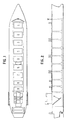
- FIGs. 1 and 2 Illustrated in Figs. 1 and 2 is a diagrammatic representation of an actual ship, the S/S Coastal Golden, a typical vessel, in many aspects, on which my invention would be used to treat ballast water stored in her holds.
- the smallest cargo hold is about 10,760 m 3
- her largest cargo hold is about 19,256 m 3 .
- All of her cargo holds are large enough to destabilize the vessel if wave action developed inside the hold, except when the hold is almost empty or almost full.
- Such a vessel is capable of carrying both oil and dry cargo.
- the cargo holds are numbered from 1-9, counting forward to aft.
- This vessel is also typical in that it would need to carry water ballast in one or more of her holds in order to safely transit open-ocean voyages without cargo.
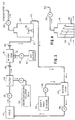
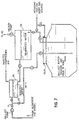
- Fig. 3 is a flow diagram which illustrates embodiments of both the method and apparatus.
- Ballast water containing at least aerobic microorganisms is pumped by a pump 22 from a hold 20 through a filter system 24 (for removing macroorganisms which are pumped into a holding tank 25 until final disposal) into a mixing tank 26 in which air is mixed at pressures higher than atmospheric with the water flow by means of an air compressor pump 28 which provides air from an air source 30 through an air injector 32.
- the oxygenated ballast water flow is further pumped into a vacuum chamber 34 where it is agitated for a suitable period by means of an internal agitator 36.
- the vacuum chamber 34 has sufficient space above the water level therein so that dissolved oxygen (DO) liberated from the water is released into this space from which it is easily removed by a vacuum pump 38 and then discharged to the atmosphere 40.
- the vacuum pump maintains a vacuum over the water within the chamber.
- Vauum is herein used to mean a pressure less than atmospheric pressure but greater than zero pressure.
- the agitator 36 may be replaced by a Weir-type system 42 (Fig.
- the lack of sufficient DO in the ballast water will then kill any resident aerobic microorganisms over a time period depending on the stamina of each microorganism relative to a lack of sufficient DO for respiration.
- a typical transatlantic ballast voyage would take 10 to 15 days.
- My lab tests showed a 99% death rate of aerobic microorganisms in a laboratory test designed to be a proxy for a ballast voyage of 10 days in which the agitation/vacuum treatment cycle is conducted for 2 days, thereby making available an 8-day suffocation period.
- Calculations determined that about a two minute treatment period was required, per 37,9 m 3 bath of water, to treat a 10,000-ton hold full of ballast water in two days.
- a two minute treatment period under very low vacuum conditions, with no cycling during the suffocation period, and with no addition of reducing gases, was chosen for the testing.
- the process can be adjusted by changing pressures and treatment times, and by use of scrubbing gases, to accommodate the various microorganisms, found throughout the world, as well as the available suffocation time allowed by the intended ballast voyage.
- ballast water in the vacuum chamber 34 need be agitated for only approximately 2 minutes, whereby only about 0.033 % of a typical hold's volume would be moving through the closed loop illustrated in Fig. 3.
- the deoxygenated water from the vacuum chamber 34 is fed to another mixing tank 43 where combustion exhaust gases (containing carbon monoxide), constituted by the stack gases from the ship's main engine 44, are pumped by another pump 46 into the mixing tank 43 from which the water is pumped by a pump 48 and returned in a closed loop to the ballast hold 20 to complete the treatment cycle.
- the cycle can be repeated as many times as necessary to remove from the ballast hold sufficient dissolved oxygen to kill the desired amount (up to 99%) of the aerobic microorganisms in the ballast water.
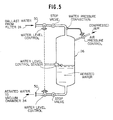
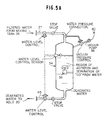
- Fig. 5 illustrates a preferred form of the mixing, oxygenator tank 26, and Fig. 5A illustrates a preferred form of the vacuum, deoxygenating chamber 34.
- Fig. 6 illustrates the application of my invention to the hold(s) and coaming(s) of an actual ship
- Fig. 7 is similar to Fig. 3 and is a schematic diagram illustrating the manner in which my invention can treat incoming ballast water sourced either from the ambient water in which the ship is floating or from ballast water drawn from the hold of the ship; valves V1 and V2 are selectively opened and closed to achieve the two modes of operation.
- AMRL/ODU performed a study to determine the effectiveness of my process for reducing the bacterial count in ballast water.
- an ambient water sample collected from the Elizabeth River in Virginia was used as a surrogate test medium for the study.
- the process parameters were evaluated under laboratory conditions, agitated and exposed to three increasingly higher vacuum levels for two minutes each.
- Benchtop-scale microcosms containing the ambient river water was exposed to the three treatments and then held for 0, 2 and 8 days of O 2 -starvation periods prior to inoculation of bacterial plates.
- the treatment levels were maintained at constant conditions for the exposure period.
- Duplicate samples of the ambient river water were sacrificed at Day-0, Day-2 and Day-8 and used to inoculate bacterial culture plates.
- the incubation period of 5 days was determined by the time required for the appearance of sufficient densities of bacterial colony forming units (CFUs) to allow for realistic and representative counts to be scored over a wide range of possible responses.
- CFUs colony forming units
- Effectiveness of the treatments was expressed as the differences between the initial conditions at Day-0 and the conditions at 2 and 8 days of exposure to the three treatments. The results of this study have also been compared to my initial study of this process. Because of the limited number of plates (as duplicates) for each treatment and control, a statistical level of significance could not be determined between the treatments and controls or the initial conditions.
- my process contains a provision to minimize such flourishing by killing or debilitating such anaerobics.
- the low probability of an anaerobic flourishment and the inherent difficulty of measuring low populations of anaerobics prevented any quantitative analysis of the control of the anaerobic population by pressurized air injection which should kill or debilitate them.
- the AMRL/ODU study created three environments of reduced dissolved oxygen under certain conditions for two periods of time. The results were deemed unexpected (in a positive way) and demonstrated a higher degree of effectiveness in the reduction of aerobic bacteria from the Elizabeth River than expected by both the Director and the Assistant Director of AMRL/ODU, each of whom are experts in the field.
- the three treatments (agitation by swirling and then the application of 2, 4 and 6 inch (HG) vacuums for two minutes) were performed on the three aliquots.
- the controls were not agitated, nor were they subjected to a vacuum. All flasks were sealed and left standing under laboratory conditions. The Day 0 samples were held for approximately 1 hour before being used to inoculate plates for bacterial colony forming units (CFU) counts.
- CFU colony forming units
- All treatments and controls were prepared in duplicate and in sufficient numbers to provide for a sacrificial series. That is, for each treatment or control, 2 flasks were prepared for inoculations at the beginning of the study (Day 0), 2 flasks for inoculation at the end of two days (Day 2), and 2 flasks for inoculation at the end of 8 days (Day 8). Duplicate flasks were prepared for each of the treatments and controls at Day 0 and the results used to evaluate the immediate effect of the treatment as well as to establish the initial conditions.
- the water was collected from the end of the wharf at NAUTICUS in downtown Norfolk, Virginia. It was collected on January 14, 1997 at approximately 2:30 PM.
- a bucket with a rope attached was lowered into the water to collect the sample.
- the sample collection bucket was scrubbed with a large bottle brush and dilute Liquinox® soap. It was thoroughly rinsed with tap water, then rinsed 9 times with fresh ultrapure water. Before sampling it was rinsed 3 times with the unfiltered Elizabeth River water. This water was poured into a 20 liter carboy, which was wrapped in aluminum foil to protect the sample from direct sunlight.
- the carboys were scrubbed with a large bottle brush and dilute Liquinox® soap. They were rinsed with tap water, then rinsed 2 times with 4N HCl, then 9 times with fresh ultrapure water. Before adding the filtered or unfiltered Elizabeth River water, they were rinsed 3 times with the Elizabeth River water they could contain. Approximately 19 liters of sea water were collected, allowing for approximately 1 liter of headspace in the carboy. The whole water sample was immediately transported to the Water Quality Laboratory at NAUTICUS.
- the scissors were scrubbed with a brush and dilute Liquinox® soap. They were rinsed with tap water, rinsed 9 times with fresh ultrapure water, and then rinsed 3 times with the unfiltered Elizabeth River water.
- the Elizabeth River water in the 20 liter carboy was mixed by inversion, and then approximately 3 liters was poured into a 5 liter carboy wrapped in aluminum foil. Some of the water in the 5 liter carboy was used to rinse the labware which needed to be rinsed with unfiltered seawater (scissors, the filtration towards and the graduated cylinders). Subsamples of the unfiltered seawater from the 20 liter carboy were poured into graduated cylinders for filtration. The filtration towers, graduated cylinders and flasks were scrubbed with a large bottle brush and dilute Liquinox® soap. All items were thoroughly rinsed with tap water, then rinsed 2 times with 4N HCl, and then 9 times with fresh ultrapure water. The filtration towers and graduated cylinders were rinsed 3 times with the unfiltered seawater, and the filtration flasks were rinsed 3 times with the filtered seawater.
- the Elizabeth River water was filtered into 2 liter glass vacuum filtration flasks, with a vacuum pressure of ⁇ 381 mm Hg. Approximately 10 liters of filtered seawater was placed on a 20 liter carboy which was wrapped in aluminum foil. The filtration was completed between 3 and 4:30 PM on January 14, 1997. The Elizabeth River water samples were then transported to the Applied Marine Research Laboratory from the Water Quality Laboratory at NAUTICUS.
- the AMRL Aquatic Toxicology laboratory received the filtered and unfiltered Elizabeth River water samples and held them at laboratory temperature (19-21°C) while protecting them from direct exposure to ambient light.
- Five treatments were prepared: Unfiltered Control (CUF); Filtered Control (CF); and Filtered Treatments A (TA), B (TB), and C (TC).
- Unfiltered Control CAF
- Filtered Control CF
- Filtered Treatments A TGF
- B TGF
- TC Filtered Treatments A
- TA Filtered Treatments A
- TB Filtered Treatments A
- TC Filtered Treatments A
- TB Filtered Treatments A
- TC Filtered Treatments A
- TB Filtered Treatments A
- TC Filtered Treatments A
- TB Filtered Treatments A
- TC Filtered Treatments A
- TB B
- C C
- the 260 mL Erlenmeyer flasks with either cotton plugs or rubber stoppers used as microcosm vessels in this study were autoclaved prior to test initiation.
- the three levels of treatment i.e., two minutes of agitation with respective vacuum levels of 50.8, 101.6 and 152.4 mm of Hg
- the three levels of treatment were applied to the microcosms (250 mL flasks) containing Elizabeth River water, and the flasks were sealed from the ambient air. Initiation time for each replicate was recorded, and was defined as the time at which the replicate attained the appropriate treatment level. All control and treatment flasks were kept in a dark chamber for the duration of the treatment intervals. Duplicates of the appropriate samples were provided to the bacteriologist in a time-series fashion; 1 hour following initialization, after 2-days and 8-days of exposure to the treatment.
- Microcosms were sampled within 1 hour of their transfer to the bacteriology laboratory. There, a 3-fold decimal dilution series was prepared using a 1 mL sample from each microcosm and sterile NaCl solution (15 psu). Subsamples (100 ⁇ l) from each dilution tube as well as from the microcosm itself were spread on petri dishes containing Marine Agar 2216 (Difco). Plates were incubated at room temperature (19°C) for 5 days, at which time colony-forming unit (CFUs) were enumerated with the aid of a light table and a magnifying lens.
- CFUs colony-forming unit
- CFU Number of bacterial colony forming units
- the AMRL/ODU study confirms the results of the Solutions Lab study where the greatest level of effectiveness was approximately 99% at the highest vacuum/agitation level. This level of effectiveness is surprising and was not expected by the AMRL/ODU investigators (the Director and Assistant Director of AMRL).
Landscapes
- Engineering & Computer Science (AREA)
- Chemical & Material Sciences (AREA)
- Environmental & Geological Engineering (AREA)
- Organic Chemistry (AREA)
- Water Supply & Treatment (AREA)
- Life Sciences & Earth Sciences (AREA)
- Hydrology & Water Resources (AREA)
- Ocean & Marine Engineering (AREA)
- Mechanical Engineering (AREA)
- Combustion & Propulsion (AREA)
- Purification Treatments By Anaerobic Or Anaerobic And Aerobic Bacteria Or Animals (AREA)
- Physical Water Treatments (AREA)
- Medicines Containing Material From Animals Or Micro-Organisms (AREA)
- Removal Of Specific Substances (AREA)
- Treatment Of Water By Oxidation Or Reduction (AREA)
- Micro-Organisms Or Cultivation Processes Thereof (AREA)
Applications Claiming Priority (5)
| Application Number | Priority Date | Filing Date | Title |
|---|---|---|---|
| US316050 | 1994-09-29 | ||
| US3160596P | 1996-11-27 | 1996-11-27 | |
| US08/921,336 US5932112A (en) | 1996-11-27 | 1997-08-29 | Method and apparatus for killing microorganisms in ship ballast water |
| US921336 | 1997-08-29 | ||
| PCT/US1997/019972 WO1998023539A1 (en) | 1996-11-27 | 1997-11-10 | Method and apparatus for killing microorganisms in ship ballast water |
Publications (3)
| Publication Number | Publication Date |
|---|---|
| EP0951450A1 EP0951450A1 (en) | 1999-10-27 |
| EP0951450A4 EP0951450A4 (en) | 2000-02-23 |
| EP0951450B1 true EP0951450B1 (en) | 2004-04-21 |
Family
ID=26707429
Family Applications (1)
| Application Number | Title | Priority Date | Filing Date |
|---|---|---|---|
| EP97948153A Expired - Lifetime EP0951450B1 (en) | 1996-11-27 | 1997-11-10 | Method for killing microorganisms in ship ballast water |
Country Status (14)
| Country | Link |
|---|---|
| US (2) | US5932112A (enExample) |
| EP (1) | EP0951450B1 (enExample) |
| JP (1) | JP2001509729A (enExample) |
| KR (1) | KR100350409B1 (enExample) |
| CN (1) | CN1113041C (enExample) |
| AU (1) | AU728016B2 (enExample) |
| BR (1) | BR9713305A (enExample) |
| CA (1) | CA2270434A1 (enExample) |
| DE (1) | DE69728792T2 (enExample) |
| ES (1) | ES2219780T3 (enExample) |
| NO (1) | NO319103B1 (enExample) |
| PT (1) | PT951450E (enExample) |
| TR (1) | TR199901171T2 (enExample) |
| WO (1) | WO1998023539A1 (enExample) |
Families Citing this family (94)
| Publication number | Priority date | Publication date | Assignee | Title |
|---|---|---|---|---|
| US5932112A (en) * | 1996-11-27 | 1999-08-03 | Browning Transport Management, Inc. | Method and apparatus for killing microorganisms in ship ballast water |
| AU1461600A (en) * | 1998-11-02 | 2000-05-22 | Gilbert L. Mains Jr. | Separation system for immiscible liquids with remote monitoring and control |
| NO314625B1 (no) * | 1999-11-15 | 2003-04-22 | Forinnova As | Fremgangsmåte og apparat for å behandle vannsystemer |
| EP2130436A1 (en) * | 2000-02-17 | 2009-12-09 | Garnett, Inc. | Method of controlling zoological and aquatic plant growth |
| US6613232B2 (en) | 2000-03-21 | 2003-09-02 | Warren Howard Chesner | Mobile floating water treatment vessel |
| US7059261B2 (en) * | 2004-01-21 | 2006-06-13 | Ncl Corporation | Wastewater ballast system and method |
| JP5048201B2 (ja) | 2000-08-04 | 2012-10-17 | ディーエムアイ バイオサイエンシズ インコーポレイテッド | ジケトピペラジン類の使用方法とジケトピペラジン類を含む組成物 |
| US6835307B2 (en) * | 2000-08-04 | 2004-12-28 | Battelle Memorial Institute | Thermal water treatment |
| JP2002066589A (ja) * | 2000-09-04 | 2002-03-05 | Takenaka Komuten Co Ltd | 殺菌方法及び殺菌装置 |
| AU2002258377A1 (en) | 2000-11-06 | 2002-09-24 | Larry Russell | Ballast water treatment for exotic species control |
| CA2341089C (en) * | 2001-03-16 | 2002-07-02 | Calgon Carbon Corporation | Ship ballast water sterilization method and system |
| US6616833B2 (en) | 2001-04-18 | 2003-09-09 | Gerard Lynch | Ship-board system for decontaminating wastewater contaminated by firefighting operations |
| US6761123B2 (en) * | 2001-05-25 | 2004-07-13 | Mh Systems | Infusion of combustion gases into ballast water preferably under less than atmospheric pressure to synergistically kill harmful aquatic nuisance species by simultaneous hypercapnia, hypoxia and acidic ph level |
| US6722933B2 (en) * | 2001-05-25 | 2004-04-20 | Mh Systems, Inc. | Closed loop control of both pressure and content of ballast tank gases to at different times kill both aerobic and anaerobic organisms within ballast water |
| FI113463B (fi) * | 2001-07-04 | 2004-04-30 | Waertsilae Finland Oy | Vesialuksen yhdistetty poistokaasun ja painolastiveden käsittelyjärjestely ja menetelmä vesialuksen painolastiveden käsittelemiseksi |
| NO314888B1 (no) * | 2001-08-28 | 2003-06-10 | Statoil Asa | Ballastvannutskifting |
| US6626122B2 (en) * | 2001-10-18 | 2003-09-30 | Chevron U.S.A. Inc | Deactivatable biocides in ballast water |
| US20050016933A1 (en) * | 2001-11-28 | 2005-01-27 | Tom Perlich | Methods, apparatus, and compositions for controlling organisms in ballast water |
| KR100463349B1 (ko) * | 2002-01-23 | 2004-12-29 | 현대중공업 주식회사 | 선박 발라스트 탱크의 침전물제거장치를 이용한 선박 발라스트 탱크내의 해양자생물 제거장치 |
| US7273562B2 (en) * | 2002-04-17 | 2007-09-25 | Nutech 03, Inc. | Ozone injection method and system |
| US6869540B2 (en) * | 2002-04-17 | 2005-03-22 | Nutech 03 | Ballast water ozone injection method and system |
| US7416660B2 (en) * | 2002-04-17 | 2008-08-26 | Nutech 03, Inc. | Bypass flow and ozone proportion method and system |
| US7407592B2 (en) * | 2002-04-17 | 2008-08-05 | Nutech 03, Inc. | Ozone retention method and system |
| US7381338B2 (en) * | 2002-04-17 | 2008-06-03 | Nutech 03, Inc. | Ballast water treatment system and method without off-gas |
| US7402253B2 (en) * | 2002-04-17 | 2008-07-22 | Nutech 03, Inc. | Controlled bypass flow and ozone proportion method and system |
| US20030205136A1 (en) * | 2002-05-02 | 2003-11-06 | Mcnulty Peter Drummond | System and method of water treatment |
| EP1499563B9 (en) * | 2002-05-02 | 2014-03-05 | McNulty, Peter, Drummond | Apparatus and method of ballast water treatment |
| US7897045B2 (en) * | 2002-06-29 | 2011-03-01 | Marenco Technology Group, Inc. | Ship-side ballast water treatment systems including related apparatus and methods |
| AU2003248773A1 (en) * | 2002-06-29 | 2004-01-19 | The Marenco Group | Ballast water treatment systems including related apparatus and methods |
| US6821442B1 (en) | 2002-08-12 | 2004-11-23 | The United States Of America As Represented By The Secretary Of The Department Of The Interior | Method and apparatus for control of aquatic vertebrate and invertebrate invasive species |
| FR2848178B1 (fr) * | 2002-12-04 | 2005-11-11 | Locaboat Plaisance | Systeme de traitement d'eaux usees et bateau fluvial comprenant un tel systeme |
| DE20302516U1 (de) * | 2003-02-15 | 2003-12-11 | Hamann Ag | Anlage zur Entfernung und Deaktivierung von Organismen im Ballastwasser |
| CN102210852B (zh) | 2003-05-15 | 2016-10-19 | 安皮奥制药股份有限公司 | T-细胞介导的疾病的治疗 |
| CA2570443A1 (en) * | 2003-06-10 | 2004-12-16 | Michel De Blois | Biological deoxygenation method and uses thereof |
| CN1197786C (zh) * | 2003-06-13 | 2005-04-20 | 大连海事大学 | 在船上输送压载水过程中杀灭生物的方法及设备 |
| US7087804B2 (en) * | 2003-06-19 | 2006-08-08 | Chevron U.S.A. Inc. | Use of waste nitrogen from air separation units for blanketing cargo and ballast tanks |
| WO2005076771A2 (en) * | 2003-07-18 | 2005-08-25 | Environmental Technologies, Inc. | On-board water treatment and management process and apparatus |
| NO20033331D0 (no) * | 2003-07-24 | 2003-07-24 | Knutsen Oas Shipping As | Fremgangsmåte og anordning for å fjerne gasser fra vann |
| WO2005021443A1 (en) * | 2003-08-29 | 2005-03-10 | Amergin, Llc | Method and system for biologic decontamination of a vessel's ballast water |
| US7618536B2 (en) * | 2003-09-03 | 2009-11-17 | Ekomarine Ab | Method of treating a marine object |
| FR2865454B1 (fr) * | 2004-01-22 | 2006-05-05 | Alstom | Structure de cuve ballast pour navire. |
| US20080164217A1 (en) * | 2004-02-13 | 2008-07-10 | Kazuki Nishizawa | Method of Liquid Detoxification and Apparatus Therefor |
| JP2007537036A (ja) * | 2004-05-11 | 2007-12-20 | メタフィル エーエス | バラスト水システム |
| US20100016268A1 (en) * | 2004-08-25 | 2010-01-21 | Amergin, Llc | Method and system for dermal tissue treatment |
| JP5214107B2 (ja) * | 2005-02-09 | 2013-06-19 | 株式会社東芝 | バラスト水浄化装置 |
| AR055792A1 (es) * | 2005-05-17 | 2007-09-05 | Wm Internat Ltd | Aparato y metodo para la estabilizacion no quimica de bio-solidos |
| DE102005044827A1 (de) * | 2005-09-20 | 2007-03-29 | Meyer Werft Gmbh | Verfahren und Vorrichtung zur Aufnahme von Ballastwasser für ein schwimmfähiges Transportmittel |
| HRPK20050906B3 (en) * | 2005-10-18 | 2009-06-30 | Tvornica Turbina D.O.O. | Marine waste water treatment device |
| US20100181260A1 (en) * | 2005-10-28 | 2010-07-22 | Resource Ballast Technologies (Proprietary) Limited | Method and Apparatus for Water Treatment to Eliminate Aquatic Organisms |
| PL1996518T3 (pl) * | 2006-03-20 | 2012-04-30 | Council Scient Ind Res | Urządzenie oraz sposób do filtrowania i odkażania wody morskiej albo wody balastowej na statkach |
| US7513998B2 (en) * | 2006-05-09 | 2009-04-07 | Sea Knight Corporation | “In-situ” ballast water treatment method |
| SE532898C2 (sv) * | 2006-09-25 | 2010-05-04 | Alfawall Aktiebolag | Metod och anordning för behandling av vätskor |
| CN101553434B (zh) * | 2006-10-20 | 2012-10-10 | 海洋救护者公司 | 液体处理方法和装置 |
| JP2008221122A (ja) * | 2007-03-12 | 2008-09-25 | Sumitomo Heavy Ind Ltd | 水処理装置 |
| KR100889997B1 (ko) * | 2007-04-05 | 2009-03-25 | (주)월드이엔지 | 영상처리를 이용한 선박 밸러스트 워터 검사 장치 및 그방법 |
| EP2146933A4 (en) * | 2007-04-10 | 2012-02-29 | Samkun Century Co Ltd | UNDERWATER PLASMA PROCESSING DEVICE AND SYSTEM AND METHOD FOR PROCESSING SHIPBALLAST WATER THEREWITH |
| AU2014201087B2 (en) * | 2007-04-12 | 2016-11-10 | Sea Knight Corporation | "In-situ" ballast water treatment system and method |
| US7442304B1 (en) * | 2007-04-12 | 2008-10-28 | Sea Knight, Llc | In-situ ballast water treatment method |
| DE102007033370B3 (de) * | 2007-07-16 | 2008-12-11 | Scheideler, Michael, Dipl.-Ing. (FH) | Verfahren und Vorrichtung zur Durchführung des Verfahrens zum Entfernen von Invertebraten, insbesondere von Wasserasseln, aus Rohrleitungssystemen |
| US7833411B2 (en) | 2007-07-31 | 2010-11-16 | Mitsui Engineering & Shipbuilding Co., Ltd. | Ballast water treatment apparatus |
| US7900780B2 (en) * | 2007-08-16 | 2011-03-08 | Mitsui Engineering & Shipbuilding Co., Ltd. | Ballast water intake and treatment system |
| US20090211507A1 (en) * | 2008-02-25 | 2009-08-27 | Ian Fielding | System and method for the collection and disposal of ballast water, bilge water and waste water |
| JP5856843B2 (ja) | 2008-05-27 | 2016-02-10 | アンピオ ファーマシューティカルズ,インコーポレイテッド | ジケトピペラジンを用いた医薬組成物 |
| KR101021041B1 (ko) | 2008-06-09 | 2011-03-15 | 주식회사 인트론바이오테크놀로지 | 유효성분으로 박테리오파지를 포함하는 선박 평형수 처리용조성물 및 이를 이용한 선박 평형수에 존재하는박테리아의 생물학적 제거 방법 |
| KR100883444B1 (ko) * | 2008-07-24 | 2009-02-17 | (주) 테크윈 | 발라스트수 처리 장치 및 방법 |
| US8870445B2 (en) * | 2008-12-12 | 2014-10-28 | II Gordon C. Burns | Liquid accelerator and chemical mixing apparatus and method |
| GB0901434D0 (en) | 2009-01-29 | 2009-03-11 | Univ Strathclyde | Ballast water treatment system |
| KR100967910B1 (ko) | 2009-11-18 | 2010-07-06 | 신강하이텍(주) | 선박 엔진의 배출가스를 이용한 선박평형수 처리방법 및 처리장치 |
| NO333905B1 (no) * | 2010-02-24 | 2013-10-14 | Knutsen Ballastvann As | Fremgangsmåte og anordning for å behandle ballastvann |
| EP2613786A4 (en) | 2010-09-07 | 2013-10-23 | Dmi Acquisition Corp | TREATMENT OF DISEASES |
| GB201019993D0 (en) * | 2010-11-24 | 2011-01-05 | Seafarm Products As | Process |
| DK201170108A (da) * | 2011-03-03 | 2012-09-04 | Bawat As | System til behandling af ballastvand i ballasttanke |
| JP2014530063A (ja) | 2011-10-10 | 2014-11-17 | アンピオ ファーマシューティカルズ,インコーポレイテッド | 免疫寛容が高められた埋込み型医療用デバイス、ならびに製造方法および埋込み方法 |
| PH12014500685B1 (en) | 2011-10-10 | 2018-10-03 | Ampio Pharmaceuticals Inc | Treatment of degenerative joint disease |
| KR101287139B1 (ko) * | 2011-10-13 | 2013-07-17 | 주식회사 파나시아 | 컴팩트하고 운용성을 높이는 멀티케이지 타입 밸러스트수 여과장치 |
| KR101287122B1 (ko) * | 2011-10-14 | 2013-07-23 | 주식회사 파나시아 | 순차적 역세척을 자동제어하는 멀티케이지 타입 밸러스트수 여과장치 및 그 방법 |
| KR101287144B1 (ko) * | 2011-10-14 | 2013-07-17 | 주식회사 파나시아 | 배압형성을 방지하는 멀티케이지 타입 밸러스트수 여과장치 |
| HK1198812A1 (en) | 2011-10-28 | 2015-06-12 | Ampio Pharmaceuticals, Inc. | Treatment of rhinitis |
| KR101324602B1 (ko) * | 2011-11-30 | 2013-11-01 | 삼성중공업 주식회사 | 스러스터 시스템 및 이를 포함하는 선박 |
| US9272766B2 (en) * | 2012-09-20 | 2016-03-01 | Sea Knight Corporation | “In-situ” ballast water treatment method and system |
| US20140238533A1 (en) * | 2013-02-25 | 2014-08-28 | Mo Husain | Efficiently effectively inserting inert gases into the entire volumes and ullage spaces of ships' steel ballast tanks to retard interior corrosion |
| CA2906864A1 (en) | 2013-03-15 | 2014-09-18 | Ampio Pharmaceuticals, Inc. | Compositions for the mobilization, homing, expansion and differentiation of stem cells and methods of using the same |
| EP4066836A1 (en) | 2014-08-18 | 2022-10-05 | Ampio Pharmaceuticals, Inc. | Treatment of joint conditions |
| US10618622B2 (en) * | 2015-03-04 | 2020-04-14 | Samsung Heavy Industries Co., Ltd. | Pollutant reduction device and method |
| EP3310375A4 (en) | 2015-06-22 | 2019-02-20 | Ampio Pharmaceuticals, Inc. | USE OF LOW-MOLECULAR FRACTIONS OF HUMAN SERUMALBUMINE IN THE TREATMENT OF ILLNESSES |
| FR3041342B1 (fr) * | 2015-09-22 | 2017-10-27 | Woter Sas | Dispositif de traitement des eaux et embarcation comportant un tel dispositif |
| JP6625907B2 (ja) * | 2016-03-08 | 2019-12-25 | 富士電機株式会社 | 排水処理方法および排水処理システム |
| US12338150B2 (en) * | 2017-07-24 | 2025-06-24 | Richard S. Trela | Negative pressure aeration and organic growth suppression system |
| US10859134B2 (en) * | 2018-06-07 | 2020-12-08 | David Oldiges | Rope gripper |
| CN110586047B (zh) * | 2019-10-08 | 2022-03-11 | 辽宁工业大学 | 一种用于吸附铅离子的改性双醛淀粉制备方法 |
| US11027987B1 (en) | 2019-11-20 | 2021-06-08 | Andy Andalibian | Ballast water, bilge water, slop water, or oily water treatment system |
| US12377940B1 (en) * | 2020-04-14 | 2025-08-05 | Correct Craft Ip Holdings, Llc | Ballast tank decontamination system and method for watersports boats |
| WO2021230458A1 (ko) * | 2020-05-12 | 2021-11-18 | (주)테크윈 | 선박평형수의 처리방법 |
| JP7808952B2 (ja) * | 2021-11-10 | 2026-01-30 | 三菱重工業株式会社 | 浮体 |
Citations (2)
| Publication number | Priority date | Publication date | Assignee | Title |
|---|---|---|---|---|
| US1809441A (en) * | 1925-08-06 | 1931-06-09 | William S Elliott | Method and apparatus for the treatment of liquids |
| US5203890A (en) * | 1989-08-07 | 1993-04-20 | Okabe Tatsuo | Deaerator for removing dissolved oxygen in water |
Family Cites Families (11)
| Publication number | Priority date | Publication date | Assignee | Title |
|---|---|---|---|---|
| US3251357A (en) * | 1964-10-13 | 1966-05-17 | Milo V Williamson | Water treatment and apparatus |
| US3676983A (en) * | 1970-07-29 | 1972-07-18 | Walter E Nold | Apparatus and method for degassing a liquid |
| US4345920A (en) * | 1976-05-17 | 1982-08-24 | Borg-Warner Corporation | Vacuum deaerator |
| NO148701C (no) * | 1979-10-16 | 1983-11-30 | Akers Mek Verksted As | Fremgangsmaate ved avgasning av vaesker, samt anordning for utfoerelse av fremgangsmaaten |
| JPS59158410U (ja) * | 1983-04-12 | 1984-10-24 | 石川島播磨重工業株式会社 | 流体中の気体除去装置 |
| JPH0673603B2 (ja) * | 1990-11-26 | 1994-09-21 | 野村マイクロ・サイエンス株式会社 | 純水または超純水中の溶存酸素の除去方法 |
| JPH04322788A (ja) * | 1991-02-25 | 1992-11-12 | Mitsubishi Heavy Ind Ltd | 船舶のバラスト水殺菌方法および殺菌装置 |
| US5192451A (en) * | 1991-05-06 | 1993-03-09 | Calgon Corporation | Method for controlling zebra mussels in ship ballast tanks |
| US5376282A (en) * | 1993-06-18 | 1994-12-27 | Ohio University | Method and apparatus for controlling zebra mussels in water conduits |
| AUPN859096A0 (en) * | 1996-03-11 | 1996-04-04 | Archer, Walter James | Ballast water de-toxification treatment system for ships |
| US5932112A (en) * | 1996-11-27 | 1999-08-03 | Browning Transport Management, Inc. | Method and apparatus for killing microorganisms in ship ballast water |
-
1997
- 1997-08-29 US US08/921,336 patent/US5932112A/en not_active Expired - Fee Related
- 1997-11-10 WO PCT/US1997/019972 patent/WO1998023539A1/en not_active Ceased
- 1997-11-10 AU AU54277/98A patent/AU728016B2/en not_active Ceased
- 1997-11-10 JP JP52465698A patent/JP2001509729A/ja not_active Ceased
- 1997-11-10 DE DE69728792T patent/DE69728792T2/de not_active Expired - Fee Related
- 1997-11-10 PT PT97948153T patent/PT951450E/pt unknown
- 1997-11-10 CN CN97180146A patent/CN1113041C/zh not_active Expired - Fee Related
- 1997-11-10 KR KR1019997004382A patent/KR100350409B1/ko not_active Expired - Fee Related
- 1997-11-10 ES ES97948153T patent/ES2219780T3/es not_active Expired - Lifetime
- 1997-11-10 EP EP97948153A patent/EP0951450B1/en not_active Expired - Lifetime
- 1997-11-10 BR BR9713305A patent/BR9713305A/pt not_active IP Right Cessation
- 1997-11-10 TR TR1999/01171T patent/TR199901171T2/xx unknown
- 1997-11-10 CA CA002270434A patent/CA2270434A1/en not_active Abandoned
-
1999
- 1999-05-26 NO NO19992537A patent/NO319103B1/no unknown
- 1999-06-02 US US09/324,055 patent/US6171508B1/en not_active Expired - Lifetime
Patent Citations (2)
| Publication number | Priority date | Publication date | Assignee | Title |
|---|---|---|---|---|
| US1809441A (en) * | 1925-08-06 | 1931-06-09 | William S Elliott | Method and apparatus for the treatment of liquids |
| US5203890A (en) * | 1989-08-07 | 1993-04-20 | Okabe Tatsuo | Deaerator for removing dissolved oxygen in water |
Also Published As
| Publication number | Publication date |
|---|---|
| DE69728792D1 (de) | 2004-05-27 |
| WO1998023539A1 (en) | 1998-06-04 |
| US6171508B1 (en) | 2001-01-09 |
| AU728016B2 (en) | 2001-01-04 |
| EP0951450A1 (en) | 1999-10-27 |
| NO992537L (no) | 1999-07-27 |
| NO992537D0 (no) | 1999-05-26 |
| KR100350409B1 (ko) | 2002-08-28 |
| EP0951450A4 (en) | 2000-02-23 |
| CN1113041C (zh) | 2003-07-02 |
| NO319103B1 (no) | 2005-06-20 |
| CN1238745A (zh) | 1999-12-15 |
| DE69728792T2 (de) | 2005-03-17 |
| CA2270434A1 (en) | 1998-06-04 |
| KR20000053355A (ko) | 2000-08-25 |
| TR199901171T2 (xx) | 1999-07-21 |
| AU5427798A (en) | 1998-06-22 |
| US5932112A (en) | 1999-08-03 |
| JP2001509729A (ja) | 2001-07-24 |
| ES2219780T3 (es) | 2004-12-01 |
| PT951450E (pt) | 2004-09-30 |
| BR9713305A (pt) | 2000-03-21 |
Similar Documents
| Publication | Publication Date | Title |
|---|---|---|
| US5932112A (en) | Method and apparatus for killing microorganisms in ship ballast water | |
| USRE41859E1 (en) | Infusion of combustion gases into ballast water preferably under less than atmospheric pressure to synergistically kill harmful aquatic nuisance species by simultaneous hypercapnia, hypoxia and acidic ph level | |
| AU2005240411B2 (en) | Ballast water system | |
| US20030029811A1 (en) | Ballast water treatment for exotic species control | |
| US6722933B2 (en) | Closed loop control of both pressure and content of ballast tank gases to at different times kill both aerobic and anaerobic organisms within ballast water | |
| KR100706359B1 (ko) | 저수장치의 유해 유기체 처리방법 | |
| CN1997599A (zh) | 压载水系统 | |
| US6821442B1 (en) | Method and apparatus for control of aquatic vertebrate and invertebrate invasive species | |
| US7513998B2 (en) | “In-situ” ballast water treatment method | |
| JP2006043674A (ja) | 微生物を利用したバラスト水浄化システム | |
| US7442304B1 (en) | In-situ ballast water treatment method | |
| US7374681B2 (en) | Biological deoxygenation method and uses thereof | |
| Girguis et al. | H+ equivalent elimination by the tube-worm Riftia pachyptila | |
| HK1061381B (en) | Ballast water treatment for exotic species control | |
| Tamburri et al. | REPORT DOCUMENTATION PAG£ | |
| HK1104521A (en) | Ballast water system |
Legal Events
| Date | Code | Title | Description |
|---|---|---|---|
| PUAI | Public reference made under article 153(3) epc to a published international application that has entered the european phase |
Free format text: ORIGINAL CODE: 0009012 |
|
| AK | Designated contracting states |
Kind code of ref document: A1 Designated state(s): DE ES FI FR GB GR IT NL PT SE |
|
| 17P | Request for examination filed |
Effective date: 19990426 |
|
| RBV | Designated contracting states (corrected) |
Designated state(s): DE ES FI FR GB GR IT NL PT SE |
|
| A4 | Supplementary search report drawn up and despatched |
Effective date: 20000111 |
|
| AK | Designated contracting states |
Kind code of ref document: A4 Designated state(s): DE ES FI FR GB GR IT NL PT SE |
|
| RAP1 | Party data changed (applicant data changed or rights of an application transferred) |
Owner name: BROWNING TRANSPORT MANAGEMENT, INC. |
|
| RIN1 | Information on inventor provided before grant (corrected) |
Inventor name: BROWNING TRANSPORT MANAGEMENT, INC. |
|
| 17Q | First examination report despatched |
Effective date: 20010502 |
|
| RTI1 | Title (correction) |
Free format text: METHOD FOR KILLING MICROORGANISMS IN SHIP BALLAST WATER |
|
| GRAP | Despatch of communication of intention to grant a patent |
Free format text: ORIGINAL CODE: EPIDOSNIGR1 |
|
| RTI1 | Title (correction) |
Free format text: METHOD FOR KILLING MICROORGANISMS IN SHIP BALLAST WATER |
|
| GRAS | Grant fee paid |
Free format text: ORIGINAL CODE: EPIDOSNIGR3 |
|
| GRAA | (expected) grant |
Free format text: ORIGINAL CODE: 0009210 |
|
| RIN1 | Information on inventor provided before grant (corrected) |
Inventor name: BROWNING, WILSON J |
|
| AK | Designated contracting states |
Kind code of ref document: B1 Designated state(s): DE ES FI FR GB GR IT NL PT SE |
|
| REG | Reference to a national code |
Ref country code: GB Ref legal event code: FG4D |
|
| REF | Corresponds to: |
Ref document number: 69728792 Country of ref document: DE Date of ref document: 20040527 Kind code of ref document: P |
|
| RAP2 | Party data changed (patent owner data changed or rights of a patent transferred) |
Owner name: AHS, LLC |
|
| REG | Reference to a national code |
Ref country code: SE Ref legal event code: TRGR |
|
| REG | Reference to a national code |
Ref country code: GR Ref legal event code: EP Ref document number: 20040402462 Country of ref document: GR |
|
| NLT2 | Nl: modifications (of names), taken from the european patent patent bulletin |
Owner name: AHS, LLC |
|
| REG | Reference to a national code |
Ref country code: GB Ref legal event code: 732E |
|
| REG | Reference to a national code |
Ref country code: PT Ref legal event code: SC4A Free format text: AVAILABILITY OF NATIONAL TRANSLATION Effective date: 20040715 Ref country code: PT Ref legal event code: PC4A Free format text: AHS, LLC US Effective date: 20040802 |
|
| NLS | Nl: assignments of ep-patents |
Owner name: AHS, LLC |
|
| REG | Reference to a national code |
Ref country code: ES Ref legal event code: FG2A Ref document number: 2219780 Country of ref document: ES Kind code of ref document: T3 |
|
| ET | Fr: translation filed | ||
| PLBE | No opposition filed within time limit |
Free format text: ORIGINAL CODE: 0009261 |
|
| STAA | Information on the status of an ep patent application or granted ep patent |
Free format text: STATUS: NO OPPOSITION FILED WITHIN TIME LIMIT |
|
| 26N | No opposition filed |
Effective date: 20050124 |
|
| PGFP | Annual fee paid to national office [announced via postgrant information from national office to epo] |
Ref country code: FR Payment date: 20061117 Year of fee payment: 10 |
|
| PGFP | Annual fee paid to national office [announced via postgrant information from national office to epo] |
Ref country code: NL Payment date: 20061121 Year of fee payment: 10 |
|
| PGFP | Annual fee paid to national office [announced via postgrant information from national office to epo] |
Ref country code: GB Payment date: 20061122 Year of fee payment: 10 |
|
| PGFP | Annual fee paid to national office [announced via postgrant information from national office to epo] |
Ref country code: SE Payment date: 20061124 Year of fee payment: 10 Ref country code: PT Payment date: 20061124 Year of fee payment: 10 Ref country code: ES Payment date: 20061124 Year of fee payment: 10 |
|
| PGFP | Annual fee paid to national office [announced via postgrant information from national office to epo] |
Ref country code: FI Payment date: 20061127 Year of fee payment: 10 |
|
| PGFP | Annual fee paid to national office [announced via postgrant information from national office to epo] |
Ref country code: IT Payment date: 20061130 Year of fee payment: 10 Ref country code: GR Payment date: 20061130 Year of fee payment: 10 |
|
| PGFP | Annual fee paid to national office [announced via postgrant information from national office to epo] |
Ref country code: DE Payment date: 20070102 Year of fee payment: 10 |
|
| REG | Reference to a national code |
Ref country code: PT Ref legal event code: MM4A Free format text: LAPSE DUE TO NON-PAYMENT OF FEES Effective date: 20080512 |
|
| EUG | Se: european patent has lapsed | ||
| GBPC | Gb: european patent ceased through non-payment of renewal fee |
Effective date: 20071110 |
|
| PG25 | Lapsed in a contracting state [announced via postgrant information from national office to epo] |
Ref country code: FI Free format text: LAPSE BECAUSE OF NON-PAYMENT OF DUE FEES Effective date: 20071110 |
|
| NLV4 | Nl: lapsed or anulled due to non-payment of the annual fee |
Effective date: 20080601 |
|
| PG25 | Lapsed in a contracting state [announced via postgrant information from national office to epo] |
Ref country code: PT Free format text: LAPSE BECAUSE OF NON-PAYMENT OF DUE FEES Effective date: 20080512 |
|
| PG25 | Lapsed in a contracting state [announced via postgrant information from national office to epo] |
Ref country code: SE Free format text: LAPSE BECAUSE OF NON-PAYMENT OF DUE FEES Effective date: 20071111 Ref country code: NL Free format text: LAPSE BECAUSE OF NON-PAYMENT OF DUE FEES Effective date: 20080601 Ref country code: DE Free format text: LAPSE BECAUSE OF NON-PAYMENT OF DUE FEES Effective date: 20080603 |
|
| REG | Reference to a national code |
Ref country code: FR Ref legal event code: ST Effective date: 20080930 |
|
| PG25 | Lapsed in a contracting state [announced via postgrant information from national office to epo] |
Ref country code: GB Free format text: LAPSE BECAUSE OF NON-PAYMENT OF DUE FEES Effective date: 20071110 |
|
| REG | Reference to a national code |
Ref country code: ES Ref legal event code: FD2A Effective date: 20071112 |
|
| PG25 | Lapsed in a contracting state [announced via postgrant information from national office to epo] |
Ref country code: FR Free format text: LAPSE BECAUSE OF NON-PAYMENT OF DUE FEES Effective date: 20071130 Ref country code: ES Free format text: LAPSE BECAUSE OF NON-PAYMENT OF DUE FEES Effective date: 20071112 |
|
| PG25 | Lapsed in a contracting state [announced via postgrant information from national office to epo] |
Ref country code: GR Free format text: LAPSE BECAUSE OF NON-PAYMENT OF DUE FEES Effective date: 20080605 |
|
| PG25 | Lapsed in a contracting state [announced via postgrant information from national office to epo] |
Ref country code: IT Free format text: LAPSE BECAUSE OF NON-PAYMENT OF DUE FEES Effective date: 20071110 |