EP0949357B1 - Method for preparing oxide single crystalline materials - Google Patents
Method for preparing oxide single crystalline materials Download PDFInfo
- Publication number
- EP0949357B1 EP0949357B1 EP99105679A EP99105679A EP0949357B1 EP 0949357 B1 EP0949357 B1 EP 0949357B1 EP 99105679 A EP99105679 A EP 99105679A EP 99105679 A EP99105679 A EP 99105679A EP 0949357 B1 EP0949357 B1 EP 0949357B1
- Authority
- EP
- European Patent Office
- Prior art keywords
- crystal
- supercooled
- oxide
- supercooling
- crystals
- Prior art date
- Legal status (The legal status is an assumption and is not a legal conclusion. Google has not performed a legal analysis and makes no representation as to the accuracy of the status listed.)
- Expired - Lifetime
Links
- 238000000034 method Methods 0.000 title claims description 27
- 239000002178 crystalline material Substances 0.000 title claims description 13
- 239000013078 crystal Substances 0.000 claims description 101
- 239000000463 material Substances 0.000 claims description 32
- 238000004781 supercooling Methods 0.000 claims description 28
- 238000010438 heat treatment Methods 0.000 claims description 19
- 238000007711 solidification Methods 0.000 claims description 18
- 230000008023 solidification Effects 0.000 claims description 18
- 239000002243 precursor Substances 0.000 claims description 17
- 238000010899 nucleation Methods 0.000 description 20
- 230000006911 nucleation Effects 0.000 description 18
- 238000001816 cooling Methods 0.000 description 8
- 239000012768 molten material Substances 0.000 description 6
- 230000000052 comparative effect Effects 0.000 description 4
- 230000007423 decrease Effects 0.000 description 4
- 230000000694 effects Effects 0.000 description 4
- 230000008018 melting Effects 0.000 description 4
- 238000002844 melting Methods 0.000 description 4
- 239000000203 mixture Substances 0.000 description 4
- 239000002887 superconductor Substances 0.000 description 4
- 229910052751 metal Inorganic materials 0.000 description 3
- 239000002184 metal Substances 0.000 description 3
- CPLXHLVBOLITMK-UHFFFAOYSA-N Magnesium oxide Chemical compound [Mg]=O CPLXHLVBOLITMK-UHFFFAOYSA-N 0.000 description 2
- 230000001154 acute effect Effects 0.000 description 2
- AYJRCSIUFZENHW-UHFFFAOYSA-L barium carbonate Chemical compound [Ba+2].[O-]C([O-])=O AYJRCSIUFZENHW-UHFFFAOYSA-L 0.000 description 2
- 238000001354 calcination Methods 0.000 description 2
- 150000002739 metals Chemical class 0.000 description 2
- 238000002360 preparation method Methods 0.000 description 2
- 230000000007 visual effect Effects 0.000 description 2
- QPLDLSVMHZLSFG-UHFFFAOYSA-N CuO Inorganic materials [Cu]=O QPLDLSVMHZLSFG-UHFFFAOYSA-N 0.000 description 1
- 229910052772 Samarium Inorganic materials 0.000 description 1
- 238000007664 blowing Methods 0.000 description 1
- 230000007547 defect Effects 0.000 description 1
- 238000005516 engineering process Methods 0.000 description 1
- 239000007788 liquid Substances 0.000 description 1
- 239000000395 magnesium oxide Substances 0.000 description 1
- 238000004519 manufacturing process Methods 0.000 description 1
- 239000002245 particle Substances 0.000 description 1
- 229910052697 platinum Inorganic materials 0.000 description 1
- 239000000843 powder Substances 0.000 description 1
- 238000010791 quenching Methods 0.000 description 1
- 230000000171 quenching effect Effects 0.000 description 1
- 229910052761 rare earth metal Inorganic materials 0.000 description 1
- 229910052703 rhodium Inorganic materials 0.000 description 1
- FKTOIHSPIPYAPE-UHFFFAOYSA-N samarium(III) oxide Inorganic materials [O-2].[O-2].[O-2].[Sm+3].[Sm+3] FKTOIHSPIPYAPE-UHFFFAOYSA-N 0.000 description 1
- 238000010583 slow cooling Methods 0.000 description 1
- 238000002791 soaking Methods 0.000 description 1
Images



Classifications
-
- C—CHEMISTRY; METALLURGY
- C30—CRYSTAL GROWTH
- C30B—SINGLE-CRYSTAL GROWTH; UNIDIRECTIONAL SOLIDIFICATION OF EUTECTIC MATERIAL OR UNIDIRECTIONAL DEMIXING OF EUTECTOID MATERIAL; REFINING BY ZONE-MELTING OF MATERIAL; PRODUCTION OF A HOMOGENEOUS POLYCRYSTALLINE MATERIAL WITH DEFINED STRUCTURE; SINGLE CRYSTALS OR HOMOGENEOUS POLYCRYSTALLINE MATERIAL WITH DEFINED STRUCTURE; AFTER-TREATMENT OF SINGLE CRYSTALS OR A HOMOGENEOUS POLYCRYSTALLINE MATERIAL WITH DEFINED STRUCTURE; APPARATUS THEREFOR
- C30B29/00—Single crystals or homogeneous polycrystalline material with defined structure characterised by the material or by their shape
- C30B29/10—Inorganic compounds or compositions
- C30B29/16—Oxides
- C30B29/22—Complex oxides
- C30B29/225—Complex oxides based on rare earth copper oxides, e.g. high T-superconductors
-
- C—CHEMISTRY; METALLURGY
- C30—CRYSTAL GROWTH
- C30B—SINGLE-CRYSTAL GROWTH; UNIDIRECTIONAL SOLIDIFICATION OF EUTECTIC MATERIAL OR UNIDIRECTIONAL DEMIXING OF EUTECTOID MATERIAL; REFINING BY ZONE-MELTING OF MATERIAL; PRODUCTION OF A HOMOGENEOUS POLYCRYSTALLINE MATERIAL WITH DEFINED STRUCTURE; SINGLE CRYSTALS OR HOMOGENEOUS POLYCRYSTALLINE MATERIAL WITH DEFINED STRUCTURE; AFTER-TREATMENT OF SINGLE CRYSTALS OR A HOMOGENEOUS POLYCRYSTALLINE MATERIAL WITH DEFINED STRUCTURE; APPARATUS THEREFOR
- C30B11/00—Single-crystal growth by normal freezing or freezing under temperature gradient, e.g. Bridgman-Stockbarger method
-
- C—CHEMISTRY; METALLURGY
- C30—CRYSTAL GROWTH
- C30B—SINGLE-CRYSTAL GROWTH; UNIDIRECTIONAL SOLIDIFICATION OF EUTECTIC MATERIAL OR UNIDIRECTIONAL DEMIXING OF EUTECTOID MATERIAL; REFINING BY ZONE-MELTING OF MATERIAL; PRODUCTION OF A HOMOGENEOUS POLYCRYSTALLINE MATERIAL WITH DEFINED STRUCTURE; SINGLE CRYSTALS OR HOMOGENEOUS POLYCRYSTALLINE MATERIAL WITH DEFINED STRUCTURE; AFTER-TREATMENT OF SINGLE CRYSTALS OR A HOMOGENEOUS POLYCRYSTALLINE MATERIAL WITH DEFINED STRUCTURE; APPARATUS THEREFOR
- C30B9/00—Single-crystal growth from melt solutions using molten solvents
Definitions
- the present invention relates to a method according to the preamble of claim 1.
- Solidification process has been conventionally known as a general procedure to yield oxide crystalline materials used for the above mentioned purpose, in which a molten material, i.e., crystalline precursor material, is cooled at a slow speed from a temperature around the melting point to promote solidification and crystal growth.
- the supercooling solidification process is a single crystal growing method utilizing such characteristics that "when molten or semi-molten liquid of an oxide crystal precursor is supercooled, i.e., kept in a supercooled condition at a temperature below the melting point, the crystal growth rate is remarkably accelerated".
- Several methods for preparing Y-oxide superconductive crystals based on the above mentioned supercooling method have been described in, for example, JP-A No. 6-211,588; Journal of Materials Research, Vol. 11, No. 4, pp. 795-803, April 1996; and ibid., Vol. 11, No. 5, pp. 1114-1119, May 1996.
- a Y-oxide superconductor precursor material which has been added with a seed crystal as nuclei for crystal growth followed by raising temperature above the peritectic temperature or raised temperature above the peritectic temperature followed by addition of the seed crystal, is subjected to supercooling (undercooling) by cooling thereof under the peritectic temperature and further cooled continuously but slowly, for example at a cooling rate of 1 °C / hr. or isothermally kept at the supercooled temperature to grow Y-oxide superconductor crystals, oxides never being solidified at once completely when they are supercooled, which is distinct from pure metals".
- the "supercooling solidification process” is a method for growing crystals in which a molten precursor material is supercooled to a temperature region below the melting point in a molten or semi-molten state and then slowly cooled, usually at a cooling rate of 1 to 10 °C / hr., or kept at the supercooled temperature, and the existence of the above mentioned “seed crystal” is not necessarily essential to the process. That is, such a process is employed for a purpose to increase the crystal growth rate.
- Fig. 1 shows a relationship between the crystal growth rate of Sm123 and the degree of supercooling. It is apparent from Fig. 1 that the crystal grow rate increases as an increase in the degree of supercooling.
- the inventors have investigated to prepare larger oxide single crystals from various viewpoints and come to a conclusion that the supercooling solidification process has a limit to prepare large single crystals and is not sufficient to yield homogeneous large single crystals with less defect.
- the crystal grow rate increases as an increase in the degree of supercooling, resulting in being possible to prepare large crystals in a short time.
- nucleation increases rapidly relative to an increase in the degree of supercooling.
- the increase of frequency of nucleation inhibits the preparation of large single crystals (for example, crystals grown from seed crystals), resulting in limitation of the size of single crystals.
- the inventors have keenly investigated and finally obtained a novel information in which, when a highly heated oxide crystal precursor material is supercooled below the melting point and then subjected to continuous slow heating within the supercooling region to grow crystals, nucleation which hinders single crystal particles from growing is controlled, while keeping high crystal growth rate, so that large single crystals can be grown without consuming longer period of time.
- This object is achieved in that said supercooling step is followed by subjecting said precursor material to continuous slow heating to gradually reduce the supercooled degree while keeping a thus supercooled condition to promote crystal growth.
- a RE123 oxide superconductive crystalline precursor material added with seed crystals is supercooled below peritectic temperature prior to solidification thereof in the course of crystal growth of the RE123 oxide superconductive crystal.
- Oxide crystals prepared by the present invention are not limited to a specific oxide but may cover any material including the above mentioned LiNdO 3 oxide crystal used as laser transmitting element. Especially, an excellent practical effect is exhibited when the present invention is applied to prepare RE123 oxide superconductive single crystalline materials in which growth of large crystals has been difficult.
- the crystal growth rate increases with an increase in the supercooling degree in accordance with square low when an oxide crystalline is grown by a supercooling solidification process. As a result, it is possible to remarkably reduce a time period required to grow an oxide crystal according to the supercooling solidification process.
- Fig. 2 shows a relationship between the supercooled degree and the frequency of nucleation. It is apparent from Fig. 2 that the frequency of nucleation increases exponentially with an increase in the supercooled degree. That is, conversely speaking, the frequency of nucleation decreases drastically with a decrease in the supercooled degree, which is achieved by slowly heating a condition of higher supercooled degree.
- the crystal growth rate increases with an increase in the supercooling degree in accordance with square low while the frequency of nucleation increases exponentially with an increase in the supercooled degree.
- the reduction of the crystal growth rate is small relative to the reduction of the frequency of nucleation.
- an application of slow heating while keeping a supercooled condition makes it possible to decrease the supercooled degree so as to remarkably reduce nucleation caused by an intentional nucleating source such as seed crystals and, at the same time, to control such intentional crystal growth rate so as to keep the growth rate at a high level and to prepare perfect and large oxide single crystals within a relatively short period of time.
- nucleation other than an intentional site such as seed crystals can be inhibited so that crystals grown from seed crystals can be large-sized.
- Such slow heating while keeping a supercooled condition for example, at a heating rate of about several °C per 100 hours, does not cause any industrial problem.
- a source of nuclei which is intentionally introduced into a crystal precursor material to grow single crystals in the present invention includes well known "seed crystals" and may also be prepared as in the following:
- oxide superconductors of higher Tc (critical temperature), such as those of Nd (16) or Sm (14) types are prepared by the conventional "supercooling molten solidification process" in which crystal growth proceeds under a slow cooling condition in a supercooled region, Nd or Sm and Ba are replaced each other in the course of crystal growth, thereby causing an inconvenient change in composition between starting and terminal portions of crystals.
- Tc critical temperature
- Sm supercooling molten solidification process
- the calcined disk material was then put on a magnesia single crystal plate and placed in a soaking zone of heating oven to form a semi-molten material by raising temperature up to 1150 °C in the atmosphere, followed keeping such a condition for 30 minutes.
- the semi-molten material was then cooled to 1,080 °C, i.e., around "peritectic temperature (about 1,065 to 1,070 °C) of Sm123 crystal (SmBa 2 Cu 3 O 7-d single crystal)" within 10 minutes, kept at this temperature for one hour to render the material as a whole isothermal, followed by seeding a Nd123 single crystal (Nd Ba 2 Cu 3 O 7-d single crystal), which was immediately quenched to 1,055 °C to subject thereof to supercooling.
- peritectic temperature about 1,065 to 1,070 °C
- Sm123 crystal SmBa 2 Cu 3 O 7-d single crystal
- the semi-molten material was slowly heated for 100 hours up to 1,065 °C at a heating rate of 0.1 °C /hr. to yield a large single crystal of Sm123 grown from the seed crystal (Nd 123 single crystal).
- the oven was cooled to room temperature after the material was slow heated for 100 hours.
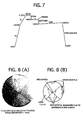
- Fig. 7 shows a heat treatment hysteresis of the material starting from calcination to completion of oven cooling after crystal growth.
- Fig. 8 shows an appearance of a Sm123 single crystal thus obtained, in which Fig. 8(a) is a visual photograph of the crystal and Fig. 8(b) is an illustration thereof.
- the thus obtained Sm123 single crystal shows a critical temperature of 90 K or more as superconductive properties.
- the thus obtained semi-molten material was kept at isothermal temperature of 1.060 °C for 72 hours to allow a crystal to grow and then cooled to room temperature by cooling the oven.
- Fig. 9 shows a heat treatment hysteresis of the material starting from calcination to completion of oven cooling after crystal growth.
- Fig. 10 shows an appearance of a Sm123 single crystal thus obtained, in which Fig. 10(a) is a visual photograph of the crystal and Fig. 10(b) is an illustration thereof.
Landscapes
- Chemical & Material Sciences (AREA)
- Engineering & Computer Science (AREA)
- Crystallography & Structural Chemistry (AREA)
- Materials Engineering (AREA)
- Metallurgy (AREA)
- Organic Chemistry (AREA)
- Inorganic Chemistry (AREA)
- Crystals, And After-Treatments Of Crystals (AREA)
- Inorganic Compounds Of Heavy Metals (AREA)
Description
Claims (2)
- A method for preparing a large oxide single crystalline material, wherein a crystal precursor material is supercooled prior to solidification thereof in the course of crystal growth of the oxide by a supercooling solidification process, characterized in that said supercooling step is followed by subjecting said precursor material to continuous slow heating to gradually reduce the supercooled degree while keeping a thus supercooled condition to promote crystal growth.
- Method according to claim 1, wherein a RE123 oxide superconductive crystalline precursor material added with seed crystals is supercooled below peritectic temperature prior to solidification thereof in the course of crystal growth of the RE123 oxide superconductive crystal.
Applications Claiming Priority (2)
| Application Number | Priority Date | Filing Date | Title |
|---|---|---|---|
| JP10092681A JPH11268986A (en) | 1998-03-20 | 1998-03-20 | Method for producing oxide single crystal |
| JP9268198 | 1998-03-20 |
Publications (2)
| Publication Number | Publication Date |
|---|---|
| EP0949357A1 EP0949357A1 (en) | 1999-10-13 |
| EP0949357B1 true EP0949357B1 (en) | 2003-09-03 |
Family
ID=14061239
Family Applications (1)
| Application Number | Title | Priority Date | Filing Date |
|---|---|---|---|
| EP99105679A Expired - Lifetime EP0949357B1 (en) | 1998-03-20 | 1999-03-19 | Method for preparing oxide single crystalline materials |
Country Status (4)
| Country | Link |
|---|---|
| US (1) | US6171390B1 (en) |
| EP (1) | EP0949357B1 (en) |
| JP (1) | JPH11268986A (en) |
| DE (1) | DE69910878T2 (en) |
Families Citing this family (2)
| Publication number | Priority date | Publication date | Assignee | Title |
|---|---|---|---|---|
| US7220706B1 (en) * | 2003-05-14 | 2007-05-22 | Praxair S.T. Technology, Inc. | Enhanced melt-textured growth |
| RU2749153C1 (en) * | 2020-11-02 | 2021-06-07 | Акционерное общество "Научно-исследовательский институт "Полюс" им. М.Ф. Стельмаха" | Method for creation of composite laser element based on oxide crystals |
Family Cites Families (6)
| Publication number | Priority date | Publication date | Assignee | Title |
|---|---|---|---|---|
| JP2707499B2 (en) * | 1987-11-26 | 1998-01-28 | 住友電気工業株式会社 | Manufacturing method of oxide superconductor |
| JP3159764B2 (en) * | 1992-02-21 | 2001-04-23 | 日本碍子株式会社 | Manufacturing method of rare earth superconductor |
| JP3034378B2 (en) * | 1992-05-25 | 2000-04-17 | 財団法人国際超電導産業技術研究センター | Method for producing Y-based oxide superconductor crystal |
| US5776864A (en) * | 1995-01-12 | 1998-07-07 | The University Of Chicago | Large single domain 123 material produced by seeding with single crystal rare earth barium copper oxide single crystals |
| US5611854A (en) * | 1995-09-21 | 1997-03-18 | The University Of Chicago | Seed crystals with improved properties for melt processing superconductors for practical applications |
| US5869431A (en) * | 1996-04-15 | 1999-02-09 | The University Of Chicago | Thin film seeds for melt processing textured superconductors for practical applications |
-
1998
- 1998-03-20 JP JP10092681A patent/JPH11268986A/en active Pending
-
1999
- 1999-03-19 DE DE69910878T patent/DE69910878T2/en not_active Expired - Lifetime
- 1999-03-19 EP EP99105679A patent/EP0949357B1/en not_active Expired - Lifetime
- 1999-03-19 US US09/273,053 patent/US6171390B1/en not_active Expired - Fee Related
Also Published As
| Publication number | Publication date |
|---|---|
| EP0949357A1 (en) | 1999-10-13 |
| DE69910878D1 (en) | 2003-10-09 |
| JPH11268986A (en) | 1999-10-05 |
| US6171390B1 (en) | 2001-01-09 |
| DE69910878T2 (en) | 2004-05-19 |
Similar Documents
| Publication | Publication Date | Title |
|---|---|---|
| EP0423375B1 (en) | Oxide superconductor and method of producing the same | |
| DE69416906T2 (en) | Process for producing a material from metal oxide mixtures | |
| US6171390B1 (en) | Method for preparing oxide single crystalline materials | |
| US7655601B2 (en) | Enhanced melt-textured growth | |
| Uecker et al. | Investigation of Crystal Growth of SrPrGaO _4 and SrLaGaO _4 | |
| JP3152322B2 (en) | Twinless (Nd, La) GaO3 single crystal and method for producing the same | |
| US5007979A (en) | Method of fabricating GaAs single crystal | |
| JPH03150208A (en) | Preparation of oxide superconductive fiber | |
| US5776864A (en) | Large single domain 123 material produced by seeding with single crystal rare earth barium copper oxide single crystals | |
| JP4153651B2 (en) | Seed crystal of oxide superconducting material and manufacturing method of oxide superconducting material using the same | |
| JP3623829B2 (en) | Method for producing RE-Ba-Cu-O-based oxide superconductor | |
| Radušovská et al. | Growth Parameters in Y123-Y211-CeO 2 System | |
| JPH0416510A (en) | Production of oxide superconducting bulk material | |
| JPH04119985A (en) | Production of ceramic superconductor | |
| JP2001270715A (en) | Molded body for producing oxide superconductor, method for producing oxide superconductor, and oxide superconductor | |
| JPH0313171B2 (en) | ||
| JPH10101490A (en) | Manufacturing method of oxide superconductor | |
| JPH0471876B2 (en) | ||
| JPH03137083A (en) | Production of oxide superconducting material | |
| JPH0725699A (en) | Method for producing oxide superconducting material | |
| JP2001270716A (en) | Oxide superconductor and manufacturing method thereof | |
| Jin et al. | Crystallization process of Bi (Pb)-Sr-Ca-Cu-O glass | |
| JPH0761919B2 (en) | High-temperature superconductor bulk single crystal production method | |
| JPH0717714A (en) | Method for producing oxide superconductor | |
| JPH085752B2 (en) | Terbium aluminate single crystal and method for producing the same |
Legal Events
| Date | Code | Title | Description |
|---|---|---|---|
| PUAI | Public reference made under article 153(3) epc to a published international application that has entered the european phase |
Free format text: ORIGINAL CODE: 0009012 |
|
| AK | Designated contracting states |
Kind code of ref document: A1 Designated state(s): DE FR GB |
|
| AX | Request for extension of the european patent |
Free format text: AL;LT;LV;MK;RO;SI |
|
| 17P | Request for examination filed |
Effective date: 20000214 |
|
| AKX | Designation fees paid |
Free format text: DE FR GB |
|
| 17Q | First examination report despatched |
Effective date: 20020523 |
|
| GRAH | Despatch of communication of intention to grant a patent |
Free format text: ORIGINAL CODE: EPIDOS IGRA |
|
| GRAS | Grant fee paid |
Free format text: ORIGINAL CODE: EPIDOSNIGR3 |
|
| GRAA | (expected) grant |
Free format text: ORIGINAL CODE: 0009210 |
|
| AK | Designated contracting states |
Kind code of ref document: B1 Designated state(s): DE FR GB |
|
| REG | Reference to a national code |
Ref country code: GB Ref legal event code: FG4D |
|
| REF | Corresponds to: |
Ref document number: 69910878 Country of ref document: DE Date of ref document: 20031009 Kind code of ref document: P |
|
| ET | Fr: translation filed | ||
| PLBE | No opposition filed within time limit |
Free format text: ORIGINAL CODE: 0009261 |
|
| STAA | Information on the status of an ep patent application or granted ep patent |
Free format text: STATUS: NO OPPOSITION FILED WITHIN TIME LIMIT |
|
| 26N | No opposition filed |
Effective date: 20040604 |
|
| REG | Reference to a national code |
Ref country code: GB Ref legal event code: 732E |
|
| PGFP | Annual fee paid to national office [announced via postgrant information from national office to epo] |
Ref country code: FR Payment date: 20110317 Year of fee payment: 13 |
|
| PGFP | Annual fee paid to national office [announced via postgrant information from national office to epo] |
Ref country code: DE Payment date: 20110316 Year of fee payment: 13 |
|
| REG | Reference to a national code |
Ref country code: FR Ref legal event code: ST Effective date: 20121130 |
|
| PG25 | Lapsed in a contracting state [announced via postgrant information from national office to epo] |
Ref country code: FR Free format text: LAPSE BECAUSE OF NON-PAYMENT OF DUE FEES Effective date: 20120402 |
|
| REG | Reference to a national code |
Ref country code: DE Ref legal event code: R119 Ref document number: 69910878 Country of ref document: DE Effective date: 20121002 |
|
| PGFP | Annual fee paid to national office [announced via postgrant information from national office to epo] |
Ref country code: GB Payment date: 20140319 Year of fee payment: 16 |
|
| PG25 | Lapsed in a contracting state [announced via postgrant information from national office to epo] |
Ref country code: DE Free format text: LAPSE BECAUSE OF NON-PAYMENT OF DUE FEES Effective date: 20121002 |
|
| GBPC | Gb: european patent ceased through non-payment of renewal fee |
Effective date: 20150319 |
|
| PG25 | Lapsed in a contracting state [announced via postgrant information from national office to epo] |
Ref country code: GB Free format text: LAPSE BECAUSE OF NON-PAYMENT OF DUE FEES Effective date: 20150319 |