EP0945907B1 - Process for producing a hydrogen storing alloy electrode - Google Patents
Process for producing a hydrogen storing alloy electrode Download PDFInfo
- Publication number
- EP0945907B1 EP0945907B1 EP97927419A EP97927419A EP0945907B1 EP 0945907 B1 EP0945907 B1 EP 0945907B1 EP 97927419 A EP97927419 A EP 97927419A EP 97927419 A EP97927419 A EP 97927419A EP 0945907 B1 EP0945907 B1 EP 0945907B1
- Authority
- EP
- European Patent Office
- Prior art keywords
- acid treatment
- hydrogen
- treatment solution
- solution
- absorbing alloy
- Prior art date
- Legal status (The legal status is an assumption and is not a legal conclusion. Google has not performed a legal analysis and makes no representation as to the accuracy of the status listed.)
- Expired - Lifetime
Links
- 229910045601 alloy Inorganic materials 0.000 title claims abstract description 205
- 239000000956 alloy Substances 0.000 title claims abstract description 205
- 238000000034 method Methods 0.000 title abstract description 22
- 229910052739 hydrogen Inorganic materials 0.000 title abstract description 15
- 239000001257 hydrogen Substances 0.000 title abstract description 15
- UFHFLCQGNIYNRP-UHFFFAOYSA-N Hydrogen Chemical compound [H][H] UFHFLCQGNIYNRP-UHFFFAOYSA-N 0.000 title abstract description 6
- 239000000243 solution Substances 0.000 claims abstract description 195
- 238000010306 acid treatment Methods 0.000 claims description 171
- 239000012670 alkaline solution Substances 0.000 claims description 107
- 238000011282 treatment Methods 0.000 claims description 85
- PXHVJJICTQNCMI-UHFFFAOYSA-N Nickel Chemical compound [Ni] PXHVJJICTQNCMI-UHFFFAOYSA-N 0.000 claims description 55
- 229910021645 metal ion Inorganic materials 0.000 claims description 54
- 229910052751 metal Inorganic materials 0.000 claims description 36
- 239000002184 metal Substances 0.000 claims description 36
- 238000004519 manufacturing process Methods 0.000 claims description 21
- 150000002500 ions Chemical class 0.000 claims description 20
- 229910052759 nickel Inorganic materials 0.000 claims description 18
- 230000004913 activation Effects 0.000 claims description 11
- 229910052782 aluminium Inorganic materials 0.000 claims description 11
- 229910017052 cobalt Inorganic materials 0.000 claims description 11
- 239000010941 cobalt Substances 0.000 claims description 11
- GUTLYIVDDKVIGB-UHFFFAOYSA-N cobalt atom Chemical compound [Co] GUTLYIVDDKVIGB-UHFFFAOYSA-N 0.000 claims description 11
- XAGFODPZIPBFFR-UHFFFAOYSA-N aluminium Chemical compound [Al] XAGFODPZIPBFFR-UHFFFAOYSA-N 0.000 claims description 8
- 230000000694 effects Effects 0.000 abstract description 19
- 239000003513 alkali Substances 0.000 abstract description 11
- 230000001976 improved effect Effects 0.000 abstract description 6
- 230000003213 activating effect Effects 0.000 abstract 3
- 239000003929 acidic solution Substances 0.000 abstract 1
- 150000001455 metallic ions Chemical class 0.000 abstract 1
- KWYUFKZDYYNOTN-UHFFFAOYSA-M Potassium hydroxide Chemical compound [OH-].[K+] KWYUFKZDYYNOTN-UHFFFAOYSA-M 0.000 description 24
- VEXZGXHMUGYJMC-UHFFFAOYSA-N Hydrochloric acid Chemical compound Cl VEXZGXHMUGYJMC-UHFFFAOYSA-N 0.000 description 14
- 150000002739 metals Chemical class 0.000 description 12
- 239000002253 acid Substances 0.000 description 11
- 229910052761 rare earth metal Inorganic materials 0.000 description 11
- 239000007864 aqueous solution Substances 0.000 description 10
- 238000006243 chemical reaction Methods 0.000 description 7
- 239000000470 constituent Substances 0.000 description 7
- XLYOFNOQVPJJNP-UHFFFAOYSA-M hydroxide Chemical compound [OH-] XLYOFNOQVPJJNP-UHFFFAOYSA-M 0.000 description 6
- 239000000203 mixture Substances 0.000 description 6
- 238000002360 preparation method Methods 0.000 description 6
- 239000010949 copper Substances 0.000 description 5
- -1 hydrogen ions Chemical class 0.000 description 5
- 230000036284 oxygen consumption Effects 0.000 description 5
- 239000013543 active substance Substances 0.000 description 4
- 150000004679 hydroxides Chemical class 0.000 description 4
- 150000003839 salts Chemical class 0.000 description 4
- WMFOQBRAJBCJND-UHFFFAOYSA-M Lithium hydroxide Chemical compound [Li+].[OH-] WMFOQBRAJBCJND-UHFFFAOYSA-M 0.000 description 3
- HEMHJVSKTPXQMS-UHFFFAOYSA-M Sodium hydroxide Chemical compound [OH-].[Na+] HEMHJVSKTPXQMS-UHFFFAOYSA-M 0.000 description 3
- 230000015572 biosynthetic process Effects 0.000 description 3
- 239000011572 manganese Substances 0.000 description 3
- 238000007254 oxidation reaction Methods 0.000 description 3
- 150000002910 rare earth metals Chemical class 0.000 description 3
- 239000000126 substance Substances 0.000 description 3
- 229910020630 Co Ni Inorganic materials 0.000 description 2
- RYGMFSIKBFXOCR-UHFFFAOYSA-N Copper Chemical compound [Cu] RYGMFSIKBFXOCR-UHFFFAOYSA-N 0.000 description 2
- KRHYYFGTRYWZRS-UHFFFAOYSA-N Fluorane Chemical compound F KRHYYFGTRYWZRS-UHFFFAOYSA-N 0.000 description 2
- 229910001122 Mischmetal Inorganic materials 0.000 description 2
- 229910017709 Ni Co Inorganic materials 0.000 description 2
- NBIIXXVUZAFLBC-UHFFFAOYSA-N Phosphoric acid Chemical compound OP(O)(O)=O NBIIXXVUZAFLBC-UHFFFAOYSA-N 0.000 description 2
- QAOWNCQODCNURD-UHFFFAOYSA-N Sulfuric acid Chemical compound OS(O)(=O)=O QAOWNCQODCNURD-UHFFFAOYSA-N 0.000 description 2
- 239000011230 binding agent Substances 0.000 description 2
- 229910052797 bismuth Inorganic materials 0.000 description 2
- JCXGWMGPZLAOME-UHFFFAOYSA-N bismuth atom Chemical compound [Bi] JCXGWMGPZLAOME-UHFFFAOYSA-N 0.000 description 2
- 230000000052 comparative effect Effects 0.000 description 2
- 229910052802 copper Inorganic materials 0.000 description 2
- 238000010586 diagram Methods 0.000 description 2
- 238000007599 discharging Methods 0.000 description 2
- 238000002955 isolation Methods 0.000 description 2
- 230000007935 neutral effect Effects 0.000 description 2
- 229920001343 polytetrafluoroethylene Polymers 0.000 description 2
- 239000004810 polytetrafluoroethylene Substances 0.000 description 2
- 239000000843 powder Substances 0.000 description 2
- 230000001737 promoting effect Effects 0.000 description 2
- 238000003756 stirring Methods 0.000 description 2
- XLYOFNOQVPJJNP-UHFFFAOYSA-N water Substances O XLYOFNOQVPJJNP-UHFFFAOYSA-N 0.000 description 2
- 229910018507 Al—Ni Inorganic materials 0.000 description 1
- 229910000967 As alloy Inorganic materials 0.000 description 1
- 229910052684 Cerium Inorganic materials 0.000 description 1
- 229910002440 Co–Ni Inorganic materials 0.000 description 1
- FYYHWMGAXLPEAU-UHFFFAOYSA-N Magnesium Chemical compound [Mg] FYYHWMGAXLPEAU-UHFFFAOYSA-N 0.000 description 1
- PWHULOQIROXLJO-UHFFFAOYSA-N Manganese Chemical compound [Mn] PWHULOQIROXLJO-UHFFFAOYSA-N 0.000 description 1
- 229910052779 Neodymium Inorganic materials 0.000 description 1
- 229910003310 Ni-Al Inorganic materials 0.000 description 1
- 229910003267 Ni-Co Inorganic materials 0.000 description 1
- 229910003298 Ni-Ni Inorganic materials 0.000 description 1
- VEQPNABPJHWNSG-UHFFFAOYSA-N Nickel(2+) Chemical compound [Ni+2] VEQPNABPJHWNSG-UHFFFAOYSA-N 0.000 description 1
- GRYLNZFGIOXLOG-UHFFFAOYSA-N Nitric acid Chemical compound O[N+]([O-])=O GRYLNZFGIOXLOG-UHFFFAOYSA-N 0.000 description 1
- 229910003262 Ni‐Co Inorganic materials 0.000 description 1
- 206010067482 No adverse event Diseases 0.000 description 1
- 229910052777 Praseodymium Inorganic materials 0.000 description 1
- RTAQQCXQSZGOHL-UHFFFAOYSA-N Titanium Chemical compound [Ti] RTAQQCXQSZGOHL-UHFFFAOYSA-N 0.000 description 1
- QCWXUUIWCKQGHC-UHFFFAOYSA-N Zirconium Chemical compound [Zr] QCWXUUIWCKQGHC-UHFFFAOYSA-N 0.000 description 1
- 150000007513 acids Chemical class 0.000 description 1
- 229910000147 aluminium phosphate Inorganic materials 0.000 description 1
- 150000001805 chlorine compounds Chemical class 0.000 description 1
- 229910001429 cobalt ion Inorganic materials 0.000 description 1
- XLJKHNWPARRRJB-UHFFFAOYSA-N cobalt(2+) Chemical compound [Co+2] XLJKHNWPARRRJB-UHFFFAOYSA-N 0.000 description 1
- 150000001875 compounds Chemical class 0.000 description 1
- 239000006258 conductive agent Substances 0.000 description 1
- 238000010276 construction Methods 0.000 description 1
- 230000001419 dependent effect Effects 0.000 description 1
- 230000006866 deterioration Effects 0.000 description 1
- 238000004090 dissolution Methods 0.000 description 1
- 238000003487 electrochemical reaction Methods 0.000 description 1
- 239000003792 electrolyte Substances 0.000 description 1
- 230000002708 enhancing effect Effects 0.000 description 1
- 238000001704 evaporation Methods 0.000 description 1
- 230000008020 evaporation Effects 0.000 description 1
- 230000004927 fusion Effects 0.000 description 1
- 238000010438 heat treatment Methods 0.000 description 1
- 230000001939 inductive effect Effects 0.000 description 1
- 229910052746 lanthanum Inorganic materials 0.000 description 1
- 229910001068 laves phase Inorganic materials 0.000 description 1
- 238000002386 leaching Methods 0.000 description 1
- 239000011777 magnesium Substances 0.000 description 1
- 229910052749 magnesium Inorganic materials 0.000 description 1
- 229910052748 manganese Inorganic materials 0.000 description 1
- 229910001453 nickel ion Inorganic materials 0.000 description 1
- 229910017604 nitric acid Inorganic materials 0.000 description 1
- 230000003647 oxidation Effects 0.000 description 1
- 239000002245 particle Substances 0.000 description 1
- 238000004080 punching Methods 0.000 description 1
- 238000011084 recovery Methods 0.000 description 1
- 230000000630 rising effect Effects 0.000 description 1
- 238000004381 surface treatment Methods 0.000 description 1
- 239000010936 titanium Substances 0.000 description 1
- 229910052719 titanium Inorganic materials 0.000 description 1
- 229910052726 zirconium Inorganic materials 0.000 description 1
Images



Classifications
-
- H—ELECTRICITY
- H01—ELECTRIC ELEMENTS
- H01M—PROCESSES OR MEANS, e.g. BATTERIES, FOR THE DIRECT CONVERSION OF CHEMICAL ENERGY INTO ELECTRICAL ENERGY
- H01M4/00—Electrodes
- H01M4/02—Electrodes composed of, or comprising, active material
- H01M4/24—Electrodes for alkaline accumulators
- H01M4/26—Processes of manufacture
-
- H—ELECTRICITY
- H01—ELECTRIC ELEMENTS
- H01M—PROCESSES OR MEANS, e.g. BATTERIES, FOR THE DIRECT CONVERSION OF CHEMICAL ENERGY INTO ELECTRICAL ENERGY
- H01M4/00—Electrodes
- H01M4/02—Electrodes composed of, or comprising, active material
- H01M4/36—Selection of substances as active materials, active masses, active liquids
- H01M4/362—Composites
- H01M4/366—Composites as layered products
-
- H—ELECTRICITY
- H01—ELECTRIC ELEMENTS
- H01M—PROCESSES OR MEANS, e.g. BATTERIES, FOR THE DIRECT CONVERSION OF CHEMICAL ENERGY INTO ELECTRICAL ENERGY
- H01M4/00—Electrodes
- H01M4/02—Electrodes composed of, or comprising, active material
- H01M4/36—Selection of substances as active materials, active masses, active liquids
- H01M4/38—Selection of substances as active materials, active masses, active liquids of elements or alloys
- H01M4/383—Hydrogen absorbing alloys
-
- Y—GENERAL TAGGING OF NEW TECHNOLOGICAL DEVELOPMENTS; GENERAL TAGGING OF CROSS-SECTIONAL TECHNOLOGIES SPANNING OVER SEVERAL SECTIONS OF THE IPC; TECHNICAL SUBJECTS COVERED BY FORMER USPC CROSS-REFERENCE ART COLLECTIONS [XRACs] AND DIGESTS
- Y02—TECHNOLOGIES OR APPLICATIONS FOR MITIGATION OR ADAPTATION AGAINST CLIMATE CHANGE
- Y02E—REDUCTION OF GREENHOUSE GAS [GHG] EMISSIONS, RELATED TO ENERGY GENERATION, TRANSMISSION OR DISTRIBUTION
- Y02E60/00—Enabling technologies; Technologies with a potential or indirect contribution to GHG emissions mitigation
- Y02E60/10—Energy storage using batteries
-
- Y—GENERAL TAGGING OF NEW TECHNOLOGICAL DEVELOPMENTS; GENERAL TAGGING OF CROSS-SECTIONAL TECHNOLOGIES SPANNING OVER SEVERAL SECTIONS OF THE IPC; TECHNICAL SUBJECTS COVERED BY FORMER USPC CROSS-REFERENCE ART COLLECTIONS [XRACs] AND DIGESTS
- Y10—TECHNICAL SUBJECTS COVERED BY FORMER USPC
- Y10T—TECHNICAL SUBJECTS COVERED BY FORMER US CLASSIFICATION
- Y10T29/00—Metal working
- Y10T29/49—Method of mechanical manufacture
- Y10T29/49002—Electrical device making
- Y10T29/49108—Electric battery cell making
- Y10T29/49115—Electric battery cell making including coating or impregnating
Definitions
- Examples 2 An explanation will be given to Examples 2 in which acid treatment solutions each containing metal ions were used. Examples 2 are substantially the same as in Examples 1 except that the acid treatment solutions each contained metal ions. Therefore, only features different from those of Examples 1 will be described.
- hydrochloric acid aqueous solutions having different initial pH levels and a 10-N potassium hydroxide aqueous solution were prepared which were respectively used as acid treatment solutions and an alkaline solution containing no metal ion. Further, predetermined metal ions were dissolved in portions of the respective solutions to prepare metal-ion-containing acid treatment solutions and a metal ion containing alkaline solution.
- alloy samples B1 to B8 treated by using the metal ion containing acid treatment solutions
- alloy samples C1 to C8 treated by using the metal-ion-containing alkaline solution
- alloy samples D1 to D 12 treated by using both the metal-ion-containing acid treatment solutions and the metal-ion-containing alkaline solutions
- the battery inner pressures p at the initial discharging were 2.8 Kg/cm 2 .
- the alloy samples B1 to B4 (Table 2-2) subjected to the treatments in which only the acid treatment solutions contained Ni ions the alloy samples C1 to C4 (Table 2-2) subjected to the treatments in which only the alkaline solutions contained Ni ions
- the alloy samples D1 to D4 (Table 2-3) subjected to the treatments in which both the acid treatment solutions and the alkaline solutions contained Ni ions the battery inner pressures p at the initial charging were 2.0 Kg/cm 2 .
- the battery inner pressure P characteristic can be improved by the treatment with an acid treatment solution in which a metal other than the alloy constituent metals is dissolved.
- an alkaline secondary battery employing a hydrogen-absorbing alloy electrode prepared through the hydrogen-absorbing alloy electrode production process according to the inventive mode group exhibits a high performance unavailable in the prior art.
- the electrochemical characteristics of a hydrogen-absorbing alloy can be a remarkably improved.
- a hydrogen-absorbing alloy electrode can be provided which ensures an excellent battery initial inner pressure characteristic, low-temperature discharge characteristic, high-rate discharge characteristic and cycle characteristic.
- the present invention is useful to improve the performance of an alkaline secondary battery employing a hydrogen-absorbing alloy electrode.
Landscapes
- Chemical & Material Sciences (AREA)
- Chemical Kinetics & Catalysis (AREA)
- Electrochemistry (AREA)
- General Chemical & Material Sciences (AREA)
- Composite Materials (AREA)
- Engineering & Computer Science (AREA)
- Manufacturing & Machinery (AREA)
- Battery Electrode And Active Subsutance (AREA)
Abstract
Description
- The present invention relates to a hydrogen-absorbing alloy electrode for use in an alkaline secondary battery such as a nickel-hydrogen secondary battery and, more particularly, to a method for enhancing the electrochemical activity of a hyclrogen-absorbing alloy electrode.
- Nickel-hydrogen secondary batteries have been known as one type of alkaline secondary batteries. The nickel-hydrogen secondary battery typically employs as its negative electrode a hydrogen-absorbing alloy electrode utilizing a hydrogen-absorbing alloy.
- Examples of the hydrogen-absorbing alloy for the negative electrode include Mm-based hydrogen-absorbing alloys comprising a Misch metal which is a mixture of rare earth elements, and Laves-phase hydrogen-absorbing alloys.
- However, these hydrogen-absorbing alloys are generally susceptible to natural oxidation so that an oxide film and the like are formed on the surfaces thereof. Where an alkaline secondary battery employs as its negative electrode a hydrogen-absorbing alloy electrode formed of such a hydrogen-absorbing alloy, hydrogen gas cannot sufficiently be absorbed by the electrode because the hydrogen-absorbing alloy has a low activity in an initial cycle. This presents problems such as a reduced battery capacity and an increased battery inner pressure in the initial cycle.
- To this end, a variety of methods have been proposed to recover the electrochemical activity of the hydrogen-absorbing alloy as a negative electrode active substance. One of the methods is an acid treatment wherein a hydrogen-absorbing alloy is immersed in an acid treatment solution such as containing hydrochloric acid to remove an oxide film from the surface of the hydrogen-absorbing alloy (Japanese Unexamined Patent Publications No. 4-179055 (1992), No. 5-225975 (1993), No. 7-73878 (1995), No. 7-153460 (1995)). The acid treatment ensures a relatively excellent oxide film removing effect, and operations for the treatment is easy. Therefore, the acid treatment is an effective method for the recovery of the electrochemical activity of the hydrogen-absorbing alloy.
- Where a hydrogen-absorbing alloy is subjected to the aforesaid conventional acid treatment, active sites appear on the surface of the hydrogen-absorbing alloy. However, the active sites of the hydrogen-absorbing alloy are extremely susceptible to oxidization, so that re-oxidization occurs during a battery fabrication process. Therefore, the conventional acid treatment fails to satisfactorily enhance the activity of the hydrogen-absorbing alloy electrode in the initial cycle. Accordingly, an alkaline secondary battery employing such a hydrogen-absorbing alloy electrode suffers an increase in the inner pressure during initial charging, a low initial discharge capacity, a poor low-temperature discharge characteristic, and a poor high-rate discharge characteristic.
- It is an object of the present invention to solve the aforesaid problems associated with the hydrogen-absorbing alloy electrode.
- To attain the aforesaid object, the inventors of the present invention have made intensive studies on an acid treatment for surface-treating a hydrogen-absorbing alloy with an acid treatment solution. As a result, the inventors have found that a highly active hydrogen-absorbing alloy can be obtained by promoting the pH rise of an acid treatment solution during an acid treatment of a hydrogen-absorbing alloy or by using an acid treatment solution containing metal ions and promoting the pH rise of the acid treatment solution during the acid treatment, thereby drastically improving the initial inner pressure characteristic and the electrochemical characteristics, such as an initial discharge characteristic, of a battery employing the hydrogen-absorbing alloy as its electrode substance. Thus, the inventors have achieved the present invention.
- In accordance with one mode of the inventive mode group, a process for producing a hydrogen-absorbing alloy electrode is provided which comprises an alloy activation treatment step wherein a hydrogen-absorbing alloy is immersed in an acid treatment solution initially having a pH level of pH 0.5 to pH 3.0, and adding an alkaline solution to the acid treatment solution before the pH level of the acid treatment solution rises to
pH 5 to promote the pH rise of the acid treatment solution. This mode is referred to as "inventive mode A". - In accordance with another mode of the inventive mode group, a process for producing a hydrogen-absorbing alloy electrode is provided which comprises an alloy activation treatment step wherein a hydrogen-absorbing alloy is immersed in an acid treatment solution containing metal ions and initially having a pH level of pH 0.5 to pH 3-0, and adding an alkaline solution to the acid treatment solution before the pH level of the acid treatment solution rises to
pH 5 to promote the pH rise of the acid treatment solution. This mode is referred to as "inventive mode B". - In accordance with further another mode of the inventive mode group, a process for producing a hydrogen-absorbing alloy electrode is provided which comprises an alloy activation treatment step wherein a hydrogen-absorbing alloy is immersed in an acid treatment solution initially having a pH level of pH 0.5 to pH 3.0, and adding an alkaline solution containing metal ions to the acid treatment solution before the pH level of the acid treatment solution rises to
pH 5 to promote the pH rise of the acid treatment solution. This mode is referred to as "inventive mode C". - The inventive modes B and C in the inventive mode group are different from the inventive mode A in that the acid treatment solution and/or the alkaline solution contain the metal ions. The inventive modes B and C are different from each other in that the metal ions are added at least to the acid treatment solution in the inventive mode B while the metal ions are added at least to the alkaline solution in the inventive mode C.
- An explanation will hereinafter be given to the importance of the feature of the inventive mode group (i.e., the pH rise of the acid treatment solution is promoted by the addition of the alkaline solution at a certain stage of the acid treatment) and the importance of the feature of the inventive modes B and C (i.e., the acid treatment solution contains a metal dissolved therein).
- The electrochemical activity of the hydrogen-absorbing alloy is enhanced by immersing the alloy in a strong acid treatment solution for surface treatment thereof. This is due to the following fact.
- When the hydrogen-absorbing alloy is immersed in the strong acid treatment solution, rare earth elements, nickel, cobalt and the like and the oxides and hydroxides thereof react with hydrogen ions in the acid treatment solution, and are leached into the solution in a pH range between pH 0.5 and
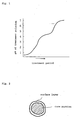
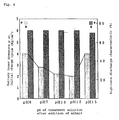
pH 4. At this time, the pH level of the acid treatment solution gradually rises. In the course of the pH rise, the surface of the alloy is roughened to increase the specific surface area of the alloy because the alloy constituents have different solubilities and leaching rates. At the same time, an isolation layer of nickel and cobalt appears on the alloy surface due to dissolution of the oxides of the rare earth elements and the like. The isolation layer has a high electrochemical activity, which improves the low-temperature discharge characteristic and cycle characteristic of the hydrogen-absorbing alloy electrode in synergy with the increase in the specific surface area of the alloy. - As shown in Fig. 1, however, the pH level of the acid treatment solution does not stop rising at
pH 4, but exceedspH 4. Since the solubilities of the alloy constituents are ph-dependent, the rare earth elements once leached into the treatment solution are deposited as hydroxides in the acid treatment solution to cover the alloy surface when the pH level of the treatment solution reaches aroundpH 5. - The pH level moderately rises from
pH 5 to around a neutral point, and a tight layer of oxides of rare earth elements and the like are readily formed on the alloy surface during the pH rise within this pH range. The tight layer formed on the alloy surface prevents an oxygen consumption reaction of the hydrogen-absorbing alloy. Therefore, where the hydrogen-absorbing alloy formed with the tight layer is used as an electrode active substance for a battery, the battery cannot exhibit a satisfactory battery inner pressure characteristic. - In accordance with the inventive mode group, the addition of the alkaline solution rapidly raises the pH level of the acid treatment solution in which the hydrogen-absorbing alloy is immersed. Therefore, the aforesaid problem is cleared up. More specafically, by rapidly raising the pH level of the acid treatment solution, the metals such as the rare earth elements leached into the acid treatment solution are forced to rapidly react with the alkali (hydroxyl ions) added during the acid treatment thereby to be deposited as hydroxides thereof on the alloy surface in the acid treatment solution. The hydroxide layer thus rapidly deposited is porous and, therefore, does not hinder the oxygen consumption reaction but catalyzes the oxygen consumption reaction.
- Therefore, a hydrogen-absorbing alloy electrode employing as its negative electrode active substance the hydrogen-absorbing alloy prepared through the alloy activation treatment process according to the inventive mode group is excellent in the low-temperature discharge characteristic, the high-rate discharge characteristic and the cycle characteristic, and does not increase the battery inner pressure.
- In the alloy activation treatment process according to the inventive mode group which ensures the aforesaid effects, the acid treatment solution initially has a pH level of pH 0.5 to pH 3.0, and the alkaline solution is added to the acid treatment solution in which the hydrogen-absorbing alloy is immersed before the pH level of the acid treatment solution reaches
pH 5, more preferably at a stage where the pH level of the acid treatment solution is not lower thanpH 4 and lower thanpH 5. It is difficult to prepare an acid treatment solution having an initial pH level of lower than pH 0.5. Use of an acid treatment solution having an initial pH level of higher than pH 3.0 cannot completely remove the oxide and hydroxide films on the alloy surface, failing to ensure satisfactory acid treatment effects. Further, if the alkaline solution is added to the acid treatment solution at a stage where the pH level of the acid treatment solution exceedspH 5, it is impossible to prevent the formation of the tight hydroxide layer. On the other hand, if the alkaline solution is added to the acid treatment solution at a stage where the pH level of the acid treatment solution is lower thanpH 4, the hydrogen-absorbing alloy is not sufficiently acid-treated. - In the alloy activation treatment process according to the inventive mode group, metal ions may be contained in the acid treatment solution and/or the alkaline solution (the inventive modes A and B). Where ions of a metal other than the metals to be leached out of the alloy into the acid treatment solution are preliminarily dissolved in the treatment solution, the metal ions are deposited on the alloy surface during the pH rise of the acid treatment solution, so that the resulting alloy has a roughened metal-rich surface. A hydrogen-absorbing alloy electrode employing the hydrogen-absorbing alloy is excellent in the electrochemical characteristics (oxygen consumption characteristic, high-rate discharge characteristic and the like).
- Examples of the metal ions include ions of nickel, cobalt, aluminum, copper and bismuth, among which nickel ions, cobalt ions and aluminum ions are preferably used either alone or in combination.
- A reason why ions of nickel, cobalt and aluminum are particularly preferred is that these metals have an excellent electric conductivity and supposedly serve to catalyze the oxygen consumption reaction on the alloy surface. Further, nickel, cobalt and aluminum are contained as alloy constituents, thereby producing no adverse effects on the battery reaction.
- The metal ions may be contained in either or both of the acid treatment solution and the alkaline solution. Where the metal ions are to be contained either in the acid treatment solution vr in the alkaline solution, it is more preferable in terms of the high-rate discharge characteristic that the metal ions are contained in the acid treatment solution. It is further more preferable that the metal ions are contained both in the acid treatment solution and in the alkaline solution, because the high-rate discharge characteristic can further be enhanced.
- To allow the metal ions to be contained in the acid treatment solution and/or the alkaline solution, a metal may directly be dissolved in the acid treatment solution or the alkaline solution but, in general, a compound of the metal is used. More specifically, a salt of the metal is used for the acid treatment solution, and a hydroxide of the metal is used for the alkaline solution.
- The concentration of the metal ions to be dissolved in the acid treatment solution is not particularly limited. The metal salt is typically dissolved in a concentration of 1 wt% to 5 wt% relative to the acid treatment solution. If the concentration is lower than 1 wt%, a satisfactory effect cannot be obtained. The metal salt cannot readily be dissolved in the acid treatment solution in a concentration of higher than 5 wt% because of the solubility thereof.
- It is further preferred to heat the acid treatment solution to dissolve the metal salt therein in a high concentration. This will be described later.
- In the alloy activation treatment process according to the inventive mode group, the alkali is added to the acid treatment solution in a pH adjusting process with the aim of creating conditions suitable for the electrochemical reaction by treating the alloy surface with a strong acid and completing the alloy treatment without impairing the preferable conditions. Therefore, the pH level of the acid treatment solution after the addition of the alkaline solution profoundly influences the electrochemical characteristics of the hydrogen-absorbing alloy. The effects of the addition of the alkali can be maximized in the following manner.
- Where the metal ions are contained neither in the acid treatment solution nor in the alkaline solution, the pH level of the acid treatment solution is preferably adjusted to
pH 7 topH 12 by the addition of the alkaline solution. The treatment within this pH range improves both the initial battery inner pressure characteristic and the high-rate discharge characteristic. - Where the metal ions are contained in the acid treatment solution and/or the alkaline solution, the pH level of the acid treatment solution is preferably adjusted to
pH 12 or higher by the addition of the alkaline solution- By rapidly raising the pH level of the acid treatment solution by the addition of the alkaline solution under the conditions where a metal other than the alloy constituent metals is dissolved in the acid treatment solution, the high-rate discharge characteristic can effectively be improved without impairing the inner pressure characteristic p at the initial charging. This will become apparent from embodiments of the present invention to be described later. - In the alloy activation treatment process according to the inventive mode group, the temperature of the treatment solution after the addition of the alkaline solution is preferably 65°C or higher. By keeping the solution at a temperature of 65°C or higher, the rate of a reaction between the added alkali (hydxoxyl ions) and the metals inducing the rare earth elements leached into the treatment solution increases, so that a more advantageous porous hydroxide layer can be formed on the alloy surface.
- In the alloy activation treatment process according to the inventive mode group, the metal-containing acid treatment solution and/or the alkaline solution are preferably heated up to 65°C or higher before use. The acid treatment solution or the alkaline solution heated up to 65°C or higher is capable of containing therein a greater amount of metal ions thereby to enhance the effect of modifying the alloy surface. Where the alkaline solution contains the metal ions, the heating is particularly effective because metals such as nickel and cobalt have a small solubility in the alkaline solution. In addition, the preheating of the solutions enables the alkali (and the metal added to the alkaline solution) to rapidly react with the metals (the metals including the rare earth metals and the metal added to the acid treatment solution) in the acid treatment solution immediately after the addition of the alkaline solution. Thus, the porous metal-rich layer having an excellent electrochemical activity can be formed on the alloy surface.
- Where the hydrogen-absorbing alloy is immersed in the acid treatment solution, the temperature of the acid treatment solution rises to about 30°C to 35°C due to chemical reaction heat and the like. To raise the temperature of the acid treatment solution to 65°C or higher, application of external heat is required. Since it is impossible and unnecessary to raise the temperature of the acid treatment solution to higher than 100°C under atmospheric pressure, the acid treatment solution is heated up to a temperature of not lower than 65°C and lower than 100°C. At this time, it is not preferred to boil the acid treatment solution, because evaporation thereof is entailed.
- Examples of specific acids to be used for the acid treatment solution according to the inventive mode group include hydrochloric acid, nitric acid, sulfuric acid, hydrofluoric acid and phosphoric acid. Examples of specific alkalis to be use for the alkaline solution include potassium hydroxide, lithium hydroxide and sodium hydroxide.
- The acid treatment according to the inventive mode group can be applied to the treatment of hydrogen-absorbing alloys, such as of rare earth metal type, a titanium type, a zirconium type and a magnesium type, for use in various alkaline secondary batteries.
-
- Fig. 1 is a graph showing the pH rise of an acid treatment solution during treatment of a hydrogen-absorbing alloy with the acid treatment solution;
- Fig. 2 is a schematic diagram illustrating a double-layer structure of a hydrogen-absorbing alloy in accordance with the present invention;
- Fig. 3 is a graph illustrating the relationship of the pH level of a treatment solution at addition of an alkaline solution versus the initial inner pressure p and high-rate discharge characteristic of a battery in accordance with the inventive mode group;
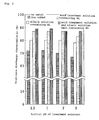
- Fig. 4 is a graph illustrating the relationship of the pH level of the treatment solution after the addition of the alkaline solution versus the initial inner pressure p and high-rate discharge characteristic of the battery in accordance with the inventive mode group;
- Fig. 5 is a graph illustrating the relationship of the pH level of the treatment solution after the addition of the alkaline solution versus the initial inner pressure p and high-rate discharge characteristic of the battery in accordance with the inventive mode group;
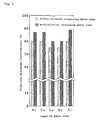
- Fig. 6 is a graph illustrating the relationship of the type of metal ions versus the high-rate discharge characteristic in accordance with the inventive mode group;
- Fig. 7 is a graph illustrating the relationship of the pH level of a treatment solution after addition of an alkaline solution containing metal ions versus the high-rate discharge characteristic in accordance with the inventive mode group; and
- Fig. 8 is a diagram illustrating the construction of a nickel-hydrogen secondary battery used in the first to the inventive mode groups.
- The present invention will hereinafter be described in detail by way of embodiments thereof.
- The inventive mode group is characterized in that an alkaline solution is added to the acid treatment solution during the acid treatment process. The features of the inventive mode group will be described by way of comparison between acid treatment processes with and without the addition of an alkali.
- Examples 1 are directed to a case where an acid treatment solution containing metal ions is used.
- A commercially available Misch metal (Mm: a mixture of rare earth metals such as La, Ce, Nd and Pr), nickel (Ni), cobalt (Co), aluminum (Al) and manganese (Mn) were mixed together in an element ratio of 1:3.4:0.8:0.2:0.6, and then heat-treated in a high-frequency fusion furnace to prepare a hydrogen-absorbing alloy ingot represented by a composition formula of MmNi3.1Co0.8Al0.2Mn0.6. In turn, the hydrogen-absorbing alloy ingot was annealed at 1,000°C for 10 hours. Subsequently, 1 Kg of the hydrogen-absorbing alloy ingot was pulverized by means of a ball mill with the use of 1 liter of water. Thus, a powdery hydrogen-absorbing alloy having an average particle diameter of 50 µm was obtained.
- Four hydrochloric acid aqueous solutions respectively having initial pH levels of pH 0-5,
pH 1,pH 2 andpH 3 were prepared as the acid treatment solution (containing no metal ion). A 10-N potassium hydroxide aqueous solution was prepared as the alkaline solution (containing no metal ion). A sample of the powdery hydzogen-absorbing alloy and each of the hydrochloric acid aqueous solutions in a weight ratio of 1:1 were put in a stirring mixer, and stirred therein while the pH level of the acid treatment solution was monitored. When the pH level of the treatment solution reached a predetermined value, a predetermined amount of the potassium hydroxide aqueous solution was added to the treatment solution, and then the resulting mixture was continuously stirred. When the pH level of the treatment solution was stabilized, the stirring was stopped, and the resulting hydrogen-absorbing alloy sample was taken out. The hydrogen-absorbing alloy sample was rinsed with pure water and dried. Thus, treated alloy samples A1 to A12 were prepared. The foregoing operation was performed at room temperature (about 25°C). - The aforesaid predetermined pH level of the treatment solution was
pH 2,pH 4,pH 5 orpH 7 as shown in a column "pH of treatment solution at addition of alkali" in Table 2-1. The aforesaid predetermined amount of the potassium hydroxide solution was an amount such that the pH level of the treatment solution could be adjusted topH 6,pH 7,pH 10,pH 12 orpH 15 as shown in a column "pH of treatment solution after addition of alkali" in Table 2-1 - The alloy samples A1 to A12 treated under such conditions are listed in Table 2-1. In Examples 1, the pH levels of the treatment solutions were adjusted by adding the 10-N potassium hydroxide aqueous solution thereto in different amounts. Alternatively, the adjustment of the pH level of the treatment solution may be achieved by using alkaline solutions having different alkalinities.
- Prepared as Comparative Examples were an alloy sample X2 (see Table 2-1) which was treated with a hydrochloric acid aqueous solution initially having
pH 1 without adding the alkaline solution, and an alloy sample X3 (see Table 2-1) which was not subjected to the acid treatment but treated with a potassium hydroxide solution (alkaline solution) havingpH 15. Further, a sample X1 (see Table 2-1) of the powdery hydrogen-absorbing alloy not subjected to the acid treatment was prepared as a reference example. - Test cells and nickel-hydrogen secondary batteries were fabricated in the following manner by using the treated alloy samples as their negative electrode active substances, and the initial inner pressure characteristic and high-rate discharge characteristic thereof were determined for examination of the electrochemical characteristics of the treated alloy samples.
- The nickel-hydrogen secondary batteries were used for determination of the battery inner pressure p at the initial charging.
- The nickel-hydrogen secondary batteries were each fabricated in the following manner. More specifically, the alloy samples were each mixed with 5 wt% of polytetrafluoroethylene powder as a binder, and the resulting mixture was kneaded for preparation of an alloy paste. The paste thus prepared was applied onto opposite sides of a collector of a punching metal and pressed for preparation of a hydrogen-absorbing alloy electrode. In turn, the hydrogen-absorbing alloy electrode (negative electrode) and a known sintered nickel electrode (positive electrode) having a lower capacity than the negative electrode were rolled with a separator interposed therebetween to form an electrode roll. After the electrode roll was inserted into a case, a 30-wt% potassium hydroxide aqueous solution was poured therein, and the case was sealed. Thus, a cylindrical nickel-hydrogen secondary battery having a theoretical capacity of 1,000 mAh was fabricated.
- The nickel-hydrogen secondary battery thus fabricated was charged at 1,000 mA for 60 minutes and, at this time, a battery inner pressure p was measured. The battery inner pressure at the initial charging represented by the battery inner pressure p is herein termed "inner pressure P characteristic''. It is noted that "initial inner pressure T characteristic" to be described later in the third and fourth inventive mode groups and the "inner pressure P characteristic" were determined under different conditions.
- Test cells for use in determination of the high-rate discharge characteristic were fabricated in the following manner.
- More specifically, 1g of each of the powdery alloy samples was mixed with 1.2 g of carbonyl nickel as a conductive agent and 0.2 g of polytetrafluoroethylene powder as a binder and, the resulting mixture was kneaded for preparation of an alloy paste. The alloy paste thus prepared was wrapped with a nickel mesh, and press-formed into a hydrogen-absorbing alloy electrode (negative electrode). The hydrogen-absorbing alloy electrode and a known sintered nickel electrode (positive electrode) having a significantly larger capacity than the negative electrode were placed in a cell. Then, a potassium hydroxide electrolyte was poured in an excess amount into the cell, which was thereafter sealed. Thus, the test cell was fabricated.
- The test cell thus fabricated was charged for 8 hours at a current of 50 mA per gram of hydrogen-absorbing alloy (50mA/g·alloy), rested for one hour, discharged at a current of 200 mA/g·alloy to a discharge termination voltage of 1.0 V. At this time, the discharge capacity (CH) was measured. After the discharging was suspended for one hour to restore the voltage of the test cell, the test cell was discharged at a current of 50 mA/g-alloy to a discharge termination voltage of 1.0 V. At this time, the discharge capacity (CL) was measured. The electrochemical activity (%) of each of the treated alloy samples was calculated from the following formula (1) using CH and CL to determine a high-rate discharge characteristic value.

- The test results are shown in Table 2-1 along with the alloy treatment conditions. A graph indicating the relationships of the pH level of the treatment solution at the addition of the alkaline solution versus the inner pressure p at the initial charging and the high-rate discharge characteristic are shown in Fig. 3, which are the results of the tests on the alloy samples A5, A2 and A6 treated with the acid treatment solutions initially having
pH 1, then havingpH 2,pH 4 andpH 5, respectively, at the addition of the alkaline solution, and havingpH 7 after the addition of the alkaline solution. A graph indicating the relationships of the pH level of the treatment solution after the addition of the alkaline solution versus the inner pressure p at the initial charging and the high-rate discharge characteristic are shown in Fig. 4, which are the results of the tests on the alloy samples A7, A2, A8, A9 and A10 treated with the acid treatment solutions initially havingpH 1, then havingpH 4 at the addition of the alkaline solution, and havingpH 6,pH 7,pH 10,pH 12 andpH 15, respectively, after the addition of the alkaline solution.Table 2-1 Alloy Sample No. or Test Cell No. Alloy Treatment Conditions Battery Characteristics Initial pH of Acid Treatment Solution pH of Treatment Solution at Addition of Alkali pH of Treatment Solution after Addition of Alkali Inner Pressure P at Initial Charging kg/cm2 High-Rate Discharge Characteristics % A1 0.5 4 7 2.8 72 A2 1 4 7 2.8 72 A3 2 4 7 2.8 70 A4 3 4 7 2.8 67 A5 1 2 7 2.8 70 A6 1 5 7 3.2 72 A7 1 9 6 4.0 72 A8 1 4 10 2.2 72 A9 1 4 12 2.0 72 A10 1 4 15 4.0 70 A11 1 7 10 5.0 72 A12 1 7 15 4.5 72 X1 - - - 2.0 60 X2 1 - - 5.3 72 X3 - 7 15 2.0 60 -: not treated - The comparison between the alloy sample X1 (not subjected to the acid treatment) and the alloy sample X2 (subjected to the acid treatment without the addition of the alkaline solution in accordance with the comparative example) shown in Table 2-1 indicates that the hydrogen-absorbing alloy subjected to the acid treatment had an improved high-rate discharge characteristic but a deteriorated inner pressure P characteristic. Further, the results of the tests on the alloy samples X2 and A1 to A12 (subjected to the acid treatment with the addition of the alkaline solution) indicate that the addition of the alkaline solution, to the treatment solution in the midst of the acid treatment improved the inner pressure P characteristic.
- This fact will be described in greater detail. In the case of the alloy samples A1 to A4 treated with the acid treatment solutions initially having pH 0.5,
pH 1,pH 2 andpH 3, respectively, then havingpH 4 at the addition of the alkaline solution, and havingpH 7 after the addition of the alkaline solution, the battery inner pressure at the initial charging was 2.8 kg/cm3 independently of the initial pH level. On the other hand, the high-rate discharge characteristic was deteriorated with the increase in the initial pH of the treatment solution. The comparison between the alloy samples A5, A2 and A6 (see Fig. 3) treated with the treatment solutions initially havingpH 1, then havingpH 2,pH 4 andpH 5, respectively, at the addition of the alkaline solution and havingpH 7 after the addition of the alkaline solution indicates that the treatment with the acid treatmentsolution having pH 5 at the addition of the alkaline solution provided for a higher battery inner pressure P at the initial charging than the treatment with the acid treatmentsolution having pH 2 orpH 4 at the addition of the alkaline solution. In the case of the alloy samples A1 and A12 treated with the acid treatmentsolutions having pH 7 at the addition of the alkaline solution, the battery inner pressure p at the initial charging is still higher. - These results indicate that the acid treatment solution preferably has an initial pH level of pH 0.5 to
pH 3 and the alkaline solution is preferably added to the acid treatment solution before the pH level of the acid treatment solution rises topH 5, more preferably at a stage where the treatment solution has a pH level of not lower than 4 and lower than 5. - Fig. 4 shows the results of the tests on the alloy samples A7, A2, A8, A9 and A10 treated with the acid treatment solutions initially having
pH 1, then havingpH 4 at the addition of the alkaline solution and havingpH 6,pH 7,pH 10,pH 12 andpH 15, respectively, after the addition of the alkaline solution. In Fig. 4, the high-rate discharge characteristics were substantially the same even if the pH levels of the treatment solutions after the addition of the alkaline solution were different within a pH range betweenpH 6 andpH 12, while the battery inner pressures P at the initial charging were higher in the case where the pH levels of the treatment solutions were lower thanpH 6 or higher thanpH 12. This indicates that the alkaline solution is preferably added to the acid treatment solution when the pH level of the treatment solution is betweenpH 7 andpH 12. - The comparison between the alloy sample X1 not subjected to any treatment and the alloy sample X3 treated only with the alkaline solution indicates that the treatment only with the alkaline solution did not improve the battery inner pressure P characteristic nor the high-rate discharge characteristic. This means that the aforesaid effects can be ensured only by adding the alkaline solution in the midst of the acid treatment.
- An explanation will be given to Examples 2 in which acid treatment solutions each containing metal ions were used. Examples 2 are substantially the same as in Examples 1 except that the acid treatment solutions each contained metal ions. Therefore, only features different from those of Examples 1 will be described.
- First, four hydrochloric acid aqueous solutions having different initial pH levels and a 10-N potassium hydroxide aqueous solution were prepared which were respectively used as acid treatment solutions and an alkaline solution containing no metal ion. Further, predetermined metal ions were dissolved in portions of the respective solutions to prepare metal-ion-containing acid treatment solutions and a metal ion containing alkaline solution. More specifically, chlorides of nickel, cobalt, copper, bismuth and aluminum were respectively dissolved in an amount of 5 wt% in portions of the hydrochloric acid aqueous solutions for preparation of five types of metal-ion-containing acid treatment solutions- Hydroxides of the aforesaid metals were respectively dissolved in portions of the aforesaid potassium hydroxide solution to saturation at room temperature (about 25°C) for preparation of five types of metal-ion-containing alkaline solutions (see Tables 2-2 and 2-3).
- Hydrogen-absorbing alloy samples were treated with the respective acid treatment
solutions having pH 4 at the addition of the alkaline solutions and havingpH 7 after the addition of the alkaline solutions under various treatment conditions. Thus, alloy samples B1 to B8 (treated by using the metal ion containing acid treatment solutions), alloy samples C1 to C8 (treated by using the metal-ion-containing alkaline solution) and alloy samples D1 to D 12 (treated by using both the metal-ion-containing acid treatment solutions and the metal-ion-containing alkaline solutions) were prepared (see Tables 2-2 and 2-3). - Alloy samples E1 to E3 were prepared by treating hydrogen-absorbing alloy samples with the acid treatment
solutions having pH 10,pH 12 andpH 15, respectively, after the addition of the alkaline solution in order to determine the optimum pH level of a treatment solution to be raised by the addition of the alkaline solution. - An alloy sample F1 was prepared in substantially the same manner as the alloy sample D2 (prepared at room temperature), except that the nickel-containing acid treatment solution and the nickel-containing alkaline solution heated at 65°C were used, in order to determine the influence of the temperature of the acid treatment solution on the electrochemical characteristics of the alloy sample.
- The electrochemical characteristics of the respective treated alloys were determined in the same manner as in Examples 1. The results are shown in Tables 2-2 and 2-3 along with the treatment conditions.
Table 2-2 Alloy Sample No. or Test Cell No. Alloy Treatment Conditions Battery Characteristics Acid Solution Alkaline Solution Inner Pressure P at Initial Charging kg/cmº High-Rate Discharge Characteri stics % Initial pH Metal lons Dissolved Metal Ions Dissolved pH After Addition Thereof B1 0.5 Ni - 7 2.0 87 B2 1 Ni - 7 2.0 87 B3 2 Ni - 7 2.0 87 B4 3 Ni - 7 2.0 83 B5 1 Co - 7 2.0 87 B6 1 Cu - 7 2.0 80 B7 1 Bi - 7 2.0 80 B8 1 Al - 7 2.0 89 C1 0.5 - Ni 7 2.0 80 C2 1 - Ni 7 2.0 80 C3 2 - Ni 7 2.0 80 C4 3 - Ni 7 2.0 78 C5 1 - Co 7 2.0 80 C6 1 - Cu 7 2.0 75 C7 1 - Bi 7 2.0 75 C8 1 - Al 7 2.0 80 not contained Table 2-3 Alloy Sample No. or Test Cell No. Alloy Treatment Conditions Battery Characteristics Acid Solution Alkaline Solution Inner Pressure High-Rate Discharge Character. sties % Initial pH Metal Ions Dissolved Metal Ions Dissolved pH After Addition Thereof P at Initial Charging kg/cm2 D1 0.5 Ni Ni 7 2.0 89 D2 1 Ni Ni 7 2.0 89 D3 2 Ni Ni 7 2.0 87 D4 3 Ni Ni 7 2.0 37 D5 1 Co Ni 7 2.0 89 D6 1 Cu Ni 7 2.0 82 D7 1 Bi Ni 7 2.0 82 D8 1 Al Ni 7 2.0 90 D9 1 Ni Co 7 2.0 89 D10 1 Ni Cu 7 2.0 80 D11 1 Ni Bi 7 2.0 80 D 121 Ni Al 7 2.0 90 E1 1 Ni Ni 10 2.0 89 E2 1 Ni Ni 12 2.0 91 E3 1 Ni Ni 15 2.0 91 F1 -1 Ni Ni 7 2.0 91 xi - - - - 2.0 60 X2 1 - - - 5.3 72 X3(A2) 1 - - 7 2.8 72 X4 1 Ni - - 5.3 85 -: not contained *: Temperature of treatment solution was 65°C after addition of alkaline solution. - In the case of the alloy samples A1 to A4 treated with the treatment solutions containing no metal ion in Examples 1 (Table 2-1), the battery inner pressures p at the initial discharging were 2.8 Kg/cm2. On the other hand, in the case of the alloy samples B1 to B4 (Table 2-2) subjected to the treatments in which only the acid treatment solutions contained Ni ions, the alloy samples C1 to C4 (Table 2-2) subjected to the treatments in which only the alkaline solutions contained Ni ions, and the alloy samples D1 to D4 (Table 2-3) subjected to the treatments in which both the acid treatment solutions and the alkaline solutions contained Ni ions, the battery inner pressures p at the initial charging were 2.0 Kg/cm2. This indicates that the battery inner pressure P characteristic can be improved by the treatment with an acid treatment solution in which a metal other than the alloy constituent metals is dissolved.
- The treatment in the presence of a metal other than the alloy constituent metals remarkably improves the high-rate discharge characteristic. As apparent from a graph in Fig. 5 prepared on the basis of the results of the tests on the alloy samples A1 to D4, however, the improvement degree of the high-rate discharge characteristic is not constant unlike the battery inner pressure P characteristic, but varies depending on the treatment conditions. More specifically, the improvement degree of the high-rate discharge characteristic is expressed as follows:
- (Treatment in which both acid solution and alkaline solution contain Ni ions)
≥ (Treatment in which only acid solution contains Ni ions)
> (Treatment in which only alkaline solution contains Ni ions)
> (Treatment in which neither acid solution nor alkaline solution contain Ni ions) - Thus, it was proven that the treatment with an acid treatment solution in which a metal other than the alloy constituent metals is dissolved (or added) improves both the battery inner pressure P characteristic and the high-rate discharge characteristic, and that the improvement degree of the high-rate discharge characteristic depends on which of the acid treatment solution and the alkaline solution contains metal ions. Where the metal ions are to be contained in the acid treatment solution or in the alkaline solution, it is preferable to add the metal ions to the acid treatment solution. It is more preferable to add the metal ions to both the acid treatment solution and the alkaline solution.
- Next, an explanation will be given to the correlation between the type of the metal ions and the electrochemical characteristic. Fig. 6 is a graph prepared on the basis of the results of the tests on the alloy samples B2 and B5 to B8, C2 and C5 to C8 which were treated with the treatment solutions containing different types of metal ions (with the other treatment conditions being the same). As apparent from Fig. 6, the improvement degree of the high-rate discharge characteristic shows the same tendency as described above, i.e., (Treatment in which only acid solution contains Ni ions) > (Treatment in which only alkaline solution contains Ni ions). On the other hand, the improvement degree of the high-rate discharge characteristic depends on the type of the metal ions, i.e., Al ≥ Ni = Co > Cu = Bi- Therefore, Al, Ni or Co ions are preferable as the metal ions, and Al ions are more preferable.
- The conclusion that Al, Ni or Co ions are preferable and Al ions are more preferable is supported by the results of the tests on the alloy samples D2 and D5 to D12 subjected to the treatments in which metal ions were contained both in the acid treatment solution and in the alkaline solution (the other treatment conditions were the same). More specifically, the combinations of Ni-Ni (D2), Co-Ni (D5), Al-Ni (D8), Ni-Co (D9) and Ni-Al (D12) ensure a more excellent high-rate discharge characteristic (see Table 2-3).
- Fig. 7 is a graph illustrating the relationship of the pH level of an acid treatment solution after the addition of an alkaline solution and the high-rate discharge characteristic in the case where both the acid treatment solution and the alkaline solution contained metal ions. The graph was prepared on the basis of the results of the tests on the alloy samples E1 to E3 and X4 shown in Table 2-3. As apparent from Fig. 7, the pH level of the treatment solution is preferably raised to
pH 7 or higher, more preferablypH 12 or higher by adding a proper amount of the alkaline solution to the treatment. - The comparison between the alloy sample F1 treated at 65°C and the alloy sample D2 treated at room temperature indicates that the alloy sample F1 provided for a more excellent high-rate discharge characteristic than the alloy sample D2. As described above, the alloy samples F1 and D2 were subjected to the treatment at different temperatures. Therefore, the difference in the high-rate discharge characteristic is attributable to the difference in the temperature of the treatment solution. That is, the treatment with a treatment solution at 65°C or higher further improves the high-rate discharge characteristic.
- As described above, the acid treatment process according to the inventive mode group is characterized in that the hydrogen-absorbing alloy is continuously treated with the acid treatment solution in a pH range between pH 0.5 and
pH 4 in which the acid effectively acts on the surface of the alloy, and the alkaline solution is added to the acid treatment solution to rapidly raise the pH of the treatment solution to a neutral or alkaline level at a stage where the pH of the treatment solution reaches a pH level ofpH 4 topH 5 at which the acid treatment becomes less effective and the formation of a tight hydroxide layer on the alloy surface would be started. This prevents the formation of the tight layer of hydroxides of rare earth elements on the alloy surface. Therefore, a hydragen-absorbing alloy electrode employing the hydrogen-absorbing alloy thus treated ensures an excellent low-temperature discharge characteristic and high-rate discharge characteristic, while preventing the deterioration in the battery inner pressure P characteristic. - Where ions of a metal such as aluminum, cobalt or nickel are added to the acid solution and/or the alkaline solution in this acid treatment, the metal is deposited on the alloy surface during the pH rise of the acid treatment solution to modify the alloy surface into a configuration (or state) suitable for the electrochemical reaction- Thus, the electrochemical characteristics such as the battery inner pressure P characteristic, the low-temperature discharge characteristic, the high-rate discharge characteristic and the cycle characteristic.
- With such effects, an alkaline secondary battery employing a hydrogen-absorbing alloy electrode prepared through the hydrogen-absorbing alloy electrode production process according to the inventive mode group exhibits a high performance unavailable in the prior art.
- In accordance with the present invention, the electrochemical characteristics of a hydrogen-absorbing alloy can be a remarkably improved. By employing the hydrogen-absorbing alloy, a hydrogen-absorbing alloy electrode can be provided which ensures an excellent battery initial inner pressure characteristic, low-temperature discharge characteristic, high-rate discharge characteristic and cycle characteristic. The present invention is useful to improve the performance of an alkaline secondary battery employing a hydrogen-absorbing alloy electrode.
Claims (19)
- A hydrogen-absorbing alloy electrode production process comprising an alloy activation treatment step of immersing a hydrogen-absorbing alloy in an acid treatment solution initially having a pH level of pH 0.5 to pH 3.0, and adding an alkaline solution to the acid treatment solution before a pH level of the acid treatment solution rises to pH 5 to promote a pH rise of the acid treatment solution.
- A hydrogen-absorbing alloy electrode production process as set forth in claim 1, wherein the alkaline solution is added to the acid treatment solution in which the hydrogen-absorbing alloy is immersed, when the pH level of the acid treatment solution reaches a pH range not lower than pH 4 and lower than pH 5.
- A hydrogen-absorbing alloy electrode production process as set forth in claim 1, wherein the pH level of the acid treatment solution in which the hydrogen-absorbing alloy is immersed is raised to a pH range between pH 7 and pH 12 by the addition of the alkaline solution.
- A hydrogen-absorbing alloy electrode production process as set forth in claim 2, wherein the pH level of the acid treatment solution in which the hydrogen-absorbing alloy is immersed is raised to a pH range between pH 7 and pH 12 by the addition of the alkaline solution when the pH level of the acid treatment solution reaches a pH range not lower than pH 4 and lower than pH 5.
- A hydrogen-absorbing alloy electrode production process as set forth in claim 1, wherein the acid treatment solution initially having a pH level of pH 0.5 to pH 3.0 contains metal ions.
- A hydrogen-absorbing alloy electrode production process as set forth in claim 5, wherein the alkaline solution is added to the acid treatment solution in which the hydrogen-absorbing alloy is immersed, when the pH level of the acid treatment solution reaches a pH range not lower than pH 4 and lower than pH 5.
- A hydrogen-absorbing alloy electrode production process as set forth in claim 5, wherein the pH level of the acid treatment solution is raised to pH 12 or higher by the addition of the alkaline solution.
- A hydrogen-absorbing alloy electrode production process as set forth in claim 5, wherein the pH level of the acid treatment solution in which the hydrogen-absorbing alloy is immersed is raised to pH 12 or higher by the addition of the alkaline solution when the pH level of the acid treatment solution reaches a pH range not lower than pH 4 and lower than pH 5.
- A hydrogen-absorbing alloy electrode production process as set forth in any of claims 5 to 8, wherein the metal ions are ions of at least one metal selected from the group consisting of nickel, cobalt and aluminum.
- A hydrogen-absorbing alloy electrode production process as set forth in claim 1 wherein the alkaline solution containing metal ions.
- A hydrogen-absorbing alloy electrode production process as set forth in claim 10, wherein the alkaline solution is added to the acid treatment solution in which the hydrogen-absorbing alloy is immersed to promote the pH rise of the acid treatment solution when the pH level of the acid treatment solution reaches a pH range not lower than pH 4 and lower than pH 5 .
- A hydrogen-absorbing alloy electrode production process as set forth in claim 10, wherein the pH level of the acid treatment solution is raised to pH 12 or higher by the addition of the alkaline solution.
- A hydrogen-absorbing alloy electrode production process as set forth in claim 10, wherein the pH level of the acid treatment solution in which the hydrogen-absorbing alloy is immersed is raised to pH 12 or higher by the addition of the alkaline solution when the pH level of the acid treatment solution reaches a pH range not lower than pH 4 and lower than pH 5.
- A hydrogen-absorbing alloy electrode production process as set forth in claim 10, wherein the metal ions are ions of at least one metal selected from the group consisting of nickel, cobalt and aluminum.
- A hydrogen-absorbing alloy electrode production process as set forth in claim 14, wherein the pH rise of the acid treatment solution in which the hydrogen-absorbing alloy is immersed is promoted by the addition of the alkaline solution when the pH level of the acid treatment solution reaches a pH range not lower than pH 4 and lower than pH 5.
- A hydrogen-absorbing alloy electrode production process as set forth in claim 14, wherein the pH level of the acid treatment solution is raised to pH 12 or higher by the addition of the alkaline solution.
- A hydrogen-absorbing alloy electrode production process as set forth in claim 14, wherein the pH level of the acid treatment solution in which the hydrogen-absorbing alloy is immersed is raised to pH 12 or higher by the addition of the alkaline solution when the pH level of the acid treatment solution reaches a pH range not lower than pH 4 and lower than pH 5.
- A hydrogen-absorbing alloy electrode production process as set forth in any of claims 5 to 17, wherein at least one of the acid treatment solution and the alkaline solution to be used in the alloy activation treatment step is kept at a temperature of 65 °C or higher.
- A hydrogen-absorbing alloy electrode production process as set forth in any of claims 5 to 17, wherein the acid treatment solution is kept at a temperature of 65 °C or higher after the addition of the alkaline solution.
Priority Applications (1)
| Application Number | Priority Date | Filing Date | Title |
|---|---|---|---|
| EP06076209A EP1713139A1 (en) | 1996-06-26 | 1997-06-20 | Hydrogen-absorbing alloy electrode and process for making the same |
Applications Claiming Priority (11)
| Application Number | Priority Date | Filing Date | Title |
|---|---|---|---|
| JP16575496 | 1996-06-26 | ||
| JP16575396 | 1996-06-26 | ||
| JP16575496 | 1996-06-26 | ||
| JP16575396A JP3433008B2 (en) | 1996-06-26 | 1996-06-26 | Method for producing hydrogen storage alloy for alkaline storage battery |
| JP30459896 | 1996-11-15 | ||
| JP30459896A JP3433031B2 (en) | 1996-06-26 | 1996-11-15 | Method for producing hydrogen storage alloy for alkaline storage battery |
| JP32897396A JP3459528B2 (en) | 1996-12-10 | 1996-12-10 | Method for producing hydrogen storage alloy for hydrogen storage alloy electrode |
| JP32897396 | 1996-12-10 | ||
| JP05955697A JP3573905B2 (en) | 1997-03-13 | 1997-03-13 | Method for producing hydrogen storage alloy electrode |
| JP5955697 | 1997-03-13 | ||
| PCT/JP1997/002146 WO1997050135A1 (en) | 1996-06-26 | 1997-06-20 | Hydrogen storing alloy electrode and process for producing hydrogen storage alloy electrode |
Related Child Applications (2)
| Application Number | Title | Priority Date | Filing Date |
|---|---|---|---|
| EP06076209A Division EP1713139A1 (en) | 1996-06-26 | 1997-06-20 | Hydrogen-absorbing alloy electrode and process for making the same |
| EP06075856 Division | 2006-04-10 |
Publications (3)
| Publication Number | Publication Date |
|---|---|
| EP0945907A1 EP0945907A1 (en) | 1999-09-29 |
| EP0945907A4 EP0945907A4 (en) | 2002-01-16 |
| EP0945907B1 true EP0945907B1 (en) | 2006-07-26 |
Family
ID=27523519
Family Applications (2)
| Application Number | Title | Priority Date | Filing Date |
|---|---|---|---|
| EP06076209A Withdrawn EP1713139A1 (en) | 1996-06-26 | 1997-06-20 | Hydrogen-absorbing alloy electrode and process for making the same |
| EP97927419A Expired - Lifetime EP0945907B1 (en) | 1996-06-26 | 1997-06-20 | Process for producing a hydrogen storing alloy electrode |
Family Applications Before (1)
| Application Number | Title | Priority Date | Filing Date |
|---|---|---|---|
| EP06076209A Withdrawn EP1713139A1 (en) | 1996-06-26 | 1997-06-20 | Hydrogen-absorbing alloy electrode and process for making the same |
Country Status (6)
| Country | Link |
|---|---|
| US (1) | US6255018B1 (en) |
| EP (2) | EP1713139A1 (en) |
| KR (1) | KR100305176B1 (en) |
| CN (1) | CN1179434C (en) |
| DE (1) | DE69736393T2 (en) |
| WO (1) | WO1997050135A1 (en) |
Families Citing this family (10)
| Publication number | Priority date | Publication date | Assignee | Title |
|---|---|---|---|---|
| WO1999066573A1 (en) * | 1998-06-18 | 1999-12-23 | Sanyo Electric Co., Ltd. | Hydrogen absorbing alloy for alkaline storage battery and method for production thereof, and hydrogen absorbing alloy electrode for alkaline storage battery and method for production thereof |
| WO2000001023A1 (en) | 1998-06-26 | 2000-01-06 | Sanyo Electric Co., Ltd. | Hydrogen absorbing alloy for alkaline storage battery and method for preparing the same |
| JP3670901B2 (en) * | 1999-08-31 | 2005-07-13 | 三洋電機株式会社 | Method for producing hydrogen storage alloy |
| JP4002829B2 (en) * | 2000-09-06 | 2007-11-07 | 日立マクセル株式会社 | Electrode element electrode material, method for producing the same, and electrochemical element |
| FR2886462B1 (en) | 2005-05-26 | 2007-07-20 | Accumulateurs Fixes | ACTIVE MATERIAL COMPOSITION AND ALKALINE ELECTROLYTE BATTERY |
| JP5173320B2 (en) | 2007-08-29 | 2013-04-03 | 三洋電機株式会社 | Hydrogen storage alloy electrode and alkaline storage battery using this hydrogen storage alloy electrode |
| US8097235B2 (en) | 2009-06-22 | 2012-01-17 | Toyota Motor Engineering & Manufacturing North America, Inc. | Bronsted acid destabilization of complex metal hydrides |
| CN105436645A (en) * | 2015-12-07 | 2016-03-30 | 天津平高智能电气有限公司 | Brazing method for vacuum switch assembling |
| CN112961996B (en) * | 2021-02-01 | 2022-05-03 | 中国科学院江西稀土研究院 | Rare earth hydrogen storage alloy and preparation method and application thereof |
| CN114507863B (en) * | 2021-03-10 | 2023-08-22 | 中国工程物理研究院电子工程研究所 | Surface treatment method of titanium material and high Wen Zhuqing titanium material |
Family Cites Families (28)
| Publication number | Priority date | Publication date | Assignee | Title |
|---|---|---|---|---|
| US4181586A (en) * | 1978-06-19 | 1980-01-01 | Ppg Industries, Inc. | Cathode electrocatalyst |
| JPS60185362A (en) | 1984-02-17 | 1985-09-20 | Sharp Corp | Manufacture of hydrogen storage electrode |
| US4902579A (en) * | 1985-03-29 | 1990-02-20 | The Standard Oil Company | Amorphous metal alloy compositions for reversible hydrogen storage |
| JPH084003B2 (en) | 1988-08-11 | 1996-01-17 | 三洋電機株式会社 | Hydrogen storage alloy electrode for alkaline storage battery and manufacturing method thereof |
| JP2925604B2 (en) * | 1989-11-09 | 1999-07-28 | 三洋電機株式会社 | Processing method of hydrogen storage alloy for alkaline secondary battery |
| US5358907A (en) * | 1990-01-30 | 1994-10-25 | Xerox Corporation | Method of electrolessly depositing metals on a silicon substrate by immersing the substrate in hydrofluoric acid containing a buffered metal salt solution |
| JPH0799691B2 (en) * | 1990-11-10 | 1995-10-25 | 工業技術院長 | Method for manufacturing hydrogen storage electrode |
| US5278001A (en) * | 1992-01-24 | 1994-01-11 | Hitachi Maxell, Ltd. | Hydrogen storage alloy, electrode comprising the same and hydrogen storage alloy cell |
| JPH05225975A (en) * | 1992-02-13 | 1993-09-03 | Furukawa Battery Co Ltd:The | Hydrogen storage alloy electrode |
| JPH0688150A (en) * | 1992-09-10 | 1994-03-29 | Chuo Denki Kogyo Kk | Production of hydrogen occluding alloy |
| JP3265652B2 (en) * | 1992-10-09 | 2002-03-11 | 松下電器産業株式会社 | Manufacturing method of alkaline storage battery and its hydrogen storage alloy |
| JP2537128B2 (en) | 1993-02-01 | 1996-09-25 | 古河電池株式会社 | Method for producing hydrogen storage alloy powder for negative electrode of nickel-hydrogen secondary battery and method for producing negative electrode for nickel-hydrogen secondary battery |
| JPH0773878A (en) * | 1993-08-31 | 1995-03-17 | Sanyo Electric Co Ltd | Manufacture of metal hydride electrode |
| JP3432870B2 (en) * | 1993-11-29 | 2003-08-04 | 三洋電機株式会社 | Method for producing metal hydride electrode |
| WO1995023435A1 (en) * | 1994-02-25 | 1995-08-31 | Yuasa Corporation | Hydrogen absorbing electrode and production method thereof |
| CA2184377C (en) * | 1994-03-31 | 2000-12-12 | Han Wu | Improved metal hydride hydrogen storage electrodes |
| JP3738052B2 (en) * | 1994-09-20 | 2006-01-25 | 三洋電機株式会社 | Nickel electrode active material, nickel electrode and nickel alkaline storage battery using the same, and production method thereof |
| US5629000A (en) * | 1994-11-25 | 1997-05-13 | Sanyo Electric Co., Ltd. | Hydrogen-absorbing alloy electrode for metal hydride alkaline batteries and process for producing the same |
| DE4445495A1 (en) * | 1994-12-20 | 1996-06-27 | Varta Batterie | Process for the recovery of metals from used nickel-metal hydride accumulators |
| KR100384760B1 (en) * | 1995-04-05 | 2003-08-19 | 산요 덴키 가부시키가이샤 | Manufacturing method of hydrogen storage alloy for alkaline storage battery and manufacturing method of hydrogen storage alloy electrode |
| KR100385480B1 (en) * | 1995-07-31 | 2003-08-19 | 산요 덴키 가부시키가이샤 | Manufacturing method of non-sintered nickel electrode for alkaline battery and alkaline storage battery |
| US5645930A (en) * | 1995-08-11 | 1997-07-08 | The Dow Chemical Company | Durable electrode coatings |
| JPH09129226A (en) | 1995-09-01 | 1997-05-16 | Sumitomo Metal Ind Ltd | Treatment method of hydrogen storage alloy for batteries |
| JP3433008B2 (en) * | 1996-06-26 | 2003-08-04 | 三洋電機株式会社 | Method for producing hydrogen storage alloy for alkaline storage battery |
| US6066415A (en) * | 1996-09-12 | 2000-05-23 | Kabushiki Kaisha Toshiba | Hydrogen absorbing electrode and metal oxide-hydrogen secondary battery |
| JP3553750B2 (en) * | 1996-11-29 | 2004-08-11 | 三洋電機株式会社 | Method for producing hydrogen storage alloy for alkaline storage battery |
| US5985057A (en) * | 1996-11-29 | 1999-11-16 | Sanyo Electric Co., Ltd. | Method of fabricating hydrogen absorbing alloy electrode |
| EP0851515A3 (en) * | 1996-12-27 | 2004-10-27 | Canon Kabushiki Kaisha | Powdery material, electrode member, method for manufacturing same and secondary cell |
-
1997
- 1997-06-20 EP EP06076209A patent/EP1713139A1/en not_active Withdrawn
- 1997-06-20 US US09/214,111 patent/US6255018B1/en not_active Expired - Fee Related
- 1997-06-20 CN CNB971972249A patent/CN1179434C/en not_active Expired - Fee Related
- 1997-06-20 WO PCT/JP1997/002146 patent/WO1997050135A1/en not_active Ceased
- 1997-06-20 KR KR1019980710482A patent/KR100305176B1/en not_active Expired - Fee Related
- 1997-06-20 EP EP97927419A patent/EP0945907B1/en not_active Expired - Lifetime
- 1997-06-20 DE DE69736393T patent/DE69736393T2/en not_active Expired - Fee Related
Also Published As
| Publication number | Publication date |
|---|---|
| DE69736393D1 (en) | 2006-09-07 |
| EP1713139A1 (en) | 2006-10-18 |
| KR100305176B1 (en) | 2001-11-30 |
| EP0945907A4 (en) | 2002-01-16 |
| DE69736393T2 (en) | 2007-08-09 |
| WO1997050135A1 (en) | 1997-12-31 |
| KR20000022078A (en) | 2000-04-25 |
| CN1179434C (en) | 2004-12-08 |
| US6255018B1 (en) | 2001-07-03 |
| CN1227671A (en) | 1999-09-01 |
| EP0945907A1 (en) | 1999-09-29 |
Similar Documents
| Publication | Publication Date | Title |
|---|---|---|
| EP0945907B1 (en) | Process for producing a hydrogen storing alloy electrode | |
| JPH0773878A (en) | Manufacture of metal hydride electrode | |
| US5549992A (en) | Preparing method for a nickel hydroxide for a nickel electrode, a manufacturing method for the nickel electrode, and an alkaline secondary battery incorporating the nickel electrode therein | |
| KR20010033703A (en) | Nickel electrode for alkali storage battery, method of producing nickel electrode for alkali storage battery, and alkali storage battery | |
| EP0468568B1 (en) | Electrochemical cell comprising a hydride-forming intermetallic compound | |
| US5943545A (en) | Method of manufacturing a hydrogen-absorbing alloy for use in an alkali storage cell | |
| EP0820109B1 (en) | Process for producing hydrogen-occlusion alloy electrode of alkaline storage battery | |
| JP2002507314A (en) | Hydrogen storage alloy | |
| JP3432870B2 (en) | Method for producing metal hydride electrode | |
| JP3433008B2 (en) | Method for producing hydrogen storage alloy for alkaline storage battery | |
| EP0765705B1 (en) | Manufacturing method for a hydrogen storage alloy powder for batteries | |
| JP3433031B2 (en) | Method for producing hydrogen storage alloy for alkaline storage battery | |
| JP3454600B2 (en) | Method for producing hydrogen storage alloy for alkaline storage battery | |
| JP3548004B2 (en) | Hydrogen storage alloy electrode for alkaline storage battery and method for producing the same | |
| JP3545209B2 (en) | Hydrogen storage alloy for alkaline storage battery and method for producing the same, hydrogen storage alloy electrode for alkaline storage battery and method for producing the same | |
| JP3454612B2 (en) | Manufacturing method of hydrogen storage alloy electrode | |
| JPH1150263A (en) | Production of stabilized hydrogen storage alloy | |
| JP3573905B2 (en) | Method for producing hydrogen storage alloy electrode | |
| EP1026763A1 (en) | Hydrogen absorbing allow electrode and method of producing the same | |
| JP3454614B2 (en) | Method for producing hydrogen storage alloy for alkaline storage battery | |
| JP3553752B2 (en) | Method for producing hydrogen storage alloy electrode | |
| JP3448886B2 (en) | Method for producing cadmium negative electrode plate for alkaline storage battery | |
| JP3322449B2 (en) | Method for producing metal hydride electrode | |
| JP3369800B2 (en) | Method for producing Ni-containing hydrogen storage alloy electrode | |
| JPH11283619A (en) | Manufacture of hydrogen storage alloy for alkaline storage battery |
Legal Events
| Date | Code | Title | Description |
|---|---|---|---|
| PUAI | Public reference made under article 153(3) epc to a published international application that has entered the european phase |
Free format text: ORIGINAL CODE: 0009012 |
|
| 17P | Request for examination filed |
Effective date: 19990114 |
|
| AK | Designated contracting states |
Kind code of ref document: A1 Designated state(s): DE FI FR GB |
|
| RIN1 | Information on inventor provided before grant (corrected) |
Inventor name: KIMOTO, MAMORU Inventor name: MATSUURA, YOSHINORI Inventor name: HIGASHIYAMA, NOBUYUKI Inventor name: KURODA, YASUSHI Inventor name: KATO, KIKUKO Inventor name: IMOTO, TERUHIKO Inventor name: FUKUDA, HIROSHI Inventor name: ISE, TADASHI |
|
| A4 | Supplementary search report drawn up and despatched |
Effective date: 20011204 |
|
| AK | Designated contracting states |
Kind code of ref document: A4 Designated state(s): DE FI FR GB |
|
| 17Q | First examination report despatched |
Effective date: 20040628 |
|
| GRAP | Despatch of communication of intention to grant a patent |
Free format text: ORIGINAL CODE: EPIDOSNIGR1 |
|
| RTI1 | Title (correction) |
Free format text: PROCESS FOR PRODUCING A HYDROGEN STORING ALLOY ELECTRODE |
|
| GRAS | Grant fee paid |
Free format text: ORIGINAL CODE: EPIDOSNIGR3 |
|
| GRAA | (expected) grant |
Free format text: ORIGINAL CODE: 0009210 |
|
| AK | Designated contracting states |
Kind code of ref document: B1 Designated state(s): DE FI FR GB |
|
| PG25 | Lapsed in a contracting state [announced via postgrant information from national office to epo] |
Ref country code: FI Free format text: LAPSE BECAUSE OF FAILURE TO SUBMIT A TRANSLATION OF THE DESCRIPTION OR TO PAY THE FEE WITHIN THE PRESCRIBED TIME-LIMIT Effective date: 20060726 |
|
| REG | Reference to a national code |
Ref country code: GB Ref legal event code: FG4D |
|
| REF | Corresponds to: |
Ref document number: 69736393 Country of ref document: DE Date of ref document: 20060907 Kind code of ref document: P |
|
| ET | Fr: translation filed | ||
| PLBE | No opposition filed within time limit |
Free format text: ORIGINAL CODE: 0009261 |
|
| STAA | Information on the status of an ep patent application or granted ep patent |
Free format text: STATUS: NO OPPOSITION FILED WITHIN TIME LIMIT |
|
| 26N | No opposition filed |
Effective date: 20070427 |
|
| GBPC | Gb: european patent ceased through non-payment of renewal fee |
Effective date: 20070620 |
|
| REG | Reference to a national code |
Ref country code: FR Ref legal event code: ST Effective date: 20080229 |
|
| PG25 | Lapsed in a contracting state [announced via postgrant information from national office to epo] |
Ref country code: DE Free format text: LAPSE BECAUSE OF NON-PAYMENT OF DUE FEES Effective date: 20080101 |
|
| PG25 | Lapsed in a contracting state [announced via postgrant information from national office to epo] |
Ref country code: GB Free format text: LAPSE BECAUSE OF NON-PAYMENT OF DUE FEES Effective date: 20070620 |
|
| PG25 | Lapsed in a contracting state [announced via postgrant information from national office to epo] |
Ref country code: FR Free format text: LAPSE BECAUSE OF NON-PAYMENT OF DUE FEES Effective date: 20070702 |