EP0944472B1 - Piece moulee en plastique avec une structure de construction - Google Patents
Piece moulee en plastique avec une structure de construction Download PDFInfo
- Publication number
- EP0944472B1 EP0944472B1 EP97941779A EP97941779A EP0944472B1 EP 0944472 B1 EP0944472 B1 EP 0944472B1 EP 97941779 A EP97941779 A EP 97941779A EP 97941779 A EP97941779 A EP 97941779A EP 0944472 B1 EP0944472 B1 EP 0944472B1
- Authority
- EP
- European Patent Office
- Prior art keywords
- structural elements
- polymer material
- load
- moulding
- bearing structure
- Prior art date
- Legal status (The legal status is an assumption and is not a legal conclusion. Google has not performed a legal analysis and makes no representation as to the accuracy of the status listed.)
- Revoked
Links
- 229920003023 plastic Polymers 0.000 title claims description 15
- 239000004033 plastic Substances 0.000 title claims description 15
- 238000010276 construction Methods 0.000 title description 18
- 239000002861 polymer material Substances 0.000 claims abstract description 29
- 238000000465 moulding Methods 0.000 claims abstract description 20
- 238000010137 moulding (plastic) Methods 0.000 claims abstract description 7
- 238000013461 design Methods 0.000 claims abstract description 4
- 229920000642 polymer Polymers 0.000 claims description 44
- 239000000835 fiber Substances 0.000 claims description 28
- 238000000034 method Methods 0.000 claims description 21
- 239000000463 material Substances 0.000 claims description 20
- 229920001169 thermoplastic Polymers 0.000 claims description 20
- -1 polypropylene Polymers 0.000 claims description 18
- 230000008569 process Effects 0.000 claims description 16
- 230000002787 reinforcement Effects 0.000 claims description 15
- 239000004743 Polypropylene Substances 0.000 claims description 10
- 239000011159 matrix material Substances 0.000 claims description 10
- 229920001707 polybutylene terephthalate Polymers 0.000 claims description 10
- 229920001155 polypropylene Polymers 0.000 claims description 10
- 241000264877 Hippospongia communis Species 0.000 claims description 8
- 239000004696 Poly ether ether ketone Substances 0.000 claims description 8
- 239000004952 Polyamide Substances 0.000 claims description 8
- 239000004642 Polyimide Substances 0.000 claims description 8
- 229920002647 polyamide Polymers 0.000 claims description 8
- 229920002530 polyetherether ketone Polymers 0.000 claims description 8
- 229920000139 polyethylene terephthalate Polymers 0.000 claims description 8
- 239000005020 polyethylene terephthalate Substances 0.000 claims description 8
- 229920001721 polyimide Polymers 0.000 claims description 8
- 239000004416 thermosoftening plastic Substances 0.000 claims description 8
- 238000001125 extrusion Methods 0.000 claims description 7
- 229920000515 polycarbonate Polymers 0.000 claims description 7
- 239000004417 polycarbonate Substances 0.000 claims description 7
- 238000001746 injection moulding Methods 0.000 claims description 5
- 229920002635 polyurethane Polymers 0.000 claims description 5
- 239000004814 polyurethane Substances 0.000 claims description 5
- OKTJSMMVPCPJKN-UHFFFAOYSA-N Carbon Chemical compound [C] OKTJSMMVPCPJKN-UHFFFAOYSA-N 0.000 claims description 4
- 229920000058 polyacrylate Polymers 0.000 claims description 4
- 230000003247 decreasing effect Effects 0.000 claims description 3
- 239000003822 epoxy resin Substances 0.000 claims description 3
- 239000011521 glass Substances 0.000 claims description 3
- 229920003986 novolac Polymers 0.000 claims description 3
- 229920000647 polyepoxide Polymers 0.000 claims description 3
- 229920003235 aromatic polyamide Polymers 0.000 claims description 2
- 229910052799 carbon Inorganic materials 0.000 claims description 2
- 238000006243 chemical reaction Methods 0.000 claims description 2
- 239000000109 continuous material Substances 0.000 claims description 2
- 238000005520 cutting process Methods 0.000 claims description 2
- 238000009792 diffusion process Methods 0.000 claims description 2
- LNEPOXFFQSENCJ-UHFFFAOYSA-N haloperidol Chemical compound C1CC(O)(C=2C=CC(Cl)=CC=2)CCN1CCCC(=O)C1=CC=C(F)C=C1 LNEPOXFFQSENCJ-UHFFFAOYSA-N 0.000 claims description 2
- 229920001568 phenolic resin Polymers 0.000 claims description 2
- 239000005011 phenolic resin Substances 0.000 claims description 2
- 229920005989 resin Polymers 0.000 claims description 2
- 239000011347 resin Substances 0.000 claims description 2
- 238000003466 welding Methods 0.000 claims description 2
- 229920000265 Polyparaphenylene Polymers 0.000 claims 2
- UCKMPCXJQFINFW-UHFFFAOYSA-N Sulphide Chemical compound [S-2] UCKMPCXJQFINFW-UHFFFAOYSA-N 0.000 claims 2
- 241000531908 Aramides Species 0.000 claims 1
- 238000003801 milling Methods 0.000 claims 1
- 125000002924 primary amino group Chemical group [H]N([H])* 0.000 claims 1
- 230000037452 priming Effects 0.000 claims 1
- 238000004080 punching Methods 0.000 claims 1
- 229920006305 unsaturated polyester Polymers 0.000 claims 1
- 238000004519 manufacturing process Methods 0.000 description 13
- 229920001187 thermosetting polymer Polymers 0.000 description 9
- 230000003014 reinforcing effect Effects 0.000 description 6
- 239000007788 liquid Substances 0.000 description 5
- 239000004734 Polyphenylene sulfide Substances 0.000 description 4
- 238000005265 energy consumption Methods 0.000 description 4
- 238000002347 injection Methods 0.000 description 4
- 239000007924 injection Substances 0.000 description 4
- 229920000069 polyphenylene sulfide Polymers 0.000 description 4
- 229920000049 Carbon (fiber) Polymers 0.000 description 3
- 229920002430 Fibre-reinforced plastic Polymers 0.000 description 3
- 230000008901 benefit Effects 0.000 description 3
- 230000015572 biosynthetic process Effects 0.000 description 3
- 239000004917 carbon fiber Substances 0.000 description 3
- 239000011151 fibre-reinforced plastic Substances 0.000 description 3
- 239000002991 molded plastic Substances 0.000 description 3
- 229920000728 polyester Polymers 0.000 description 3
- 239000012815 thermoplastic material Substances 0.000 description 3
- WKBPZYKAUNRMKP-UHFFFAOYSA-N 1-[2-(2,4-dichlorophenyl)pentyl]1,2,4-triazole Chemical compound C=1C=C(Cl)C=C(Cl)C=1C(CCC)CN1C=NC=N1 WKBPZYKAUNRMKP-UHFFFAOYSA-N 0.000 description 2
- 238000004026 adhesive bonding Methods 0.000 description 2
- 238000000137 annealing Methods 0.000 description 2
- 239000004760 aramid Substances 0.000 description 2
- 238000005266 casting Methods 0.000 description 2
- 238000010586 diagram Methods 0.000 description 2
- 238000005516 engineering process Methods 0.000 description 2
- 239000006260 foam Substances 0.000 description 2
- 239000002828 fuel tank Substances 0.000 description 2
- 239000003365 glass fiber Substances 0.000 description 2
- 238000010348 incorporation Methods 0.000 description 2
- 239000003973 paint Substances 0.000 description 2
- 238000010422 painting Methods 0.000 description 2
- 239000012783 reinforcing fiber Substances 0.000 description 2
- 239000004616 structural foam Substances 0.000 description 2
- 239000011031 topaz Substances 0.000 description 2
- 229910052853 topaz Inorganic materials 0.000 description 2
- 238000004804 winding Methods 0.000 description 2
- 239000004698 Polyethylene Substances 0.000 description 1
- 229910000831 Steel Inorganic materials 0.000 description 1
- NIXOWILDQLNWCW-UHFFFAOYSA-N acrylic acid group Chemical group C(C=C)(=O)O NIXOWILDQLNWCW-UHFFFAOYSA-N 0.000 description 1
- 239000000654 additive Substances 0.000 description 1
- 229920003180 amino resin Polymers 0.000 description 1
- 229920006231 aramid fiber Polymers 0.000 description 1
- 230000009286 beneficial effect Effects 0.000 description 1
- 238000000071 blow moulding Methods 0.000 description 1
- 238000003490 calendering Methods 0.000 description 1
- 230000008859 change Effects 0.000 description 1
- 239000011248 coating agent Substances 0.000 description 1
- 238000000576 coating method Methods 0.000 description 1
- 238000007596 consolidation process Methods 0.000 description 1
- 238000009749 continuous casting Methods 0.000 description 1
- 239000011199 continuous fiber reinforced thermoplastic Substances 0.000 description 1
- 230000007797 corrosion Effects 0.000 description 1
- 238000005260 corrosion Methods 0.000 description 1
- 230000008878 coupling Effects 0.000 description 1
- 238000010168 coupling process Methods 0.000 description 1
- 238000005859 coupling reaction Methods 0.000 description 1
- 230000007423 decrease Effects 0.000 description 1
- 230000001419 dependent effect Effects 0.000 description 1
- 238000011161 development Methods 0.000 description 1
- 230000018109 developmental process Effects 0.000 description 1
- 230000000694 effects Effects 0.000 description 1
- 239000004744 fabric Substances 0.000 description 1
- 230000002349 favourable effect Effects 0.000 description 1
- 239000011152 fibreglass Substances 0.000 description 1
- 239000000446 fuel Substances 0.000 description 1
- JEIPFZHSYJVQDO-UHFFFAOYSA-N iron(III) oxide Inorganic materials O=[Fe]O[Fe]=O JEIPFZHSYJVQDO-UHFFFAOYSA-N 0.000 description 1
- 238000005304 joining Methods 0.000 description 1
- 238000002844 melting Methods 0.000 description 1
- 230000008018 melting Effects 0.000 description 1
- 239000002184 metal Substances 0.000 description 1
- 239000007769 metal material Substances 0.000 description 1
- 239000000178 monomer Substances 0.000 description 1
- 229920000573 polyethylene Polymers 0.000 description 1
- 229920002959 polymer blend Polymers 0.000 description 1
- 229920005594 polymer fiber Polymers 0.000 description 1
- 229920005606 polypropylene copolymer Polymers 0.000 description 1
- 229920005749 polyurethane resin Polymers 0.000 description 1
- 230000035484 reaction time Effects 0.000 description 1
- 239000002689 soil Substances 0.000 description 1
- 238000005507 spraying Methods 0.000 description 1
- 239000010959 steel Substances 0.000 description 1
- 238000005728 strengthening Methods 0.000 description 1
- 239000000126 substance Substances 0.000 description 1
- 238000012360 testing method Methods 0.000 description 1
- 239000004753 textile Substances 0.000 description 1
- 229920006337 unsaturated polyester resin Polymers 0.000 description 1
- 229920002554 vinyl polymer Polymers 0.000 description 1
Images


Classifications
-
- B—PERFORMING OPERATIONS; TRANSPORTING
- B62—LAND VEHICLES FOR TRAVELLING OTHERWISE THAN ON RAILS
- B62D—MOTOR VEHICLES; TRAILERS
- B62D29/00—Superstructures, understructures, or sub-units thereof, characterised by the material thereof
- B62D29/04—Superstructures, understructures, or sub-units thereof, characterised by the material thereof predominantly of synthetic material
- B62D29/041—Understructures
-
- B—PERFORMING OPERATIONS; TRANSPORTING
- B29—WORKING OF PLASTICS; WORKING OF SUBSTANCES IN A PLASTIC STATE IN GENERAL
- B29C—SHAPING OR JOINING OF PLASTICS; SHAPING OF MATERIAL IN A PLASTIC STATE, NOT OTHERWISE PROVIDED FOR; AFTER-TREATMENT OF THE SHAPED PRODUCTS, e.g. REPAIRING
- B29C45/00—Injection moulding, i.e. forcing the required volume of moulding material through a nozzle into a closed mould; Apparatus therefor
- B29C45/14—Injection moulding, i.e. forcing the required volume of moulding material through a nozzle into a closed mould; Apparatus therefor incorporating preformed parts or layers, e.g. injection moulding around inserts or for coating articles
- B29C45/14631—Coating reinforcements
-
- B—PERFORMING OPERATIONS; TRANSPORTING
- B29—WORKING OF PLASTICS; WORKING OF SUBSTANCES IN A PLASTIC STATE IN GENERAL
- B29C—SHAPING OR JOINING OF PLASTICS; SHAPING OF MATERIAL IN A PLASTIC STATE, NOT OTHERWISE PROVIDED FOR; AFTER-TREATMENT OF THE SHAPED PRODUCTS, e.g. REPAIRING
- B29C45/00—Injection moulding, i.e. forcing the required volume of moulding material through a nozzle into a closed mould; Apparatus therefor
- B29C45/16—Making multilayered or multicoloured articles
- B29C45/1671—Making multilayered or multicoloured articles with an insert
-
- B—PERFORMING OPERATIONS; TRANSPORTING
- B29—WORKING OF PLASTICS; WORKING OF SUBSTANCES IN A PLASTIC STATE IN GENERAL
- B29C—SHAPING OR JOINING OF PLASTICS; SHAPING OF MATERIAL IN A PLASTIC STATE, NOT OTHERWISE PROVIDED FOR; AFTER-TREATMENT OF THE SHAPED PRODUCTS, e.g. REPAIRING
- B29C65/00—Joining or sealing of preformed parts, e.g. welding of plastics materials; Apparatus therefor
- B29C65/70—Joining or sealing of preformed parts, e.g. welding of plastics materials; Apparatus therefor by moulding
-
- B—PERFORMING OPERATIONS; TRANSPORTING
- B29—WORKING OF PLASTICS; WORKING OF SUBSTANCES IN A PLASTIC STATE IN GENERAL
- B29C—SHAPING OR JOINING OF PLASTICS; SHAPING OF MATERIAL IN A PLASTIC STATE, NOT OTHERWISE PROVIDED FOR; AFTER-TREATMENT OF THE SHAPED PRODUCTS, e.g. REPAIRING
- B29C66/00—General aspects of processes or apparatus for joining preformed parts
- B29C66/01—General aspects dealing with the joint area or with the area to be joined
- B29C66/05—Particular design of joint configurations
- B29C66/10—Particular design of joint configurations particular design of the joint cross-sections
- B29C66/11—Joint cross-sections comprising a single joint-segment, i.e. one of the parts to be joined comprising a single joint-segment in the joint cross-section
- B29C66/112—Single lapped joints
-
- B—PERFORMING OPERATIONS; TRANSPORTING
- B29—WORKING OF PLASTICS; WORKING OF SUBSTANCES IN A PLASTIC STATE IN GENERAL
- B29C—SHAPING OR JOINING OF PLASTICS; SHAPING OF MATERIAL IN A PLASTIC STATE, NOT OTHERWISE PROVIDED FOR; AFTER-TREATMENT OF THE SHAPED PRODUCTS, e.g. REPAIRING
- B29C66/00—General aspects of processes or apparatus for joining preformed parts
- B29C66/01—General aspects dealing with the joint area or with the area to be joined
- B29C66/05—Particular design of joint configurations
- B29C66/10—Particular design of joint configurations particular design of the joint cross-sections
- B29C66/11—Joint cross-sections comprising a single joint-segment, i.e. one of the parts to be joined comprising a single joint-segment in the joint cross-section
- B29C66/112—Single lapped joints
- B29C66/1122—Single lap to lap joints, i.e. overlap joints
-
- B—PERFORMING OPERATIONS; TRANSPORTING
- B29—WORKING OF PLASTICS; WORKING OF SUBSTANCES IN A PLASTIC STATE IN GENERAL
- B29C—SHAPING OR JOINING OF PLASTICS; SHAPING OF MATERIAL IN A PLASTIC STATE, NOT OTHERWISE PROVIDED FOR; AFTER-TREATMENT OF THE SHAPED PRODUCTS, e.g. REPAIRING
- B29C66/00—General aspects of processes or apparatus for joining preformed parts
- B29C66/01—General aspects dealing with the joint area or with the area to be joined
- B29C66/05—Particular design of joint configurations
- B29C66/10—Particular design of joint configurations particular design of the joint cross-sections
- B29C66/11—Joint cross-sections comprising a single joint-segment, i.e. one of the parts to be joined comprising a single joint-segment in the joint cross-section
- B29C66/114—Single butt joints
-
- B—PERFORMING OPERATIONS; TRANSPORTING
- B29—WORKING OF PLASTICS; WORKING OF SUBSTANCES IN A PLASTIC STATE IN GENERAL
- B29C—SHAPING OR JOINING OF PLASTICS; SHAPING OF MATERIAL IN A PLASTIC STATE, NOT OTHERWISE PROVIDED FOR; AFTER-TREATMENT OF THE SHAPED PRODUCTS, e.g. REPAIRING
- B29C66/00—General aspects of processes or apparatus for joining preformed parts
- B29C66/01—General aspects dealing with the joint area or with the area to be joined
- B29C66/05—Particular design of joint configurations
- B29C66/10—Particular design of joint configurations particular design of the joint cross-sections
- B29C66/11—Joint cross-sections comprising a single joint-segment, i.e. one of the parts to be joined comprising a single joint-segment in the joint cross-section
- B29C66/114—Single butt joints
- B29C66/1142—Single butt to butt joints
-
- B—PERFORMING OPERATIONS; TRANSPORTING
- B29—WORKING OF PLASTICS; WORKING OF SUBSTANCES IN A PLASTIC STATE IN GENERAL
- B29C—SHAPING OR JOINING OF PLASTICS; SHAPING OF MATERIAL IN A PLASTIC STATE, NOT OTHERWISE PROVIDED FOR; AFTER-TREATMENT OF THE SHAPED PRODUCTS, e.g. REPAIRING
- B29C66/00—General aspects of processes or apparatus for joining preformed parts
- B29C66/50—General aspects of joining tubular articles; General aspects of joining long products, i.e. bars or profiled elements; General aspects of joining single elements to tubular articles, hollow articles or bars; General aspects of joining several hollow-preforms to form hollow or tubular articles
- B29C66/51—Joining tubular articles, profiled elements or bars; Joining single elements to tubular articles, hollow articles or bars; Joining several hollow-preforms to form hollow or tubular articles
- B29C66/52—Joining tubular articles, bars or profiled elements
- B29C66/522—Joining tubular articles
- B29C66/5224—Joining tubular articles for forming fork-shaped connections, e.g. for making Y-shaped pieces
- B29C66/52241—Joining tubular articles for forming fork-shaped connections, e.g. for making Y-shaped pieces with two right angles, e.g. for making T-shaped pieces
-
- B—PERFORMING OPERATIONS; TRANSPORTING
- B29—WORKING OF PLASTICS; WORKING OF SUBSTANCES IN A PLASTIC STATE IN GENERAL
- B29C—SHAPING OR JOINING OF PLASTICS; SHAPING OF MATERIAL IN A PLASTIC STATE, NOT OTHERWISE PROVIDED FOR; AFTER-TREATMENT OF THE SHAPED PRODUCTS, e.g. REPAIRING
- B29C66/00—General aspects of processes or apparatus for joining preformed parts
- B29C66/50—General aspects of joining tubular articles; General aspects of joining long products, i.e. bars or profiled elements; General aspects of joining single elements to tubular articles, hollow articles or bars; General aspects of joining several hollow-preforms to form hollow or tubular articles
- B29C66/51—Joining tubular articles, profiled elements or bars; Joining single elements to tubular articles, hollow articles or bars; Joining several hollow-preforms to form hollow or tubular articles
- B29C66/52—Joining tubular articles, bars or profiled elements
- B29C66/522—Joining tubular articles
- B29C66/5225—Joining tubular articles for forming cross-shaped connections, e.g. for making X-shaped pieces
-
- B—PERFORMING OPERATIONS; TRANSPORTING
- B29—WORKING OF PLASTICS; WORKING OF SUBSTANCES IN A PLASTIC STATE IN GENERAL
- B29C—SHAPING OR JOINING OF PLASTICS; SHAPING OF MATERIAL IN A PLASTIC STATE, NOT OTHERWISE PROVIDED FOR; AFTER-TREATMENT OF THE SHAPED PRODUCTS, e.g. REPAIRING
- B29C66/00—General aspects of processes or apparatus for joining preformed parts
- B29C66/50—General aspects of joining tubular articles; General aspects of joining long products, i.e. bars or profiled elements; General aspects of joining single elements to tubular articles, hollow articles or bars; General aspects of joining several hollow-preforms to form hollow or tubular articles
- B29C66/51—Joining tubular articles, profiled elements or bars; Joining single elements to tubular articles, hollow articles or bars; Joining several hollow-preforms to form hollow or tubular articles
- B29C66/52—Joining tubular articles, bars or profiled elements
- B29C66/522—Joining tubular articles
- B29C66/5229—Joining tubular articles involving the use of a socket
-
- B—PERFORMING OPERATIONS; TRANSPORTING
- B29—WORKING OF PLASTICS; WORKING OF SUBSTANCES IN A PLASTIC STATE IN GENERAL
- B29C—SHAPING OR JOINING OF PLASTICS; SHAPING OF MATERIAL IN A PLASTIC STATE, NOT OTHERWISE PROVIDED FOR; AFTER-TREATMENT OF THE SHAPED PRODUCTS, e.g. REPAIRING
- B29C66/00—General aspects of processes or apparatus for joining preformed parts
- B29C66/50—General aspects of joining tubular articles; General aspects of joining long products, i.e. bars or profiled elements; General aspects of joining single elements to tubular articles, hollow articles or bars; General aspects of joining several hollow-preforms to form hollow or tubular articles
- B29C66/51—Joining tubular articles, profiled elements or bars; Joining single elements to tubular articles, hollow articles or bars; Joining several hollow-preforms to form hollow or tubular articles
- B29C66/52—Joining tubular articles, bars or profiled elements
- B29C66/524—Joining profiled elements
- B29C66/5244—Joining profiled elements for forming fork-shaped connections, e.g. for making window frames or Y-shaped pieces
- B29C66/52441—Joining profiled elements for forming fork-shaped connections, e.g. for making window frames or Y-shaped pieces with two right angles, e.g. for making T-shaped pieces
-
- B—PERFORMING OPERATIONS; TRANSPORTING
- B29—WORKING OF PLASTICS; WORKING OF SUBSTANCES IN A PLASTIC STATE IN GENERAL
- B29C—SHAPING OR JOINING OF PLASTICS; SHAPING OF MATERIAL IN A PLASTIC STATE, NOT OTHERWISE PROVIDED FOR; AFTER-TREATMENT OF THE SHAPED PRODUCTS, e.g. REPAIRING
- B29C66/00—General aspects of processes or apparatus for joining preformed parts
- B29C66/50—General aspects of joining tubular articles; General aspects of joining long products, i.e. bars or profiled elements; General aspects of joining single elements to tubular articles, hollow articles or bars; General aspects of joining several hollow-preforms to form hollow or tubular articles
- B29C66/51—Joining tubular articles, profiled elements or bars; Joining single elements to tubular articles, hollow articles or bars; Joining several hollow-preforms to form hollow or tubular articles
- B29C66/52—Joining tubular articles, bars or profiled elements
- B29C66/524—Joining profiled elements
- B29C66/5245—Joining profiled elements for forming cross-shaped connections, e.g. for making window frames or X-shaped pieces
- B29C66/52451—Joining profiled elements for forming cross-shaped connections, e.g. for making window frames or X-shaped pieces with four right angles, e.g. for making +-shaped pieces
-
- B—PERFORMING OPERATIONS; TRANSPORTING
- B29—WORKING OF PLASTICS; WORKING OF SUBSTANCES IN A PLASTIC STATE IN GENERAL
- B29C—SHAPING OR JOINING OF PLASTICS; SHAPING OF MATERIAL IN A PLASTIC STATE, NOT OTHERWISE PROVIDED FOR; AFTER-TREATMENT OF THE SHAPED PRODUCTS, e.g. REPAIRING
- B29C66/00—General aspects of processes or apparatus for joining preformed parts
- B29C66/50—General aspects of joining tubular articles; General aspects of joining long products, i.e. bars or profiled elements; General aspects of joining single elements to tubular articles, hollow articles or bars; General aspects of joining several hollow-preforms to form hollow or tubular articles
- B29C66/51—Joining tubular articles, profiled elements or bars; Joining single elements to tubular articles, hollow articles or bars; Joining several hollow-preforms to form hollow or tubular articles
- B29C66/52—Joining tubular articles, bars or profiled elements
- B29C66/526—Joining bars
- B29C66/5265—Joining bars for forming cross-shaped connections, e.g. for making X-shaped pieces
-
- B—PERFORMING OPERATIONS; TRANSPORTING
- B29—WORKING OF PLASTICS; WORKING OF SUBSTANCES IN A PLASTIC STATE IN GENERAL
- B29C—SHAPING OR JOINING OF PLASTICS; SHAPING OF MATERIAL IN A PLASTIC STATE, NOT OTHERWISE PROVIDED FOR; AFTER-TREATMENT OF THE SHAPED PRODUCTS, e.g. REPAIRING
- B29C66/00—General aspects of processes or apparatus for joining preformed parts
- B29C66/70—General aspects of processes or apparatus for joining preformed parts characterised by the composition, physical properties or the structure of the material of the parts to be joined; Joining with non-plastics material
- B29C66/72—General aspects of processes or apparatus for joining preformed parts characterised by the composition, physical properties or the structure of the material of the parts to be joined; Joining with non-plastics material characterised by the structure of the material of the parts to be joined
- B29C66/721—Fibre-reinforced materials
-
- B—PERFORMING OPERATIONS; TRANSPORTING
- B29—WORKING OF PLASTICS; WORKING OF SUBSTANCES IN A PLASTIC STATE IN GENERAL
- B29C—SHAPING OR JOINING OF PLASTICS; SHAPING OF MATERIAL IN A PLASTIC STATE, NOT OTHERWISE PROVIDED FOR; AFTER-TREATMENT OF THE SHAPED PRODUCTS, e.g. REPAIRING
- B29C66/00—General aspects of processes or apparatus for joining preformed parts
- B29C66/70—General aspects of processes or apparatus for joining preformed parts characterised by the composition, physical properties or the structure of the material of the parts to be joined; Joining with non-plastics material
- B29C66/73—General aspects of processes or apparatus for joining preformed parts characterised by the composition, physical properties or the structure of the material of the parts to be joined; Joining with non-plastics material characterised by the intensive physical properties of the material of the parts to be joined, by the optical properties of the material of the parts to be joined, by the extensive physical properties of the parts to be joined, by the state of the material of the parts to be joined or by the material of the parts to be joined being a thermoplastic or a thermoset
- B29C66/739—General aspects of processes or apparatus for joining preformed parts characterised by the composition, physical properties or the structure of the material of the parts to be joined; Joining with non-plastics material characterised by the intensive physical properties of the material of the parts to be joined, by the optical properties of the material of the parts to be joined, by the extensive physical properties of the parts to be joined, by the state of the material of the parts to be joined or by the material of the parts to be joined being a thermoplastic or a thermoset characterised by the material of the parts to be joined being a thermoplastic or a thermoset
- B29C66/7392—General aspects of processes or apparatus for joining preformed parts characterised by the composition, physical properties or the structure of the material of the parts to be joined; Joining with non-plastics material characterised by the intensive physical properties of the material of the parts to be joined, by the optical properties of the material of the parts to be joined, by the extensive physical properties of the parts to be joined, by the state of the material of the parts to be joined or by the material of the parts to be joined being a thermoplastic or a thermoset characterised by the material of the parts to be joined being a thermoplastic or a thermoset characterised by the material of at least one of the parts being a thermoplastic
-
- B—PERFORMING OPERATIONS; TRANSPORTING
- B29—WORKING OF PLASTICS; WORKING OF SUBSTANCES IN A PLASTIC STATE IN GENERAL
- B29C—SHAPING OR JOINING OF PLASTICS; SHAPING OF MATERIAL IN A PLASTIC STATE, NOT OTHERWISE PROVIDED FOR; AFTER-TREATMENT OF THE SHAPED PRODUCTS, e.g. REPAIRING
- B29C70/00—Shaping composites, i.e. plastics material comprising reinforcements, fillers or preformed parts, e.g. inserts
- B29C70/68—Shaping composites, i.e. plastics material comprising reinforcements, fillers or preformed parts, e.g. inserts by incorporating or moulding on preformed parts, e.g. inserts or layers, e.g. foam blocks
- B29C70/681—Component parts, details or accessories; Auxiliary operations
- B29C70/682—Preformed parts characterised by their structure, e.g. form
-
- B—PERFORMING OPERATIONS; TRANSPORTING
- B29—WORKING OF PLASTICS; WORKING OF SUBSTANCES IN A PLASTIC STATE IN GENERAL
- B29C—SHAPING OR JOINING OF PLASTICS; SHAPING OF MATERIAL IN A PLASTIC STATE, NOT OTHERWISE PROVIDED FOR; AFTER-TREATMENT OF THE SHAPED PRODUCTS, e.g. REPAIRING
- B29C70/00—Shaping composites, i.e. plastics material comprising reinforcements, fillers or preformed parts, e.g. inserts
- B29C70/68—Shaping composites, i.e. plastics material comprising reinforcements, fillers or preformed parts, e.g. inserts by incorporating or moulding on preformed parts, e.g. inserts or layers, e.g. foam blocks
- B29C70/74—Moulding material on a relatively small portion of the preformed part, e.g. outsert moulding
- B29C70/742—Forming a hollow body around the preformed part
-
- B—PERFORMING OPERATIONS; TRANSPORTING
- B29—WORKING OF PLASTICS; WORKING OF SUBSTANCES IN A PLASTIC STATE IN GENERAL
- B29C—SHAPING OR JOINING OF PLASTICS; SHAPING OF MATERIAL IN A PLASTIC STATE, NOT OTHERWISE PROVIDED FOR; AFTER-TREATMENT OF THE SHAPED PRODUCTS, e.g. REPAIRING
- B29C70/00—Shaping composites, i.e. plastics material comprising reinforcements, fillers or preformed parts, e.g. inserts
- B29C70/68—Shaping composites, i.e. plastics material comprising reinforcements, fillers or preformed parts, e.g. inserts by incorporating or moulding on preformed parts, e.g. inserts or layers, e.g. foam blocks
- B29C70/84—Shaping composites, i.e. plastics material comprising reinforcements, fillers or preformed parts, e.g. inserts by incorporating or moulding on preformed parts, e.g. inserts or layers, e.g. foam blocks by moulding material on preformed parts to be joined
-
- B—PERFORMING OPERATIONS; TRANSPORTING
- B62—LAND VEHICLES FOR TRAVELLING OTHERWISE THAN ON RAILS
- B62D—MOTOR VEHICLES; TRAILERS
- B62D23/00—Combined superstructure and frame, i.e. monocoque constructions
- B62D23/005—Combined superstructure and frame, i.e. monocoque constructions with integrated chassis in the whole shell, e.g. meshwork, tubes, or the like
-
- B—PERFORMING OPERATIONS; TRANSPORTING
- B29—WORKING OF PLASTICS; WORKING OF SUBSTANCES IN A PLASTIC STATE IN GENERAL
- B29C—SHAPING OR JOINING OF PLASTICS; SHAPING OF MATERIAL IN A PLASTIC STATE, NOT OTHERWISE PROVIDED FOR; AFTER-TREATMENT OF THE SHAPED PRODUCTS, e.g. REPAIRING
- B29C66/00—General aspects of processes or apparatus for joining preformed parts
- B29C66/50—General aspects of joining tubular articles; General aspects of joining long products, i.e. bars or profiled elements; General aspects of joining single elements to tubular articles, hollow articles or bars; General aspects of joining several hollow-preforms to form hollow or tubular articles
- B29C66/51—Joining tubular articles, profiled elements or bars; Joining single elements to tubular articles, hollow articles or bars; Joining several hollow-preforms to form hollow or tubular articles
- B29C66/52—Joining tubular articles, bars or profiled elements
- B29C66/526—Joining bars
- B29C66/5268—Joining bars characterised by their solid cross sections being non-circular, e.g. being elliptical, square or rectangular
-
- B—PERFORMING OPERATIONS; TRANSPORTING
- B29—WORKING OF PLASTICS; WORKING OF SUBSTANCES IN A PLASTIC STATE IN GENERAL
- B29C—SHAPING OR JOINING OF PLASTICS; SHAPING OF MATERIAL IN A PLASTIC STATE, NOT OTHERWISE PROVIDED FOR; AFTER-TREATMENT OF THE SHAPED PRODUCTS, e.g. REPAIRING
- B29C66/00—General aspects of processes or apparatus for joining preformed parts
- B29C66/70—General aspects of processes or apparatus for joining preformed parts characterised by the composition, physical properties or the structure of the material of the parts to be joined; Joining with non-plastics material
- B29C66/71—General aspects of processes or apparatus for joining preformed parts characterised by the composition, physical properties or the structure of the material of the parts to be joined; Joining with non-plastics material characterised by the composition of the plastics material of the parts to be joined
-
- B—PERFORMING OPERATIONS; TRANSPORTING
- B29—WORKING OF PLASTICS; WORKING OF SUBSTANCES IN A PLASTIC STATE IN GENERAL
- B29C—SHAPING OR JOINING OF PLASTICS; SHAPING OF MATERIAL IN A PLASTIC STATE, NOT OTHERWISE PROVIDED FOR; AFTER-TREATMENT OF THE SHAPED PRODUCTS, e.g. REPAIRING
- B29C66/00—General aspects of processes or apparatus for joining preformed parts
- B29C66/70—General aspects of processes or apparatus for joining preformed parts characterised by the composition, physical properties or the structure of the material of the parts to be joined; Joining with non-plastics material
- B29C66/72—General aspects of processes or apparatus for joining preformed parts characterised by the composition, physical properties or the structure of the material of the parts to be joined; Joining with non-plastics material characterised by the structure of the material of the parts to be joined
- B29C66/721—Fibre-reinforced materials
- B29C66/7212—Fibre-reinforced materials characterised by the composition of the fibres
-
- B—PERFORMING OPERATIONS; TRANSPORTING
- B29—WORKING OF PLASTICS; WORKING OF SUBSTANCES IN A PLASTIC STATE IN GENERAL
- B29C—SHAPING OR JOINING OF PLASTICS; SHAPING OF MATERIAL IN A PLASTIC STATE, NOT OTHERWISE PROVIDED FOR; AFTER-TREATMENT OF THE SHAPED PRODUCTS, e.g. REPAIRING
- B29C66/00—General aspects of processes or apparatus for joining preformed parts
- B29C66/70—General aspects of processes or apparatus for joining preformed parts characterised by the composition, physical properties or the structure of the material of the parts to be joined; Joining with non-plastics material
- B29C66/72—General aspects of processes or apparatus for joining preformed parts characterised by the composition, physical properties or the structure of the material of the parts to be joined; Joining with non-plastics material characterised by the structure of the material of the parts to be joined
- B29C66/721—Fibre-reinforced materials
- B29C66/7214—Fibre-reinforced materials characterised by the length of the fibres
- B29C66/72141—Fibres of continuous length
-
- B—PERFORMING OPERATIONS; TRANSPORTING
- B29—WORKING OF PLASTICS; WORKING OF SUBSTANCES IN A PLASTIC STATE IN GENERAL
- B29C—SHAPING OR JOINING OF PLASTICS; SHAPING OF MATERIAL IN A PLASTIC STATE, NOT OTHERWISE PROVIDED FOR; AFTER-TREATMENT OF THE SHAPED PRODUCTS, e.g. REPAIRING
- B29C66/00—General aspects of processes or apparatus for joining preformed parts
- B29C66/70—General aspects of processes or apparatus for joining preformed parts characterised by the composition, physical properties or the structure of the material of the parts to be joined; Joining with non-plastics material
- B29C66/72—General aspects of processes or apparatus for joining preformed parts characterised by the composition, physical properties or the structure of the material of the parts to be joined; Joining with non-plastics material characterised by the structure of the material of the parts to be joined
- B29C66/721—Fibre-reinforced materials
- B29C66/7214—Fibre-reinforced materials characterised by the length of the fibres
- B29C66/72143—Fibres of discontinuous lengths
-
- B—PERFORMING OPERATIONS; TRANSPORTING
- B29—WORKING OF PLASTICS; WORKING OF SUBSTANCES IN A PLASTIC STATE IN GENERAL
- B29C—SHAPING OR JOINING OF PLASTICS; SHAPING OF MATERIAL IN A PLASTIC STATE, NOT OTHERWISE PROVIDED FOR; AFTER-TREATMENT OF THE SHAPED PRODUCTS, e.g. REPAIRING
- B29C66/00—General aspects of processes or apparatus for joining preformed parts
- B29C66/70—General aspects of processes or apparatus for joining preformed parts characterised by the composition, physical properties or the structure of the material of the parts to be joined; Joining with non-plastics material
- B29C66/73—General aspects of processes or apparatus for joining preformed parts characterised by the composition, physical properties or the structure of the material of the parts to be joined; Joining with non-plastics material characterised by the intensive physical properties of the material of the parts to be joined, by the optical properties of the material of the parts to be joined, by the extensive physical properties of the parts to be joined, by the state of the material of the parts to be joined or by the material of the parts to be joined being a thermoplastic or a thermoset
- B29C66/739—General aspects of processes or apparatus for joining preformed parts characterised by the composition, physical properties or the structure of the material of the parts to be joined; Joining with non-plastics material characterised by the intensive physical properties of the material of the parts to be joined, by the optical properties of the material of the parts to be joined, by the extensive physical properties of the parts to be joined, by the state of the material of the parts to be joined or by the material of the parts to be joined being a thermoplastic or a thermoset characterised by the material of the parts to be joined being a thermoplastic or a thermoset
- B29C66/7394—General aspects of processes or apparatus for joining preformed parts characterised by the composition, physical properties or the structure of the material of the parts to be joined; Joining with non-plastics material characterised by the intensive physical properties of the material of the parts to be joined, by the optical properties of the material of the parts to be joined, by the extensive physical properties of the parts to be joined, by the state of the material of the parts to be joined or by the material of the parts to be joined being a thermoplastic or a thermoset characterised by the material of the parts to be joined being a thermoplastic or a thermoset characterised by the material of at least one of the parts being a thermoset
-
- B—PERFORMING OPERATIONS; TRANSPORTING
- B29—WORKING OF PLASTICS; WORKING OF SUBSTANCES IN A PLASTIC STATE IN GENERAL
- B29L—INDEXING SCHEME ASSOCIATED WITH SUBCLASS B29C, RELATING TO PARTICULAR ARTICLES
- B29L2012/00—Frames
-
- B—PERFORMING OPERATIONS; TRANSPORTING
- B29—WORKING OF PLASTICS; WORKING OF SUBSTANCES IN A PLASTIC STATE IN GENERAL
- B29L—INDEXING SCHEME ASSOCIATED WITH SUBCLASS B29C, RELATING TO PARTICULAR ARTICLES
- B29L2031/00—Other particular articles
- B29L2031/712—Containers; Packaging elements or accessories, Packages
- B29L2031/7172—Fuel tanks, jerry cans
Definitions
- the present invention relates to a plastic molded part Construction structure according to the preamble of claim 1, such as a container, a case, a gas or liquid tank, a pipeline, a vehicle cell, a Cabin, a body or the like, and a Process for producing such a molded plastic part with construction structure for manufacturing of car bodies, transport containers, cable car cabins, Fuel tanks and the like, i.e. so of molded parts which is also a load-bearing construction structure form.
- a plastic molded part Construction structure according to the preamble of claim 1, such as a container, a case, a gas or liquid tank, a pipeline, a vehicle cell, a Cabin, a body or the like, and a Process for producing such a molded plastic part with construction structure for manufacturing of car bodies, transport containers, cable car cabins, Fuel tanks and the like, i.e. so of molded parts which is also a load-bearing construction structure form.
- thermosets again mats or sheets made of fiber-reinforced thermosets into the required shape using a deep-drawing process brought, whereupon the final curing, for example in a press mold or by post-annealing.
- a deep-drawing process brought, whereupon the final curing, for example in a press mold or by post-annealing.
- a hollow body is known from EP 0 687 546 internal support frame known, but none has load-bearing function.
- This hollow body is a thin-walled housing that is made from a blow molding technique thermoplastic hose is made and which contains a support frame made of plastic injection molding.
- the support frame is at contact points with the housing connected. This is e.g. a filter housing as Activated carbon filter or a resonator room to dampen Intake noise formed.
- the support frame serves only the Dimensional stability, but it cannot perform a load-bearing function meet and has no fiber reinforcement.
- An air freight container hood is known from DE 2636 557 thermoset glass fiber reinforced plastic Gfk (glass fiber polyester) known with an inserted portal frame is stiffened and which is a continuous continuous fiber reinforcement at the front opening contains one form stable front opening.
- This too Container hood has no load-bearing structure.
- US 4652171 does not disclose molded plastic parts but a completely different, opposite product type, namely pure high-strength supporting structures with minimal weight.
- Rods and tubes are in a complicated, very complex and time-consuming Method using unidirectional fibers, braided Stockings and thermosetting resin bonded together. This However, duromeric joining process is not only very expensive, but also so time consuming that short cycle times are impossible.
- the object is achieved by means of a Plastic molded part with construction structure after Claim 1 and a method according to claim 16 solved.
- the plastic molding with construction structure is formed from simple single high-strength fiber-reinforced Structural elements that lead to a load-bearing Structure composed and connected with each other and which one at least in parts of it is load-bearing Structure of a polymer mass forming the molded part is encapsulated.
- This turns relative in a simple way inexpensive yard goods structural elements and construction structures generated in any form and the desired shape and surface in a simple way is produced by pouring or spraying the polymer mass.
- short cycle times can be achieved.
- Complete casting or Injection molding of the supporting structure with the polymer mass results in a completely protected, smooth surface. For example, for large space lattice structures but also only partial areas, especially at connection points the structural elements, the polymer mass be cast around.
- the supporting structure Structural elements are particularly suitable Continuous fiber reinforcements made of glass fibers, carbon, Polypropylene, polyethylene, aramid or others high-strength polymer fibers.
- thermoplastics such as polyamide are particularly suitable (PA), polypropylene (PP), polyethylene terephthalate (PET), Polybutylene terephthalate (PBT), polycarbonate (PC), Polyimide (PI), polyacrylates, polyphenylene sulfide (PPS), Polyetheretherketone (PEEK).
- Thermoset materials such as polyurethane (PUR), unsaturated polyester resins, epoxy resins, phenolic resins, Aminoplasts or, if necessary, novolac resins.
- PUR polyurethane
- unsaturated polyester resins such as epoxy resins, phenolic resins, Aminoplasts or, if necessary, novolac resins.
- structural elements that form the supporting structure can be, for example, length-oriented Structures such as rods, tubes, longitudinal profiles such as T-profiles, L-angles and around flat structures such as plates, mats, Act honeycombs, grids and the like.
- These structural elements can generally be used in plastics technology usual production methods are produced, preferably by means of pultrusion, extrusion, continuous casting, extrusion or calendering. These are preferred Structural elements by cutting, reworking and Made up of "endless" material.
- the individual structural elements by plugging, screwing, Gluing, welding and the like connected together, where corresponding in the connection area Coupling or connecting elements are arranged can.
- the individual structural elements can have multiple layers be built with at least one high strength core and an outermost layer, which is preferably compatible is with the polymer mass immediately surrounding the element or which outermost layer on which the element polymer mass immediately surrounding or adheres well can be easily connected or mixed with this.
- Quality Adhesion between structural elements and thermoplastic Polymer mass is achieved through compatible polymer materials, which diffuse into each other and themselves thereby connecting microscopically, or by chemical Bonds.
- there polymer blends can also be used.
- the one that forms the molded part or the structural structure Polymer mass at least partially comprises a thermoplastic Polymer, such as polyamide (PA), polypropylene (PP), Polyethylene terephthalate (PET), polybutylene terephthalate (PBT), polycarbonate (PC), polyimide (PI), polyacrylates, Polyphenylene sulfide (PPS), polyether ether ketone (PEEK).
- a thermoplastic Polymer such as polyamide (PA), polypropylene (PP), Polyethylene terephthalate (PET), polybutylene terephthalate (PBT), polycarbonate (PC), polyimide (PI), polyacrylates, Polyphenylene sulfide (PPS), polyether ether ketone (PEEK).
- PA polyamide
- PP polypropylene
- PET Polyethylene terephthalate
- PBT polybutylene terephthalate
- PC polycarbonate
- PI polyimide
- PES Polyacrylates
- PES polyether
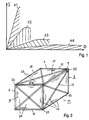
- Curve K1 shows the stress / strain behavior S (D) a high-strength and highly rigid material, one Structural element, such as one with continuous fibers reinforced matrix material, for example a Epoxy resin reinforced with 50% carbon fibers.
- Curve K2 shows a thermoplastic material reinforced with short fibers.
- the curve K3 shows the S (D) behavior of the unreinforced thermoplastic material and the curve K4 that Stress / strain behavior of a so-called structural foam, such as a polycarbonate foam.
- each Structural elements For the production of molded parts with construction structures will start from the manufacture of each Structural elements assumed. For example, of pultrusion or continuous extrusion of pipes, rods, Profiles and the like, which endless materials then divided into the desired length become.
- Thermoplastic continuous fiber reinforced Structural elements are e.g. made by pultrusion.
- continuous fiber reinforcement is used extruded thermoset materials, which either by harden the corresponding additives quickly or which ones Post-treatment, such as post-annealing, UV treatment and the like, be hardened. It is also possible to do this To produce continuous materials by coextrusion by As described above, the structural elements have multiple layers are trained.
- the inner core can, for example, consist of the fiber reinforced thermoset material, while the outermost layer at least partially from one thermoplastic material is made, such as made of polypropylene, polycarbonate and the like. It is of course important that the individual layers of material adhere well to one another or are compatible.
- Good liability can be achieved on the one hand by Adhesion at the interface or through or Diffusion of the molecules in the two halves on both sides of the Boundary layer into each other.
- the latter can, for example can be achieved by using thermosets on the surface yet are not fully cured or meltable Thermoplastics can be arranged on the surface.
- Good adhesion is also achieved by the boundary layer a chemical reaction between the two Boundary-forming polymers or between the Molecules of the polymers. In the end it is possible also, a bonding layer between the two polymers (9 in Fig. 3c) to be arranged.
- the supporting structure After the supporting structure has been manufactured, it is an injection mold or a mold is inserted, whereupon the thermoplastic polymer mass is injected or poured. It is now essential that the injected or poured Polymer mass is compatible with the outermost layer of the respective structural elements of the supporting structure or that the surface of the supporting structure looks good connects with the polymer mass. Now that it's possible the polymer mass for forming the molded part or the Designing the structure of the structure in turn in multiple layers, after the injected or poured polymer mass either the now encased load-bearing structure in another injection mold or Mold can be entered, or the volume of the The present injection mold or casting mold can thereby can be enlarged by sliding elements in the walls are provided. It is about so-called multiple tools, which inject or Allow pouring in of several polymer masses Formation of a multi-layer molded part.
- the lightest possible molded part with a construction structure to obtain it is advantageous to the polymer mass form at least partially foamed.
- Molded parts such as housings, tanks, bodies and the like, are easily recyclable by the Polymer mass can be granulated again by melting can while the fiber reinforced structural elements again used for example as fiber reinforcement can find.
- the idea of the present invention is that first a scaffold or the supporting structure so-called yard goods is manufactured or that individual structural elements of this scaffold on simple and cheap way to manufacture what the Elements assembled using robots, for example become.
- Fig. 2 shows a liquid tank 11 as an example of a plastic molded part according to the invention with a structural structure, the walls are shown transparently are so that the supporting structure 3 is visible.
- This load-bearing structure 3 consists of a space frame 13 with diagonal bars 17 as well as longitudinal bars 19 and cross bars 21 as structural elements 5, which for consolidation or Bracing the individual walls.
- the individual structural elements or rods with each other connected for example by means of a connector part 25 can be done as a connecting element 7, such as is shown in Fig. 3a.
- longitudinal bars 17, 19 and 21 can be, for example, by means of carbon fibers reinforced polyurethane resin rods act which are surface-coated or surface-treated in order to better adhesion of those surrounding the individual rods Ensure polymer mass.
- These structural elements 3 can also have other profile shapes, e.g. as pipes be trained.
- the spaces 24 and 26 are then also as walls between the bars, for example by means of injection molding, filled.
- connection elements (7) and connection areas 6 of different types rod-like, longitudinally oriented (5.1) and flat (5.2) Structural elements, which in a suitable selection and Compilation form the supporting structure 3.
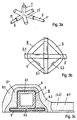
- Fig. 3a shows a connector part 7 as a connector 25 with which e.g. the bars 17, 19, 21 of Fig. 2 are connected by inserting and gluing.
- Fig. 3b shows in supervision a connection of two itself crossing longitudinal profiles, e.g. in the form of rectangular tubes as structural elements 5, which as a plate flat connecting element 7 are glued and wherein the whole e.g. through a fiber-reinforced polymer mass 8 is surrounded and held together as a partial molded part.
- This molded part here forms a connection area 6.
- 3c illustrates in cross section a connection of a square tube profile as a longitudinally oriented structural element 5.1, which on a plate as a flat Structural element 5.2 is glued or welded on.
- a wall area which e.g. from polymer mass 8 with foamed partial areas 8.0 can exist or which other flat Structural elements 5.2, such as grids or honeycombs, contain can.
- the surrounding form-forming polymer mass 8 forms here also a reinforcing connection area 6 the polymer mass can also consist of two or more layers, 8.1, 8.2.
- tie layer here 9 to establish a very strong connection between Structural elements and polymer mass on the Structural elements 5.1 and 5.2, e.g.
- the walls of a container can also, for example with lath-shaped, i.e. flat structural elements as Struts to be supported, such as the box-shaped container of Fig. 4 is shown.
- lath-shaped, i.e. flat structural elements as Struts to be supported such as the box-shaped container of Fig. 4 is shown.
- the individual structural elements, which form the supporting structure for example can be produced "endlessly" by means of pultrusion or extrusion are made of continuous fiber reinforced thermoplastic or thermoset material.
- stiff and having a very high modulus Structural elements are required can be a special one high proportion of continuous fiber reinforcement e.g. 50-60 Vol% are used.
- novolaks at least in part, which result in a higher crosslink density than that commercially available duromers.
- the continuous fiber reinforcements can be all fibers mentioned at the beginning act, these preferably before incorporation into the matrix polymer must be substructed so that its surface is good It is wettable by the one that includes these fibers Polymer.
- This is already one best known technology, because the strengthening of Thermoplastics and thermosets, for example with glass, Carbon fibers, aramid fibers and the like, in the state is well known in the art.
- FIG. 5 Another example of such a supporting structure 3 is shown in FIG. 5 with curved, longitudinally oriented Profiles or tubes as structural elements 5 and with connecting elements 7, 25, for example for the Formation of a wall of a basin, a pipe wall, a tube with a very large diameter, one Pressure tanks etc.
- FIG. 6 in turn shows a cable car cabin 31, whose load-bearing framework consists of an inventive, supporting structure 3 is formed.
- a cable car cabin 31 whose load-bearing framework consists of an inventive, supporting structure 3 is formed.
- Reinforcing element in the side walls relatively light dimensioned, lattice-like structures 37 as another To use example of flat structural elements 5.2, which in a frame 39 of the supporting structure 3 are attached.
- FIG. 7 shows a vehicle cell 41 as a further example of an automobile, with a high-strength supporting structure shown.
- This consists of strong longitudinal ones Structural elements 5.1 connected to flat parts 5.2, partial areas of the supporting structure with the surrounding Polymer mass can form 8 body parts. In this way is also a self-supporting plastic body produced.
Landscapes
- Engineering & Computer Science (AREA)
- Mechanical Engineering (AREA)
- Chemical & Material Sciences (AREA)
- Composite Materials (AREA)
- Manufacturing & Machinery (AREA)
- Combustion & Propulsion (AREA)
- Transportation (AREA)
- Structural Engineering (AREA)
- Architecture (AREA)
- Laminated Bodies (AREA)
- Moulding By Coating Moulds (AREA)
- Body Structure For Vehicles (AREA)
- Injection Moulding Of Plastics Or The Like (AREA)
- Sewage (AREA)
Claims (23)
- Pièce moulée en matière synthétique comprenant une structure de construction, une masse polymère (8) thermoplastique qui forme la pièce moulée, et une structure porteuse de charge, qui est intégrée dans la pièce moulée et est entourée par la masse polymère (8) thermoplastique, caractérisée par une structure (3) porteuse de charge avec un renfort de fibres continues, qui se composent de plusieurs éléments de structure (5) individuels, reliés entre eux et très résistants, lesquels éléments de structure (5) présentent un renfort de fibre continue dans une matrice polymère, tous les points de liaison étant entourés et maintenus ensemble entre les éléments de structure (5) individuels par la masse polymère (8) thermoplastique comme zone de liaison (6) et la matrice polymère des éléments de structure (5) étant reliée de façon adhésive à la masse polymère (8) thermoplastique et enveloppante.
- Pièce moulée selon la revendication 1, caractérisée en ce que les éléments de structure (5) sont renforcés avec des fibres continues à base de verre, de carbone, d'aramide, de polymère LC ou d'autres fibres polymères très résistantes.
- Pièce moulée selon l'une quelconque des revendications 1 ou 2, caractérisée en ce que les éléments de structure (5) présentent un thermoplastique comme matériau de matrice, tel que du polyamide (PA), du polypropylène (PP), du polyéthylène-théréphtalate (PET), du polybutylène-théréphtalate (PBT), du polycarbonate (PC), du polyimide (PI), des polyacrylates, du sulfure de polyphénylène (PPS), du polyétheréthercétone (PEEK).
- Pièce moulée selon l'une quelconque des revendications 1 ou 2, caractérisée en ce que les éléments de structure (5) présentent un matériau duromère comme matrice, tel que du polyuréthanne PUR, du polyester non saturé, des résines époxy, des résines phénoliques, un aminoplaste ou une novolaque.
- Pièce moulée selon l'une quelconque des revendications précédentes, caractérisée en ce que des produits orientés dans le sens longitudinal (5.1) comme des tiges, des tuyaux, des barres, des profilés et des produits plats (5.2) comme des plaques, des agglomérés laminés, des nids d'abeille, des grilles, etc. sont utilisés comme éléments de structure (5) pour la formation de la structure (3) portante.
- Pièce moulée selon l'une quelconque des revendications précédentes, caractérisée en ce que les éléments de structure (5) sont reliés entre eux au moyen d'éléments de liaison (7) pour la formation de la structure (3) portante.
- Pièce moulée selon l'une quelconque des revendications précédentes, caractérisée en ce que les éléments de structure (5) individuels pour la fabrication de la structure (3) portante sont fabriqués par extrusion, pultrusion, coulée continue ou d'autres procédés continus de transformation des matières plastiques, les éléments individuels étant fabriqués à partir du matériau continu par découpage, estampage, fraisage, sciage et reprise ultérieure.
- Pièce moulée selon l'une quelconque des revendications précédentes, caractérisée en ce que les éléments de structure (5) individuels pour la formation de la structure portante sont conçus avec plusieurs couches avec un élément central très résistant et une couche de liaison comme couche la plus extérieure, qui est compatible avec la masse polymère (8) entourant directement l'élément, de sorte que l'élément de structure et la masse polymère sont reliés entre eux par adhérence par la couche de liaison (9).
- Pièce moulée selon l'une quelconque des revendications précédentes, caractérisée en ce que la surface de l'élément de structure (5) est suffisamment compatible pour qu'on ait une diffusion sur la surface de contact avec la masse polymère (8) environnante.
- Pièce moulée selon l'une quelconque des revendications précédentes, caractérisée en ce que la masse polymère (8) présente un polymère thermoplastique comme une polyamide (PA), du polypropylène (PP), du polyéthylène-théréphtalate (PET), du polybutylène-théréphtalate (PBT), du polycarbonate (PC), du polyimide (PI), des polyacrylates, du sulfure de polyphénylène (PPS), du polyétheréthercétone (PEEK).
- Pièce moulée selon l'une quelconque des revendications précédentes, caractérisée en ce que la masse polymère (8) présente un renfort de fibre courte ou de fibre longue.
- Pièce moulée selon l'une quelconque des revendications précédentes, caractérisée en ce que la masse polymère est conçue avec plusieurs couches (8.1, 8.2) avec une solidité et une rigidité du matériau polymère dans les couches respectives qui diminuent de l'élément de structure (5) vers la surface.
- Pièce moulée selon l'une quelconque des revendications précédentes, caractérisée en ce que la masse polymère (8) est au moins partiellement moussée (8.0).
- Pièce moulée selon l'une quelconque des revendications précédentes, caractérisée en ce que la masse polymère (8) est au moins partiellement teintée à l'intérieur.
- Pièce moulée selon l'une quelconque des revendications précédentes, caractérisée en ce que plusieurs pièces moulées en matière synthétique forment une cellule de véhicule (41) avec les structures (3) porteuses de charges et intégrées.
- Procédé pour la fabrication d'une pièce moulée en matière synthétique avec une structure de construction, avec une masse polymère (8) thermoplastique, qui forme la pièce moulée, et avec une structure (3) porteuse de charge et comprenant plusieurs éléments de structure (5) individuels et très résistants, les éléments de structure (5), qui présentent un renfort de fibre continue dans une matrice polymère, étant coupés aux dimensions et ensuite reliés entre eux, de sorte qu'une structure (3) porteuse de charge est renforcée de fibres continues et formée, laquelle est insérée dans un moule, polymère (8) thermoplastique et fondue est versée ensuite dans le moule et tous les points de liaison entre les éléments de structure (5) individuels étant entourés et maintenus ensemble par la masse polymère (8) thermoplastique comme zones de liaison (6), la matrice polymère des éléments de structure (5) étant reliée par adhérence à la masse polymère (8) thermoplastique enveloppante, et la pièce moulée en plastique avec la structure (3) porteuse de charge et intégrée étant démoulée ensuite.
- Procédé selon la revendication 16, caractérisé en ce que la formation de la masse polymère (8) s'effectue par moulage par injection.
- Procédé selon la revendication 16 ou 17, caractérisé en ce que, après le démoulage, la structure (3) portante et au moins partiellement enveloppée est introduite dans un autre moule et une autre masse polymère plastique est versée dans ce moule pour la formation d'une masse polymère (8.1, 8.2) à plusieurs couches et entourant au moins partiellement la structure.
- Procédé selon la revendication 16 ou 17, caractérisé en ce que, après le versement de la masse polymère (8.1), le volume du même moule est ensuite augmenté par des parois coulissantes et une autre masse polymère (8.2) est versée ensuite dans le même moule pour la formation d'une masse polymère à plusieurs couches et entourant la structure.
- Procédé selon l'une quelconque des revendications 16 à 19, caractérisé en ce que, avec des éléments de structure (5) ou masses polymères (8) à plusieurs couches, on obtient une bonne adhérence sur les surfaces limites par adhésion sur la surface limite, par diffusion des molécules des deux côtés de la surface limite les unes dans les autres par réaction chimique sur la surface limite ou par placement d'une couche de liaison (9) d'adhérence entre des éléments de structure (5) et la masse polymère (8).
- Procédé selon la revendication 16, caractérisé en ce que les éléments de structure (5) individuels sont reliés pour la formation de la structure (3) portante par des éléments de liaison (7) complémentaires au niveau de la forme tels que des éléments de liaison vissables, enfichables et encliquetables.
- Procédé selon la revendication 16, caractérisé en ce que les éléments de structure (5) individuels sont reliés entre eux par une liaison fonctionnant sous l'action d'une force entraínée par adhérence par collage, soudage, etc.
- Procédé selon la revendication 16, caractérisé en ce que la liaison des éléments de structure (5) individuels pour la formation de la structure (3) portante est obtenue par enveloppement des éléments de structure individuels au moyen de filets, de bandes et similaires.
Applications Claiming Priority (3)
| Application Number | Priority Date | Filing Date | Title |
|---|---|---|---|
| CH244496 | 1996-10-08 | ||
| CH244496 | 1996-10-08 | ||
| PCT/CH1997/000379 WO1998015404A1 (fr) | 1996-10-08 | 1997-10-07 | Piece moulee en plastique et structure de construction |
Publications (2)
| Publication Number | Publication Date |
|---|---|
| EP0944472A1 EP0944472A1 (fr) | 1999-09-29 |
| EP0944472B1 true EP0944472B1 (fr) | 2004-08-11 |
Family
ID=4233972
Family Applications (1)
| Application Number | Title | Priority Date | Filing Date |
|---|---|---|---|
| EP97941779A Revoked EP0944472B1 (fr) | 1996-10-08 | 1997-10-07 | Piece moulee en plastique avec une structure de construction |
Country Status (7)
| Country | Link |
|---|---|
| US (1) | US6299246B1 (fr) |
| EP (1) | EP0944472B1 (fr) |
| JP (1) | JP2001501714A (fr) |
| CN (1) | CN1093031C (fr) |
| AT (1) | ATE273118T1 (fr) |
| DE (1) | DE59711849D1 (fr) |
| WO (1) | WO1998015404A1 (fr) |
Cited By (1)
| Publication number | Priority date | Publication date | Assignee | Title |
|---|---|---|---|---|
| DE102010050874B4 (de) * | 2010-11-09 | 2015-05-21 | Daimler Ag | Kraftfahrzeugstrukturbauteil aus mittels eines Knotenelements verbundenen Halbzeug-Bauteilen und Herstellungsverfahren |
Families Citing this family (59)
| Publication number | Priority date | Publication date | Assignee | Title |
|---|---|---|---|---|
| CN1204016C (zh) * | 1999-10-20 | 2005-06-01 | 地方小型汽车公司 | 由纤维增强热塑性塑料制成的汽车外壳及其制造方法 |
| BR0200820B8 (pt) * | 2002-02-27 | 2013-02-19 | tirante de ligaÇço em compàsito. | |
| DE10229400B4 (de) * | 2002-06-29 | 2006-05-24 | Dr.Ing.H.C. F. Porsche Ag | Aufbaustruktur für ein Fahrzeug, insbesondere einen Personenkraftwagen |
| JP4621499B2 (ja) * | 2002-09-15 | 2011-01-26 | アールシーシー リージョナル コンパクト カー アーゲー | ファイバ補強熱可塑性材料から構造部品を製造する方法 |
| DE50306774D1 (de) * | 2002-09-15 | 2007-04-19 | Weber Technology Ag | Strukturbauteil aus faserverstärktem thermoplastischem kunststoff |
| JP2004142584A (ja) * | 2002-10-24 | 2004-05-20 | Fuji Heavy Ind Ltd | 自動車の車体後部構造 |
| US7094299B2 (en) | 2003-05-02 | 2006-08-22 | Ford Global Technologies, Llc | Method for robotically applying large volumes of structural foam within automotive applications |
| JP2007516866A (ja) * | 2003-12-17 | 2007-06-28 | アーマセル ピーティーワイ リミテッド | 複数片構成部品の製作法 |
| US20050281517A1 (en) * | 2004-06-18 | 2005-12-22 | Wessels Robert A Jr | Multi-layered buffer tube for optical fiber cable |
| US7000978B1 (en) | 2004-08-20 | 2006-02-21 | Frank Messano | Thin-skin ultralight recreational vehicle body system |
| US7251915B2 (en) * | 2004-09-10 | 2007-08-07 | Pullman Industries, Inc. | Frame system for motor vehicle |
| ATE435730T1 (de) * | 2004-10-22 | 2009-07-15 | Dow Global Technologies Inc | Verbundartikel aus kunststoff und herstellungsverfahren dafür |
| EP1775201A3 (fr) * | 2005-10-17 | 2007-05-30 | ArvinMeritor GmbH | Pièce composite, notamment un panneau de véhicule |
| US7578534B2 (en) * | 2005-11-03 | 2009-08-25 | Martin Marietta Materials, Inc. | Structural panel for a refrigerated trailer comprising an integrated bulkhead structure for promoting air flow |
| US20070160793A1 (en) * | 2005-12-21 | 2007-07-12 | Bayer Materialscience Llc And Daimlerchrysler Corporation | Load-bearing composite panels |
| JP4759390B2 (ja) * | 2006-01-12 | 2011-08-31 | 東邦テナックス株式会社 | Frp製のコンテナ構成部材及びそれを用いた軽量コンテナ |
| US7575264B1 (en) | 2006-03-14 | 2009-08-18 | Martin Marietta Materials, Inc. | Cargo bed structure comprising fiber reinforced polymer components |
| US20070216197A1 (en) * | 2006-03-14 | 2007-09-20 | Martin Marietta Materials, Inc. | Composite cargo floor structure having a reduced weight |
| ATE511440T1 (de) * | 2006-04-27 | 2011-06-15 | Aksys Gmbh | Verfahren zur herstellung eines verbundwerkstoffteils |
| WO2008025133A1 (fr) * | 2006-08-29 | 2008-03-06 | Magna International Inc. | Éléments structuraux moules par injection a l'aide d'eau |
| TWI333519B (en) * | 2006-09-13 | 2010-11-21 | Ind Tech Res Inst | Processing method of polymer product |
| US7874125B2 (en) * | 2007-03-08 | 2011-01-25 | Lrm Industries International, Inc | Molded support beam |
| US8186747B2 (en) * | 2008-07-22 | 2012-05-29 | Martin Marietta Materials, Inc. | Modular composite structural component and structures formed therewith |
| US8857128B2 (en) * | 2009-05-18 | 2014-10-14 | Apple Inc. | Reinforced device housing |
| US8985034B2 (en) | 2009-06-25 | 2015-03-24 | Biofiba Innovations Pty Ltd | Timber substitute |
| DE102009040901B4 (de) * | 2009-09-11 | 2022-02-24 | Brose Fahrzeugteile SE & Co. Kommanditgesellschaft, Coburg | Verfahren zum Herstellen von Tragstrukturen in Kraftfahrzeugen |
| JP2011098523A (ja) * | 2009-11-06 | 2011-05-19 | Ihi Corp | ケースの製造方法、及びケース |
| US8511498B2 (en) | 2010-01-25 | 2013-08-20 | Apple Inc. | Method for manufacturing an electronic device enclosure |
| US8408972B2 (en) | 2010-01-25 | 2013-04-02 | Apple Inc. | Apparatus and method for intricate cuts |
| DE102010014504A1 (de) * | 2010-04-10 | 2011-10-13 | Daimler Ag | Karosserie für einen Personenkraftwagen |
| JP5494230B2 (ja) * | 2010-05-24 | 2014-05-14 | 株式会社豊田中央研究所 | 車体構造 |
| US8372495B2 (en) | 2010-05-26 | 2013-02-12 | Apple Inc. | Electronic device enclosure using sandwich construction |
| US9120272B2 (en) | 2010-07-22 | 2015-09-01 | Apple Inc. | Smooth composite structure |
| US9011623B2 (en) | 2011-03-03 | 2015-04-21 | Apple Inc. | Composite enclosure |
| US10676845B2 (en) | 2011-04-12 | 2020-06-09 | Ticona Llc | Continuous fiber reinforced thermoplastic rod and pultrusion method for its manufacture |
| CA2832823C (fr) | 2011-04-12 | 2020-06-02 | Ticona Llc | Ame composite pour cables electriques de transmission |
| EP2697799B1 (fr) | 2011-04-12 | 2016-05-25 | Ticona LLC | Cordon ombilical destiné à des applications sous-marines |
| JP6166964B2 (ja) * | 2012-07-04 | 2017-07-19 | 有限会社野間口事務所 | 繊維で構成される有形体の製造方法 |
| CN103029293B (zh) * | 2012-12-25 | 2015-04-01 | 哈尔滨工业大学 | 树脂基碳纤维复合材料桁架杆件连接方法 |
| US10407955B2 (en) | 2013-03-13 | 2019-09-10 | Apple Inc. | Stiff fabric |
| DE102013209095A1 (de) * | 2013-05-16 | 2014-11-20 | Bayerische Motoren Werke Aktiengesellschaft | Crashstruktur für ein Fahrzeug |
| CN204608330U (zh) | 2013-12-20 | 2015-09-02 | 苹果公司 | 编织纤维带 |
| DE102014212924A1 (de) * | 2014-07-03 | 2016-01-07 | Bayerische Motoren Werke Aktiengesellschaft | Längsträgeranordnung einer Karosserie eines Kraftfahrzeugs und Karosserie eines Kraftfahrzeugs mit einer derartigen Längsträgeranordnung |
| GB201413637D0 (en) * | 2014-07-31 | 2014-09-17 | Mclaren Applied Technologies Ltd | Manufacture of vehicle structures |
| DE102014222933B4 (de) * | 2014-11-11 | 2021-09-09 | Bayerische Motoren Werke Aktiengesellschaft | Faserverbundwerkstoffbauteil sowie Verfahren zur Herstellung eines Faserverbundwerkstoffbauteils |
| DE102015007297A1 (de) | 2015-06-10 | 2016-12-15 | Audi Ag | Verfahren zum Herstellen eines Hohlkörpers |
| CN104925010A (zh) * | 2015-07-13 | 2015-09-23 | 苏州新区华士达工程塑胶有限公司 | 一种高强度塑料保险杠 |
| EP3766686A1 (fr) | 2015-09-17 | 2021-01-20 | Roberto Velozzi Jerez | Panneaux composites porteurs, matériaux, produits et procédés de fabrication et d'utilisation associés |
| US9718498B1 (en) * | 2016-04-08 | 2017-08-01 | Ford Global Technologies, Llc | Vehicular body structure |
| DE102016106688A1 (de) * | 2016-04-12 | 2017-10-12 | Dr. Ing. H.C. F. Porsche Aktiengesellschaft | Hybridbauteil für ein Fahrzeug |
| CN116788371A (zh) * | 2016-12-31 | 2023-09-22 | 郑州泽正技术服务有限公司 | 碳纤维织物复合材料整车骨架及其制备方法 |
| DE102017203404A1 (de) | 2017-03-02 | 2018-09-06 | Bayerische Motoren Werke Aktiengesellschaft | Faserbauteil mit zu einem Fachwerk verbundenen Faserstäben |
| DE102017216062A1 (de) * | 2017-09-12 | 2019-03-14 | Ford Global Technologies, Llc | Tragbarer Transportbehälter und Transportbehälter-Halterungssystem eines Fahrzeugs |
| US10864686B2 (en) | 2017-09-25 | 2020-12-15 | Apple Inc. | Continuous carbon fiber winding for thin structural ribs |
| US11401451B2 (en) | 2017-11-20 | 2022-08-02 | L&P Property Management Company | Fiber reinforced flexible foams |
| US11613621B2 (en) | 2019-05-17 | 2023-03-28 | L&P Property Management Company | Expandable graphite flame retardant coating for polyurethane and latex foam |
| DE102021115293B4 (de) | 2021-06-14 | 2023-02-09 | Bayerische Motoren Werke Aktiengesellschaft | Schutzplatte für einen gepanzerten Personenkraftwagen |
| US12343911B2 (en) * | 2023-08-08 | 2025-07-01 | GM Global Technology Operations LLC | Molded tanks formed of multiple materials |
| CN117341237B (zh) * | 2023-12-06 | 2024-03-08 | 威驰腾(福建)汽车有限公司 | 碳纤维结构件及其制备方法 |
Family Cites Families (16)
| Publication number | Priority date | Publication date | Assignee | Title |
|---|---|---|---|---|
| NL285164A (fr) * | 1961-11-20 | |||
| US4045075A (en) * | 1975-12-18 | 1977-08-30 | Pulver Donald W | Automobile body frame and envelope construction |
| DE2636557A1 (de) * | 1976-08-13 | 1978-02-16 | Buderus Eisenwerk | Luftfracht-container |
| FR2513176A1 (fr) * | 1981-09-18 | 1983-03-25 | Allibert Sa | Procede permettant d'enrober hermetiquement les armatures d'une piece en matiere plastique armee interieurement et pieces obtenues selon ce procede |
| US4491362A (en) * | 1981-09-23 | 1985-01-01 | Kennedy Thomas H | Automotive fiberglass body |
| DE3479572D1 (en) * | 1983-01-05 | 1989-10-05 | Deutsche Forsch Luft Raumfahrt | Element for joining of two bars with circular cross-section |
| US4613177A (en) * | 1984-06-25 | 1986-09-23 | Michael Ladney, Jr. | Vehicle bumper |
| JPS63189713U (fr) * | 1987-05-27 | 1988-12-06 | ||
| US5041318A (en) * | 1988-06-23 | 1991-08-20 | Hulls John R | Composite structural member with integral load bearing joint-forming structure |
| US4976490A (en) * | 1988-10-05 | 1990-12-11 | Ford Motor Company | Reinforced composite structure |
| US5139297A (en) * | 1991-09-12 | 1992-08-18 | Ford Motor Company | Internal stroking bumper beam |
| CN1085173A (zh) * | 1992-09-26 | 1994-04-13 | 白清栋 | 自行车架及制法 |
| US5403063A (en) * | 1993-05-21 | 1995-04-04 | Sjostedt; Robbie J. | Modular integral floor construction for vehicle body |
| DE4420879A1 (de) * | 1994-06-15 | 1995-12-21 | Mann & Hummel Filter | Herstellverfahren für einen Hohlkörper mit einem innenliegenden Stützrahmen |
| US5762395A (en) * | 1996-06-25 | 1998-06-09 | General Motors Corporation | Molded cross car support structure |
| US5806919A (en) * | 1996-11-04 | 1998-09-15 | General Motors Corporation | Low density-high density insert reinforced structural joints |
-
1997
- 1997-10-07 CN CN97198620A patent/CN1093031C/zh not_active Expired - Fee Related
- 1997-10-07 WO PCT/CH1997/000379 patent/WO1998015404A1/fr not_active Ceased
- 1997-10-07 US US09/269,496 patent/US6299246B1/en not_active Expired - Fee Related
- 1997-10-07 JP JP10517044A patent/JP2001501714A/ja not_active Ceased
- 1997-10-07 AT AT97941779T patent/ATE273118T1/de not_active IP Right Cessation
- 1997-10-07 EP EP97941779A patent/EP0944472B1/fr not_active Revoked
- 1997-10-07 DE DE59711849T patent/DE59711849D1/de not_active Revoked
Cited By (1)
| Publication number | Priority date | Publication date | Assignee | Title |
|---|---|---|---|---|
| DE102010050874B4 (de) * | 2010-11-09 | 2015-05-21 | Daimler Ag | Kraftfahrzeugstrukturbauteil aus mittels eines Knotenelements verbundenen Halbzeug-Bauteilen und Herstellungsverfahren |
Also Published As
| Publication number | Publication date |
|---|---|
| ATE273118T1 (de) | 2004-08-15 |
| CN1232421A (zh) | 1999-10-20 |
| EP0944472A1 (fr) | 1999-09-29 |
| CN1093031C (zh) | 2002-10-23 |
| US6299246B1 (en) | 2001-10-09 |
| WO1998015404A1 (fr) | 1998-04-16 |
| DE59711849D1 (de) | 2004-09-16 |
| JP2001501714A (ja) | 2001-02-06 |
Similar Documents
| Publication | Publication Date | Title |
|---|---|---|
| EP0944472B1 (fr) | Piece moulee en plastique avec une structure de construction | |
| DE102009040901B4 (de) | Verfahren zum Herstellen von Tragstrukturen in Kraftfahrzeugen | |
| DE102010003497B4 (de) | Verfahren zur Herstellung eines Aufprallschutzelementes | |
| EP3218170B1 (fr) | Élément structural en matériau renforcé par des fibres et son procédé de fabrication | |
| DE4120133C2 (de) | Bauteil und Verfahren zur Herstellung eines solchen | |
| EP3165430B1 (fr) | Procédé de fabrication d'une structure de liaison comprenant au moins deux composants profilés, et structure de liaison et carrosserie | |
| EP3178634A1 (fr) | Procédé de fabrication d'un composant en matériau hybride | |
| EP1268164B1 (fr) | Composant en matiere synthetique renforcee par fibres et son procede de production | |
| DE60106283T2 (de) | Formverfahren | |
| EP1052164B1 (fr) | Groupe de paroi pour véhicule automobile | |
| EP3384168B1 (fr) | Procede de fabrication d'un ensemble | |
| DE102011121639B4 (de) | Rotationssymmetrisches Strukturelement in Gitterkonstruktion und Verfahren zu dessen Herstellung | |
| DE102013022247B4 (de) | Fahrzeug-Karosserieelement | |
| DE102008029518B4 (de) | Verfahren zur Herstellung von Faserverbundbauteilen und Faserverbundbauteile | |
| WO2017182310A1 (fr) | Pièce structurale | |
| DE102011087497A1 (de) | Verfahren zur Herstellung von Faserverbund-Hohlbauteilen | |
| DE10253300A1 (de) | Faserverstärkter Verbundkunststoff zur Herstellung von Strukturbauteilen, Strukturbauteile aus einem derartigen Verbundkunststoff sowie Verfahren zur Herstellung von faserverstärkten Strukturbauteilen | |
| EP4454853A1 (fr) | Composant structurel | |
| EP3165431B1 (fr) | Structure de liaison comprenant au moins un composant en corps creux à double paroi, procédé de fabrication et carrosserie de véhicule | |
| DE102013020871A1 (de) | Strukturbauteil für ein Kraftfahrzeug | |
| DE29700151U1 (de) | Sicherheitstank | |
| EP2116406B1 (fr) | Récipient pour substances de fonctionnement et son procédé de fabrication | |
| WO2004022320A1 (fr) | Demi-produit et procede pour la fabrication d'un composant de vehicule | |
| DE1967215C2 (de) | Mehrwandiger Heizölbehälter und Verfahren zu seiner Herstellung | |
| DE202025101232U1 (de) | Frontendträger |
Legal Events
| Date | Code | Title | Description |
|---|---|---|---|
| PUAI | Public reference made under article 153(3) epc to a published international application that has entered the european phase |
Free format text: ORIGINAL CODE: 0009012 |
|
| AK | Designated contracting states |
Kind code of ref document: A1 Designated state(s): AT CH DE ES FR GB IT LI |
|
| 17P | Request for examination filed |
Effective date: 19990716 |
|
| RAP1 | Party data changed (applicant data changed or rights of an application transferred) |
Owner name: RCC REGIONAL COMPACT CAR AG |
|
| 17Q | First examination report despatched |
Effective date: 20010802 |
|
| GRAP | Despatch of communication of intention to grant a patent |
Free format text: ORIGINAL CODE: EPIDOSNIGR1 |
|
| RIC1 | Information provided on ipc code assigned before grant |
Ipc: 7B 29C 45/14 B Ipc: 7B 29C 70/68 B Ipc: 7B 29D 12/00 A |
|
| RTI1 | Title (correction) |
Free format text: PLASTIC MOLDED PART WITH A CONSTRUCTION STRUCTURE |
|
| GRAS | Grant fee paid |
Free format text: ORIGINAL CODE: EPIDOSNIGR3 |
|
| GRAA | (expected) grant |
Free format text: ORIGINAL CODE: 0009210 |
|
| AK | Designated contracting states |
Kind code of ref document: B1 Designated state(s): AT CH DE ES FR GB IT LI |
|
| PG25 | Lapsed in a contracting state [announced via postgrant information from national office to epo] |
Ref country code: IT Free format text: LAPSE BECAUSE OF FAILURE TO SUBMIT A TRANSLATION OF THE DESCRIPTION OR TO PAY THE FEE WITHIN THE PRESCRIBED TIME-LIMIT;WARNING: LAPSES OF ITALIAN PATENTS WITH EFFECTIVE DATE BEFORE 2007 MAY HAVE OCCURRED AT ANY TIME BEFORE 2007. THE CORRECT EFFECTIVE DATE MAY BE DIFFERENT FROM THE ONE RECORDED. Effective date: 20040811 |
|
| REG | Reference to a national code |
Ref country code: GB Ref legal event code: FG4D Free format text: NOT ENGLISH |
|
| REG | Reference to a national code |
Ref country code: CH Ref legal event code: EP |
|
| REF | Corresponds to: |
Ref document number: 59711849 Country of ref document: DE Date of ref document: 20040916 Kind code of ref document: P |
|
| PG25 | Lapsed in a contracting state [announced via postgrant information from national office to epo] |
Ref country code: AT Free format text: LAPSE BECAUSE OF NON-PAYMENT OF DUE FEES Effective date: 20041007 |
|
| PG25 | Lapsed in a contracting state [announced via postgrant information from national office to epo] |
Ref country code: ES Free format text: LAPSE BECAUSE OF FAILURE TO SUBMIT A TRANSLATION OF THE DESCRIPTION OR TO PAY THE FEE WITHIN THE PRESCRIBED TIME-LIMIT Effective date: 20041122 |
|
| GBT | Gb: translation of ep patent filed (gb section 77(6)(a)/1977) |
Effective date: 20041201 |
|
| PLAQ | Examination of admissibility of opposition: information related to despatch of communication + time limit deleted |
Free format text: ORIGINAL CODE: EPIDOSDOPE2 |
|
| PLBQ | Unpublished change to opponent data |
Free format text: ORIGINAL CODE: EPIDOS OPPO |
|
| ET | Fr: translation filed | ||
| PLBI | Opposition filed |
Free format text: ORIGINAL CODE: 0009260 |
|
| PLAQ | Examination of admissibility of opposition: information related to despatch of communication + time limit deleted |
Free format text: ORIGINAL CODE: EPIDOSDOPE2 |
|
| PLAR | Examination of admissibility of opposition: information related to receipt of reply deleted |
Free format text: ORIGINAL CODE: EPIDOSDOPE4 |
|
| PLBQ | Unpublished change to opponent data |
Free format text: ORIGINAL CODE: EPIDOS OPPO |
|
| PLAB | Opposition data, opponent's data or that of the opponent's representative modified |
Free format text: ORIGINAL CODE: 0009299OPPO |
|
| 26 | Opposition filed |
Opponent name: FRAUNHOFER-GESELLSCHAFT ZUR FOERDERUNG DER ANGEWAN Effective date: 20050511 Opponent name: AKSYS GMBH Effective date: 20050511 |
|
| R26 | Opposition filed (corrected) |
Opponent name: FRAUNHOFER-GESELLSCHAFT ZUR FOERDERUNG DER ANGEWAN Effective date: 20050511 Opponent name: AKSYS GMBH Effective date: 20050511 |
|
| PLAN | Information deleted related to communication of a notice of opposition and request to file observations + time limit |
Free format text: ORIGINAL CODE: EPIDOSDOBS2 |
|
| PLAX | Notice of opposition and request to file observation + time limit sent |
Free format text: ORIGINAL CODE: EPIDOSNOBS2 |
|
| PLAX | Notice of opposition and request to file observation + time limit sent |
Free format text: ORIGINAL CODE: EPIDOSNOBS2 |
|
| PLAF | Information modified related to communication of a notice of opposition and request to file observations + time limit |
Free format text: ORIGINAL CODE: EPIDOSCOBS2 |
|
| PLBB | Reply of patent proprietor to notice(s) of opposition received |
Free format text: ORIGINAL CODE: EPIDOSNOBS3 |
|
| RAP2 | Party data changed (patent owner data changed or rights of a patent transferred) |
Owner name: WEBER TECHNOLOGY AG |
|
| PGFP | Annual fee paid to national office [announced via postgrant information from national office to epo] |
Ref country code: GB Payment date: 20061023 Year of fee payment: 10 |
|
| PGFP | Annual fee paid to national office [announced via postgrant information from national office to epo] |
Ref country code: DE Payment date: 20071025 Year of fee payment: 11 |
|
| PGFP | Annual fee paid to national office [announced via postgrant information from national office to epo] |
Ref country code: FR Payment date: 20071016 Year of fee payment: 11 Ref country code: CH Payment date: 20080108 Year of fee payment: 11 |
|
| GBPC | Gb: european patent ceased through non-payment of renewal fee |
Effective date: 20071007 |
|
| RDAF | Communication despatched that patent is revoked |
Free format text: ORIGINAL CODE: EPIDOSNREV1 |
|
| PG25 | Lapsed in a contracting state [announced via postgrant information from national office to epo] |
Ref country code: GB Free format text: LAPSE BECAUSE OF NON-PAYMENT OF DUE FEES Effective date: 20071007 |
|
| RDAG | Patent revoked |
Free format text: ORIGINAL CODE: 0009271 |
|
| STAA | Information on the status of an ep patent application or granted ep patent |
Free format text: STATUS: PATENT REVOKED |
|
| REG | Reference to a national code |
Ref country code: CH Ref legal event code: PL |
|
| 27W | Patent revoked |
Effective date: 20081204 |
|
| PLAB | Opposition data, opponent's data or that of the opponent's representative modified |
Free format text: ORIGINAL CODE: 0009299OPPO |