EP0942485A1 - Lithium secondary battery - Google Patents
Lithium secondary battery Download PDFInfo
- Publication number
- EP0942485A1 EP0942485A1 EP99104777A EP99104777A EP0942485A1 EP 0942485 A1 EP0942485 A1 EP 0942485A1 EP 99104777 A EP99104777 A EP 99104777A EP 99104777 A EP99104777 A EP 99104777A EP 0942485 A1 EP0942485 A1 EP 0942485A1
- Authority
- EP
- European Patent Office
- Prior art keywords
- zeolite
- battery
- battery case
- electrolyte solution
- lithium secondary
- Prior art date
- Legal status (The legal status is an assumption and is not a legal conclusion. Google has not performed a legal analysis and makes no representation as to the accuracy of the status listed.)
- Withdrawn
Links
- 229910052744 lithium Inorganic materials 0.000 title claims abstract description 27
- WHXSMMKQMYFTQS-UHFFFAOYSA-N Lithium Chemical compound [Li] WHXSMMKQMYFTQS-UHFFFAOYSA-N 0.000 title claims abstract description 24
- HNPSIPDUKPIQMN-UHFFFAOYSA-N dioxosilane;oxo(oxoalumanyloxy)alumane Chemical compound O=[Si]=O.O=[Al]O[Al]=O HNPSIPDUKPIQMN-UHFFFAOYSA-N 0.000 claims abstract description 52
- 239000010457 zeolite Substances 0.000 claims abstract description 49
- 229910021536 Zeolite Inorganic materials 0.000 claims abstract description 48
- 239000005486 organic electrolyte Substances 0.000 claims abstract description 16
- 238000010521 absorption reaction Methods 0.000 claims abstract description 14
- 229920000642 polymer Polymers 0.000 claims abstract description 4
- 239000008151 electrolyte solution Substances 0.000 claims description 21
- 239000007772 electrode material Substances 0.000 claims description 9
- 239000000843 powder Substances 0.000 claims description 9
- 229910000323 aluminium silicate Inorganic materials 0.000 claims description 3
- 239000000725 suspension Substances 0.000 claims description 2
- 239000003792 electrolyte Substances 0.000 abstract description 20
- 238000000354 decomposition reaction Methods 0.000 abstract description 10
- 230000006866 deterioration Effects 0.000 abstract description 6
- 230000006872 improvement Effects 0.000 abstract description 3
- 230000001629 suppression Effects 0.000 abstract description 3
- 229940021013 electrolyte solution Drugs 0.000 description 30
- -1 lithium transition metal compound Chemical class 0.000 description 11
- 239000007774 positive electrode material Substances 0.000 description 10
- OKTJSMMVPCPJKN-UHFFFAOYSA-N Carbon Chemical compound [C] OKTJSMMVPCPJKN-UHFFFAOYSA-N 0.000 description 6
- 229910001290 LiPF6 Inorganic materials 0.000 description 6
- 239000000463 material Substances 0.000 description 6
- KMTRUDSVKNLOMY-UHFFFAOYSA-N Ethylene carbonate Chemical compound O=C1OCCO1 KMTRUDSVKNLOMY-UHFFFAOYSA-N 0.000 description 5
- 239000011888 foil Substances 0.000 description 5
- 238000004519 manufacturing process Methods 0.000 description 5
- 239000007773 negative electrode material Substances 0.000 description 5
- 239000002904 solvent Substances 0.000 description 5
- HBBGRARXTFLTSG-UHFFFAOYSA-N Lithium ion Chemical compound [Li+] HBBGRARXTFLTSG-UHFFFAOYSA-N 0.000 description 4
- 229910052782 aluminium Inorganic materials 0.000 description 4
- XAGFODPZIPBFFR-UHFFFAOYSA-N aluminium Chemical compound [Al] XAGFODPZIPBFFR-UHFFFAOYSA-N 0.000 description 4
- 239000012298 atmosphere Substances 0.000 description 4
- 229910001416 lithium ion Inorganic materials 0.000 description 4
- 229920000573 polyethylene Polymers 0.000 description 4
- 239000000758 substrate Substances 0.000 description 4
- 238000004804 winding Methods 0.000 description 4
- WEVYAHXRMPXWCK-UHFFFAOYSA-N Acetonitrile Chemical compound CC#N WEVYAHXRMPXWCK-UHFFFAOYSA-N 0.000 description 3
- RYGMFSIKBFXOCR-UHFFFAOYSA-N Copper Chemical compound [Cu] RYGMFSIKBFXOCR-UHFFFAOYSA-N 0.000 description 3
- KRHYYFGTRYWZRS-UHFFFAOYSA-N Fluorane Chemical compound F KRHYYFGTRYWZRS-UHFFFAOYSA-N 0.000 description 3
- SECXISVLQFMRJM-UHFFFAOYSA-N N-Methylpyrrolidone Chemical compound CN1CCCC1=O SECXISVLQFMRJM-UHFFFAOYSA-N 0.000 description 3
- 239000004698 Polyethylene Substances 0.000 description 3
- 238000006243 chemical reaction Methods 0.000 description 3
- 239000011889 copper foil Substances 0.000 description 3
- 229910000040 hydrogen fluoride Inorganic materials 0.000 description 3
- 238000000034 method Methods 0.000 description 3
- 239000000203 mixture Substances 0.000 description 3
- 239000012299 nitrogen atmosphere Substances 0.000 description 3
- YEJRWHAVMIAJKC-UHFFFAOYSA-N 4-Butyrolactone Chemical compound O=C1CCCO1 YEJRWHAVMIAJKC-UHFFFAOYSA-N 0.000 description 2
- IJGRMHOSHXDMSA-UHFFFAOYSA-N Atomic nitrogen Chemical compound N#N IJGRMHOSHXDMSA-UHFFFAOYSA-N 0.000 description 2
- BVKZGUZCCUSVTD-UHFFFAOYSA-L Carbonate Chemical compound [O-]C([O-])=O BVKZGUZCCUSVTD-UHFFFAOYSA-L 0.000 description 2
- 239000004743 Polypropylene Substances 0.000 description 2
- VYPSYNLAJGMNEJ-UHFFFAOYSA-N Silicium dioxide Chemical compound O=[Si]=O VYPSYNLAJGMNEJ-UHFFFAOYSA-N 0.000 description 2
- WYURNTSHIVDZCO-UHFFFAOYSA-N Tetrahydrofuran Chemical compound C1CCOC1 WYURNTSHIVDZCO-UHFFFAOYSA-N 0.000 description 2
- 239000006230 acetylene black Substances 0.000 description 2
- 239000011230 binding agent Substances 0.000 description 2
- 230000015572 biosynthetic process Effects 0.000 description 2
- 230000000052 comparative effect Effects 0.000 description 2
- 230000007423 decrease Effects 0.000 description 2
- 229910021385 hard carbon Inorganic materials 0.000 description 2
- 230000010220 ion permeability Effects 0.000 description 2
- 229910000625 lithium cobalt oxide Inorganic materials 0.000 description 2
- PQXKHYXIUOZZFA-UHFFFAOYSA-M lithium fluoride Chemical compound [Li+].[F-] PQXKHYXIUOZZFA-UHFFFAOYSA-M 0.000 description 2
- BFZPBUKRYWOWDV-UHFFFAOYSA-N lithium;oxido(oxo)cobalt Chemical compound [Li+].[O-][Co]=O BFZPBUKRYWOWDV-UHFFFAOYSA-N 0.000 description 2
- 239000012046 mixed solvent Substances 0.000 description 2
- 239000003960 organic solvent Substances 0.000 description 2
- 229920001155 polypropylene Polymers 0.000 description 2
- RUOJZAUFBMNUDX-UHFFFAOYSA-N propylene carbonate Chemical compound CC1COC(=O)O1 RUOJZAUFBMNUDX-UHFFFAOYSA-N 0.000 description 2
- 239000000741 silica gel Substances 0.000 description 2
- 229910002027 silica gel Inorganic materials 0.000 description 2
- 239000007784 solid electrolyte Substances 0.000 description 2
- 239000000126 substance Substances 0.000 description 2
- 238000003466 welding Methods 0.000 description 2
- 238000004438 BET method Methods 0.000 description 1
- KRHYYFGTRYWZRS-UHFFFAOYSA-M Fluoride anion Chemical compound [F-] KRHYYFGTRYWZRS-UHFFFAOYSA-M 0.000 description 1
- CDBYLPFSWZWCQE-UHFFFAOYSA-L Sodium Carbonate Chemical compound [Na+].[Na+].[O-]C([O-])=O CDBYLPFSWZWCQE-UHFFFAOYSA-L 0.000 description 1
- 239000002194 amorphous carbon material Substances 0.000 description 1
- 229910021383 artificial graphite Inorganic materials 0.000 description 1
- 230000008901 benefit Effects 0.000 description 1
- 239000003575 carbonaceous material Substances 0.000 description 1
- 150000004651 carbonic acid esters Chemical class 0.000 description 1
- 230000008859 change Effects 0.000 description 1
- 239000011248 coating agent Substances 0.000 description 1
- 238000000576 coating method Methods 0.000 description 1
- 238000004891 communication Methods 0.000 description 1
- 150000001875 compounds Chemical class 0.000 description 1
- 230000000593 degrading effect Effects 0.000 description 1
- 238000007599 discharging Methods 0.000 description 1
- 230000005611 electricity Effects 0.000 description 1
- 239000000835 fiber Substances 0.000 description 1
- 229910002804 graphite Inorganic materials 0.000 description 1
- 239000010439 graphite Substances 0.000 description 1
- 239000011357 graphitized carbon fiber Substances 0.000 description 1
- 230000005484 gravity Effects 0.000 description 1
- 238000009413 insulation Methods 0.000 description 1
- 238000011031 large-scale manufacturing process Methods 0.000 description 1
- 229910001547 lithium hexafluoroantimonate(V) Inorganic materials 0.000 description 1
- 229910001540 lithium hexafluoroarsenate(V) Inorganic materials 0.000 description 1
- 229910002102 lithium manganese oxide Inorganic materials 0.000 description 1
- MHCFAGZWMAWTNR-UHFFFAOYSA-M lithium perchlorate Chemical compound [Li+].[O-]Cl(=O)(=O)=O MHCFAGZWMAWTNR-UHFFFAOYSA-M 0.000 description 1
- 229910001486 lithium perchlorate Inorganic materials 0.000 description 1
- 229910001496 lithium tetrafluoroborate Inorganic materials 0.000 description 1
- CJYZTOPVWURGAI-UHFFFAOYSA-N lithium;manganese;manganese(3+);oxygen(2-) Chemical compound [Li+].[O-2].[O-2].[O-2].[O-2].[Mn].[Mn+3] CJYZTOPVWURGAI-UHFFFAOYSA-N 0.000 description 1
- VROAXDSNYPAOBJ-UHFFFAOYSA-N lithium;oxido(oxo)nickel Chemical compound [Li+].[O-][Ni]=O VROAXDSNYPAOBJ-UHFFFAOYSA-N 0.000 description 1
- VLXXBCXTUVRROQ-UHFFFAOYSA-N lithium;oxido-oxo-(oxomanganiooxy)manganese Chemical compound [Li+].[O-][Mn](=O)O[Mn]=O VLXXBCXTUVRROQ-UHFFFAOYSA-N 0.000 description 1
- 230000007246 mechanism Effects 0.000 description 1
- 229910052751 metal Inorganic materials 0.000 description 1
- 239000002184 metal Substances 0.000 description 1
- 229910021382 natural graphite Inorganic materials 0.000 description 1
- 229910052757 nitrogen Inorganic materials 0.000 description 1
- 239000011356 non-aqueous organic solvent Substances 0.000 description 1
- 230000035699 permeability Effects 0.000 description 1
- 229920006254 polymer film Polymers 0.000 description 1
- 229920000131 polyvinylidene Polymers 0.000 description 1
- 230000008569 process Effects 0.000 description 1
- 238000003908 quality control method Methods 0.000 description 1
- 229910021384 soft carbon Inorganic materials 0.000 description 1
- YLQBMQCUIZJEEH-UHFFFAOYSA-N tetrahydrofuran Natural products C=1C=COC=1 YLQBMQCUIZJEEH-UHFFFAOYSA-N 0.000 description 1
- 229910052723 transition metal Inorganic materials 0.000 description 1
- 150000003624 transition metals Chemical class 0.000 description 1
- XLYOFNOQVPJJNP-UHFFFAOYSA-N water Substances O XLYOFNOQVPJJNP-UHFFFAOYSA-N 0.000 description 1
Images
Classifications
-
- H—ELECTRICITY
- H01—ELECTRIC ELEMENTS
- H01M—PROCESSES OR MEANS, e.g. BATTERIES, FOR THE DIRECT CONVERSION OF CHEMICAL ENERGY INTO ELECTRICAL ENERGY
- H01M10/00—Secondary cells; Manufacture thereof
- H01M10/05—Accumulators with non-aqueous electrolyte
- H01M10/056—Accumulators with non-aqueous electrolyte characterised by the materials used as electrolytes, e.g. mixed inorganic/organic electrolytes
- H01M10/0564—Accumulators with non-aqueous electrolyte characterised by the materials used as electrolytes, e.g. mixed inorganic/organic electrolytes the electrolyte being constituted of organic materials only
- H01M10/0566—Liquid materials
- H01M10/0567—Liquid materials characterised by the additives
-
- H—ELECTRICITY
- H01—ELECTRIC ELEMENTS
- H01M—PROCESSES OR MEANS, e.g. BATTERIES, FOR THE DIRECT CONVERSION OF CHEMICAL ENERGY INTO ELECTRICAL ENERGY
- H01M10/00—Secondary cells; Manufacture thereof
- H01M10/05—Accumulators with non-aqueous electrolyte
- H01M10/052—Li-accumulators
-
- H—ELECTRICITY
- H01—ELECTRIC ELEMENTS
- H01M—PROCESSES OR MEANS, e.g. BATTERIES, FOR THE DIRECT CONVERSION OF CHEMICAL ENERGY INTO ELECTRICAL ENERGY
- H01M4/00—Electrodes
- H01M4/02—Electrodes composed of, or comprising, active material
- H01M4/62—Selection of inactive substances as ingredients for active masses, e.g. binders, fillers
-
- H—ELECTRICITY
- H01—ELECTRIC ELEMENTS
- H01M—PROCESSES OR MEANS, e.g. BATTERIES, FOR THE DIRECT CONVERSION OF CHEMICAL ENERGY INTO ELECTRICAL ENERGY
- H01M50/00—Constructional details or processes of manufacture of the non-active parts of electrochemical cells other than fuel cells, e.g. hybrid cells
- H01M50/40—Separators; Membranes; Diaphragms; Spacing elements inside cells
- H01M50/409—Separators, membranes or diaphragms characterised by the material
- H01M50/431—Inorganic material
- H01M50/434—Ceramics
-
- H—ELECTRICITY
- H01—ELECTRIC ELEMENTS
- H01M—PROCESSES OR MEANS, e.g. BATTERIES, FOR THE DIRECT CONVERSION OF CHEMICAL ENERGY INTO ELECTRICAL ENERGY
- H01M50/00—Constructional details or processes of manufacture of the non-active parts of electrochemical cells other than fuel cells, e.g. hybrid cells
- H01M50/40—Separators; Membranes; Diaphragms; Spacing elements inside cells
- H01M50/409—Separators, membranes or diaphragms characterised by the material
- H01M50/443—Particulate material
-
- H—ELECTRICITY
- H01—ELECTRIC ELEMENTS
- H01M—PROCESSES OR MEANS, e.g. BATTERIES, FOR THE DIRECT CONVERSION OF CHEMICAL ENERGY INTO ELECTRICAL ENERGY
- H01M10/00—Secondary cells; Manufacture thereof
- H01M10/05—Accumulators with non-aqueous electrolyte
- H01M10/058—Construction or manufacture
-
- H—ELECTRICITY
- H01—ELECTRIC ELEMENTS
- H01M—PROCESSES OR MEANS, e.g. BATTERIES, FOR THE DIRECT CONVERSION OF CHEMICAL ENERGY INTO ELECTRICAL ENERGY
- H01M4/00—Electrodes
- H01M4/02—Electrodes composed of, or comprising, active material
- H01M4/62—Selection of inactive substances as ingredients for active masses, e.g. binders, fillers
- H01M4/621—Binders
-
- H—ELECTRICITY
- H01—ELECTRIC ELEMENTS
- H01M—PROCESSES OR MEANS, e.g. BATTERIES, FOR THE DIRECT CONVERSION OF CHEMICAL ENERGY INTO ELECTRICAL ENERGY
- H01M6/00—Primary cells; Manufacture thereof
- H01M6/14—Cells with non-aqueous electrolyte
- H01M6/16—Cells with non-aqueous electrolyte with organic electrolyte
- H01M6/162—Cells with non-aqueous electrolyte with organic electrolyte characterised by the electrolyte
- H01M6/168—Cells with non-aqueous electrolyte with organic electrolyte characterised by the electrolyte by additives
-
- Y—GENERAL TAGGING OF NEW TECHNOLOGICAL DEVELOPMENTS; GENERAL TAGGING OF CROSS-SECTIONAL TECHNOLOGIES SPANNING OVER SEVERAL SECTIONS OF THE IPC; TECHNICAL SUBJECTS COVERED BY FORMER USPC CROSS-REFERENCE ART COLLECTIONS [XRACs] AND DIGESTS
- Y02—TECHNOLOGIES OR APPLICATIONS FOR MITIGATION OR ADAPTATION AGAINST CLIMATE CHANGE
- Y02E—REDUCTION OF GREENHOUSE GAS [GHG] EMISSIONS, RELATED TO ENERGY GENERATION, TRANSMISSION OR DISTRIBUTION
- Y02E60/00—Enabling technologies; Technologies with a potential or indirect contribution to GHG emissions mitigation
- Y02E60/10—Energy storage using batteries
-
- Y—GENERAL TAGGING OF NEW TECHNOLOGICAL DEVELOPMENTS; GENERAL TAGGING OF CROSS-SECTIONAL TECHNOLOGIES SPANNING OVER SEVERAL SECTIONS OF THE IPC; TECHNICAL SUBJECTS COVERED BY FORMER USPC CROSS-REFERENCE ART COLLECTIONS [XRACs] AND DIGESTS
- Y02—TECHNOLOGIES OR APPLICATIONS FOR MITIGATION OR ADAPTATION AGAINST CLIMATE CHANGE
- Y02P—CLIMATE CHANGE MITIGATION TECHNOLOGIES IN THE PRODUCTION OR PROCESSING OF GOODS
- Y02P70/00—Climate change mitigation technologies in the production process for final industrial or consumer products
- Y02P70/50—Manufacturing or production processes characterised by the final manufactured product
Definitions
- the present invention relates to a lithium secondary battery which achieves suppression of deterioration in the charge-discharge cycle characteristic of a battery caused by decomposition of an electrolyte by limiting the moisture mixed in an organic electrolyte solution to a considerably lower level as well as to improvement of its self-discharge characteristic.
- lithium secondary batteries With a large energy density, and which can be used as a power source for electric equipment that is small, such as portable communication devices and notebook-sized personal computers.
- concerns about resource saving and energy saving are raised in the background to international protection of the earth's environment, which is one of the reasons why the lithium secondary battery is expected to serve as a motor drive battery for electric vehicles and hybrid electric vehicles, which are under consideration for active introduction on the market in the automobile industry, etc.
- a lithium transition metal compound oxide or the like is used as a positive active material, while a carbon material such as hard carbon or graphite is used as a negative active material .
- a carbon material such as hard carbon or graphite
- Upon charging lithium ions in the positive active material are transferred to and captured by the negative active material through an electrolyte solution obtained by dissolving a lithium electrolyte in a nonaqueous organic solvent. In discharging, the reverse battery reaction occurs.
- the carbonic acid ester family such as ethylene carbonate (EC), diethyle carbonate (DEC), or dimethyle carbonate (DMC)
- EC ethylene carbonate
- DEC diethyle carbonate
- DMC dimethyle carbonate
- electrolyte lithium fluoride complex compounds, particularly LiBF 4 , LiPF 6 , LiAsF 6 , LiSbF 6 , etc. are used. It is known that these electrolytes dissolve well into the aforementioned organic solvent, and show relatively high ionic conductivity.
- electrolytes are highly hygroscopic, and there are those, like LiPF 6 , which decompose due to moisture absorption.
- these electrolytes are handled carefully in a dry nitrogen atmosphere, etc. since many of them do not dehydrate easily once they have been moisturized, even if it does not result in decomposition.
- Fig. 4 shows the self-discharge characteristic captured according to changes in open circuit voltage in case where the experimental coin cells were formed under various conditions using an electrolyte solution in which LiPF 6 was dissolved in a mixed solvent of EC and DEC. Having been left alone after full charging, a battery D, which was formed and charged inside a globe box replaced with and filled with dry nitrogen, shows the least self-discharge, while a battery A, which was formed inside a similar globe box, and was thereafter charged inside a tight box containing a silica gel, proceeds with self-discharge a little bit faster than the battery D.
- a battery B which was charged in a tight box which was assembled in an air atmosphere and in which silica gel was put, showed a steep voltage decrease in about half the time of the battery D or the battery A, spends, and in addition, a battery C, which was formed inside said globe box using an electrolyte solution where water drops were intentionally added, and charged within said tight box, showed a steep voltage drop immediately after finishing the charge. It may thus be considered that the moisture within a battery greatly affects the self-discharge characteristic.
- the present invention was achieved, considering the problems of the prior art mentioned above, the purpose of which is to provide a lithium secondary battery that removes moisture that mixes easily within the battery and that has a good charge-discharge cycle characteristic and a self-discharge characteristic without requiring large-scale production facilities.
- a lithium secondary battery comprising a battery case, an internal electrode body contained in the battery case and including a positive electrode, a negative electrode and a separator film made of porous polymer, the positive electrode and the negative electrode being wound or laminated so that the positive electrode and negative electrode are not brought into direct contact with each other via the separator film, an organic electrolyte solution contained in the battery case, and a zeolite having a moisture absorption characteristic, having been incorporated in the battery case so that the zeolite is brought into contact with the organic electrolyte solution within the battery case.
- the zeolite be incorporated in the battery case, using at least one of the following means, namely: (1) a means to dispose the zeolite to be contained in a bag permeable to electrolyte solution inside the battery case, (2) a means to mix the zeolite with an electrode active material structuring the positive electrode and/or the negative electrode, (3) a means to disperse the zeolite on the surface of the separator film, and (4) a means to make the zeolite into a fine powder and to disperse it by suspension in the electrolyte solution.
- these means together in plurality.
- the zeolite of an aluminosilicate family having at least a structure of the LTA type, FAU type, CHA type, or MOR type, and having an Al/Si ratio in the zeolite frame equal to or less than 10, is preferably used.
- Such zeolite does not contribute to battery reaction and exhibits a good moisture absorption under low moisture pressure.
- the lithium secondary battery of the present invention deterioration of the charge-discharge cycle characteristic of a battery due to decomposition of electrolyte is suppressed and the self-discharge characteristic is improved since the moisture in the organic electrolyte solution is limited to a considerably low level.
- the internal electrode body of the lithium secondary battery of the present invention comprises a positive electrode, a negative electrode and a separator made of porous polymer film, the positive electrode and the negative electrode being wound or laminated so that the positive electrode and negative electrode are not brought into direct contact with each other via the separator.
- an internal electrode body 1 of a winding type is produced by winding a positive electrode 2 and a negative electrode 3 having two sheets of separator 4 in between, with lead lines 5 provided for electrode 2 and 3 respectively.
- the lamination-type internal electrode body 7 laminates the positive electrode 8 and the negative electrode 9 alternately via the separator 10 with lead lines 6 being connected to each of electrodes 8 and 9 respectively as shown in Fig. 2.
- Such internal electrode bodies 1, 7 are basically configured to have a plurality of element batteries being connected in parallel, an element battery consisting of positive electrodes and negative electrodes facing each other.
- the positive electrodes 2, 8 and the negative electrodes 3, 9 are formed in the shape of a thin plate with an electrode active material being coated respectively onto aluminum foil and copper foil as substrate materials.
- the internal electrode body 19 with a laminate configuration shown in Fig. 3 is structured so that a positive active material layer 14 is formed on one surface of a positive substrate material 11 in the shape of a plate or a foil, while a negative active material layer 15 is formed on one surface of a negative substrate material 12, connecting electrically respective surfaces without electrode active material layers being formed thereon.
- the surface of a positive active material layer 14 and the surface of a negative active material layer 15 are laminated so as to oppose each other via a separator 17 or a solid electrolyte 18 to configure a plurality of steps.
- the configuration of the internal electrode body 19 has element batteries connected in series.
- lithium transition metal compound oxides such as lithium cobalt oxide (LiCoO 2 ), lithium nickel oxide (LiNiO 2 ), or lithium manganese oxide (LiMn 2 O 4 ), etc. are generally used as positive active materials.
- the electrode active material a carbon powder such as acetylene black, graphite powder, etc.
- an amorphous carbon material such as soft carbon or hard carbon, or carbon powder such as natural graphite, etc. is used.
- a separator it is preferable to use a three-layer structural separator in which a polyethylen film with lithium ion permeability and including micropores is sandwiched between porous polypropylene films having lithium ion permeability.
- This serves also as a safety mechanism in which when the temperature of the internal electrode body is raised, the polyethylene film is softened at about 130°C so that the micropores collapse to suppress the movement of lithium ions, that is, battery reaction.
- this polyethylene film is sandwiched between polypropylene films having a softening temperature higher than said polyethylene film, it is possible to prevent contact/welding between the positive and negative electrodes.
- Such various internal electrode bodies 1, 7, and 19 are mounted within battery cases in accordance with their respective shapes.
- the electrolyte solution with which the internal electrode bodies 1, 7, and 19 are impregnated and which is filled in the battery cases other than the above-mentioned EC, DEC, DMC, propylene carbonate (PC), ⁇ -butyrolactone, tetrahydrofuran, and acetonitrile, etc. can be nominated.
- a nonaqueous organic electrolyte solution is preferably used, including a single solvent or a mixture solvent of these organic solvents, and one or more of the above-mentioned LiPF 6 , etc., and lithium halide, etc., such as LiClO 4 as an electrolyte dissolved in the solvent. Further, it is also possible to use a macromolecular solid electrolyte or the like formed by gelating the thus formed electrolyte solution.
- decomposition of electrolyte is suppressed by making the moisture in the electrolyte solution be absorbed by zeolite, which features excellent absorption of moisture without being reactive with members or materials configuring a battery.
- the zeolite is incorporated within the battery case, within the thus-structured lithium secondary battery, so as to contact the organic electrolyte solution.
- zeolite is preferably used in a powder state in order to make the contact area with the electrolyte solution larger.
- this zeolite As one means to incorporate this zeolite into a battery there is, a means where the zeolite is contained in a bag having electrolyte solution as well as moisture permeability and the zeolite is never allowed to spill out, and said bag is disposed within the battery case.
- the bag where the zeolite is contained has the shape of a band, it is possible to fit it in a part of the internal electrode body. In that case, however, the distance between positive and negative electrodes is made longer, and thus there is a disadvantageous aspect such that the internal resistance of the battery increases.
- the present means are preferably used not on their own but together with other means.
- zeolite As another means to incorporate zeolite into a battery, it is possible to mention a means whereby it is mixed into an electrode active material structuring a positive electrode and/or a negative electrode.
- the method of coating an electrode active material in a paste state from an original powder state onto a substrate plate of metal foil is adopted as a way of forming a positive electrode or a negative electrode, it is possible to easily incorporate zeolite uniformly within the internal electrode body that is considered to require moisture absorption in the battery case merely by adding a necessary amount of zeolite powder to the electrode active material when this paste is being formed.
- zeolite uniformly within the internal electrode body, which is considered to require moisture absorption, by a means whereby zeolite is dispersed/stuck onto the surface of a separator film, and also by a means whereby zeolite is made into a fine powder to such a degree that it does not settle due to gravity and is instead dispersed in the electrolyte solution.
- the means to incorporate the above-described zeolite into the inside of a battery case can be adopted on their own or in combination.
- absorption of moisture in an electrolyte solution using the above-described zeolite is to be absorption fundamentally at a very low level of around less than several ten ppm of moisture density in the electrolyte solution, that is, under a low moisture pressure.
- a zeolite to be used in the present invention a zeolite of an aluminosilicate family having at least any structure of LTA type, FAU type, CHA type, or MOR type, and having an Al/Si ratio in the zeolite frame of equal to or less than 10, is preferably used.
- the 3A(K-A) type and 4A(Na-A) type, or 5(Ca-A) type are preferably used, and for FAU types, the X(Na-X) type or Y(Na-Y) type is preferably used.
- the zeolite frame having an Al/Si ratio equal to or under 10 is preferable, since it is generally hydrophilic and has a superior absorption characteristic under a low moisture pressure.
- a paste has been formed with a LiMn 2 O 4 powder body having surface area of 1.4m 2 /g based on the BET method as a positive active material, to which 4wt% of acetylene black has been added to provide conductivity to it. Further, a polyvinyliden fluoride (PVDF) as a binder and a normal methylpyrrolidone (NMP) as a solvent are mixed therein. With this paste coated on both sides of 25- ⁇ m aluminum foil, a positive electrode is formed having an electrode planar shape with a length towards the winding direction of 3400mm ⁇ a width of 200mm.
- PVDF polyvinyliden fluoride
- NMP normal methylpyrrolidone
- a paste has been formed with a highly graphitized carbon fiber in the shape of a fiber with a diameter of approximately 5 ⁇ m, and a length of approximately 10 ⁇ m as a negative active material, to which 2wt% of artificial graphite has been added to improve conductivity.
- a PVDF as a binder and an NMP as a solvent are mixed therein, and it is coated on both sides of 20- ⁇ m copper foil, and thereby a negative electrode is formed having an electrode planar shape with a length towards the winding direction of 3400mm ⁇ a width of 200mm.
- the thus-formed positive electrode and negative electrode are wound with insulation provided by employing 210mm-wide separators made of polyprophylene to from an internal electrode body.
- an aluminum foil lead tub is connected to the positive electrode and a copper foil lead tab is connected to the negative electrode by ultrasonic-welding with an appropriate distance in between and on the respective side surfaces of the internal electrode bodies so that one of the electrodes is formed at one end of the internal electrode body.
- the above-described wound body is inserted into an aluminum pipe (a battery case) with an inside diameter of 48mm and an outside diameter of 50mm and a length of 260mm within a globe box having a dew point of -80°C and a bag made of the same substance as that forming the separator where in LTA-type zeolite powder (zeolum A-3 bulb-shape product produced by Tosoh Corp.) of 5g at the lead tub was disposed at both ends of the internal electrode bodies.
- LTA-type zeolite powder zeolum A-3 bulb-shape product produced by Tosoh Corp.
- the electrolyte solution a mixed solvent of EC and DEC where in electrolyte LiPF 6 is dissolved to yield 1 mol% density
- the internal volume of the globe box is kept at a vacuous for two hours, allowing permeation of electrolyte into the battery.
- the positive lead tub is fitted into the positive terminal of the battery, to which the cap of positive terminal is attached and sealed.
- zeolite performing well in terms of its moisture absorption characteristic even under a lower moisture pressure is incorporated inside the battery so as to be in contact with the organic electrolyte solution by a simple means, so that any moisture mixed into the electrolyte solution is limited to an extremely lower level.
- deterioration of the charge-discharge cycle characteristic of the battery due to decomposition of electrolyte is suppressed, and the self-discharge characteristic is improved.
- a production facility, etc. having a large-scale dry nitrogen atmosphere becomes unnecessary and it becomes possible to suppress the production cost.
- a lithium secondary battery uses an organic electrolyte solution and includes a battery case, an internal electrode body contained in a battery case and including a positive electrode, a negative electrode and a separator made of porous polymer.
- the positive electrode and the negative electrode are wound or laminated so that the positive electrode and negative electrode are not brought into direct contact with each other via the separator.
- a zeolite having a moisture absorption characteristic has been incorporated in the battery case so that the zeolite is brought into contact with the organic electrolyte solution within the battery case.
- the lithium secondary battery achieves suppression of deterioration of a charge-discharge cycle characteristic of a battery caused by decomposition of an electrolyte by limiting moisture mixed into an organic electrolyte solution to a considerably lower level as well as improvement of its self-discharge characteristic.
Landscapes
- Chemical & Material Sciences (AREA)
- Chemical Kinetics & Catalysis (AREA)
- Electrochemistry (AREA)
- General Chemical & Material Sciences (AREA)
- Engineering & Computer Science (AREA)
- Inorganic Chemistry (AREA)
- Manufacturing & Machinery (AREA)
- Ceramic Engineering (AREA)
- Physics & Mathematics (AREA)
- Condensed Matter Physics & Semiconductors (AREA)
- General Physics & Mathematics (AREA)
- Secondary Cells (AREA)
- Battery Electrode And Active Subsutance (AREA)
Abstract
Description
- The present invention relates to a lithium secondary battery which achieves suppression of deterioration in the charge-discharge cycle characteristic of a battery caused by decomposition of an electrolyte by limiting the moisture mixed in an organic electrolyte solution to a considerably lower level as well as to improvement of its self-discharge characteristic.
- In recent years, realization of practical use of lithium secondary batteries is being planned, as secondary batteries with a large energy density, and which can be used as a power source for electric equipment that is small, such as portable communication devices and notebook-sized personal computers. Moreover, concerns about resource saving and energy saving are raised in the background to international protection of the earth's environment, which is one of the reasons why the lithium secondary battery is expected to serve as a motor drive battery for electric vehicles and hybrid electric vehicles, which are under consideration for active introduction on the market in the automobile industry, etc. Thus, it is eagerly desired to put large capacity lithium secondary batteries, suitable for these uses into early practical use.
- In a lithium secondary battery, a lithium transition metal compound oxide or the like is used as a positive active material, while a carbon material such as hard carbon or graphite is used as a negative active material . Upon charging, lithium ions in the positive active material are transferred to and captured by the negative active material through an electrolyte solution obtained by dissolving a lithium electrolyte in a nonaqueous organic solvent. In discharging, the reverse battery reaction occurs.
- Here, as an organic electrolyte solution, the carbonic acid ester family such as ethylene carbonate (EC), diethyle carbonate (DEC), or dimethyle carbonate (DMC), is mainly used, while as an electrolyte, lithium fluoride complex compounds, particularly LiBF4, LiPF6, LiAsF6, LiSbF6, etc. are used. It is known that these electrolytes dissolve well into the aforementioned organic solvent, and show relatively high ionic conductivity.
- However, the above-mentioned electrolytes are highly hygroscopic, and there are those, like LiPF6, which decompose due to moisture absorption. In addition, these electrolytes are handled carefully in a dry nitrogen atmosphere, etc. since many of them do not dehydrate easily once they have been moisturized, even if it does not result in decomposition.
- Even if the electrolytes are strictly controlled, however, when moisture exists in the electrolyte solution, this moisture causes decomposition of electrolytes. For example, in the case where LiPF6 is adopted as an electrolyte, its decomposition separates out HF (hydrogen fluoride) so that HF affects the positive active material to elute a transition metal in the positive active material. Thus, battery capacity decreases due to a chemical change in the positive active material, causing problems such as deterioration of the charge-discharge cycle characteristic.
- The control of moisture contained in such an electrolyte solution requires not only quality control by the manufacturer, etc., producing the electrolyte solutions but also strict control at the site where batteries are assembled. Since other battery parts, e.g. the battery case, electrodes, electrode active material, etc., are usually handled under an air atmosphere prior to assembly, the moisture absorbed into these parts will come out and mix with the electrolyte solution.
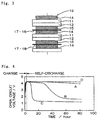
- Furthermore, the present inventors have obtained an experimental result in which mixing of moisture into the inside of a battery affects the self-discharge characteristic badly. Fig. 4, shows the self-discharge characteristic captured according to changes in open circuit voltage in case where the experimental coin cells were formed under various conditions using an electrolyte solution in which LiPF6 was dissolved in a mixed solvent of EC and DEC. Having been left alone after full charging, a battery D, which was formed and charged inside a globe box replaced with and filled with dry nitrogen, shows the least self-discharge, while a battery A, which was formed inside a similar globe box, and was thereafter charged inside a tight box containing a silica gel, proceeds with self-discharge a little bit faster than the battery D.
- In comparison with the above, a battery B, which was charged in a tight box which was assembled in an air atmosphere and in which silica gel was put, showed a steep voltage decrease in about half the time of the battery D or the battery A, spends, and in addition, a battery C, which was formed inside said globe box using an electrolyte solution where water drops were intentionally added, and charged within said tight box, showed a steep voltage drop immediately after finishing the charge. It may thus be considered that the moisture within a battery greatly affects the self-discharge characteristic.
- Therefore, there is a possibility that the admixture of moisture takes place not only from the materials with which the above-mentioned battery and each member are made, but also from the mixture of moisture inside a battery under the environment where a battery is being produced. Usually, to avoid such an event, the assembly of a battery is performed under a dry nitrogen atmosphere, etc., resulting in, however, considerable cost for production facilities to produce large-capacity large-sized lithium secondary batteries under such an atmosphere.
- The present invention was achieved, considering the problems of the prior art mentioned above, the purpose of which is to provide a lithium secondary battery that removes moisture that mixes easily within the battery and that has a good charge-discharge cycle characteristic and a self-discharge characteristic without requiring large-scale production facilities.
- That is, according to the present invention, a lithium secondary battery comprising a battery case, an internal electrode body contained in the battery case and including a positive electrode, a negative electrode and a separator film made of porous polymer, the positive electrode and the negative electrode being wound or laminated so that the positive electrode and negative electrode are not brought into direct contact with each other via the separator film, an organic electrolyte solution contained in the battery case, and a zeolite having a moisture absorption characteristic, having been incorporated in the battery case so that the zeolite is brought into contact with the organic electrolyte solution within the battery case.
- In a lithium secondary battery of the present invention, it is preferred that the zeolite be incorporated in the battery case, using at least one of the following means, namely: (1) a means to dispose the zeolite to be contained in a bag permeable to electrolyte solution inside the battery case, (2) a means to mix the zeolite with an electrode active material structuring the positive electrode and/or the negative electrode, (3) a means to disperse the zeolite on the surface of the separator film, and (4) a means to make the zeolite into a fine powder and to disperse it by suspension in the electrolyte solution. Thus, it is also preferred to use these means together in plurality.
- Here, as the zeolite, the zeolite of an aluminosilicate family having at least a structure of the LTA type, FAU type, CHA type, or MOR type, and having an Al/Si ratio in the zeolite frame equal to or less than 10, is preferably used. Such zeolite does not contribute to battery reaction and exhibits a good moisture absorption under low moisture pressure.
-
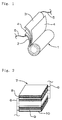
- Fig. 1 is a perspective view showing the structure of a wound-type internal electrode body.
- Fig. 2 is a perspective view showing one embodiment of the structure of a lamination-type internal electrode body.
- Fig. 3 is a (cross-)section view showing another embodiment of the structure of a lamination-type internal electrode body.
- Fig. 4 is a graph showing self-discharge characteristic of a lithium secondary battery with various amounts of moisture mixed therein.
-
- According to the lithium secondary battery of the present invention, deterioration of the charge-discharge cycle characteristic of a battery due to decomposition of electrolyte is suppressed and the self-discharge characteristic is improved since the moisture in the organic electrolyte solution is limited to a considerably low level.
- While the embodiments of the present invention are described below, it goes without saying that the present invention is not limited to the following embodiments.
- The internal electrode body of the lithium secondary battery of the present invention comprises a positive electrode, a negative electrode and a separator made of porous polymer film, the positive electrode and the negative electrode being wound or laminated so that the positive electrode and negative electrode are not brought into direct contact with each other via the separator. In particular, as shown in Fig. 1, an
internal electrode body 1 of a winding type is produced by winding apositive electrode 2 and anegative electrode 3 having two sheets ofseparator 4 in between, withlead lines 5 provided forelectrode - On the other hand, the lamination-type
internal electrode body 7 laminates the positive electrode 8 and thenegative electrode 9 alternately via theseparator 10 withlead lines 6 being connected to each ofelectrodes 8 and 9 respectively as shown in Fig. 2. Suchinternal electrode bodies positive electrodes 2, 8 and thenegative electrodes - In contrast, the
internal electrode body 19 with a laminate configuration shown in Fig. 3 is structured so that a positiveactive material layer 14 is formed on one surface of apositive substrate material 11 in the shape of a plate or a foil, while a negativeactive material layer 15 is formed on one surface of anegative substrate material 12, connecting electrically respective surfaces without electrode active material layers being formed thereon. The surface of a positiveactive material layer 14 and the surface of a negativeactive material layer 15 are laminated so as to oppose each other via aseparator 17 or asolid electrolyte 18 to configure a plurality of steps. In this case, unlike the above-describedinternal electrode body internal electrode body 19 has element batteries connected in series. - For a battery with any of the above-described structures, lithium transition metal compound oxides such as lithium cobalt oxide (LiCoO2), lithium nickel oxide (LiNiO2), or lithium manganese oxide (LiMn2O4), etc. are generally used as positive active materials. In addition, in order to improve the conductivity of these positive active materials, it is preferable to mix with the electrode active material a carbon powder such as acetylene black, graphite powder, etc. On the other hand, for the negative active electrode, an amorphous carbon material such as soft carbon or hard carbon, or carbon powder such as natural graphite, etc. is used.
- In addition, as a separator, it is preferable to use a three-layer structural separator in which a polyethylen film with lithium ion permeability and including micropores is sandwiched between porous polypropylene films having lithium ion permeability. This serves also as a safety mechanism in which when the temperature of the internal electrode body is raised, the polyethylene film is softened at about 130°C so that the micropores collapse to suppress the movement of lithium ions, that is, battery reaction. When this polyethylene film is sandwiched between polypropylene films having a softening temperature higher than said polyethylene film, it is possible to prevent contact/welding between the positive and negative electrodes.
- Such various
internal electrode bodies internal electrode bodies - Next, in the present invention, decomposition of electrolyte is suppressed by making the moisture in the electrolyte solution be absorbed by zeolite, which features excellent absorption of moisture without being reactive with members or materials configuring a battery. The zeolite is incorporated within the battery case, within the thus-structured lithium secondary battery, so as to contact the organic electrolyte solution. Here, in many cases, zeolite is preferably used in a powder state in order to make the contact area with the electrolyte solution larger.
- As one means to incorporate this zeolite into a battery there is, a means where the zeolite is contained in a bag having electrolyte solution as well as moisture permeability and the zeolite is never allowed to spill out, and said bag is disposed within the battery case. Here, if the bag where the zeolite is contained has the shape of a band, it is possible to fit it in a part of the internal electrode body. In that case, however, the distance between positive and negative electrodes is made longer, and thus there is a disadvantageous aspect such that the internal resistance of the battery increases. On the other hand, in the case of not fitting it into the internal electrode body, there is a disadvantage in that it is inferior to the means described below in terms of efficiency in absorbing moisture since the place where the bag is disposed is set at a local position such as the circumference of the internal electrode body. Thus, the present means are preferably used not on their own but together with other means.
- As another means to incorporate zeolite into a battery, it is possible to mention a means whereby it is mixed into an electrode active material structuring a positive electrode and/or a negative electrode. In the case where the method of coating an electrode active material in a paste state from an original powder state onto a substrate plate of metal foil is adopted as a way of forming a positive electrode or a negative electrode, it is possible to easily incorporate zeolite uniformly within the internal electrode body that is considered to require moisture absorption in the battery case merely by adding a necessary amount of zeolite powder to the electrode active material when this paste is being formed.
- Moreover, it is possible to incorporate zeolite uniformly within the internal electrode body, which is considered to require moisture absorption, by a means whereby zeolite is dispersed/stuck onto the surface of a separator film, and also by a means whereby zeolite is made into a fine powder to such a degree that it does not settle due to gravity and is instead dispersed in the electrolyte solution. Incidentally, the means to incorporate the above-described zeolite into the inside of a battery case can be adopted on their own or in combination.
- Now, absorption of moisture in an electrolyte solution using the above-described zeolite is to be absorption fundamentally at a very low level of around less than several ten ppm of moisture density in the electrolyte solution, that is, under a low moisture pressure. Thus, it is necessary to select a zeolite which exhibits good absorption of moisture under such conditions.
- Therefore, as a zeolite to be used in the present invention a zeolite of an aluminosilicate family having at least any structure of LTA type, FAU type, CHA type, or MOR type, and having an Al/Si ratio in the zeolite frame of equal to or less than 10, is preferably used.
- Among these zeolites, for LTA types, the 3A(K-A) type and 4A(Na-A) type, or 5(Ca-A) type are preferably used, and for FAU types, the X(Na-X) type or Y(Na-Y) type is preferably used. In addition, the zeolite frame having an Al/Si ratio equal to or under 10 is preferable, since it is generally hydrophilic and has a superior absorption characteristic under a low moisture pressure.
- Although the present invention is described in further detail by way of examples as follows, needless to say the present invention is not to be limited to the following examples.
- A paste has been formed with a LiMn2O4 powder body having surface area of 1.4m2/g based on the BET method as a positive active material, to which 4wt% of acetylene black has been added to provide conductivity to it. Further, a polyvinyliden fluoride (PVDF) as a binder and a normal methylpyrrolidone (NMP) as a solvent are mixed therein. With this paste coated on both sides of 25-□m aluminum foil, a positive electrode is formed having an electrode planar shape with a length towards the winding direction of 3400mm × a width of 200mm.
- On the other hand, a paste has been formed with a highly graphitized carbon fiber in the shape of a fiber with a diameter of approximately 5µm, and a length of approximately 10µm as a negative active material, to which 2wt% of artificial graphite has been added to improve conductivity. Further a PVDF as a binder and an NMP as a solvent are mixed therein, and it is coated on both sides of 20-µm copper foil, and thereby a negative electrode is formed having an electrode planar shape with a length towards the winding direction of 3400mm × a width of 200mm.
- The thus-formed positive electrode and negative electrode are wound with insulation provided by employing 210mm-wide separators made of polyprophylene to from an internal electrode body. During formation of this internal electrode body, as a lead tab for electricity collection, an aluminum foil lead tub is connected to the positive electrode and a copper foil lead tab is connected to the negative electrode by ultrasonic-welding with an appropriate distance in between and on the respective side surfaces of the internal electrode bodies so that one of the electrodes is formed at one end of the internal electrode body. Incidentally, production of the foregoing positive and negative electrode and production of an internal electrode body proceed under a normal air atmosphere without taking any measures against low moisture.
- Subsequently the above-described wound body is inserted into an aluminum pipe (a battery case) with an inside diameter of 48mm and an outside diameter of 50mm and a length of 260mm within a globe box having a dew point of -80°C and a bag made of the same substance as that forming the separator where in LTA-type zeolite powder (zeolum A-3 bulb-shape product produced by Tosoh Corp.) of 5g at the lead tub was disposed at both ends of the internal electrode bodies. The negative lead tab is fitted into a battery terminal, the cap of which is further attached to the battery case, and the side of the negative terminal of the battery case is sealed.
- Next, from the open side of positive terminal of the battery case, the electrolyte solution, a mixed solvent of EC and DEC where in electrolyte LiPF6 is dissolved to yield 1 mol% density, is injected and the internal volume of the globe box is kept at a vacuous for two hours, allowing permeation of electrolyte into the battery. Thereafter the positive lead tub is fitted into the positive terminal of the battery, to which the cap of positive terminal is attached and sealed.
- Ten batteries according to this example were formed. Discharge capacity, internal resistance, and self-discharge amount were measured for each battery. Here, charge and discharge were measured, employing a constant-current power source as the power source with a current intensity of approximately 0.2C covering a range of 2.5V to 4.2V. The internal resistance was calculated based on the voltage drop at the terminals at the time of alternating to discharge after the initial charge. The self-discharge amount is calculated after measuring the initial discharge capacity at discharge immediately after the initial charge, and recharging immediately and leaving it stand at room temperature for 28 to 30 days. Thereafter, the discharge capacity was measured, with the difference between the discharge amounts before and after being let stand at room temperature being divided by the number of days of being left to stand. The test results are shown in Table 1.
Characteristic of Battery Related to Example Battery No. Discharge Capacity (Ah) Internal Resistance (m□) Self-discharge Amount (%/day) Battery Weight (g) Quantity of Electrolyte (g) 1 21.8 4.75 0.42 813 178 2 22.4 5.25 0.58 805 165 3 22.3 5.5 0.52 808 167 4 22.6 5.75 0.48 815 171 5 21.9 5 0.52 825 178 6 21.3 5.25 0.31 852 209 7 22.3 6.5 0.68 860 215 8 21.7 6.75 0.69 872 230 9 22.5 6.25 0.34 878 234 10 22.2 6.75 0.36 868 226 Average 22.1 5.78 0.49 840 197 1σ 0.4 0.74 0.13 29 28 - In comparison with the above-described example, a test similar to the example was conducted as an example for comparison adopting the same method as in the example of producing ten batteries with the exception that the zeolite powder was incorporated inside the battery case. The test results are shown in Table 2.
Characteristic of Battery Related to Example for Comparison Battery No. Discharge Capacity (Ah) Internal Resistance (m□) Self-discharge Amount (%/day) Battery Weight (g) Quantity of Electrolyte (g) 11 22.5 5.5 1.01 822 177 12 22.5 5.75 1.01 858 213 13 22.3 6.25 1.1 823 182 14 22.5 6.75 0.78 847 202 15 22.5 8.25 1.01 851 208 16 22.4 8 0.93 864 220 17 22.4 6.5 0.93 844 199 18 22.3 6.5 0.93 879 233 19 22.5 7.5 0.92 838 194 20 22.6 6.25 0.84 853 208 Average 22.5 6.73 0.95 848 204 1σ 0.1 0.92 0.09 18 17 - As shown in Table 1 and Table 2, concerning the self-discharge amount, a result such that the amount for the battery for the comparative example reached approximately twice the level as that for the battery for the example in spite of the fact that the discharge capacity is almost similar in the batteries in the example and in the comparative example. Such a difference in self-discharge amount can be considered to have taken place as a result in which is the battery for the example, moisture mixed in various materials used to form the battery as well as moisture inside the battery case during the forming process of the battery was absorbed by zeolite, resulting in preventing the decomposition of the electrolyte, that is, maintaining the charge/discharge characteristic without degrading ionic conductivity.
- As described above, according to the lithium secondary battery of this invention, zeolite performing well in terms of its moisture absorption characteristic even under a lower moisture pressure is incorporated inside the battery so as to be in contact with the organic electrolyte solution by a simple means, so that any moisture mixed into the electrolyte solution is limited to an extremely lower level. Thus deterioration of the charge-discharge cycle characteristic of the battery due to decomposition of electrolyte is suppressed, and the self-discharge characteristic is improved. Moreover, concerning the formation of a large-sized lithium secondary battery, there is an advantage in that a production facility, etc. having a large-scale dry nitrogen atmosphere becomes unnecessary and it becomes possible to suppress the production cost.
- A lithium secondary battery uses an organic electrolyte solution and includes a battery case, an internal electrode body contained in a battery case and including a positive electrode, a negative electrode and a separator made of porous polymer. The positive electrode and the negative electrode are wound or laminated so that the positive electrode and negative electrode are not brought into direct contact with each other via the separator. A zeolite having a moisture absorption characteristic, has been incorporated in the battery case so that the zeolite is brought into contact with the organic electrolyte solution within the battery case. The lithium secondary battery achieves suppression of deterioration of a charge-discharge cycle characteristic of a battery caused by decomposition of an electrolyte by limiting moisture mixed into an organic electrolyte solution to a considerably lower level as well as improvement of its self-discharge characteristic.
Claims (3)
- A lithium secondary battery comprising:a battery case;an internal electrode body contained in the battery case and including a positive electrode, a negative electrode and a separator film made of porous polymer, the positive electrode and the negative electrode being wound or laminated so that the positive electrode and negative electrode are not brought into direct contact with each other via the separator film,an organic electrolyte solution contained in the battery case, anda zeolite having a moisture absorption characteristic, which is incorporated in the battery case so that the zeolite is brought into contact with the organic electrolyte solution within the battery case.
- A lithium secondary battery according to claim 1, wherein the zeolite is incorporated in the battery case, using at least one of the following means:(1) a means that disposes the zeolite to be contained in a bag permeable to electrolyte solution inside the battery case,(2) a means that mixes the zeolite with the electrode active material structuring the positive electrode and/or the negative electrode,(3) a means that disperses the zeolite on the surface of the separator film, and(4) a means that makes the zeolite into a fine powder and disperses it by suspension in the electrolyte solution.
- A lithium secondary battery according to claim 1 or 2, wherein;the zeolite of an aluminosilicate family having at least one structure of the LTA type, FAU type, CHA type, or MOR type, and having an Al/Si ratio in the zeolite frame equal to or less than 10 is used.
Applications Claiming Priority (2)
| Application Number | Priority Date | Filing Date | Title |
|---|---|---|---|
| JP10059288A JPH11260416A (en) | 1998-03-11 | 1998-03-11 | Lithium secondary battery |
| JP5928898 | 1998-03-11 |
Publications (1)
| Publication Number | Publication Date |
|---|---|
| EP0942485A1 true EP0942485A1 (en) | 1999-09-15 |
Family
ID=13109061
Family Applications (1)
| Application Number | Title | Priority Date | Filing Date |
|---|---|---|---|
| EP99104777A Withdrawn EP0942485A1 (en) | 1998-03-11 | 1999-03-10 | Lithium secondary battery |
Country Status (4)
| Country | Link |
|---|---|
| US (1) | US6632565B2 (en) |
| EP (1) | EP0942485A1 (en) |
| JP (1) | JPH11260416A (en) |
| CA (1) | CA2265075A1 (en) |
Cited By (8)
| Publication number | Priority date | Publication date | Assignee | Title |
|---|---|---|---|---|
| EP1107336A3 (en) * | 1999-11-30 | 2001-09-19 | Sony Corporation | Nonaqueous electrolyte battery |
| EP1094537A3 (en) * | 1999-10-19 | 2004-03-24 | Ngk Insulators, Ltd. | Lithium secondary battery |
| WO2004077588A3 (en) * | 2003-02-28 | 2005-10-20 | Gaia Akkumulatorenwerke Gmbh | Li polymer batteries with separator dispersion and method for the production thereof |
| WO2007049871A1 (en) | 2005-10-26 | 2007-05-03 | Lg Chem, Ltd. | Secondary battery of improved life characteristics |
| US7465519B2 (en) | 2004-09-03 | 2008-12-16 | The Hongkong University Of Science And Technology | Lithium-ion battery incorporating carbon nanostructure materials |
| EP1952465A4 (en) * | 2005-10-26 | 2011-03-30 | Lg Chemical Ltd | SECONDARY BATTERY WITH IMPROVED LIFE-OF-LIFE CHARACTERISTICS BY REMOVING METAL IONS |
| CN101710629B (en) * | 2009-11-03 | 2012-05-30 | 赛恩斯能源科技有限公司 | Battery Pack Charging Method |
| EP4243142B1 (en) * | 2022-03-07 | 2026-03-18 | SK On Co., Ltd. | Secondary cell including na-y-type zeolite adsorbent |
Families Citing this family (31)
| Publication number | Priority date | Publication date | Assignee | Title |
|---|---|---|---|---|
| JP2001223030A (en) * | 2000-02-09 | 2001-08-17 | Ngk Insulators Ltd | Lithium secondary battery |
| US6699665B1 (en) * | 2000-11-08 | 2004-03-02 | Surface Logix, Inc. | Multiple array system for integrating bioarrays |
| JP3858689B2 (en) * | 2001-12-21 | 2006-12-20 | 日本電気株式会社 | BATTERY USING LAMINATE PACKAGE AND METHOD FOR MANUFACTURING THE SAME |
| JP2003308817A (en) * | 2002-04-17 | 2003-10-31 | Nissan Motor Co Ltd | Battery pack |
| JP4100341B2 (en) * | 2003-12-26 | 2008-06-11 | 新神戸電機株式会社 | Positive electrode material for lithium secondary battery and lithium secondary battery using the same |
| JP4707426B2 (en) * | 2005-03-23 | 2011-06-22 | 三洋電機株式会社 | Nonaqueous electrolyte secondary battery |
| JP5378305B2 (en) * | 2010-06-11 | 2013-12-25 | 株式会社日立製作所 | Lithium ion battery |
| US20130224571A1 (en) * | 2010-12-13 | 2013-08-29 | Nec Corporation | Lithium ion secondary battery and method for manufacturing the same |
| JP5910014B2 (en) * | 2011-11-15 | 2016-04-27 | 日立化成株式会社 | Positive electrode for lithium ion secondary battery, lithium ion secondary battery using the same, and method for producing positive electrode for lithium ion secondary battery |
| TWI561469B (en) * | 2011-11-15 | 2016-12-11 | Hitachi Chemical Co Ltd | Lithium ion secondary battery, material, negative electrode, positive electrode material, positive electrode mixture, positive electrode, electrolyte, separator amd binder for lithium ion secondary battery |
| JP6045901B2 (en) | 2012-12-18 | 2016-12-14 | オートモーティブエナジーサプライ株式会社 | Mixed electrode for non-aqueous electrolyte battery and manufacturing method thereof |
| US20140272542A1 (en) * | 2013-03-12 | 2014-09-18 | Cooper Technologies Company | Electrochemical energy storage device with molecular seive storage cell |
| WO2014200063A1 (en) * | 2013-06-12 | 2014-12-18 | 日立化成株式会社 | Aluminum silicate complex, conductive material, conductive material for lithium ion secondary cell, composition for forming lithium ion secondary cell negative electrode, composition for forming lithium ion secondary cell positive electrode, negative electrode for lithium ion secondary cell, positive electrode for lithium ion secondary cell, and lithium ion secondary cell |
| JP2015022907A (en) * | 2013-07-19 | 2015-02-02 | 住友電気工業株式会社 | Sodium molten salt battery |
| JP6315281B2 (en) * | 2015-02-10 | 2018-04-25 | トヨタ自動車株式会社 | Nonaqueous electrolyte secondary battery |
| WO2016159083A1 (en) * | 2015-03-31 | 2016-10-06 | 株式会社大阪ソーダ | Electrochemical capacitor |
| KR101946310B1 (en) * | 2016-06-22 | 2019-02-11 | 간사이 페인트 가부시키가이샤 | Conductive paste and mixture paste for lithium ion battery positive electrode |
| JP7073643B2 (en) * | 2016-07-13 | 2022-05-24 | 栗田工業株式会社 | Lithium ion battery |
| DE102016214259A1 (en) * | 2016-08-02 | 2018-02-08 | Robert Bosch Gmbh | A rechargeable lithium battery |
| JP2018022613A (en) * | 2016-08-03 | 2018-02-08 | 栗田工業株式会社 | Electrolyte for nonaqueous electrolyte secondary battery |
| WO2018043431A1 (en) * | 2016-09-01 | 2018-03-08 | 栗田工業株式会社 | Lithium ion battery |
| US10615461B2 (en) * | 2017-03-02 | 2020-04-07 | GM Global Technology Operations LLC | Lithium ion battery including lithium ion-exchanged zeolite particles |
| US20180254449A1 (en) * | 2017-03-02 | 2018-09-06 | GM Global Technology Operations LLC | Composite porous separator including lithium ion-exchanged zeolite particles |
| DE102017211412A1 (en) | 2017-07-05 | 2019-01-10 | Robert Bosch Gmbh | Lithium cell separator with sponge material layer |
| US10483592B2 (en) | 2017-08-30 | 2019-11-19 | GM Global Technology Operations LLC | Method of manufacturing lithium ion battery cells |
| US11411260B2 (en) | 2019-10-23 | 2022-08-09 | Ford Global Technologies, Llc | Lithium-ion cell containing solid adsorbent and method of producing the same |
| US12021237B2 (en) | 2019-10-31 | 2024-06-25 | Pacific Industrial Development Corporation | Inorganic materials for use in a lithium-ion secondary battery |
| CN114641894A (en) * | 2019-10-31 | 2022-06-17 | 太平洋工业发展公司 | Inorganic material for lithium ion secondary battery |
| EP4030523A1 (en) * | 2021-01-06 | 2022-07-20 | Pacific Industrial Development Corporation | Inorganic scavenging additive for use in a lithium-ion secondary battery |
| CN114142158B (en) * | 2021-12-02 | 2024-04-19 | 中材科技膜材料(山东)有限公司 | AGM (advanced glass fiber) diaphragm for winding battery and preparation method thereof |
| US20250132400A1 (en) * | 2023-10-23 | 2025-04-24 | GM Global Technology Operations LLC | Non-aqueous secondary lithium-ion battery cell with a transition metal trapping metal oxide |
Citations (12)
| Publication number | Priority date | Publication date | Assignee | Title |
|---|---|---|---|---|
| US3864168A (en) * | 1974-03-22 | 1975-02-04 | Yardney International Corp | Electrolytic cells incorporating water scavengers |
| EP0075132A1 (en) * | 1981-09-15 | 1983-03-30 | VARTA Batterie Aktiengesellschaft | Galvanic cell with integrated getter |
| JPS5981869A (en) * | 1982-11-01 | 1984-05-11 | Hitachi Maxell Ltd | Manufacture of lithium battery |
| JPS61264682A (en) * | 1985-05-20 | 1986-11-22 | Matsushita Electric Ind Co Ltd | organic electrolyte battery |
| JPS61264679A (en) * | 1985-05-20 | 1986-11-22 | Matsushita Electric Ind Co Ltd | Organic electrolyte battery |
| JPH06267593A (en) * | 1993-03-15 | 1994-09-22 | Yuasa Corp | Cell |
| JPH07192775A (en) * | 1993-12-24 | 1995-07-28 | Sony Corp | Non-aqueous electrolyte secondary battery |
| JPH07262999A (en) * | 1994-03-25 | 1995-10-13 | Toppan Printing Co Ltd | Lithium battery |
| US5474858A (en) * | 1992-07-21 | 1995-12-12 | Medtronic, Inc. | Method for preventing gas formation in electro-chemical cells |
| JPH09134720A (en) * | 1995-11-10 | 1997-05-20 | Toyota Central Res & Dev Lab Inc | Lithium secondary battery |
| JPH09161773A (en) * | 1995-11-30 | 1997-06-20 | Yazaki Corp | Electrode material for non-aqueous secondary battery and non-aqueous secondary battery |
| JPH09192486A (en) * | 1996-01-24 | 1997-07-29 | Mazda Motor Corp | Engine exhaust gas purification catalyst |
Family Cites Families (14)
| Publication number | Priority date | Publication date | Assignee | Title |
|---|---|---|---|---|
| ZA785067B (en) * | 1978-09-06 | 1980-04-30 | South African Inventions | Electrochemical cell |
| JPS5784571A (en) | 1980-11-14 | 1982-05-26 | Sanyo Electric Co Ltd | Organic electrolyte battery |
| GB2118534B (en) * | 1982-04-15 | 1985-10-09 | South African Inventions | Electronically conductive tectosilicates |
| JPS599874A (en) | 1982-07-08 | 1984-01-19 | Nippon Denso Co Ltd | Organic battery |
| JPS6139464A (en) | 1984-07-31 | 1986-02-25 | Toyota Motor Corp | Organic electrolyte secondary battery |
| AU574580B2 (en) * | 1985-06-04 | 1988-07-07 | Sgl Technic Ltd. | Rechargeable secondary battery |
| JP2778065B2 (en) * | 1988-11-28 | 1998-07-23 | 松下電器産業株式会社 | Non-aqueous electrolyte secondary battery |
| JPH05315006A (en) | 1992-05-11 | 1993-11-26 | Sony Corp | Non-aqueous electrolyte battery and manufacturing method thereof |
| JPH0773883A (en) | 1993-08-31 | 1995-03-17 | Haibaru:Kk | Secondary battery |
| JP3182296B2 (en) | 1994-07-15 | 2001-07-03 | 三洋電機株式会社 | Non-aqueous electrolyte secondary battery |
| US5707756A (en) * | 1994-11-29 | 1998-01-13 | Fuji Photo Film Co., Ltd. | Non-aqueous secondary battery |
| JPH09139232A (en) | 1995-09-14 | 1997-05-27 | Toshiba Corp | Lithium battery |
| US5707760A (en) * | 1996-12-09 | 1998-01-13 | Valence Technology, Inc. | Additives for inhibiting decomposition of lithium salts and electrolytes containing said additives |
| US5728489A (en) * | 1996-12-12 | 1998-03-17 | Valence Technology, Inc. | Polymer electrolytes containing lithiated zeolite |
-
1998
- 1998-03-11 JP JP10059288A patent/JPH11260416A/en active Pending
-
1999
- 1999-03-05 US US09/262,821 patent/US6632565B2/en not_active Expired - Fee Related
- 1999-03-08 CA CA002265075A patent/CA2265075A1/en not_active Abandoned
- 1999-03-10 EP EP99104777A patent/EP0942485A1/en not_active Withdrawn
Patent Citations (12)
| Publication number | Priority date | Publication date | Assignee | Title |
|---|---|---|---|---|
| US3864168A (en) * | 1974-03-22 | 1975-02-04 | Yardney International Corp | Electrolytic cells incorporating water scavengers |
| EP0075132A1 (en) * | 1981-09-15 | 1983-03-30 | VARTA Batterie Aktiengesellschaft | Galvanic cell with integrated getter |
| JPS5981869A (en) * | 1982-11-01 | 1984-05-11 | Hitachi Maxell Ltd | Manufacture of lithium battery |
| JPS61264682A (en) * | 1985-05-20 | 1986-11-22 | Matsushita Electric Ind Co Ltd | organic electrolyte battery |
| JPS61264679A (en) * | 1985-05-20 | 1986-11-22 | Matsushita Electric Ind Co Ltd | Organic electrolyte battery |
| US5474858A (en) * | 1992-07-21 | 1995-12-12 | Medtronic, Inc. | Method for preventing gas formation in electro-chemical cells |
| JPH06267593A (en) * | 1993-03-15 | 1994-09-22 | Yuasa Corp | Cell |
| JPH07192775A (en) * | 1993-12-24 | 1995-07-28 | Sony Corp | Non-aqueous electrolyte secondary battery |
| JPH07262999A (en) * | 1994-03-25 | 1995-10-13 | Toppan Printing Co Ltd | Lithium battery |
| JPH09134720A (en) * | 1995-11-10 | 1997-05-20 | Toyota Central Res & Dev Lab Inc | Lithium secondary battery |
| JPH09161773A (en) * | 1995-11-30 | 1997-06-20 | Yazaki Corp | Electrode material for non-aqueous secondary battery and non-aqueous secondary battery |
| JPH09192486A (en) * | 1996-01-24 | 1997-07-29 | Mazda Motor Corp | Engine exhaust gas purification catalyst |
Non-Patent Citations (8)
| Title |
|---|
| PATENT ABSTRACTS OF JAPAN vol. 008, no. 194 (E - 264) 6 September 1984 (1984-09-06) * |
| PATENT ABSTRACTS OF JAPAN vol. 011, no. 117 (E - 498) 11 April 1987 (1987-04-11) * |
| PATENT ABSTRACTS OF JAPAN vol. 018, no. 672 (E - 1646) 19 December 1994 (1994-12-19) * |
| PATENT ABSTRACTS OF JAPAN vol. 095, no. 010 30 November 1995 (1995-11-30) * |
| PATENT ABSTRACTS OF JAPAN vol. 096, no. 002 29 February 1996 (1996-02-29) * |
| PATENT ABSTRACTS OF JAPAN vol. 097, no. 009 30 September 1997 (1997-09-30) * |
| PATENT ABSTRACTS OF JAPAN vol. 097, no. 010 31 October 1997 (1997-10-31) * |
| PATENT ABSTRACTS OF JAPAN vol. 097, no. 011 28 November 1997 (1997-11-28) * |
Cited By (12)
| Publication number | Priority date | Publication date | Assignee | Title |
|---|---|---|---|---|
| EP1094537A3 (en) * | 1999-10-19 | 2004-03-24 | Ngk Insulators, Ltd. | Lithium secondary battery |
| EP1107336A3 (en) * | 1999-11-30 | 2001-09-19 | Sony Corporation | Nonaqueous electrolyte battery |
| US7776465B1 (en) | 1999-11-30 | 2010-08-17 | Sony Corporation | Nonaqueous electrolyte battery |
| WO2004077588A3 (en) * | 2003-02-28 | 2005-10-20 | Gaia Akkumulatorenwerke Gmbh | Li polymer batteries with separator dispersion and method for the production thereof |
| EP1783852A2 (en) | 2003-02-28 | 2007-05-09 | Dilo Trading AG | Separator dispersion for Li-polymer-batteries |
| EP1783852A3 (en) * | 2003-02-28 | 2008-09-17 | Dilo Trading AG | Separator dispersion for Li-polymer-batteries |
| US7465519B2 (en) | 2004-09-03 | 2008-12-16 | The Hongkong University Of Science And Technology | Lithium-ion battery incorporating carbon nanostructure materials |
| WO2007049871A1 (en) | 2005-10-26 | 2007-05-03 | Lg Chem, Ltd. | Secondary battery of improved life characteristics |
| EP1952465A4 (en) * | 2005-10-26 | 2011-03-30 | Lg Chemical Ltd | SECONDARY BATTERY WITH IMPROVED LIFE-OF-LIFE CHARACTERISTICS BY REMOVING METAL IONS |
| EP1952459A4 (en) * | 2005-10-26 | 2012-02-01 | Lg Chemical Ltd | ACCUMULATOR HAVING IMPROVED LONGEVITY CHARACTERISTICS |
| CN101710629B (en) * | 2009-11-03 | 2012-05-30 | 赛恩斯能源科技有限公司 | Battery Pack Charging Method |
| EP4243142B1 (en) * | 2022-03-07 | 2026-03-18 | SK On Co., Ltd. | Secondary cell including na-y-type zeolite adsorbent |
Also Published As
| Publication number | Publication date |
|---|---|
| US6632565B2 (en) | 2003-10-14 |
| CA2265075A1 (en) | 1999-09-11 |
| US20020061439A1 (en) | 2002-05-23 |
| JPH11260416A (en) | 1999-09-24 |
Similar Documents
| Publication | Publication Date | Title |
|---|---|---|
| US6632565B2 (en) | Lithium secondary battery | |
| US7803483B2 (en) | Hermetically sealed high capacity nonaqueous electrolyte battery and battery pack with the same | |
| US7927740B2 (en) | Battery pack and vehicle | |
| US9406973B2 (en) | Nonaqueous electrolyte battery and battery pack | |
| KR101312860B1 (en) | Non-aqueous electrolyte battery | |
| EP1195826B1 (en) | Solid electrolyte cell | |
| KR102491619B1 (en) | Anode for lithium secondary battery and lithium secondary battery including the same | |
| US7582386B2 (en) | Nonaqueous electrolyte battery, battery pack and vehicle | |
| US20120141871A1 (en) | Nonaqueous electrolyte battery, battery pack and vehicle | |
| US20050244716A1 (en) | Lithium-ion secondary battery and method of charging lithium-ion secondary battery | |
| KR20180031548A (en) | Solid electrolyte, lithium battery, battery pack and vehicle | |
| CN1332484A (en) | Nonaqueous electrolyte secondary battery and its manufacture | |
| US20160056463A1 (en) | Non-aqueous electrolyte secondary battery | |
| US6258485B1 (en) | Lithium secondary battery | |
| KR20180028930A (en) | Electrode Comprising Current Collector Having a 3Dimension Network Structure | |
| EP1191618B1 (en) | Rechargeable battery using nonaqueous electrolyte | |
| WO2019069356A1 (en) | Electrode group, secondary battery, battery module, electricity storage device, vehicle and flying body | |
| JP2000260469A (en) | Lithium secondary battery | |
| US11205780B2 (en) | Battery assembly and method of manufacturing nonaqueous electrolyte secondary battery | |
| KR20060009411A (en) | Large capacity high rate lithium ion battery | |
| KR20180065096A (en) | Battery Module Comprising Cell Frames of Standardized Structure | |
| JPH10241740A (en) | Nonaqueous system battery | |
| KR200364044Y1 (en) | Lithium Ion Battery of High Rate and High Capacity | |
| KR20170042112A (en) | Negative electrode, method of preparing the same, and lithium battery including the negative electrode | |
| KR20260031288A (en) | Electrode assembly and secondary battery |
Legal Events
| Date | Code | Title | Description |
|---|---|---|---|
| PUAI | Public reference made under article 153(3) epc to a published international application that has entered the european phase |
Free format text: ORIGINAL CODE: 0009012 |
|
| AK | Designated contracting states |
Kind code of ref document: A1 Designated state(s): BE CH DE FR GB IT LI |
|
| AX | Request for extension of the european patent |
Free format text: AL;LT;LV;MK;RO;SI |
|
| 17P | Request for examination filed |
Effective date: 20000215 |
|
| AKX | Designation fees paid |
Free format text: BE CH DE FR GB IT LI |
|
| 17Q | First examination report despatched |
Effective date: 20011203 |
|
| GRAP | Despatch of communication of intention to grant a patent |
Free format text: ORIGINAL CODE: EPIDOSNIGR1 |
|
| STAA | Information on the status of an ep patent application or granted ep patent |
Free format text: STATUS: THE APPLICATION IS DEEMED TO BE WITHDRAWN |
|
| 18D | Application deemed to be withdrawn |
Effective date: 20051007 |