EP0936282A2 - Dielektrikum aus fluoriertem amorphen Kohlenstoff mit einem niedrigen k-Wert, und Verfahren zu dessen Herstellung - Google Patents
Dielektrikum aus fluoriertem amorphen Kohlenstoff mit einem niedrigen k-Wert, und Verfahren zu dessen Herstellung Download PDFInfo
- Publication number
- EP0936282A2 EP0936282A2 EP99300444A EP99300444A EP0936282A2 EP 0936282 A2 EP0936282 A2 EP 0936282A2 EP 99300444 A EP99300444 A EP 99300444A EP 99300444 A EP99300444 A EP 99300444A EP 0936282 A2 EP0936282 A2 EP 0936282A2
- Authority
- EP
- European Patent Office
- Prior art keywords
- pecvd
- chamber
- substrate
- silane
- generally
- Prior art date
- Legal status (The legal status is an assumption and is not a legal conclusion. Google has not performed a legal analysis and makes no representation as to the accuracy of the status listed.)
- Granted
Links
Images
Classifications
-
- H—ELECTRICITY
- H10—SEMICONDUCTOR DEVICES; ELECTRIC SOLID-STATE DEVICES NOT OTHERWISE PROVIDED FOR
- H10P—GENERIC PROCESSES OR APPARATUS FOR THE MANUFACTURE OR TREATMENT OF DEVICES COVERED BY CLASS H10
- H10P14/00—Formation of materials, e.g. in the shape of layers or pillars
- H10P14/20—Formation of materials, e.g. in the shape of layers or pillars of semiconductor materials
-
- H—ELECTRICITY
- H10—SEMICONDUCTOR DEVICES; ELECTRIC SOLID-STATE DEVICES NOT OTHERWISE PROVIDED FOR
- H10P—GENERIC PROCESSES OR APPARATUS FOR THE MANUFACTURE OR TREATMENT OF DEVICES COVERED BY CLASS H10
- H10P14/00—Formation of materials, e.g. in the shape of layers or pillars
- H10P14/60—Formation of materials, e.g. in the shape of layers or pillars of insulating materials
- H10P14/63—Formation of materials, e.g. in the shape of layers or pillars of insulating materials characterised by the formation processes
- H10P14/6326—Deposition processes
- H10P14/6328—Deposition from the gas or vapour phase
- H10P14/6334—Deposition from the gas or vapour phase using decomposition or reaction of gaseous or vapour phase compounds, i.e. chemical vapour deposition
- H10P14/6336—Deposition from the gas or vapour phase using decomposition or reaction of gaseous or vapour phase compounds, i.e. chemical vapour deposition in the presence of a plasma [PECVD]
-
- C—CHEMISTRY; METALLURGY
- C23—COATING METALLIC MATERIAL; COATING MATERIAL WITH METALLIC MATERIAL; CHEMICAL SURFACE TREATMENT; DIFFUSION TREATMENT OF METALLIC MATERIAL; COATING BY VACUUM EVAPORATION, BY SPUTTERING, BY ION IMPLANTATION OR BY CHEMICAL VAPOUR DEPOSITION, IN GENERAL; INHIBITING CORROSION OF METALLIC MATERIAL OR INCRUSTATION IN GENERAL
- C23C—COATING METALLIC MATERIAL; COATING MATERIAL WITH METALLIC MATERIAL; SURFACE TREATMENT OF METALLIC MATERIAL BY DIFFUSION INTO THE SURFACE, BY CHEMICAL CONVERSION OR SUBSTITUTION; COATING BY VACUUM EVAPORATION, BY SPUTTERING, BY ION IMPLANTATION OR BY CHEMICAL VAPOUR DEPOSITION, IN GENERAL
- C23C16/00—Chemical coating by decomposition of gaseous compounds, without leaving reaction products of surface material in the coating, i.e. chemical vapour deposition [CVD] processes
- C23C16/22—Chemical coating by decomposition of gaseous compounds, without leaving reaction products of surface material in the coating, i.e. chemical vapour deposition [CVD] processes characterised by the deposition of inorganic material, other than metallic material
- C23C16/26—Deposition of carbon only
-
- H—ELECTRICITY
- H10—SEMICONDUCTOR DEVICES; ELECTRIC SOLID-STATE DEVICES NOT OTHERWISE PROVIDED FOR
- H10P—GENERIC PROCESSES OR APPARATUS FOR THE MANUFACTURE OR TREATMENT OF DEVICES COVERED BY CLASS H10
- H10P14/00—Formation of materials, e.g. in the shape of layers or pillars
- H10P14/60—Formation of materials, e.g. in the shape of layers or pillars of insulating materials
- H10P14/66—Formation of materials, e.g. in the shape of layers or pillars of insulating materials characterised by the type of materials
- H10P14/668—Formation of materials, e.g. in the shape of layers or pillars of insulating materials characterised by the type of materials the materials being characterised by the deposition precursor materials
- H10P14/6681—Formation of materials, e.g. in the shape of layers or pillars of insulating materials characterised by the type of materials the materials being characterised by the deposition precursor materials the precursor containing a compound comprising Si
- H10P14/6682—Formation of materials, e.g. in the shape of layers or pillars of insulating materials characterised by the type of materials the materials being characterised by the deposition precursor materials the precursor containing a compound comprising Si the compound being a silane, e.g. disilane, methylsilane or chlorosilane
-
- H—ELECTRICITY
- H10—SEMICONDUCTOR DEVICES; ELECTRIC SOLID-STATE DEVICES NOT OTHERWISE PROVIDED FOR
- H10P—GENERIC PROCESSES OR APPARATUS FOR THE MANUFACTURE OR TREATMENT OF DEVICES COVERED BY CLASS H10
- H10P14/00—Formation of materials, e.g. in the shape of layers or pillars
- H10P14/60—Formation of materials, e.g. in the shape of layers or pillars of insulating materials
- H10P14/68—Organic materials, e.g. photoresists
- H10P14/683—Organic materials, e.g. photoresists carbon-based polymeric organic materials, e.g. polyimides, poly cyclobutene or PVC
- H10P14/687—Organic materials, e.g. photoresists carbon-based polymeric organic materials, e.g. polyimides, poly cyclobutene or PVC the materials being fluorocarbon compounds, e.g. (CHxFy) n or polytetrafluoroethylene
-
- H—ELECTRICITY
- H10—SEMICONDUCTOR DEVICES; ELECTRIC SOLID-STATE DEVICES NOT OTHERWISE PROVIDED FOR
- H10P—GENERIC PROCESSES OR APPARATUS FOR THE MANUFACTURE OR TREATMENT OF DEVICES COVERED BY CLASS H10
- H10P14/00—Formation of materials, e.g. in the shape of layers or pillars
- H10P14/60—Formation of materials, e.g. in the shape of layers or pillars of insulating materials
- H10P14/69—Inorganic materials
- H10P14/6902—Inorganic materials composed of carbon, e.g. alpha-C, diamond or hydrogen doped carbon
Definitions
- the invention relates to a method of forming an interlevel dielectric of the type used in interconnect structures of integrated circuits, and more paticularly to a plasma enhanced chemical vapor deposition method of forming a low-dielectric-constant insulating material.
- interconnects lines, vias, etc.
- RC resistance-capacitance
- Fluorocarbon polymers have been studied for more than two decades and most of their applications is for the use of coating materials to protect plastics, fibers, and metals. It is known that a-F:C films can be fabricated using plasma enhanced CVD ("PECVD"). Early experience with a-F:C showed that the films deposited at room temperature could be deposited with a dielectric constant as low as 2.1 and a thermal stability ⁇ 300 °C. Further experimentation showed that if the a-F:C films were deposited at higher substrate temperatures, the thermal stability could be improved up to 400 °C, but the dielectric constant increased above ⁇ 2.5.
- PECVD plasma enhanced CVD
- Table I illustrates how the dielectric constants and thermal stabilities of several members of carbon family compare to a-F:C. It shows that the dielectric constant can be lowered if carbon films contain higher fluorine concentrations.
- the fluorine concentration of a-F:C film depends on the fluorine to carbon ratio in the discharge, which is established by the feed gas composition, RF power input, substrate temperature, and total pressure.
- the thermal stability is closely related to the degree of crosslinking among the polymer chains. The greater the degree of crosslinking, the more tightly bound the structures are, and the higher the thermal stability.
- either raising substrate temperature, enhancing ion bombardment, or applying low frequency plasma energy can increase the crosslinking in a-F:C films.
- % - 50 at.% Amorphous polymer highly crosslinked 2.7 - 3.8 350 - 400 °C Fluorinated Amorphous Carbon (a-F:C) C & F F: 40 at.% - 50 at.% Amorphous polymer, highly crosslinked 2.1 - 2.8 300 - 420 °C PTFE or Teflon C & F F: 67 at.% (- CF 2 -) polymer, uncrosslinked 2.0 ⁇ 300 °C
- the disadvantages of high temperature deposition processes are that it not only increases the dielectric constant, but also leads to poor adhesion to SiO 2 and Si 3 N 4 due to increased thermal stress, and also causes higher leakage current in the films. It appears that a lower deposition temperature is desirable.
- Fluorinated amorphous carbon has a dielectric constant k below 3.0 and, depending on the proportion of fluorine (F) in the film, can have a k in the range of 2.0 to 2.5.
- a major problem with a-F:C is its poor thermal stability. It has heretofore not been possible to prepare a-F:C films with suitable low-dielectric-constant properties (k less than 2.5), and a thermal stability above 400°C. Temperatures in the sintering range (450°C) typical for manufacturing ULSI chips cause excessive shrinkage of the a-F:C film, probably due to fluorine volatilization. Mechanical strength and adhesion problems also are obstacles to the use of a-F:C as an interconnect dielectric in high-density integrated circuits.
- PECVD plasma enhanced chemical vapor deposition
- a plasma enhanced chemical vapor deposition (PECVD) process for depositing a dielectric material on a substrate for use in interconnect structures of integrated circuits.
- the method comprises steps which include positioning the substrate in a PECVD chamber and heating the substrate to a temperature above 200°C.
- a flow of fluorine containing gas (FCG) and carbon containing gas (CCG) is introduced into the chamber under sufficient applied energy to form a fluorine and carbon gas plasma in the chamber.
- the ratio of FCG to CCG is selected to deposit fluorinated amorphous carbon on the substrate.
- a flow of silane (SiH 4 ) is introduced into the chamber.
- the silane increases the thermal stability of the fluorinated amorphous carbon deposited on the substrate.
- FCG fluorine containing gas
- C 4 F 8 carbon containing gas
- CH 4 methane
- a suitable ratio of FCG to CCG for the deposit of fluorinated amorphous carbon on the substrate is generally in the range of between 1/1 and 30/1 (FCG/CCG) and, more preferably, generally in the range of 5/1 to 15/1.
- the percentage of silane gas in the mixture of FCG, CCG, and silane gases introduced into the PECVD chamber is preferably generally in the range of 1% to 15%.
- the ambient pressure maintained in the PECVD chamber during the introduction of FCG, CCG, and silane into the chamber is preferably generally in the range of 0.3 Torr to 2.0 Torr.
- plasma energy in the form of high frequency (HF) plasma energy, is supplied to ionize the gases introduced into the chamber.
- low frequency (LF) energy is introduced into the chamber, to enhance the crosslinking in the deposited a-F:C film.
- the HF energy has a frequency of 13.56 MHz and is preferably applied at an energy level of between 0.5 Watts and 3.0 watts per square centimeter of substrate surface.
- the LF is supplied in a frequency range generally in the range of 100 KHz to 900 KHz, the low frequency energy level preferably being generally in the range of 0.5 Watts and 3.0 Watts per square centimeter of substrate surface.
- a suitable selected thickness for the a-F:C film deposited using the present invention is generally in the range of 1,000 angstroms to 10,000 angstroms, although the invention is not limited to any specific thickness range.
- the substrate and deposited fluorinated amorphous carbon is annealed.
- the present invention allows for annealing at a temperature greater than or equal to 440°C, although the process can be used with anneals of between 300°C and 550°C.
- the duration of the anneal is a matter of design choice but will generally exceed 20 minutes and can be 2 hours or more, depending on the design and performance specifications of the integrated circuits being fabricated.
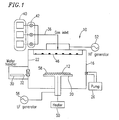
- Fig. 1 is a schematic depiction of a PECVD chamber for carrying out selected steps in the process of the present invention.
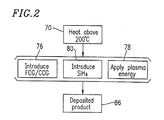
- Fig. 2 is a block diagram illustrating the steps in the process for depositing fluorinated amorphous carbon on a substrate in a PECVD chamber as shown in the Fig. 1, in accordance with the present invention.
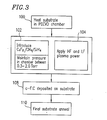
- Fig. 3 is a block diagram illustrating a preferred embodiment of a process for depositing fluorinated amorphous carbon on a substrate in a PECVD chamber, carrying the process through to a final anneal.
- the present invention provides a process for depositing fluorinated amorphous carbon (a-F:C) on a silicon wafer or other substrate.
- the wafer substrate at the time the steps in the method are carried out, has been processed by well-known techniques (not shown) to produce integrated circuit (IC) features (e.g., transistors and other active and passive devices) on the wafer.
- IC integrated circuit
- the type and number of integrated circuit features on the substrate are unimportant to the process of the present invention, except that the low-k fluorinated amorphous carbon dielectric material is most advantageously employed on ultra-large-scale-integration (ULSI) high-density ICs.
- ULSI ultra-large-scale-integration
- the dielectric material is used in interconnect structures, such as conductive lines and vias (not shown) which are well-known conductive interconnect features typically formed in, and extend through, the interconnect dielectric film which is deposited on the wafer, including the a-F:C dielectric deposited in the method of the present invention.
- interconnect structures such as conductive lines and vias (not shown) which are well-known conductive interconnect features typically formed in, and extend through, the interconnect dielectric film which is deposited on the wafer, including the a-F:C dielectric deposited in the method of the present invention.
- the form, architecture, and conductive materials used in the interconnect structures, as well as the methods of forming such structures, are not described herein and are a matter of design choice well known to those skilled in the art.
- This invention relates to the method of forming a suitable low-dielectric-constant (low-k) dielectric film which is deposited on the wafer and is suitable for use between and around the conductive lines, vias, and other conductors in ULSI and similar ICs.
- low-k dielectric film which is deposited on the wafer and is suitable for use between and around the conductive lines, vias, and other conductors in ULSI and similar ICs.
- Fig. 1 is a schematic illustration of a suitable apparatus 10 for carrying out a plasma enhanced chemical vapor deposition (PECVD) on a substrate such as wafer 12.
- Apparatus 10 includes a PECVD chamber 16 of a size suitable for holding one or more wafers 12, which are supported in the chamber on a chuck 20.
- the interior 22 can be evacuated or pressurized as desired by a suitable pump and valve apparatus schematically illustrated in Fig. 1 by pump 26.
- Individual wafers 12 are moved in and out of chamber 16 by a suitable wafer handler 30 through a gate valve 32 in the chamber wall, allowing wafers to be moved onto chuck 20 for processing, and then removed from the chamber.
- Selected gases used in PECVD processing are introduced into the chamber through a suitable manifold system 36 from various gas supply reservoirs indicated collectively at 40, controlled by valves 42.
- the gases are introduced into the chamber through what is called a shower head 46, which distributes the gases as required.
- Chuck 20 can be heated to any desired temperature, the heating element for this purpose being schematically depicted as heater 50.
- the heater and chuck are used to select the temperature of wafer 12 during PECVD processing.
- Plasma energy is supplied to the chamber through an RF generator 52 which supplies high frequency (HF) RF power radiated through shower head 46.
- HF high frequency
- Apparatus 10 preferably also includes a low frequency (LF) generator 56 for supplying LF power to the interior of the chamber.
- LF power is applied between the chuck 20 and shower head 46 in a manner well known to those skilled in the art.
- LF power is used to increase crosslinking in the amorphous fluorinated carbon (a-F:C) film deposited on wafer 12 during PECVD processing.
- Fig. 2 illustrates the steps in the process of the present invention, which will be described with reference to Figs. 1 and 2.
- a wafer substrate 12 is first positioned on chuck 20 in PECVD chamber 16 by wafer handler 30.
- the substrate 12 is typically a silicon wafer prepared for receiving a-F:C, the a-F:C being deposited on the upper surface 58 of the wafer.
- the first step shown in Fig. 2 is step 70, which is the heating of substrate 12 to a temperature above 200°C.
- wafer 12 is heated to a temperature generally in the range of 200°C-300°C.
- the next step 76 is the introduction of a flow of fluorine containing gas (FCG) and carbon containing gas (CCG) into chamber 16 via manifold 36 from suitable supplies 40.
- FCG fluorine containing gas
- CCG carbon containing gas
- the preferred FCG is octafluorocyclobutane (C 4 F 8 ) and the preferred CCG is methane (CH 4 ).
- the ratio of FCG/CCG introduced into chamber 16 is selected to deposit a-F:C on substrate 12 by plasma enhanced chemical vapor deposition. The suggested ratio is between 1/1 and 30/1 (FCG/CCG) and, preferably, between 5/1 and 15/1.
- suitable plasma power is applied in chamber 16 (step 78).
- suitable plasma power includes HF energy (13.56 MHz), at an energy level of between 0.5 Watts and 3.0 Watts per square centimeter of substrate surface (i.e., the surface area of substrate 12), and LF energy, at a frequency generally in the range of 100 KHz 900 KHz, at an energy level of 0.5 Watts and 3:0 Watts per square centimeter of substrate surface.
- C 4 F 8 provides discharge of two kinds of long-life radicals.
- One is the fluorocarbon radical (CF x ) (wherein 1 ⁇ x ⁇ 2 ), which is the building block for a-F:C deposits.
- the other is F and F 2 atoms, which are destructive etchants that form volatile fluorides which weaken the a-F:C film deposited on substrate 12.
- the methane serves to discharge hydrogen (H) radicals, which can tie up F atoms by forming volatile HF, which reduces the etching from the F and F 2 atoms, thus improving the stability of the resultant a-F:C film deposited on the wafer.
- the deposition rate and the fluorine concentration of the a-F:C film are selectively controlled by the flow rates of the FCG and CCG gases, as well as the chamber pressure within chamber 16.
- the ratio of FCG to CCG is generally between 1 to 1 and 30 to 1 and is preferably between 5 to 1 and 15 to 1 (FCG to CCG).
- the ambient pressure maintained within chamber 16 during steps 76 and 78 is preferably generally in the range of 0.3 Torr to 2.0 Torr.
- the present invention further includes the additional step 80 of introducing silane (SiH 4 ) gas into chamber 16, together with the FCG and CCG gases, during steps 76 and 78.
- the percentage of silane introduced into chamber 16 during step 80 is preferably generally in the range of 1% to 15% of the total introduced gases (i.e., FCG and CCG and silane).
- the silane has been found to improve the thermal stability of the deposited a-F:C film.
- Thermal stability is generally defined as minimal-to-zero shrinkage (e.g.. less than 1% shrinkage) of the deposited a-F:C film during the high temperature anneal which is carried out upon completion of the interlevel interconnects on an IC wafer. It is advantageous in IC wafer fabrication to be able to anneal the fabricated wafer at a temperature above 440°C for a minimum of approximately 20 minutes, and preferably between 30 minutes and up to several hours.
- the anneal is generally a part of the completion process for the devices on the wafer.
- One significant problem with the use of a-F:C dielectrics on IC wafers has been its poor thermal stability during anneals over 350°C-400°C.
- Fluorinated amorphous carbon films deposited using prior art processes, when subjected to higher temperature anneals (440°C+) exhibit undesirable shrinkage, for example, 5% - 20% or more.
- thermal stability minimum or zero shrinkage at final anneals up to 440°C - 465°C
- Fig. 3 shows an illustrative embodiment the process of the present invention, explaining the process in greater detail.
- the wafer 12 is positioned on chuck 20 in chamber 16 and heated to a temperature generally in the range of 200°C to 300°C.
- gases C 4 F 8 , CH 4 , and SiH 4 are introduced into chamber 16 via supplies 40 and valves 42 and manifold 36.
- the gases are distributed in chamber 16 through showerhead 46.
- the flow rates of gases during step 102 are the rates required to maintain the ambient pressure within chamber 16 generally in the range of 0.3 Torr and 2.0 Torr.
- the ratio of C 4 F 8 to CH 4 (C 4 F 8 /CH 4 ) during step 102 is generally in the range of 1/1 to 30/1 and preferably between 5/1 and 15/1.
- the percentage of silane gas introduced in step 102, as a percentage of the three introduced gases C 4 F 8 , CH 4 , and SiH 4 is generally in the range of 1% to 15% SiH 4 .
- the flow of C 4 F 8 , CH 4 , and SiH 4 during step 102 can alternatively be characterized as flow rates measured in standard cubic centimeters per minute (sccm), per cubic meter of interior volume 22 in PECVD chamber 16.
- sccm standard cubic centimeters per minute
- the following are suitable flow rates (per m 3 of chamber volume) for carrying out step 102:
- step 104 is carried out by applying HF and LF plasma energy in chamber 16.
- the HF energy is at a suggested standard frequency of 13.56 MHz and at an energy level of between 0.5 Watts and 3.0 Watts per square centimeter of surface area 58 of substrate wafer 12.
- LF energy is applied at a frequency generally in the range of 100 KHz to 900 KHz at an energy level of between 0.5 Watts and 3.0 Watts per square centimeter of substrate surface.
- Steps 102 and 104 deposit a-F:C on wafer 12 (step 108).
- a suitable thickness of a-F:C film deposited in step 108 is generally in the range of 1,000 angstroms to 10,000 angstroms.
- wafer 12 is removed from chamber 16 by any suitable means, such as handler 30, and annealed (step 110) in a suitable annealing oven at a temperature generally in the range of 300°C to 550°C.
- a suitable annealing oven at a temperature generally in the range of 300°C to 550°C.
- the process exhibits good thermal stability (i.e., shrinkage of less than approximately 1%) at anneal temperatures above 440°C, generally in the range of 440°C - 465°C.
- a 6-inch wafer 12 was placed on chuck 20 and heated to a temperature of 250°C.
- a flow of C 4 F 8 , CH 4 , and SiH 4 gases was introduced into the chamber at the following flow rates
- HF power 13.56 MHz was applied at a power level of 200 Watts and LF power (500 KHz) was applied at 200 Watts.
- the ambient pressure in the chamber was maintained at approximately 0.4 Torr.
- the above conditions produced a deposition rate of a-F:C of 1,200 angstroms/minute. Deposition was carried out for four minutes. Then the wafer was removed from the chamber and a final anneal was carried out at 450° C for 30 minutes.
- the resultant dielectric constant k of the a-F:C was approximately 2.3.
- the present invention has been found to improve the thermal stability and lower the dielectric constant of deposited a-F:C films formed by PECVD processes. Variations in the process are possible within the scope of the present inventions For example, the deposition temperature and ratio of gases specified in the experimental example are suggestive only. Within the specified ranges disclosed herein, it will be necessary to optimize the flow rates and temperatures used in IC manufacturing processes which are employed for commercial production.
Landscapes
- Chemical & Material Sciences (AREA)
- Inorganic Chemistry (AREA)
- General Chemical & Material Sciences (AREA)
- Chemical Kinetics & Catalysis (AREA)
- Engineering & Computer Science (AREA)
- Materials Engineering (AREA)
- Mechanical Engineering (AREA)
- Metallurgy (AREA)
- Organic Chemistry (AREA)
- Formation Of Insulating Films (AREA)
- Internal Circuitry In Semiconductor Integrated Circuit Devices (AREA)
- Chemical Vapour Deposition (AREA)
Applications Claiming Priority (2)
| Application Number | Priority Date | Filing Date | Title |
|---|---|---|---|
| US23382 | 1979-03-23 | ||
| US09/023,382 US5900290A (en) | 1998-02-13 | 1998-02-13 | Method of making low-k fluorinated amorphous carbon dielectric |
Publications (3)
| Publication Number | Publication Date |
|---|---|
| EP0936282A2 true EP0936282A2 (de) | 1999-08-18 |
| EP0936282A3 EP0936282A3 (de) | 2001-06-27 |
| EP0936282B1 EP0936282B1 (de) | 2006-10-18 |
Family
ID=21814764
Family Applications (1)
| Application Number | Title | Priority Date | Filing Date |
|---|---|---|---|
| EP99300444A Expired - Lifetime EP0936282B1 (de) | 1998-02-13 | 1999-01-21 | Dielektrikum aus fluoriertem amorphen Kohlenstoff mit einem niedrigen k-Wert, und Verfahren zu dessen Herstellung |
Country Status (6)
| Country | Link |
|---|---|
| US (1) | US5900290A (de) |
| EP (1) | EP0936282B1 (de) |
| JP (1) | JPH11251308A (de) |
| KR (1) | KR100283007B1 (de) |
| DE (1) | DE69933598T2 (de) |
| TW (1) | TW414812B (de) |
Families Citing this family (34)
| Publication number | Priority date | Publication date | Assignee | Title |
|---|---|---|---|---|
| US5989998A (en) * | 1996-08-29 | 1999-11-23 | Matsushita Electric Industrial Co., Ltd. | Method of forming interlayer insulating film |
| JP3429171B2 (ja) * | 1997-11-20 | 2003-07-22 | 東京エレクトロン株式会社 | プラズマ処理方法及び半導体デバイスの製造方法 |
| EP1033746A4 (de) * | 1997-11-20 | 2003-05-28 | Tokyo Electron Ltd | Plasma-abscheidung eines films |
| JP3574734B2 (ja) * | 1997-11-27 | 2004-10-06 | 東京エレクトロン株式会社 | 半導体デバイスの製造方法 |
| US6147407A (en) * | 1998-03-27 | 2000-11-14 | Lucent Technologies Inc. | Article comprising fluorinated amorphous carbon and process for fabricating article |
| US6184157B1 (en) * | 1998-06-01 | 2001-02-06 | Sharp Laboratories Of America, Inc. | Stress-loaded film and method for same |
| SG81991A1 (en) * | 1999-05-25 | 2001-07-24 | Tokyo Electron Ltd | Method for producing insulator film |
| CN1170003C (zh) * | 1999-06-18 | 2004-10-06 | 日新电机株式会社 | 碳膜及其形成方法以及碳膜被覆物品及其制造方法 |
| DE69940114D1 (de) * | 1999-08-17 | 2009-01-29 | Applied Materials Inc | Oberflächenbehandlung von kohlenstoffdotierten SiO2-Filmen zur Erhöhung der Stabilität während der O2-Veraschung |
| US6602806B1 (en) | 1999-08-17 | 2003-08-05 | Applied Materials, Inc. | Thermal CVD process for depositing a low dielectric constant carbon-doped silicon oxide film |
| KR100541541B1 (ko) * | 1999-08-26 | 2006-01-12 | 삼성전자주식회사 | 플라즈마 증착장비의 프로세스 챔버 |
| JP4140674B2 (ja) | 1999-09-27 | 2008-08-27 | 東京エレクトロン株式会社 | 多孔質アモルファス膜の観察方法及びその観察装置 |
| US6303518B1 (en) | 1999-09-30 | 2001-10-16 | Novellus Systems, Inc. | Methods to improve chemical vapor deposited fluorosilicate glass (FSG) film adhesion to metal barrier or etch stop/diffusion barrier layers |
| US6296906B1 (en) | 1999-09-30 | 2001-10-02 | Novellus Systems, Inc. | Annealing process for low-k dielectric film |
| AU2905901A (en) * | 1999-11-30 | 2001-06-12 | Regents Of The University Of California, The | Method for producing fluorinated diamond-like carbon films |
| US20020005539A1 (en) * | 2000-04-04 | 2002-01-17 | John Whitman | Spin coating for maximum fill characteristic yielding a planarized thin film surface |
| US6458718B1 (en) | 2000-04-28 | 2002-10-01 | Asm Japan K.K. | Fluorine-containing materials and processes |
| US6486078B1 (en) | 2000-08-22 | 2002-11-26 | Advanced Micro Devices, Inc. | Super critical drying of low k materials |
| US6632478B2 (en) | 2001-02-22 | 2003-10-14 | Applied Materials, Inc. | Process for forming a low dielectric constant carbon-containing film |
| US7307137B2 (en) * | 2001-07-05 | 2007-12-11 | Honeywell International Inc. | Low dielectric constant materials and methods of preparation thereof |
| JP4758938B2 (ja) * | 2001-08-30 | 2011-08-31 | 東京エレクトロン株式会社 | 絶縁膜の形成方法及び絶縁膜の形成装置 |
| US20040247896A1 (en) * | 2001-12-31 | 2004-12-09 | Paul Apen | Organic compositions |
| US7482249B2 (en) * | 2002-11-29 | 2009-01-27 | Fraunhofer-Gesellschaft Zur Forderung Der Angewandten Forschung E.V. | Method and device for machining a wafer, in addition to a wafer comprising a separation layer and a support layer |
| US20060166491A1 (en) * | 2005-01-21 | 2006-07-27 | Kensaku Ida | Dual damascene interconnection having low k layer and cap layer formed in a common PECVD process |
| DE102005034764B4 (de) * | 2005-07-26 | 2012-08-02 | Fraunhofer-Gesellschaft zur Förderung der angewandten Forschung e.V. | Verfahren zur Herstellung von funktionalen Fluor-Kohlenstoff-Polymerschichten mittels Plasmapolymerisation von Perfluorocycloalkanen und damit beschichtete Substrate |
| US8206996B2 (en) | 2006-03-28 | 2012-06-26 | Lam Research Corporation | Etch tool process indicator method and apparatus |
| US7951616B2 (en) * | 2006-03-28 | 2011-05-31 | Lam Research Corporation | Process for wafer temperature verification in etch tools |
| KR101669470B1 (ko) * | 2009-10-14 | 2016-10-26 | 삼성전자주식회사 | 금속 실리사이드층을 포함하는 반도체 소자 |
| US9520372B1 (en) | 2015-07-20 | 2016-12-13 | Taiwan Semiconductor Manufacturing Company, Ltd. | Wafer level package (WLP) and method for forming the same |
| CN116892014B (zh) * | 2017-04-13 | 2026-03-27 | 应用材料公司 | 用于沉积低介电常数膜的方法与设备 |
| KR102803457B1 (ko) * | 2022-06-09 | 2025-05-07 | 충남대학교산학협력단 | 고유전 비정질 불소화 탄소 박막, 이의 제조방법 및 이를 이용한 반도체 또는 커패시터 소자 |
| KR102681204B1 (ko) | 2022-09-15 | 2024-07-02 | 충남대학교산학협력단 | 고유전 비정질 불소화 탄소 박막을 이용한 커패시터, 그 제조방법 및 이를 이용한 반도체 |
| KR102769909B1 (ko) | 2022-09-15 | 2025-02-19 | 충남대학교산학협력단 | 고유전 비정질 불소화 탄소 박막 게이트 유전층을 갖는 반도체 소자 및 그 제조방법 |
| KR102697075B1 (ko) | 2022-09-15 | 2024-08-21 | 충남대학교산학협력단 | 고유전 비정질 불소화 탄소 초박막층을 포함하는 반도체 구조물과 반도체 소자 및 그 제조방법 |
Family Cites Families (4)
| Publication number | Priority date | Publication date | Assignee | Title |
|---|---|---|---|---|
| JPS62180073A (ja) * | 1986-02-03 | 1987-08-07 | Ricoh Co Ltd | 非晶質炭素膜およびその製造方法 |
| JP2962851B2 (ja) * | 1990-04-26 | 1999-10-12 | キヤノン株式会社 | 光受容部材 |
| CA2157257C (en) * | 1994-09-12 | 1999-08-10 | Kazuhiko Endo | Semiconductor device with amorphous carbon layer and method of fabricating the same |
| JP2737720B2 (ja) * | 1995-10-12 | 1998-04-08 | 日本電気株式会社 | 薄膜形成方法及び装置 |
-
1998
- 1998-02-13 US US09/023,382 patent/US5900290A/en not_active Expired - Fee Related
- 1998-11-27 JP JP10338211A patent/JPH11251308A/ja active Pending
- 1998-12-08 TW TW087120344A patent/TW414812B/zh not_active IP Right Cessation
-
1999
- 1999-01-21 DE DE69933598T patent/DE69933598T2/de not_active Expired - Fee Related
- 1999-01-21 EP EP99300444A patent/EP0936282B1/de not_active Expired - Lifetime
- 1999-02-03 KR KR1019990003534A patent/KR100283007B1/ko not_active Expired - Fee Related
Also Published As
| Publication number | Publication date |
|---|---|
| KR100283007B1 (ko) | 2001-02-15 |
| EP0936282B1 (de) | 2006-10-18 |
| JPH11251308A (ja) | 1999-09-17 |
| US5900290A (en) | 1999-05-04 |
| DE69933598D1 (de) | 2006-11-30 |
| DE69933598T2 (de) | 2007-08-23 |
| EP0936282A3 (de) | 2001-06-27 |
| TW414812B (en) | 2000-12-11 |
| KR19990072395A (ko) | 1999-09-27 |
Similar Documents
| Publication | Publication Date | Title |
|---|---|---|
| EP0936282B1 (de) | Dielektrikum aus fluoriertem amorphen Kohlenstoff mit einem niedrigen k-Wert, und Verfahren zu dessen Herstellung | |
| US6440878B1 (en) | Method to enhance the adhesion of silicon nitride to low-k fluorinated amorphous carbon using a silicon carbide adhesion promoter layer | |
| US6410462B1 (en) | Method of making low-K carbon doped silicon oxide | |
| US6303519B1 (en) | Method of making low K fluorinated silicon oxide | |
| US6991959B2 (en) | Method of manufacturing silicon carbide film | |
| US6919270B2 (en) | Method of manufacturing silicon carbide film | |
| US6593655B1 (en) | Method for producing hydrogenated silicon oxycarbide films having low dielectric constant | |
| US6756323B2 (en) | Method for fabricating an ultralow dielectric constant material as an intralevel or interlevel dielectric in a semiconductor device | |
| US5869149A (en) | Method for preparing nitrogen surface treated fluorine doped silicon dioxide films | |
| JP4272424B2 (ja) | 半導体素子のレベル内またはレベル間誘電体としての超低誘電率材料、その製造方法、およびそれを含む電子デバイス | |
| US6184572B1 (en) | Interlevel dielectric stack containing plasma deposited fluorinated amorphous carbon films for semiconductor devices | |
| US20020164429A1 (en) | Methods for forming a low dielectric constant carbon-containing film, and films produced thereby | |
| US6790789B2 (en) | Ultralow dielectric constant material as an intralevel or interlevel dielectric in a semiconductor device and electronic device made | |
| KR20010075563A (ko) | 실리콘 카바이드 증착 방법 및 배리어 층과 패시베이션층으로써의 용도 | |
| KR20080027138A (ko) | 고밀도의 절연막을 형성하는 방법 | |
| EP1256125A1 (de) | Elektronenstrahl-behandlung von cvd- abgeschiedenen schichten zur herstellung von materialen mit niedriger dielektrizitätskonstante | |
| US20050048795A1 (en) | Method for ultra low-K dielectric deposition | |
| US6419985B1 (en) | Method for producing insulator film | |
| KR20010021449A (ko) | 질화 규소계 막의 성막 방법 | |
| KR102670993B1 (ko) | 1-메틸-1-이소-프로폭시-실라사이클로알칸 및 이로부터 제조된 고밀도 오가노실리카 필름 | |
| US6541400B1 (en) | Process for CVD deposition of fluorinated silicon glass layer on semiconductor wafer | |
| US6844612B1 (en) | Low dielectric constant fluorine-doped silica glass film for use in integrated circuit chips and method of forming the same |
Legal Events
| Date | Code | Title | Description |
|---|---|---|---|
| PUAI | Public reference made under article 153(3) epc to a published international application that has entered the european phase |
Free format text: ORIGINAL CODE: 0009012 |
|
| AK | Designated contracting states |
Kind code of ref document: A2 Designated state(s): DE FR GB |
|
| AX | Request for extension of the european patent |
Free format text: AL;LT;LV;MK;RO;SI |
|
| PUAL | Search report despatched |
Free format text: ORIGINAL CODE: 0009013 |
|
| AK | Designated contracting states |
Kind code of ref document: A3 Designated state(s): AT BE CH CY DE DK ES FI FR GB GR IE IT LI LU MC NL PT SE |
|
| AX | Request for extension of the european patent |
Free format text: AL;LT;LV;MK;RO;SI |
|
| 17P | Request for examination filed |
Effective date: 20011212 |
|
| AKX | Designation fees paid |
Free format text: DE FR GB |
|
| 17Q | First examination report despatched |
Effective date: 20050704 |
|
| GRAP | Despatch of communication of intention to grant a patent |
Free format text: ORIGINAL CODE: EPIDOSNIGR1 |
|
| GRAS | Grant fee paid |
Free format text: ORIGINAL CODE: EPIDOSNIGR3 |
|
| GRAA | (expected) grant |
Free format text: ORIGINAL CODE: 0009210 |
|
| AK | Designated contracting states |
Kind code of ref document: B1 Designated state(s): DE FR GB |
|
| REG | Reference to a national code |
Ref country code: GB Ref legal event code: FG4D |
|
| REF | Corresponds to: |
Ref document number: 69933598 Country of ref document: DE Date of ref document: 20061130 Kind code of ref document: P |
|
| ET | Fr: translation filed | ||
| PLBE | No opposition filed within time limit |
Free format text: ORIGINAL CODE: 0009261 |
|
| STAA | Information on the status of an ep patent application or granted ep patent |
Free format text: STATUS: NO OPPOSITION FILED WITHIN TIME LIMIT |
|
| 26N | No opposition filed |
Effective date: 20070719 |
|
| PGFP | Annual fee paid to national office [announced via postgrant information from national office to epo] |
Ref country code: DE Payment date: 20090115 Year of fee payment: 11 |
|
| PGFP | Annual fee paid to national office [announced via postgrant information from national office to epo] |
Ref country code: GB Payment date: 20090121 Year of fee payment: 11 |
|
| PGFP | Annual fee paid to national office [announced via postgrant information from national office to epo] |
Ref country code: FR Payment date: 20090113 Year of fee payment: 11 |
|
| GBPC | Gb: european patent ceased through non-payment of renewal fee |
Effective date: 20100121 |
|
| REG | Reference to a national code |
Ref country code: FR Ref legal event code: ST Effective date: 20100930 |
|
| PG25 | Lapsed in a contracting state [announced via postgrant information from national office to epo] |
Ref country code: FR Free format text: LAPSE BECAUSE OF NON-PAYMENT OF DUE FEES Effective date: 20100201 |
|
| PG25 | Lapsed in a contracting state [announced via postgrant information from national office to epo] |
Ref country code: DE Free format text: LAPSE BECAUSE OF NON-PAYMENT OF DUE FEES Effective date: 20100803 |
|
| PG25 | Lapsed in a contracting state [announced via postgrant information from national office to epo] |
Ref country code: GB Free format text: LAPSE BECAUSE OF NON-PAYMENT OF DUE FEES Effective date: 20100121 |