EP0933469A2 - Vibrationsreinigungsvorrichtung - Google Patents
Vibrationsreinigungsvorrichtung Download PDFInfo
- Publication number
- EP0933469A2 EP0933469A2 EP99630011A EP99630011A EP0933469A2 EP 0933469 A2 EP0933469 A2 EP 0933469A2 EP 99630011 A EP99630011 A EP 99630011A EP 99630011 A EP99630011 A EP 99630011A EP 0933469 A2 EP0933469 A2 EP 0933469A2
- Authority
- EP
- European Patent Office
- Prior art keywords
- chamber
- hydrocyclone
- axis
- outlet
- substantially cylindrical
- Prior art date
- Legal status (The legal status is an assumption and is not a legal conclusion. Google has not performed a legal analysis and makes no representation as to the accuracy of the status listed.)
- Withdrawn
Links
- 239000000835 fiber Substances 0.000 claims abstract description 52
- 239000002245 particle Substances 0.000 claims abstract description 17
- 238000000926 separation method Methods 0.000 claims abstract description 11
- 239000012530 fluid Substances 0.000 claims description 13
- XLYOFNOQVPJJNP-UHFFFAOYSA-N water Substances O XLYOFNOQVPJJNP-UHFFFAOYSA-N 0.000 claims description 12
- 238000000034 method Methods 0.000 claims description 9
- 230000009471 action Effects 0.000 claims description 7
- 239000007788 liquid Substances 0.000 claims description 7
- 239000000356 contaminant Substances 0.000 claims description 6
- 230000004069 differentiation Effects 0.000 abstract description 2
- 238000004140 cleaning Methods 0.000 description 8
- 230000000694 effects Effects 0.000 description 5
- 239000013078 crystal Substances 0.000 description 4
- 230000006872 improvement Effects 0.000 description 3
- 239000000463 material Substances 0.000 description 3
- 239000002562 thickening agent Substances 0.000 description 3
- 229920001131 Pulp (paper) Polymers 0.000 description 2
- 230000008901 benefit Effects 0.000 description 2
- 230000001419 dependent effect Effects 0.000 description 2
- 238000005188 flotation Methods 0.000 description 2
- 239000012634 fragment Substances 0.000 description 2
- 239000011121 hardwood Substances 0.000 description 2
- 239000012535 impurity Substances 0.000 description 2
- 239000004576 sand Substances 0.000 description 2
- 238000002604 ultrasonography Methods 0.000 description 2
- 239000004831 Hot glue Substances 0.000 description 1
- 241000269400 Sirenidae Species 0.000 description 1
- 238000005291 chaos (dynamical) Methods 0.000 description 1
- 238000010276 construction Methods 0.000 description 1
- 238000011109 contamination Methods 0.000 description 1
- 238000011161 development Methods 0.000 description 1
- 230000018109 developmental process Effects 0.000 description 1
- 230000005484 gravity Effects 0.000 description 1
- 229910052500 inorganic mineral Inorganic materials 0.000 description 1
- 239000003562 lightweight material Substances 0.000 description 1
- 230000007246 mechanism Effects 0.000 description 1
- 239000011707 mineral Substances 0.000 description 1
- 239000004033 plastic Substances 0.000 description 1
- 230000008569 process Effects 0.000 description 1
- 239000011347 resin Substances 0.000 description 1
- 229920005989 resin Polymers 0.000 description 1
- 238000004062 sedimentation Methods 0.000 description 1
- 239000002023 wood Substances 0.000 description 1
Images

Classifications
-
- D—TEXTILES; PAPER
- D21—PAPER-MAKING; PRODUCTION OF CELLULOSE
- D21D—TREATMENT OF THE MATERIALS BEFORE PASSING TO THE PAPER-MAKING MACHINE
- D21D5/00—Purification of the pulp suspension by mechanical means; Apparatus therefor
- D21D5/18—Purification of the pulp suspension by mechanical means; Apparatus therefor with the aid of centrifugal force
- D21D5/24—Purification of the pulp suspension by mechanical means; Apparatus therefor with the aid of centrifugal force in cyclones
-
- B—PERFORMING OPERATIONS; TRANSPORTING
- B04—CENTRIFUGAL APPARATUS OR MACHINES FOR CARRYING-OUT PHYSICAL OR CHEMICAL PROCESSES
- B04C—APPARATUS USING FREE VORTEX FLOW, e.g. CYCLONES
- B04C11/00—Accessories, e.g. safety or control devices, not otherwise provided for, e.g. regulators, valves in inlet or overflow ducting
-
- B—PERFORMING OPERATIONS; TRANSPORTING
- B04—CENTRIFUGAL APPARATUS OR MACHINES FOR CARRYING-OUT PHYSICAL OR CHEMICAL PROCESSES
- B04C—APPARATUS USING FREE VORTEX FLOW, e.g. CYCLONES
- B04C9/00—Combinations with other devices, e.g. fans, expansion chambers, diffusors, water locks
Definitions
- the present invention relates to hydrocyclones in general and to hydrocyclones for cleaning paper pulp in particular.
- the quality and value of paper is directly related to the quality and uniformity of the fiber stock used to produce it.
- Modern sources of pulp fibers especially fibers from recycled materials, fibers produced from tropical hardwood, and fibers produced from wood chips which have been stored in the open, are contaminated with various impurities. These impurities include lightweight particles of resin from tropical hardwood, lightweight particles of plastic and hot glue from recycled paper, broken fiber fragments from recycled paper, and heavy weight particles including sand and dirt.
- Hydrocyclones have found widespread use in the papermaking industry for cleaning and improving the quality of stock used for forming a paper web. Hydrocyclones employ a combination of gravity, centrifugal force, and hydrodynamic forces to separate particles and fibers of varying density and size.
- hydrocyclones which can separate both high and low-density materials from fibers at the same time.
- the art related to hydrocyclones continues to develop and improve, nevertheless, it remains true that often several cleaning cycles are needed to perform an adequate separation and cleaning of a given feed of fluid containing fiber and contaminates.
- Fibers are screened by forcing them to pass through screens of varying sizes.
- Sedimentation and flotation including dissolved air-assisted flotation, are used in clarifying water containing fibers.
- Recently a new technique has utilized ultrasound to create a pressure gradient on particles which is size dependent. This techniques has been used expressly to clarify water containing pulp fibers. However these techniques have not contributed to the improvement in the design of hydrocyclones.
- the Hydrocyclone of this invention employs ultrasonic vibrations, typically between 20,000 and 100,000 Hz to improve the efficiency and throughput of hydrocyclones used in cleaning paper pulp.
- the action of the ultrasound is used in two ways. First it is used to create a sound/pressure gradient, sometimes referred to as a streaming effect, which causes a buoyancy effect on the relatively large fiber particles but not on the smaller particles, in particular the water molecules. This effect introduces a new force which can be added to the centrifugal force to move fibers towards the walls of a hydrocyclone.
- a pulp thickener based on using ultrasonic energy to separate fiber from a flow of stock is expected to substantially improved effectiveness compared to a conventional hydrocyclone thickener.
- the pulp thickener utilizes a hydrocyclone to form a quasi-laminar fluid flow between a top drain and a bottom drain within a substantially cylindrical chamber.
- An ultrasonic generator typically a piezoelectric transmitter of ultrasonic energy, is positioned to push the fibers introduced into the hydrocyclone across stream lines defined by the quasi-laminar flow so that stream lines that exit through the top of the hydrocyclone have been substantially depleted of fibers.
- the second mechanism is a technique whereby a jigging action is produced such that the heavier particles sink through lighter weight fibers to the bottom or towards the walls of the hydrocyclone.
- a jigging action is produced such that the heavier particles sink through lighter weight fibers to the bottom or towards the walls of the hydrocyclone.
- a mat of fibers can form near the walls of the cyclone chamber which can result in excessive fibers being drawn off with the heavyweight rejects.
- the flow of heavyweight rejects may be smaller and can contain less fibers. This improvement in separation reduces the number of hydrocyclone stages required to clean a given supply of contaminated stock.
- the ultrasonic sound is produced by an ultrasonic piezoelectric oscillator or with an ultrasonic whistle or siren.
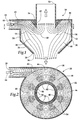
- FIG. 1 is an is an illustrative, side elevational view of the hydrocyclone of this invention.
- FIG. 2 is a cross-sectional plan view of the hydrocyclone of FIG. 1 taken along section line 2-2.
- FIG. 3 is a side elevational schematic view of an alternative embodiment of the hydrocyclone of this invention.
- FIG. 4 is a side elevational schematic view of a further embodiment of the hydrocyclone of this invention.
- FIG. 5 is a side elevational schematic view of yet another embodiment of the hydrocyclone of this invention.
- FIG. 6 is a side elevational schematic view of a further embodiment of the hydrocyclone of this invention.
- a hydrocyclone 20 is shown in FIG. 1.
- the hydrocyclone 20 has a substantially cylindrical body 22 formed of a cylindrical section 24 and a conical section 26.
- a fluid inlet 28 injects stock containing fiber tangentially into the chamber 30 defined by the cylindrical body 22.
- the chamber 30 has an outlet 32 at the top 34 and an outlet 36 at the bottom 38.
- the outlet openings 32, 36 are aligned with an axis defined by the cylindrical body 22.
- a pipe 40 extends from the top outlet opening 32 into the chamber 30.
- Streamlines 42 show how water, indicated by arrow 44, which enters the hydrocyclone 20 is split into two flows.
- One set of streamlines 46 flows out the bottom outlet opening 36, and one set of streamlines 48 flows to the top outlet 32.
- the rotation of the water injected into the hydrocyclone 20 creates a hydrodynamic flow field where the water is said to be in a quasi-laminar flow.
- a piezoelectric transducer 50 made up of individual crystals 52, as shown in FIG. 2, is positioned around the bottom outlet 32. When energized, the crystals 52 produce ultrasonic energy 54 which creates a streaming effect which pushes fibers contained in the water adjacent to the transducer 50 away from the source of ultrasonic energy.
- the fibers are moved across the streamlines 48 and thus out of the flow which leaves the top 34 of the hydrocyclone 20.
- the flow of the liquid should be predictable or laminar.
- Laminar flow is said to exist when the Reynolds number is within a certain range. Reynolds number is a non-dimensional number which is dependent on fluid viscosity, velocity, pipe diameter, and density.
- Laminar flow is characterized as a flow where turbulence is absent and wherein a theoretical particle traveling with the fluid will travel along a uniform predictable path.
- Laminar flow may be contrasted with turbulent flow which is covered by chaos theory, and in which a theoretical particle travels an unpredictable path.
- laminar flow means that mixing within the fluid is not taking place.
- laminar flow occurs at very low flow velocities. In a hydrocyclone the centrifugal energy which the rotating flow imparts to the fluid results in a flow having many of the characteristics of laminar flow.
- the hydrocyclone 20 of this invention by utilizing quasi-laminar flow within the hydrocyclone 20 to achieve high volume separation with improved differentiation.
- the hydrocyclone 20 has a diameter of approximately thirty-six inches with an upper outlet of about twelve inches in diameter.
- the ultrasonic streaming effect has a range of action which is about ten to fifty cm. This action range would be effective in a hydrocyclone with the above described dimensions to push fibers across streamlines so they will pass out the outlet 36 at the bottom of the hydrocyclone.
- Ultrasonic energy may be employed in hydrocyclones designed for cleaning a flow of pulp stock by separating out heavyweight or lightweight components of the flow.
- An alternative embodiment hydrocyclone 56 has a conical chamber 58 with a tangential inlet 60, a bottom outlet 62 for accept fibers, and an outlet 64 at the top for lightweight reject particles and fiber fragments.
- a conical screen 66 is placed ahead of the outlet 64 to prevent desirable fibers from leaving through the reject outlet 64. Typically the screen would be expected to rapidly become clogged with fibers. However, by vibrating the screen 66 at ultrasonic frequencies, fibers are pushed away from the screen's surface 68 to thereby prevent clogging of the screen.
- the screen itself may be a piezoelectric crystal which is caused to vibrate, or the screen may be connected to a source which generates ultrasonic energy. The energy could also be supplied internal to the screen 66 through the outlet 64.
- a through flow cleaner 70 of this invention has an inverted conical chamber 72 in which the bottom 74 outlet opens into a second cylindrical chamber 76.
- An inlet 78 injects stock into the top 80 of the inverted conical chamber 72 tangentially to the cylindrical wall 82 of the inverted conical chamber 72.
- a centrally located vortex finder 84 acts as a source of ultrasonic energy or waves which push the fibers contain in the injected stock towards the wall 82 of the inverted conical chamber 72 and away from the vortex finder 84. This improves the separation of fibers from small lightweight contaminants.
- a vortex finder tube 86 collects the central lightweight material and a second outlet 88 collects the heavyweight component from the second chamber 76.
- FIG. 5 Another alternative embodiment of cleaner 90 of this invention is shown in FIG. 5.
- the cleaner 90 has a conical chamber 92 with a tangential inlet 94 at the top 96.
- An upper outlet 98 draws lightweight rejects up from the center vortex.
- the cleaner 90 is similar to the cleaner 70 shown in FIG. 4 in having a second chamber 100 into which the conical chamber 92 empties through an outlet 102 at the bottom of the chamber 92. Again a vortex finder 104 removes. through an outlet 105, the lightweight component of the flow introduced into the cleaner 90.
- a heavyweight fraction is collected through a second outlet 106 from the second chamber 100.
- a piezoelectric ultrasonic transducer 108 is positioned at the top 110 of the of the chamber 92 surrounding the upper outlet 98. Ultrasonic energy emanating from the transducer 108 pushes fibers away from the center of the cleaner 90, increasing separation efficiency for the materials drawn from the upper outlet 98 and through the vortex finder outlet 104.
- a cleaner 112 is shown in FIG. 6 .
- This cleaner 112 again has an inverted conical chamber 114 with a tangential inlet 118 at the top 116.
- the conical chamber 112 has an axis defined between an upper outlet 120 and a bottom outlet 122.
- This type of cleaner is used to remove sand and dirt from papermaking stock. It is common for fiber to become mixed with the heavyweight contaminants near the bottom outlet 122 and result in a heavyweight reject stream that contains significant amounts of useful fiber.
- An acoustic field generator 124 which may be an ultrasonic piezoelectric transducer 126, is mounted near the outlet 122.
- the transducer 126 will separate the useful fiber from the heavyweight contaminants through a jigging action similar to the way minerals are separated based on density: the greater inertia of the heavyweight contaminants will tend to drive them through the fibers towards the wall 128 of the chamber 114.
- the overall result is that the heavyweight rejects contain less useful fiber, thus reducing or eliminating the need to further process the heavyweight rejects to recover useful fiber rejected with the heavyweight rejects.
- a crystal which responds to high frequency electromagnetic waves by vibrating at the frequency of the imposed electronic signal is referred to as a piezoelectric transducer.
- Other means of generating high frequency sound include ultrasonic whistles and sirens.
- ultrasonic energy generally refers to sound frequencies above 20,000 Hertz, in some instances sound in the audible frequency range would be effective at moving fibers and particularly for separating fibers and heavyweight contaminants as shown in FIG. 6.
- a substantially cylindrical chamber is defined to include chambers having tapered walls forming a cone, biconic chambers, and chambers having parabolic and hyperbolic walls or wall segments.
- the flow may be introduced through an inlet which is tangent to the wall of the chamber making up the hydrocyclone but the flow could also be introduced through an inlet where secondary structure such as a spiral or twin spiral baffle causes the water to rotate about the vertical axis of the separation chamber.
Landscapes
- Engineering & Computer Science (AREA)
- Mechanical Engineering (AREA)
- Cyclones (AREA)
- Paper (AREA)
- Physical Or Chemical Processes And Apparatus (AREA)
- Artificial Filaments (AREA)
- Chemical Or Physical Treatment Of Fibers (AREA)
Applications Claiming Priority (2)
| Application Number | Priority Date | Filing Date | Title |
|---|---|---|---|
| US09/016,119 US6036027A (en) | 1998-01-30 | 1998-01-30 | Vibratory cleaner |
| US16119 | 1998-01-30 |
Publications (2)
| Publication Number | Publication Date |
|---|---|
| EP0933469A2 true EP0933469A2 (de) | 1999-08-04 |
| EP0933469A3 EP0933469A3 (de) | 2000-04-26 |
Family
ID=21775505
Family Applications (1)
| Application Number | Title | Priority Date | Filing Date |
|---|---|---|---|
| EP99630011A Withdrawn EP0933469A3 (de) | 1998-01-30 | 1999-01-22 | Vibrationsreinigungsvorrichtung |
Country Status (4)
| Country | Link |
|---|---|
| US (1) | US6036027A (de) |
| EP (1) | EP0933469A3 (de) |
| JP (1) | JP2997934B2 (de) |
| CA (1) | CA2260550A1 (de) |
Cited By (2)
| Publication number | Priority date | Publication date | Assignee | Title |
|---|---|---|---|---|
| WO2014048419A1 (de) * | 2012-09-26 | 2014-04-03 | Buettner Klaus | Kreissymmetrisch aufgebauter hydrozyklon mit als ultraschallsonotrode ausgebildetem führungselement |
| WO2019211523A1 (en) * | 2018-05-02 | 2019-11-07 | Valmet Automation Oy | Apparatus and method for sorting particles in flowing suspension |
Families Citing this family (15)
| Publication number | Priority date | Publication date | Assignee | Title |
|---|---|---|---|---|
| US8173431B1 (en) | 1998-11-13 | 2012-05-08 | Flir Systems, Inc. | Mail screening to detect mail contaminated with biological harmful substances |
| CA2304266A1 (en) * | 1999-04-02 | 2000-10-02 | Norman L. Arrison | Apparatus and process for separating fluids and particles |
| IL129564A (en) * | 1999-04-23 | 2004-06-20 | Atlantium Lasers Ltd | A method for disinfecting and purifying liquids and gases and a device for its use |
| US6416675B1 (en) * | 2000-09-19 | 2002-07-09 | Mccasland Edwin D. | Separating materials having different specific gravities |
| WO2009023314A2 (en) * | 2007-05-09 | 2009-02-19 | Icx Technologies | Mail parcel screening using multiple detection technologies |
| JP2010188283A (ja) * | 2009-02-18 | 2010-09-02 | Kawata Mfg Co Ltd | サイクロン装置および微粉除去方法 |
| US8243274B2 (en) * | 2009-03-09 | 2012-08-14 | Flir Systems, Inc. | Portable diesel particulate monitor |
| WO2010115142A2 (en) * | 2009-04-03 | 2010-10-07 | Mesosystems Technology Inc. | Method and apparatus for capturing viable biological particles over an extended period of time |
| WO2012148648A2 (en) | 2011-04-27 | 2012-11-01 | Becton Dickinson & Co. | Devices and methods for separating magnetically labeled moieties in a sample |
| CN104736718A (zh) | 2012-10-26 | 2015-06-24 | 贝克顿·迪金森公司 | 用于操纵流体样品中的组分的装置和方法 |
| KR20160024624A (ko) * | 2014-08-26 | 2016-03-07 | 제이에스이엔지(주) | 원심분리장치 |
| EP3302810A4 (de) * | 2015-06-01 | 2018-12-19 | Cetamax Ventures Ltd. | Systeme und verfahren zur verarbeitung von flüssigkeiten |
| US10905998B2 (en) * | 2017-07-20 | 2021-02-02 | Brett Evan Patrick | Process and apparatus to remove carbon-14 from carbon-dioxide in atmospheric gases and agricultural products grown in controlled environments |
| CN112316500B (zh) * | 2020-09-30 | 2022-03-01 | 中国石油天然气股份有限公司 | 一种超声波旋流分离装置 |
| DE102021004050A1 (de) * | 2021-08-05 | 2023-02-09 | Messer Se & Co. Kgaa | Vorrichtung und Verfahren zum Trennen von Fluidgemischen |
Family Cites Families (28)
| Publication number | Priority date | Publication date | Assignee | Title |
|---|---|---|---|---|
| BE420877A (de) * | 1936-03-11 | |||
| US2787374A (en) * | 1951-09-20 | 1957-04-02 | Centriclone Corp | Centrifugal classifier |
| US2809567A (en) * | 1953-09-16 | 1957-10-15 | Bauer Bros Co | Apparatus for separating solids from a liquid suspension |
| AT244996B (de) * | 1963-08-26 | 1966-02-10 | Voith Gmbh J M | Wirbelabscheider |
| US3558484A (en) * | 1969-12-11 | 1971-01-26 | Wayne F Carr | Separating apparatus |
| SU490503A1 (ru) * | 1973-03-27 | 1975-11-05 | Предприятие П/Я В-2262 | Акустическа центрифуга |
| US3893914A (en) * | 1973-04-05 | 1975-07-08 | Roy A Bobo | Cyclone centrifuge apparatus |
| FI54436C (fi) * | 1976-05-14 | 1978-12-11 | Enso Gutzeit Oy | Hydrocyklon |
| FI58954C (fi) * | 1979-08-20 | 1981-05-11 | Enso Gutzeit Oy | Hydrocyklon |
| US4378289A (en) * | 1981-01-07 | 1983-03-29 | Hunter A Bruce | Method and apparatus for centrifugal separation |
| CA1212648A (en) * | 1981-02-14 | 1986-10-14 | John D. Peel | Cyclone separator with down going axial discharge for light components |
| US4842145A (en) * | 1981-06-22 | 1989-06-27 | B.W.N. Vortoil Rights Co. Pty. Ltd. | Arrangement of multiple fluid cyclones |
| US4414112A (en) * | 1982-01-29 | 1983-11-08 | Recovery Technology Associates | Oil/water separator |
| SE435581B (sv) * | 1982-08-16 | 1984-10-08 | Celleco Ab | Forfarande for uppdelning av en blandning av en relativt tyngre fibersuspension (accept) och letta fororeningar (reject) |
| SE435582B (sv) * | 1982-09-02 | 1984-10-08 | Karl Arvid Skardal | Virvelrenare for separering av fiber-vetskesuspensioner, i synnerhet av pappersmassa, i en langstreckt cirkuler virvelkammare |
| GB8604462D0 (en) * | 1986-02-22 | 1986-03-26 | Elp Products Ltd | Hydrocyclone |
| GB8612759D0 (en) * | 1986-05-27 | 1986-07-02 | Unilever Plc | Manipulating particulate matter |
| JPS6320051A (ja) * | 1986-07-11 | 1988-01-27 | Mitsubishi Heavy Ind Ltd | 懸濁液から粗粒を選択的に回収する方法 |
| FI77066C (fi) * | 1987-09-01 | 1989-01-10 | Ahlstroem Oy | Foerfarande och anordning foer rening av massasuspension. |
| US4786412A (en) * | 1987-11-23 | 1988-11-22 | Eagle-Picher Industries, Inc. | Hydrocyclone having dewatering tube |
| US5024755A (en) * | 1989-11-22 | 1991-06-18 | Bird Escher Wyss | Cone wear detection |
| CA2053651C (en) * | 1991-10-17 | 1999-01-12 | Pentti Vikioe | Hydrocyclone |
| SE469511B (sv) * | 1991-12-02 | 1993-07-19 | Celleco Hedemora Ab | Hydrocyklon med turbulensskapande organ |
| US5240115A (en) * | 1992-11-10 | 1993-08-31 | Beloit Technologies, Inc. | Field adjustable hydrocyclone |
| FI943809A7 (fi) * | 1994-08-19 | 1996-02-20 | Outokumpu Mintec Oy | Suodatinväliaine |
| JPH08141443A (ja) * | 1994-11-21 | 1996-06-04 | Satomi Seisakusho:Kk | 渦流式除塵機及び渦流式除塵機の異物除去方法 |
| US5566835A (en) * | 1995-10-05 | 1996-10-22 | Beloit Technologies, Inc. | Cleaner with inverted hydrocyclone |
| US5882530A (en) * | 1997-04-30 | 1999-03-16 | The University Of Akron | Crossflow filter cyclone apparatus |
-
1998
- 1998-01-30 US US09/016,119 patent/US6036027A/en not_active Expired - Fee Related
-
1999
- 1999-01-22 EP EP99630011A patent/EP0933469A3/de not_active Withdrawn
- 1999-01-28 CA CA002260550A patent/CA2260550A1/en not_active Abandoned
- 1999-01-29 JP JP11020856A patent/JP2997934B2/ja not_active Expired - Lifetime
Cited By (2)
| Publication number | Priority date | Publication date | Assignee | Title |
|---|---|---|---|---|
| WO2014048419A1 (de) * | 2012-09-26 | 2014-04-03 | Buettner Klaus | Kreissymmetrisch aufgebauter hydrozyklon mit als ultraschallsonotrode ausgebildetem führungselement |
| WO2019211523A1 (en) * | 2018-05-02 | 2019-11-07 | Valmet Automation Oy | Apparatus and method for sorting particles in flowing suspension |
Also Published As
| Publication number | Publication date |
|---|---|
| EP0933469A3 (de) | 2000-04-26 |
| US6036027A (en) | 2000-03-14 |
| JP2997934B2 (ja) | 2000-01-11 |
| JPH11262691A (ja) | 1999-09-28 |
| CA2260550A1 (en) | 1999-07-30 |
Similar Documents
| Publication | Publication Date | Title |
|---|---|---|
| US6036027A (en) | Vibratory cleaner | |
| US3399770A (en) | Method for centrifugal separation of particles from a mixture | |
| US4971685A (en) | Bubble injected hydrocyclone flotation cell | |
| US20140102977A1 (en) | Ballasted anaerobic method for treating wastewater | |
| US6284096B1 (en) | Process for discharging impurities from a hydrocyclone and a hydrocyclone | |
| US3533506A (en) | Hydrocyclone | |
| RU2019295C1 (ru) | Сепаратор для минералов | |
| US6227374B1 (en) | Process and floatation device for the removal of interfering materials from an aqueous fiber pulp suspension | |
| US6706180B2 (en) | System for vibration in a centrifuge | |
| FI60981B (fi) | Foerfarande och anordning foer uppdelning av en flytande suspension av fasta partiklar i fraktioner med olika genomsnittliga egenskaper | |
| JPH04300381A (ja) | 繊維とノットの流体で運ばれるスラリーからノットを取除くためのふるい装置 | |
| FI58448B (fi) | Foerfarande och anordning foer renande av en stroem av mekaniskt finfoerdelat material | |
| RU2200629C1 (ru) | Грохот-дезинтегратор с интенсификацией кавитации комбинированным воздействием ультразвука | |
| RU2061812C1 (ru) | Устройство для сортирования волокнистой массы | |
| RU2329868C1 (ru) | Виброконцентратор | |
| US3489286A (en) | Hydrocyclone separator with particle trap | |
| SU1292843A1 (ru) | Устройство дл очистки электролита от шлама | |
| JPH04500392A (ja) | 繊維懸濁液を軽い汚染物質から浄化するための方法及び配列 | |
| CN115991555B (zh) | 一种具有分离颗粒以及清理滤芯功能的分离器 | |
| SU1093357A1 (ru) | Флотационна машина | |
| EP0427555A1 (de) | Blasenentfernung | |
| KR101425000B1 (ko) | 고농도농축액 이물질 분리장치 | |
| JPH04141251A (ja) | 遠心分離装置 | |
| EA014356B1 (ru) | Способ и устройство для обогащения материалов, находящихся в виде твердых частиц | |
| SU971469A1 (ru) | Гидроциклон |
Legal Events
| Date | Code | Title | Description |
|---|---|---|---|
| PUAI | Public reference made under article 153(3) epc to a published international application that has entered the european phase |
Free format text: ORIGINAL CODE: 0009012 |
|
| AK | Designated contracting states |
Kind code of ref document: A2 Designated state(s): AT DE ES FI SE |
|
| AX | Request for extension of the european patent |
Free format text: AL;LT;LV;MK;RO;SI |
|
| PUAL | Search report despatched |
Free format text: ORIGINAL CODE: 0009013 |
|
| AK | Designated contracting states |
Kind code of ref document: A3 Designated state(s): AT BE CH CY DE DK ES FI FR GB GR IE IT LI LU MC NL PT SE |
|
| AX | Request for extension of the european patent |
Free format text: AL;LT;LV;MK;RO;SI |
|
| AKX | Designation fees paid |
Free format text: AT DE ES FI SE |
|
| STAA | Information on the status of an ep patent application or granted ep patent |
Free format text: STATUS: THE APPLICATION IS DEEMED TO BE WITHDRAWN |
|
| 18D | Application deemed to be withdrawn |
Effective date: 20001027 |