EP0928311B1 - Formgegenstand mit reaktiven funktionen - Google Patents
Formgegenstand mit reaktiven funktionen Download PDFInfo
- Publication number
- EP0928311B1 EP0928311B1 EP97943867A EP97943867A EP0928311B1 EP 0928311 B1 EP0928311 B1 EP 0928311B1 EP 97943867 A EP97943867 A EP 97943867A EP 97943867 A EP97943867 A EP 97943867A EP 0928311 B1 EP0928311 B1 EP 0928311B1
- Authority
- EP
- European Patent Office
- Prior art keywords
- shaped article
- manufactured
- shaped
- article according
- polymeric material
- Prior art date
- Legal status (The legal status is an assumption and is not a legal conclusion. Google has not performed a legal analysis and makes no representation as to the accuracy of the status listed.)
- Expired - Lifetime
Links
Classifications
-
- C—CHEMISTRY; METALLURGY
- C08—ORGANIC MACROMOLECULAR COMPOUNDS; THEIR PREPARATION OR CHEMICAL WORKING-UP; COMPOSITIONS BASED THEREON
- C08J—WORKING-UP; GENERAL PROCESSES OF COMPOUNDING; AFTER-TREATMENT NOT COVERED BY SUBCLASSES C08B, C08C, C08F, C08G or C08H
- C08J7/00—Chemical treatment or coating of shaped articles made of macromolecular substances
- C08J7/12—Chemical modification
-
- C—CHEMISTRY; METALLURGY
- C08—ORGANIC MACROMOLECULAR COMPOUNDS; THEIR PREPARATION OR CHEMICAL WORKING-UP; COMPOSITIONS BASED THEREON
- C08B—POLYSACCHARIDES; DERIVATIVES THEREOF
- C08B15/00—Preparation of other cellulose derivatives or modified cellulose, e.g. complexes
- C08B15/05—Derivatives containing elements other than carbon, hydrogen, oxygen, halogens or sulfur
- C08B15/06—Derivatives containing elements other than carbon, hydrogen, oxygen, halogens or sulfur containing nitrogen, e.g. carbamates
-
- G—PHYSICS
- G01—MEASURING; TESTING
- G01N—INVESTIGATING OR ANALYSING MATERIALS BY DETERMINING THEIR CHEMICAL OR PHYSICAL PROPERTIES
- G01N33/00—Investigating or analysing materials by specific methods not covered by groups G01N1/00 - G01N31/00
- G01N33/48—Biological material, e.g. blood, urine; Haemocytometers
- G01N33/50—Chemical analysis of biological material, e.g. blood, urine; Testing involving biospecific ligand binding methods; Immunological testing
- G01N33/53—Immunoassay; Biospecific binding assay; Materials therefor
- G01N33/543—Immunoassay; Biospecific binding assay; Materials therefor with an insoluble carrier for immobilising immunochemicals
- G01N33/54353—Immunoassay; Biospecific binding assay; Materials therefor with an insoluble carrier for immobilising immunochemicals with ligand attached to the carrier via a chemical coupling agent
-
- B—PERFORMING OPERATIONS; TRANSPORTING
- B01—PHYSICAL OR CHEMICAL PROCESSES OR APPARATUS IN GENERAL
- B01J—CHEMICAL OR PHYSICAL PROCESSES, e.g. CATALYSIS OR COLLOID CHEMISTRY; THEIR RELEVANT APPARATUS
- B01J2219/00—Chemical, physical or physico-chemical processes in general; Their relevant apparatus
- B01J2219/00274—Sequential or parallel reactions; Apparatus and devices for combinatorial chemistry or for making arrays; Chemical library technology
- B01J2219/00277—Apparatus
- B01J2219/00497—Features relating to the solid phase supports
Definitions
- the present invention relates to a molded article, the Surface for chemical, biochemical or biological Applications are provided with reactive functions.
- polysaccharides e.g. cellulose, starch or chitin
- organic synthetic polymers such as plastics
- plastics e.g. polyethylene, polypropylene, polytetrafluoroethylene or polystyrene
- Their surface properties such as charge, chemical functionality or hydrophobicity have been used for synthesis, separation and detection reactions for many decades, for example in the following areas: chemical solid-phase synthesis; hydrophobic chromatography, ion exchange chromatography or affinity chromatography or affinity enrichment.
- these materials are used in bulk in reaction vessels such as columns or cartridges.
- special reactive functions on the surface are advantageously used for this purpose, as exemplified by the following schematic representation.
- shaped objects such as flat material, for example Paper made from specially derivatized cellulose, for example carboxymethyl, diethylaminoethyl, phospho-, Alkyl or aryl cellulose of great importance.
- the manufacturing processes for starting materials of the shaped objects mentioned however require highly toxic reagents such as cyanogen bromide, Epichlorohydrin or acrylonitrile, and / or quite drastic alkaline Reaction conditions so that the ones made from it Cellulose papers have a much lower mechanical and chemical Have stability.
- paper is preferably used as paper pulp Surface treatment agents in a one-step reaction implemented to increase the paper quality.
- molded articles are made from, among others regenerated cellulose in a one-step reaction modified. Shaped articles made from non-regenerated cellulose or from paper are not addressed.
- the object of the present invention is now to create new materials to provide for the life sciences or new shaped objects, whose surface for chemical, biochemical or biological applications with reactive functions are, these materials in particular by special gentle procedures should be provided. This is supposed to the mechanical and chemical properties of the molded articles not be changed or not significantly.
- the fields of application for a molded article according to the invention lie in immunology, biochemistry, molecular biology, clinical diagnostics or bio-process engineering.
- examples for Possible uses are ion exchange chromatography, Affinity chromatography or affinity enrichment, hydrophobic Chromatography, blotting, dot blotting and chemical Solid phase synthesis.
- the molded article according to the invention can thereby be produced be made from a molded cellulosic polymer material, especially paper-based, or from a molded one Polymer-based polymer material, especially based on hydroxylated polyolefin.
- the shaped articles according to the invention due to very mild reaction conditions, the use less toxic materials and solvents as well as simple technical implementation can be produced. Is particularly important here that the underivatized cellulose starting material in its chemical and mechanical properties are only insignificant is changed.
- the chemical anchoring has an excellent pH stability, approximately in the range of 2-12 Room temperature.
- the carbonylation and / or reaction according to process step 1 (b) in dimethylformamide (DMF) perform, especially at room temperature and / or without Buffer addition and / or without adding another base in addition Dimethylformamide (DMF).
- the carbonylation can be carried out in pyridine.
- the molded article according to the invention can thereby be produced be made from a molded cellulosic polymer material, especially paper-based, or from a molded one Polymer-based polymer material, especially based on hydroxylated polyolefin.
- a shaped object cellulose-based can refer to the above to get expelled.
- the molded article of the second embodiment according to the invention can be prepared by 4-nitrophenyl isocyanate in step (a) or 4-nitrophenyl isothiocyanate used.
- step (b) It can also be produced by the step (b) blocked with acetic anhydride.
- step (c) can also be produced by the step (c) reduced with samarium II iodide.
- the molded article is made of molded Polymer material obtainable by implementing the Measure (a) and / or (b) and / or (c) in dimethylformamide (DMF) carries out, in particular at room temperature and / or without Buffer addition and / or without the addition of another base in addition Dimethylformamide (DMF).
- DMF dimethylformamide
- Molded articles according to the invention can thereby be produced be that of a molded polymer material from the through Membranes, foils, miniaturized reaction vessels, Pipette tips and microtiter plates are formed group.
- the reaction solution of the activation step is by filtration or decanted and the activated molded article removed three times with half the volume of the solvent the reaction solution rinsed for 5 to 10 min each.
- the Wash phases are discarded.
- 3 ml / l g polymer of a 0.3 molar Solution of ethylenediamine or 1,6-bis (methylamino) hexane or O, O'-bis (2-aminopropyl) polyethylene glycol in DMF or Pyridine are added and at room temperature below Exclusion of moisture for 6 to 16 h again.
- the reaction solution is then by filtration or decanting removed and the modified molded article three times with the Half the volume of the solvent in the reaction solution for rinsed for 5 to 10 min each. Then this washing procedure with distilled water, ethanol, acetone, ethyl acetate and repeated diethyl ether. After removing the residual ether the molded article is dried in a high vacuum.
- the molded article here: cellulose sheets
- the molded article which is dried / freeze-dried in a high vacuum, is sealed in a container which is easy to close and is adapted to the molded article, with 3 ml of a 0.1 molar solution of isocyanate per 1 g of polymer (here: cellulose) and at 60 ° C. (with exclusion of moisture ) heated in a drying cabinet for 12 h.
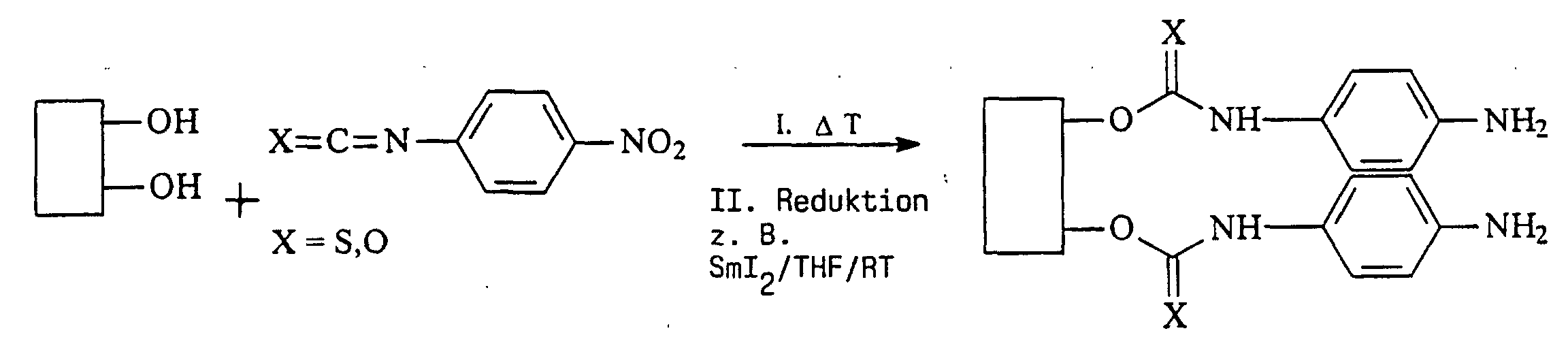
- Example 7 Addition of 4-nitrophenyl isocyanate (C 7 H 4 N 2 O 3 ) [164.12]
- Example 8 Addition of 4-phenyl isothiocyanate (C 7 H 4 N 2 O 2 S) [180.19]
- the vessel is swiveled several times.
- reaction solution of the activation step is removed by filtration or decanting, and the activated molded article is pivoted for 5 to 10 min each with 3 ml of solvent per g of dry weight of the polymer used.
- the washing phases are discarded after decanting or filtering off.
- the solvents are used in the following order: Dimethylformamide (pA), water (bidist.) Ethanol (zS), Acetone (zS), ethyl acetate (zS), dichloromethane (pA). After evaporation of the organic solvent, the activated Molded article dried in a high vacuum at room temperature.
- the pre-dried activated molded article is in 3 ml DMF / pyridine (2: 1, volume / volume) per g dry weight presented and then mixed with 0.5 ml of acetic anhydride. After 6 hours at room temperature and moderate swiveling, the Response canceled. The reaction solution is decanted off or filtered off and the washing procedure repeated as in stage I.
- the pre-dried activated molded article is in 10 ml DMF (abs) submitted per g dry weight and with 2 ml of a 0.1 molar Solution samarium-II-iodide in THF (abs) per g dry weight added.
- the reaction vessel is swung in Exclusion of moisture for 10 to 16 h at room temperature.
- the molded article becomes with 5 ml DMF / g dry weight for 15 min and then swirled twice with 10 ml water (bidist.) for approx. 2 to 3 h. Thereupon the washing procedures according to level 1 repeated.
Landscapes
- Chemical & Material Sciences (AREA)
- Health & Medical Sciences (AREA)
- Life Sciences & Earth Sciences (AREA)
- Immunology (AREA)
- Engineering & Computer Science (AREA)
- Medicinal Chemistry (AREA)
- Chemical Kinetics & Catalysis (AREA)
- Organic Chemistry (AREA)
- Polymers & Plastics (AREA)
- Molecular Biology (AREA)
- Biomedical Technology (AREA)
- Biochemistry (AREA)
- Urology & Nephrology (AREA)
- Hematology (AREA)
- General Chemical & Material Sciences (AREA)
- Microbiology (AREA)
- General Physics & Mathematics (AREA)
- Food Science & Technology (AREA)
- Physics & Mathematics (AREA)
- Analytical Chemistry (AREA)
- Biotechnology (AREA)
- General Health & Medical Sciences (AREA)
- Cell Biology (AREA)
- Pathology (AREA)
- Materials Engineering (AREA)
- Polyurethanes Or Polyureas (AREA)
- Polysaccharides And Polysaccharide Derivatives (AREA)
- Treatments Of Macromolecular Shaped Articles (AREA)
- Addition Polymer Or Copolymer, Post-Treatments, Or Chemical Modifications (AREA)
- Manufacture Of Macromolecular Shaped Articles (AREA)
- Solid-Sorbent Or Filter-Aiding Compositions (AREA)
Description


Beispiel 1: CDI = 1,1'-Carbonyldiimidazol
Beispiel 2: CDT = 1,1'-Carbonyldi-1,2,4-triazol
Beispiel 3: CDB = 1,1'-Carbonyldi-1,2,3-benzotriazol
Beispiel 4: PCT = Phenoxycarbonyltetrazol
Beispiel 5: CAP = Chlorameisensäurephenylester
Beispiel 6: CANP = Chlorameisensäure-4-nitrophenylester
pH 0, 7, 8, 9, 10, 11, 12, 13 und 14 (entsprechend verdünnte NaOH) 24 h/Raumtemperatur;
Konzentrierter wässriger Ammoniak (25 %), 24 h/Raumtemperatur; Trifluoressigsäure (99 %), 24 h/Raumtemperatur;
In allen Fällen konnten die anfänglichen Modifizierungsgrade verifiziert werden.
Beispiel 7: Addition von 4-Nitrophenyl-isocyanat (C7H4N2O3)[164.12]
Beispiel 8: Addition von 4-Phenyl-isothiocyanat (C7H4N2O2S)[180.19]
Das Gefäß wird jeweils mehrmals geschwenkt. Die Reaktionslösung des Aktivierungsschrittes wird durch Filtration oder Abdekantieren entfernt und der aktivierte Formgegenstand mit jeweils 3 ml Lösungsmitteln pro g Trockengewicht des eingesetzten Polymers für jeweils 5 bis 10 min geschwenkt. Die Waschphasen werden nach dem Abdekantiercn oder Abfiltrieren verworfen.
Claims (12)
- Formgegenstand, dessen Oberfläche für chemische, biochemische oder biologische Anwendungen mit reaktiven Funktionen versehen ist, dadurch herstellbar, daß man(a) von einem geformten Polymermaterial auf Papierbasis als Formgegenstand ausgeht, dessen Oberfläche mit Hydroxylgruppen versehen ist, und den Formgegenstand in an sich bekannter Weise mit einem Carbonylierungsreagenz umsetzt und(b) den carbonylierten Formgegenstand mit einer Verbindung der Formel R3-NH-R4, worin R3 den Rest eines an sich bekannten primären Amins und R4 ein H-Atom oder R3 und R4, die gleich oder verschieden sein können, Reste eines an sich bekannten sekundären Amins darstellen, zu einem Urethan-Derivat umsetzt.
- Formgegenstand nach Anspruch 1, dadurch herstellbar, daß man ein Carbonylierungsreagenz (i) aus der durch 1,1'-Carbonyldiimidazol (CDI), 1,1-Carbonyldi-1.2.4-triazol (CDT), 1,1'-Carbonyldi-1.2.3-benzotriazol (CDB) und/oder Phenoxycarbonyltetrazol (PCT) gebildeten Gruppe und/oder (ii) aus der durch Chlorameisensäurephenylester (CAP) und/oder Chlorameisensäure-4-nitrophenylester (CANP) gebildeten Gruppe verwendet.
- Formgegenstand nach Anspruch 2 (i), dadurch herstellbar, daß man die Carbonylierung und/oder Umsetzung gemäß Anspruch 1(b) in Dimethylformamid (DMF) durchführt, insbesondere bei Raumtemperatur und/oder ohne Pufferzusatz und/oder ohne Zusatz einer weiteren Base neben Dimethylformamid (DMF).
- Formgegenstand nach Anspruch 2 (ii), dadurch herstellbar, daß man die Carbonylierung in Pyridin durchführt.
- Formgegenstand, dessen Oberfläche für chemische, biochemische oder biologische Anwendungen mit reaktiven Funktionen versehen ist, dadurch herstellbar, daß man(a) von einem geformten Polymermaterial als Formgegenstand ausgeht, dessen Oberfläche mit Hydroxylgruppen versehen ist, und den Formgegenstand mit einem Isocyanat und/oder Isothiocyanat umsetzt und Nitrogruppen oder geschützte Aminogruppen einführt und(b) gegebenenfalls die unumgesetzten Hydroxylgruppen des aktivierten Formgegenstandes blockiert,(c) gegebenenfalls, sofern bei Stufe (a) durch das Isocyanat und/oder Isothiocyanat Nitrogruppen eingeführt worden sind, diese Nitrogruppen zu Aminogruppen reduziert und(d) gegebenenfalls, sofern bei Stufe (a) durch das Isocyanat und/oder Isothiocyanat geschützte Aminogruppen eingeführt worden sind, diese geschützten Aminogruppen zu freien Aminogruppen, entschützt.
- Formgegenstand nach Anspruch 5, dadurch herstellbar, daß man von einem geformten Polymermaterial auf Zellulosebasis ausgeht, insbesondere auf Papierbasis.
- Formgegenstand nach Anspruch 5, dadurch gekennzeichnet, daß man von einem geformten Polymermaterial auf Kunststoffbasis ausgeht, insbesondere auf Basis von hydroxyliertem Polyolefin.
- Formgegenstand nach Anspruch 5, 6 oder 7, dadurch herstellbar, daß man bei Stufe (a) 4-Nitrophenyl-isocyanat oder 4-Nitrophenyl-iso-thiocyanat verwendet.
- Formgegenstand nach einem der Ansprüche 5 bis 8, dadurch herstellbar, daß man bei Stufe (b) mit Essigsäureanhydrid blokkiert.
- Formgegenstand nach einem der Ansprüche 5 bis 9, dadurch herstellbar, daß man bei Stufe (c) mit Samarium-II-iodid reduziert.
- Formgegenstand nach einem der Ansprüche 5 bis 10, dadurch herstellbar, daß man die Umsetzung gemäß Anspruch 5(a) und/oder 5(b) und/oder 5(c) in Dimethylformamid (DMF) durchführt, insbesondere bei Raumtemperatur und/oder ohne Pufferzusatz und/oder ohne Zusatz einer weiteren Base neben Dimethylformamid (DMF).
- Formgegenstand nach einem der vorhergehenden Ansprüche, dadurch herstellbar, daß man von einem geformten Polymermaterial aus der durch Membranen, Folien, miniaturisierte Reaktionsgefäße, Pipettenspitzen und Mikrotiterplatten gebildeten Gruppe ausgeht.
Applications Claiming Priority (3)
| Application Number | Priority Date | Filing Date | Title |
|---|---|---|---|
| DE19638085 | 1996-09-18 | ||
| DE19638085 | 1996-09-18 | ||
| PCT/EP1997/005123 WO1998012246A1 (de) | 1996-09-18 | 1997-09-18 | Formgegenstand mit reaktiven funktionen |
Publications (2)
| Publication Number | Publication Date |
|---|---|
| EP0928311A1 EP0928311A1 (de) | 1999-07-14 |
| EP0928311B1 true EP0928311B1 (de) | 2003-04-09 |
Family
ID=7806036
Family Applications (1)
| Application Number | Title | Priority Date | Filing Date |
|---|---|---|---|
| EP97943867A Expired - Lifetime EP0928311B1 (de) | 1996-09-18 | 1997-09-18 | Formgegenstand mit reaktiven funktionen |
Country Status (8)
| Country | Link |
|---|---|
| EP (1) | EP0928311B1 (de) |
| JP (1) | JP2001504869A (de) |
| KR (1) | KR20000036217A (de) |
| AU (1) | AU730793B2 (de) |
| CA (1) | CA2265689A1 (de) |
| DE (1) | DE59709797D1 (de) |
| NO (1) | NO991296L (de) |
| WO (1) | WO1998012246A1 (de) |
Families Citing this family (2)
| Publication number | Priority date | Publication date | Assignee | Title |
|---|---|---|---|---|
| EP3569621A4 (de) * | 2017-01-16 | 2020-09-23 | KRI, Inc. | Durch schwefelsäureveresterung modifizierte cellulosenanofasern und verfahren zur herstellung von cellulosenanofasern |
| JP2020019854A (ja) * | 2018-07-31 | 2020-02-06 | 株式会社ダイセル | セルロース誘導体とその成形体 |
Family Cites Families (7)
| Publication number | Priority date | Publication date | Assignee | Title |
|---|---|---|---|---|
| US4330440A (en) * | 1977-02-08 | 1982-05-18 | Development Finance Corporation Of New Zealand | Activated matrix and method of activation |
| SE450834B (sv) * | 1980-11-19 | 1987-08-03 | Biocompat Inc | Sett att binda ett protein till en berare innehallande hydroxylgrupper |
| DE3301670A1 (de) * | 1983-01-20 | 1984-07-26 | Bayer Ag, 5090 Leverkusen | Leimungsmittel |
| DE3814326A1 (de) * | 1988-04-28 | 1989-11-09 | Akzo Gmbh | Verfahren zur modifizierung von cellulosischen dialysemembranen zur verbesserung der biocompatibilitaet und vorrichtung zur durchfuehrung des verfahrens |
| JPH04183392A (ja) * | 1990-11-19 | 1992-06-30 | Fuji Photo Film Co Ltd | 生理活性物質を固定化した膜の製造方法 |
| DE69226578T2 (de) * | 1991-03-04 | 1998-12-24 | Daicel Chemical Industries, Ltd., Sakai, Osaka | Production eines Zellulosederivates |
| JPH08100001A (ja) * | 1994-09-28 | 1996-04-16 | Teijin Ltd | 蛍光標識化セルロース類 |
-
1997
- 1997-09-18 KR KR1019997002279A patent/KR20000036217A/ko not_active Withdrawn
- 1997-09-18 WO PCT/EP1997/005123 patent/WO1998012246A1/de not_active Ceased
- 1997-09-18 DE DE59709797T patent/DE59709797D1/de not_active Expired - Lifetime
- 1997-09-18 EP EP97943867A patent/EP0928311B1/de not_active Expired - Lifetime
- 1997-09-18 AU AU45553/97A patent/AU730793B2/en not_active Ceased
- 1997-09-18 CA CA002265689A patent/CA2265689A1/en not_active Abandoned
- 1997-09-18 JP JP51429198A patent/JP2001504869A/ja active Pending
-
1999
- 1999-03-17 NO NO991296A patent/NO991296L/no unknown
Also Published As
| Publication number | Publication date |
|---|---|
| AU730793B2 (en) | 2001-03-15 |
| JP2001504869A (ja) | 2001-04-10 |
| EP0928311A1 (de) | 1999-07-14 |
| CA2265689A1 (en) | 1998-03-26 |
| WO1998012246A1 (de) | 1998-03-26 |
| NO991296D0 (no) | 1999-03-17 |
| NO991296L (no) | 1999-05-06 |
| KR20000036217A (ko) | 2000-06-26 |
| DE59709797D1 (de) | 2003-05-15 |
| AU4555397A (en) | 1998-04-14 |
Similar Documents
| Publication | Publication Date | Title |
|---|---|---|
| EP0382150B1 (de) | Verfahren zur Herstellung von aktivierten Chitosanen und deren Verwendung bei der Herstellung von Chitosanderivaten | |
| DE60224685T2 (de) | Herstellung von ionenaustauschermedien | |
| DE2627125A1 (de) | Vernetztes pullulan | |
| CH644386A5 (de) | Cyclodextrin-polyvinylalkohol-polymere und verfahren zur herstellung von zur bildung von inklusionskomplexen geeigneten cyclodextrin-polyvinylalkohol-polymeren. | |
| EP2274080B1 (de) | Hydrophobe cellulose-membran, verfahren zu ihrer herstellung und ihre verwendung in der hydrophoben interaktionschromatography | |
| DE2906989A1 (de) | Aktivierter fester traeger und seine herstellung | |
| DE102013005184A1 (de) | Verfahren zur Funktionalisierung einer Oberfläche | |
| DE19855173C2 (de) | Verfahren zur Herstellung derivatisierter Polymere und Derivate von funktionelle Gruppen aufweisende Polymere sowie Verfahren zur Substratbindung | |
| WO1998012246A1 (de) | Formgegenstand mit reaktiven funktionen | |
| EP0971960A1 (de) | Thermoplastischer werkstoff auf der basis von polysacchariden sowie ein verfahren zu dessen herstellung und verwendung desselben | |
| WO2002046294A1 (de) | Verfahren zur herstellung von formstabilen, sphärischen kohlenhydratpartikeln sowie ihre verwendung | |
| EP1232018A2 (de) | Verfahren zum aufbringen eines polymers auf einen träger | |
| DE3886110T2 (de) | Hydrophiles erzeugnis und verfahren zur herstellung. | |
| EP0910601A1 (de) | Azlacton-derivatisierte polyamide | |
| EP1149118B1 (de) | Verfahren zur herstellung derivatisierter polymere | |
| EP0544664B1 (de) | Perlförmige celluloseprodukte für trenn- und trägermaterialien und ihre herstellung | |
| DE19856387B4 (de) | Verfahren zur Herstellung eines Adsorbermaterials, danach hergestelltes Adsorbermaterial sowie dessen Verwendung | |
| EP0572910B1 (de) | Dialysemembran aus Polysaccharidether II | |
| EP1263806A1 (de) | Alkalistabile beschichtung auf trägermaterialien | |
| DD274676A1 (de) | Verfahren zur herstellung von festen phasen fuer molekularbiologische nachweis- und trennoperation | |
| DE10216513A1 (de) | Polymerverbindung aufgebaut aus linearen Polymerketten | |
| DE602004009436T2 (de) | Vernetztes polyimin und dessen verwendung für die immobilisierung von sauren oder elektrophilen verbindungen in einer lösung | |
| CA1063103A (en) | Mixed alkali metal-magnesium salt of crosslinked starch xanthate and process of preparation | |
| EP1364983B1 (de) | Polymere mit Halogenfunktionen und Verfahren zu deren Herstellung | |
| DD281397A5 (de) | Verfahren zur aktivierung von carboxylgruppenhaltigen polymeren verbindungen |
Legal Events
| Date | Code | Title | Description |
|---|---|---|---|
| PUAI | Public reference made under article 153(3) epc to a published international application that has entered the european phase |
Free format text: ORIGINAL CODE: 0009012 |
|
| 17P | Request for examination filed |
Effective date: 19990317 |
|
| AK | Designated contracting states |
Kind code of ref document: A1 Designated state(s): DE DK ES FI GB |
|
| 17Q | First examination report despatched |
Effective date: 20000114 |
|
| GRAG | Despatch of communication of intention to grant |
Free format text: ORIGINAL CODE: EPIDOS AGRA |
|
| GRAG | Despatch of communication of intention to grant |
Free format text: ORIGINAL CODE: EPIDOS AGRA |
|
| GRAH | Despatch of communication of intention to grant a patent |
Free format text: ORIGINAL CODE: EPIDOS IGRA |
|
| GRAH | Despatch of communication of intention to grant a patent |
Free format text: ORIGINAL CODE: EPIDOS IGRA |
|
| GRAA | (expected) grant |
Free format text: ORIGINAL CODE: 0009210 |
|
| AK | Designated contracting states |
Designated state(s): DE DK ES FI GB |
|
| PG25 | Lapsed in a contracting state [announced via postgrant information from national office to epo] |
Ref country code: FI Free format text: LAPSE BECAUSE OF FAILURE TO SUBMIT A TRANSLATION OF THE DESCRIPTION OR TO PAY THE FEE WITHIN THE PRESCRIBED TIME-LIMIT Effective date: 20030409 |
|
| REG | Reference to a national code |
Ref country code: GB Ref legal event code: FG4D Free format text: NOT ENGLISH |
|
| PG25 | Lapsed in a contracting state [announced via postgrant information from national office to epo] |
Ref country code: DK Free format text: LAPSE BECAUSE OF FAILURE TO SUBMIT A TRANSLATION OF THE DESCRIPTION OR TO PAY THE FEE WITHIN THE PRESCRIBED TIME-LIMIT Effective date: 20030709 |
|
| REG | Reference to a national code |
Ref country code: GB Ref legal event code: FG4C Free format text: NOTIFICATION HAS NOW BEEN RECEIVED FROM THE EUROPEAN PATENT OFFICE THAT THE NAME OF THE APPLICANT SHOULD HAVE BEEN RECORDED AS: GESELLSCHAFT FUR BIOTECHNOLOGISCHE FORSCHUNG MBH |
|
| GBT | Gb: translation of ep patent filed (gb section 77(6)(a)/1977) | ||
| PG25 | Lapsed in a contracting state [announced via postgrant information from national office to epo] |
Ref country code: ES Free format text: LAPSE BECAUSE OF FAILURE TO SUBMIT A TRANSLATION OF THE DESCRIPTION OR TO PAY THE FEE WITHIN THE PRESCRIBED TIME-LIMIT Effective date: 20031030 |
|
| PLBE | No opposition filed within time limit |
Free format text: ORIGINAL CODE: 0009261 |
|
| STAA | Information on the status of an ep patent application or granted ep patent |
Free format text: STATUS: NO OPPOSITION FILED WITHIN TIME LIMIT |
|
| 26N | No opposition filed |
Effective date: 20040112 |
|
| PGFP | Annual fee paid to national office [announced via postgrant information from national office to epo] |
Ref country code: GB Payment date: 20120920 Year of fee payment: 16 |
|
| PGFP | Annual fee paid to national office [announced via postgrant information from national office to epo] |
Ref country code: DE Payment date: 20120924 Year of fee payment: 16 |
|
| GBPC | Gb: european patent ceased through non-payment of renewal fee |
Effective date: 20130918 |
|
| REG | Reference to a national code |
Ref country code: DE Ref legal event code: R119 Ref document number: 59709797 Country of ref document: DE Effective date: 20140401 |
|
| PG25 | Lapsed in a contracting state [announced via postgrant information from national office to epo] |
Ref country code: GB Free format text: LAPSE BECAUSE OF NON-PAYMENT OF DUE FEES Effective date: 20130918 |
|
| PG25 | Lapsed in a contracting state [announced via postgrant information from national office to epo] |
Ref country code: DE Free format text: LAPSE BECAUSE OF NON-PAYMENT OF DUE FEES Effective date: 20140401 |