EP0926455A2 - Verdichtungsdrucksteuerung für Transportkälteanlage mit Saugdruckregulierung - Google Patents
Verdichtungsdrucksteuerung für Transportkälteanlage mit Saugdruckregulierung Download PDFInfo
- Publication number
- EP0926455A2 EP0926455A2 EP98630077A EP98630077A EP0926455A2 EP 0926455 A2 EP0926455 A2 EP 0926455A2 EP 98630077 A EP98630077 A EP 98630077A EP 98630077 A EP98630077 A EP 98630077A EP 0926455 A2 EP0926455 A2 EP 0926455A2
- Authority
- EP
- European Patent Office
- Prior art keywords
- refrigeration system
- compressor
- data
- pressure side
- suction
- Prior art date
- Legal status (The legal status is an assumption and is not a legal conclusion. Google has not performed a legal analysis and makes no representation as to the accuracy of the status listed.)
- Granted
Links
Images

Classifications
-
- F—MECHANICAL ENGINEERING; LIGHTING; HEATING; WEAPONS; BLASTING
- F25—REFRIGERATION OR COOLING; COMBINED HEATING AND REFRIGERATION SYSTEMS; HEAT PUMP SYSTEMS; MANUFACTURE OR STORAGE OF ICE; LIQUEFACTION SOLIDIFICATION OF GASES
- F25B—REFRIGERATION MACHINES, PLANTS OR SYSTEMS; COMBINED HEATING AND REFRIGERATION SYSTEMS; HEAT PUMP SYSTEMS
- F25B49/00—Arrangement or mounting of control or safety devices
- F25B49/02—Arrangement or mounting of control or safety devices for compression type machines, plants or systems
-
- F—MECHANICAL ENGINEERING; LIGHTING; HEATING; WEAPONS; BLASTING
- F25—REFRIGERATION OR COOLING; COMBINED HEATING AND REFRIGERATION SYSTEMS; HEAT PUMP SYSTEMS; MANUFACTURE OR STORAGE OF ICE; LIQUEFACTION SOLIDIFICATION OF GASES
- F25B—REFRIGERATION MACHINES, PLANTS OR SYSTEMS; COMBINED HEATING AND REFRIGERATION SYSTEMS; HEAT PUMP SYSTEMS
- F25B49/00—Arrangement or mounting of control or safety devices
- F25B49/02—Arrangement or mounting of control or safety devices for compression type machines, plants or systems
- F25B49/022—Compressor control arrangements
-
- F—MECHANICAL ENGINEERING; LIGHTING; HEATING; WEAPONS; BLASTING
- F25—REFRIGERATION OR COOLING; COMBINED HEATING AND REFRIGERATION SYSTEMS; HEAT PUMP SYSTEMS; MANUFACTURE OR STORAGE OF ICE; LIQUEFACTION SOLIDIFICATION OF GASES
- F25B—REFRIGERATION MACHINES, PLANTS OR SYSTEMS; COMBINED HEATING AND REFRIGERATION SYSTEMS; HEAT PUMP SYSTEMS
- F25B41/00—Fluid-circulation arrangements
- F25B41/20—Disposition of valves, e.g. of on-off valves or flow control valves
-
- F—MECHANICAL ENGINEERING; LIGHTING; HEATING; WEAPONS; BLASTING
- F25—REFRIGERATION OR COOLING; COMBINED HEATING AND REFRIGERATION SYSTEMS; HEAT PUMP SYSTEMS; MANUFACTURE OR STORAGE OF ICE; LIQUEFACTION SOLIDIFICATION OF GASES
- F25B—REFRIGERATION MACHINES, PLANTS OR SYSTEMS; COMBINED HEATING AND REFRIGERATION SYSTEMS; HEAT PUMP SYSTEMS
- F25B41/00—Fluid-circulation arrangements
- F25B41/20—Disposition of valves, e.g. of on-off valves or flow control valves
- F25B41/24—Arrangement of shut-off valves for disconnecting a part of the refrigerant cycle, e.g. an outdoor part
-
- F—MECHANICAL ENGINEERING; LIGHTING; HEATING; WEAPONS; BLASTING
- F25—REFRIGERATION OR COOLING; COMBINED HEATING AND REFRIGERATION SYSTEMS; HEAT PUMP SYSTEMS; MANUFACTURE OR STORAGE OF ICE; LIQUEFACTION SOLIDIFICATION OF GASES
- F25B—REFRIGERATION MACHINES, PLANTS OR SYSTEMS; COMBINED HEATING AND REFRIGERATION SYSTEMS; HEAT PUMP SYSTEMS
- F25B2400/00—Component parts or details not otherwise provided for in this subclass
- F25B2400/16—Receivers
-
- F—MECHANICAL ENGINEERING; LIGHTING; HEATING; WEAPONS; BLASTING
- F25—REFRIGERATION OR COOLING; COMBINED HEATING AND REFRIGERATION SYSTEMS; HEAT PUMP SYSTEMS; MANUFACTURE OR STORAGE OF ICE; LIQUEFACTION SOLIDIFICATION OF GASES
- F25B—REFRIGERATION MACHINES, PLANTS OR SYSTEMS; COMBINED HEATING AND REFRIGERATION SYSTEMS; HEAT PUMP SYSTEMS
- F25B2600/00—Control issues
- F25B2600/11—Fan speed control
- F25B2600/111—Fan speed control of condenser fans
-
- F—MECHANICAL ENGINEERING; LIGHTING; HEATING; WEAPONS; BLASTING
- F25—REFRIGERATION OR COOLING; COMBINED HEATING AND REFRIGERATION SYSTEMS; HEAT PUMP SYSTEMS; MANUFACTURE OR STORAGE OF ICE; LIQUEFACTION SOLIDIFICATION OF GASES
- F25B—REFRIGERATION MACHINES, PLANTS OR SYSTEMS; COMBINED HEATING AND REFRIGERATION SYSTEMS; HEAT PUMP SYSTEMS
- F25B2700/00—Sensing or detecting of parameters; Sensors therefor
- F25B2700/19—Pressures
-
- F—MECHANICAL ENGINEERING; LIGHTING; HEATING; WEAPONS; BLASTING
- F25—REFRIGERATION OR COOLING; COMBINED HEATING AND REFRIGERATION SYSTEMS; HEAT PUMP SYSTEMS; MANUFACTURE OR STORAGE OF ICE; LIQUEFACTION SOLIDIFICATION OF GASES
- F25B—REFRIGERATION MACHINES, PLANTS OR SYSTEMS; COMBINED HEATING AND REFRIGERATION SYSTEMS; HEAT PUMP SYSTEMS
- F25B2700/00—Sensing or detecting of parameters; Sensors therefor
- F25B2700/19—Pressures
- F25B2700/195—Pressures of the condenser
-
- Y—GENERAL TAGGING OF NEW TECHNOLOGICAL DEVELOPMENTS; GENERAL TAGGING OF CROSS-SECTIONAL TECHNOLOGIES SPANNING OVER SEVERAL SECTIONS OF THE IPC; TECHNICAL SUBJECTS COVERED BY FORMER USPC CROSS-REFERENCE ART COLLECTIONS [XRACs] AND DIGESTS
- Y10—TECHNICAL SUBJECTS COVERED BY FORMER USPC
- Y10S—TECHNICAL SUBJECTS COVERED BY FORMER USPC CROSS-REFERENCE ART COLLECTIONS [XRACs] AND DIGESTS
- Y10S62/00—Refrigeration
- Y10S62/17—Condenser pressure control
Definitions
- This invention relates to transport refrigeration systems. More particularly, this invention relates to a transport refrigeration system that automatically adjusts compressor discharge pressure using a suction modulation valve to reduce compressor cycling and increase pull-down capacity of the transport refrigeration unit.
- Container refrigeration systems are known in the art for providing methods of limiting maximum head/condenser pressures.
- Conventional container refrigeration systems such as that employed in the THINLINE® series of transport refrigeration units manufactured by the Carrier Transicold Division of Carrier Corporation located in Syracuse, New York, typically include a condenser pressure control logic or the like to limit and maintain head/condenser pressures to a maximum value.
- these machines activate one or more condenser fans in response to an increasing ambient temperature to maintain discharge pressures below a predetermined maximum value in low temperatures.
- transport/container refrigeration system that is capable of establishing and maintaining maximum refrigeration system capacity during periods of temperature pull-down without necessitating rapid compressor cycling.
- the present inventive transport refrigeration system provides a structure and method intended to overcome many of the shortcomings and attendant disadvantages of known container/transport refrigeration machines that share problems considered unavoidable within the industry, some of which have been discussed herein above.
- the present invention surmounts these problems with a radical new structure that combines a data processor with a strategically positioned high side pressure line pressure transducer to improve and optimize refrigeration system capacity during periods of temperature pull-down while requiring only minimal compressor cycling.
- the refrigeration system constructed according to one preferred embodiment of the present invention comprises a microprocessor or computer implemented device to control the compressor discharge pressure to a maximum value during periods when the condenser system pressure control is inactive, i.e.
- the preferred device comprises: a data processing device; an input device in communication with the data processing device; an algorithmic software directing the data processing device; and a data storage unit, wherein digitized pressure data can be extracted and supplied to the data processing device such that the data processing device, directed by the algorithmic software, can expand the digitized pressure data and synthesize enhanced data to automatically control suction modulation valve cycling, suction solenoid valve cycling, condenser fan cycling, and/or compressor cycling using the digitized pressure data provided by the high pressure side transducer, and algorithmically defined interrelationships between the digitized pressure data and digitized data provided by suction modulation valve transducers, suction solenoid transducers, condenser fan transducers and compressor transducers.
- the word “enhance” means a process of developing refined data by interpreting related data points from an existing data base to generate new data points based on extrapolation, interpolation, modeling, extension, or the like, or a combination thereof to increase the number of data points to include the newly generated data points. In this way, the existing data base can be "enhanced”.
- the word “synthesize” means to create an enhanced model from a set of digitized data points.
- a control model means to create a control model base including new data points created by a process wherein existing data points from the existing data base are “enhanced” and an “enhanced” model is created.
- algorithmic software means an algorithmic program used to direct the processing of data by a computer or data processing device.
- extracting describes a device-implemented mathematical process or software directed computer process of selecting data from a given set of data points based on a predefined criteria for selecting data.
- Data extraction is a software directed or device-implemented process of selecting data from a given set of data points based on a predefined criteria for selection among the set.
- the word “expanding” means creating new data points based on a parameter or parameters consistent with a selected group of existing data points.
- the words “software implemented” as used herein refer to the use of a software program on a particular computer system.
- the words “computer implemented device” refer to the use of a computer system on a particular device.
- discretrete data as used herein are interchangeable with “digitized data”
- digital data as used herein means data which are electromagnetically stored in the form of singularly isolated, discontinuous data or digits.
- data processing device as used herein refer to a CPU and an interface system. The interface system provides access to the CPU such that data could be entered and processed by the data processing device.
- a feature of the present invention is the provision of a container/transport refrigeration system that utilizes an associated logic to control the aforesaid compressor discharge pressure during periods of water-cooled operation as well, thereby eliminating the need a for water pressure switch to be installed in a refrigeration system that has a water-cooled condenser.
- Another feature of the present invention is the provision of a container/transport refrigeration system having reduced periods of compressor cycling, thereby increasing user perception of system operation and capability.
- Yet another feature of the present invention is the provision of a container/transport refrigeration system having multiple interrelated automated pressure control systems, thereby providing increased system reliability and reduced system maintenance.
- the preferred embodiments described herein as follows address the long felt need by those in the container/transport refrigeration industry to provide a highly efficient refrigeration system capable of controlling and limiting the compressor discharge pressure to a maximum value during periods when the associated condenser pressure control system logic is inactive.
- Conventional condenser pressure control logic is typically limited to condenser fan control mechanisms, devices and methods.
- the preferred embodiments described herein can readily and reliably function without the need for a water pressure switch installed anywhere in the refrigeration system, even when the refrigeration system employs a water-cooled condenser unit.
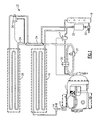
- FIG. 1 is a simplified schematic diagram illustrating one embodiment of a container refrigeration system 10 having a pressurized receiver 18 familiar to those skilled in the art of container/transport refrigeration systems. Operation of the refrigeration system can best be understood by starting at the compressor 11, where the suction gas (refrigerant) is compressed to a higher temperature and pressure. When operating with the air-cooled condenser 16, the gas flows through the compressor discharge service valve 12 into a pressure regulator valve 14 that is normally open. The pressure regulator valve 14 restricts the flow of refrigerant to maintain a predetermined minimum discharge pressure. Refrigerant gas then moves into the air-cooled condenser 16. Air flowing across a group of condenser coil fins and tubes cools the gas to its saturation temperature.
- the suction gas refrigerant
- the gas condenses to a high pressure/high temperature liquid and flows to a receiver 18 that stores additional charge necessary for low temperature operation.
- Conventional condenser pressure control transducers/sensors (enumerated as 320 in figure 3) can be installed within the receiver 18 or can be located at any point on the high pressure side of the refrigeration system 10 to adapt the system 10 for use with pressure control logic such that high side pressures can be limited and maintained.
- the words "high pressure side”, as used herein refer to that portion of the refrigeration system between the compressor discharge service valve 12 and the thermostatic expansion valve 26.
- the liquid refrigerant continues through a manual liquid line valve 20, a filter-drier 22 (that keeps refrigerant clean and dry), and a heat exchanger 24 that increases subcooling of liquid refrigerant to a thermostatic expansion valve 26.
- a gas flash gas
- Heat is absorbed from the return air by the balance of the liquid, causing it to vaporize in the evaporator coil 28.
- the vapor then flows through a suction modulation valve 30 (and a suction solenoid valve 32 under some conditions) back to the compressor 11.
- thermostatic expansion valve bulb 34 on the suction line near the evaporator coil 28 outlet controls the thermostatic expansion valve 26, maintaining a constant superheat at the coil outlet regardless of load conditions, except at abnormally high container temperatures such as during pulldown (valve at maximum operating pressure condition).
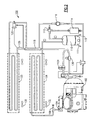
- FIG 2 is a simplified schematic diagram of a container refrigeration system 100 having a water-cooled condenser 110 familiar to those skilled in the art of transport refrigeration. Operation of the refrigeration system 100 is similar to that described herein above for the container refrigeration system 10 having a receiver 18. Therefore, operation of the refrigeration system 100 will be explained herein below only with regard to details that are different between the two refrigeration systems 10, 100 to preserve brevity and clarity. For example, as refrigerant gas is discharged from the air-cooled condenser 108, it moves through a water-cooled condenser 110, having a water inlet 111 and a water outlet 115,where it flows across a water chilled coiled tube bundle (not shown).
- the refrigerant gas is cooled to its saturation temperature and exits the water-cooled condenser 110 as a high pressure/saturated liquid. From the water-cooled condenser 110, operation is as described herein above for the container refrigeration system 10. Generally, the water-cooled condenser 110 will have a water pressure switch (not shown) coupled to its water supply line to activate air-cooled condensing when water is not being supplied via water inlet 111.
- the suction solenoid valve 126 can be operated in its fully open position where it allows the low pressure refrigerant vapor exiting the evaporator unit 122 to flow unrestricted into the compressor unit 102.
- the suction solenoid valve 126 can also be operated in its fully closed position where it restricts the compressor unit 102 input (suction) line to prohibit the flow of low pressure refrigerant vapor. It can readily be appreciated that operating the suction solenoid valve 126 in its fully closed position will prevent the compressor unit 102 from receiving a continuous source of low pressure refrigerant vapor to be compressed, thereby preventing the compressor unit 102 from injecting new compressed hot refrigerant vapor into the air-cooled condenser unit 108.
- the reduced supply of compressed hot refrigerant vapor discharged by the compressor unit 102 will allow the condenser units 108, 110 more time to cool and liquefy the existing compressed hot refrigerant vapor that is presently flowing through the condenser coils.
- the compressor unit 102 discharge line continues to lose its existing compressed hot refrigerant vapor supply. This process then yields a lower pressure within the compressor unit discharge line.
- P 1 V 1 /T 1 P 2 V 2 /T 2 , where P, V and T represent pressure, volume and temperature respectively in a closed system.
- the suction modulation valve 124 can be operated in a fully closed or open position to restrict the supply of low pressure refrigerant vapor to the compressor unit 102.
- the suction modulation valve 124 can also be selectively operated in any number of partially closed or partially open positions to more precisely control and limit the amount of low pressure refrigerant vapor that is supplied to the input of the compressor unit 102.
- liquid line pressures can also be reduced simply by providing condenser unit fan(s) 132 to further reduce the compressed hot refrigerant vapor temperature during periods when the condenser fan(s) 132 are normally shut down, i.e. periods when the normal condenser unit pressure controls are inactive.
- liquid line pressures in a transport refrigeration system 100 that has condenser water cooling capability could also be reduced simply by using the same principles described herein above during periods of condenser water cooling, thereby eliminating the necessity to employ a water pressure switch to maintain a safe water pressure level for the refrigeration system 100.
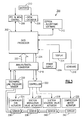
- FIG 3 a block diagram illustrates a control system 300 that is suitable for use with the transport refrigeration systems 10 and 100 shown in figures 1 and 2 respectively, to control the compressor 11, 102 discharge pressure.
- the control system will be described herein below with reference to the refrigeration system 100 shown in figure 2. It shall be readily understood however that the control system 300 will function equally well with the refrigeration system 10 shown in figure 1.
- the control system 300 is seen to include a data processor 302 receiving signals from and analog-to-digital converter 318.
- the analog-to-digital converter 318 digitizes signals from a compressor discharge line pressure sensor 320 strategically placed in the refrigeration system 100 liquid line.
- the data processor 302 selectively controls the condenser fan(s) 132, the suction modulation valve 124, the suction solenoid valve 126, and/or the compressor/motor unit 102 based upon the digitized values read from the compressor discharge line pressure sensor 320.
- Predetermined pressure values are stored in a memory unit 312 along with the algorithmic software (enumerated as 400 in figures 4A,B).
- the algorithmic software 400 is stored in a PROM such as an EEPROM familiar to those skilled in the computer arts. It will readily be appreciated that the present invention is not limited to the exact embodiment shown in figure 3 however, and that many other types of memory units can also be used to accomplish the present invention.
- control system 300 has a real time clock and memory control unit 308 as well as a memory unit 306 having a battery 310 power back-up capability to ensure the integrity of data bases stored in the memory unit 306 during periods of lost power to the refrigeration system 100.
- the aforesaid digitized discharge line pressure sensor 320 data is then stored in the memory unit 306 for processing by the data processor 302 in accordance with instructions prescribed by the algorithmic software 312.
- Control system 300 is also seen to have a power supply 304 for providing power to the data processor 302.
- a display 314 and a keyboard (keypad) 316 or like device are provided to supply visual pressure readings and allow an operator the ability to manually access and modify the control system 300 operating parameters if desired or necessary.
- a system 300 operator can easily customize the system set points, for example, to operate during precisely defined periods when the standard condenser pressure control logic is inoperative or during precisely defined periods when the water-cooled condenser 110 is being water-cooled as stated herein before.
- a controller unit 322 is seen operatively coupled via a data bus 334 to a predetermined set of actuators/transducers 336, 338, 340, 342.
- the present inventors found that a combination of actuators including a condenser fan actuator 324, a suction modulation valve actuator 326, a suction solenoid valve actuator 328 and a compressor motor actuator 330 provided workable results for the present invention.
- strategically operating one or more of the actuators according to one preferred embodiment of the present invention will yield the desired result of accurately and precisely controlling the compressor 102 discharge pressure to a maximum value using the data processor 302 control when the standard condenser pressure control logic is inoperative or not working, or when the system 100 is in its water-cooled mode of operation.
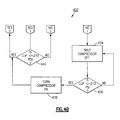
- Figures 4A, B illustrate an algorithmic software 400 in accordance with one embodiment of the present invention and that is suitable for use with the control system 300 shown in figure 3 and the transport refrigeration systems 10, 100 shown in figures 1 and 2 respectively.
- the purpose of the algorithmic software 400 is to control and limit the compressor 102 discharge pressure to a maximum value with use of a data processor 302 during periods when the normal refrigeration system compressor pressure controls are inactive.
- the data processor 302 is combined with one or more sensors/transducers 320 to sense the refrigerant system 100 liquid line pressure and selectively initiate one or more actions when the aforesaid liquid line pressure is above a preset limit.
- the data processor 302 can turn the condenser fan(s) 108 on and/or off, close and/or open the suction solenoid valve 126, close and/or open the suction modulation valve 124, and/or turn the compressor 102 on and/or off.
- the data processor 302 will back up one step. If the liquid line pressure continues to remain below the preset limit for a predefined period of time, it will then back up another step. This process will continue until the normal refrigeration system control sequence is attained.
- the aforesaid process control begins with a refrigeration system 100 that is operating in its normal mode as depicted in block 402.
- the compressor 102 discharge pressure is monitored via control system 300 to determine if the liquid line pressure is equal to or greater than 310 psi as depicted in block 404.
- the present invention is not so limited however, and it shall be understood that other liquid line pressure limits can just as well be used to accomplish the present inventive method of controlling compressor 102 discharge pressures. If the liquid line pressure is less than 310 psi, the control system 300 does nothing and normal refrigeration system 100 operation is allowed to continue.
- the control system 300 then proceeds to make a determination whether the condenser fan(s) 108 are on as illustrated in block 406. This determination is accomplished when the data processor 302 reads the digital data provided by the condenser fan sensor 336 via the analog/digital converter 318. If the condenser fan(s) 108 are found to be off, then the control system 300 proceeds to turn on the condenser fan(s) 108 as depicted in block 408. The condenser fan(s) 108 are then allowed to run for five seconds at which time the liquid line pressure is again examined to determine if the liquid line pressure is equal to or less than 310 psi as illustrated in blocks 410 and 412.
- the control system 300 commences to make a determination whether the suction solenoid valve 126 is open as illustrated in block 420. As shown in block 420, if the suction solenoid valve 126 is found to be in its closed position, the control system 300 will then commence to close the suction solenoid valve 126 as shown in block 422.
- the condenser fan(s) 108 have been activated as a result of a liquid line pressure equal to or exceeding 310 psi, and running the condenser fan(s) 108 for a predetermined amount of time does not lower the liquid line pressure to 210 psi or less, then the condenser fan(s) 108 are allowed to run continuously until such condition is finally achieved as depicted in blocks 412, 414 and 416.
- the control system 300 turns off the condenser fan(s) 108 as illustrated in block 418, and the refrigeration system 100 is allowed to resume its normal operation as shown in block 402 of figure 4A.
- the control system 300 will commence to read the liquid line pressure immediately after closing the suction solenoid valve 126. As shown in blocks 424, 426 and 428, the control system 300 will proceed to reopen the suction solenoid valve 126 if and when the liquid line pressure finally reaches 210 psi or less. If closing the suction solenoid valve 126 does not immediately lower the liquid line pressure to 310 psi or less, the control system 300 commences to also close the suction modulation valve 124 as illustrated in block 430.
- the suction modulation valve 124 is then incrementally ramped open by the control system 300 in twenty percent increments until the liquid line pressure is below 310 psi as determined by reading the signals provided by the suction modulation valve sensor 338. It shall be understood that the present invention is not so limited however, and that the suction modulation valve 124 can just as well be incrementally opened in steps other than the twenty percent steps referenced herein above to accomplish the present inventive method. If closing both the suction solenoid valve 126 and the suction modulation valve 124 do not lower the liquid line pressure to 310 psi or less, then the control system 300 commences to also shut off the compressor 102 as shown in blocks 432 and 434, illustrated in figures 4A and 4B respectively.
- the control system 300 then commences to determine if the liquid line pressure has dropped to 210 psi or less as illustrated in block 436. If the liquid line pressure remains above 210 psi, the compressor 102 is kept in its off mode as shown. If the liquid line pressure drops to 210 psi or less, then the compressor 102 is again turned on as shown in block 438. Immediately after turning the compressor 102 back on as shown in block 438, the liquid line pressure is again examined to ensure that the liquid line pressure is still at or below 210 psi as illustrated in block 440. Similarly, the present invention is not so limited or restricted to providing working results related to sensing liquid line pressures of 210 psi.
- control system 300 proceeds to reopen the suction solenoid valve 126 as represented in blocks 424, 426 and 428 of figure 4A. The control sequence then proceeds to back up its previous sequence of steps until normal system 100 operation is attained as referenced herein above.
Landscapes
- Engineering & Computer Science (AREA)
- Physics & Mathematics (AREA)
- Mechanical Engineering (AREA)
- Thermal Sciences (AREA)
- General Engineering & Computer Science (AREA)
- Devices That Are Associated With Refrigeration Equipment (AREA)
Applications Claiming Priority (2)
| Application Number | Priority Date | Filing Date | Title |
|---|---|---|---|
| US08/997,028 US5907957A (en) | 1997-12-23 | 1997-12-23 | Discharge pressure control system for transport refrigeration unit using suction modulation |
| US997028 | 2001-11-28 |
Publications (3)
| Publication Number | Publication Date |
|---|---|
| EP0926455A2 true EP0926455A2 (de) | 1999-06-30 |
| EP0926455A3 EP0926455A3 (de) | 2002-04-24 |
| EP0926455B1 EP0926455B1 (de) | 2005-10-05 |
Family
ID=25543573
Family Applications (1)
| Application Number | Title | Priority Date | Filing Date |
|---|---|---|---|
| EP98630077A Expired - Lifetime EP0926455B1 (de) | 1997-12-23 | 1998-12-18 | Verdichtungsdrucksteuerung für Transportkälteanlage mit Saugdruckregulierung |
Country Status (8)
| Country | Link |
|---|---|
| US (1) | US5907957A (de) |
| EP (1) | EP0926455B1 (de) |
| JP (1) | JP3103340B2 (de) |
| KR (1) | KR100289170B1 (de) |
| CN (1) | CN1144992C (de) |
| DE (1) | DE69831787T2 (de) |
| DK (1) | DK0926455T3 (de) |
| TW (1) | TW382057B (de) |
Cited By (1)
| Publication number | Priority date | Publication date | Assignee | Title |
|---|---|---|---|---|
| EP1146299A1 (de) * | 2000-04-14 | 2001-10-17 | Carrier Corporation | Integriertes elektronisches Kühlmittelmanagementsystem |
Families Citing this family (25)
| Publication number | Priority date | Publication date | Assignee | Title |
|---|---|---|---|---|
| US6112534A (en) * | 1998-07-31 | 2000-09-05 | Carrier Corporation | Refrigeration and heating cycle system and method |
| US6138467A (en) * | 1998-08-20 | 2000-10-31 | Carrier Corporation | Steady state operation of a refrigeration system to achieve optimum capacity |
| US6170277B1 (en) * | 1999-01-19 | 2001-01-09 | Carrier Corporation | Control algorithm for maintenance of discharge pressure |
| US6148627A (en) * | 1999-03-26 | 2000-11-21 | Carrier Corp | High engine coolant temperature control |
| US6360553B1 (en) | 2000-03-31 | 2002-03-26 | Computer Process Controls, Inc. | Method and apparatus for refrigeration system control having electronic evaporator pressure regulators |
| US6499307B1 (en) * | 2000-07-24 | 2002-12-31 | Venturedyne, Ltd. | Refrigeration system incorporating simplified valve arrangement |
| JP2002079828A (ja) * | 2000-09-07 | 2002-03-19 | Suzuki Motor Corp | 電気自動車用空調装置 |
| US6357241B1 (en) * | 2000-12-22 | 2002-03-19 | Carrier Corporation | Method of controlling refrigerant cycle with sealed suction pressure sensor |
| US20040141852A1 (en) * | 2002-12-18 | 2004-07-22 | Emilio Brown | Complete capacity control kit for a reciprocating compressor system |
| US7353659B2 (en) * | 2004-05-28 | 2008-04-08 | York International Corporation | System and method for controlling an economizer circuit |
| US7143594B2 (en) * | 2004-08-26 | 2006-12-05 | Thermo King Corporation | Control method for operating a refrigeration system |
| EP2149019B1 (de) * | 2007-05-09 | 2017-10-04 | Carrier Corporation | Einstellung der betriebsgrenzen eines kompressors |
| WO2009012310A1 (en) * | 2007-07-17 | 2009-01-22 | Johnson Controls Technology Company | Control system |
| WO2012047499A2 (en) | 2010-09-28 | 2012-04-12 | Carrier Corporation | Operation of transport refrigeration systems to prevent engine stall and overload |
| IL211596A (en) * | 2011-03-07 | 2012-01-31 | David Mifano | Vehicular potable water dispensing apparatus |
| US8844307B2 (en) | 2011-06-06 | 2014-09-30 | General Electric Company | Appliance with a water filtration system |
| US9885508B2 (en) | 2011-12-28 | 2018-02-06 | Carrier Corporation | Discharge pressure calculation from torque in an HVAC system |
| CN103776212B (zh) * | 2012-10-25 | 2015-12-02 | 珠海格力电器股份有限公司 | 制冷系统中冷凝机组的控制方法和控制装置 |
| CN103453727A (zh) * | 2013-09-13 | 2013-12-18 | 柳州职业技术学院 | 一种面向仓储冷库的分布式制冷控制系统及其控制方法 |
| CN105987550B (zh) | 2015-02-27 | 2021-04-09 | 开利公司 | 制冷系统冷凝器风扇控制 |
| CN105823282B (zh) * | 2016-03-30 | 2018-04-10 | 杭州佳力斯韦姆新能源科技有限公司 | 一种用于二氧化碳热泵系统优化运行的排气压力控制方法 |
| US10627145B2 (en) * | 2016-07-07 | 2020-04-21 | Rocky Research | Vector drive for vapor compression systems |
| CN105928268B (zh) * | 2016-07-13 | 2018-05-29 | 上海海洋大学 | 一种制冷系统中两相射流泵供液的控制方法和控制系统 |
| US10465949B2 (en) | 2017-07-05 | 2019-11-05 | Lennox Industries Inc. | HVAC systems and methods with multiple-path expansion device subsystems |
| US11852131B2 (en) | 2017-09-25 | 2023-12-26 | Carrier Corporation | Pressure safety shutoff |
Family Cites Families (11)
| Publication number | Priority date | Publication date | Assignee | Title |
|---|---|---|---|---|
| US3354665A (en) * | 1966-12-01 | 1967-11-28 | Trane Co | Condenser fan speed control |
| JPS57169558A (en) * | 1981-04-09 | 1982-10-19 | Mitsubishi Electric Corp | Air conditioning equipment |
| US4646964A (en) * | 1982-03-26 | 1987-03-03 | Parker Electronics, Inc. | Temperature control system |
| US5271238A (en) * | 1990-09-14 | 1993-12-21 | Nartron Corporation | Environmental control system |
| US5163301A (en) * | 1991-09-09 | 1992-11-17 | Carrier Corporation | Low capacity control for refrigerated container unit |
| US5369597A (en) * | 1992-12-21 | 1994-11-29 | Bujak, Jr.; Walter E. | System for controlling heating or cooling capacity in heating or air conditioning systems |
| US5259204A (en) * | 1993-01-08 | 1993-11-09 | Mckeown Dennis | Refrigerant release prevention system |
| US5309727A (en) * | 1993-05-07 | 1994-05-10 | Carrier Corporation | Reactive control for discrete chiller units |
| US5454511A (en) * | 1994-09-22 | 1995-10-03 | Carrier Corporation | Controlled setpoint recovery |
| US5539382A (en) * | 1995-04-21 | 1996-07-23 | Carrier Corporation | System for monitoring the operation of a condenser unit |
| US5711161A (en) * | 1996-06-14 | 1998-01-27 | Thermo King Corporation | Bypass refrigerant temperature control system and method |
-
1997
- 1997-12-23 US US08/997,028 patent/US5907957A/en not_active Expired - Lifetime
-
1998
- 1998-11-10 TW TW087118686A patent/TW382057B/zh not_active IP Right Cessation
- 1998-12-08 JP JP10347688A patent/JP3103340B2/ja not_active Expired - Fee Related
- 1998-12-18 DK DK98630077T patent/DK0926455T3/da active
- 1998-12-18 EP EP98630077A patent/EP0926455B1/de not_active Expired - Lifetime
- 1998-12-18 DE DE69831787T patent/DE69831787T2/de not_active Expired - Lifetime
- 1998-12-21 CN CNB981259405A patent/CN1144992C/zh not_active Expired - Fee Related
- 1998-12-22 KR KR1019980057199A patent/KR100289170B1/ko not_active Expired - Fee Related
Cited By (1)
| Publication number | Priority date | Publication date | Assignee | Title |
|---|---|---|---|---|
| EP1146299A1 (de) * | 2000-04-14 | 2001-10-17 | Carrier Corporation | Integriertes elektronisches Kühlmittelmanagementsystem |
Also Published As
| Publication number | Publication date |
|---|---|
| CN1144992C (zh) | 2004-04-07 |
| EP0926455B1 (de) | 2005-10-05 |
| TW382057B (en) | 2000-02-11 |
| JPH11316055A (ja) | 1999-11-16 |
| KR100289170B1 (ko) | 2001-05-02 |
| JP3103340B2 (ja) | 2000-10-30 |
| DE69831787T2 (de) | 2006-05-18 |
| CN1225444A (zh) | 1999-08-11 |
| DK0926455T3 (da) | 2006-02-13 |
| EP0926455A3 (de) | 2002-04-24 |
| US5907957A (en) | 1999-06-01 |
| DE69831787D1 (de) | 2006-02-16 |
| KR19990066861A (ko) | 1999-08-16 |
Similar Documents
| Publication | Publication Date | Title |
|---|---|---|
| US5907957A (en) | Discharge pressure control system for transport refrigeration unit using suction modulation | |
| TWI407066B (zh) | 節能冷凍系統 | |
| US4535598A (en) | Method and control system for verifying sensor operation in a refrigeration system | |
| JP3995216B2 (ja) | 冷凍システム | |
| US4538422A (en) | Method and control system for limiting compressor capacity in a refrigeration system upon a recycle start | |
| US7353659B2 (en) | System and method for controlling an economizer circuit | |
| KR100755160B1 (ko) | 냉각 시스템의 제어 | |
| US5046325A (en) | Refrigerating circuit apparatus with two stage compressor and heat storage tank | |
| US4535607A (en) | Method and control system for limiting the load placed on a refrigeration system upon a recycle start | |
| CA1264364A (en) | Automatic anti-surge control for dual centrifugal compressor system | |
| AU653879B2 (en) | Automatic chiller stopping sequence | |
| US5983655A (en) | Thermal storage monitoring and control system for cargo container | |
| KR950003791B1 (ko) | 자동 냉각기 설비의 평형 | |
| US6779355B2 (en) | Refrigeration device | |
| US5974815A (en) | Humidity control system for cargo container | |
| JP2001066038A (ja) | 恒温冷媒液循環装置 | |
| JP3996321B2 (ja) | 空調機とその制御方法 | |
| JPH0650614A (ja) | 冷凍装置 | |
| US2754665A (en) | Low temperature refrigeration system for cascade operation | |
| JPH09264620A (ja) | 自然循環ループを併用する冷房装置及びその運転方法 | |
| JP2002081793A (ja) | 温調装置 | |
| JPH03274361A (ja) | 冷凍装置 | |
| JPH03164662A (ja) | 冷蔵庫 | |
| JPH04124560A (ja) | 冷凍機の容量制御方法 | |
| JPS5926216B2 (ja) | 冷凍装置の冷水出口温度調節機構 |
Legal Events
| Date | Code | Title | Description |
|---|---|---|---|
| PUAI | Public reference made under article 153(3) epc to a published international application that has entered the european phase |
Free format text: ORIGINAL CODE: 0009012 |
|
| AK | Designated contracting states |
Kind code of ref document: A2 Designated state(s): AT BE CH CY DE DK ES FI FR GB GR IE IT LI LU MC NL PT SE Kind code of ref document: A2 Designated state(s): DE DK FR GB NL |
|
| AX | Request for extension of the european patent |
Free format text: AL;LT;LV;MK;RO;SI |
|
| PUAL | Search report despatched |
Free format text: ORIGINAL CODE: 0009013 |
|
| AK | Designated contracting states |
Kind code of ref document: A3 Designated state(s): AT BE CH CY DE DK ES FI FR GB GR IE IT LI LU MC NL PT SE |
|
| AX | Request for extension of the european patent |
Free format text: AL;LT;LV;MK;RO;SI |
|
| 17P | Request for examination filed |
Effective date: 20020701 |
|
| AKX | Designation fees paid |
Free format text: DE DK FR GB NL |
|
| 17Q | First examination report despatched |
Effective date: 20040219 |
|
| GRAP | Despatch of communication of intention to grant a patent |
Free format text: ORIGINAL CODE: EPIDOSNIGR1 |
|
| GRAS | Grant fee paid |
Free format text: ORIGINAL CODE: EPIDOSNIGR3 |
|
| GRAA | (expected) grant |
Free format text: ORIGINAL CODE: 0009210 |
|
| AK | Designated contracting states |
Kind code of ref document: B1 Designated state(s): DE DK FR GB NL |
|
| REG | Reference to a national code |
Ref country code: GB Ref legal event code: FG4D |
|
| REG | Reference to a national code |
Ref country code: DK Ref legal event code: T3 |
|
| REF | Corresponds to: |
Ref document number: 69831787 Country of ref document: DE Date of ref document: 20060216 Kind code of ref document: P |
|
| ET | Fr: translation filed | ||
| PLBE | No opposition filed within time limit |
Free format text: ORIGINAL CODE: 0009261 |
|
| STAA | Information on the status of an ep patent application or granted ep patent |
Free format text: STATUS: NO OPPOSITION FILED WITHIN TIME LIMIT |
|
| 26N | No opposition filed |
Effective date: 20060706 |
|
| PGFP | Annual fee paid to national office [announced via postgrant information from national office to epo] |
Ref country code: NL Payment date: 20071109 Year of fee payment: 10 |
|
| PGFP | Annual fee paid to national office [announced via postgrant information from national office to epo] |
Ref country code: DK Payment date: 20081112 Year of fee payment: 11 |
|
| NLV4 | Nl: lapsed or anulled due to non-payment of the annual fee |
Effective date: 20090701 |
|
| PG25 | Lapsed in a contracting state [announced via postgrant information from national office to epo] |
Ref country code: NL Free format text: LAPSE BECAUSE OF NON-PAYMENT OF DUE FEES Effective date: 20090701 |
|
| REG | Reference to a national code |
Ref country code: DK Ref legal event code: EBP |
|
| PG25 | Lapsed in a contracting state [announced via postgrant information from national office to epo] |
Ref country code: DK Free format text: LAPSE BECAUSE OF NON-PAYMENT OF DUE FEES Effective date: 20100104 |
|
| REG | Reference to a national code |
Ref country code: FR Ref legal event code: PLFP Year of fee payment: 18 |
|
| PGFP | Annual fee paid to national office [announced via postgrant information from national office to epo] |
Ref country code: DE Payment date: 20151119 Year of fee payment: 18 Ref country code: GB Payment date: 20151125 Year of fee payment: 18 |
|
| PGFP | Annual fee paid to national office [announced via postgrant information from national office to epo] |
Ref country code: FR Payment date: 20151123 Year of fee payment: 18 |
|
| REG | Reference to a national code |
Ref country code: DE Ref legal event code: R119 Ref document number: 69831787 Country of ref document: DE |
|
| REG | Reference to a national code |
Ref country code: DE Ref legal event code: R082 Ref document number: 69831787 Country of ref document: DE Representative=s name: SCHMITT-NILSON SCHRAUD WAIBEL WOHLFROM PATENTA, DE |
|
| GBPC | Gb: european patent ceased through non-payment of renewal fee |
Effective date: 20161218 |
|
| REG | Reference to a national code |
Ref country code: FR Ref legal event code: ST Effective date: 20170831 |
|
| PG25 | Lapsed in a contracting state [announced via postgrant information from national office to epo] |
Ref country code: FR Free format text: LAPSE BECAUSE OF NON-PAYMENT OF DUE FEES Effective date: 20170102 |
|
| PG25 | Lapsed in a contracting state [announced via postgrant information from national office to epo] |
Ref country code: GB Free format text: LAPSE BECAUSE OF NON-PAYMENT OF DUE FEES Effective date: 20161218 Ref country code: DE Free format text: LAPSE BECAUSE OF NON-PAYMENT OF DUE FEES Effective date: 20170701 |